HAL Id: tel-00796461
https://tel.archives-ouvertes.fr/tel-00796461
Submitted on 4 Mar 2013HAL is a multi-disciplinary open access archive for the deposit and dissemination of sci-entific research documents, whether they are pub-lished or not. The documents may come from teaching and research institutions in France or abroad, or from public or private research centers.
L’archive ouverte pluridisciplinaire HAL, est destinée au dépôt et à la diffusion de documents scientifiques de niveau recherche, publiés ou non, émanant des établissements d’enseignement et de recherche français ou étrangers, des laboratoires publics ou privés.
photoactive and electroactive groups
Qing Zhou
To cite this version:
Qing Zhou. Synthesis of new tetrazines functionalized with photoactive and electroactive groups. Other. École normale supérieure de Cachan - ENS Cachan, 2012. English. �NNT : 2012DENS0039�. �tel-00796461�
THESE DE DOCTORAT
DE LECOLE NORMALE SUPERIEURE DE CACHAN
Présentée par QING ZHOU
pour obtenir le grade de
DOCTEUR DE LECOLE NORMALE SUPERIEURE DE CACHAN
Domaine : CHIMIE
Sujet de la thèse :
Synthesis of new tetrazines functionalized with photoactive and
electroactive groups
Thèse présentée et soutenue à Cachan le 20/07/2012 devant le jury composé de : Jean-Christophe LACROIX Professeur (Université Paris Diderot)
Jean-Manuel RAIMUNDO Maître de conférences (Université Aix-Marseille) Céline FROCHOT Directeur de Recherche CNRS
Pierre AUDEBERT Professeur (ENS-CACHAN) Gilles CLAVIER Chargé de recherche CNRS
Fan YANG Professeur (ECNU-Shanghai) Fabien MIOMANDRE Maître de conférences (ENS-CACHAN) Jie TANG Professeur (ECNU-Shanghai)
Laboratoire de Photophysique et Photochimie Supramoléculaires et Macromoléculaire-PPSM
Table of Contents ... 3
Acronyms ... 7
General Introduction ... 9
Chapter 1 Introduction of 1,2,4,5-tetrazine: chemistry and application ... 13
1.1 Introduction of 1,2,4,5-tetrazine ... 13
1.2 Synthesis of s-tetrazines ... 14
1.2.1 Pinner synthesis ... 15
1.2.2 Modification of Pinner synthesis for aliphatic s-tetrazine ... 17
1.2.3 Synthesis of dichlorotetrazine ... 20
1.3 Reactivity of tetrazine ... 22
1.3.1 Inverse electron-demand Diels-Alder reaction ... 22
1.3.2 Cross-coupling reactions with terminal alkynes ... 26
1.3.3 Aromatic nucleophilic substitution (SNAr reaction) ... 28
1.3.4 Azaphilic addition with carbanions ... 34
1.4 Physical chemistry of s-tetrazine ... 36
1.4.1 Electrochemistry of s-tetrazine ... 36
1.4.1.1 Introduction of electrochemistry ... 36
1.4.1.2 Electrochemistry of tetrazines ... 37
1.4.2 Photophysical properties of s-tetrazines ... 40
1.4.2.1 Introduction to photophysical chemistry ... 40
1.4.2.2 Photophysical properties of tetrazines ... 44
1.4.3 Computational chemistry on tetrazines ... 47
1.5 Applications of s-tetrazines ... 50
1.5.1 Energetic materials from tetrazines ... 50
1.5.2 Pharmaceuticals from tetrazines ... 51
1.5.3 Efficient solar cells ... 52
1.5.4 NLO-phore with tetrazine ... 53
1.6 Conclusions ... 54
Chapter 2 New s-tetrazines derivatives as the ion pair receptors ... 63
2.1 Introduction ... 63
2.1.1 Supramolecular chemistry and ion pair receptor ... 63
2.1.2 Fluorescent molecular sensors and electrochemical sensors ... 64
2.1.3 Experimental evidence of anion-tetrazine interactions ... 66
2.1.4 Anion-p interactions ... 68
2.2 Molecular design of ion pair receptors ... 72
2.3 Molecular synthesis ... 77
2.3.1 Preparation of 3,6-dichloro-1,2,4,5-tetrazine ... 77
2.3.2 Preparation of ion-pair receptors ... 78
2.3.3 Selection and synthesis of ion pairs ... 79
2.4 Screening for ion-pairs ... 80
2.5.3 Determination of binding constant ... 89
2.6 Fluorescence studies of ion pair receptors ... 91
2.6.1 Spectroscopic properties of receptors ... 91
2.6.2 Titration studies ... 92
2.7 UV-vis absorption studies of ion pair receptors ... 97
2.8 Conclusions ... 100
Chapter 3 Studies of tetrazines with bulky or electron withdrawing substituents.107 3.1 Studies of tetrazines with bulky or electron withdrawing substituents ... 107
3.1.1 Molecular design ... 107
3.1.2 Synthesis ... 108
3.1.3 Absorption and fluorescence properties ... 111
3.1.4 Electrochemical properties ... 113
3.2 New alkyl-s-tetrazines from an unexpected reaction ... 116
3.2.1 Introduction ... 116
3.2.2 Optimization and extension of the scope of the reaction ... 117
3.2.3 Spectroscopic studies ... 119
3.2.4 Electrochemical studies ... 123
3.3 Toward s-tetrazine based fluorescent dyads ... 125
3.3.1 Molecular design ... 125
3.3.2 Synthesis ... 127
3.3.3 Spectroscopic studies ... 132
3.3.4 Electrochemical studies ... 135
3.4 Tetrazines benzimidazole dyads ... 138
3.4.1 Molecular design ... 138 3.4.2 Synthesis ... 139 3.4.3 Spectroscopic studies ... 141 3.4.4 Electrochemical studies ... 143 3.5 Concluding remarks ... 144 Chapter 4 New brightly fluorescent s-tetrazines ... 149
4.1 Resonant Energy transfer ... 149
4.2 Molecular design and synthesis ... 153
4.2.1 Molecular design ... 153
4.2.2 Preparation of the novel s-tetrazines n-ads ... 155
4.3 Spectroscopic studies of N-(2-(6-chloro-s-tetrazine-3-yloxy)ethyl)- 2-trifluoromethylbenzimidazole 143 ... 160
4.3.1 Electrochemical study ... 160
4.3.2 Absorption and fluorescence studies ... 161
4.3.3 Study of the energy transfer in 143 ... 163
4.4 Spectroscopic and electrochemical studies of NITZ ... 166
4.5 Spectroscopic studies of 145 ... 175
4.5.1 Absorption and fluorescence studies ... 175
4.5.2 Energy transfer study ... 177
4.5.3 Color analysis of 2NITZ fluorescence ... 183
4.6 Spectroscopic studies for 146 ... 184
4.6.1 Absorption and fluorescence studies ... 184
4.6.2 Energy transfer studies for 3NITZ ... 185
4.7 Application of NITZ: three colors electrofluorochromic cell ... 189
4.8 Conclusions ... 193
General conclusion and perspectives ... 195
Chapter 5 Experimental Section ... 197
Publication ... 241
CV: cyclic voltammogram D-A: Diels-Alder
DCM: dichloromethane DMF: dimethylformamide EA: ethyl acetate
HEDMs: high-energy density materials HOMO: highest occupied molecular orbital LUMO: lowest unoccupied molecular orbital NLO: nonlinear optical
NI: naphtalimide PE: petroleum ether
PE(2) : photoelectron spectroscopy (1.4.1.2) PET: photoelectron spectroscopy
PEO: polyethylene glycol THF: tetrahedrofuran TZ: 1,2,4,5-tetrazine UV: ultra-violet
The quest for new original organic fluorophores is still active in the scientific community, because of the many applications of these compounds in the fields of light generation, sensors, biosensors, and so on1,2. Among new organic fluorophores, s-tetrazines play a special role because their fluorescence stems from a normally forbiddenn-p* transition, localized on the s-tetrazine ring. Because of this, s-tetrazines are indeed the smallest organic fluorophores known to date. In addition, they have a strong electron withdrawing character, and consequently their excited state is a strong oxidant (E° in the +2V range) and their fluorescence is therefore quenched by a variety of electron donors, which opens the way to the realization of original fluorescent sensors. In addition, these molecules are fluorescent both in the liquid and solid state, which is a chemical rarity. In the former years, the team lead by Pr Audebert in the ENS Cachan has started to study extensively s-tetrazine derivatives, especially their fluorescence1 as well as the electrochemically triggered fluorescence switching (electrofluorochromism)3. And not the least, most s-tetrazine synthesis are relatively easy, starting from the classical dichloro-s-tetrazine, now routinely produced in the laboratory on several-grams scale.
s-Tetrazines are also electroactive molecules, which can be reversibly transformed into a stable anion-radical, and whose fluorescence can be efficiently switched on and off by electrochemical conversion. They can be inserted into larger molecular assemblies in order to develop low bandgap polymers and related materials4. Due to all these outstanding properties, s-tetrazines are an extremely promising target in the field of synthetic and physical chemistry.
Chapter 1 of this manuscript is devoted to the bibliographic analysis, describing the state of the knowledge in the field of s-tetrazines, replacing it in the larger domain of the fluorescent and electroactive organic fluorophores.
The main body of work aimed at the synthesis and studies new s-tetrazines, in order to match different goals and to improve the efficiency of these molecules, especially in the field of fluorescence and chemical sensing. First of all, an interesting point to investigate was the possibility to prepare anion-sensing molecules, because some theoretical works have proposed that s-tetrazine5 should be able to form stable adducts with some anions, in particular halide anions. In addition, these adducts could be non-fluorescent, or at least have a quite different emission spectrum. Although initial findings from the ENS Cachan group had not permitted
10 substrate could occur, without trying to favor the proximity of the s-tetrazine ring with the anion that was supposed to interact. We wished therefore to develop supramolecular s-tetrazines, where an ions pair would be forced to sit close to the s-tetrazine ring, in order to get an interaction between them. To achieve this goal, a straightforward path was to connect s-tetrazine with a cation binder. If a cation could be locked very close to the s-tetrazine, then in turn the counteranion would also be obliged to stay in the vicinity, therefore enhancing the possibility of an interaction between the two partners. Thus, we have introduced a polyethylene oxide chain substituted on both ends by s-tetrazine rings. We describe the synthesis of some of these compounds, as well as the analytical studies in the presence of various ions pairs. We have analyzed the complexation efficiency with various salts and more especially the influence of the anion, using NMR, UV-vis. absorption and fluorescence spectroscopies as tools. We have found that in the case of these particular s-tetrazines, the nature of the anion influenced the NMR and fluorescence data. We have also found that, in the presence of iodide or bromide, photoxidation took place. This is related in chapter 2.
We have prepared s-tetrazines with bulky or electron withdrawing substituents in order to check if the fluorescence quantum yield could be improved. Indeed it is known that free rotation of substituents around the fluorophore in the excited state often causes the fluorescence intensity to decrease and bulky groups might counter this effect. Another point of concern was that the only efficiently fluorescent s-tetrazines known when our work was started were the chloroalkoxy-s-tetrazines. We have, during the course of the PhD, found a methodology to prepare new chloroalkyl and dialkyl s-tetrazines which are fluorescent, through simple aromatic nucleophilic substitution, although this reaction had been previously claimed not to work in the s-tetrazine series. This is related in chapter 3
Finally, we aimed at fighting one the major drawbacks of s-tetrazines, their relatively low absorption coefficients (around 500 L.mol-1.cm-1 in the visible range and 1500 in the UV range). Actually, because the optical properties of s-tetrazines stem from a normally forbidden electronic transition, their absorption coefficient is unfortunately relatively low, compared to standard fluorophores (coumarins6 displays values in the 30000 L.mol-1.cm-1 range and fluorescein7, one of the best fluorophores, reaches 140000 L.mol-1.cm-1), but they perform much better than diacetyls, the only other class of fluorophores working after a n-p* transition,
fluorophore able to absorb light with a much better efficiency and then transfer the energy onto the s-tetrazine, which can in turn emit fluorescence. However, the choice of the partner fluorophore is not trivial, since only efficient energy transfer has to occur, and detrimental processes have to be avoided, especially undesirable photoincuced electron transfer which leads on the other hand to fluorescence quenching, or non-radiative deactivation processes. This has been achieved by introducing electron-deficient fluorophores, and especially naphthalimides have proved to display excellent energy transfer with a high efficiency. Initial synthetic work is the final subject presented in chapter 3, and full spectroscopic studies results are given in chapter 4.
Reference
1. Clavier, G.; Audebert, P., s-Tetrazines as Building Blocks for New Functional Molecules and Molecular Materials. Chem Rev 2010, 110 (6), 3299-3314.
2. Devaraj, N. K.; Weissleder, R., Biomedical Applications of Tetrazine Cycloadditions. Accounts
Chem Res 2011, 44 (9), 816-827.
3. Kim, Y.; Do, J.; Kim, E.; Clavier, G.; Galmiche, L.; Audebert, P., Tetrazine-based electrofluorochromic windows: Modulation of the fluorescence through applied potential. J
Electroanal Chem 2009, 632 (1-2), 201-205.
4. Quinton, C.; Alain-Rizzo, V.; Dumas-Verdes, C.; Clavier, G.; Miomandre, F.; Audebert, P., Design of New Tetrazine-Triphenylamine Bichromophores - Fluorescent Switching by Chemical Oxidation. Eur J Org Chem 2012, (7), 1394-1403.
5. Garau, C.; Quinonero, D.; Frontera, A.; Costa, A.; Ballester, P.; Deya, P. M., s-Tetrazine as a new binding unit in molecular recognition of anions. Chem Phys Lett 2003, 370 (1-2), 7-13.
6. Hrdlovic, P.; Donovalova, J.; Stankovicova, H.; Gaplovsky, A., Influence of Polarity of Solvents on the Spectral Properties of Bichromophoric Coumarins. Molecules 2010, 15 (12), 8915-8932. 7. Bogdanova, L. N.; Mchedlov-Petrossyan, N. O.; Vodolazkaya, N. A.; Lebed, A. V., The influence of beta-cyclodextrin on acid-base and tautomeric equilibrium of fluorescein dyes in aqueous solution.
Chapter I Introduction of 1,2,4,5-tetrazine:
chemistry and applications
1.1 Introduction of 1,2,4,5-tetrazine
Tetrazine (Figure 1.1) is a benzene like molecule with four CH units replaced by nitrogen atoms. The first two isomers, 1,2,3,4- and 1,2,3,5-tetrazine, have been the subject of synthetic studies1,2. Unfortunately few unequivocal products have been demonstrated, while 1,2,4,5-tetrazine (or s-tetrazine) has been unambiguously characterized experimentally3,4,5. N N N N N N N N N N N N
1,2,3,4-tetrazine 1,2,3,5-tetrazine 1,2,4,5-tetrazine
Figure 1.1. Tetrazine isomers.
The first report of s-tetrazine dates back to the end of the 19th century by Pinner6. He prepared several s-tetrazines, but did not go into many further investigations on their properties. Over the years, there have been more and more scientists interested in the s-tetrazines chemistry7,8. A lot of new s-tetrazines derivatives were synthesized by different ways9, including symmetrical tetrazines and unsymmetrical ones7 (Figure 1.2).
Figure 1.2. 1,2,4,5-Tetrazine derivatives.
As mentioned before, four CH groups are replaced by four more electronegative nitrogen atoms on the prototypical aromatic ring, which confer a high electron affinity to s-tetrazines. Hence they are the electron poorest C-N heterocycles, and can be reduced at high to very high potentials (-0.8~-0.4V vs Ag+/Ag). In addition, high nitrogen content makes s-tetrazines good candidates for energetic materials10,11.
The other distinct character of s-tetrazines is their low-lying p* orbital (Figure 1.3), resulting in an n-p* transition in the visible range. Thus, all s-tetrazines have a deep color ranging from purple to orange to red.
Figure 1.3. Qualitative diagram illustrating the energy shifts of the frontier orbitals of benzene and s-tetrazine as a result of 1,2,4,5-tetraaza replacement and 3,6-disubstitution by electron
donating groups R.
The development of 1,2,4,5-tetrazine chemistry has been steady since 1996, not only owing to their structure and their reactivity, but also due to potential applications in various fields. The group of Professor Pierre Audebert and others payed more attention to the optical and electrochemical properties of new 1,2,4,5-tetrazines compounds given their outstanding photophysical and electron accepting properties.
1.2 Synthesis of s-tetrazines
There is no direct synthesis of the s-tetrazine ring. It is always obtained by oxidation of its 1,2- or 1,4-dihydro (or even in very few cases its tetrahydro) counterpart (Scheme 1.1) by mild oxidizing agents, such as nitrites, bromine, air,
ferric chloride, hydrogen peroxide or chromic oxide9.
Scheme 1.1. Oxidation of diphenyl-1,2-dihydro-s-tetrazine.
Dihydro-s-tetrazine can be obtained by various methods. However, five main different ones are commonly used (Scheme 1.2)12. As the first reported method, the Pinner synthesis has been the object of several modifications as well as a number of special procedures. Most of the procedures presented have been shown to work for aromatic compounds. Only methods 1 and 4 can be used to prepare 3,6-dialkyl-1,2-dihydro-s-tetrazines.
Scheme 1.2. Main preparation of dihydro-s-tetrazine.
1.2.1 Pinner synthesis
Pinner synthesis6 plays a important role in the s-tetrazine chemistry. Original Pinner synthesis of dihydro-s-tetrazines has been shown in scheme 2(1): the aromatic nitrile is reacted with hydrazine in an aqueous solution of ammonium hydroxide, and the dihydro-s-tetrazines obtained is further oxidized into s-tetrazines. The mechanism of formation of s-tetrazines via Pinner synthesis is described inScheme 1.3.
Scheme 1.3. Mechanism of formation of s-tetrazines via Pinner synthesis.
This synthetic route is effective for most of the aromatic symmetrical s-tetrazine where the nitrile is not sterically crowded. Wiley and co-workers13 have improved the syntheses by carrying out the reaction under anhydrous conditions in a mixture of methanol and triethylamine. Some 3,6-diaryl-1,2,4,5-tetrazines (1 and 2 in figure 1.4) and 3,6-di-p-biphenylyl-1,2,4,5-tetraines (3 in figure 1.4) were obtained in moderate yields. Using the same protocol, Soloducho14 and his colleagues have synthesized a series of novel linear tetrazines, bis(pyrrolyl)tetrazines (4 in figure 1.4) and bis(phenyl)tetrazines (5,6,7 in figure 1.4). At the same time, Audebert4 and his colleagues have synthesized some new original tetrazines substituted by heterocylclic rings (8,9 in figure 1.4) using a related protocol and submitted them to electropolymerization.
Figure 1.4. Examples of symmetrical aromatic s-tetrazines obtained by the modified Pinner synthesis.
One of the most efficient modification of Pinner synthesis have been the discovery that the presence of sulfur in the reaction could lead to the formation of dihydro-s-tetrazine from aromatic nitrile in good yield12. Audeberts group8 has proposed a reasonable mechanism on the basis of phenomenon observed during the course of the reaction (Scheme 1.4): the color of the solution changed from colorless to light orange, and vigorous production of H2S was detected through out of the reaction. This suggests that the active nucleophile is the addition product of sulfur on hydrazine (H2N-NH-SH).
Scheme 1.4. Mechanism of formation of aromatic tetrazines proposed by Audebert et al.
1.2.2 Modification of Pinner synthesis for aliphatic s-tetrazines
Pinner synthesis is effective for most of the symmetrical aromatic s-tetrazines , but does not work or does work in very low yields for aliphatic ones7,15. No clear explanation has been proposed for this observation, but could be likely due to confusion between the intermediate 1,2-dihydro-s-tetrazines and isomeric 4-amino-1,2,4-triazoles. In the case of aliphatic derivatives, the nitrile can be replaced by an aldehyde to give the hexahydro-s-tetrazine, which can be oxidized to s-tetrazine in two steps albeit in an overall low yield16,17 (Scheme 1.5). However, aliphatic s-tetrazines are highly volatile, can easily sublimate (some at atmospheric pressure and room temperature), and are difficult to isolate.
Recently, Neals group18 reported the metal-catalyzed one-pot synthesis of s-tetrazines directly from aliphatic nitriles and hydrazine. They used the reaction of benzyl cyanide with neat hydrazine to survey a range of Lewis acid catalysts at 5mol% loading. Finally, the addition of 5mol% nickel triflate (Ni(OTf)2) led to near quantitative yield (95%) of 3,6-dibenzyl-s-tetrazine, and zinc triflate (Zn(OTf)2) gave good yields (70%). Then with these metal-catalysts, several s-tetrazines were synthesized directly from nitriles (Table 1.1). The scope of this method extends to asymmetric 3,6-disubstituted-terazines, which are among the most challenging s-tetrazines to synthesize. Although one of them (entry 15) was obtained in lower yield (about 12%), most of them have been synthesized in good to excellent yields (30%-70%).
Table 1.1. Synthesis of s-tetrazines directly from nitriles catalyzed by Ni(OTf)2 and Zn(OTf)2. Entr y R 1 R2 Ca t Product Yiel d [%]a 1 Ni 95 2 Zn 59 3 Zn 24 4 Zn 32 5b Ni 58 6 Ni 68 7 Ni 66
8 Ni 41 9 Zn 43 10 O HO Ni N N N N O HO 70 11 Zn 40 12c Zn 36 13 Ni 36 14 Zn 40 15 Zn 12 16b Zn 30
a. Yields reported after isolation by silica flash chromatography. b. The protective groups were lost during oxidative workup. c. Reaction required 36h.
Additionally, they explored the effect of Ni (OTf)2 and Zn (OTf)2 on the synthesis of s-tetrazine from aromatic nitriles and formamidine salts (Table 1.2). The metal ions could promote the reaction and increase the yield of s-tetrazine, which was between 60%-74%.
Entry R Cat. Product Yield [%]a 1 O HO Ni 74 2 Ni 64 3b Zn 70
a. Yields reported after isolation by silica flash chromatography. b. Required use of DMF as cosolvent and 36h of reaction.
These modifications of Pinners synthesis of s-tetrazine are helpful to obtain new s-tetrazines. Especially, the metal-catalyzed one-pot synthesis of s-tetrazines broade the range of accessible substituted s-tetrazines. Consequently, it could benefit to many applications of s-tetrazines to various fields, such as, materials science, total synthesis and coordination chemistry.
1.2.3 Synthesis of dichlorotetrazine
Dichloro-s-tetrazine, is an important intermediate for my research, and deserves particular attention. The synthetic work of Hiskeys19,20 group is of utmost importance for the development of new s-tetrazines. They introduced an easy and quasi-quantitative procedure (Scheme 1.6) for the production of 3, 6-bis (3, 5-dimethyl-1H-pyrazol-1-yl)-s-tetrazine (10), which is a major intermediate to prepare dichloro-s-tetrazine.
Scheme 1.6. Preparation of 3,6-bis (3,5-dimethyl-1H-pyrazol-1-yl)-s-tetrazine.
Audebert and colleagues8 also contributed to this synthetic scheme by substituting the nitrous gas originally used in the oxidation step of the dihydro-s-tetrazine by the less cumbersome sodium nitrite (Scheme 1.7).
Scheme 1.7. Oxidation of bis(dimethylpyrazolyl)-dihydro-s-tetrazine with sodium nitrite..
The pyrazolyl moieties of 11 act as soft leaving groups, allowing a large range of substituents to be introduced on the s-tetrazine ring, provided that the basic character of the entering nucleophile is not too strong and its hardness of medium strength21,19. This has been done with hydrazine to give compound 12(Scheme 1.8).
Scheme 1.8. Substitution of bis(dimethylpyrazolyl)-s-tetrazine with hydrazine.
Then, compound 12 can be used to prepared 3,6-dichloro-s-tetrazine in two steps with an overall yield ca. 80% and no tedious purification during the process (a very short chromatography is however required if very pure dichloro-s-tetrazine is needed). Hiskey22 et al. investigated this reaction with chlorine gas (Scheme 1.9).
Scheme 1.9. Preparation of dichloro-s-tetrazine with chlorine gas.
Recently more convenient reaction conditions for this transformation were proposed by Harrity et al., who replaced chlorine gas by the less dangerous trichloroisocyanuric acid23 (Scheme 1.10).
N N N N HN NH H2N NH2 12 N N N N Cl Cl 13 N N N O O O Cl Cl Cl CH3CN, 0@, r t
Scheme 1.10. Preparation of dichloro-s-tetrazine with trichloroisocyanuric acid.
In conclusion, the original Pinner synthesis is the main method to obtain s-tetrazines, especially for the aromatic substituted symmetrical derivatives. However, it can give aliphatic ones after modification. Based on the importance of dichloro-s-tetrazine in our research, we introduced its recently developed improved synthesis.
1.3 Reactivity of s-tetrazine
1.3.1 Inverse electron-demand Diels-Alder reaction
Until now, one of the main purposes for the s-tetrazines research was preparation of tailored molecules and their implication in inverse demand Diels-Alder cycloaddition reactions24,25 to make new pyridazines. The first observation was made by Carboni and Linsey26 in 1959, while studying the synthesis of s-tetrazines from fluoroolefins and hydrazine. They discovered that s-tetrazines reacted readily with a variety of unsaturated compounds releasing one mole of nitrogen and yielding either dihydropyradazines or pyradazines depending on the dienophile reactant. It has since been determined that s-tetrazines react through a formal [4+2] Dield-Alder cycloaddition with numerous dienophiles. For example, 3,6-dimethyl-1,2,4,5-tetrazine can react with dienophiles such as alkenes and alkynes, forming formal [4+2] Diels-Alder adducts. These adducts instantly undergo a retro Diels-Diels-Alder step, releasing nitrogen. In the case of alkenes, after rearrangement, isomeric dihydropyradazines are typically formed. For example, the adduct (14, which has not been observed.) immediately undergoes an irreversible retro Diels-Alder step, which is responsible for the release of nitrogen to give 1,4-dihydro-pyridazine 15 27,28 (Scheme 1.11).
This application became the most developed to date, with large contributions from the groups of Sauer and Boger29,30,31,32. Tetrazines reaction with dienophiles can be followed spectroscopically by observing the disappearance of the visible absorption band usually found between 510 and 550nm. Sauer and co-workers performed extensive kinetic studies of the cycloaddition of various 3,6-substituted s-tetrazines with numerous dienophiles with this technique. The [4+2] cycloadditions of 1,2,4,5-tetrazine (16) with different dienophiles (alkynes, cyclic alkenes, ketene aminals and so on) have been the object of studies to improve the conditions, yields and obtain supplementary kinetic data(Scheme 1.12).
Cycloadditions with electron-rich alkynes27 afforded the expected donor-substituted pyridazines. All reactions proceed cleanly, side reactions are not observed and yields are generally high.
Scheme 1.12. [4+2] Cycloadditions of 1,2,4,5-tetrazines with alkynes.
The reactions with cyclic alkenes (Scheme 1.13) are somewhat more complicated, due to different subsequent reactions being possible29. The mode of these subsequent reactions depends on the structure of the dienophile, as well as onthe substituents in the 3- and 6- positions of the 1,2,4,5-tetrazine.
For open-chain alkenes (Scheme 1.14), the modes of subsequent reactions also depend on the substituents of the alkene. For example, when ethylene (17) is the dienophile, the initially formed 4,5-dihydropyridazine (18) undergoes immediate trimerization to a mixture of stereoisomers (19) with respect to the central 1,3,5-triazane ring system.
Scheme 1.14. [4+2] Cycloadditions of 1,2,4,5-tetrazine with ethylene.
Boger and co-workers also reported the relative reactivity of tetrazines (20-24) toward N-vinyl pyrrolidinone33(Figure 1.5). The corresponding experiments indicated that the reactivity of s-tetreazine (20) is greater than that of the others. The experimental findings were consistent with Austin model 1 computational studies of a full range of substituted 1,2,4,5-tetrazines, where the LUMO of both 21 and 22 was at a higher energy than that of 3,6-dicarbomethoxy-1,2,4,5-tetrazine, but lower than 23 and 24.
Figure 1.5. Order of reactivity of a series of s-tetrazines in inverse electron demand Diels-Alder reactions with electron-rich dienophiles.
They also found that the cycloaddition regioselectivity is consistent with the polarization of the diene and the ability of the methylthio group to stabilize a partial negative charge at C-3, and the N-acylamino group to stabilize a partial positive charge at C-6 (Scheme 1.15).
Scheme 1.15. The cycloaddition regioselectivity of 3-acylamino-6-methylthio-s-tetrazine in inverse electron demand D-A reaction.
Recently, the Diels-Alder reactions of s-tetrazine have been widely used. For instance, Dove34 and co-workers used s-tetrazine-norbornene click reactions to functionalize degradable polymers derived from lactide (Scheme 1.16). This methodology, using the click reaction between s-tetrazine and norbornene, provides a versatile approach to wideningthe available pool of renewable polymeric materials.
Scheme 1.16. Reaction of 3,6-di-2-pyridyl-s-tetrazine with norbornene end-functional poly(L-lactide).
Furthermore, Josephs group35,36 introduced the s-tetrazine-trans-cyclooctene ligation (Scheme 1.17), a new bioorthogonal reaction with unusually fast rates that is based on the cycloaddition of s-tetrazines and trans-cyclooctene37. The development of this bioorthogonal reaction was enabled by a photochemical flow-reaction for the efficient preparation of trans-cyclooctene37-38. The results showed that 3,6-diaryl-s-tetrazines offer an excellent combination of fast reaction rates and stability for both the starting material and conjugation products.
Scheme 1.17. Diels-Alder reaction of s-tetrazines with trans-cyclooctene.
Joseph and co-workers35 designed a trans-cyclooctene derivative with enhanced reactivity in the s-tetrazine-trans-cyclotene ligation by computational methods. The strained trans-cyclooctene derivative not only displays better reactivity but also can be easily derivatized, and bioconjugation to the protein thioredoxin has been demonstrated.
Today, the Diels-Alder reaction of s-tetrazine has gained more and more attention from researchers. This is due to the valuable applications in certain fields, particularly in biomedical application and total synthesis of natural compounds. On the other hand, heterocyclic aromatic rings can be synthesized by this kind of reaction. So it would be a potential subject of future development to obtain functional materials with the Diels-Alder reaction of s-tetrazine.
1.3.2 Cross-coupling reactions with terminal alkynes
The nonsymmetrically substituted s-tetrazines have been reported in limited number, because of their uneasy preparation. Until recently, the yield for their direct from the appropriate intermediates was low and the product difficult to purify from the symmetric ones always obtained as side products. On the other hand, the frequently utilized nucleophilic substitution reactions (see next paragraph) have been mostly limited to amines and alcohols. Kotschys39 group prepared a series of substituted chloro-s-tetrazines, which were reacted with different terminal alkynes under Sonogashira or Nergishi coupling conditions (Scheme 1.18) to furnish alkynyl-s-tetrazines in moderate to good yields. The electron-donating property of the substituent on the tetrazine core was found to have a significant influence on the success of the reaction. The results constitute the first example of cross-coupling reactions on s-tetrazines.
Scheme 1.18. Cross-Coupling of various chloro-s-tetrazines with alkynes (the structures of R and Q are given in table 1.3).
Most aminotetrazines (28a-c) furnished the expected products (Table 1.3), but reaction with trimethylsilylacetylene (29d) was unsuccessful, as only decomposition was observed. Compounds bearing a secondary (28d) or primary amine (28e) scarcely reacted even after prolonged heating or changing the catalyst. More electron-deficient chloro-s-tetrazines (28f-h) were extremely sensitive and led only to decomposition products.
Table 1.3. Sonogashira coupling of various chlorotetrazines with acetylene derivatives.
entry Q R Yield(%)a
1 Morpholinyl (28a) C(CH3)2OH (29a) 57 (30a)
2 Ph (29b) 56 (30b)
3 C4H9 (29c) 29 (30c)
4 TMS (29d) decb
5 Pyrrolidinyl (28b) 29a 52 (31a)
6 29b 23 (31b)
7 29c 56 (31c)
8 Diethylamino (28c) 29a 30 (32a)
9 29b 48 (32b)
10 29c 65 (32c)
11 Butylamino (28d) 29c traces 12 Amino (28e) 29a-c starting
materials 13 Dimethylpyrazolyl (28f) 29a-c dec
14 Methoxy (28g) 29a dec
15 Chloro (28h) 29a dec
1.3.3 Aromatic nucleophilic substitution (SNAr reaction)
Besides the formation of the s-tetrazine ring directly from Pinner synthesis, a very important route toward functional s-tetrazines relies on their functionalization through nucleophilic aromatic substitution (SNAr), starting from an adequate precursor. For this purpose, bis(thiomethyl)-s-tetrazine was initially the compound of choice because of its relatively easy synthesis40.
Bogers group33 reported three unsymmetrical s-tetrazines (20, 21 and 34) for regioselective Diels-Alder reactions studies, which were anticipated to be accessible through the selective displacement of one methylthio group of 3,6-bis-(methylthio)-1,2,4,5-tetrazine (22) with the anions of tert-butyl carbamate, acetamide, or benzyl carbamate in one step procedure (Scheme 1.19). While this route proved successful, an alternative approach enlisting first the addition of ammonia and subsequent acylation of the resulting 6-amino-3-(methylthio)-1,2,4,5-tetrzine was also examined thus providing two methods for their preparation applicable to other unsymmetrically substituted tetrazines. N N N N SCH3 SCH3 1. NH3/CH3OH 2. Ac2O, DMAP, 80@, 71% N N N N NHAc SCH3 NaH, 69% H2N O OtBu N N N N NHBoc SCH3 NaH, 61% H2N O OBn N N N N NHCBZ SCH3 22 21 20 34
Scheme 1.19. Nucleophilic substitution on dimethylthio-s-tetrazine.
Snyders group41 also did some research in this field. For getting various heterocyclic compounds, they prepared tryptamine-tethered s-tetrazines by the displacements of methylthiolate from s-tetrazines in excellent yields (Scheme 1.20 and Table 1.4).
Scheme 1.20. Preparation of tryptamine-tethered s-tetrazines. Table 1.4. Tethering of 1,2,4,5-tetrazines to tryptamine.
item indole R1 R2 tetrazine R3 LG conditions a
Product/yield 1 35a H H 36a SCH3 SCH3 A 37a/94% 2 35b Bn H 36a SCH3 SCH3 A 37b/95% 3 35c Bn Ac 36a SCH3 SCH3 B 37c/60% 4 35a H H 36b H SCH3 A 37d/86% 5 35b Bn H 36b H SCH3 A 37e/85% 6 35b Bn H 36c CH3 SCH3 A 37f/85% 7 35b Bn H 36d Cl Cl C 37g/83%
a: A=reflux in MeOH; B= n-BuLi in THF, -30 ; C= reflux in CH2Cl2
In order to investigate the Diels-Alder reactions of the unsymmetrically disubstituted 3-methoxy-6-methylthio-1,2,4,5-tetrazine 23, Sakyas group42 prepared it from 3,6-bis(methylthio)-1,2,4,5-tetrazine 22 and catalytic sodium methoxide in methanol (Scheme 1.21). Compared to the previously reported use of phosgene and diazomethane43, to synthesize s-tetrazine 24 from this method is technically more convenient (Table 1.5).
Scheme 1.21. Substitution of dimethylthio-s-tetrazine with sodium methoxide. Table 1.5. Selective preparation of 23 and 24.
NaOMe equiv. solvent temperatures time 23 24 1.2 THF 0 20min <5% 22% 1.1 THF -78 , -30 2h, 1h 60% 22% 0.1 MeOH -15 , 0 2h, 1h <5% 56%
0.1 MeOH -15 3h 65% <5% 0.1 MeOH -15 , 0 , RT 2h, 16h, 2h 7% 63% 0.1 MeOH -78 , -30 24h, 4h 72% 5%
Besides dimethylthio-s-tetrazine 22, bis (dimethylpyrazolyl)-s-tetrazine 11 was another candidate for preparation of unsymmetrical s-tetraiznes through nucleophilic aromatic substitution. Since pyrazolyl moiety acts as a soft leaving group, a large range of substituents could be introduced on s-tetrazine 11. Audebert and colleagues44 have prepared mono- and bis- N-pyrrolyl tetrazine 39 and 40 based on the SNAr reaction of 11 with the anion N-pyrrolate anion, and investigated their electrochemical and spectroscopic features (Scheme 1.22).
Scheme 1.22. Synthesis of compounds 39 and 40.
As mentioned, these reactions have been mostly limited to nitrogen45,46 and oxygen nucleophiles. There are only a few reports on the use of carbon nucleophile. Yamanaka and co-workers47 studied the reaction of methoxy-N-heteroaromatics with phenylacetonitrile or ethyl cyanoacetate under basic conditions. They obtained unsymmetrically disubstituted s-tetrazines 42 and 43 in tetrahydrofuran in the presence of sodium hydride. The respective yields are 77% and 59% (Scheme 1.23).
CN CH 2CO OE t, N aH dio xan e, reflu x
Scheme 1.23. The reaction of 6-methoxy-3-phenyl-s-tetrazine with phenylacetonitrile or ethyl cyanoacetate.
Some of the intermediates formed through nucleophilic addition also require a subsequent oxidation to the aromatic product, which limits the number of substituents that are tolerated48. An optimal solution to this problem would be the use of s-tetrazines bearing good leaving groups which on treatment with nucleophiles, could undergo sequential displacement. Kotschys group49 has explored the selectivity of nucleophilic substitutions on various s-tetrazines. The three symmetrical s-tetrazine derivatives selected for the reactions with a series of nucleophiles, included dichloro-s-tetrazine 13, bis(3,5-dimethylpyrazol-1-yl)-s-tetrazine 11, and 3,6-bis(4-bromo-3,5-dimethylpyrazol-1-yl)-s-tetrazine 44 (Scheme 1.24). N N N N LG LG NuH N N N N Nu LG + N N N N Nu Nu
LG= chloro, 3,5-dimethylpyrazol-1-yl, 4-bromo-3,5-dimethylpyrazol-1-yl
NuH= NH3, MeOH, i-BuSH, KOH
N2H4, morpholine, BuNH2,
Et2NH, pyrrolidine
Scheme 1.24. Substitution of s-tetrazines by various nucleophiles.
As expected, the chlorine atoms of 3,6-dichloro-s-tetrazine are both good leaving groups although the introduction of electron donating substituents led to a marked decrease of reactivity, which in turn allowed for the isolation of selectively mono substituted derivatives. Especially, s-etrazines showed a marked tendency for disubstitution, when methanol or isobutyl mercaptan were used as the nucleophiles (Table 1.6).
Table 1.6. Preparation of s-tetrazines by nucleophilic substitution. Isolated yields of the mono- and disubstituted s-tetrazines from the reaction of 13,11 and 44.
s-tetrazine/LG NuH monosubstitution disubstitution
NH3 78% MeOH 52% 39% i-BuSH 5% 76% 13/Chloro morpholine 83% BuNH2 65% Et2NH 89% pyrrolidine 68% NH3 96% MeOH 80% 3% i-BuSH 66% 12% 11/3,5-dimethylpyrrazol-1-yl KOH 78% N2H4 85% morpholine 77% BuNH2 91% Et2NH 46% pyrrolidine 74% NH3 72% MeOH 63% 8% 44/4-bromo-3,5-dimethylpyrrazol-1-yl i-BuSH 23% 43% KOH 81% N2H4 67% morpholine 83%
After establishing the selective substitution on symmetrical s-tetrazines, the reactivity and selectivity of substitution on unsymmetrical ones towards nucleophiles was also examined (Scheme 1.25).
Scheme 1.25. Substitution on unsymmetrically by various nucleophiles. The chloro-s-tetrazines gave only decomposition when reacted with soft hydrazine or hard potassium hydroxide. However, the other two s-tetrazines showed outstanding reactivity, and the course of the process depended both on the nature of the reagent and the leaving group. The reactivity of the leaving groups toward
hydrazine decreased in the order: methoxy > pyrazolyl > amino, while towards the potassium hydroxide, it is methoxy, amino > bromopyrazolyl > mercapto > pyrazolyl (Table 1.7).
Table 1.7. Product distribution in the reaction of some selected s-tetrazine with different nucleophiles. (the yield were determined by NMR spectral investigation of the crude product).
LG Nu NuH Normal
substitution (50)
Ipso substitution (51) NH2 decomposition Decomposition MeO N2H4 decomposition decomposition chloro i-BuS Decomposition Decomposition
NH2 Decomposition Decomposition MeO KOH Decomposition Decomposition
i-BuS Decomposition Decomposition
NH2 100% MeO N2H4 100% 3,5-dimethyl i-BuS 100% Pyrazol-1-yl NH2 100% MeO KOH 100% i-BuS 34% 66% NH2 100% MeO N2H4 100% 4-bromo- i-BuS 100% 3,5-dimethyl NH2 100%
Pyrazol-1-yl MeO KOH 100%
i-BuS 66% 34%
Audeberts group4,50 optimized the reaction conditions for the mono- and disubstitution of dichloro-s-tetrazine with alcohols (Scheme 1.26). Alcoholates proved to be too reactive as a lot of degradation took place and the desired products were obtained only in moderate yields. The reaction yield was improved by using the alcohol directly in a pressure tube. Addition of 2,4,6-collidine at room temperature gave the highest conversion to the monosubstituted derivative.
Disubstitution with the same alcohol can be done in good yield when using a combination of 2,4,6-collidine and pressure tube51. Unsymmetrical s-tetrazines can also be prepared from the monoether, but an alcoholate must be used in this case again and, the yield is about 25%.
Scheme 1.26. Study of the SNAr reaction conditions for the monosubstitution of 13 with butane-1,4-diol.
1.3.4 Azaphilic addition with carbanions
When reactive carbon nucleophiles such as organolithium or Grignard reagents52 were used in an attempt to substitute 3,6-bis (methylthio)-s-tetrazine, the organic groups only added onto a ring nitrogen atom , giving azaphilic addition transformation, and not the SNAr reaction. This is quite unprecedented for nitrogen containing heterocycles, but had been reported previously for 3,6-diphenyl-s-tetrazine.
Kotschys group53 has prepared different s-tetrazine derivatives and reacted them with a series of organometallic reagents (Scheme 1.27), Azaphilic addition (a), reduction (b) or nucleophilic displacement (c) were observed. They noticed that the more polar organometallic reagents, especially lithium, magnesium and zinc derivatives, showed a marked affinity towards the nitrogen atom of the s-tetrazine core, a behavior fairly unusual in heterocyclic chemistry. The oxidative rearrangement of the azaphilic adducts to alkoxy/aryloxy tetrazines was also observed in certain cases (Table 1.8).
Scheme 1.27. Product distribution in the azaphilic addition of orgaometallic carbanions to s-tetrazines.
Table 1.8. Results of azaphilic addition reactions of s-tetrazines with carbanions (yield %). Entry. tetrazine R-M a (%) b (%) c (%) d (%) 1 11 BuLi 70 2 11 PhLi 62 3 11 PhMeCl 85 4 11 BuCuLiI 60 40 5 11 BuZnBr 85 15 6 11 PhZnBr 90 7 11 PhZnBr 45 35 8 11 (C3H5)3In2Br3 60 9 11 (C3H5)3In2Br3 50 50 10 52 BuLi 13 32 11 52 BuMgI 96 12 52 PhLi 35 25 13 52 PhMeCl 58 14 53 BuLi 13 80 15 53 BuMgI 43 56 16 53 PhLi 85 17 53 PhMeCl 90 18 22 BuLi 90 19 22 PhLi 80 20 22 PhMeCl 94 21 54 PhMeCl dec
In conclusion, the study of reactivity of s-tetrazine mainly aimed at the synthesis of large variety of new compounds, such as, pyridazines or symmetrical and unsymmetrical s-tetrazines, SNAr reaction was widely used by us to obtain new s-tetrazines derivatives scince they display original fluorescence and electrochemical properties.
1.4 Physical chemistry of s-tetrazine
1.4.1 Electrochemistry of s-tetrazine 1.4.1.1 Introduction to electrochemistry
Electrochemistry is a branch of chemistry that studies chemical reactions which take place in a solution at the interface of an electron conductor (a metal or a semiconductor) and an ionic conductor (the electrolyte), and which involve electron transfer between the electrode and the electrolyte or species in solution54.
Electroanalytical methods are a class of techniques in analytical chemistry which study an analyte by measuring the potential (volts) and current (amperes) in an electrochemical cell55,56. These methods can be classified into several categories depending on which aspects of the cell are controlled and which are measured. The three main categories are: potentiometry, coulometry and voltammetry. Voltammetry applies a constant or varying potential at an electrodes surface and measure the resulting current with a three electrodes system. This method can reveal the reduction or oxidation potential of an analyte and its electrochemical reactivity. This method in practical term is nondestructive since only a very small amount of the analyte is consumed at the two-dimensional surface of the working and auxiliary electrodes.
Cyclic voltammetry56,57,58(CV) is a type of potentiodynamic electrochemical measurement. In a cyclic voltammetry experiment the working electrode potential is ramped linearly versus time as shown in figure 1.6. The ramping is known as the experiments scan rate (V/s). The potential is applied between the reference electrode and the working electrode while the current is measured between the working electrode and the counter electrode.
As the waveform shows, the forward scan produces a current peak for any analytes that can be reduced (or oxidized depending on the initial scan direction) through the range of the potential scanned. The current will increase as the potential reaches the reduction potential of the analyte, but then falls off as the concentration of the analyte is depleted close to the electrode surface. If the redox couple is reversible then when the applied potential is reversed, it will reach the potential that will reoxidize (re-reduce) the product formed in the first reduction (oxydation) reaction, and produces a current of reverse polarity from the forward scan. This backward peak will usually have a similar shape to the forward one. Figure 1.7 display a typical cyclic voltammogram where ipc and ipa show the peak cathodic and anodic current
respectively for a reversible reaction. Cyclic Voltammetry is generally used to study the electrochemical properties of an analyte in solution.
Figure 1.7. Example of cyclic voltammetry curve.
1.4.1.2 Electrochemistry of s-tetrazines
The easy reduction of s-tetrazines (compared to other polyazines) was reported by Stone et al. as soon as 196359. Subsequently their electrochemical reversibility was mentioned several times60. Then a paper by Neugebauer et al. gathered newly recorded along with ancient data from his group and former works61. Notably, fundamental experiments of photoelectron spectroscopy (PE) of s-tetrazines due to Gleiter et al62,63 , who studied a large number of donor or acceptor-substituted
s-tetrazines in order to find out the influence of p-electron donating and accepting groups on the ionization energies and the level ordering of s-tetrazines were included in the investigation. These PE measurements were combined with an electrochemical study (E1/2) and HAM/3 calculations to correlate PE bands and calculated the HAM/3 electron affinities. It should be mentioned that this interesting and relatively complete work reports a measurement on the very interesting compound difluoro-s-tetrazine, the synthesis of which was never subsequently reported. The anion radicals of various s-tetrazines have also been studied by ESR spectroscopy.
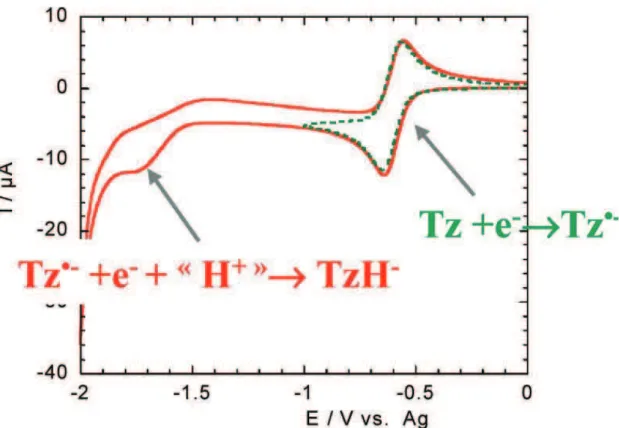
Aubederts group studied many s-tetrazine derivatives, to decipher the factors governing the electrochemical properties44,50,51. All s-tetrazines examined which are substituted by heteroatoms or aromatics can be reversibly reduced in organic solvents, because of their electron-deficient character, accepting one electron to give an anion radical, very stable in the absence of acids (Figure 1.8). The differences in E1/2 values for the reversible reduction to the corresponding anion radicals reflect the electronic influence of the substituents. Thus, the variation of the potential E0 can be easily correlated to the electron withdrawing or donating character of the substituent(Table 1.9).
Table 1.9. Half-wave reduction potential (V vs Fc/Fc+) of s-tetrazine in dichloromethane. No. Substituent X, Y E0 No. Substituent X, Y E0
1 Phenyl, phenyl -1.21 18 Cl, Cl -0.68 2 Pyrrol-2-yl, pyrrol-2-yl -1.31 19 Cl, OMe -0.99 3 2-thienyl, 2-thienyl -1.24 20 Cl, naphthalene-1-yloxy -0.97 4 2,2-bithienyl-5-yl, 2,2-bithienyl-5-yl -1.25 21 Cl, pyrrolidine-1-yl -1.35 5 4-ferrocenylphenyl, 4-ferrocenylpheny -1.32 22 Cl, 2,3-diphenylaziridin-1-yl -1.04 6 Cl, borneol -0.74 23 OMe, OMe -1.25 7 SMe, SMe -1.20 24 OMe, SMe -1.23 8 Cl, 9H-fluoren-9-ylemthoxy -0.75 25 Cl, paracyclophan-4-ylmethoxy -0.82 9 Cl, adamantan-2-yloxy -0.79 26 Cl, adamantan-1-ylmethoxy -0.85 10 Cl, pentachlorophenoxy -0.54 27 Cl, N-phtalimidyl -0.51 11 Adamantan-1-ylmethoxy, admantan-1-ylmethoxy -1.13 28 Pyrrolidin-1-yl, pyrrolidin-1-yl -1.73 12 3,5-dimethyl-1H-pyrazol-1-yl, OMe -0.89 29 3,5-dimethyl-1H-pyrazol-1-yl, pyrrol-1-yl -0.97 13 Pyrrol-1-yl, -1.07 30 ferrocenyl, -1.28
pyrrol-1-yl ferrocenyl 14 3,5-dimethyl-1H-pyrazol-1-yl, 3,5-dimethyl-1H-pyrazol-1-yl, -0.96 31 s-tetrazine -1.16 15 difluorotetrazine -0.56 32 dicyanotetrazine -0.31 16 Bis(methylamino)tetrazine -1.51 33 Bis(dimethylamino)tetrazine -1.55 17 dimethyltetrazine -1.32 34 Bis(aziridyl)tetrazine -1.25
Figure 1.8. Cyclic voltammograms of bis-substituted tetrazines in dichloromethane (+0.1 M TBAP) on a platinum electrod: bis(N-pyrrolyl)-tetrazine (solid line) and
bis(thienyl)tetrazine (dashed line).
Most of the tetrazine derivatives can also accept a second electron, despite the fact that this process is not electrochemically reversible in standard conditions. However, this latter process is chemically reversible (with the exception of dichloro-s-tetrazine), as demonstrated by the cyclic voltammogram of compound 8 in figure 1.9. Despite the fact that the second electron transfer does not give a stable dianion (which is probably very basic and reacts with traces of water or protic impurities), a stable species is formed and is sluggishly reoxidized into the original anion radical, which is completely restored. It is probable that the reduced species formed is the known dihydrotetrazine, or more likely its monoanion.
Figure 1.9. Cyclic voltammograms of 9 showing the first and second reductions.
1.4.2 Photophysical properties of s-tetrazines 1.4.2.1 Introduction to photophysical chemistry
The aim of this part is to recall the basic principles of UV-visible absorption and fluorescence emission.
(1) Absorption of UV-visible light
An electronic transition consists in the promotion of an electron from an orbital of a molecule in its ground state to an unoccupied orbital by absorption of a photon. There are several kinds of molecular orbitals which can give different types of electronic transitions (Figure 1.10).
Figure 1.10. Energy levels of molecular orbitals in formaldehyde and possible electronic transition.
The energy of these electronic transitions is generally as follow: np* < pp* < ns* < ss*. In absorption and fluorescence spectroscopy, two important types of orbitals are considered: the Highest Occupied Molecular Orbitals (HOMO) and the Lowest Unoccupied Molecular Orbitals (LUMO). The energy difference between the HOMO and LUMO is termed the HOMO-LUMO gap, and the spectrum is decided by this gap. Both refer to the ground state of molecule.
The efficiency of light absorption is expressed by the molar absorption coefficient (e), which can be calculated by the Beer-Lambert Law (Equation 1.1).
Equation 1.1. The Beer-Lambert Law.
(2) Fluorescence emission
Once a molecule is excited by absorption of a photo, it returns to the ground state by various possible de-excitation pathways (Figure 1.11): emission of fluorescence, internal conversion (direct return to the ground state without emission of fluorescence), intersystem crossing (possibly followed by emission of phosphorescence), conformational changes. Interactions in the excited state with other molecules may also open other pathways: electron transfer, proton transfer, energy transfer, excimer or exciplex formation, intermolecular charge transfer64 which competes with intramolecular de-excitation processes.
Figure 1.11. De-excitation pathways for an excited molecule.
Generally, emission of photons accompanying the S1S0 relaxation is called fluorescence (Figure 1.12), and the fluorescence spectrum is located at higher wavelengths (lower energy) than the absorption spectrum because of the energy loss in the excited state due to vibrational relaxation.
Figure 1.12. The Perrin-Jablonski diagram (top) and illustration of the relative positions of absorption, fluorescence and phosphorescence spectra (botom).
(3) Lifetimes and quantum yields
The lifetime is the average time during which the molecules stay in the excited state before emitting one photon. The fluorescence decays time ts, is one of the most important characteristics of a fluorescent molecule because it defines the time window of observation of dynamic phenomena.
The fluorescence quantum yield FF is the fraction of excited molecules that return to the ground stateS0 with emission of fluorescence photons. It is equal to the ratio of the number of emitted photons to the number of absorbed photons. It also can be written by using the radiative lifetime (Equation 1.2). It gives the efficiency of the fluorescence process. is the rate constant for radiative deactivation S1!S0 with emission of fluorescence; is the rate constant for all the non-radiative (internal conversion S1!S0, intersystem crossing). introduces the excited state lifetime of fluorophore. is called radiative lifetime on the condition that the only way of de-excitation S1!S0 was fluorescence emission.
Equation 1.2. Fluorescence quantum yield.
In order to obtain this value, a comparative method is widely used. This method relies on the use of fluorescence standards with known fluorescence quantum yields and is really only applicable to solution phase measurements. So the experiment should be prepared under the same excited wavelength. Hence, it can be written as equation 1.3.
Equation 1.3. Equation for estimation of fluorescence quantum yield.
X represents the compound of interest while S is the standard compound. F is the integrated area under the corrected fluorescence spectrum. A is the absorbance of the solution, and it should not exceed 0.1 at any wavelength longer than the excitation wavelength. This recommendation is made so as to minimize any effects due to re-absorption of the fluorescence. n is the refractive indice of the solvent used for the two solutions.
1.4.2.2 Photophysical properties of tetrazines
Based on the structure of 1,2,4,5-tetrazine, this molecule not only has p* orbitals, but also non bonding n orbitals. So these orbitals contributes to two kinds of transition: np* transition and pp* transition. This is another outstanding character of s-tetrazine. The vapor spectrum of s-tetrazine was first studied by Koenigsberger and Vogt, and later by Lin et al65. Glenn66,67 reported a series of researches that dealt with the infrared, visible, and ultraviolet spectra of s-tetrazine, and in particular, with the understanding of the energetic of the four lone pairs of nitrogen nonbonding electrons.
From the early report68 of the absorption spectra, s-tetrazine vapor shows two main singlet absorption systems: a first is around 250nm which corresponds to the pp* transition analogue to benzene and a second system is around 500nm which is due to the np* transition. Mason has assigned the broad absorption in the region of 350nm in solutions to an additional np* transition. These results are identical with the recent research.
In addition, Mason69 et al. pointed out, that the position of the absorption band corresponding to the n!p* transition is weakly influenced by the nature of the substituents and was shown not to be solvatochromic. The molar extinction coefficient associated with this transition is low, about 500-1000L"mol-1"cm-1. Contrary, the position of p!p* transition strongly depends on the substituents nature, it correlates linearly with their electron-donating or withdrawing character. Figure 1.13 shows the absorption spectra8 of different s-tetrazines, 13 (green), 3-chloro-6-methoxy-1,2,4,5-tetrazine 55 (blue), 24 (red), which clearly present this influence.
Figure 1.13. Absorption spectra of compounds 13 (green), 55 (blue), 24 (red).
The first report of fluorescence of s-tetrazines was from Mihir and Lionel70. Fluorescence of s-tetrazine and dimethyl-s-tetrazine were studied at different temperatures: 77K for s-tetrazine and room temperature for dimethyl-s-tetrazine. In fact, these two compounds are photochemically unstable; they decomposed to nitrogen and cyanuric acid or acetonitrile. Then the following studies showed that increasing the size of the substituents can improve the photostability. For instance, diphenyl-s-tetrazines is stable upon light irradiation.
A series of new substituted s-tetrazines were prepared by Audeberts group (figure 1.14), and their photophysical properties were also observed. Generally, the color range of s-tetrazine is from purple to orange to red, but not all of them are fluorescent (Figure 1.15).
Figure 1.14. New s-tetrazines from Audeberts group.
Figure 1.15. Left: photograph under ambient light of selected tetrazines with their corresponding formulas. Right: same sample irradiated at 365nm.
The lifetime of s-tetrazine is very dependent on the nature of the substituents (table 1.10). The longest one was reported for 3-chloro-6-methoxy-s-tetrazine (55) about 160ns, while the lifetime of dimethoxytetrazine (29) is just 49ns. Furthermore, the molecules with the longest lifetimes also have the highest quantum yields.
Table 1.10. Absorption and fluorescence maxima of tetrazines recorded in dichloromethane. tetrazine UV-vis absorption fluorescence
l1 l2 l3 lmax a fb t(ns)c 1 544 295 602 <0.5 11 524 383 278 13 515 307 551,567 0.14 58 24 524 345 275 575 0.11 49 56 521 328 270 572 0.36 144 57 522 391 273 576 0.025 12.8,6.3 58 529 396 258 580 5x10⁻³ 7.1, 1.93 59 524 394 263 577 5x10⁻³ 5.39d 60 518 323 269 565 0.29 150 61 528 397,349 257 585 6x10⁻³ 62 529 403 288 585 2x10⁻³ 63 522 330 269 570 0.126 59 64 528.5 398, 348 259 575 6x10⁻³ 10 55 520 327 269 567 0.38 160 s-tetrazine 542 320 252 575 6x10⁻⁴ 1.5 a. lex= l1, b. f±8%, c. t±2%, d. average of a multiexponential decline
1.4.3 Computational chemistry on tetrazines
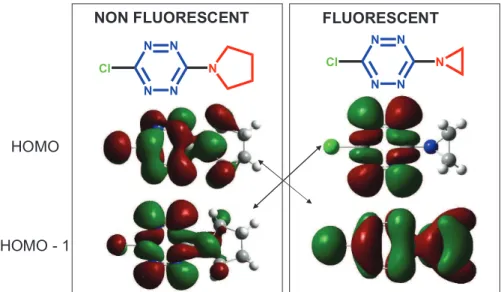
In order to understand the origin of the differences in fluorescence properties, systematic quantum chemical studies have been conducted4. It has been found that in many cases the HOMO of the s-tetrazine is a combination of the four nonbonding n electrons of the nitrogen atoms. However, a p orbital lies frequently very close to this n orbital, and according to the substituent nature their order can be exchanged. In other words, the p orbital becomes the HOMO of the molecule. Figure 1.16 shows the HOMO and HOMO-1 obtained by DFT calculations in the two antagonist cases of the pyrrolidine and the aziridine substituents.
N N N N
Cl N
HOMO
NON FLUORESCENT FLUORESCENT
N N
N N
Cl N
HOMO - 1
Figure 1.16. Calculated structures of the HOMO and HOMO-1 of tetraziens.
The results show in particular that fluorescence occurs when the HOMO orbital has a nonbonding n character, but is absent if the HOMO is a p orbital. Extension of this calculation to other derivatives confirms that trend (Figure 1.17). Hence, the occurrence of the fluorescence properties of s-tetrazine can be predicted through such theoretical approach.
The calculations also allow a good estimation of the relative position of the reduction potentials of the tetrazines. It is directly linked to the relative LUMO position, as could be expected (Table 1.11) (Figure 1.18).
Table 1.11. Values of differences between standard potentials and the differences between LUMO levels compared with tetrazine 18 as the standard.
compound Measured DE0 [V] Measured DELUMO [eV]
55 0.31 0.28
65 0.67 0.70
24 0.57 0.55
40 1.05 1.27
Figure 1.18. Correlation between the differences in the LUMO energies of s-tetrazines (55,65,24,40) relative to 18 and the differences of their standard potentials (R2=0.9904).
1.5 Applications of s-tetrazines
1.5.1 Energetic materials from tetrazines
High-energy density materials (HEDMs) offer distinct advantages to conventional carbon-based energetic materials. Due to a large number of N-N and C-N bonds, they possess large positive heats of formation71,72. Hence energetic high-nitrogen organic compounds are promising candidates for HEDMs. The low percentage of carbon and hydrogen in these compounds has a double positive effect: enhancement of density73,11 and thermal stability74. Thanks to this special properties,
there are a lot of s-tetrazine derivatives which have been synthesized and characterized by Los Alamos National Laboratory75, Xiaos group76 and Talawars group (Figure 1.19).
Figure 1.19. High nitrogen content s-tetrazine derivatives for energetic material applications.
1.5.2 Pharmaceuticals from s-tetrazines
1,2,4,5-tetrazine derivatives or their n-hydro form have a high potential for biological activity, possessing a wide range of antiviral and antitumor properties. These derivatives have also been widely used in pesticides and herbicides. According to the literature, 1,2,4,5-tetramethyl-3,6-bis(phenylethynyl)-1,2,4,5-tetrazine has been suggested as an antitumor agent77,78,79; 3-amino-6-aryl-1,2,4,5-tetrazines showed modest antimalarial activity80 a series of tetrahydro-s-tetrazines have been evaluated for their antibacterial and antifungal activities81, and some hexahydro-s-tetrazines proved to have useful analgesic and antiflammatory activities.
Recently, in addition to Hus and Werbels group doing more research on the biological activity of s-tetrazine derivatives, Devaral and his colleagues used the inverse demand Diels-Alder reactivity of s-tetrazine to label biomarkers on live cells82,28,83 (scheme 1.28). The main advantages of this reaction compared to
conventional bioorthogonal reactions are: (1) there is no requirement for a catalyst; (2) the bimolecular rate constants for reaction can be very high (>103 M-1.s-1) with appropriate choice of s-tetrazine and strained dienophile; (3) certain s-tetrazine chromophores are fluorogenic upon cycloaddition, thus improving signal-to-background for fluorescence microscopy; (4) the reactants are straightforward to synthesize from commercial sources.
Scheme 1.28. A: reaction of benzylamino-s-tetrazine with trans-cyclooctenol is extremely rapid and leads to dihydropyradazine adducts; B: live cell multistep labeling of A549 human
lung carcinoma cells using tetrazine cycloadditions.
1.5.3 Efficient solar cells
Due to its high electro-attractor effect, s-tetrazines can be used in solar cells. Dings group84 reported a new s-tetrazine based low-bandgap semiconducting polymer, PCPDTTTz (Figure 1.20). This is the first solution-processable conjugated polymer with s-tetrazine in the main chain. This polymer shows good thermal stability and broad absorption covering 450-700 nm. The HOMO and LUMO energy levels were estimated to be -5.34 and -3.48 eV respectively, with an electrochemical bandgap of 1.86 eV. Simple polymer solar cells based on PCPDTTTz and PC71BM exhibit a calibrated power conversion efficiency of 5.4%.


![Figure 2.9. ESP map from the BP86/TZP SPE calculations for the singly charged cation {[Ag 2 (bptz) 2 (CH 3 CN) 2 ] [AsF 6 ]} + with a color scale of 188 (blue) to 231 (red) kcal mol -1](https://thumb-eu.123doks.com/thumbv2/123doknet/14526418.723039/72.892.286.601.112.503/figure-esp-calculations-singly-charged-cation-color-scale.webp)