HAL Id: hal-01443230
https://hal.archives-ouvertes.fr/hal-01443230
Submitted on 30 Oct 2020
HAL is a multi-disciplinary open access
archive for the deposit and dissemination of
sci-entific research documents, whether they are
pub-lished or not. The documents may come from
teaching and research institutions in France or
abroad, or from public or private research centers.
L’archive ouverte pluridisciplinaire HAL, est
destinée au dépôt et à la diffusion de documents
scientifiques de niveau recherche, publiés ou non,
émanant des établissements d’enseignement et de
recherche français ou étrangers, des laboratoires
publics ou privés.
diazotroph-fueled export production in the VAHINE
mesocosm experiments
Angela N. Knapp, Sarah E. Fawcett, Alfredo Martinez-Garcia, Nathalie
Leblond, Thierry Moutin, Sophie Bonnet
To cite this version:
Angela N. Knapp, Sarah E. Fawcett, Alfredo Martinez-Garcia, Nathalie Leblond, Thierry Moutin,
et al.. Nitrogen isotopic evidence for a shift from nitrate- to diazotroph-fueled export production in
the VAHINE mesocosm experiments. Biogeosciences, European Geosciences Union, 2016, 13 (16),
pp.4645-4657. �10.5194/bg-13-4645-2016�. �hal-01443230�
www.biogeosciences.net/13/4645/2016/ doi:10.5194/bg-13-4645-2016
© Author(s) 2016. CC Attribution 3.0 License.
Nitrogen isotopic evidence for a shift from nitrate- to
diazotroph-fueled export production in the
VAHINE mesocosm experiments
Angela N. Knapp1, Sarah E. Fawcett2,3, Alfredo Martínez-Garcia4, Nathalie Leblond5, Thierry Moutin5, and Sophie Bonnet5
1Earth, Ocean, and Atmospheric Science Department, Florida State University, 117 N Woodward AVE,
Tallahassee, FL, 32306, USA
2Department of Geosciences, Guyot Hall, Princeton University, Princeton, NJ 08544, USA 3Department of Oceanography, University of Cape Town, Rondebosch, 7701, South Africa 4Max Plank Institute for Chemistry, Hahn-Meitner-Weg 1, 55128 Mainz, Germany
5Mediterranean Institute of Oceanography (MIO), IRD/CNRS/Aix-Marseille University, IRD Noumea,
101 Promenade R. Laroque, BPA5, 98848 Noumea Cedex, France Correspondence to:Angela N. Knapp ([email protected])
Received: 14 November 2015 – Published in Biogeosciences Discuss.: 14 December 2015 Revised: 21 July 2016 – Accepted: 29 July 2016 – Published: 18 August 2016
Abstract. In a coastal lagoon with a shallow, 25 m water col-umn off the southwest coast of New Caledonia, large-volume ( ∼ 50 m3)mesocosm experiments were undertaken to track the fate of newly fixed nitrogen (N). The mesocosms were in-tentionally fertilized with 0.8 µM dissolved inorganic phos-phorus to stimulate diazotrophy. N isotopic evidence indi-cates that the dominant source of N fueling export produc-tion shifted from subsurface nitrate (NO−3)assimilated prior to the start of the 23-day experiments to N2fixation by the
end of the experiments. While the δ15N of the sinking par-ticulate N (PNsink)flux changed during the experiments, the
δ15N of the suspended PN (PNsusp)and dissolved organic N
(DON) pools did not. This is consistent with previous obser-vations that the δ15N of surface ocean N pools is less respon-sive than that of PNsink to changes in the dominant source
of new N to surface waters. In spite of the absence of de-tectable NO−3 in the mesocosms, the δ15N of PNsinkindicated
that NO−3 continued to fuel a significant fraction of export production (20 to 60 %) throughout the 23-day experiments, with N2 fixation dominating export after about 2 weeks.
The low rates of organic N export during the first 14 days were largely supported by NO−3, and phytoplankton abun-dance data suggest that sinking material primarily comprised large diatoms. Concurrent molecular and taxonomic studies
indicate that the diazotroph community was dominated by diatom–diazotroph assemblages (DDAs) at this time. How-ever, these DDAs represented a minor fraction (< 5 %) of the total diatom community and contributed very little new N via N2fixation; they were thus not important for driving
ex-port production, either directly or indirectly. The unicellular cyanobacterial diazotroph, a Cyanothece-like UCYN-C, pro-liferated during the last phase of the experiments when N2
fixation, primary production, and the flux of PNsinkincreased
significantly, and δ15N budgets reflected a predominantly di-azotrophic source of N fueling export. At this time, the ex-port flux itself was likely dominated by the non-diazotrophic diatom, Cylindrotheca closterium, along with lesser contri-butions from other eukaryotic phytoplankton and aggregated UCYN-C cells, as well as fecal pellets from zooplankton. Despite comprising a small fraction of the total biomass, UCYN-C was largely responsible for driving export produc-tion during the last ∼ 10 days of the experiments both di-rectly (∼ 5 to 22 % of PNsink)and through the rapid transfer
of its newly fixed N to other phytoplankton; we infer that this newly fixed N was transferred rapidly through the dissolved N (including DON) and PNsusppools. This inference
recon-ciles previous observations of invariant oligotrophic surface ocean DON concentrations and δ15N with incubation studies
showing that diazotrophs can release a significant fraction of their newly fixed N as some form of DON.
1 Introduction
One of the primary pathways by which carbon dioxide (CO2)is removed from the atmosphere is via
photosynthe-sis, through which it is converted into organic carbon. In the ocean, this process is known as the “biological pump” since upon death, the phytoplankton that fixed inorganic carbon into biomass in surface waters are eventually trans-ported to depth (either via passive sinking or as a byproduct of grazing), thereby “pumping” the carbon to deep waters where it remains isolated from the atmosphere on hundred-to thousand-year timescales. In broad regions of the surface ocean, the scarcity of the essential macronutrient, nitrogen (N), limits photosynthesis and thus the capacity of the biolog-ical pump to remove CO2from the atmosphere (Falkowski,
1997). Consequently, there is considerable interest in quan-tifying fluxes of N to the ocean, as well as in understanding the fate of that N once it enters the ocean.
In addition to lesser contributions from rivers and atmo-spheric deposition, the dominant source of N to the ocean is biologically mediated di-nitrogen (N2)fixation (Gruber,
2004). Marine cyanobacteria, bacteria, and archaea that can access the abundant dissolved N2gas pool as a source of
as-similative N are known as diazotrophs and have a competi-tive advantage over other microbes and phytoplankton that require an exogenous source of N such as nitrate (NO−3), ammonium (NH+4), and/or dissolved organic N (DON). Sev-eral geochemical signals that accumulate in the thermocline of the oligotrophic gyres are thought to result from dia-zotrophic activity in overlying surface waters. In particu-lar, diazotrophic biomass has elevated N to phosphorus (P) ratios (∼ 25 : 1 to 50 : 1; Holl and Montoya, 2008; Krauk et al., 2006; Kustka et al., 2003; White et al., 2006) rela-tive to typical (i.e., “Redfieldian”) marine biomass (∼ 16 : 1 N : P; Falkowski, 2000; Redfield, 1958; Sterner and Elser, 2002). The death of diazotrophs and subsequent reminer-alization of their biomass in the thermocline can cause NO−3 to phosphate (PO3−4 ) concentration ratios > 16 : 1 in regions associated with high rates of N2 fixation (Gruber
and Sarmiento, 1997; Hansell et al., 2004). Combining in-ventories of elevated subsurface NO−3 : PO3−4 concentration ratios with timescales over which the signal has accumu-lated has been used to estimate basin-scale rates of ma-rine N2 fixation (Deutsch et al., 2001; Eugster and
Gru-ber, 2012; Gruber and Sarmiento, 1997). Additionally, the NO−3 accumulating in the thermocline as a result of dia-zotrophic activity has a N isotopic composition (“δ15N”) of ∼ −2 to 0 ‰ (Carpenter et al., 1997; Hoering and Ford, 1960; Minagawa and Wada, 1986), which is distinct from that of mean ocean NO−3, ∼ 5 ‰ (Sigman et al., 2009;
“δ15N”, where δ15N = {[(15N/14N)sample/(15N/14N)reference]
– 1} × 1000, with atmospheric N2 as the reference).
Con-sequently, regions of the ocean associated with elevated rates of N2fixation accumulate low-δ15N NO−3 in the same water
masses that host elevated NO−3 : PO3−4 concentration ratios; the accumulation of this low-δ15N NO−3 has also been used to estimate basin-scale N2fixation rates (Knapp et al., 2008).
While geochemical evidence indicates that the high N : P ratios and low δ15N of diazotrophic biomass is ultimately incorporated into the upper thermocline of the tropical and subtropical ocean, the pathways by which these geochemi-cal signatures are transferred from the surface to subsurface ocean remain enigmatic. For example, the conspicuous ma-rine diazotroph Trichodesmium spp. is thought to be grazed by only a small number of zooplankton (O’Neill and Roman, 1994; Roman, 1978), suggesting that this diazotroph may not be transferred up the food web in the same way as other phy-toplankton. Additionally, due to the presence of buoyant gas vacuoles, Trichodesmium spp. may not sink as efficiently as other phytoplankton, potentially explaining why its biomass is often not observed in sediment traps (Walsby, 1992). This renders sinking upon death, another common fate of phyto-plankton biomass, a less likely pathway by which newly fixed N may leave surface waters.
Instead of being transferred up the food web to higher trophic levels or being removed via sinking, newly fixed N has been thought to play a critical role in supporting the microbial loop through the release of DON and NH+4. Pro-grammed cell death (Berman-Frank et al., 2004), grazing (Glibert and Bronk, 1994), and direct release (Capone et al., 1994) have been invoked as mechanisms by which Tri-chodesmiumspp. may release DON and NH+4 to surround-ing waters. While consumption of this diazotroph derived N (DDN) would retain its low-δ15N signature in the event that the DDN consumers eventually sink into the thermo-cline, it leaves unclear the mechanism by which an elevated NO−3 : PO3−4 concentration ratio accumulates in the thermo-cline, since the micro-organisms consuming the DDN would likely do so at or close to Redfield stoichiometry. Moreover, there is little field evidence of DON concentrations increas-ing, or the δ15N of DON decreasing, in regions (Knapp et al., 2011) or periods (Knapp et al., 2005) of high N2fixation
relative to regions and/or times with low rates of N2fixation.
Consequently, while many pathways have been explored, the fate of newly fixed N remains obscure.
One geochemical tool that has been used to track the fate of DDN, as well as to quantify its contribution to export pro-duction, is the upper ocean δ15N budget. Comparing the dis-tinct δ15N of subsurface NO−3 and newly fixed N, the two dominant sources of new N to surface waters, with the δ15N of the export flux (“PNsink δ15N”) provides an integrative
measure of the relative contributions of subsurface NO−3 and N2 fixation to export production (e.g., Altabet, 1988;
et al., 2005; Liu et al., 1996). Assigning newly fixed N a δ15N of −1 ‰, the fractional importance of N2 fixation for
sup-porting export production (x) in an upper ocean δ15N budget can be expressed as follows:
PNsinkδ15N = x(−1 ‰) + (1 − x)(NO−3 δ15N). (1)
Rearranging and solving for x yields the following:
x = (NO−3 δ15N − PNsinkδ15N)/(1 + NO−3δ15N). (2)
Multiplying the fraction of export production supported by N2 fixation (x) by the PNsink mass flux provides a
time-integrated N2fixation rate that can be compared with15N2
incubation-based N2 fixation rate measurements (Knapp et
al., 2016). We note that the δ15N of NO−3 in the equa-tions above more accurately refers to the δ15N of NO−3+ ni-trite (NO−2); however, NO−2 concentrations are typically ex-tremely low throughout the oxidized water column, so for brevity, we refer to NO−3+NO−2 measurements as NO−3 mea-surements.
N isotope budgets in stratified, oligotrophic gyres consis-tently indicate that subsurface NO−3 supports at least 75 %, and often > 90 %, of export production, even during the strat-ified summer season (Altabet, 1988; Casciotti et al., 2008; Fawcett et al., 2011; Knapp et al., 2005, 2016). This is in-consistent with biological assays indicating that N2fixation
supports a higher, and often dominant, fraction of tropical and subtropical export production (e.g., Capone et al., 2005; Montoya et al., 2004). The disagreement between the results of these biological assays and the δ15N budgets (as well as the lack of response in the concentration and/or δ15N of olig-otrophic surface ocean DON) raises the following questions: are upper ocean δ15N budgets an appropriate tool for track-ing the fate of DDN, and is the δ15N of sinking organic matter diagnostic for the source of N fueling export production?
To address the fate of DDN and to quantify the contri-bution of newly fixed N to export production, large vol-ume (∼ 50 m3) mesocosms were deployed in a region of the southwest Pacific known to support diazotrophy dur-ing the austral summer (Bonnet et al., 2015; Dupouy et al., 2000; Rodier and Le Borgne, 2008, 2010) and where PO3−4 availability appears to ultimately control N2 fixation rates
(Moutin et al., 2005, 2008). In order to better track the fate of DDN, these mesocosms were intentionally fertilized with ∼0.8 µM dissolved inorganic phosphorus (DIP) to stimulate diazotrophic activity and thus amplify the biogeochemical signals of N2fixation. Here, we present δ15N budgets from
inside the manipulative mesocosm experiments and discuss how the observed geochemical signals correspond to con-temporaneous shifts in diazotroph and phytoplankton com-munity composition.
2 Methods
2.1 Experimental design and sample collection
A detailed description of the VAHINE mesocosm experi-ments is provided elsewhere (Bonnet et al., 2016b). Briefly, three 2.3 m diameter, 15 m deep (∼ 50 m3)cylinders of im-permeable, transparent plastic sheeting (subsequently re-ferred to as M1, M2, and M3) were deployed in shallow wa-ters (25 m water column depth) of the oligotrophic Noumea lagoon, 28 km from New Caledonia (Bonnet et al., 2016b). Screw-top plastic bottles (250 mL) were attached to the bot-tom of the mesocosms to collect PNsink. These “sediment
trap” samples were collected daily by SCUBA divers and “swimmers” were removed from them prior to analysis. Wa-ter column samples were collected daily at 6 m depth from each of the three mesocosms throughout the 23-day experi-ment. Discrete samples for nutrients including NO−3+NO−2 and NH+4, suspended particulate N (PNsusp), and total N
(TN = PNsusp+DON + NO−3+NO−2+NH+4)were collected
by pumping water via PVC tubing connected to a teflon pump (Astii) into 50 L polyethylene carboys atop a floating platform. The 50 L carboys were transferred to the R/V Alis and immediately subsampled on deck for the discrete sam-ples described above. Finally, samsam-ples were also collected at a control site near the mesocosms (subsequently referred to as “Noumea lagoon waters”) to monitor biogeochemical con-ditions outside of the manipulative mesocosm experiments.
To stimulate diazotrophy, DIP was added on the evening of the fourth day of the experiments to reach a final concentra-tion of ∼ 0.8 µM in each mesocosm. As described in (Bonnet et al., 2016b), this was achieved by pumping a 20 L concen-trated DIP stock solution throughout the 15 m water column of each mesocosm.
2.2 Nitrogen concentration and δ15N analyses
A detailed description of the sample collection, analysis, and results of dissolved inorganic N (DIN) measurements made in the VAHINE mesocosm experiments is described else-where (Berthelot et al., 2015; Bonnet et al., 2016b). Briefly, the concentration of NH+4 was determined using a fluoromet-ric method (Holmes et al., 1999) with a detection limit of 0.01 µM, the concentration of NO−3+NO−2 was determined using colorimetric methods (Strickland and Parsons, 1968) with a detection limit of 0.01 µM, and the concentration of PNsusp was determined by wet oxidation (Pujo-Pay and
Raimbault, 1994) with a quantification limit of 0.06 µM. The δ15N of PNsuspwas determined by filtering seawater through
a pre-combusted, acid-washed Whatman GF/F (nominal pore size of 0.7 µm), followed by high-temperature combustion of the filter coupled with isotope ratio mass spectrometry using a Delta Plus Thermo Fisher Scientific mass spectrometer as described in (Berthelot et al., 2015).
The concentration of TN for samples collected at the same time and in the same manner as the DIN samples described above was determined by persulfate oxidation (Solorzano and Sharp, 1980) with adaptations (Knapp et al., 2005), and the resulting NO−3 was measured by chemiluminescence (Braman and Hendrix, 1989). DON concentration was de-termined by subtracting the concentrations of PNsusp, NH+4,
and NO−3+NO−2 (reported in Berthelot et al., 2015) from the measured TN concentration of each sample with a propa-gated error of ±0.5 µM. The δ15N of NO−3+NO−2 was mea-sured using the denitrifier method (Casciotti et al., 2002; McIlvin and Casciotti, 2011; Sigman et al., 2001) with a typ-ical standard deviation of ±0.2 ‰. The δ15N of TN was de-termined via persulfate oxidation of TN to NO−3 (Knapp et al., 2005) and subsequent analysis of NO−3 δ15N by the den-itrifier method, with a propagated error for DON δ15N cal-culated using a Monte Carlo method (Press et al., 1992) of ±0.6 ‰. Finally, the δ15N of PNsink was measured using a
Thermo Scientific Flash 2000 Elemental Analyzer coupled with a Delta Plus Thermo Scientific mass spectrometer. The average standard deviation for the standards analyzed was ±0.06 ‰.
3 Results
The intentional DIP fertilization of the mesocosms on the fourth evening of the VAHINE experiments lends temporal structure to the 23-day course of observations. Three distinct phases are evident based on multiple biogeochemical met-rics: days 1 to 4, prior to DIP fertilization (subsequently re-ferred to as “P0”), which largely reflect “background” con-ditions; days 5 to 14, after DIP fertilization (subsequently referred to as “P1”), characterized by a much longer DIP turnover time than P0; and finally, days 15 to 23 (subse-quently referred to as “P2”), during which DIP concentra-tions decreased and biomass, primary production, and N2
fixation rates increased (Berthelot et al., 2015; Bonnet et al., 2016b). Differences in the community composition of phy-toplankton and diazotrophs (Leblanc et al., 2016; Turk-Kubo et al., 2015) were also evident among the three phases of the VAHINE experiments. Consequently, the results described below are evaluated within the temporal context of the ob-served biogeochemical changes in the mesocosms.
3.1 DON concentration and δ15N
Concentrations of DON within the mesocosms showed no significant change over the course of the 23-day experiments (Fig. 1a). Average DON concentrations in M1, M2, and M3 were 5.4 ± 0.3, 5.3 ± 1.1, and 5.5 ± 0.6 µM, respectively. These concentrations are consistent with previous observa-tions from surface waters of other oligotrophic ocean regions (Knapp et al., 2011; Letscher et al., 2013), as well as with the DON concentration of 5.4 µM in Noumea lagoon waters
δ
δ
Figure 1. VAHINE water column DON concentration measure-ments from this study in color overlain upon those of Berthelot et
al. (2015), in gray (a), DON δ15N (b), PNsusp concentration (c),
and PNsuspδ15N (d) from within M1 (red filled inverted triangles),
M2 (blue filled squares), M3 (green filled circles), and in the la-goon waters outside the mesocosms (“X” symbols). Error bars
rep-resent propagated error for DON concentration and DON δ15N,
and ±1 SD for PNsusp concentration. No replicate measurements
of PNsuspδ15N were made, so no error bars are shown. Shaded
re-gions indicate P0 (days 1 through 4) and P2 (days 15 through 23), with the unshaded region in between indicating P1 (days 5 through 14).
measured outside the mesocosms. However, while our ob-servation of invariant DON concentrations over the duration of the experiments are largely similar to those reported by Berthelot et al. (2015), the DON concentration that we mea-sured for three samples collected at the end of P2 diverge from those of Berthelot et al. (2015) who report decreas-ing DON concentrations (of ∼ 0.9 µM) in all three meso-cosms during P2 compared to P0 and P1. For comparison, Fig. 1a shows DON concentration measurements from this study overlain upon those of Berthelot et al. (2015). We note that our DON sampling resolution was not as high as that of Berthelot et al. (2015), so it is possible that we missed the decrease in DON concentration in the mesocosms. The Berthelot et al. (2015) DON concentration decrease, which they attribute to consumption by phytoplankton and/or het-erotrophic bacteria, was not accompanied by a decrease in DOC concentration, which given typical C : N ratios for ma-rine dissolved organic matter (DOM) of 12 to 14 (Benner, 2002), would be expected to decline by ∼ 9 to 12 µM. Since both TN sample sets were collected at the same time and in
the same manner, and since the DON concentration calcu-lated by mass balance in both cases used the same DIN and PNsusp measurements reported by (Berthelot et al., 2015),
the only measurement contributing to the discrepancy is that of TN. We note that slightly different reagents were used to chemically oxidize TN to NO−3; while (Berthelot et al., 2015) used the wet-oxidation method of (Pujo-Pay and Raimbault, 1994), the TN measurements reported here were made with a reagent that contained no boric acid and a higher sodium hydroxide concentration (Fawcett et al., 2011; Knapp et al., 2005). In addition, the potassium persulfate was recrystal-lized four times, then rinsed with GC-grade methanol to speed drying and remove N contamination to facilitate iso-topic analysis (Fawcett et al., 2014; Higgins et al., 2009). We cannot explain the discrepancy between the DON concentra-tion measurements for samples collected at the end of P2 in this study and those reported by Berthelot et al. (2015); given that our samples were also measured for DON δ15N (dis-cussed below), we interpret the data presented in this study in the context of our DON concentration measurements rather than those of Berthelot et al. (2015). We note, however, that regardless of the DON concentration used, the conclusions from our δ15N budget remain the same (see Sect. 4.1 below). Similar to the concentration of DON, the δ15N of DON showed no significant change over the course of the exper-iments (Fig. 1b, Table 1). The average DON δ15N in M1, M2, and M3 was 4.7 ± 1.0, 4.7 ± 0.4, and 5.3 ± 1.0 ‰, re-spectively. The δ15N of DON in the VAHINE mesocosms is similar to that reported previously for the North Pacific gyre (4.7 ‰), where the similarity of the δ15N of DON to the δ15N of subsurface NO−3 was interpreted to reflect the dominance of subsurface NO−3 for fueling export production (Knapp et al., 2011).
3.2 PNsuspδ15N
The concentration of PNsusp (along with the concentrations
of suspended particulate organic carbon (PCsusp)and
phos-phorus; PPsusp) increased over the course of the experiments
(Fig. 1c), most notably during P2, consistent with the ob-served increase in carbon and N2fixation during P2
(Berth-elot et al., 2015). However, the δ15N of PNsuspin the
meso-cosms did not show any significant change with time, and was largely similar to the δ15N of PN
suspin the lagoon
wa-ters (Fig. 1d, Table 1). The average δ15N of PNsusp in M1,
M2, and M3 was 3.3 ± 0.8, 3.4 ± 1.4, and 3.8 ± 1.5 ‰, re-spectively, while the δ15N of PNsuspoutside the mesocosms
was 3.3 ± 1.3 ‰. 3.3 PNsinkδ15N
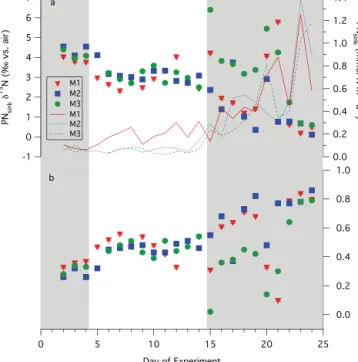
In contrast to the concentration of DON and the δ15N of DON and PNsusp, the δ15N of PNsink changed significantly
over the course of the experiments (Fig. 2a). Evaluating the PNsink δ15N collected in all three mesocosms during P0,
δ
Figure 2. VAHINE PNsinkmass flux in M1 (red solid line), M2
(blue dotted line), and M3 (green dashed line), and PNsinkδ15N in
M1 (red filled inverted triangles), M2 (blue filled squares), and M3
(green filled circles) (a) and the corresponding contribution of N2
fixation to export production (b). Shaded regions indicate P0 (days 1 through 4) and P2 (days 15 through 23), with the unshaded region
in between indicating P1 (days 5 through 14). PNsinkδ15N error
bars represent an average measurement SD of ±0.06 ‰, and error
bars for the fractional contribution of N2fixation to the PNsinkflux
reflect the ±0.06 ‰ range associated with the PNsinkδ15N
mea-surements.
P1, and P2 with the Kruskal-Wallis rank-sum test for non-parametric data (Triola, 2001) shows that the mean δ15N of PNsink for each time period (P0, P1 and P2) is
signifi-cantly different (p < 0.005). Considering the mesocosms in-dividually, the δ15N of PN
sinkfor each time period was
sig-nificantly different for M2 (p < 0.005) and potentially for M3 (0.1 > p > 0.05), but not for M1 (0.9 > p > 0.1). The av-erage PNsink δ15N in M1, M2, and M3 during P0 was
3.9 ± 0.1, 4.4 ± 0.3, and 4.2 ± 0.2 ‰, respectively, decreas-ing to 2.9 ± 0.5, 3.2 ± 0.4, and 3.0 ± 0.3 ‰ durdecreas-ing P1, and 2.2 ± 1.9, 1.4 ± 1.2, and 3.3 ± 1.9 ‰ during P2 (Fig. 2a). All PNsinkδ15N measurements for the mesocosms are reported
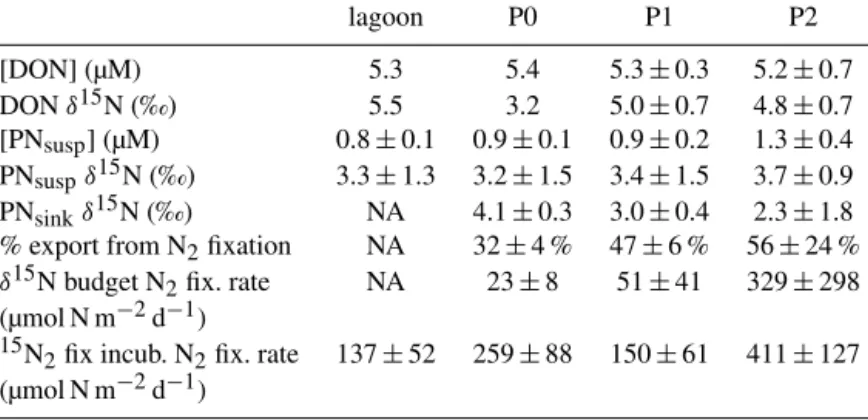
Table 1. Average concentrations (±1 SD; µM) and δ15N (‰) for organic N pools and fluxes in the VAHINE mesocosms during P0 (days 1 through 4), P1 (days 5 through 14), and P2 (days 15 through 23), as well as in the lagoon waters outside the mesocosms. Additionally, the
average (±1 SD) fraction of export supported by N2fixation based on δ15N budget calculations, as well as the average (±1 SD) N2fixation
rate for each time period based on both δ15N budget calculations and15N2incubations (Berthelot et al., 2015), are reported. Note that DON
concentration and δ15N for the lagoon and P0 are based on one measurement, so no standard deviation is included. DIN pool concentrations
were low (i.e., < 0.1 µM) and invariant throughout the experiment (Berthelot et al., 2015).
lagoon P0 P1 P2 [DON] (µM) 5.3 5.4 5.3 ± 0.3 5.2 ± 0.7 DON δ15N (‰) 5.5 3.2 5.0 ± 0.7 4.8 ± 0.7 [PNsusp] (µM) 0.8 ± 0.1 0.9 ± 0.1 0.9 ± 0.2 1.3 ± 0.4 PNsuspδ15N (‰) 3.3 ± 1.3 3.2 ± 1.5 3.4 ± 1.5 3.7 ± 0.9 PNsinkδ15N (‰) NA 4.1 ± 0.3 3.0 ± 0.4 2.3 ± 1.8
% export from N2fixation NA 32 ± 4 % 47 ± 6 % 56 ± 24 %
δ15N budget N2fix. rate NA 23 ± 8 51 ± 41 329 ± 298
(µmol N m−2d−1)
15N
2fix incub. N2fix. rate 137 ± 52 259 ± 88 150 ± 61 411 ± 127
(µmol N m−2d−1)
4 Discussion
4.1 The fate of newly fixed N – pools or fluxes?
As described above, a primary goal of the VAHINE project was to track the fate of newly fixed N in manipulative meso-cosm experiments (Bonnet et al., 2016b). The δ15N of PNsusp
in the euphotic zone has often been used to infer the domi-nant N form fueling primary production, particularly in olig-otrophic systems where NO−3 and NH+4 are typically effec-tively completely consumed in surface waters (Altabet, 1988; Altabet and McCarthy, 1985; Capone et al., 2005; Treibergs et al., 2014). However, bulk PNsuspincludes compositionally
distinct N-containing particles: diverse living autotrophs and heterotrophs as well as detrital organic matter (Fawcett et al., 2011; Rau et al., 1990). In the oligotrophic Sargasso Sea, each of these groups has been shown to have a distinct δ15N signature, with the δ15N of bulk PNsusprecording their
mass-weighted average (Fawcett et al., 2011, 2014; Treibergs et al., 2014). The δ15N of PNsuspis also altered by the consumption
and production of N forms recycled in surface waters (e.g., NH+4), the fluxes of which can often greatly exceed the ex-ternal supply of N to the euphotic zone (e.g., via N2fixation
or NO−3 mixed up from below; Altabet, 1988; Knapp et al., 2011; Lourey et al., 2003). Thus, while the δ15N of PNsusp
may provide some indication of the primary N source sup-porting the upper ocean ecosystem, it is unlikely to be a good indicator of the dominant N form fueling export production (Altabet, 1988; Lourey et al., 2003).
This appears to be the case in the VAHINE mesocosms. The δ15N of PNsusp remained roughly constant throughout
the 23-day experiments and did not significantly differ from the δ15N of PNsusp in the lagoon waters where rates of N2
fixation were relatively low and constant in the absence of DIP fertilization (Fig. 1d, Table 1). During P1, N2
fixa-tion added ∼ 0.1 µM N to the mesocosms (Berthelot et al., 2015). Assuming a δ15N of −1 ‰ for this DDN (Carpen-ter et al., 1997; Hoering and Ford, 1960; Minagawa and Wada, 1986), its accumulation as PNsusp (assuming an
av-erage PNsuspδ15N of 3.0 ‰ on day 5) would lower the δ15N
of this pool by ∼ 0.4 ‰. However, the δ15N of PNsusp did
not decline and, if anything, increased by day 14 (average δ15N of 3.7 ‰), further indicating that DDN did not accu-mulate significantly in the PNsusp pool in the mesocosms.
This pattern was even more pronounced during P2: while N2
fixation added ∼ 0.25 µM N and the concentration of PNsusp
increased by 0.25 to 0.74 µM (Berthelot et al., 2015), the δ15N of PNsuspremained unchanged (Fig. 1d, Table 1). Thus,
while DDN may have passed through the PNsusp pool, its
transit was sufficiently rapid that the δ15N of N2 fixation
never accumulated above detection limits in PNsusp.
We note that both the concentration and δ15N of PNsusp
in the lagoon waters were high (i.e., 0.8 ± 0.1 µM and 3.3 ± 1.3 ‰) relative to euphotic zone PNsuspin similar
olig-otrophic regions such as near Bermuda and Hawaii (e.g., PNsusp concentration and δ15N of 0.2 to 0.3 µM and −1
to 1 ‰; (Altabet, 1989, 1988; Casciotti et al., 2008; Dore et al., 2002; Fawcett et al., 2011, 2014). The high back-ground PNsusp concentrations observed in the Noumea
la-goon have been previously attributed to anthropogenically driven eutrophication related to untreated sewage release from New Caledonia (Fichez et al., 2010). While the site of the VAHINE mesocosms located 28 km off the coast was se-lected to be as representative of the open ocean as possible, it was still at the entrance to the lagoon where the water quality is affected by ocean water inflow, land-derived inputs, and anthropogenic inputs such as industrial and waste water dis-charge (Labrosse et al., 2000). The high δ15N of PNsuspmay
de-riving from human waste is typically high in δ15N (5 to 20 ‰; McClelland and Valiela, 1998; Swart et al., 2013; Townsend-Small et al., 2007). However, subsurface NO−3 δ15N in this region is 6.5 ‰ (this study; Yoshikawa et al., 2015), such that its assimilation by phytoplankton would also serve to elevate the δ15N of PNsusp. In sum, the high δ15N of PNsusprequires
the assimilation of NO−3 even if the source of that NO−3 is uncertain. More importantly, the invariant δ15N of PNsusp
throughout the mesocosm experiments confirms that while fluxes of DDN may have passed through the PNsusp pool,
DDN did not accumulate as PNsusp above detection limits.
This observation is consistent with previous work showing low seasonality in the δ15N of the PNsusp pool in spite of
changes in the sources and fluxes of new N to oligotrophic surface waters (e.g., Altabet, 1988).
Similarly, the stability of the DON concentration and δ15N (as well as the consistently low concentrations of NO−3+NO−2 and NH+4; Berthelot et al., 2015) in the meso-cosms could be interpreted as indicating that very little DDN was transferred to the dissolved pools during the experi-ments. These observations are in contrast to previous stud-ies documenting the release of significant quantitstud-ies of dis-solved N during N2 fixation. For example, elevated DON
and/or NH+4 concentrations have been observed in the waters surrounding Trichodesmium blooms (Devassy et al., 1978; Karl et al., 1997; Lenes et al., 2001) and in aging Tri-chodesmium cultures (Mulholland and Capone, 2001), and Trichodesmiumhas been shown to directly release upwards of 50 % of its newly fixed N as DON and/or NH+4 (Bon-net et al., 2016a; Capone et al., 1994; Glibert and Bronk, 1994; Mulholland et al., 2004) with a low δ15N (Meador et al., 2007). While the VAHINE mesocosms were domi-nated by diazotrophs other than Trichodesmium (Turk-Kubo et al., 2015), it is still possible that DDN was released during the experiments but was so rapidly taken up by other (N-limited) organisms that it never accumulated in the dissolved pool. Indeed, when N2 fixation rates increased towards the
end of P1 and into P2, diatoms without diazotrophic sym-bionts rapidly increased 3- to 6-fold in all mesocosms, the non-diazotrophic cyanobacterium, Synechococcus, increased ∼10-fold, and small (< 35 µm) eukaryotic phytoplankton in-creased 2- to 4-fold (Leblanc et al., 2016). Given that the mesocosm bags were impermeable to an external physical N supply (e.g., upwelled or advected NO−3), the most likely N source fueling the observed phytoplankton growth during P2 was DDN. This is supported by short-term (24 to 72 h) experiments conducted during the VAHINE study that were designed to track the fate of DDN. They showed the accumu-lation of15N originating from15N2fixation in the dissolved
N pool and in the biomass of non-diazotrophic diatoms and picoplankton (0.2 to 2 µm size fraction) on day 17 and 19 of the mesocosm experiments (Bonnet et al., 2016a). The total N supplied by N2fixation during P2, when N2fixation rates
were highest (average of 27.3 ± 1.0 nmol N L−1d−1over the
three mesocosms; Berthelot et al., 2015), was ∼ 0.25 µM. This quantity of N amounts to < 5 % of the ambient DON concentration, such that the addition of any portion of this DDN to the DON pool, regardless of whether it was subse-quently consumed by phytoplankton, would not have been evident above the background DON concentration or δ15N. However, it is clear that DDN did not accumulate as NH+4 since, while NH+4 concentrations increased slightly during P2 (from ∼ 0.01 to 0.06 µM; Berthelot et al., 2015), they were still extremely low throughout the experiments.
In contrast to the invariant δ15N of the PNsusp and DON
pools, the δ15N of PNsink significantly decreased over the
course of the experiments (Fig. 2a, Table 1). The unique ex-perimental design of the mesocosms provided a closed sys-tem that prevented the resupply of nutrients via lateral or ver-tical exchange, such that N2fixation is the only new N source
that could drive changes in the δ15N of PNsink. Moreover,
the effectively complete NO−3 consumption that occurred in these waters prior to the initiation of the experiments (Berth-elot et al., 2015) simplifies δ15N budget calculations by re-moving the need to consider a potentially variable isotope effect (or indeed, any isotope effect) for NO−3 assimilation; only the initial δ15N of the NO−3 is required.
We use Eq. (2) to evaluate the contribution of N2fixation
to export production in the mesocosms, taking the δ15N of subsurface NO−3 to be that measured in the outside waters that are thought to flush the lagoon (6.5 ‰ at 200 m). The av-erage fractional contribution of N2fixation to export
produc-tion within the three mesocosms increased over the course of the experiments; N2 fixation supported 32 ± 4, 47 ± 6, and
56 ± 24 % of export production during P0, P1, and P2, re-spectively (Fig. 2b, Table 1). In spite of the range in PNsink
δ15N, especially in P2, the mean δ15N of PNsink is
signif-icantly different between each time period; the fraction of export production supported by N2fixation during each time
period is thus also significantly different. We note that the apparent fractional contribution of N2fixation to export
pro-duction suggested by the δ15N of PNsinkin the VAHINE
ex-periments is high relative to geochemical studies conducted in other tropical and subtropical open ocean regions (< 10– 25 %; Altabet, 1998; Knapp et al., 2005; Casciotti et al., 2008). However, the intentional fertilization of the meso-cosms with DIP, the lack of external N sources other than N2 fixation to the water column, and the 15 m mesocosm
water column that was both significantly shallower and less turbulent than that of the open ocean study sites, all likely favored diazotrophy in the mesocosms. Direct comparison of the fractional significance of N2 fixation to export
pro-duction in the VAHINE experiments with observations from open ocean sites should thus be made with caution.
Given the potential for especially large gradients in the δ15N of NO−3 in the upper thermocline of the South Pacific (Casciotti et al., 2013; Yoshikawa et al., 2015), and the pos-sibility that the island provided a source of NO−3 of unknown
Table 2. Comparison of time-integrated diazotroph derived N
(DDN) for each mesocosm based on δ15N budget calculations and
15N
2fixation incubation rates.
M1 M2 M3
δ15N budget DDN (µM) 0.29 0.28 0.20
15N
2incubation [N] (µM) 0.41 0.38 0.38
δ15N budget/15N2incubation 71 % 75 % 52 %
(albeit high) δ15N to the lagoon, the results of our δ15N bud-get are best used to evaluate relative changes in the sources of N fueling export production. Regardless of the uncertainty in the absolute contribution of N2fixation to export
produc-tion at any one time point, the relative shift in the δ15N of PNsinkis significant and clearly indicates that export
produc-tion in the mesocosms was initially fueled primarily by NO−3 that had been assimilated prior to the start of the experiments, with N2fixation becoming the dominant driver of export by
the end of the experiments.
During P0, the rates of primary production and N2fixation
were low, although N2fixation appears to have been slightly
higher than during P1 (Berthelot et al., 2015). In addition, there was no observable increase in PNsusp concentration
during P1, indicating that little to no growth occurred during this phase of the experiments. Given the mean PNsink δ15N
of 4.1 ± 0.3 ‰ during P0, we hypothesize that the sinking flux (which was also low; ∼ 0.07 mmol N m−2d−1; Fig. 2a) likely constituted mainly large cells that, due to the lack of nutrients and turbulence that characterized the mesocosm en-closures, were unable to grow and instead sank rapidly out of surface waters. This is supported by the following: (i) a small but detectable decline in the concentration of PCsusp
dur-ing P0 (Berthelot et al., 2015); (ii) taxonomy data from the mesocosms showing a sharp decline in the abundance of the initially dominant, large and chain-forming diatom species (e.g., Thalassionema spp., Leptocylindrus spp., and Chaeto-ceros spp.) between days 2 and 5 (Leblanc et al., 2016), and (iii) calculations using Stokes’ law, modified specifi-cally for diatoms by (Miklasz and Denny, 2010), that pre-dict that diatoms with a diameter of 50 to 100 µm will sink at speeds > 10 m day−1, allowing them to easily sink out of the 15 m-deep mesocosms on the timescale of a day. Given that diatoms have a strong tendency towards NO−3 assimilation (Dortch, 1990; Fawcett and Ward, 2011; Goericke, 2002), the preferential sinking out of large diatoms that had consumed predominantly NO−3 prior to the commencement of the ex-periments can explain the slightly higher δ15N of PNsink
dur-ing P0 than P1 (average of 4.1 ± 0.3 ‰ vs. 3.0 ± 0.4 ‰), even though N2fixation was marginally higher during P0.
Throughout most of P1, N2fixation rates, primary
produc-tion, and the sinking flux remained low and constant (Berth-elot et al., 2015; Fig. 2a). Along with the relatively invariant δ15N of PNsinkduring this period, these observations suggest
that PNsinkcomprised mostly aggregated suspended material
that had been present in surface waters since the beginning of the experiments rather than newly generated biomass. In-deed, the δ15N of PNsinkthroughout P1 is indistinguishable
from that of PNsusp (3 ‰; Figs. 1d and 2a, Table 1). Thus,
despite the lack of NO−3 in the mesocosms, more than half of the export production that occurred during P1 was supported by NO−3 that had been assimilated by phytoplankton prior to the start of the experiments (Eq. 1). N2fixation rates began to
increase by day 11 or 12 in all mesocosms; this was quickly followed by an increase in PNsuspconcentrations, as well as
an increase in the magnitude of the sinking flux and a de-crease in its δ15N, consistent with both an increased supply of N to the mesocosms and a low δ15N for that N.
To confirm that the decrease in the δ15N of PNsinkis best
explained by N2fixation, we compared the N2fixation rate
derived from the δ15N budget (Eqs. (1) and (2), above) with the15N2incubation-based N2fixation rates (Berthelot et al.,
2015; Table 2). The time-integrated DDN that accumulated as PNsinkover the course of the 23-day experiments in each
of the mesocosms corresponds to 52 to 75 % of the 15N2
incubation-based N2 fixation flux integrated over the same
time period (Table 2). In spite of the uncertainty associ-ated with both analyses, including the different timescales over which each metric may integrate N2fixation fluxes and
the possibility that some of the DDN accumulated in the DON and/or PNsusp pools below analytical detection limits,
we conclude that the primary fate of newly fixed N in the VAHINE mesocosm experiments was to be converted into the PNsinkflux.
We note that the net DON consumption at the end of P2 proposed by (Berthelot et al., 2015) would not change our δ15N budgets given the suggestion by the authors that the primary fate of this DON was to accumulate in the PNsusp
pool; this represents a redistribution of N between surface pools separate from the PNsink flux. While there is no
rea-son that the consumed DON had to be retained in the PNsusp
pool, the isotopic data indicate that if the (Berthelot et al., 2015) DON concentrations are correct, then, as the authors propose, the fate of this DON has to primarily be retention in the PNsusp pool. The isotope data also suggest that the
ma-jority of the DDN in the mesocosms was fairly rapidly ex-ported, either directly by sinking diazotrophs, by zooplank-ton grazing upon the diazotrophs (Hunt et al., 2016), and/or indirectly after being cycled through the dissolved N pool and assimilated by non-diazotrophic plankton in the PNsusp
pool that then sank into the sediment traps (Bonnet et al., 2016a), rather than being retained in surface waters. This is consistent with prior work using δ15N budgets to quantify the significance of DDN for supporting export production (Alta-bet, 1988; Casciotti et al., 2008; Dore et al., 2002). The re-sults presented here demonstrate that the δ15N of the PNsink
flux, compared to the δ15N of DON and/or the PNsusp pool,
is the most appropriate tool for evaluating the fate of newly fixed N on timescales ranging from 1 day to several weeks
because it records the δ15N of the sources of new N fueling export production with the most fidelity.
4.2 NO−3- and N2fixation-driven export production in
the context of changing phytoplankton and diazotroph community composition
The shift from NO−3 to N2 fixation as the dominant source
of N fueling export production during the VAHINE meso-cosm experiments is paralleled by observed changes in the composition of the phytoplankton and diazotroph communi-ties (Leblanc et al., 2016; Turk-Kubo et al., 2015). In par-ticular, the diazotroph that dominated inside the mesocosms prior to DIP fertilization (i.e., during P0), as well as im-mediately following DIP fertilization (i.e., during P1), was Richeliaassociated with the diatom Rhizosolenia (Het-1), a diatom–diazotroph assemblage (DDA) that was also com-mon in the Noumea lagoon waters (Turk-Kubo et al., 2015). However, a Cyanothece-like group-C unicellular cyanobac-terial diazotroph (hereafter, “UCYN-C”) came to dominate the diazotroph community inside the mesocosms during P2. This diazotroph was rarely observed outside the mesocosms, suggesting that the experiment itself created favorable con-ditions for the success of this ecotype, which has never been observed at high abundances in the marine water column (Turk-Kubo et al., 2015). It is possible that the microbial community response to DIP fertilization created conditions suitable for UCYN-C growth inside the mesocosms (see be-low; Turk-Kubo et al., 2015).
During P0, the diatom community was numerically dom-inated by non-diazotrophic species such as Leptocylindrus spp. and Chaetoceros spp., with DDAs comprising a minor fraction (i.e., < 5 %) of total diatom abundance, and becom-ing even less abundant durbecom-ing P1 (Leblanc et al., 2016). Thus, while DDAs may have been responsible for the low levels of N2 fixation detected during P0 and P1, they were not
suffi-ciently abundant to be important drivers of export produc-tion; rather, we suggest that the small amount of export that occurred during P0 and P1 was fueled by large (non-DDA) diatoms and aggregating PNsusp that bore the high δ15N of
earlier NO−3 consumption (see above).
The increase in the rate of N2 fixation observed
to-wards the end of P1 (days 11 to 12) was rapidly fol-lowed by a 2- to 10-fold increase in the abundance of non-diazotrophic diatoms, driven almost exclusively by Cylin-drotheca closterium, which reached maximum abundance on days 15 to 16 and then declined to P1 levels by days 18 to 20 (Leblanc et al., 2016). Beginning on day 11 to 15, the abundance of both Synechococcus and small eukary-otic phytoplankton (< 35 µm) also increased, although less rapidly than the diatoms. Unlike the large diatoms, these two groups continued to grow until the end of the experiments (Leblanc et al., 2016). Molecular data suggest that UCYN-C were the dominant diazotrophs responsible for the elevated rates of N2fixation during late P1 and throughout P2
(Turk-Kubo et al., 2015). We hypothesize that the subsequent rapid transfer of DDN to the dissolved pool fueled the observed growth of C. closterium and other phytoplankton during this time period. This is supported by a short-term15N2
labeled-DDN transfer experiment conducted on days 17 and 19 in which nanoSIMS (nanoscale secondary ion mass spectrom-etry) analyses revealed that non-diazotrophic plankton (di-atoms and picoplankton) became significantly enriched in
15N after 24 to 72 h due to their assimilation of DDN
trans-ferred from the diazotrophs in the mesocosms (Bonnet et al., 2016a). Regardless of the form of this DDN (i.e., NH+4 or DON), in the mesocosms it would retain the low-δ15N char-acteristic of N2 fixation, thereby lowering the δ15N of the
phytoplankton that consumed it. Since the δ15N of PNsusp
did not decline significantly during P2 but the δ15N of PNsink
did, it follows that the sinking flux likely comprised a con-tribution from both UCYN-C and the DDN-fueled phyto-plankton. The isotope data also suggest that while the C. closteriumand other phytoplankton that consumed the DDN may have briefly contributed to the PNsusppool, they did not
accumulate above detection limits in the PNsusppool for > 1
day (i.e., the timescale of mesocosm sampling) before sink-ing. This is analogous to the DDN passing briefly and unde-tectably through the dissolved N pool before it was rapidly consumed by phytoplankton. UCYN-C are small cyanobac-teria (5.7 ± 0.8 µm); (Bonnet et al., 2016a), but they were ob-served to aggregate into 100 to 500 µm particles that sank rapidly, constituting 22.4 ± 5 % of the PCsink flux at the
height of the UCYN-C bloom (day 17) and ∼ 5 % as the bloom decayed (Bonnet et al., 2016a). In addition to their direct contribution to export, UCYN-C provided the N that fueled phytoplankton growth during P2, such that this organ-ism was responsible for driving most of export production in the mesocosms, albeit largely indirectly. One implication of these results is that the phenomenon of newly fixed N be-ing released to the dissolved pool is apparently not unique to Trichodesmium spp. Another implication of the indirect control of diazotrophs on export production, if relevant to the open ocean, is that while the transfer of DDN to depth via non-diazotrophic phytoplankton ultimately leads to a de-cline in the δ15N of thermocline NO−
3, it will not increase the
NO−3 : PO3−4 concentration ratio of these subsurface waters.
5 Conclusions
The goal of the VAHINE project was to track the fate of newly fixed N in large-volume, DIP-fertilized mesocosm ex-periments. Consistent with previous work, we found no ev-idence of newly fixed N accumulating in the surface DON or PNsusp pools. Instead, the δ15N of the PNsink flux
de-creased over the course of the experiments in proportion to increasing rates of N2fixation. These observations are
con-sistent with the traditional oceanographic paradigm that new fluxes of N to the surface ocean are balanced by the
dom-inant flux out of surface waters, the sinking particulate flux (Eppley and Peterson, 1979). Moreover, they suggest that up-per ocean δ15N budgets that include measurements of PNsink
are the best metric for tracking the fate of DDN and for di-agnosing the dominant N source fueling export production. While at-sea collections of PNsinkare expensive and
logisti-cally challenging, our results underscore the value of PNsink
δ15N measurements and emphasize their critical role in con-straining the location, magnitude, and timing of marine N2
fixation fluxes.
This work provides isotopic evidence not only for newly fixed N leaving surface waters via the sinking flux, but also strongly suggests that DDN was first rapidly cycled through the dissolved N and PNsusppools before being transferred to
the sinking flux. While prior δ15N budget studies have shown the rapid transfer of low-δ15N N from surface to subsurface waters, the unique design of the mesocosm experiments that received no other external N source to support phytoplankton growth after several weeks of isolation requires that the low-δ15N PNsink flux observed during P2 was fueled by DDN.
Daily water column measurements of dissolved organic and inorganic N concentrations (and the δ15N of DON) indicate that DDN did not accumulate above detection limits in these or the PNsusp pools for > 1 day timescales. While the δ15N
budget suggests that N2fixation was the primary source of
N fueling export production during P2, phytoplankton abun-dance data show that non-diazotrophic phytoplankton, in-cluding large diatoms and Synechococcus, “bloomed” dur-ing P2 (Leblanc et al., 2016), accumulatdur-ing in numbers too large to be supported by recycled forms of N that did not de-rive from N2fixation. Assuming that these non-diazotrophic
phytoplankton had no other means of acquiring N than via the UCYN-C population that also increased significantly dur-ing P2, it is extremely likely that DDN was transferred from UCYN-C to the non-diazotrophic phytoplankton that drove most of the export production, along with a small direct contribution (∼ 5 to 22 %) from aggregated UCYN-C cells (Bonnet et al., 2016a) and zooplankton grazing (Hunt et al., 2016). Indeed, such a DDN transfer to the non-diazotrophic pool was directly observed in a companion nanoSIMS-15N2
study conducted in mid-P2 when UCYN-C was blooming but diatom abundances were declining (Bonnet et al., 2016a); there is no reason that the same mechanism did not fuel the growth of diatoms earlier in P2. These diatoms included C. closterium, which reportedly has the ability to survive in low nutrient environments with seed populations that remain poised to thrive when supplied with a pulse of nutrients, and then sink out of surface waters under calm conditions due to their size (Kingston, 2009; Margalef, 1978; Wasmund et al., 2014). This is consistent with our observations of PNsusp
and PNsinkduring the VAHINE experiments. In addition, C.
closterium abundances have been observed to increase dra-matically after Trichodesmium blooms in the South West Pa-cific (Bonnet et al., 2016). Our study provides some of the first evidence for DDN being rapidly transferred through the
dissolved pool to other phytoplankton that then dominate the sinking flux instead of being transferred to the subsurface by diazotrophs sinking directly out of surface waters.
Our findings are consistent with prior work showing that diazotrophs release newly fixed N to the dissolved pool (Capone et al., 1994; Glibert and Bronk, 1994; Mulholland et al., 2004, 2006), as well as with studies that have failed to ob-serve DDN accumulating in surface ocean N pools (Fawcett et al., 2011, 2014; Knapp et al., 2005, 2011). The results of the VAHINE experiments reconcile some of these observa-tions, but also leave open the question of the composition of the DDN that is released to the dissolved pool. Addition-ally, the experiments raise the questions of how microbes and phytoplankton stay “poised” to rapidly assimilate DDN, and why they sink out of surface waters when they acquire DDN, with no retention or accumulation of that DDN in the upper ocean N pools. In other words, why is the fate of DDN so disproportionately biased towards sinking?
Information about the Supplement
All data generated for this manuscript are available in the Supplement related to this article.
The Supplement related to this article is available online at doi:10.5194/bg-13-4645-2016-supplement.
Acknowledgements. We acknowledge the input of Travis Meador
and two anonymous reviewers that clarified the manuscript. Fund-ing for Angela N. Knapp was provided by NSF-OCE #1537314, for Sarah E. Fawcett from the University of Cape Town URC fund, the Grand Challenges Program of Princeton University, and NSF-OCE #1136345 to B. Ward and D. Sigman. Funding for this research was provided by the Agence Nationale de la Recherche (starting grant VAHINE ANR-13-JS06-0002), INSU-LEFE-CYBER program, GOPS, IRD and M.I.O. The authors thank the captain and crew of the R/V Alis and acknowledge the SEOH divers service from the IRD research center of Noumea (E. Folcher, B. Bourgeois, and A. Renaud) and from the Observatoire Océanologique de Villefranche-sur-mer (OOV, J. M. Grisoni) as well as the technical service of the IRD research center of Noumea for their helpful technical support. C. Guieu, F. Louis, and J. M. Grisoni from OOV are warmly thanked for the mesocosm design and their useful advice for deployment. The authors also thank D. Sigman and G. Haug for providing analytical support for N concentration and isotope measurements.
Edited by: F. Lacan
References
Altabet, M. A.: Particulate New Nitrogen Fluxes in the Sargasso Sea, J. Geophys. Res.-Oceans, 94, 12771–12779, 1989. Altabet, M. A.: Variations in Nitrogen Isotopic Composition
be-tween Sinking and Suspended Particles – Implications for Ni-trogen Cycling and Particle Transformation in the Open Ocean, Deep-Sea Res. Pt. I, 35, 535–554, 1988.
Altabet, M. A. and McCarthy, J. J.: Temporal and Spatial Variations in the Natural Abundance of N-15 in PON from a Warm-Core Ring, Deep-Sea Res. Pt. I, 32, 755–772, 1985.
Benner, R.: Chemical Composition and Reactivity, in: Biogeochem-istry of Marine Dissolved Organic Matter, edited by: Hansell, D. A. and Carlson, C. A., Academic Press, New York, 2002. Berman-Frank, I., Bidle, K. D., Haramaty, L., and Falkowski, P. G.:
The demise of the marine cyanobacterium, Trichodesmium spp., via an autocatalyzed cell death pathway, Limnol. Oceanogr., 49, 997–1005, 2004.
Berthelot, H., Moutin, T., L’Helguen, S., Leblanc, K., Hélias, S., Grosso, O., Leblond, N., Charrière, B., and Bonnet, S.: Dinitro-gen fixation and dissolved organic nitroDinitro-gen fueled primary pro-duction and particulate export during the VAHINE mesocosm experiment (New Caledonia lagoon), Biogeosciences, 12, 4099– 4112, doi:10.5194/bg-12-4099-2015, 2015.
Bonnet, S., Berthelot, H., Turk-Kubo, K., Fawcett, S., Rahav, E.,
L’Helguen, S., and Berman-Frank, I.: Dynamics of N2
fixa-tion and fate of diazotroph-derived nitrogen in a low-nutrient, low-chlorophyll ecosystem: results from the VAHINE mesocosm experiment (New Caledonia), Biogeosciences, 13, 2653–2673, doi:10.5194/bg-13-2653-2016, 2016a.
Bonnet, S., Moutin, T., Rodier, M., Grisoni, J.-M., Louis, F., Folcher, E., Bourgeois, B., Boré, J.-M., and Renaud, A.: In-troduction to the project VAHINE: VAriability of vertical and tropHIc transfer of diazotroph derived N in the south wEst Pa-cific, Biogeosciences, 13, 2803–2814, doi:10.5194/bg-13-2803-2016, 2016b.
Bonnet, S., Rodier, M., Turk-Kubo, K. A., Germineaud, C., Menkes, C., Ganachaud, A., Cravatte, S., Raimbault, P., Camp-bell, E., Quéroué, F., Sarthou, G., Desnues, A., Maes, C., and
Eldin, G.: Contrasted geographical distribution of N2 fixation
rates and nifH phylotypes in the Coral and Solomon Seas (south-western Pacific) during austral winter conditions, Global Bio-geochem. Cy., 29, doi:10.1002/2015GB005117, 2015.
Braman, R. S. and Hendrix, S. A.: Nanogram Nitrite and Nitrate De-termination in Environmental and Biological-Materials by Vana-dium(III) Reduction with Chemi-Luminescence Detection, Anal. Chem., 61, 2715–2718, 1989.
Capone, D. G., Burns, J. A., Montoya, J. P., Subramaniam, A., Mahaffey, C., Gunderson, T., Michaels, A. F., and Car-penter, E. J.: Nitrogen fixation by Trichodesmium spp.: An important source of new nitrogen to the tropical and sub-tropical North Atlantic Ocean, Global Biogeochem. Cy., 19, doi:10.1029/2004GB002331, 2005.
Capone, D. G., Ferrier, M. D., and Carpenter, E. J.: Amino-Acid Cycling in Colonies of the Planktonic Marine Cyanobac-terium Trichodesmium-Thiebautii, Appl. Environ. Microbiol., 60, 3989–3995, 1994.
Carpenter, E. J., Harvey, H. R., Fry, B., and Capone, D. G.: Biogeo-chemical tracers of the marine cyanobacterium Trichodesmium, Deep-Sea Res. Pt. I, 44, 27–38, 1997.
Casciotti, K. L., Buchwald, C., and McIlvin, M.: Implications of trate and nitrite isotopic measurements for the mechanisms of ni-trogen cycling in the Peru oxygen deficient zone, Deep-Sea Res. Pt. I, 80, 78–93, 2013.
Casciotti, K. L., Sigman, D. M., Hastings, M. G., Bohlke, J. K., and Hilkert, A.: Measurement of the oxygen isotopic composition of nitrate in seawater and freshwater using the denitrifier method, Anal. Chem., 74, 4905–4912, 2002.
Casciotti, K. L., Trull, T. W., Glover, D. M., and Davies, D.: Con-straints on nitrogen cycling at the subtropical North Pacific Sta-tion ALOHA from isotopic measurements of nitrate and particu-late nitrogen, Deep-Sea Res. Pt. II, 55, 1661–1672, 2008. Deutsch, C., Gruber, N., Key, R. M., Sarmiento, J. L., and
Ganachaud, A.: Denitrification and N(2) fixation in the Pacific Ocean, Global Biogeochem. Cy., 15, 483–506, 2001.
Devassy, V. P., Bhattathiri, P. M. A., and Qasim, S. Z.: Trichodesmium-erythraeum phenomenon, Indian J. Mar. Sci., 7, 168–186, 1978.
Dore, J. E., Brum, J. R., Tupas, L. M., and Karl, D. M.: Seasonal and interannual variability in sources of nitrogen supporting ex-port in the oligotrophic subtropical North Pacific Ocean, Limnol. Oceanogr., 47, 1595–1607, 2002.
Dortch, Q.: The interaction between ammonium and nitrate uptake in phytoplankton, Mar. Ecol.-Prog. Ser., 61, 183–201, 1990. Dupouy, C., Neveux, J., Subramaniam, A., Mulholland, M. R.,
Montoya, J. P., Campbell, L., Carpenter, E. J., and Capone, D. G.: Satellite captures Trichodesmium blooms in the southwest-ern tropical Pacific, EOS, 81, 13–16, 2000.
Eppley, R. W. and Peterson, B. J.: Particulate organic-matter flux and planktonic new production in the deep ocean, Nature, 282, 677–680, 1979.
Eugster, O. and Gruber, N.: A probabilistic estimate of global ma-rine N-fixation and denitrification, Global Biogeochem. Cy., 26, GB4013, doi:10.1029/2012GB004300, 2012.
Falkowski, P. G.: Evolution of the nitrogen cycle and its influence
on the biological sequestration of CO2in the ocean, Nature, 387,
272–275, 1997.
Falkowski, P. G.: Rationalizing elemental ratios in unicellular algae, J. Phycol., 36, 3–6, 2000.
Fawcett, S. and Ward, B.: Phytoplankton succession and nitrogen utilization during the development of an upwelling bloom, Mar. Ecol.-Prog. Ser., 428, 13–31, 2011.
Fawcett, S. E., Lomas, M., Casey, J. R., Ward, B. B., and Sigman, D. M.: Assimilation of upwelled nitrate by small eukaryotes in the Sargasso Sea, Nat. Geosci., 4, 717–722, 2011.
Fawcett, S. E., Lomas, M. W., Ward, B. B., and Sigman, D. M.: The counterintuitive effect of summer-to-fall mixed layer deep-ening on eukaryotic new production in the Sargasso Sea, Global Biogeochem. Cy., 28, 86–102, 2014.
Fichez, R., Chifflet, S., Douillet, P., Gérard, P., Gutierrez, F., Jouon, A., Ouillon, S., and Grenz, C.: Biogeochemical typology and temporal variability of lagoon waters in a coral reef ecosystem subject to terrigeneous and anthropogenic inputs (New Caledo-nia), Mar. Pollut. Bull., 61, 309–322, 2010.
Glibert, P. M. and Bronk, D. A.: Release of Dissolved Organic Ni-trogen by Marine Diazotrophic Cyanobacteria, Trichodesmium Spp, Appl. Environ. Microbiol., 60, 3996–4000, 1994.
Goericke, R.: Top-down control of phytoplankton biomass and community structure in the monsoonal Arabian Sea, Limnol. Oceanogr., 47, 1307–1323, 2002.
Gruber, N.: The dynamics of the marine nitrogen cycle and its
in-fluence on atmospheric CO2 variations, in: The Ocean Carbon
Cycle and Climate, Follows, edited by: Follows, M. and Oguz, T., Kluwer Academic, Dordrecht, 2004.
Gruber, N. and Sarmiento, J. L.: Global patterns of marine nitrogen fixation and denitrification, Global Biogeochem. Cy., 11, 235– 266, 1997.
Hansell, D. A., Bates, N. R., and Olson, D. B.: Excess nitrate and nitrogen fixation in the North Atlantic Ocean, Mar. Chem., 84, 243–265, 2004.
Higgins, M. B., Robinson, R. S., Casciotti, K. L., McIlvin, M. R., and Pearson, A.: A Method for Determining the Nitrogen Iso-topic Composition of Porphyrins, Anal. Chem., 81, 184–192, 2009.
Hoering, T. C. and Ford, H. T.: The Isotope Effect in the Fixation of Nitrogen by Azotobacter, J. Am. Chem. Soc., 82, 376–378, 1960.
Holl, C. M. and Montoya, J. P.: Diazotrophic growth of the ma-rine cyanobacterium Trichodesmium IMS101 in continuous cul-ture: Effects of growth rate on N(2)-fixation rate, biomass, and C : N : P stoichiometry, J. Phycol. 44, 929–937, 2008.
Holmes, R. M., Aminot, A., Kerouel, R., Hooker, B. A., and Peter-son, B. J.: A simple and precise method for measuring ammo-nium in marine and freshwater ecosystems, Can J. Fish. Aquat. Sci., 56, 1801–1808, 1999.
Hunt, B. P. V., Bonnet, S., Berthelot, H., Conroy, B. J., Foster, R. A., and Pagano, M.: Contribution and pathways of diazotroph-derived nitrogen to zooplankton during the VAHINE mesocosm experiment in the oligotrophic New Caledonia lagoon, Biogeo-sciences, 13, 3131–3145, doi:10.5194/bg-13-3131-2016, 2016. Karl, D., Letelier, R., Tupas, L., Dore, J., Christian, J., and Hebel,
D.: The role of nitrogen fixation in biogeochemical cycling in the subtropical North Pacific Ocean, Nature, 388, 533–538, 1997. Kingston, M. B.: Growth and motility of the diatom Cylindrotheca
Closterium: Implications for commercial applications, Journal of the North Carolina Academy of Science, 125, 138–142, 2009. Knapp, A. N., Casciotti, K. L., Berelson, W. M., Prokopenko, M.
G., and Capone, D. G.: Low rates of nitrogen fixation in eastern tropical South Pacific surface waters, P. Natl. Acad. Sci. USA, 113, 4398–4403, 2016.
Knapp, A. N., DiFiore, P. J., Deutsch, C., Sigman, D. M., and Lip-schultz, F.: Nitrate isotopic composition between Bermuda and Puerto Rico: Implications for N(2) fixation in the Atlantic Ocean, Global Biogeochem. Cy., 22, doi:10.1029/2007GB003107, 2008.
Knapp, A. N., Sigman, D. M., and Lipschultz, F.: N isotopic com-position of dissolved organic nitrogen and nitrate at the Bermuda Atlantic time-series study site, Global Biogeochem. Cy., 19, doi:10.1029/2004GB002320, 2005.
Knapp, A. N., Sigman, D. M., Lipschultz, F., Kustka, A. B., and Capone, D. G.: Interbasin isotopic correspondence between upper-ocean bulk DON and subsurface nitrate and its implica-tions for marine nitrogen cycling, Global Biogeochem. Cy., 25, doi:10.1029/2010GB003878, 2011.
Krauk, J. M., Villareal, T. A., Sohm, J. A., Montoya, J. P., and Capone, D. G.: Plasticity of N : P ratios in laboratory and field
populations of Trichodesmium spp, Aquat. Microb. Ecol., 42, 243–253, 2006.
Kustka, A. B., Sanudo-Wilhelmy, S. A., Carpenter, E. J., Capone, D., Burns, J., and Sunda, W. G.: Iron requirements for dinitrogen-and ammonium-supported growth in cultures of Trichodesmium (IMS 101): Comparison with nitrogen fixation rates and iron: carbon ratios of field populations, Limnol. Oceanogr., 48, 1869– 1884, 2003.
Labrosse, P., Fichez, R., Farman, R., and Adams, T.: New Cale-donia, in: Seas at the Millenium, An Environmental Evaluation, edited by: Sheppard, C., Elsevier, Amsterdam, 2000.
Leblanc, K., Cornet, V., Caffin, M., Rodier, M., Desnues, A., Berth-elot, H., Turk-Kubo, K., and Heliou, J.: Phytoplankton commu-nity structure in the VAHINE MESOCOSM experiment, Biogeo-sciences Discuss., doi:10.5194/bg-2015-605, in review, 2016. Lenes, J. M., Darrow, B. P., Cattrall, C., Heil, C. A., Callahan,
M., Vargo, G. A., Byrne, R. H., Prospero, J. M., Bates, D. E., Fanning, K. A., and Walsh, J. J.: Iron fertilization and the Trichodesmium response on the West Florida shelf, Limnol. Oceanogr., 46, 1261–1277, 2001.
Letscher, R. T., Hansell, D. A., Carlson, C. A., Lumpkin, R., and Knapp, A. N.: Dissolved organic nitrogen in the global surface ocean: Distribution and fate, Global Biogeochem. Cy., 27, 141– 153, 2013.
Liu, K. K., Su, M. J., Hsueh, C. R., and Gong, G. C.: The nitrogen isotopic composition of nitrate in the Kuroshio Water northeast of Taiwan: Evidence for nitrogen fixation as a source of isotopi-cally light nitrate, Mar. Chem., 54, 273–292, 1996.
Lourey, M. J., Trull, T. W., and Sigman, D. M.: Sensitivity of delta N-15 of nitrate, surface suspended and deep sinking particulate nitrogen to seasonal nitrate depletion in the Southern Ocean, Global Biogeochem. Cy., 17, doi:10.1029/2002GB001973, 2003.
Margalef, R.: Life-forms of phytoplankton as survival alternatives in an unsustainable environment, Oceanol. Ac., 1, 493–509, 1978.
McClelland, J. W. and Valiela, I.: Linking nitrogen in estuarine pro-ducers to land-derived sources, Limnol. Oceanogr., 43, 577–585, 1998.
McIlvin, M. R. and Casciotti, K. L.: Technical Updates to the Bac-terial Method for Nitrate Isotopic Analyses, Anal. Chem., 83, 1850–1856, 2011.
Meador, T. B., Aluwihare, L. I., and Mahaffey, C.: Isotopic hetero-geneity and cycling of organic nitrogen in the oligotrophic ocean, Limnol. Oceanogr., 52, 934–947, 2007.
Miklasz, K. A. and Denny, M. W.: Diatom sinking speeds: Improved predictions and insight from a modified Stokes’ law, Limnol. Oceanogr., 55, 2513–2525, 2010.
Minagawa, M. and Wada, E.: Nitrogen Isotope Ratios of Red Tide Organisms in the East-China-Sea – a Characterization of Biolog-ical Nitrogen-Fixation, Mar. Chem., 19, 245–259, 1986. Montoya, J. P., Holl, C. M., Zehr, J. P., Hansen, A., Villareal, T.
A., and Capone, D. G.: High rates of N2 fixation by
unicellu-lar diazotrophs in the oligotrophic Pacific Ocean, Nature, 430, 1027–1031, 2004.
Moutin, T., Karl, D. M., Duhamel, S., Rimmelin, P., Raimbault, P., Van Mooy, B. A. S., and Claustre, H.: Phosphate availability and the ultimate control of new nitrogen input by nitrogen
fix-ation in the tropical Pacific Ocean, Biogeosciences, 5, 95–109, doi:10.5194/bg-5-95-2008, 2008.
Moutin, T., Van Den Broeck, N., Beker, B., Dupouy, C., Rimmelin, P., and Le Bouteiller, A.: Phosphate availability controls Tri-chodesmium spp. biomass in the SW Pacific Ocean, Mar. Ecol.-Prog. Ser., 297, 15–21, 2005.
Mulholland, M. R., Bernhardt, P. W., Heil, C. A., Bronk, D. A., and O’Neil, J. M.: Nitrogen fixation and release of fixed nitrogen by Trichodesmium spp. in the Gulf of Mexico, Limnol. Oceanogr., 51, 1762–1776, 2006.
Mulholland, M. R., Bronk, D. A., and Capone, D. G.: Dinitrogen fixation and release of ammonium and dissolved organic nitrogen by Trichodesmium IMS101, Aquat. Microb. Ecol., 37, 85–94, 2004.
Mulholland, M. R. and Capone, D. G.: Stoichiometry of nitrogen and carbon utilization in cultured populations of Trichodesmium IMS101: Implications for growth, Limnol. Oceanogr., 46, 436– 443, 2001.
O’Neill, J. M. and Roman, M. R.: Ingestion of the cyanobac-terium Trichodesmium spp. by pelagic harpacticoid copepods Macrosetella, Miracia and Oculosetella, Hydrobiologia, 292– 293, 235–240, 1994.
Press, W. H., Teukolsky, S. A., Vetterling, W. T., and Flannery, B. P.: Numerical Recipes in C: The art of scientific computing, 2nd Edn., Cambridge University Press, 1992.
Pujo-Pay, M. and Raimbault, P.: Improvement of the wet-oxidation procedure for simultaneous determination of particulate organic nitrogen and phosphorus collected on filters, Mar. Ecol.-Prog. Ser., 105, 203–207, 1994.
Rau, G. H., Teyssie, J.-L., Rassoulzadegan, F., and Fowler, S. W.:
13C/12C and15N/14N variations among size-fractionated marine
particles: implications for their origin and trophic relationships, Mar. Ecol.-Prog. Ser., 59, 33–38, 1990.
Redfield, A. C.: The Biological Control of Chemical Factors in the Environment, Am. Sci., 46, 205–221, 1958.
Rodier, M. and Le Borgne, R.: Population and trophic dynamics of Trichodesmium thiebautii in the SE lagoon of New Caledonia, Comparison with T. erythraeum in the SW lagoon, Mar. Pollut. Bull., 61, 349–359, 2010.
Rodier, M. and Le Borgne, R.: Population dynamics and environ-mental conditions affecting Trichodesmium spp. (filamentous cyanobacteria) blooms in the south-west lagoon of New Cale-donia, J. Exp. Mar. Biol. Ecol., 358, 20–32, 2008.
Roman, M. R.: Ingestion of Blue-Green-Alga Trichodesmium by Harpactacoid Copepod, Macrosetella-Gracilis, Limnol. Oceanogr., 23, 1245–1248, 1978.
Sigman, D. M., Casciotti, K. L., Andreani, M., Barford, C., Galanter, M., and Bohlke, J. K.: A bacterial method for the nitro-gen isotopic analysis of nitrate in seawater and freshwater, Anal. Chem., 73, 4145–4153, 2001.
Sigman, D. M., DiFiore, P. J., Hain, M. P., Deutsch, C., Wang, Y., Karl, D. M., Knapp, A. N., Lehmann, M. F., and Pantoja, S.: The dual isotopes of deep nitrate as a constraint on the cycle and budget of oceanic fixed nitrogen, Deep-Sea Res. Pt. I, 56, 1419– 1439, 2009.
Solorzano, L. and Sharp, J. H.: Determination of Total Dissolved Nitrogen in Natural-Waters, Limnol. Oceanogr., 25, 751–754, 1980.
Sterner, R. W. and Elser, J. J.: Ecological stoichiometry: the biol-ogy of elements from molecules to the biosphere, in: Ecologi-cal stoichiometry: the biology of elements from molecules to the biosphere, Princeton, NJ, USA, 2002.
Strickland, J. D. H. and Parsons, T. R.: A practical handbook of seawater analysis, Fisheries Research Board of Canada, Ottowa, 1968.
Swart, P. K., Anderson, W. T., Altabet, M. A., Drayer, C., and Bell-mund, S.: Sources of dissolved inorganic nitrogen in a coastal lagoon adjacent to a major metropolitan area, Miami Florida (USA), Appl. Geochem., 38, 134–146, 2013.
Townsend-Small, A., McCarthy, M. J., Brandes, J. A., Yang, L. Y., Zhang, L., and Gardner, W. S.: Stable isotopic composition of nitrate in Lake Taihu, China, and major inflow rivers, Hydrobi-ologia, 581, 135–140, 2007.
Treibergs, L. A., Fawcett, S. E., Lomas, M. W., and Sigman, D. M.: Nitrogen isotopic response of prokaryotic and eukaryotic phy-toplankton to nitrate availability in Sargasso Sea surface waters, Limnol. Oceanogr., 59, 972–985, 2014.
Triola, M. F.: Elementary Statistics, Addison Wesley Longman, New York, NY, 2001.
Turk-Kubo, K. A., Frank, I. E., Hogan, M. E., Desnues, A., Bon-net, S., and Zehr, J. P.: Diazotroph community succession during the VAHINE mesocosm experiment (New Caledonia lagoon), Biogeosciences, 12, 7435–7452, doi:10.5194/bg-12-7435-2015, 2015.
Walsby, A. E.: The gas vesicles and buoyancy of Trichodesmium, in: Marine Pelagic Cyanobacteria: Trichodesmium and other Di-azotrophs, edited by: Carpenter, E. J., Capone, D. G., and Rueter, J. G., Springer, Dordrecht, Netherlands, 1992.
Wasmund, N., Nausch, G., and Hansen, A.: Phytoplankton succes-sion in an isolated upwelled Benguela water body in relation to different initial nutrient conditions, J. Mar. Syst., 140, 163–174, 2014.
White, A. E., Spitz, Y. H., Karl, D. M., and Letelier, R. M.: Flexible elemental stoichiometry in Trichodesmium spp. and its ecologi-cal implications, Limnol. Oceanogr., 51, 1777–1790, 2006. Yoshikawa, C., Makabe, A., Shiozaki, T., Toyoda, S., Yoshida, O.,
Furuya, K., and Yoshida, N.: Nitrogen isotope ratios of nitrate and N* anomalies in the subtropical South Pacific, Geochem. Geophy. Geosy., 16, 1439–1448, 2015.