HAL Id: hal-02973245
https://hal.archives-ouvertes.fr/hal-02973245
Submitted on 21 Oct 2020
HAL is a multi-disciplinary open access
archive for the deposit and dissemination of
sci-entific research documents, whether they are
pub-lished or not. The documents may come from
teaching and research institutions in France or
abroad, or from public or private research centers.
L’archive ouverte pluridisciplinaire HAL, est
destinée au dépôt et à la diffusion de documents
scientifiques de niveau recherche, publiés ou non,
émanant des établissements d’enseignement et de
recherche français ou étrangers, des laboratoires
publics ou privés.
Cross-lingual and cross-domain evaluation of Machine
Reading Comprehension with Squad and CALOR-Quest
corpora
Delphine Charlet, Géraldine Damnati, Frédéric Bechet, Gabriel Marzinotto,
Johannes Heinecke
To cite this version:
Delphine Charlet, Géraldine Damnati, Frédéric Bechet, Gabriel Marzinotto, Johannes Heinecke.
Cross-lingual and cross-domain evaluation of Machine Reading Comprehension with Squad and
CALOR-Quest corpora. LREC 2020, May 2020, MARSEILLE, France. pp.5491-5497. �hal-02973245�
Proceedings of the 12th Conference on Language Resources and Evaluation (LREC 2020), pages 5491–5497 Marseille, 11–16 May 2020 c
European Language Resources Association (ELRA), licensed under CC-BY-NC
Cross-lingual and cross-domain evaluation of Machine Reading
Comprehension with Squad and CALOR-Quest corpora
Delphine Charlet
1, G´eraldine Damnati
1, Fr´ed´eric B´echet
2, Gabriel Marzinotto
1,2, Johannes Heinecke
1(1) Orange Labs, Lannion
(2) Aix-Marseille Univ, Universit´e de Toulon, CNRS, LIS, Marseille, France
(1) {first.last}@lis-lab.fr
(2) {first.last}@orange.com
Abstract
Machine Reading received recently a lot of attention thanks to both the availability of very large corpora such as SQuAD or MS MARCO containing triplets (document, question, answer), and the introduction of Transformer Language Models such as BERT which obtains excellent results, even matching human performance according to the SQuAD leaderboard. One of the key features of Transformer Models is their ability to be jointly trained across multiple languages, using a shared subword vocabulary, leading to the construction of cross-lingual lexical representations. This feature has been used recently to perform zero-shot cross-lingual experiments where a multilingual BERT model fine-tuned on a machine reading comprehension task exclusively for English was directly applied to Chinese and French documents with interesting performance. In this paper we study the cross-language and cross-domain capabilities of BERT on a Machine Reading Comprehension task on two corpora: SQuAD and a new French Machine Reading dataset, called CALOR-QUEST. The semantic annotation available on CALOR-QUESTallows us to give a detailed analysis on the kind of questions that are properly handled through the cross-language process.
Keywords: Machine Reading Comprehension, cross-lingual, FrameNet
1.
Introduction
The Machine Reading Comprehension (MRC) task re-ceived recently much attention thanks to both the availabil-ity of very large corpora such as SQuAD or MS MARCO containing triplets (document, question, answer), and the introduction of Transformer Language Models such as BERT which obtains excellent results, even matching hu-man perforhu-mance according to the SQuAD leaderboard. One of the key features of the Transformer Models is their ability to be jointly trained across multiple languages, us-ing a shared subword vocabulary, leadus-ing to the construc-tion of cross-lingual lexical representaconstruc-tions. This feature has been used recently to perform zero-shot cross-lingual experiments where a multilingual BERT model fine-tuned on a MRC task exclusively for English was directly applied to Chinese and French documents with promising perfor-mance.
This study follows this path by comparing the impact of cross-language and cross-domain mismatch between train-ing and testtrain-ing corpora on a MRC task with BERT. More-over, we propose to qualify each question according to a taxonomy and study which kind of questions are robust to cross-lingual transfer.
We perform our study on SQuAD as well as on a new
French Machine Reading dataset, called CALOR-QUEST
, which contains texts on other topics than SQuAD. One of
the particularities of CALOR-QUESTis the fact that it was
built on a semantically annotated corpus, with a Berkeley FrameNet model. For each question, a semantic descrip-tion of the expected answer, as well as the quesdescrip-tion trigger is provided, allowing for a deeper result analysis and giving more insights about the behavior of BERT in a cross-lingual setting.
This paper is organised as follows: section 2 presents some
related work on cross-lingual Machine Reading Compre-hension evaluation with Transformers model; section 3.2
presents the CALOR-QUESTcorpus with its semantic
an-notations; section 4 describes the taxonomy of questions
derived from CALOR-QUESTand applied to SQuAD;
sec-tion 5 reports the different cross-lingual and cross-domain experiments performed with detailed error analysis accord-ing to our question taxonomy.
2.
Related work
Machine Reading Comprehension (MRC) is a task related to Question-Answering where questions are not generic in scope but are related to a particular document. Recently very large corpora (SQuAD (Rajpurkar et al., 2016), MS MARCO (Nguyen et al., 2016)) containing triplets (doc-ument, question, answer) were made available to the sci-entific community allowing to develop supervised meth-ods based on deep neural networks with promising results. These methods need very large training corpora to be effi-cient, however such kind of data only exists for English at the moment.
Developing such resources for a new language requires a lot of effort, as presented in (He et al., 2018) for Chinese. Many methods have been proposed to help reducing this cost based on an automatic translation process between MRC resources in English and the target language (Asai et al., 2018; Lee and Lee, 2019).
In addition to methods performing a full translation of En-glish corpora into a target language, methods have been proposed to directly perform online translation with a mul-tilingual alignment process (Asai et al., 2018). One of the key issues with translation based methods, is the alignment between the source and target language when generating a text span answering a given question, as described in (Cui
et al., 2019). To overcome this problem several studies have proposed to take advantage of multilingual training of word representation in order to capture cross-lingual lexical rep-resentations. When training a machine reading model on a large source language corpus, and a much smaller target language corpus, this cross-lingual space allows the target model to benefit from the large source language training examples. Such approaches were proposed in (Cui et al., 2019; Kumar et al., 2019; Lee and Lee, 2019).
Another line of research consists in considering only mul-tilingual lexical representations in a zero-shot cross-lingual setting where a machine reading model trained exclusively on a source language is applied to a target language for which no task-related data is available, an approach stud-ied in (Siblini et al., 2019) and (Artetxe et al., 2019). In this study we will investigate this zero-shot cross-lingual paradigm by applying a BERT multilingual model fine-tuned for an MRC task on a source language to an eval-uation dataset on a target language. Moreover, we will compare cross-domain and cross-lingual performance and we will try to answer this question: which factor between language mismatch and domain mismatch has the strongest influence on the performances of an MRC task?
3.
Machine reading Comprehension corpora
description
3.1.
SQUAD corpus
3.1.1. Dataset collection
The SQUAD corpus has been built from a collection of Wikipedia articles, selected from the top 10000 articles pro-vided by the Project Nayuki’s Wikipedia internal PageR-anks. A subset of 536 articles has been randomly sampled from these articles. As a result, the collection has not been driven by any domain specific selection, but on the con-trary the selection based on internal PageRank is likely to provide a variety of domains with general articles (the ones that are the more referred to in Wikipedia). We can thus ar-gue the the SQUAD corpus reflects a ”general knowledge” domain.
3.1.2. Question collection
In order to collect questions, the articles have been sepa-rated into articles and crowdworkers have been asked to ask and answer up to 5 questions for a given paragraph, within a time laps of 4 minutes. The answer has to be highlighted in the paragraph. As described into more details in (Rajpurkar et al., 2016), the crowdworkers were asked to use their own words but most questions were close to paraphrases with variations in syntactic constructions or small lexical varia-tions with synonyms on the main verb for instance.
3.1.3. French-SQUAD subset
A translation into French of a subset of SQuAD proposed by (Asai et al., 2018). To do so, the authors trained an attention-based Neural Machine Translation model to trans-late questions and paragraphs. They proposed a method to align the start and end positions of the answer in the source language with a span of the context in the target lan-guage using attention weights. They have extracted with this approach several paragraphs and their corresponding
question/answer pairs, resulting in 327 (question,answer, paragraph-question pairs over 48 articles. Thanks to the paragraph and question identifiers, we generated the same subset from the original English SQUAD corpus, allowing comparisons to be drawn from the same subset in two dif-ferent languages.
3.2.
CALOR-QUEST a machine reading corpus
with semantic annotations
3.2.1. Dataset collection
One of the contributions of this work is to use a new French
MRC corpus called CALOR-QUEST , developed from a
corpus of encyclopedic documents annotated with
seman-tic information (CALOR-FRAME) following the Berkeley
Framenet paradigm described in (Marzinotto et al., 2018).
The CALOR-FRAME corpus was initially built in order
to alleviate Semantic Frame detection for the French lan-guage with two main purposes. The first one was to have a large amount of annotated examples for each Frame with all their possible frame Elements, with the deliberate choice to annotate only the most frequent Frames. As a result, the corpus contains 53 different Frames but around 26k oc-currences of them along with around 57k Frame Element occurrences. The second purpose was to study the im-pact of domain change and style change. To this end the corpus was built by gathering encyclopedic articles from two thematic domains (WW1 for First World War and Arch for Archeology and Ancient History) and 3 sources (WP Wikipedia, V for the Vikidia encyclopedia for children and
CTfor the Cliotext collection of historical documents)
re-sulting in the 4 subcorpora described in Table 1.
collection domain source
V antiq Arch V
WP arch Arch WP
CT WW1 WW1 CT
WP WW1 WW1 WP
Table 1: CALOR corpus collection
As opposed to SQUAD articles collection approach that
resulted in a ”general knowledge” corpus, the CALOR
-QUESTcollection approach results in a specialized domain
specific corpus.
3.2.2. Question collection
The approach followed to build CALOR-QUEST ,
de-scribed in (B´echet et al., 2019), is based on the use of semantic annotation in order to generate pairs of ques-tion/answer from an annotated document.
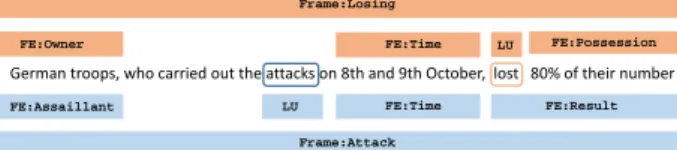
German troops, who carried out the attacks on 8th and 9th October, lost 80% of their number
FE:Assaillant LU FE:Time FE:Result
Frame:Attack
FE:Owner LU FE:Possession
Frame:Losing
FE:Time
Figure 1: Example of sentence annotated with Frames in
An example of annotated sentence1is given in figure 1. As one can see, a single sentence can be annotated with sev-eral frames, each of them triggered by a Lexical Unit (LU):
attacksand lost for respectively the Frames Attack
and Losing. To each Frame is associated a set of Frame
Element(FE) which are the arguments of the semantic
re-lation represented by the Frame. From such annotations, a
Question/Answercorpus can be obtained. The method
con-sists in producing, for every Frame occurrence f , a triplet (F, E, C) where F is the label of the frame f , E is one Frame Element of f and C (for Context) is the set of the other Frame Elements of f . Given a triplet (F, E, C), ques-tions can be produced for which the answer is E.
Two processes have been used to generate the
ques-tion/answer pairs of CALOR-QUEST : one based on an
automatic generation process to obtain the training
parti-tion of CALOR-QUEST ; one based on a manual process
for the validation/test partition.
The automatic generation process consists in using spe-cific and generic patterns for generating questions from a triplet (F, E, C). Generic rules allow to produce a very large number of questions covering all possible questions a Frame could produce, without too much concern for the syntactic correctness of the questions produced. On the op-posite, specific rules produce less questions but are closer to questions that one can naturally produce for a given Frame. In all cases the semantic validity of the questions generated is guaranteed, but not their syntactic validity.
The manual collection of natural questions is reduced to
a validation/test set. Annotators had to write questions
about a text paragraph directly from (F, E, C) triplets. The original sentence was not presented in order to leave more freedom for the annotator in her or his lexical
and syntactic choices. Besides, the annotator can
se-lect any elements of the context to include in the
ques-tion. The main advantage of this method is that it is
possible to know, for each error made by an MRC sys-tem, which phenomenon was not well covered by the model. An example of the information provided to the annotator and the collected questions is given below:
Frame = Hiding objects • Context
– Agent : a Gallic militia leader – Hidden object: a treasure
– Hiding place: in his Bassing farm • Answer
– Place: Moselle
• Questions produced:
– In which region did the Gallic militia leader hide the treasure?
– Where is the location of the Bassing farm in which the Gallic militia leader hid the treasure ?
1the corpus is in French but the examples are translated in
or-der to facilitate the reaor-der’s comprehension
With the proposed method, the resulting corpus CALOR-QUEST consists of about 300 documents in French, for which nearly 100 000 automatic question/answer pairs, and more than 1000 natural question/answer pairs are available. More detailed numbers per collection are given in table 2.
collection #docs #natural #generated
questions questions V antiq 61 274 4672 WP arch 96 302 36259 CT WW1 16 241 7502 WP WW1 123 319 50971 total 296 1136 99404
Table 2: Description of CALOR-QUEST corpus
In the following, the CALOR-QUESTpartition used to train
models is made only of generated questions while the par-tition used for test is the natural question set.
4.
Semantically-based taxonomy of
questions
One of the key features of CALOR-QUEST is to provide
a semantic representation of the answer for each question of the corpus. This representation of the expected answers is based on the Frame Element taxonomy used to annotate
CALOR-FRAME. We propose to associate to each Frame
Element a question type that can generalize the kind of an-swers represented by each Frame Element type. This
tax-onomy of questions is presented in section 4.1 for CALOR
-QUESTand applied to SQuaD in section 4.2.
4.1.
C
ALOR-Q
UESTquestion labelling
For each Frame Element, a question type can be assigned corresponding to the kind of question that could be asked to retrieve the Frame Element (FE). This question type is made of a Wh-word (interrogative determiners, adverbs, or pronouns) eventually followed by a specifier. We have performed this mapping association for the 53 Frames of
the CALOR-FRAME corpus. For example, to the Frame
Hiding, the FE Hiding place is associated to the Wh-word where, Hiding object is associated to what and Agent to who agent. For ”who” and ”what”, we make a distinction whether the FE corresponding to the an-swer is or is not the agent of the Frame. In the former case, the question type is who agent or what agent. In the latter case, it is simply who or what. We have chosen to make this distinction because some Frames can have sev-eral Frame Elements that can be retrieved by asking ”what” or ”who” question (eg. ”who attacks who?”). Addition-ally, we assume that asking a question about the agent of a Frame can raise different issues than asking a question about its patient.
Eventually, all the 495 Frame Elements of the CALOR
-FRAME corpus can be clustered into 64 question types.
In this study they are used to categorize the questions of our test sets in order to study systems general performance along question types and to observe more deeply cross-domain and cross-language robustness of the models. The
CALOR-QUEST test partition covers all the Frames, but only a subset of 245 Frame Elements, corresponding to 38 different question types occur in this test partition. 20 of them occur more than 10 times, covering about 98% of the questions.
4.2.
Bilingual subset of SQuAD question
labelling
The French subset of SQUAD (Fr-sub-SQUAD) will be used in our study both in its French version (Fr-sub-SQuAD) and in its corresponding original En-glish version (En-sub-SQuAD) to support our experimen-tal observations. We have manually labelled this subset of questions with the same question type taxonomy as the one
obtained from CALOR-QUEST. We want to point out that
this manual annotation process is not based on the Wh-word used in the questions, but rather on the semantic role of their answers. For instance, all questions for which the answer is a place are labelled where whatever the formulation of the question (e.g. ”What venue did Super Bowl 50 take place in?”).
4.3.
Question type distribution
Figure 2 presents the distribution of the 20 most frequent
question types in both CALOR and sub-SQuAD corpora.
In both cases the majority class is the category what but the proportion is higher for sub-SQuAD. Questions related to amounts (how much) are much more represented in the sub-SQuAD corpus while the category who agent is
more represented in CALOR-QUEST. The other categories
are rather similarly distributed. Adverbial phrases on the right of the histogram correspond to a minority of questions
in CALOR-QUESTbut present some interesting properties
in terms of models robustness.
5.
Experiments
5.1.
Experimental set up
We use for our MRC system a fine-tuned version of BERT multilingual model: multi cased L-12 H-768 A-12 (Devlin
et al., 2018)2, with default hyperparameters. In order to
re-produce the same conditions as the SQuAD corpus, we cut the CALOR documents into paragraphs whose lengths are close to the average paragraph length of SQuAD (around 120 tokens): starting at the beginning of each document, we look for the next end of sentence marker after 120 tokens. This constitutes the first paragraph on which the MRC sys-tem will be applied. Then the process is repeated on the text starting at the next sentence in the document.
The evaluation is done with SQuAD’s evaluation script3,
customized for French (removing french articles in the nor-malization process, instead of English articles) when evalu-ating French corpora. In this evaluation set-up, ”F1” is the average F-measure per question, where for each question a precision/recall performance is measured between the pre-dicted and ground-truth sets of tokens in answer spans.
2
https://github.com/google-research/bert/ blob/master/run_squad.py)
3https://github.com/allenai/bi-att-flow/
blob/master/squad/evaluate-v1.1.py
Models that are claimed to be trained on SQuAD in this pa-per are trained on the standard training set of SQuADv1.1.
Training on the CALORcorpus is done on a selected
sam-ple set of 30K generated questions. The sampling strategy is motivated by the objective of covering with at least one question all the answers of the corpus. When an answer has several candidate questions, the priority is given to ques-tions generated with specific rules (which are closer to nat-ural questions). Finally the set is completed with questions produced by generic rules in order to reach a 30k train-ing size. Experiments, not reported here, have shown that adding many variants of generic questions for each answer does not improve performances, and may even decrease them.
5.2.
Comparing cross-domain and
cross-language robustness
Table 3 compares performances in terms of F1 of a BERT
model trained on SQuAD or trained on CALOR for
vari-ous test sets. For the first two lines, the test sets differ both from language and domain (even though both SQuAD
and CALORare intrinsically multi-domain, we use the term
”domain” to refer the switch in corpus collection condi-tion).
Training Corpus SQuAD CALOR
Train. Size (Lang.) 87599 (En) 30000 (Fr)
Fr-CALOR-Quest 62.1 82.0
En-SQuAD 87.9 58.3
En-sub-SQuAD 88.8 58.7
Fr-sub-SQuAD 79.6 61.8
Table 3: F1 on various test sets in French and in English
with models trained on SQuAD (trainv1.1) or CALOR
-QUEST
We can observe the impact of train/test mismatch. How-ever, simply observing those two lines is not enough to conclude if language or domain switch are responsible for the drop in performances. The third and fourth line pro-vide some interesting insights. If the model trained on French data yield slightly better performances on Fr-sub-SQuAD than on En-sub-Fr-sub-SQuAD (61.8 vs 58.7), the model trained on English SQuAD outperforms the model trained
on French CALORfor both languages. Even if training
cor-pora don’t have the same size, it is particularly striking to observe that a model trained in similar conditions but on a different language can yield 79.6 F1 while a model trained on French data in different conditions provides a 17.8 pts absolute drop in average F1. These results tend to show that Machine Reading Comprehension models based on multi-lingual BERT contextual representations are more robust to language variations than to domain variations.
Figure 3 shows detailed performances of models trained on
CALORor SQuAD on the CALOR-QUESTnatural
ques-tions test set, depending on the question type labelled as presented in section 4.1. Categories are ranked according to decreasing average F1 score for the model trained on SQuAD. The count of each question type is given in the x axis labels.
Figure 2: distribution of question types for CALOR and the bilingual subset of SQuAD
Figure 3: Detailed performance by question type on the CALOR-QUESTtest set
The first observation is that performance is not uniform among question types, with performance ranging from 24% to 82% for SQuAD model, and from 42% to 95% for CALOR model. All question types improve their perfor-mance when the model is trained on the dedicated CALOR corpus, with a relative improvement ranging from 2% (since when to 78% (for which reason). Even if the conclusions must be tempered by the small amount of examples for these labels, the observation could be ex-plained by the fact that since when answers are strongly correlated to a stable syntactic construction with a
par-ticular preposition (since or depuis in French) followed
by a date. On the other hand, (for which reason)
answers are more likely to occur with a large variety of formulations, making it more difficult for models to
generalize. The question types which perform almost
the same, whatever the model, are against who and
since whenbut, here again, the small size of these sets
does not allow to draw definitive conclusions. The ques-tion types with the largest improvement (around 60% and more) are: for which reason, to whom, to what,
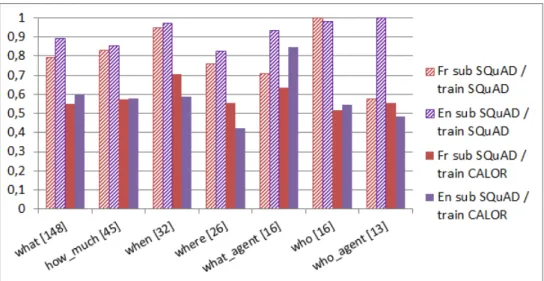
question type performs well (¿80%) already with SQuAD model, and its improvement with dedicated model is mod-erated. Finally, the worst performing question-type is the same for both models: for which reason, even though there is a noticeable improvement with CALOR corpus. The next figure focuses on the SQuAD bilingual test set. It is important to note from table 3 that the overall results on full En-SQuAD and on En-sub-SQuAD are comparable and for the rest of this section we will study in depth mod-els performance on sub-SQuAD only. Hence figure 4 shows performance for the question-types with more than 10 oc-currences (covering more than 90% of the sub-SQuAD questions) for different versions of the test set (French or English) and for different models: the model trained on SQuAD and the model trained on CALOR.
It can be observed that most of the time, results obtained on different question types are comparable across lan-guages for a given model, except for who agent and
what agent where these results are less stable.
How-ever, the difference due to model training conditions is very
important. Hence, training on the CALORFrench corpus,
which is not suited for the thematic domains of SQuAD questions, does not help answering French questions and performance remains at the level of the English ones. That pleads for the intrinsic multilingual capacity of BERT, but domain specific data still enables to get the best perfor-mance. In other words the language effect has less impact than the domain shift effect.
5.3.
Mixing training corpora
In this section we want to observe the impact of mix-ing trainmix-ing data from different languages and different domains. Hence table 4 contains a third column where the model has been trained on a hybrid training
cor-pus composed of the CALOR-QUEST 30k French
ques-tion/paragraph pairs and a randomly sampled subset of 60k English SQuAD question/paragraph pairs. Sub-sampling the SQuAD corpus was achieved in order to obtain equiv-alent corpora in terms of training size (around 90k ques-tion/paragraph pairs).
Training Corpus SQuAD CALOR mixed
Train. Size 87599 30000 30k(Fr))
(Lang.) (En) (Fr) +60k(En)
Fr-CALOR-Quest 62.1 82.0 82.6
En-SQuAD 87.9 58.3 87.6
En-sub-SQuAD 88.8 58.7 87.7
Fr-sub-SQuAD 79.6 61.8 75.4
Table 4: F1 on various test sets with models trained on SQuAD (trainv1.1), CALOR-Quest and a mix of both
The first row shows that performance on the Fr-CALOR-Quest test set is only slightly impacted by training data aug-mentation (82.6 F1 with mixed training corpus against 82.0 with Calor only. A more detailed analysis showed how-ever that some question types are not impacted by corpus augmentation (what, when, how much, to what and what for) while some are positively impacted (+10% rel-ative for to whom and +36% relrel-ative for against who)
and some on the contrary are negatively impacted (-15% relative for in what way and -30% relative for for which reason). The second and third rows yields similar conclusions: training on a multilingual corpus has little impact on overall performance for English test sets. The last row however confirms the preceding conclusions regarding the larger influence of domain against language. For the French subset of SQuAD adding training data from the same domain in English is more efficient (79.6 aver-age F1) than adding training data in French from another domain.
6.
Conclusion
This paper presented a study on the cross-language and cross-domain capabilities of BERT on a Machine Reading Comprehension task. We have described a new French
Ma-chine Reading dataset, called CALOR-QUEST . The
se-mantic annotation available on CALOR-QUESTallows us
to give a detailed analysis on the types of questions that are properly handled through the cross-language process. Thanks to a semantically motivated taxonomy of (ques-tion, paragraph, answer) triplets, we were able to highlight which question types are intrinsically more error prone and which are more sensitive to language or domain shift. Fi-nally, the use of a subset of the SQuAD test corpus available in both French and English allowed further observations to be drown. One of the main conclusion of this work is that with multilingual contextual word representations, the lan-guage effect has less impact than the domain shift effect.
7.
Bibliographical References
Artetxe, M., Ruder, S., and Yogatama, D. (2019). On the cross-lingual transferability of monolingual representa-tions. arXiv preprint arXiv:1910.11856.
Asai, A., Eriguchi, A., Hashimoto, K., and Tsuruoka, Y. (2018). Multilingual extractive reading comprehension by runtime machine translation. CoRR, abs/1809.03275. B´echet, F., Aloui, C., Charlet, D., Damnati, G., Heinecke, J., Nasr, A., and Herledan, F. (2019). CALOR-QUEST : generating a training corpus for Machine Reading Com-prehension models from shallow semantic annotations. In MRQA: Machine Reading for Question Answering -Workshop at EMNLP-IJCNLP 2019 - 2019 Conference on Empirical Methods in Natural Language Processing, Hong Kong, China, November.
Cui, Y., Che, W., Liu, T., Qin, B., Wang, S., and Hu, G. (2019). Cross-lingual machine reading comprehen-sion. In Proceedings of the 2019 Conference on Empir-ical Methods in Natural Language Processing and the 9th International Joint Conference on Natural Language Processing (EMNLP-IJCNLP), pages 1586–1595. Devlin, J., Chang, M.-W., Lee, K., and Toutanova, K.
(2018). Bert: Pre-training of deep bidirectional
trans-formers for language understanding. arXiv preprint
arXiv:1810.04805.
He, W., Liu, K., Liu, J., Lyu, Y., Zhao, S., Xiao, X., Liu, Y., Wang, Y., Wu, H., She, Q., et al. (2018). Dureader: a chinese machine reading comprehension dataset from real-world applications. ACL 2018, page 37.
Figure 4: Result on bilingual subset of SQUAD corpus
Kumar, V., Joshi, N., Mukherjee, A., Ramakrishnan, G., and Jyothi, P. (2019). Cross-lingual training for auto-matic question generation. CoRR, abs/1906.02525. Lee, C.-H. and Lee, H.-Y. (2019). Cross-lingual
trans-fer learning for question answering. arXiv preprint
arXiv:1907.06042.
Marzinotto, G., Auguste, J., Bechet, F., Damnati, G., and Nasr, A. (2018). Semantic frame parsing for informa-tion extracinforma-tion : the calor corpus. In Proceedings of the Eleventh International Conference on Language Re-sources and Evaluation (LREC-2018). European Lan-guage Resource Association.
Nguyen, T., Rosenberg, M., Song, X., Gao, J., Tiwary, S., Majumder, R., and Deng, L. (2016). Ms marco: A hu-man generated machine reading comprehension dataset. arXiv preprint arXiv:1611.09268.
Rajpurkar, P., Zhang, J., Lopyrev, K., and Liang, P. (2016). Squad: 100,000+ questions for machine comprehension of text. In Proceedings of the 2016 Conference on Em-pirical Methods in Natural Language Processing, pages 2383–2392. Association for Computational Linguistics. Siblini, W., Pasqual, C., Lavielle, A., and Cauchois, C.
(2019). Multilingual question answering from format-ted text applied to conversational agents. arXiv preprint arXiv:1910.04659.