Title
Studying illicit drug trafficking on Darknet markets: structure and organisation from a Canadian perspective
Authors
Broséus J.1*, D. Rhumorbarbe1, C. Mireault2, V. Ouellette2, F. Crispino2, D. Décary-Hétu3
Affiliations
1 University of Lausanne, Ecole des Sciences Criminelles, Lausanne, Switzerland
2 Département de Chimie, biochimie et physique, Laboratoire de recherche en criminalistique,
Université du Québec à Trois-Rivières, Québec, Canada
3 Université de Montréal, École de criminologie, Québec, Canada
* Corresponding author : [email protected]
POSTPRINT VERSION. The final version is published here:
Broséus, J., Rhumorbarbe, D., Mireault, C., Ouellette, V., Crispino, F., & Décary-Hétu, D. (2016). Studying illicit drug trafficking on Darknet markets: Structure and organisation from a Canadian perspective. Forensic Science International, 264, 7-14. http://dx.doi.org/10.1016/j.forsciint.2016.02.045 CC BY-NC-ND
Abstract
Cryptomarkets are online marketplaces that are part of the Dark Web and mainly devoted to the sale of illicit drugs. They combine tools to ensure anonymity of participants with the delivery of products by mail to enable the development of illicit drug trafficking.
Using data collected on eight cryptomarkets, this study provides an overview of the Canadian illicit drug market. It seeks to inform about the most prevalent illicit drugs vendors offer for sale and the preferred destination countries. Moreover, the research gives an insight into the structure and organisation of distribution networks existing online. We inform on the number of listings each vendor manages, the number of cryptomarkets they are active on and the products they sell in function of their presence on them.
This research demonstrates the importance of online marketplaces in the illicit drug markets. It shows how the analysis of data available online may elicit knowledge on criminal activities. Such knowledge is mandatory to design efficient policy for monitoring or repressive purposes.
Keywords
1. Introduction
Cryptomarkets are defined as a type of website that employs advanced encryption to protect the anonymity of users and that have been launched by entrepreneurs since a few years to increase the security of virtual illicit markets [1]. They are part of the Dark Web (a small part of the Deep Web) and propose a wide range of illegal products, mainly illicit drugs, which are shipped by post. They share many structural features with popular marketplaces such as eBay or Amazon, with searchable listings of products for sale and buyers being able to leave feedback on their purchases. These online markets use the virtually untraceable cryptocurrency bitcoin, The Onion Router (TOR) service and the encryption of private messages, files and e-mails using the Pretty Good Privacy (PGP) cryptosystem to ensure anonymity of both administrators and participants [1-4]. These technologies and the delivery of products by mail have significantly decreased the monitoring and detection abilities of law enforcement agencies. Moreover, these tools combined with an escrow system have significantly changed the structure and organisation of illicit drug trafficking. This phenomenon is characterised as a revolution and a criminal evolution in drug trading [5, 6].
Works evaluated the impact of such marketplaces on consumers and vendors as well as the spread of this trafficking. In particular, studies focussed on Silk Road, the first cryptomarket to appear at the beginning of 2011 [1, 5-13]. Researchers first characterised Silk Road as an “eBay for Drugs” with drug consumers making personal use-sized purchases and described transactions as ‘business-to-customers’ [1-3]. Instead, a study showed that a significant proportion of transactions on Silk Road was best characterised as ‘business-to-business’, with sales in quantities and at prices typical of purchases made by dealers sourcing stock [6]. Just before its closure, more than 1000 vendors were active on Silk Road and annual sales were estimated at 89.7 millions USD [6]. United-States was the most frequent country of origin of vendors and sellers proposed to ship their illicit products mostly worldwide [3]. While cryptomarkets contribute little to the global illicit drug trade, more than 50% of drug consumers in Australia, England and United-States know they exist and about 15% of them have performed at least one transaction [12].
Cryptomarkets show benefits for both vendors (security, worldwide market) and consumers (diversity in the kind of available drugs, the information related to products and vendors, the quality of products, security) compared to traditional market [10-12]. At the time of writing, about 20 cryptomarkets are active. This illustrates the strong demand for this kind of
products. It seems unlikely that cryptomarkets are going to disappear, in spite of law enforcement crackdowns [6].
Thus, this research aims at gaining knowledge on these marketplaces. In particular, the study investigates the structure and organisation of the illicit drug trafficking from a Canadian perspective. Data were collected in 2014 from eight cryptomarkets and consist in 3685 listings and about 200 vendor profiles from Canada.
2. Material and methods
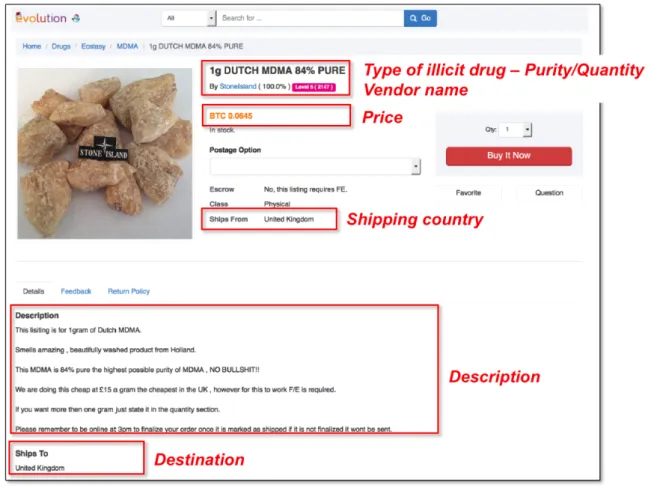
Listings and vendor profiles present on eight cryptomarkets were indexed and collected between August and September 2014 using a web crawler. Each listing had its own webpage that contained a title (drug name and quantity), description, product category, price, vendor identification number, shipping country, shipping destinations and postage options. Feedback from past customers on both product and vendor is available for consultation (see Figure 1). Each vendor also had his own profile page, which contained the registration date, a personal description, his public PGP key, a metric related to feedback (i.e. good/bad reputation), and the number of past transactions. Since our study aims at analysing the Canadian illicit drug market on Darknet, only listings and vendors from Canada were considered. Thus, our dataset contained 3685 listings and 198 vendor profiles.
In this paper, we first provide an overview of the Canadian drug market with information such as the types of illicit drugs on sale and the destination countries. Then, we investigate how the online market is structured and organised through a combined analysis of usernames and their public PGP keys. PGP is an encryption protocol that allows anyone to encrypt a message in a way that ensures that only the recipient can decrypt the data [4]. It involves from the participants the sharing of their respective public PGP keys and they serve as an important identity-verification tool between users [14]. Thus, the analysis of PGP keys may confirm the membership of similar usernames to the same distribution network and also reveal the existence of relationships between different usernames.
Figure 1. Example of a listing with collected information in red
(screenshot of the cryptomarket Evolution)
3. Overview of the illicit drug trafficking
The Canadian market seems to contribute little to the global drug trade on Darknet in terms of listings originating from Canada as the drug listings originating from Canada represented only 6% of the respective total number of listings on Silk Road [3].
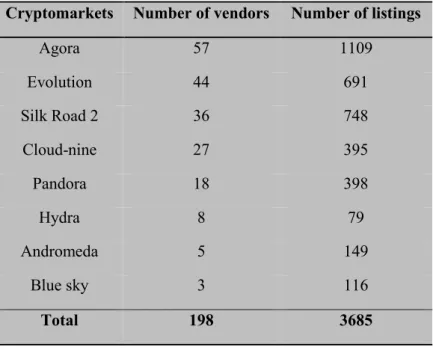
According to our dataset, Agora, Silk Road 2 and Evolution are the three main cryptomarkets in terms of the number of vendors active on them and products on sale, as illustrated by Table 1.
Cryptomarkets Number of vendors Number of listings Agora 57 1109 Evolution 44 691 Silk Road 2 36 748 Cloud-nine 27 395 Pandora 18 398 Hydra 8 79 Andromeda 5 149 Blue sky 3 116 Total 198 3685
Table 1. Number of vendor names and listings originating from Canada on the eight cryptomarkets
Cannabis (mainly weed/marijuana but also resin, concentrates, etc.) is largely proposed,
followed by products sold as Ecstasy, Psychedelics and Stimulants (see Table 2). Ecstasy, MDA and MDMA are mainly proposed as Ecstasy. Substances particularly mentioned in the category
Stimulants are cocaine, speed/methamphetamine and amphetamine; more rarely are ephedrine,
ephedrine, methylone and MDVP. Psychedelic comprises mostly substances such as LSD blotters/crystal, mushrooms, mescaline, dissociatives (mainly GHB and ketamine) and Research Chemicals. While heroin is principally present in the category Opioids, fentanyl, hydromorphone and oxycodone are also proposed. 2906 listings concern these types of drugs, which represent about 80% of the total number of drug listings collected on the eight cryptomarkets (n = 3685).
Category Number of listings Percentage (n = 3685) Cannabis 1334 36 Ecstasy 549 15 Psychedelics 428 12 Stimulants 410 11 Opioids 185 5
Table 2. Number of listings and proportions per category of illicit drug1
Canadian vendors propose to ship illicit products mainly all over the world, as illustrated by Table 3. Such information does not enable us to infer the precise country the illicit drug may be sent to but reveals the capability of vendors to handle worldwide shipping. They are not reluctant to ship illicit drugs across borders. This may be explained by the techniques used by sellers to make interception of mails unlikely – e.g., vacuum sealing, “professional-looking” envelops with typed destination addresses. Since some vendors also asked to be paid at the time of the transaction, shipping drugs worldwide represents a relatively low risk for them [3]. Canada, United-States or both of them are the only possible destinations of a few listings. These are thus described as domestic shipments, which have low chances to be seized by law enforcement authorities, according to vendors’ statements on their profiles. Lastly, it is worth noting the presence of listings not to be intended for Australia, since this country implemented efficient methodologies to control importations of illicit products by post [15].
1 There were a number of additional categories under which drugs were sold on each of the eight marketplaces
that we do not present in our tables, because the substances involved were not illegal: other (n = 143),
paraphernalia (n = 1), prescription (n = 197), steroids (n = 6), supplements (n = 1), undefined (n = 390) and weight loss (n=3).
Destination Number of listings Percentage (n = 2906*)
Worldwide 1801 62
Domestic 388 13
Information not available 367 13
List of countries 311 11
Worldwide except Australia 17 < 1 Worldwide except Domestic 22 < 1
Table 3. Destinations of the shipments as mentioned by the vendors (* : number of listings concerning cannabis,
ecstasy, psychedelics, stimulants and opioids)
4. Structure of the trafficking
a. Analysing vendor names
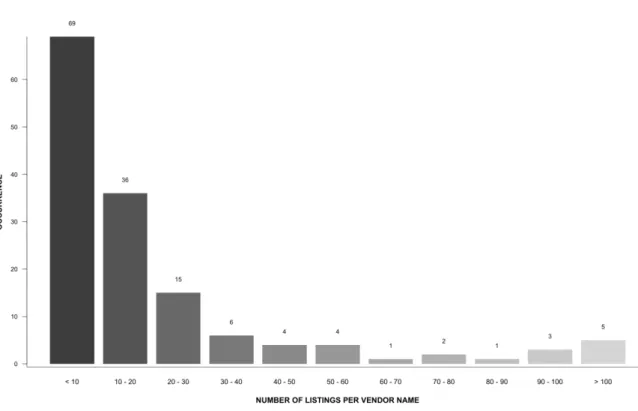
136 unique usernames were identified (names were considered different even when only the case was different). Most of the Canadian vendors manage less than ten listings each (69 vendors, representing 47 % of the total number of vendors, see Figure 2). This is probably because of the difficulty of managing several listings at the same time (that may concern different types of illicit drugs), since customers may order the same listing more than once. Therefore, each vendor has to manage its supply and the orders. However, some vendors propose a relatively high number of products. For instance, five vendors possess more than 100 listings each. This observation may reveal that they play a major role in the illicit drug trafficking.
Figure 2. Distribution of the number of listings for each vendor
A complementary way to evaluate which vendors may be important actors of the trafficking consists in studying the structure of their illicit activity (i.e. their presence on one or several markets). When based on vendor names, this analysis reveals that most of the vendors (114, about 80% of the total number of vendors) focus their activity on only one market (Figure 3). Furthermore, their presence on several cryptomarkets at the same time decreases when the number of cryptomarkets increases. Nevertheless, some vendors do operate on several markets. They may be thus defined as important actors of drug trafficking compared to vendors focussing on the same cryptomarket. This is especially true since vendors present on several cryptomarkets usually manage a high number of listings: the number of listings of a vendor is correlated to the number of markets where he is present (correlation of 0.6, p-value < 10-16).
For instance, 17 vendors are present from 3 to 6 markets. The number of listings each of them manages varies between 19 and 438. The minimum of this range is relatively high according to Figure 2 (see above).
Figure 3. Occurrence of vendor names and PGP keys on one or several cryptomarkets
b. Analysing PGP keys
It is worth noting that the results obtained through the analysis of usernames are uncertain. Indeed, presence of similar vendor names on different marketplaces does not mean they are part of the same distribution network. Moreover, the semantically or phonetically similarity between virtual usernames may not be a relevant indicator of their use by the same people/organisation. For instance, on Andromeda a vendor named Cannabisking says in his profile: “WE ARE NOT ASSOCIATED WITH CANNABISKING FROM CLOUD-NINE. WE ARE CANNABISKING EVERYWHERE ELSE. ON CLOUD-NINE WE ARE CANNABISKINGS”. The analysis of the public PGP key associated with each vendor provides meaningful information to address such issue. Since the key serves as an authentication tool between participants, this analysis objectifies the determination of the structure of the online market and makes less uncertain the characterisation of distribution networks (see Material and methods). Thus, a vendor mentions
another vendor named TessellatedMDMA mentions on his profile: ”We are the same vendor as "Tessellated". This is the account we sell our MDMA on. You can confirm we are the same because we are both using the same PGP key and this message is signed with that key”. The combined analysis of vendor names and public PGP keys shows that 89% of usernames are associated with only one key and 83% of keys are associated with only one username. This shows that vendors generally use one and only one public PGP key. Conversely, one key is mostly associated with one and only one username. It is worth noting that most of the vendors are present on only one cryptomarket (see Figure 3), which may partly explain these high percentages. Nevertheless, these results illustrate the individual character of the association username - public PGP key. A few keys are associated with usernames that are different (14% of PGP keys are related to two different names, 2% to three different names). In other words, different usernames/seller accounts are using the same PGP key. Most of these seller accounts are active on different cryptomarkets, even though two keys are found to be respectively associated with two vendors on the same cryptomarket. This is not an attractive approach, as there is a fee associated with opening a seller account [3]. However, by ensuring their presence on several cryptomarkets, sellers may reach more customers and increase their income. In a few words, illicit drug trafficking on Darknet is therefore more structured than we would have thought through the analysis of vendor names.
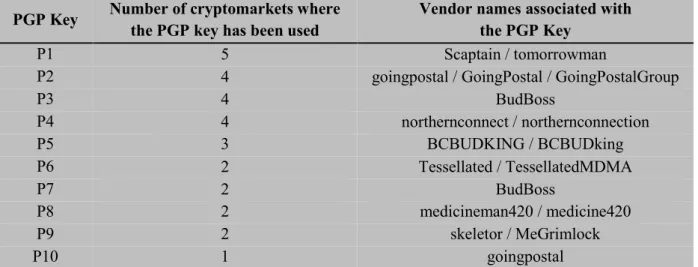
Indeed ou morever, The analysis of public PGP keys shows that for the most part usernames used by a same distribution network are quite similar, with names differing only from the case or addition of a word (see the names associated with P2, P4, P5, P6 and P8 in Table 4). This makes sense as the vendor sells commodity and relies on repeat custom, sometimes interacting with the same people. The reputation and the name of a vendor are strongly connected. When you have reached good reputation, you will keep your username since it vouches for the quality of the commodity you sell. For instance, a vendor named Straightbiz mentions in his profile “You can find me on Silk Road & Agora under the same vendor name I have great feedbacks (perfect 5/5 so far which took me months of honest selling)“. Thus, reputation and username play a major role regarding income. In the drugs cryptomarket era, having good customer service and a good reputation via feedback are important assets to the success of distribution networks [6].
Public PGP keys also reveal relationships between vendors that were uncertain or not suspected because of differences in their usernames (see especially P1 and P9 in Table 4). These results confirm the information provided by vendors on their profiles. For instance, on the profile of Scaptain we read “[...] NEW OWNER--- TOMORROWMAN!! Purchased this account on april 17th. Identity can be verified by my pgp”. Likewise, MeGrimlock and skeletor (P9) use exactly the same words in the description of their profiles. Usernames associated by P2 (see Table 4) all mention to be part of the “Going Postal Group”. On the cryptomarket Pandora the vendor associated with P8 clearly says he is ”Currently on AGORA, Blue Sky and Pandora(medicineman420) and SR2(medicine420)” and vendors associated with P4 refer to the same e-mail address in the description of their profiles. Lastly, BCBUDking and Tessellated/TessellatedMDMA are also linked through their respective keys, confirming their statements on their profiles (see the first paragraph of this section).
PGP Key Number of cryptomarkets where the PGP key has been used Vendor names associated with the PGP Key
P1 5 Scaptain / tomorrowman
P2 4 goingpostal / GoingPostal / GoingPostalGroup
P3 4 BudBoss P4 4 northernconnect / northernconnection P5 3 BCBUDKING / BCBUDking P6 2 Tessellated / TessellatedMDMA P7 2 BudBoss P8 2 medicineman420 / medicine420 P9 2 skeletor / MeGrimlock P10 1 goingpostal
Table 4. Examples of vendor names associated with the same PGP key
Some vendors, while using exactly the same name on the cryptomarkets they are active on, do not necessarily use the same public PGP key (10% of vendors are associated with two keys and 1% with three keys). Consequently, this shows the importance of combining the analysis of
Vendor names where the same name is used Number of cryptomarkets Number of PGP keys used by the vendor BudBoss 6 2 tomorrowman 5 2 CanadianExpress 4 2 MeGrimlock 3 2 goingpostal 2 2 medicineman420 2 2 northernconnection 3 1 GoingPostal 2 1 BCBUDking 1 1 GoingPostalGroup 1 1
Table 5. Examples of vendor names associated with one or several PGP keys
5. Organisation of the trafficking
Figure 4 illustrates the proportions of illicit drugs vendors, linked through their names and/or public PGP keys, offer for sale. This analysis shows that some vendors are specialised in selling one category of illicit drug whatever the cryptomarkets where they are (see BudBoss and northernconnect/northernconnection, which manage 478 and 73 listings, respectively). The difference of vendor’s behaviour according to marketplace is also revealed by such analysis. Straightbiz (25 listings) only proposes two types of illicit drugs. Nevertheless, he focuses on selling psychedelics on Agora and stimulants on Evolution. The distribution networks respectively composed of Scaptain/tomorrowman (107 listings) and goingpostal/GoingPostal/GoingPostalGroup (294 listings) propose a wide range of illicit drugs and are present on several marketplaces (on Evolution, GoingPostal and GoingPostalGroup are associated with the same public PGP key). Therefore, this raises questions on their ability to ensure their supply. Scaptain/tomorrowman do not propose all their products on the markets they are active on (for instance, opioids on Agora and Hydra; psychedelics on Hydra and Pandora). Differences are also observed when several sellers, part of the same distribution network, are active on the same cryptomarket. On Evolution, GoingPostalGroup proposes opioids, psychedelics and cannabis while another entity of the same distribution network mainly focuses on selling ecstasy and stimulants. Likewise, the two entities Tessellated/TessellatedMDMA, part of the same distribution network according to the analysis of their public PGP keys, do not propose the same types of illicit drugs in function of their seller accounts in accord with their statements on their vendor profiles.
Figure 4. Proportions of the types of illicit drugs offered for sale by some Canadian vendors (proportions are
expressed in function of the percentage of the total number of illicit drug listings proposed by each vendor). Addendum
A study of the quantity and price of the illicit drugs proposed by sellers may help to refine the description of the organisation of distribution networks. For instance, we may hypothesise on the type of purchasers targeted by sellers (i.e. consumers or dealers) as well as the role of sellers in the distribution chain. That would also be a relevant analysis to corroborate the importance of specific vendors in the Canadian illicit drug market.
6. Conclusion
This study investigates illicit drug trafficking from a Canadian perspective through the analysis of 3685 listings and 198 vendor profiles collected during two months on eight cryptomarkets. The contribution of Canadian vendors may be described to be low when considering the global illicit trade on Darknet. Nevertheless, they propose a wide range of products and can handle worldwide shipping. The results reveal the presence of key actors of the Canadian illicit drug trafficking. They are characterised by the number of listings they manage, the diversity in the types of products they offer for sale and the number of cryptomarkets they are active on. The combined analysis of vendor names and public PGP keys gives an insight into the structure of the trafficking and reveals the existence of distribution networks. It shows that vendors may be active on several cryptomarkets and may use similar or different usernames. Therefore, trafficking on Darknet is more structured than we thought after the analysis of usernames. Lastly, the study of the products sellers offer for sale illustrates that some of them dedicate part of their online accounts to the selling of specific types of illicit drugs, whether they are present on one or several cryptomarkets. Moreover, the products they offer depend on the marketplace where they sell. In a few words, distribution networks may manage different seller accounts, may be present on several cryptomarkets and may propose a wide range of illicit drugs. Thus, they are organised and structured to ensure an efficient trafficking.
This research demonstrates that data available online help to better understand illicit drug trafficking on Darknet. Moreover, they enable to highlight the main actors and to draw hypotheses on the structure and distribution of the online market. Knowledge gathered through the analysis of this data is mandatory to design efficient policy for monitoring or repressive purposes. Indeed, the seizures of cryptomarkets along with the arrests of administrators by law enforcement authorities did not prove to be an efficient approach to disrupt trafficking on Darknet and to interrupt the development of this phenomenon. Yet, these data are virtual and uncertain, making the study of this phenomenon difficult. The contribution of the profiling of physical data may provide a better understanding of all the aspects of the illicit drug trading on cryptomarkets [16]. For instance, it may corroborate the structure of the distribution networks highlighted through the analysis of digital data [17].
References
1. Martin, J., Lost on the Silk Road: Online drug distribution and the ‘cryptomarket’. Criminology and Criminal Justice, 2014. 14(3): p. 351-367.
2. Barratt, M.J., Silk Road : eBay for Drugs. Addiction, 2012. 107(3): p. 683-683.
3. Christin, N., Traveling the Silk Road: A measurement analysis of a large anonymous
online marketplace. Technical Reports, 2012. CMU-CyLab-12-018.
4. Zimmermann, P., The Official PGP User's Guide, ed. MIT Press Cambridge. 1995, MA, USA.
5. Van Hout, M.C. and T. Bingham, Responsible vendors, intelligent consumers: Silk
Road, the online revolution in drug trading. International Journal of Drug Policy, 2014.
25(2): p. 183-189.
6. Aldridge, J. and D. Décary-Hétu, Not an 'Ebay for Drugs': The Cryptomarket 'Silk Road'
as a Paradigm Shifting Criminal Innovation. Social Science Research Network, 2014.
7. Burns, L., A. Roxburgh, R. Bruno, and J. Van Buskirk, Monitoring drug markets in the
Internet age and the evolution of drug monitoring systems in Australia. Drug Testing
and Analysis, 2014. 6(7-8): p. 840-845.
8. Buxton, J. and T. Bingham, The Rise and Challenge of Dark Net Drug Markets. Policy Brief 7, 2015.
9. Phelps, A. and A. Watt, I shop online – recreationally! Internet anonymity and Silk
Road enabling drug use in Australia. Digital Investigation, 2014. 11(4): p. 261-272. 10. Hout, M.C.V. and T. Bingham, ‘Surfing the Silk Road’: A study of users’ experiences.
International Journal of Drug Policy, 2013. 24(6): p. 524-529.
11. Hout, M.C.V. and T. Bingham, ‘Silk Road’, the virtual drug marketplace: A single case
study of user experiences. International Journal of Drug Policy, 2013. 24(5): p. 385-391. 12. Barratt, M.J., J.A. Ferris, and A.R. Winstock, Use of Silk Road, the online drug
marketplace, in the United Kingdom, Australia and the United States. Addiction, 2014.
109(5): p. 774-783.
13. Dolliver, D.S., Evaluating Drug Trafficking on the Tor Network: Silk Road 2, the
Sequel. International Journal of Drug Policy, 2015. 26(11).
14. Afilipoaie, A. and P. Shortis, From Dealer to Doorstep – How Drugs Are Sold On the
Dark Net, in Global Drug Policy Observatory Situation Analysis. June 2015: Swansea
University.
15. Parkinson, A., Illicit Material in International Mail: The Application of Forensic
Intelligence, in ANZFSS International Symposium. 2014: Adelaide.
16. Mireault, C., V. Ouellete, J. Aldridge, D. Décary-Hétu, F. Crispino, and J. Broséus,
Potentiel criminalistique de l'étude de la distribution et la consommation de drogues au Canada à partir des données collectées sur les cryptomarchés. Canadian Society of
Forensic Science Journal, 2015. Accepted for publication.
17. Horne, N., K. Edmondson, M. Harrison, and B. Scott, The applied use of forensic
intelligence for community and organised crime. Australian Journal of Forensic