HAL Id: hal-00327643
https://hal.archives-ouvertes.fr/hal-00327643
Submitted on 9 Oct 2008
HAL is a multi-disciplinary open access
archive for the deposit and dissemination of
sci-entific research documents, whether they are
pub-lished or not. The documents may come from
teaching and research institutions in France or
abroad, or from public or private research centers.
L’archive ouverte pluridisciplinaire HAL, est
destinée au dépôt et à la diffusion de documents
scientifiques de niveau recherche, publiés ou non,
émanant des établissements d’enseignement et de
recherche français ou étrangers, des laboratoires
publics ou privés.
scenario
Jérôme Charles
To cite this version:
Jérôme Charles. Status of the CKM Matrix and a simple New Physics scenario. Proceedings of the
Second Workshop on Theory, Phenomenology and Experiments in Heavy Flavour Physics, Jun 2008,
Capri, Italy. pp.17, �10.1016/j.nuclphysbps.2008.10.020�. �hal-00327643�
Status of the CKM Matrix and a simple New Physics scenario
J. Charles, on behalf of the CKMfitter groupa∗
aCentre de Physique Th´eorique, Luminy Case 907
13288 Marseille Cedex 9, France
We present a short status of the CKM matrix in the Standard Model as well as possible New Physics contri-butions to BB mixing.
1. Introduction
We shall be concerned by the weak current transitions that mix quarks of different flavors, as encoded by the Cabibbo-Kobayashi-Maskawa (CKM) matrix in the Standard Model (SM). The unitarity 3 × 3 CKM matrix can be described by
four real parameters that we define `a la
Wolfen-stein by λ2 = |Vus|2 |Vud|2+ |Vus|2 A2λ4 = |Vcb|2 |Vud|2+ |Vus|2 (1) ¯ ρ + i¯η = −VudVub∗ VcdVcb∗
This parametrization is exact, unitary and phase convention independent to all orders in λ. Our aim is to extract as much as possible infor-mation from experimental and theoretical inputs so that constraints on the CKM parameters are obtained. Then the questions to be asked follow: does the CKM mechanism describe the experi-mental data ? To which accuracy ? Are possible New Physics contributions needed, or simply al-lowed ?
The CKMfitter project follows this program within the Rfit frequentist approach [1]. In these proceedings a few recent results are highlighted.
∗Unit´e Mixte de Recherche 6207 du CNRS et des
Uni-versit´es Aix-Marseille 1, Aix-Marseille 2 et Sud
Toulon-Var, affili´ee `a la FRUMAM. This work has been supported
in part by the EU Contract No. MRTN-CT-2006-035482 ‘FLAVIANET’ and by the ANR Contract ANR-06-JCJC-0056. γ γ α α ∆md K ε K ε s m ∆ & d m ∆ ub V β sin 2 (excl. at CL > 0.95) < 0 β sol. w/ cos 2 excluded at CL > 0.95 α β γ ρ -1.0 -0.5 0.0 0.5 1.0 1.5 2.0 η -1.5 -1.0 -0.5 0.0 0.5 1.0 1.5
excluded area has CL > 0.95
Capri 2008 CKM
f i t t e r
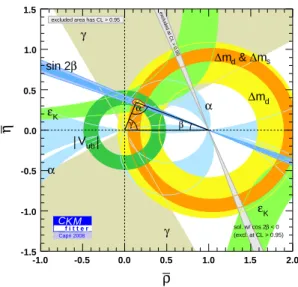
Figure 1. SM constraints at 95%CL on the apex
(¯ρ, ¯η) of the Bd Unitarity Triangle.
2. The global fit
The global fit is defined as the combined con-straints from the selection of inputs that are both well measured and reasonably well understood from the theoretical point of view. This
tradi-tionally corresponds to |Vud|, |Vus|, |Vcb|, |Vub|
(from semileptonic decays), |εK|, ∆md, ∆ms,
BR(B → τ ν), and the angles of the Unitarity Triangle α, β and γ, which are the only
observ-ables that can directly be interpreted in terms of fundamental parameters with negligible theoreti-cal uncertainties.
The detailed list of inputs and references can be found in [1]. There are little changes with re-spect to the last CKMfitter update done for Win-ter 2008 conferences [2]. Presumably the most important issues as for the traditional inputs to the global CKM fit are the marginal agreement between the exclusive and inclusive semileptonic
determinations of both |Vcb| and |Vub| [3], and the
statistical interpretation of γ [4].
The outcome of the global fit is shown in Fig. 1
in the (¯ρ, ¯η) plane, corresponding to the best fit
values of the CKM parameters
A = 0.795+0.025−0.015 λ = 0.2252+0.0008−0.0008 (2) ¯ ρ = 0.135+0.033 −0.016 ¯ η = 0.345+0.015−0.018
3. New Physics in BB mixing
Even if the global fit within the SM does not show any significant anomaly, it is interesting to study generic New Physics (NP) scenarios in or-der to quantify better the agreement of the data with the SM predictions, and to find bounds on possible non standard contributions. One of the simplest of these scenarios consists in allowing for arbitrary NP in neutral meson mixing by writing
Bq H SM+NP ∆B=2 ¯Bq ≡ Bq H SM ∆B=2 ¯Bq (3) × (Re(∆q) + i Im(∆q))
where the SM is located at the point ∆d= ∆s=
1. Here we will not use observables related to the kaon system.
In order to fit for NP according to the above equation one must first be sure that there is suffi-cient information to constraint the SM contribu-tion. This is done by assuming that tree-level
ob-servables are purely standard, namely |Vud|, |Vus|,
|Vcb|, |Vub|, γ and α = π−γ −φd/2 where φdis the
‘effective’ β angle as measured in Bd → (c¯c)KS,
that is φd = 2β + Arg(∆d). The remaining
ob-servables relevant to the global fit depend on both
the SM parameters A, λ, ¯ρ, ¯η and the NP
param-eters ∆d,s. Additional useful information on the
latter parameters come from the measurement of
the semileptonic asymmetries Ad,sSL and the width
differences ∆Γd,swhich in our simple NP scenario
can be written as
∆Γq = cos ϕq∆ΓSMq (4)
where ϕq is the weak phase Arg(−M12q /Γ
q
12). It is
important to keep in mind that both the semilep-tonic asymmetries and the width differences are plagued by significant theoretical uncertainties, which we estimate following Ref. [5].
Recent measurements by the Tevatron experi-ments have a strong impact on the NP in mix-ing scenario. Indeed first correlated constraints
in the (φs, ∆Γs) plane from the time-dependent
angular analysis of Bs → J/ψφ have been
pre-sented by both CDF and D0 [6,7]. These mea-surements show a discrepancy of about two stan-dard deviations with respect to the SM prediction
φs = −2βs = −0.0360 ± 0.0017, and have been
the basis of a claim for evidence for non standard
contributions in BsBsmixing in Ref. [8], using a
Bayesian treatment of the data.
The interpretation of the Tevatron measure-ments in view of a combined analysis is not
straightforward, for two reasons. The first is
that D0, in contrast to CDF, assumes SU(3) fla-vor symmetry of the strong interaction in order to take as additional input the CP-conserving
phases in Bd → J/ψK∗ which in this symmetry
limit are identical to the ones in Bs → J/ψφ.
While this is an interesting approach allowing for a deeper use of the experimental data, it is not known at present to which extent the SU(3) assumption can be used for final state interac-tion effects, nor the typical size of the correc-tions. Ref. [8] attempts to correct for the SU(3) assumption by reintroducing, ‘by hand’, the mir-ror solution that is otherwise suppressed by the
Bd → J/ψK∗ input. However possible bias and
overestimate of the constraint corresponding to the main solution is not taken into account.
Fortunately at the time of the present work-shop a new (preliminary) measurement free of the SU(3) assumption was made public by the D0 col-laboration in order to make easier the combina-tion with CDF. This is what we use in the present report.
-1 -0.5 0 0.5 1 1.5 2 Ρ -1.5 -1 -0.5 0 0.5 1 1.5 Η È VubÈ Γ ÈVubÈ&Γ all
New Physics in B-Bmixing excluded area has CL>0.95
Capri 2008
C K M f i t t e r
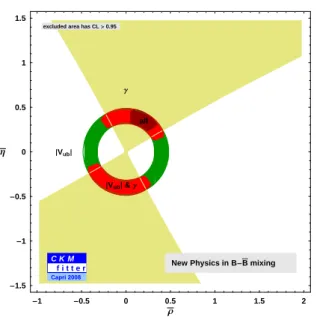
Figure 2. Constraints at 95%CL on the apex
(¯ρ, ¯η) of the BdUnitarity Triangle, within the full
SM+NP scenario.
The second subtlety in using these data is re-lated to significant preasymptotic (non Gaussian) effects due to the relatively low statistics in both the experiments [6,7]. The naive interpretation of
the log-likelihood as a χ2 has the consequence of
biasing the fitted estimate of ∆Γs towards large
values, and the fitted error on φs towards small
values (i.e. the Gaussian assumption is not con-servative in this case). This is very much similar to the well known problem of extracting the an-gle γ from asymmetries that are suppressed
be-cause of the small value of rB. Ref. [6] corrects for
the non Gaussianities by using a fully frequentist Monte-Carlo approach, thus constructing Confi-dence Level contours that have the correct cov-erage of the true value of the parameters. In the present analysis, though, we use the simplified Gaussian assumption (keeping in mind it is a pri-ori not conservative) because we lack the neces-sary information from D0 to perform the fully fre-quentist study. Ref. [8] also uses a similar treat-ment of the input data.
The results of the full combined analysis within the NP in mixing scenario is shown in Fig. 2 in the
(¯ρ, ¯η) plane. It is seen that the resulting allowed
region is compatible with the one obtained from the pure SM fit, however it has larger size be-cause of the presence of the additional parameters
∆d,s. The BqBq mixing is best explored directly
in the ∆q complex plane, see Figs. 3 and 4. One
-2 -1 0 1 2 3 ReHDdL -2 -1 0 1 2 ImHDdL Α Dmd&Dms AslHBdL& AslHBsL
sin2Β& cos2Β>0 all
SM point
New Physics in Bd-Bd
mixing excluded area has CL>0.68
Capri 2008
C K M f i t t e r
Figure 3. Full SM+NP scenario. Constraints
at 68%CL on the complex ∆d parameter, which
measures the deviation of BdBd mixing with
re-spect to the SM.
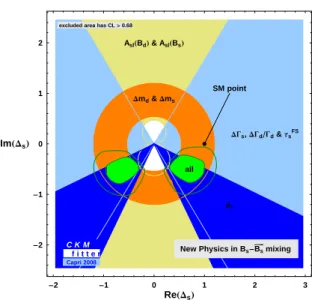
finds from these plots that the combined
analy-sis slightly prefers non standard values for the ∆q
parameters, however the effect is not large. In or-der to put this statement on quantitative grounds, one compute p-values for various hypotheses cor-responding to the SM predictions, see Table 1. The largest (2.7σ) discrepancy with respect to the Standard Model predictions is found when
testing (one dimensionally) Arg(∆s) = 0 or
-2 -1 0 1 2 3 ReHDsL -2 -1 0 1 2 ImHDsL DGs,DGdGd&ΤsFS Dmd&Dms AslHBdL& AslHBsL Φs all SM point New Physics in Bs-Bs mixing excluded area has CL>0.68
Capri 2008
C K M f i t t e r
Figure 4. Full SM+NP scenario. Constraints
at 68%CL on the complex ∆s parameter, which
measures the deviation of BsBs mixing with
re-spect to the SM.
the new Tevatron analysis of Bs → Jψφ.
How-ever the two dimensional hypothesis ∆s = 1 is
less disfavored, with only 2.2 standard deviations. This is related to the fact that Eq. (4) together
with the measurement of ∆Γspushes ϕs, and thus
φs (both phases are equal if the NP phase
dom-inates [5]), towards the SM value. This is best
viewed in the (φs, ∆Γs) plane that we detail
be-low. Indeed one lesson from Fig. 4 is that, as far
as BsBs mixing is concerned, the only really
rel-evant inputs are ∆ms and φs. Since the direct
measurement of ∆ms is well in agreement with
the SM prediction, and since ∆Γsis strongly
cor-related with φs, one can perform a much
sim-plified analysis by restricting to the (φs, ∆Γs)
plane and directly comparing with the experimen-tal measurements in [6,7].
Fig. 5 shows the Confidence Level contours in
the (φs, ∆Γs) plane. Again it clearly appears that
what drives the minor discrepancy with respect to
the SM is the CP phase φs. p-values for the SM
Table 1
p-values and standard deviations for different hy-potheses corresponding to the SM predictions within the generic SM+NP scenario
hypothesis p-value σ Arg(∆d) = 0 0.37 0.9 ∆d= 1 0.34 0.9 Arg(∆s) = 0 0.0077 2.7 ∆s= 1 0.029 2.2 ∆d= ∆s= 1 0.07 1.8
hypotheses corresponding to this simplified plot are reported in Table 2.
Table 2
p-values and standard deviations for different hy-potheses corresponding to the SM predictions,
fo-cusing only on the (φs, ∆Γs) inputs
hypothesis p-value σ φs= −2βs (CDF only) 0.039 2.1 φs= −2βs (D0 only) 0.055 1.9 φs= −2βs (CDF&D0) 0.0062 2.7 φs= −2βs
(CDF&D0 & Eq. (4)) 0.016 2.4
4. Conclusion and outlook
Although there is a hint of a departure from the Standard Model related to the measurement
of the phase φs, consistently by the CDF and D0
experiments, we do not see evidence (larger than the 3σ threshold) for New Physics, which has to be contrasted with Ref. [8]. It should be noted that an update of [8] performed for the present workshop leads to a similar conclusion [10]. It thus means that, in addition to possible artefacts of the Bayesian approach, the SU(3) assumption
-3 -2 -1 0 1 2 3 Φs -0.6 -0.4 -0.2 0 0.2 0.4 0.6 DGs SM D0 CDF ΤsFS cosHΦsLxDGsSM all New Physics in Bs-Bs mixing excluded area has CL>0.95
Capri 2008
C K M f i t t e r
Figure 5. Constraints at 68%CL in the (φs, ∆Γs)
plane. Overlaid are the constraints from the di-rect CDF measurement, the didi-rect D0 measure-ment, the constraint from Eq. (4), the constraint
from the flavor specific lifetime τFS
Bs [9] and the
overall combination. The SM prediction is also shown.
as originally done in [7] and only partially lifted in [8] significantly increased the discrepancy with respect to the SM value. In the absence of a bet-ter understanding of SU(3) breaking in non lep-tonic decays one should not draw definite conclu-sions about the Standard Model that are based on this assumption.
More importantly we have shown that the bulk
of the effect in BsBsmixing comes from the direct
measurement of φs in Bs → Jψφ, and that the
full combined fit does not really add significant information with respect to the pure experimental analyses in [6,7]. This can be clearly understood from the following facts. First, the measurement
of ∆msis in well agreement with the indirect SM
prediction. Second, the semileptonic asymmetries are plagued by too large experimental errors to
give a useful constraint in the Bs system. And
third, the lifetime difference ∆Γsnot only suffers
from a significant theoretical uncertainty, but also has a suppressed dependence on the mixing phase in the SM region, because of the cosine function. Several new measurements that were presented during the Summer 2008 conferences have a sig-nificant impact on the analysis presented in this report [11]. This includes the frequentist combi-nation by the HFAG group of the CDF and D0
extraction of (φs, ∆Γs) [9], which, as expected,
relaxes the tension with the SM. On the other hand new data from CDF again go in the NP di-rection [12]. Finally the new World Average for BR(B → τ ν) exhibits a specific correlation with
∆md and the CKM angles α, β and γ that only
agrees with the SM at the 2.5σ level [11]. REFERENCES
1. J. Charles et al., CKMfitter group, Eur. Phys. J. C41, 1 (2005); updated results and plots available at: http://ckmfitter.in2p3.fr 2. S. Descotes-Genon, CKMfitter group, talk
given at Rencontres de Moriond EW, 1-8 March 2008, La Thuile (Italy)
3. The Review of Particle Physics, C. Amsler et
al., Physics Letters B667, 1 (2008)
4. K. Trabelsi, CKMfitter group, talk given at CKM2008, 9-13 September 2008, Roma (Italy)
5. A. Lenz and U. Nierste, JHEP 0706:072 (2007)
6. CDF Collaboration (T. Aaltonen et al.), Phys. Rev. Lett. 100:161802 (2008)
7. D0 Collaboration (V.M. Abazov et al.), arXiv:0802.2255 [hep-ex]
8. M. Bona et al., UTfit collaboration,
arXiv:0803.0659 [hep-ph]
9. E. Barberio et al., HFAG group,
arXiv:0808.1297 [hep-ex]; online update
at http://www.slac.stanford.edu/xorg/hfag 10. L. Silvestrini, UTfit collaboration, these
pro-ceedings
11. O. Deschamps, CKMfitter group, talk given
at ICHEP08, 29 July-5 August 2008,
Philadelphia, PA (United States)
12. D. Tonelli, CDF Collaboration, talk given at ICHEP08