David J. Magid, MD, MPH
Khalid Aziz, MBBS, MA,
MEd(IT)
Adam Cheng, MD
Mary Fran Hazinski, RN,
MSN
Amber V. Hoover, RN,
MSN
Melissa Mahgoub, PhD
Ashish R. Panchal, MD,
PhD
Comilla Sasson, MD, PhD
Alexis A. Topjian, MD,
MSCE
Amber J. Rodriguez, PhD
Aaron Donoghue, MD,
MSCE
Katherine M. Berg, MD
Henry C. Lee, MD
Tia T. Raymond, MD
Eric J. Lavonas, MD, MS
© 2020 American Heart Association, Inc.
Part 2: Evidence Evaluation and Guidelines
Development
2020 American Heart Association Guidelines for Cardiopulmonary
Resuscitation and Emergency Cardiovascular Care
Circulation
https://www.ahajournals.org/journal/circ
ABSTRACT:
The 2020 American Heart Association (AHA) Guidelines for
Cardiopulmonary Resuscitation and Emergency Cardiovascular Care is
based on the extensive evidence evaluation performed in conjunction
with the International Liaison Committee on Resuscitation. The Adult
Basic and Advanced Life Support, Pediatric Basic and Advanced Life
Support, Neonatal Life Support, Resuscitation Education Science, and
Systems of Care Writing Groups drafted, reviewed, and approved
recommendations, assigning to each recommendation a Class of
Recommendation (ie, strength) and Level of Evidence (ie, quality).
The 2020 Guidelines are organized in knowledge chunks that
are grouped into discrete modules of information on specific topics
or management issues. The 2020 Guidelines underwent blinded
peer review by subject matter experts and were also reviewed and
approved for publication by the AHA Science Advisory and Coordinating
Committee and the AHA Executive Committee. The AHA has rigorous
conflict-of-interest policies and procedures to minimize the risk of bias
or improper influence during development of the guidelines. Anyone
involved in any part of the guideline development process disclosed all
commercial relationships and other potential conflicts of interest.
INTRODUCTION
This Part describes the process of creating the 2020 American Heart Association
(AHA) Guidelines for Cardiopulmonary Resuscitation (CPR) and Emergency
Cardio-vascular Care (ECC). The process of evidence evaluation, the format of the
guide-line document; the formation of the AHA writing groups; the guideguide-line
develop-ment, review, and approval process; and the management of potential conflicts of
interest are described.
METHODOLOGY AND EVIDENCE REVIEW
The 2020 Guidelines are designed to present a comprehensive yet succinct
compi-lation of guidance for CPR and ECC. These adult basic and advanced life support,
pediatric basic and advanced life support, neonatal life support, resuscitation
edu-cation science, and systems of care guidelines are based on the extensive evidence
evaluation performed in conjunction with the International Liaison Committee on
Resuscitation (ILCOR), as detailed in the 2020 International Consensus on CPR and
ECC Science With Treatment Recommendations (CoSTR).
1–7Key Words: AHA Scientific Statements ◼ cardiac arrest ◼ evidence evaluation ◼ resuscitation
The AHA partnered with the ILCOR task forces, as well
as with other ILCOR member councils, in the evidence
review process. The ILCOR Scientific Advisory
Commit-tee, consisting of methodological experts, created a
methodological governance process for evidence
evalua-tion. Although the 2015 AHA Guidelines Update for CPR
and ECC relied primarily on systematic reviews, the 2020
Guidelines used 3 types of evidence reviews (systematic
reviews, scoping reviews, and evidence updates), each of
which resulted in a description of the published evidence
that facilitated guideline development.
4,8Systematic Review
The first type of evidence review is the systematic review,
conducted according to the recommendations of the
Na-tional Academy of Medicine,
9by using the
methodologi-cal approach proposed by the Grading of
Recommenda-tions, Assessment, Development, and Evaluation (GRADE)
Working Group.
10Each ILCOR task force identified and
prioritized questions to be addressed by using the PICOST
(population, intervention, comparator, outcome, study
design, time frame) format
11and determined the
impor-tant outcomes to be reported. A detailed search for
rel-evant publications was performed on MEDLINE, Embase,
and Cochrane Library databases, with identified
publica-tions screened for further evaluation.
Two systematic reviewers conducted a risk-of-bias
as-sessment for each relevant study by using Cochrane and
GRADE criteria for randomized controlled trials (RCTs),
12Quality Assessment of Diagnostic Accuracy Studies
(QUADAS)-2 for studies of diagnostic accuracy,
13and
GRADE criteria for observational and interventional
studies informing therapy or prognosis questions.
10In
addition to assessing scientific bias, the Cochrane
risk-of-bias tool also considers both the source of funding
and potential conflicts of interest of authors of the study.
The reviewers created evidence profile tables containing
information on all study outcomes.
14The quality of the
evidence (ie, confidence in the estimate of the effect)
was categorized as high, moderate, low, or very low
15on the basis of the study methodologies and the GRADE
domains of bias, inconsistency, indirectness, imprecision,
and publication bias
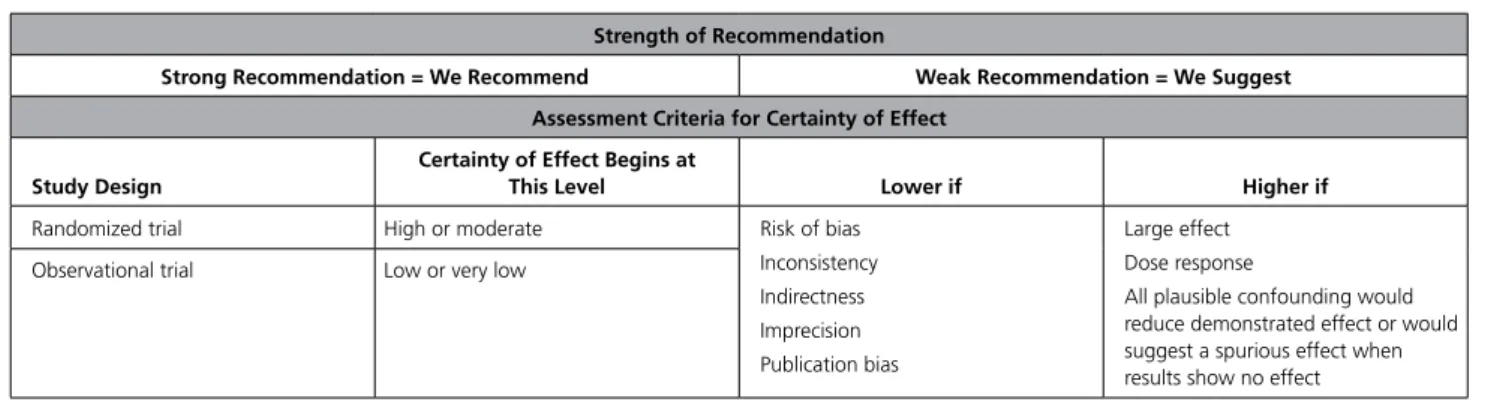
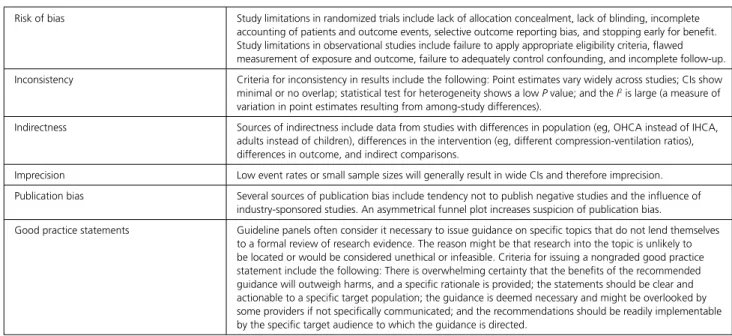
10(Tables 1 and 2). Any unresolved
disparity between reviewer assessments was resolved
through discussions and consensus with the task force
representative of the Scientific Advisory Committee and,
if disagreement remained, by the larger ILCOR task force.
The ILCOR task forces reviewed, discussed, and
debat-ed the studies and systematic review analyses, drafting a
consensus on science statement and a written summary of
identified evidence and evidence quality for each outcome.
When there was consensus, the task force developed
con-sensus treatment recommendations, labeled as strong or
weak and either for or against a therapy, prognostic tool,
or diagnostic test, noting the certainty of the evidence. In
addition, each topic summary included the PICOST
ques-tion and a justificaques-tion and evidence-to-decision
frame-work section, capturing the values and preferences
consid-ered by the task force as well as a list of knowledge gaps.
Public input was sought at multiple stages, including
PI-COST development and draft CoSTR statements.
4The task
forces considered all public comments when finalizing the
CoSTR statements. All 2020 CoSTR statements underwent
peer review by at least 5 subject matter experts and were
endorsed by the ILCOR board before publication.
Scoping Review
The second type of evidence review is the scoping
re-view. The purpose of a scoping review is to provide an
overview of the available research evidence related to a
specific topic and to determine if sufficient evidence is
identified to recommend performance of a systematic
review. One difference between scoping reviews and
systematic reviews is that scoping reviews have broader
inclusion criteria, whereas traditional systematic reviews
address a narrow, clearly defined question. Unlike the
treatment recommendations that can arise from a
sys-tematic review, scoping reviews cannot result in a new
ILCOR treatment recommendation or modification of an
existing ILCOR treatment recommendation.
The methodology for the scoping review was based
on the Preferred Reporting Items for Systematic Reviews
Table 1. GRADE Terminology for Strength of Recommendation and Criteria for Evidence Certainty Assessment34
Strength of Recommendation
Strong Recommendation = We Recommend Weak Recommendation = We Suggest Assessment Criteria for Certainty of Effect
Study Design
Certainty of Effect Begins at
This Level Lower if Higher if
Randomized trial High or moderate Risk of bias
Inconsistency Indirectness Imprecision Publication bias Large effect Dose response
All plausible confounding would reduce demonstrated effect or would suggest a spurious effect when results show no effect Observational trial Low or very low
GRADE indicates Grading of Recommendations, Assessment, Development, and Evaluation.
and Meta-analyses (PRISMA) Extension for Scoping
Re-views.
8,16,17Each task force identified questions to be
re-viewed, presented in the PICOST format. The MEDLINE,
Embase, and Cochrane databases were then searched to
identify relevant publications. Those performing the
scop-ing reviews extracted data to create summary tables. The
task force then reviewed the studies and the evidence
tables, developing a consensus narrative summary of the
evidence and an overview of the task force insights. Each
topic narrative summary and overview of task force
in-sights as well as the complete scoping review were posted
on the ILCOR website for public review and input,
4with
final versions included in the appendix and summarized
in the body of the relevant task force CoSTR publication.
Evidence Update
The evidence update is the third type of review supporting
the 2020 CoSTR and the 2020 Guidelines. This review is
used for questions not undergoing a systematic or scoping
review. Evidence updates were performed by AHA writing
group members, AHA volunteers, or other ILCOR member
council volunteers. The evidence update reviewers used
PubMed to conduct searches of English language
publica-tions indexed in the MEDLINE database. When the search
strategies from previous reviews were available, these
were repeated. Searching beyond the MEDLINE database
was optional, at the discretion of the reviewer. Reviewers
identified relevant new studies, guidelines, and systematic
reviews, and completed an evidence update worksheet,
8which included the research question, the search strategy,
and a table summarizing any new evidence. After review
by the ILCOR Science Advisory Committee Chair, the
evidence update worksheet was included in the relevant
2020 CoSTR task force publication appendix and cited
within the body of the manuscript.
GUIDELINE FORMAT
In contrast to prior ECC Guidelines, the 2020
Guide-lines are organized in knowledge chunks, grouped into
discrete modules of information on specific topics or
management issues.
18Each modular knowledge chunk
includes a table of recommendations, a brief
introduc-tion or synopsis, recommendaintroduc-tion-specific supportive
text, and, when appropriate, figures, flow diagrams of
algorithms, and additional tables. Hyperlinked
refer-ences are provided to facilitate quick access and review.
FORMATION OF THE AHA GUIDELINE
WRITING GROUPS
The AHA strives to ensure that each guideline writing
group includes requisite expertise and diversity,
repre-sentative of the broader medical community by selecting
experts from a wide array of backgrounds, geographic
regions of North America, sexes, races, ethnicities,
in-tellectual perspectives, and scopes of clinical practice.
Volunteers with an interest and recognized expertise in
resuscitation are nominated by the writing group chair,
selected by the AHA ECC Committee and approved by
the AHA Manuscript Oversight Committee. The Adult
Basic and Advanced Life Support Writing Group included
experts in emergency medicine, critical care, cardiology,
toxicology, neurology, emergency medical services,
edu-cation, research, and public health. The Pediatric Basic
Table 2. GRADE Terminology34
Risk of bias Study limitations in randomized trials include lack of allocation concealment, lack of blinding, incomplete accounting of patients and outcome events, selective outcome reporting bias, and stopping early for benefit. Study limitations in observational studies include failure to apply appropriate eligibility criteria, flawed measurement of exposure and outcome, failure to adequately control confounding, and incomplete follow-up. Inconsistency Criteria for inconsistency in results include the following: Point estimates vary widely across studies; CIs show minimal or no overlap; statistical test for heterogeneity shows a low P value; and the I2 is large (a measure of
variation in point estimates resulting from among-study differences).
Indirectness Sources of indirectness include data from studies with differences in population (eg, OHCA instead of IHCA, adults instead of children), differences in the intervention (eg, different compression-ventilation ratios), differences in outcome, and indirect comparisons.
Imprecision Low event rates or small sample sizes will generally result in wide CIs and therefore imprecision. Publication bias Several sources of publication bias include tendency not to publish negative studies and the influence of
industry-sponsored studies. An asymmetrical funnel plot increases suspicion of publication bias.
Good practice statements Guideline panels often consider it necessary to issue guidance on specific topics that do not lend themselves to a formal review of research evidence. The reason might be that research into the topic is unlikely to be located or would be considered unethical or infeasible. Criteria for issuing a nongraded good practice statement include the following: There is overwhelming certainty that the benefits of the recommended guidance will outweigh harms, and a specific rationale is provided; the statements should be clear and actionable to a specific target population; the guidance is deemed necessary and might be overlooked by some providers if not specifically communicated; and the recommendations should be readily implementable by the specific target audience to which the guidance is directed.
GRADE indicates Grading of Recommendations, Assessment, Development, and Evaluation; IHCA, in-hospital cardiac arrest; and OHCA, out-of-hospital cardiac arrest.
and Advanced Life Support Writing Group consisted of
pediatric clinicians including intensivists, cardiac
intensiv-ists, cardiologintensiv-ists, and emergency physicians and
emer-gency medicine nurses. The Neonatal Life Support
Writ-ing Group included neonatal physicians and nurses with
backgrounds in clinical medicine, education, research,
and public health. The Resuscitation Education Science
Writing Group consisted of experts in resuscitation
ed-ucation, clinical medicine (ie, pediatrics, intensive care,
emergency medicine), nursing, prehospital care, and
health services and education research. The Systems of
Care Writing Group included experts in clinical medicine,
education, research, and public health. Before
appoint-ment, writing group members completed a disclosure of
relevant relationships with industry. Writing group
mem-bers also adhered to all AHA requirements for
manage-ment of any potential conflicts of interest.
GUIDELINES DEVELOPMENT, REVIEW,
AND APPROVAL
Each AHA writing group reviewed all relevant and
cur-rent AHA guidelines for CPR and ECC,
19–30pertinent
2020 CoSTR evidence and recommendations,
1–3,6,7and
all relevant evidence update worksheets to determine
if current guidelines should be reaffirmed, revised, or
retired, or if new recommendations were needed. The
Table 3. Applying Class of Recommendation and Level of Evidence to Clinical Strategies, Interventions, Treatments, or Diagnostic Testing in Patient Care (Updated May 2019)*
This tool has been used in all AHA ECC Guidelines and focused updates since its initial publication in the 2015 Guidelines Update.35
This table defines the Classes of Recommendation (COR) and Levels of Evidence (LOE). COR indicates the strength the writing group assigns the recommendation, and the LOE is assigned based on the quality of the scientific evidence. The outcome or result of the intervention should be specified (an improved clini-cal outcome or increased diagnostic accuracy or incremental prognostic information). Classes of Recommendation COR designations include Class 1, a strong recommendation for which the potential benefit greatly outweighs the risk; Class 2a, a moderate recommendation for which benefit most likely outweighs the risk; Class 2b, a weak recommendation for which it’s unknown whether benefit will outweigh the risk; Class 3: No Benefit, a moderate recommendation signifying that there is equal likelihood of benefit and risk; and Class 3: Harm, a strong recommendation for which the risk outweighs the potential benefit. Suggested phrases for writing Class 1 recommendations include • Is recommended • Is indicated/useful/ effective/beneficial
• Should be performed/administered/other Comparative-effectiveness phrases include treatment/strategy A is recommended/indicated in preference to treatment B, and treatment A should be chosen over treatment B. Suggested phrases for writing Class 2a recommendations include • Is reasonable • Can be useful/ effective/beneficial
Comparative-effectiveness phrases include treatment/strategy A is probably recommended/indicated in preference to treatment B, and it is reasonable to choose treatment A over treatment B. For comparative-effectiveness recommendations (COR 1 and 2a; LOE A and B only), studies that support the use of comparator verbs should involve direct comparisons of the treatments or strategies being evaluated. Suggested phrases for writing Class 2b recommendations include • May/might be reasonable
• May/might be considered
• Usefulness/ effectiveness is unknown/unclear/uncertain or not well-established Suggested phrases for writing Class 3: No Benefit recommendations (generally, LOE A or B use only) include • Is not recommended • Is not indicated/ useful/effective/beneficial • Should not be performed/administered/other Suggested phrases for writing Class 3: Harm recommendations include • Potentially harmful • Causes harm • Associated with excess morbidity/mortality • Should not be performed/administered/other Levels of Evidence For LOEs, the method of assessing quality is evolving, including the application of standardized, widely-used, and preferably validated evidence grading tools; and for systematic reviews, the incorporation of an Evidence Review Committee. LOE designations include Level A, Level B-R, Level B-NR, Level C-LD, and Level C-EO. Those categorized as Level A are derived from
• High-quality evidence from more than 1 randomized clinical trial, or RCT
• Meta-analyses of high-quality RCTs
• One or more RCTs corroborated by high-quality registry studies Those categorized as Level B-R (randomized) are derived from
• Moderate-quality evidence from 1 or more RCTs
• Meta-analyses of moderate-quality RCTs
Those categorized as Level B-NR (nonrandomized) are derived from
• Moderate-quality evidence from 1 or more well-designed, well-executed nonrandomized studies, observational studies, or
registry studies
• Meta-analyses of such studies
Those categorized as Level C-LD (limited data) are derived from • Randomized or nonrandomized observational or registry studies with limitations of design or execution • Meta-analyses of such studies
• Physiological or mechanistic studies in human subjects Those categorized as Level C-EO (expert opinion) are derived from • Consensus of expert opinion based on clinical experience COR and LOE are determined independently (any COR may be paired with any LOE). A recommendation with LOE C does not imply that the recommendation is weak. Many important clinical questions addressed in guidelines do not lend themselves to clinical trials. Although RCTs are unavailable, there may be a very clear clinical consensus that a particular test or therapy is useful or effective.
writing groups then drafted, reviewed, and approved
recommendations, assigning to each recommendation
a Class of Recommendation (COR) (ie, strength) and
Level of Evidence (LOE) (ie, quality) (Table 3). Each of
the 2020 Guidelines articles was submitted for
blind-ed peer review to 5 subject matter experts nominatblind-ed
by the AHA. Before appointment, all peer reviewers
were required to disclose relationships with industry
and any other potential conflicts of interest, and all
disclosures were reviewed by AHA staff. Peer reviewer
feedback was provided for guidelines in draft format
and again in final format. All guidelines were reviewed
and approved for publication by the AHA Science
Ad-visory and Coordinating Committee and AHA
Execu-tive Committee.
MANAGEMENT OF POTENTIAL
CONFLICTS OF INTEREST
The AHA and ILCOR have rigorous conflict-of-interest
policies and procedures to minimize the risk of bias
or improper influence during development of the
CoSTRs and the AHA guidelines. Both organizations
followed these policies
31–33throughout the 2020
evi-dence evaluation and document preparation process,
and anyone involved in any part of this process was
required to disclose all commercial relationships and
other potential conflicts (including intellectual) both
before joining the writing group and during writing
group activities. These disclosures were reviewed
be-fore assignment of task force chairs and members,
writing group chairs and members, consultants, and
peer reviewers. In keeping with the AHA conflict of
interest policy, the chair and most members of each
ILCOR and AHA writing group had to be free of
rel-evant conflicts. Writing group members do not draft
text or vote on any recommendation for which they
had a relevant conflict. Appendix 1 lists writing group
members’ disclosure information. Peer reviewers were
also required to disclose relationships with industry
and any other potential conflicts of interest; these
dis-closures appear in Appendix 2.
ARTICLE INFORMATION
The American Heart Association requests that this document be cited as follows: Magid DJ, Aziz K, Cheng A, Hazinski MF, Hoover AV, Mahgoub M, Panchal AR, Sasson C, Topjian AA, Rodriguez AJ, Donoghue A, Berg KM, Lee HC, Raymond T, Lavonas EJ. Part 2: evidence evaluation and guidelines development: 2020 American Heart Association Guidelines for Cardiopulmonary Resuscitation and Emergency Cardiovascular Care. Circulation. 2020;142(suppl 2):S358–S365. doi: 10.1161/CIR.0000000000000898
Appendix 1. Writing Group Disclosures Writing
Group
Member Employment Research Grant
Other Research Support Speakers’ Bureau/ Honoraria Expert Witness Ownership Interest Consultant/ Advisory Board Other David J. Magid
University of Colorado NIH†; NHLBI†; CMS†; AHA†
None None None None None American Heart
Association (Senior Science Editor)† Khalid Aziz University of Alberta
Pediatrics
None None None None None None Salary: University
of Alberta† Katherine M.
Berg
Beth Israel Deaconess Medical Center Pulmonary and Critical
Care
NHLBI Grant K23 HL128814†
None None None None None None
Adam Cheng Alberta Children’s Hospital
None None None None None None None
Aaron Donoghue The Children’s Hospital of Philadelphia, University of Pennsylvania School of Medicine
None None None Atkinson,
Haskins, Nellis, Brittingham,
Gladd & Fiasco*
None None None
Mary Fran Hazinski
Vanderbilt University School of Nursing
None None None None None American
Heart Association† None Amber V. Hoover American Heart Association
None None None None None None None
(Continued )
Disclosures
Eric J. Lavonas Denver Health Emergency Medicine
BTG Pharmaceuticals (Denver Health (Dr Lavonas’ employer) has research, call center, consulting,
and teaching agreements with BTG Pharmaceuticals.
BTG manufactures the digoxin antidote,
DigiFab. Dr Lavonas does not receive bonus or incentive compensation, and these agreements involve an unrelated product. When these guidelines were developed, Dr Lavonas recused from discussions related to digoxin poisoning.)†
None None None None None American Heart
Association (Senior Science
Editor)†
Henry C. Lee Stanford University NICHD (PI of R01 grant examining intensive care for infants born at extremely early gestational age)*
None None None None None None
Melissa Mahgoub
American Heart Association
None None None None None None None
Ashish R. Panchal
The Ohio State University Wexner
Medical Center Emergency Medicine
None None None None None None None
Tia T. Raymond Medical City Children’s Hospital Congenital Heart Surgery Unit
None None None None None None None
Amber J. Rodriguez American Heart Association National Center Emergency Cardiovascular Care
None None None None None None None
Comilla Sasson
American Heart Association
None None None None None None None
Alexis A. Topjian The Children’s Hospital of Philadelphia, University of Pennsylvania School of Medicine Anesthesia and Critical Care
None None None None None None None
This table represents the relationships of writing group members that may be perceived as actual or reasonably perceived conflicts of interest as reported on the Disclosure Questionnaire, which all members of the writing group are required to complete and submit. A relationship is considered to be “significant” if (a) the person receives $10 000 or more during any 12-month period, or 5% or more of the person’s gross income; or (b) the person owns 5% or more of the voting stock or share of the entity, or owns $10 000 or more of the fair market value of the entity. A relationship is considered to be “modest” if it is less than “significant” under the preceding definition.
*Modest. †Significant.
Appendix 1. Continued Writing
Group
Member Employment Research Grant
Other Research Support Speakers’ Bureau/ Honoraria Expert Witness Ownership Interest Consultant/ Advisory Board Other
REFERENCES
1. Berg KM, Soar J, Andersen LW, Böttiger BW, Cacciola S, Callaway CW, Couper K, Cronberg T, D’Arrigo S, Deakin CD, et al; on behalf of the Adult Advanced Life Support Collaborators. Adult advanced life sup-port: 2020 International Consensus on Cardiopulmonary Resuscitation and Emergency Cardiovascular Care Science With Treatment Recom-mendations. Circulation. 2020;142(suppl 1):S92–S139. doi: 10.1161/ CIR.0000000000000893
2. Greif R, Bhanji F, Bigham BL, Bray J, Breckwoldt J, Cheng A, Duff JP, Gilfoyle E, Hsieh M-J, Iwami T, et al; on behalf of the Education, Imple-mentation, and Teams Collaborators. Education, impleImple-mentation, and teams: 2020 International Consensus on Cardiopulmonary Resuscitation and Emergency Cardiovascular Care Science With Treatment Recom-mendations. Circulation. 2020;142(suppl 1):S222–S283. doi: 10.1161/ CIR.0000000000000896
3. Maconochie IK, Aickin R, Hazinski MF, Atkins DL, Bingham R, Couto TB, Guerguerian A-M, Nadkarni VM, Ng K-C, Nuthall GA, et al; on behalf of the Pediatric Life Support Collaborators. Pediatric life support: 2020 Interna-tional Consensus on Cardiopulmonary Resuscitation and Emergency Car-diovascular Care Science With Treatment Recommendations Circulation. 2020;142(suppl 1):S140–S184. doi: 10.1161/CIR.0000000000000894 4. Morley PT, Atkins DL, Finn JC, Maconochie I, Nolan JP, Rabi Y, Singletary EM,
Wang TL, Welsford M, Olasveengen TM, et al. Evidence evaluation pro-cess and management of potential conflicts of interest: 2020 International Consensus on Cardiopulmonary Resuscitation and Emergency Cardio-vascular Care Science With Treatment Recommendations. Circulation. 2020;142(suppl 1):S28–S40. doi: 10.1161/CIR.0000000000000891 5. Nolan JP, Maconochie I, Soar J, Olasveengen TM, Greif R, Wyckoff MH,
Singletary EM, Aickin R, Berg KM, Mancini ME, et al. Executive sum-mary: 2020 International Consensus on Cardiopulmonary Resuscita-tion and Emergency Cardiovascular Care Science With Treatment Rec-ommendations. Circulation. 2020;142(suppl 1):S2–S27. doi: 10.1161/ CIR.0000000000000890
6. Olasveengen TM, Mancini ME, Perkins GD, Avis S, Brooks S, Castrén M, Chung SP, Considine J, Couper K, Escalante R, et al; on behalf of the Adult Basic Life Support Collaborators. Adult basic life support: 2020 Interna-tional Consensus on Cardiopulmonary Resuscitation and Emergency Car-diovascular Care Science With Treatment Recommendations. Circulation. 2020;142(suppl 1):S41–S91. doi: 10.1161/CIR.0000000000000892 7. Wyckoff MH, Wyllie J, Aziz K, de Almeida MF, Fabres J, Fawke J,
Guinsburg R, Hosono S, Isayama T, Kapadia VS, et al; on behalf of the Neo-natal Life Support Collaborators. NeoNeo-natal life support: 2020 International
Consensus on Cardiopulmonary Resuscitation and Emergency Cardio-vascular Care Science With Treatment Recommendations. Circulation. 2020;142(suppl 1):S185–S221. doi: 10.1161/CIR.0000000000000895 8. International Liaison Committee on Resuscitation. Continuous evidence
evaluation guidance and templates. https://www.ilcor.org/documents/ continuous-evidence-evaluation-guidance-and-templates. Accessed De-cember 31, 2019.
9. Institute of Medicine (US) Committee of Standards for Systematic Reviews of Comparative Effectiveness Research. Finding What Works in Health
Care: Standards for Systematic Reviews. Washington, DC: The National
Academies Press; 2011.
10. GRADE Working Group. 5.2.1. Study limitations (risk of bias). In: Schünemann HJ, Brożek J, Guyatt G, Oxman A., eds. GRADE Handbook. 2013. https://gdt.gradepro.org/app/handbook/handbook.html. Accessed December 31, 2019.
11. Cochrane Training. Chapter 5: defining the review questions and devel-oping criteria for including studies. In: O’Connor D, Higgins J, Green S, eds. Cochrane Handbook for Systematic Reviews of Interventions. Ver-sion 5.1.0. 2011. https://handbook-5-1.cochrane.org/chapter_5/5_de-fining_the_review_question_and_developing_criteria_for.htm. Accessed December 31, 2019.
12. Cochrane Training. Chapter 8: assessing risk of bias in included studies. In: Higgins JPT, Altman DG, Sterne J, eds. Cochrane Handbook for Systematic
Reviews of Interventions. Version 5.1.0. 2011.
https://handbook-5-1.co-chrane.org/chapter_8/8_assessing_risk_of_bias_in_included_studies.htm. Accessed December 31, 2019.
13. Whiting PF, Rutjes AW, Westwood ME, Mallett S, Deeks JJ, Reitsma JB, Leeflang MM, Sterne JA, Bossuyt PM; QUADAS-2 Group. QUADAS-2: a revised tool for the quality assessment of diagnostic accuracy studies.
Ann Intern Med. 2011;155:529–536. doi: 10.7326/0003-4819-155-
8-201110180-00009
14. Evidence Prime. GRADEpro GDT—an introduction to the system. https:// gdt.gradepro.org/app/help/user_guide/index.html. Accessed December 31, 2019.
15. Schünemann HJ, Oxman AD, Brozek J, Glasziou P, Jaeschke R, Vist GE, Williams JW Jr, Kunz R, Craig J, Montori VM, Bossuyt P, Guyatt GH; GRADE Working Group. Grading quality of evidence and strength of recommendations for diagnostic tests and strategies. BMJ. 2008;336:1106–1110. doi: 10.1136/bmj.39500.677199.AE
16. Tricco AC, Lillie E, Zarin W, O’Brien KK, Colquhoun H, Levac D, Moher D, Peters MDJ, Horsley T, Weeks L, Hempel S, Akl EA, Chang C, McGowan J, Stewart L, Hartling L, Aldcroft A, Wilson MG, Garritty C, Lewin S, Godfrey CM, Macdonald MT, Langlois EV, Soares-Weiser K, Moriarty J, Clifford T,
Appendix 2. Reviewer Disclosures
Reviewer Employment Research Grant Other Research Support Speakers’ Bureau/ Honoraria Expert Witness Ownership Interest Consultant/Advisory Board Other
Fredrik Folke Gentofte University Hospital (Denmark)
None None None None None None None
Joel Lexchin University Health Network, Toronto (Canada)
None None None None None None None
Robert T. Mallet University North Texas Health Science Center
None None None None None AHA (service on study
sections reviewing grant applications to support resuscitation research)*
None
Mary Ann McNeil University of Minnesota None None None None None None None
Taylor Sawyer Seattle Children’s Hospital/ University of Washington
None None None None None None None
Will Smith Wilderness and Emergency Medicine Consulting (WEMC)
None None None None None None None
Lorrel E. B. Toft University of Nevada Reno None None None None None None None
This table represents the relationships of reviewers that may be perceived as actual or reasonably perceived conflicts of interest as reported on the Disclosure Questionnaire, which all reviewers are required to complete and submit. A relationship is considered to be “significant” if (a) the person receives $10 000 or more during any 12-month period, or 5% or more of the person’s gross income; or (b) the person owns 5% or more of the voting stock or share of the entity, or owns $10 000 or more of the fair market value of the entity. A relationship is considered to be “modest” if it is less than “significant” under the preceding definition.
*Modest.
Tunçalp Ö, Straus SE. PRISMA extension for scoping reviews (PRISMA-ScR): checklist and explanation. Ann Intern Med. 2018;169:467–473. doi: 10.7326/M18-0850
17. PRISMA. PRISMA for scoping reviews. http://www.prisma-statement.org/ Extensions/ScopingReviews. Accessed December 31, 2019.
18. Levine GN, O’Gara PT, Beckman JA, Al-Khatib SM, Birtcher KK, Cigarroa JE, de Las Fuentes L, Deswal A, Fleisher LA, Gentile F, Goldberger ZD, Hlatky MA, Joglar JA, Piano MR, Wijeysundera DN. Recent innovations, modifications, and evolution of ACC/AHA clinical practice guidelines: an update for our constituencies: a report of the American College of Cardiology/American Heart Association Task Force on Clinical Practice Guidelines. Circulation. 2019;139:e879–e886. doi: 10.1161/CIR.0000000000000651
19. Field JM, Hazinski MF, Sayre MR, Chameides L, Schexnayder SM, Hemphill R, Samson RA, Kattwinkel J, Berg RA, Bhanji F, et al. Part 1: executive summary: 2010 American Heart Association Guidelines for Cardiopulmonary Resus-citation and Emergency Cardiovascular Care. Circulation. 2010;122(suppl 3):S640–S656. doi: 10.1161/CIRCULATIONAHA.110.970889
20. Neumar RW, Shuster M, Callaway CW, Gent LM, Atkins DL, Bhanji F, Brooks SC, de Caen AR, Donnino MW, Ferrer JM, et al. Part 1: executive summary: 2015 American Heart Association Guidelines Update for Cardio-pulmonary Resuscitation and Emergency Cardiovascular Care. Circulation. 2015;132(suppl 2):S315–S367. doi: 10.1161/CIR.0000000000000252 21. Kleinman ME, Goldberger ZD, Rea T, Swor RA, Bobrow BJ, Brennan EE,
Terry M, Hemphill R, Gazmuri RJ, Hazinski MF, Travers AH. 2017 Amer-ican Heart Association focused update on adult basic life support and cardiopulmonary resuscitation quality: an update to the American Heart Association Guidelines for Cardiopulmonary Resuscitation and Emergency Cardiovascular Care. Circulation. 2018;137:e7–e13. doi: 10.1161/CIR.0000000000000539
22. Escobedo MB, Aziz K, Kapadia VS, Lee HC, Niermeyer S, Schmölzer GM, Szyld E, Weiner GM, Wyckoff MH, Yamada NK, Zaichkin JG. 2019 American Heart Association focused update on neonatal resuscitation: an update to the American Heart Association Guidelines for Cardiopul-monary Resuscitation and Emergency Cardiovascular Care. Circulation. 2019;140:e922–e930. doi: 10.1161/CIR.0000000000000729
23. Panchal AR, Berg KM, Cabañas JG, Kurz MC, Link MS, Del Rios M, Hirsch KG, Chan PS, Hazinski MF, Morley PT, Donnino MW, Kudenchuk PJ. 2019 American Heart Association focused update on systems of care: dispatcher-assisted cardiopulmonary resuscitation and cardiac arrest cen-ters: an update to the American Heart Association Guidelines for Cardio-pulmonary Resuscitation and Emergency Cardiovascular Care. Circulation. 2019;140:e895–e903. doi: 10.1161/CIR.0000000000000733
24. Panchal AR, Berg KM, Hirsch KG, Kudenchuk PJ, Del Rios M, Cabañas JG, Link MS, Kurz MC, Chan PS, Morley PT, et al. 2019 American Heart Association focused update on advanced cardiovascular life support: use of advanced airways, vasopressors, and extracorporeal cardiopul-monary resuscitation during cardiac arrest: an update to the American Heart Association guidelines for cardiopulmonary resuscitation and emergency cardiovascular care. Circulation. 2019;140:e881–e894. doi: 10.1161/CIR.0000000000000732
25. Panchal AR, Berg KM, Kudenchuk PJ, Del Rios M, Hirsch KG, Link MS, Kurz MC, Chan PS, Cabañas JG, Morley PT, Hazinski MF, Donnino MW. 2018 American Heart Association focused update on advanced cardiovas-cular life support use of antiarrhythmic drugs during and immediately after cardiac arrest: an update to the American Heart Association Guidelines for Cardiopulmonary Resuscitation and Emergency Cardiovascular Care.
Cir-culation. 2018;138:e740–e749. doi: 10.1161/CIR.0000000000000613
26. Atkins DL, de Caen AR, Berger S, Samson RA, Schexnayder SM, Joyner BL Jr, Bigham BL, Niles DE, Duff JP, Hunt EA, Meaney PA. 2017 American Heart Association focused update on pediatric basic life sup-port and cardiopulmonary resuscitation quality: an update to the Ameri-can Heart Association Guidelines for Cardiopulmonary Resuscitation and Emergency Cardiovascular Care. Circulation. 2018;137:e1–e6. doi: 10.1161/CIR.0000000000000540
27. Charlton NP, Pellegrino JL, Kule A, Slater TM, Epstein JL, Flores GE, Goolsby CA, Orkin AM, Singletary EM, Swain JM. 2019 American Heart Association and American Red Cross focused update for first aid:
presyncope: an update to the American Heart Association and American Red Cross Guidelines for First Aid. Circulation. 2019;140:e931–e938. doi: 10.1161/CIR.0000000000000730
28. Duff JP, Topjian A, Berg MD, Chan M, Haskell SE, Joyner BL Jr, Lasa JJ, Ley SJ, Raymond TT, Sutton RM, Hazinski MF, Atkins DL. 2018 Ameri-can Heart Association focused update on pediatric advanced life support: an update to the American Heart Association Guidelines for Cardiopul-monary Resuscitation and Emergency Cardiovascular Care. Circulation. 2018;138:e731–e739. doi: 10.1161/CIR.0000000000000612
29. Duff JP, Topjian AA, Berg MD, Chan M, Haskell SE, Joyner BL Jr, Lasa JJ, Ley SJ, Raymond TT, Sutton RM, Hazinski MF, Atkins DL. 2019 Ameri-can Heart Association focused update on pediatric advanced life support: an update to the American Heart Association Guidelines for Cardiopul-monary Resuscitation and Emergency Cardiovascular Care. Circulation. 2019;140:e904–e914. doi: 10.1161/CIR.0000000000000731
30. Duff JP, Topjian AA, Berg MD, Chan M, Haskell SE, Joyner BL Jr, Lasa JJ, Ley SJ, Raymond TT, Sutton RM, et al. 2019 American Heart Association focused update on pediatric basic life support: an update to the Ameri-can Heart Association guidelines for cardiopulmonary resuscitation and emergency cardiovascular care. Circulation. 2019;140:e915–e921. doi: 10.1161/CIR.0000000000000736
31. American Heart Association. Conflict of interest policy. https://www.heart. org/en/about-us/statements-and-policies/conflict-of-interest-policy. Ac-cessed December 31, 2019.
32. American Heart Association. MOC policies and procedures regarding re-lationships with industry for writing group members. https://professional. heart.org/idc/groups/ahamah-public/@wcm/@sop/@spub/documents/ downloadable/ucm_495614.pdf. Accessed April 30, 2020.
33. American College of Cardiology Foundation, American Heart Associa-tion. Methodology manual and policies from the ACCF/AHA task force on practice guidelines. 2010. https://professional.heart.org/idc/groups/ ahamah-public/@wcm/@sop/documents/downloadable/ucm_319826. pdf. Accessed April 30, 2020.
34. Soar J, Maconochie I, Wyckoff MH, Olasveengen TM, Singletary EM, Greif R, Aickin R, Bhanji F, Donnino MW, Mancini ME, Wyllie JP, Zideman D, Andersen LW, Atkins DL, Aziz K, Bendall J, Berg KM, Berry DC, Bigham BL, Bingham R, Couto TB, Böttiger BW, Borra V, Bray JE, Breckwoldt J, Brooks SC, Buick J, Callaway CW, Carlson JN, Cassan P, Castrén M, Chang WT, Charlton NP, Cheng A, Chung SP, Considine J, Couper K, Dainty KN, Dawson JA, de Almeida MF, de Caen AR, Deakin CD, Drennan IR, Duff JP, Epstein JL, Escalante R, Gazmuri RJ, Gilfoyle E, Granfeldt A, Guerguerian AM, Guinsburg R, Hatanaka T, Holmberg MJ, Hood N, Hosono S, Hsieh MJ, Isayama T, Iwami T, Jensen JL, Kapadia V, Kim HS, Kleinman ME, Kudenchuk PJ, Lang E, Lavonas E, Liley H, Lim SH, Lockey A, Lofgren B, Ma MH, Markenson D, Meaney PA, Meyran D, Mildenhall L, Monsieurs KG, Montgomery W, Morley PT, Morrison LJ, Nadkarni VM, Nation K, Neumar RW, Ng KC, Nicholson T, Nikolaou N, Nishiyama C, Nuthall G, Ohshimo S, Okamoto D, O’Neil B, Yong-Kwang Ong G, Paiva EF, Parr M, Pellegrino JL, Perkins GD, Perlman J, Rabi Y, Reis A, Reynolds JC, Ristagno G, Roehr CC, Sakamoto T, Sandroni C, Schexnayder SM, Scholefield BR, Shimizu N, Skrifvars MB, Smyth MA, Stanton D, Swain J, Szyld E, Tijssen J, Travers A, Trevisanuto D, Vaillancourt C, Van de Voorde P, Velaphi S, Wang TL, Weiner G, Welsford M, Woodin JA, Yeung J, Nolan JP, Hazinski MF. 2019 International Consensus on Cardiopulmonary Resus-citation and Emergency Cardiovascular Care Science With Treatment Recommendations: summary from the Basic Life Support; Advanced Life Support; Pediatric Life Support; Neonatal Life Support; Education, Implementation, and Teams; and First Aid Task Forces. Circulation. 2019; 140:e826–e880. doi: 10.1161/CIR.0000000000000734
35. Morrison LJ, Gent LM, Lang E, Nunnally ME, Parker MJ, Callaway CW, Nadkarni VM, Fernandez AR, Billi JE, Egan JR, et al. Part 2: evidence eval-uation and management of conflicts of interest: 2015 American Heart Association Guidelines Update for Cardiopulmonary Resuscitation and Emergency Cardiovascular Care. Circulation. 2015;132(suppl 2):S368– S382. doi: 10.1161/CIR.0000000000000253