HAL Id: hal-02116745
https://hal-amu.archives-ouvertes.fr/hal-02116745
Submitted on 1 May 2019
HAL is a multi-disciplinary open access
archive for the deposit and dissemination of
sci-entific research documents, whether they are
pub-lished or not. The documents may come from
teaching and research institutions in France or
abroad, or from public or private research centers.
L’archive ouverte pluridisciplinaire HAL, est
destinée au dépôt et à la diffusion de documents
scientifiques de niveau recherche, publiés ou non,
émanant des établissements d’enseignement et de
recherche français ou étrangers, des laboratoires
publics ou privés.
Removal of Humidity by Ionic Liquid Filter to Protect
Gas Sensors
Xueru Yan, Alexandre Favard, Jean-Luc Seguin, Marc Bendahan, Stéphane
Anguille, Philippe Moulin
To cite this version:
Xueru Yan, Alexandre Favard, Jean-Luc Seguin, Marc Bendahan, Stéphane Anguille, et al.. Removal
of Humidity by Ionic Liquid Filter to Protect Gas Sensors. CNRIUT’2018, Jun 2018, Aix-en-Provence,
France. �hal-02116745�
________________________________________________________________________________________________________________CNRIUT’2018, Aix-en-Provence
Removal of Humidity by Ionic Liquid Filter to Protect Gas Sensors
_______________________________________________________________________________________________________________
Xueru Yan
1, Alexandre Favard
2,
Jean-Luc Seguin
2, Marc Bendahan
2,
Stéphane Anguille
1,
Philippe Moulin
1[email protected] [email protected]@im2np.fr [email protected] [email protected] [email protected]
1 IUT, Aix-Marseille Université
Laboratoire de Mécanique, Modélisation & Procédés Propres, UMR 7340 2 IUT, Aix-Marseille Université
Institut Matériaux Microélectronique Nanosciences de Provence, UMR 7334
Thèmes – Environnement - Électronique
Résumé –Air quality has become a hot issue of common concern, particularly BTEX gases (Benzene, Toluene, Ethylbenzene and
Xylene). They often cause serious environmental problems and have negative effect on human health even at very low concentration. Gas sensors have been in use for monitoring flammable as well as toxic gases. Since a few years, metal oxide gas sensor are also used to the control and monitor the air quality Thedetection of gaseous pollutants under real conditions requires working in a humid environment. It is well known that the humidity reduces the performances of gas sensors, particularly in terms of sensitivity. In this work, we demonstrated the possibility to reduce the humidity impact on a metal oxide sensor by using ionic liquid-based filter, without modification of the sensor sensitivity.
1 Introduction
With the development of society and the advancement of technology, human demand on the environment has gradually gone beyond the bearing capacity of the environment. Air quality has become a hot issue of common concern, particularly BTEX gases (Benzene, Toluene, Ethylbenzene and Xylene). They often cause serious environmental problems and have negative effect on human health even at very low concentration. Since a few years, mental oxide gas sensors are used to control and monitor the air quality. It is well known the performance of metal oxide gas sensors is influenced by relative humidity [1]. In this work, we demonstrated the possibility to reduce the humidity impact on a metal oxide sensor using an ionic liquid-based filter, without modification of the sensor sensitivity.
2 Materials and Methods
2.1 Ionic liquid based filterIonic liquids (ILs) are salts which form liquid phase at room temperature. More importantly, these are endowed with excellent solvating ability and can be recycled [2]. In this study, the 1-butyl-3-methylimidazolium bromide ([Bmim+][Br-]) [3] is selected as absorbent due to its high viscosity hygroscopic properties and availability. The innovation of this filter is to capture the water vapor from a mix of gases without impacting the target gases [4]. 2.2 Gas Sensor
The gas sensor is composed of a sensitive layer of tungsten trioxide (WO3) thin film (50 nm) deposited by reactive RF magnetron sputtering on a transducer developed in IM2NP laboratory [5].
The WO3 is a n-type metal oxide with a large gap and oxygen vacancies and its conductivity depends on the composition of the surrounding gas atmosphere.
The sensor response under BTEX vapors was calculated using the relation (1):
Sensor response (%) = (Rair− Rgas
Rgas ) × 100 (1) With Rair, the sensor’s resistance under air and Rgas, the sensor’s resistance under BTEX vapors.
2.3 Test bench for electrical characterization under target gases and humidity
We used a fully automated test bench specially designed for the BTEX gases detection in the pressure of different humidity levels. It is composed of a gas dilution and humidification system that generates an output mixture at very low concentrations (1 to 500 ppb) with a variable humidity (0 to 90%), an integrated test cell and an
acquisition system to characterize the electrical responses of the sensor.
3 Results and Discussion
3.1 Influence of humidity on sensor response
To study the humidity influence on the sensor response, the gas sensor was exposed at 500 ppb of BTEX under dry air and wet air (relative humidity 50%). With the figure 1 shown, under dry air, the sensor response is 24%. When the introduction of 50% relative humidity in mixture gas, the sensor response is reduced to 12%. As some studies reported that humidity leads to a decrease of the sensor response [6, 7].
Figure 1 - Sensors response to 500 ppb of BETX, a) in dry air (0 %), b) in wet air (50 % RH)
3.2 Influence of filters to sensor under dry air
It is important that the addition of a filter upstream of the sensor does not disturb its response. We therefore studied the sensor response under identical conditions (HR 0%, BTEX: 500ppb) initially without filter and then with filter. We first designed a filter composed by a mixture of active carbon (AC) and ionic liquid (IL), to capture humidity. However, when we placed this filter upstream the sensor, sensor response decreased to 12% (fig.2a) compared to sensor response without filter (fig.2b).
It means that this filter has an influence on gas sensor response. In order to understand this problem, we renewed the experiment with a first filter based only on pure activated carbon and then with a second filter based only on ionic liquid. With the AC filter, the sensor response decreased to 12% (fig.2c), which is the same as the response of mixed IL-AC filter.
However, when only the IL filter was placed upstream the sensor, the response to 500 ppb of BTEX remains 25% (fig.2d). Based on this experiment we can conclude that the IL filter does not capture BTEX gases. For the next experiments we choose this filter configuration (IL filter only).
mixture, as already reported in the literature [8, 9]. Because of the overwhelming physical adsorption mechanisms, active carbon with large surface area and rich pore structure shows high adsorption capacity to VOCs. Furthermore, the presence of chemical functional groups on AC surfaces makes it a good adsorbent for VOCs through chemical adsorption mechanisms. When the [Bmim+][Br-] was exposed on wet air, it was found that it caught water vapors because the anions of IL ([Br-]) and water molecules form H-bonding [10].
Figure 2 - Compared response to500 ppb of BETX with different filters under dry air (0 % HR, 100 sccm) 3.3 Influence of ionic liquid filter on sensor response under wet air
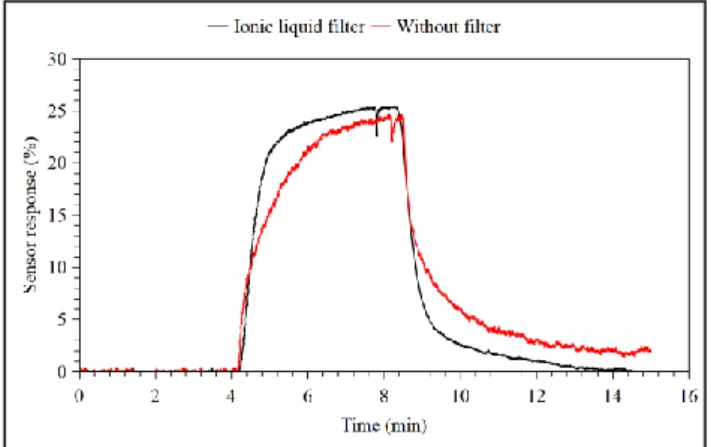
To reduce the humidity influence on the sensor response, according to last experiment, we placed an IL filter upstream the sensor, and the sensor was exposed to 500 ppb of BTEX with 50% relative humidity.
In figure 3, we can observe that with or without IL filter, the sensor response remains 25%. Hence, with this filter, the gas sensor keep its performances, even under 50% of relative humidity.
Figure 3 - Sensors response under 500 ppb of BTEX, a) in dry air (0 % RH), b) wet air (50 % RH) with ionic liquid filter
4 Conclusions
In this work, we proposed a new solution to protect gas
sensors from humidity. We confirmed that with an IL filter,
which is comprised by [Bmim+][Br-], on upstream can reduce the influence on gas sensor. We also demonstrated that the ionic liquid filter does not disturb BTEX detection.
5 Acknowledgment
The author wish to thank Mr. Alain COMBES for technical support throughout this work.
References
[1] C. Wang, L. Yin, L. Zhang, D. Xiang, R. Gao, Metal Oxide
Gas Sensors: Sensitivity and Influencing Factors, Sensors vol
10, 2010, p. 2088 – 2106
[2] M.H. Ibrahim, M.Hayyan, M.A.Hashim, A. Hayyanm, The
role of ionic liquids in desulfurization of fuels: A review,
Renewable and Sustainable Energy Review, 2016
[3] P.L.A. Alviz, A. J. Alvarez, Comparative life cycle
assessment of the use of an ionic liquid ([Bmim][Br]) versus a volative organic solvent in the production of acetylsalicylic acid, Journal of Cleaner Production, 2017
[4] Anguille S., Testa F., Moulin P., Device for extraction of
pollutants by multichannel tubular membrane, EP
14306002.8, 2016, EP2015/064462
[5] A. Favard, T. Contaret, K. Aguir, A. Dumas, M. Bendahan,
Highly Sensitive WO3 Thin Films Integrated on Microsensor
Platforms for ppb BTEX Detection in a Gas Mixture with High Rate of Humidity, Proceeding IEEE Sensor, 2017
[6] Q Qi, T. Zhang, X. Zheng, H. Fan, L. Liu, R. Wang, Y. Zeng,
Electrical response of Sm2O3-doped SnO2 to C2H2 and effect
of humidity interference, Sensors and Actuators B, vol 134,
2008, p. 36 – 42
[7] R. Ionescu, A. Vancu, C. Moise, A. Tomescu, Role of water
vapour in the interaction of SnO2 gas sensors with CO and
CH4, Sensors and Actuators B,vol 61, 1999, p. 39 – 42
[8] X. Zhang, B. Gao, A. E. Creamer, C. Cao, Y. Li, Adsorption
of VOCs onto engineered carbon materials: A review, Journal
of Hazardous Materials, vol 338, 2017, p. 102-123
[9] Y. Long, S. Wu, Y. Xiao, P. Cui, H. Zhou, VOCs reduction and inhibition mechanisms of using active carbon filler in bituminous materials, Journal of Cleaner Production, vol 181, 2018, p. 784 - 793
[10] E.P. Grishina, L.M. Ramenskaya, M.S.Gruwdev, O.V. Kraeva, Water effect on physicochemical properties of
1-butyl-3-methylimidazolium based ionic liquids with inorganic anions, Journal of Molecular Liquids, vol 177, 2013, p. 267 -