HAL Id: tel-02090654
https://hal-univ-orleans.archives-ouvertes.fr/tel-02090654
Submitted on 5 Apr 2019HAL is a multi-disciplinary open access archive for the deposit and dissemination of sci-entific research documents, whether they are pub-lished or not. The documents may come from teaching and research institutions in France or abroad, or from public or private research centers.
L’archive ouverte pluridisciplinaire HAL, est destinée au dépôt et à la diffusion de documents scientifiques de niveau recherche, publiés ou non, émanant des établissements d’enseignement et de recherche français ou étrangers, des laboratoires publics ou privés.
Gasoline Compression Ignition engine
Pietro Matteo Pinazzi
To cite this version:
Pietro Matteo Pinazzi. Potential of ozone to enable the low load operation of a Gasoline Compression Ignition engine. Reactive fluid environment. Université d’Orléans, 2018. English. �tel-02090654�
UNIVERSITÉ D’ORLÉANS
ÉCOLE DOCTORALE
ENERGIE, MATERIAUX, SCIENCES DE LA TERRE ET DE
L’UNIVERS
LABORATOIRE PRISME
THÈSE
présentée par :
Pietro Matteo PINAZZI
soutenue le : 18 Décembre 2018
Pour obtenir le grade de : Docteur de l’université d’Orléans
Discipline/ Spécialité : Energétique
Potential of ozone to enable the low load
operation of a Gasoline Compression Ignition
engine.
THÈSE dirigée par :
Mr Fabrice FOUCHER Professeur, Université d’Orléans
RAPPORTEURS :
Mr Francesco CONTINO Professeur, Vrije Universiteit Brussel
Mr Robert DIBBLE Professeur, KAUST
___________________________________________________________________
JURY :
Mr Philippe DAGAUT Directeur de Recherche, ICARE-CNRS
Mr Olivier GUÉZET Ingénieur de Recherche, PSA Groupe
Mr Toni TAHTOUH Docteur, Ingénieur de Recherche, IFPEN
3
UNIVERSITÉ D’ORLÉANS
ÉCOLE DOCTORALE
ENERGIE, MATERIAUX, SCIENCES DE LA TERRE ET DE
L’UNIVERS
LABORATOIRE PRISME
THÈSE
présentée par :
Pietro Matteo PINAZZI
soutenue le : 18 Décembre 2018
Pour obtenir le grade de : Docteur de l’université d’Orléans
Discipline/ Spécialité : Energétique
Potentiel de l'ozone pour atteindre le
fonctionnement en faible charge d'un moteur
essence a allumage par compression.
THÈSE dirigée par :
Mr Fabrice FOUCHER Professeur, Université d’Orléans
RAPPORTEURS :
Mr Francesco CONTINO Professeur, Vrije Universiteit Brussel
Mr Robert DIBBLE Professeur, KAUST
___________________________________________________________________
JURY :
Mr Philippe DAGAUT Directeur de Recherche, ICARE-CNRS
Mr Olivier GUÉZET Ingénieur de Recherche, PSA Groupe
Mr Toni TAHTOUH Docteur, Ingénieur de Recherche, IFPEN
5
1. Index
1. INDEX ... 5 2. ABBREVIATIONS ... 9 1. BACKGROUND AND MOTIVATION ... 11 1.1. ENERGY OUTLOOK ... 13 1.1.1. Gasoline: the fuel for future transportation ... 13 1.1.2. Reducing the impact of transportation on the environment ... 17 1.2. RESEARCH OBJECTIVE ... 19 2. INTRODUCTION ... 21 2.1. INTERNAL COMBUSTION ENGINES ... 23 2.1.1. SI Gasoline Engine ... 23 2.1.2. Compression Ignition Engine ... 232.2. ADVANCED INTERNAL COMBUSTION ENGINES WORKING ON LOW TEMPERATURE COMBUSTION ... 24
2.2.1. HCCI ... 27
2.2.2. CAI-SACI: HCCI in SI engines ... 28
2.2.3. HCCI for CI Diesel Engines ... 30
2.2.4. Gasoline Compression Ignition engine ... 31
2.3. GASOLINE COMPRESSION IGNITION ENGINE ... 31
2.3.1. Partial fuel stratification ... 31 2.3.2. Advantages of using gasoline in CI engines ... 32 2.3.3. Gasoline Partially Premixed Combustion ... 33 2.3.4. Efficient and clean part and high load operation ... 34 2.3.5. GCI Low Load Limitations ... 35 2.3.5.1. VVT for rebreathing of Hot Burnt gases ... 35 2.3.5.2. Use of Low Octane Gasoline (Naphtha) ... 36
2.4. CHEMICAL AGENTS FOR COMBUSTION IMPROVEMENT ... 37
2.5. OZONE AS A COMBUSTION IMPROVER ... 37 2.5.1. Ozone – hydrocarbon interaction ... 37 2.5.1.1. Ozone impact on the oxidation chemistry of small chain hydrocarbons ... 38 2.5.1.2. Effect of ozone on the combustion characteristics ... 40 2.5.2. Ozone impact on IC engine combustion ... 41 2.5.3. Ozone generator ... 45 2.6. NITROGEN OXIDES ... 46 2.6.1. Nitrogen Oxide formation in IC engines ... 46 2.6.1.1. Kinetics of NO formation ... 46 2.6.1.2. Kinetics of NO2 formation ... 47 2.6.2. Nitrogen Oxide interaction with hydrocarbon oxidation. ... 48 2.6.2.1. Residual Nitrogen Oxides ... 48 2.6.2.2. Chemistry of Nitrogen oxides–hydrocarbon interaction ... 48
2.7. CONCLUSIONS, GOALS, STRATEGIES AND CRITICAL ASPECTS ... 52
2.7.1. Aim of the work ... 52
2.7.2. Critical issues, strategy, and structure of the work. ... 53
3. METHODOLOGY ... 57
6 3.1.1. Direct Injection Fuel Supply for GCI operation ... 60 3.1.2. Combustion chamber ... 61 3.1.3. Exhaust emission measurements ... 61 3.1.4. Accuracy of the acquisition system ... 61 3.2. OPTICALLY ACCESSIBLE ENGINE ... 62 3.2.1. OH* chemiluminescence ... 63 3.2.2. CH2O PLIF ... 64 3.2.3. Simultaneous spatially integrated OH* and CH* chemiluminescence measurement ... 66 3.3. 3D CFD SIMULATION ... 67 3.3.1. Surrogate fuel for 3D simulations ... 68 3.3.2. Grid Convergence Study ... 69 3.3.3. Evaluation of CFD Model Performance against Experiments ... 70 4. LOW LOAD GCI COMBUSTION ... 73 4.1. INTRODUCTION ... 75 4.2. INTAKE CONDITIONS ... 75
4.3. LOCAL FUEL DISTRIBUITION ... 77
4.3.1. Autoignition and Combustion Development ... 79 4.3.2. NOx emissions ... 83 4.3.3. Abnormal NOX emissions ... 84 4.3.4. Evaluation of the impact of Residual NO on combustion ... 87 4.3.4.1. Experimental Evaluation of the residual NO ... 88 4.3.4.2. CFD study of the impact of NO on combustion ... 91 4.4. IMPACT OF THE INJECTION SYSTEM ... 94 4.4.1. Impact of the injector umbrella angle ... 94 4.4.2. Spray target position ... 100 4.5. DOUBLE INJECTION STRATEGY ... 105 4.5.1. Impact of the timing of the second injection on combustion behavior ... 107 4.5.2. Impact of the timing of the first injection on combustion behavior ... 109 4.5.3. Impact of the umbrella angle on the double injection strategy ... 110 4.6. CONCLUSIONS ... 115 5. OZONE IMPACT ON HCCI GASOLINE COMBUSTION ... 119 5.1. INTRODUCTION ... 121 5.2. GASOLINE PREMIXED COMBUSTION UNDER NON SEEDED CONDITIONS ... 121 5.3. OZONE ASSISTED GASOLINE PREMIXED COMBUSTION ... 123 5.3.1. Effect on thermodynamically established combustion ... 123 5.3.1.1. Impact on the combustion phasing ... 125 5.3.1.2. Impact on combustion efficiency and combustion stability ... 127 5.3.2. Extension of the autoignition region ... 131 5.3.2.1. Reduction of the lean limit ... 131 5.3.2.2. Reduction of the autoignition temperature ... 136 5.4. CONCLUSIONS ... 141 6. OPTICAL INVESTIGATION OF THE IMPACT OF OZONE ON HCCI COMBUSTION ... 145 6.1. INTRODUCTION ... 147
6.2. IMPACT OF OZONE ON THERMODYNAMICALLY ESTABLISHED COMBUSTION ... 148
6.3. EXTENSION OF THE AUTOIGNITION REGION: OZONE INDUCED COMBUSTION ... 153
7 6.3.2. Analysis of Ozone Induced (OI) combustion by means of CH* and OH* detection by photomultipliers 155 6.4. CONCLUSIONS ... 159 7. OZONE-ASSISTED GCI LOW LOAD OPERATION ... 161 7.1. INTRODUCTION ... 163 7.2. OZONE IMPACT UNDER DIRECT-INJECTION GCI OPERATION ... 163 7.2.1. Ozone decomposition in a D-I CI engine ... 163 7.2.2. Impact of the fuel injection timing on the promoting effect of ozone ... 166 7.3. EXTENDING THE LOW LOAD LIMIT OF A GCI ENGINE BY MEANS OF OZONE SEEDING ... 172 7.3.1. Maximization of the ozone effect through adaptation of the fuel injection strategy ... 172 7.3.2. Using Ozone to reduce the Intake temperature required for gasoline autoignition ... 174 7.3.3. Characteristics of low intake temperature combustion induced by ozone ... 175 7.3.4. Control of GCI combustion via the timing of the second injection. ... 177 7.3.5. Conclusions ... 182 8. CONCLUSIONS AND PERSPECTIVES ... 185 9. REFERENCES ... 193
8
9
2. Abbreviations
CAI Controlled Auto Ignition
CAD Crank Angle Degree
CFD Computational Fluid Dynamics
CI Compression Ignition
CH2O Formaldehyde
CO Carbon Monoxide
CO2 Carbon Dioxide
CR Compression Ratio
COV Coefficient of Variation
DI Direct Injection
DOC Diesel Oxidation Catalyst
EGR Exhaust Gas Recirculation
FSN Filter Smoke Number
GCI Gasoline Compression Ignition
GPPC Gasoline Partially Premixed Combustion
HC Unburned Hydrocarbon
HCCI Homogeneous Charge Compression Ignition
IGR Internal Gas Recirculation
IMEP Indicated mean effective pressure
LTC Low Temperature Combustion
NO Nitrogen monoxide
NO2 Nitrogen dioxide
ON Octane Number
O Oxygen atom
O2 Diatomic oxygen molecule
O3 Ozone
PRF Primary Reference Fuel
RON Research Octane Number
SACI Spark Assisted Compression Ignition
SI Spark Ignition
SOI Start of Injection
SOI1 Start of first Injection
SOI2 Start of second Injection
TDC Top Dead Center
VVT Variable Valve Train
10
11
1. Background and Motivation
12
13
1.1.
ENERGY OUTLOOK
1.1.1.
Gasoline: the fuel for future transportation
In recent decades, the global energy demand has continued to grow and forecasts indicate that this trend will remain unchanged in the near future. As can be seen in Figure 1, world energy consumption is forecast to increase from 579 quadrillion KJ in 2012 to 664 quadrillion KJ in 2020 and then to 860 quadrillion KJ in 2040, a 48% increase (1.4%/year) [1]. The regions of Asia outside the Organization for Economic Cooperation and Development (Non-OECD Asia), including China and India, account for more than half of the increase. The industrial sector continues to account for the largest share of delivered energy consumption, and will consume over half of global delivered energy in 2040. Data from [1,2] show that although renewable energy will be the world’s fastest-growing energy source, fossil fuels will continue to supply more than three-fourths of world energy use in 2040.
Figure 1. World total energy consumption by region. Data from [3].
The ever-increasing economic activity and population growth (forecasts [4] indicate a rise in population from 7.3 billion people in 2012 to 9.7 billion in 2050) drive the increases in energy use. A more detailed analysis, shown in Figure 2, indicates that Non-OECD nations drive the increase in total energy use, with non-OECD Asia accounting for 55% of the world increase in energy consumption. It is also important to understand which sectors consume the most energy. The three main categories are industry, transportation,
0
100
200
300
400
500
600
700
800
900
2011
2012
2020
2025
2030
2035
2040
En
e
rg
y
C
o
n
s
u
m
p
ti
o
n
[q
u
a
d
ri
ll
io
n
B
tu
]
Year
OECD
Non-OECD
14
and buildings. Although total energy consumption will grow in the years to come, the share of total consumption by end-use sector will remain relatively unchanged. The industrial sector is predicted to account for approximately half (~53%) of the energy consumption, with the remainder consumed by buildings (~21%) and a slightly higher ratio (~26%) by transportation, as indicated in Figure 3.
Figure 2. World total energy consumption by region (detailed). Data from [3].
2012
2040
Figure 3. Energy consumption by end-use sector. Data from [3]
0
100
200
300
400
500
600
700
800
900
2011
2012
2020
2025
2030
2035
2040
En
e
rg
y
C
o
n
s
u
m
p
ti
o
n
[q
u
a
d
ri
ll
io
n
K
J
]
Year
OECD
Other non-OECD
Non-OECD Asia
21%
25% 54%
Buildings Transportation Industrial
21%
26% 53%
15
The delivered energy consumption of transportation is approximately one fourth of the global demand, and will increase at an annual average rate of 1.4%, from 110 quadrillion KJ in 2012 to 164 quadrillion KJ in 2040. Transportation energy demand growth occurs almost entirely in regions outside the Organization for Economic Cooperation and Development (non-OECD), with transportation demand remaining roughly flat in OECD regions, reflecting different expectations for economic growth in developing regions compared with developed regions [2]. Worldwide, petroleum and other liquid fuels are the dominant source of transportation energy: despite electrification and the search for alternative energy sources, their share of total transportation energy is expected to decline only slightly over the projection period [5], from 96% in 2012 to 88% in 2040, as shown in Figure 4.
Figure 4. World transportation sector energy consumption by energy source. Data from[5,6]
Among liquid fuels, motor gasoline will remain the most widely used fuel in transportation, even though its share of total transportation energy consumption will probably decline from 2012 to 2040. From 2012 to 2040 the total transportation market share of diesel fuel (including biodiesel), which is the second-largest transportation fuel, will decline and the share of jet fuel will increase (Figure 5). Electricity will remain a minor fuel for the world’s transportation energy use, although its importance in passenger rail transportation will remain high: in 2040, electricity will account for 40% of total passenger rail energy consumption. The electricity share of total light-duty vehicle energy consumption is forecast to increase to 3% in 2040 in the reference case, as increasing sales of new plug-in electric vehicles penetrate the total light-duty stock.
0% 10% 20% 30% 40% 50% 60% 70% 80% 90% 100%
Energ
y
Co
ns
um
pt
io
n
Year
16
Gasoline fuel will remain the reference fuel for transportation, however, particularly for light duty passenger vehicles. This is an important factor to be considered when investigating future powertrain systems.
17
1.1.2.
Reducing the impact of transportation on the environment
Over the past century the carbon dioxide concentration in the atmosphere has increased significantly. Compared to the pre-industrial era, this increase corresponds to approximately 280 ppm [7]. Because of the continually increasing energy consumption, the average concentration of CO2 has increased by 2 ppm/year
in the last ten years. Significant increases have also occurred in the levels of methane and nitrous oxide [7].
Figure 6. Distribution of CO2 emissions in the transportation sector. [8]
The anthropic influence on the climate system is clear [9]. Among the many human activities that produce greenhouse gases, the use of energy represents by far the largest source of emissions. Within the energy sector, CO2 resulting from the oxidation of carbon in fuels during combustion dominates total greenhouse
gas (GHG) emissions, and the transport sector is, in order of importance, the third source of CO2, two-thirds
of which is produced by electricity and heat generation. In order to mitigate CO2 emissions from the
transportation sector, the European community introduced a series of norms, the European Emission Standards, which define the acceptable limits for exhaust emissions of new vehicles sold in the European Union (EU) and European Economic Area (EEA) member states. The emission standards are defined in a series of European Union directives staging the progressive introduction of increasingly stringent standards. For CO2, a target of 95 grams per kilometer will apply from 2021, but this value will be dramatically reduced
18
hydrocarbon (HC), and particulate matter (PM). Consequently, despite the huge efforts already made in the last decade to provide the technology currently available on the market, the study of
Figure 7. Global comparison of passenger car efficiency standards. [8]
more advanced, clean and efficient combustion strategies for internal combustion engines (ICE) still represents a major concern of the scientific community.
19
1.2.
RESEARCH OBJECTIVE
In view of the environmental context, the transportation sector has to participate in the creation of sustainable development. A reduction of CO2 and pollutant emissions is necessary to provide a clean living
environment, so research must strive to provide efficient and clean vehicles.
Since its invention over a century ago, the internal combustion engine has been the main propulsion system for human and goods transportation. While the introduction of electrical and hybrid engines is undoubtedly an efficient means to reduce the environmental impact of transportation, a full conversion to an electric powertrain is more difficult. Several issues are related to the increase in electricity demand and battery system production, which can result in a negative environmental impact. Future transportation will be based on a mix of thermal and electrical powertrains. Internal combustion engines will still largely exist, as will the need to reduce the CO2 and pollutant emissions caused by their use as a propulsion system. For these
reasons, the development of clean and efficient vehicle propulsion has become a major objective.
Two types of internal combustion engines are currently employed: Gasoline Spark Ignition (SI) engines, and Diesel Compression Ignition (CI) engines. The key features of the SI engine are the lower cost of production and the relatively clean operation, at the expense of a relatively low efficiency. The diesel engine is the reference in terms of efficiency, but requires a more expensive aftertreatment system to avoid dispersion of the high level of pollutants formed during the combustion process. For these reasons advanced combustion engines combining high efficiency, low pollutants and reduced cost have been developed.
Gasoline Compression Ignition (GCI) engines are a promising engine concept aiming for efficient and clean operation. In GCI engines, high octane number gasoline is employed to fuel a high compression ratio CI engine. The combination of the CI mode and the gasoline fuel properties enables Low Temperature Combustion (LTC) characterized by ultra-low emissions of Nitrogen Oxides (NOx) and Soot. GCI provides very good performances but some challenges have to be overcome before it can be employed for practical applications. Specifically, the high octane number which yields several advantages at high load, in fact limits the ignitability of gasoline in low load operating conditions, making it difficult to achieve low load operations.
The aim of this research was to demonstrate the potential of using an ozone generator to extend the operating range of a GCI engine. Ozone is a strong oxidizing agent which has been shown to improve the oxidation chemistry of hydrocarbon fuels. Ozone can be produced from natural air by means of ozone generators, which could become a compact and low cost solution that is easily integrable and controllable in a passenger car. By placing an ozone generator in the intake manifold of the engine, ozone can be produced and
20
employed to seed the intake air and therefore promote gasoline autoignition under critical GCI low load operation. The aim of the present work was therefore to investigate the possibility of using ozone to extend the ignitability range of gasoline and to ascertain whether an ozone generator could be an efficient solution for achieving low load operation and extending the operating range of a GCI engine.
21
2. Introduction
22
23
2.1.
INTERNAL COMBUSTION ENGINES
The internal combustion engine has been employed for passenger and goods transportation for more than a hundred years. It is a robust and affordable power generator with a high power to weight ratio, making it optimal for transportation applications. Nowadays, conventional gasoline spark ignition (SI) engines and diesel compression ignition (CI) engines dominate the transportation market.
2.1.1.
SI Gasoline Engine
SI engines work under the principle of the Otto thermodynamic cycle with the heat introduction taking place at constant volume. In most SI engines a homogeneous fuel-air mixture is obtained by means of different fuel injections during the intake stroke or beginning of the compression stroke. The ignition of the intake charge is controlled by the timing of the electrical discharge across the spark plug gap. Efficient and clean combustion requires the mixture to have a stoichiometric fuel-air equivalence ratio. Load is then controlled by throttling the mass of air admitted, leading to pumping losses which affect the net indicated efficiency at part load. Increasing the thermal efficiency by means of a higher compression ratio is possible but knock related issues demand increasingly high fuel quality in terms of octane index. This is why SI engines generally cannot reach the efficiency of high compression ratio diesel engines. However, there is a range of low cost technologies that can reduce the losses traditionally encountered at both low and high engine loads: cylinder deactivation systems, cooled exhaust gas recirculation (EGR), hybridization and water injection systems. In SI engines, after the ignition induced by the electric discharge, a flame front propagates in the cylinder, increasing the local temperature and gas pressure. Nitrogen oxides (NO) are thus formed by the Zeldovich mechanism in the high temperature post flame gases. Carbon monoxide (CO) is formed due to the presence of rich regions caused by the inhomogeneity in the fuel-air mixture, while large amounts of unburned hydrocarbons (HC) are formed due to flame quenching on the combustion chamber wall and the crevices. The three-way catalytic converter allows for the simultaneous reduction of the above-mentioned pollutants, making SI engines a relatively clean powertrain with respect to CI diesel engines. Soot production is relatively low for conventional SI engines and particulate filters are not required. In the most recent SI engines working with stratified fuel-air mixtures, higher amounts of soot are produced, so a Gasoline Particulate Filter (GPF) is included in the exhaust gases aftertreatment system.
2.1.2.
Compression Ignition Engine
In a diesel CI engine the intake air flow is compressed and highly reactive diesel fuel is injected into the cylinder only near the end of the compression stroke. After the injection, the fuel spray atomizes in small droplets, evaporates and mixes with air. Meanwhile, the piston continues to compress the mixture, and when the mixture temperature reaches the fuel’s ignition temperature, ignition of a premixed quantity of fuel and
24
air occurs. If the injection event has not yet been completed, the remaining fuel that did not participate in premixed combustion is consumed in the rate-controlled combustion phase, creating a diffusion flame. Due to the absence of an actuator triggering the ignition event, the fuel has to have a high autoignition propensity in terms of Cetane number. Diesel CI engines are currently the most efficient powertrain for automotive transportation. Their lower fuel consumption is mainly due to the higher compression ratio employed and to the fact that the power output is controlled by merely adjusting the amount of fuel injected, avoiding the introduction of throttling losses at part load. CI diesel engines generally run on lean fuel, meaning that lower in cylinder temperatures are reached and a lower amount of heat is rejected to the coolant and toward the exhaust. As an additional benefit, the gamma, or specific heat ratio, is higher for lean burn engines than for engines that operate at stoichiometry. Less of the thermal energy generated by the combustion reactions is lost in the excitation states of larger triatomic species (CO2 and H2O vapor), resulting in more thermal energy
available for raising the pressure and temperature of the working fluid, increasing the work that can be extracted. Because of the higher peak pressure and temperature, diesel CI engines demand a more expensive engine layout. The high rotational inertia limits the maximum speed and increases the cost of all the hardware that has to be very durable. A further drawback of CI engines is the pollutant emissions. Diffusion-controlled combustion is a significant source of soot and NOx due to the ignition of non-homogeneous mixtures. Because the engine is run in non-stoichiometric conditions, it cannot rely on the economic three-way catalytic converter, and a more complex, and hence expensive, aftertreatment system has to be included at the exhaust. A Diesel Oxidation Catalyst (DOC) for HC oxidation, a Diesel Particulate Filter (DPF) for soot, and a Selective Catalytic Reduction (SCR) system for NOx reduction by NH3 have to be installed to
clean up the exhaust gases.
2.2.
ADVANCED INTERNAL COMBUSTION ENGINES WORKING ON
LOW TEMPERATURE COMBUSTION
In recent years considerable research has been conducted to provide advanced combustion strategies with the aim of improving internal combustion engines. The characteristics of the two major engine families, CI and SI, can be summarized as follows. On the one hand, compression engines are the benchmark for high efficiency and low fuel consumption, albeit at the expense of a significant production of NOx and soot and a higher cost of production. On the other hand, gasoline SI engines are relatively low-polluting and cheaper, but with a limited efficacy due to throttled part load operation.
Advanced combustion strategies have emerged from the study and the development of existing engine technologies. The goal is to achieve the best tradeoff between efficiency, pollutant emissions and costs, maintaining the strengths of existing engines and overcoming their weaknesses. The ideal engine should be efficient like a CI engine, cos-effective like an SI engine, and the production of pollutants should be
25
eliminated at the source, allowing for a less complex aftertreatment system. This is possible only by developing advanced ICE relying on advanced combustion processes.
Two major approaches can be adopted to improve current combustion engines: increasing the thermal efficiency of SI engines, or reducing the pollutant emissions of already efficient CI engines.
Starting from an SI layout, the idea is to improve efficiency by increasing the CR while overcoming knock issues, for example by using water injection [10,11]. Another possible way is employ advanced spark ignition devices, i.e. microwave assisted [12], which make it possible to increase the thermal efficiency by running the SI engine with a leaner fuel-air mixture and reducing pump losses.
Starting from a CI engine layout, the main objective is to maintain the already good efficiency while reducing the production of NOx and soot that mainly affect diesel combustion. To achieve clean combustion in IC engines, a wide range of advanced combustion modes have been introduced. For the sake of clarity, in this work, all these strategies will be grouped together under the term Low Temperature Combustion (LTC) strategy.
Figure 8. Diagram showing the equivalence ratio-temperature ranges for soot and NOx formation and the regions for conventional diesel, SI, HCCI, and LTC. From [13]
As shown in Figure 8, NOx and Soot are produced when combustion is characterized by certain in-cylinder conditions of temperature and equivalence ratio. The basic principle of LTC consists in preventing the formation of NOx and Soot by circumnavigating the regions on a T-ϕ plane which are responsible for the
26
production of these pollutants. Specifically, soot can be suppressed by burning lean mixtures (ϕ<2) and NOx production is overcome by attaining low combustion temperatures (T<2200K) [13].
Homogeneous Charge Compression Ignition (HCCI) is an advanced combustion mode in which a well premixed, lean fuel/air mixture is compression-ignited. In this way, combustion originates from a lean mixture and low combustion temperatures are generated, as shown in Figure 8. HCCI can be ideally employed for the combustion of any kind of fuel. HCCI is an important concept here because it is the basic principle of all the LTC which will be described hereafter. Despite the different methodologies employed, all LTC strategies are fundamentally related to the HCCI combustion strategy. Several ways have been studied to achieve LTC combustion and simultaneously avoid soot and NOx formation, but this kind of clean combustion has then to be implemented on engines for widespread commercial application. A feasibility study of the implementation of LTC combustion for practical engine applications must take into account the constraints to which manufacturers, oil companies, and the final customers are subject. For these reasons, a realistic solution that can be applied in the short-medium term should be based on a currently available engine layout and should run on fuels available on the market, i.e. Diesel or Gasoline.
Engine Layout
Fuel Spark Ignition Compression Ignition
Gasoline SACI, CAI Gasoline HCCI, GCI, GPPC
Diesel - Diesel HCCI/LTC
Table 1. Advanced combustion modes for SI and CI engines.
Based on this consideration, it is possible to schematize the different strategies developed to implement LTC in real engines depending on the base engine architecture layout and the fuel employed. LTC mainly refers to CI combustion. However, by deactivating the spark ignition system, the CI mode can be achieved in SI engines. This is the case of Controlled Auto-Ignition (CAI) and Spark Assisted Compression Ignition (SACI) strategies, which aim to run SI engines in CI mode at least for a certain part of the load speed map (low and part load). In CI engines, LTC can be achieved by running the engine with conventional Diesel fuel, leading to the Diesel LTC strategy. Gasoline Compression Ignition (GCI) is an engine concept which relies on the use of gasoline fuel in CI diesel engines to achieve Low Temperature Combustion.
As already mentioned, there are several different ways in which the LTC strategy can be realized, and the characteristics and challenges of applying this combustion mode depend on the fuel and the engine layout employed. In the following sections, a short presentation of the main ways in which LTC are realized is reported. Because GCI engines are the main topic of the present research, they will be given particular attention.
27
2.2.1.
HCCI
A homogeneous charge compression ignition (HCCI) engine uses a well-mixed fuel-air charge like spark-ignition engines and relies on compression spark-ignition like diesel engines [14]. Similar to diesel engines, the use of high compression ratios and the removal of the throttling valve in HCCI allow for high efficiency operation, thereby resulting in lower CO2 emissions per unit of work delivered by the engine. In HCCI
engines, a homogeneous fuel-air mixture can be obtained by port fuel injection or early direct injections. Under the compression work of the piston, the highly diluted (air or EGR) fuel-air mixture ignites when the in-cylinder temperature and pressure reach the ignitability point of the fuel. It is clear that without the use of an actuator that directly triggers combustion, autoignition is driven by the chemical kinetics. The charge autoignites in several locations simultaneously. Depending on the chemistry of the fuel employed, autoignition spots are located in the regions in which the equivalence ratio and temperature conditions are the most favorable for the oxidation reactions to occur. There is no flame propagation and the combustion rate is fast. HCCI has several strengths. The most important one is that this combustion mode combines both high efficiency and ultra-low emissions of NOx and soot. Thermal efficiency is generally high because of unthrottled operation, the high compression ratio, and the high effective expansion ratio. Moreover, the formation of soot and NOx can be simultaneously suppressed by burning lean mixtures (0.3<ϕ<0.6) and maintaining low peak combustion temperatures. Another additional feature of the HCCI strategy is that in this combustion mode the fuel ignition is governed by chemical kinetics. As a result, any kind of fuel can be burned in HCCI mode provided that the thermodynamic conditions necessary for autoignition are achieved. This can be done by modulating the intake conditions (pressure and temperature) in order to supply the necessary pressure-temperature path. However, there are some drawbacks related to HCCI combustion.
Firstly, HCCI can only be implemented over a narrow region of the load speed operating range at which a CI engine is required to operate for automotive applications. At high load, HCCI is difficult to achieve because premixed combustion leads to intense heat release responsible for a high pressure gradient which can cause excessive mechanical stress and noise. Low load operations are also difficult to achieve. This is mainly due to the fact that low power output corresponds to extremely lean mixtures, in which combustion is problematic because of the high energy required to initialize and because the in-cylinder temperatures are too weak to sustain the oxidation reactions. It should be mentioned that the low load limit is fuel dependent. Autoignition of high CN diesel fuel is less difficult to achieve, while low load with a high ON gasoline fuel or alcohol fuel is particularly challenging.
As the combustion process is driven by chemical kinetics, controlling the combustion phasing is challenging due to the lack of an actuator, such as a spark plug, that would provide direct control over the ignition event.
28
Combustion phasing therefore depends on the physical and chemical properties of the fuel-air mixture, as well as the history of the in-cylinder thermodynamic conditions. The combustion process can thus be indirectly controlled by various parameters such as intake temperature and pressure, equivalence ratio, EGR, composition of the IGR, and on-demand use of chemical additives.
Generally, high CO and HC emission results from incomplete oxidation of the fuel. High HC comes from fuel deposited on the cylinder liner and in crevices. CO emissions are also high because of the low temperature achieved during combustion and the subsequent lack of energy necessary to complete the CO to CO2 conversion. Cold start is another challenging aspect to be addressed when considering HCCI
combustion, since the lowering of the intake temperature can prevent the in-cylinder conditions necessary for autoignition from being reached, leading to misfire.
Due to its limitations, it is difficult to apply HCCI across the entire operating range of engines for practical automotive use. Therefore, the other advanced combustion modes based on LTC strategies can be seen as a way to apply the HCCI strategy over those portions of the load speed range of a conventional IC engine where the challenges are less difficult to overcome, using the actuators provided according to the specific engine layout. For example, the CAI strategy uses HCCI at low load in gasoline fueled SI engines by deactivating the spark plug. Although applying the HCCI strategy at low load may seem somewhat counterintuitive because of the above-mentioned low load limitations with high ON fuels, the CAI mode can rely on the Variable Valve Train (VVT) available in an SI engine to trap hot residual burnt gases in order to increase the intake charge temperature. Alternatively, other advanced combustion strategies have tried to introduce some variation in the ideal HCCI mode in order to extend its operating range. This is the case of GCI engines relying on the partially premixed combustion of gasoline. In this case, the mixture is not totally premixed but a certain degree of stratification is induced by a more complex multiple direct injection strategy which is commonly employed in diesel engines. This makes it easier to achieve heat release control and clean and efficient high load operations, but lower loads are more challenging because of the CI engine layout which does not always provide VVT and ignition can be difficult depending on the autoignition propensity of the fuel employed.
2.2.2.
CAI-SACI: HCCI in SI engines
The application of the HCCI strategy to SI engines is generally denoted Controlled Auto Ignition CAI. In this kind of combustion, gasoline fuel is premixed with the intake charge by port fuel injection or early direct injections in the admission stroke. CAI is a potential solution to increase the thermal efficiency at engine part and low load [15]. Pumping losses are suppressed by operating the engine at wide throttle
29
openings, and the spark is deactivated to let the fuel autoignite by means of the compression work of the piston. To regulate the load, the mass of fuel is adjusted. Consequently, for a low power output demand, i.e. low load and idle, the fuel air mixture becomes extremely lean (ϕ<0.4), and because of the relatively low compression ratio of SI engines, the in-cylinder thermodynamic conditions necessary for gasoline autoignition are not achieved. To overcome this issue, CAI makes use of VVT [16] systems that generally equip the SI engine to regulate the IGR trapped mass. In this way, the in-cylinder charge temperature can be increased by trapping hot burnt gases [17,18], favoring the spontaneous ignition of the high ON gasoline fuel. The amount of IGR can be controlled by regulating the intake and exhaust valve opening. Two main strategies are employed:
• Negative valve overlap NVO. Burnt gases are trapped in the cylinder by separating and shortening both the exhaust valve opening period at the exhaust stroke and the intake valve opening period during the intake stroke. This strategy introduces some gas-exchange efficiency losses related to the recompression of trapped gases.
• Rebreathing of exhaust gases is performed by a second opening of the exhaust valve during the compression stroke. In this way, the cylinder charge is filled with both the fresh air coming from the inlet duct and the burnt gases which have not yet evacuated the exhaust duct. The advantage over the NVO strategy is that it involves no recompression losses.
In CAI mode, the amount of trapped burnt residuals determines the reactivity of the intake charge, and the higher IGR rate increases the reactivity of the fuel-air mixture. Consequently, the IGR rate can be employed to achieve autoignition and control the combustion phasing. This is particularly necessary near TDC as the load decreases, due to the lower reactivity of leaner mixtures. At low load, when the mixture is highly diluted, the ignition can be further improved by re-activation of the spark plug. This strategy goes under the name of SACI, Spark assisted compression ignition. There are several variations of CAI and SACI. The CAI strategy can lead to high part load efficiency with low emissions of NOx compared to SI engine operation. There are, however, several challenges that have to be addressed to employ CAI combustion in practical applications. Operating in CAI mode over the entire load-speed range of an engine is extremely difficult. Low loads are difficult to achieve because of the high IGR rate required to achieve autoignition. High loads are difficult to achieve because of a high pressure rise rate. Nonetheless, CAI operation can be employed in a reduced portion of the load speed map of an SI engine. In this case, it is necessary to provide a switching strategy from CAI to SI mode and vice versa. Independently of the operating range width, controlling the combustion phasing always requires particular attention. A complex control strategy
30
simultaneously involving VVT, hot and cooled EGR, and direct fuel injection should be employed, especially when considering transient operations.
2.2.3.
HCCI for CI Diesel Engines
Engine-out emission regulations concerning Diesel engines specify that CI diesel engines must be equipped with aftertreatment systems for NOx and diesel particulate matter. In order to reduce the complexity and the cost of exhaust gas posttreatment systems, diesel combustion has been extensively investigated. HCCI is considered as the major candidate capable of providing an in-cylinder approach to overcome the formation of pollutants at the source. In conventional Diesel combustion fuel readily ignites after being injected at the end of the compression stroke near TDC. The strategy to attain HCCI operation in CI engines is to advance the injection event and use a high EGR rate in order to give the fuel more time to mix with air, to form a mixture with a lower equivalence ratio and to generate a lower flame temperature. This could potentially enable the simultaneous attenuation of the mechanisms governing the production of NOx and soot. Initial approaches [19–21] employed diesel port fuel injection to create a homogeneous fuel/air mixture as in SI engines. However, several problems were encountered due to poor evaporation and mixing because of the low volatility of diesel fuel. Moreover, because of the high reactivity, diesel fuel tends to easily ignite when compressed and the compression ratio needed to be reduced in order to avoid knocking and combustion before TDC. To overcome the limitations of port fuel injection, HCCI can be implemented by using direct injection. However, the conventional diesel injection strategy has to be modified accordingly to meet HCCI requirements. In order to achieve a well-mixed charge the injection should be advanced earlier during the compression stroke [22–25] and to improve mixing, special nozzles designed to disperse and soften the spray [25–27] can be employed. A drawback of early fuel injections is fuel impingement on the cylinder wall, leading to very high HC emissions and to the deterioration of lubrication oil, especially with conventional wide umbrella angle diesel injectors. Special injectors with reduced umbrella angles [28] were then specially designed to direct the fuel toward the piston head bowl even at very early injection timing. Because of the high CN of diesel, early injection leads to early ignition. A high EGR rate has therefore to be employed regardless of the injection strategy to slow down the oxidation reactions, avoid knocking and prevent autoignition from taking place too early in the compression stroke [22,26,28,29]. Other techniques made use of a low compression ratio [30] or late intake valve closing to reduce the effective compression ratio while preserving a high expansion ratio [31,32]. Diesel HCCI research showed that the high reactivity and low volatility of diesel fuels make it difficult to achieve the desired mixing quality and the necessary ignition delay to achieve low temperature combustion. A branch of the research on HCCI strategies introduced the possibility of running diesel CI engines with less reactive and more volatile gasoline fuels.
31
2.2.4.
Gasoline Compression Ignition engine
The need to meet the increasingly stringent regulations concerning diesel engines led researchers to find a way to reduce the pollutant emissions of diesel CI engines without affecting the high thermodynamic efficiency of this powertrain family. Because of the difficulties in applying the HCCI concept with diesel fuel, various research groups have demonstrated the interest of using of gasoline fuel in CI engines in order to achieve LTC combustion. As this doctoral research will focus on GCI engines, an entire section is dedicated to this topic and is presented below.
2.3.
GASOLINE COMPRESSION IGNITION ENGINE
Gasoline compression ignition engines have the potential to realize LTC by combining a CI engine and gasoline fuel. As for conventional diesel engines, high thermal efficiency is achieved by using a high compression ratio and unthrottled operation over the entire operating range. The autoignition resistance and the high volatility of gasoline improves the fuel-air mixing process, enabling LTC and avoiding the local equivalence ratios (ϕ) and combustion temperatures responsible for NOx and soot production. Direct injection strategies make it possible to control the combustion process by controlling the degree of fuel stratification. Several studies have focused on Gasoline combustion in CI engines and different approaches have been employed, that converged on the development of GCI engines. In this section, the most important concepts underlying the GCI engine concept are reviewed and presented.
2.3.1.
Partial fuel stratification
Partial fuel stratification is an important notion in understanding the combustion process in GCI engines. A major contribution to the comprehension of the impact of fuel stratification on gasoline compression ignition combustion can be found in the work of Dec [13,33–37] and it is well reviewed by Dempsey et al. [38]. Fuel stratification measures the degree of inhomogeneity present in the combustion chamber following the introduction of the fuel in the cylinder. The stratification level ranges in scale and its boundaries are defined by the conditions that can be found in traditional combustion systems. The minimum level of stratification is the premixed conditions that can be found in gasoline engines. Under these conditions, the charge is homogeneous and the local equivalence ratio values correspond to the global value that characterizes the mixture. The maximum level of stratification corresponds to the diffusion flame typical of conventional diesel combustion. In this case, combustion occurs when the injection event is not yet completed and the degree of heterogeneity is maximum. Regions where the equivalence ratio is extremely low (the periphery of the jet) coexist with regions where the equivalence ratios exceed the stoichiometric value by multiple times. The level of stratification is directly controlled by the injection strategy. Port fuel or early injection during the compression stroke gives low stratification while injection near TDC at the end of the
32
compression stroke gives higher fuel stratification. Partial fuel stratification can be obtained by intermediate injection timings during the final part of the compression stroke or by using more complex multiple injection strategies which split the total fuel mass, combining a first early premixed fuel portion with a further stratified injection close to the end of the combustion stroke. The importance of partial fuel stratification is that it is strongly linked to the combustion behavior. The main advantages of low fuel stratification are the low NOx and soot, but the downside is a limited combustion efficiency, controllability and noise. At the other extreme, high stratification is characterized by high combustion efficiency and controllability, at the expense of higher NOx and soot formation due to the higher temperature and equivalence ratio. An intermediate level of stratification presents behavior which lies in between the two extremes. So a potentially efficient and clean combustion can be achieved by precisely modulating the level of stratification. Another important aspect of fuel stratification is that it also contributes to determining the mixture reactivity. Dec et al. [33,34,37] showed that depending on the fuel chemistry, richer fuel pockets are more reactive than leaner regions. This is generally valid for double stage ignition fuels (such as n-heptane or naphtha) and it can be extended to single stage fuels under certain conditions, i.e. gasoline or gasoline-ethanol blends under boosted intake pressure conditions [36,39,40]. A direct consequence is that the different levels of fuel stratification can be employed differently depending on the operating range of the engine. At high load, stratification should be high enough to slow down the heat release rate but not too high in order to avoid NOx and soot, whereas low load operation requires higher stratification to improve fuel reactivity and combustion stability.
The importance of partial fuel stratification is that it can be governed through the injection strategy, which consequently becomes the actuator on which GCI engines rely to control the LTC process. Therefore, the injection strategy plays a fundamental role in GCI engines because it makes it possible to extend the application range of LTC over wider load speed ranges. This determines the potential of the GCI strategy to represent a strong candidate for practical, clean, and efficient engine applications.
2.3.2.
Advantages of using gasoline in CI engines
Gasoline fuels are designed with a high antiknock quality and are characterized by a high octane number (ON). This makes gasoline extremely resistant to compression ignition. As demonstrated by studies on the CAI mode, without a spark plug, gasoline is difficult to ignite in engines with a CR in the range of 9-11 and the intake charge temperature has to be increased by using large amounts of IGR. However, if gasoline fuel is injected in a conventional diesel CI engine with a CR in the order of 14-20, the in-cylinder temperature and pressure near TDC can reach values which meet the conditions required for gasoline autoignition. The interesting feature of gasoline is that, compared to Diesel, it has a much larger ignition delay for any given
33
set of operating conditions [41]. The characteristic diesel diffusion flames are avoided and instead, auto-ignition occurs after completion of the injection event [42–47]. In addition, because of the high volatility and low boiling point [48], gasoline readily evaporates in the range of in-cylinder temperatures which characterize the compression stroke of a conventional CI engine. This dramatically improves the propensity of gasoline to mix with the in-cylinder air, making it possible to reduce the local strength of the fuel air mixture, which is characterized by a lower local ER value. The ease with which gasoline evaporates and mixes, together with the tendency to generate longer ignition delays, ensure that at the moment of ignition, the local equivalence ratio values are well below the limits for soot formation. Moreover, because the mixture is diluted, the peak temperatures achieved during combustion are low, avoiding NOx formation. This makes gasoline fuel an intrinsically good candidate to implement LTC strategies in CI engines and achieve efficient and clean combustion [45].
2.3.3.
Gasoline Partially Premixed Combustion
Gasoline PPC is a combustion strategy employed in a large region of the operating map of a GCI engine. This concept is directly linked to PFS and to the chemical and physical properties of gasoline fuel. Injecting gasoline in a CI engine can lead to premixed combustion as in an HCCI engine. In order to overcome the issues related to the excessive heat release rate generated by premixed combustion, GCI engines are based on a Partially Premixed Combustion PPC strategy. To achieve PPC, fuel direct injection is employed to create a fuel-air mixture which is homogeneous enough to avoid soot and NOx, but at the same time sufficiently stratified to prevent autoignition occurring simultaneously in the whole volume as in typical HCCI combustion [33]. Because of the fuel and temperature stratification [33,34] induced by a specific direct injection strategy, different degrees of reactivity characterize the mixture inside the combustion chamber. Combustion therefore originates from the most reactive regions, and then sequentially extends to the rest of the volume, leading to a progressive consumption of the fuel and staged heat generation. Thanks to this staged combustion process, the heat release is significantly smoothed, as are the noise and mechanical stress [37]. The high load limitations typical of the HCCI mode can be overcome: excessive pressure gradients are avoided. If the injection strategy is employed properly, the presence of richer and highly reactive fuel pockets will be enough to trigger autoignition but not excessively so, so that the production of NOx and soot will be lower if compared to conventional diesel engines. PPC also enables a second relevant issue, which particularly affects HCCI operations, to be overcome, namely control of the combustion phasing. In PPC, the combustion process is not exclusively controlled by chemical kinetics as in HCCI. Instead, the equivalence ratio and temperature stratification caused by direct injection induced
34
inhomogeneities mainly drive the fuel ignition. The timing of combustion can be therefore controlled by managing the injection strategy as is commonly done in diesel engines.
2.3.4.
Efficient and clean part and high load operation
The effectiveness of gasoline partially premixed combustion has been demonstrated in several studies focusing on achieving high load operation while maintaining low levels of NOx, soot and noise. Efficient and clean combustion at part and high load can be achieved in GCI by combining different injection strategies, EGR levels, and intake boosting. Kalghatgi was the first to focus on applying the concept of gasoline partially premixed combustion at high load [41,49]. In [49], the authors used a gasoline with 94.7 RON and 85.9 MON to fuel a 2.0 L single cylinder diesel engine with a compression ratio of 14 at an engine speed of 1200 rpm. Because the ignition delay was longer for gasoline compared to diesel, much higher IMEP were attained with gasoline for a given intake pressure and EGR level while maintaining lower NOx and smoke emissions. The highest IMEP reached with gasoline was 14.86 bar with a soot level of 0.36 FSN and an ISNOx level of 1.21 g/kWh. In [41], a double injection strategy consisting in a pilot injection at the beginning of the compression stroke and the main injection close to TDC further increased the IMEP and simultaneously reduced the pollutant emissions. A maximum IMEP of 15.95 bar was achieved, with an FSN < 0.07, ISNOx of 0.58 g/kWh, ISFC of 179 g/kWh, ISHC of 2.9 g/kWh and ISCO of 6.8 g/kWh. In the same operating conditions, to get such a low level of smoke with Swedish MK1 diesel fuel, the IMEP had to be below 6.5 bar. At Lund, Manente et al. [50–52] also carried out a detailed investigation of the PPC of gasoline, and results clearly highlighted the potential of the gasoline compression ignition engine to achieve high efficiency with low NOx and soot emissions. In a heavy duty engine, a high boost level combined with ∼50% of EGR yielded a gross indicated efficiency of 53% with a maximum IMEP of 25 bar. It should be noted that an estimated brake efficiency close to 50% was maintained constant in the 16 to 25 bar IMEP range, while the level of pollutants was most of the time below the limits laid down by the US 10 and EU VI legislations. In [53], Dec et al. from Sandia investigated the use of fuel stratification to extend the high load of a gasoline fueled CI engine. In a single cylinder 0.98L engine, using a combination of premixed and direct injected fuel supply, the engine was run at 14 bar IMEP with an indicated thermal efficiency of ~44.7%. Sellnau and coworkers from Delphi developed a light duty Gasoline Direct Injection Compression Ignition (GDCI) engine [54–62]. In [55], the Delphi GDCI engine was tested under different load speed conditions, and results indicated that very low NOx and particulate matter productions were achieved at all operating conditions including 3500rpm - 16 bar IMEP and 2500rpm -18 bar IMEP. These results indicate the potential of the gasoline compression ignition engine to reduce the complexity of the aftertreatment systems that equip conventional diesel CI engines.
35
2.3.5.
GCI Low Load Limitations
Although GCI has shown a potential for efficient and clean operation at high load, achieving low load can be challenging due to the high octane number of commercial gasoline. A high resistance to autoignition offers several advantages at high load, but when the power output demand decreases, the injected fuel mass is reduced, and the intake charge mixture becomes increasingly leaner and less reactive. In [63], the authors assessed the difficulty of achieving stable low load conditions when 87 AKI gasoline autoignites in a light duty CI engine. The influence of several parameters, such as uncooled Exhaust Gas Recirculation (EGR), injection timing, injection pressure and nozzle geometry was analyzed, emphasizing the need to concentrate a sufficiently stratified fuel-air mixture in the piston bowl. Without enhancing the intake temperature or pressure conditions, autoignition of commercial gasoline is challenging and characterized by excessive emission of HC and CO, and low combustion efficiency [42,45,46]. The in-cylinder pressure and temperature reached during the compression stroke are not enough to meet the autoignition requirement of the high ON fuel and misfire occurs. In order to achieve the autoignition of lean gasoline mixtures, the intake temperature or pressure needs to be increased. However, at low load the enthalpy content of the exhaust gases would not be enough to supply the energy necessary to the turbocharging system to boost the intake pressure. Increasing the intake temperature by intake air heaters is not a suitable solution because the system will be too slow to enable accurate control of the intake conditions. Research focusing on the low load operation of GCI engines has proposed two main solutions. The first effective solution consists in equipping the CI engine architecture with a VVT system allowing for flexible control of the valve timing to trap hot residual gases and increase the in-cylinder temperature. The second approach concerns the type of fuel used. Replacing high ON gasoline with more reactive naphtha fuel characterized by an intermediate ON and high volatility can reduce the fuel thermodynamic demand necessary for autoignition, making it possible to achieve GCI operation over the entire load speed range.
2.3.5.1. VVT for rebreathing of Hot Burnt gases
As shown by the work of Sellnau at Delphi [55,59,60,62] and by Borgqvist et al. in Lund [64–66], increasing the intake charge temperature is possible by trapping hot burnt gases, thus improving the reactivity of the mixture and therefore achieving gasoline ignition. Using VVT in [55] demonstrated to be a key enabler of RON 91 gasoline autoignition. The study reported that at low load conditions of 1500 rpm-2 bar IMEP, a secondary-exhaust-valve-lift event was employed to rebreathe hot exhaust gas and promote autoignition. A specially designed cam was used to maximize the effective compression ratio. An ISFC of about 230 g/kWh was obtained. The exhaust port temperatures were about 250°C. In [60], the performance of a gen II Delphi GDCI was presented. Concerning low load operations, an improved VVT, continuously-variable mechanical valve train system, and injection system design enabled 2.4 bar at 2000 rpm with an ISFC of
36
206g/KWh and an indicated efficiency of 44.2% to be achieved. At idle conditions (800 rpm – 2bar IMEP) the engine showed an indicated efficiency of 36.6 % and ISFC of 249.8 g/KWh. Although the use of an advanced engine architecture enriched with VVT demonstrated the potential for efficient operation also at low load, the increased cost of the engine and the additional complexity of the control strategy may discourage the implementation of such a solution for practical automotive applications.
2.3.5.2. Use of Low Octane Gasoline (Naphtha)
The second research approach suggested the use of low octane gasoline fuel, in the range of naphtha fuel in CI engines. The key limitation for GCI low load operations is related to the ON of gasoline available on the market. Ideally, the optimal fuel for CI engines should be resistant enough to autoignition to achieve LTC at high load, but reactive enough to be ignited at low load when the mixture is leaner and less reactive. In this context, in [45], the authors suggested that the octane number of the ideal fuel for PPC should be in the range of 70-85 RON, while the boiling range should be similar to that of commercial gasoline. According to several studies [42,45,46,48,67] naphtha fuel, which has a volatility in the range of gasoline but a lower resistance to autoignition, matches the reactivity demand of CI engines, enabling clean and efficient high load operations and stable operations down to idle and low load. In [68] the author compared Diesel and naphtha fuel in the same CI engine. Naphtha was shown to improve the particulate/NOx trade-off in the drive cycle relevant conditions with a significant reduction in CO2 emission. Moreover, reductions in CO
and HC could also be possible. Other positive properties leading to a tendency to promote the use of naphtha as a key fuel for the future are the higher energy density compared to gasoline, and the lower refining costs. The use of an intermediate octane number fuel such as naphtha has therefore several advantages in the context of GCI engines. However, for short-term application, the use of such a fuel is not possible because it will take time to adapt the fuel distribution system.
37
2.4.
CHEMICAL AGENTS FOR COMBUSTION IMPROVEMENT
As concluded in the previous section, the main limitation which affects GCI low load operation could be overcome by achieving the compression ignition of a lean fuel air mixture. Chemically promoting the autoignition propensity of lean gasoline-air mixtures can be a possible way to achieve low load operations in GCI engines without using complex VVT to increase the intake temperature or without relying on fuel which is still not available in the market. Because of its strong oxidizing properties, ozone can strongly promote combustion. Moreover, the on-board production of ozone is possible by means of a compact and cheap ozone generator. The chemistry of ozone-interaction along with more details about the ozone generator are therefore presented in this section. Nitrogen oxides (NOx) are another chemical compound that can promote combustion. Because of the use of EGR or IGR, nitrogen oxides, such as NO and NO2,
can be present inside the combustion chamber of a GCI engine and consequently react with gasoline fuel. An additional interest in studying the chemistry of nitrogen oxides is related to the fact that such chemical compounds, as will be showed later in this chapter, can react with ozone. Therefore, a review of the formation mechanisms along with the chemistry of the interaction with hydrocarbon is included in this section.
2.5.
OZONE AS A COMBUSTION IMPROVER
2.5.1.
Ozone – hydrocarbon interaction
Ozone is an inorganic molecule with the chemical formula O3. Ozone is an allotrope of oxygen that is much
less stable than the diatomic allotrope O2.
(a) (b)
Figure 9. Skeletal formula of ozone (a). Ball and stick model of the Ozone molecule (b).
Ozone is a powerful oxidant (far more so than dioxygen) and has many industrial and consumer applications related to oxidation, such as water treatment, manufacture of pharmaceuticals, the ozonation of oleic acid and others. In recent years, because of its strong oxidizing features, ozone has been investigated for combustion-related applications.
38
2.5.1.1. Ozone impact on the oxidation chemistry of small chain hydrocarbons
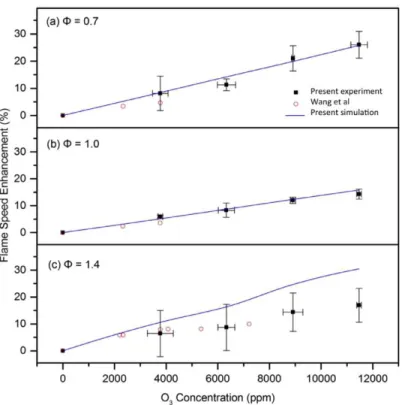
Because of its strong oxidizing properties, ozone has been shown to improve the combustion of hydrocarbons. The impact of ozone on the chemistry of hydrocarbon oxidation was fundamentally investigated in flame-related studies [69–84] for small hydrocarbons with C1 – C4 carbon chains. Small hydrocarbon chains and relatively simple systems such as a laminar flame burner offer the optimal environment for studying the impact of ozone on oxidation chemistry. In [81], results from experiments showed that the addition of high ozone concentration can enhance the flame propagation speed of CH4 and
C3H8 air mixtures. By way of example, Figure 10 shows the flame speed enhancement induced by different
ozone concentrations for CH4 flames, for different equivalence ratios. The reasons behind the effect of ozone
should be sought in the chemical kinetics. The effect of this agent is due to its ability to alter the hydrocarbon oxidation path, opening the way for reactions that would not occur in conventional oxygen-driven combustion.
Figure 10. Promoting effect of ozone on the laminar flame speed of CH4 .
P = 1 bar and T= 300 K. Adapted from [81]
There are two combined effects related to the presence of ozone that lead to an improvement in the oxidation process. The first is due to a direct interaction between the O3 moleculesand other species present in the
39
reactive mixture. More specifically, in [73], the authors suggested that the reason for the burning velocity enhancement with ozone addition is the acceleration of chain-branching reactions due to the presence of O3
molecules in the gas mixture. The presence of the O3 molecules in the pre-flame zone results in a much
faster growth of intermediate species such as HO2, H2O2, and CH2O due to the reactions:
"#+ % " + %"& (1)
"#+ "% "&+ %"& (2)
"#+ %&" "&+ %&" (3)
" + '%# % + '%&" (4)
Then, subsequent chain-branching reactions through CH3, CH2O, HCO, etc. can accelerate the whole flame
propagation process. Results also showed that ozone induced an increase in the concentrations of H, O and OH radicals in the flame front and in the post-flame region. It should be noted that the presence of O3 also
leads to a temperature increase in the pre-heat region. However, the burning velocity enhancement was shown to be dominated by the radical related chain-branching reactions rather than by the thermal effect [70,71].
The direct interaction of O3 molecules is not the only mechanism that governs the impact of this chemical
agent on the oxidation process. As highlighted by Foucher et al. in [85] and by Halter et al. in [72], ozone increases the reactivity of the system mostly because it is a carrier of highly reactive O atoms coming from the decomposition of unstable O3 molecules. For CH4 flames, this effect was described in detail in [72], in
![Figure 4. World transportation sector energy consumption by energy source. Data from[5,6]](https://thumb-eu.123doks.com/thumbv2/123doknet/14720840.751119/16.918.180.736.456.801/figure-world-transportation-sector-energy-consumption-energy-source.webp)