Author Role:
Chaire en hydrologie statistique
Title, Monographic:
Ontario hydrometric network rationalization. Statistical considerations
Translated Title:
Reprint Status:
Edition:
Author, Subsidiary:
Author Role:
Place of Publication:
Québec
Publisher Name:
INRS-Eau
Date of Publication:
1996
Original Publication Date:
Juillet 1996
Volume Identification:
Extent of Work:
ii, 84
Packaging Method:
pages incluant 3 annexes
Series Editor:
Series Editor Role:
Series Title:
INRS-Eau, rapport de recherche
Series Volume ID:
470
Location/URL:
ISBN:
2-89146-436-2
Notes:
Rapport annuel 1996-1997
Abstract:
Rapport de la Chaire en hydrologie statistique soumis à M.M. Dillon Limited
Call Number:
R000470
Ontario Hydrometrie Network Rationalizatio/l
Statistical Considerations
Statistical Considerations
by:
Taha B.M.J. Ouarda
Peter F. Rasmussen
Bernard Bobée
Josée Morin
Chair in Statistical Hydrology
National Institute for Scientific Research, INRS-Eau
2800 Einstein, C.P. 7500, Sainte-Foy (Quebec) Gl V 4C7
submitted to:
M. M. Dillon Limited
BOX 1850 North York
Ontario, M2N 6H5
Rapport de recherche
NO
R-470
C
INRS-Eau,
1996
ISBN: 2-89146-436-2
M. M. DILLON Limited
F. Ivan Lorant
Jodi
L.
Lougheed
Chair in Statistical Hydrology
INRS-Eau
Taha B.M.J. Ouarda
Peter F. Rasmussen
Bernard Bobée
Josée Morin
Table of contents
Table of contents ... i
Acknowledgments '" ...
ii
1 Introduction ... 1
2 Theoretical aspects ... 3
2.1 Classical record extension procedures ... 3
2.2 Application to the rationalization ofhydrometric networks ... 5
3 Rationalization methodology ... 7
3.1 Decision criteria ... 7
3.2 Identification of sub-regions ... 8
3.3 Description of the program REDUC ... 9
4 Application ... 13
4.1 Data base ... 13
4.2 Clustering analysis ... 15
4.3 Discussion ofresults ... 15
5 Conclusions ... 21
6 References ... '" ... 23
Appendix A Listing of the programs REDUC and ClAT ABLE ... 25
Appendix B Output of the program REDUC ... 31
This study was funded through a contract with the Division of Water Resources of M. M. Dillon
Limited, North York, Ontario. The authors of the present report gratefully acknowledge the input
and encouragement trom F. Ivan Lorant. The help ofJodi
L.
Lougheed is also acknowledged.
1 Introduction
Traditionally, network designers have been concemed with accessing the suitability of potential
new sites for hydrometric monitoring. Today's budgetary constraints are imposing a new objective:
the elaboration of a rational strategy for reducing the CUITent hydrometric networks so as to
minimize the loss of information.
M. M. Dillon is currently involved in the process of rationalizing streamflow gauging stations for
flood management and water resource management in general for the Ontario Ministry ofNatural
Resources. The objective of M. M. Dillon's project is to define the requirements to the
hydrometric network for an adequate management of Ontario's water resources, and to develop
guidelines for adding and deleting stations. To select a general long-term, cost effective
monitoring strategy, M. M. Dillon is considering the data needs of the different users along with a
multitude of other criteria in the evaluation and rating of streamflow stations. Within this general
framework, the Chair in Statistical Hydrology at INRS-Eau has been asked to provide an
assessment of the statistical information content of the hydrometric stations in Ontario. The
statistical approach used in this study permits to identify, and eventually eliminate, stations whose
input to the total information is minimal, allowing in this way to minimize the loss of information
on a regional basis.
Various quantitative and qualitative criteria must be taken into account in the decision on which
stations to discontinue and which to maintain. Such criteria can include the following:
• size of the basin;
• record length;
• stability of control structures;
• accuracy of rating curve;
• number of demands for information during the last 10 years;
• estimated number of demands for information during the next 10 years;
• planned major projects;
• importance for the study of a particular problem such as floods;
• historical reasons;
• follow up of climatic changes and their impacts on hydrologie regimes;
• cost of operation and maintenance of the station; and
• accessibility of the station.
Although many factors must be considered, the contribution of INRS-Eau
rs
confined to analyzing
the statistical aspects of the rationalization of the hydrometric network of Ontario. A statistical
procedure for network rationalization was developed by Rasmussen et al. (1995) for the Ministry
of Environment of Quebec (Ouarda et al., 1996). The same procedure has been applied in this
study to the hydrometric network of the Province of Ontario. The final evaluation of the value of a
given station may involve an integration of the various criteria, of which statistical aspects
represent one particular element.
2 Theoretical aspects
In this section, the methodology for network rationalization based on the analysis of the
correlation between stations is briefly presented. The methodology will then be applied to the
streamflow gauging network of Ontario.
2.1 Classical record extension procedures
Short data series extension by means of linear regression has been frequently used in the past to
obtain series of equal length for use in the design and management of complex water resource
systems. Typically, one is interested in monthly flows, but other variables such as the annual
maximum daily discharge can also be considered. The HEC-4 program (U.S. Army Corps of
Engineers, 1971) was developed for this type of analysis.
An
improved version of HEC-4, the
software REMUS, was developed at INRS-Eau (perron et al., 1994). Sorne of the basic principles
for extending short records by means of regression are described in the following section. In a
subsequent section, these results are adapted to the case of the rationalization of hydrometric
networks.
We consider the case of two neighbouring gauging stations, possibly located on the same river.
Their corresponding watersheds are exposed to the same type of climate and more importantly
-often to the same meteorological events.
It
is therefore reasonable to assume sorne kind of
correlation between data at the two stations (annual flood data, monthly flow, etc.) Assume that
station Y has n) years of data (e.g. annual floods) and that station X has n)
+
n
2
years ofwhich n)
are concomitant with the data observed at Y. This can be illustrated as follows:
We are interested in reconstructing information about flows at site
Y
for the n
2
rrussmg years.
This can be done by simple linear regression of y on x, i.e. we assume that for the n
2
years,
Yi
can
be estimated as
(1)
Whether such synthetic data adds information or noise to one's knowledge of the statistical
characteristics of the y-series depends on several things. First of ail, it depends on the statistical
property one is interested in. Assume for instance that our interest is to estimate the mean value of
the variable
Y
as accurately as possible. Matalas and Jacobs (1964) showed that the mean value
ily
of the extended series can be expressed as
(2)
where YI is the average of
Yi
observed in period nI' and XI and
x
2
are the averages of
Xi
observed
A
in periods nI and n
2 ,
respectively. The parameter
J3
is the estimated regression coefficient. Based
on tbis formulation, it is possible to show (Cochran, 1953) that the variance of
il,
the mean value
estimator based on the extended series, is given by
(3)
where
(j~
is the population variance of
Y
and p is the population correlation between
X
and
Y.
For practical use, these values may be replaced by their estimates based on the nI years of data. In
order to assess whether the extended series provides additional information on the variable Y, the
above variance must be compared with the variance obtained by simply estimating the mean trom
the nI observed values of
Y.
The latter is given by
(j~
1
nI> and the condition for an improved
estimator (smaller variance) of the mean can be expressed as:
(4)
Hence, estimating the mean trom the extended series is profitable only if the correlation between
the two sites exceeds
(1 n) -
2It
l
/2.
If extension is desired at a particular site, one should identify
and use the auxiliary station in the network which leads to the minimum variance of the mean
value estimator. In general, this station must be highly correlated with the station of interest, and
there must be several years of concurrent data.
2 Theoretical aspects
5
If the variance of the y-series is of interest, one can proceed as in the case of the mean. Matalas
and Jacobs (1964) obtained the following expression for the unbiased variance estimator
&~
based
on the extended series:
(5)
where sx is the standard deviation estimate based on the entire x-series, and sX
I
and
SYI
are,
respectively, the standard deviation estimates of X and Y based on the n) years of data. Moreover,
Matalas and Jacobs (1964) showed that the variance of the variance estimator based on the
extended series is given by
(6)
where
A,
B, and C are constants that depend on n) and n
2
(see e.g. Vogel and Stedinger (1985)).
The first term on the right hand side is equal to the variance of the variance estimator based on the
n) years of y-data, and extension is therefore profitable wh en p
2
> ( - B ±
.,JB
2
-
4
AC) /2A.
It
should be noted that it is possible to consider the extension based on several neighbouring stations
(Moran, 1974). In that case, the correlation coefficient appearing in the above formula should be
replaced by the multiple correlation coefficient,
Pm'
and the period n) will be the period where aIl
stations have data. If
p
stations are considered as basis for the extension, then in the case of the
mean value estimator, the condition for an improved estimator is p!
>
p/(n) -
2). For annual
maximum and minimum flows, we have found that best results are generally obtained by
considering only one station.
2.2 Application to the rationalization of hydrometric networks
Looking at the rationalization problem from a purely statistical point ofview, one would choose to
eliminate stations that are highly correlated with another station in the network and in future years
reconstitute the missing data by regression techniques as described above.
It
should be
emphasized, however, that for the design of a rationalization strategy the problem is slightly
different from that described in the previous section. First of aIl, one cannot actually make the
extension at the present time, because future data (which is our interest) are not known. However,
one can assess the precision of, say, the variance of the mean value estimator (eq. 3) after a certain
number of years (assuming cr; and P remain unchanged and equal to present values). If the amount
of information contained in the extended senes is found satisfactory, O'ne may decide to
discontinue statiO'n
Y.
It
is also possible tO' estimate the gain of waiting sO'me years before
abandO'ning a station.
The variO'us fO'rmulae presented in the previous section must be nrodified'
for
the case O'f
ratiO'nalizatiO'n. FO'r the purpO'se O'f illustration, cO'nsider the following data scenariO':
1960
1975
1995
2015
X:
***************
Y:
*****************************
The
tI*tIindicates years fO'r which records exist. Here, nI is again the period O'f cO'ncurrent data at
the twO' sites, n
2
is the future extension period, and n
3
is a periO'd of additiO'nal data at site
Y.
Hence, at statiO'n X there is data from 1975-95 and at station Y from 1960-1995. We consider an
extension hO'rizon of20 years, i.e. the periO'd from 1995-2015. In classical extensiO'n procedures, it
is always the shortest series that is extended. In the above case, it may be either X or Y, depending
on which criteria O'ne adopts for eliminating stations. In the case where statiO'n X is eliminated, O'ne
can use the formulae in the previO'us section by considering the period n
2
+
n
3
as the extensiO'n
periO'd. In the case where Y is eliminated, the formulae must be modified tO' accO'unt fO'r the period
n
3
•
It
can be shO'wn (Rasmussen et al., 1995) that the variance O'f the mean value estimatO'r at
station Y based O'n extension is given by:
(7)
Eq. 3 is a special case O'f tbis more general expressiO'n, obtained for n
3
=
O. A similar expression
can be obtained fO'r the estimator of the variance (Rasmussen et al., 1995), but it is rather complex
and is not reported here.
EstimatiO'n O'f the mean with reconstructed data is profitable, compared tO' the use O'f only O'bserved
values, if:
(8)
3 Rationalization methodology
3.1 Decision criteria
A set of decision criteria must be defined to allow for the rational elimination of stations from the
network. Consider the case where budget cuts require k gauging stations be discontinued. Which k
stations among the
m
stations in the existing network should be selected? The number of possible
combinations of stations to abandon is given by the binomial coefficient
C(m,k).
For each
combination, one may compute an information figure according to which the combinations may be
ranked. Such a procedure would allow the identification of the best combination of sites to
eliminate, at least from a purely statistical point ofview.
The definition of a performance figure is a critical point and subject to several somewhat arbitrary
decisions. First, in order to use the approach described ab ove, it is necessary to define a time
horizon, n
2
•
The consequences of reducing the number of monitoring stations in the network is
not experienced immediately, but only after sorne years. One could try several time horizons and
examine the sensitivity of the optimal decision. Secondly, a performance figure that reflects the
amount of information one is likely to have available after n
2
years must be chosen. For practical
comparison, this figure must be based on sorne kind of aggregated regional information.
It
is
important to identify the kind of information one is interested in. For example, one could choose
the inverse of the variance of the mean value estimator given by (7) as a surrogate for the amount
of information at a particular site. A global aggregated performance index
Ig (Q)
could be defined
for example as:
(8)
where
Q
is the basic variable of the rationalization, and
JÎ
is the mean value estimator. The
summation is carried out over ail stations in the network or in a pre-determined group of stations.
Note that the mean value of the logarithms of
Q
is considered. This is done to eliminate scaling
differences between sites. Therefore, a priori the sites in the network have equal importance, no
matter the size of their watersheds. For the sites where monitoring is continued, the best mean
value estimate will be based on n
2
observed data, while at discontinued stations the variance will
be assessed using eq. 7. For each discontinued station, the best auxiliary station for record
extension is sought among the m-k remaining stations. After having examined all possible
combinations of station removal, one can identify the one that has minimum Ig (Q). The procedure
can be easily implemented on a computer.
It
should be strongly emphasized that the above procedure depends on the choice of the basic
variable. Quite ditferent results may be obtained if one considers for example annual floods and
annual minimum tlows. Renee, the variable of interest should be carefully selected keeping the
objective of the network in mind. It may also be preferable to perform the analysis with ditferent
variables and make sorne compromises in the choice of stations to eliminate.
3.2 Identification of sub-regions
Given the large size of the Ontario hydrometric network, it is desirable to pre-classify the network
in smaller geographical regions. The boundary of regions can be determined using a tree-clustering
algorithm as suggested by Bum and Goulter (1991). The correlation coefficient between the data
of two sites can be used to quantify the similarity between these sites. If many variables are of
interest, a weighted average can be used. The similarity between two sites
i
and
j
can be defined
as:
K
f·
IJ
=
"IDkf,k··
L.J
,IJ
(9)
k=\
where
K
is the number of variables being considered (annual minimum tlows, annual maximum
tlows, and annual mean tlows, for example), ID k is the weight associated with the variable
k,
and
rk,ij is the correlation between sites
i
and
j
for the variable
k.
The distance between two groups, X
and Y, containing respectively nl< and ny sites can be defined by the following average linkage
clustering distance:
(10)
It
should be noted that, as a particular case, groups X and Y may contain only one site each. When
used in a rationalization context, clustering allows us to identify groups of sites that are highly
correlated. The final rationalized network should ideally contain stations from aIl identified groups
3 Rationalization methodology
9
of stations.
It
is obvious that, if aIl stations of a particular group are eliminated, it will no longer be
possible to extend data within that group in order to improve the estimates of the mean and the
variance. Consequently, the best approach consists in studying each of the identified groups
separately.
3.3 Description of the program REDUC
The program REDUC was developed to automatize the rationalization of hydrometric networks
(see Appendix A). The program was developed in the MATLAB environment and can only be run
if the software MATLAB and certain MATLAB Toolboxes are available. The various steps in the
computations performed by REDUC are briefly described in this section.
REDUC provides an answer to the following question: "If the objective is to eliminate k stations
among n stations in a particular region, which choice of k stations will minimize the performance
index, Ig ?" In the first stage, aIl possible combinations of k stations among a total of n stations are
identified. The number of combinations is given by the binomial coefficient:
C
k
=
n!
n
k!(n-k)!
(11)
where
!
is the facto rial operator.
In the second stage, the index Ig is computed for each one of the possible
C~
combinations. The
combination leading to the lowest value of Ig is identified. For the analysis of a particular
combination, we proceed as follows: The n stations of the region are first split into two groups:
the first group contains the k stations proposed for elimination and the second group contains the
(n - k) stations to be conserved. The best estimate of the mean value of the variable of interest
(minimum, mean, or maximum) after n
2
years is then identified. In this application, the value of the
horizon of estimation is fixed to n
2
=20 years. A set of results is also produced for n
2
=
10 years.
For the (n - k) stations to be conserved, the best estimate is obtained directly from observed data,
i.e. historical record and additional record to be acquired du ring the next n
2
=
10 years.
For each discontinued station, the variance of the mean is computed on the basis of observed data
and,
if
profitable, of reconstituted data. The program REDUC determines which station among the
(n - k) to be conserved should be used as an auxiliary station for reconstitution of information. As
explained above, this choice usually depends on the correlation between eliminated and auxiliary
stations, and the length of the common period of record.
Since quantiles of flow variables are often of interest, additional information concerning precision
estimation is computed by REDUe.
An
approximate expression for the estimation precision of
flood quantile estimates (and other variables as weil) is given by:
(12)
where n is the number of available observations, n
2
is the time horizon, and
Ô';
is the estimation of
the variance of the log-transformed variable (based on n years of data).
It
is seen that a linear
relationship exists between the precision of Qr and the standard deviation of the mean of the
transformed variable. The precision of Qr depends also on the value of the quantile zr of a
standardized normal distribution and on the coefficient of variation of the variable. To derive the
above simplified equation, it has been assumed that the variance of the mean value explains the
majority of the variation in flood quantile estimates. This hypothesis allows us to eliminate the
effect of the return period and to reach more general results. It must also be pointed out that the
procedure is based on the hypothesis that a certain level of uniformity of the coefficient of
variation exists across the province.
For each region, and for each rationalization scenano (number of discontinued stations
k=1,2,3, .. ,n), the REDUe program determines which k stations should be eliminated.
It
must be
pointed out that the fact that a station is selected for closure in the scenario k does not imply that
it will also be selected for closure in the scenario k+
1. If, for example it is decided to close 10
stations, the network manager can con suit the output ofREDue and identify the most appropriate
10 stations. The rationalization procedure described in this section is illustrated by Figures la and
1 b in the case where k
=
1. A listing of program REDUe is provided in Appendix A.
3 Rationalization methodology
if Station
CD
Is rémoved
8
8
0
repeat for
ail stations
Cluster ( tram phase 1 )
....-z.,.
, Var mean
-
..
....-z.,.
, Var_mean, •
....-z.,.
, Var_mean, ...
ml" ... (
Var_m~~n
~i
=
14(for example)
If station
0
is removed
reconstitute information in site
(0
fromsite
0
Figure 1a Rationalization procedure for k=1, identification of auxiliary stations.
Station
Reference
CD
®
re~ed
Var_mean
removed
...
removed
. ..
C0
---
min JVar mean )
---
-1-2, -
l,'
0
---
®
..
----
-0
..
---
..
---
---
-0
----
...
-
..
---
-(0
.
min,
.
,
®
...
....
-
..
-
-_
....
-
min .J'Var mean ,
fol - 34,
~
34""
...
L
Var_mean
~
(Var_meanl
~
...
0
L
4 Application
The rationalization procedure has been applied to the entire hydrometric network of the province
of Ontario. The results ofthis application are presented in this section.
4.1 Data base
Data for the study was obtained from the HYDAT CD-ROM, version 4.94 (Environment Canada,
1996) containing Canadian surface water data up to 1994. M. M. Dillon supplied a list of
streamflow hydrometric stations in the Province of Ontario. This list was first subjected to a
filtering to identify natural flow stations that meet certain criteria.
The following stations were identified as level stations that do not contain any flow information;
they were consequently removed from the list of stations to be considered in this study:
2AB018
2GHOO8
2BAOO4
2GHOO9
2BOOO4
2GH010
2BF010
2HA017
2BF011
2HA018
2CAOOS
2HB017
2CAOO6
2HC048
2CGOO2
2H0015
200006
2HMOOS
2EA014
2MBOO7
2EOO12
2MBOO8
2FAOO3
2MBOO9
2FAOOS
2MC022
2FE012
2MC023
2GC027
5PA010
2GC028
5PA011
2GFOO2
5PD021
2GGOOS
5PD034
2GG010
500009
2GG011
500021
2GHOOS
500022.
Furthermore, sorne stations were not present in the HYDAT data base and were consequently not
included in this study. These stations are:
2EC117
2EC118
2EC119
2EC123
2FB011
2JB017
2JE025
2JE026
2LA801.
Annual minimum, mean, and maximum daily flow information were then obtained from HYDAT
for the remaining stations in the list. A second screening consisted in identifying stations that were
already closed at previous dates, or that did not contain enough information for a rigorous
statistical analysis. Stations 2FCO 18 (daily information available from 1986 to 1992), 2HA028
(daily information available from 1992 to 1993), and 2MC027 (daily information available from
1986 to 1992) are included in the list of stations that were previously operated by Water Survey
Canada and are now operated by Conservation Authorities. Those three stations do not contain
enough information for the analysis. However, other stations that traded hands from Water Survey
Canada to Conservation Authorities, and that seemed to contain an adequate amount of
information were conserved as part of the study. Stations 5PB020 (daily information available for
1986) and 5PB022 (daily information available from 1985 to 1993) were also removed from the
list of stations for the study. Other stations for which the period of "complete" record is not
adequate for statistical analysis (less than 10 years of data) were also removed from the statistical
study. Such list included (among others) the stations: 2ED027, 2GA042, 2MC030, 2HA029,
2HC050, 5QEO Il, 5PBO 19.
AlI
stations that were removed from the data base of the study should
be evaluated on the basis of other non-statistical criteria. A total of 162 stations were included in
the following correlation analysis.
Station 02AA001 was identified by M.M. Dillon as important and was consequently not
considered for elimination. However, this station can be used for the extension of series in other
sites.
4 Application
15
4.2 Clustering analysis
The 162 stations identified in the previous section were pre-c1assified in smaller geographical
regions using a tree-c1ustering algorithm (Bum and Goulter, 1991). The unweighted
average-linkage clustering algorithm was used to calculate the amalgamated group similarity, on the basis
of the weighted correlation matrix. A weight of25% was given to annual minimum and mean daily
flows, and a weight of 50% was given to the annual maximum daily flows to reflect the priorities
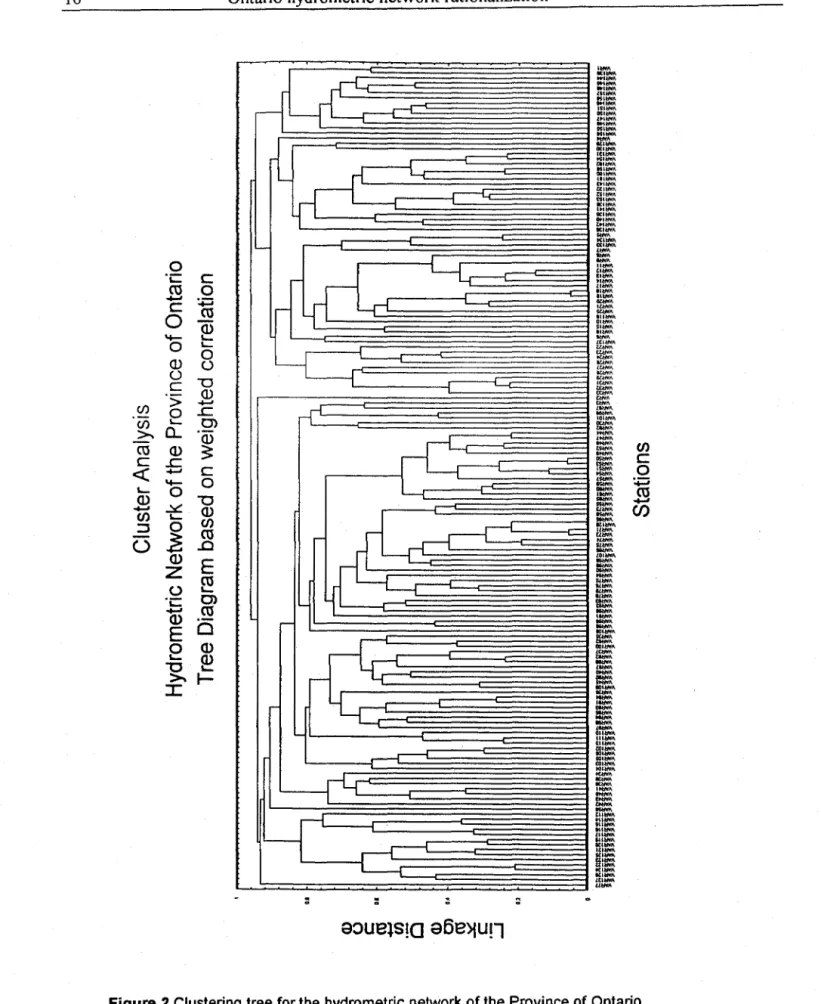
of the hydrometric network of Ontario. Figure 2 shows the tree diagram, based on weighted
correlation, for the hydrometric network of Ontario. The variables on the X-axis indicate station
numbers. 21 major groups of stations were identified on the basis of this clustering procedure. The
groups were found to correspond essentially to 21 different geographical areas of the province.
It
should be mentioned that a few stations were reclassified after the c1uster analysis to avoid
extension with auxiliary stations located unreasonably far away. A complete list of the stations of
each group is presented in Table 1. This list also indicates the identification number of each station
as they appear in the tree diagram.
4.3 Discussion of results
The result of the rationalization analysis is presented in various forms. Appendix B contains the
entire output from REDDC for each of the three variables considered (annual maximum, annual
mean, and annual minimum daily flow). The 21 groups of stations are treated one at the time.
First, the stations belonging to the particular group being examined is listed, along with
information on the length of the data records, the stations' individual contribution to
19
(denoted
"CI(act)"), the present precision of the quantile estimator, the stations' individual contribution to
Ig after n
2
=
20 future years of full monitoring, and the precision of the quantile estimator after
n
2
=
20 years. Then follows the results of the reduction analysis. The case of one discontinued
station is examined; the best choice is found, the program prints the results and proceeds to the
examination of the case oftwo discontinued stations, and so forth. For each eliminated station, the
program prints the name of the auxiliary station that should be used for future data extension.
It
also prints the values of n), n
2
and n
3,
the correlation coefficient between data at the two sites, the
station's contribution to
19
(denoted CI) after n
2
years, and the precision of the quantile estimator
after n
2
years. The program also pro duces a matrix of group
19
values where the lines correspond
to the different groups, and the columns represent different number of removed stations. This
matrix is subsequently analysed by the program ClAT ABLE to produce the global ranking of
Cf) Cf)
~
co
c
c::(
o
ï::::
CO
....
C
o
-
o
ID
U
C
'>
e
0...
ID
..c:
....
-
o
.:::s::.
~~
ID
Z
U
ï:::::::
....
ID
E
e
~
l
c
o
+=l
CU
~
1....o
U
"0
ID
...
..c:
0)
"(j)
3
c
o
"0
Q)
CI)
CU
..c
E
~
0)
CU
b
Q)
~
1
-aouelS!a a6e)ju!l
CI)
c
o
+=l
J9
Cf)
4 Application
17
Table 1 Result of cluster analysis
Group 1
Group 4
Group 7
Group 10
Group 13
Group 16
Group 19
119
2KF011
102
2HOOO3
63
2GBOO7
44
2FCOOl
22
2CFOO7
5
2A0010
129
40C001
120
2LA007
103
2HOOO6
77
2GHOO3
46
2FC011
23
2CF008
6
2BA003
130
4FCool
121
2LBOO6
104
2HOOO8
80
2HAOO6
47
2FC015
24
2CF012
7
2BB003
122
2LBOO7
105
2HOOO9
81
2HA007
49
2F0002
26
20B007
133
4JC002
123
2LBOO8
106
2HOO12
83
2HBOO4
50
2FEOOS
134
4JOOOS
124
2LB017
84
2HB007
51
2FEOO9
137
4LJool
125
2LB020
85
2HB008
52
2FE011
126
2LB022
86
2HB012
53
2FE013
127
2MCool
88
2HB015
54
2FE014
128
2MC026
99
2HC03O
57
2FF007
108
2HEool
59
2GA010
60
2GA018
61
2GA038
Group 2
Group 6
Group 8
Group 11
Group 14
Group 17
Group 20
110
2HJool
36
2EC010
64
2GC002
2
2ABOO8
18
2CC005
135
4KAool
144
5POO14
111
2HK007
91
2HC009
70
2GE007
3
2AB017
19
2CC010
136
4KA002
145
5POO15
112
2HK008
92
2HC013
76
2GH002
4
2AC001
20
2COool
146
5POO17
113
2HK009
93
2HC018
78
2GHOO4
21
2COO06
147
5POO19
114
2HLOO4
94
2HC019
79
2GH011
25
2CF013
148
5P0022
115
2HLOO5
95
2HC025
118
2JC008
149
5P0023
116
2HMOO4
96
2HC027
150
5P0024
117
2HMOOS
97
2HC028
151
5P0028
98
2HC029
155
5QOOO8
101
2HC033
156
5QOO15
107
2HOO13
157
5QOO17
158
5QOO18
Group 3
Group 6
Group 9
Group 12
Group 16
Group 18
GrouQ21
34
2EC002
35
2ECOO9
55
2FF002
27
200013
8
2BFool
131
4GA002
1
2AAool
38
2E0007
37
2EOOO3
56
2FFOO4
28
200014
9
2BF002
132
4GBOO4
138
5PAOO6
39
2E0010
40
2E0014.
58
2FFOOS
29
200015
10
2BFOO4
139
5PB014
41
2FAOOl
45
2FCOO2
65
2GC010
30
200020
11
2BFOO5
140
5PB015
42
2FAOO2
62
2GA041
66
2GC018
31
2EAOOS
12
2BFOO6
141
5PB018
43
2FB007
82
2HBool
68
2G0020
32
2EA010
13
2BF007
142
5PB021
48
2FC016
87
2HB013
67
2GOO19
33
2EB013
14
2BFOOS
143
5PCOll
89
2HB018
69
2GEOOS
15
2BF009
152
5QA002
90
2HB020
71
2GG002
16
2BF012
153
5QAOO4
100
2HC031
72
2GG003
17
2CAOO2
154
5QC003
109
2HGOO1
73
2GGOOS
159
5QEOOS
74
2GGOO6
160
5QEOO9
75
2GG009
161
5QE012
162
5RCOOl
stations (details on this program is provided in the report by Rasmussen et al. (1995); a listing is
given in Appendix A). The output of the program CIATABLE is presented in Appendix C for the
three variables considered. The tables in Appendix C should be read as follows: The first column
contains the number of stations that one may wish to discontinue. The following columns give the
number of stations that should be removed from each of the 21 groups. With this information one
may retum to Appendix Band identify the stations that should be removed.
To summarize the results in a more accessible form, we have proceeded as in the project for the
Ministry ofEnvironment ofQuebec, that is, we have identified, for each of the three variables, the
first ten sites that should be removed if only statistical considerations were taken into account in
the rationalization, then the next ten stations, and so forth up to 40 stations. It is straightforward
to continue the procedure if one so wishes. Table 2 presents the result of the analysis of Appendix
Band C. The results for the minimum annual flows are not presented. Several stations have years
with zero flows or flows beIow a censoring level related to the precision of the monitoring
equipment. In general, minimum flows are much less correlated than mean annual flows or
maximum annual flows and, although record extension may be profitable from a statistical point of
view, synthetic low flow data appear to be somewhat unreliable. Therefore, we recommend
putting the main emphasis on the annual mean and annual maximum daily flows. As an additional
information, Table 2 also provides information on the correlation coefficient between the
discontinued station and its auxiliary station.
It
may be seen that the correlations generally are very
high, especially for the mean annual flow where in sorne cases it is very close to one. If mean
annual daily flow is the only variable of interest such high correlations would clearly indicate a
redundancy of information since synthetic data, obtained by record extension, would provide
almost as accurate information on the variable as actually observed data. For the mean annual
flows, the correlation for the first 40 discontinued stations are generally ab ove 0.90. Correlations
tend to be slightly smaller for annual maximum flows, but they are still quite high.
It
should be
noted that the correlation coefficient between data at a given site and data at its auxiliary station is
.
not the only factor that affects the choice of stations to discontinue. The common period of record
is also very important, as is the Iength of the data series at the site. In fact, our definition of a
performance figure tend to favour discontinuance of stations with long records. This is because the
marginal benefit of additional data at a station with a short data record is higher than at a station
with a long record. This aspect of our performance figure may Iead to results that seem
contradictory to results from other studies. However, conflicting results are a common
phenomenon in multicriteria analyses; one will have to weight the different criteria and perform a
multicriteria analysis.
4 Application
Table 2 Result of rationalization analysis. Global ranking
of stations in network according to statistical pertinence.
Annual maximum
Annual mean
Station
rho
Station
rho
2FF002
0.96
2HB001
0.98
2GG002
0.98
2HB013
0.98
2FC001
0.93
2GB007
0.99
2FE008
0.98
2GG002
1.00
10
2FE009
0.99
2FC001
0.94
2GA010
0.93
2FE008
0.99
2EA005
0.88
2FF007
0.99
2CC005
0.98
2GA010
0.97
2BF005
0.98
2EA005
0.92
5QA002
0.92
2CC001
1.00
2LB006
0.89
2HM004
0.95
2MC001
0.94
2HC025
0.94
2HM005
0.91
2HC027
0.95
2EC002
0.72
2FC002
0.93
20
2FB007
0.79
2FF002
0.95
2FC002
0.72
2FC015
0.97
2HB001
0.84
2FE009
0.98
2FC011
0.95
2COO01
0.97
2EA010
0.89
2BF005
0.98
5PB014
0.85
5QA002
0.89
2HL005
0.81
2LA007
0.95
2HC025
0.88
2LB006
0.95
2HA007
0.81
2HL004
0.92
2G0020
0.90
2EC002
0.74
30
2GG006
0.92
2FB007
0.87
2CF007
0.91
2HC003
0.79
2COO01
0.91
2HA006
0.95
2COO06
0.93
2BF007
0.97
2BF007
0.97
2BF008
0.97
4LJ001
0.45
4JC002
0.88
2LB007
0.85
2LB007
0.93
2HOO03
0.83
2HC019
0.86
2EOO03
0.90
2HB008
0.90
2HA006
0.83
2GC018
0.97
40
2GC101
0.94
2FC011
0.95
2FC015
0.91
2GA038
0.95
2JC008
0.89
200015
0.92
2CA002
0.90
2BF001
0.89
4JC002
0.68
2BF009
0.96
4JOO05
0.85
2BB003
0.93
19
5 Conclusions
A statistical approach to hydrometric network rationalization has been applied to 162 stations in
Ontario. Based on cluster analysis, the stations were divided into 21 group with high correlations.
In the cluster analysis, both annual maximum, mean, and minimum daily flows were considered.
The 21 groups essentially corresponds to geographical regions. A few stations were manually
reclassified after the geographical regions were identified on a map. This was done to avoid record
extension with auxiliary stations that are far from the main stations. For each group, the case of
discontinuing one station, two stations, etc. was considered. At discontinued stations, a record
extension technique was used to evaluate the precision of the mean value of three hydrological
variables (annual maximum, mean, and minimum daily flows) after a certain number ofyears (20).
Adopting a global performance figure, various rationalization scenarios can be compared and the
best can be chosen. Appendix Band C provide the complete results of this analysis. In Table 2 in
Section 4 we have compiled sorne of these results into a more accessible form. Table 2 shows, in
groups of ten stations, the order in which stations should be removed from the network.
6 References
Burn,
D.H
and Goulter, I.C. An approach to the rationalization of streamflow data collection
networks, J. Hydrol., 1991, 122, 71-91.
Cochran, W.G. Sampling Techniques, John Wiley, New York, 1953.
Environment Canada, HYDAT, Version 4.94, Surface Water and Sediment Data to 1994, Atmospheric
Environment Service, CD-ROM 2245, 1996.
Matalas, N.e. and Jacobs, B. A correlation procedure for augmenting hydrologic data, U.S. Geol.
SUlV. Prof. Pap., 1964, 434-E, 7 pp.
Moran, M.A. On estimators obtained from a sample augmented by multiple regression, Water Resour.
Res., 1974, 10(1),81-85.
Ouarda, T. B.M.J., Rasmussen, P. F., and Bobée, B. On the rational reduètion ofhyrometric networks,
Proceedings of the Sixth Annual American Geophysical Union, Hydrology Days, ed.
H
J.
Morel-Seytoux, Hydrology Days Publication, CA, USA, pp. 383-394, 1996.
Perron,
H,
Legendre, P. Bobée, B., and Perreault,
L.
REMUS: Software for missing data recovery,
Stochastic and Statistical Methods in Hydrology and Environmental Engineering, Vol. 1, Extreme
Values: Floods and Droughts, ed K.W. Hipel, Kluwer Academic Publishers, The Netheriands, pp.
327-338, 1994.
Rasmussen, P.F, Ouarda, T.B.M.J., and Bobée, B. Rationalization of the hydrometric network for the
Province of Quebec (in French), Research Report No R-456, INRS-Eau, University of Quebec,
Quebec, 1995.
U.S. Arrny Corps of Engineers, HEC-4 monthly streamflow simulation, Generalized Computer
Program, 723-X6-L2340, Hydro!. Eng. Cent., Davis, CA., 1971
Vogel, R.M. and Stedinger, J.R. Minimum variance streamflow record augmentation procedures,
WaterResour. Res., 1985,21(5), 715-723.
APPENDIXA
function reduc(Q,names);
% function reduc(Q,names)
%
***********************************************
% 'Q' con tains the complete data set
% 'names' contains the station names
% @
Peter Rasmussen, october 1995
%
***********************************************
%---DEFINITION OF VARIOUS
CONSTANTS---n2
=20;
%
Time horizon
T
=100;
% Return period
zt
=
norminv(l-l/T);
%
Quanti1e in N(O,I) distribution
%---CALL SUBROUTINE "REDUCINF.m" TO GET INFORMATION ON VARIOUS
CONSTANTS---%
REDUCINF MUST CONTAIN VARIABLES ngroup, G1, .. Gn, ListStat
reducinf:
%---OPEN OUTPUT
FILE---fid = fopen('reduc.res', 'at');
fid2
=
fopen('cia.res', 'at');
%---LOG-NORMAL
TRANSFORMATION---Q(find(Q))=log(Q(find(Q))) ;
%---COMPUTE CORRELATION OF NORMAL DATA---%
disp('Computing correlation matrix')
nmat=[];rhomat=[];
for i=l:size(names,l)
end
[n rho]=statcorr(Q,i);
nmat = [nmat;n];
rhomat = [rhomat;rho];
ctisp( 'Done')
%---STORE VARIABLES FOR SUBSEQUENT
USE---Qinput=Q;
namesinput=names;
for igroup=l:ngroup
disp( ['Analyzing group' int2str(igroup)]);
fprintf(l,'*****************************************\n1):
fprintf(I,'Analysis of group no. %ct in the network\n',igroup);
fprintf(l,'*****************************************\n\n'};
%---GET STATIONS IN
GROUP---eval ( [' index=G' int2str (igroup) ';']);
Q - Qinput(:,index);
nstat - length(index);
names = namesinput(index, :);
rho = rhomat(index,index);
ncon = nmat(index,index);
%---GET INDEX OF STATIONS THAT WILL CERTAINLY BE
MAINTAINED---ListIndex =
[li
for i=l:size(ListStat,l)
for j=l:size(names,l)
end
end
if strcmp(ListStat(i,:),names(j,:))
ListIndex
=
[Listlndex j];
break
end
%---WRITE STATION INDEX, NAMES, AND OTHER
INFO---fprintf(fid, '---\n');
fprintf(fid, 'Stations in group %2d\n',igroup);
fprintf(fid, '---\n');
fprintf(fid, '%10s%5s%13s%12s%14s%10s\n', 'Name', 'N', 'CI (act) " ...
'PrQT(act) " 'CI(10a) " 'PrQT(10a)' );
LI=reshape(ListStat',I,prod(size(ListStat))) ;
for i-l:nstat
Qi
=Q(find (Q(:, ill, i) ;
n
=length(Qi);
Clact=std(Qi)/sqrt(n);
CIIOa-std(Qi)/sqrt(n+n2);
VarY = std(Qi)A2;
Cv - sqrt(VarY) / mean(Qi);
Zt
=
norminv(l-l/T);
VarQTact -
(1+Zt*Cv)A2*VarY/n;
PrQTact = sqrt(VarQTact) *100;
VarQTIOa
=(1+Zt*Cv)A2*VarY/(n+n2);
PrQTIOa
=sqrt(VarQTIOa) *100;
%
Variance of normal data at site i
Coefficient of variation at site
% Quantile in N(O,I) distribution
Var(QT)/QTA2 now
Var(QT)/QT
Aend
Appendix A Listing
of the
prograrns REDUC and
ClAT ABLE
str location = findstr(LI,names(i,:»;
if Ïength(str location)
&
(rem(str 10cation-l,6)==0)
fprintf (fid, '\10s*%4d%13. 5f%12 .-3f% 14 . snI O. 3f\n' , ...
names(i,:),n,CIact,PrQTact,cI10a,PrQTI0a) ;
el se
end
fprintf (tid, '\105% 5d%13. 5f% 12. 3n14. 5f% 10. 3f\n' , ...
names(i,:),n,Clact,PrQTact,CI10a,PrQTI0a
);
fprintf(fid, '\n');
fprintf(fid2,'%3d ',igroup);
for kk=O:nstat-length(ListIndex)
i f
kk==O
comb- [);
ncomb-1;
else
end
comb = cmat2(nstat,kk);
ncomb
=
size(comb,l);
Matrix of possible station combinations
Number of lines, i.e. binomial coef.
%---REMOVE ALL COMBINATIONS CONTAINING ELEMENTS FROM "ListStat"
%---THESE ARE THE STATIONS THAT WILL BE MAINTAINED WITH
CERTAINTY---for ns=1:1ength(ListIndex)
ix=(comb'-ListIndex(ns)*ones(kk,ncomb)==zeros(kk,ncomb);
if size(ix,l)==1
ix=f ind (ix) ;
else
ix=find(sum(ix) ) ;
end
if comb-=[J
If not the case of zero stations removed (kk=D)
comb (ix, :)=[);
ncomb=size(comb,l) ;
end
end
%---Print screen
info---fprintf(l, '\nOlimination de %d sites du r,seau',kk);
fprintf(I, '\n%d combinations are being examined\n',ncomb);
CI = 1e10D;
% Initialize variable 'bestcombvar'
for k=l:ncomb
%---GET
INDICES---jx = l:nstat;
%
Generate vector of index
if kk==O
% Index of eliminated stations
ix=[J;
else
ix
=
cOmb(k,:);
end
jx(ix)
=
[J;
% Index of remaining stations
%---FIND THE BEST EXTENSION AT EACH ELIMINATED
STATION---%
This is based on the variance of the Mean after n2 years
Vmy =
[li
Ext site=[l;
for i=ix
-minvar - 1/1ength( find(Q(:,i»);
jminvar
=
0;
Initialize variable 'minvar' which contains
the minimum extended variance at site i
%
DETERMINE BEST SITE FOR EXTENSION AT SITE l
for j=jx
nI
=
ncon(i,j);
n3
=
length(find(Q(:,i)))-nl;
%---GET
CORRELATION---if n1>=5
&
rho(i,j»O
R2 = rho (i, j) A2;
else
R2
0;
end;
Number of years of concur. data
Number of add. data at site i
%---VARIANCE OF MEAN AFTER n2 YEARS AT ELIMINATED SITE i
%---BASED ON POSSIBLE EXTENSION WITH DATA FROM SITE j
if R2* (nl-2) > (1+(n1-3)
*n2*n31
(n1+n2)·1 (n1+n3»)
&n1>=5
v -
1/n1 1
(n1+n2+n3) A2
* (
(n1+n2) A2 + n1*n3
- n2*(n1+n2)*(R2-(1-R2)/(nl-3»);
if v<minvar
end
end
minvar
=
v;
jminvar = j;
If current site j yield better
extension at site i, then update
end
%
End of loop
(examination of best reconstitution at i'th Site)
end
Vmy = [Vmy std(Q(find(Q(:,i»,i»'2*minvar];
Ext site = [Ext_site jminvar];
Vector of minimum variances for the
stations removed in
combinat ion k
end
% End of loop i (evaluation of the i eliminated sites)
%---CALCULATION
or
AGGREGATED STANDARD DEVIATION IN COMBINATION
sumvar = sum(sqrt(Vmy»;
%
Agg. std at removed sites
for j=jx
% Agg. std at cont. sites
= Q(find(Q(:,j»,j);
n = length
(QQ) ;sumvar = sumvar + std(QQ)/sqrt(n+n2);
end
\fprintf (fid, '%3d' , ix) ;
%fprintf(fid, '%10.3f\n',sumvar);
if sumvar
<
CI
CI
:>;><sumvar;
bestcomb - ix;
bestExt site = Ext_site;
end
end
% End of evaluation of combination no. k
%---OUTPUT
RESULT---i f
kk-=O
end
fprintf(fid, '\n%s%d%s%d%s\n', '*** ELIMINATION DE ',kk,' SITES DU GROUPE ',igroup,' ***');
fprintf (fid, '%10s%10s%6s%6s%6s%6s% 10s%10s\n', 'station', 'Aux. st.', 'nI', 'n2', 'n3', ...
'rha', 'CI (rat) ','PrQT(rat) ');
for k=l:length(bestcomb)
i=bestcomb(k) ;
j=bestExt_site(k) ;
end
if j-=O
% If data extension is possible
icc = fi nd ( Q ( : ,j ) . *Q ( : , i) );
nI
length( icc );
n3
=length(find(Q(:,i»)-nl;
rhaij=rho(i,j);
Qi = Q(find(Q(:,i»,i);
VarY =
std(Qi)~2;Cv = sqrt(VarY) / mean(Qi);
Zt = norminv(l-l/T);
n = n1+n2+n3;
VarEY = VarY/nI *
1/n~2Index of concurrent years
Number of years of concur. data
Number of add. data at site i
Get corr. between site i and j
Store data at site i in Qi
Variance of normal data at site
Coefficient of variation at site
Quantile in N(O,I) distribution
n1*n3 -
n2*(nl+n2)*(rhoij~2-(1-rhoij~2)/(nl-3»);* (
(n1+n2)
~2+
CI sitei
=
sqrt(VarEY);
VarQT =
(1+Zt*Cv)~2*VarEY;
%
CI at the eliminated site i
%
Var(QT)/QT~2for red. network
fprintf (fid, '%10s%10s%6d%6d%6d%6. 2f% 10.
sn
10. 3f\n' , ...
names(i,:),names(j,:),nl,n2,n3,rhaij,CI_sitei,sqrt(VarQT)*lOO);
else
If extension is nat possible (lack of correlation or all stations removed)
fprintf(fid, '%10s%10s\n',names(i,:), '******');
end
fprintf(fid2, '%lO.Sf',CI);
fprintf(fid2,'\n') ;
end
fclose(fid);
fclose(fid2) ;
Appendix A Listing
of the
programs REDUC and CIATABLE
function [res, ciamatrix,
igcount]~ciatable();%
function [res, ciamatrix, igcount]-ciatable();
*************************************************************
The function reads and analyzes the output from program REDUC
@
Peter Rasmussen, october 1995
*************************************************************
nmax~100;