THÈSE
THÈSE
en vue de l’obtention du
DOCTORAT DE L’UNIVERSITÉ DE TOULOUSE
DOCTORAT DE L’UNIVERSITÉ DE TOULOUSE
délivré par
Université Paul Sabatier
présentée et soutenue par
Catherine PONS LELARDEUX
le 17 octobre 2017
Real-time Virtual Collaborative Environment
Designed for Risk Management Training:
Communication and Decision Making
(Environnement
virtuel multi-joueurs temps-réel pour la formation à la gestion des risques:
Communication et prise de décision)
École doctorale et discipline ou spécialité :
EDMITT École Doctorale Mathématiques Informatique Télécommunications de Toulouse
-Image, Information, Hypermedia
Unité de recherche :
IRIT - Institut de Recherche en Informatique de Toulouse - UMR 5505
Directeur(s) de Thèse :
M
rJean-Pierre Jessel Professeur Université de Toulouse
UPSAutres membres du jury :
M
rStéphane Natkin, Professeur, Conservatoire National des Arts et Métiers, (Rapporteur)
M
meElise Lavoué, Maître de Conférence, Université Jean Moulin Lyon 3, (Rapporteur)
Communication et prise de décision dans un environnement virtuel multi-joueurs temps-réel destiné à la formation à la gestion des risques
Les facteurs humains figurent parmi les causes originelles de trop nombreux accidents, dans les transports, l’industrie ou encore dans les parcours de soins. Dans ces contextes socio-techniques complexes et dynamiques, le risque de survenue d’incidents est permanent. La formation des équipes interprofessionnelles à la gestion des risques dans un environnement reproduisant fidèlement le contexte professionnel est un enjeu majeur. La motivation de cette thèse est de proposer un environnement virtuel multi-joueurs destiné à la formation à la gestion des risques liés à des défauts de communication ou de prises de décision. Pour cela, une méthode de création de scénarios interactifs destinés à la formation à la gestion des risques a été présentée. Un système de communication, un système collaboratif de prise de décision et un modèle de description d’objectifs complexes composés d’actions, de communications et de décisions sont présentés. L’environnement multi-joueurs interactif s’appuie sur cet ensemble cohérent. Ces systèmes et modèles proposés octroient une relative liberté aux équipes pour gérer la situation professionnelle présentée au sein de l’environnement virtuel. Ils permettent aussi le contrôle de la situation pédagogique dans son ensemble. Une méthode à forte valeur d’innovation a aussi été proposée pour structurer le débriefing d’une formation à la gestion des risques. Cela permet notamment d’automatiser la production de débriefing personnalisé, individuel et collectif à l’issu des séances de formation.
Mots-clés : environnement virtuel collaboratif, scénario, formation à la gestion des risques, communica-tion, échange d’informations, prise de décision collaborative, argumentacommunica-tion, serious game, environnement multijoueurs.
Abstract
Communication and Decision Making in a real-time Virtual Collaborative Envi-ronment Designed for Risk Management Training
Many accidents in transport, industry or healthcare result from a causal chain of events where inadvertent human errors have not been corrected in time. In such socio-technical and dynamic systems where complexity and unpredictability widespread, training teams to risk management in real-life like situations is crucial. This thesis aims to provide a virtual multi-player environment designed for inter-professional team training to risk management. To that end, a method to design risk management interactive and controlled scenario has been described. A communication system, a group decision making system and a team tracing model have been created. They all together enable the virtual team to be free enough to manage the educational situations. These coherent and innovative environment allows us to control the team activity and automate the edition of a personalized, individual and corporate debriefing at the end of a team training session.
Keywords: virtual collaborative environment, interactive collaborative learning, risk management train-ing, serious game, collaborative decision maktrain-ing, argumentation, communication, information exchanges, multiplayer environment
Je tiens à remercier particulièrement Jean-Pierre Jessel, mon directeur de thèse pour toute son attention, pour sa confiance, ses conseils, son encadrement, sa bonne humeur et la sympathie qu’il m’a réservée.
Je remercie sincèrement aussi Stéphane Natkin qui m’a fait l’honneur d’accepter d’être rapporteur ainsi qu’Elise Lavoué.
Je tiens à remercier Vincent Minville et Damien Djaouti d’avoir accepté de participer à ce jury.
Je remercie tout particulièrement Pierre Lagarrigue pour sa bienveillance, sa confiance, son opiniâtreté, son éternel dynamisme, ses conseils et sa coopération depuis de nombreuses années.
A la mémoire de ma grand-mère Hélène et de mon oncle Gérard,
A mes deux blondes Marie et Hélène qui m’apportent les plus grandes joies de mon existence, A ma mère pour son éternel soutien, ses valeurs et ses critiques constructives,
A mon père pour son soutien, ses conseils, son humour et mes premières consoles de jeux, A ma formidable soeur Nathalie et à Julien son champion,
A Thomas, Lucie et Noémie qui me donnent le sourire avec leurs bêtises et leurs fous rires A mes oncles qui ont toujours été présents et m’ont permis de garder les pieds sur terre. A Michel Galaup pour sa coopération, sa bonne humeur et son enthousiasme,
A David Panzoli pour son esprit critique et son humour,
A Thomas Rodsphon avec qui j’ai eu le plaisir de travailler et pu voir évoluer au fil des projets et des années,
A tous ceux avec qui j’ai eu le plaisir de travailler au fil des projets de serious games à l’université : Olivier Baptista, Vincent Lubrano, Olivier Chabiron, Cyrielle Guimbal, Nicolas Muller, Laetitia Saillard, Jan Smolinski et tous les autres.
A tous ceux qui m’ont dit oui et que j’adore,
A tous ceux qui m’ont dit non et que je remercie de m’avoir poussée malgré eux à proposer le meilleur,
permis de voir un avenir meilleur encore,
A Marie (de la montagne et de la mer) pour son amitié et ces bons moments passés sur notre plage de Palavas-Les-Flôts
Aux copains qui sont toujours présents contre vents et marées,
A Manu en souvenir de nos soirées Street Fighter et Mortal Combat dans notre belle ville de Montpellier,
A Alex pour ces nouvelles aventures qui contribuent à la reconstruction de chacun de nous.
“Success is not final, failure is not fatal: it is the courage to continue that counts.”
Remerciements
. . . vContents
. . . viiPart I
Context, goals and challenge
. . . 11
Global introduction
. . . 31.1 Context . . . 3
1.1.1 Example: the aviation context . . . 5
1.1.2 Example: the healthcare context . . . 6
1.1.3 Example: the railway context . . . 7
1.1.4 Synthesis . . . 7
1.2 Complex socio-technical system and dynamic situation. . . 8
1.2.1 The complex healthcare system . . . 9
1.2.2 The complex aviation system. . . 10
1.2.3 Synthesis . . . 10
1.3 Rules and recommendations: a top-down approach . . . 10
1.3.1 Aeronautics . . . 11
1.3.2 Marine accidents, shipwrecks example . . . 11
1.3.3 Heathcare example. . . 12
1.3.4 Synthesis . . . 12
1.4 To an educational issue . . . 13
1.4.1 Simulation . . . 13
1.4.2 Simulation in healthcare . . . 16
1.4.3 Example of aviation training center with simulator . . . 17
1.4.4 Synthesis . . . 18
1.5 Synthesis . . . 18
1.5.1 Synthèse en français. . . 18
1.5.2 Synthesis in English . . . 19
2
Goals and challenge
. . . 213
Case of study : the operating room
. . . 273.1 The teamwork in the operating room. . . 27
3.2 The WHO surgical safety checklist . . . 28
3.3 Non-technical skills in the Operating Room . . . 30
3.4 Synthesis . . . 31
Part II
State of the art
. . . 334
Multiplayer virtual environments for training
. . . 354.1 A digital collaborative environment. . . 35
4.1.1 Interactive objects, tasks and behaviors. . . 36
4.1.2 Representation of a team activity in a collaborative environment. . . 37
4.1.3 Global main objective based on non-linear tasks and conflicts in a team 37 4.2 Serious games . . . 39 4.2.1 Teleological approach . . . 39 4.2.2 Genealogical approach . . . 39 4.2.3 Axiological approach . . . 39 4.2.4 Empirical approach . . . 40 4.3 Learning games . . . 41 4.3.1 Characteristics . . . 41
4.3.2 Definitions connected to game vocabulary . . . 42
4.4 Synthesis . . . 42
5
Designing an interactive scenario
. . . 455.1 Interactive Scenario . . . 45
5.2 Scenario centered on tasks . . . 46
5.3 Scenario designed with ontology and tree-like structure . . . 47
5.4 Scenario represented with Petri Nets . . . 48
5.5 Scenario designed with Linear Logic . . . 49
5.6 Model based on resources . . . 50
5.7 Adapting and re-using an existing environment . . . 51
5.8 Experimental approach to design a scenario with autonomous agent . . . . 51
5.9 Business Process Modeling and Notation (BPMN). . . 51
5.10 Synthesis . . . 53
6
Communication
. . . 556.1 Communication and situation awareness . . . 55
6.1.1 Communication . . . 55
6.1.2 Situation awareness . . . 56
6.1.3 Team Situation awareness . . . 56
6.2 Communication in a virtual environment . . . 56
6.2.1 Human-like communication between a human and a computer-controlled character(CCC). . . 57
6.2.2 Communication between 2 humans using a virtual environment . . . 61
6.3 Fostering the communication . . . 63
6.3.1 Implicit rules of a natural professional communication . . . 64
6.3.2 Spoken dialogue interface . . . 65
6.3.3 Text-chat systems . . . 66
6.4 Synthesis . . . 66
7
Group decision making
. . . 717.1 Decision making. . . 71
7.1.2 A conflict to provoke a decision making. . . 72
7.1.3 The role of reasoning in a decision-making. . . 74
7.1.4 The role of argumentation in a group decision-making . . . 74
7.2 Decision support system . . . 76
7.3 Decision making in a virtual environment. . . 78
7.4 Synthesis . . . 82
8
The grail of traceability
. . . 858.1 Intelligent Tutoring Systems. . . 85
8.1.1 A probabilist approach : Bayesian Networks . . . 85
8.1.2 Examples . . . 87 8.2 Learning Analytics . . . 88 8.3 Monitoring dialogue . . . 89 8.4 Synthesis . . . 90
9
Conclusion
. . . 91 9.1 Conclusion in French. . . 91 9.2 Conclusion in English . . . 93Part III
Contributions
. . . 9710
Designing an educational risk management scenario based
on real-life cases
. . . 9910.1 Classical challenges to design an interactive scenario . . . 99
10.2 Specific challenge to foster communication . . . 100
10.3 Specific challenges relative to risk management training . . . 101
10.4 Two categories of educational scenario: perfect initial situation and irregular initial situation . . . 101
10.4.1 Draw up an educational scenario basing on a real causal chain of events that leaded to an accident. . . 102
10.4.2 Systemic analysis methods in healthcare . . . 103
10.5 Methodology . . . 104
10.6 Synthesis . . . 107
10.6.1 Synthèse en français. . . 107
10.6.2 Synthesis in English . . . 107
11
A model to design collaborative educational scenarii
dedi-cated for risk management training
. . . 10911.1 Using BMPN for multi-player scenario modeling . . . 110
11.1.1 Business Process Modeling Notation . . . 110
11.1.2 Weaknesses and difficulties to create an educational scenario with Business Process Diagram. . . 113
11.2 A specific grammar to describe synchronous and collaborative human activi-ties in an educational scenario . . . 114
11.2.1 Attach the action to objects on the virtual scene. . . 114
11.2.2 Extend a BPMN regular path with new outlying sequences to build an educational collaborative scenario. . . 116
11.2.3 Task to dispatch between team members while respecting their profes-sional role. . . 116
11.2.4 Different categories of task in a collaborative universe . . . 117
11.2.5 Pre-conditions and post-conditions to support a dynamic activity . . 118
11.2.6 A condition to know who knows what . . . 119
11.2.7 A condition to know if a task have already been achieved. . . 119
11.3 Scenario content checking and validation . . . 122
11.4 Synthesis . . . 123
11.4.1 Synthèse en français. . . 123
11.4.2 Synthesis in English . . . 123
12
A methodology for prototyping the collaborative virtual
en-vironment for training
. . . 12512.1 2D multiplayer and real-time environment . . . 127
12.2 3D multiplayer and real-time environment . . . 127
12.3 A client/server architecture . . . 128
12.4 Architecture . . . 129
12.4.1 Game Connection Module. . . 129
12.4.2 Scenario Management Module . . . 129
12.4.3 Scenario Settings Module . . . 131
12.4.4 Task Management Module . . . 131
12.4.5 Virtual memory module . . . 132
12.4.6 Information module . . . 132
12.4.7 Documentation module. . . 132
12.4.8 Communication Manager Module . . . 132
12.4.9 Decision making Module . . . 132
12.4.10 Educational Objectives Monitoring Module . . . 132
12.4.11 Debriefing Module . . . 132 12.4.12 Trainer Module . . . 132 12.5 Synthesis . . . 133 12.5.1 Synthèse en français. . . 133 12.5.2 Synthesis in English . . . 133
13
Communication system
. . . 135 13.1 Information . . . 13513.2 Virtual memory of a character . . . 137
13.3 Activity Panel . . . 139
13.4 Conversational panel. . . 140
13.5 Searching and reading information . . . 141
13.6 Broadcasting/receiving an information. . . 141
13.7 Signs and feedback to represent some implicit rules of communication. . . 142
13.8 Asking someone else an information and answer to a question . . . 143
13.9 Asking a teammate about their activity . . . 144
13.10 Interjections . . . 144
13.11 Listening to information exchanged in another conservation . . . 145
13.11.1 Working temporal continuum system . . . 145
13.11.2 Contextual sound system . . . 146
13.12 Synthesis . . . 146
13.12.1 Synthèse en français. . . 146
13.12.2 Synthesis in English . . . 147
14
Group decision making system
. . . 14914.1 Overview of the group decision making system . . . 149
14.2 A model to describe a debate . . . 150
14.2.1 The participants . . . 151
14.2.2 The role of the leader . . . 151
14.2.3 The available answers. . . 151
14.2.4 The participants’ opinions. . . 151
14.2.6 Arguments . . . 151
14.3 Choosing and triggering a debate . . . 151
14.4 Graphical representation and available interactions . . . 152
14.5 Giving one’s opinion . . . 152
14.6 Arguing one’s opinion . . . 152
14.7 The final decision . . . 154
14.8 Example of decision making in an operating room . . . 154
14.9 Synthesis . . . 155
14.9.1 Synthèse en français. . . 155
14.9.2 Synthesis in English . . . 155
15
A team tracing model: EURIKAT
. . . 15915.1 Monitoring the training activity . . . 160
15.2 Overview of existing models. . . 160
15.2.1 Model tracing . . . 160
15.2.2 Petri Net . . . 160
15.2.3 Bayesian Net. . . 161
15.2.4 Model based on constraints . . . 161
15.3 Different kinds of objectives . . . 161
15.4 Script objectives. . . 162
15.4.1 Objective cast ’Game Over’. . . 162
15.4.2 Objective cast ’Step’ . . . 162
15.5 Educational objectives. . . 162
15.6 Unit element . . . 163
15.6.1 Objective cast ’Info’ . . . 163
15.6.2 Objective cast ’Action’ . . . 163
15.6.3 Objective cast ’Vote’ . . . 164
15.6.4 Objective cast ’VAR’ . . . 164
15.7 A specific grammar to build complex objectives. . . 164
15.8 Buggy behavior: identifying errors and defining a predictable error as an outcome . . . 165
15.9 How does it work ?. . . 165
15.10 Synthesis . . . 165
15.10.1 Synthèse en français. . . 165
15.10.2 Synthesis in English . . . 166
16
Particular Risk Management Debriefing
. . . 16916.1 Debriefing process in a training context . . . 170
16.2 From real serious adverse event debriefing to fictional serious adverse event debriefing . . . 171
16.3 An innovative method to display debriefing for risk management . . . 171
16.4 Synthesis . . . 174
16.4.1 Synthèse en français. . . 174
16.4.2 Synthesis in English . . . 174
Part IV
Experiments
. . . 17517
The training scenarios
. . . 17718
Experiments to assess the communication system
. . . 18318.1 Experiments . . . 183
18.2 Results on communication system . . . 184
18.2.1 Global view of the teamwork . . . 184
18.2.2 Feature “collect information on documents” analysis . . . 187
18.3 Results on team situation awareness . . . 190
18.3.1 Feature “vote” analysis. . . 190
18.3.2 Synthesis . . . 192
18.4 Conclusion . . . 193
19
Experiments to assess the decision making system
. . . 19519.1 Method. . . 195
19.2 Results and discussion. . . 196
19.3 Conclusion . . . 198
20
Experiments to assess the model of objectives
. . . 19920.1 Experimental protocol. . . 199
20.2 Two training situations . . . 200
20.3 Results . . . 200
20.3.1 Step objectives . . . 201
20.3.2 Educational objectives . . . 201
20.4 Conclusion . . . 202
Part V
Conclusion and further works
. . . 20321
Synthesis in French
. . . 205Démarche et contributions . . . 205
Bilan et points forts . . . 207
Perspectives . . . 209
22
Synthesis in English
. . . 211Challenge and Contributions to achieve the objectives . . . 211
Report and good points. . . 213
Future works and outlooks. . . 216
List of Figures
. . . 217List of Tables
. . . 221Bibliography
. . . 223I
P
ar
t
1
Global introduction
1.1 Context. . . 3
1.1.1 Example: the aviation context . . . 5
1.1.2 Example: the healthcare context . . . 6
1.1.3 Example: the railway context . . . 7
1.1.4 Synthesis . . . 7
1.2 Complex socio-technical system and dynamic situation . . . 8
1.2.1 The complex healthcare system . . . 9
1.2.2 The complex aviation system. . . 10
1.2.3 Synthesis . . . 10
1.3 Rules and recommendations: a top-down approach. . . 10
1.3.1 Aeronautics . . . 11
1.3.2 Marine accidents, shipwrecks example. . . 11
1.3.3 Heathcare example. . . 12
1.3.4 Synthesis . . . 12
1.4 To an educational issue . . . 13
1.4.1 Simulation . . . 13
1.4.2 Simulation in healthcare . . . 16
1.4.3 Example of aviation training center with simulator . . . 17
1.4.4 Synthesis . . . 18
1.5 Synthesis. . . 18
1.5.1 Synthèse en français. . . 18
1.5.2 Synthesis in English. . . 19
1.1 Context
During several decades, the society was the witness of a large variety of accidents on different industrial contexts as transport (aeronautic, aerospace, shipping. . . ), nuclear, healthcare, mechanical, chemical, electrical industry. . . . As everyone would like to live in a safer world and learn from its mistakes, many programs on risk management and disaster reduction were developed to analyze, prevent and avoid some serious events or accidents. Professionals and researchers from different disciplines investigate the near-misses, serious events and accidents
aiming to seek out the failures, technical or human errors on these events which have led to a disaster. The proceeding for identifying the errors or evaluating its causes aims to highlight the main contributing factors, particularly human factors such as communication default, stress, fatigue, human-machine interface problems. . . Nowadays, it is well known that accidents or disasters are not caused by a single mechanical or human failure. Most of them do not happen in isolation but they are the result of chain of events. Researchers proposed to classify accidents with three type of accident models: sequential, epidemiological and systemic [Hollnagel2004]. A sequential theory of accident causation had been grasped by most of researchers in the field of human error. This theory from Heinrich’s axioms [Heinrich+1931], Bird’s Domino’s theory [Bird1974] and Reason’s [Reason1990][Reason1990] ‘swiss cheese model’.
Consequences of an accident are multiple: loss of investment, people injuries, contamination of environment. . . The chain of successive events that build the trajectory to an accident is shaped by the human activity. Most of the time, when flow of events takes away from an expected trajectory, the main objective is clearly not completely achieved and the probability that the worst unpredictable accident appears increases. In many domains as transport, manufacturing, healthcare and process industry, there are lost of examples of incidents, disaster, near-misses, serious events or accidents whom one of the root causes is connected to human activity.
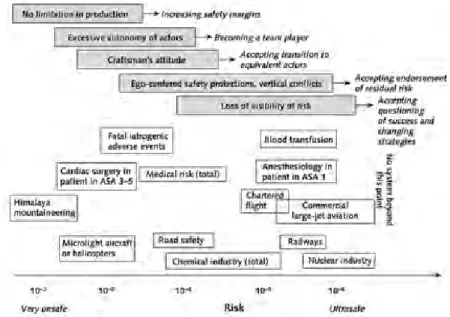
Amalerti et Hoc [Amalberti+2005] classified different human activities or industries according to the level of exposure of catastrophe or deaths.
Figure 1.1 – Average rate per explosure of catastrophes and associated deaths in
various industries and human activities.
Many studies have identified human errors contributing to incidents, accidents or disas-ter in domains like aviation, rail industry, medical, road, nuclear and chemical indus-tries[Shappell+2012][Glendon2009][Malakis+2010][Straeter+2002][Wilson+2006]. The last three subsections present some examples from domains where academic research and experts studied accidents or major disasters for which communication default or wrong decision had been identified among the root causes.
1.1.1 Example: the aviation context
The aviation context is one of the most advanced studied system in terms of safety and risks management. Even if aviation accident is fortunately rare, each time, experts investigate to rebuild the chain of events that leaded to the incident. The International Civil Aviation Organization (ICAO) and the Commercial Aviation Safety Team (CAST), which includes Government officials and aviation industry leaders, propose a taxonomy which is used to classify the aviation occurrences (ie accidents or incidents). In this taxonomy, human factors, failures, technical damages, wildlife or natural weather conditions are listed as possible contributive factors.
Using this taxonomy, the Boeing company analyzed their flights between 2006 to 2015 and the three first categories of fatalities are loss of control in flight, runway excursion and controlled flight into or toward a terrain.
In Europe, the European Saefty Agency (EASA) publish in its annual report in 2016 that among the accidents happened in 2015, the only fatal accident in the category ’‘aeroplanes‘’ involving an EASA MS operators was the Germanwings accident on 24 March 2015. It can be observed that there was a higher number of non-fatal accidents involving EASA MS operators in 2015 than the 10-year average, with 24 compared to the average of 21.8 over the previous 10 years[Agency2016].
In this annual report, the EASA mentions that 3 083 "‘CRM and communication"’ incidents were listed in human factors against 1718 in "‘personal readiness and crew impairment"’ and 34 for "‘Flight crew perception and awareness/decision making and planning"’.
On one hand, the relationship between organization management, the safety management sys-tems and the professional practices are explored from many decades through the deployment of different measures and methods[McDonald+2000][Atak+2011][Wiegmann+2005]. On the other hand, the aviation companies tracked any element that could help them to increase and improve safety. Between 1959 and 2015, the Boeing Company tracked aviation accidents and showed that 53 percent of all commercial airline fatal accidents occurred during the takeoff and landing phases of flight[Boeing2015]. The figure1.2represents the percentage of fatal accidents and onboard fatalities during each phase of a flight. But the flight phases are not the only crucial stage for aviation safety. Aircraft maintenance is also generally regarded as a crucial step[McDonald+2000][Atak+2011].
Figure 1.2 – Fatal accidents and onboard fatalities by phase of flight.
The recent example of Emirate Company illustrates the critical phase of landing. An accident on Emirates company happened in July 2016 to a Boeing 777-300 which touched
the ground with their belly while landing and ignited. The Australian Transportation Safety Bureau analyzed 75 fatal airplane accidents which occurred between 1988 and 1990. They mention that the three most frequent occurrences were loss of control, collision with terrain and wire-strike. The most common pilot factors relates to poor judgment and decision making [Bureau1996].
The Flight Safety Foundation - a worldwide organization since 1947 - develops recommen-dations to reduce approach and landing accident for the safety in aviation and aerospace industry. According to this foundation, “there is a general agreement that human error is involved in more than 70 percent of aviation accidents”[Foundation2000]. In may 2001, the Joint Aviation Authorities (JAA), a co-operation of most European civil aviation regulatory authorities (created before EASA in 2002) mentions that 70-80 percent of accident are due to human factors. Management safety experts in aviation use some tricks to open discussion into human errors in aviation situation. For example, Gordon Dupont, from Transport Canada used since 1993 the dirty dozen concept to open discussions on safety and human errors. The dirty dozen concept refers to the twelve most common Aviation Maintenance-related, Human Factors causes of errors: Lack of Communication, Complacency, Lack of Knowledge, Distraction, Lack of Teamwork, Fatigue, Lack of Resources, Pressure, Lack of Assertive-ness, Stress, Lack of AwareAssertive-ness, and Norms. Different studies [Endsley+2000;Fracker1990;
Sarter+1991], since 1988, have shown the role of human factors and especially the role of the situation awareness in the aviation accidents. Hartel et al [Hartel+1989] explained that a lack of communication was the lead causal factor in a review of 200 aviation mishaps. Fortunately, in spite of all unpredictable and possible events that can occur during the take-off, the flight and the landing, very few accidents happen comparing to the number of flights all over the world.
1.1.2 Example: the healthcare context
Healthcare is another field for which human error can lead to dramatic consequences. Numerous investigators present this 10−4risk for accident as an extrapolated average value in health care [Gaba2000][Leape1994]. Adverse events can occur at any phases of the patient care especially in hospitals but 65 percent of adverses events are linked to surgery [Zegers+2011]. Beyond the human tragedies, the costs have been estimated between $17 billions and $29 billions per year in United States[Kohn+2000]. The rate of fatal adverse events among hospital patients is much greater but it depends on the domain [Kohn+2000]. In obstetrics, anesthesiology, or blood transfusion, the risk for fatal adverse events per exposure is less than 10−5 [Amalberti+2005]. Conversely, surgery has a total rate of fatal adverse events of almost 10−4[Thomas+2000]. In France, 9.2 adverse serious events occurs in surgery while in the same time 4.7 occurs in medecine [MotyMonnereau2009].
Some examples of surgical serious adverse events as wound infection, anesthesia injury, wrong-surgery-site, wrong-patient, retained surgical items, surgical fires, patient fall. . . Hempel et al. [Hempel+2013] have been referenced as consequences of human errors. In "‘To err is human"’[Kohn+2000], different types of errors are referenced as :
• diagnostic: error or delay, failure to employ indicated tests, use of mutmoded tests, therapy, failure to act on results of monitoring or testing. . .
• treatment: error in performance of an operation, procedure or test, error in administer-ing the treatment, error in dose or method of usadminister-ing a drug. . .
• preventive: failure to provide prophylactic treatment • others: failure of communication, equipment failure. . .
A study conducted in 21 Dutch hospitals in 2004 [Zegers+2011] aimed to determine the presence of adverse events during hospitalizations and to consider how far they could be
prevented. The results showed that surgical adverse events occurred in 3.6 percent of hospital admissions and represented 65 percent of all adverse events. 41 percent of the surgical adverse events was considered to be preventable.
In 1999, Gawande et al[Gawande+1999] studied 15,000 randomly medical records concerning patients from Utah and Colorado Hospitals in 1992. Among adverse events, 54 percent of surgical adverse events occurring in industrialized countries are considered as preventable events. Many studies show that human factors are most often listed among the multiple causes of an accident or a near-miss. They also point that the most current root causes of adverse events in the operating room is due to a communication problem [Halverson+2011;
Kohn+2000;Lingard+2004]. The Pennsylvania Patient Safety Reporting System is a secure, web-based system that permits Pennsylvania hospitals to submit reports of “Serious Events,” “Incidents,” and “Infrastructure Failures”. In its annual report in 2007, the Pennsylvania
Patient Safety Authority notes that communication problem was most often linked with reports of medication errors and errors in procedures, treatments or tests [Pennsylvania Patient Safety Authority2007]. These events accounted for about 63 percent of all events reported mentioning communication as a contributing factor. The Joint Commission for Hospital Accreditation in USA reports [Joint Commission2008] that 64 percent of root causes of sentinel events (3548 adverse events reported) involved communication default between 1995 and 2005.
In France, the national ENEIS report, edited in 2009, aims to publish analysis on adverse events connected to cares. 6.2 serious adverse events occur in 1 000 days of hospitalization ie: approximatelty one serious adverse event each five days in a clinical service in charge of 30 patient’s beds. This report pointed that among the human contributive factors: 27.6 percent concerns the human professional failures, 26.4 percent concerns the insufficient supervision of team’s members, 24.1 percent concerns the communication defaults between professionals. In the operating room, the good operating achievement essentially depends on the dynamic information exchanges [Plasters+2003]. The miscommunication is the clincher of near-misses and adverse events[Hempel+2013].
1.1.3 Example: the railway context
The transportation industry is another domain where human errors can cause fatal accidents. Some research focused on railway incident occurrence that involved communication default [Murphy2001][Shanahan+2007].
As in aviation, there is a large quantity of research describing and classifying the nature of errors associated with one particular type of railway incident. The errors related to "‘Signals passed at danger"’ have been categorized from a range of different perspectives including behavioral and cognitive or information processing [Wright2000].
Wilson et al [Wilson+2006] revealed that the critical aspects of the railway safety are the communication, shared planning and conducting briefing, all central to a collaborative work. As in aviation, the teamwork is virtual by means that they are not all located in a same place and their gangs are mobile. The recent research in applied ergonomy focused on the mental workload of signalers [Pickup+2005], team-working and situation awareness [Bristol2004], reasoning [Jorna+2007], expertise and competences[Skjerve+2002] and information interfaces [Kiewiet+2005][Kiewiet+2005].
1.1.4 Synthesis
French : Un état de l’art sommaire sur différents domaines comme l’aviation, la santé, le
transport férroviaire montre que de nombreux travaux de recherche et enquêtes d’investigation tentent de décrypter la succession d’événements qui ont conduit à un accident pour com-prendre comment et pourquoi les accidents sont survenus. Ces travaux visent à enrichir
les connaissances pour améliorer la gestion des risques mais aussi à amener les hommes à capitaliser l’expérience et corriger dans le futur leurs erreurs qu’il s’agisse de défauts d’organisation, de défaut de commnication ou encore de mauvaise prise de décision.
English: The last short basic review on different fields as aviation, healthcare or railway
safety shows that many investigations and research focused on risks to understand how and why accident happen and to help to prevent and manage risks connected to human errors which are unavoidable. Some of them aims point out particularly communication defaults, organization defaults or wrong decision making. In all these examples, a team has to achieve a global task in a complex environment which is composed of people who must work together in a limited space and time. The next section presents the similarities between all these situations.
1.2 Complex socio-technical system and
dynamic situation
In such a complex system as the operating room, the flight deck or the railway cockpit, individuals share a common goal and manipulate a set of technical objects, specific equipment and documentation which help them to fulfill their professional requirements. Technical objects and specific equipments embed software and sensors which give and control dynamic pieces of information to inform the professionals on the situation. Most of the time, a socio-technical system combine human-human and human-computer interactions with interfaces and monitoring systems.
A socio-technical system [Trist1981][Susman+1986] is more or less complex and this com-plexity can come from different sources:
• different disciplines, expertise and cultures coexist within the team, • the operators deal with unanticipated events,
• the operator’s interactions are non linear and often unpredictable,
• humans interact with each others and with technical objects or computer systems which deliver technical information,
• the state of the system changes and evolves over the time.
Each individual has both individual technical tasks and collaborative tasks. Every one knows their job and tasks to accomplish to fulfill their role and helps the team reach an identified common goal. For example, in the operating room, while the anesthetist nurse prepares the material for the anesthesia, the operating nurse prepares the patient’s operating instrumentation on a table, the surgeon and the anesthetist check together the position of the patient on the operating table.
On the other hand, the time is another characteristic which also brings complexity to the situation. As well as the time passes, states of pieces of information change and each operator needs to update their representation of the situation. They try to build the most probable representation of the world, working out the information collected on the changing environment.
Many cognitive models try to understand the human cognition in dynamic and complex situation. Most of them are based on Rasmussen taxonomy named: “Skills-Rules-Knowledge” [Rasmussen1983]. In this model, the activity is separated in automatism, rules and knowledge. Hoc et Amalberti complete this model [Hoc+2007] to take in account the fact that the operator does not react immediately when an information is coming. In fact, the operator uses time to evaluate the dynamism of the situation and anticipate some predictable events.
The heart of this theory is that the operator updates successively their representation of the current situation. Their representation depends on the information received from the environment but also on the operator’s knowledge (procedural knowledges or global knowledges).
As human interactions or human-computer interactions can produce hazards, paradoxes can appear and accidents, incidents or adverse events are hardly predictable. To decrease workload and assist professionals in such a complex and dynamic situation, high-level technological equipments track information in real-time as arterial pressure, heart rate in the patient’s case, altitude, location. . . for the aircraft Monitoring equipments allow the operators to be informed about the evolution of the situation in real-time and trigger alerts if abnormal values statement are picked up.
But the added benefits also bring unexpected side effects that could compromise safety. Researchers have identified that when automation changes the way human operators perform the tasks, complacency begins to manifest itself, especially in multi-task environments. Even if automation and monitoring equipments assist operators in their complex tasks, they do not replace the humans abilities as communication, decision making, situation awareness that combine essential non-technical skills to manage in a best way a socio-technical and dynamic complex situation.
The two next subsections detail the complex socio-technical systems in two different fields as the operating room in the healthcare area and the flight desk in the aviation area.
1.2.1 The complex healthcare system
In the healthcare context, Vicente [Vicente1999] lists several contributing factors to teamwork system complexity. Effken [Effken2002] describes health care as a complex dynamic socio-technical system in which groups of people cooperate for patient care and are faced with numerous contingencies that cannot be fully anticipated. The operating room is so a complex and dynamic socio-technical system. It gathers different people as the surgeon, the anesthetist, the operating nurse, the anesthetist nurse, the patient and technical or monitoring equipment: anesthesia machine, electric generator for the scalpel, surgical aspiration system. . . The complexity of this dynamic system comes from multiple elements; the composition of the team is heterogeneous. Each one has their own technical skills and responsibilities. There are multiple interactions that influence the evolution of the system. But, a successful operation depends on what information is dynamically exchanged [Plasters+2003].
Often participants in healthcare delivery conflict with each other because individuals follow different
sub-objectives; this misalignment can produce inefficiencies, unexpected situations and different care problems. A dozen of dimensions of complexity in health care are described by Carayon [Carayon2006], Plesk and Greenhald [Plsek+2001] and Effken [Effken2002]. The case of the operating room is specific. In the operating room, different disciplines are represented as surgery, anesthesia, and nursing. Each professional deals with a large variety of pathology. They are free to act and communicate. Their actions and purposes are interconnected and aim for the same main global goal. Any action and communication have an impact on the state of the system. Sometimes, the team can visualize dynamic information: on monitoring equipment, the patient’s clinical data change in real-time and are represented on graphics. During the operating time and depending on the period, the surgeon can join the anesthetist on a specific task and successively join the operating nurse to accomplish another task... Different groups inside the team are temporary composed to attempt an micro-objective and each one exists for a very short time, namely until the goal is achieved.
1.2.2 The complex aviation system
Another example concerns the aircraft system. Pilots, cabin crews, air maintenance staff. . . work together in the same space and time. They must react in a best way fac-ing to unpredictable events that could move to a tragic situation. They also collaborate with the air traffic control staff and with the maintenance aircraft staff. . . They need to use different aircraft commands, configure the aircraft parameters, gather dynamic information about weather conditions and the aircraft location, define flight plan. . . . Globally, in an aircraft, two people manage mainly the situation : the Pilot Flying and the Pilot Not Flying. The Pilot Non Flying or Pilot Monitoring is the one who has responsibility for monitoring the actions and awareness of aircraft control. Both, they have to collaborate with each other. As the operating room system, the aircraft is a socio-technical system where humans work together and automatic component embedded high-level technology assist them with their tasks.
1.2.3 Synthesis
French Les systèmes dans lesquels les accidents sont les plus probables sont les systèmes
socio-techniques complexes dans lesquels la situation évolue de manière dynamique et cette évolution peut modifier les trajectoires qui permettent de réaliser l’objectif commun. Dans ces systèmes, des opérateurs à compétences complémentaires sont réunis dans le temps pour réaliser une tâche commune et globale. Atteindre un objectif commun pour le groupe signifie collaborer mais aussi réaliser des tâches individuelles et techniques en utilisant du matériel de monitoring à haute technicité par exemple. Le bloc opératoire ou encore le poste de pilotage d’un avion sont des exemples de systèmes socio-techniques complexes et dynamiques.
English Globally, the socio-technical complex and dynamic systems are systems in which
incidents are hardly predictable because many operators are involved, many events can occur and the situation changes over the time. The chain of events are likely to deeply modify the outcomes and particularly the trajectories that could lead to reach the main team’s objective. In such a system, operators who has complementary skills need to get together to accomplish a common mission. Reach a common goal for a team means that each one need to cooperate and work together but also they have to realize some individual and technical tasks using or not high-level monitoring equipment. The operating room or the flight deck of the aircraft are some examples of socio-technical complex and dynamic systems.
1.3 Rules and recommendations: a top-down
approach
Many politicians, directors, safety managers are involved by means of laws in the development and the publication of recommendations, rules and procedures that are supposed to help professionals to decrease accidents and increase their performance. On one side, through the legal system, the society places the safety as a priority and on the other side, workers and organizations are reluctant to change their practices. The paradox is that people adore the novelty and innovation but hate the changes.
New equipments, high-level simulators, high-level automation, new safer processes and technologies are supposed to encourage workers to avoid accidental side effects and increase their performance. But, some of them often interpret new rules and procedures as a stronger control of their activities.
Some authors[Carthey+2011] consider the causes of non compliance from organization and professionals as a problem due to an information overload, a multitude of rules, the rules themselves, their complexity and their lack of relevance. They have to deal with
local, professional associations or consortium, governmental and international guidelines and policies. Some other authors consider that the humans adapt their behavior facing the policies and the rules thanks to the diversity of situation ever experimented. Hollnagel, Woods and Leveson [Hollnagel+2012] illustrated the ideas that operators adapt the laws and principles when they live in unstable or surprising environments. These deviations from the rules highlight the human ability and flexibility facing to the dynamic and complex situations that are naturally unsettled and unpredictable. The question of education and training is crucial to make workers understand the means of the rules and procedures in the context of risk management.
1.3.1 Aeronautics
Created after the second civil war in 1944, the International Civil Aviation Organization (ICAO) is the specialized agency of UNO gathers 191 states and a large number of global aviation organizations. They develop and publish international Standards And Recommended Practices (SARP) and Procedures for Air Navigation Services. They form the basis of national regulations with a legal status. To avoid accidents, the ICAO implements policies and rules whose some security and safety checklists have been edited. For example, the flight deck checklist aims to ensure that the crew correctly configures the aircraft for the flight. It forms the basis of procedural standardization in the cockpit and allow a cross-checking among the crew members. Locally, in many countries, an office is in charge of Safety Investigations to prevent incidents and accidents. In France, the "‘Bureau Enquêtes et d’Analyses"’(BEA) attached to the Minister of Transport, investigates, analyzes information, develop conclusions determining causes and/or contributing factors of incidents in civil aviation area. In Europe, the European Aviation Safety Agency (EASA) was created in 2002 by the European Commission. It tooks over the functions of the Joint Aviation Authorities of the EU countries. The responsibilities of EASA include drafting of aviation safety legislation and providing technical advice to the European Commission and to the EU Member States, airworthiness and type certification of aircraft and aircraft parts for aircraft operating in the EU, approval of aircraft design organizations world-wide and of production and maintenance organizations inside and outside of the EU.
1.3.2 Marine accidents, shipwrecks example
One of the most famous and tragic accident is the Titanic sinking. From the analysis of this tragedy, expert’s investigation revealed many dysfunctions.
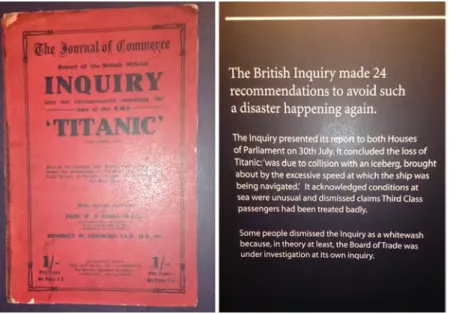
The official US and British inquiries into the sinking of the Titanic recommended some safety practices which are already used nowadays. They published a final report in 30 July of 1912 and the Titanic disaster led to the convening of the first International Convention for the Safety of Life at Sea (SOLAS) on November 1913. For example, International Ice Patrol, S.o.S and number of lifeboats rules have been created based on the British Inquiries recommendations. Yet nowadays, the International Ice Patrol monitors and reports on the location of North Atlantic Ocean icebergs that could pose a threat to transatlantic sea traffic. Since this disaster, the firing of red rockets from a ship must be interpreted as a sign of the need for help. The distress rockets are still used on boats today. There were too few lifeboats available and they had not been properly filled or manned with trained seamen because number of lifeboats depended on the tonnage of the ship. Since the Titanic disaster, lifeboat and raft accommodations are based on the number of passengers for cruises and not merely on tonnage. Titanic museum in Belfast where Titanic was built by Harland and Wolff’s company presents the history of Titanic, the disaster, the inquiries, the recommendations and the actual research on the Titanic (see figure1.3).
For example, when the disaster occurred, the radio communications were not supplied with a secondary power and did not operate 24 hours along. As the consequence, the rescue services did not hear on time the emergency calls send by the Titanic. The inquiries resulted that
Figure 1.3 – British Inquiry recommendation after the Titanic Disaster (From the
Titanic Museum in Befast - Ireland)
the radio communications would be operated 24 hours along with a secondary power supply on passenger ships. This measure would help not to miss distress calls and also to maintain contact with vessels in the same area as well as coastal onshore radio stations.
1.3.3 Heathcare example
In healthcare domain, the World Healthcare Organization (WHO) publishes many recom-mendations and procedures for patient safety as the checklists [Patient Safety2009] and edits many reports for medical staff over the world on disease preventions as Tuberculosis, Malaria, food safety, aids. . . The French national healthcare agency ’Haute Autorité de Santé’ publish guidelines to improve risks management[Harousseau2012] and adjust the WHO recommendation and checklist to the local French healthcare system. This particular safety surgical checklist is detailed in the section3.2.
1.3.4 Synthesis
French L’analyse des accidents les plus critiques a conduit les politiques et décideurs à
établir de nouvelles règles, recommandations, procédures de sécurité de manière à prévenir ou éviter de nouvelles catastrophes similaires. Du côté des mises en œuvre, les professionnels sont surchargés d’un empilement de règles, recommandations et procédures à suivre qu’ils perçoivent comme des contraintes administratives sans en comprendre totalement leur intérêt. D’autres les considèrent comme un nouveau moyen de contrôler leur activité professionnelle. Par conséquent, les règles et recommandations mal comprises ou mal perçues peuvent être mal appliquées. Selon leur niveau d’expérience ou encore le niveau de perception de leur utilité, ces recommandations de sécurité sont parfois adaptées avec plus ou moins de pertinence dans les organisations et par les professionnels à qui elles sont destinées. La formation des professionnels et des organisations devient essentielle pour qu’ils saisissent leur interêt à mettre en oeuvre les recommandations de sécurité produites après l’analyse de réels accidents évitables qui ne sont malheureusement pas des cas isolés.
English One one hand, the investigations against the most tragic disasters lead most of
prevent new similar accidents. On the other hand, some professionals often interpret new rules and procedures as a stronger control of their activities. Others consider that the rules, policies or recommendations as a problem due to the stacking of rules, the rules themselves. By the consequence, some professionals an organization refuse to comply and are reluctant to change and apply new rules, recommendations and policies. They adjust or apply safety recommendations according to the level of relevance they consider and the interest they pay attention for. In conclusion, workers and organizations have to be educated to really understand the interest and the relevance of the safety recommendation made from real cases of accident.
1.4 To an educational issue
Education and training is given out for many years by simulating professional work to prevent accident or serious event and it is definitely not an innovation. The Chinese philosopher Confucius said “I hear and I forget, I see and I remember, I do and I understand”. Kolb [Kolb1984], Specht and Sandlin[Specht+1991] believe that learning is a process which is constantly modified by experience. “Experiential learning focuses on ’doing’ in addition to the ’hearing’ and ’seeing’ that occur in traditional lecture class” [Specht+1991]. They also argue that experiential learning is a structured activity in which material and principles that are encountered are integrated and applied to new situations.
1.4.1 Simulation
Here the word simulation does not mean a tool to assist in decision-making but the word simulation refers to (1) a digital model which replicates characteristics of a system (2) the ability to lead experimentation, modify the data input that may influence the data output. So, a simulator could be defined as a software providing a numerical model which replicates a system and proposes representations of its evolution and its behavior by executing it and interacting with. An example based on a mathematical and precisely on a statistical method used to mimic a probabilistic process within computer simulation is the Monte Carlo method. A simulation utilizes sequences of random or predefined numbers as data and provides approximate solutions to a mathematical problems by performing statistical sampling experiments on a computer. Pedgen et al [Pegden+1995] define the simulation as a “process of designing a model of a real system and conducting experiments with this model for the purpose of either understanding the behavior of the system and/or evaluating various strategies for the operation of the system.’"
Many researches [Kinkade+1972][Pegden+1995][Hays+2012][Salas+2009] refer to simulators as training devices. ”Simulation, in general, is any artificial or synthetic environment that is created to manage an individual’s (or team’s) experiences with reality"’ [Bell+2008]. Salas et al[Salas+2009] use the term of simulation-based training (SBT) that encompasses a continuum of technology intended for training purposes. As a result, simulation-based training could be represented by any synthetic practice environment that is created in order to impart the competencies (i.e. attitudes, concepts, knowledge, rules, or skills) that will improve a trainee’s performance.
In the aviation training history as in the medicine training history, many examples show that simulation is used for many years. The next two examples show how it was used in the last centuries in these two fields.
Example of simulator for medical training
During the 18th century, Madame Du Coudray teaches the art of birthing to women across French countryside[Ramsey+1999]. Part of the training relies on mannequins allowing to re-enact several obstetric handling. It is estimated that during her 25 years education
campaign, she has trained over 4,000 midwives and as a consequence the infant mortality has markedly decreased. Over the next centuries, medicine and medical education have largely benefited from the latest technological and technical advances, owing to their unmatched potential for saving lives.
Example of simulator in aviation training
Whereas the first motorized flight succeeded in 1890 with Clement Ader and with the Wright brothers in 1903, one of the first fight simulators in the world was invented in France in the pilot Antoinette school in 1910. The Antoinette aircraft, invented by Léon Levavasseur, was steered by two wheels, one in each pilot’s hand. This system was not intuitive and needed training to learn to use it. So, two young military student-pilots invented a simulator based on two half-barrels of Champagne to familiarize future Antoinette pilots with this non-intuitive steering system.
Figure 1.4 – One of the first flight simulators in the world - 1910 - France
Nowadays, simulation largely widespread and many high technology simulators have been designed to be used in a learning context. Some of them mixed tangible objects and software to reproduce situations or environments designed to an educational purpose. Others simply dedicate real places and real professional equipment to a training purpose. Courses may include live human role-playing or virtual role-playing as they may include high technology simulators. On the other hand, digital learning games are one kind of training environments in which environment and scenario are both artificial.
They are becoming serious competitors to real-life simulators for the professional training, in particular in the highly technical business where their cost-effectiveness is a considerable asset. But, the more expertise level learners have, the more fidelity level they expect. Therefore, to give to the player a feeling of high fidelity related to the professional context, the game play would be really very restricted. It is difficult to strike a balance between game play and fidelity to real professional world thus, using different training contexts is probably an issue. In any particular training situation, environment and scenario are interspersed. But sometimes, there is a mixture of reality and virtuality as illustrated in figure1.5. The concept of a "training continuum" relates to the mixture of classes of objects presented in any particular training situation. Real professional environments, are shown at one end of the continuum, and virtual environments, at the opposite extremum. At the furthest right position (see the reference number 4 on the scheme), the case defines environments consisting only of real objects in a real professional environment; baseline situation includes authentic and real cases. Learning session includes for example what is observed via a conventional video display of a real-world scene. An additional example includes direct viewing of the same real scene, but not via any particular graphic and electronic display system.
The following case on the right (see the reference number 3 on the scheme), defines environ-ments consisting only of real objects in a real professional environment; baseline situation includes an authentic case which has been redrafted and designed for training. An example of learning session would be a session during which actors play character’s role like in a theater and students try to manage the situation by using real objects and human-like objects as virtual patient even if the situation presents a virtual case. Therefore, as indicated in the figure, the most straightforward way to view a Mixed Reality Learning Environment is one in which real and virtual world objects and virtual training case are together within a single learning session [Chin+2009;Liarokapis+2009].
The latter case (see the reference number 2 on the scheme) defines environments consisting solely of virtual objects in a virtual environment and presents only training virtual situation. An example is a learning session based on a digital learning game which proposes a virtual professional situation designed for training. An other example would be done with a conventional computer graphic simulation.
Figure 1.5 – Training continuum: from virtuality to reality
Whatever the training environment and for a long time, education to risk management and safety prevention had considered the individual and technical skills as motor skills having the priority comparing to the other skills. As the consequence, many training programs focus on technical and individual skills to improve operator’s performance and slight non-technical skills as teamwork, communication, leadership, decision-making. . . Nowadays, simulation to train to perform technical tasks which need to train motor abilities or to apply technical procedure is still used because humans are often assisted by machines and equipments which need to be experimented before using them in the real-life professional context.
But, current courses, given out to people whom jobs will be practiced in complex and dynamic situations, expand their modules with educational units entirely dedicated to risk management and safety prevention. These educational units try to take in consideration teamwork and non-technical skills. Most of the time, they include at least one of this three elements: (1) a module which aims to transfer knowledge connected to laws, regulations and
theoretical aspects; (2) a module which most of the time takes the form of a storytelling and consists in a description of the chain of events that happened before and during a real-life accident. This chain of events could be analyzed in the classroom. In this module, good practices based on real-life situations could be presented; (3) a module which consists to put teams in a real-life situation. Each student plays a role in an educational environment. In this educational environment, students simulate their professional activities, train to apply safety procedures and train their behavior to ensure safety. After the activity of simulation session, the teacher could highlight failures or non-safety behaviors that could have been identified and should promote safe behavior.
The two next subsections present examples of education training centers in the fields of healthcare and aviation which have used for a long time simulators and simulation.
1.4.2 Simulation in healthcare
In many hospitals worldwide, simulation centers have been created for healthcare education. In most cases, they replicate different medical places as the operating room or the patient’s room. They focus mainly on technical skills and aim at reducing the gap between what students learn in textbooks and gestures they are expected to perform in the real professional world. They allow medical and paramedical teams to train to standardized and normal situation and also to specific crisis situations or/and special clinical situations.
The word "simulation", in healthcare training, is used to provide a safe environment for education without any real risk of accident or disease for the patient. Practically, modern simulation in healthcare education corresponds to using an equipment, sometimes a computer software, a mixed reality system "which is a combination of both real and virtual" or a standardized patient for replicating a medical environment and/or a clinic situation and/or a specific pathology. “Simulation is a technique [...] to replace or amplify real experiences with guided experiences that evoke or replicate substantial aspects of the real world in a fully interactive manner”[Gaba2004]. Simulation in medical education offers many benefits. Firstly, it provides a safe, patient-free environment where mistakes can be experimented repeatedly and without causing any harm. Doing so, simulation also allows addressing rare yet critical situations. Secondly, simulations can easily be tailored to a specific curriculum, selected on demand and arranged by a teacher into a comprehensive collection in order to suit one or several given training objectives. Moreover, as the training does not depend any more exclusively on the practitioner’s personal experience, simulators bring a form of standardization which, besides of being a strong asset in favor of equal opportunity, tends to guarantee a good “average level” among the trained practitioners. More advantages of medical simulation are listed by Ziv et al[Ziv+2003].
Although simulation has been resorted to since as early as antiquity, the birth of modern simulation is often dated in the early 1960’s[Rosen2008]. A modern simulator is computer-driven, runs an anatomically or physiologically accurate model of a human organ or patient and allows interaction with the medical learners [Murphy+2007]. Modern simulators integrate various degrees of sophistication: from simple multimedia to 3-dimensional virtual reality applications. Those usually provide representations and interactions for task trainers to fully-immersive virtual replicas of the clinical environment and the patient, including audio and touch. Virtual reality has available a large spectrum of techniques and devices in order to produce an illusion of reality with more or less believability. For instance, in the field of anatomic simulators alone, Richard Satava[Satava1996] has highlighted the steady evolution of three generations: anatomical modelling (navigation-enabled immersive representation), physical modeling (featuring interactions, deformations and kinematic constraints) and physiological modelling (where the functions of the organ system are introduced). The contribution of VR to simulators is undeniable [Gallagher+2005] and explains why they are now in common use in medical education for training to many different tasks.
One common use of simulation is for learning therapeutic procedures. This can be achieved using a mannequin, like SimMan (Laerdal) or Human Patient Simulator (HPS, CAE Health-care), both being physical devices yet embedding extra digital features for simulating a large number of vital functions such as breathing, heart rate, blood pressure and numerous patient sounds. Accessories allow for the replication of more specific diseases (flesh wounds, burn marks, etc). The mannequin can be auscultated, intubated and ventilated; it can undergo a cardiac massage and even endure a defibrillation. Its pulse can be checked in several locations (arm, carotid, femoral artery, etc). A specific location on its arm can even be given an injection or installed a catheter Training to surgical gestures is another context where simulators are used. The Laparoscopic Surgery training simulator (LAP Mentor, Simbionix) is a mobile simulator composed of several instruments dedicated to laparoscopic surgery and a screen displaying the image simulating the endoscope camera. Each instrument, whose handle is the accurate reproduction of a genuine one, can be manipulated with 5 degrees of freedom. The force feedback reproduces the feel of tissue resistance on the surgeon’s hands. The simulator embeds several scenarios of increasing difficulty (stitching, gastric bypass, etc.) and sorted in different learning modules (essential, advanced skills, etc) [Websky+2012]. Surgery simulators can grow more complex (and more expensive) like the Endoscopic Sinus Simulator (ES3, Lockheed Martin) for endoscopic sinus surgery. The ES3 aims at providing the most immersive experience by combining high-end graphics, haptic controls, voice recog-nition, a head-mannequin with realistic anatomy, and a physical replica of an endoscope (see [Fried+2010] for a detailed description). The Vascular Intervention System Training (VIST G5, Mentice) is another example of a large-scale simulator combining physical devices
and virtual reality in order to provide the closest possible experience to reality.
The simulators mentioned above are high-fidelity simulators, which means they tend to reproduce the patient or a sub-system with a high degree of realism, both visually and interactively. Yet, high-fidelity is not a prerequisite for efficiency in training [Gallagher+2005] and low-fidelity simulators can be used for teaching processes and conceptual knowledge. This is the case for diagnosis and decision making, which can also be practiced using simulators like virtual patients [Cook+2009]. A virtual patient is often presented as a simple text-and-graphics interactive slide-show where a case study (possibly spanning through several years using ellipses) is presented as a branching scenario where the learner explores the consequences of their decisions. Another illustration of training to non practical skills is the well known Virtual Anesthesia Machine which provides a simplified yet insightful view on the inner operating of an anesthesia machine [Fischler+2008].
1.4.3 Example of aviation training center with simulator
The Federal Aviation Administration proposes lessons learned from Transport Airplane Accidents. The objective is to gather the material with many more of the most historically significant, policy shaping accidents, in order that the lessons that can be learned.
In aerospace schools, a wide variety of simulators are used to train professional pilots in different aircraft cockpits. The aim is to improve both technical and non-technical skills. The training on flight simulator is intended to maintain the proficiency of flight crews in identifying and reacting appropriately to in-flight emergencies. The Joint Aviation Authorities Training Organization [Joint Aviation Autorities2017] proposes a set of training to improve crew behavior on particular well-known situations.
In 1993, the National Transportation Safety Board identified the misuse of a security checklist as one of the probable causes of 3 major airline accidents in the United States[Degani+1993]. Puentes mentioned the importance to train the pilot’s ability skills to control with or without advanced automation the aircraft during the descent[Puentes2011]. One of the most known aviation landing relative to this ability is the successful ditching of the A320 on the Hudson River in 2008. The experimented Captain Sullenberger succeed to manually flight and land the aircraft without any automation.