En vue de l’obtention du
DOCTORAT DE L’UNIVERSITÉ DE TOULOUSE
Délivré par : l'Université Toulouse III - Paul Sabatier
Spécialité : Neurosciences
Présentée et soutenue le : 07/07/2017 par :
Christelle LARZABAL
BRINGING VERY LONG-TERM MEMORIES BACK TO LIFE
RÉVEILLER NOS MÉMOIRES LES PLUS ANCIENNES
JURY
Rodrigo QUIROGA University of Leicester Rapporteur Aude OLIVA Massachusetts Institute of Technology Rapporteur
Laurence TACONNAT Université de Tours Examinateur
Lluίs FUENTEMILLA Universitat de Barcelona Examinateur Simon THORPE Université Toulouse III, Paul Sabatier Directeur de thèse
Ecole doctorale : ED CLESCO – Spécialité : Neurosciences
Unité de recherche : Centre de Recherche Cerveau et Cognition (CerCo) Directeur de thèse : Simon Thorpe
2
Bringing very Long-Term Memories back to Life, Christelle Larzabal
3
ABSTRACT
Memory plays tricks on us and fails us even for recent events. So for the retrieval of sensory information that we have not experienced for decades, surely the memories are gone without a trace, but can we be sure of this? What if the information had been there all along ready to be explicitly retrieved through recall or familiarity for example? So far, experimental evidence is lacking. The purpose of my thesis was to shed some light on the retrieval of these inactive memories. To tackle this problem I developed my research around two main axes: For the first part which is theoretical, I suggest that a) reactivations are not necessary to maintain very long-term memories if the memories were sufficiently repeated at first; b) it might be possible to retrieve explicitly remote inactive memories using specific cues; in the second part which is experimental, I show that a) within specific conditions participants are able to retrieve explicitly very long-term memories that were left inactive for decades and b) such memory traces could be found on the Electroencephalography (EEG) signals. Surprisingly, when conditions are met, remote memories that were thought to be lost can again elicit recall or familiarity. With these results, a question remains: How do neurons store such information? Keywords: Long-Term memory; Sensory information; Explicit memory; Inactive Memory; Recall; Familiarity; Electroencephalography;
5
RESUMÉ
On pense souvent que notre mémoire nous joue des tours et nous fait défaut. Ces oublis concernent généralement des souvenirs qui ne sont pourtant pas si vieux. Alors quand il s’agit de se rappeler d’informations sensorielles auxquelles nous n’avons pas repensé depuis plusieurs dizaines d’années, pas de doute, il ne reste plus rien… Mais en est-on vraiment sûr? Et si l’information était toujours là, prête à se manifester de manière explicite -comme sous forme de rappel ou de sentiment de familiarité- pour peu que les conditions le lui permettent? A ce jour, très peu d’expériences ont été menées sur ce sujet. L’objectif de ma thèse a donc été d’apporter des premiers éléments de réponse concernant la récupération de mémoires laissées inactives. Ma recherche s’est orientée selon deux axes principaux : une première partie théorique où je montre a) qu’il n’est pas nécessaire de réactiver une trace mnésique pour la maintenir à très long terme si elle a été suffisamment répétée et b) que la récupération explicite de cette mémoire serait possible grâce à la présentation d’informations qui cibleraient au mieux le souvenir ; une seconde partie expérimentale où je montre a) que des participants sont capables de récupérer de manière explicite des informations laissées en dormance pendant au moins une dizaine d’années et b) que cette trace mnésique pourrait être détectée sur des tracés d’Electroencéphalographie (EEG). Ainsi, et aussi étonnant que cela puisse paraître, dans des conditions favorables à leur réactivation, d’anciennes traces mnésiques que l’on croyait disparues, peuvent de nouveau surgir sous la manifestation de rappel ou de sentiment de familiarité par exemple. Ces résultats soulèvent des questions majeures concernant le stockage neuronal de cette information.
Mots-clés : Mémoire à long-terme ; Information sensorielle ; Mémoire explicite ; Mémoire inactive ; Rappel ; Familiarité ; Electroencéphalographie
7
RESUMÉ SUBSTANTIEL
Il est communément admis que pour conserver nos souvenirs il vaut mieux y repenser régulièrement. En effet, la réactivation d’une information permet le maintien, voire le renforcement de la trace mnésique sous-jacente. Cependant, dans certains cas, l’information sensorielle peut être perçue suffisamment de fois pour être stockée en mémoire à long terme puis ne plus être réactivée. Est-il alors possible de conserver la trace de ces mémoires qui n’ont plus été réutilisées ? Ou bien sont-elles tout simplement effacées au bout d’un certain nombre d’années ? Récemment, il a été montré que même des images vues à trois reprises et pendant quelques secondes pouvaient encore influencer le comportement de participants presque 20 ans plus tard (Mitchell, 2006). Il semblerait donc que nos traces mnésiques soient toujours disponibles même lorsque celles-ci ne sont pas réactivées. Cependant et comme le fait remarquer Mitchell dans son article, la persistance de ces traces mnésiques a été mise en évidence dans une tâche de récupération implicite où les participants ne savaient pas qu’ils devraient essayer de récupérer en mémoire les images vues auparavant.
Dans ma thèse, j’ai voulu aller plus loin en testant dans des tâches de mémoire explicite s’il serait possible que des participants puissent récupérer des informations sensorielles à très long-terme et laissées dormantes. Dans ces tâches les participants étaient donc poussés à récupérer une information sensorielle bien précise.
Pour ce faire, j’ai orienté ma thèse selon deux axes principaux : un axe théorique et un axe expérimental.
L’axe théorique est composé des chapitres 1 et 2 de ma thèse. Le chapitre 1 qui s’appuie sur une revue de littérature soumise à publication, a pour objectif de montrer que les processus mnésiques d’encodage et de récupération seraient le résultat d’inférences statistiques de type Bayésien s’inscrivant en continuité directe avec nos mécanismes perceptuels. Ces inférences seraient calculées en continu et permettraient l’accumulation d’informations spécifiques à l’origine de la récupération d’un souvenir dans des tâches expérimentales bien définies. Ce modèle rendrait ainsi compte de l’ensemble des phénomènes de récupération mnésique. Dans le chapitre 2, je développe ce modèle dans le cas de la récupération d’information à très long terme. Je montre notamment qu’il serait possible de récupérer explicitement des mémoires laissées dormantes pendant des dizaines d’années. Pour ce faire, il faudrait arriver à
8 cibler l’information à l’aide d’indices bien spécifiques qui seraient utilisés dans des tâches les plus favorables à la récupération explicite.
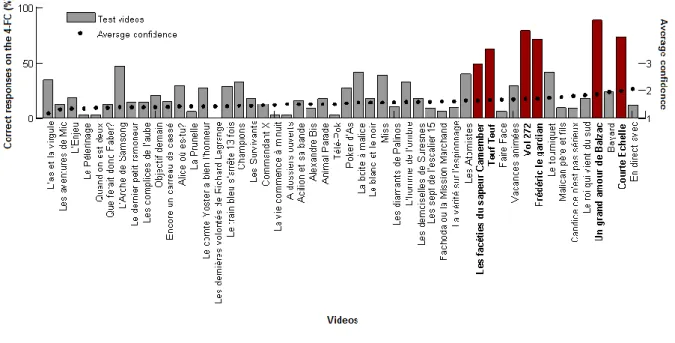
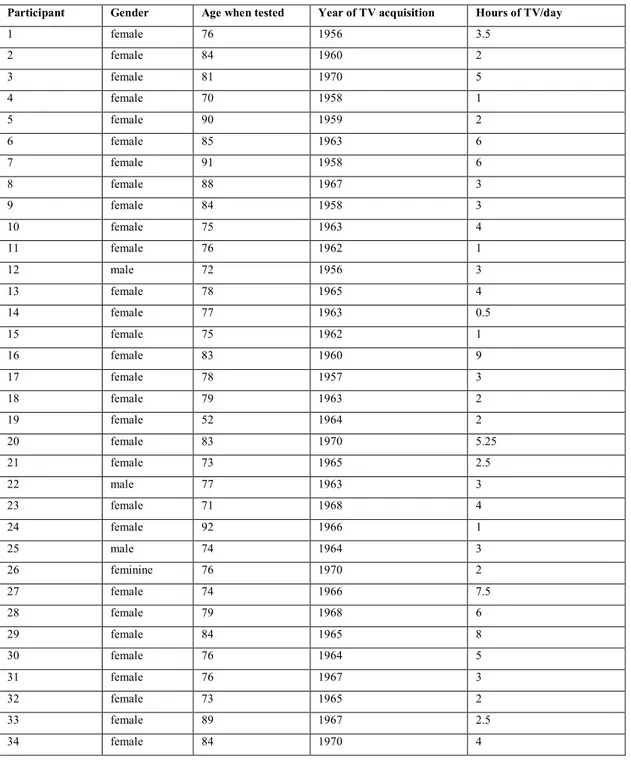
Le second axe, l’axe expérimental est la partie la plus largement développée dans ma thèse et est constituée des chapitres 3, 4, 6 et 7. Les chapitres 3 et 4 correspondent à deux expériences où j’ai testé la récupération explicite d’informations sensorielles laissées dormantes pendant une dizaine d’années au moins. Les données présentées dans ces deux chapitres on fait l’objet d’articles qui ont été acceptés (chapitre 3) ou soumis à publication (chapitre 4). Dans le chapitre 3, des participants déclarant posséder une télévision durant les années 1960-1970 (N = 34) ont été testés sur leur capacité à se souvenir de programmes télévisés (n = 50) diffusés durant ces années-là et non rediffusés depuis. Pour chaque programme télévisé, un court extrait du générique était proposé. En moyenne, les participants ont jugé que sept à huit de ces extraits audiovisuels (15%) leur étaient familiers. Parmi ces réponses, deux participants ont été capables de rappeler spontanément le titre de deux de ces programmes télévisés. Lorsqu’un rappel spontané n’était pas possible, les participants étaient invités à identifier le titre parmi quatre propositions. Au total 50 réponses correctes ont été obtenues. Ces réponses correctes étaient associées d’un sentiment de familiarité, d’une certaine confiance dans la réponse que les participants avaient donné, et d’informations contextuelles spécifiques au moment de la diffusion de l’épisode télévisé.
Ces premières données nous permettent de confirmer ce que l’on avait prédit théoriquement, à savoir qu’il est possible de réveiller des informations sensorielles laissées à l’état de dormance pendant plusieurs décennies, suscitant leur rappel ou la récupération explicite d’informations bien spécifiques.
Dans le chapitre 4, nous allons encore plus loin en montrant que la récupération explicite d’informations sensorielles vues en moyenne trois fois et pendant seulement quelques secondes est toujours possible dix ans plus tard. En effet 24 participants qui avaient vus des images très simples (n = 144) il y a environ 12 ans ont été capables d’identifier de nouveau ces images parmi un choix de deux propositions avec des performances meilleures que celles du niveau chance. Cet effet s’est vu en moyenne au travers des participants et a été particulièrement visible chez huit d’entre eux.
Les chapitres 6 et 7 correspondent à des expériences où j’ai analysé le signal cérébral mesuré par électroencéphalographie (EEG) pendant la récupération explicite d’information sensorielle à long terme. Pour des raisons pratiques, ces expériences ont été menées sur une échelle de temps bien plus courte que les deux expériences comportementales développées
ci-9 dessus (cinq mois maximum). Ces expériences ont été menées de manière très similaire : elles comportaient plusieurs sessions d’apprentissages d’extraits audiovisuels très courts et ensuite une session de rappel ou les participants étaient invités à jugés si l’image qui leur était proposait avait été extraite d’un clip audiovisuel qui leur avait été montré ou non.
Dans le chapitre 6, je regarde tout particulièrement l’effet de l’intervalle de rétention entre le moment de l’apprentissage et le moment de rappel. Je montre ainsi la différence d’activation cérébrale mesurée en EEG chez des participants (N = 11) entre des images nouvelles et des images présentes dans des clips (n = 375) montrés quelques heures, un jour ou trois semaines auparavant. Dans le chapitre 7 je regarde l’effet du nombre de présentations des clips audiovisuels lors du rappel trois semaines plus tard. Dans ce cas, les clips (n = 480) étaient montrés soient une, deux, trois ou cinq fois chez des participants (N = 12). Cette expérience s’est poursuivie d’une seconde où la récupération en mémoire de clips audiovisuels a été testée cinq mois plus tard, dans un paradigme où les clips audiovisuels étaient remontrés aux participants.
L’analyse des données récoltées en EEG s’est faite selon des mesures bien spécifiques que je développe dans le chapitre 5 de ma thèse. Je montre ainsi que les techniques d’analyses multivariées de patterns permettent d’identifier des traces mnésiques à long terme.
En conclusion, cette thèse permet de révéler que nombreuses traces mnésiques seraient conservées à l’état latent. En élaborant des tâches expérimentales bien spécifiques, il serait possible de réveiller de manière explicite des informations sensorielles répétées seulement quelques fois. Ces résultats questionnent le substrat biologique de ces mémoires. Serait-il possible de conserver des traces au sein d’un vaste réseau neuronal ? Nous espérons que de nouvelles recherches permettront d’apporter de futurs éléments de réponse.
11
ACKNOWLEDGEMENTS
Je me permets d’écrire cette section dans mon français natal.
Tout d’abord je tiens à remercier Simon Thorpe qui dès le début m’a donné son entière confiance dans l’élaboration de ce projet de thèse. Je me souviens de son enthousiasme –et de sa chemise Hawaïenne !- lors de notre premier entretien visiophonique. J’avais postulé à une seule offre de thèse, celle que Simon proposait, et dès les premières minutes de notre conversation, je savais que c’était avec lui que je voulais faire ma thèse. En faisant partie de son équipe j’ai eu la chance d’avoir tout le support matériel et humain qui m’a permis de conduire l’ensemble de mes recherches dans des conditions plus qu’optimales. Malgré ces quatre années de thèse, je dois avouer que je connais encore très mal le milieu de la recherche mais je pense difficilement me tromper en disant que Simon est un directeur de thèse atypique. Toujours plein d’enthousiasme, Simon est prêt à tester n’importe qu’elle idée aussi farfelue qu’elle puisse paraître. Et des idées ce n’est pas ce qui lui manque ! C’est donc dans ce bouillonnement intellectuel que ma thèse s’est peu à peu construite.
La deuxième personne que je tiens à remercier est Nadège Macé. Nadège avait fait sa thèse avec Simon quelques années auparavant et était la manager de l’équipe pendant la première moitié de ma thèse. C’est grâce à Nadège que j’ai pu créer la structure de mon projet de thèse, me lancer dans les expériences et les analyser. Nadège était là à tous les niveaux de mon travail et permettait de faire le lien entre Simon et ma thèse. Mais bien au-delà de ces apports professionnels, Nadège est pour moi une personne de confiance, qui m’a écouté et soutenu dans les moments difficiles où la thèse n’était pour moi plus qu’une préoccupation mineure. Suite aux décisions ministérielles, Nadège a été forcée de quitter l’équipe, un départ qui nous a tous affecté.
Après le départ de Nadège, c’est Karine Bouyer qui est arrivée et qui a été la manager pendant la deuxième partie de ma thèse. Je tiens à remercier Karine pour toute son aide au niveau administratif et pour avoir toujours pris le temps de faire un point concernant l’avancée de mon travail. Tellement pratique que son bureau soit juste à côté du mien et de celui de Simon !
12 J’ai eu la chance que mon bureau soit également en face de celui d’Emmanuel Barbeau. Un merci tout particulier à Emmanuel et à Eve Tramoni d’avoir voulu collaborer sur un projet qu’ils avaient en tête depuis plusieurs années. L’encadrement d’Emmanuel sur ce projet, m’a permis d’acquérir une plus grande rigueur scientifique lors de chaque étape de ce travail. Ce bureau justement, j’ai pu le partager pendant ces quatre années avec Jaya, ma compère de thèse et récemment docteur, Sophie, qui m’a assisté dans les passations de toutes les expériences que j’ai menées au CerCo, Evelyne qui était en post-doc pendant une petite année, Danaé, qui a commencé sa thèse depuis un an et Méyi, en stage de M2. Un grand merci à vous pour la super ambiance qu’il y a eu dans ce bureau avec beaucoup, beaucoup de rires ! Je remercie également Elodie et Martin, pour toute la bonne humeur dans le bureau à côté.
Je tiens également à remercier Maroufa pour ses gâteaux, ses petits plats mijotés et surtout nos petites conversations qui me donnaient toujours le sourire à la fin d’une longue journée de travail.
Plus généralement, je tiens à remercier le M4 team et l’ensemble des personnes qui sont au CerCo ou ont été au CerCo. C’est grâce à vous tous, que la bonne ambiance au labo était possible. Un merci tout particulier à Pier Zanone dont les conseils ont été précieux pour les quelques dernières retouches apportées à mon manuscrit.
Il serait bien trop réducteur cependant de se limiter à la sphère CerCo.
Je tiens à remercier tous les participants qui ont bien voulu consacrer un peu de leur temps pour mes expériences. Tous ces résultats ne seraient pas là sans eux !
Je remercie également l’ensemble des membres du jury pour avoir accepté d’évaluer mon travail. Merci à Rodrigo Quiroga, à Aude Oliva, à Laurence Taconnat et à Lluis Fuentemilla. Un grand MERCI aussi à Chris Moulin qui m’a donné la chance de collaborer avec lui. Merci, de m’avoir accueillie à Grenoble pendant un mois, et merci d’avoir consacré autant de temps sur notre projet. Je tiens à le dire, ma thèse aurait été bien moins aboutie sans tout cet apport intellectuel.
Je veux aussi en profiter pour remercier Jean-Rémi King, Simon van Gaal et Martijn Wooke, qui ont permis de tracer mon chemin jusqu’à cette thèse et Simone pour m’avoir ouvert un tout nouvel horizon après cette thèse.
13 Et pour finir un énorme merci à tous mes amis : Cécilia et Leila en particulier, la Coloc Sansou ainsi que le groupe des Dimitri de Pau et mes amis du Pays Basque.
MILESKER
Merci à ma famille, Merci Callista.
15
Table of Contents
ABSTRACT ... 3
RESUMÉ ... 5
RESUMÉ SUBSTANTIEL ... 7
ACKNOWLEDGEMENTS ... 11
Table of Contents ... 15
Table of Figures ... 21
GENERAL INTRODUCTION ... 25
1. The essence of the words ... 25
1.1 Brain ... 25
1.2 Information: In-formation ... 26
1.3 A few musical notes on memory ... 27
2. Studying very long-term memories ... 28
2.1 Explicit memories ... 29
2.2 A brief literature overview ... 30
2.3 Overall framework ... 33
2.4 Presentation of the chapters... 34
PART 1-THEORETICAL FRAMEWORK - ... 37
CHAPTER 1. Unifying memory and perception into the same framework... 39
Abstract ... 39
Chapter presentation ... 40
1. Introduction ... 41
2. Memory encoding and retrieval: A dynamic Bayesian framework ... 43
2.1 Memory encoding: from perceptual processing to the creation of a distinct percept ... 44
2.2 Memory retrieval: a dynamic Bayesian account ... 47
16
3. Evidence for a dynamic Bayesian model ... 56
3.1 Timing of early processes ... 58
3.2 Timing of higher level processes ... 59
4. Clinical application ... 61
5. Conclusion ... 64
CHAPTER 2. From recent and active memories to remote and inactive ones
... 67
Abstract ... 67 Presentation chapter ... 68 1. Introduction ... 70 2. Memory consolidation ... 71 2.1 Synaptic consolidation ... 712.2 Repetition: the key for neuronal selectivity and long-term storage ... 72
2.3 System-level consolidation ... 75
3. Post-consolidation reactivations, prior and accessibility ... 75
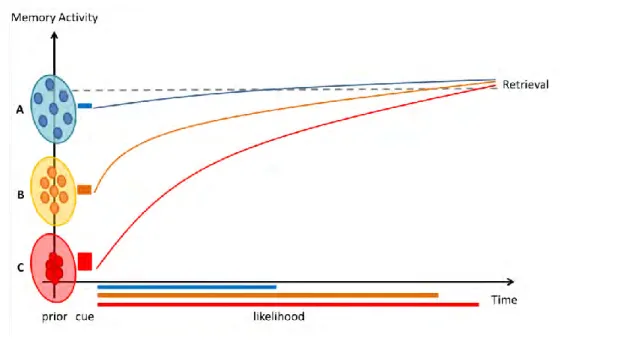
3.1 Memory activity in a Bayesian perspective ... 76
3.2 Updating the prior value ... 77
4. Silent neurons for dormant memories: experimental evidence ... 79
4.1 From STDP to dynamic Bayesian inferences ... 79
4.2 Inactive neurons for inactive memories ... 82
5. Conclusion ... 84
PART 2– EMPIRICAL FRAMEWORK - ... 85
Presentation of the behavioral experiments... 87
CHAPTER 3. Waking up buried memories of old TV programs... 89
Abstract ... 89
Presentation chapter ... 90
17
2. Material and Methods ... 93
2.1 Participants ... 93
2.2 Stimuli ... 93
2.3 Task ... 94
3. Results ... 95
3.1 Participants’ performance for the famous TV programs ... 95
3.2 Older participants’ performance for the test TV programs ... 97
3.3 Influencing factors ... 105
4. Discussion ... 106
5. Conclusion ... 109
6. Acknowledgements ... 109
7. Supplementary information ... 110
CHAPTER 4. Long-term memory and familiarity after 12 years ... 115
Abstract ... 115
Presentation chapter ... 116
1. Introduction ... 119
2. Method ... 120
2.1 Participants ... 120
2.2 Initial test: the DMS-48 ... 120
2.3 Current tasks ... 122
3. Results ... 126
3.1 Naïve control participants ... 126
3.2 Test participants’ performance ... 126
4. Discussion ... 132
5. Acknowledgment ... 134
Discussion of the behavioral results ... 135
18
CHAPTER 5. Detecting the retrieval of long-term memories on a EEG signal
... 139
1. Introduction ... 139
2. EEG compared to other neuroimaging techniques ... 140
2.1 EEG ... 140
2.2 Comparison ... 140
3. Description of the techniques used ... 142
3.1 ERPs analyses ... 142
3.2 Time-Frequency analyses... 143
3.3 MVPA for decoding subtle effects ... 145
4. Conclusion ... 148
CHAPTER 6. Decoding long-term memories of short audiovisual clips... 149
Abstract ... 149
Chapter presentation ... 150
1. Introduction ... 152
2. Materials and methods ... 153
2.1 Participants ... 153
2.2 Stimuli ... 153
2.3 Procedure ... 153
2.4 EEG acquisition and analysis ... 155
3. Results ... 157 3.1 Behavioral results ... 157 3.2 EEG analysis ... 161 4. Discussion ... 165 5. Conclusion ... 167 6. Acknowledgements ... 168 7. Supplementary information ... 168
19
CHAPTER 7. Effect of repetition on explicit long-term memory: an EEG
study ... 171
Chapter presentation ... 171
1. Introduction ... 172
2. Material and Methods ... 173
2.1 Participants ... 173
2.2 Stimuli ... 173
2.3 Task ... 174
2.4 EEG acquisition and analysis ... 175
3. Results ... 177
3.1 Behavioral results ... 177
3.2 EEG analysis ... 180
4. Discussion ... 182
5. Material and Methods ... 183
5.1 Participants ... 183 5.2 Stimuli ... 183 5.3 Task ... 184 6. Results ... 185 6.1 Behavioral results ... 185 7. Discussion ... 186 8. Supplementary information ... 187
GENERAL DISCUSSION ... 189
1. Wrap-up... 189 1.1 Overall framework ... 189 1.2 Substantial progress ... 189 2. Theoretical considerations... 1902.1 Identification, familiarity, novelty ... 190
2.2 Consciousness and memory ... 191
2.3 Concepts and neuronal selectivity ... 192
2.4 Forgetting ... 194
20
2.6 The role of affects ... 200
3. Future directions ... 200
3.1 Limits ... 200
3.2 Linking behavior and decoding analyses ... 201
3.3 From Bayesian to integrated information... 201
4. Conclusion ... 203
4.1 A personal view to my thesis ... 203
4.2 Can one see the shape of our memories? ... 203
OPENING. Beyond matter, from Alan Turing to Cymatics ... 205
1. Standing waves ... 205
2. Cymatics ... 206
3. Harmonics in the brain ... 207
FINANCIAL SUPPORT ... 209
21
Table of Figures
Figure I.1 Representations of the cortical structures ... 26
Figure I.2 Schematic representations of the hippocampus and the rhinal cortices ... 29
Figure I.3 An illustration of the forgetting curves ... 32
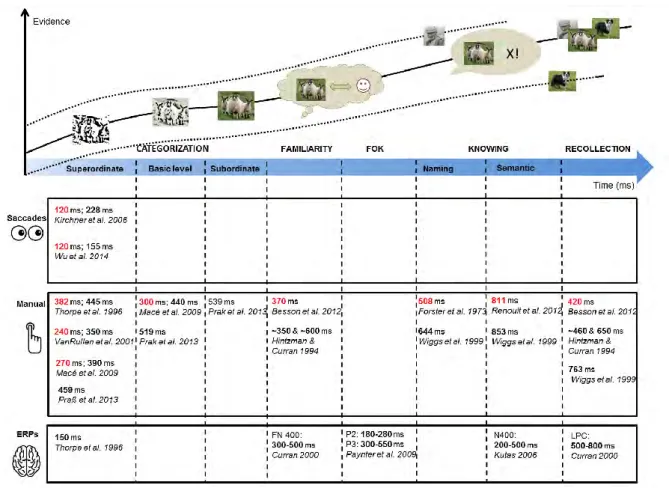
Figure 1.1 From perception to memory. ... 42
Figure 1.2 Memory retrieval: a decision based on the evidence accumulated over time towards different hypotheses/classes. ... 50
Figure 1.3 Decisions based on the evidence accumulation model. ... 57
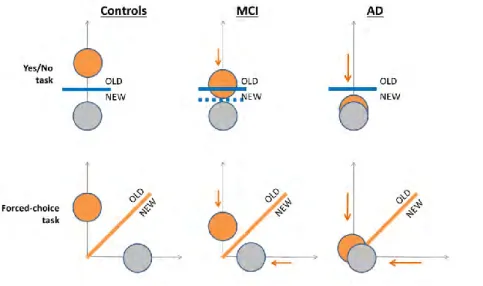
Figure 1.4 Two-dimensional representation of the distribution of the neuronal responses on a Yes/No judgement and a on a forced-choice task. ... 64
Figure 2.1 Illustration of the Sharpening model. ... 73
Figure 2.2 Retrieval from inactive to active memories... 78
Figure 2.3 Activations of neurons during the presentation of a specific stimulus. ... 81
Figure 3.1 Experimental design. ... 95
Table 3.1 Collection of 50 reports for the test videos judged familiar by the older participants. ... 103
Figure 3.2 Performance in the 4-FC for the 50 test TV programs... 104
Table 3.S1 Older participants’ detailed information: gender, age, year of TV acquisition and daily number of hours of watching TV at the time of the recall. ... 110
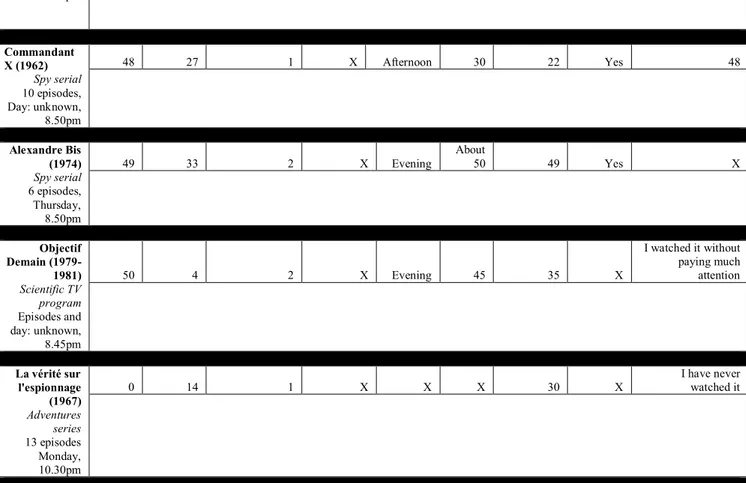
Table 3.S2 Details of famous and test TV programs: broadcast period, number of episodes, duration of episodes and number of seasons. ... 113
Figure 4.1 Examples of pairs of stimuli used in the DMS-48 for the three conditions “Unique”, “Paired” and “Abstract”. ... 121
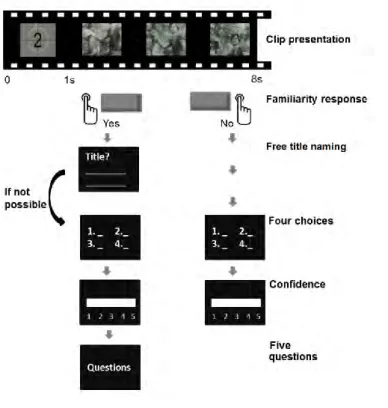
Figure 4.2 The current experimental procedure consisted in two explicit memory tests: a forced-choice (task 1) and a Yes/No recognition (task 2). ... 124
Figure 4.3 Test participants’ performance on the current experiment. ... 127
Figure 4.4 Participants’ performance on the forced-choice and Yes/No tasks according to the number of times stimuli were seen in the DMS-48 (2002-2008): less than three times (< 3) or 3 times and more (≥ 3). ... 128
Figure 4.5 Participants performance over the confidence level in the forced-choice task. ... 130
22 Figure 5.1 Spatiotemporal scale of neural signals for commonly used neuroimaging techniques. ... 139 Figure 5.2 Lay-out of a 64-electrode cap using the BIOSEMI system. ... 140 Figure 6.1 Experimental design. ... 155 Figure 6.2 Behavioral performance: HITs responses on average across participants. .. 159 Figure 6.3 Differential EEG activity between snapshots seen in the 3 learning sessions (HOURS, 1D and 3W before the recall) and NEW snapshots. ... 163 Figure 6.4 Early ERPs analysis on average across 11 participants for snapshots seen HOURS or 1D before and compared to New pictures. ... 164 Figure 6.5 Decoding analysis for the comparisons between the 3 learning session (Hours, 1D, 3W) and New pictures on average across participants. ... 165 Figure 6.S1 Differential EEG activity between REMEMBER or KNOW snapshots and NEW snapshots. ... 169 Figure 6.S2 Decoding analysis for the comparisons between Remember or Know
responses and New pictures on average across participants. ... 170 Figure 7.1 Experimental design. ... 175 Figure 7.2 Participants recall performance for videos seen 1, 2, 3 or 5 times 3 weeks before. ... 179 Figure 7.3 Differential EEG activity between snapshots seen ONE, TWO, THREE or FIVE TIMES, three weeks ago and NEW snapshots. ... 181 Figure 7.4 Decoding analyses for the comparisons between the four numbers of
exposures (ONE, TWO, THREE, FIVE) and NEW pictures on average across
participants. ... 182 Figure 7.5 Experimental design. ... 184 Figure 7.6 Retrieval performance over the number of exposures for audiovisual clips seen five months ago. ... 186 Figure 7.S1 Differential EEG activity between REMEMBER or KNOW snapshots and NEW snapshots. ... 187 Figure 7.S2 Decoding analyses for the comparisons between the four numbers of
exposures (ONE, TWO, THREE, FIVE) and NEW pictures on average across the five participants with the best decoding performance. ... 187 Figure O.1 Exemplar of Chladni’s figures (from (Chladni, 1787)) ... 206
23
“
We watch an ant make his laborious way across a wind- and wave-molded beach. He moves ahead, angles to the right to ease his climb up a steep dune let, detours around a pebble, stops for a moment to exchange information with a compatriot. Thus he makes his weaving, halting way back to his home. So as not to anthropomorphize about his purposes, I sketch the path on a piece of paper. It is a sequence of irregular, angular segments not quite a random walk, for it has an underlying sense of direction, of aiming toward a goal. I show the unlabeled sketch to a friend. Whose path is it? An expert skier, perhaps, slaloming down a steep and somewhat rocky slope. Or a sloop, beating upwind in a channel dotted with islands or shoals.Perhaps it is a path in a more abstract space: the course of search of a student seeking the proof of a theorem in geometry.
Whoever made the path, and in whatever space, why is it not straight; why does it not aim directly from its starting point to its goal? In the case of the ant (and for that matter the others) we know the answer. He has a general sense of where home lies, but he cannot foresee all the obstacles between. He must adapt his course repeatedly to the difficulties he encounters and often detour uncrossable barriers. His horizons are very close, so that he deals with each obstacle as he comes to it; he probes for ways around or over it, without much thought for future obstacles. It is easy to trap him into deep detours. Viewed as a geometric figure, the ant's path is irregular, complex, hard to describe. But its complexity is really a complexity in the surface of the beach, not a complexity in the ant.
On that same beach another small creature with a home at the same place as the ant might well follow a very similar path.”
25
GENERAL INTRODUCTION
1. The essence of the words
1.1 Brain
Brain: an organ of soft nervous tissue contained in the skull of vertebrates, functioning as the coordinating center of sensation and intellectual and nervous activity (Oxford definition).
This definition goes back to the biological structure of the brain from which high level functions emerge. At the end of its development, the brain is composed of several structures: the brain stem: with the midbrain, the pons and the medulla, the diencephalon with the thalamus and hypothalamus, the cerebellum and the cerebrum. The cortex, the most external layer of gray matter of the cerebrum is divided into neocortical and allocortical structures, the latter including the hippocampus and the rhinal cortices.
From an evolutionary perspective, the cerebral cortex can be seen as a tissue that was constrained to develop inside rigid boundaries delimited by the skull. This expansion was particularly important in primates and especially in humans. To overcome this space limitation, the tissue adapted its growth by folding up into gyri (ridges) and sulci (depressions). To some extent, gyri are used to delimit cortical areas that have a structural and a functional specificity. As an example, the inferior temporal gyrus which corresponds approximately to the Brodmann area 20 is particularly involved in recognition memory. Cortical areas are included in four main lobes: frontal, parietal, temporal, occipital (figure I.1). But as already observed by Ramon y Cajal at the beginning of the 20th century, the
relative uniformity of the six-layered structure of the neocortex demonstrates its structural unity.
26 Figure I.1 Representations of the cortical structures
Lateral view (A), medial view (B) and brain ontogeny (C) (from (Forstmann et al., 2015))
1.2 Information: In-formation
The vibrations of a djembe after being hit by a musician The severe damage on the trunk of the tree following the storm My body is still shivering after you kissed me on the neck
A tissue was in a certain condition but is now in a different state due to physical perturbations coming from the environment. This transition shows the integration of new information into the system through the reshaping or the deformation of the tissue.
Like for every organic tissue, the brain is exposed to environmental constraints and is constantly deformed by the action of external or internal agents. Deformation allows the integration of new inputs by the tissue and through its content creates the IN-FORMATION necessary to perceive the world. According to Bohm, “Information is a difference of form that makes a difference of content, i.e. meaning” (Bohm, 1989). To explain it simply, Bohm gives
27 the example of letters on a printed page: the difference of meaning is held in the difference in the forms of the letters.
Therefore, any type of information would be revealed through the interaction between two entities. If we consider human experiences, information would be generated from the interaction between an external object (external input) and the nervous tissue or between an internal input and the nervous tissue. While it seems obvious that any external object has a specific form, the same would apply for internal inputs. Indeed, internal inputs, commonly called thoughts or mental images would originate from the direct abstraction of objects present in the outside world. Such new forms might be more subtle than the ones we experience in the outside world, yet it does not restrict the potential of information they can convey. Again, to explain it simply, writing could be a good example.
Nowadays, it is hard to see any relationship between letters and their corresponding physical objects. However such correspondence does exist. Let’s take the example of the two first letters of the Latin alphabet: “A/a” and “B/b” which correspond to alpha and beta in the Greek alphabet. Alpha derives from the Phoenician alphabet “aleph” , which means head of ox, and this comes directly from the Egyptian hieroglyph . Beta is equivalent to the “bet” letter in the Phoenician alphabet which means house and derives from the Egyptian hieroglyph .
It is interesting to see that every Egyptian hieroglyph corresponds to a symbol that is a direct abstraction of an object taken from the outside world. In a way, a living ox or a real house would be the external objects and the Egyptian hieroglyphs or the letters A and B, their respective mental images.
The form of these “mental images” can correspond to ideas (logograms) or to sounds (phonograms) that combined together provide specific information and can have as much influence as real objects.
One would easily understand why such writing was considered as sacred at the time: the close relationship between the symbols and their outside attributes gave them sacred powers which would be activated when read.
1.3 A few musical notes on memory
Information is in the shape and can be called quale (Balduzzi and Tononi, 2009) in the field of neuroscience. A shape is informative because it can be characterized by two invariants: its frequency range of resonance also called spectrum and the whole set of possible points in that
28 frequency range. A point in that shape can be seen as a chord and the whole set of possible chords as the musical scale of the shape.
Every time some information is integrated in our brain specific shapes might be created. In this perpetual movement which never ends and which does not really stabilize, the brain tries to create stable representations based on the information provided by this continuous ballet. This choreography of shapes would not have the same substance as the forms we are used to experiencing in our daily life and could not be reached by our sense of vision. Instead, a more subtle approach would be needed. The major scale with its seven notes (do-re-mi-fa-sol-la-si /
C–D–E–F–G–A–B) is a beautiful example of such idea by corresponding to the vibration of the quantum sphere. As such, any representation we build in mind at any time might correspond to the vibration of a specific shape that has emerged from the structural organization of assemblies of neurons. Some of these experiences can be frivolous and would not have any impact on the nervous tissue while others might have a stronger influence. In the latter case, if the information leads to the modification of the structural organization of the tissue it results in the encoding of the input. The creation of this memory trace can be seen as an imprint in the brain. As a natural extension, memory could be viewed as the preservation of those shapes generated by specific neuronal organizations and remembering, literally: being “again member”, the reinstatement of those shapes into conscious access. Accordingly, human knowledge would be held in subtle shapes that could be used in specific domains. From this view, one would better understand why in the Greek mythology, Mnemosyne, the goddess of Memory was also the mother of arts, science and literature embodied in the nine muses.
Importantly, the maintenance of these memory traces over time would vary and only specific constraints would enable the creation of very long-term memories and their potential retrieval. As I will show in the next section, little is known about our ability to retrieve very long-term memories explicitly. In this yet to be explored field, my thesis will try to provide a better insight.
2. Studying very long-term memories
Classically, (very) long-term memories are split into two main categories: explicit memories that can be verbalized (declarative) and implicit memories which are reflected in individual’s behavior (nondeclarative) (Squire and Zola-morgan, 1991). In my thesis, I will focus on explicit memories that rely on the Medial Temporal lobe unlike implicit memories.
29 2.1 Explicit memories
2.1.1 The Medial Temporal Lobe
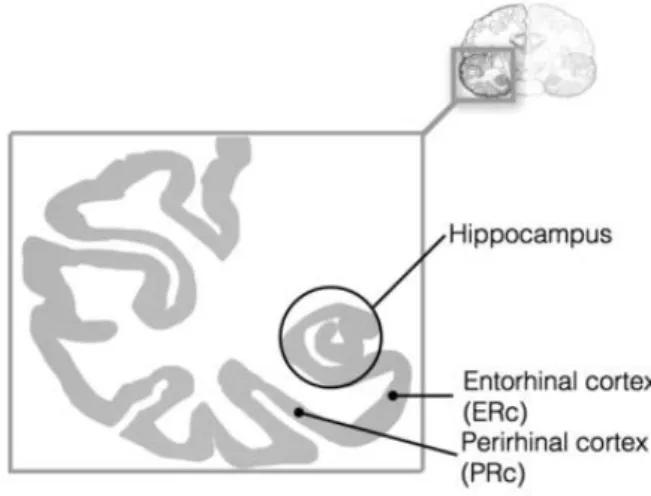
As its name suggests, the Medial Temporal Lobe is part of the temporal lobe which is one of the four cortical regions (the green region in the figure I.1). It includes allocortical areas including the hippocampus that is part of the archicortex and the rhinal cortices that are part of the periarchicortex, a transitional zone between the archicortex and the neocortex (figure I.2). The hippocampus is composed of the dentate gyrus, four CA fields and the subiculum. The rhinal cortices include the entorhinal and perirhinal cortices. Interestingly, the Medial Temporal Lobe is also made of neocortex with the parahippocampal structure located posteriorly to the rhinal cortices.
Figure I.2 Schematic representations of the hippocampus and the rhinal cortices
From (Moulin et al., 2013))
The Medial Temporal lobe is a critical region from which phenomenological experiences of explicit retrieval can emerge. It can lead to familiarity if one can categorize an item as previously encountered (it is an “old” item) or to recollection if the categorization as an “old” item is associated with contextual details (Mandler, 1980).
2.1.2 Semantic, episodic, autobiographic
Explicit memories can be semantic if they reflect general knowledge such as retrieving a name, or episodic if a unique specific event can be retrieved within its spatial and temporal context such as the first day in college (Tulving, 1985a). When semantic and episodic memories are related to the self, they form autobiographical memories that reflect the past of
30 every individual’s life. Therefore, all autobiographical memories are not necessarily episodic (Levine et al., 2002; Piolino et al., 2002; Tulving et al., 1988).
2.1.3 Assessing explicit memories
Explicit memories are potentially verbalized by the participants. Therefore they have to be tested in a task where the participants are voluntarily engaged in the retrieval of specific information. This way, participants’ performance is a direct result of a retrieval process that they initiated. Several paradigms have been designed to test explicit retrieval and can be split into two main categories: recall tasks and recognition tasks. In recall tasks, participants have to retrieve a specific piece of information that is not present in their environment (free recall) or only partially (cued-recall). In recognition tasks the information is presented to the participants -either alone in a Yes/No task or among several propositions in a forced-choice task- and participants are asked to identify which item was previously encountered.
As we see, the amount of information necessary to perform these tasks significantly varies and not being able to retrieve a name in a free recall task would not necessarily mean not being able to identify it from two instances. This will be discussed at length in chapter 1.
2.2 A brief literature overview
The memory literature is huge but when it comes to very long-term or remote memory -that is for periods of a few months to decay- less data exist. This is mainly due to practical reasons: while it is easy to test the retrieval of sensory information the same day as it was presented, it is more difficult to make sure that all conditions will be met again to test the same participants several years later. Despite this strong constraint, some studies were able to test the retrieval of very long-term memories.
2.2.1 Lifetime memories
One possible way for explicitly testing participants’ very long-term memories, is to ask them retrieve information acquired in their real life. Using this first method, researchers could potentially test lifetime memories for a wide range of “ecological” material related to semantic or episodic information such as the memory of old classmates (Bahrick et al., 1975), of information learnt in school (Bahrick, 1984) or of specific autobiographical events (Rathbone et al., 2008; Rubin and Schulkind, 1997; Viard et al., 2007). These studies showed that explicit information acquired during young adulthood could be maintained through the individual’s lifetime.
31 Interestingly, data from amnesic patients revealed that very long-term memories could be robust to damage in the Medial Temporal lobe (Bayley et al., 2006, 2003; Reed and Squire, 1998) although this is not very clear for very long-term episodic information (for a review see: (Frankland and Bontempi, 2005)). This ambiguity led to the contemporary debate: standard model versus Multiple Trace Theory Model (MTT). According to the standard model, the Medial Temporal Lobe (MTL) and the hippocampus in particular would be involved in supporting declarative memories (semantic or episodic) that were recently formed but over time the memories would become independent of the hippocampus and would only rely on cortical structures (Squire and Alvarez, 1995). For the MTT, this would be true only for semantic information and remote episodic memories would still rely on the hippocampus (Nadel and Moscovitch, 1997).
2.2.2 Forgetting curves
When possible, the amount of information retrieved in a given task can be assessed for different retention intervals. The data can be used to draw forgetting curves with on the x-axis of the graph the time elapsed since the acquisition phase and on the y-axis the percentage of retrieval in the specific task (see figure I.3 for an example). This graphical representation provides valuable information on participants’ performance over long time delays even if they do not necessarily encompass the whole lifespan of an individual (for example: (Conway et al., 1991; Squire, 1989)). In particular, forgetting curves showed that retrieval performance quickly decreases after the learning phase but then stabilizes for several decades. It is hard to say which mathematical law follows any of the forgetting curves but the power function of time seems to fit well with the data (Anderson and Schooler, 1991; Rubin and Wenzel, 1996; Wixted and Ebbesen, 1991).
32 Figure I.3 An illustration of the forgetting curves
The percentage of correctly recognized concepts and names is plotted for various retention intervals. From (Conway et al., 1991).
2.2.3 Long-term memories: the where under the scope of fMRI studies
The stabilization of long-term memories comes with a reorganization of its underlying neuronal network. This system-level consolidation is a slow process taking at least several weeks to be completed. As we mentioned, two main theories: the standard model and the Multiple Trace Theory have been proposed to account for this reorganization. This debate, not yet closed, provided a great enthusiasm inside the whole neuroscience community. Many investigations were carried out to get a better understanding of the role of the hippocampus over long retention intervals. The spatial resolution provided by the fMRI technique was particularly helpful and provided evidence toward the Multiple Trace Theory (Harand et al., 2012; Maguire and Frith, 2003; Maguire, 2001). As we see, the role of the hippocampus on long-term retrieval focused most of the attention. This would explain the poor amount of data concerning the temporal dynamics during long-term retrieval assessed via EEG (Electroencephalography) or MEG (Magnetoencephalography). Indeed, only a couple of studies examined participants’ EEG activity during the retrieval of items seen the previous day (Curran and Friedman, 2004; Jaeger et al., 2010; Wolk et al., 2006) and only one study went as far as recording the EEG activity for pictures seen four weeks before (Tsivilis et al., 2015).
33
2.2.4 Remaining questions
This brief survey shows that the explicit retrieval of long-term memories that have been acquired several decades ago is possible. However, one main limitation comes from the fact that the experimenter has little control on the acquisition parameters during new learning. Among them, two parameters are difficult to assess: the strict number of times the information was presented and the fact that the information could have been encountered again outside the original acquisition period. One exception might be the television test that was designed to evaluate remote memories of one-season TV programs used in several studies by Squire et al. (Squire and Fox, 1980; Squire and Slater, 1975; Squire, 1989).
Several questions remain unanswered: How long can information that has not been revisited since the initial acquisition be maintained? Does this duration depend on the number of exposures during the acquisition phase? How do brain processes unfold over time during the retrieval of remote memories? These questions are at the core of my thesis.
2.3 Overall framework
My thesis would not have been possible without the scientific environment in which it took place. After completing my Master’s degree, Simon gave me the opportunity to join his team for a new and exciting research project: the M4 project. “M4” stands for Memory Mechanisms in Man and Machine but “Man” should now be changed to “Mammals” with Danaé Rémon’s work on dogs. The substantial financial support that Simon got from the European Research Council for five years (FP7/2007-2013/ERC grant agreement n° 323711) allowed him to hire several PhD students, post-docs, managers, and a research assistant to create the M4 team. The idea was to gather people from different backgrounds –psychology, neuroscience or computation-, to tackle the issue of the formation and the maintenance of very long-term memories. Simon used his strong expertise in visual perception and in fast visual recognition in particular (Kirchner and Thorpe, 2006; Thorpe et al., 1996; Wu et al., 2010) together with advanced computational developments (Masquelier and Thorpe, 2007; Masquelier et al., 2009) to think memory from a complete different perspective. Ten claims are at the core of his radical proposal that the M4-team was invited to investigate:
1/ Humans can recognize visual and auditory stimuli that they have not experienced for decades;
2/ Recognition after very long delays is possible without ever reactivating the memory trace in the intervening period;
34 3/ These very long-term memories require an initial memorization phase, during which memory strength increases roughly linearly with the number of presentations;
4/ A few tens of presentations can be enough to form a memory that can last a lifetime; 5/ Attention-related oscillatory brain activity can help store memories efficiently and rapidly; 6/ Storing such very long-term memories involves the creation of highly selective “Grandmother Cells” that only fire if the original training stimulus is experienced again; 7/ The neocortex contains large numbers of totally silent cells (“Neocortical Dark Matter”) that constitute the long-term memory store;
8/ Grandmother Cells can be produced using simple spiking neuronal networks models with Spike-Time-Dependent-Plasticity (STDP) and competitive inhibitory lateral connections; 9/ This selectivity only requires binary synaptic weights that are either “on” or “off”, greatly simplifying the problem of maintaining the memory over long periods;
10/ Artificial systems using memristor-like devices can implement the same principles, allowing the development of powerful new processing architectures that could replace conventional computing hardware.
2.4 Presentation of the chapters
With no doubt, this manifesto largely inspired the direction and the content of my thesis. With Simon and Nadège Macé, the M4-manager during the first half of my thesis, we agreed that I would carry experiments concerning the retrieval of remote memories. Like an archeologist my goal was to find evidence for very long-term memories of sensory stimuli that were thought to be lost. And for that, I had to respect one major constraint: stimuli should not have been presented again for years after the acquisition period. In this adventure I had the support from the National Institute of Audiovisual in Toulouse (chapter 3), and from Emmanuel Barbeau and Eve Tramoni who gave me access to a list of participants that we could test in a well-controlled design (chapter 4). I am very grateful to Sophie Muratot who helped me collecting all this precious data.
In such a pre-defined framework I could have easily fallen in the trap of becoming a mere “inspector” that would validate (or reject) one of the claims above. Lucky me, Simon gave me the opportunity to express myself in this project. My main motivation was to understand the underlying processes at the basis of our subjective experiences during memory retrieval. Especially my interest lied in its dynamic component. I decided to carry EEG experiments to study how processes unfold in time during long-term retrieval (chapter 5). After the conclusive results of the first EEG experiment (chapter 6) I decided to follow-up and to study
35 the impact of repetition for long-term retrieval (chapter 7). This project was successfully handled by Méyi Dulème who presented the results in her Master’s thesis. Gathering experimental evidence was a first step in understanding the dynamic of retrieval, another step was to propose a theoretical framework that could explain it. In this enterprise I had all the support from Chris Moulin. It was an extraordinary chance for me that Chris had to evaluate my work at the mid-term of my thesis. Following that, he gave me the opportunity to work on a literature review about the dynamics of retrieval (chapter 1). This helped me to prepare the ground for the topic of very long term retrieval (chapter 2).
2.4.1 Peer-reviewed articles
Some chapters of this thesis correspond to articles that were submitted for peer-review in scientific journals. For easier reading, I slightly adapted them in my thesis.
Unifying memory and perception into the same framework: a dynamic Bayesian approach
Christelle Larzabal, Simon J. Thorpe, Chris J.A Moulin
Review article submitted
Waking up buried memories of old TV programs
Christelle Larzabal, Nadège Bacon-Macé, Sophie Muratot, Simon J. Thorpe
Research article accepted in Frontiers in Behavioral Neuroscience (2017)
Long term memory and familiarity after 12 years
Christelle Larzabal, Eve Tramoni, Sophie Muratot, Simon J. Thorpe, Emmanuel J. Barbeau
Research article submitted
37
39
CHAPTER 1. Unifying memory and perception into
the same framework
Abstract
Traditionally, memory is split into separate systems and subsystems according to their function. Although perception can also be similarly broken down into separate subsystems, many neuroscientific views of perception tend to see processing as a meaningful whole, with information flowing through a series of stages from low level processing in V1 to conceptual categorization in the medial temporal lobe. In this article we draw upon such perceptual theories to propose that encoding and retrieval of information is based on the ‘accumulation of evidence’, arising directly from perceptual mechanisms. As such, we see memory as a single system, but like perception, it involves varying levels of processing based on the computational nature of the task in hand, such as subjective awareness, discrimination, categorization, and retrieval of context. Episodic memory and recollection lie at the top of this information processing hierarchy. We review evidence from experimental data in support of this hypothesis and show how it might account for clinical pathologies such as Alzheimer’s disease.
40 Chapter presentation
This first chapter reflects in many aspects all the knowledge I acquired during my Master’s degree and that I had time to fully process to integrate it in the field of memory. I started with subliminal and bi-stable perception with Jean-Rémi King in Paris, before studying the role of intuition in decision-making with Martijn Wokke in Amsterdam. I have to tell that my 6-month internship with Jean-Rémi was an invaluable experience. With him I really started to understand and do cognitive neuroscience. He introduced me to many notions, either theoretical like Bayesian inferences, or technical like decoding analyses applied to MEG data. Coming from the field of biology all of this was new to me but so exciting! The following year I had the chance to go to Amsterdam for a 6-month internship. I remember the first paper Martijn told me to read: The neural basis of decision Making (Gold and Shadlen, 2007). It was quiet tough and so abstract at first! I did not give up reading and finally I got the essence of it. A decision was the result of Bayesian inferences computed over times. While decision-making is usually associated with motor actions such as going to a specific direction, it is a very generic term that also holds for perception or memory. Indeed the task that our participants had to perform was like an implicit memory task. It is with this background that I started my PhD with for main focus the retrieval of very long-term memories.
I quickly realized that I was not the only one who started from perception and ended up with memory. It was also the case of Simon who just hired me! I knew that we would share the same vision: the idea of a continuum between perception and memory. However since the beginning Simon was reluctant to the idea of Bayesian inferences. I remember when I discussed it with Chris during my mid-thesis committee. He was more interested and suggested to write a review on this topic. We dedicated a lot of time for this project. I even went to visit Chris in Grenoble for a month to work on this project full time. I thank Karine, the lab manager, for making my stay easy in Grenoble.
The discussion went on for months with Simon and finally we ended up with a review article: “Unifying memory and perception into the same framework: a dynamic Bayesian approach” that we submitted for peer-review. It has the merit of being a personal view rooted on theoretical notions about memory and tries to make the bridge between two main cognitive fields: perception and memory. Note that for ease of reading some sections of the review article were skipped and a few changes were provided.
41 1. Introduction
Encoding and retrieving from human memory are complex activities involving many dispersed brain regions. For instance, the frontal lobe is often described as being involved in the control and monitoring of memory (Goldman-Rakic, 1987; Miller, 2000), the parietal lobe is recruited in recognition/episodic memory and decision making (Adolphs et al., 1996; Cabeza et al., 2008; Platt and Glimcher, 1999; Shadlen and Newsome, 1996), and the occipital lobe is implicated in the generation of visual imagery and in perceptual priming experiments (Kosslyn et al., 2001; Roland and Gulyas, 1994; Wiggs and Martin, 1998). However, the medial temporal lobe (MTL) - including the hippocampus and the entorhinal, perirhinal and parahippocampal cortices - is usually considered to be the critical area for memory function. In particular, the hippocampus is known to be a crucial brain region; if it is removed or damaged, memory function is severely impaired with an inability to either store new information (anterograde amnesia) or retrieve distant memories (retrograde amnesia). The hippocampus is thus seen as playing a critical role in memory (Burgess et al., 2001; Marr, 1970; Rolls, 1996; Squire, 1992). Contemporary views of hippocampal function see it as particularly crucial for episodic memory, the ability to retrieve contextual specifics from memory. Some authors consider that it is only involved in the initial formation of representations which later rely on neocortical sites (the standard model: e.g (Squire et al., 1984) ) whereas others see it as a central processor that remains involved in the binding of separate sources of information together into a coherent whole (Olsen et al., 2012; Ryan et al., 2000; Yonelinas, 2013). Here, we will argue that these views concerning hippocampal activation and binding can be linked with theories of perception.
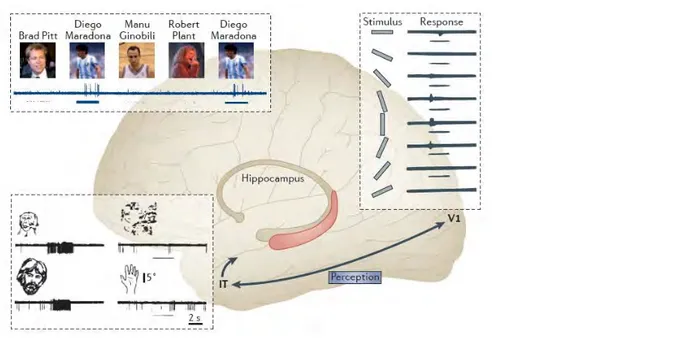
Interestingly, the hippocampus is located at the end of the visual ventral stream and receives input from multiple sensory modalities (Suzuki and Amaral, 1994). The hippocampus is also a strategic center that plays a key role in the integration of sensory inputs (Squire et al., 2004). Based on this neuroanatomical structure, our hypothesis is that memory lies on a continuum with perceptual processes, and that the encoding of information emerges from the routine treatment of perceptual input. After having been processed in subcortical regions such as the lateral geniculate nucleus (LGN) in the thalamus, sensory inputs have to pass through successive cortical areas for the information to be integrated. For visual stimuli (see Figure 1.1), the input follows the visual ventral stream by entering the primary visual area V1, where the neurons fire for low-level properties of stimuli (e.g. bars, edges). Higher order attributes are then encoded through the next regions of the visual cortex (V2, V3) until the Lateral
42 Occipital Complex (LOC) in humans or the Inferior Temporal cortex (IT) in macaques. It is in the LOC that we find the most specific or selective neurons in the pathway, such as face-selective neurons. The hippocampus, at the end of this perceptual stream, is thought to be involved in binding of sensory information to other stored representations, and it is here that multi-modal selectively firing neurons have been found (such as the ‘Halle Berry’ cell which fires for her face, name and for the character she plays in Catwoman (Quiroga et al., 2005). By receiving monosynaptic hippocampal projections (Thierry et al., 2000), direct communication between the prefrontal cortex and the hippocampus is possible and occurs preferentially during the first stages of the formation of the memory trace: encoding and consolidation (Benchenane et al., 2010). Recent decoding techniques used on combined MEG and fMRI data reveal a dynamic continuum of activation associated with an increase of categorization from V1 to IT (Cichy et al., 2014) that might continue until the MTL and PFC. This strongly suggests that early M/EEG effects cannot differentiate different types of stimulus, but as activation spreads throughout the brain, it allows the entanglement of such representations (DiCarlo and Cox, 2007).
Figure 1.1 From perception to memory.
In the visual ventral stream the processing of visual stimuli starts in the primary visual area V1, where the neurons fire for low-level properties of stimuli such as for a specific bar orientation (a vertical bar in the figure). The neuronal selectivity increases through the next regions and reaches its maximum at the end of the visual ventral stream: in the Inferior Temporal cortex (IT) in macaques or in the Lateral Occipital Complex (LOC) in humans. At this stage, neurons encode higher order attributes such as specific body parts (faces in the
43
figure) that can be bound to other representations in the medial temporal lobe and in the hippocampus in particular, where neurons fire for specific concepts (the footballer Maradona in the figure) (from (Quiroga, 2012))
We make the novel suggestion that this evolution of cells firing according to the differentiation of increasingly specific and complex representations (which can be thought of as a perceptual process) could ultimately lead to further differentiation, creating a distinct percept that contains all information associated with that percept. We propose here that this process of differentiation is akin to the perceptual process of evidence accumulation over time, such that memory is based on the outputs of a perceptual system making ever fine-grained evaluations of items in perception.
We suggest that memory encoding and retrieval are dynamic processes that unfold over time and that directly emerge from perceptual mechanisms. We will show that dynamic Bayesian inferences can explain both memory encoding and retrieval by relying mainly on the MTL. In particular we will show how the interaction between retrieval tasks (e.g. free recall or forced-choice tasks) and retrieval assessments (e.g. Remember/Know/New judgement) lead to different retrieval modes (naming, feeling of knowing, familiarity…) that emerge from the same evidence accumulation model. We will review evidence from behavioral and time-resolved experiments that support this model. We strongly believe that this model can also be extended to clinical cases and as an example, we will also illustrate how this evidence of accumulation model might account for Alzheimer’s disease.
2. Memory encoding and retrieval: A dynamic Bayesian framework First proposed by von Helmholtz in 1866 (Helmholtz, 1947) perceptual integration is now often considered as an inference problem and can be explained in Bayesian terms (Kersten et al., 2004; J-R. King and Dehaene, 2014; Ko and Lau, 2012). Given the noisy information coming from our senses at a time t and prior knowledge acquired through experience, the brain’s role is to decide what the most probable sensory input is. This process of reaching a suitable decision based on priors is referred to as the accumulation of evidence. The implication is that over time, Bayesian processes drive the acquisition of information that enables a final perceptual decision. Here we propose a natural continuum of this idea, and propose that memory encoding and retrieval can be similarly modelled as a Bayesian process. Note that in itself, the idea of priors in perceptual decision making is, in essence, about memory, since priors are in some way merely an agglomeration of activations based on
44 previous experience. Even the very idea of identifying a stimulus rests upon the idea that something in the environment is matched with an internal representation, which is again, based on memory.
2.1 Memory encoding: from perceptual processing to the creation of a distinct percept
2.1.1 A dynamic Bayesian approach
During the encoding of a stimulus, a cascade of brain regions are activated which are reflected by the firing of neuronal assemblies associated with an alteration of their synaptic weights. As with perceptual decision-making we suggest that the encoding of a stimulus is supported by a succession of brain processes performing Bayesian statistics that decide at their own level which representation is the most probable given the incoming stimulus. Depending on the environmental circumstances, perceptual decisions will tend to focus on specific features and will reduce the possibilities into several hypotheses; part of this decision making will involve long term memory–such as decisions about the classification of objects (e.g. living or non-living), their identification (e.g. cat or dog) and simple judgements of familiarity.
In our view, this diminution of possibilities over time leads to a reduced and clustered multidimensional space, where the brain’s role is to find the most probable hypothesis Hi
given noisy sensory evidence E coming from the selected features. This inference problem is expressed in Bayesian terms as finding P(Hi|E), the posterior probability. The posterior is
defined as being proportional to two parameters that can be known, the likelihood function and the prior:
𝑃(𝐻𝑖|𝐸)~ 𝑃(𝐸|𝐻𝑖)𝑃(𝐻𝑖)
With P(E|Hi): the likelihood function of obtaining evidence from the sensory input;
P(Hi): the probability of occurrence of the stimulus Hi called prior;
The posterior probability is calculated for all different hypotheses: H1 to Hx: P(H1|E), P(H2|E)
… P(Hx|E) with the purpose of extracting the one with the maximal a posteriori probability.
Perceptual decisions and decisions in general are not conducted on a single maximum a
posteriori value. Instead, to be sure that posterior value has some consistency the same
calculation is performed over a certain period of time. The idea is to accumulate evidence in support of a hypothesis (Gold and Shadlen, 2007). Mathematically, this is done by
45 multiplying the logarithm of the likelihood ratios (log LR, called also weight of evidence) obtained at each time i (from 1 to n values). The prior can thus be considered as being the log LR at time 0.
For a binary decision this is expressed as: Log LR12 ≡ logP(𝑒P(𝑒1,𝑒2,…,𝑒𝑛|ℎ1) 1,𝑒2,…,𝑒𝑛|ℎ2) = ∑ log 𝑃(𝑒𝑖|ℎ1) 𝑃(𝑒𝑖|ℎ2) 𝑛 𝑖=1
This means that at each time i, a decision variable (DV = log LR) is calculated from the evidence obtained up to that point. Decisions can be made if a certain criterion is reached or if the cost is too high to continue the process (Gold and Shadlen, 2007). This mathematical approach might explain the differences observed in terms of subjective report according to the criterion level used. Indeed, explicit access would only emerge if the DV reaches a subjective threshold that corresponds to a high level criterion. If the DV is too low, but still differs from random noise, implicit behaviors can be observed (Dehaene, 2008). In addition, every DV comes with an estimate of its level of uncertainty that might be the basis of metacognitive judgments. Metacognition commonly described as ‘knowing what we know’ (or what we do not know) does not only apply to explicit processes and can be considered as a second order judgement performed on unconscious or conscious processes (Charles et al., 2013; Spehn and Reder, 2000). A metacognitive estimate of certainty can be translated in terms of confidence levels or error detection and is used to initiate and co-ordinate efficient memory behaviors (Moulin and Souchay, 2015).
2.1.2 The creation of a conceptual representation
During memory encoding, low-level regions such as V1 and V2 for the visual ventral stream are first activated by an incoming stimulus. Depending on the stimulus properties and according to the task in which participants are involved, brain activity can spread out to higher cortical structures such as in IT before reaching the prefrontal cortex and the MTL structures. It has been shown in the monkey that the proportion of cells with activity that directly corresponds to subjective perception increases along the visual ventral stream: from 20% in V1 to 90% in IT (Logothetis, 1998). This strong link has also been seen in studies of epileptic patients (Kreiman et al., 2002; Quiroga et al., 2008b) where most of the neurons in the MTL were activated according to the patient's subjective reports, the MTL getting direct input from IT. The MTL has been implicated in the last stages of visual processing as shown by deficits in visual spatial cognition in patients with Alzheimer’s disease (Butter et al., 1996;