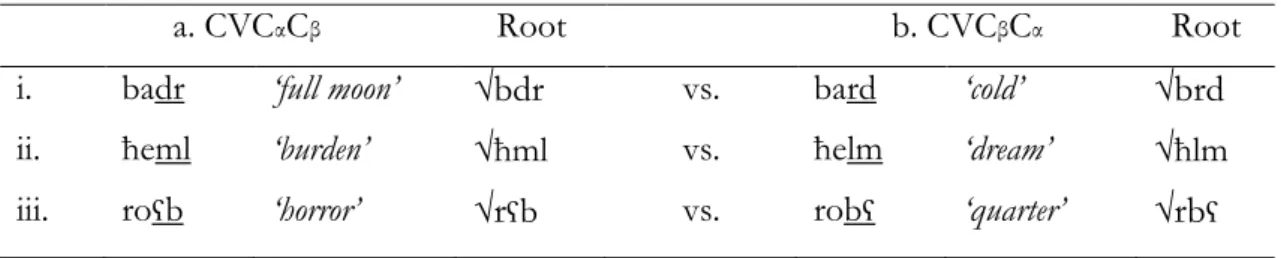
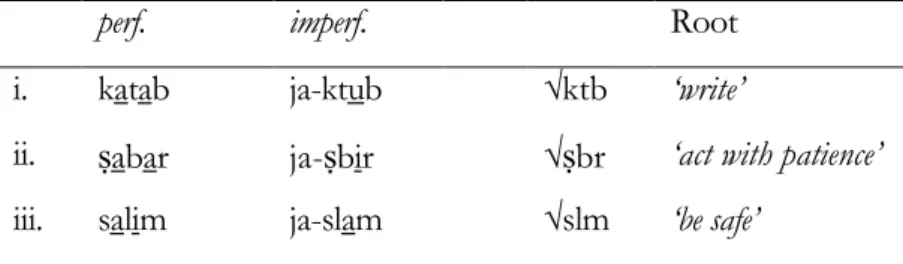
UFR Linguistique
N° attribué par la bibliothèque
Thèse de Doctorat
Discipline : Linguistique Théorique
Radwa Fathi
La longueur vocalique en arabe égyptien: une nouvelle
conception
Vowel length in Egyptian Arabic: a different view
Thèse dirigée par : Jean Lowenstamm
Soutenue le 6 Septembre 2013
Composition du jury :
Sabrina Bendjaballah, CNRS – LLF
Monik Charette, SOAS, University of London (pré-rapporteur)
Mohand Guerssel, Université du Québec à Montréal (pré-rapporteur)
Jean Lowenstamm, Université Paris Diderot (Paris 7)
iii
List of Tables ... vii
List of Charts ... xi
Abbreviations ... xii
Acknowledgments ... xiii
Introduction ... 1
0.1 Purpose of the study ... 1
0.2 Research design ... 4
Chapter 1 The Formal Representation of Cardinal Vowels in Egyptian Arabic ... 6
1.1 Introduction... 6
1.2 Outlines of the vowel system ... 8
1.2.1 The surface vowel inventory: Quality and Quantity ... 8
1.2.2 Vowel distribution ... 9
1.2.3 The underlying vowel phonemes ... 12
1.3 Problem statement ... 14
1.3.1 Abnormal long vowel distribution ... 14
1.3.2 The limitation of vowel length contrasts to specific positions ... 15
1.3.3 The limitation of vowel length contrasts to specific qualities ... 16
1.4 How distinctive is vowel length in Egyptian Arabic? ... 17
1.5 Reinterpreting vowel length in Egyptian Arabic... 22
1.5.1 The vocalization device of Classical Arabic and Moroccan Arabic ... 22
1.5.2 The vocalization device of Egyptian Arabic ... 28
1.5.3 What final vowels can reveal ... 34
1.5.4 When allomorphy gets involved: the “singular feminine nominal marker” ... 38
iv
Chapter 2
The Formal Representation of Mid-vowels in Egyptian Arabic ... 45
2.1 Introduction... 45
2.2 Considering the “loss of brevity thesis” ... 46
2.2.1 In Moroccan Arabic ... 46
2.2.2 In Egyptian Arabic ... 47
2.3 Statement of the problem ... 49
2.4 The organization of the vowel system of Egyptian Arabic ... 52
2.4.1 The parameters ... 52
2.4.2 Interpreting empty nuclei ... 57
2.5 Mid-vowels ... 69
2.5.1 Missing short mid-vowel phonemes ... 69
2.5.2 Previous accounts of long mid-vowels in Egyptian Arabic ... 72
2.5.3 Reanalyzing long mid-vowels ... 74
2.5.4 Glide-medial segholates ... 76
2.6 Concluding remarks... 80
Chapter 3 Ablaut in Egyptian Arabic ... 81
3.1 Introduction... 81
3.2 A general view of the Egyptian Arabic verbal organization ... 83
3.2.1 The verbal measures ... 83
3.2.2 The formal representation of the verb in Egyptian Arabic ... 85
3.3 The strategies for understanding the Egyptian Arabic verb ... 88
3.4 The perfective of Egyptian Arabic ... 91
3.4.1 Vocalisms ... 91
v
3.5.1 The apophonic mechanism in Classical Arabic ... 110
3.5.2 Towards an apophony-based account of aspectual alternations in Egyptian Arabic ... 114
3.5.3 The predictability of certain imperfective melodies ... 127
3.5.4 The lexical vowel Ø ... 129
3.5.5 More evidence for “frontness” ... 138
3.6 Concluding remarks... 143
Chapter 4 The Vocalization of Hollow and Deaf Verbs in Egyptian Arabic ... 144
4.1 Introduction... 144
4.2 Identifying the problem ... 145
4.3 Hollow (Glide-medial) verbs ... 148
4.3.1 Expected vocalisms ... 148
4.3.2 The attested vocalisms ... 156
4.4 Deaf (Biliteral) verbs ... 159
4.4.1 The aspectual melodic alternations ... 159
4.4.2 The arrangement of the vocalic material in deaf perfectives ... 161
4.4.3 Why deaf verbs implement lexical vowels Ø and a ... 163
4.5 Concluding remarks... 173
Chapter 5 Word Stress in Egyptian Arabic ... 174
5.1 Introduction... 174
5.2 Outlines of stress assignment in Egyptian Arabic ... 176
5.2.1 The characteristics of Egyptian Arabic stress ... 176 5.2.2 Stress placement in Egyptian Arabic, generalizations and challenges 180
vi
5.3.2 Stressed epenthetic vowels ... 189
5.3.3 The proposal ... 190
5.3.4 The phonetic correlates of stress in Egyptian Arabic ... 193
5.3.5 Stress and vowel length, correlation undone ... 195
5.4 Accentuation on a skeletal level ... 200
5.4.1 Stressed antepenultimate vowels ... 200
5.4.2 Stressed final short vowels ... 208
5.4.3 Stressed final long vowels ... 211
5.4.4 Stressed long vowels in absolute final position... 213
5.5 Concluding remarks... 217
Conclusion ... 218
References ... 221
Appendices ... 232
vii
Table 1.1 Surface vowel qualities ... 8
Table 1.2 Vowel distributions within the syllable ... 9
Table 1.3 Distribution of short vowels ... 9
Table 1.4 Distribution of long vowels ... 11
Table 1.5 Length contrasts and the three cardinal vowels ... 12
Table 1.6 Minimal contrasts and mid-vowels ... 13
Table 1.7 Lack of ideal correspondence between vowel length and contrasting length ... 15
Table 1.8 Vowel length contrast in CEA ... 17
Table 1.9 Final long vowels alternating with final [h] in free variation ... 18
Table 1.10 mesektu: ‘you (PL) caught it (MASC)’ + l ‘to, for PREP’ + IOP (1SING). ... 19
Table 1.11 mesektu: ‘you (PL) caught it (MASC)’ /mesek-tu + hu/ ... 20
Table 1.12 Every long vowel in a final open syllable is followed by a latent /hu/ morpheme ... 20
Table 1.13 The vocalic equipment of MA compared to CA ... 23
Table 1.14 The CEA vocalization compared to CA ... 28
Table 1.15 Branching vowels in CEA and differential phonetic length ... 30
Table 1.16 Branching vowels in CEA and differential phonetic length due to stress ... 32
Table 1.17 CA labis- /CEA lebes- √lbs ‘put (clothes) on’ perfective paradigm ... 34
Table 1.18 Subject inflectional morphemes ... 34
Table 1.19 The Feminine singular nominal marker in CEA ... 39
Table 1.20 The role of epenthesis in the allomorphy ... 40
Table 2.1 Delinking of short {i, u, a} vowels in MA ... 46
Table 2.2 Delinking of short {i, u, a} vowels in CEA ... 48
viii
Table 2.6 Long mid-vowels vs. long high vowels ... 71
Table 2.7 The origins of long mid-vowels in CEA ... 72
Table 2.8 Mirror image segholates ... 77
Table 3.1 Ablaut in CA: verbal Measure I (3SING.MASC) ... 83
Table 3.2 Ablaut in CEA: verbal Measure I (3SING.MASC) ... 84
Table 3.3 Verbal measures found in both CA and CEA (3SING.MASC) ... 84
Table 3.4 The perfective/imperfective alternation patterns in CA: (3SING.MASC) forms ... 88
Table 3.5 Four verbal classes in CA vs. two classes in CEA: the perfective ... 89
Table 3.6 The perfective/imperfective alternation patterns in CEA ... 89
Table 3.7 The perfective: CA vs. MA ... 91
Table 3.8 Unexpected retention of short vowel {a} by CEA ... 93
Table 3.9 Neutralization of CA (a _ i) and (a _ u) into (e _ e) in CEA ... 94
Table 3.10 CEA katab vs. selem : perfective verbal paradigms ... 96
Table 3.11 Stable second stem vowel in -katab- but not in -selem- ... 96
Table 3.12 CEA katab vs. selem: perfective and negation ... 97
Table 3.13 Stable first stem vowel in -katab- but not in -selem- ... 98
Table 3.14 The CoCoC ~ CeCeC variants in the perfective of CEA ... 106
Table 3.15 Perfective/Imperfective alternating patterns in CA... 110
Table 3.16 The vocalic material involved in the aspectual alternations in CA .... 110
Table 3.17 Apophony, established in CA ... 113
Table 3.18 Perfective/Imperfective alternating patterns in CEA ... 115
Table 3.19 Two perfective and three imperfective patterns in CEA ... 115
Table 3.20 Absent possible systems of aspectual alternations in CEA ... 116
Table 3.21 Perfective/imperfective CEA melodies reformulated in Elements .... 116
ix
Table 3.25 The imperfective prefixes in je-msek and jo-xrog ... 124
Table 3.26 The imperfective prefix in je-slam ... 124
Table 3.27 Factoring out the predictable A Element from the imperfective melody... 126
Table 3.28 The lexical perfective and imperfective melodies ... 126
Table 3.29 A selection of apophony-based alternations ... 127
Table 3.30 Predictable imperfective patterns ... 128
Table 3.31 Identifying the phonologically conditioned imperfective melody .... 129
Table 3.32 The I A step in semeʕ/je-smaʕ alternation pattern ... 131
Table 3.33 The step (Ø I), established ... 132
Table 3.34 Subset of the class katab/je-kteb with lowering R1 and/or R2 ... 133
Table 3.35 Identifying “frontness” in the imperfective ... 135
Table 3.36 The class mesek/je-msek ... 136
Table 3.37 Identifying the perfective managed by epenthesis ... 137
Table 3.38 Apophony, established in CEA ... 138
Table 3.39 Input (U ⇒ I) in CEA ... 139
Table 3.40 Output A, indicator of input I ... 139
Table 3.41 Perfective entry /U/ vs. perfective entry (U transforming to ⇒ I) ... 140
Table 3.42 Output (Ø _ e) ~ output (Ø _ o) ... 141
Table 3.43 Future fusions due to the mounting influence of “ambient I”... 142
Table 3.44 The apophonic derivation of CEA imperfective ... 142
Table 4.1 Root types and vocalic patterns in CEA Measure I: Perfective (3SING.MASC) ... 147
Table 4.2 The absence of Non A-Vocalization in CEA hollow and deaf verbs ... 147
Table 4.3 The vocalic equipment of glide-medial roots if it replicated the set of options available to verbs from strong roots (3SING.MASC) ... 149
x
Table 4.6 CEA hollow verbs: attested melodies (3SING.MASC) ... 156
Table 4.7 CEA deaf verbs: aspectual alternation patterns ... 159
Table 4.8 CEA deaf verbs: rough underlying representation ... 160
Table 4.9 The perfective of deaf verbs vs. their sane counterparts ... 164
Table 4.10 Deaf verb: root √gr ‘pull’ whose perfective lexical entry is A ... 170
Table 4.11 Glide-medial roots: √mjl ‘lean’ and √mwt ‘die’: perfective ... 171
Table 4.12 Glide-final roots: √rmj ‘throw’ and √dʕw ‘pray’: perfective ... 172
Table 5.1 Manifestations of stress shift in CEA ... 176
Table 5.2 Stress location and clitics bearing stress ... 177
Table 5.3 Long vowels and stress in CEA ... 178
Table 5.4 Stress and the structure of stressed syllable ... 181
xi
Chart 1.1 The surface vowel inventory ... 8
Chart 1.2 The underlying vowel phonemes ... 13
Chart 1.3 The surface vowel inventory vs. the underlying inventory ... 16
Chart 1.4 The CA and MA vowel inventories ... 22
Chart 2.1 The attested MA vowel inventory and the predicted CEA vowel inventory ... 49
Chart 2.2 CEA and MA vowel inventories ... 49
Chart 2.3 The surface vowel inventory of Ge’ez ... 60
Chart 2.4 The MA, Ge’ez and CEA vowel qualities in terms of Elements ... 63
xii
1 First person NEG Negation
2 Second person PREP Preposition
3 Third person PRO Pronoun
SING Singular SUB Subject
PL Plural OBJ Object
MASC Masculine POSS Possessive
FEM Feminine GEN Genitive
CS Construct State NOM nominative
GP Government Phonology INSTRUM instrumental
ECP Empty Category Principle DOP Direct Object Pronoun
PG Proper Government IOP Indirect Object Pronoun
*PG Lack of Proper Government Ø zero marker for nothing
perf. Perfective v/V vowel
xiii
Jean Lowenstamm, this dissertation is dedicated to you.
Sabrina Bendjaballah, my gratitude for your impressive continuous support and your availability, as a scholar whom I hold the highest esteem and especially as a friend, is simply inexpressible.
Nicola Lampitelli, Nora Arbaoui and Noam Faust, thanks for the valuable discussions, for the helpful feedback and for your company all through the last five years.
Philippe Ségéral, thank you for having welcomed me into your fascinating seminars and thanks for having taught me a lot and for the advice whenever I needed one.
George Boulakia, thanks for letting me enjoy your guidance, patience, generosity and warmth ever since I came to Paris 7.
Anne Abeillé, thanks to you and to the members of Laboratoire de Linguistique Formelle for welcoming me in the lab, and for generously sharing with me its intellectual and material resources.
Prof. Shohei Yoshida, thank you so much for your support and guidance, and for sponsoring my application for a post-doctoral position in Japan.
I am grateful to Dr. Sabrina Bendjaballah, Prof. Monik Charette, Prof. Mohand Guerssel and Prof. Shohei Yoshida for having agreed to participate in the evaluation of my work and for having accepted to be my jury.
Thanks to all my colleagues and friends at Paris 7, the fellows with whom I shared as much worries and stresses as fun.
xiv
many others, too numerous to name, thanks for the lives you have been giving to establish social justice.
1
Introduction
0.1 Purpose of the study
This dissertation is devoted to the study of the vowel system of my native language, a variety of Arabic spoken in Cairo and in the major urban centers in northern Egypt, known under the generic term “Egyptian Arabic.”
Although Egyptian Arabic has received special attention over the past five decades, it can be clearly seen that research efforts aimed at understanding the phonology of this language squarely fall into two distinct categories: a) descriptive, and b) theoretical. Unfortunately, the boundaries between these two categories seem to have remained unchanged over the years. This can most clearly be seen when the results of theoretically-oriented studies are examined. Here, it seems that these studies’ main preoccupation has been mostly limited to checking whether the proposals provided therein could handle the challenging generalizations proposed by earlier descriptive works. It is also possible that the descriptions themselves are problematic, as most of the data has not been updated for a long period of time (with scarce exceptions).
One of the goals of this study is therefore to meet the compelling need to refresh the debate on Egyptian Arabic phonology and to shrink the size of the unfortunate gulf that divides the two research blocks, the descriptive on one side and theoretical on the other side.
The first common thread that runs through all chapters of the dissertation is thus to establish descriptive generalizations on issues that have not yet received enough attention, descriptions that constitute true linguistic generalizations of a type likely to feed theoretical elaboration. New relevant information will be adduced and a detailed analysis of a
2
comprehensive fragment of fresh data dealt with through analytical tools different from those used previously by my predecessors, will be offered.
By introducing new terms of analysis into the discussion of Egyptian Arabic, specific predictions will be made and several crucial interrelations, unavailable in earlier works, will be brought to light.
The main argument of the dissertation is that the key to the interpretation of the most prominent vowel-related events in this language lies in the interdependence of vowel quality and vowel quantity. I establish a transparent relationship between these two, only phonologically long vowels in Egyptian Arabic can maintain their quality on the phonetic level, otherwise they become incapable of surfacing. They are, in this case, phonetically replaced either by an epenthetic vowel or by nothing at all. I thus construe vowel length in strictly phonological terms.
The development of this thesis was made possible by utilizing theoretical tools that recognize a skeletal tier. These tools allow for the redefinition of vowel length, not as a phonetic difference between short and long vowels as is usually the case, but rather, in terms of the number of nuclear positions to which a vowel is attached. Length is no longer represented as an inherent feature of vowels; the segmental string therefore becomes unspecified for length features that are instead represented on the CV level. A long vowel becomes the expression of a vocalic object attached to two nuclear positions whereas a vowel is deemed short when associated with one skeletal position. Once vowel length in Egyptian Arabic is reinterpreted in such a way and the principles managing the economy of the vowel system are determined, a wide range of explanations for repeatedly reported problematic issues such as the vocalization of verbs and the stress pattern, etc. immediately falls out.
The establishment of the new construal of vowel length in Egyptian Arabic was also made possible through comparison with other varieties of Arabic whose diachrony and parameters are relatively well understood, namely Classical Arabic and the Arabic spoken in the Maghreb. With the proliferation of valuable research on contemporary varieties of spoken Arabic, the prospect of defining the parameters responsible for the identification and
3
stabilization of each language or dialect, appears to be within reach. This is the other common thread running through the dissertation. The comparative examination carried out between Egyptian Arabic and the other Arabic varieties reveals how they are even more tightly related than had been surmised. The relationship that binds the spoken varieties of Arabic can be articulated in such a way that they can be viewed as being true dialects of one language, rather than different languages.1 Indeed, what might seem indeterminable in Egyptian Arabic can be possibly retrieved and ascertained on the basis of Maghribi Arabic and vice-versa.
The dissertation in this respect aims at extensively contributing to the enhancement of the study of Arabic dialectology. But, my ultimate goal is to give a deductive structure to my results and to draw conclusions that can go beyond the case of Egyptian Arabic or Arabic dialectology, indeed to contribute to the elaboration of Linguistic Theory.
1 Of course, I use “dialect” in the modern technical sense; not in the sense of XIXth century scholars who used to
4
0.2 Research design
The dissertation is in the form of a theme and four variations. The central theme is put forth in the first chapter. The examination of the major characteristics of the Egyptian Arabic vowel system through a pure structuralist approach calls into question the too widely accepted concept that vowel length is contrastive in this language. The central objective of this chapter is therefore to reconsider vowel length in Egyptian Arabic. The closer examination of vowel length using different theoretical tools which recognize a skeletal level leads to developing a new concept of vowel length in Egyptian Arabic. A specific correlation between a vowel’s surface quality and the number of templatic positions to which it is attached is endorsed; a vowel maintains its quality on the phonetic level only when attached to two nuclear positions.
An extended elaboration of the correlation between vowel quality and vowel quantity covers all the material of the dissertation. In chapter two, I show how the emerging view of vowel length can lay the foundation for determining the parameters involved in deriving the vowel system. I subsequently make use of these parameters to understand and redefine mid-vowels of Egyptian Arabic. Consequently, the new analysis of long mid-mid-vowels makes it possible to explain an intriguing distributional lacuna in glide-medial segholate nouns.
My rejection of the traditional conceptions of vowel length brings forth rich consequences. Indeed, my novel construal of vowel length is shown to be the essential tool for resolving a number of challenging issues in the verbal system, issues that have not been seriously addressed until now. This is firstly seen in chapter three where the allegedly unpredictable aspectual vocalic alternations are explained; then in chapter four where the invariable perfective melody of hollow and deaf verbs is finally understood.
The investigation into verbal vocalizations is followed by a final return to the main theme in the fifth chapter in the form of a comprehensive examination of the stress phenomenon. Here, I offer an alternative system of stress assignment that emphasizes – again – the role of the economy of the vowel system. Two main theoretical procedures are
5
fundamental for establishing this alternative view of stress: a) the representation of vowel length on the CV skeletal level, and b) the implementation of the CVCV model. The main argument of this chapter is that the prosodic features are not specified in the vowel segments themselves, the assignment of prominence perceived as “stress” can be rather expressed by means of government relations affecting particular positions on the skeletal level.
6
Chapter 1
The Formal Representation of Cardinal Vowels in Egyptian
Arabic
1.1 Introduction
Vowel length is often assumed to play a contrastive role in Egyptian Arabic. But, contrary to what would be expected for a language in which vowel length is presumably distinctive, long vowels in Egyptian Arabic have a very limited distribution in relation to short ones. Indeed, length contrasts appear to be restricted to particular word positions as well as particular vowel qualities. This calls into question the view that vowel length is distinctive. When the bases upon which vowel contrasts have been established are examined, an important result is reached: these bases are far from being reliable. This leads to a closer examination of vowel length with different tools than those employed earlier in structuralist phonology; these tools are the theoretical resources that recognize a skeletal tier. This chapter discusses how these resources are utilized for developing a novel construal of vowel length in Egyptian Arabic.
Vowel length cannot be seen as only a phonetic difference between short and long vowels (i.e. as inherent property of vowels), but rather must be defined in terms of the number of nuclear positions to which a vowel is attached. I argue that {i, u, a} vowels maintain their surface quality only when they are attached to two templatic positions. The difference between the phonetically short series [i, u, a] and the phonetically long series [i:, u:, a:] is a mere consequence of stress: a vowel {i, u, a} exhibits explicit phonetic length only under stress.
7
The discussion is organized as follows: it begins in section 2 with an outline of the general characteristics of the vowel system. The problems arising from the observation of these characteristics are then specified in section 3. In section 4, the reasons that could lead to the assumption of a contrastive role of vowel length are reconsidered. This reconsideration leads to a more restrictive analysis of the distribution of long vowels: long vowels are exclusively penultimate. In section 5, the different vocalic manifestations in Egyptian Arabic are examined in comparison with two well-studied vowel systems, Classical Arabic and Moroccan Arabic. This comparative examination lays the groundwork for a new view of vocalic length in Egyptian Arabic. The redefinition of vocalic length in terms of templatic space is further supported by two cases, the final empty nuclei and the allomorphy displayed by the feminine singular nominal marker.
8
1.2 Outlines of the vowel system
1.2.1 The surface vowel inventory: Quality and Quantity
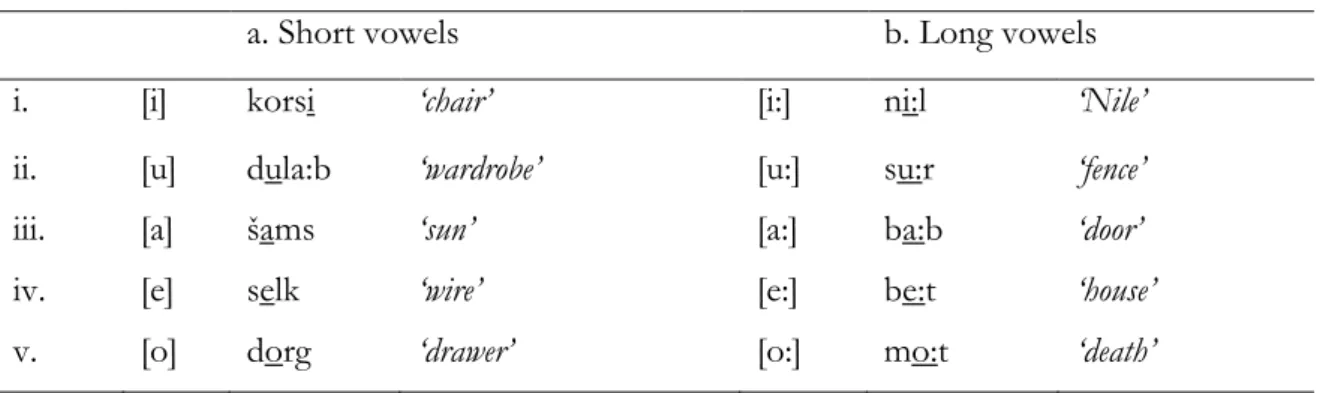
Colloquial Egyptian Arabic (from here on CEA) displays an array of surface vocalic qualities including both short and long counterparts: [i], [i:], [u], [u:], [a], [a:], [e], [e:], [o], [o:].2 This range of surface qualities is documented (underscored) in Table 1.1 and presented in Chart1.1.
Table 1.1 Surface vowel qualities
a. Short vowels b. Long vowels
i. [i] korsi ‘chair’ [i:] ni:l ‘Nile’
ii. [u] dula:b ‘wardrobe’ [u:] su:r ‘fence’
iii. [a] šams ‘sun’ [a:] ba:b ‘door’
iv. [e] selk ‘wire’ [e:] be:t ‘house’
v. [o] dorg ‘drawer’ [o:] mo:t ‘death’
Chart 1.1 The surface vowel inventory
a. Short b. Long
Front Back Front Back
High i u i: u:
Mid e o e: o:
Low a a:
2 Consonants are usually considered to be the cause of vowel’s allophonic variations other than those covered in
this and further chapters of this work. For example, Ammar and Morsi (2006) note that in [ ʕædd] ‘he counted’ and [ʕɑḍḍ] ‘he bit,’ the [æ] changes into [ɑ] because of the influence of the neighboring emphatic consonant [ḍ]. In this study, I use the notation [a] for all of the allophonic variations of /a/.
9
1.2.2 Vowel distribution
In CEA, as in all other forms of Arabic, vowels do not occur in syllable-initial position. Short vowels can be found in: a) open syllables (CV), and b) syllables closed by one or two consonants (CVC and CVCC). Long vowels, on the other hand, can exist in: a) open syllables (CVV), b) syllables closed by one consonant (CVVC), but not in syllables closed by two consonants (*CVVCC). This is recapitulated in Table 1.2.
Table 1.2 Vowel distributions within the syllable
a. Short vowels b. Long vowels
i. Open syllable CV CVV
ii. Syllable closed by one consonant CVC CVVC
iii. Syllable closed by two consonants CVCC *CVVCC
The exact distribution of syllables capable of accommodating short vowels in CEA can be identified by examining the underlined sequences in Table 1.3. In the table, two verbs suffixed with different pronominal clitics are presented; mesekt ‘I caught’ in set I and mesket ‘she caught’ in set II.
Table 1.3 Distribution of short vowels Set I: mesekt ‘I caught’
a. Syllables b. Distribution within the word Gloss
i. mesekt ‘I caught’
CV CVCC CVCC: ultimate
ii. mesektu ‘I caught him/it (MASC)’
CV CVC CV CV: ultimate and antepenultimate
iii. mesektaha ‘I caught her/it (FEM)’
CV CVC CV CV CV: penultimate
iv. mesektohom ‘I caught them’
10
Set II: mesket ‘she caught’
a. Syllables b. Distribution within the word Gloss
i. mesket ‘she caught’
CVC CVC CVC: penultimate
ii. mesketu ‘she caught him/it (MASC)’
CVC CV CV CVC: antepenultimate
iii. mesketha ‘she caught her/it (FEM)’
CVC CVC CV CVC: penultimate
iv. meskethom ‘she caught them’
CVC CVC CVC CVC: ultimate
Syllables with short nuclei are recognized in the following word positions:
1. (CV) and (CVC) exist in the ultimate, penultimate as well as the antepenultimate positions of the word.
2. (CV) exists in the preantepenultimate position. 3. (CVCC) only exists in the word-final position.
These findings can be summed up as follows:
(1.1) Short vowels in CEA can occur in any position of the word. Short vowels are freely distributed.
As for long vowels, a basic idea of their distribution can be gathered from the observation of the underlined syllables in Table 1.4. The table shows the verb mesekna ‘we caught’ affixed by different pronominal, prepositional and negative clitics.
11
Table 1.4 Distribution of long vowels mesekna ‘we caught’
a. Syllables b. Distribution within the word Gloss
i. mesekna: ‘we caught him/it (MASC)’
CV CVC CVV CVV: ultimate
ii. mesekna:ha ‘we caught her/it (FEM)’
CV CVC CVV CV CVV: penultimate
iii. meseknaha:li
CV CVC CV CVV CV CVV: penultimate
‘we caught it (FEM) for me’
iv. mamseknahali:š
CVC CVC CV CV CVVC CVVC: ultimate
‘we didn’t catch it (FEM) for me’
We therefore see that:
1. Only one long vowel can exist for a single utterance.
2. (CVV) can be found in either the final or the pre-final positions of the word. 3. (CVVC) is only found in the word-final position.
The distribution of long vowels can be stated as follows:
(1.2) Long vowels in CEA are not freely distributed. Long vowels are limited to either the ultimate or the penultimate position of the word.
12
1.2.3 The underlying vowel phonemes
The existing quantitative contrasts involving the three cardinal vowels {i, u, a}, as seen (underscored) in Table 1.5, led most investigators concerned with the makeup of the vowel system of CEA to: a) assume a contrastive role played by vowel length, and b) consider /i/, /i:/, /u/, /u:/, /a/ and /a:/ as six different vowel phonemes.3
Table 1.5 Length contrasts and the three cardinal vowels a. [u] vs. [u:]
i. [mesektu] vs. ii. [mesektu:]
‘you (PL) caught’ ‘you (PL) caught him/it (MASC)’
b. [i] vs. [i:]
i. [korsi] vs. ii. [korsi:]
‘chair’ ‘his chair’
c. [a] vs. [a:]
i. [maʕa] vs. ii. [maʕa:]
‘with’ ‘with him’
However, careful inspection of the pairs displayed in Table 1.5 leads to a curious finding:
(1.3) The only word position where a vowel length contrast can be identified is the final position.
In addition, the existence of qualitative contrasts between the long high vowels [i:], [u:] and the long mid-vowels [e:], [o:] prompted investigators to posit the latter as two more vowel phonemes in CEA. Consider the pairs displayed (underlined) in Table 1.6.
3 Studies on Egyptian Arabic include Harrell (1957), Mitchell (1956), Tomiche (1964), Broselow (1976), Yoshida
13
Table 1.6 Minimal contrasts and mid-vowels a. [i:] vs. [e:]
i. [mi:l] vs. ii. [me:l]
‘incline! Imperative (2SING.MASC)’ ‘inclination’
b. [u:] vs. [o:]
i. [mu:t] vs. ii. [mo:t]
‘die! Imperative (2SING.MASC)’ ‘death’
Short mid-vowels were, on the contrary, barred from the phonological vowel inventory due to the absence of minimal pairs opposing short [e], [o] to short [i], [u].
In view of that, the list of vowel phonemes has consistently been defined as follows: /i/, /i:/, /u/, /u:/, /a/, /a:/, /e:/, /o:/; this is seen in Chart 1.2.
Chart 1.2 The underlying vowel phonemes
a. Short b. Long
Front Back Front Back
High i u i: u:
Mid e: o:
14
1.3 Problem statement
The vowel system that has just been described is challenging in many respects. In this chapter, we will focus on only one problematic aspect of this system, that of “vowel length” and its related intriguing manifestations. In particular, the following three points will be the main object of our inquiry:
1. The limited distribution of long vowels.
2. The limited positions wherein vowel length contrasts can be established.
3. The limited range of qualities for which vowel length distinctions can be recognized.
1.3.1 Abnormal long vowel distribution
The distributional study of short and long vowels in CEA revealed some noteworthy findings; the most relevant ones are:
1. Short vowels occur in any word position.
2. Long vowels are restricted to the final and the pre-final positions of the word.
These two findings are essentially paradoxical because languages in which vowel length is presumably “distinctive” usually exhibit a free distribution of long vowels, or the distribution of long vowels at least tends to be equivalent to that of short vowels.4 The comparatively restricted distribution of long vowels with respect to short ones in CEA does not conform to the attested trends and will need to be addressed.
15
1.3.2 The limitation of vowel length contrasts to specific positions
Long vowels in CEA have been argued to exist in both the ultimate and penultimate positions of the word. If the relationship between long vowels and contrasting length is construed as in (1.4), then a vowel length contrast is expected to be recognizable in both final and pre-final positions of the word.
(1.4) Where long vowels are identified, a vowel length contrast can be established.
And yet, the minimal pairs that show quantitative vocalic distinctions reveal something else; a vowel length contrast is not identifiable but word-finally. This directly raises the question: if long vowels have been shown to exist in both final and pre-final word positions, why can a length contrast not be established in the penultimate position of the word?
In other words, what keeps the distribution of “vowel length contrasts” even more restricted than the distribution of “long vowels” themselves? Consider the lack of perfect correspondence between the
distribution of long vowels and the word positions where length contrasts can be established (Table 1.7).
Table 1.7 Lack of ideal correspondence between vowel length and contrasting length a. Long vowels b. Vowel length contrast
i. Ultimate word position + +
ii. Penultimate word position + –
As we will see in section 1.4, the purported length contrast in word-final position is a mere illusion.
16
1.3.3 The limitation of vowel length contrasts to specific qualities
A quick comparison between the surface vowel inventory and the underlying vowel phonemes reiterated in Chart 1.3 reveals the following: length contrasts exclusively hold of the set of cardinal vowels. This is due to the simple fact that short mid-vowels are absent from the phonemic level.
Chart 1.3 The surface vowel inventory vs. the underlying inventory a. Surface vowel inventory b. Underlying vowel phonemes
i, i: u, u: i, i: u, u:
e, e: o, o: e: o:
a, a: a, a:
The absence of the short mid-vowel phonemes, */e/ and */o/, raises two important questions:
1) Did the length contrast get lost in the course of the evolution of the CEA vowel system? 2) Why can a length contrast be established for cardinal vowels and not for mid-vowels? In
other words, is contrasting length “quality-dependent”?
The proliferation of these types of problems indicates the following fact: we do not know enough about vowel length in CEA. The main objective of this chapter is therefore to enhance our understanding of vowel length and to determine whether or not it is distinctive in CEA.
In order to address this query, I move away from the conventional structuralist approach, and I implement different theoretical tools, namely those that recognize a skeletal tier. The rich consequences this decision brings forth will be seen progressively as we proceed. Let us begin by raising the core question of this chapter of how distinctive vowel length is in CEA.
17
1.4 How distinctive is vowel length in Egyptian Arabic?
Assessing vowel length contrasts in CEA basically relies upon minimal pairs like those seen in Table 1.8. Let us closely examine those pairs and carefully consider each (i) form versus its (ii) correspondent.
Table 1.8 Vowel length contrast in CEA a. [u vs. u:]
i. [mesektu] vs. ii. [mesektu:]
/mesek-tu/ mesek ‘catch’ -(2SUBJ.PL)
/mesek-tu + ??/ mesek - SUBJ(2PL) + ‘it (OBJ.MASC)’
‘you (PL) caught’ ‘you (PL) caught it (.MASC)’
b. [i vs. i:]
i. [korsi] vs. ii. [korsi:]
/korsi/ korsi (noun SING.MASC)
/korsi + ??/ korsi + ‘his (POSS)’
‘chair’ ‘his chair’
c. [a vs. a:]
i. [maʕa] vs. ii. [maʕa:]
/maʕa/ maʕa (PREP)
/maʕa + ??/ maʕa + ‘him (GEN)’
‘with’ ‘with him’
In addition to the fact that a length contrast is only recognizable in ultimate word position, the pairs of words displayed above reveal another specific feature that casts great doubt on the entire list and renders it far from reliable. It is conspicuous that the series in (ii) are morphologically far more complex than those in (i). The final vowel lengthening necessarily indicates a certain morphological process that consistently involves (3SING.MASC).
18 Consequently, two important questions arise:
1) Do forms ending with final long vowels regularly involve the (3SING.MASC)?
2) What is the nature and where exactly is the concrete pronominal material signaling (3SING.MASC)?
If we return to series (ii) in Table 1.8 (a) through (c), two assumptions can be made regarding the phantomlike (3SING.MASC) pronoun (indicated by the two question marks “??” in the rough underlying structure):
1. The (3SING.MASC) morpheme is a “contentless” morpheme, an empty appendix which permits the spreading of any neighboring vowel on its left, thus yielding the lengthening effect.
2. The morpheme is present but for some reason it cannot explicitly materialize. The presence of the morpheme can only be inferred by its lengthening effect on the preceding vowel.
Here, I would like to point out that the (ii) series in Table 1.8, the forms that exhibit a final long vowel, are commonly found in free variation with forms ending in [h] like what appears in Table 1.9. The variety ending in an audible [h] is not infrequent; it is conditioned by personal stylistic factors or contextual factors like slow speech or rhetorical emphasis.
Table 1.9 Final long vowels alternating with final [h] in free variation a. Variants ending in long vowels b. Variants ending in [h] Gloss
i. [mesektu:] ~ [mesektu:h] ‘you (PL) caught it (MASC)’
ii. [korsi:] ~ [korsi:h] ‘his chair’
iii. [maʕa:] ~ [maʕa:h] ‘with him’
This would be one reason to dismiss the pairs in Table 1.8 as reliable ground for the establishment of length contrast. The final [h] in column (b) of Table 1.9 provides the first solid clue that the underlying makeup of series (ii) of Table 1.8 is very different from that of series (i).
19
If evidence for the occurrence of long vowels in final open syllables (CVV#) were mainly based upon words like those in series (ii) in Table 1.8, a simple test can disprove it. Let us take mesektu: ‘you (PL) caught it (MASC)’ as an example; further addition of suffixes to
mesektu: obligatorily activates the dormant (3SING.MASC) pronoun that finally materializes as
–hu. This test is demonstrated in Table 1.10. As pointed out in the right-hand side column in
(c) in Table 1.10 below, *mesektu:li ‘you (PL) caught it (MASC) for me’ is completely ungrammatical.
Table 1.10 mesektu: ‘you (PL) caught it (MASC)’ + l ‘to, for (PREP)’ + IOP (1SING)
a. verb + clitics b. Attested c. Expected
i. mesektu: + l + i mesektuhu:li *mesektu:li
‘you (PL) caught it (MASC)’ + for + me
ii. mesektu: + l + ha mesektuholha *mesektulha
‘you (PL) caught it (MASC)’ + for + her
Once the (3SING.MASC) morpheme is no longer found in an absolute final word position, the elided material is unmistakably recovered as hu (which alternates with ho in closed syllables).5 The underlying structures in column (b) of Table 1.11 can thus be posited for the utterances in column (a).
5 In Egyptian Arabic, high vowels undergo lowering in closed syllables. Consider the final high vowels in the imperfective tektebi ‘you (SING.FEM) write’ and tektebu ‘you (PL) write’ when they get concatenated by different
clitics (the vowels in question are underscored below).
a. b.
i. tektebi ‘you (SING.FEM) write’ tektebu ‘you (PL) write’
ii. tektebihalna ‘you (SING.FEM) write it (FEM) to us’ tektebuhalna ‘you (PL) write it (FEM) to us’
iii. tektebelha ‘you (SING.FEM) write to her’ tektebolha ‘you (PL) write to her’
20
Table 1.11 mesektu: ‘you (PL) caught it (MASC)’ /mesek-tu + hu/
a. b. Gloss
i. [mesektu: ~ mesektu:h] /mesek-tu + hu/ ‘you (PL) caught it (MASC)’
ii. [mesektuhu:li] /mesek-tu+ hu+ l + i/ ‘you (PL) caught it (MASC) for me’
iii. [mesektuholha] /mesek-tu+ hu+ l + ha/ ‘you (PL) caught it (MASC) for her’
Essentially, all long vowels in final open syllables involve (3SING.MASC). In view of this argument, a drastic consequence immediately ensues for the distribution of long vowels. If all long vowels in final open syllables (CVV#) are followed by a latent morpheme like that shown in Table 1.12, then the claim articulated in (1.5) can be put forth.
Table 1.12 Every long vowel in a final open syllable is followed by a latent /hu/ morpheme
a. b. Gloss
i. [mesektu: ~ mesektu:h] /mesek-tu + hu/ ‘you (PL) caught it (MASC)’
ii. [korsi: ~ korsi:h] /korsi+ hu/ ‘his chair’
iii. [maʕa: ~ maʕa:h] /maʕa+ hu/ ‘with him
(1.5) Long vowels in CEA are not ‘final or penultimate’; they are exclusively penultimate.
Following from all what precedes, two conclusions can be drawn:
(1.6) a. In CEA, vowel length must be conditioned b. In CEA, vowel length cannot be distinctive.
According to these conclusions, all of the previously observed problems will be resolved; namely the abnormal distribution of long vowels compared to short ones, the abnormal restrictiveness of length contrasts to a set of positions and a set of qualities.
However, if the conclusions in (1.6) are correct and if the assumption that “vowel length
is contrastive in CEA” is rejected, then how can the relationship between {i and i:}, {u and u:}, {a and a:} be interpreted? Are they just allophonic variations?
21
Providing a satisfactory answer to this question, or at least the preliminary essential keys to a satisfactory answer, is the main objective of the next section. The discussion will be pursued in order to determine the implications of the difference in “vowel length” between {i and i:}, {u and u:}, {a and a:}.
Before doing so, we will stop briefly to consider the case of Moroccan Arabic (from now on MA) that will enhance our understanding of vowel length in CEA. The case of MA will be discussed in comparison with the Classical variety of Arabic (from now on CA). First, the basic aspects of the CA and MA vowel systems will be quickly reviewed. This is followed by a detailed analysis of the CEA data which reveals some striking similarities underlying both modern dialects. This will gradually lay the ground for a redefinition of vowel length in CEA.
Note that the point is not whether or not MA or CEA have CA as an input language. Rather, the comparative examination that will be provided is primarily intended to investigate the way in which the two contemporary dialects manage their vocalic material in comparison with each other and with the Classical variety.
22
1.5 Reinterpreting vowel length in Egyptian Arabic
1.5.1 The vocalization device of Classical Arabic and Moroccan ArabicCA is well known for its three-vowel system which includes short and long cardinal vowels; this is seen in Chart 1.4 (a). If the CA vowel inventory is compared to that of MA in Chart 1.4 (b), two evident differences are revealed:
1. While a length contrast can be recognized for the three vowels {i, u, a} in CA, no clear phonetic length contrasts can be discerned for these three same vowels in MA. As a result, it does not seem possible to establish an underlying vowel length distinction in MA.
2. A fourth central high vowel ɨ which does not exist in CA appears in the MA system.
Chart 1.4 The CA and MA vowel inventories
a. CA b. MA
i, i: u, u: i
ɨ u
a, a: a
In view of these divergences, a series of important questions have repeatedly been raised:
1) MA supposedly lost one series of vowels; why does this result in a four-vowel system, not in a three-vowel system?
2) Could there be any relationship between the loss of one series of vowels and this unexpected fourth vowel?
The set of data in Table 1.13 sheds light on the issue and leads up to the generalization in (1.7).6
6 The data – initially supplied by Mohand Guerssel – is adapted from Lowenstamm (1991, 2011), Kabbaj (1990) and
23
Table 1.13 The vocalic equipment of MA compared to CA
CA MA Gloss
i. taktubu tɨktɨb ‘you (SING.MASC) write’
ii. katabna: ktɨbna ‘we wrote’
iii. ħima:r ħmar ‘donkey’
iv. kari:m krim ‘generous’
v. ba:b bab ‘door’
vi. labisu: lɨbsu ‘they put (clothes) on’
vii. muslim mɨslɨm ‘muslim’
viii. kattaba kɨttɨb ‘he made X write’
(1.7) a. Where a word is attested in both Classical and Moroccan Arabic, the latter does not realize the short vowels of the Classical Arabic version, but retains the long vowels present therein.7
b. More concretely, where CA has a short vowel, MA displays either the high central vowel ɨ or no vowel at all.
In earlier structuralist views of vowel length, it was not possible to interpret the aforementioned differences between the CA and MA vocalizations seen in Table 1.13. Vowel length was construed as an inherent property of individual segments and thus represented at the phonemic level. In this view, both vowels in e.g. MA ktɨbna ‘we wrote’ are the same
length; both are “short.” However, with the emergence of theories that distinguish a skeletal tier, length was conceived of differently. Vowel length, under the prosodic theory in e.g. McCarthy (1981) is viewed as a consequence of the number of skeletal positions to which a vocalic expression is attached; a short or a long vowel by itself is no more recognized. A short vowel is a result of the mapping of the vocalic material onto a single V slot in the
7 The generalization articulated in (1.7a) appears in Lowenstamm (1991, 2011) following previous works that have
brought forward very important aspects of the vowel systems of both Classical Arabic and Moroccan Arabic. The reader is referred to the following resources for further discussion: McCarthy (1979a, 1981), Kaye, Ech-chadli and El Ayachi (1986), Heath (1987, 2002, 2003), Kaye, Lowenstamm and Vergnaud (1990), Guerssel and Lowenstamm (1990, 1996), Kaye (1990b), Kabbaj (1990), McCarthy and Prince (1990b), Caubet (1993), El Medlaoui (1998, 2000), Arbaoui (2002), Benbraham (2004), Lampitelli (2005), Boueddine (2011), and references therein.
24
CV-skeleton whereas a long vowel is a result of linking the vocalic substance to two V skeletal positions.
(1.8) Vowel length reformulated in the prosodic theory
Within the subsequent CVCV model initiated in Lowenstamm (1996), a notable reduction of the number of the classical arboreal syllabic constituents is posited; syllable structure is reduced to CV. The model assumes a systematic alternation between non-branching
onsets and non-branching nuclei, with one-to-one correspondence between syllabic constituents
and skeletal slots. The constituent coda is excluded from the structure, or rather construed as the onset of a following CV unit. Two adjacent consonants (two Onsets) on the surface must, in this view, be separated by a phonetically empty nucleus, and an empty onset can be either straddled by a long vowel, or it can intervene between two adjacent vowels in languages allowing hiatus.8 Length is represented in this framework as a segmental expression linked to two units of the same type separated by an empty unit of a different type. A geminate results from the identification of two C units surrounding an empty V unit in-between; see (1.9b).
(1.9)
a. b.
CV- skeleton … C V C V … … C V C V …
|
Consonantal melody tier t t
[t] [tt]
8 For a detailed discussion of this model and the motivations behind its development, cf. Lowenstamm (1996) and
Scheer (2004).
a. b.
CV- skeleton …C V C … … C V V C…
|
Vocalic melody tier a a
25
Similarly, a long vowel is represented as two identified V units (two Nuclei) flanking a non-identified C unit (an empty onset); this is seen in (1.10b).
(1.10) Vowel length in the CVCV model
a. b.
CV- skeleton … C V C V … … C V C V …
|
Vocalic melody tier a a
[a] [a:]
With the availability of these theoretical resources, the difference between e.g. the CA word ħima:r vs. MA ħmar ‘donkey’ can be readily accounted for as in (1.11). Peripheral vowels are maintained if and only if two vocalic units are available. If not, delinking ensues.
(1.11)
a. Classical Arabic b. Moroccan Arabic
ħ m r ħ m r
C V C V C V C V C V C V C V C V
i a i a
ħima:r ħmar
Peripheral vowels thus never ceased to be “long” in MA. As for short peripheral vowels, they have not necessarily been lost; rather, MA lost the ability to attach short peripheral vowels to single skeletal positions, i.e. non-branching nuclei in the conventional syllabic terms. This situation is referred to in Lowenstamm (1991, 2011) as the “loss of brevity of
peripheral vowels thesis.” This thesis can be formally expressed as in (1.12) and its consequences
are specified in (1.13).9
26 (1.12) i, u and a must branch.
(1.13) a. A vowel delinks unless attached to two Vs (i.e. it is long). b. Delinking does not necessarily entail vowel loss.
c. Templatic structure is unaffected by delinking. (i.e. everything being equal, MA inherits the templatic structure of CA for the relevant items)
Delinking, as just described, entails massive proliferation of consonantal sequences in MA. CA taktubu ‘you (SING.MASC) write’ for example will yield *tktb in MA, as sketched out in (1.14). (1.14) CA t a k t u b u C V C V C V C V delinked material a u u MA t k t b CA taktubu vs. hypothetical MA *tktb
However, the actual form is tɨktɨb, some consonant sequences are allowed while others
are broken in well-determined points; the high central vowel ɨ appears to the left of empty nuclei. Clearly, the intervention of vowel ɨ is purely phonotactic. The alternation {ɨ/empty nucleus} reflects the economy of MA’s epenthetic system (Kaye, 1990b). According to the postulates of standard Government Phonology developed in Kaye, Lowenstamm and Vergnaud (1990), government is defined as a binary asymmetric relation between two skeletal positions, one of which is the governor while the other is the governee. Good governors must have phonetic content.10 A nuclear position is said to be licensed to remain empty if it is properly governed (PG). In other words, an empty nucleus always requires government from the following contentful one; otherwise, epenthetic material is inserted. This situation is
10 The reader is referred to Kaye (1990b), Kaye, Lowenstamm and Vergnaud (1990), Charette (1990), Yoshida (1990,
27
expressed under the Empty Category Principle (ECP) in Kaye, Lowenstamm and Vergnaud (1990) as follows:
(1.15) Empty skeleton positions are subject to a special form of government, they must be properly governed.
The ECP accounts for the vowel/zero alternations in MA, i.e. the alternations {ɨ/empty nucleus} where the zero variant appears under proper government. An empty nuclear position (a V skeletal slot) is licensed if and only if properly governed. Consequently, if one nucleus can supposedly govern another and the direction of government is defined from right to left, it will be possible to characterize the contexts in which an empty nucleus is or is not realized phonetically; this is illustrated in (1.16). Note that proper government (PG) is hereafter indicated by non-interrupted lines and lack of proper government (*PG) is indicated by interrupted lines.
(1.16) MA tɨktɨb and the distribution of vowel ɨ
t k t b C V C V C V C V epenthetic material Epen. ɨ *PG Epen. ɨ *PG delinked material a u u [tɨktɨb]
As a result and in terms of templatic space, the two vowels in the MA ktɨbna will be of
different lengths. Consider in this view the comparative analysis between CA katabna: and MA ktɨbna ‘we wrote’ demonstrated in (1.17). The peripheral vowel a in MA ktɨbna is a
vocalic expression occupying two nuclear positions while the high central vowel ɨ identifies a single V position.
28 (1.17) CA k a t a b n a C V C V C V C V C V MA k t b n a epenthetic material ɨ delinked material a a CA katabna: vs. MA ktɨbna
1.5.2 The vocalization device of Egyptian Arabic
Now once the selected piece of CEA data in Table 1.14 is carefully examined, it is strikingly reminiscent of the case of MA. Specifically, {i, u, a} vowels in CEA correspond exactly to CA long ones of similar qualities. This is in stark contrast to CA short vowels that alternate in CEA either with the vowel e or with nothing at all, i.e. {e/empty nucleus}. This generalization is of course not meant to describe every single instance, but rather the words that are present in both languages.
Table 1.14 The CEA vocalization compared to CA
a. CA b. CEA Gloss
i. labisu: lebsu ‘they put (clothes) on’
ii. kaburna: keberna ‘we grew up’
iii. ʔuktubi: ʔektebi ‘write! Imperative (2SING.FEM)’
iv. taktubu tekteb ‘you (SING.MASC) write’
v. ʔaswad ʔeswed ‘black’
vi. laʕib leʕb ‘playing (verbal noun)’
vii. ħulm ħelm ‘dream’
viii. ka:bu:s kabu:s ‘nightmare’
ix. du:la:b dula:b ‘wardrobe’
29
The comparative analyses of CA taktubu vs. CEA tekteb ‘you (SING.MASC) write’ and CA
labisu: vs. CEA lebsu ‘they put (clothes) on’ reveal a clear case of the dissociation of short
{i, u, a} vowels in the modern Egyptian variety. That is, {i, u, a} vowels delink if they are not attached to two V positions; this is illustrated in (1.18).
(1.18)
a. b.
CA t a k t u b u l a b i s u
C V C V C V C V C V C V C V C V
CEA t e k t e b l e b s u
CA taktubu vs. CEA tekteb CA labisu: vs. CEA lebsu
The representations above point to the following facts:
1. CA peripheral vowels are not manifested in the CEA parallel forms unless they branch. 2. Non-branching vowels are systematically substituted in CEA by e or by nothing at all. 3. The distribution of vowel e (to the left of empty nuclei) is government-dependent.
Accordingly, the following principle can be identified as one of the keys for understanding the CEA system:
30 The result can be represented as follows:
(1.20)
a. b.
C V C V C V
/i, u, a/ /i, u, a/
[i, u, a] [e, nothing]
At this point, the careful reader will notice an apparent paradox. On the one hand, I claim that {i, u, a} vowels are long; everything being equal, this should mean “equally long.” On the other hand, we saw that some {i, u, a} vowels are longer than others. A glance at the forms in column (b) of Table 1.15, particularly at the underscored u vowels, illustrates this peculiarity.
Table 1.15 Branching vowels in CEA and differential phonetic length
a. CA b. CEA Gloss
i. labisu: lebsu ‘they put (clothes) on’
ii. ka:bu:s kabu:s ‘nightmare’
iii. du:la:b dula:b ‘wardrobe’
Consider the structural representation of these three cases, given in (1.21), with special attention to the boldface type u’s, and their respective templates (underscored).
(1.21)
a.
CA l a b i s u
C V C V C V C V CEA l e b s u
31
b.
CA k a b u s
C V C V C V C V C V CEA k a b u s
CA ka:bu:s vs. CEA kabu:s
c.
CA d u l a b
C V C V C V C V C V CEA d u l a b
CA du:la:b vs. CEA dula:b
The problem can be stated as follows:
1. All of the three u vowels in CEA correspond to long ones in CA.
2. The two templatic V slots permit the explicit expression of the three u vowels in CEA, i.e. they are all phonologically long.
3. Although all are similarly branching, the u in CEA kabu:s compared to those in lebsu and
dula:b is phonetically much longer.
4. Although similarly branching, u and a in CEA kabu:s and dula:b (see 1.21b and c) exhibit different phonetic length.
Two questions ensue:
1) Why do the three u vowels in CEA kabu:s, lebsu and dula:b not exhibit identical phonetic length although they are endowed (per hypothesis) with identical phonological length? 2) Why does u not exhibit the same phonetic length as a, as in CEA kabu:s and dula:b,
32
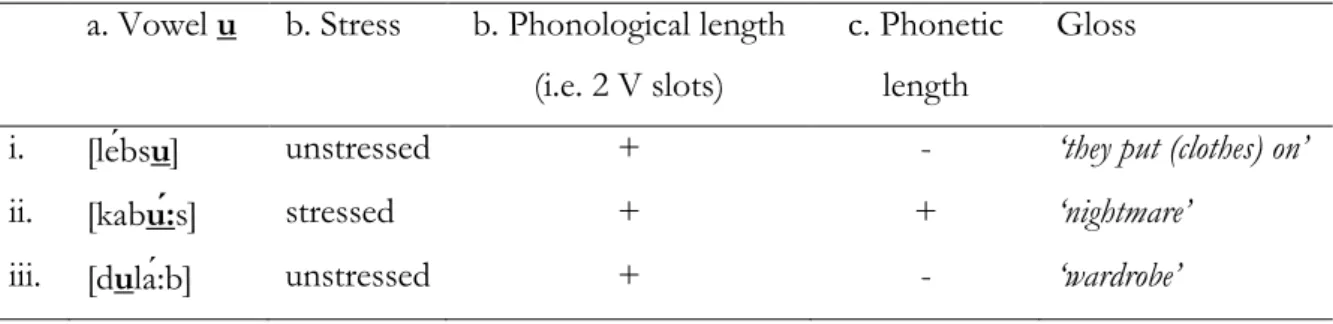
The answer to these two questions will immediately follow once the “stress position” in the utterances under investigation is considered. When the workings of stress are understood, we can determine why the u in kabú:s displays “phonetic length” contrary to the u in lébsu and dulá:b in CEA. The u in kabú:s is simply “stressed” differently from the other two; consider Table 1.16.
Table 1.16 Branching vowels in CEA and differential phonetic length due to stress a. Vowel u b. Stress b. Phonological length
(i.e. 2 V slots)
c. Phonetic length
Gloss
i. [lébsu] unstressed + - ‘they put (clothes) on’
ii. [kabú:s] stressed + + ‘nightmare’
iii. [dulá:b] unstressed + - ‘wardrobe’
Likewise, when the CEA kabú:s and dulá:b are considered, it becomes obvious that the vowel perceived as phonetically longer than the other is the one under stress.
This result is documented under (1.22) and formally expressed afterward in (1.23).
(1.22) “Stress” phonetically validates the length of an already “phonologically long” vowel.
(1.23)
a. b. c.
C V C V C V C V C V C V
i u a
[i, í:] [u, ú:] [a, á:]
Phonological length, phonetic duration and the influence of stress are discussed in detail in chapter 5, section 5.3.
33 To conclude:
1. In CEA, {i, u, a} vowels must branch in order to overtly surface.
2. Non-branching {i, u, a} dissociate and the corresponding templatic nuclear position either remains unidentified or is phonetically interpreted by means of {e}.
3. Only under stress is a phonologically long {i, u, a} vowel realized with explicit phonetic length. All of the following vowels [i, í:], [u, ú:], [a, á:] exhibit identical phonological length; their
phonetic length differs according to whether or not they bear stress.
It seems, for the first time, quite possible to characterize vowel length in CEA in terms other than as “an inherent property of vowels.” According to a vowel’s surface quality, the number of templatic nuclear positions to which it is attached can be inferred.
In light of the afore-stated conclusions, one last yet important issue will require to be addressed, that is the dissociated vocalic material. The loss of brevity thesis implies a proliferation of unrealized vowels, the ones that are phonetically interpreted as [Ø] or [e] in CEA.11 If delinked vowels are present on the phonological level, the question that naturally follows is whether this phonetically unrealized material can be detected. In the remaining part of this chapter, I will present two cases that show concrete evidence of this “covert” material. First, final empty nuclei in CEA are brought into discussion to illustrate how a delinked vowel can be inferred by its impact on neighboring ones. Then a brief consideration of the singular feminine nominal marker, where a dissociated latent vowel can be completely recovered, is provided.
34
1.5.3 What final vowels can reveal
The status of final vowels in CEA can be accurately illustrated by means of the subject inflectional morphemes appearing on verbs in the perfective aspect. Consider the representative piece of data in Table 1.17.
Table 1.17 CA labis- /CEA lebes- √lbs ‘put (clothes) on’ perfective paradigm
CA CEA
i. 1PL labisna: lebesna
ii. 1SING labistu lebest
iii. 3SING.FEM labisat lebset
Factoring out the perfective stems CA labis- and CEA lebes- in Table 1.17, the following inflectional endings can be established:
Table 1.18 Subject inflectional morphemes
CA CEA
i. 1PL – na: – na
ii. 1SING – tu – t
iii. 3SING.FEM – at – et
Consideration of the above inflectional suffixes leads to the following outcome:
(1.24) a. 1PL b. 1SING c. 3SING.FEM CA n a t u a t C V– C V C V C V– C V C– V C V CEA n a t e t delinked material u a
35
As we saw in the preceding section, the above result can be expressed as follows:
(1.25)
a. b.
C V C V # C V #
/i, u, a/ /i, u, a/
[i, u, a] [ ]
The above representations make it fundamental to distinguish the phonetic emptiness resulting from the two situations illustrated in (1.26). Naturally, both are phonetically actualized as “nothing” or “silent,” yet there is a significant difference in their behavior.
(1.26)
a. b.
C V # C V #
/i, u, a/ / /
[ ] [ ]
Let us once more consider the relevant inflectional suffixes, more precisely what looks like a “final closed syllable.”
(1.27)
a. 1SING b. 3SING.FEM
CA t u a t
C V– C V C V– C V
CEA t e t
36
Two categorical distinctions can be established for final closed syllables in CEA:
1. Closed syllables followed by silent nuclei emptied from their phonetic vocalic content (i.e. a nuclear vacuity resulting from delinking); this is exemplified by the underlined V in (1.27a). 2. Closed syllables followed by empty nuclei that never had any vocalic content in the first
place, neither in CA nor in CEA; this is exemplified by the underlined V in (1.27b).
The contrast depicted in (1.27) indicates that not all final “phonetically silent” nuclei in CEA necessarily stem from “phonologically contentless” ones. This distinction can be further specified as follows:
1. Some final consonants can be reanalyzed as onsets of virtually open syllables. 2. Some final consonants are onsets of empty nuclei.
An important piece of evidence that stands in support of this asymmetry is vowel e intervening between the verbal stem and the feminine marker in CEA lebs-et ‘she put (clothes) on,’ contrary to its absence in the case of (1SING) in CEA lebes-t ‘I put (clothes) on.’ According to Government Phonology, this divergence automatically results from the ECP:
(1.28) a. b. l b s t l b s t C V1 C V2 C – V3 C V4 C V1 C V2 C – V3 C V4 /v/ / / PG e *PG lebes t lebset
The emptiness of the vocalic position separating the verbal stem -lebes- and the morpheme –t in (1.28a) indicates a perfect condition of well-formedness. The unbreakable {…s-t} sequence suggests a dormant governor occupying V4 (underscored). If the latter V position was phonologically empty, the {…s-t} sequence would have been split up by
37
epenthetic material to repair two empty nuclei occurring in a row, hence {…set}. This is exactly what happens in (1.28b). The phonetic interpretation of V3 as e in lebs-et indicates the absence of any governor and therefore witnesses the true emptiness of the nuclear position on its right.
Thus, two important conclusions can be drawn:
1. In CEA, not all final vocalic positions projected as “zero” on the surface are structurally dead (i.e. phonologically empty).
2. CEA presents two types of final governors:
a. Governors that enjoy explicit phonetic and phonological content (i.e. conventional governors); let us call them Governor Type 1. This type of governors is exemplified by the final a in lebesna ‘we put (clothes) on’; see (1.29a).
b. Governors that were evacuated from their concrete phonetic vocalic content (v in 1.29b). These governors involve a latent, yet structurally active nucleus. They are exemplified by the final silent nucleus in lebest ‘I put (clothes) on’ where two empty nuclei “appear” to occur in a row. We will call them Governor Type 2.
c. In CEA, there is a category of final nuclei that can be characterized as both phonologically and phonetically “contentless.” This type is exemplified by the final empty nucleus in lebset ‘she put (clothes) on.’ These nuclei are not governors; see (1.29c).
(1.29)
a. Governors Type 1 b. Governors Type 2 c. Non-governors C V1 C V2 # C V1 C V2 # C V1 C V2 #
/V/ /v/ / /
PG PG *PG
Epenthesis: not required Epenthesis: required