OATAO is an open access repository that collects the work of Toulouse
researchers and makes it freely available over the web where possible
Any correspondence concerning this service should be sent
to the repository administrator:
[email protected]
This is an author’s version published in:
http://oatao.univ-toulouse.fr/23962
To cite this version:
Simon, Valérie
and Moreau, Lucile
and Romdhana, Mohamed Hédi
and
Sablayrolles, Caroline
and Vignoles-Montrejaud, Mireille
and Lecomte,
Didier Emissions of Polycyclic Aromatic Hydrocarbon Particulates from
combustion of different fuels. (2012) Fresenius Environmental Bulletin, 21 (4a).
946-955. ISSN 1610-2304
EMISSIONS OF POLYCYCLIC AROMATIC HYDROCARBON
PARTICULATES FROM COMBUSTION OF DIFFERENT FUELS
Valérie Simon1,2*, Lucile Moreau1,2, Mohamed Hédi Romdhana1,2,3, Caroline Sablayrolles1,2, Mireille Montréjaud-Vignoles1,2 and Didier Lecomte3
1 Université de Toulouse, INPT, LCA (Laboratoire de Chimie Agro-Industrielle), ENSIACET, 4 Allée Emile Monso, 31030 Toulouse, France 2 INRA; LCA (Laboratoire de Chimie Agro-Industrielle), 31030 Toulouse, France
3 Université de Toulouse, MINES ALBI, RAPSODEE UMR CNRS 2392, 81013 Albi, France
ABSTRACT
The use of biomass as fuel for combustion allows par-tial replacement of fossil fuels and the reduction of fossil carbon dioxide emissions. Nevertheless, combustion of bio-mass waste may generate toxic pollutants such as Poly-cyclic Aromatic Hydrocarbons (PAHs) whose production is related to the combustion temperature, oxygen consump-tion and origin of the biomass fuel.
In the present study, experimental protocols for bio-mass combustion and analytical quantification of PAHs were carried out. Six types of fuel were burned in a tubu-lar reactor: two bio-solids dried differently (air drying and fry drying), oil-shale, used cooking oil (for recycling) and two types of woody biomass (oak and beech). The com-bustion tests were performed at 850°C with fixed bed samples weighing about 1 g. The identification and quan-tification of PAHs in the particulate phase were performed by ultrasonic extraction followed by high-resolution gas chromatography coupled to low-resolution mass spectro-metry. The 16 main EPA-classified PAHs have been identi-fied. The results show that emissions of fry-dried sludge are approximately 5000 µg g-1, thus 10 times greater than those
of wood and 10 times lower than those of used cooking oils. Toxicity of the particulate phase was essentially due to benzo(a)pyrene and benzo(b)fluoranthene.
KEYWORDS: PAHs, emissions, Fry-dried sludge, Air-dried
sludge, Woody biomass, Oil shale
1. INTRODUCTION
Biomass combustion is a very important processing operation as it gives a large volume reduction and recov-ery of energy, and should thus be considered for destruc-tion of toxic biomass such as wastewater treatment plant by-products. However combustion, while once regarded as an effective solution, is now facing environmental prob-lems due to stricter air pollution standards, especially par-ticulate and gaseous emissions.
* Corresponding author
According to the European Council Directive 96/62/EC, European Union Member States must establish limit values for incineration emissions. Moreover, Directive 2000/76/EC requires limitation of the effects of waste incineration and co-incineration on the environment, in particular emis-sions to air, soil, surface water and groundwater with the resulting risks to human health.
Ash, carbon dioxide and water are the major combustion effluents. Other compounds such as sulfur oxides (SOx),
nitrogen oxides (NOx), heavy metals, chlorinated
hydrocar-bons (dioxins and furans), volatile organic compounds and polycyclic aromatic hydrocarbons (PAHs) are produced in smaller quantities but are more dangerous in terms of en-vironmental impact and human health [1-5]. Polycyclic aromatic hydrocarbons (PAHs) consist of two or more fused benzene rings, and most of them are semi-volatile and highly carcinogenic and mutagenic [6-11]. The atmos-pheric PAHs are gas phase partitioned and adsorbed to particulate matter according to their vapour pressure and atmospheric conditions [12]. Low molecular weight PAHs tend to be more concentrated in the gaseous phase, while those with higher molecular weights are often associated with particulates, and the PAHs recognized as carcinogenic are also mostly found with particulate matter. The forma-tion of organic hydrocarbons during incineraforma-tion is af-fected by many operating parameters such as type of fuel [13-16], but also combustion temperature, waste composi-tion, flow rate and composition of feed gas [5, 17-20]. Cer-tain studies have shown that PAH emissions are at a maximum between 800°C and 1000°C for wood [21] and for acrylic waste [22], whereas a drop in emissions between 500 and 800°C has been observed during the incineration of wastewater treatment plant sludges [23]. An increase in the concentration of oxygen in the feed gas results, in the case of wastewater treatment plant sludges, in an increase in PAH emissions at temperatures between 500°C and 800°C [23]. For coal combustion, an excess of at least 10% oxygen decreases particulate PAH emissions to almost zero, whereas emission of particles increases with 5 to 40% excess oxygen [15]. The flow of air through the combustion oven is also important. Incineration with a low airflow for temperatures between 700-800°C and with a higher flow for temperatures between 900-1000°C
favours a decrease in PAH emissions [19, 24]. The bustion mode also has an impact. In fluidized bed com-bustion, bed material mixes well with air, and its combus-tion flame is different from that of a fixed bed. For low temperature fixed bed combustion, PAHs are formed through pyrolysis, however, at high temperatures, PAHs are formed from precursors [25].
In order to make further reductions in PAH polluted emissions the council directive 2004/107/EC sets target values for concentrations of benzo(a)pyrene (1 ng m-3)
used as a tracer for the PAH carcinogenic risk. Generally, PAHs are produced during incomplete burning or pyroly-sis at high temperatures [17, 26].
Some chemical reactions may result in the formation of PAHs, such as cyclization reactions of alkyl groups and the polymerization reactions following a condensation reaction [26]. Because of their ubiquity in the environ-ment, PAHs are found in various materials such as fossil fuels, and also in industrial biomass such as sludge from wastewater treatment plants [16, 27].
To obtain reliable data on the composition and con-centrations of PAHs in particulate matter, versatile ana-lytical methods are necessary for efficient sample proc-essing and for subsequent chemical analyses. Traditional methods of sample preparation for the determination of particulate-bound PAHs include Soxhlet extraction, soni-cation, microwave-assisted extraction (MAE) or pressur-ized liquid extraction (PLE) [28-33]. For the analysis step, GC-MS and HPLC-fluorescence detection has been found to be the best for the determination of PAHs in environ-mental samples [29, 33, 34].
Various studies have sought to develop combustion experiments in order to analyze PAH emissions for differ-ent fuels, such as forest and agricultural biomass [14], wood [21], coal [15, 19, 26], urban solid waste [20, 35], sewage sludge [36], oily sludge [37], plastic waste espe-cially polyethylene [37] and acrylic polymer [22, 24].
Emissions data for PAHs is necessary to inventory fuel burn, in order to create life cycle assessment of the combustion process. However, there is still very little information regarding the PAH emissions for dry-biomass
combustion. This is the context of the present study, to measure the PAH concentrations in combustion of air-dried (ADS) and fry-air-dried sludge (FDS) obtained from a pulp and paper manufacturing unit, particularly focussing on the comparison of these emissions with various other biomass burned under the same conditions.
2. MATERIALS AND METHODS
2.1. Chemicals and standards
A standard mix containing naphthalene (NAP), ace-naphtylene (ACY), acenaphtene (ACE), fluorene (FLR), phenanthrene (PHE), anthracene (ANT), fluoranthene (FTN), pyrene (PYR), benzo(a)anthracene (B(a)A), chry-sene (CHRYS), benzo(b)fluoranthene (B(b)F), benzo(k)-fluoranthene (B(k)F), benzo(a)pyrene (B(a)P), dibenzo-(a,h)anthracene (D(ah)A), benzo(g,h,i)perylene (B(ghi)P) and indeno(c,d)pyrene (IND) at 100 µg mL-1 of metha-nol:dichloromethane (1:1, v:v) was used for calibration (M-610 Accustandard, New Haven, CT, USA).
Deuterated PAHs were used as extraction standards (anthracene d-10 and benzo(a)pyrene d-12 at 300 µg mL-1
of acetonitrile) and as an internal standard (fluoranthene d-10 at 300 µg.mL-1 of acetonitrile) (Supelco, France).
Anthracene d-10 was chosen as a reference for the light PAH fraction (NAP to PYR) and benzo(a)pyrene d-12 for the heavy PAH fraction (B(a)A to B(ghi)P).
All solvents are for residue analysis (>99.8% GC; Fluka).
2.2. Fuel sampling
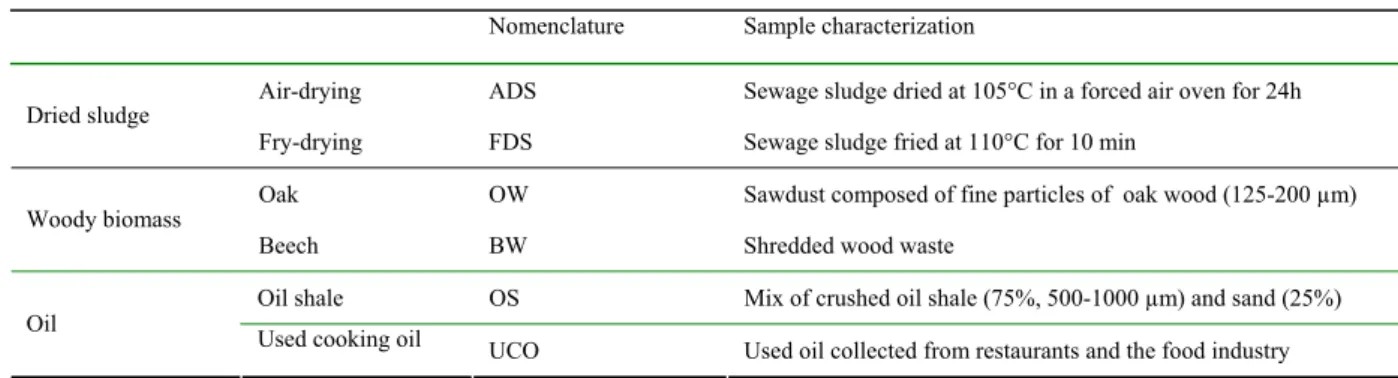
The fuel samples used are shown in Table 1. The dried biomass, consisting of sewage sludge produced from paper pulp manufacturing, was dried in two different ways: con-ventional air-drying and a fry-drying process. The air-dried sludge is obtained by drying the sample 24 h at 105°C in a forced air oven. The fry-dried sludge is prepared by im-mersing the sample in an electric fryer with used cooking oil [38]. The oil temperature was set at 110°C. Residence time of the sewage sludge in the fryer was 10 min. After treatment, the sludge was stored at -18°C.
TABLE 1 - Characterization of the fuels samples.
Nomenclature Sample characterization
Air-drying ADS Sewage sludge dried at 105°C in a forced air oven for 24h Dried sludge
Fry-drying FDS Sewage sludge fried at 110°C for 10 min
Oak OW Sawdust composed of fine particles of oak wood (125-200 µm) Woody biomass
Beech BW Shredded wood waste
Oil shale OS Mix of crushed oil shale (75%, 500-1000 µm) and sand (25%) Oil Used cooking oil
TABLE 2 - C, H, O, N, S, ash, LHV, HHV analysis of fuel samples ADS FDS UCO OS BW OW N* 1.8 ± 0.5 0.7 ± 0.3 0.2 ± 0.2 0.3 ± 0.1 0.3 ± 0.1 0.4 ± 0.1 C* 18.7 ± 2.9 51.4 ± 0.5 77.4 ± 0.4 15.7 ± 1.4 45.8 ± 0.2 44.6 ± 0.2 H* 1.7 ± 0.2 6.5 ± 0.6 12.3 ± 0.3 1.6 ± 0.1 5.9 ± 0.1 5.8 ± 0.2 S* ≤ 0.01 ≤ 0.01 ≤ 0.01 1.9 ± 0.5 ≤ 0.01 ≤ 0.01 O* 22.9 ± 2.6 15.9 ± 0.7 10.2 ± 0.7 19.5 ± 1.5 46.2 ± 0.2 48 ± 0.5 Ash* 54.8 ± 0.1 25.6 ± 1.5 0.6 ± 0.6 62.7 ± 0.1 1.7 ± 0.6 1.2 ± 0.4 HHV** 8.1 ± 0.1 27.0 ± 0.7 41.2 ± 0.1 7.9 ± 0.7 24.3 ± 0.1 23.6 ± 0.4 LHV** 7.7 ± 0.1 25.6 ± 0.6 37.7 ± 0.1 7.6 ± 0.6 22.9 ± 0.1 22.4 ± 0.3 * % (dry basis), ** MJ/kg (dry basis)
In order to compare the results obtained with these dried sludges, the experiments were also conducted with currently available fuels from different sources: woody biomass (oak and beech), oil shale and used cooking oil.
2.3. Chemical characterization
The fuel samples were analyzed by standard elemen-tal and proximate analysis. The ultimate analysis gives the elemental (C, H, N, and S) compositions of the total solid matter using a self-integrated and microprocessor con-trolled elemental analyzer (model: NA 2100 Protein, CE Instruments). The oxygen content is calculated as the complement to 100 of the sum of carbon hydrogen, nitro-gen, sulfur and ash, as in equation 1. Table 2 shows the ultimate analysis of the samples used in this study.
])
Ash
[
]
S
[
]
N
[
]
H
[
]
C
([
100
]
O
[
=
−
+
+
+
+
(1)The proximate analysis is described by the ash con-tent in a sample [Ash]. The ash concon-tent is the residue that remains after combustion at 850°C.
The Lower Heating Value of the fuel samples (LHV) is experimentally measured using the elemental analyzer. The Higher Heating Value (HHV) is calculated from the Lower Heating Values according to equation 2.
v
H
]
H
[
2
18
LHV
HHV
=
+
∆
(2)where ∆Hv is the latent heat of vaporization.
The results of these analyses (C, H, O, N, S, ash, LHV and HHV) are shown in Table 2 and are the average of three experiments.
2.4. Experimental combustion protocol
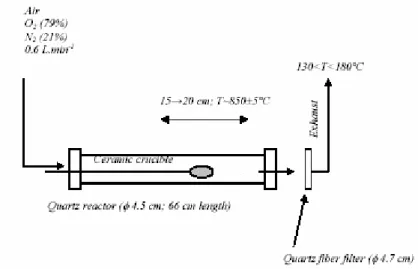
An experimental device was developed to enable combustion of each fuel sample and sampling of the par-ticulate fraction in the flue gas (Figure 1). The horizontal tubular reactor was used to perform combustion. It con-sists of a horizontal quartz reactor of 4.5 cm diameter and 66 cm long, heated by electrical resistances placed in refractory fibers. The sample of fuel is fed in batch using a sliding tube at the input of the reactor, and fuel samples are placed in a fused ceramic crucible fixed to this sliding tube. Combustion air is drawn from a bottle of synthetic air and passed continuously through the reactor at a pres-sure slightly above atmospheric prespres-sure. Total airflow is 0.6 L min-1.
The reactor is heated to a temperature of 850°C, the recommended temperature for the total destruction of sludge organic matter [39] under constant airflow to re-move the by-products of combustion. During operation, the tubular reactor has a hot isothermal over a length of 15 to 20 cm. The residence time of flue gas in the hot zone is greater than 2 s and is therefore in agreement with values required by Directive 89/369/EEC for which gases from combustion are heated to a temperature of at least 850°C in the presence of at least 6% oxygen.
Samples of 1 g of fuel in the form of a thin layer (2-3 mm) were placed in the crucible. The temperature in the vicinity of the sample was measured by K-type thermo-couple (850±5°C), and the time lag between the introduc-tion of the sample and combusintroduc-tion self-igniintroduc-tion is a few seconds.
In order to cut down external contamination, all de-vices were carefully cleaned. Glassware (Petri dish, test tube, quartz tube, etc…), the pliers and the ceramic cruci-ble were washed with ether (to eliminate all residual hy-drocarbons). Finally, the devices were washed with a spe-cial alkaline soap (labwash), and then rinsed with water, deionized water, acetone and dichloromethane.
2.5. Sample collection and analysis
The emitted particulates were collected on quartz fiber filters (diameter 47 cm, Schleicher & Schuell) at a flow rate of 0.6 L min-1. Prior to sampling, filters were kiln-fired at
500°C overnight. Then, the dishes were wrapped in alu-minium foil and stored in a dessicator.Laboratory blanks were used for correcting possible contamination from the quartz tube, solvents and storage, for every experimental set. PAH extractions were made within two days. Extrac-tions of blank filters showed no PAH contamination above the quantification limits.
After sampling, a deuterated PAH solution was added on the filters. PAHs eluting between naphthalene and pyrene (low PAHs) were corrected by anthracene-d10 and com-pounds eluting between benzo(a)anthracene and benzo(ghi)-perylene (heavy PAHs) by benzo(a)pyrene-d12.
The particulates on the filter were extracted at 25°C for 1h with dichloromethane in an ultrasonic bath. The extract was concentrated to 1 mL by evaporation under ni-trogen flow. Finally, a fluoranthene-d12 solution was added to each sample in micro test tubes which were hermeti-cally sealed and stored at -28°C until analysis. Fluoran-thene-d12 was used as internal standard.
Analyses were performed by High Resolution Gas Chromatography (Agilent 6890 Serie GC System) cou-pled with a Low Resolution Mass Spectrometer (Agilent 5973 Network Mass selective detector) provided with a chromatographic column DB5 MS (30 m × 0.25 mm ×
0.30 µm thickness) (J&W Scientific). Chromatographic conditions were as follows : injector temperature 300°C; injection in splitless mode (1 min); thermal program: 5 min at 100°C, ramp 20°C.min-1 up to 180°C (3 min), ramp
15°C.min-1 up to 260°C (5 min), ramp 10°C.min1 up to
300°C (10 min); carrier gas helium, 1.4 mL.min-1,
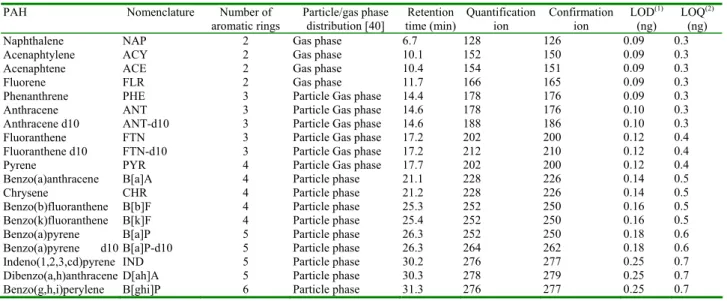
injec-tion volume 0.5 µL, temperature transfer line 300°C. The chromatogram was obtained in the Selected Ion Monitor-ing (SIM) mode from characteristics shown in Table 3.
To study the repeatability of the analysis, a standard solution containing PAH concentrations (1 µg mL-1) was
injected 10 times. The relative standard deviation deter-mined for each PAH (from 4% for ACE to 9% for PHE) is less than 10%. The reproducibility and the PAH recov-ery have been evaluated using the different experiments shown in Table 4. The reproducibility concerning the total PAH concentrations ranged between 16% and 38% for oak and fry-drying respectively; recoveries ranged from 78% for the low molecular weight PAHs to 85% for those with high molecular weight.
The internal standard quantification method was per-formed for each compound for the 0-100 µg mL-1 linear
domain. The analytical quantification limits (S/N=10) for individual PAH compounds were between 0.3-0.7 ng (Table 3). Limits of quantification for the emission rates are between 0.6 and 1.4 µg g-1 for all fuels except
fry-dried sludge and used cooking oils (1.8-4.2 µg g-1).
2.6. Emission rates
The emission rate
τ
PAH expresses the ratio between the mass of PAHs collected on the filter and the total fuel mass. It is calculated according to relationship 3.[
]
p i c f PAH m m m PAH ρ = τ (3)where, mi is the mass of dichloromethane used for
ex-traction by ultrasound, mp is the mass of a sample taken
for concentration, mc is the mass of extract obtained after
concentration, ρ is the density of dichloromethane and [PAH] is the concentration of final extract obtained by chromatographic analysis (µg mL-1).
3. RESULTS AND DISCUSSION
The total emissions of PAHs (particulate phase) vary depending on the fuel sample (Table 4). The emission rate varies between 123 and 45455 µg g-1 for air-dried sludge
and used cooking oils respectively. Emission from fry-dried sludge is in the region of 5000 µg g-1 thus 10 times
higher than those for wood and 10 times lower than those for oils.
TABLE 3 - Nomenclature, number of aromatic rings, retention time, m/z of specific fragments used in SIM data acquisition mode, limit of detection(1), limit of quantification(2).
PAH Nomenclature Number of
aromatic rings Particle/gas phase distribution [40] time (min)Retention Quantification ion Confirmation ion LOD (1) (ng) LOQ (2) (ng) Naphthalene Acenaphtylene Acenaphtene Fluorene Phenanthrene Anthracene Anthracene d10 Fluoranthene Fluoranthene d10 Pyrene Benzo(a)anthracene Chrysene Benzo(b)fluoranthene Benzo(k)fluoranthene Benzo(a)pyrene Benzo(a)pyrene d10 Indeno(1,2,3,cd)pyrene Dibenzo(a,h)anthracene Benzo(g,h,i)perylene NAP ACY ACE FLR PHE ANT ANT-d10 FTN FTN-d10 PYR B[a]A CHR B[b]F B[k]F B[a]P B[a]P-d10 IND D[ah]A B[ghi]P 2 2 2 2 3 3 3 3 3 4 4 4 4 4 5 5 5 5 6 Gas phase Gas phase Gas phase Gas phase Particle Gas phase Particle Gas phase Particle Gas phase Particle Gas phase Particle Gas phase Particle Gas phase Particle phase Particle phase Particle phase Particle phase Particle phase Particle phase Particle phase Particle phase Particle phase 6.7 10.1 10.4 11.7 14.4 14.6 14.6 17.2 17.2 17.7 21.1 21.2 25.3 25.4 26.3 26.3 30.2 30.3 31.3 128 152 154 166 178 178 188 202 212 202 228 228 252 252 252 264 276 278 276 126 150 151 165 176 176 186 200 210 200 226 226 250 250 250 262 277 279 277 0.09 0.09 0.09 0.09 0.09 0.10 0.10 0.12 0.12 0.12 0.14 0.14 0.16 0.16 0.18 0.18 0.25 0.25 0.25 0.3 0.3 0.3 0.3 0.3 0.3 0.3 0.4 0.4 0.4 0.5 0.5 0.5 0.5 0.6 0.6 0.7 0.7 0.7
TABLE 4 - PAH particulate emission rates (µg g-1) of dried sludge, woody biomass, used cooking oil and oil shale
Used cooking oil (UCO)
Fry-drying (FDS)
Air-drying (ADS)
Oak (OW) Beech (BW) Oil Shale (OS)
n 5 8 5 5 5 5 Naphtalene 22967 ± 7754 1758 ± 448 3.8 ± 0.8 129 ± 75.3 15.4 ± 3.1 14.9 ± 6.7 Acenaphtylene 529 ± 200 80 ± 18 1.1 ± 0.2 14.8 ± 3.9 16.2 ± 3.2 6.3 ± 4.2 Acenaphtene 395 ± 128 62 ± 17 3.3 ± 0.7 30.8 ± 13.2 32.8 ± 6.6 19.1 ± 8.6 Fluorene 945 ± 396 142 ± 42 3.5 ± 0.7 57.5 ± 20.6 51.0 ± 10.2 3.4 ± 1.6 Phenanthrene 5661 ± 2433 782 ± 174 4.4 ± 0.9 71.1 ± 17 68.5 ± 13.7 72.1 ± 33.0 Anthracene 1525 ± 702 335 ± 137 46.2 ± 9.2 127.4 ± 53.2 61.3 ± 12.3 54.3 ± 23.4 Fluoranthene 3005 ± 1305 516 ± 73 18.4 ± 3.7 46.4 ± 10.6 45.9 ± 9.2 48.0 ± 10.6 Pyrene 2786 ± 1169 495 ± 70 25.8 ± 5.2 54.3 ± 12.2 73.9 ± 14.8 46.3 ±5.8 Benzo(a)anthracene 330 ± 130 56 ± 22 1.2 ± 0.2 9.1 ± 2.2 9.4 ± 1.9 8.8 ± 2.7 Chrysene 683 ± 394 183 ± 40 7.2 ± 1.4 17.6 ± 4.9 15.7 ± 3.1 12.7 ± 1.6 Benzo(b)fluoranthene 1386 ± 472 <5 5 2 ± 0.4 10.4 ± 3.4 18.0 ± 3.6 38.7 ± 16.3 Benzo(k)fluoranthene 2605 ± 836 250 ± 63 2.1 ± 0.4 16.5 ± 16.2 21.5 ± 4.3 13.9 ± 1.3 Benzo(a)pyrene 522 ± 182 123 ± 60 1.2 ± 0.2 17.4 ± 4.0 25.6 ± 5.1 13.0 ± 5.9 Indeno(1,2,3,c,d)pyrene 723 ± 562 99 ± 40 1.1 ± 0.2 3.1 ± 1.2 2.8 ± 0.6 <1.4 Dibenzo(a,h)anthracene 28 ± 12 <5 <1.4 <1.4 2.6 ± 0.5 <1.4 Benzo(g,h,i)perylene 1366 ± 983 141 ± 52 1.6 ± 0.3 3.9 ± 1.4 3.0 ± 0.6 0.8 ± 0.1 Total (µg. g−1) 45455 5023 123 605 463 339 (%) 100 1 Ash g µg − × − 457 68 3 6 5 9 ) ( 1 1 − − × × kg MJ LHV g µg 1206 196 16 80 20 15
n: number of replicate experiments, p< 0.05
The PAH molecules responsible for at least 10% of emissions are (Figure 2):
fry-dried sludge: NAP, PHE, FTN used cooking oil: NAP, PHE beech: NAP, PHE, ANT oak: FLR, PHE, ANT, PYR oil shale: PHE, ANT, FTN, PYR air-dried sludge: ANT, FTN, PYR
Indeno(1,2,3,c,d)pyrene and dibenzo(a,h)anthracene molecules were emitted at relatively low levels.
The frequent presence of naphthalene and other light particulate PAHs is the result of adsorption/absorption, because these low molecular weight molecules are more abundant in the gas phase.
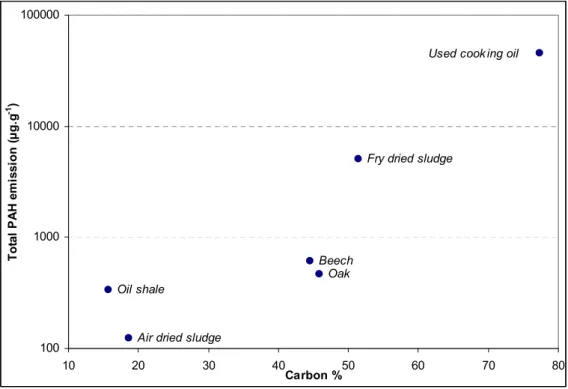
A higher fraction of carbon (Figure 3) contained in the combustion fuel resulted in a higher total-PAH con-centration in the particulate phase.
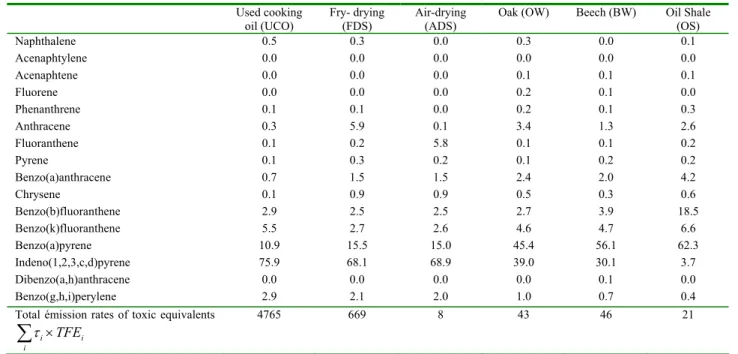
Human toxicity was evaluated using benzo(a)pyrene as equivalent carcinogenic toxicity (EQT). The toxic equivalent was calculated using formula 4.
PAHEQT = Σ τPAHi * TEFi (4)
Where TEF are the toxic equivalence factors [41] and τPAHi the PAH emission rates.
The toxic equivalents are listed in Table 5. The toxic-ity of particulate phases was mainly due to the presence of benzo(a)pyrene and indeno(1,2,3,cd)pyrene for all fuels except the oil shale for which the main contributions were from emissions of benzo(a)pyrene and benzo(b)fluoranthene. Although there are high emissions of light PAHs, their contribution to the global toxicity is a minor one.
0 10 20 30 40 50 60
NAP ACY ACE FLR PHE ANT FTN PYR B(a)A CHRYS B(b)F B(k)F B(a)P IND D(ah)A B(ghi)P
100
τi/
Στ
i
%
Used Cooking Oil Fry Dried Sludge Air Dried Sludge Oak
Beech Oil Shale
FIGURE 2 - Amount of 16 PAH emissions (%) from combustion
Used cook ing oil
Fry dried sludge
Beech Oak Oil shale
Air dried sludge
100 1000 10000 100000 10 20 30 40 50 60 70 80 Carbon % T o ta l P AH e m is si o n (µ g .g -1 )
TABLE 5- Toxic equivalent percentages of B(a)P for each PAH Used cooking oil (UCO) Fry- drying (FDS) Air-drying (ADS)
Oak (OW) Beech (BW) Oil Shale (OS) Naphthalene 0.5 0.3 0.0 0.3 0.0 0.1 Acenaphtylene 0.0 0.0 0.0 0.0 0.0 0.0 Acenaphtene 0.0 0.0 0.0 0.1 0.1 0.1 Fluorene 0.0 0.0 0.0 0.2 0.1 0.0 Phenanthrene 0.1 0.1 0.0 0.2 0.1 0.3 Anthracene 0.3 5.9 0.1 3.4 1.3 2.6 Fluoranthene 0.1 0.2 5.8 0.1 0.1 0.2 Pyrene 0.1 0.3 0.2 0.1 0.2 0.2 Benzo(a)anthracene 0.7 1.5 1.5 2.4 2.0 4.2 Chrysene 0.1 0.9 0.9 0.5 0.3 0.6 Benzo(b)fluoranthene 2.9 2.5 2.5 2.7 3.9 18.5 Benzo(k)fluoranthene 5.5 2.7 2.6 4.6 4.7 6.6 Benzo(a)pyrene 10.9 15.5 15.0 45.4 56.1 62.3 Indeno(1,2,3,c,d)pyrene 75.9 68.1 68.9 39.0 30.1 3.7 Dibenzo(a,h)anthracene 0.0 0.0 0.0 0.0 0.1 0.0 Benzo(g,h,i)perylene 2.9 2.1 2.0 1.0 0.7 0.4
Total émission rates of toxic equivalents
i i
i×TFE
∑
τ4765 669 8 43 46 21
The emission of PAHs may also be related to the mass of fuel or the heating value. PAH composition in the par-ticulate phase was defined as the PAH mass normalized by the total mass of fuel without the ash fraction and by the Lower Heating Value (Table 4). The trend was clearly that the emission factors from used cooking oil are 1 order of magnitude higher than fry-dried sludge and 2 orders of magnitude higher than woody biomass, oil shale and air-dried sludge.
Total PAH particulate emissions were strongly influ-enced by fuel type and even more strongly by burning conditions. Types of incinerator and combustion tempera-ture are considered as the two major factors for combus-tion testing [14, 20]. Hence, the results were compared with emissions reported from laboratory scale studies operating in a temperature range between 800-860°C. Experiments performed in a tubular quartz reactor have been conducted for furniture wood waste [21]. Average particulate phase concentration at 800°C is about 2002 µg g-1 which is 3-4 times higher than those measured for the
BW and OW. However, emission of total PAHs in this study was in the range reported by [42] showing that PAHs from oak and pine were emitted between 100 and 800 µg g-1 depending on the nature of wood and the
alti-tude. Lower emission ranges varying between 126-229 µg g-1 and 172-472 µg g-1 for agricultural woods and forest
wood respectively were also found [14].
Emissions of total PAH particulates from UCO were one order of magnitude higher than literature values for oily sludge taken from a crude oil storage tank of a petro-leum refinery plant [37]. Nevertheless, the total PAH particulate emissions from oily sludge are close to the
emission from FDS. Despite the high values of emissions from FDS mainly due to the oily fraction, these values are in the same range as some agricultural biomass. Barley straw, wheat straw and corn stover yielded a higher con-centration of PAH particulates (2298-3953 µg g-1) [14].
The relatively lower concentration of PAHs formed under ADS combustion was also found with the combustion of coal, liquid diesel fuel and polyethylene plastic [15, 19, 37].
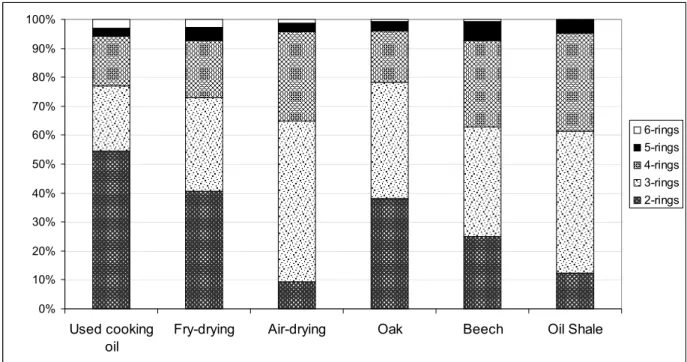
The spread of emissions as a function of the number of aromatic rings is shown in Figure 4. PAHs with 2 and 3 rings account for between 62 and 78% of emissions, those with 4 rings between 17 and 27% whereas the PAHs with 5 and 6-rings are in a minority (< to 10%) whatever the fuel.
The 2 and 3 ring PAHs, that are molecules generated in the gaseous phase (Table 3), are found in very high proportions in the particulate phase. In general, the con-centrations in the particulate phase are overestimated for these molecules [43, 44], mainly due to sorption of gase-ous compounds on the filter during sampling. For the heaviest molecules, an underestimation of the concentra-tions could be linked to volatilization from particulate on the filter.
Many studies have proposed that the ratios of PAH compounds can be used for source identification [16, 30, 45-47]. The calculated values for the most frequently used ratios of PAHs are listed in table 6. The B(ghi)P/IND and B(a)A/B(a)P show minimal variations and do not per-mit source identification. Conversely, PYR/B(a)P and B(a)P/B(ghi)P make it possible to discriminate the ori-gins.
0% 10% 20% 30% 40% 50% 60% 70% 80% 90% 100% Used cooking oil
Fry-drying Air-drying Oak Beech Oil Shale
6-rings 5-rings 4-rings 3-rings 2-rings
FIGURE 4 - Emissions distribution as a function of the aromatic rings number.
TABLE 6 - Comparison of PAH characteristic ratios (calculated from mean emission rates)
PAH ratios
Used cooking
oil (UCO) Fry- drying (FDS)
Air-drying (ADS)
Beech (BW) Oak (OW) Oil Shale (OS) PYR/B(a)P B(a)P/B(ghi)P B(ghi)P/IND B(a)P/B(a)P 5.8 0.4 1.9 0.6 4.2 0.9 1.4 0.5 15.3 0.8 1.5 1.0 2.7 4.5 1.3 0.5 1.8 8.5 1.1 0.4 3.7 16.3 >0.6 0.7 4. CONCLUSION
The objective of this work was to study the emissions of particulate PAHs in combustion of different types of fuels: used cooking oils, air-dried sludge, fry-dried sludge, woody biomass and oil shale. This work proposes an ex-perimental protocol for combustion, the sampling of the particulate phase, and identification and quantification of the 16 priority PAH pollutants listed by the Environmental Protection Agency. The emission rates depend on the initial composition of the raw fuel, in particular the carbon and hydrogen content. Both used cooking oil and fry-dried sludge have the highest emission levels 45455 and 5023 µg g-1 respectively; and these last ones are respectively 10, 15
and 40 order of magnitude higher than woody biomass, oil shale and air-dried sludge. Generally, the PAHs which con-tribute most significantly to the emission levels are: naph-thalene, phenanthrene, fluoranthene, anthracene and pyrene. Particulate phase toxicity, calculated as benzo(a)pyrene equivalents, was essentially due to benzo(a)pyrene and benzo(b)fluoranthene. These results are an extremely useful indicator for predicting the adverse effects of this combus-tion on human health.
ACKNOWLEDGMENTS
The authors would like to acknowledge the financial support of ADEME ‘‘Agency for environment and energy management” and Midi-Pyrénées region.
REFERENCES
[1] Liem, D.A. and Van Zorge, J.A. (1995) Dioxins and related compounds status and regulatory aspects. Environ. Sci. & Pollut. Res. 2(1), 46-56.
[2] Bignal, K.L., Langridge, S. and Zhou, J.L. (2008) Release of polycyclic aromatic hydrocarbons, carbon monoxide and par-ticulate matter from biomass combustion in a wood-fired boiler under varying boiler conditions. Atmos. Environ. 42, 8863-8871.
[3] Jolliet, O., Brent, A., Geedkoop, M., Itsubo, N., Mueller-Wenk, R., Pena, C., Schenk, R., Stewart, M. and Weidema, B. (2003) Final Report of the LCIA Definition Study. Life Cycle Impact Assessment Programme of the UNEP/SETAC Life Cycle Initiative.
[4] Werther, J. and Ogada, T. (1999) Sewage sludge combustion. Prog. Energy. Combust. Sci. 25, 55-116.
[5] Lavric, E.D., Konnov, A.A. and De Ruyck, J. (2004) Dioxin levels in wood combustion-a review. Biomass and Bioenergy 26, 115-145.
[6] International Agency for Research on Cancer (1983) Evalua-tion of carcinogenic risk of chemicals to humans. Polycyclic aromatic compounds, Part 1, chemical, environmental and experimental data. Monograph No 32. IARC, Lyon. [7] Steineck, G., Plato, N., Alfredsson, L. and Norell, S.E.
(1989) Industry-related urothelial carcinogens: application of a job-exposure matrix to census data. Am. J. Ind. Med. 16, 209-224.
[8] Grimmer, G., Brune, H., Dettbarn, G., Jacob, J., Misfeld, J., Mohr, U., Naujaek, K.W., Timm, J. and Wenzel-Hartung, R. (1991) Relevance of polycyclic aromatic hydrocarbons as environmental carcinogens. Fresenius J. Anal. Chem. 339, 792-795.
[9] Mumtaz, M.M., George, J.D. and Gold, K.W. (1996) ATSDR evaluation of health effects of chemicals. IV. Polycyclic hy-drocarbons (PAHs): understanding a complex problem. Toxi-cology and Industrial Health 12(6), 742-995.
[10] Soontjens, C.D., Holmberg, K., Westerholm, R.N. and Raf-ter, J.J. (1997) Characterization of polycyclic aromatic com-pounds in diesel exhaust particulate extract responsible for aryl hydrocarbon receptor activity. Atmos. Environ. 31(2), 219-225.
[11] Pesch, B., Haerting, J., Ranft, U., Klimpel, A., Oelschlagel, B. and Schill, W. (2000) Occupational risk factors for urothe-lial carcinoma: agent-specific results from a case control study in Germany. Int. J. Epidemiol. 29, 238-247.
[12] Pankow, J.F. (1987) Review and comparative analysis of the theories of partitioning between the gas and aerosol particu-late phases in the atmosphere. Atmos. Environ. 21(11), 2275-2283.
[13] Hedberg, E., Kristensson, A., Ohlsson, M., Johansson, C., Johansson, P.E., Swietlicki, E., Vesely, V., Wideqvist, U. and Westerholm, R. (2002) Chemical and physical characteriza-tion of emissions from birch wood combuscharacteriza-tion in a wood stove. Atmos. Environ. 36(30), 4823-4837.
[14] Jenkins, B.M., Jones, A.D., Turn, S.Q. and Williams R.B. (1996) Particle concentrations, gas-particle partitioning, and species intercorrelations for Polycyclic Aromatic Hydrocar-bons (PAH) emitted during biomass burning. Atmos. Envi-ron. 30(22), 3825-3835.
[15] Mastral, A.M., Callen, M.S. and Garcia, T. (1999) Polycyclic Aromatic Hydrocarbons and Organic Matter Associated to Particulate Matter Emitted from Atmospheric Fluidized Bed Coal Combustion. Environ. Sci. Technol. 33(18), 3177–3184. [16] Cai, Q.Y., Mo, C.H., Wu, Q.T., Zeng, Q.Y. and
Katsoyian-nis, A. (2007) Occurrence of organic contaminants in sewage sludges from eleven wastewater treatment plants, China. Chemosphere 68(9), 1751-1762.
[17] Yan, J.H., You, X.F., Li, X.D., Ni, M.J., Yin, X.F., and Cen,
K.F. (2004) Performance of PAHs emission from bituminous
coal combustion. Journal of Zhejiang University - Science 5(12), 1554-1564.
[18] Chien, Y.C., Liang, C.P. and Shih, P.H. (2009) Emission of polycyclic hydrocarbons from the pyrolysis of liquid crystal wastes. J. Hazard. Mater. 170, 910-914.
[19] Mastral, A.M., Callen, M.S., Murillo, R., Garcia, T. and Vi-nas, M. (1999) Influence on PAH emissions of the air flow in AFB coal combustion. Fuel 78, 1553-1557.
[20] Chianga, P.C., You, J.H., Chang, S.C and Wei, Y.H. (1992) Identification of toxic PAH compounds in emitted particu-lates from incineration of urban solid wastes. J. Hazard. Ma-ter. 31(1), 29-37.
[21] Khalfi, A., Trouve, G., Delobel, R. and Delfosse, L. (2000) Correlation of CO and PAH emissions during laboratory-scale incineration of wood waste furniture. Journal of Ana-lytical and Applied Pyrolysis 56, 243-262.
[22] Singh, S. and Prakash, V. (2007) The effect of temperature on PAHs emission from incineration of acrylic waste. Envi-ronmental Monitoring and Assessment 127, 73-77. [23] Wei, Y.L. and Wu, C.H. (1997) PAH emissions from
fluid-ized-bed incineration of an industrial sludge. Air & waste manage. assoc. 47, 953,960.
[24] Prakash, V. and Singh, S. (2010) Effect of combustion vari-ables on PAHs emission from incineration of cellulose waste filters from acrylic industry. Environmental Monitoring and Assessment 163, 591-598.
[25] You, X. (2008) Polycyclic aromatic hydrocarbon (PAH) emission from co-firing municipal solid waste (MSW) and coal in a fluidized bed incinerator. Waste Management 28(9), 1543-1551.
[26] Mastral, A.M., Callen, M.S. and Murillo, R. (1996) Assess-ment of PAH emissions as a function of coal combustion variables. Fuel 75(13), 1533-1536.
[27] Dai, J., Xu, M., Chen, J., Yang, X. and Ke, Z. (2007) PCDD/F, PAH and heavy metals in the sewage sludge from six wastewater treatment plants in Beijing, China. Chemos-phere 66, 353-361.
[28] Mastral, A.M., López, J.M., Callén, M.S, Garcia, T., Murillo, R. and Navarro, M.V. (2003) Spatial and temporal PAH concentrations in Zaragoza, Spain. Sci.Total Environ. 307(1-3), 111-124.
[29] Karthikeyan, S., Balasubramanian, R. and See, S.W. (2006) Optimization and validation of a low temperature micro-wave-assisted extraction method for analysis of polycyclic aromatic hydrocarbons in airborne particulate matter. Talanta (69), 79-86.
[30] Ravindra, K., Sokhi, R. and Van Grieken, R. (2008) Atmos-pheric polycyclic aromatic hydrocarbons: Source attribution, emission factors and regulation. Atmos. Environ. (44), 2895-2921.
[31] Dallarosa, J., Calesso Teixeira E, Meira L, WiegandF. Study of the chemical elements and polycyclic aromatic hydrocarbons in atmospheric particles of PM10 and PM2.5 in the urban and ru-ral areas of South Brazil. Atmos. Res. 2008;89:76-92. [32] Dejean, S., Raynaud, C., Meybeck, M., Della Massa, J.P. and
Simon, V. (2008) Determination of airborne polycyclic aro-matic hydrocarbons in the Toulouse area (France) by Gas Chromatography – Mass Spectrometry. Fresenius Environ-mental Bulletin 17(10b), 1697-1704.
[33] Dejean, S., Raynaud, C., Meybeck, M., Della Massa, J.P. and Simon, V. (2009) Polycyclic aromatic hydrocarbons (PAHs) in atmospheric urban area: monitoring on various types of sites. Environmental Monitoring and Assessment 2009;10.1007/s10661-007-0136-y.
[34] Foan, L., Sablayrolles, C., Elustondo, D., Lasheras, E., Gon-zalez, L., Ederra, A., Simon, V. And Santamaria, J.M. (2010) Reconstructing historical trends of Polycyclic Aromatic Hy-drocarbons deposition in a remote area of Spain using moss material from a herbarium. Atmos. Environ. 44(26), 3207-3214.
[35] Dezhi, S., Xianjin, T., Weixiang, W., Jie, F., Chaofeng, S., Murray, B. and Yingxu C. (2009) Effect of MSW source-classified collection on polycyclic aromatic hydrocarbons in residues from full-scale incineration in China. Water Air Soil Pollut. 198, 347-358.
[36] Mininni, G., Sbrilli, A., Guerriero, E. and Rotatori, M. (2004) Polycyclic aromatic hydrocarbons formation in sludge incin-eration by fluidized bed and rotary kiln furnace. Water Air Soil Pollut. 154, 3-18.
[37] Li, C.T., Lee, W.J., Mi, H.H. and Su, C.C. (1995) PAH emis-sion from the incineration of waste oily sludge and PE plastic mixtures. Sci.Total Environ. 170(3), 171-183.
[38] Romdhana, M.H., Hamasaid, A., Ladevie, B. and Lecomte, D. Energy valorization of industrial biomass: Using a batch frying process for sewage sludge. Bioresour. Technol. 100(15), 3740-3744.
[39] Mémento technique de l’eau, Dixième édition, Tome 2, Ed. Degrémont Suez, 2005.
[40] Ravindra, K., Bencs, L., Wauters, E., de Hoog, J., Deutsch, F., Roekens, E., Bleux, N., Berghmans, P. and Van Grieken, R. (2006) Seasonal and site-specific variation in vapour and aerosol phase PAHs over Flanders (Belgium) and their rela-tion with anthropogenic activities. Atmos. Environ. 40, 771-785.
[41] Nisbet, I.C.T. and Lagoy, P.K. (1992) Toxic equivalency fac-tors (TEFs) for polycyclic [42] McCrillis, R.C., Watts, R.R. and Warren S.H. (1992) Effects of operating variables on PAH emissions and mutagenity of emissions from wood-stoves. J. Air Waste Manag. Assoc. 42(5), 691-694. [43] Goriaux, M., Jourdain, B., Temime, B., Besombes, J.L.,
Mar-chand, N., Albinet, A., Leoz-Garziandia, E. and Wortham, H. (2006) Field comparison of PAH measurements using a low flow denudeur device and conventional sampling systems. Environmental Sciences and Technology 40(20), 6398–6404. [44] McMurry, P.H. (2000). A review of atmospheric aerosol measurements. Atmospheric Environment 34 (12), 1959– 1999.
[45] Guo, H., Lee, S.C., Ho, K.F., Wang, X.M. and Zuo, S.C. (2003) Particle-associated polycyclic aromatic hydrocarbons in urban air of Hong-Kong. Atmos. Environ. 37, 5307-5317. [46] Yang, H.H., Jung, C.H., Wang, Y.F. and Hsieh, L.T. (2005)
Polycyclic aromatic hydrocarbons emissions from joss paper furnaces. Atmos. Environ. 39, 3305-3312.
[47] Yang, X.Y., Okada, Y., Tang, N., Matsunaga, S., Tamura, K., Lin, J.M., Kameda, T., Toriba, A. and Hayakawa, K. (2007) Long-range transport of polycyclic aromatic hydrocarbons from China to Japan. Atmos. Environ. 41, 2710-2718.
CORRESPONDING AUTHOR
Valérie Simon
Laboratoire de Chimie Agro-Industrielle UMR 1010
INRA/INPT ENSIACET
4 Allée Emile Monso BP 44362 31030 Toulouse FRANCE Phone: +33 534 323 552 Fax: +33 534 323 597. Email: [email protected]