Model……….. Dr. said bouheraoua & Dr .Muhammad Ali Jinnah Ahmad
Takaaful Operation: Appraisal of the Existing Models
and Exploration of a Possible Alternative,
the Wadi’ah Model
Dr. Said Bouheraoua* &
Muhammad Ali Jinnah Ahmad**
Abstract:
Practice differs regarding the underlying Islamic financial contracts used in
various takaaful operational models. However, the current takaaful
operational models have been subject to several criticisms from both
operational and Shariah compliance viewpoints. This paper examines the
fundamental and modus operandi of the existing takaaful models. It
highlights area of strengths and weaknesses. The paper then explores
takaaful model based on wadi’ah. It evaluates the extent to which the
wadi’ah yad Damaanah contract can be used as an alternative for takaaful
operational functions. The viability of takaaful companies implementing the
wadi’ah model is assessed. The aim of this paper is to have an in-depth
understanding of the existing models and open horizons for possible
alternative models.
Key Terms: Takaaful - Participants -Takaaful Operators - Tabaru’- Wakaalah – Mudaraba - Ju’alah- Wadi’ah
(*)- Assoc. Prof. Dr Said Bouheraoua is a Senior Researcher at the International Shari’ah Research Academy for
Islamic Finance (ISRA). He can be contacted at [email protected].
(**)- Muhammad Ali Jinnah Ahmad is a Researcher at the International Shari’ah Research Academy for Islamic
Model……….. Dr. said bouheraoua & Dr .Muhammad Ali Jinnah Ahmad
1. Introduction
Despite the fact that takaaful (Islamic insurance) is a product which has only recently been introduced in Islamic countries, Islamic insurance operations on a commercial basis have grown remarkably. Gross takaaful contributions have grown from US$1.4 billion in 2004 to over US$3.4 billion in 2007. There still exists a large, expanding and untapped Muslim population on almost every continent. Based on research interviews and estimates, the likely size of the global takaaful market could be as high as US$7.7 billion by the end of 2012.1 However, the promotion of takaaful has been impeded by unresolved fiqh questions regarding the nature of the takaaful contract, the ownership of the takaaful fund, and the nature of the contractual relationship between the participants and the takaaful companies, i.e., characterizing it as agency (wakaalah), silent partnership (mudaarabah), agency for investment (wakaalah bil-istithmaar), or a promise of reward for a stipulated achievement (juaalah). All of these unanswered questions have played a role in limiting the number of takaaful companies, in slowing their development and their expansion on an international level, and in earning them low [credit] ratings. On the other hand, conventional insurance companies have been handed the opportunity to seize market share by opening takaaful windows.
In response to the ongoing Shari‘ah issues related to takaaful and re-takaaful companies, the International Shari’ah Research Academy for Islamic finance (ISRA) decided to evaluate the contractual bases for the relationship between the participants and the takaaful and re-takaaful companies and to propose an alternative to them that may avoid Shari’ah problems as much as possible. It intends to participate in providing a precise and effective legal framework for the relationships between Islamic takaaful companies and their international counterparts, especially since the activities of these companies have already transcended the local level and gone international.
The plan of the paper is as follows: first, it reviews the conceptual issues related to the existing takaaful models. Then the overview of wadi’ah principles is described. Next, the new model of wadi’ah is discussed and clarified. The paper concludes with the implication of this model and directions for further research. It is hoped that this research will provide more understanding of the wadi’ah model and help the industry ascertain the most appropriate basis for takaaful and re-takaaful operations.
2. Preliminary Comments
The paper is not intended to investigate or evaluate the contractual relationship between the participants or to suggest a replacement for it.
The project for a takaaful contract on the basis of wadi’ah does not seek to eliminate or undermine other contractual forms; rather, it represents one of a
Model……….. Dr. said bouheraoua & Dr .Muhammad Ali Jinnah Ahmad
number of possible alternatives for regulating the contractual relationship between the participants and the takaaful companies.
3. Appraisal of the Existing Contractual Relationships between the
Participants and the Takaaful Companies
There are four major contractual forms currently being used as the bases for the relationship between the participants and the takaaful companies namely wakaalah model, modified wakaalah model, hybrid model and waqf model:
3.1 Form One: Takaaful on a Pure Agency Basis (Wakaalah)
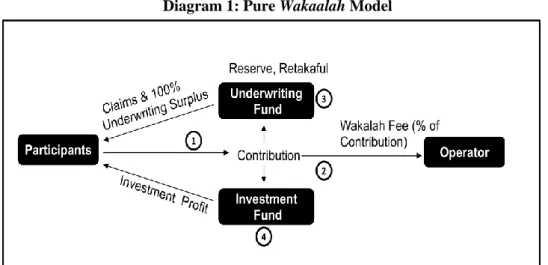
In a pure wakaalah model, takaaful participants contribute to the takaaful fund on the basis of voluntary charitable contributions (tabarru’) to cooperate in mitigating [certain] risks. The takaaful companies manage the tabarru’ fund, processing claims and paying compensation, on the basis of agency for a fee (wakaalah bil-ajr). The takaaful company is authorized to invest a portion of the takaaful fund. By doing so it becomes entitled to a fee for acting as the agent for investment. With respect to the investment, the takaaful company does not bear any liability for losses unless it has been negligent or has violated its mandate; conversely, it does not participate with the takaaful participants in any profits.
Model……….. Dr. said bouheraoua & Dr .Muhammad Ali Jinnah Ahmad
3.2 Form Two: Takaaful on a Modified Agency Basis (Modified
Wakaalah)
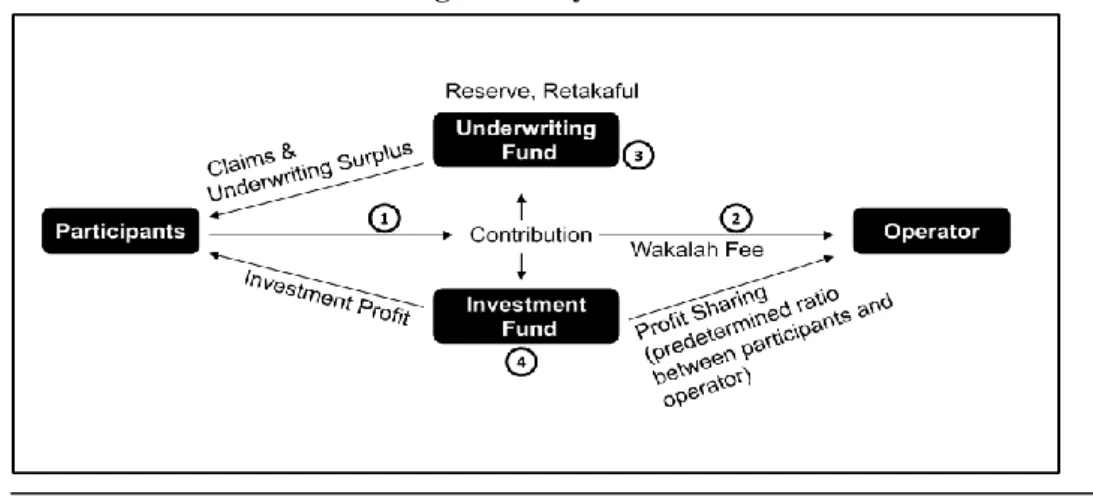
Diagram 2: Modified Wakaalah Model
In a modified wakaalah model, takaaful participants contribute to the takaaful fund on the basis of donation (tabarru’) to cooperate in mitigating [certain] risks. The takaaful companies manage the tabarru’ fund, processing claims and paying
compensation, on the basis of agency for a fee (wakaalah bil-ajr). The main difference between pure agency and modified agency is that, in modified agency, the takaaful company shares with the takaaful participants in the surplus in the fund―if there is any―on the basis of an incentive, or what is called a “performance fee”.
3.3 Form Three: Takaaful on the Basis of Agency and Silent Partnership
(Hybrid)
Model……….. Dr. said bouheraoua & Dr .Muhammad Ali Jinnah Ahmad
In this model, the contractual relationship is similar with the pure agency with regards to the company commissioned to manage the underwriting activities, for which it receives a fee. It differs from it in the second area of activity (investment). The first form adopts agency for investment while this form adopts silent partnership (mudaarabah). The takaaful company still does not bear any liability for losses unless it has been negligent or has violated its mandate; however, it does not take a fixed fee for its activities; rather, it shares with the fund in any profits accrued, its share being that of the mudaarib (entrepreneur) in a mudaarabah contract.
3.4 Form Three: Takaaful on the Basis of Waqf
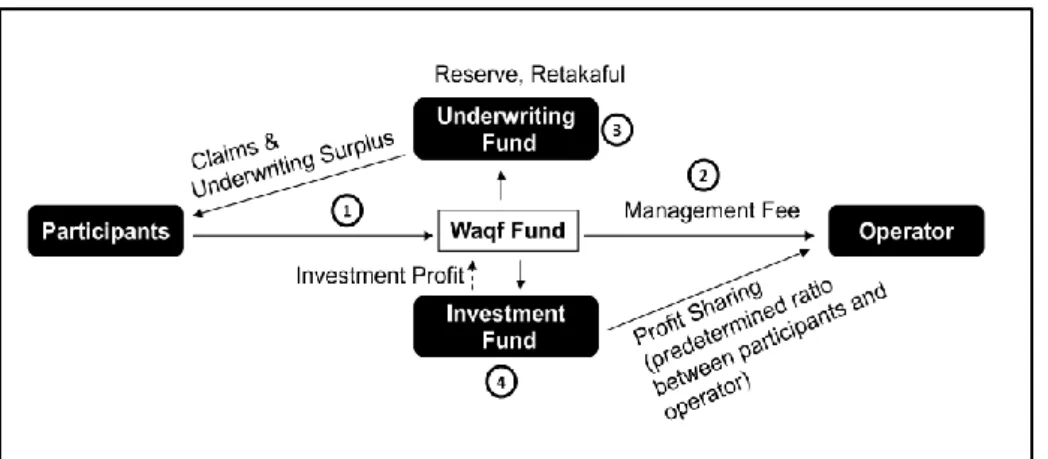
Diagram 4: Waqf Model
In waqf model, a waqf fund is established by the shareholders and the participants will contribute to the waqf fund. The operator will received a pre-agreed management fee for underwriting services and share the mudarabah investment profits based on a pre-agreed profit sharing ratio. In this model, takaaful operator will play two different roles, as a manager and as a mudarib. The waqf fund will be used for claims, retakaaful and reserves. Any surplus in the waqf fund will be distributed as per the waqf deed which normally distributed to the participant, kept as a reserve or utilized for charitable purposes.
4. Issues Raised in the Existing Takaaful Models
A general takaaful scheme essentially involves the relationship of two parties: the takaaful operator and a group of participants. The relationship between participants is governed by the contracts of takaaful and tabarru’ as adopted by most countries, or waqf as practiced by Pakistan and South Africa, or cooperative partnership (mushaarakah ta’awuniyyah) as recently endorsed by many scholars in several conferences, while the relationship between participants and the takaaful operator is
Model……….. Dr. said bouheraoua & Dr .Muhammad Ali Jinnah Ahmad
governed by the contract of wakaalah (agency), whereby the takaaful operator is appointed to manage the scheme. Nevertheless, other Islamic contracts may also be combined with wakaalah,
Although Shari’ah scholars agree with the conceptual basis underlying the wakaalah model, they have raised some questions related to the current practice. One major issue still under deliberation involves the distinction between pure wakaalah and the modified approaches in which, besides a wakaalah fee, a percentage share of the underwriting surplus is paid as a performance incentive to the operator, while the participants remain the actual owners of fund. Another issue is: how to measure the exact share of the participants with regard to inheritance and zakaah? The intergenerational issue is also being raised, as the contingency reserves may not be equitable between generations, as the operator is likely to hold higher proportionate reserves in the early years for future contingencies.
There is also a strong trend for the operational model to move towards a hybrid wakaalah-based model, as it has been argued that the pure wakaalah business model puts takaaful at a pricing disadvantage when competing for business that does not require Shari’ah-compliant coverage. It is argued that the reason is that wakaalah-based operators are unable to use retained underwriting surplus to discount. As a result, it has been argued that takaaful pricing for group and commercial cover is often uncompetitive. This lack of competitiveness reduces an operator’s ability to use brokerage as a “cost-effective mechanism” to source business.2
In addition, it is argued that the current wakaalah model is not robust enough and will fail when the industry matures; the supply value chain of the takaaful/re-takaaful industry involves many parties (agents or direct brokers / TO / re-takaaful/re-takaaful broker / RTO / retrocession broker / retrocessionnaires) who are entitled to their respective service/wakaalah fees, and the funds get progressively depleted after each party takes its fees. The balance of the fund will be too small to respond to claims, thus undermining the purpose of takaaful/re-takaaful.3
Under the mudaarabah concept, two parties, basically the capital provider (rabb al-mal), i.e., the participant, and the entrepreneur (mudaarib), i.e., the takaaful operator, operate on a joint-venture basis. The advantage of the mudaarabah model is that operators have a bigger incentive to engage in efficient underwriting and strategically invest, as they will receive a portion of the surplus.4 A number of issues arise from the current practice of mudaarabah model, however.
Is the mudaarabah model really cooperative in nature? Can the donation be considered mudaarabah capital? Is the mudaarabah profit the same as surplus?
Model……….. Dr. said bouheraoua & Dr .Muhammad Ali Jinnah Ahmad
Can the shareholder share the underwriting surplus, as is the common practice in conventional insurance?
In case of a fund shortfall, is the requirement of qarÌ (interest-free loan) from the mudaarib in accord with the principle of mudaarabah?5
The issues and concerns about the applicability of mudaarabah as an approach of risk sharing have driven some takaaful operators to adopt the wakaalah model. Under the wakaalah model, the participants remain the actual owners of the fund into which the contribution is pooled. This fund is managed by the wakil (agent) on the principles of agency for investment (wakaalah bil-istithmaar). Before the agent starts managing the fund, it will first deduct out a predefined amount as a wakaalah fee/operator fee for management and service expenses. This model is commonly used in the Gulf and Southeast Asian countries. One of the advantages of the wakaalah model is that, when starting a new fund, operators know how much revenue they will generate because they receive a fixed share of the contributions.6
In a nutshell, each of these models has its own strong and weak points, and none can be exceptionally distinctive from the others as each meets the needs of a particular market. It is difficult to judge the relative merits of each of these models, which all serve their purpose in their own way. None of them are perfect, and there must be concerted efforts to fine-tune them to solve the problems in each of the models.7 Therefore, the conceptual issues related to the mudaarabah and wakaalah models have lead to the exploration of other contracts which can serve as bases for takaaful operations.
5. Exploring the Takaaful Operational Model Based on Wadi’ah
Before we proceed to the discussion of the proposed new model, it is necessary to examine the underlying contract in the wadi’ah model as it will determine the Islamic rule for the activities that take place within it.
5.1
Definition of Wadi’ah
Definitions of wadi’ah have been provided by different schools of Islamic jurisprudence. Some hanafi scholars have defined the contract as an implicit or explicit empowerment of another for safekeeping of one’s property.8
The Shafi’is and Maalikis have defined it as granting another person agency (tawkiil) for safekeeping of one’s property or legal possession.9 In general, these definitions signifies wadi’ah as an instrument that allows a person to keep the wealth or items belonging to oneself with another person for safe keeping purposes.
The wadi’ah contract is permissible and recommended with evidence for it in the Qur’aan, the Sunnah and consensus. For example, Allah says in the Qur’aan:
ْنَأ ْمُكُرُمْأَي َهَّللا َّنِإ
اَهِلْهَأ ىَلِإ ِتاَناَمَْلْا اوُّدَؤُ ت
Model……….. Dr. said bouheraoua & Dr .Muhammad Ali Jinnah Ahmad
In the above verse, Allah SWT commands the believers to render trusts their rightful owners. Trust can covers all the wealth that is given like the wealth in mudarabah contract, asset for the lease contract and wealth that is given to another person as al-wadi’ah. The word trust has been used in the above verse indicate the importance of fulfilling all types of trust including safe keeping (al-wadi’ah). The word amanah (trust) is more general than al-wadi’ah because al-wadi’ah is a type of amanah (trust)11.
َيْلَو ُهَتَ نامَأ َنِمُتْؤا يِذَّلا ِّدَؤُ يْلَ ف ًاضْعَ ب ْمُكُضْعَ ب َنِمَأ ْنِإَف
ُهَّبَر َهَّللا ِقَّت
12
“And if one of you entrusts another, then let him who is entrusted discharge his trust [faithfully] and let him fear Allah”
The above verse indicates that when you decide to trust one another, and then let the one who is trusted fulfill his trust, and let him fear Allah. It is therefore understood that trust is important before you can leave your wealth to someone else for the purpose of safe keeping and the trusted person must fear to Allah for this trust. Although the word wadi’ah is not specifically mentioned in the Qur’aan, Muslim scholars understand it to be included in the term amaanah (trust), which the abovementioned Qur’aanic verses require be discharged.
The proof on the legality of wadi’ah contarct is also supported by the Sunnah, for instance:
ُللها ىَّلَص ِللها ُلوُسَر يِنْعَ ت , َرَمَأَو " :ْتَلاَق َمَّلَسَو ِهْيَلَع ُللها ىَّلَص ِّيِبَّنلا ِةَرْجِه يِف َةَشِئاَع ْنَع
, َمَّلَسَو ِهْيَلَع
َسَو ِهْيَلَع ُللها ىَّلَص ِللها ِلوُسَر ْنَع َيِّدَؤُ ي ىَّتَح َةَّكَمِب ُهْنَع َفَّلَخَتَ ي ْنَأ ُهْنَع ُللها َيِضَر اًّيِلَع
ْتَناَك يِتَّلا َعِئاَدَوْلا َمَّل
ساَّنلِل ُهَدْنِع
" 13A'ishah mentioned, regarding the Hijrah of the Prophet (peace be upon him), that he ordered 'Ali (may Allah be pleased with him) to remain behind in Makkah in order to
return the items that people had entrusted for safekeeping with Allah's Messenger (peace be upon him) back to their owners.
From this hadith, it is clear that The Prophet used to keep the wealth of Meccan people and when he was ordered to migrate to Madinah, he asked Ali to return the assets that were kept with him to their owners. In addition to the recommendation from the Qur’an and Sunnah on the concept of amanah and al-wadi’ah, jurists both the past and present also have consistently supported on the permissibility of al-wadi’ah.
There is a further precedent in the practice of the Prophet’s companions for the form of wadi’ah practiced today. The most significant example is the safekeeping service offered by Zubayr ibn al-Awwaam. Because of his reputation for trustworthiness, people would ask Zubayr to hold their money and valuable items in his custody for safekeeping. The large sums of money were a burden to Zubayr, for he worried that he
Model……….. Dr. said bouheraoua & Dr .Muhammad Ali Jinnah Ahmad
same time he could not use it. Upon reflection, he decided to ask depositors permission to use their money and consider it as a loan. Thus, whenever a depositor come asking for safekeeping, he would refuse and say,
َةَعْ يَّضلا ِهْيَلَع ىَشْخَأ يِّنِإ ؛ٌفَلَس َوُه ْنِكَلَو , َلَ
14
“No, but make it a loan; I fear it will be lost.”
Through this action Zubayr changed the basic concept that the depositary would only keep people’s trusts without use. This enabled borrowing to invest while at the same time ensuring the safety of the money.
5.
2 The Concept of Wadi’ah Yad Damaanah
The jurists of all schools of law agree that wadi’ah is a form of trust contract, i.e., the property placed in the possession of the depositary (mustawda’) is regarded as trust. Therefore, the mustawda’ is not obliged to guarantee the property except in case of negligence or ta’addii (breach of trust). However, jurists agree that the custodian becomes liable (daamin) for the deposit if he utilizes it.15 In addition, an opinion of Imaam AÍmad has been transmitted that the depositary (mustawda’) is responsible in the event that the property is damaged. This opinion is based on an opinion of Umar ibn al-Khattaab, who held Anas ibn Maalik liable for assets lost while being held for safekeeping.
ِل
لا َيِضَر ِباَّطَخْلا ِنْب َرَمُع ْنَع " َيِوُر اَم
هِلاَم ِنْيَ ب ْنِم ْتَبَهَذ ًةَعيِدَو ٍكِلاَم َنْب َسَنَأ َنَّمَض ُهَّنَأ ُهْنَع ُهَّل
16
It is narrated that Umar ibn al-Khattaab had ordered Anas bin Malik to replace the property under his safe keeping.
From the above story, it appears that Umar has allowed the contract of safe keeping with guarantee (yad damanah). Although this story might not be a strong justification on the concept of safe keeping with guarantee, the majority of jurist’s share the same view that if the custodian utilizes the al-wadi’ah or the wealth, then it will be considered as I’arah (simple loan) that must be guaranteed. The hanafi jurist al-Kaasaani opined that if the property held by the depositary is in form of cash, whether dinars or dirhams, and the depositor has given permission to use it, then it is no longer a deposit but a loan (qard).17 The hanbali jurist al-Buhuuti also stated that a wadi’ah contract in which the depositor consents that the depositary can utilize the goods is no longer wadi’ah but a loan for which the depositary is liable.18
Until now, the view of contemporary scholars with regard to money deposited in Islamic banking institutions is in line with the views of scholars of the past. For example, the Islamic Fiqh Academy of the OIC, in the proceedings of its 9th session, April 1-6, 1995 issued a resolution which states, “Deposits in current accounts, whether placed with Islamic banks or conventional banks, are, from a fiqh perspective, loans.
Model……….. Dr. said bouheraoua & Dr .Muhammad Ali Jinnah Ahmad
The bank in accepting the deposit assumes liability for it (yad al-Damaanah), and it must return the deposit when requested.”
5.
3 The Current Practice of Wadi’ah Yad al-Damaanah
Wadi’ah yad al-Damaanah, is a type of wadi’ah that combines two contracts: deposit (wadi’ah) and guarantee (Damaanah). A Damaanah contract, when attached to the wadi’ah contract, converts the concept of wadi’ah to guaranteed safe custody. Such a combination will facilitate wider participation in the Islamic banking system, where the deposits are the source of funds for the bank. These funds are used for banking investment activities. The bank that accepts the deposits is liable and has to guarantee their return to the depositor upon request. Therefore, they are considered as loans to the bank.
The salient features of this type of wadi’ah can be summarised as follows:
One: the deposited asset need not be segregated, as long as the custodian can differentiate between his own asset and the asset of the depositor.
Two: the custodian is entitled to use the deposited item for trading or other purposes, irrespective of the consent of the depositor, as he is guaranteeing the deposit and is liable for any damage or loss. The risk taken by the custodian permits him to utilise the deposit, as gain comes with the corresponding risk.
Three: the custodian has a right to any income derived from the utilisation of the deposited asset. This is based on the Islamic legal maxims: al-kharaaj bi al-damaan “profit [from a thing] is in return for liability [for loss from it]”, and al-ghunm bil-ghurm “liability is in return for benefit”.
Four: the owner of the deposit (depositor) can withdraw the deposit at any time, and it is the obligation of the custodian thereof to give him the asset upon request.
Five: the wadi’ah yad al-Damaanah contract is similar to qard (a loan). This is because when the depositor deposits his asset with the custodian, he is assumed to have loaned it to him. Therefore, all principles of a loan would be applicable to this contract. Six: since this contract is similar to a loan, it cannot generate any pre-agreed benefit/income to the depositor over and above the principal amount of deposit. Failure to ensure the above will be tantamount to riba.
6. Exploring the New Takaaful Model Based on Wadi’ah
The wadi’ah operational model in takaaful has been suggested by some researchers and scholars as an alternative model, but a feasibility study never been conducted to test its viability for the takaaful operation.19 An enhanced version of this model was presented at the International Islamic Fiqh Academy conference held in Jordan in April 2010, and the feedback from the scholars was positive and encouraging.
Model……….. Dr. said bouheraoua & Dr .Muhammad Ali Jinnah Ahmad
6.
1 The Mechanism of the Wadi’ah Model in Takaaful Operations
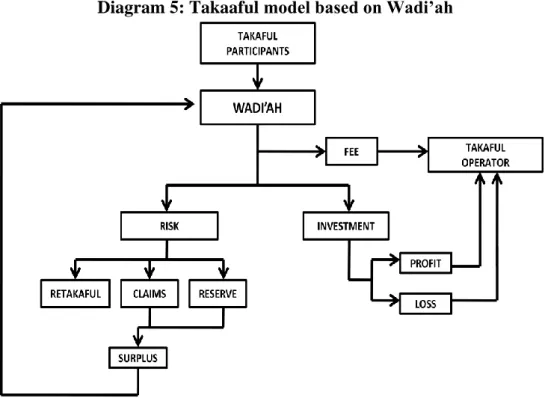
Under the proposed wadi’ah model, takaaful participants agree to deposit their money for the purpose of mutual help in case misfortune occurs to some of the participants. In the context of takaaful operations, the takaaful participants as a group appoint the takaaful operator to manage and safe-keep the money deposited in the wadi’ah fund in return for a wakaalah fee. In this model, the money pooled by the takaaful participants is considered a guaranteed deposit. However, if any claims are made or expenses incurred in managing the scheme, the wadi’ah fund will be treated as tabarru’ (donation), based on the agreement of mutual assistance between the participants. With regard to the wadi’ah fund, the takaaful operator is authorized to invest the fund but will bear the risk of any losses to the fund as it is considered wadi’ah yad al-Damaanah. On the other hand, any investment return will belong solely to the takaaful operator. The takaaful participants are the owner of the entire wadi’ah fund, including the principal and any underwriting surplus.
Diagram 5: Takaaful model based on Wadi’ah
Significant Islamic banking experience is available in the implementation of the wadi’ah contract for its deposit instruments. There has, however, been no experience in doing so for takaaful. It should be noted that the nature of wadi’ah in Islamic banking is slightly different from the nature of wadi’ah in takaaful. To put it
Model……….. Dr. said bouheraoua & Dr .Muhammad Ali Jinnah Ahmad
simply, people deposit their money in a bank for two main purposes, namely transactions and investment; but in takaaful, people deposit their money for risk-sharing purposes. Thus, the wadi’ah mechanism in takaaful must be adapted to the existing takaaful institutional structure and market, and it must accommodate the concept of risk-sharing in takaaful. Therefore, the participants must understand that the money that is being deposited is their commitment for mutual assistance and donation. Therefore, the amount of deposited money will inevitably decrease as it is intended to be used to cover the takaaful expenses and the claims filed by the participants.
Furthermore, the validity of Islamic insurance, according to Islamic jurisprudence, is based on the commitment of the participants to make donations for their collective interest. In the wadi’ah model, the contribution is regarded as a deposit, and donation will only be exercised when the risk or claim happened. In other words, if any claims are made or expenses incurred by the takaaful operator, the wadi’ah fund will be tapped and treated as tabarru’ (donation), based on the principle of mutual assistance. If claims are not made, the fund will remain as a wadi’ah under the safe-keeping of the takaaful operator.
In this wadi’ah model, the relationship between the participants is governed by the concept of tabarru’ or cooperative partnership (mushaarakah ta’awuniyyah). The relationship between the operator and participant is governed by wakaalah and safe-keeping. The relationship between the participant and the risk fund is iltizaam bil- tabarru’. In this model, the money pooled by the participants in the takaaful fund is considered as a deposit and not as a donation. The wadi’ah fund is jointly owned by all participants as opposed to the shareholders in a conventional insurance company. The takaaful operator only has the mandate given by the owners to administer the fund as per the contract agreement.
Surplus, defined as assets minus liabilities, is an important component in takaaful. Some Regulatory authorities have determined that the managing company (takaaful operator) is not entitled to any share of it in line with the remunerated wakaalah (agency) contract between it and the participants. In the wadi’ah model, the participants enjoy a fully guaranteed right to the entire wadi’ah fund, including any net underwriting surplus,
The takaaful operator is authorized by participants to manage the risk, and this comprises all operational areas such as pricing, valuation, distribution, acquisition, underwriting, claims handling, and asset management. For carrying out these administrative tasks, the takaaful operator receives fee-based compensation. With regard to the fund and since it is considered as wadiah yad dhaman, the takaaful operator can invest the fund but will bear the risk of any losses to the fund. On the other hand, any investment profit will belong to the takaaful operator.
Model……….. Dr. said bouheraoua & Dr .Muhammad Ali Jinnah Ahmad
The wadi’ah yad al-Damaanah contract allows the takaaful operator to invest the fund money in return for deposit protection. But the takaaful operator has no legal obligation to pay depositors a hibah or a fixed return. As the takaaful operator only manages but does not own the takaaful fund, the shareholders consequently cannot be held responsible for any deficits (unless the deficit is due to the negligence or misconduct of the operator). It has to be noted that a qard is not explicitly mandated by the Shari’ah. The loan will be repaid out of arising surplus in the future, though both timing and amount are uncertain. In addition to the usual technical reserves, the wadi’ah fund would be considered as a contingency reserve fund for future situations from the deposits received.
7. Rationale for the Wadi’ah Model
Research is being done on this new model. The initial findings are that the wadi’ah model has many advantages over the existing models in that it creates fairness, transparency and a trust relationship between the takaaful operator and the participants. While a global standard and convergence of takaaful models seem not to be imminent, the harmonization of takaaful practices between regions is vital. One of the most controversial issues discussed within the takaaful industry is the question of surplus distribution, i.e., whether the takaaful operator is allowed to share in the underwriting surplus. The wadi’ah model provides clarity on this issue by retaining the ownership of the surplus to the participants. This model will concur with the practice of surplus distribution in the Middle East.
In the mudaarabah arrangement, the cooperative nature of the contract is undermined. The relationship between the participants should be based on tabarru’ and not mudaarabah. Under a typical wakaalah model, the tabarru’ (donation) remains the property of the participants unless consumed, as they have the right to receive the surplus back, and therefore, it becomes a conditional gift. This feature in turn gives rise to issues such as inheritance (it is not possible to measure the share of the surplus in the pool at the time of death) and zakaah in the case of the death of the persons, as the donation is a conditional gift. Also, the relationship is between the participants and the operator and also among the participants (exchange of gift for a gift). As such, doubts are created that the contract has become a contract of compensation. Furthermore, the modified wakaalah and mudaarabah models have departed from the pure models of wakaalah and mudaarabah. A consistent business model and transparency are required in order to better reflect a globally accepted structure of the takaaful operators. The wadi’ah model resolves the ambiguities surrounding the ownership of takaaful funds: the participants are the owners of the funds; they do not lose their ownership of the funds and thus have the exclusive right to the surplus. This is better than the current
Model……….. Dr. said bouheraoua & Dr .Muhammad Ali Jinnah Ahmad
model of applying the wakaalah concept whereby participants lose a considerable portion of the surplus.
Sharing of investment profits is well accepted in takaaful. However, sharing profits in the case of surplus and not sharing losses as they give only loan (qard) will burden the takaaful participant and put the scheme in risk. The relationship between the participants and the takaaful operator should be based on a more secure and transparent model. The wadi’ah model secures the participants’ fund and guarantees the transparency of the relationship between the participants and the takaaful operator. The wadi’ah model is more equitable between the participants and takaaful operator, as the participants have a fully guaranteed right to the entire wadi’ah fund, including any net underwriting surplus, while the takaaful operator has a full right to management fees and the profits of investments earned if they opt to invest. Finally, the most important feature of the wadi’ah model is that it is Shari’ah compliant. The concept of wadi’ah yad Damaanah has been successfully implemented in Islamic banking institutions. The wadi’ah model is able to mitigate many unresolved issues in the takaaful market and become an alternative as the existing models are criticized for not meeting certain requirements of Islamic law.
8.
Issues and Challenges of the Takaaful Model Based on Wadi’a
h There are a number of challenges to be overcome to ensure the viability of the wadi’ah model in the market. The main challenge is whether it complies with the legal and regulatory framework in Malaysia and other jurisdictions. In this respect, this model can be considered as a deposit-taking activity which may not be in line with the Banking and Financial Institution Act (BAFIA), the Islamic Banking Act (IBA) or any act of different jurisdiction.Among the important Shari’ah issues related to wadi’ah is the giving of hibah by the custodian to the depositors. The hibah given to the depositors is solely at the discretion of the takaaful operator, and it should not be promised upfront to the participants. Should there be a promise, then this may be akin to riba. Furthermore, the element of uncertainty in the system of hibah remains a setback in mobilization of Islamic deposits, given that contractual interest income has been the norm in the market for deposits. Nevertheless, this should not present a huge challenge with regards to the takaaful product as it is a nonprofit contribution.
Another possible Shari’ah issue relates to insufficient funds. If there is a deficit in the takaaful fund, the takaaful operator is required to provide a qard (loan) to the fund and recover it from the participants in the future. However, some Shari’ah scholars may question how it is that the wadi’ah yad Damaanah, which is essentially a qard from the participants, may be counterbalanced by a qard from the takaaful operator
Model……….. Dr. said bouheraoua & Dr .Muhammad Ali Jinnah Ahmad
Some regulators might allow under certain circumstances that no immediate cash injection is done, sufficing with a mere assignment of assets from the shareholders’ fund to the takaaful fund. One obvious advantage for the operator is that it continues to earn investment profit on the earmarked assets, as they remain in the shareholders’ fund. Such exemption is only likely to be granted if the operator can show that the deficit in the takaaful fund is only short-term and that the overall solvency of the operator is not affected.
The main challenge of this model is in maintaining the solvency of the wadi’ah fund as it will be reduced by claims and other expenses. Furthermore, the participants’ full ownership of the surplus will not attract the takaaful operator to adopt this model as the bulk of takaaful profits are generated from underwriting surplus, namely the amount of premium collected and the amount paid out as compensations.
9. Conclusion
The concept of this new takaaful model is based on the contract of wadi’ah yad dhamanah (guaranteed safe custody). In the context of takaaful operation, the participants as a group appoint the takaaful operator to manage and safe-keep the money deposited in the wadi’ah fund in return for wakaalah fee. The distinctive of this model is that the money pooled by the participants is considered as a deposit and not as a donation. Participants will be the owner of the entire takaaful fund, including any net underwriting surplus. The wadi’ah fund will be deducted and channeled as tabarru‘(donation) if there any claims were made or expenses incurred by the takaaful operators, and this is based on the principle of ta’awun (mutual assistance) between the participants. Takaaful participants also authorized the takaaful operator to use and invest the fund but will bear the risk of any losses to the fund. In return, the investment profit will exclusively belong to the takaaful operator. Thus, the source of income for the takaaful operator is from the wakaalah fee and the investment profit. It is found that the wadi’ah model has many advantages over the existing models; it creates fairness, transparency and a trust relationship between the takaaful operator and the participants. It is more equitable, as the participants enjoy a fully guaranteed right to the entire wadi’ah fund, including any net underwriting surplus, while the takaaful operator enjoys management fees and the profits of investments from the fund. The wadi’ah model is also more transparent than the existing model as it clearly determines the ownership of the fund and the ownership of the underwriting surplus. It mitigates several issues by treating the contribution from the participant as a deposit money and not as tabarru‘, hence the participants will not lose on the ownership of the fund, as it is required by the rules of tabarru‘ in the Shari‘ah. It is also more compliant to the shari‘ah in that the modified wakaalah and mudharabah models have departed from the pure models of wakaalah and mudharabah.
Model……….. Dr. said bouheraoua & Dr .Muhammad Ali Jinnah Ahmad
REFERENCES
Engku Ali, E.R and Odierno, H.S (2008). Essential Guide to Takaaful (Islamic Insurance). CERT Publication Wahab, A. R, Lewis, M.K. & K. & Hassan, M.K. (2007) Islamic Takaaful: Business Models, Shariah Concerns, and Proposed Solutions, Thunderbird International Business Review, Volume 49. Issue 3.
Frenz, T. Takaaful and Retakaaful, Principles and Practices. Munich RE Retakaaful,
Sigma, (2008). Insurance in the Emerging Markets: Overview and Prospects for Islamic Insurance. Swiss Re. Billah, M. M. Different Models of Takaaful in the Global Sound Market.
Al-Zuhayli, W. (2001). Financial Transactions in Islamic Jurisprudence. Damascus: Dar Al-Fikr. Ernst and Young. (2009). The World Takaaful Report 2009, p. 39.
1
The World Takaful Report 2009, Ernst and Young, page 39.
2 Ernst and Young, The World Takaful Report 2009, p. 34. 3 Interview with Mr. Ismail Mahbob of MNRB Retakaful. 4
Swiss Re, Sigma No 5/2008 “Insurance in the Emerging Markets: Overview and Prospects for Islamic Insurance”, p.24
5 Abdul Rahim Abdul Wahab, Mervyn K. Lewis & M. Kabir Hassan, “Islamic Takaful: Business Models, Shariah
Concerns, and Proposed Solutions”, Thunderbird International Business Review, Vol. 49, May-June 2007, pp. 371-396.
6
Swiss Re, Sigma No 5/2008 “Insurance in the emerging markets: overview and prospects for Islamic insurance”, page Sigma page 24
7 Billah, M.M. “Different Models of Takaful in the Global Sound Market”. Retrieved from
http://www.takaful.coop/doc_store/takaful/differentModels.pdf
8 Ibn Aabidiin, 4:515. 9
Al-Khatib Al-Shirbini, vol.3 p.79. Hashyiat Al-Dusuqi, vol. 3, p.419.
10 Al-Nisa’, 58
11 Ibn Abidin, Rad Al-Muhtar ala Al-Dur Al-Mukhtar, vol.5, p.662, Darul Fikir, Beirut. 12 Al-Baqarah, 283
13
Al-Baihaqi, Sunan Al-Kubro, vol.6, p.472, Darul Kutub Ilmiyyah, Beirut.
14 Al-Baihaqi, Al-Sunan Al-Kubro, vol.6, p.467, 3rd Edition, 2003, Dar Al-Kutub Al-Ilmiyyah, Beirut. Al-Nawawi,
Riyaadu Al-Solihin, vol.1, p. 77, Dar Al-Rayyan.
15
Zuhayli. W, Fiqh Al-Islami wa Adillatuhu, p.4026
16 Al-Maqdisi, Al-Uddah Syarh Al-Umdah, vol.1, p.293, Darul Hadis, Al-Kaherah. 17
Al-Kasani, Badaai` al-Sanaai’, vol.8, p. 3899
18 Al-Buhuti, Kasyaf al-Qina’, vol.4, p. 1414
19 Frenz, T. Takaful and Retakaful, Principles and Practices, Munich RE Retakaful, p. 68. Engku Ali, E.R and