O
pen
A
rchive
T
OULOUSE
A
rchive
O
uverte (
OATAO
)
OATAO is an open access repository that collects the work of Toulouse researchers and makes it freely available over the web where possible.This is an author-deposited version published in : http://oatao.univ-toulouse.fr/ Eprints ID : 11899
To cite this version : Munoz Cuartas, Victor and Perrin, Marianne and Pastor, Marie-Laetitia and Welemane, Hélène and Cantarel, Arthur and Karama, Moussa Identification of the elastic properties in CFRP composites. (2014) In: International Symposium on Aircraft Materials ACMA 2014, 23 April 2014 - 26 April 2014 (Marrakech, Morocco).
Any correspondance concerning this service should be sent to the repository administrator: [email protected]
Identification of the elastic properties in CFRP composites
Victor Munoz †, Marianne Perrin*, Marie-Laetitia Pastor*, Hélène Welemane †, Arthur Cantarel*, Moussa Karama †
† Université de Toulouse, INP-ENIT, LGP, 47 avenue d’Azereix, 65016 Tarbes, France, [email protected], [email protected],
*Université de Toulouse, IUT, ICA, 1 rue Lautréamont, BP 1624, 65016 Tarbes, France, [email protected], [email protected],
Keywords: Laminated composite, Transversely isotropic material, Elastic constants
measurement, Material characterization, Ultrasonic immersion testing.
The mechanical characterization of composite materials encounters nowadays a major interest due to their increasing use in the aeronautic industry. The design of most of these materials is based on their stiffness, which is mainly obtained by means of static measurement.
Regarding non-destructive evaluations, the measurement of ultrasonic wave velocities constitutes a qualified technique for the acquisition of the elastic constants of composite materials [1]. By sending several ultrasonic bulk waves within the material, phase velocity is calculated and thus the elastic constants can be obtained through the inversion of the Christoffel equation [2]:
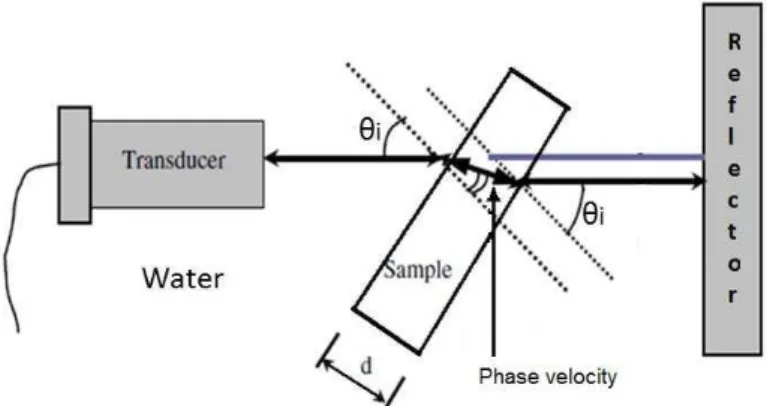
In this paper, the elastic constants of a unidirectional carbon fiber reinforced laminates were determined with the back-reflection ultrasonic technique in immersion. For such anisotropic plates with small thickness, the time of flight was measured at different incidents angles θi (figure 1) using numerical methods [3].
In order to validate the ultrasonic characterization, classical mechanical characterizations using tensile tests were also performed for the same material and for 3 different directions of the fiber axis (0°, 90° and 45°). Deformation gauges were used to measure the axial and lateral strains and stiffness constants were then estimated from the elastic parts of the stress-strain curves. At the same time, a digital image correlation system was also implemented to corroborate the gauge data. Such technique aims at matching two digital images of a surface observed at two different states of strain [4]. The processed image allows then to obtain the deformation at these points for each loading condition.
These three results of stiffness tensor measurement (ultrasonic characterization, strain gauges and digital image correlation during tensile tests) were compared to literature and to the material manufacturer [Hexcel Corporation®] to evaluate the accuracy of the characterization methods. The calculated Young’s modulus in the fiber axis using strain gauges was more accurate than ultrasonic characterization and digital image correlation in regards with the material manufacturer. Nevertheless, the other elastic constants were calculated with good accuracy for the three methods.
Figure 1 – Experimental setup for ultrasonic characterization References
[1] Siva Shashidhara Reddy, S.; Balasubramaniam, K.; Krishnamurthy, C.V.; Shankar, M. Ultrasonic goniometry immersion techniques for the measurement of elastic moduli. Composite Structures 67, pp. 3-17. 2005.
[2] Bodian, P.A. Propagation des ultrasons en milieu hetérogène et anisotrope : application à l'évaluation des propriétés d'élasticité et d'atténuation d'aciers moules par centrifugation et de soudures en incone. PhD thesis. Institut National des Sciences Appliquées de Lyon. 2011.
[3] Chu, Y. C.; Degtyar, A.D.; Rokhlin, S. I. On determination of orthotropic material moduli from ultrasonic velocity data in nonsymmetry planes. J. Acoust. Soc. Am., Vol. 95, No. 6, pp. 3191-3203. 1994.
[4] He, Y.; Makeev, A. Characterization of nonlinear shear properties for composite materials using digital image correlation and finite element analysis. Composite Science and Technology 73, pp. 64-71. 2012.