HAL Id: hal-01081383
https://hal.archives-ouvertes.fr/hal-01081383
Submitted on 7 Nov 2014
HAL is a multi-disciplinary open access
archive for the deposit and dissemination of
sci-entific research documents, whether they are
pub-lished or not. The documents may come from
teaching and research institutions in France or
abroad, or from public or private research centers.
L’archive ouverte pluridisciplinaire HAL, est
destinée au dépôt et à la diffusion de documents
scientifiques de niveau recherche, publiés ou non,
émanant des établissements d’enseignement et de
recherche français ou étrangers, des laboratoires
publics ou privés.
Quantum dash based directly modulated lasers for
long-reach access networks
Siddharth Joshi, Nicolas Chimot, Luiz Anet Neto, Alain Accard, Jean-Guy
Provost, Florent Franchin, Abderahim Ramdane, François Lelarge
To cite this version:
Siddharth Joshi, Nicolas Chimot, Luiz Anet Neto, Alain Accard, Jean-Guy Provost, et al.. Quantum
dash based directly modulated lasers for long-reach access networks. Electronics Letters, IET, 2014,
50 (7), pp.534 - 536. �10.1049/el.2013.4121�. �hal-01081383�
1
Quantum Dash based Directly Modulated
Lasers for long reach Access Networks
S. Joshi, N. Chimot, L. A. Neto, A. Accard, J-G. Provost, F.
Franchin, A. Ramdane, and F. Lelarge
We demonstrate an innovative 10 Gbps single mode optical transmitter with the capacity of error free transmission in the range of 0 to 100kms with constant biasing conditions using a Quantum Dash Directly Modulated Laser. We use a commercially available etalon filter as passive optical filter to achieve penalty free transmission with a dynamic extinction ratio (DER) > 6dB over a large range of fiber spans.
Introduction: The increase in the performance of digital electronics and
desktop computers has resulted in expansion of triple play services in recent years [1]. The interactive internet today, demands gigabit bandwidth provisions. In addition from the service provider point of view, it is desirable to have higher split-ratio for reduction of cost and a longer reach of the network for remotely located subscribers. As the standardization of next generation passive optical access networks (NGPON2) is still under way, it is necessary to develop innovative 10Gbits/s transmitters at 1.55µm for long reach, low cost and high capacity access and metropolitan networks which could be deployed in access networks over the period of next few years. Directly modulated lasers (DMLs) are attractive candidates for access networks owing to their high output power, low threshold current, tolerance to optical feedback, and ability to operate in semi-cooled or un-cooled conditions. However, for a conventional Quantum Well (QW) a DML, the transmission distances are limited to the range of about 30kms, because of frequency chirping at 1.550µm inherent to high bit rate direct modulation. It also proved difficult to achieve high dynamic extinction ratios (DER). Transmissions over 200kms have readily been demonstrated with DML using different approaches based on proper management of the chirp. These methods use for example a dispersion compensation fibre [2], specific filtering [3-5] reduction of spectral broadening [6] or electronic compensation [7]. However, these solutions require tightly stabilized optical filters, accurate temperature control or specific power consuming electronic detection schemes. We propose here a compact solution for such transmitters using Quantum Dash (Q-Dash) based gain material for optical transmission in the range of 0 to 100kms.
Q-Dash Directly Modulated Lasers: Self-assembled semiconductor
quantum-dot (QDot) and quantum-dash (QDash) based lasers appear to be promising devices since higher differential gain and lower chirp are expected. Recently, p-doping of the Qdash active layers led to further improvement of intrinsic dynamic properties [8] and Henry's factors as low as 2.5 have been reported. Un-amplified 10 Gbps transmission in standard single mode fibre from back-to-back up to 65kms at constant operating conditions was hence demonstrated with an extinction ratio of 8dB [9]. In this work, we report that the combination of this promising material system with a commercially available etalon filter enables error-free uncompensated 10 Gbps transmissions over a record distance of 100 kms in standard single mode (SMF) fibre span. A constant bias current from back-to-back up to 100kms with DER greater than 6dB are reported. Using DML based on this material, a -18dB onset of coherence collapse was further reported [10], making the demonstration of their compatibility with isolator free operation. These performances pave the way to their widespread use for long reach (100 kms) access networks.
Device Fabrication: For the present study the laser active region is
composed of 6 InAs quantum dash layers embedded in 6nm thick InGaAsP (λg=1.45 µm) Quantum Wells separated by 20 nm p-doped
InGaAsP (λg=1.17 µm) barriers in dash-in-a-well design [8]. The optical
confinement is obtained by using a separate confinement heterostructure (SCH) layer, with a thickness of 20nm on the p-side and 70nm on the n-side. For the distributed feedback (DFB) lasers required for transmission evaluation, we have fabricated buried ridge stripe (BRS) laser of lengths 800µm with a λ/4 shifted gratings.
Results: The light-current characteristics of the DFB laser at room
temperature (fig.1.a), shows a threshold current of about 35mA, the output power at 100mA is about 8mW resulting in a 5dBm power coupled to the fiber. Results on static characteristics on p-doped Qdash lasers can also be found in [11]. As a result of p-doping a higher temperature tolerance for the device is also observed, as can be seen from the alpha-parameter [12] of the device (fig.1.b). In order to evaluate the dynamic properties of the QDash DML, the large signal chirp [13] induced by the modulation of injected current by 1ns long square pulses was characterized. In the experiment, the optical signal is analysed through a Mach-Zehnder interferometer, in order to measure the time-resolved amplitude and frequency response. The frequency chirp (fig.2.a) variation at 25°C as a function of time when the device is biased for currents between 60mA-120mA keeping a constant DER of 3dB at 10 Gbps in back-to-back (B2B) was evaluated. This corresponds to peak to peak voltage in between 0.6V to 2.5V. For a constant DER the adiabatic chirp increases up to 2.5GHz and the transient chirp reaches values below 2GHz (fig. 2.b). This reduced value of transient and adiabatic chirp is valuable for long reach transmission. On the other hand for a constant bias current of 100mA with a varying peak to peak voltage we observe an increase in both adiabatic and transient chirp which reaches up to 3GHz (fig.2(c)). Thus the DER can be increased at the expense of transmission distance. We attribute this strong damping of chirp to both the RC parasitic limitation related to BRS process and to the QDash active layer properties.
0 50 100 150 200 0 5 10 15 Current (mA) O u tp u t P o w e r (m W ) P(I) 50 100 150 200 1 2 3 4 Current (mA) A lp h a Alpha 25°C Alpha 45°C b) a)
Fig1. Static characteristics of p-doped QDash laser
a L(I) characteristics of the DFB laser under evaluation at room temperature b Measured α-parameter constant over large range of current both at room temperature and in semicooled operation
0 0.2 0.4 0.6 0.8 1 1.2 1.4 1.6 1.8 22 −3 −2 −1 0 1 2 3 Time (ns) F r eq u e n c y ( G H z) 60mA 70mA 80mA 90mA 100mA 110mA 120mA 1 2 3 4 5 0 1 2 3 4 Extinction Ratio (dB) F re q u en cy ( G H z) Transient Chirp Adiabatic Chirp 60 80 100 120 0 1 2 3 Current (mA) F re q u en cy ( G H z) Transient Chirp Adiabatic Chirp c) b) a)
Fig.2: Large signal chirp of a p-doped QDash laser
a Time resolved instantaneous frequency variation with varying biasing current ranging from 60 to 120 mA and peak-to-peak current is adjusted for constant extinction ratio of 3 dB
b Measured chirp against extinction ratio at constant bias current of 100 mA c Measured chirp against bias current at constant DER of 3 dB
A standard 10 Gbps nonreturn-to-zero (NRZ) laser modulation is realized with a pseudorandom binary sequence (PRBS) generator emitting 231
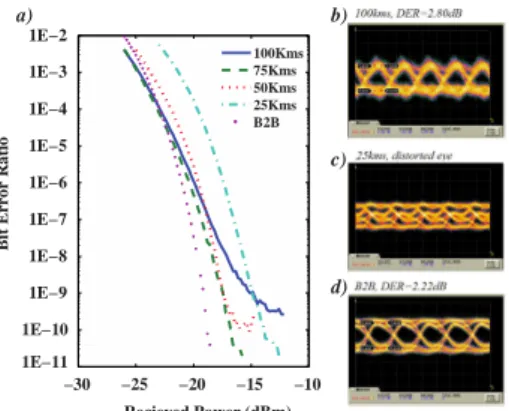
-1 long words. Power launched into the fibre is maintained to +3dBm in order to minimize the non-linear effects. The transmitted NRZ signal is sent to an APD receiver before error detection. Fig.3a shows the bit error rate (BER) measured at 25°C. Biasing current and peak-to-peak modulation current are chosen to optimize the transmission after 100kms in SMF and these conditions are kept constant for other transmission distances. Floor free transmission at 10 Gbps up to a bit-error rate of 1E-10 is achieved over 1E-100kms of SMF. DER is 2.8dB (fig. 3b-d). It can be noticed that the BER curve for 25kms has a larger penalty compared to the other distances. This can be related to the interaction of the laser chirp with fiber dispersion as discussed in [5, 14]. Thus, the QDash based
2
DMLs have the potential to transmit over distances as long as 100kms, without resorting to any external control. However, the ER remains not compatible with access standards (2.7 instead of 6dB).
−30 −25 −20 −15 −10 1E−11 1E−10 1E−9 1E−8 1E−7 1E−6 1E−5 1E−4 1E−3 1E−2 Recieved Power (dBm) B it E rr o r R a ti o 100Kms 75Kms 50Kms 25Kms B2B a) b) c) d)
Fig3 Optical transmission without an Etalon filter
a BER without using the etalon filter
b-d Corresponding eye diagram after 100 km transmission at 25 kms and in B2B
These measurements were subsequently repeated with a conventional etalon filter added before the fiber span. The steepness of the etalon is around 1dB/GHz, which is consistent with the adiabatic chirp of the laser. The low steepness value of the filter make the amplitude reshaping robust to any variations. The filter conditions are set and fixed for the entire range of distances measured, i.e no adjustment to the filter is required for distance from B2B all the way to 100kms. ER after the etalon filter is found to be greater than 6dB as shown in fig. 4(b). One can note that the introduction of filter in the optical channel resulted in the Bit-error-ratio curves to be almost penalty free (fig. 4).
The Quantum Dash based transmitters combined with a commercial etalon filter hence prove to be very adapted for long reach access networks. The advantage of this approach is that the filter conditions are not changed over the entire range of distances, thus yielding very high flexibility. Also, this method requires no feedback loop. These transmitters can also be used to achieve a high split ratio, and thus reducing cost of the access network infrastructure. −30 −25 −20 −15 −10 1E−11 1E−10 1E−9 1E−8 1E−7 1E−6 1E−5 1E−4 1E−3 1E−2 Recieved Power (dBm) B it E rr o r R a ti o 100Kms 75Kms 50Kms 25Kms B2B a) b) c) d)
Fig4: Optical transmission using on Etalon filter
a BER with etalon filter
b-d Corresponding eye diagram after 100 km transmission at 25 kms and in B2B
Conclusion: In this work we demonstrate compact, low consumption,
long-reach optical transmitters for NGPON2 using Q-Dash DML. Error free transmission in the range of 0 to 100kms at constant biasing conditions was demonstrated. These results reinforce the high potential of p-doped Qdash active layers for high bit rate modulation and open the way to truly low-cost DML for access and metropolitan applications. In addition using an etalon filter with the QDash-DML leads to a high extinction ratio with high tolderence to the filter conditions. We believe that this approach has the potential to provide optical sources for
NGPON2, which require a high optical budget, longer reach to remote
ONUs with high flexibility.
Acknowledgments: The authors would like to acknowledge the support of
EU FP7 ITN PROPHET, grant no. 264687 and the Agence Nationale de la Recherche, France for the DIQDOT project.
© The Institution of Engineering and Technology 2014 20 December 2013 doi: 10.1049/el.2013.4121
One or more of the Figures in this Letter are available in colour online. S. Joshi, N. Chimot, A. Accard, J.-G. Provost, F. Franchin and F. Lelarge (III-V Lab, A Joint Laboratory of ‘Alcatel Lucent Bell Labs’, ‘Thales Research & Technology’ and CEA-LETI, Route de Nozay, 91460 Marcoussis, France)
E-mail: [email protected]
L.A. Neto (Enssat, 6, rue de Kerampont, 22305 Lannion, France) Q4 A. Ramdane (LPN-CNRS, Route de Nozay, 91460 Marcoussis, France)
References
1 Kazovsky, L., Shaw, W., Gutierrez, D., Cheng, N., and Wong, S.: ‘Next-generation optical access networks’, J. Lightwave Technol., 2007, 25, pp. 3428–3442
2 Mizuhara, O., Nguyen, T.V., Tzeng, L.D., and Yeates, P.D.: ‘10 Gbits/s transmission experiment using direct modulation and including 8:1 time division-multiplex setup’, Electron. Lett., 1995, 31, pp. 660–662
3 Morton, P.A., Tanbun-Ek, T., Logan, A., Ackerman, D.A., Shtengel, G., Chand, J.E., Johnson, R.D., Yadvish, R.D., Sergent, M., and Sciortino, P.F.: ‘High speed, low chirp, directly modulated 1.55 µm
DFB laser sources for 10 Gbit/s local distribution’. Proc. Optical Fiber Communication, 1996, TuH6, pp. 39–40
4 Matsui, Y., Mahgerefteh, D., Zheng, X., Liao, C., Zhencan, F.F., McCallion, K., and Tayebati, P.: ‘Chirp-managed directly modulated laser (CML)’, IEEE Photonics Technol. Lett., 2006, 18, pp. 385–387
5 Wedding, B.: ‘New method for optical transmission beyond dispersion limit’, Electron. Lett., 1992, 28, pp. 1298–1300
6 Binder, J., and Kohn, U.: ‘10 Gbit/s-dispersion optimized transmission at 1.55 µm wavelength on standard single mode fiber’, IEEE Photonics Technol. Lett., 1994, 6, pp. 558–560
7 Feuer, M.D., Huang, S.Y., Woodward, S.L., Coskun, O., and Boroditsky, M.: ‘Electronic dispersion compensation for a 10 Gb/s link using a directly modulated laser’, IEEE Photonics Technol. Lett., 2003, 15, pp. 1788–1790
8 Lelarge, F., Brenot, R., Rousseau, B., Martin, F., Poingt, F., Legouezigou, L., Pommereau, F., Accard, A., Make, D., Chimot, N., and Van Dijk, F.: ‘Effect of p-doping on temperature and dynamic per- formances of 1550 nm InAs/InP quantum dash based lasers’. IEEE Int. Conf. Indium Phosphide & Related Materials’, 2009, ThB1.6, pp. 383– 386
9 Chimot, N., Joshi, S., Lelarge, F., Accard, A., Provost, J.-G., Franchin, F., and Debregeas-Sillard, H.: ‘QDash-based directly modulated lasers for next-generation access network, photonics technology letters’, IEEE, 2013, 25, (17), pp. 1660–1663
10 Zou, Q., Merghem, K., Azouigui, S., Martinez, A., Accard, A., Chimot, N., Lelarge, F., and Ramdane, A.: ‘Feedback-resistant p-type doped InAs/InP quantum-dash distributed feedback lasers for isolator-free 10 Gb/s transmission at 1.55 µm’, Appl. Phys. Lett., 2010, 97, pp. 231115– 231118
11 Chimot, N., Joshi, S., Aubin, G., Merghem, K., Barbet, S., Accard, A., Ramdane, A., and Lelarge, F.: ‘1550 nm InAs/InP quantum dash based directly modulated lasers for next generation passive optical network’. Indium Phosphide and Related Materials (IPRM), 2012, 27–30 August 2012, vol., no., pp. 177–180
12 Provost, J.G., and Grillot, F.: ‘Measuring the ‘chirp and the linewidth enhancement factor of optoelectronic devices with a Mach–Zehnder interferometer’, IEEE Photonics J., 2011, 3, (3), pp. 476–488
13 Saunders, R.A., King, J.P., and Hardcastle, I.: ‘Wideband chirp measurement technique for high bit rate sources’, Electron. Lett., 1994, 30, (16), pp. 1336–1338
14 Mohrdiek, S., Burkhard, H., Steinhagen, F., Hillmer, H., Losch, R., Schlapp, W., and Gobel, R.: ‘10-Gb/s standard fiber transmission using directly modulated 1.55-µm quantum-well DFB lasers’, IEEE Photonics Technol. Lett., 1995, 7, (1), pp. 1357–1359