Université de Montréal
Does Acculturation Equal Identification? Two studies
with Latin-American Immigrants
par Diana Cárdenas
Département de psychologie Faculté des arts et sciences
Mémoire présenté à la Faculté des arts et sciences en vue de l’obtention du grade de Maître ès Sciences (M. SC.)
en Psychologie
Décembre, 2011
Université de Montréal
Faculté des études supérieures et postdoctorales
Ce mémoire intitulé:
Does Acculturation Equal Identification? Two Studies with Latin-American Immigrants
Présentée par : Diana Cárdenas
évalué par un jury composé des personnes suivantes :
Jean-Claude Lasry, Ph.D., président-rapporteur Roxane de la Sablonnière, Ph.D., directeur de recherche
RESUMÉ
Partout, des millions d'immigrants doivent apprendre à interagir avec une nouvelle culture (acculturation) et à s’y identifier (identification). Toutefois, il existe un débat important sur la relation entre l’acculturation et l’identification. Certains chercheurs les considèrent comme étant des concepts identiques; d’autres argumentent qu'un lien directionnel unit ces concepts (c.-à-d. l'identification mène à l'acculturation, ou l'acculturation mène à l'identification). Toutefois, aucune étude n'a pas investigué la nature et la direction de leur relation. Afin de clarifier ces questions, trois modèles théoriques testeront la relation entre l’acculturation et l’identification et deux variables centrales à l’immigration, soit être forcé à immigrer et l’incohérence des valeurs. Dans le premier modèle, les variables d'immigration prédirent simultanément l'acculturation et l'identification. Le second modèle avance que les variables d'immigration mènent à l'identification, qui mène à l'acculturation. Le troisième modèle précis plutôt que les variables d'immigration prédisent l'acculturation, qui prédit l'identification. Le premier modèle propose que l'acculturation et l'identification sont le même concept, tandis que les second et troisième stipulent qu'ils sont différents (ainsi que la direction de leur relation). Ces modèles seront comparés afin d’examiner l'existence et la direction du lien qui unit l'acculturation et l'identification. Lors de la première étude, 146 immigrants latino-américains ont répondu à un questionnaire. Les analyses des pistes causales appuient le troisième modèle stipulant que l'acculturation mène à l'identification et, donc, qu'ils sont des concepts distincts. Les résultats ont été confirmés à l’aide d’une
deuxième étude où 15 immigrants latino-américains ont passé une entrevue semi-structurée. Les implications théoriques et pratiques seront discutées.
ABSTRACT
At present, millions of immigrants are learning to participate (acculturation) and identify to a new culture (identification). In acculturation research, there is considerable debate about the relationship between acculturation and identification. While some researchers consider them as identical concepts, other researchers argue that they are distinct. In addition, it is unclear which variable is at the origin of the other one. The aim of our research is to clarify the distinction and relationship of the variables. To this end, three theoretical models will be tested; they will differ on how acculturation and identification relate to two important immigration variables (coerciveness to immigrate and value incongruence). The first model states that the immigration variables simultaneously predict acculturation and identification. The second model affirms that the immigration variables predict identification, which then predicts acculturation. The third model is similar but instead acculturation predicts identification. Thus, if acculturation and identification have the same relationship to the two immigration variables (first model), they represent a single construct. However, if identification leads to acculturation (second model), they must be different concepts, identification prompting acculturation. Nonetheless, if acculturation leads to identification (third model), then these variables are not only different but acculturation influences identification. In the first study, 146 Latin American immigrants responded to a questionnaire. Path analyses support the third model, suggesting that acculturation leads to identification. The results were confirmed
in a second study, where the semi-structured interviews of 15 Latin American immigrants were analyzed. The theoretical and practical implications are discussed.
Table of Contents
Table of Contents i
List of Tables ii
List of Figures iii
List of Acronyms and Abbreviations v
Acknowledgement vii
Introduction 1
Chapter 1 6
Cultural Identity 8
Acculturation and Cultural Identification 9
Coerciveness to Immigrate 18 Value Incongruence 23 Overview of Studies 26 Chapter 2 30 Method 30 Results 36 Discussion 41 Chapter 3 44 Method 45 Results 50 Discussion 63
Chapter 4 66 Implications 68 Limitations 72 Future Research 74 Conclusion 79 References 80 Annexe A xiii
Questionnaire of Study 1 English
Annexe B xxviii
Questionnaire of Study 1 Spanish
Annexe C xliii
Instructions of Narratives English
Annexe D xlvii
List of Tables
Table 1. The acculturation schools of thoughts and the acculturation models 14 Table 2. Study 1: Alpha scores and means for participant's personal 33
and Canada/Quebec cultural values
Table 3. Study 1: Means and standard deviations 37
Table 4. Study1: Correlations between being forced to immigrate, value
incongruence, and measures of identification 37
Table 5. Study 2: Means and standard deviations 62
Table 6. Study 2: Correlations between being forced to immigrate, value
List of Figures
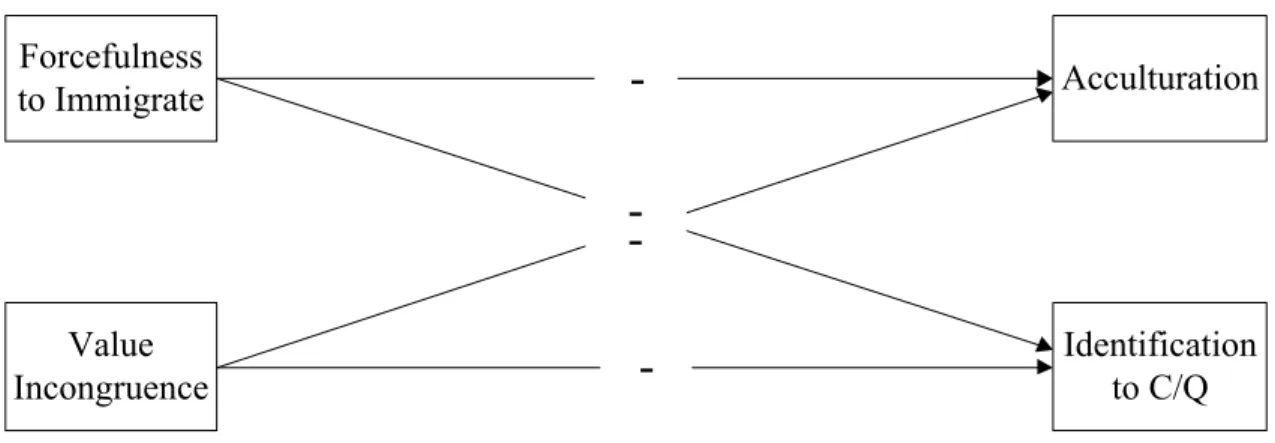
Figure 1. Model 1, where it is predicted that coerciveness to immigrate and value incongruence predicts acculturation as well as identification with the new culture. Acculturation and identity processes are
considered to be the same. 27
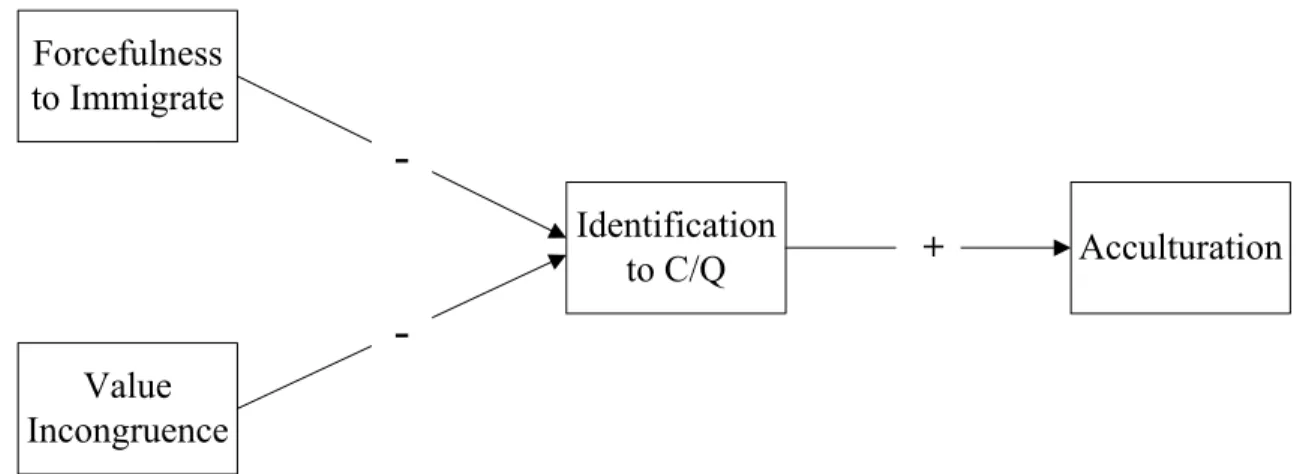
Figure 2. Model 2, where it is predicted that coerciveness to immigrate and value incongruence predicts identification which will in turn
predict acculturation to the new culture. 28
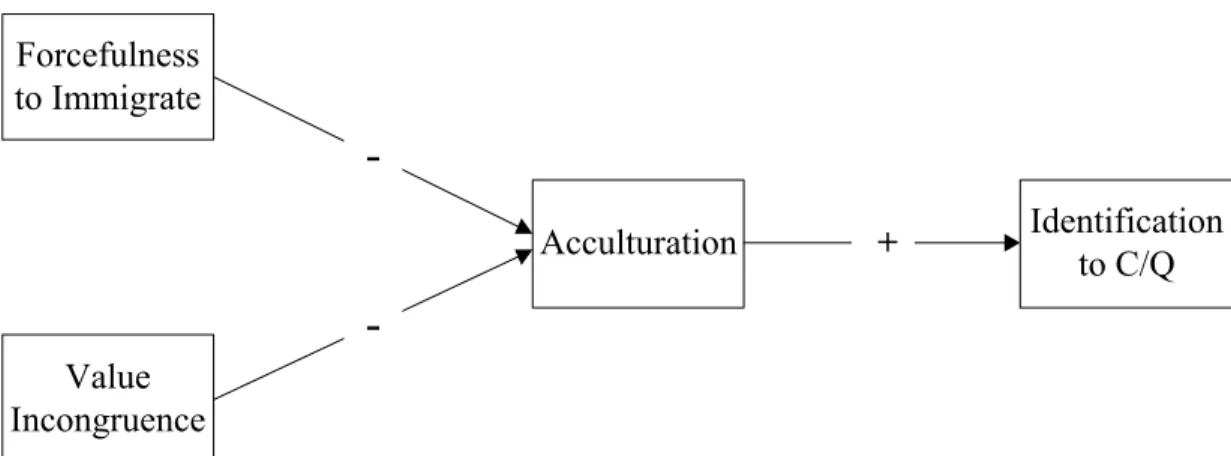
Figure 3. Model 3, where it is predicted that coerciveness to immigrate and value incongruence predicts acculturation which will in turn
predict identification with the new culture. 29
Figure 4. First model, where acculturation and identity processes are considered to be the same. Results show that coerciveness to immigrate and
value incongruence do not predict cognitive identity, nor
identity integration. 38
Figure 5. Second model, where acculturation and identity processes are considered to be different. Results show that coerciveness to immigrate and
value incongruence do not predict cognitive identity, nor
Figure 6. Third model, where acculturation and identity processes are considered different. Results show that coerciveness to immigrate and
value incongruence predict acculturation, which in turn predicts
List of Acronyms and Abbreviations
CFI Comparative Fit IndexN Total number of cases in a sample
p Probability of a success in a binary trial
r Pearson product-moment correlation coefficient RMSEA Root mean square error of approximation SD Standard deviation
This Master’s thesis is dedicated to every immigrant in the world. It is with their stories and faces in mind that this thesis was written
Acknowledgements
I would like to thank my thesis director Roxane de la Sablonnière, who true to her title directed me towards exceeding my own expectations. It is thanks to her passion for excellence and for ideas that change the world that today I can proudly present this Master’s thesis. I also thank the president of the jury, Dr. Jean-Claude Lasry and the member of Jury, Dr. Mireille Joussemet for their invaluable comments when revising this Master’s thesis.
My deepest gratitude go towards past and present members of the Laboratoire de recherche sur l’identité et les changements sociaux. Without the invaluable help of Fabrice, Émilie, Esther, Raphael, Marie-Claire, Mariam, and Mathieu the ideas
presented below would not have matured. I am particularly thankful to Laura, my desk neighbour and companion in the Master’s road who challenged my ideas, inspiring me to give my best while giving me courage.
I also thank my family, Alberto, Martha, Laura and Paola for being an important part of my growth as a person, and for giving me the support and love I needed to pursue my studies. It is thanks to them that the ideas in this thesis were born. I would also like to thank Clemencia Mesa and Arturo Oliveros for their assistance in the second study. I express my deepest gratitude to Maxime, who continually reminds me of what the most important thing in life is, refocusing my vision whenever it got lost; I thank him for his love. I also thank Gianina, Anne-Marie, Danielle and David for giving me
I am also grateful to the Social Sciences and Humanities Research Council (SSHRC) and the Université de Montréal for their financial support.
Last but not least, I am eternally grateful to Jesus Christ, my God and Saviour, for giving me strength in my weakness and for giving me a hope for a better future.
Introduction
In 2006, 19.6% of the Canadian population was of immigrant origin (Statistics Canada, 2007); that is, one out of five Canadians was an immigrant. This number is projected to augment by the year 2031, increasing to 29%- 32% of the population, with Arabs and West Asians being the groups that will increase the most (Statistics Canada, 2010). The projections also estimate that this same percentage of Canadians will have a mother tongue different from French and English, and 14% of them will have a non-Christian religion. What these statistics show is that immigration in Canada, as in most western countries, is a reality that cannot be denied. The increased number of immigrants has lead (and will continue to lead) to an increasingly diversified population, where people with different visions of the world come together and integrate the different ways of viewing the world. Even though studying such social changes from a societal framework is essential, it is also fundamental to understand each individual immigrant’s perspective and their ways of integrating such changes. After all, healthy citizens make for healthy societies.
The present master’s thesis explores two important and related changes that each immigrant must undergo: the first one refers to behavioural changes, how immigrants come to behaviourally participate in the new culture. This is reflected on how comfortable they feel participating in cultural activities, as well as on how satisfactory they find their relations with people from the new culture; this, in essence, is acculturation. The second change studied here refers to changes in identity, that is, how
an immigrant comes to identify, view, or consider himself as part of a new cultural group.
The relationship between acculturation and identification is not always clear in psychology. Sometimes, they are considered to be the same (acculturation = identification). However, sometimes, they are believed to be two different variables (acculturation ≠identification). Indeed, there is mixed literature on how these concepts relate to each other and no evidence directly testing the similarity or distinctiveness of the concepts (“acculturation = identification” vs. “acculturation ≠identification”).
Establishing the sameness or distinctiveness of these constructs is essential, both theoretically and practically. By settling whether acculturation and identification are the same or not, researchers will be better equipped to ask and answer the difficult immigration questions. For example, if acculturation is found to be conceptually different but leading to identification, researchers may be able to explore the circumstances that promote, or hinder the relationship between these variables. In more applied work, integration programs for immigrants can be evaluated using acculturation and identification separately, as the programs may have different effects on these variables. Thus, establishing the difference between these two variables can have important ramifications.
The first goal of the following master’s thesis is to disentangle the ambiguity in acculturation literature. It will empirically examine the two opposite hypothesis (“acculturation = identification” vs. “acculturation ≠identification”) by probing how acculturation and identification relate to two important pre and post immigration variables: coerciveness to immigrate (i.e., how forced people felt to immigrate) and
value incongruence (i.e., the difference between people’s own values and the values perceived in the new culture).
By trying to establish whether acculturation and identification are different or not, another important question arises. If these two constructs are the same, there is no need to question which concept originates the other. However, if the concepts are different, then we need to explore the directionality of their relationship. We need to determine whether acculturation facilitates identification, or rather, whether identification leads to acculturation. Therefore, the second goal of this Master’s thesis is to determine the direction of the relationship between these variables by making use of coerciveness to immigrate and value incongruence.
To this end, three models will be proposed and tested. If Model 1 (acculturation = identification) is found to be true, that is, if the external immigration variables have the same relationship with acculturation and with identification, then we can conclude that they are indeed the same variables. If, on the other hand, Model 2 (acculturation ≠ identification, and identification leads to acculturation) is acceptable, then we can conclude that they are two different constructs and that identification precedes and leads to acculturation. Lastly, if Model 3 (acculturation ≠identification, and acculturation leads to identification) is confirmed, it would also imply that acculturation and identification are two different concepts, but it would presuppose that identification will not take place without acculturation. By testing these three models, we will be able to determine whether acculturation and identification are the same or different concepts and, if indeed they are different, which concept determines the other (see Table 1 in page 12 for a summary of the models).
This master’s thesis is divided in four chapters. This first chapter consists of the theoretical context. First, the concept of identification and acculturation will be explored, emphasising the contradiction that is found in literature (“acculturation = identification” vs. “acculturation ≠identification”) and the importance of testing which model is correct. In addition, we will explore the possible direction of the relationship between these two concepts, that is, if identification leads to acculturation or vice versa. Afterwards, the external factors (i.e., coerciveness to immigrate and incongruence of values) used to test the sameness or difference between the concepts are fully explained. Subsequently, the three models will be presented (Model 1: acculturation = identification; Model 2: acculturation ≠identification, and identification leading to acculturation; Model 3: acculturation ≠identification, and acculturation leading to identification).
The second chapter will discuss the methodology employed in the first empirical study used to test the models. This is a quantitative study, where Latin American immigrants to Canada (N = 147) answered a questionnaire. The results of the path analysis performed in order to test the three models are presented, followed by a discussion of the results and the need to obtain the same results with a different methodology.
The third chapter presents the second study, which has a qualitative methodology and is carried out to replicate the results previously found. Fifteen immigrants selected from the first study narrated their immigration stories. After their stories were coded for the main variables, the results of their narratives were analysed. A discussion of results follows.
Lastly, the fourth chapter will discuss the theoretical and practical implications of the results, and the methodological issues of the studies. This chapter also explore the repercussions of distinguishing acculturation from identification. Lastly, it highlights indications for future studies by exploring how social norm theory and cognitive dissonance theory can influence the relationship between acculturation and identification.
CHAPTER 1
As immigrants arrive to a new country, they are faced with many challenges. Some of them are everyday struggles that can have an important effect on their well-being. For example, they must find a place to live, get a bank account, a health insurance card and a driver’s licence, try to get a job, and very likely learn a new language. As they juggle with the practicalities of everyday life in a new country, immigrants must also deal with the pressing psychological changes they are experiencing.
An important change experienced by immigrants is in their self-concept. They have to confront the ever pressing question “who am I?”, and more importantly, “who am I, now that I discovered a different way of being in this new culture?” By being introduced to a new country, they undergo changes in their identity, in the way they define themselves, and in how they construct their self-definition. These changes in an immigrant’s self-concept can have significant consequences for their personal (e.g., well-being, Benet-Martinez, Leu, Lee, & Morris, 2002) and social lives (e.g., tolerance of other groups, Rocas & Brewer, 2002).
Another change that comes as a result of living in a new country is that immigrants have the possibility of living in and appreciating a new culture. They have the opportunity to create friendship ties with people from a different culture, as well as participate in new traditions. In other words, immigrants have the unique potential of “walking in the shoes” of a person from a different culture. By changing their behaviour
and making it similar to the one observed in people from the new cultural group, immigrants acculturate.
These two changes, changes in behaviour (acculturation) and changes in self-concept (identity) occur as a consequence of intercultural contact. They can occur simultaneously, and in the same direction. This could imply that both concepts are similar, so similar in fact that they are the same concept. However, this is not necessarily so; they could be related yet unequal concepts. What is the true relationship between participating in the new culture, or acculturating, and cultural identification?
The goal of the research presented in the following chapters is to better understand the relationship between acculturation and identification, by making use of two important immigration variables, coerciveness to immigrate (or feeling forced to immigrate) and value incongruence. More specifically, we will test whether acculturation and identification are the same (e.g., Wong-Rieger & Quintanta, 1987) or different constructs (e.g., Ward, Bochner & Furnham, 2001), by examining their relationships to coerciveness to immigrate and value incongruence. If acculturation and identification are the same, we would expect them to have the same relationship to coerciveness to immigrate and value incongruence. However, if acculturation and identification are different constructs, they should have a different relationship to both immigration variables. Nonetheless, before attempting to further comprehend the relation between these variables, we must first understand how a person comes to identify to a new culture.
Cultural Identity
Social identity has been famously defined by Tajfel (1978) as the “part of an individual’s self-concept which derives from his knowledge of his membership of a social group together with the value and emotional significance attached to that group” (p. 63). In other words, it is the part of a person’s identity that exists because he knows that he belongs to a group, that this group has a certain value, as well as a certain emotional significance (Ellemers, Kortekaas, & Ouwerkerk, 1999). According to Taylor (1997), one’s cultural group is a particularly important source of one’s social identity because it provides individuals with an overarching framework or blueprint of what to believe, and how to behave, in a specific culture (Taylor, 1997). In other words, identification with a specific cultural group enables individuals to think and behave appropriately in that specific culture, by providing them with self-knowledge based on their group’s characteristics, such as a shared history, language and values (Berry, 1980).
The importance of culture in one’s identity is exemplified by the number of theories about the self that place culture as the reference point of one’s identity (Sussman, 2000). For example, Markus and Kitayama (1991) believe that the culture a person is born in determines whether he has an independent, or an interdependent self-construal. Similarly, terror management theory (Solomon, Greenberg, & Pyszczynski, 1991) states that many of one’s culturally-relevant behaviours exist to protect against existential anxiety. These theories serve to illustrate the essential role of culture in one’s self and identity.
Cultural identity and the self are usually considered to be very static concepts. A Canadian will generally have a Canadian identity throughout his life time; a Colombian will generally have a Colombian identity. As long as these people remain in their culture, their cultural identity will not change but rather remain the same. However, when an individual experiences major life changes, the self-concept undergoes change (Amiot, de la Sablonnière, Terry & Smith, 2007). Modifications in cultural identity are even more notorious when immigration is the change taking place because an individual is now in contact with a culture that is different from the person’s culture of origin. This contact may lead to changes in the self-concept such that the individual starts thinking of himself as part of the new cultural group. He can start identifying to people in the new culture and viewing himself as a member of new cultural group. Among immigrants, one of the important correlates of identifying to the new cultural group is acculturation. Acculturation and Cultural Identification
Graves (1967) was the first person to use the term “psychological acculturation”, which he defined as the change in worldview that occurs in groups (or individuals) as a result of being in contact with another cultural group. In addition, Graves explains that a person must identify to the new cultural group in order to acculturate, thus, giving them different definitions and functions. Nevertheless, after this explanation, he uses the words acculturation and identification as if they were synonyms, erasing the distinction that he had created between the two terms. Graves’ text reflects the confusion that has plagued the social sciences since.
After Graves, the words acculturation and identification have been used interchangeably by some researchers, as if they were synonymous of each other, while others have clearly given them different definitions and roles. However, even after 40 years of acculturation research, confusion still remains as to how these concepts relate to each other. No one has clearly determined whether they are the same or different, or whether one leads to the other. This can be exemplified by examining Berry’s (1997) popular theory of acculturation.
Berry (1997) presents acculturation as being bidimensional; a person can acculturate to a new culture and to the culture of origin, and these two levels or dimensions of acculturation are independent of each other. Based on these two dimensions, Berry created four categories or strategies of acculturation where immigrants and other minority groups fit, depending on their level of acculturation to both cultures. Even though Berry’s theory has inspired many researchers, one of the criticisms that his theory faces is the lack of psychological content in the classification of acculturation (Rudmin, 2003). This can be exemplified by the fact that Berry uses acculturation and identification as if they were synonyms. Thus, the unclear relationship between these two concepts has permeated even one of the most cited acculturation theories today.
In terms of acculturation’s definition, the one commonality found among many studies is that acculturation implies that an individual changes his behaviour (Berry, 1997; Berry, Kim, Minde, & Mok, 1987; Gordon, 1964; LaFramboise, Coleman, & Gerton, 1993; Ryder, Alden, & Paulhus, 2000; Ward et al., 2001; Wong-Rieger &
Quintanta, 1987). Considering this pattern in the definition of acculturation, it is henceforward defined as the changes observed in individuals’ behaviour that is the result of contact with a different culture.
It is usually believed that individuals living in contact with a culture different from their own for an extended period of time will not only learn the social skills and knowledge of the new culture but will also integrate, to some extent, the new cultural identity (Cuellar, Arnold, & Gonzalez, 1995). This is evidenced by the personal testimonies of immigrants who return to their country of origin and feel that they no longer belong there. Their self-concept has changed, and they can no longer define themselves solely as Colombians, for example.
As Trimble (2003) points out, many researchers believe there is an important relationship existing between acculturation and identity; however, few have been able to clarify their relationship because these are very complex and intertwined constructs. Nevertheless, exploring the sameness or distinctiveness of these variables has important theoretical and practical consequences. At a theoretical level, it will not only allow researchers to better understand the relationship between the two variables (e.g., when and how they predict each other), but it will also lead to exploring new questions (e.g., does acculturation lead to more identification?). At a more practical level, better understanding their relationship will lead to being able to better target policies and interventions with immigrants. For example, if we determine that acculturation and identification are different and that indeed acculturating to a new culture leads to
identifying to it, then policy makers could target the acculturation of immigrants, knowing that identification with the new culture will follow.
Few studies that have examined the relationship between acculturation and identification, and they are thus described. Phinney (2003) showed with a multiple regression that individuals who acculturated (here measured as the extent to which immigrants interact with Americans as well as their English proficiency) tended to have a higher levels of American identity. However, the statistical analysis does not allow us to determine whether the two concepts are the same or not, nor the direction of the relationship.
Hutnik (1986), on the other hand, categorized individuals according to their level of identification to the new culture and to the culture of origin. More specifically, inspired by Berry’s (1997) four acculturation strategies, Hutnik proposed four identity strategies. Individuals were placed in one of the categories, depending on their levels of identification to the new culture and the culture of origin. Then the different identity strategies were compared in their acculturation level (or social adaptation, in Hutnik’s term). Results from this study showed that, in general, individual’s identity strategies did not necessarily predict acculturation. A follow-up study by Snauwaert, Soenens, Vanbeselaere, and Boen (2003) showed that Hutnik’s identity strategies do not necessarily relate to Berry’s acculturation strategies either. In other words, a person who highly acculturates to the new and original culture does not necessarily identify highly to the new and original culture.
Even though these two studies are pioneers in that they are testing the relationship between acculturation and identification, there are two important shortcomings that must be highlighted. In both studies, individuals were categorized based on Berry’s (1997) four acculturation strategies; as a consequence, some of the criticisms aimed at Berry’s theory (Rudmin, 2003) applies to it. More specifically, by theorising categories and then forcing data into these categories, an important source of bias is introduced (Rudmin, 2003) and thus, the true relationship between acculturation and identification cannot be understood. In addition, by putting individuals into categories, statistical variance is removed, which may have an important effect on results. Second, the directional relationship between these two concepts is not determined, as their statistical methods and their methodology do not test whether acculturation leads to identification or the opposite. Thus, even though these studies highlight the importance of studying the sameness or differences between acculturation and identification, no clear conclusion can be made. As such, confusion in the field continues to reign, as some believe they are synonyms, while others consider them as different (Liebkind, 2006).
There are two general schools of thought in acculturation literature that describe the relationship between acculturation and identity in different ways (see Table 1). In both literatures, acculturation clearly refers to changes in an individual’s behaviour as a result of being in contact with another culture (Berry, 1997; Berry et al., 1987; Gordon, 1964; Hutnik, 1986; LaFramboise et al., 1993; Liebkind, 2006; Ryder et al., 2000; Snauwaert et al., 2003; Ward et al., 2001; Wong-Rieger & Quintana, 1987). However,
both views differ as to how they define identity in terms of acculturation (i.e., the same as, or different from, acculturation) and to their relationship (one directly predicts the other, or both are covariant).
The first school of thought posits that an acculturating individual acquires a new identity within the self while he integrates behavioural characteristics of the new cultural group (see Table 1; Berry, 1997; Berry & Kim, 1988; Berry et al., 1987; Cuellar et al., 1995; Snauwaert et al., 2003; Ryder et al., 2000; Wong-Rieger & Quintanta, 1987). In other words, identification is a form of acculturation, because it is an internal change, but a change nonetheless. According to this view, acculturation and identification with the new cultural group cannot be separated, because a person who behaves in a “Canadian way” must, without a doubt, also see himself as a “Canadian”. Therefore, a Colombian immigrant will integrate the Canadian identity at the same time as he creates social relationships with Canadians and participate in its traditions. As Kosmitzki (1996) summarizes it, this acculturation model implies that the new cultural identity is acquired as the person learns social skills and knowledge concerning the new cultural context. Table 1
The acculturation schools of thoughts and the acculturation models
Schools of thought Definition of the school Models Definitions of the models First school of
thought Acculturation = Identification
Model 1 Acculturation and identification occur simultaneously
Second school of
thought Acculturation ≠ Identification
Model 2 Identification leads to acculturation Model 3 Acculturation leads
Following the new cultural group’s behaviour is enough to create in a person a cultural identity.
Empirically speaking, Berry, Kim, Power, Young and Bujaki (1989) found that people who participate in activities of the new society (e.g., participating in clubs, reading newspaper from the new culture) tend to have a higher desire to be in contact with the new culture. However, they did not directly test participants’ cultural identity, thus not confirming that acculturation and identification are the same concepts. This way of conceiving the variables remains to be tested.
The second acculturation school of thought believes that being in contact with the new culture does not necessarily mean that immigrants integrate its identity (see Table 1). As Ward, Bochner and Furnham (2001) point out, successful immigrants will acquire the functional skills that enable them to succeed in the new environment; however, this may be independent from any changes in their identity. In other words, just because an individual adopts the behaviour of the new culture, it does not mean that he necessarily has a sense of belonging to the new cultural group.
Rosenthal, Bell, Demetrious and Efklides (1989) gave initial (yet statistically unclear) evidence for this hypothesis. In addition, more evidence was given by Wong-Rieger and Quintana (1987). Even though they considered identity changes as being part of acculturation, they measured behavioural acculturation apart from identity changes. Their results show that behavioural acculturation (e.g., working) was easier to integrate than cognitive (e.g., language) and self-identity (self-labelling) changes. Their results show that acculturation does not take place at the same rate as identity changes. In
addition, results from Hutnik’s (1986; Snauwaert et al,. 2003) study also point towards the difference between these concepts.
Some of the researchers that have differentiated between these two concepts have also postulated that identification is a prerequisite to acculturation. Graves (1967), for example, believed that identification with a new culture was necessary if an individual was to acculturate to it; according to him, believing that one belongs to a new culture is an antecedent and a requirement to changing the way one behaves. However, this directionality has not been tested. Even more, it is also possible to conceive of the opposite relationship between these concepts, such that acculturation or participation in a new culture leads to higher identification. Specifically, acculturation may introduce immigrants to the new cultural group, allowing them to experience the similarities and differences between the new group and themselves. By means of this participation, immigrants may be able to understand how the cultural group defines itself and eventually integrate this new definition into this self-concept (see Table 1).
In summary, many have theorized about the sameness or distinction of these psychological variables. Some acculturation researchers have hypothesized that acculturation and identification are essentially the same construct. Others believe that they must be conceptualized as two different variables. In addition, those espousing this view also consider that identification leads to acculturation even though the opposite directionality may also be possible.
As far as it is known, no one has empirically tested the difference or sameness of the acculturation and identification construct. Indeed, as the previously mentioned
literature shows, very few researchers have attempted to empirically explore this question (Rosenthal et al., 1989; Wong-Rieger & Quintana, 1987). Since the relationship between these variables has not been established (same versus distinct), the direction of this relationship also remains unclear. Therefore, the present thesis has two goals: first, to test the sameness or distinction of acculturation and identification, and second to test the directionality of these variables (identification leads to acculturation or acculturation leads to identification).
The two following studies will determine which of the two acculturation traditions is empirically supported as well as the casual direction of the relationship by testing three different models; in the first model, two important immigration variables, coerciveness to immigrate, and value incongruence, will simultaneously and directly predict both acculturation and identity. Model 1 implies that acculturation and identification are the same construct by expecting them to have the same relationship to the immigration variables (see Table 1).
In the second model, the two important immigration variables will only directly predict identification, which will in turn predict acculturation. Model 2 connotes that acculturation and identification are two different constructs, and that acculturation only arises after identification takes place (refer to Table 1).
Lastly, the third model presents coerciveness to immigrate and value incongruence as directly predicting acculturation, which will in turn predict identity. Just as Model 2, Model 3 also suggests that acculturation and identification are different.
However, it proposes that acculturation will give rise to identification, as opposed to Model 2 (see Table 1).
By testing these three models and comparing them to one another, we will establish whether the two variables are different or the same, as well as the direction of the relationship. Therefore, we turn to understand our predictive variables, coerciveness to immigrate and value incongruence, and their relationship to acculturation and identification.
Coerciveness to Immigrate
Generally, acculturation researchers (e.g., Berry, 1997; Berry et al., 1987; Ward et al., 2001) mention several pre-immigration factors that influence the acculturation process. Some are demographic (e.g., age, time spent in the new country of residence) while others are psychological (e.g., coping strategy, locus of control). Most researchers believe that it is important to pay special attention to the economic, social, political and cultural factors in the society of origin, because they can illustrate a person’s reasons for immigrating; and, as Berry (1997) points out, “what led the acculturation group to begin the process (whether voluntary [or not]) appears to be an important source of variation in the outcome” (p. 26). In other words, the degree to which people felt forced to immigrate can determine an immigrant’s adaptation to the new culture. This can be so because feeling forced to immigrate summarizes several aspects of the pre-immigration process such as the economic/social/political/cultural situation of the society of origin, as well as the particular psychological factors of individuals that affect the adaptation process (e.g., desiring to increase their personal status). Considering that feeling forced
to immigrate summarizes several important pre-immigration factors, the present studies will use coerciveness to immigrate to better understand the relationship between acculturation and identification.
The term and distinction of voluntary versus involuntary immigration (Berry, 1997) is often employed in sociology (e.g. Taylor, 1969). For example, Richmond (1993) describes two types of immigrants: proactive and reactive. Proactive immigrants are those who decided to move after carefully considering all relevant information in order to maximize the advantages. Reactive immigrants, on the other hand, decided to move as they faced a crisis where the only perceived solution was to escape. Richmond (1993) argues that there is a quantitative difference between the two types of immigrants, which lies on the severity of the circumstances that caused migration; those that were more forced to immigrate (reactive immigrants) had very severe circumstances pushing them away from their countries. However, he did not specify how the differences between the two types of immigrants could affect their reaction to the new culture.
Most adaptation and acculturation models include coerciveness to immigrate as a variable that can affect people at any point of the process. For example, Berry (1997) believes that the adaptation process has five steps, beginning with being in contact with a new culture (first step) and finishing with adaptation (the last step). According to Berry, feeling forced to immigrate can affect the adaptation process in any of the five steps. Ward and colleagues (Ward et al., 2001) also believe that reasons for immigrating affect the acculturation and adaptation process; however, and again, they did not specify
where in the process (beginning with cross-cultural transition and finishing with adaptation) do reasons for immigrating, and ultimately, coerciveness to immigrate, affect an immigrant’s adaptation process.
We believe it is possible that coerciveness to immigrate will be most important when people are trying to participate in the new culture, that is, when they are acculturating because people who are forced to immigrate do so with an emotional and experiential “baggage” that other immigrants do not have. These people usually have lived very negative experiences in their country of origin (e.g., threats to their lives), and they have to cope with these experiences as they learn how to participate in a new culture. They have certain responses that can impede on their cognitive processes (Everly & Lating, 2004) and exploratory behaviour, which are important for learning abilities during cross-cultural contact (Allen, Vaage, & Hauff, 2006). As such, people who felt forced to immigrate should have difficulty acculturating to a new country. Initial evidence for the influence of coerciveness to immigrate on acculturation was given by Berry, Kim, Minde and Mok (1987). Nonetheless, instead of asking people how forced they felt to immigrate, they separated people according to their type of immigration visa (“immigrants”, “refugees”, and “sojourners” or international students with a student visa). They assumed that refugees were the individuals most forced to immigrate, and they tested whether these groups differed in their levels of acculturative stress (the stress experienced when one’s behaviour is in conflict with the behaviour appropriate in a new culture). Acculturative stress can be seen as an indirect measure of acculturation because individuals experiencing acculturation stress will avoid such a
feeling by not behaving in conflicting ways, which might require them to not participate in the host culture. As such, it is can be an indirect measure of acculturation.
Berry and associates (1987) found that immigrants with a “refugee” visa had the highest levels of acculturative stress, while “immigrants” (with a permanent resident visa) had the lowest levels. They concluded that “refugees” where more stressed by interaction with the new culture because they were forced to immigrate. Yet, two shortcomings in this study need commenting. First, it is not mentioned whether the difference in means is statistically significant, hence it cannot be concluded that one “type” of immigrant has less acculturation stress than another. Second, if the difference was significant, their degree of coerciveness cannot be assumed by their legal classification. For one, a boy who immigrates with his family may be classified as an “immigrant” even if s/he was forced to immigrate by his parents. Thus, it cannot be concluded that being forced to immigrate leads to lower acculturation stress based on the assumption that all “refugees” were forced to immigrate.
Further analysis of the sojourner sample (Berry et al., 1987) found that individuals who strongly desired to escape unpleasant situations had high acculturation stress. Again, this is not a direct measure of how much people felt forced to immigrate nor of their actual acculturation, but it gives initial evidence to the idea that feeling forced to immigrate impedes on acculturation.
Another study by Sayegh and Lasry (1999) also illustrates that coerciveness to immigrate and acculturation are related to each other. Even though this was not the main goal of their study, they found that people with different acculturation strategies (as
conceptualized by Berry, 1997) differed in their perceived coerciveness to immigrate. Even though the directional link cannot be established (perceived coerciveness affects acculturation, or acculturation affects perceived coerciveness), this study shows that there is a relationship between these variables.
Based on the theoretical and empirical evidence presented above, it is hypothesized that coerciveness to immigrate will negatively predict acculturation.
However, feeling forced to immigrate might not have a direct effect on identification with the new culture. This is so, because the characteristics that promote or hinder the integration of the new identity will only be experienced as the person is in actual contact with the new culture. For example, an individual will only be able to experience the similarities between the Colombian and Canadian identity when he has become acquainted with it. Without being in contact with the new culture, he will not be able to integrate the new cultural identity. Therefore, coerciveness to immigrate cannot affect identification with the new culture without first affecting his interactions with the new culture; unless, of course, acculturation and identification are in essence the same construct. Therefore, feeling forced to immigrate will be used as a predictor to settle whether acculturation and identification with the new culture are two different constructs or not.
If acculturation and identification with the new culture are synonymous, then feeling forced to immigrate should have a direct effect on acculturation and identification. That is, if they represent the same variable, we expect coerciveness to immigrate to have a direct and negative impact on both acculturation and identity
processes (i.e., identification with the new culture and identity integration). On the other hand, if acculturation and identification are not the same construct, there will be no direct effect of coerciveness to immigrate on identification; instead, there will be an indirect effect, where the effect of feeling forced on identification passes through acculturation. In other words, if acculturating doesn’t necessarily mean identifying more to the new culture, feeling forced to immigrate should directly and negatively affect acculturation, and affect identity processes (i.e., identification with the new culture and identity integration) indirectly (through acculturation).
In addition to using coerciveness to immigrate to test whether acculturating is the same construct as identifying to the new culture, we will use another variable: the perception of value incongruence.
Value Incongruence
Another important variable that has been shown to affect the acculturation process is the difference between a person’s culture of origin and the host culture in terms of language, religion, skin color, and others as such (Berry, 1997; Black, 1976; Ward et al., 2001). Generally, the greater the difference between two cultures, the harder the adaptation process is. One of the most important differences that needs to be evaluated is the difference or incongruence of values (i.e., the perceived difference between ones values and the values in the new culture) for two main reasons: first, both individuals and societies hold values and second, values represent what people consider to be important and what they stand for. When one’s personal values are incongruent with those in ones’ society, that is, when what one considers to be important is
incongruent with what society believes is important, one’s well-being suffers (Stromberg & Boehnke, 2001). But what is the consequence of this incongruence on acculturation and identification with the new culture?
A value is defined by Schwartz (1994) as a “belief pertaining to desirable end states [...]¸ that transcend specific situations [and that] guides selection or evaluation of behaviour, people and events [...]”. In other words, a value is a belief about desirable transsituational goals. At a more cognitive level, values are cognitive representations of basic human needs and they express individual, biological, and societal needs. Schwartz found ten distinct types of values and has empirically demonstrated their universality in content and relationship to each other (Schwartz, 1992, 1994). That is, Schwartz’s structure has shown to be universal, as there were very few variations differences when tested across 20 countries (Schwartz, 1992). The theoretical structure of values is such that some values are close to each other (e.g., benevolence and conformity) and congruent, while others are opposite (e.g., benevolence and hedonism) and incongruent in their essence. The pursuit of each one of the values has consequences at the level of the value structure; pursuing one specific value is most likely compatible with the values close to it (pursuing benevolence also allows one to pursue conformity) but incompatible with others opposite to it (pursuing benevolence does not allows one to pursue hedonism). This structure seems to hold even when an individual experiences value change (Bardi, Lee, Hofmann-Towfigh, & Soutar, 2009).
Every culture and every person differs in the importance they give to each value; for the Colombian immigrant, benevolence might be the most important value. At the
same time, he might perceive that for Canadians this value is not as important. When the individual finds himself in a position where his most important values are different from those in a society, he is said to experience person/society value incongruence. Sagiv and Schwartz (2000) noted that one of the reasons why value incongruence decreases well-being is because individuals living in a society with opposite values do not have the tools they need to pursue their own values (Sagiv & Schwartz, 2000). If the Colombian immigrant finds that the Canadian environment does not offer the tools required for him to express concern and care for his close ones, not only will he experience lower well-being, but he will also be less involved in the new culture. That is, if he experiences value incongruence, he will have trouble acculturating.
Research on organizational psychology has demonstrated how value incongruence can influence employees’ adaptation to changes in their work. For example, it has been found that value incongruence plays an important role in employee movement. It affects employee’s likelihood to leave an organization (e.g., Amos & Weathington, 2008; Hyde & Weathington, 2006) and their desire to stay after major changes have been implemented (Meyer, Hecht, Gill & Toplonytsky, 2010). These studies show that when the work environment does not give individuals the capacity to express their values and develop their personal goals, they are less likely to engage in the organization. Even though these studies were not done with an immigrant population, it gives initial support to the following proposition: value incongruence has a negative effect on the extent to which immigrants participate in the new culture (i.e., acculturate).
Taking these studies into an immigration context, if we consider that values are transsituational goals, and that goals aim at directing actions, then living in a place with values incongruent from one’s own is living in a place where one’s goals and the goals of the culture do not fit together. As a consequence of this lack of fit in goals, the individual cannot participate in the new culture, because participating in it, or acculturating, would go against his own values. Due to the low degree of acculturation, the individual experiencing value incongruence will have difficulty integrating the new cultural identity and will have a weak identification with it. In other words, experiencing value incongruence leads to a decrease in acculturation, which in turn leads to lower identification with the new culture. However, this will be true if acculturating to a new culture does not necessarily mean that a person identifies to it.
If identification and acculturation are the same construct, then we would expect value incongruence to have a direct and negative effect on both acculturation and identification with the new culture. On the other hand, if the two variables are distinguishable, then value incongruence should have a direct and negative effect on acculturation, which would in turn decrease identification with the new culture.
Overview of Studies
Two empirical studies will test whether acculturation and identification are the same constructs, or two different variables, and the direction between them by proving three different models. The three models will differ on how acculturation and identification relate to coerciveness to immigrate and value incongruence.
The first model predicts that acculturation and identification are the same construct by stating that they will have equal relationships to coerciveness to immigrate and value incongruence. That is, this model posits that coerciveness to immigrate and value incongruence will negatively predict both acculturation and identification, such that an increase in feeling forced to immigrate and in value incongruence will simultaneously lead to lower levels of acculturation and identification (see Figure 1). If this model is accepted, then we can conclude that there is some evidence for thinking that acculturation and identification are the same construct.
The second model predicts that acculturation and identification are different constructs by expecting a direct link between the immigration variables (coerciveness to immigrant and value incongruence) and identification, and an indirect link with acculturation. In other words, higher coerciveness to immigrate and value incongruence will lead to lower identification, which will result in less acculturation (Figure 2). If this
Value Incongruence Forcefulness to Immigrate Acculturation Identification to C/Q
cc
-
cc
cc
-
cc
-
-Figure 1. Model 1, where it is predicted that coerciveness to immigrate and value incongruence predicts acculturation as well as identification with the new culture. Acculturation and identity processes are considered to be the same.
model is accepted, we can conclude that identification and acculturation are different, and that identification is required in order to acculturate.
The third model also predicts that acculturation and identification are different constructs but it expects a different relationship between the variables. It proposes a direct link between coerciveness to immigrant and value incongruence and acculturation, but an indirect link with identification; identification will only be predicted by acculturation, and not by coerciveness to immigrate or value incongruence. Therefore, feeling greatly forced to immigrate and experiencing high levels of value incongruence will lead to lower acculturation, which will lead, in turn, to lower identification (see Figure 3). If this model is accepted, we may conclude that identification and acculturation are dissimilar concepts and that acculturation leads to identification.
Value Incongruence Forcefulness to Immigrate Identification to C/Q Acculturation
c
-
c
c
-
c
C+cFigure 2. Model 2, where it is predicted that coerciveness to immigrate and value
incongruence predicts identification which will in turn predict acculturation to the new culture.
To choose the most appropriate model, two empirical studies were designed. The first one made use of a quantitative methodology and asked Latin American immigrants to answer a questionnaire that measured coerciveness to immigrant, value incongruence, acculturation, and identification. This study tested which of the three models presented above was superior using path analyses. The second study tested the validity of the preferred model with a qualitative design. Participants’ spontaneous expressions of the main variables were closely examined and analyzed.
Value Incongruence Forcefulness to Immigrate Acculturation Identification to C/Q
c
-
c
c
-
c
C+cFigure 3. Model 3, where it is predicted that coerciveness to immigrate and value incongruence predicts acculturation which will in turn predict identification with the new culture.
CHAPTER 2
The goal of Study 1 is to test whether acculturation and identification are the same or different constructs by testing three different models; the first one implies that acculturation and identification are essentially the same construct. The second one entails that these two variables are different, and that identification leads to acculturation. The third also implies that they are different concepts, but in this model acculturation predicts identification. In order to choose the best of the three models, a quantitative study was performed.
Method Participants
In total, 147 immigrants whose mother tongue was Spanish were recruited in French classes and in Hispanic churches in Montreal. The age of participants ranged from 18 to 56, with a mean age of 34. In the sample, 61% (81) of participants were women. The majority of the participants were born in Colombia (45.9%), followed by Mexico (17.8 %) and Peru (13.7%). The remaining 22% came from other countries in Latin America. On average, participants had left their country of origin 53.71 months ago (SD = 70.33), and 80% were living their first immigration experience in Canada.
Most participants had the permanent resident immigration status (75%), while 13.9% had the Canadian citizenship. Few participants were refugees (6.3%), seeking the refugee status (2.1%), or students with a student visa (2.1%). In total, one person reported having finished elementary school (.7%), 17.2% finished secondary school, and 18.6% did technical studies (e.g., to be a secretary). Most people had finished
undergraduate studies (51.4%), while some reported having completed graduate studies (11.7%). Most participants (97.8%) said that their mother tongue was Spanish; three people did not answer this question, and one person indicated Russian as his mother tongue. This person was removed from further analysis.
Procedure
Using a back-translation procedure (Brislin, 1970), the questionnaire was first translated from English to Spanish by a bilingual individual, and then translated back into English by another person. Any incongruence between the original English questionnaire and the back translation was settled by a bilingual researcher.
To verify that that all the items were clearly stated, 5 individuals not included in the following results answered the questionnaire, seeking any mistakes or misunderstandings in the questions. Any confusion was resolved by the main researcher. Measures
The measures used in this study were selected with the targeted population in mind. Considering that the immigration population is not accustomed to answering questionnaires, scales with few items were included when possible.
Coerciveness to immigrate: With one question, participants were asked how much they felt forced to immigrate. The scale ranged from 1 (Not at all forced) to 10 (Very forced).
Value incongruence: To measure Schwartz (1992) 10 theoretical values, the short version of Schwartz’s Portrait Value Questionnaire (PVQ) was used. Schwartz (2003) recommended the use of this scale over the most commonly used Schwartz Value Survey (SVS) with populations that do not come from an academic backgrounds or that
think in more concrete (as opposed to abstract) ways because it is conceptually easier to understand.
The 21 items of the PVQ describes 21 individuals who characterize one of Schwartz’s 10 theoretical values, and participants answered how much they resemble the description. An example of an item is as follows: “She wants to have a lot of money and expensive things. It is important to her to be rich”. Individuals answered in a Likert-type scale from 1 (Not at all like me) to 10 (Very much like me) whether they were similar to the described individuals or not. The more an individual said he resembled the description, the more he is said to endorse the value. Each value was measured by two items (except for universalism which had three items); the final score for the value was the mean of the value’s items.
Subsequently, the same 21 items were answered by participants, but instead of concerning the similarities between the own participants and the descriptions, they answered how similar the descriptions were to a typical Canadian/Quebecer (1 being “Not at all like a typical Canadian/Quebecer”, and 10 being “Very much like a typical
Canadian/Quebecer”). To see the alpha and mean of every value, refer to Table 2.
The value incongruence score was created by calculating an absolute difference score. An individual’s value score (e.g., his power value) was subtracted from his perceived Canadian/Quebecer value score (e.g., Canadian/Quebecer power value). This was done for each of the values, creating 10 value difference scores. Afterwards, these scores were averaged to create the value incongruence score.
Table 2
Study 1: Alpha scores and means for participant's personal and Canada/Quebec cultural values
Personal values
Canada/Quebec cultural values
Alpha Mean SD Alpha Mean SD
Total values .77 6.46 1.18 .77 6.51 1.13 Power .62 3.53 2.18 .57 5.94 2.30 Achievement .65 5.57 2.52 .75 6.20 2.27 Hedonism .72 6.71 2.38 .49 5.11 1.68 Self-direction .68 7.33 2.20 .42 7.12 1.95 Universalism .71 8.04 1.86 .58 7.28 1.81 Benevolence .73 7.90 1.98 .62 5.71 2.24 Tradition .28 5.13 2.26 .17 4.12 1.87 Conformism .31 6.39 2.14 .48 6.36 2.37 Security .65 7.42 2.31 .57 8.24 1.80
Acculturation: A shortened version of the Vancouver Acculturation Index (Ryder et al., 2000) was used to measure acculturation to Canada/Quebec. Its goal is to assess the extent to which people participate in, and identify to, the new culture. In order to avoid the identification aspect of the scale, the two items concerning identification and values were removed so that only behavioural items remained.
Generally, this scale measures participation in both heritage and host culture. However, in the present study we were only interested in seeing involvement in the host culture. For this reason, only items concerning the host culture were used. Seven statements measuring individuals’ level of participation in Canadian/Quebecer culture were presented and participants answered in a Likert-type scale from 1 (Totally
disagree) to 10 (Totally agree). An example of an item is: I often participate in
Quebec’s/Canada’s cultural traditions. The internal reliability score for this scale is .79. Cognitive Identification: To measure identification with Canada/Quebec, a scale developed by Ellemers (et al., 1999) was employed. Cognitive identification or self-categorisation refers to the cognitive awareness that one is a member of a group (Ellemers et al., 1999; Jackson, 2002). Three items were used to assess participants’ identification with the new cultural group, and individuals answered using a Likert-type scale ranging from1 (Totally disagree) to 10 (Totally agree). The alpha score was .84. An example of an item is “I have a lot in common with members of the Latin American group”.
Identity Integration: When measuring cultural identity changes in immigrants, it is also important to measure another aspect of cognitive identity, which is identity integration. Identity integration is the process by which one comes to believe that a new identity is an important definition of who one is. It is through this process that a new identity becomes an essential aspect of one’s self-concept, at the same level as those identities already in the self (Amiot et al., 2007; Benet-Martinez & Haritatos, 2005; Cheng et al., 2008; Sharma & Sharma, 2010). This is done by creating cognitive links between cultural identities, such that they overlap with each other and do not feel
fragmented (Amiot et al., 2007). Thus, a Colombian immigrant who has fully integrated the Canadian identity into his self-concept has created a cognitive overlap between these two identities and as a result will believe that being Canadian is as important to his self-definition as is being Colombian.
To measure identity integration, an adapted version of the “Inclusion of the Other in the Self” Scale (Aron, Aron, & Smollan, 1992; Aron, Aron, Tudor, & Nelson, 1991) was used. This pictorial scale was originally conceived to measure the closeness experienced with other people. In the present study, it was used to measure an individual’s perceived closeness or integration of his two cultural identities, the Latin American and Canadian/Quebecer cultural identities (for an adaptation to social identities, see Aron & McLaughlin-Volpe, 2001).
The scale consists of seven pictures showing two circles (one representing the Latin American cultural identity and one representing the Quebecer/Canadian cultural identity) overlapping to differing degrees. Picture 1 represents circles that do not overlap at all while Picture 7 shows circles nearly occupying the same space; Picture 2 to 6 represent different levels of overlap between the cultural identities. Participants were asked to select the number that best illustrates the relationship between the two cultural identities. Since both cultural identities are shown overlapping, the degree of overlap represents the degree to which the new cultural identity is interconnected with the culture of origin. The higher the score, the more integrated the new identity is.