HAL Id: hal-01180005
https://hal.archives-ouvertes.fr/hal-01180005
Submitted on 28 Aug 2017HAL is a multi-disciplinary open access archive for the deposit and dissemination of sci-entific research documents, whether they are pub-lished or not. The documents may come from teaching and research institutions in France or abroad, or from public or private research centers.
L’archive ouverte pluridisciplinaire HAL, est destinée au dépôt et à la diffusion de documents scientifiques de niveau recherche, publiés ou non, émanant des établissements d’enseignement et de recherche français ou étrangers, des laboratoires publics ou privés.
THERMODYNAMICAL FRAMEWORK FOR
MODELING CHEMO-MECHANICAL COUPLING IN
MUSCLE CONTRACTION – FORMULATION AND
PRELIMINARY RESULTS
Matthieu Caruel, Philippe Moireau, Dominique Chapelle
To cite this version:
Matthieu Caruel, Philippe Moireau, Dominique Chapelle. THERMODYNAMICAL FRAMEWORK FOR MODELING CHEMO-MECHANICAL COUPLING IN MUSCLE CONTRACTION – FOR-MULATION AND PRELIMINARY RESULTS. 4th International Conference on Computational and Mathematical Biomedical Engineering - CMBE2015, Jun 2015, Paris, France. �hal-01180005�
4th International Conference on Computational and Mathematical Biomedical Engineering - CMBE2015 29 June-1 July 2015, France P. Nithiarasu and E. Budyn (Eds.)
THERMODYNAMICAL FRAMEWORK FOR MODELING
CHEMO-MECHANICAL COUPLING IN MUSCLE CONTRACTION
– FORMULATION AND PRELIMINARY RESULTS
Matthieu Caruel1,2, Philippe Moireau2, and Dominique Chapelle2
1Universit´e Paris-Est Cr´eteil Val de Marne, Cr´eteil, France, [email protected] 2Inria Saclay-Ile-de-France, Team M⌅DISIM, Palaiseau, France, [email protected]
SUMMARY
We propose a muscle chemo-mechanical model by which cross-bridges in sarcomeres are considered as special chemical entities having internal mechanical variables pertaining to the actual geometric configuration. This provides a thermodynamical basis for modeling the complex interplay of chemical and mechanical phenomena at the sarcomere level. Important motivations for this modeling choice in-clude the ability to represent (i) the so-called power-stroke phenomenon and (ii) short-time responses of a muscle, e.g. to load steps, and we will present some corresponding numerical simulations. Key words: muscle modeling, sarcomere, chemo-mechanical coupling, thermodynamics
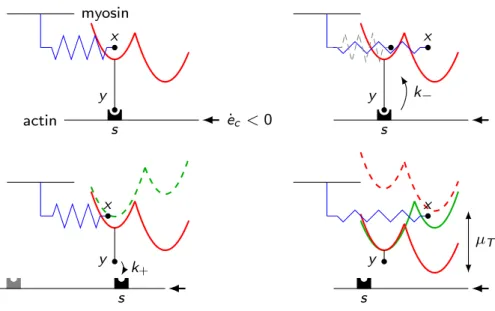
Muscle contraction occurs at the nanoscale of a hierarchical multi-scale structure with the attachment of so-called cross-bridges within sarcomeres, namely, the creation of chemical bonds between myosin heads and specific sites on actin filaments. A cross-bridge in itself can be seen as a special chemical entity having internal mechanical variables – or degrees of freedom – pertaining to the actual geomet-ric configuration, which implies that the free energy of the cross-bridge – whether in an attached or unattached state – must be made dependent on these internal variables [1]. This provides a thermo-dynamical basis for modeling the complex interplay of chemical and mechanical phenomena at the sarcomere level. Within this framework we propose a muscle model with two mechanical variables associated with a cross-bridge as in [2]. This means that a cross-bridge is modeled by combining two mechanical components, here a linear spring and a bi-stable element. For the action of individual cross-bridges occurring at the nanometer scale, the energy provided by the Langevin thermostat can-not be neglected, and we therefore propose to endow the internal mechanical variables with stochastic dynamics. Our proposed chemo-mechanical model of a cross-bridge is summarized in Fig. 1 in each of the four stages of the so-called Lymn-Taylor cycle [3]. Here we point out that we consider only two chemical states – namely, attached versus unattached – instead of four in [4], albeit in our case with two internal mechanical variables instead of one.
Important motivations for this modeling choice include the ability to represent (i) the so-called power-stroke phenomenon and (ii) short-time responses of a muscle, e.g. to load steps. Our approach allows for systematic treatment of the model energetics, and in particular one goal of the proposed description is to investigate the potential benefit in mechanical efficiency with systems including – in addition to chemically-induced transformations – thermally-induced conformational changes such as the power-stroke.
In this contribution, we will first present the details of the proposed cross-bridge model, write the corresponding Langevin (stochastic) equations and give the associated Fokker-Planck equations. We will then show that the resulting model satisfies the essential thermodynamical requirements. This model can then be substituted for the simpler model considered in [5] – relying on two chemical states but only one internal mechanical variable for a cross-bridge – in order to obtain a complete muscle behavior description in a continuum mechanics framework. Finally we will present some numerical simulations of this model, in particular in steady-state shortening and isometric transient conditions.
myosin x y actin s ˙ec < 0 x y s k x y s µT x y s k+
Figure 1: Chemical-mechanical cross-bridge model in Lymn-Taylor cycle: attached (top) vs. detached (bot-tom) / pre-power-stroke (left) vs. post-power-stroke (right). The two internal mechanical variables are denoted by x and y, ˙ec is the sarcomere strain rate, and (k+, k ) denote the binding and unbinding reaction rates,
respectively.
REFERENCES
[1] T.L. Hill. Free Energy Transduction And Biochemical Cycle Kinetics. Dover, 2004.
[2] M. Caruel, J.-M. Allain, and L. Truskinovsky. Muscle as a metamaterial operating near a critical point. Phys. Rev. Lett., 110, 2013.
[3] R.W. Lymn and E.W. Taylor. Mechanism of adenosine triphosphate hydrolysis by actomyosin. Biochemistry, 10(25):4617–4624, 1971.
[4] E. Eisenberg and T.L. Hill. A cross-bridge model of muscle contraction. Progress In Biophysics & Molecular Biology, 33(1):55–82, 1978.
[5] D. Chapelle, P. Le Tallec, P. Moireau, and M. Sorine. Energy-preserving muscle tissue model: Formulation and compatible discretizations. Journal for Multiscale Computational Engineering, 10(2):189–211, 2012.