HAL Id: hal-02066119
https://hal.archives-ouvertes.fr/hal-02066119
Submitted on 13 Mar 2019
HAL is a multi-disciplinary open access
archive for the deposit and dissemination of
sci-entific research documents, whether they are
pub-lished or not. The documents may come from
teaching and research institutions in France or
abroad, or from public or private research centers.
L’archive ouverte pluridisciplinaire HAL, est
destinée au dépôt et à la diffusion de documents
scientifiques de niveau recherche, publiés ou non,
émanant des établissements d’enseignement et de
recherche français ou étrangers, des laboratoires
publics ou privés.
Regeneration of High Silica Zeolites via Advanced
Oxidation Processes-A Preliminary Study About
Adsorbent Reactivity Toward Ozone
Pierre Monneyron, Stéphane Mathé, Marie-Hélène Manero, Jean-Noël
Foussard
To cite this version:
Pierre Monneyron, Stéphane Mathé, Marie-Hélène Manero, Jean-Noël Foussard. Regeneration of High
Silica Zeolites via Advanced Oxidation Processes-A Preliminary Study About Adsorbent Reactivity
Toward Ozone. Chemical Engineering Research and Design, Elsevier, 2003, 81 (9), pp.1193-1198.
�10.1205/026387603770866371�. �hal-02066119�
OATAO is an open access repository that collects the work of Toulouse
researchers and makes it freely available over the web where possible
Any correspondence concerning this service should be sent
to the repository administrator:
[email protected]
This is an author’s version published in: http://oatao.univ-toulouse.fr/23282
To cite this version:
Monneyron, Pierre and Mathé, Stéphane and Manero, Marie-Hélène
and Foussard,
Jean-Noël Regeneration of High Silica Zeolites via Advanced Oxidation Processes
—A Preliminary
Study About Adsorbent Reactivity Toward Ozone. (2003) Chemical Engineering Research
and Design, 81 (9). 1193-1198. ISSN 0263-8762
Official URL :
https://doi.org/10.1205/026387603770866371
REGENERATION OF HIGH SILICA ZEOLITES VIA ADVANCED
OXIDATION PROCESSESÐA PRELIMINARY STUDY ABOUT
ADSORBENT REACTIVITY TOWARD OZONE
P. MONNEYRON1, S. MATHE´1, M.-H. MANERO2and J.-N. FOUSSARD1
1Laboratoire d’Inge´nierie des Proce´de´s de l’Environnement, De´partement Ge´nie des Proce´de´s Industriels, Institut National des Sciences Applique´es, Toulouse, France
2De´partement de Ge´nie Chimique, Institut Universitaire et Technologique Paul Sabatier, Toulouse, France
A
iming at regenerating adsorbents, the reactivity toward ozone of two high silicazeolites (HSZ), a dealuminated faujasite Y (Fau Y) and a silicalite (Sil Z), was investigated. In case of Fau Y, no physical adsorption occurred but a total degradation of ozone. This phenomenon was attributed to an active sites-role of silanol groups (SiOH), mainly developed by the dealumination step. In contrast, the ozone adsorption in the smaller channels of Sil Z was important (about 17 mmol g 1), but when a certain local concentration of
ozone was reached, the ozone degradation became signi cant and increased up to 100%. The ozonated zeolites were regenerated in an oven. Whereas the regeneration was total at 773K, a treatment at 500K seemed insuf cient since a co-adsorption phenomenon was observed with suspected nitrous oxides (NO2) as a product of ambient nitrogen oxidation. Whereas the Fau Y
was not affected at all by ozonation, the adsorption capacities of Sil Z zeolite were enhanced, and it exhibited a higher selectivity for polar compound. This was attributed to a surface modi cation, by highly reactive species generated during molecular ozone decomposition. Keywords: high silica zeolites; adsorption; regeneration; advanced oxidation processes (AOP); ozone; catalytic decomposition.
INTRODUCTION
In the treatment of industrial polluted air streams, adsorption on a porous media, such as activated carbon or hydrophobic zeolites, is commonly adopted (Le Cloirec, 1998). Instead of being land lled and replaced, activated carbon is mainly regenerated via pressure or thermal desorption, aiming at restoring the adsorption activity with as little damage as possible to the original pore structure. Advanced oxidation processes (AOP) were investigated as an alternative regene-ration method for activated carbon (Masuda et al., 2001), highlighting its scavenger effect toward ozone (Dusenbury and Canon, 1996), but also in case of zeolites (Leichsenring et al., 1996a; Zlotopol’sky and Smolenskaya, 1996), notably when coked in catalytic petrochemistry (Querini, 2000; Mariey et al., 1996).
In parallel, AOP are investigated as direct technologies for water or gas streams treatment (Shen and Ku, 1999) and, interestingly, adsorbents can provide a good environment for oxidation reaction (Vidic et al., 1997), as shown in previous studies of zeolite regeneration by photocatalysis (Monneyron et al., 2003a) or V-UV radiation combining the effect of photolysis and the creation of ozone from ambient oxygen (Monneyron et al., 2003b).
To use ozonation as a regeneration technique for organic compounds adsorbed on high silica zeolites (HSZ), it is
essential to establish the interaction between ozone and the adsorbent. Moreover, as shown by Chiang et al. (2002) for activated carbon, any modi cation of adsorption properties of the solid is to be determined.
METHODS AND MATERIALS Adsorbents
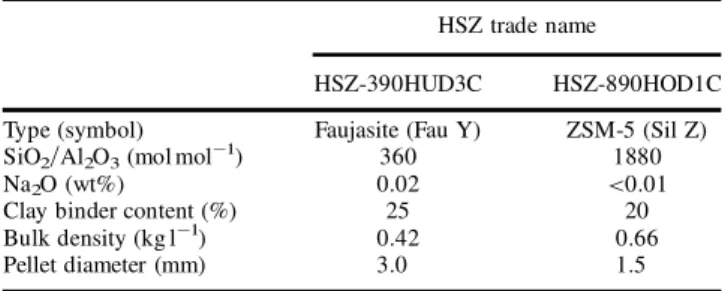
Two commercial HSZ from TOSOH Corp. were used in this work, a dealuminated faujasite Y (Fichtner-Schmittler et al., 1990) and a silicalite (Olson et al., 1980). The main characteristics of adsorbents are given in Table 1. Prior to experimentation, the zeolites were heated at 230¯C
(or 500¯C when speci cally mentioned) overnight, and
kept in a desiccator to prevent ambient humidity to interfere with experiments.
Ozonation Experimental Setup
A commercial ozone generator from air (model 5LO from Trailigaz) was used here, and since the ozone production is function of air pressure ( p ˆ 0.7 bar), ow (F ˆ 0.25m3h¡1),
and power applied, P (W), the ozone inlet concentration was reproduced with an uncertainty of §0.5 g m¡3. The reactor,
circulating in a double glass wall, was 20 cm high and 8 cm in internal diameter. At the inlet, outlet and each 5 cm, an intermediate gaseous sample could be taken and ozone concentration determined with a BMT 964 Ozone Analyser. At these ve points, the temperature was followed at the same time, as can be seen in Figure 1. Whereas the inlet and outlet enabled the gas temperature to be followed, the inner-reactor measurements reported the solid pellets surface temperatures.
Adsorpti on Equilibria Measurements
The investigation of ozonation in uence on adsorption capacity of HSZ toward model VOCs was performed using batch experiments via a standard volumetric method described elsewhere (Monneyron et al., 2003c).
In the same way, the selectivity of adsorbent (Z1=2),
calcu-lated using equation (1), where X and Y are respectively the adsorbed and gas phase molar fraction, was determined in competitiveadsorption experiments(Monneyron et al., 2003c).
Z1=2ˆXX1¢ Y2
2¢ Y1 …1†
RESULTS AND ANALYSIS Ozonated Air Flow on HSZ Fixed Bed
In this set of experiments, the inlet concentrations (CIN)
of ozone were equal to 9.5, 18.5, and 26.5 g m¡3respectively
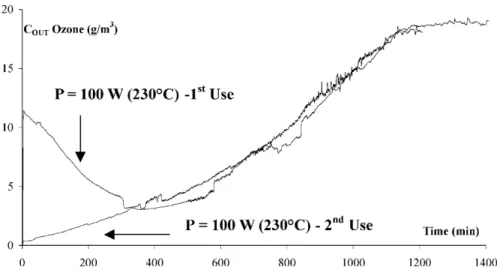
for P ˆ 50, 100 and 150 W. The mass of adsorbent was adjusted to practical requirements. The results obtained on the activated Fau Y exhibited two different parts, the rst being an instantaneous breakthrough of ozone up
to COUTˆ 65%¢CIN, immediately followed by a decrease of
the concentration, as shown in Figure 2. After reaching a minimum, the ozone concentration increased to COUTˆ CIN.
This evolution does not involved any physical adsorption phenomenon, but it has rather to be seen as an evolution of ozone decomposition on the Fau Y surface. There have been very few studies on ozone decomposition mechanisms but, as reported by Tsyganenko et al. (Mariey et al., 1997; Tsyganenko et al., 2001), the molecular ozone exhibits some Lewis basic characteristics, notably on silanol groups (SiOH), that were reported by Dhandapani and Oyama (1997) to be well-known catalytic sites for ozone decomposition in indoor air treatment patents. The supplier of the commercial Fau Y used in this study kept undisclosed the chemical nature of the clay binder together with details of dealumination technique. But whatever conditions may have been applied to obtain the high Si=Al ratio, a signi -cant number of SiOH groups were formed, typically 10=100 framework atoms (Meininghaus and Prins, 2000; Kawai and Tsutsumi, 1998), and are suspected to be responsible for the initiation of the decomposition complex mechanism of ozone on Fau Y.
After the regeneration step, the Fau Y had the same global behavior toward gaseous ozone, except that the decomposi-tion was total from the very beginning of the experiment. The sampling of temperature at different points of the adsorbent bed (5, 10 and 15 cm) enabled us to explain the two different behaviors observed until 400 min. Whereas during the second use of Fau Y sample, the full decomposi-tion of ozone was taking place almost completely at the beginning of the bed, shifting to the higher parts with time, in the rst experiment the reactions took place in the whole bed and much more slowly, i.e. with a smaller heat emission notably visible at the 5 cm–DT measurement. It is therefore suspected that the contact with ozone increased the number of decomposition active sites by modifying the surface. The ozone decomposition slowly ended, the previously mentioned sites being deactivated with time.
The observed behaviour of Sil Z toward ozonation was very dissimilar from Fau Y. As shown in Figure 3 for the (P ˆ 50 W)-experiment, a classical adsorption breakthrough curve was obtained. Moreover, it is clear that physical adsorption of ozone took place on Sil Z since the break-through time decreased, and its slope was higher as the ozone concentration increased.
In our case, the maximum outlet concentration was dependent on the inlet concentration (COUTmax=CINˆ 100,
75 and 20%, respectively, for P ˆ 50, 100 and 150 W), meaning that some ozone was also decomposed. Whereas for the lowest concentration, the outlet concentration was stable at (COUTˆ CIN), on the second part of the other
curves, the ozone concentration decreased to a steady state of 100% decomposition.
The temperature pro les, shown in Figure 4, obtained during these experiments are another indicator of the two different phenomena happening consecutively. Indeed in the two experiments where ozone decomposition occurred, for P ˆ 100 and 150 W, the temperature elevations were quite different from the P ˆ 50 W where only adsorption occurred. Indeed, the second temperature increase of P ˆ 100 and P ˆ 150 W experiments did not exhibit the same behaviour, the respective slopes being 1.8 and 1:3 K m3g¡1
O3 for adsorption and decomposition phases. Table 1.Main characteristics of zeolites.
HSZ trade name
HSZ-390HUD3C HSZ-890HOD1C Type (symbol) Faujasite (Fau Y) ZSM-5 (Sil Z) SiO2=Al2O3(mol mol¡1) 360 1880
Na2O (wt%) 0.02 <0.01
Clay binder content (%) 25 20 Bulk density (kg l¡1) 0.42 0.66
Pellet diameter (mm) 3.0 1.5
As a quick approximation of the adsorption capacity of Sil Z toward ozone, the linear part of the breakthrough was used to estimate t1=2when (COUTˆ CIN=2), directly or
by extrapolation, assuming that at the beginning of the
breakthrough no ozone decomposition occurred. The values, obtained for P ˆ 50 and 100 W, are quite consistent with each other (16 and 17:5 mmol g¡1
Sil Z), whereas for
P ˆ 150 W, the adsorbed quantity seems overestimated (24 mmol g¡1
Sil Z). This is not surprising since, in the last
case, the linear part of the curve is very short (COUTmaxCINˆ 20%) so that the ozone decomposition
could not be neglected. This surprising difference between the two HSZ was reported also in the aqueous phase by Sakoda et al. (2001), leading to a very different aqueous ozone enrichment factor (1:100). In the same way, Izumi et al. (2001), investigated the gaseous ozone enrichment on HSZ at low temperatures (down to 213 K) where no ozone decomposition occurred, but the difference in adsorption capacities of both zeolites was much less important. These results tend to show that the decomposition of ozone requires a minimum local concentration, the kinetic of decomposition depending notably on the ozone concentra-tion, supplied by its physisorption in the framework channels of Sil Z. This decomposition is therefore much slower than on Fau Y, which is consistent with the
Figure 2. Ozonated air ow on Fau Y (400 g–20 cm).
Figure 3. Ozonated air ow on Sil Z (200 g–6 cm).
hypothesis of a determining role of silanol groups as actives sites, the Sil Z having undergone no dealumination treat-ment. It may be supposed that in this case the decomposition was initiated by the hydroxyls groups of the clay binder (Alpay et al., 1996) or by local heterogeneity of the zeolite framework. Then, the ozone decomposition involving very reactive species (Dhandapani and Oyama, 1997), some complex radical chain reactions would have led to a slow spreading into the whole bed, down to a total decomposition of the inlet ozone.
Regeneration of Sil Z After Ozonation
As shown in Figure 5 by the two experiments conducted for P ˆ 150 W after a 500¯C overnight heat treatment, the
regeneration of the Sil Z sample was total, whereas in a (P ˆ 100 W)-set of experiments, when the oven temperature was generally xed to 230¯C only, the regeneration was
insuf cient as an initial partial breakthrough of ozone occurred. However, in both cases, the ozone global physical adsorption capacity decreased, indicating a modi cation of
zeolite internal surface. Considering these results and as mentioned in the introduction of this paper, it was absolutely necessary to check the adsorption properties of the oxidised zeolites.
Adsorpti on Properti es of Ozonated HSZ Adsorption equilibria measurements showed that the contact of ozonated air with Fau Y (3000 min) had no effect at all on its adsorption capacities in single component isotherms, and on its selectivitytoward VOC binary mixtures. On the contrary, the Sil Z zeolite was signi cantly affected by the ozone treatment (9000 min), as shown by Figures 6 and 7. Indeed, the adsorption capacity of Sil Z toward both components increased after ozonation, which is to be linked with the hypothesis of a surface modi cation. This augmenta-tion was much greater and earlier, in terms of minimum concentration, for TOL (‡25%, from Ce ˆ 0.001 mmol l¡1)
than for DIO (‡8%, from Ce ˆ 0.007mmol l¡1). This could
be attributed to the difference of their micropore llings (52 and 87%, respectively, for TOL and DIO; Monneyron
Figure 5. Oven temperature in uence on Sil Z regeneration after ozone treatment.