Initial growth of Pterygota macrocarpa Schumann
(Sterculiaceae) depending on the light intensity in
Côte d'Ivoire
*1 KOUADIO Kouassi, 1 N’GUESSAN Koffi, 2 KOUASSI Kouadio Henri, 1 ETTIEN Kouassi Bosson
Rolande
1Laboratoire de Botanique et de Biologie Végétale, UFR Biosciences, Université Félix HOUPHOUET BOIGNY
Abidjan-Cocody, 22 BP 582 Abidjan 22 (Côte d’Ivoire). E-mail: [email protected] Cél: (+225) 47 – 90 – 82 – 75 // 04 – 98 – 89 – 60, E-mail: [email protected],
2Laboratoire de Biologie Végétale et amélioration des plantes, Université LOUROUGNON GUEDE de Côte d’Ivoire
BP 150 Daloa (Côte d’Ivoire). E-mail: [email protected]
Original submitted in on 16th May 2013 Published online at www.m.elewa.org on 2nd September 2013.
ABSTRACT
Objective: A study on the growth of Pterygota macrocarpa (Sterculiaceae), in the nursery depending on the intensity of the light, was conducted within the Forest Management Unit of Bossematié. The main objective is to seek additional information on the initial growth of Pterygota macrocarpa , an overexploited and endangered species, for use in reforestation programs of Ivorian forests.
Methodology and Results: The study is based on the determination of the dynamics of growth in height and diameter and leaf production of this species in environments with varied intensity of light. Three media gradual illumination intensity (low, medium, high), housing each nursery of Pterygota macrocarpa were installed and the various measurements were performed. The results showed that the average height of saplings in media of low light is statistically different from that obtained in highly sunny environment (F = 4.391, P = 0.0370). In contrast, the mean diameter and the mean of leafs production did not show a significant difference in these environments. Furthermore, the study showed that the initial growth of Pterygota macrocarpa is slow, like that of most tree species commonly exploited.
Keywords: Pterygota macrocarpa, vulnerable species, growing in the nursery, Bossematié, Côte d'Ivoire. INTRODUCTION
The forest ecosystem is constantly renewed, due to the natural process of death and regeneration (Kouadio et al., 2007). Natural regeneration by
Ivorian forests because of Because inappropriate conditions under closed canopies. Unfortunately, in the reforestation campaigns of classified forests,
Journal of Applied Biosciences 68:5356 – 5365
Kouadio et al. J. Appl. Biosci. 2013. Initial growth of Pterygota macrocarpa depending on light intensity in Cote d’Ivoire
International Union for Nature Conservation (IUCN, 2008). This list consists of the vulnerable species, threatened and at risk of extinction. In addition, few studies have been conducted on the growth dynamics of biological parameters (height, diameter and leaf production) of these species. The main objective of this study is to obtain additional information on the initial growth of Pterygota macrocarpa (Koto, Sterculiaceae), a local trees species and endangered, in order to use them for the regeneration of Ivorian forest and natural reserves. Pterygota macrocarpa is a large tree from 25 to 30 m height comprising a quite cylindrical barrel with impressive winged
buttresses at the base. The bark is gray clear smooth with a yellow, granulated, fibrous notch. The sheets are simple alternate, very large, orbicular, tough, slightly lobed, persistent with long petiole. The flowers are unisexual, inflorescence in cyme final. The Fruits are the large follicules (10 to 20 cm in diameter), fixed on the branches by long stalks, comprise many winged seeds from 6 to 7 cm length and 3 to 4 cm broad, piled up in the valves. This study will determine the dynamics of growth in height and diameter and the evolution of leaf production of the young stems of this vulnerable species in 03 middles of light varying intensity.
MATERIALS AND METHODS
The study was conducted in the Department Abengourou, in east-central Côte d'Ivoire, in the nursery of Forestry (UGF) of Bossematié-Appouessou. UGF is 240 km from Abidjan and is located between 6 ° 20 'and 6 ° 35' north latitude and 3 ° 20 'and 3 ° 35' W (Fig. 1). Located in the mesophilic Sector Guinean Domain, the Abengourou Department is characterized by an annual average temperature of 26.7 ° C and an average annual rainfall of about 1251.6 mm (Kouadio, 2007 ). This sector relies on four soil types (Ferralsols, Cambisols, and arenosols Gleysols), the most dominant are Ferralsols (Gerold, 1996). According Guillaumet and Adjanohoun (1971), the vegetation of the Department of Abengourou is semi-deciduous types. The characterization of the dynamics of growth of Pterygota macrocarpa in the nursery demanded the
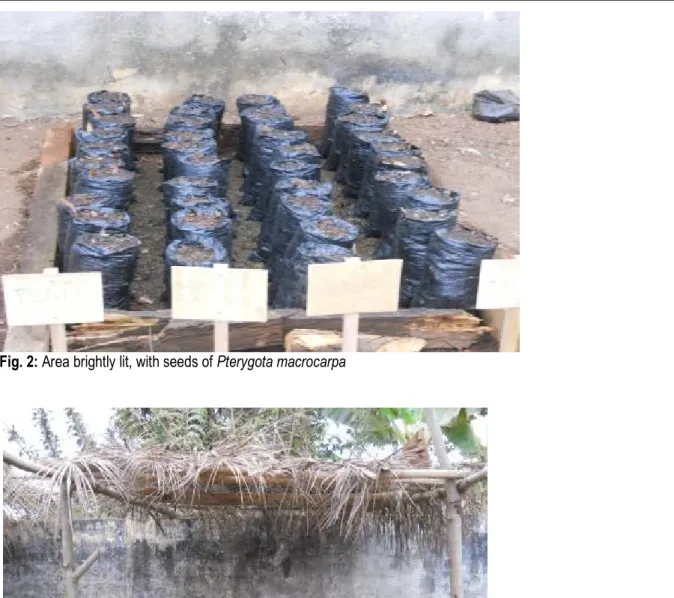
establishment of a device comprising three media of varying intensity of light. There was the highly light environment (Fig. 2), a moderately sunny medium (Fig. 3) and a low light environment (Fig. 4). Each compartment is composed of a block of 04 rows of each seedling wraps 10, arranged one beside the other. The experiment was performed on plants at least 4 weeks with at least 4 leaves (Fig. 5) and lasted 90 days. Each medium contained 20 samples. On each rod, the number of sheets produced was counted. Height measurements were made between the collar and the terminal bud of each plant, while those diameters were made at collar. Rows of bags were watered 2 times per day during the experiment (at 6:00 in the morning and evening to 17 hours).
Kouadio et al. J. Appl. Biosci. 2013. Initial growth of Pterygota macrocarpa depending on light intensity in Cote d’Ivoire
Fig. 2: Area brightly lit, with seeds of Pterygota macrocarpa
Fig. 4: Middle dimly lit by the light, with the seeds of Pterygota macrocarpa
Kouadio et al. J. Appl. Biosci. 2013. Initial growth of Pterygota macrocarpa depending on light intensity in Cote d’Ivoire
RESULTS
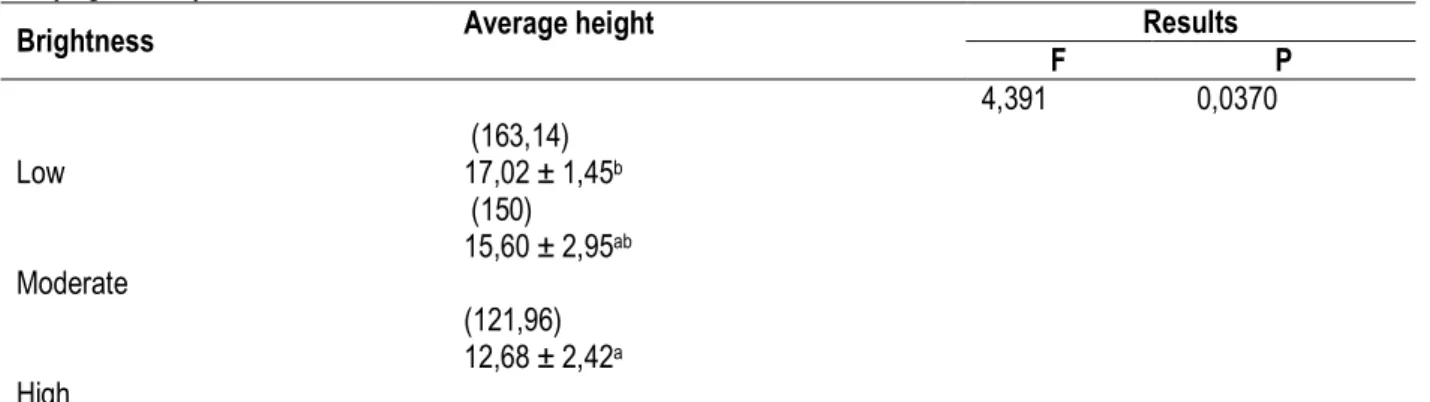
Growth evolution in stem height, depending on the intensity of light: The elongation of saplings of Pterygpta macrocarpa (Sterculiaceae) is accelerated in dimly lit areas and slow in brightly lit middle (Fig. 6). Indeed, the estimated average heights in these areas are of the order of 17 cm and 12.7 cm, respectively, in the low areas and brightly lit at the end of 90 days of experience. The evolution of these saplings in moderately lit environment is moderately accelerated. In addition, the weekly average growth estimated in the
03 middles is of the order of 1.4 cm 1.2 cm and 1 cm, respectively, in environments low, medium and brightly lit. The results (Table 1) show that the average height of young stems of dimly lit environment is statistically different (F = 4.391, P = 0.0370) than that obtained in the brightly lit environment. However, the comparison between the average height of young stems moderately lit environment and the other two areas, showed no significant different. High light Medium light Low light 1 2 3 4 5 6 7 8 9 10 11 12 Weeks 0 2 4 6 8 10 12 14 16 18 M e a n h e ig h t (c m )
Fig. 6: Curves evolution of height growth of saplings of Pterygota macrocarpa (Sterculiaceae) in the media of different illuminations
Table 1: Comparison of average heights of saplings of Pterygota macrocarpa in different lighting environments of varying intensity
Brightness Average height Results
F P Low (163,14) 17,02 ± 1,45b 4,391 0,0370 Moderate High (150) 15,60 ± 2,95ab (121,96) 12,68 ± 2,42a
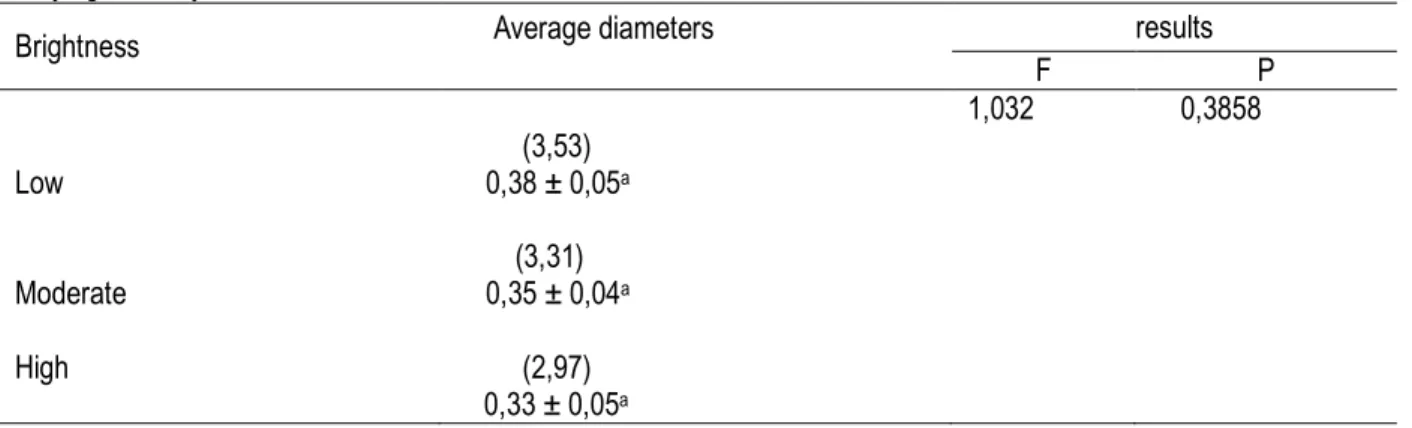
Evolution of the stem diameter growth, depending on the intensity of light: The evolution of the diameter growth of Pterygpta macrocarpa is similar in low, medium and high of light intensity (Fig. 7). Similarly, the average weekly growth was substantially equal and was 0.29 cm, 0.27 cm and 0.25 cm, respectively, in environments low, medium and brightly lit. The results (Table 2) show that the average diameters show no significant difference between the environments of varying intensity illumination.
Evolution of rods leaf production in nursery, depending on the intensity of light: The quantities of leaves produced by young stems of Pterygota macrocarpa are quantitatively equal in environments low, medium and highly illuminated (Fig. 8). After 12 months, the average production of leafs is of the order of 8.8 and 9.0 leaves, respectively in the low and medium settings and enlightened about 9.5 leaves in brightly lit areas. These averages do not show significant difference in these environments (Table 3).
High light Medium light Low light 1 2 3 4 5 6 7 8 9 10 11 12 Weeks 0,00 0,02 0,04 0,06 0,08 0,10 0,12 0,14 0,16 0,18 0,20 0,22 0,24 M e a n s te m d ia m e te r (c m )
Fig. 7: Curves of growth trends of diameter of Pterygota macrocarpa (Sterculiaceae) in the middle of different illumination
Table 2: Comparison of average diameters of saplings of Pterygota macrocarpa, in different lighting environments of varying intensity
Brightness Average diameters results
F P Low (3,53) 0,38 ± 0,05a 1,032 0,3858 Moderate (3,31) 0,35 ± 0,04a
Kouadio et al. J. Appl. Biosci. 2013. Initial growth of Pterygota macrocarpa depending on light intensity in Cote d’Ivoire
High light Medium light Low light 1 2 3 4 5 6 7 8 9 10 11 12 Weeks 0 2 4 6 8 10 N u m b e r o f le a v e s
Fig. 8: Curves of evolution of leaf production of saplings of Pterygota macrocarpa in different lighting environments Table 3: Comparison of mean leaf production, of Pterygota macrocarpa, in environments of the varying light intensity.
Brightness Average leaves production
Results F P Low (82,6) 8,80 ± 1,48a 0,467 0,6380 Moderate High (84) 9,00 ± 0,70a (85,4) 9,40 ± 0,54a
F: Fisher test decision, P: probability (= 5%), Means with the same letter are not significantly different at p = 5% DISCUSSION
Beyond 3 months, the young stems of Pterygota macrocarpa (Sterculiaceae) from dimly lit areas were higher than those of the average light environment. This difference shows that the growth of this species is more accelerated in dimly lit areas. The low lights stimulate the growth in height of Pterygota macrocarpa, which is not the case for growth in thickness and the leaves production that have shown no significant difference in the three environments. Indeed, the growth rate in diameter and leaf emission rate showed similarities in the three environments. Compared to other tree species commonly exploited and
endangered, the initial height growth of Pterygota macrocarpa (Sterculiaceae) is slower. Indeed, the average values of the height and diameter of the majority of these tree species exploited are higher than those of the species studied. This is the case of Milicia excelsa (Welw.) C. C. Berg. (Iroko, Moraceae) having an average height of about 25 cm and a mean diameter of about 1.05 mm at 03 months (database.prota.org / Milicia excelsa). For Entandrophragma cylindricum (Sprague) Sprague (Meliaceae), the mean values are in the range of 19.26 cm for height growth and 3.6 mm in diameter growth in 3 months (database.prota.org /
Entandrophragma cylindricum). Also Debroux et al. (1998) showed that young stems of Autranella congolensis (De Wild.) A. Chev. (Sapotaceae) and Baillonella toxisperma Pierre (Sapotaceae), two valuable species of Cameroonian forests, have had the average height, respectively, of the order of 3 cm and 21.3 cm, 3 months after emergence. Ultimately, the initial growth of tree species commonly used is slow. This delay is probably due to their sensitivity to high luminosities at the juvenile stage. Although the germination of most forest tree seed requires light, during their juvenile growth, the growth of most of these tree species called the "slow growth" takes place in the undergrowth. The high light intensities are harmful to the biology of their seeds. For Pterygota macrocarpa, elongation of young stems is fast in the middle dimly lit environ while it is slowed down in the brightly lit areas. Moreover, the initially slow growth forest species may also be related to the development of the root system as is shown Ouedraogo et al. (2006) on Boswellia
dalzelii Hutch. (Burseraceae). Dauro et al. (2003) had already pointed out that the development of the root system is a key factor in seedling survival. The enlargement of the root is a more effective strategy for the sustainability of forest timber because it can store feeder reserves. Unfortunately, root development is difficult and takes a considerable time in forest trees. This difficulty can be a limiting factor for the nutrition of seedlings in water and minerals, making them less competitive compared to other species of the undergrowth. All these factors make the sustainability of forest species. To overcome these difficulties, Doucet et al. (2007) advocated improving the regeneration of tree species through the application of silvicultural techniques (Forest methods of regeneration combined of harvest of the wood for construction on the support and of regeneration of the forest). It is, under natural conditions, assisted regeneration with enrichment techniques (parcels of forestry exploitation enriched).
CONCLUSION
The study showed that the initial growth in height and diameter of Pterygota macrocarpa (Sterculiaceae) is slow, like that of most tree species commonly exploited. However, the height growth of this species is positively influenced by low illumination. In contrast, growth in diameter and production of leaves are insensitive to changes in light intensity. The development of the root system and photosensitivity are the main factors responsible for the slow initial growth of most tree species commonly exploited. To facilitate the
sustainability of forest species in danger of extinction, it is desirable to introduce Pterygota macrocarpa (Sterculiaceae) in reforestation programs of Ivorian forests. For this purpose, the low light intensities are more suitable for the production of plants of this species. With the prospect of greater control of the initial growth of biological parameters, the study should be extended to all forest species overexploited and endangered
REFERENCES
Dauro D, Mohamed-Saleem MA, Gintzburger G. 2003. Recruitment and survival of native annual Trifolium species in the highlands of Ethiopia. Afr. J. Ecol, 34 (1): 1-9.
Debroux L, Delwingt W, Mbolo M, Amougou A. 1998. Régénération du moabi et du mukulungu au
Cameroun : Perspectives pour
l’aménagement. B. Trop. 255 (24): 5-17. Doucet JL, Dissaki A, Mengome A, Issembé Y, Dainou
forêt dense ivoirienne de production. B. Trop. 254 (4) : 25-37.
Ettien DT. 2005. Potentiels de régénération des essences forestières commerciales par la germination des graines, dans la forêt classée du Haut-Sassandra (Centre-Ouest de la Côte-d’Ivoire). Thèse de Doctorat 3ème cycle, U.F.R.
Biosciences, Université Abidjan-Cocody, Abidjan, Côte d’Ivoire, 259 pp.
Kouadio et al. J. Appl. Biosci. 2013. Initial growth of Pterygota macrocarpa depending on light intensity in Cote d’Ivoire
d’Ivoire, Avenard JM, Eldin E, Girad G, Sircoulon J, Touchebeuf P, Guillaumet JL, Adjanohoun E, Perraud A (ed). ORSTOM, Paris: France, 161-262.
[Internet] < http: //database.prota.org/recherche.htm>. Visité le 14 Novembre 2012.
Kouadio K. 2007. Études de la flore, de la végétation et de l’impact de l’éclaircie sélective par dévitalisation, sur les essences principales de la forêt classée de Bossematié, Est de la Côte-d’Ivoire. Thèse de Doctorat Unique, U.F.R. Biosciences, Université Abidjan-Cocody, Abidjan, Côte d’Ivoire, 192 pp.
Kouadio K. 2012. Étude du comportement des essences locales exploitées couramment et menacées de disparition, en essaie de reboisement dans la pépinière de l’UGF de Bossematié, en fonction de l’intensité de l’ensoleillement. Rapport scientifique, Centre National de Floristique, UFR Biosciences, Université Félix HOUPHOUET-BOIGNY Abidjan-Cocody, Abidjan, Côte d’Ivoire, 57 pp. Kouadio K, Kouassi KE, Kouamé NF, Traoré D. 2007.
Impact de l’éclaircie sur la régénération
naturelle des essences principales, dans la forêt classée de Bossematié (Côte d’Ivoire). Sci. Nat. Vol. 4 (1) : 27-35.
Kouakou N. 1989. Contribution à l’étude de la régénération naturelle dans les trouées d’exploitation en forêt de Taï (Côte d’Ivoire) : approches écologiques et phytosociologiques. Thèse de Doctorat-Ingénieur, Faculté des Sciences et Techniques, Université nationale, Abidjan, Côte d’Ivoire, 203 pp.
Kouamé NF. 1998. Influence de l'exploitation forestière sur la végétation et la flore de la forêt classée du Haut-Sassandra (Centre-Ouest de la Côte d’Ivoire). Thèse de Doctorat 3ème cycle, U.F.R.
Biosciences, Université Abidjan-Cocody, Abidjan, Côte d’Ivoire, 227 pp.
Ouédraogo A, Thiombiano A, Hahn-hadjali, Guiko S. 2006. Régénération sexuée de Boswellia dalzielii Hutch., un arbre médical de grande valeur au Burkina-Faso. B. Trop. 289 (3) : 41-52.
International Union for Nature Conservation. 2008.
IUCN Red List of Threatened Species.www. iucnredlist.org