UNIVERSITÉ DE MONTRÉAL
EXPERIMENTAL AND NUMERICAL ANALYSIS OF IMPACT DAMAGE PROGRESSION IN SANDWICH STRUCTURES DESIGNATED FOR STAY VANE EXTENSIONS IN
HYDRAULIC TURBINES
GHODRATOLLAH MORADA DÉPARTEMENT DE GÉNIE MÉCANIQUE ÉCOLE POLYTECHNIQUE DE MONTRÉAL
THÈSE PRÉSENTÉE EN VUE DE L’OBTENTION DU DIPLÔME DE PHILOSOPHIAE DOCTOR
(GÉNIE MÉCANIQUE) DÉCEMBRE 2017
UNIVERSITÉ DE MONTRÉAL
ÉCOLE POLYTECHNIQUE DE MONTRÉAL
Cette thèse intitulée :
EXPERIMENTAL AND NUMERICAL ANALYSIS OF IMPACT DAMAGE PROGRESSION IN SANDWICH STRUCTURES DESIGNATED FOR STAY VANE EXTENSIONS IN
HYDRAULIC TURBINES
présentée par : MORADA Ghodratollah
en vue de l’obtention du diplôme de : Philosophiae Doctor a été dûment acceptée par le jury d’examen constitué de :
M. SHIRAZI-ADL Aboulfazl, Ph. D., président
M. BOUKHILI Rachid, Doctorat, membre et directeur de recherche M. VADEAN Aurelian, Doctorat, membre et codirecteur de recherche M. GOSSELIN Frédérick, Doctorat, membre
DEDICATION
ACKNOWLEDGEMENTS
I would like to first thank Pr. Aurelian Vadean and Pr. Rachid Boukhili for their guidance and support during this research project. Your insightful criticism, suggestions and encouragement guided me to complete a rigorous work, while gaining scientific and practical knowledge.
I gratefully acknowledge the contributions of my coworkers on this project, Rim Ouadday, Aymen Marouene and Abderrahmen Kaabi at École Polytechnique de Montreal. The technical advice and support of Josée Laviolette and Isabelle Nowlan are also gratefully acknowledged.
I would like to express my thanks for the financial support by the Consortium de Recherche en Fabrication et Réparation des Roues d'Eau (CREFARRE) and the Natural Sciences and Engineering Research Council of Canada (NSERC). I am also very grateful for Alstom Power and the Hydro Quebec Research Institute (IREQ) for their support. I would also like to thank Michel Sabourin for his technical support.
Finally, I would like to express my gratitude to my family and my friends for being supportive and encouraging throughout the good and bad times for the past years.
RÉSUMÉ
Après des décennies de fonctionnement, une réhabilitation majeure des turbines hydrauliques existantes est nécessaire pour maximiser leur efficacité et leur rendement. Pour atteindre cet objectif, la meilleure solution est de modifier les profils hydrauliques d’avant-directrice en ajoutant une extension en matériaux composites. Malgré leur utilisation croissante, les matériaux composites sont sensibles aux dommages causés par les objets extérieurs. La détection des dommages internes, la prédiction de la propagation de dommages et l'amélioration de la résistance aux dommages restent la principale préoccupation dans le domaine des matériaux composites. L'objectif principal de cette thèse était d'étudier, à l'aide d'outils expérimentaux et numériques, la résistance aux dommages des panneaux sandwich avec une âme hybride soumise aux impacts à faible vitesse. Le comportement de structures sandwiches soumises aux impacts à faible vitesse a été évalué en termes de force de contact, d'absorption d'énergie, de propagation des dommages et de modes de rupture.
En premier lieu, la réponse au choc de la peau du sandwich fabriquée avec un stratifié non-tissé (NCF) a été étudiée à l'aide d'une tour de chute instrumentée. Un modèle 3D de viscoplastique-dommage a été développé pour prédire la propagation de viscoplastique-dommages dans un stratifié NCF. Le modèle numérique a été implémenté dans le logiciel de calcul d’éléments finis LS-DYNA/explicit. Le comportement non-linéaire en cisaillement du modèle proposé a été défini en considérant la dépendance au taux de déformation et la charge d'inversion symétrique. L'efficacité et la précision du modèle ont été vérifiées en comparant les résultats numériques avec ceux obtenus à partir des essais de cisaillement et des essais d'impact à faible vitesse. De plus, les effets de vitesse de déformation sur la résistance aux dommages des stratifiés NCF a été étudié.
En second lieu, des analyses expérimentales et numériques pour structures sandwiches avec une âme en ATH/époxy soumises aux impacts à haute énergie et à faible vitesse ont été réalisées. La raison de cette recherche est que pour une nouvelle solution de réhabilitation de la turbine est fortement requis d’utiliser des matériaux qui peuvent absorber les charges d'impact à haute énergie et préserver un niveau d'intégrité structurale élevé.
Le modèle numérique comprend un modèle viscoplastique pour décrire le comportement de l’âme en ATH/époxy. La capacité du modèle proposé à prédire l’initiation et propagation des dommages a été démontrée en comparant les résultats numériques avec les données expérimentales. En outre, la contribution de chaque constituant d’une structure sandwich dans l'absorption d'énergie a été quantifiée.
En dernier lieu, la réponse des poutres sandwiches avec une âme en ATH/époxy soumis à des sollicitations quasi statiques et dynamiques de flexion trois points a été étudiée. L'objectif était d'explorer les mécanismes de défaillance des poutres sandwiches ainsi que l'interaction entre les modes de rupture. L'effet du taux de déformation sur le comportement de poutres sandwiches a été démontré en réalisant des essais de flexion trois points en sollicitations quasi statiques et dynamiques.
La contribution principale de cette thèse est l'évaluation de la performance de la structure sandwich avec une âme en ATH/époxy en termes de résistance aux dommages induits par impact, d'absorption d'énergie et de conservation de son intégrité structurale. Un modèle numérique robuste a également été développé pour prédire l'amorçage et la propagation de dommages dans la structure sandwich en composite.
ABSTRACT
After decades of operation, a major rehabilitation of existing hydraulic turbines is required to maximize their efficiency and output. To achieve this aim, the best solution is to modify the hydraulic profiles of stay vanes by adding composite extension structures to the original stay vanes. Nowadays, composite materials have found their way into different industrial fields due to their advantage over metals or metal alloys. Despite their increasing use, composite materials are sensitive to impact damage induced by foreign objects. Detecting internal damage, predicting damage progression and improving damage resistance is still the major concern of composite materials.
The main objective of this thesis was to investigate low-velocity impact damage resistance of sandwich panels with a hybrid core using experimental and numerical tools. The impact behavior of sandwich panels was evaluated in terms of contact force, energy absorption, damage propagation and failure modes.
First, the impact response of sandwich face sheets made with non-crimp fabrics (NCF) laminate was studied using an instrumented drop weight impact machine. A 3D viscoplastic-damage model was developed to predict damage growth in NCF laminate. The numerical model was implemented in LS-DYNA/explicit. The nonlinear shear-strain behaviour of numerical model was defined by considering the strain rate dependence and symmetric reversal load. Efficiency and accuracy of the model were verified by comparing the numerical results with the experimental results obtained from shear tests and low-velocity impact tests. In addition, the effects of strain rate on impact resistance of NCF laminate was studied.
Second, experimental and numerical analysis of ATH/epoxy core sandwich panels subjected to low-velocity impact loads were performed. The reason for this investigation is that, for a new solution of turbine rehabilitation is strongly required to choose the composition materials which can absorb higher impact loads and preserve a high margin of structural integrity. The numerical model includes a viscoplastic model for describing the ATH/epoxy core behavior. The capability of the proposed model in the prediction of damage growth was demonstrated by comparing the numerical results with experimental data. Additionally, the contribution of each sandwich component in energy absorption was evaluated.
Finally, quasi-static and low-velocity impact response of sandwich beams with an ATH/epoxy core in three-point bending were investigated. The goal was to explore failure mechanisms of sandwich beams as well as the interaction between the failure modes. The effects of strain rate on the behavior of sandwich beams were shown by performing three-point bending under quasi-static and impact loading.
The main contribution of this thesis is to evaluate the performance of sandwich structure with an ATH/epoxy core in terms of impact damage resistance, energy absorption and retain its structural integrity. A robust numerical model was also developed to predict damage initiation and propagation in composite sandwich structure.
TABLE OF CONTENTS
DEDICATION ... III ACKNOWLEDGEMENTS ... IV RÉSUMÉ ... V ABSTRACT ...VII TABLE OF CONTENTS ... IX LIST OF TABLES ... XIII LIST OF FIGURES ... XIIIINTRODUCTION ... 1
1.1 Background and description ... 1
1.2 Problem statement and research motivation ... 1
1.3 General objective ... 3
1.4 Specific objectives ... 3
1.5 Proposal outline ... 5
LITERATURE REVIEW ... 8
2.1 Low-velocity impact ... 8
2.2 Failure modes of laminated composites ... 8
2.2.1 Matrix failure ... 9
2.2.2 Interface delamination ... 10
2.2.3 Fiber failure ... 11
2.3 Behavior of sandwich structures under impact loading ... 11
2.3.1 Failure modes of sandwich structure ... 14
2.4 Modeling of damage and fracture of laminated composites ... 17
2.5.1 Failure initiation criteria ... 20
2.5.2 Failure propagation ... 23
2.6 Interlaminate failure simulation ... 26
2.7 Simulation of impact on sandwich structures ... 29
2.8 Material selection for composite stay vane extension ... 30
2.8.1 Face sheets material ... 30
2.8.2 Core material ... 30
ARTICLE 1: VISCOPLASTIC-DAMAGE MODEL FOR LOW-VELOCITY IMPACT SIMULATION OF NON-CRIMP FABRIC-REINFORCED COMPOSITES... 32
3.1 Abstract ... 32
3.2 Introduction ... 32
3.3 Development of the constitutive model ... 34
3.3.1 Continuum damage mechanics ... 34
3.3.2 Viscoplastic model ... 36
3.3.3 Strain-rate dependence of shear modulus and strength ... 37
3.4 Intra-laminar damage model ... 38
3.4.1 Fiber failure modes ... 38
3.4.2 Matrix failure modes ... 39
3.5 Inter-laminar damage model ... 42
3.6 Experimental tests ... 43
3.6.1 Materials and manufacturing ... 43
3.6.2 Impact tests ... 44
3.6.3 Finite element model ... 44
3.6.4 Material properties ... 45
3.7.1 In-plane shear test simulations ... 47
3.7.2 Impact simulation ... 50
3.8 Conclusions ... 57
ARTICLE 2: LOW-VELOCITY IMPACT RESISTANCE OF ATH/EPOXY CORE SANDWICH COMPOSITE PANELS: EXPERIMENTAL AND NUMERICAL ANALYSES ... 59
4.1 Abstract ... 59
4.2 Introduction ... 59
4.3 Experimental tests ... 61
4.3.1 Low-velocity impact tests ... 62
4.3.2 Compression test on ATH/epoxy ... 63
4.4 Finite element model ... 64
4.4.1 Modeling of ATH/epoxy ... 65
4.4.2 Face sheet damage model ... 68
4.4.3 Material properties for the model ... 74
4.4.4 Mesh sensitivity analysis ... 75
4.5 Results and discussion ... 75
4.5.1 Impact response of ATH/epoxy specimens ... 75
4.5.2 Impact response of the sandwich panels ... 78
4.6 Conclusions ... 86
ARTICLE 3: FAILURE MECHANISMS OF SANDWICH BEAM WITH AN ATH/EPOXY CORE UNDER STATIC AND DYNAMIC THREE-POINT BENDING ... 88
5.1 Abstract ... 88
5.2 Introduction ... 88
5.3.1 Quasi-static three-point bending test ... 91
5.3.2 Flexural impact test ... 91
5.3.3 Digital image correlation (DIC) ... 92
5.4 Numerical models ... 92
5.4.1 Progressive damage model of face sheet ... 93
5.4.2 Viscoplastic-damage model of ATH/epoxy ... 96
5.4.3 Material properties ... 99
5.5 Results and discussion ... 100
5.5.1 Static three-point bending tests ... 100
5.5.2 Response of long beam bending ... 102
5.5.3 Dynamic three-point bending tests ... 104
5.5.4 Effect of impact-induced damage on the flexural response of beam ... 112
5.6 Conclusions ... 113
GENERAL DISCUSSION ... 115
6.1 Modeling aspects ... 115
6.2 Damage resistance of sandwich structure ... 115
6.2.1 Effects of core material ... 115
6.2.2 Effects of strain rate ... 116
6.2.3 Effects of global deformation ... 116
CONCLUSION AND RECOMMENDATIONS ... 118
LIST OF TABLES
Table 3.1: Material properties of an E-glass fiber/epoxy NCF laminate ... 46
Table 3.2: Material constants of the viscoplastic model ... 47
Table 4.1: Material properties of an E-glass fiber/epoxy NCF laminate ... 74
Table 4.2: Material constants of ATH/epoxy resin ... 74
Table 5.1: Dimension of sandwich beam specimens ... 91
Table 5.2: Material properties of an E-glass fiber/epoxy NCF laminate ... 99
Table 5.3: Material constants of ATH/epoxy polymer ... 100
LIST OF FIGURES
Figure 1.1: Extension structure attached to the stay vane ... 2
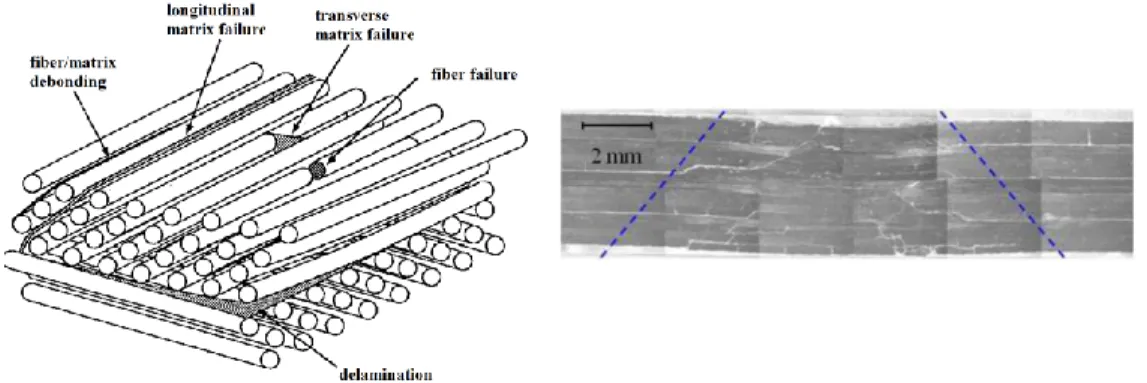
Figure 2.1: Observed damage in unidirectional laminated composite (Berthelot, 1999) ... 9
Figure 2.2: Matrix damage scenario: a) shear cracks and b) bending cracks (Berthelot, 1999) .... 10
Figure 2.3: Impact-induced delamination in unidirectional laminated composite (Maio et al., 2013) ... 11
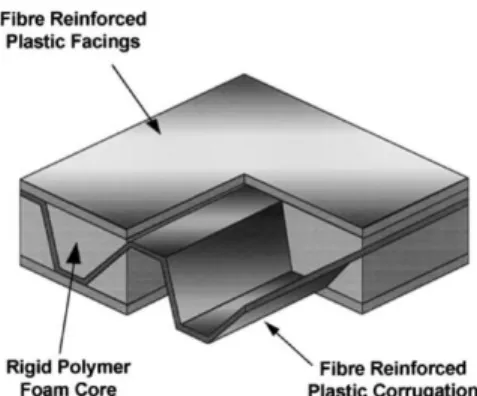
Figure 2.4: Sandwich composite panel with woven face sheets and wave core (Jin et al., 2013) . 12 Figure 2.5: Sandwich composite panel with a corrugated laminated core filled by a phenolic foam (Torre et al., 2000b) ... 13
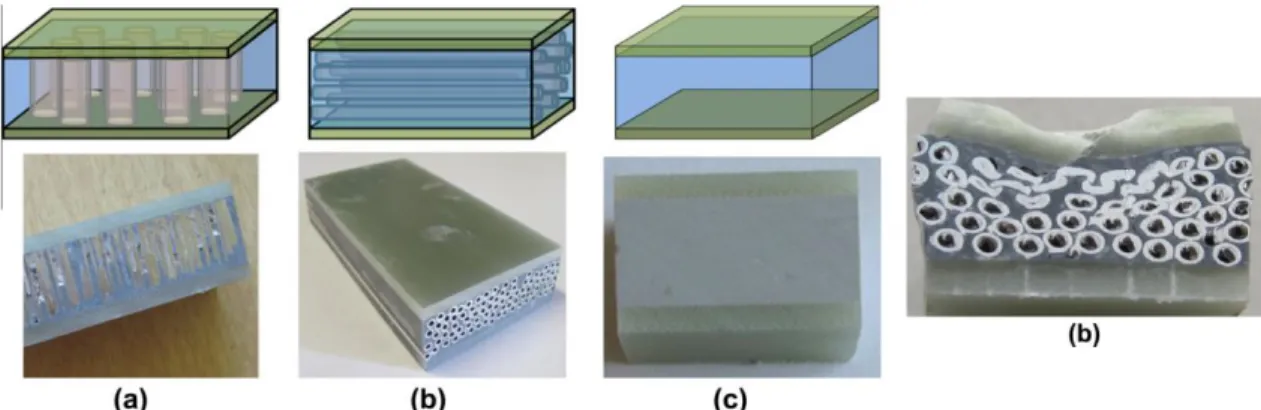
Figure 2.6: Sandwich panels with different cores: a) hybrid core with vertical millitubes, b) hybrid core with horizontal millitubes and c) conventional syntactic foam (Ji et al., 2013) ... 14
Figure 2.7:Sandwich failure modes (Steeves et al., 2004) ... 14
Figure 2.8: Failure modes of un-foamed and foamed core sandwich panels (Vaidya et al., 2008) ... 15
Figure 2.9: Kink-band found in an NCF composite loaded in compression (Edgren et al., 2008) 17 Figure 2.10: Discrete damage mechanics (Bouvet et al., 2012) ... 18
Figure 2.11: A volume element with micro-cracks ... 19
Figure 2.12: Stress components acting on the potential fracture plane (Pinho et al., 2012) ... 22
Figure 2.13: Bilinear response of intra-laminar damage model (Topac et al., 2016) ... 24
Figure 2.14: a) cracks propagation for an angle equal to 0 and b) cracks propagation for an angle other than 0 (Pinho et al., 2012) ... 24
Figure 2.15: a) A unidirectional composite under transverse tension and b) material behvaior with failure (Pinho et al., 2006) ... 26
Figure 2.16: Constitutive law of cohesive zone model (Topac et al., 2016) ... 27
Figure 2.17: Low-velocity impact response of sandwich panel at 190 J (Ji et al., 2013) ... 31
Figure 3.2: Intra-laminar damage model behavior for fiber failure ... 39
Figure 3.3: Fracture plane in compression loading ... 40
Figure 3.4: Flowchart of the process within UMAT subroutine ... 42
Figure 3.5: Internal architecture of the NCF reinforcement ... 44
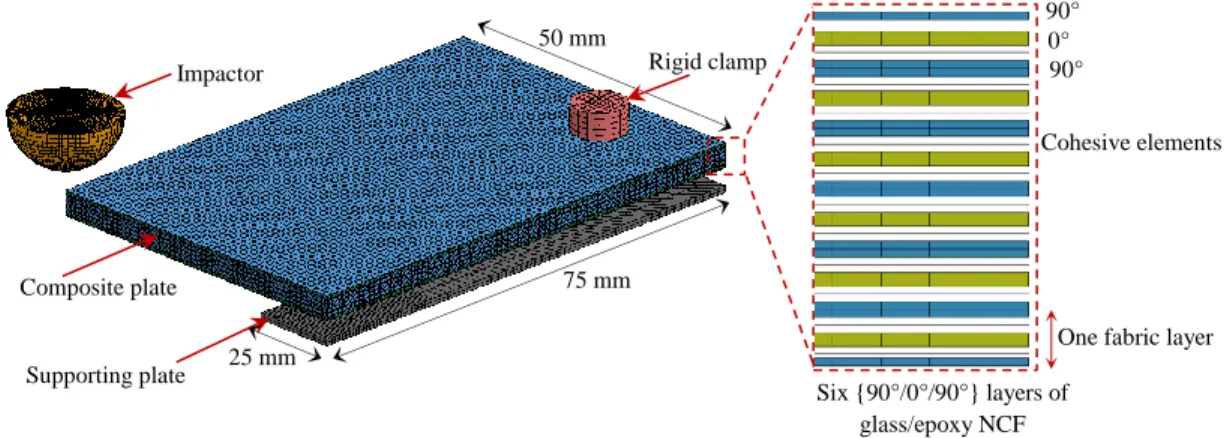
Figure 3.6: Finite element model for impact analyses ... 45
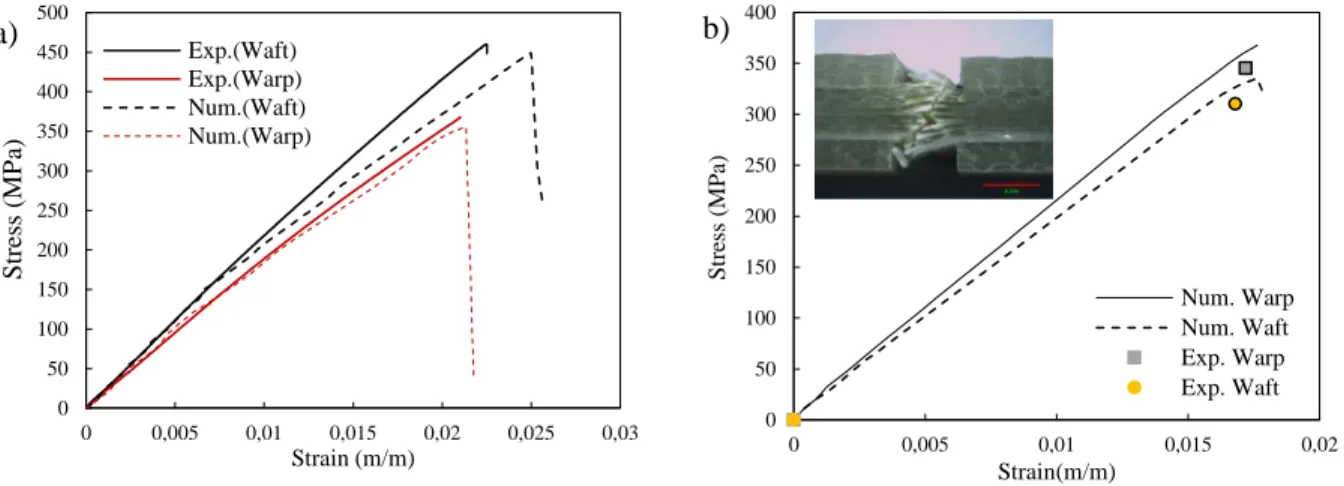
Figure 3.7: a) Tensile stress-strain response and b) compression stress-strain response of NCF laminates ... 47
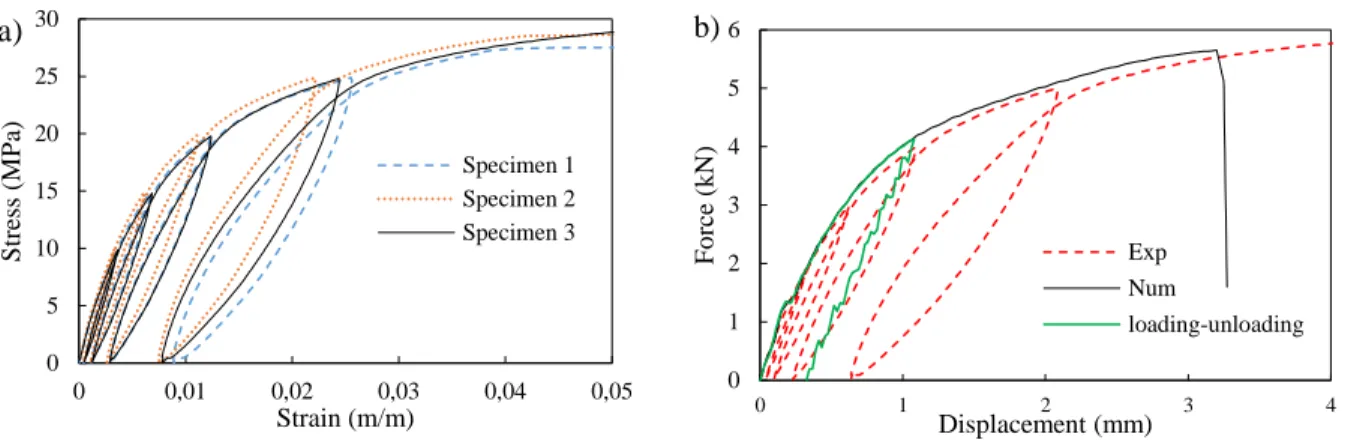
Figure 3.8: a) Nonlinear shear-strain curves obtained from experimental results, b) Tensile loading and unloading curves ... 48
Figure 3.9: Relative shear stiffness degradation verse shear strain ... 49
Figure 3.10: In-plane shear failure a) experimental and b) numerical results ... 49
Figure 3.11: Tensile force versus displacement curves of [{-45/+45/-45 }]3s under various strain rates ... 50
Figure 3.12: Impact response at impact energies of a) 10 J and b) 20 J ... 51
Figure 3.13: Impact response at impact energies of a) 30 J and b) 45 J ... 52
Figure 3.14: Maximum contact force versus initial impact energy ... 53
Figure 3.15: Impact damage area at various impact energies (the dashed line represents the delamination area) ... 54
Figure 3.16: Interface delamination obtained by optical microscopy ... 55
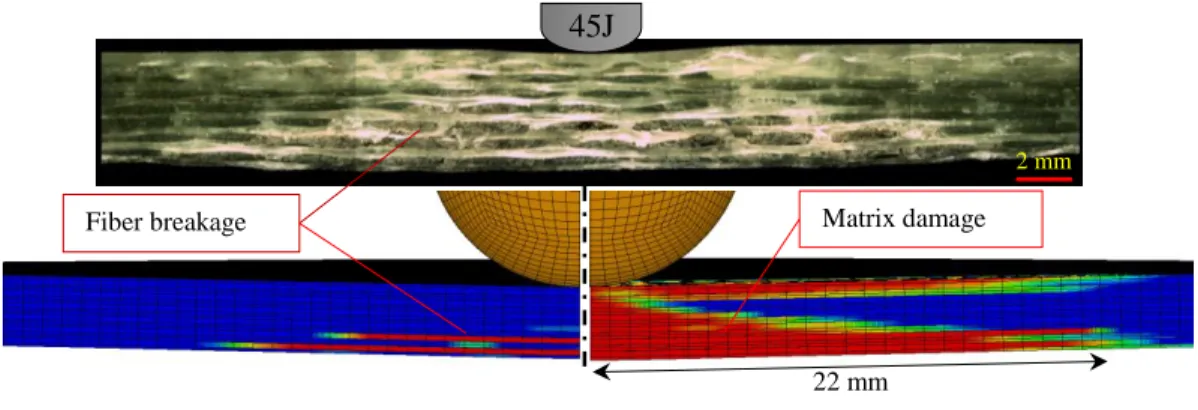
Figure 3.17: Cross-sectional view of the damage zone at an impact energy of 45 J ... 56
Figure 3.18: Force-displacement curves under quasi-static and dynamic loadings ... 57
Figure 4.1: a) Schematic of the sandwich panel, b) panel test sample ... 61
Figure 4.2: a) Wood mould for fabrication, b) Specimen fixture apparatus ... 63
Figure 4.3: a) Force-displacement curves of ATH/epoxy under compressive loading and un-loading and b) Flexural behavior of ATH/epoxy and neat epoxy ... 64
Figure 4.4: Finite element model for impact analyses: a) ATH/epoxy specimen b) sandwich
specimen ... 65
Figure 4.5: Stress-strain response of the ATH/epoxy core a) compression b) tension ... 66
Figure 4.6: Shear-strain response implemented in the intra-laminar damage model ... 69
Figure 4.7: Intra-laminar damage model behavior for fiber failure ... 71
Figure 4.8: Potential fracture plane under compression loading ... 72
Figure 4.9: Force-time and energy-time curves in terms of the in-plane size of elements ... 75
Figure 4.10: Impact response of ATH/epoxy specimens at various impact energies ... 76
Figure 4.11: Visual impact damage on the top face of ATH/epoxy specimens ... 76
Figure 4.12: Impact response of an ATH/epoxy specimen at an impact energy of 40 J ... 77
Figure 4.13: Damage zone in an ATH/epoxy specimen at an impact energy of 40 J: a) experimental observation and b) numerical result ... 78
Figure 4.14: Impact response of a sandwich panel for impact energies of a) 20 J and b) 30 J ... 79
Figure 4.15: Impact response of a sandwich panel for impact energies of a) 40 J and b) 60 J ... 80
Figure 4.16: Permanent deformation versus the impact energy ... 81
Figure 4.17: Force-displacement curves at various impact energies ... 82
Figure 4.18: Global deformation and local indentation of sandwich panels ... 82
Figure 4.19: Comparison between the experimental and numerical damage on the top face sheet at various impact energies ... 83
Figure 4.20: Damage observed after cross-sectioning in a sandwich specimen at 40 J ... 84
Figure 4.21: Damage zone in a sandwich panel under an impact energy of 40 J: a) experimental face sheet damage, b) matrix shear cracks of the face sheet and c) core crushing... 85
Figure 4.22: Energy dissipation mechanism for all investigated impact energies ... 86
Figure 5.1: a) Schematic of the sandwich beam and b) beam test sample ... 90
Figure 5.3: Numerical model of three-point bending: (a) short sandwich beam and (b) long sandwich beam ... 93 Figure 5.4: Potential fracture plane under compression loading ... 95 Figure 5.5: Stress-strain response of the ATH/epoxy core: a) compression and b) tension ... 97 Figure 5.6: a) Force-displacement curves of ATH/epoxy under compressive loading at various strain rates and b) Flexural behavior of ATH/epoxy and neat epoxy. ... 100 Figure 5.7: Load-deflection curves for the short beam sandwich subjected to quasi-static loading
... 101 Figure 5.8: Collapse mode for the three-point bending tests: a) experimental and b) numerical 101 Figure 5.9: Load-deflection curves for long beam sandwich under quasi-static loading ... 102 Figure 5.10: (a) Longitudinal strain field before failure, (b) shear strain field prior to failure, (c) failure mode corresponding to the first load drop and (d) failure mode corresponding to final failure ... 104 Figure 5.11: Flexural impact response of the sandwich composite beams: a) force-time and b) energy-time curves ... 105 Figure 5.12: Crack propagation of the sandwich beams for impact energies of 60 J and 80 J .... 106 Figure 5.13: Maximum impact force versus the impact energy ... 106 Figure 5.14: Force-deflection response for the sandwich beams under static and flexural impact loading ... 108 Figure 5.15: Comparison of static and impact induced damage (after longitudinal cross sectioning)
... 108 Figure 5.16: Comparison of experimental and numerical results for impact energies of: a) 20 J and b) 40 J ... 109 Figure 5.17: Comparison of experimental and numerical results for impact energies of: a) 60 J and b) 80 J ... 110 Figure 5.18: Comparison of the predicted damage and experimental damage zones ... 111 Figure 5.19: Global deformation and local indentation of the sandwich beams ... 112
Figure 5.20: Visual damage zone in the impacted sandwich beams ... 112 Figure 5.21: Load-deflection curves for the long beam sandwich subjected to quasi-static loading
... 113 Figure 6.1: Impact response of: a) NCF laminate at impact energy of 45 J and b) sandwich panel at impact energy of 40 J ... 116 Figure 6.2: Impact response of: a) sandwich panel clamped between two rigid supports and b) sandwich beam under three-point bending at impact energy of 60 J ... 117
INTRODUCTION
1.1 Background and description
Composite materials have been shown to have very high strengths and stiffness to weight ratios which permit them to be in various industrial applications where the high structural performances are required. For this reason, composite structures have found their ways in the new field such as transports, sports goods, civil engineering and energy productions. In addition, composite materials may be specifically designed to be attached to the existing conventional structures to improve their mechanical properties and structure performances. However, composite structures are sensitive to the impacts of foreign objects. In-service composite structures may experience impact damage during manufacturing or maintenance because of the collision with dropped tools and environmental debris around the structures and consequently, can lead to complex behavior in the structures. The composite structures have various damage modes such as matrix failure, fiber breakage or interface delamination. Certain failure modes are internal damage with little or no external visibility. Furthermore, these damage modes can propagate quickly or gradually due to fatigue loading during service operation and can considerably reduce structural performance. Performing visual inspection of damage is not a clear indicator of internal damage in composite structures and destructive methods are not practical options. Therefore, in order to increase the structural efficiency of composite materials and improve their damage resistance, it is necessary to gain better knowledge about the impact response of composite structures.
1.2 Problem statement and research motivation
Hydraulic power has been a great source of green energy for human activities during the past decades and helps to provide the massive energy required for the industrial development. Hydroelectricity is a renewable source of energy which is an important solution for avoiding the environmental change. Hydroelectricity is generally derived from running water. Indeed, underwater turbines are turned by the pressure of running water.
Today the hydroelectric power plants with more than 40 years old are needed to be rehabilitated in order to give them a new life. This rehabilitation is also required to improve the turbine
performance and to diminish their environmental impacts, in conjunction with solving the problems like cavitation wearing. Most of the turbine hydraulic parts are fabricated from stainless steels or cast irons. The turbine performances are gradually reduced due to changing of hydraulic original profiles which are generally caused by the erosion of turbine steel surface after years of operation, and also on-site reparation. The stay vanes consist of the number of blades that are arranged around turbine in order to steer the water into the turbine shaft. It should be mentioned that the stay vanes are fixed. The stay vanes can have considerable effects on the performance of a hydroelectric plant. Therefore, improving the stay vane profile is an important concern of turbine rehabilitation. Recently, Alstom Company proposed to modify the profile of stay vane by adding an extension structure to the leading edge of stay vane, as shown in Figure 1.1. It has been demonstrated in the laboratory that this modification helps to gain about 0.7% efficiency with respect to the existing turbine (Bornard et al., 2014). Generally, the stay vane extensions are made of stainless steel and welded on the existing stay vanes. However, Alstom proposed an innovative structure made with composite materials. The proposed structure is a composite sandwich composed of a fiberglass shell filled with the epoxy casting. The fiberglass shell of the extension will be attached to the surface of original stay vanes by the epoxy casting. It is worth noting that there is no need for welding and no risk of stay vane profile deformation due to heat generation by using a composite extension. Furthermore it enhances the impact resistance properties of stay vanes (Bornard et al., 2014).
Figure 1.1: Extension structure attached to the stay vane
The preliminary investigation showed that the hydraulic pressure on the extension structure is almost negligible if the stay vane’s profile was optimized. Nevertheless, impacts induced by the
debris flow in water can cause serious damage to the extension structure. The biggest debris flow that has been recorded is a rock having dimensions of approximately 15 cm, and the maximum velocity of flow is approximately 6 m/s. Impact-induced damage can significantly degrade the mechanical properties of composite structures. Therefore, it is required to investigate the impact damage resistance of extension structure.
In the earliest stage of this project, several sandwich constructions with different core materials, such as a foam/epoxy core, an ATH/epoxy core and a double core made of ATH/epoxy and extruded polystyrene (XPS) foam, were analyzed under low-velocity impact tests (Ouadday, 2013). After preliminary study, an innovative sandwich construction made of glass/epoxy laminated face sheets and the ATH/epoxy core is selected to fabricate stay vane extension structure.
1.3 General objective
The general objective of this thesis is to develop a novel sandwich composite structure and evaluate its impact resistance, which is used for the design of an extension structure. The extension structure modifies the stay vane’s profile and consequently increases the performance of an original hydraulic turbine.
1.4 Specific objectives
The specific objectives of this thesis are:
(1) Modeling damage progression for low-velocity impact simulation
The first objective of this thesis aimed at developing and validating a progressive damage model to assess the damage resistance of the extension shell made of non-crimp fabric (NCF) laminated composite, based on the following main steps:
- The development of a progressive damage model based on the continuum damage mechanics approach;
- The improvement of accuracy of the existing model by incorporating the strain rate dependence and the reversal load in the model;
- The validation of the proposed model by comparing numerical results with the experimental results which were obtained by performing shear tests and low-velocity impact tests on the laminated composites;
- The investigation of damage propagation sequence as the impact energy increases; - The demonstration of the model’s ability to predict accurately failure modes of
laminated composites by comparing the numerical results with microscopy observations;
- The investigation of the effect of strain rate on the static and dynamic responses of the laminated composite.
(2) Investigating the impact resistance of sandwich panels with an ATH/epoxy core
The second objective of this thesis is to demonstrate the impact response of the sandwich composite structures made of NCF glass/epoxy laminated face sheet and ATH/epoxy core, based on the following steps:
- The characterization of ATH/epoxy core by performing various mechanical tests; - The investigation of the impact behavior of composite sandwich structures by
conducting low-velocity impact tests;
- The assessment of damage zone using a destructive observation approach; - The development and validation of a material model for the sandwich core;
- The finite element simulation of sandwich structures to obtain more insight information on the behavior of sandwich structures;
- The comparison of the numerical and experimental results in order to demonstrate the efficiency and accuracy of the model.
(3) Investigating the failure mechanism of sandwich composite beams with an ATH/epoxy core
The third objective of this thesis was to determine the failure modes and the failure sequence of the sandwich composite structures with an ATH/epoxy core, based on the following steps:
- The investigation of the failure mechanism of sandwich structures by performing three-point bending tests and using Digital Image Correlation technique;
- The analysis of the interaction between various failure modes that may occur during three-point bending tests;
- The extension of the progressive damage model to capture various failure modes; - The assessment of functionality of the progressive damage model to predict the failure
mechanisms in the sandwich beams;
- The investigation of the influence of strain rate on the mechanical behavior of sandwich structures under three-point bending tests.
1.5 Proposal outline
The main body of this thesis is separated into three sections. Each section is dedicated to a research article prepared during this project in order to attain the above-mentioned objectives. The following outlines describe each article and its context with regard to the specific objectives.
(1) Article 1: Viscoplastic-damage model for low-velocity impact simulation of non-crimp fabric-reinforced composites
This article presents a viscoplastic-damage model for modeling a non-crimp fabric-reinforced laminate under low-velocity impacts. The model includes a mixed-mode matrix damage initiation and propagation law in combination with a nonlinear shear-strain behavior. An explicit UMAT code is developed and implemented in Ls-dyna/explicit. Furthermore, low-velocity impact tests and shear tests were conducted on the NCF glass/epoxy laminates. The numerical results were then compared to the acquired experimental data. The main contributions of this paper are:
- A viscoplastic-damage model that can accurately predict the mechanical behavior of composite materials under low-velocity impact;
- An improvement in the definition of reversal load of shear- strain behavior, which can be easily implemented;
- The effects of strain rate on the damage extension in the NCF glass/epoxy laminates are well established.
This article was submitted to the “International Journal of Solids and Structures”, in March 2017. This journal treats all aspects of the science, including fracture, optimum design methods, model analysis, structural topology and numerical techniques.
(2) Article 2: Low-velocity impact resistance of ATH/epoxy core sandwich composite panels: Experimental and numerical analyses
This article is concerned with the performance of sandwich panels with an ATH/epoxy core in terms of mechanical response and damage resistance. Low-velocity impact tests on the novel sandwich panels were conducted at various impact energies. The damage initiation and propagation were monitored as the impact energy increases. In addition, a progressive damage model was developed to predict the damage progression in the sandwich panels. The numerical prediction results were compared to those of the experimental tests for a wide range of impact energies. The main contributions of this paper are:
- It is the first time that the low-velocity impact response of sandwich panels with an ATH/epoxy core are investigated;
- A new material model that simulates the nonlinear behaviour of an ATH/epoxy core; - A post-impact analysis of specimens which provides more insight information about the
failure modes in the face sheet and core;
- The performance of ATH/epoxy core sandwich panels subjected to low-velocity impacts is evaluated in terms of damage resistance;
- The ability of ATH/epoxy core material to absorb the impact energy and reduce the damaged zone is shown.
This article was published in “Journal of Composites Part B”, volume 114, pages 418-431 in February 2017. This journal publishes original research on all areas of composites and nano-engineered materials, with emphasis being placed on evaluation and modelling of engineering details and concepts.
(3) Article 3: Failure mechanisms of sandwich beam with an ATH/epoxy core under static and dynamic three-point bending
This article presents an investigation on the failure mechanisms of the sandwich beams with an ATH/epoxy core under three-point bending tests. The three-point bending tests were executed under quasi-static and dynamic loading conditions. Digital image correlation (DIC) technique were used to show the role of various failure modes in the collapse of the sandwich beam. In addition, the 3D progressive damage model was extended to predict the different failure modes of sandwich beams. The performance of numerical model at predicting the failure initiation and propagation was evaluated by comparing the numerical results with the experimental results. The main contributions of this paper are:
- It is the first time that the failure mechanisms of sandwich beams with an ATH/epoxy core are presented in the literature;
- An efficient FEM model for predicting the various failure modes and the sequence of failure events inside the sandwich structures;
- The difference between quasi-static and dynamic three-point bending and the effects of strain rate on the damage progression are well established;
- The performance of sandwich beam under large global deformation was evaluated, as well as its limitation on bearing low-velocity impact loading.
This article was published in “Journal of Composite Structures”, volume 176, pages 281-293 in May 2017. This journal publishes articles that contribute to knowledge in the application of composite materials in engineering structures.
LITERATURE REVIEW
2.1 Low-velocity impact
Low-velocity impact occurs when a foreign object impacts the structure, for instance, when a tool drops during manufacturing or maintenance, or when debris on the road impacts the structure. In general, low-velocity impacts are considered to occur at velocity less than 10 m/s, nevertheless Abrate (1991) said that the low-velocity impact happens for impactor velocity less than 100 m/s. The composite structures are more vulnerable to impact damage when compared to metallic structures. Damage in metallic structures appears at the impacted face, therefore it could be easily detected. In contrary, damage in composite structures generally initiates on the non-impacted face or as internal damage, and it is difficult to diagnostic. Moreover, the ductile nature of metallic structures helps to absorb a large amounts of energy through plastic deformation during an impact event. However, most composite structures have a brittle nature and can only dissipate energy through elastic deformation and damage propagation. The damage resistance of composite structures (the amount of impact-induced damage) is therefore an important issue in the application and development of composite materials. Furthermore, the impact-induced damage is especially dangerous because it significantly decreases the mechanical properties of the structures such as the compressive strength.
2.2 Failure modes of laminated composites
From the design point of view, damage initiation threshold as well as perforation threshold are essential in composite materials. The evolution of the size of impact-induced damage with the initial impact energy must be then studied. The global response of a composite laminate subjected to low-velocity impact, in terms of contact force and corresponding deflection, has been investigated by many researchers. Certain researchers prefer to perform a filtering process to remove the vibration modes of impactor from impact results. However, Davies and Olsson (2004)
believe this filtering can hide the important information such as sudden contact load drops corresponding to delamination initiation. The appearance of damage is generally accompanied by oscillations in the force-time curves of impact results. During an impact event, the different failure
modes that can occur in the laminated composites are: the matrix failure, delamination and fiber breakage. Furthermore, numerous investigations allowed the different authors to describe the failure mechanism during a low-velocity impact (Richardson et al., 1996b).
Damage is generally distributed around the impact point in the form of a damaged cone, as shown in Figure 2.1. The damage zone is more extended around the non-impacted face and more restricted around the impact point. Damage in laminated composites is categorized into two parts
(Hodgkinson, 2000):
o The intra-laminar damage: the damage appearing inside the ply as matrix cracking, fiber/matrix debonding or fiber failure;
o The inter-laminar damage: the damages appearing at the interface of two successive plies.
In the following sections, different damage modes are presented in order of appearance in the impacted specimens.
Figure 2.1: Observed damage in unidirectional laminated composite
(Berthelot, 1999)
2.2.1 Matrix failure
Matrix failure is the first damage modes induced by a low-velocity impact. This failure mode appears in the form of matrix cracks and fiber/matrix debonding (Richardson et al., 1996b). Matrix damage is oriented towards the fiber directions. Two categories of matrix cracks are distinguished by their nature:
a) Shear cracks: they appear in the upper and middle layers due to high transverse shear stress and are inclined at approximately 45°;
b) Bending cracks: they are formed by high tensile bending stress and generally appear in the bottom layers.
Formation of each type of matrix cracks depends on the geometrical dimensions of the impacted specimens. The bending cracks are more pronounced in the long thin specimens due to large deflection, while the shear cracks are more present among the short thick specimens, which are stiffer and suffer from transverse shear stress under the impactor.
Figure 2.2: Matrix damage scenario: a) shear cracks and b) bending cracks
(Berthelot, 1999)
2.2.2 Interface delamination
In the failure mechanism of composite laminates, delamination generally appears after matrix cracks. Indeed, once matrix cracks reach to the interface of plies with different fiber orientation, they are stopped by the change in fiber orientation and propagate among the plies as delamination. Liu (1988) revealed that delamination is caused by the flexural stiffness mismatch among two adjacent plies. Composite laminates under impact loading tend to bend concave along the fiber direction, while the bend is convex in the transverse direction which induces high shear stress in the ply interface (Richardson et al., 1996a). The larger the difference of fiber orientation of two plies is, the greater the delamination zone will be induced in impacted specimens.
Maio et al. (2013) also explained that delamination is initiated by the high normal out-of-plane stress, which is caused by the presence of matrix crack and the high inter-laminate shear stress at ply interface (accompanied with very low through-thickness strength). The delamination initiated by the shear cracks is unstable, while the delamination initiated by the vertical cracks propagates in a stable manner and is proportional to the applied force (Richardson et al., 1996a). In addition,
b) a)
delamination in the impacted specimens occurs after a threshold energy, which depends on the specimen geometry as well as the inter-laminar fracture energy. It is commonly approved that the interface delamination extremely depends on the Mode II fracture energy.
In general, delamination appears in the form of peanut shape which its axis is oriented in the fiber direction of the ply under the interface, as shown in Figure 2.3. Even if, delamination is not a catastrophic failure mode, it is considered as a most important mode of failure because it reduces the compressive resistance of composite laminates. That’s why a good prediction of delamination zone is very important for accurate simulations.
Figure 2.3: Impact-induced delamination in unidirectional laminated composite (Maio et al., 2013)
2.2.3 Fiber failure
Fiber breakage appears later than matrix cracks and delamination in the failure mechanism of laminated composites. They are localized close to the impact axis and they generally occur at high impact energies, under the impact point and on the non-impacted face. Under the impactor, the fibers fail due to high localized stress (shear stress near the contact area) and indentation effects
(Richardson et al., 1996a). On the non-impacted face, the high tensile stress due to bending deformation is responsible for the fiber failure. The fiber failure is a catastrophic failure mode of laminated composites and leads to impactor penetration.
2.3 Behavior of sandwich structures under impact loading
Sandwich structures have been frequently used in many engineering fields because of high bending resistance and good strength to weight ratio. A composite sandwich structure is composed of two thin face sheets bonded to a relatively thick core. The face sheets of sandwich withstand almost all
the in-plane loads. While, the core transmits shear stress between two face sheets and also supplies shear rigidity to the structure.
The core material plays the main role in the mechanical properties and damage behavior of sandwich structures. The proper choice of the core material is therefore very essential. Various types of material have been widely used as core material in sandwich structures, such as: a) foam core, b) honeycomb core, c) balsa wood and d) corrugated sheets. An aluminum honeycomb core provides the best stiffness to weight ratio, but it most likely suffers from corrosion damage. Various cellular foams use in the industrial application because of their water resistance, relatively low cost, and feasibility to apply traditional manufacturing methods like hand layup. The foam core can supply a better bonding with face sheets by increasing the support surface. Balsa cores are commonly used in the marine industry. Wang et al. (2016) compared the low-velocity impact response of sandwich structures with five different cores: low-density balsa wood, high-density balsa wood, cork, polypropylene honeycomb and polystyrene foam. They concluded that polystyrene foam is the optimum choice for core material to increase the energy absorption and penetration resistance. Jin et al. (2013) designed a new integrated woven corrugated sandwich structure (Figure 2.4) in order to improve face/core debonding resistance. Their experimental results showed that the anisotropy of the sandwich core results in different failure modes under three-point bending tests. The failure mode in the warp direction is the core shear failure, whereas that in the weft direction under flexural loading is indentation failure.
Figure 2.4: Sandwich composite panel with woven face sheets and wave core
(Jin et al., 2013)
Yan et al. (2014) compared the three-point bending response of a sandwich beam with aluminum foam-filled corrugated core and that of sandwich with the empty corrugated core. The filling of corrugated core resulted in significantly increasing the bending stiffness and load bearing capacity of sandwich structures. Furthermore, Abdi et al. (2014) studied the effect of the polyester pin
reinforcement in the foam core. They reported a significant improvement in the flexural properties of sandwich structure with the polyester pin reinforcement.
The main concern with conventional core sandwiches is that they cannot resist a high impact energy without suffering from a large damage area. A novel core material with higher density is needed to resist a high impact energy. Torre and Kenny (2000b) developed a new sandwich composite panel to increase the damage resistance. The sandwich panel was made of glass/polyester skins and a core composed of an internally corrugated laminate filled with a phenolic foam, as shown in Figure 2.5. The impact response of this sandwich was compared with the impact response of a phenolic foam-core sandwich panel. The corrugated sandwich panel demonstrated a better performance in terms of the energy dissipation and damage resistance compared to the convention sandwich panel.
Figure 2.5: Sandwich composite panel with a corrugated laminated core filled by a phenolic foam (Torre et al., 2000b)
Ji et al. (2013) also developed a novel sandwich panel with a hybrid core composed of metallic millitubes and polymer matrix. They compared the impact behavior of three sandwich panels with different core materials, as shown in Figure 2.6. The compressive strength, flexural strength and low-velocity impact response of sandwich panel with horizontal millitubes were significantly improved. The results also showed that the energy absorption capacity of the sandwich was enhanced due to the plastic deformation of the aluminum millitubes. Furthermore, the first few rows of millitubes act as a cushioning layer to protect the face/core interface and no interface debonding was found in the sandwich with horizontal millitubes.
Figure 2.6: Sandwich panels with different cores: a) hybrid core with vertical millitubes, b) hybrid core with horizontal millitubes and c) conventional
syntactic foam (Ji et al., 2013)
2.3.1 Failure modes of sandwich structure
The investigation on the behavior of sandwich structures under low-velocity impact events requires distinguishing different failure modes of sandwich structures and their effects on the sandwich stiffness. Once damage occurs in a sandwich structure, the stiffness and load bearing capacity of sandwich decrease considerably until the final failure. Four main modes of failure in composite sandwich structures have been classified as (Steeves et al., 2004): 1) the core shear failure, 2) interface debonding between the face sheet and the core, 3) wrinkling of the face sheet, 4) indentation due to core crushing, as displayed in Figure 2.7.
The occurrence of these failure modes depends on the material properties of sandwich components, the interface between the face sheet and core.
Figure 2.7:Sandwich failure modes (Steeves et al., 2004)
When the impact energy increases, damage initiates and propagates in the sandwich components. The initial impact energy is dissipated by damage mechanisms in the face sheet and core. The mode
of energy dissipation depends on the geometry, materials and boundary conditions of the sandwich panel. Cantwell et al. (1994) revealed that the shear failure of face sheet is the main source of energy dissipation in sandwich panels used in marine structures. Mines et al. (1998b) investigated the impact response of two sandwich panels with the Coremat core and honeycomb core. They concluded that the core crushing is the dominant mode of energy absorption.
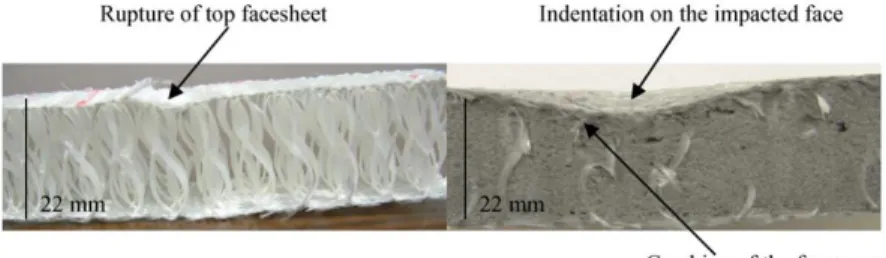
One of the main disadvantages of the conventional core sandwich is the dissimilarity of the face sheets and core material. With respect to this concern, Vaidya et al. (2008) studied the low-velocity impact response of sandwich panels with a hollow core and a polyurethane foam filled core. The failure mode of un-foamed sandwich was the buckling of the core plies and rupture of top face sheet, while that of the foamed sandwich was foam crushing, as observed in Figure 2.8.
Figure 2.8: Failure modes of un-foamed and foamed core sandwich panels
(Vaidya et al., 2008)
The perforation resistance of sandwich panels with different core materials (made with a cross-linked PVC, a linear PVC and PET), placed between glass fiber-reinforced skins, was investigated by Hassan and Cantwell (2012). The experimental results revealed that the perforation resistance was strongly dependent on the foam shear strength and the Mode II of foam material fracture. They pointed out that simple shear tests can be used to verify the perforation behaviour of foam materials. Zhou et al. (2013) proposed a sandwich panel with a hybrid core composed of three foam with different densities bonded together (linear PVC, cross-linked PVC and PEI foams) to improve the perforation resistance.
Othman and Barton (2008) studied the failure mechanisms of honeycomb sandwich panels under quasi-static and impact loading. It was found that the peak force and total energy absorption under impact loading are significantly higher than the quasi-static loading. Schuble et al. (2005)
face sheets and PVC foam core is nearly similar. However, they emphasised that the static deformation and strain levels are more severe, and the damage processes initiated earlier.
Furthermore, three-point bending tests have been used by many researchers to study the failure mechanisms of sandwich beams and trace the failure maps. For instance, Crupi et al. (2012)
analyzed the static and dynamic three-point bending responses of aluminum honeycomb sandwiches. They reported that the bending response of sandwich beams is dependent on the support spans. The collapse mode of sandwich beams with short span support is the core shear failure mode (Mode II), while the sandwich beams with long span support collapsed by Mode I. The effect of face/core bonding on the impact response of glass/polyester PVC foam core sandwich panels by performing flexural impact tests was investigated by Imielinska et al. (2008). They concluded that the type of bonding does not influence the delamination threshold load. Veedu and Carlsson (2005) also studied the effects of the face/core debonding on the buckling and failure behaviour of foam-core sandwich columns. The results showed that the long interface debonding and low core density considerably reduce the buckling force.
Daniel et al. (2012) investigated the impact and post-impact response of sandwich panels made of unidirectional glass/vinylester skins with various core materials (PVC foam and balsa wood). The experimental results revealed that even a minor visible damage can considerably reduce the residual mechanical properties. Damage tolerance of NCF composite sandwich with crosslinked PVC foam core was analysed by Edgren et al. (2008). The compressive after impact tests were carried out on the specimens with visible impact damage (penetrated face sheet) and barely visible impact damage (BVID). The obtained experimental results revealed that the penetrated specimen and BVID damage specimen collapsed at the same compressive force. Furthermore, they used two approaches to predict the compressive strength of damaged specimens: 1) a single equivalent notch and 2) an equivalent open hole. A single equivalent notch represents better the kink-band forming (narrow bands with micro buckled fibers, see Figure 2.9) during compression tests which controls the compressive strength. However, the authors recommend an equivalent open hole with a diameter equal to the damaged area to estimate the compressive failure, as it is difficult to determine a critical notch length.
The effect of oblique impact on the response of composite sandwich plates with a Nomex honeycomb core was also investigated by Ivanez et al. (2015). The maximum contact force, damaged area and energy absorption tend to decrease with increasing the impact angle.
Figure 2.9: Kink-band found in an NCF composite loaded in compression (Edgren et al., 2008)
2.4 Modeling of damage and fracture of laminated composites
In the literature, several analytical solutions for specific impact cases have been proposed to model a complex impact event. These solutions are limited to simple impact cases in which the complicated phenomena such as transverse shear deformation and rotary inertia were not considered. Furthermore, the geometry of impactor was neither considered in modeling, and a single point contact between the impactor and plate was assumed. These models allow to understand the effects of mass and plate geometries on the impact response. Such limitations can be overcome by using numerical models. The most common numerical method for impact simulation is the finite element method. Various finite element software packages have been applied to simulate an impact event such as ABAQUS/explicit, LS-DYNA, etc. The software permit users to implement a new material model in the software via a user-defined subroutine (UMAT). The material modeling is important to simulate the impact damage propagation, energy absorption and stiffness degradation.
Various approaches can be found in the literature to simulate the damage evolution in laminated composites and they can be categorized into four types: 1) failure criteria, 2) fracture mechanics, 3) plasticity and 4) damage mechanics approaches.
The failure criteria based on the material strengths can determine the loading conditions under which failure initiates, however it does not reduce the material stiffness. In this approach, once damage initiates, Young’s modulus in the failure direction is set to zero. The failure criteria approach can predict neither the position nor the size of damage zone. That is why the fracture mechanics approach can be more attractive. In the fracture mechanics approach, the strain energy at the crack front (for a known crack length) is first calculated, and then compared with the critical strain energy release rate in order to increase the crack length. The approach has been used to simulate the delamination growth and the prediction of residual compressive strength. However, it is worth noting that the application of fracture mechanics approach requires a prior knowledge of the crack growth path. Plasticity approach is suitable for composite laminates which exhibit ductile response such as Graphite/Peek, Boron/Aluminum and other thermoplastic composites and it can be merged with the failure criteria approach for estimating damage growth. The continuum damage mechanics approach has been used by numerous researchers in the past decades. The approach has been applied successfully to simulate an impact event. Moreover, the continuum damage mechanics (CDM) can be combined with the failure criteria approach for predicting the damage initiation and with the fracture mechanics approach for simulating the damage propagation. Recently, Bouvet et al. (2012) developed a 3D model based on discrete damage mechanics to simulate the various impact damage modes and interaction between them during low-velocity impact. In this model, the laminate is discretized into volumetric elements joined together by the interface elements, as shown in Figure 2.10. Matrix cracks are inevitably vertical in this model for avoiding the creation of complex mesh in the impact zone. Consequently, the model is limited to thick composites where the ply thickness can be negligible respect to the laminate thickness. Application of this type of damage mechanics is still rare.
2.5 Continuum damage mechanics of composite materials
Continuum damage mechanics was originally proposed by Kachanov and Rabotnov (1958). They proposed the concept of representing damage accumulation during creep of metals by using a scalar damage parameter. The effects of randomly dispersed micro-defects (void) were considered on the macro parameters of structure (mechanical properties). The CDM approach was later used for laminated composites by Talreja (1985).
The definition of internal damage parameters used in a CDM model is very important. The damage parameters must be capable of representing the effects of micro-defect, as well as making the model applicable to engineering problems. Kachanov and Rabotnov (1958) proposed the area density definition of damage parameters. However, it is difficult to measure the effective area directly from the crack distribution after cross-sectioning.
To give details of common damage definition in the composite materials, a volume element at macro-scale is considered, as shown Figure 2.11. In this figure, S is the cross-section area of volume element Vm, before damage occurs. After the formation of micro-cracks and void growth with an
area of Sd, the effective area becomes 𝑆̅ = 𝑆 − 𝑆𝑑.
Figure 2.11: A volume element with micro-cracks
The internal damage parameter d can be defined by quantifying the relative micro-cracks area in the cross-section of volume element as follows:
𝑑 = 𝑆𝑑 𝑆 =
𝑆 − 𝑆̅ 𝑆
(2-1) It is worth noting that the damage parameter value varies between 0 and 1. When the damage parameter d is equal to zero, it indicates the undamaged state of the material, and once d is equal to one, it indicates the final failure state of material.
The appearance of micro-cracks in the cross-section reduces the resisting area and the stress redistributes over the undamaged area. Therefore, the relationship between effective stress in an undamaged material state and damaged state can be written as follows:
𝜎̅ = 𝜎𝑆 𝑆̅=
𝜎 1 − 𝑑
(2-2) This is the concept of Kachanov-Rabotnov damage theory, which was proposed for one dimension bar and it formed the foundation for the development of CDM. In general, the development of CDM model includes two parts: failure initiation criteria and failure propagation. These two parts are discussed in the following sections.
Initially, damage models based on CDM were used for 2D problems in which only in-plane stress effects were assumed. Damage models for woven laminated composites have been developed by Iannucci et al. (2001) to simulate matrix cracks and fiber breakage in the warp and weft directions. Iannucci and Ankersen (2006) proposed an energy-based damage model which can be applied to both woven and unidirectional composites. Lately, Pinho et al. (2006) developed a full 3D damage model which includes a set of three-dimensional failure criteria. Donadon et al. (2008) also implemented a 3D progressive failure model in the explicit Ls-dyna software, considering the different inter-laminar damage modes which can occur in laminated composites. The low-velocity impact response of foam-based sandwich composite was also simulated by using a 3D damage model and interfacial cohesive elements (Feng et al., 2013).
2.5.1 Failure initiation criteria
As mentioned previously, laminated composite materials have different failure modes such as matrix crack, fiber breakage and fiber-matrix debonding. Various failure criteria have been used to precisely predict the initiation of failure in composite materials. In the literature, four forms of failure criteria have been developed: 1) limit theories in which the maximum stress and maximum strain was used as criteria, 2) polynomial theories in which a polynomial expression of stress components was used to define a failure envelope (Tsai-Wu failure criterion (1971)), 3) strain energy theories in which material failure is defined by using a nonlinear energy based criterion (Tsai-Hill criterion (1965)), 4) direct mode theories in which the initiation of each failure mode is defined by a discrete equations (Hashin failure criterion (1980)). Hashin failure criterion has been
frequently used because the theory is capable to predict damage onset for each failure modes separately. Hashin failure criteria are described as follows:
Fiber tension failure (𝜎11≥ 0) 𝐹𝑓𝑡 = ( 𝜎11 𝑋𝑡) 2 + 𝛼 (𝜎12 𝑆𝑙) ≥ 1 (2-3) Fiber compression failure (𝜎11 ≤ 0)
𝐹𝑓𝑐 = (𝜎11 𝑋𝑐)
2
≥ 1 (2-4)
Matrix tension failure criterion (𝜎22 ≥ 0) 𝐹𝑚𝑡 = ( 𝜎22 𝑌𝑡) 2 + (𝜎12 𝑆𝑙) 2 ≥ 1 (2-5)
Matrix compression failure criterion (𝜎22≤ 0)
𝐹𝑚𝑐 = ( 𝜎22 2𝑋𝑡) 2 + [(𝑌 𝑐 2𝑆𝑡) 2 − 1] + (𝜎12 𝑆𝑙) 2 ≥ 1 (2-6)
where Xt and Xc represent the tension and compression strengths in the longitudinal (fiber) directions; Yt and Yc describe the tension and compression in the transverse direction; and Sl and St
are the longitudinal and transverse shear strengths.
In the literature, there are a lot of attempts to improve Hashin criteria. The fiber failure criteria of Hashin has been accepted anonymously, while several modifications have been proposed for the matrix failure criteria. The most well-known modification was done by Puck and Shurmann (1998). Puck and Shurmann modified Hashin failure criteria to accurately predict inter-laminar fracture failure in laminated composites. Firstly, they suggested that the failure criteria must be defined based on the stress components acting on the potential fracture plane and its corresponding strengths. Therefore, the nominal strengths that are measured from mechanical tests cannot be used in the failure criteria. Secondly, they assumed that the transverse compressive stress on the potential fracture plane does not contribute to initiating the failure, and the failure initiation is mainly caused by the two shear stress components as illustrated in Figure 2.12. Actually, the compressive stress increases the shear resistance, proportional to the friction between two fracture surfaces.
Figure 2.12: Stress components acting on the potential fracture plane (Pinho et al., 2012)
In order to apply these assumptions, a failure criterion based on the Mohr-Coulomb theory was developed by the authors as follows:
𝐹𝑚𝑐 = ( 𝜎𝑛𝑡 𝑆23+ 𝜇𝑛𝑡𝜎𝑛𝑛) 2 + ( 𝜎𝑛𝑙 𝑆12+ 𝜇𝑛𝑙𝜎𝑛𝑛) 2 ≥ 1 (2-7)
where σnn, σnt, σnl are the normal stress and transverse and longitudinal shear stresses on the fracture
plane, respectively. S23 and S12 represent the corresponding shear strength on the fracture plane.
The constant μnt and μnl describe the fraction of fracture surfaces.
Recently, Catalanotti et al. (2013) proposed new three-dimensional failure criteria for unidirectional composite laminates. They argued that Puck’s failure criteria do not predict precisely the failure of plies embedded in multidirectional laminates. They revealed that it is required to use the in-situ strengths whose values increase, once a ply implants in multidirectional laminates. Therefore, the transverse tensile and shear strengths, as well as the compressive transverse strength should be computed based on the ply thickness.
Furthermore, they showed that the accuracy of Puck’s tensile criterion depends on relations amongst the material strengths. For example, the criterion predicts correctly the failure initiation under pure transverse tension only if 𝑌𝑇 ≤ √2𝑆23. YT and S
23 are the transverse tensile strength and
the transverse shear strength respectively. Therefore, the failure criteria were modified to take into account the influence of in-situ condition as follows:
where 𝜅 and 𝜆 are computed by 𝜅 = (𝑆𝑙𝑖𝑛2− 𝑌𝑡𝑖𝑠) 𝑆⁄ 𝑡𝑖𝑠𝑌𝑡𝑖𝑠 and 𝜆 = 2𝜇𝑛𝑙𝑆𝑡𝑖𝑠⁄𝑆𝑙𝑖𝑠− 𝜅. In addition, 𝑌𝑡𝑖𝑠, 𝑆
𝑡𝑖𝑠 and 𝑆𝑙𝑖𝑠 are the in-situ matrix tensile strength and shear strength in the transverse and longitudinal directions, respectively.
2.5.2 Failure propagation
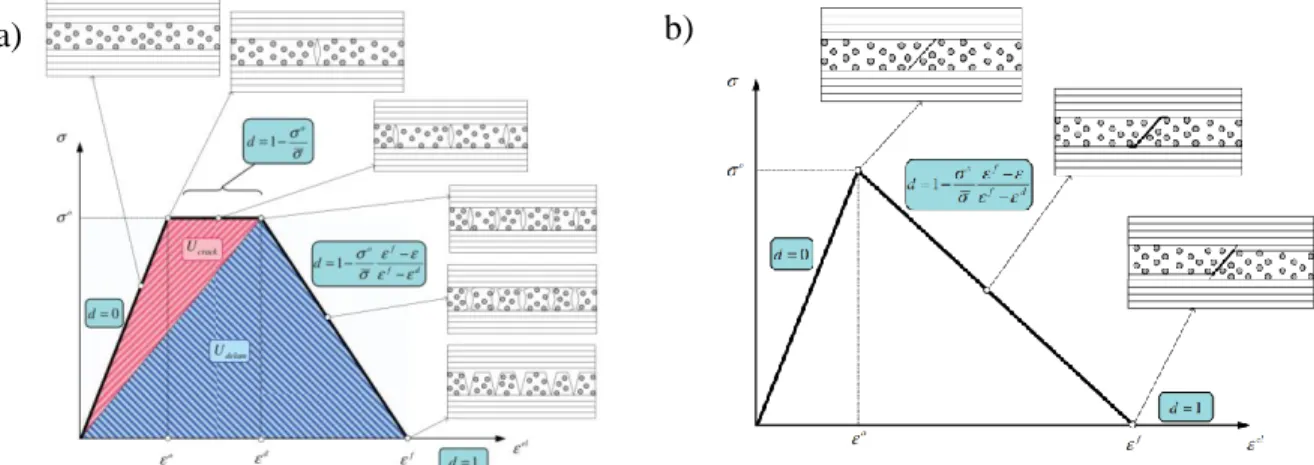
When damage initiates in laminated composites (the failure indices attains one), the constitutive law must be modified to simulate the propagation of cracks/damage in the composite materials. The damage propagation of various failure modes can be treated in different ways. In general, the damage propagation is modelled using a strain-softening process. This approach originally was proposed for cohesive elements in the work of Camanho et al. (2002). The strain-softening process starts from point A (in Figure 2.13) and follows line A-C to reach the completely damaged state. As mentioned previously, an internal damage variable is used to define the evolution of damage propagation.
Moreover, stiffness reduction must be performed in a manner that the energy dissipated (by the numerical model) per unit area of crack growth should be equal to the fracture energy of the material for a specific failure mode. The area under the bilinear curve represents the energy dissipated during the damage evolution. The damage models based on continuum damage mechanics are often constructed in the framework of the thermodynamics in which the positivity of dissipation is interpreted as the damage can only grow (damage growth is an irreversible process).
Once a partially damaged state B happens, the line B-O will be followed under the unloading conditions. The unloading behavior of the material is always elastic linear as shown in Figure 2.13.
𝐹mt = (𝜎nn 𝑆t𝑖𝑠) 2 + (𝜏nl 𝑆l𝑖𝑠) 2 + (𝜏nt 𝑆t𝑖𝑠) 2 + λ (𝜎nn 𝑆t𝑖𝑠) 2 (𝜏nl 𝑆l𝑖𝑠) 2 + κ (𝜎nn 𝑆t𝑖𝑠) 2 ≥ 1 (2-8)
Figure 2.13: Bilinear response of intra-laminar damage model (Topac et al., 2016)
Pinho et al. (2012) introduced two physically-based scenarios for matrix failure propagation regarding the fracture angle of multidirectional laminated composites. The fracture angle is the maximum angle between the fracture surface and the normal plane. When the fracture angle is equal to zero, the creation of the first crack triggers the creation of further cracks, until it reaches a saturation point at which delamination occurs (see Figure 2.14a). Once the fracture angle is not equal to zero, a wedge effect initiates delamination after the creation of the first crack, as shown in Figure 2.14b.
Figure 2.14: a) cracks propagation for an angle equal to 0 and b) cracks propagation for an angle other than 0 (Pinho et al., 2012)
The expressions of damage evolution in the CDM is maybe the most erratic part of the model development. The evolution equations depend on the damage behavior of the material. Williams and Vaziri (2001) used three damage growth parameters based on a Weibull distribution of strength:
b) a)
where E, εf and X represent the elastic modulus, failure strain and material strength respectively, e
is the base of natural logarithm and m describes the shape of damage propagation curve. A quadratic expression was also used by some researchers to define the damage evolution parameter (Donadon et al., 2009; Zhou et al., 2015):
In general, a linear expression has been used for damage evolution in the CMD as follows:
where 𝜀𝑜 correspond to the failure initiation strain and 𝜀𝑓 correspond to the maximum strain.
2.5.2.1 Smeared cracking formulation
One of the main problems in continuum damage mechanics is strain localization caused by degradation of element material properties, and the mesh dependency of FEM solution. This problem leads to decrease of calculated energy absorption with the reduction in the element size. Generally, a smeared formulation is applied to overcome the problem of strain localization. The main idea of the smeared cracking is to create a relation between the volumetric energy (energy dissipated per unit volume (Pinho et al., 2006)) and the fracture energy of material. As consequence of this method, the constitutive law of material must include a parameter related to the element dimensions in order to attain a constant fracture energy independent of the element dimensions. To demonstrate the method, the entire plate shown in Figure 2.15 is modeled as one element. The failure energy of the element can be calculated from:
𝑈 = 𝐿1𝐿2𝐿3× 𝜎𝑜𝜀𝑓
2
(2-12) According to fracture mechanics principles, this energy must be equal to an energy per unit area multiplied by the dimensions of fracture area A=L1×L3 as follows:
𝑈 = 𝐺𝑓× 𝐿1𝐿3 (2-13) 𝑑 = 1 − 𝑒𝑥𝑝 [− 1 𝑚 𝑒( 𝐸𝜀𝑓 𝑋 ) 𝑚 ] (2-9) 𝑑 = 1 −𝜀0 𝜀 [1 + 𝜅2(2𝜅 − 3)] 𝜅 = 𝜀 − 𝜀0 𝜀𝑓− 𝜀0 (2-10) 𝑑 = 𝜀𝑓 𝜀𝑓− 𝜀0(1 − 𝜀𝑓 𝜀) (2-11)
![Figure 3.11: Tensile force versus displacement curves of [{-45/+45/-45 }]3s under various strain rates](https://thumb-eu.123doks.com/thumbv2/123doknet/2340356.33753/68.918.285.634.188.416/figure-tensile-force-versus-displacement-curves-various-strain.webp)