HAL Id: ineris-00972483
https://hal-ineris.archives-ouvertes.fr/ineris-00972483
Submitted on 3 Apr 2014
HAL is a multi-disciplinary open access
archive for the deposit and dissemination of
sci-entific research documents, whether they are
pub-lished or not. The documents may come from
teaching and research institutions in France or
abroad, or from public or private research centers.
L’archive ouverte pluridisciplinaire HAL, est
destinée au dépôt et à la diffusion de documents
scientifiques de niveau recherche, publiés ou non,
émanant des établissements d’enseignement et de
recherche français ou étrangers, des laboratoires
publics ou privés.
Transposition of an exothermic reaction to a continuous
intensifies reactor
Wassila Benaissa, Sébastien Elgue, Nadine Gabas, Douglas Carson, Michel
Demissy
To cite this version:
Wassila Benaissa, Sébastien Elgue, Nadine Gabas, Douglas Carson, Michel Demissy. Transposition
of an exothermic reaction to a continuous intensifies reactor. 6. International Conference on process
intensification, Sep 2005, Delft, Netherlands. pp.69-77. �ineris-00972483�
Transposition of an exothermic réaction to a continuous
intensifiée! reactor
W Benaissaab, S Elguea, M Cabassucf, N Gabasa, D Carsonb, M Démisse/3
a
Laboratoire de Génie Chimique, UMR 5503 CNRS-INPT-UPS, France
b
INERIS (Institut National pour l'Environnement Industriel et les Risques), France
ABSTRACT
The aim of this study is thé transposition of an exothermic réaction carried out in a batch reactor to a continuous intensified one. The esterification of propionic anhydride with 2-butanol was selected as a case study. The décomposition reactions of thé reactants and thé products were studied by DSC whereas thé heat of solution of thé two reactants were determined by isothermal calorimetry. An extensive expérimental programme was then carried out using thé Mettler RC-1 réaction calorimeter in order to characterize thé thermal and kinetic behaviour of thé réaction under isothermal conditions. Thé thermal conversion was compared with thé molar conversion obtained by simulation based on a kinetics from thé literature. Optimal and safe operating conditions were eventually defined for a continuous heat exchanger type reactor. Dedicated software was used to assess thé feasibility of thé esterification in this reactor by calculating thé conversion and température profiles along thé process and utility lines.
Keywords: process intensification, chemical reactor, safety, esterification, simulation.
NOTATIONS
Eaj : activation energy (J.mol"1)
Cmhp : propionic anhydride concentration (mol.L'1)
C2b : 2-butanol concentration (mol.L1)
C^p : acid propionic concentration (mol.L"1)
fc, : réaction rate constant (L.mol'Vs" 1
) ko. : frequency factor
R : gas constant (J.K'^mol1)
1 INTRODUCTION
In thé event of loss of control of thé cooling System of a reactor during thé process, exothermic reactions can lead to thermal runaway, which can in turn lead to loss of confinement of toxic and/or fiammable substances. Safety thus is an important operational objective when processes are developed or optimised. Most processes in thé specialty
chemical industry are batch or semi-batch opérations. Thèse types of reactors can offer large production volumes and are quite flexible. However controlling thé température and heat transfer becomes more diffïcult as thé size of thé reactor increases (1). New perspectives are appearing by process intensification: that is, miniaturised and continuous technologies developed to attain better heat transfer and safer conditions. The aim of this work is to study how an exothermic réaction can be carried out in a new compact, intensified, continuous, multifunctional reactor. This pilot reactor is composed of three sections made up of a 6-plate sandwich heat exchanger. The main advantage of this type of reactor is in coupling high heat exchange capacities with plug flow behaviour of thé process fluid in a modular apparatus. This arrangement offers a better heat transfer area, heat transfer coefficient and température control. The esterification of propionic anhydride by 2-butanol was chosen as a model réaction. A large set of expérimental data is available and has been used to characterise thé thermodynamic and kinetic behaviour of thé réaction. The non-catalysed réaction exhibits second-order kinetics. An autocatalytic type behaviour is observed when sulphuric acid is added to thé réaction mixture as catalyst. Moreover a spécifie software tool has been used to estimate thé process behaviour during thé synthesis as well as to déterminé thé optimal operating conditions for safety control. The simulation algorithm is based on a complex dynamic model of thé intensified reactor. It gives as results thé concentration and température profiles along thé réaction line.
2 CASE STUDY: ANHYDRIDE PROPIONIC ESTERIFICATION 2.1 Introduction
The esterification of propionic anhydride by 2-butanol leads to butyl propionate and propionic acid (see fig.l). This synthesis is exothermic: Ubrich et al (2) found a value of AHr = -62.5 ± 1 kJ.mol"1. The réaction is relatively simple to carry out in a homogeneous liquid phase. This réaction thus constitutes a relevant case in thé studies relating to thé assessment of thé chemical risk (3).
CH, CH2
" i C
N y \ CH, CH2
Figure 1. Réaction schème for thé esterification of propionic anhydride by 2-butanol
According to Galvan et al. (4), thé réaction rate is a fonction of catalyst: without catalyst thé réaction is second-order but has a kind of autocatalytic behaviour when sulphuric acid is présent in thé réaction mixture.
2.2 Réaction rate without catalyst
When thé réaction is performed with no strong acid as catalyst, thé réaction is slow and follows second-order kinetics, fïrst order in each reactant (4):
2.3 Réaction with sulphuric acid as catalyst
In thé présence of sulphuric acid, Zaldivar et al (5) made thé following observations: . The réaction rate seems to be proportional to thé acid concentration,
. The réaction rate increases with propionic acid concentration, causing a kind of autocatalytic behaviour (see équations [eq. 4] and [eq. 5]),
. After having reached a certain concentration, propionic acid no longer influences thé réaction rate.
Since thé various theoretical réaction pathways are complex, an empirical model was devised assuming thé existence of two catalysts (caû,cat2) (6). The transformation of thé initial catalyst was developed by taking into account acidity function (7).
Thus, thé réaction rate of thé main réaction can be written as (4) :
rx = (*, + k2 • Ccatl )• Canhp • C2b + k3 • Ccat2 • C [eq. 3 ]
The réaction rate due to thé formation of thé second catalyst is also taken into account:
Lastly, thé expression of thé acidity function is:
Mr = - ( A • Ccaa + p2 • CacP)- [ p3 + 1 1 I [eq. 5]
Réaction rate constants follow Arrhenius law:
kt =koi• e x p ( - Eaj /(R • Tr)) [eq. 6]
The kinetic parameters are given in table 1.
Table 1. Kinetic parameters équations from [eq. 1] to [eq. 5]. (5)
i
1
2
3
4
to,
5.36178 10
7 a2.8074 1 0
1 0 b3.9480 1 0
1 0 a1.4031 10
8a
t ( J . m o r
1)
80478,64
79159,5
69974,6
76617,2
Pi2,002.1G
-13,205.10'
2-21,3754
12706
L.moî!.s"]3 PREUMINARY CALORIMETRIC STUDIES 3.1 Microcalorimetry DSC
DSC (Differential Scanning Calorimeter) was used to study thé thermal stability of various samples. Only a few milligrams of each were needed.
A fïrst séries of experiments was carried out on thé pure reagents and thé réaction products. The samples were heated from room température to 400 °C at a rate of 5 °C/min. Table 2 gives thé onset température and thé température at thé peak as well as thé energy released during thé décomposition. Thèse values are compared with thé référence data bases available in thé literature. Following thé same operating conditions, a complementary test was carried
out using a mixture of 1.10 mg for each of thé two reagents. The DSC curve obtained is shown in Figure 2: heat flow released during experiment (expressed in W.g"1) is plotted
against température (expressed in °C).
Table 2. Pure Products 2-Butanol Propionic anhydride Propionic acid Butyl Propionate
Results of thé DSC experiments on pure products.
Mass (mg) 2.54 2.22 1.82 2.05 Tonseta (°C) 183.5 - 1 5 5 188.4 - 1 7 0 Tmaxb(°C) 187.0 167.5 209.8 174.2-209.2 AHdecc(J/g) - 4 2 - 4 7 -35 - 7 0 Tonsetbibd (°C) 184.6 154 186.6 — a
Tonset : température of décomposition (°C)
b
Tmax : température corresponding to thé maximum energy released by thé decomposition(°C)
0
AHjec : energy of décomposition (J.g")
d
Tonsetyb : température of décomposition, data from bibliography (8).
Thé first peak gives thé energy released by thé main réaction and thé second area corresponds to thé energy of décomposition. According to table 2 and figure 2, thé température of thé réaction mixture must not exceed 150 °C to avoid any décomposition.
DSC: 2-Butanol and Propionic anhydride
200 2S0 Température (°C)
Figure 2. Microcalorimetry DSC for a mixture of propionic anhydride and 2-butanoI 3.2 Isothermal Calorimetry C80
Alos et al. (9) noticed an endothermic effect when propionic anhydride is mixed with 2-butanol. The C80 isothermal calorimeter was used to déterminé thé heat of solution. 2.10"3 mol of each reactant was placed in thé calorimeter in separate compartments. After thé calorimeter was stabilised at 40 °C, thé reactants were mixed together inside thé calorimeter. The non-catalysed esterification réaction rate is very slow, thus thé heating effect observed is due to thé solution. The results show that thé enthalpy of solution is 22.1 J.g"1.
4 KINETIC MODELLING AND SIMULATION
The kinetic model is essential in predicting thé behaviour of thé continuous intensified reactor. A computer simulation program was used to validate thé kinetic model suggested in thé literature and detailed in paragraph 2.
The standard 2 litre Mettler RC-1 reactor in thé semi batch mode was modelled. The reactor was filled with thé specified quantity of 2-butanol with or without sulphuric depending on thé experiment. The simulation takes into account thé step of adding thé second reagent (propionic anhydride) and thé second step where thé réaction was allowed to go to completion after thé addition. The foliowing assumptions were made:
. The mixture température is maintained constant by thé jacket régulation,
. The System is agitated perfectly: température as well as chemical and physical properties of réaction mixture are uniform,
• Réaction mixture is a homogenous liquid phase,
. The variation of volume due to thé mixture and dilution are neglected.
The dynamic formulation of thé model leads to a system of differential and algebraic équations. The simulation produces thé concentration profiles and thé volume vs time.
5 EXPERIMENTAL STUDY IN THE RC-1 CALORIMETER 5.1 Expérimental procédure
Ten experiments were carried out in thé réaction calorimeter RC1 for jacket températures ranging from 30 to 70 °C and sulphuric acid concentrations ranging from 0.3 % to 0.8 % (expressed as a percentage of thé weight of butyl alcohol). The 2-butanol was introduced into thé reactor as well as thé proper quantity of sulphuric acid. The stirring speed was fixed at 200 RPM. When thé mixture température was equilibrated, 6.86 mol of propionic anhydride was pumped into thé reactor at a constant flow rate over a 15 minutes period. During thé réaction, thé réaction température was maintained constant by controlling thé température jacket. However, thé second reagent was added in several times when thé instantaneous heat release was likely to exceed thé cooling capacity of thé calorimeter.
5.2 Expérimental results
The results were recorded by thé WinRC® (10) software. During acquisition, it records on line ail thé pertinent thermal parameters. After thé experiment, it calculâtes thé heat flux due to thé réaction as a fonction of time (Qr in W) and calculâtes thé enthalpy of réaction for a spécifie area chosen by thé user (ÀHr en kJ.mol"1). The software also calculâtes thé thermal conversion (X en %) within thé intégration limits.
5.3 Kinetic validation
-7
— —
•
-*" * •
v u * * * * " ' " "
f ^
-I
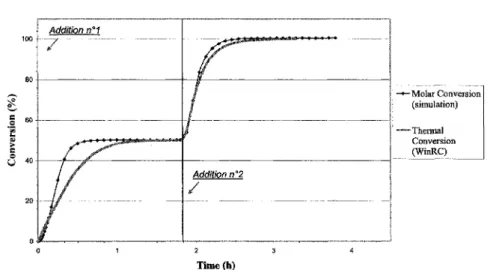
—•— Molar Conversion (simulation) — T h e r m a l Conversion (WinRC) Time (h)Figure 3. Conversion profiles results from simulation and WinRC® (Tr=50°C, wSUi=0,3%)
If we assume that heat released is due only to thé main réaction, thermal conversion can be compared with molar conversion. Thus, thé expérimental thermal conversion is compared with thé molar conversion obtained by simulation. An example is given in figure 3. The curves are in good agreement. We thus deem thé kinetic model valid.
6 ESTERIFICATION IN THE CONTINUOUS INTENSIFIED REACTOR 6.1 Heat-Exchanger/Reactor OPR (Open Plate Reactor)
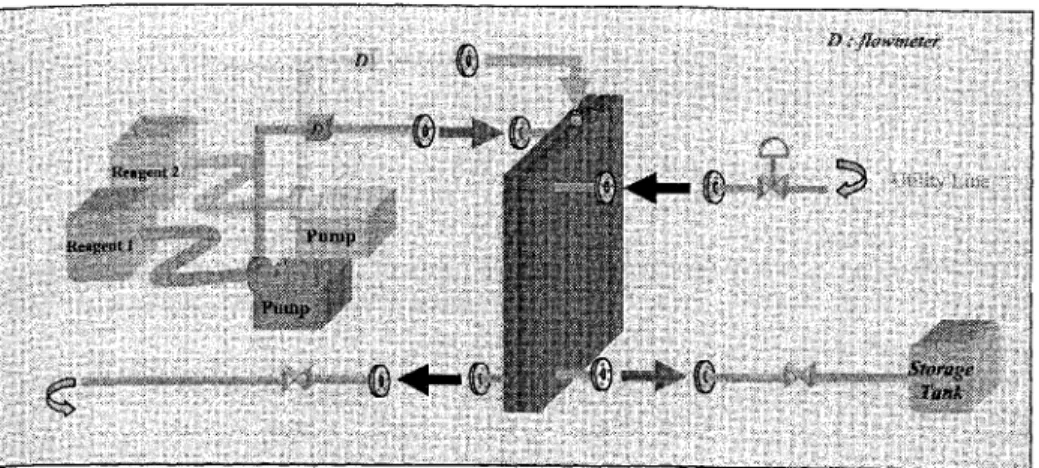
The thermal and kinetic behaviour of thé esterification of propionic anhydride by 2-butanol has now been characterized. The objective is then to study thé operating conditions of this réaction in thé heat/exchanger OPR (Open Plate Reactor) developed by Alfa Laval Vicarb. The OPR is a small, multifunctional, continuous reactor which is built like a multi-plate heat exchanger divided into sections (11). As shown in figure 4, each section is made up of a reactive plate where thé réaction mixture flows, surrounded by two cooling plates containing thé utility fiuid. This new concept of "reactor/ heat exchanger" makes it possible to perform complex chemical reactions with a very accurate thermal control. The OPR appears particularly well-suited to process intensification, as it makes possible an increase of reactant concentration and a réduction of solvent consumption at thé same time. The pilot is composed of three sections and has a total capacity of 1.5 L. Previous studies hâve shown that thé OPR can be consider as plug flow for a flow-rate of reagents equal to 50 L.h"1. The operating system allows a maximum cooling fluid flow-rate of 5 m3^"1.
§-. - • ;.
Figure 4. Simplifiée représentation of thé "heat-exchanger/reactor" OPR 6.2 Data processing tool
A spécifie computer simulation program has been developed in paralleled to thé development of thé reactor. Thé software takes into account thé spécifie geometry of thé intensified reactor and provides thé température profiles of thé cooling fluid as well as thé température profile and conversion profile along thé réaction line. Preliminary réaction tests carried out on thé OPR hâve been used to validate thé simulation framework. In this way, thé more interesting results hâve been obtained from thé study of thé oxidation of sodium thiosulfate by hydrogen peroxide since this réaction présents fast kinetics. By means of température records ail along thé reactor and of thé final réaction yield, like showed in figure 5, thé thiosulfate oxidation réaction allows to successfully validate thé simulation framework.
Utility flow rate: 1.8 m3/h block 1 , 0.9 m3/h block 2 & 3 1 0 0 T~ " •" ~ ~ • -90 80 7 0 -0,4 0,6 0,8 Volume (L) Process fluid *-Utility fluid • -Wal l
• Process fluid (exp) * Utility fluid (exp) « Réaction yield (exp)
Réaction yield 1,2 0,8 0,6 0,4 0,2 1,4
6.3 Spécifie simulations
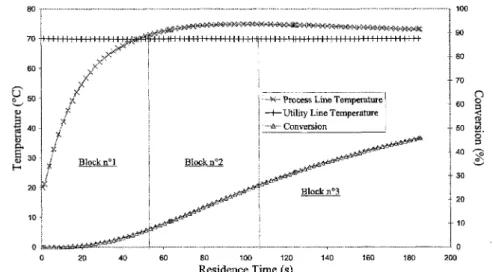
The use of thé data processing tool makes it possible to asses thé feasibility and potential of carrying out thé esterification in this reactor. The main parameters to be modified are thé initial sulphuric acid concentration, inlet température and cooling fluid flow-rate. It is then possible to déterminé operating conditions in terms of molar conversion while maintaining proper heat transfer and an overall température lower than 100 °C. One resuit is presented in figure 6 and shows that for a reactor composed of three sections, corresponding to a 3 minute résidence time, conversion can reach 45 % for this réaction.
n
Process Line Température Utility Line Température
—*-- Conversion
100 120 140 160 180 200
Résidence Time (s)
Figure 6. Température profiles and molar conversion along thé reactor OPR for thé propionic anhydride esterification
7 CONCLUSION
A kinetic model taken from thé literature for thé production of butyl propionate by reacting propionic anhydride with 2-butanol has been validated by experiments done in a 2 litres, Mettler RC-1 semi-batch réaction calorimeter. The kinetic model was then used as input to a computer simulation of an Open Plate Reactor to déterminé thé feasibility of using this new compact continuous reactor to produce butyl propionate. The operating conditions were optimised using thé results of thé computer simulations and show that thé transposition is indeed feasible. Expérimental vérification in thé OPR pilot Reactor are under way.
ACKNOWLEDGEMENT
The authors would like to thank Alfa Laval in supply of thé "heat-exchanger/reactor" and Data Processing Tool software which hâve made possible this study.
REFERENCES
(1) Stoessel, F., 1993, What is your thermal risk ?, Chemical Engineering Progress, 68-75. (2) Ubrich, O., B. Srinivan, P. Lerena, D. Bonvin & F. Stoessel, 1999, Optimal feed profile
for a second order réaction in a semi-batch reactor under safety constraints ; Expérimental study, Journal of Loss Prévention in thé Process Industries, 12,485-493. (3) Snee, T.J., H. Barcons, H. Hernandez & J.M. Zaldivar, 1992, Characterisation of an
exothermic réaction usin adiabatic and isothermal calorimetry, Journal of Thermal Analysis, 38,2129-21AÏ.
(4) Galvan, I.M., J.M. Zaldivar, H. Hemandez & E. Molga, 1996, The use of neural network for fitting complex kinetic data, Computers & Chemical Engineering, 20(12), 1451-1465.
(5) Zaldivar, J.M., H. Hernandez, E. Molga, I.M. Galvan & F. Panetsos, 1993, The use of neural networks for thé identification of kinetic functions of complex reactions, Proceedings of thé third european symposium on computer aided process engineering, ESCAPE 3, Graz, Austria, 42-46.
(6) Dhanuka, V.R., V.C. Malshe & S.B. Chandalia, 1977, Kinetics of thé liquid phase esterification of carboxylic acids with alcohols in thé présence of acid catalysts : re-interpretation of published data, Chemical Engineering Science, 32 (5), 551-556. (7) Haldar, R. & D.P. Rao, 1992, Expérimental studies on parametric sensitivity of a batch
reactor, Chemical Engineering Technology, 15,34-38.
(8) Perry, R.H., D.W. Green et J.O. Maloney, 1997, Perry's Chemical Engineers' Handbook, MacGraw-Hill Professional.
(9) Alos, M.A., J.M. Zaldivar, F. Strozzi, R. Nomen & J. Sempere, 1996, Application of parametric sensitivity to batch process safety : theorical and expérimental studies, Chemical Engineering Technology, 19,222-232.
(10) WinRC®, 2000, Mettler Toledo, The RC1® System, Operating instructions and user guide.
(11) Devatine, A., L. Prat, P. Cognet, M. Cabassud & F. Chopard, 2003, Process Intensification : Performances Evaluation of a New Concept « Open Plate Reactor », 4th European Congress of Chemical Engineering — ECCE 4, Granada, Spain.

![Table 1. Kinetic parameters équations from [eq. 1] to [eq. 5]. (5)](https://thumb-eu.123doks.com/thumbv2/123doknet/2339583.33600/4.901.124.668.379.839/table-kinetic-parameters-equations-eq-eq.webp)