Mouna Ben Chouikha and Salem Ben Dhaou Dakhli 706 Knowledge Sharing in Virtual Organizations: Barriers and Enablers
K
NOWLEDGE
S
HARING IN
V
IRTUAL
O
RGANIZATIONS
:
B
ARRIERS AND
E
NABLERS
Mouna Ben Chouikha, CREPA Laboratory, Paris-Dauphine University, France
Salem Ben Dhaou Dakhli, CERIA Laboratory, Paris-Dauphine University, France
Abstract
Modern organizations have to deal with many drastic external and internal constraints due notably to the globalization of the economy, the fast technological changes, and the shifts in customers demand. Moreover, organizations functionally divided and hierarchical internal structures are too rigid and make difficult their adjustment to the changing constraints resulting from the pressure of their external environment. Consequently, to survive and maintain their competitive advantage in the market, modern organizations must alter their internal structure to become organic and flexible systems able to adapt and progress in a high velocity environment. Virtual organizations are among the most popular solutions which provide organizations with more agility and improve their efficiency and effectiveness. Despite many success stories materialized by economic and non-economic benefits, many virtual organizations have failed to reach their goals due to the problems they have encountered while trying to manage knowledge. In this work, we analyze the barriers and enablers of knowledge management in virtual organizations.
Keywords: knowledge; knowledge management; virtual organization; knowledge sharing; boundary.
1
I
NTRODUCTIONModern organizations have to deal with many drastic external and internal constraints. On the one hand, their environment is continuously changing due notably to the globalization of the economy, the fast technological transformations, and the shifts in customers demand. On the other hand, organizations are functionally divided and hierarchical internal structures are too rigid and make difficult their adjustment to the changing constraints resulting from the pressure of their external environment. Consequently, to survive and maintain their competitive advantage in the market, modern organizations must alter their internal structure and to become an organic and flexible systems able to adapt and progress in a high velocity environment (Mishra et al., 2002). As pointed out by many authors, cooperation based on permanent or temporary inter-organizational relationships are among the most popular solutions which provide traditional organizations with more agility and improve their efficiency and effectiveness (Alexander, 1995) (Hastings, 1993). Virtual organizations are examples of such new business forms adopted by many traditional organizations to reach specific shared goals. Such forms have emerged with the help of information and communication technologies. There are two main reasons behind the popularity of virtual organizations. Firstly, traditional organizations demand for more work flexibility, and cost-effective technological capabilities which make working remotely more viable and attractive for individuals. Secondly, virtual organizations permit traditional organizations accessing and transferring knowledge and expertise across organizational and spatial boundaries, internal networks and geographically dispersed groups and individuals. Virtual organizations make possible the combination of resources, competencies and strengths of many partners which develop products and services through cooperation instead of competition. Products and services developed by virtual organizations are likely to be complete and of high quality due the mutual learning of partners routines, skills, and work procedures. Despite many
Mouna Ben Chouikha and Salem Ben Dhaou Dakhli 707 Knowledge Sharing in Virtual Organizations: Barriers and Enablers
success stories materialized by economic and non-economic benefits, many virtual organizations have failed to reach their goals due to the problems they have encountered while trying to manage knowledge. In particular, virtual organizations characteristics like geographic dispersion and information technology dependence make it difficult learning and knowledge sharing among their members and organizational settings. In this work, we analyze the barriers and enablers of knowledge sharing within virtual organizations. Our paper is organized as follows. Section 2 defines the concept of virtual organization and identifies its main characteristics. In section 3, we present the concepts of knowledge and knowledge management. Section 4 is dedicated to the barriers of knowledge sharing within virtual organizations. In section 5, we propose solutions to reduce the impacts of such barriers by identifying the enablers of knowledge management in virtual organizations. Section 6 concludes this paper and lists the future research directions.
2
V
IRTUALO
RGANIZATIONSThe purpose of virtual organization consists in the optimization of the use of opportunities which derive from the market or from resources. Many definitions of the virtual organization concept have been proposed in the literature. (Fisher and Fisher, 1998), (Hoefling, 2001), and (Travica, 2005), stress that a virtual organization is a collection of geographically dispersed units which may be either entire organizations that depend on electronic linking in order to complete a set of business processes, or individuals, groups, organizational units which may belong to the same organization or to different organizations. A virtual organization may be temporary and dedicated to task or a project, or permanent, decentralized and independent of any spatial connection. The enterprises involved keep their legal and economic independence. (Boudreau et al., 1998) consider that a virtual organization is a temporary, flexible arrangement of dispersed components, contributed by multiple organizations and linked together with information technologies. According to (Lipnack and Stamps, 2000), a virtual team is defined as “a group of people who work interdependently with a shared purpose across space, time, and organizational boundaries using technology”. Therefore a virtual organization may be considered as a global virtual team which is temporary, culturally diverse, geographically dispersed, and electronically communicating work group (Jarvenpaa and Leidner, 1998). From Porter’s point of view, a virtual organization is “a collection of business units in which people and work processes from representing in the business units interact intensively in order to perform work, which benefits all” (Porter, 1990). Drawing on the significant literature, (Porter, 1990) and (Warner and Witzel, 2004) have identified the main characteristics of virtual organizations. Such characteristics are notably:
Geographical dispersion,
Reliance on information and communications technologies in order to permit organizational actors carrying out distance work,
Ability to work in a mobile dynamic manner, Ability to take hybrid forms,
Lack of boundaries, Flexibility,
Vertical/Horizontal integration, High fluctuation in workforce,
Decentralization and independence of spatial connections, Short business cycle time.
In this paper, we draw on the literature to define a virtual organization as a configuration of legally independent units (traditional organizations, individuals,…) that cooperate in order to share a set of shared goals related to goods and services development and distribution. Within a virtual organization, centralized functions are replaced by coordination mechanisms based on information and communication technologies. Each unit involved in a virtual organization participates with its resources and core competencies. A virtual organization is viewed by third parties as a homogeneous organization that may be temporary or permanent. It is created to fulfill a mission which determines its lifetime.
Mouna Ben Chouikha and Salem Ben Dhaou Dakhli 708 Knowledge Sharing in Virtual Organizations: Barriers and Enablers
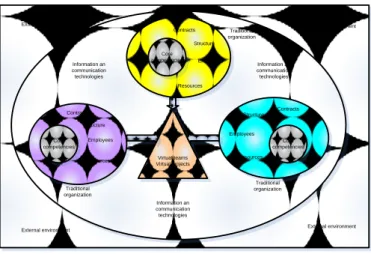
As noted by many authors, the organizational processes associated to a virtual organization are not restricted by space. Moreover, actors involved in a virtual may never meet face to face (Hofstede, 1997) (Jarvenpaa et al., 1998) (Jones and Bowie, 1998). Figure 1 illustrates the concept of virtual organization. Core competencies Core competencies Core competencies Employees Resources Employees Resources Resources Employees Structure Structure Structure Contracts Contracts Contracts Virtual teams Virtual projects Information an communication technologies Information an communication technologies Information an communication technologies External environment External environment External environment External environment Traditional organization Traditional organization Traditional organization
Figure 1. Virtual organization representation
As a configuration of traditional organizations and individuals which includes many virtual teams, a virtual organization has many advantages like flexibility, dynamism, productivity improvement, cost reduction (Mowshowitz, 1997), time-to-market reduction (Rafaeli and Ravid, 2003), collaboration across organizational boundaries, and faster response time due to ubiquity (Arnison and Miller, 2002). Another advantage of virtual organizations consists in the reuse of virtual teams work methods which can become an important part of the organization's knowledge repository. Indeed, electronic exchanges can be archived providing future teams with information about team problems confronted and team solutions generated in the past (Lewis, 1998) (Walsh and Ungson, 1991). However, virtual organizations have many drawbacks including the monetary and non-monetary loss due to a downtime arising out of a possible failure of the medium of communication, decrease of productivity, the difficulty of knowledge sharing due to the geographic dispersion, and the lack of face to face communication and interaction and the distrust arising among the actors (Arnison and Miller, 2002). In the next section, we focus on the barriers of knowledge sharing within virtual organizations.
3
KNOWLEDGE MANAGEMENT IN ORGANIZATIONS:
A
L
ITERATURE REVIEWPrior to presenting the knowledge management process in organizations, we first define the concept of knowledge.
3.1 The knowledge concept
To avoid confusion between knowledge, information and data, we start this section with defining these three concepts. Data is just a set of signs, numbers and letters represented by bits i.e. lots of ones and zeros. For example, “10121965” is data which may represent many facts, assertions or perceptions. Information is data with semantics i.e. data associated with an interpretation model which reflects the context of creation and use. Information involves manipulation of raw data. Often, information can be used to obtain a more meaningful indication of trends or patterns For example, if a “dd.mm.aaaa” French model of date is used as a model of interpretation, 10121965 means December 10, 1965. In contrast, if an “mm.dd.aaaa” English model of date is used as a model of interpretation, 10121965 means October 12, 1965. Knowledge is defined as information that is relevant for executing certain business actions. (Becerra-Fernandez et al., 2004) stress that knowledge is information with decision-making and action-directed utility and purpose. According to (Newell et al., 2002) and (Nonaka and Takeuchi, 1995), knowledge may be understood as a justified true belief. Unlike data and information, knowledge involves the added value of beliefs and commitment, leads to action; and is
context-Mouna Ben Chouikha and Salem Ben Dhaou Dakhli 709 Knowledge Sharing in Virtual Organizations: Barriers and Enablers
specific and relational (Newell et al., 2002). This definition emphasizes the temporary nature of knowledge. For example, the relationship between the quantity of bread to be ordered by a grocery, the quantity of bread currently in the inventory, and the daily sales of products that use bread is knowledge. Knowledge is different from data and information since it is the richest, deepest and most valuable of the three concepts and therefore may be ranked at the highest level in a hierarchy with information at the middle level, and data to be at the lowest level.
The knowledge and information concepts are mutually dependent. On the one hand, information is external to human beings and is stored in various supports like books or databases while knowledge is internal to the minds of knowledge workers. On the other hand, information is converted to knowledge through the internalization process and knowledge is transformed into information once it is externalized (Alavi and Leidner, 1995). Internalization consists in transforming information which is external into knowledge which is internal to the minds of knowledge workers. Learning and information processing by knowledge workers facilitate internalization and result in creation of new knowledge, or alteration of existing knowledge. Externalization consists in articulating internal knowledge in order to making it external to the mind of a knowledge worker. Externalized knowledge is called explicit knowledge or information while tacit knowledge is knowledge which cannot be articulated (Zack, 1999). Knowledge is tacit if it is difficult to express using some understandable symbols like written notations or spoken language. The concept of tacit knowledge was introduced by (Nonaka, 1994), drawing on the more philosophical work of (Polanyi 1967) which considers that tacit knowledge is the type of knowledge we use to carry out the actions that we perform routinely without thinking consciously about how to carry out these actions. According to (Kano-Kikoski and Kikoski, 2004), explicit knowledge comprises “knowing that” while tacit knowledge refers to “knowing how”. (Choo and Bontis, 2002) consider that there are three categories of knowledge: explicit, tacit, and cultural. Firstly, explicit knowledge is defined as “knowledge that has been codified formally using a system of symbols and can therefore be easily communicated or diffused”. Secondly, tacit knowledge corresponds to “the implicit knowledge used by organizational members to perform their work and make sense of their worlds. Tacit knowledge is hard to verbalize because it is expressed through action-based skills and cannot be reduced to rules and recipes”. Finally, cultural knowledge consists of “the shared assumptions and beliefs about an organization’s goals, capabilities, customers and competitors”. (Choo and Bontis, 2002) stress that all three types of knowledge are interdependent, and the more integrated they are, the more unique the organizational advantage.
Instead of explicit and tacit knowledge, many authors talk about fluid and sticky knowledge. According to (Lei, , the knowledge base that lays the foundation of an organization's core competence is composed of easily replaced domain knowledge and the less easily replaced knowledge related to the way work is carried out. (Blecker et al., 2002) use the expression fluid knowledge to call the first form of knowledge since it is capable to flow around an organization. These authors call sticky knowledge the second form of knowledge because it is related to the operational and decision processes undertaken within an organization and are inseparable from knowing how work is carried out. The signifiers fluid and sticky are more appropriate for this application than the descriptors explicit and tacit (Nonaka and Takeuchi, 1995). Sticky knowledge is glued onto the experiences of individuals and may remain unarticulated formally. The replacement of such knowledge is problematic because it is not easily surfaced in order for it to be codified, stored, or transmitted. It may be partly transmitted between individuals through communities of practice, social web forums and wikis, story telling or boundary objects.
Another important characteristic of knowledge is that it is related to action (Nonaka and Takeuchi, 1995) (Nonaka, 1994) (Buckley, 2001). This means that the value of knowledge results from the ability of knowledge workers to impact the real environment in which they operate. Moreover, the action of knowledge workers within the environment where they operate generates feedback information which facilitates organizational learning. In particular, tacit knowledge can take the form of embodied knowledge which is materialized by action of knowledge workers (Blackler, 1995). 3.2 The knowledge management process
(Becerra-Fernandez et al., 2004) define knowledge management as the set of performing the activities involved in discovering, capturing, sharing, and applying knowledge so as to enhance, in a
cost-Mouna Ben Chouikha and Salem Ben Dhaou Dakhli 710 Knowledge Sharing in Virtual Organizations: Barriers and Enablers
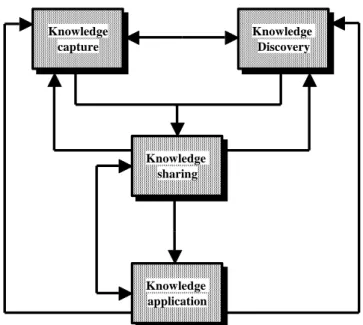
effective fashion, the impact of knowledge on the organization’s goal achievement. This definition is compliant with the well-known definition of management as doing what is needed to get the most out of some resource. According to (Fahey et al., 2001), knowledge Management enables, supports, and encourages three interrelated foci: knowledge stock development, knowledge flow management, and knowledge putting to use. Firstly, the development of organization’s knowledge stock results from discovering or creating new knowledge and refining existing knowledge. Secondly, the knowledge flow management is related to knowledge sharing among individuals and across all organizational. Finally, knowledge is put in use within an organization through its continued development and use as part of individuals day-to-day work to carry out operational and decision-making processes. (Davenport and Prusak, 2000) note that knowledge is not managed for its own sake. Rather, knowledge management is carried out within organizations in order to create, share, and leverage increasingly higher quality knowledge needed by organizations to achieve three interrelated goals: superior external performance, superior internal performance, and enhancement of the organizational actors quality of life. (Fahey et al., 2001) and (Thomas et al., 2001) emphasize the human and social facet of knowledge management meaning it extends beyond design and use of the tools and technologies involved in gathering, analyzing, and transmitting data. Rather knowledge management is a human endeavor which focuses on individuals and groups creating and using knowledge. It proposes methods that bring individual together to create, share, and leverage knowledge. Consequently, knowledge management has an individual facet and a social facet. Nevertheless, technology is needed to carry out effectively and efficiently all the activities of the knowledge management process. The knowledge management process is composed of four activities: knowledge discovery, knowledge capture, knowledge sharing, and knowledge application (Figure 2).
Figure 2. The knowledge management process activities
Knowledge discovery consists in the development of new tacit or explicit knowledge from data and information, or from the synthesis of prior knowledge. This activity includes combination and socialization tasks. The combination task permits synthesizing multiple bodies of explicit knowledge to create new, more complex sets of explicit knowledge. It takes place through communication, integration, and systemization of multiple streams of explicit knowledge. For example, explicit knowledge contained in existing course slides may be combined and reused to build a new course. The socialization task consists in synthesizing tacit knowledge across individuals. It is usually carried out through joint activities instead of written or verbal instructions. Discussion forums, images transfer or apprenticeships are often used by socialization.
The knowledge capture activity permits retrieving either explicit or tacit knowledge that resides within people, artifacts, or organizational entities. Knowledge captured may be located either within the organization or beyond the organization boundaries including consultants, competitors, customers,
Knowledge capture Knowledge Discovery Knowledge sharing Knowledge application
Mouna Ben Chouikha and Salem Ben Dhaou Dakhli 711 Knowledge Sharing in Virtual Organizations: Barriers and Enablers
suppliers, and prior employers of the organization’s new employees. This activity rests on the externalization and internalization tasks described in a previous section.
The knowledge sharing activity consists in communicating explicit or tacit knowledge to other individuals. It results in effective transfer and understanding of knowledge to recipients who are individuals or groups. This activity is based on two tasks: socialization and exchange. Exchange consists in transferring or communicating explicit knowledge between individuals, groups, or organizations. Knowledge exchange is similar to the information exchange. For example, transferring a programming guide by a developer to another developer is an exchange task since knowledge contained in the programming guide is explicit.
The knowledge application activity is concerned with the use of explicit or tacit knowledge to guide the execution of the organization’s operational and decision processes. This activity depends strongly on the quality of outputs issued from the discovery and capture activities as well as on the quality of the technology infrastructure used for knowledge storage. Let us note two remarks related to knowledge application. On the one hand, the party that makes use of the knowledge does not necessarily need to comprehend it. On the other hand, knowledge application is possible even in the absence of actual exchange or transfer of knowledge. The knowledge application activity is composed of two tasks: direction and routines execution. The direction task involves an individual who uses the knowledge he owns to guide the action of another individual without transferring his knowledge to that person. For example, direction is carried up when a production worker asks an expert how to solve a particular problem with a machine, and then solves the problem based on instructions given by this expert.
The routines execution task consists in the utilization of knowledge embedded in procedures, rules, and norms to guide future behavior within an organization. For example, an inventory management system utilizes knowledge related the relationship between demand and supply without communicating such knowledge through individuals.
Unlike many authors, we consider – in this work - that knowledge storage is a part of the information technology infrastructure needed by the knowledge management process. In addition to knowledge storage, information technology infrastructure includes data processing, and communication systems. In this paper we focus on the knowledge sharing activity in virtual organizations. Indeed, knowledge sharing plays a crucial role in achieving the common outcomes of the partners involved in a virtual organization where project teams are virtual and geographically dispersed. Moreover, due to the division of labor and the resulting fragmentation, specialization, and distribution of knowledge, the integration of complementary knowledge held by actors involved in virtual teams is a necessary condition to develop new products and services supporting the creation of a virtual organization (Grant, 1996).
4
THE BARRIERS OF KNOWLEDGE SHARING IN VIRTUAL ORGANIZATIONSMany authors have identified the minimum conditions necessary for effective knowledge sharing in organizations. These conditions are related to characteristics of knowledge (tacitness,…), characteristics of the knowledge provider and consumer (workload, absorptive capacity, motivation,…), characteristics of the relationships between organizational actors (trust,…), and characteristics of the organizational context (communication infrastructure, the media richness of the information and communication technologies,…) (Boisot, 1998) (Huber, 1991) (Lane and Lubatkin, 1998) (O’Dell et al., 1998). Barriers confronted by knowledge sharing stem when any of these conditions do not exist, and result in inefficient, ineffective, or impossible knowledge sharing. These barriers, which already exist in traditional organizations, are exacerbated in virtual organizations characterized by geographical dispersion, asynchronous communication, lack of physical structure, information and communication technologies dependence, temporary nature of virtual teams and projects, combination of resources of independent organizations, fluctuating workforce and constantly restructuring of virtual teams. That virtual organizations characteristics result in barriers for knowledge sharing is compliant with the conclusions stated by many authors. For instance, (Davenport and Prusak, 2000) mention that on the one hand, a large amount of knowledge in an organization is tacit knowledge and on the other hand, most knowledge is gained from organizational neighbors, in
Mouna Ben Chouikha and Salem Ben Dhaou Dakhli 712 Knowledge Sharing in Virtual Organizations: Barriers and Enablers
face to face meetings, depending on trust. Furthermore, as stressed by (Nonaka, 1994) and (Davenport and Prusak, 2000), the transfer of tacit and cultural knowledge needs extensive personal contact. Indeed, explicit knowledge aside, both tacit and cultural knowledge are personal, context-specific and therefore, hard to formalize and communicate (Blecker and Neumann, 1998). Moreover, according to (Blecker and Neumann, 1998), “since the exchange of tacit knowledge already encounters substantial barriers within a single organization, its interchange within a network is widely considered as being impossible”. These authors stress that significant differences in corporate culture, competition among partners, missing rules of cooperation, and inadequate coordination are factors that also restrict the inter-organizational knowledge sharing. Consequently, because of virtual organizations characteristics, informal and face to face communication between organizational actors cannot take place frequently. Prior to examining the means to overcome the barriers of knowledge sharing in virtual organizations, we analyze these barriers in terms of organizational boundaries. Indeed, to form a virtual organization with other organizations and in order to cooperate, partner organizations cross boundaries which are not only physical but also personal, hierarchical, legal, cultural, financial, and practical. Therefore, boundary analysis is particularly useful for understanding virtual organizations composed of multiple formal and informal organizational settings which refer to sub-organizational entities made of many individuals who perform a set of organizational tasks. Geographically dispersed projects teams and management teams, and communities of practice are examples of organizational settings where organizational boundaries emerge and constitute barriers to knowledge sharing.
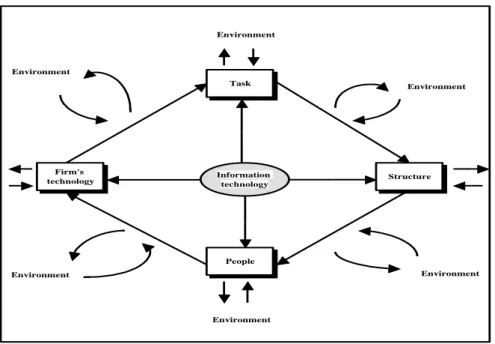
In virtual organizations, boundaries emerge when members of virtual organizational settings interact formally or informally. As noted by (Wenger, 1998), informal organizational settings do not exist in isolation but interact with other informal and formal organizational settings. Organizational boundaries within and between interacting organizational settings are rooted in difficulties related either to organizational actors involved in interactions, or at the very nature of knowledge held by these actors. In addition to the characteristics of knowledge mentioned above, we deduce from the Leavitt's model (Figure 3) that organizational knowledge resides in organizations components (structure, people, tasks, firm’s technology, technology information), or in interactions between these components, or in goods and services produced by organizations (Leavitt, 1963).
Task Firm's technology Structure People Information technology Environment Environment Environment Environment Environment Environment
Figure 3. The Leavitt model of an organization (modified by (Stohr and Konsynski, 1992))
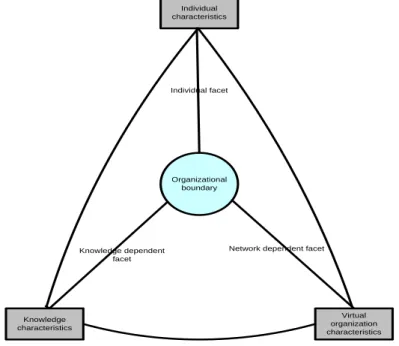
Therefore, interactions between members of virtual teams are affected on the one hand, by the specific knowledge held by partners of the virtual organization, on the other hand, by the characteristics of such an organization, and finally by the characteristics of organizational actors involved in virtual organizational settings. Furthermore, the boundaries intra and inter organizational settings have three interdependent facets: individual, knowledge dependent, and network dependent. Firstly, the individual facet is determined by the virtual teams members motivation, cognitive characteristics,
Mouna Ben Chouikha and Salem Ben Dhaou Dakhli 713 Knowledge Sharing in Virtual Organizations: Barriers and Enablers
beliefs, cultures, backgrounds, and their trust in each other. Secondly, the knowledge dependent facet reflects the contribution of diversity, specialization, and tacitness of knowledge exchanged by organizational actors within and between virtual organizational settings. Thirdly, the network facet takes into account the very characteristics of virtual organizations such as geographic dispersion, information technology dependence, and workforce fluctuation. In particular, virtual organizations may seem doomed to fail with its perceived lack of social interaction and shared experience, geographic dispersion, and amorphous tangible structure. Figure 4 illustrates the three facets model of organizational boundaries. Organizational boundary Virtual organization characteristics Knowledge characteristics Individual characteristics Individual facet Knowledge dependent facet
Network dependent facet
Figure 4. The three facets model of organizational boundaries
It is obvious that the differences between the individual characteristics of organizational are among the main causes of intra and inter virtual organizational settings low permeability.
Similarly, lack of motivation and confidence in other members of virtual teams, and the differences between national and organizational cultures exacerbate the low permeability of intra and inter virtual organizational settings. Furthermore, the perception of knowledge as a power and a source of advantages for its owner seems to be engrained in many organizational actors in particular within virtual organizations. This explains the tendency of such actors to horde knowledge. Many authors confirm this analysis and underline that knowledge sharing is perceived by many individuals as a loss of power (Davenport and Prusak, 2000) (Blecker and Neumann, 1998). These authors mention that for many organizational actors, knowledge sharing is associated with lack of absorptive capacity in recipients, intolerance for mistakes or need for help, anger at losing one’s position of advantage, desire for personal power, single orientation on competition, living in the past, conservatism, emotional and motivational aspects, limited capacity of observation, processing and learning.
Finally, organizational and national cultures constitute major factors which influence knowledge sharing to a large extent in virtual organizations. Indeed, as mentioned by (Choo and Bontis, 2002), a virtual organization often reflects organizational and national cultures of people and traditional organizations which create it.
5
T
HE ENABLERS OF KNOWLEDGE MANAGEMENT IN VIRTUAL ORGANIZATIONThe enablers of knowledge sharing in virtual organizations consist of the set of measures to manage the boundaries within and across virtual teams. Carlile has proposed approaches to manage such boundaries through the creation of boundary objects (Carlile, 2002) (Carlile, 2004). As emphasized by
Mouna Ben Chouikha and Salem Ben Dhaou Dakhli 714 Knowledge Sharing in Virtual Organizations: Barriers and Enablers
(Carlile and Rebentish, 2003), there are three main relational characteristics of organizational boundaries: the difference, the dependence, and the novelty.
The difference characteristic refers both to the quantity and the types of knowledge held by the organizational actors involved in a virtual team. Such a characteristic does not have any impact on knowledge sharing without the dependence characteristic, which describe the relationships within and between virtual teams. The novelty characteristic describes the intensity of changes in the context i.e. the dependencies and differences between the organizational actors involved in a virtual team. (Carlile, 2004) distinguishes three categories of organizational boundaries -syntactic, semantic, and pragmatic- and proposes three approaches to manage them effectively.
The syntactic boundary is characterized by stability and control of differences and dependencies between organizational actors. (Carlile, 2004) argues that knowledge transfer is the most appropriate approach to manage syntactic boundaries. This approach - called oriented information processing approach - is based on the development of a common lexicon (language) to facilitate knowledge assessment and sharing at organizational boundaries.
The transition between the syntactic boundary and the semantic boundary takes place when novelty results in ambiguous dependencies, differences, or interpretations. To manage semantic organizational boundaries, (Carlile, 2004) suggests an interpretative approach to create common understandings that are appropriate to assess and share knowledge at organizational boundaries.
Organizational boundaries become pragmatics when novelty is enough to generate conflicting interests for organizational actors. Such conflicting interests are obstacles to knowledge sharing in virtual teams. Indeed, in case of conflicting interests, the knowledge developed in an area often produces negative consequences for other areas. These consequences and the costs they incur, strengthen resistance of virtual teams members to change and knowledge sharing. In order to manage pragmatic organizational boundaries, (Carlile, 2004) proposes a political approach – called transformational approach - based on negotiation. This approach transforms conflicting interests and knowledge held by organizational actors into shared interests. Whatever the type of boundary, the approach used to manage it results in boundary objects which facilitate knowledge sharing and bridge the knowledge gap associated with this boundary. The approaches to organizational boundaries management, and the resulting boundary objects are enablers for knowledge sharing either in traditional or in virtual organizations.
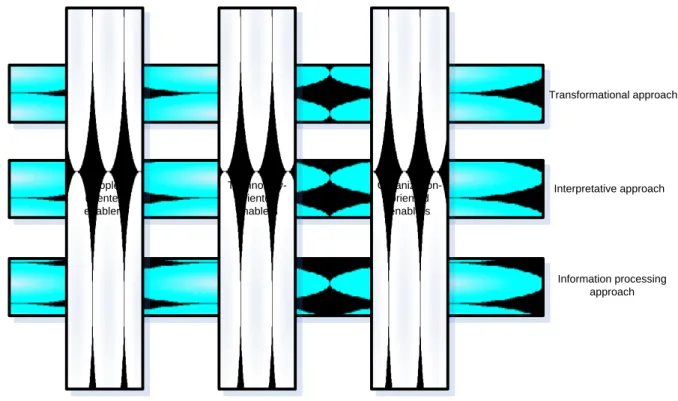
In this section, we complete Carlile’s analysis by defining a set of means to implement the approaches he proposes in order to manage organizational boundaries in virtual organizations. To do this, we draw on the three facets model of organizational boundaries. We believe that any approach to management of organizational boundaries in virtual organizations must take into account as far as possible all the aspects of these facets. The analysis of the barriers faced by knowledge sharing in virtual organizations, based on the three facets model of organizational boundaries, identifies three types of enablers to overcome these barriers: people-oriented, technology-oriented, and organization-oriented. Figure 5 illustrates that the enablers of knowledge sharing in virtual organizations are orthogonal to the three approaches proposed by Carlile to manage organizational knowledge boundaries.
Mouna Ben Chouikha and Salem Ben Dhaou Dakhli 715 Knowledge Sharing in Virtual Organizations: Barriers and Enablers
People-oriented enablers Technology-oriented enablers Organization-oriented enablers Transformational approach Interpretative approach Information processing approach
Figure 5. Orthogonality of Carlile’s approaches and knowledge sharing enablers
5.1 The people-oriented enablers of knowledge sharing
The people-oriented enablers concern the individual facet and include actions to motivate organizational actors, overcome their resistance to knowledge sharing, and improve their trust in each other. Incentives are examples of such enablers. In addition to monetary incentives, non-monetary incentives like training play an important role in motivating organizational actors within virtual organizations. As noted by (Jarvenpaa and Leidner, 1998) and (Cummings and Broomiley, 1996), trust among organizational actors is an important component of the glue that holds virtual teams together. Based on these authors work, we identify the following enablers of trust establishment among virtual teams members:
Compliance of virtual teams members behavior with any commitments both explicit or implicit,
Honesty of virtual teams members in whatever negotiations preceded such commitments, Non-opportunistic behavior of virtual teams members,
Shared social norms,
Repeated interactions between virtual teams members.
(Jarvenpaa and Leidner, 1998) consider that interactions are the key in building relationships and subsequently trust between virtual teams members. Nevertheless, virtual organizations face challenges in their knowledge sharing efforts mainly concerning issues of trust among organizational members who have little or no social interaction with each other; and high dependence on a technological medium that may not convey tacit and cultural knowledge that is exchanged on an everyday basis due to physical proximity and face-to-face interactions in a traditional organization. Moreover, the mitigation of the resistance of virtual teams members to knowledge sharing may take time. Furthermore, the people-oriented enablers listed above may not even result in desirable outcomes. Indeed, what may bring individuals together and to some extent, supersede the level of individual perceptions depends highly upon the goals of the virtual organization be they for profit or not. Let us note that monetary incentives and perceived preferential treatment may result in divisions among virtual teams members and exacerbate the virtual organizations prickly issues of trust and individual perceptions. To solve this problem, virtual organizations management plays a critical role in
Mouna Ben Chouikha and Salem Ben Dhaou Dakhli 716 Knowledge Sharing in Virtual Organizations: Barriers and Enablers
evangelizing the policy that knowledge is the prerogative of all members of the virtual organization and not of particular groups.
5.2 The technology-oriented enablers of knowledge sharing
Technology-oriented enablers refer to information and communication technologies (ICT) tools used within virtual organizations to overcome barriers of knowledge sharing due to geographical dispersion, dispersion, asynchronous communication, lack of physical structure, and difficulties to face-to-face meeting. Messaging systems, audio and video conferences tools, intranets, content integrators tools like portals, sharable repositories, and Web 2.0 are examples of technology-oriented enablers of knowledge sharing in virtual organizations. In particular, Web 2.0 provides organizational actors within virtual organizations with several applications which facilitate communication between virtual teams members and mitigates the impacts of barriers of knowledge sharing. Blogs, wikis, RSS tools, tagging tools, and social networking tools are among the most popular applications provided by Web 2.0. (Mory, 2009) has proposed comprehensive definitions of these applications. The impact of ICT tools on knowledge sharing in virtual organizations depends on the nature of these tools. We distinguish two categories of ICT tools. On the one hand, there are traditional ICT tools - like portals, intranets and repositories – associated with centralized and controlled knowledge sharing. Such tools are more suited to explicit knowledge sharing between members of geographically dispersed virtual teams. However, the use of traditional ICT tools is effective only if the explicit knowledge shared is regularly updated by organizational actors who hold this knowledge. On the other hand, there are instant messaging systems, audio and video conference systems, and Web 2.0 tools which facilitate socialization of virtual teams members and contribute to partial sharing of tacit knowledge. Unlike traditional ICT tools which focus on organizations, tools belonging to the second category focus on people. Therefore, for effective use of these tools, the management of virtual organizations should change the focus so that organizational actors are able to decide.
5.3 The organization-oriented enablers of knowledge sharing
The support provided by virtual organizations management and organizational culture values to knowledge sharing, are among the main enablers of knowledge sharing in virtual organizations. Firstly, for knowledge creation and sharing to take place, management must understand on the one hand, the concept of knowledge, its ramifications, and its role within virtual organizations and on the other hand, the difficulties caused by virtual organizations characteristics. Many authors suggest that the creation of social meeting areas permit mitigating knowledge-related problems inherent in virtual organizations such as lack of time and face-to-face meetings locations. Inspiring locations proposed by (Coakes, 2002) are examples of such areas.
Secondly, as pointed out by (Davenport and Prusak, 2000), common language - shared by all the members of each virtual team – is an important factor in knowledge sharing in virtual organizations. According to these authors, the common language concept spans not only multi-ethnic and different organizational cultures, and international boundaries, but also technical jargon and an understanding of the language used in different areas and levels of a particular profession. Common language is among the boundary objects issued from Carlile’s syntactic approach dedicated to knowledge transfer (Carlile, 2004). This author confirms the findings of Davenport and Prusak who note that successful knowledge transfer sometimes works only if the parties involved have face-to-face contact and suggest solutions to create a common platform for virtual teams members through education, discussion, publications, teamwork, and job rotation (Davenport and Prusak, 2000).
Finally, to reach their goals, virtual organizations require a strong organizational culture to support knowledge creation and sharing. According to (Choo, 2002), an organization’s cultural knowledge includes beliefs that are used to assign value and significance to new information and therefore indirectly dictate the trajectory of the organization’s path. Organizational culture is defined by the collective rules by which an organization operates. These rules include shared behaviors, routines, norms, values, and beliefs, and form the basis for how individuals operate within the context of the organization. Therefore, organizational culture is materialized by a set of observable behaviors and the underlying values that drive behaviors.. The degree of formality with which employees conduct themselves, the organization’s dress code, and the type of technology used, are examples of
Mouna Ben Chouikha and Salem Ben Dhaou Dakhli 717 Knowledge Sharing in Virtual Organizations: Barriers and Enablers
organizational culture rules. Organizational culture may be analyzed at three levels. Beneath the level of observable behaviors are the values that underlie behavior and cannot be directly observed. At an even deeper level, observable values are determined by assumptions and beliefs. While an organization or individual’s values may remain within awareness and can be stated, assumptions and beliefs are often out of conscious awareness. (O’Dell et al., 1998) note that organizational culture includes a strong professional ethic and pride supported by well-honed skills in teaming, including cross-functional teams and warns that without such a culture, it must expend efforts to create such a culture, or risk failure. Organizational culture plays a critical role in knowledge sharing within virtual organizations. Indeed, that virtual teams members values match organizational culture shared values, help virtual organizations achieve common goals. Sharing knowledge within virtual teams reflects the degree to which organizational actors are comfortable with the behaviors encouraged by the virtual organization management.
6
C
ONCLUSION AND FUTURE RESEARCH DIRECTIONSIn this paper, we have analyzed the barriers and enablers of knowledge sharing within virtual organizations. To this end, we have proposed a multi-faceted model of organizational boundaries in virtual organizations. The enablers of knowledge sharing in virtual organizations that we have presented in this work are orthogonal to the three approaches proposed by Carlile to manage knowledge boundaries. We validate our work in the case of a virtual organization composed of a French insurance company and an Indian offshore software development company. The goal of this virtual organization is to provide the insurance company with software systems needed to support its business processes. The collaboration between the two companies takes place through virtual project teams where the software designers belong to the insurance company and the software developers belong to the offshore company. Members of virtual teams exchange information by using both traditional ICT and Web 2.0 tools. Whatever the virtual project team, there is no face-to-face meeting between software designers and software developers due to the distance between the two headquarters. Our observations of work progress in this virtual organization confirm our findings about barriers and enablers of knowledge sharing. In particular, many barriers are related either to the lack of a common language or to the differences between national cultures. The lack of a common language results on the one hand, from the difference between the language spoken in the two companies involved in the virtual organization and on the other hand, from the differences between the jargon used by the designers and the developers of software systems. Therefore, communication between software designers and software developers was difficult and knowledge sharing in virtual project teams was limited to explicit written knowledge. Another barrier to knowledge sharing was the lack of trust between the two companies employees. For instance, many software designers was reluctant to knowledge sharing with software developers because they fear losing power associated with the business knowledge they hold. We have also noted that, despite their high dependence on ICT tools, virtual organizations have to be careful. Indeed, as we have observed in the experienced virtual organization, successful knowledge sharing in virtual organizations is not triggered only by adopting ICT tools. It depends mainly on virtual organizations maturity and their ability to adopt the appropriate principles and organizational values to overcome barriers related to their characteristics. In particular, for Web 2.0 tools to be effective supports to knowledge sharing, partners involved in virtual organizations must be mature enough for loosing control and moving to altruism without any organizational central guidance. Finally, we think that the lessons learned from our experience should be validated using more case studies. Another research direction consists in determining the characteristics of organizational culture which maximize the benefits of Web 2.0 tools to support knowledge sharing in virtual organizations.
Mouna Ben Chouikha and Salem Ben Dhaou Dakhli 718 Knowledge Sharing in Virtual Organizations: Barriers and Enablers
References
Alavi, M., and Leidner, D.E., “Knowledge Management and Knowledge Management Systems: Conceptual Foundations and Research Issues”, MIS Quarterly, Vol. 25, No. 1, January, 1995, pp. 107-136.
Alexander, E.R., “How Organizations Work Together, Interorganizational Coordination in Theory and Practice”, Gordon & Breach Publishers, USA, 1995.
Arnison, L., and Miller, P., “Virtual teams: A virtue for the conventional team”, Journal of Workplace Learning, Vol. 14, No. 4, 2002, pp. 166-173.
Becerra-Fernandez, I., Gonzalez, A., and Saberhwal, R., “Knowledge Management”, Prentice-Hall, 2004.
Blackler, F., “Knowledge, Knowledge Work and Organizations: An Overview and Interpretation”, Organization Studies, Vol. 16, No. 6, 1995, pp. 1021-1046.
Blecker, T., and Neumann, R., “Interorganizational knowledge management: Some perspectives for knowledge oriented strategic management in virtual organizations”, in Malhotra, Y., (Ed.), “Knowledge Management & Virtual Organizations”, Hershey: Idea Group Publishing, 2000, pp. 63-83.
Boisot, M.H., “Knowledge assets; Securing competitive advantage in the information economy”, Oxford University Press, 1998.
Boudreau, M.-C., Loch, K. D., Robey, D., and Straub, D., “Going Global: Using Information Technology to Advance the Competitiveness Of the Virtual Transnational Organization”, Academy of Management Executive, Vol. 12, No. 4, pp. 120-128, 1998.
Buckley, W., “Mind and Brain: a Dynamic System Model”, In Geyer F., and Van Der Zouwen J. (Eds), Sociocybernetics: Complexity, Autopoiesis, and Observation of Social Systems, Knowledge Sharing Over Social Networking Systems, 2001.
Carlile, P.R., “A Pragmatic View of Knowledge and Boundaries: Boundary Objects in New Product Development”, Organization Science, Vol. 13, No. 4, 2002, pp. 442-455.
Carlile, P.R., “Transferring, Translating and Transforming: An Integrative Framework for Managing Knowledge across Boundaries”, Organization Science , Vol. 15, No. 5, 2004, pp. 555-568. Carlile, P.R., and Rebentisch, E.S., “Into the black box: The Knowledge transformation cycle”,
Management Science, Vol. 49, 2003, pp. 1180–1195.
Choo, C.W., and Bontis N., (Eds), "Strategic Management of Intellectual Capital and Organizational Knowledge", Oxford University Press, New York, 2002.
Coakes, E., Willis, D., and Clarke, S. (Eds), “Knowledge Management in the Socio-Cultural World”, Springer-Verlag Limited, London, 2002.
Cummings, L. L., and Broomiley, P., “The Organizational Trust Inventory Development and Validation”, In Kramer and Tyler (Eds), Trust in Organizations, Sage, 1996, pp. 302-330. Davenport, T.H., and Prusak, L., “Working knowledge: how organizations manage what they know”,
Harvard Business School Press, 2000.
Fahey, L., Srivastava, R., Sharon, J.S., and Smith, D.E., “Linking e-business and operating processes: The role of knowledge management”, IBM Systems Journal, Vol. 40, No. 4, 2001, pp. 889-906.
Fisher, K., and Fisher, M.D., “The Distributed Mind: Achieving High Performance Through the Collective Intelligence of Knowledge-Work Teams”, Amacom, New York, 1998.
Grant, R.M., “Toward a Knowledge-Based Theory of the Firm”, Strategic Management Journal, Vol. 17, 1996, pp. 109-122.
Hastings, C., “The New Organization, Growing the Culture of Organizational Networking”, McGraw-Hill Book Company, London, UK, 1993.
Hoefling, T., “Working virtually: Managing People for Successful Virtual Teams and Organizations”, Stylys, Sterling, 2001.
Hofstede, G., “Cultures and Organizations: Software of the Mind”, McGraw-Hill, New York, 1997. Huber, G.P., “Organizational learning: the contribution process and the literatures”, Organization
Science, Vol. 2, 1991, pp. 88-115.
Jarvenpaa, S., Knoll, K., and Leidner, D., “Is Anybody Out There? Antecedents of Trust in Global Virtual Teams”, Journal of Management Information Systems, Vol. 14, 1998. pp. 29-64.
Mouna Ben Chouikha and Salem Ben Dhaou Dakhli 719 Knowledge Sharing in Virtual Organizations: Barriers and Enablers
Jarvenpaa, S.L., and Leidner, D., “Communications and trust in virtual teams”, Journal of Computer Mediated Communications, Vol. 3, No. 4, June 1998.
Jones, T.M., and Bowie, N.E., “Moral hazards on the road to the virtual corporation”, Business Ethics Quarterly, Vol. 8, No. 2, 1998, 1998, pp. 273-292.
Kano-Kikoski, C.K., and Kikoski, J.F., “The Inquiring organization: tacit knowledge, conversation and knowledge creation – skills for 21st century organizations”, Westport, CT: Praeger, 2004. Lane, P.J., and Lubatkin, M., “Relative absorptive capacity and interorganizational learning”, Strategic
Management Journal, Vol. 19, 1998, pp. 461-477.
Leavitt, H.J., (ed.), “The Social Science of Organizations, Four Perspectives”, Prentice-Hall, Englewood Cliffs, New Jersey, 1963.
Lei, D., “Competence Building, Technology Fusion and Competitive Advantage: the Key Roles of Organizational Learning and Strategic Alliances”, International Journal of Technology Management, Vol. 14, 1997, pp. 208-237.
Levy, M., “WEB 2.0 implications on knowledge management”, Journal of Knowledge Management, Vol. 13, No. 1, pp. 120-134, 2009.
Lewis, R., “Membership and management of a `virtual' team: The perspectives of a research manager”, R & D Management, Vol. 28, No. 1, 1998, pp. 5-13.
Lipnack, J., and Stamps, J., “Virtual Teams: People Working Across Boundaries with Technology”, 2nd edition, John Wiley & Sons, New York, 2000.
Mishra, S., Deshmukh, S.G., and Vrat, P., “Matching of technological forecasting technique to a technology Technological Forecasting and Social Change”, Vol. 69, No. 1, pp. 1-27, 2002. Mowshowitz, A., “On the theory of virtual organization”, Systems Research and Behavioral Science,
Vol. 14n No. 6, 1997, pp. 373-384.
Newell, S., Robertson, M., Scarborough, H., and Swan, J., “Managing Knowledge Work”, New York, Palgrave, 2002.
Nonaka, I., “A Dynamic Theory of Organizational Knowledge Creation”, Organization Science, Vol. 5, No. 1, 1994.
Nonaka, I., and Takeuchi, H., “The Knowledge-Creating Company”, Oxford University Press, New York, 1995.
O’Dell, C., Jackson Grayson Jr., C., with Essaides, N., “If only we knew what we know: the transfer of internal knowledge and best practice”, The Free Press, New York, 1998.
Polanyi, M., “The Tacit Dimension”, London, Routledge, 1967.
Porter, M., “Competitive Advantage of Nations”, Free Press, New York, 1990.
Rafaeli, S., and Ravid, G., “Information sharing as enabler for the virtual team: An experimental approach to assessing the role of electronic mail in disintermediation”, Information Systems Journal, Vol. 13, No. 2, 2003, pp. 191-206.
Stohr, E.A., and Konsynski, B.R., “Information Systems and Decision Processes”, IEEE Computer Society Press, 1992.
Thomas, J.C., Kellogg, W.A., and Erickson, T., “The knowledge management puzzle: Human and social factors in knowledge management”, IBM Systems Journal, Vol. 40, No. 4, 2001, pp. 863-884.
Travica, B., “Virtual organization and electronic commerce”, ACM Data Base for Advances in Information Systems, Vol. 36, No. 3, pp. 45-68, 2005.
Walsh, J. P., and Ungson, G. R., “Organizational Memory”, Academy of Management Review, Vol. 16, No. 1, 1991, pp. 57-91.
Warner, M., and Witzel, M., “Managing in Virtual Organization”, Thomson, London, 2004.
Wenger, E, “Communities of Practice: Learning, Meaning and Identity”, Cambridge University Press, New York, 1998.