UNIVERSITÉ DE SHERBROOKE Faculté de génie
Département de génie civil
DEVELOPMENT OF A CONSEQUENTIAL DYNAMIC
MODEL INCORPORATING VARIABILITY AND
UNCERTAINTY ANALYSIS FOR ASSESSING LIFE
CYCLE ENVIRONMENTAL IMPACTS OF PAVEMENTS
DÉVELOPPEMENT D'UN MODÈLE DYNAMIQUE
INCORPORANT L'ANALYSE DE LA VARIABILITÉ ET
DE L'INCERTITUDE POUR L'ÉVALUATION DES
CONSÉQUENCES ENVIRONNEMENTALES DU CYCLE
DE VIE DES CHAUSSÉES
Thèse de doctorat
Spécialité : génie civil
Hessam AZARIJAFARI
Sherbrooke (Québec) Canada
Juillet 2018
MEMBRES DU JURY
Pr. Ben AMOR, Directeur Pr. Ammar YAHIA Codirecteur Pr. Dahai QI Rapporteur Dr. Jeremy GREGORY Évaluateur Dr. Geoffrey GUEST ÉvaluateurACKNOWLEDGEMENT
My journey thus far could never have been such fascinating if it were not because of the following individuals who have made irreplaceable contribution to everything I have achieved. It is why I would like to thank Prof. Ben Amor and Prof. Ammar Yahia for granting me their confidence. I could not have had a better team of directors. You guided me to have a more mature scientific mind, which I am indefinitely grateful and indebted. I would like to thank you for keeping an open door for me all the time, urging me to perfect my research work, as well as filling our collaboration at all levels with pleasure.
My special thanks go to Mathieu Courchesne for providing the building energy model and Adam Hayashi and Guillaume Lemieux for the intellectual support from the Canadian cement industry. The statistical data provided by Julie Ruby from the ministry of transportation in Quebec (MTQ) is appreciated. The financial supports of this research project were provided by the Fonds Nature et technologies (FQRNT), the Natural Sciences and Engineering Research Council of Canada (NSERC), the Centre de recherche sur les infrastructures en béton (CRIB), and the Fondation de l’ Université de Sherbrooke.
My sincere gratitude goes to all LIRIDE members. I am grateful for the welcoming and warm working group you made with your team spirit and your nice personalities. I will not forget all the funs we had during lunch times and parties as well as all the cake days we celebrated. I also appreciate your encouragement and help for learning and revising my French text and presentations.
I am grateful to Prof. Dahai Qi, Dr. Jeremy Gregory, and Dr. Geoffrey Guest for their valuable comments on my dissertation.
I am grateful for what I learnt in terms of leadership and cooperation with my friends in ACI-Sherbrooke that helped me to better manage my research work. I truly appreciate your contributions to my professional and personal development. Notably, I would like to thank Prof. Arezki who always supported me in ACI-Sherbrooke.
I would like to say a big thank to my brothers for their unconditional love. My sincere thanks go to Jafar for the friendship and help he brought for us in Iran and here. Last but not the least, no words can express my gratitude towards my wife, Motahareh, for her love, support and patience during my rough time and for listening to me during all these evenings. I would like to thank my little son, Ryan, who increases the level of happiness in our family .
RÉSUMÉ
Le choix d’une option écologique pour les chaussées parmi plusieurs options constitue un défi pour les gouvernements depuis longtemps. Une quantité importante de matériaux est requise pour la construction des chaussées et le maintien des conditions de service de la circulation au-dessous des seuils de performance. Afin de répondre à la demande en matériaux de construction, des procédés énergivores doivent être mis en place. Ces procédés produisent différents types d'émissions. En outre, il convient de noter que les impacts environnementaux des chaussées ne se limitent seulement pas aux matériaux de construction et aux machines. En effet, la sélection d’un type de chaussée peut influencer, selon ses propriétés, la consommation de carburant des véhicules et les demandes en climatisation des bâtiments avoisinants.
Jusqu'à présent, plusieurs impacts environnementaux de matériaux alternatifs pour la construction de chaussées ont été étudiés grâce à la méthode d'analyse du cycle de vie (ACV). Lors d'une ACV de chaussée à grande échelle, visant à examiner les implications ou exigences liées aux politiques, par exemple, il est important d'évaluer les changements induits sur le marché par ces politiques. Ces changements peuvent concerner une modification de la demande pour d'autres produits ayant la même fonction et / ou du volume des coproduits générés. L'ACV conséquentielle (ACVC) est utilisée pour saisir les conséquences environnementales directes et indirectes de la sélection des chaussées. Des études antérieures d'ACVC ont identifié les technologies affectées à long terme dans des phases distinctes du cycle de vie du produit. Les résultats de ces études tendent, cependant, à négliger les impacts des systèmes de produits à court terme. En fait, le manque de comptabilité dynamique dans les études d'ACVC empêche les décideurs d'obtenir une analyse plus complète et mieux informée des flux d'émissions au fil du temps. De plus, compte tenu de la longue phase d'utilisation des infrastructures routières, un grand nombre de paramètres interdépendants change constamment en fonction du temps.
Une structure dynamique devient alors essentielle pour relier ces paramètres aux facteurs de caractérisation (FC) dynamiques. De plus, l'application des facteurs d'émission et des changements dans la consommation de carburant ou de l'efficacité peut aider à améliorer la précision du processus décisionnel lié à la sélection des chaussées. Cependant, la distribution temporelle des impacts, induits par les paramètres du cycle de vie de la chaussée, n'est pas
entièrement prise en compte dans les études précédentes d'ACVC. Les incertitudes et les variabilités doivent être étudiés pour examiner la robustesse des résultats, ce qui n'a pas encore été pris en compte auparavant en ACV. Pour élaborer un cadre plus global dans l'analyse des incertitudes et des variabilités, il est essentiel de considérer les dépendances réciproques entre les sources de variabilité et d'incertitude. En fait, négliger ces interdépendances peut mener à une conclusion entièrement différente de celle obtenue par un échantillonnage indépendant. Jusqu'à présent, aucune méthode n'a été proposée pour évaluer de manière cohérente les sources de variabilité et d'incertitude des ACV de la chaussée, que ce soit dans des contextes conséquentiels ou attributionnels.
Le premier objectif de ce projet de recherche vise à développer un cadre global, capable de capturer les interdépendances des paramètres tout en analysant les sources d'incertitude et de variabilité. Le cadre proposé comprend des simulations de Monte Carlo pour la propagation des incertitudes et de différents types des variabilités. Le cadre a été appliqué à une étude de cas d'ACV attributionnelle (ACVA), dans laquelle l'asphalte et le béton ont été comparés. Différentes sources, telles que l'incertitude due à la qualité des données et aux choix méthodologiques ainsi que la variabilité des paramètres, ont été étudiées.
Les résultats de l'analyse de Monte Carlo montrent que les choix méthodologiques, telle que la méthode d'allocation, peuvent modifier le scénario le moins impactant sur l’environnement pour quatre catégories intermédiaires. Ces catégories sont principalement affectées par la chaîne d'approvisionnement en pétrole brut. La variabilité des matériaux et des méthodes de construction peut modifier le scénario préféré dans différentes catégories de dommages, à savoir la santé humaine et le réchauffement climatique. En outre, le scénario préféré en matière de qualité de l'écosystème peut être modifié lorsque l'incertitude des paramètres est prise en compte. La raison en est que les scores qualitatifs les plus mauvais sont donnés à l'incertitude géographique du flux élémentaire qui contribue majoritairement à la qualité de l'écosystème (c'est-à-dire le zinc). L'effet combiné des sources d'incertitude et de variabilité pour cette étude de cas empêche le décideur d'en arriver à une conclusion robuste sur la qualité de l'écosystème, la santé humaine et les effets du réchauffement climatique. Cependant, pour la catégorie ressource, le résultat comparatif entre la chaussée en asphalte et en béton est suffisamment
important et, par conséquent, les sources de variabilités et d'incertitudes ne changent pas les conclusions.
Le second objectif de ce projet de recherche est de développer un cadre de travail dynamique pour l'évaluation de l'aspect environnemental des chaussées. De plus, le cadre proposé dans le premier objectif a été adopté pour considérer diverses sources d'incertitude et de variabilité, tels que la qualité des données, les paramètres de modélisation et la variabilité, dans différentes phases du cycle de vie des chaussées. Les changements dynamiques du vecteur de la demande et de la matrice de la technosphère ont été calculés en tenant compte de l'horizon temporel dans lequel les technologies sont affectées. Les composantes du cycle de vie ont été délimitées grâce à une paramétrisation précise de plus de 130 facteurs dépendant du temps. Selon le cadre d'analyse des incertitudes proposé à l'étape précédente, une simulation de Monte Carlo a été menée pour propager les incertitudes et les variabilités du système en divisant les paramètres par l'incertitude de qualité des données, l'incertitude de modélisation et la variabilité des données. La méthode proposée a été appliquée à l'étude de cas d'une chaussée en asphalte (Statu quo) changé en chaussée en béton (choix alternatif).
Les résultats montrent qu'une simplification de changements dynamiques dans l'ACV des chaussées peut entraîner une évaluation inexacte des résultats de dommages. Les avantages environnementaux attribués en substituant le scénario du statu quo par l'alternatif sont alors surestimés de 7, 17 et 77% pour respectivement les catégories changement climatique, santé humaine et ressource. En outre, les résultats de la catégorie qualité des écosystèmes montrent que la modélisation dynamique peut avoir un impact supérieur de 114% à la mise en œuvre de l'approche statique. Le manque de prise en compte du profil temporel des émissions de gaz à effet de serre dans les résultats, avec des FC statiques, conduit à une surestimation de 473,5 t CO2eq des bénéfices du potentiel de réchauffement climatique lors de la substitution de l'asphalte
au béton. Les résultats d'incertitude montrent que les sources de variabilité contribuent à 41-71% de la variance des quatre catégories de dommages. Cette contribution est principalement attribuée à la comptabilisation mensuelle de la température (8-16% de la variance des résultats de dommages) et à la durée de vie des chaussées (11-15% de la variance des résultats de dommages). Malgré la propagation des diverses sources d'incertitude et de variabilité dans cette
étude de cas, la conclusion sur le scénario préféré est demeurée inchangée dans les résultats des dommages.
Ce projet de recherche a clairement montré l'impact de la prise en compte des changements en temps réel dans l'évaluation environnementale de la chaussée. Plus précisément, en ce qui concerne la phase d'utilisation et les horizons temporels de la technologie affectée, il est essentiel d'inclure les variables dépendantes du temps pour améliorer la représentativité des résultats obtenus. Néanmoins, l'importance des sources d'incertitude et de variabilité et de leur distinction dans l'ACV de la chaussée ne doivent pas être ignorées.
Mots clés: Chaussées, Analyse du cycle de vie (ACV) conséquentielle; Analyse d'incertitude;
SUMMARY
The selection of an environment-friendly alternative for pavements remains a challenge for governments for a long time now. A significant quantity of materials is required for the construction of pavements and maintenance of traffic service conditions above the performance thresholds. In order to meet the demand for construction materials, energy-intensive activities must be operated, which produce various types of emissions. Further, it should be mentioned that the environmental impacts of pavements are not limited to construction materials and machinery. In fact, pavement selection can induce changes in fuel consumption of vehicles and, to some extent, can adjust the heating and cooling demands of buildings through the properties of pavements.
So far, several environmental impacts from alternative materials for constructing pavements have been investigated through the method of life cycle assessment (LCA). Conducting LCA of pavement on a large scale, such as, when considering its policy-related implications or requirements, is distinguished from small scale assessment. In the large-scale assessment, it is important to assess the changes induced through the demand of other products with the same function and/or the induced production volume of the co-producing processes. Consequential LCA (CLCA) is employed to capture the direct and indirect environmental consequences of pavement selection in different sectors. Previous CLCA studies have only captured the long-term affected technologies in distinct phases of the product life cycle. Hence, the results tend to neglect the short-term impacts and the impacts of short-run product systems. In fact, the lack of dynamic accounting in CLCA prevents policymakers from gaining a more informed and comprehensive analysis of emission flows over time. Furthermore, given the long use phase of pavement infrastructures, the vast number of interdependent parameters constantly change as a function of time. A dynamic structure is essential to link these parameters to dynamic characterization factors (CFs). Moreover, apart from being complex and requiring the prediction of technological improvements, applying the emission factors and fuel consumption or efficiency improvements can help enhancing the accuracy of the decision-making process involved in the selection of pavements. However, the temporal distribution of impacts induced by pavement life cycle parameters is not fully captured in previous CLCA studies. Moreover,
the variations of the results in CLCA studies are usually overlooked and are not included in the interpretation of the conclusions.
The uncertainty and variability sources should be investigated to examine the robustness of the results. To reach a comprehensive model for the uncertainty analysis, it is essential to consider the interdependencies of the variability and uncertainty sources. In fact, neglecting the interdependencies may lead to an entirely different conclusion compared to those obtained through an independent sampling. So far, no method has been proposed to consistently assess the variability and uncertainty sources of pavements LCAs either in consequential or attributional frameworks.
To fill in the research gaps, this dissertation aimed to develop a comprehensive framework, that is able to capture interdependencies of parameters while analyzing uncertainty and variability sources. The proposed model comprises Monte Carlo simulations to propagate the sources of variations to the results. The model was applied to a case study of attributional life cycle assessment (ALCA), in which asphalt and concrete pavements were compared. Different sources, such as uncertainty due to data quality and methodological choices as well as variability of parameters, were investigated.
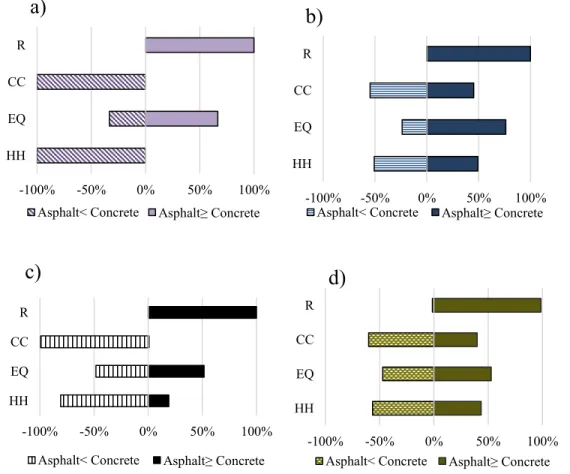
The results of the Monte Carlo analysis show that it is feasible to assess the combined and the individual effects of common uncertainty and variability sources. Based on the variability and uncertainty of the results, a certain conclusion is case specific at both the midpoint and endpoint levels was identified. The methodological choices, such as allocation, can change the environmentally preferred scenario in four midpoint categories. The variability in construction materials and methods can change the preferred scenario in different damage categories, such as, human health and global warming. In addition, the preferred scenario in ecosystem quality can be changed when the parameter uncertainty is taken into account. The reason is that the worst qualitative scores are given to the geographical uncertainty of the elementary flow that majorly contributes to ecosystem quality (i.e. zinc). The combined effect of the uncertainty and variability sources for this case study prevents the decision-maker from reaching a robust conclusion about the ecosystem quality, human health, and global warming effects. However,
for the resources category, the comparative result between asphalt and concrete pavements is sufficiently large. Therefore, the sources of variability and uncertainty do not change the preferred scenario.
The second objective of this research project is to develop a dynamic consequential framework for assessing the environmental aspect of pavements. Moreover, the proposed model in the first objective was adopted to assess various sources of uncertainty and variability, such as data quality and modeling and variability, in different life cycle phases of pavements. The dynamic changes in the demand vector and the technosphere matrix were computed considering the time horizon of the affected technologies. The life cycle components were delineated through a precise parametrization of more than 130 time-dependent factors. According to the uncertainty analysis model proposed in the previous stage, a Monte Carlo simulation was conducted to propagate the variations in the system dividing the parameters to data quality uncertainty, modeling uncertainty, and variability. The proposed method was applied to the case study of shifting from an asphalt pavement (business-as-usual) to a concrete one (alterative).
The obtained results show that a simplification for capturing the dynamic changes can result in an inaccurate assessment of the damage results. The environmental benefits credited by substituting the business-as-usual scenario with the alternative is overestimated by 7, 17, and 77% for climate change, ecosystem quality and resources categories, respectively. In addition, the results of ecosystem quality category show that including the dynamic spirit in the modeling can result in a 114% higher impact than implementing the static approach. The lack of accounting for temporal profile of the greenhouse gas (GHG) emissions in static CF results leads to an overestimation of the global warming potential (GWP) benefits of substituting asphalt with concrete by 473.5 t CO2eq. The uncertainty results show 41-71% contribution of the variability
sources to the variance of the four damage categories. This variability is mainly attributed to the monthly temperature accounting (8-16% to the variance of damage results) and the service life of pavements (11-15% to the variance of damage results). Despite propagating the various sources of uncertainty and variability in this case study, the conclusion on the shifting decision remained unchanged in the damage results.
This research project clearly showed the impact of considering the dynamic changes in the environmental assessment of pavement. More specifically, when it comes to the use phase and the time horizons of the affected technology, it is essential to include the time-dependent variables to improve the representativeness of the obtained results. Nevertheless, the importance of uncertainty and variability sources and distinguishing them in the pavement LCA should not be ignored.
Keywords: Pavements, Consequential life cycle assessment (CLCA); Uncertainty analysis;
TABLE OF CONTENTS
ACKNOWLEDGEMENT ... i
RÉSUMÉ ... ii
SUMMARY ... vi
LIST OF FIGURES ... xiii
LIST OF TABLES ... xv
LIST OF ACRONYMS AND ABREVIATIONS... xvi
CHAPTER 1 INTRODUCTION ... 1
1.1 Context ... 1
1.2 Dissertation organization ... 3
CHAPTER 2 LCA CONCEPTS AND CRITICAL REVIEW OF LITERATURE ... 5
2.1 An introduction to LCA ... 5
2.2 Fundamentals of ALCA and CLCA ... 6
2.2.1 Goal and Scope definition ... 7
2.2.2 Inventory analysis ... 11
2.2.3 Life cycle impact assessment (LCIA)... 13
2.2.4 Interpretation ... 13
2.2.5 Summary of CLCA and ALCA frameworks ... 14
2.3 Life cycle assessment of pavements ... 15
2.3.1 Goal and Scope Definition of pavements ... 17
2.3.2 Inventory analysis of pavements ... 24
2.3.3 LCIA and interpretation of pavements ... 32
2.4 Conclusions and outlook... 34
CHAPTER 3 PROBLEM STAEMENT AND PROJECT DEFINITION ... 37
3.1 Problem statement ... 37
3.2 Research objectives ... 39
3.3 Research questions ... 40
CHAPTER 4 ASSESSING THE INDIVIDUAL AND COMBINED EFFECTS OF UNCERTAINTY AND VARIABILITY SOURCES IN COMPARATIVE LCA OF PAVEMENTS 41 4.1 Abstract ... 44
4.2 Introduction ... 46
4.3 Methodology ... 49
4.3.1 Uncertainty model description ...49
4.4 Case study: Asphalt and concrete pavements ... 53
4.4.1 Goal and scope definition ...53
4.4.2 Inventory analysis ...53
4.4.3 Life cycle impact assessment method ...54
4.4.4 Uncertainty and variability analyses of the inventory data ...54
4.5 Results and discussion ... 57
4.5.1 Comparative results ...57
4.5.2 Results of uncertainty and variability analysis ...64
4.6 Conclusions and outlook ... 70
CHAPTER 5 REMOVING SHADOWS FROM CONSEQUENTIAL LCA THROUGH A TIME-DEPENDENT MODELING APPROACH: POLICY-MAKING IN ROAD PAVEMENT SECTOR ... 73
5.1 Abstract ... 75
5.2 Introduction ... 76
5.3 Methodology ... 79
5.3.1 Description of the dynamic consequential model for pavements ...79
5.3.2 Description of the Case Study ...81
5.3.3 Impact assessment methods ...85
5.3.4 Treatment of uncertainty and variability sources ...86
5.4 Results and discussions ... 86
5.4.1 Dynamic human health, ecosystem quality and resource results ...86
5.4.2 Dynamic vs. static GHG results in consideration of CFs ...91
5.4.3 Individual and combined analysis of uncertainty and variability sources ...93
CHAPTER 6 CONCLUSIONS AND RECOMMENDATION ... 99
6.1 Research contributions ... 99
6.2 Conclusions (EN) ... 100
6.3 Conclusions (FR) ... 104
6.4 Recommendations ... 108
Appendix 1. ... 123
Appendix 2. ... 150
Appendix 3. ... 165
LIST OF FIGURES
Figure 1.1. Contribution of different sectors to GHG emissions in Quebec [5] ... 2
Figure 2.1. Life cycle assessment (LCA) framework adopted from ISO 14040 [13] ... 6
Figure 2.2. Schematic presentation of ALCA framework ... 9
Figure 2.3. Schematic presentation of CLCA framework ... 10
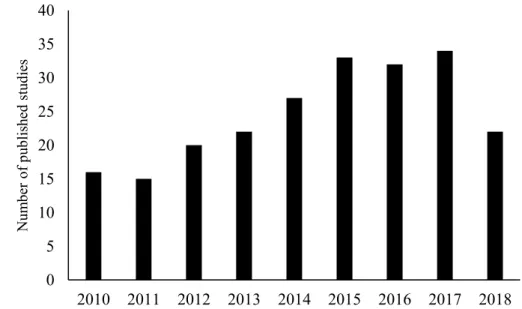
Figure 2.4. Number of research articles and review papers on pavement LCA since 2010. (Search on Scopus Web site on key word “life cycle assessment” AND “pavement”, available by April 2018 [43]). ... 16
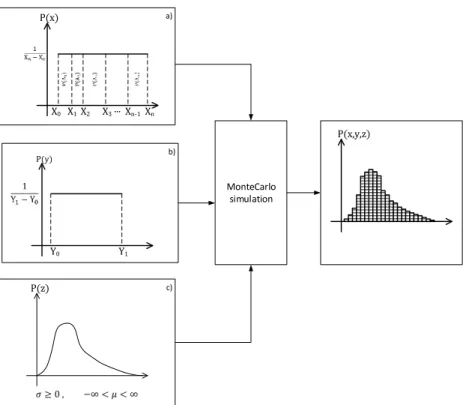
Figure 4.1. General framework of a) scenario uncertainty, b) variability in construction materials and methods, and c) parameter uncertainty modeling ... 52
Figure 4.2. Midpoint results of concrete and asphalt scenario (IMPACT 2002+) ... 58
Figure 4.3. Endpoint results of concrete and asphalt scenario (IMPACT 2002+) ... 64
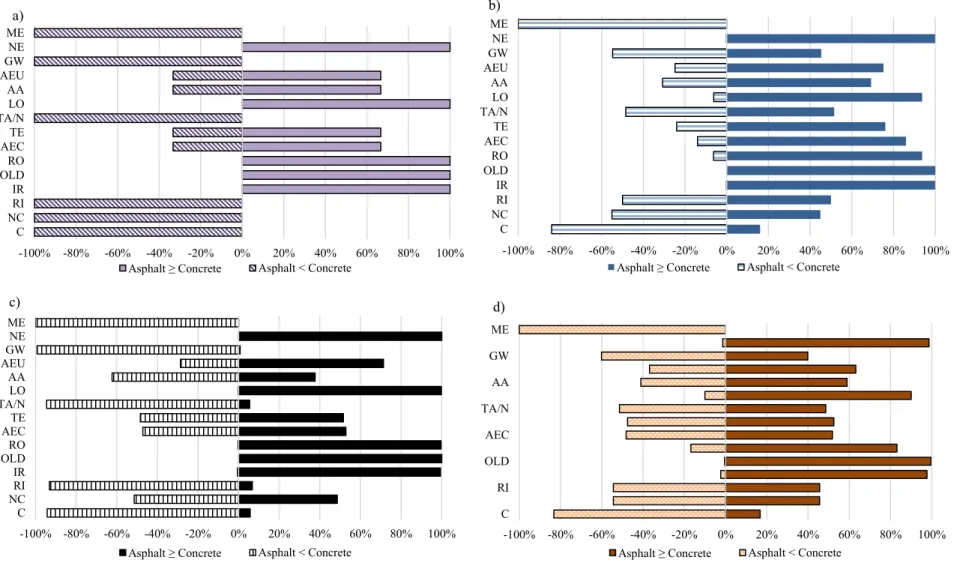
Figure 4.4. Analysis of a) scenario uncertainty (allocation choices), b) variability for the construction materials and methods, c) parameter uncertainty (data quality of environmental flows), and d) aggregation of three sources using Monte Carlo simulation with a 95 % confidence interval considering impact categories of IMPACT 2002+ ... 66
Figure 4.5. Analysis of a) scenario uncertainty (allocation choices), b) variability for the construction materials and methods, c) parameter uncertainty (data quality of environmental flows), and d) aggregation of three sources using Monte Carlo simulation with a 95 % confidence interval considering IMPACT 2002+ damage categories ... 69
Figure 5.1. Connections between pavement life cycle components and affected technologies and flows with different time horizons. ... 83
Figure 5.2. Accumulated mean, median and 5th and 95th percentile results of ecosystem quality (EQ), human health (HH), and resource (R) based on IMPACT 2002+ LCIA method. ... 90
Figure 5.3. Comparison of static GWP fixed CFs for time horizons of 100 years (black continuous line) based on IPCC 2013 and dynamic CFs results (blue continuous line) for the substitution of ALT with BAU. ... 93 Figure 5.4. Sources of variability and uncertainty and inputs to the variance in each category based on correlation coefficients of the normalized squared Spearman rank. LT= Long-term, ST= Short-term, IRI= International roughness index, M&R= Maintenance and repair, BAU=
Business-as-usual scenario, Pij= Dimension functions in rigidity model, Ta= Atmospheric
LIST OF TABLES
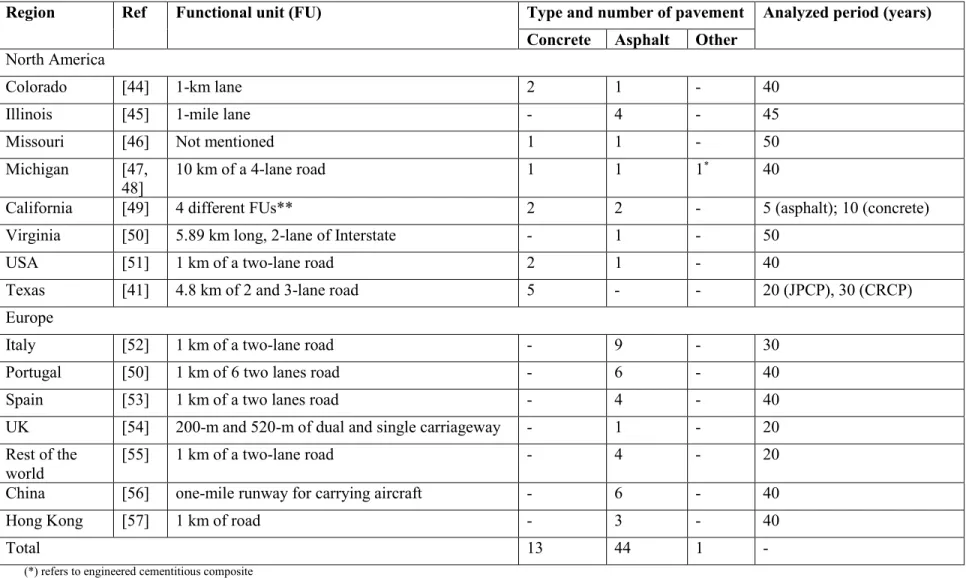
Table 2.1. Differences in conducting an LCA study in attributional and consequential
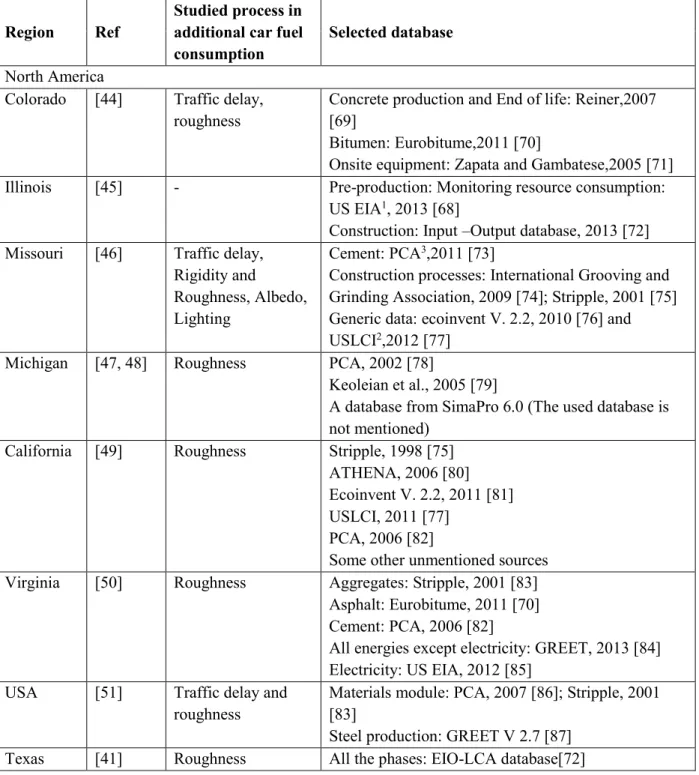
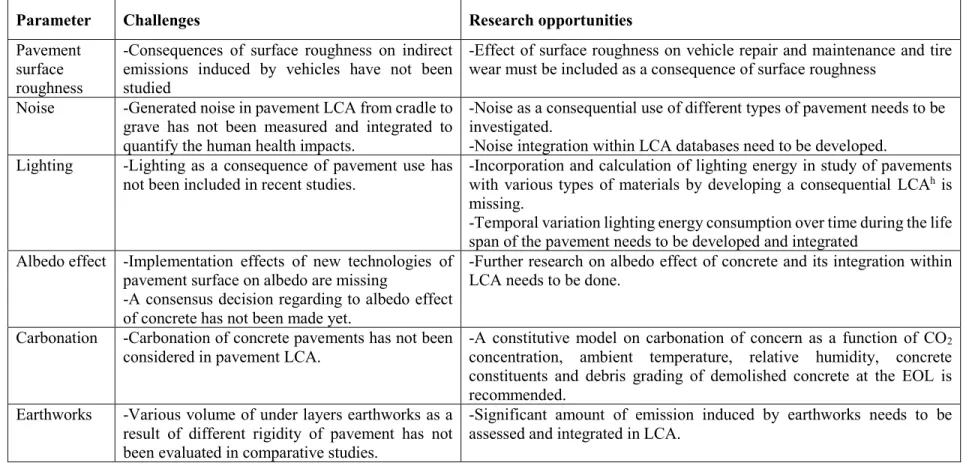
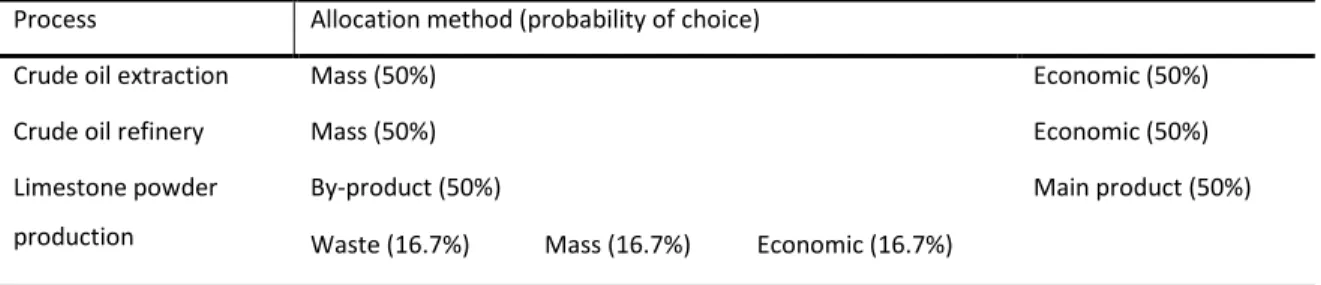
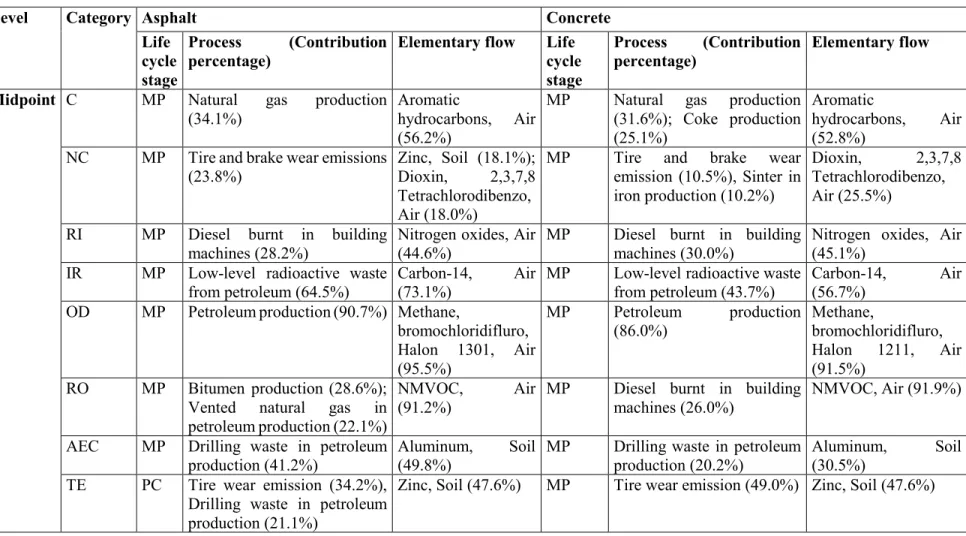
frameworks ... 15 Table 2.2. Goal and scope variations as function of the assessed region ... 18 Table 2.3. Main used databases in pavement LCAs ... 22 Table 2.4. Summary of the challenges and research opportunities in life cycle inventory of pavement ... 36 Table 4.1. Definition of different scenarios for allocation of bitumen and limestone production ... 55 Table 4.2. Major process and substances contributor of midpoint and endpoint categories ... 61 Table 5.1. Summary of affected technologies in different time horizons (WCS = West
LIST OF ACRONYMS AND ABREVIATIONS
Acronym Definition
AA Aquatic acidification
AADT Annual average daily traffic AEC Aquatic ecotoxicity
AEU Aquatic eutrophication
ALCA Attributional life cycle assessment ALT Alternative
BAU Business-as-usual BFS Blast furnace slag
C Carcinogenic
CC Climate change
CF Characterization factor
CLCA Consequential life cycle assessment DALY Disabled adjusted life years
DLCI Dynamic life cycle inventory EOL End-of-life
EQ Ecosystem quality
ELCD European life cycle database FHWA Federal highway administration FU Functional unit
GHG Greenhouse gas
GW Global warming
GWP Global warming potential
HH Human health
HMA Hot mix asphalt IR Ionizing radiation
IRI International roughness index ISO International standard organization JPCP Jointed plain concrete pavement kWh Kilowatt hour
LCA Life cycle assessment LCI Life cycle inventory
LCIA Life cycle impact assessment method LO Land occupation
ME Minera extraction M&R Maintenance and repair
MTQ Ministre des transports du Québec NC Non-carcinogenic
NE Non-renewable energy OLD Ozone layer depletion
PDF.m2.yr Potentially disappeared fraction (on a certain surface and during a certain year)
R Resources
RI Respiratory inorganic RO Respiratory organic
SCM Supplementary cementitious material TA/N Terrestrial acidification and nitrification TE Terrestrial ecotoxicity
UHI Urban heat island
USEIA United States energy information administration USEPA United States environmental protection agency USLCI United States life cycle inventory
Published research communications from this dissertation
The doctoral work has resulted in two scientific papers published in peer-reviewed journals and another one submitted. Seven presentations were made in seminars and conferences in the form of oral (5) and poster (2). Details on all articles and communications are summarized in the following Table.
Type Details Date
Submitted
article Hessam AzariJafari, Ammar Yahia, Ben Amor; “Removing shadows from consequential LCA through a time-dependent modeling approach: policy-making in road pavement sector”; Environmental Science and Technology.
2018 Accepted
article Hessam AzariJafari, Ammar Yahia, Ben Amor; “Assessing the individual and combined effects of uncertainty and variability sources in comparative LCA of pavements”; International Journal of Life Cycle Assessment; (2017): 1-15.
2017 Accepted
article Hessam AzariJafari, Ammar Yahia, Mourad Ben Amor; “Life cycle assessment of pavements: Reviewing research challenges and opportunities”; Journal of Cleaner Production; Volume 112; Part 4 (2016): 2187-2197.
2016 Oral
Presentation Hessam AzariJafari, Ammar Yahia, Ben Amor; “Dynamic assessment of pavement rolling resistance and its environmental consequences: a case study of concrete and asphalt in Quebec”; Rencontres étudiantes du CRIB; June 2017; Sherbrooke; Canada.
2017
Oral
Presentation Hessam AzariJafari, Ammar Yahia, Murad Ben Amor; “Évaluation des impacts environnementaux des chaussées par le développement d’une nouvelle approche d’analyse du cycle de vie”; Forum Environnement et développement durable en Estrie; June 2017; Sherbrooke; Canada.
2017
Oral
Presentation Hessam AzariJafari, Ammar Yahia, Ben Amor; "Prediction of the environmental burdens associated with increased concrete pavement construction: a case study in Quebec"; ACI 123 Research in Progress Session, ACI Fall Convention, October 2016, Philadelphia, USA.
2016
Oral
Presentation Hessam AzariJafari, Ammar Yahia, Mourad Ben Amor; “Comparative life cycle environmental impacts of asphalt and jointed plain concrete pavement”; 22nd Annual CEGSS Conference; June 2015; Montreal; Canada.
2015 Oral
Presentation Hessam AzariJafari, Ammar Yahia, Mourad Ben Amor; “Comparative attributional life cycle assessment of asphalt and concrete pavements”; Rencontres étudiantes du CRIB; June 2015; Sherbrooke; Canada.
2015 Poster
Presentation Hessam AzariJafari, Ammar Yahia, Ben Amor; “Environmental friendly pavement selection in a context of macro-scale decision-making: A consequential LCA”; 5th International Forum on the Life Cycle Management of Products and Services (CYCLE 2016 in English); October 2016; Montreal; Canada.
2016
Poster
Presentation Hessam AzariJafari, Ammar Yahia, Mourad Ben Amor; “Life cycle assessment of concrete and asphalt pavements: a case study in the province of Quebec (Canada)”; LCA XV; Vancouver; October 2015; Canada.
CHAPTER 1 INTRODUCTION
1.1 Context
The importance of environmental sustainability has been recognized in recent decades by public agencies and private contractors. Therefore, the stakeholders focus on the need to adopt ecological technologies and processes in life cycle stages of infrastructures. In transportation infrastructure, this focus is mainly put on environmentally friendly alternatives in the design, construction, operation, and maintenance of highways and driveways, including pavements. There are approximately 1.13 million two-lane equivalent lane-kilometers of public road in Canada [1]. Construction and maintenance of pavements requires large quantity of materials, which induces significant environmental impacts. Various construction materials used in pavements cause substantial environmental impacts (e.g., contributing approximately 75 Mt of carbon dioxide (CO2) emissions, which is approximately 5% of the total transportation
emissions in the U.S. [2]). Functional design of a pavement in cold regions requires thicker pavement layers to sustain frost heave and particularly uneven settlements at spring thaw. For example, roughly more than 5,300 t of asphalt (in case of asphalt pavement) and 1,900 m3 of
concrete (in case of cement concrete pavement) are required only for the surface layer of a 1-km highway in Canada [3]. In addition, preparation and transportation of the high volume of materials for pavement sub-layers and earthworks contribute to various environmental impacts.
Many sustainable practices have been implemented in pavements through innovative design and utilization of by-products. The increasing use of supplementary cementitious materials (SCMs) in concrete pavements cannot only recycle the waste material but also replace portland cement in the mix design. Long-life pavements are also designed to improve the environmental performance of highways through a long service life and minimum maintenance and repair (M&R). Although the consumption of construction materials is important in reaching an environmentally friendly decision, it is not the main driver of emissions in different parts of the world. In 2014, the road transportation sector emitted 142.6 Mt of CO2eq, or 83.2% of
transportation-related GHG emissions and 19.5% of total Canadian GHG emissions [4], which is principly attributed to vehicles fuel consumption and emissions. Similar contribution was
reported in Quebec as shown in Figure 1.1 [5]. While governments focus on the GHG reduction solution such as car electrification, it has been already reported that pavements play an important role in the environmental impacts of road transportation [6, 7] through changing in rates of vehicles fuel consumption due to the rolling resistance at tire-pavement interface.
The environmental impacts of pavements are not limited to the transportation sectors as the physical properties of pavements can indirectly influence the energy consumptions in urban area as presented. In fact, the surface reflectivity of pavement can induce a radiative forcing (RF) effect and, consequently, change the ambient temperature in urban area. This change in temperature leads to an electricity adjustment for compensating heat gain or loss in buildings [8]. Therefore, a refined systematic approach for pavement systems is required to quantify the environmental impacts of the pavement systems during its whole life cycle, including the usage stage.
Figure 1.1. Contribution of different sectors to GHG emissions in Quebec [5]
There exists plenty of environmental assessment methods. Among these methods, LCA is the most commonly used in industry and in the governments environmental strategies. In addition to the holistic investigation of all the pavement life cycle stages (from cradle to grave), LCA results can be implemented in sustainable development decision-making. Although a lot of
investigations and practices have been deployed in the pavement system, an LCA assessment tool to properly quantify environmental sustainability in the pavement system is still missing. Identifying the appropriate framework for this assessment is a crucial task and choosing a simplistic framework may mislead decision-makers.
1.2 Dissertation organization
The dissertation is organized in the following manner:
Chapter 1 provides an overview of the context of this work and the organization of this
dissertation.
Chapter 2 is divided in two parts. In the first part, a brief introduction on fundamentals of LCA
and comparison of ALCA and CLCA frameworks is presented. In the second part, a review of pavement LCA studies incorporating the research gaps and opportunities is dicussed. The latter part of chapter 2 was published as a review paper in Journal of Cleaner Production. Nevertheless, an update was performed on the literature review to include recent studies that have been published since then.
Chapter 3 discusses the problem statement and the objectives of this research project.
Chapter 4 presents the proposed model to treat the uncertainty and variability sources in
pavement LCA. The methodology is applied to an ALCA case study and data quality uncertainty, variability of construction materials and methods, and uncertainty due to the methodological choices were propagated to the results.
Chapter 5 presents the development of the novel dynamic CLCA framework, including the procedure of defining the LCI and its connection to dynamic CFs. The method was applied to a case study of pavement selection in Quebec. Then, the model proposed in Chapter 3 was used to integrate the data quality and model uncertainties as well as the variabilities in different life cycle phases.
Chapter 6 provides a summary and an overview of main findings obtained in this research project. In addition, the originality of this dissertation is presented in this chapter. Recommendations for future work are also presented.
CHAPTER 2 LCA CONCEPTS AND CRITICAL
REVIEW OF LITERATURE
2.1 An introduction to LCA
Recent environmental policies require a framework for identifying the alternatives in which the investments are the most profitable in order to guarantee a sustainable development. Hence, many societies tend to assess and compare their strategies and products’ environmental impacts by performing an environmental assessment of the different present options. Life cycle assessment (LCA) has become an accepted tool for performing these analyses and answering important questions about current topics of concern to the public. In fact, LCA is helping the societies to quantify, classify, and assess the environmental impacts of any interactions between ecosphere and technosphere.
Road transportation is known for its considerable energy and environmental (i.e. emissions) impacts. For example, it is reported that more than 120 million gallons of gasoline and 35 million gallons of other types of fuels are being consumed in the U.S. highways every year [9]. Such considerable amount of fuel consumptions leads consequently to different air, water, and soil pollutions [10]. Apart from the fuel consumption, it was also demonstrated that moving toward sustainable development in pavement construction projects can lead to lowering their Greenhouse Gas (GHG) emissions, and their life cycle cost [11]. Hence, road stakeholders are interested in evaluating environmental burdens by considering different life cycle stages of roads.
Taking into account the importance of road transportation in the people’s daily life and being aware of its important role in environmental impacts, an assessment framework for pavement alternatives is of great importance [12]. Hence, methodological improvements helping to assess the environmental burdens associated with the pavement options needs to be developed and implemented accurately.
2.2 Fundamentals of ALCA and CLCA
Life Cycle Assessment (LCA) is a holistic tool that can help a product or service stakeholder to reach the objective of sustainable development of their outcome. Indeed, LCA helps to quantify, analyze, and compare environmental impacts of diverse types of product or service from material extraction (cradle) to their end of life (grave) phase. The LCA procedure starts from drawing a schematic view of life cycle phases of the product system from cradle to grave followed by quantification of the environmental burdens associated with each phase. After that, the quantified elements will be aggregated and classified into lower number of categories to facilitate the decision-making process.
The principles and framework of conducting an LCA studies comprises four phases of any LCA, which are detailed in ISO 14040 and 14044 standards (See Figure 1). Based on the aforementioned standards, LCA methodology is divided into the following steps [13, 14]: 1) goal and scope definition; 2) Inventory collection and analysis; 3) environmental impact assessment, and 4) interpretation of the obtained results. The relationship between the different LCA phases as well as applications of LCA are presented in Figure 2.1.
Depending on the application and goal of the study, LCA studies can be divided into attributional and consequential frameworks. An attributional LCA (ALCA) is known as the traditional LCA framework that can capture the environmental burdens within the defined system boundary of the life cycle. Environmentally relevant physical flows to and from a life cycle and its subsystems is the main description of ALCA. On the other hand, consequential life cycle assessment (CLCA) describes how physical flows can change as a consequence of an increase or decrease in demand for the studied system [15]. Formerly called change oriented LCA [14] considers the consequences resulting from a given choice and for short or long-term environmental impacts of the decisions. System description and methodological differences between ALCA and CLCA are presented in the context of ISO framework.
2.2.1 Goal and Scope definition
In this step, questions or hypotheses is formulated and objectives and boundary of the studied system are defined. In fact, goal and scope definition respond the following important questions:
- What is the reason of conducting LCA? - What is going to be analyzed?
- How is it going to be analyzed?
Several goals have been proposed in the ISO 14040 standard [13] and the Environmental Protection Agency (EPA) guide [16] including: product development, public policy making, process optimization, marketing, strategic planning, and decision making.
According to ISO 14040, various parameters shall be specified and clarified at the scope including the product’s functions and functional unit, system boundary, data collection and assumptions, life cycle impact assessment method, data quality requirements, and allocation procedure in case of multifunctional processes or recycling [13].
a) Goal and Scope of ALCA
The ALCA methodology is commonly implemented to find hotspots in a product life cycle, product declaration, and generic consumer information [17]. Energy and material flows along the product's supply chain during use and disposal or recycling at a point in time (typically
short-time perspective) are tracked by ALCA. Formerly called “accounting” LCA includes all flows throughout a product chain, regardless of their relevance to a change in the modeled system [18]. Figure 2.2 presents a schematic view of a system boundary and its interaction with the ecosphere with an ALCA framework. In the context of ALCA, only attributes to the direct and indirect emissions corresponding to the reference flows and background unit processes are investigated. Lack of future investigation and ignoring the market condition, such as capacity, policy, and competitiveness of product system, leads to a decision in the ILCD handbook that they recommend implementing the ALCA only in contexts where no decision is to be made based on the study results [11].
Depending upon the goal of the ALCA, function of the system is defined by description of the service performance of the investigated system. Functional unit is simply determined as a quantitative form of the function. Due to the inconvertible unit processes in the system boundary and also considering the use of average data, there is always a linear relationship between functional unit size and the calculated environmental impacts in ALCA [19]. For example, in case of electricity production, life cycle inventory results demonstrate the average electricity production in a specific spatial and temporal context. The results could be presented as the emissions per kWh generated electricity. The magnitude of the functional unit (kWh) does not affect the conclusions because the average emissions and consumptions of the electricity system scale linearly with the functional unit.
Allocation in ALCA is commonly followed by the ISO standard recommendations. It can be started from subdivision or system expansion in the system boundary and flowed by physical relationship, and non-physical (economic, mass, and etc.) relationship between co-products, respectively [14]. In fact, the choice of allocation method in ALCA manifest a source of uncertainty in the framework that should be categorized in the uncertainty due to the methodological choices. It was reported that the allocation choices can affect the preferred scenario when comparing different alternatives of pavements and therefore should be carefully treated in the ALCA studies.
Alternative case Emissions Resources Production Use End of Life Market for reference flows (Average of current technology) Business-as-usual Production Use End of Life Market for reference flows (Average of current technology)
Figure 2.2. Schematic presentation of ALCA framework
b) Goal and Scope of CLCA
Based on the definition of Shonan guidance principlesa [20], CLCA is “a system modelling
framework in which activities in a product system are linked so that activities are included in the product system to the extent that they are expected to change as a consequence of a change in demand for the functional unit”. Indeed, it seeks the environmental consequences (in short and long term) of possible (future) changes between alternative product systems. The goal of a CLCA study can discuss the following question: “How would world markets be affected by a change in a product or service and what would be the consequences on the environment?” Therefore, there is always a comparative nature and an investigation of specific suppliers to the demands in CLCA goal, which distinctively seeks the consequences of the substitution in the world. At the application level, the CLCA framework helps evaluating the environmental consequences of a decision that are dependent on many factors including the economic, technological and environmental mechanisms.
Searching in the literature of CLCA, it was observed that Ekvall seems to be the first to propose the inclusion of the indirect impacts in the life cycle assessment methodology [21]. This
a Global Guidance Principles for Life Cycle Assessment Databases
Environment Human activities
inclusion would allow the interpretation of the environmental consequences induced by the market and that take place outside the supply chain. Among the first economic techniques linked to the CLCA methodology, there is the partial equilibrium model, in a simplified application. The assessment of consequences at this level is suitable for the case of mature technologies [22]. However, as a simplification, the step-wise procedure proposed by Weidema has been implemented in many CLCA studies [23]. Figure 2.3 presents the methodology of a CLCA study. The main difference compared to Figure 2.2 is that the CLCA system boundary ideally includes the equilibrium of demand and supply of different intermediate flows and recycling markets [24]. Alternative case Emissions Resources Production Use End of Life Market for reference flows (affected technologies) Business-as-usual case Production Use End of Life Market for reference flows (Affected technologies)
Figure 2.3. Schematic presentation of CLCA framework
Within the context of CLCA, an estimate of the system-wide changes in emissions and consumptions will result from a change in the level of the functional units produced [25]. Therefore, the results depend on the magnitude of the change. The change caused by a small
Interaction with other market flows
Environment Human activities
increase or reduction of the product are described by environmental data for the marginal technologies (affected technologies). Hence, the size of functional unit can explicitly influence on the study results. Functional unit selection in CLCA plays an important role due to the comparative nature of CLCA and the fact that it is the basis of equivalence, when comparing different product alternatives in CLCA studies [26].
In case of CLCA, allocation and recycling are typically solved through system expansion because multifunctional processes and recycling influence certain processes outside the investigated life cycle [15]. In this sense, system expansion is performed to maintain equilibrium of product systems in terms of product outputs, through considering an equivalent production in the other systems.
2.2.2 Inventory analysis
The objective of the inventory analysis is to list all the substances that are emitted into or extracted from the environment during the life cycle of the product or service. The ISO standards [13, 14] for life cycle inventory analysis explain the construction of LCI process chain models by combining data of unit processes. Procedure of compilation on all unit processes’ inputs and outputs of the product or service is presented in this step. Quantification of the emissions and resources in addition to description of every unit processes are conducted in detail.
In recent years there is a shift in LCA to larger scale decision contexts. Part of the reason for this shift has been the argument that since LCA is useful for determining the environmental impacts of a product. Ekvall highlighted the importance to distinguish between these frameworks, in order to reduce several methodological problems, especially in the inventory level [27]. Based on this shift, life cycle assessment methods are classified into two main frameworks: attributional and consequential. In the next sections, explicit description of the aforementioned frameworks in life cycle inventory phase will be presented.
i. Life cycle inventory of ALCA
The inventory of an ALCA determines the flows associated with the delivery of the specified functional unit of the system, i.e. reference flows. The ALCA framework includes all the processes that have a significant contribution to the product of concern and to its function [25]. As shown in Figure 2.2, the environmental flows that contributed in impact assessment are located inside the system boundary and there is a direct relationship between the unit processes and the emissions. Indeed, what is really happening in the ALCA system should be reflected by the system boundaries and the type of data used. In the modeling of the system’s life cycle, data representing the average performance are usually used in order to attribute the average environmental burdens for producing a unit of the product in the system [14].
ii. Life cycle inventory of CLCA
Unlike ALCA, the CLCA framework considers that a change in demand for a resource in a product life cycle will affect the international markets at the margin. Thus, the initial data quality goal for many of the consequential life cycle inventory subsystems is global marginal data [24]. Moreover, the CLCA framework takes into account unit processes inside and outside of the product's system boundaries [28]. It also applies economic data to measure physical flows of indirectly affected processes. In addition, ALCA normalizes the total impact of a given product system to its corresponding functional unit, while the CLCA inspects both, the marginal and non-marginal effects of the alternatives.
The technology affected by the small changes and capable of dealing with the marginal effect is called affected technology [29]. The recognition of the affected technology is based on a five step procedure proposed in [17] and it is as follows:
1. The time horizon applied (short or long-term)
2. If the change affects only specific processes or the market in general 3. The affected market’s trend in the volume
4. The presence of any potential to increase or reduce the production 5. If the technology is least or most preferred
This procedure has been applied to various markets and examples are given in different disciplines [30-33]. However, the use of the five-step method for determining the market trends highlighted the different types of constraints to which the technology in the market of concern can be subjected. These limitations vary between political, technological, physical and economical [17].
iii. Temporal aspect of CLCA and ALCA frameworks
The methodology of conducting LCA, whether it is attributional or consequential, can be assessed in short or long-term perspective. Generally, in the context of short-term, the existing technologies are investigated in the life cycle inventory. While in long-term, future market will be assessed and employed to generate corresponding life cycle inventory. Each temporal aspect of the LCA methodology can be considered in three ways. The values corresponding the LCI can be taken in to account as a constant (Fixed) value in time and therefore all the possible changes in time may not be acknowledged. While in certain cases, the inventory values are changing in time. If the changes over time follow a regular pattern (i.e. an equation can be developed), it can be called a dynamic inventory.
2.2.3 Life cycle impact assessment (LCIA)
Three elements can be included in this step of the LCIA and they are classification, characterization and weighting. The impact categories are selected, and the emissions are classified under the corresponding classes. All the unit processes listed in the inventory analysis are converted into environmental impacts corresponding to several impact categories based on "cause and effect" chains. The inventory results are directly assigned to the corresponding midpoint and endpoint categories through characterization factors. Since the conversion of life cycle inventory is not involved with the type of data (marginal or average) and the goal and scope of the study, there is no change in CLCA and ALCA methodology to conduct this stage.
2.2.4 Interpretation
Interpretation of the results of the three previous phases responses to the stated objectives in the first step. In addition, iterative characteristic of the LCA lets practitioners to reconsider what
was missed out in the interpretation step. Whether it is ALCA or CLCA, a conclusion forms depending on the application and the goal and scope of the study. In comparative studies, the most common interpretation is the relative mitigation of an alternative in form of normalized quantity [15]. Plevin et al. [19] stated presentations of LCA results in the attributional framework usually do not acknowledge the constraints in the world and therefore it might mislead practitioners who use the study results for a decision-making. On the other hand, CLCA can draw a conclusion on indicating that the difference reflects consequences, rather than only an accounting of process emissions.
In terms of uncertainty analysis, it was stated that due to stoichiometric relationship between inputs and outputs of ALCA, there is a low level of uncertainty in such framework [34]. It was also reported that the ALCA framework is nearly always highly uncertain because it does not take into account a representation of complex socio-economic systems in decision-making contexts [35]. The future is inherently uncertain and this uncertainty sets a limit to all attempts to describe future consequences of a change [36-38]. However, Widema et al. [17] claimed that uncertainty in ALCA is inherently existed due to unknowable and uncontrollable estimations when considering a prospective context. Another study by Weidema et al. proposed a data collection method in which the level of uncertainty can be decreased by the uncertainty involved in forecasting market data [35].
2.2.5 Summary of CLCA and ALCA frameworks
Considering the proposed framework by ISO series, the main differences between the ALCA and CLCA are in the goal and scope definition, life cycle inventory, and interpretation phases. When it comes to their application in decision-making, the ALCA is to be improved on the level of relevance related to the situation being studied, while the CLCA framework is to be developed to include consequences of the change in the system. In terms of inventory, marginal data and identification of affected suppliers are mandatory in CLCA while data collection in ALCA is based on the average data. There is no difference in the LCIA stage of ALCA and CLCA while the conclusions made from each framework may be distinctive due to the different goals defined for each framework. A summary of the difference between ALCA and CLCA is presented in Table 2.1.
Table 2.1. Differences in conducting an LCA study in attributional and consequential frameworks Life cycle stage ALCA CLCA Goal of the study
Understanding the emissions and consumptions directly associated with the life cycle of a product, hotspot finding, and environmental product deceleration
Informing policy-makers and consumers on the changes in total emissions and consumptions from a purchasing or policy decision.
System boundary
The processes and material flows directly used in the production
All processes and material flows which are directly or indirectly affected by a change in the output of the product Type of inventory data Average Marginal Allocation methods
Allocation rule is based on the ISO recommendation: Subdivision or system expansion, physical relationship, non-physical relationship System expansion Distinct uncertainty sources
Uncertain in terms of many
methodological choices and in case of decision-making
Uncertain due to the availability of market data and interactions in the world
2.3 Life cycle assessment of pavements
This section is an updated version of the recent critical literature review on LCA of pavements, which is published as a review article in Journal of Cleaner Production and is attached to this dissertation as Appendix A.
Many research activities on environmental LCA of pavements have been conducted. From the late 1990’s, published studies focused on different phases of pavement life cycle, including
asphalt and concrete pavements. The significant variation between the studies is mainly based on available data and different Goal and scope definitions. The critical literature review conducted by Santero et al. provided an exhaustive summary of application of LCA on pavement until 2011. They presented recommendations and necessary actions that should be taken to fill the identified research gaps with respect to construction, use and end of life (EOL) phases of pavement life cycle [39, 40]. As can be observed in Figure 2.4, since 2010, there is a continuous increase of published articles on LCA of pavements. This reflects the increased attention of using LCA in assessing the environmental burdens of pavements. Most of these papers focused on the implementation of innovative technologies on pavements construction, the use of recycled materials [41, 42], and the investigation of various phases of the pavement life cycle rather than improving the applicability and the adequacy of LCA methodology to the pavement problems. In the following sections, a critical literature review of pavement studies based on the ISO framework are presented.
Figure 2.4. Number of research articles and review papers on pavement LCA since 2010.
(Search on Scopus Web site on key word “life cycle assessment” AND “pavement”, available by April 2018 [43]). 0 5 10 15 20 25 30 35 40 2010 2011 2012 2013 2014 2015 2016 2017 2018 Nu m ber o f p ub lis hed stu dies
2.3.1 Goal and Scope Definition of pavements
During the goal and scope definitions, the aim of LCA, its intended audience and its application shall be highlighted. In addition, the scope of the study shall be defined according to the ISO series. The latter includes definition of the function of the pavement, functional unit (FU), reference flows, and the system boundary. When two or more product systems are compared, FU and system boundary definition play a key role in the LCA results [26].
Table 2.2 shows the goal and scope definition elements presented in the reviewed papers. It is worth noting that the major cited papers in Table 2.2 and the reviewed ones, comparing different type of pavements, shows a significant heterogeneity of functional units and other components. LCA standards such as ISO 14040 and 14044 have no technical details on, for example, phases and processes that should be included in the assessment, life spans that should be analyzed, or what are the minimum data that should be considered in the LCA modeling. Beyond the inconsistencies between the publications, the significant differences in calculated life cycle environmental impact results make their comparison simply impossible. The variations of different sections of goal and scope definition, and consequently on LCA results are explained in more details in the sub-sections.
Table 2.2. Goal and scope variations as function of the assessed region
Region Ref Functional unit (FU) Type and number of pavement Analyzed period (years) Concrete Asphalt Other
North America
Colorado [44] 1-km lane 2 1 - 40
Illinois [45] 1-mile lane - 4 - 45
Missouri [46] Not mentioned 1 1 - 50
Michigan [47,
48] 10 km of a 4-lane road 1 1 1
* 40
California [49] 4 different FUs** 2 2 - 5 (asphalt); 10 (concrete)
Virginia [50] 5.89 km long, 2-lane of Interstate - 1 - 50
USA [51] 1 km of a two-lane road 2 1 - 40
Texas [41] 4.8 km of 2 and 3-lane road 5 - - 20 (JPCP), 30 (CRCP)
Europe
Italy [52] 1 km of a two-lane road - 9 - 30
Portugal [50] 1 km of 6 two lanes road - 6 - 40
Spain [53] 1 km of a two lanes road - 4 - 40
UK [54] 200-m and 520-m of dual and single carriageway - 1 - 20
Rest of the
world [55] 1 km of a two-lane road - 4 - 20
China [56] one-mile runway for carrying aircraft - 6 - 40
Hong Kong [57] 1 km of road - 3 - 40
Total 13 44 1 -
(*) refers to engineered cementitious composite
(**) Two of the FUs include 10 miles length of two lanes road with 34000 and 86000 annual average daily traffic with 35 and 25% truck traffic, respectively. The other FUs consist of 5 miles length of two and four lanes roads and supporting 3200 and 11000 annual average daily traffic, which include 15 and 29% truck traffic, respectively
i. Functional Unit
ISO 14040 defines FU as “quantified performance of a product system for use as a reference unit” [13]. As mentioned earlier, when two or more product systems are compared by using LCA, functional unit plays a key role in the LCA results [26]. Dale and Kim reported that selecting different FUs may result in different outputs and conclusions for the same study [58]. In pavement LCAs, FU should consider the definition of physical properties of the pavement system, including design, structural components, and material properties. FU must also reflect effective exterior factors on the pavement, such as traffic load. In a comparative study of pavement LCA, FU acts as a reference unit to which all inputs (material resources and energy) and outputs (emissions to air, water, and soil) are normalized.
Santero et al. mentioned that variation of FUs in pavement LCA studies makes it impossible to compare the results [39], and to assess their variations following different FU. Similar to pavement LCA, this observation is reported in LCA’s dealing with different in other product systems [26]. In order to make LCA conclusions more robust, it will be interesting to systematically implement different FUs, as a sensitivity analysis, as done by Loijos et al. [59] and Chen et al. [60], who implemented 12 different FUs to analyze 12 types of concrete pavements. The same approach was also followed by Wang et al. [49] and Santos et al. [50]. When we refer to Table 2.2, the most frequent FU is 1 km or mile of a road with a specific number of lanes. However, it cannot be totally appropriate to reflect road functions if the roadway classification (interstate, urban, rural, and pedestrian) and its lane width in addition to the number of lanes are not taken into account. By adding these characteristics, we implicitly reflect the approximate average daily traffic within the FU. Also, this makes it easier for LCA practitioners to take the advantage of available case studies and apply them for their own cases.
ii. System boundaries
Referring to ISO 14040, system boundary definition involves the selection of activities and processes included within the life cycle phases of the pavement [13]. It also involves taking into account the appropriate geographical and temporal scope such as the location and the period of the assessment. Different types of decisions are outlined based on at what level of complexity (network or specific project) and at what stage within the planning process (early planning or
late planning/design) the decision is to be made [61]. Such decisions influence system boundaries selection by using attributional or consequential LCA. Selecting an inappropriate system boundary that does not reflect the assessed pavement reality may lower the degree of LCA practitioner’s confidence in decision making [26].
As shown in Table 2.3, there is a significant variation in selected pavement’s life spans, which ranges from 5 to 50 years. In some publications, they have chosen recommended life span by local transportation administration or based on rehabilitation program and life design of the road [62]. This comes in contrast to other studies where the reason of choosing the selected life span is simply not mentioned [50, 53].
Assessing the pavement system over a time horizon puts forward a major challenge. Some approaches were proposed for determining the analysis period. For example, using 1.2 to 1.5 times the longest functional design life among all alternatives is a commonly used approach when conducting a life cycle cost [10]. Consequently, the defined life span will be long enough in order to include influential factors in the use phase, like traffic growth rate. Such consideration is rarely checked in the reviewed papers. A sensitivity analysis by Reza et al. showed that expanding life span up to 70 years could substantially increase direct and indirect energy consumption by 40% in operation and maintenance phase of the pavement LCA [62].
In addition to the pavement’s life span, the system boundary should also encompass the following phases: material production, pavement construction, use, maintenance and repair (M&R), and EOL. Most of the reviewed papers focused on raw materials extraction, their transportation (including equipment), construction, and maintenance and repair (M&R). However, in some studies, transportation needed during each phase (e.g. transportation after raw materials production) of the life cycle was assigned to that phase [63, 64]. In contrast, other studies have considered all the transportations during life cycle as a stand-alone phase in the life cycle [50, 65, 66]. The M&R is also a good example of non-uniformity in pavements LCA. In some cases, M&R and construction is presented as a separate phase [50], where in others, M&R
is defined as a stand-alone phase [45, 67]. The EOL and use phases were frequently not considered, because of the cut-off approachb (in the case of EOL) [53].
Since 2011, studies are increasing their focus on the use phase, by considering, for example, fuel consumption and emissions as a consequence of surface roughness and traffic delay (See Table 2.3). However, they are not the only parameters to consider during the use phase. As an example, albedo effects, lighting, noise, and leachate can substantially affect the environmental impacts of the pavements, and until now, there is rare comprehensive studies incorporating all these components of the use phase.
b“The cut-off system model in short, is based on the Recycled Content, or Cut-off, approach. The underlying
philosophy of this approach is that primary (first) production of materials is always allocated to the primary user of a material. If a material is recycled, the primary producer does not receive any credit for the provision of any recyclable materials. As a consequence, recyclable materials are available burden-free to recycling processes, and secondary (recycled) materials bear only the impacts of the recycling processes. For example, recycled paper only bears the impacts of waste paper collection and the recycling process of turning waste paper into recycled paper” [68] US EIA. U.S. Energy Information Administration, Petroleum Supply Annual, Volume 1
Table 2.3. Main used databases in pavement LCAs Region Ref Studied process in additional car fuel
consumption Selected database North America
Colorado [44] Traffic delay,
roughness Concrete production and End of life: Reiner,2007 [69] Bitumen: Eurobitume,2011 [70]
Onsite equipment: Zapata and Gambatese,2005 [71]
Illinois [45] - Pre-production: Monitoring resource consumption:
US EIA1, 2013 [68]
Construction: Input –Output database, 2013 [72] Missouri [46] Traffic delay,
Rigidity and
Roughness, Albedo, Lighting
Cement: PCA3,2011 [73]
Construction processes: International Grooving and Grinding Association, 2009 [74]; Stripple, 2001 [75] Generic data: ecoinvent V. 2.2, 2010 [76] and USLCI2,2012 [77]
Michigan [47, 48] Roughness PCA, 2002 [78]
Keoleian et al., 2005 [79]
A database from SimaPro 6.0 (The used database is not mentioned)
California [49] Roughness Stripple, 1998 [75] ATHENA, 2006 [80] Ecoinvent V. 2.2, 2011 [81] USLCI, 2011 [77]
PCA, 2006 [82]
Some other unmentioned sources Virginia [50] Roughness Aggregates: Stripple, 2001 [83]
Asphalt: Eurobitume, 2011 [70] Cement: PCA, 2006 [82]
All energies except electricity: GREET, 2013 [84] Electricity: US EIA, 2012 [85]
USA [51] Traffic delay and
roughness Materials module: PCA, 2007 [86]; Stripple, 2001 [83] Steel production: GREET V 2.7 [87]
![Figure 1.1. Contribution of different sectors to GHG emissions in Quebec [5]](https://thumb-eu.123doks.com/thumbv2/123doknet/2903649.75039/24.918.215.670.542.863/figure-contribution-different-sectors-ghg-emissions-quebec.webp)