Asymmetric Total Synthesis of (+)-Virosine A via Sequential
Nucleophilic Cyclizations onto an Activated Formamide
Guillaume Bélanger,* Marianne Dupuis, and Robin Larouche-Gauthier
De
́partement de Chimie, Université de Sherbrooke, 2500 boulevard Université, Sherbrooke, Québec J1K 2R1, Canada
*
S Supporting InformationABSTRACT:
The first synthesis of tetracyclic alkaloid virosine A
is reported. The natural alkaloid was prepared in only 13 steps, in
an enantioenriched form. The azabicyclo[2.2.2]octane core was
efficiently assembled using a key Vilsmeier
−Haack and Mannich
cyclizations sequence performed in one pot.
■
INTRODUCTION
Virosine A is a tetracyclic alkaloid from the Securinega family.
These alkaloids are isolated from several species of the
Euphorbiaceae plant family
1and are known to act on the
central nervous system as
γ-aminobutyric acid (GABA)
receptor antagonists.
2Visorine A (1) was isolated by Ye and
co-workers in 2008.
3The structure elucidation is essentially
based on 1D and 2D NMR data (Figure 1).
Intriguingly, the structure of visorine A is exactly the same as
was proposed for securinol B by Arbain and Sargent in 1991.
4In fact, securinol B and its epimer, securinol A, were both
initially isolated from Securinega suf f riticosa by Tamura and
Iwamoto in 1965.
5While securinol A was fully characterized,
data about securinol B only allowed the authors to suggest that
securinol B was a stereoisomer of securinol A. Based on
analogies with more abundant members of this family such as
viroallosecurinine (3), an azabicyclo[3.2.1]octane core was
initially proposed by the authors (see structures 4 and 5 for
securinol B and A, respectively). In 1991, Arbain and Sargent
revised the structure of securinol A (2) to an
azabicyclo[2.2.2]-octane core skeleton based on X-ray analysis of its
hydro-bromide salt. Because it was known that both securinol A and B
lead to viroallosecurinine (3) upon treatment of their respective
mesylate with collidine,
6presumably through the same
aziridinium ion 6,
4Arbain and Sargent therefore proposed
the revised structure 1 for securinol B even though they had not
isolated the latter. When Ye and co-workers reported the
isolation of a new alkaloid in the same family in 2008, even
though the structure 1 they elucidated matched the one
proposed for securinol B, in the absence of sufficient
characterization data on securinol B they legitimately proposed
another name, virosine A.
3No synthesis of this interesting and
rather unusual polycyclic alkaloid is reported to date.
■
RESULTS AND DISCUSSION
We planned to make use of a cascade of Vilsmeier
−Haack and
Mannich cyclizations as the key step to assemble the
azabicyclo[2.2.2]octane core of the natural product.
7Scheme
1 shows our retrosynthetic analysis of virosine A (1). The latter
could be derived from intermediate 7, which in turn could be
obtained upon chemoselective amide activation of formamide
8, generating two rings and two of the four stereocenters of
virosine A. Intermediate 8 would be obtained after functional
group manipulation on amine 9 and enolization of the
butenolide ring. The latter would be the product of an
intramolecular olefination. Finally, azido-alcohol 10 would be
prepared by desymmetrization of meso-epoxide 11 and
functionalization of the alkene moiety.
Received: December 22, 2011
Published: March 5, 2012 Figure 1.Representative Securinega alkaloids.
We already have disclosed our approach to the core of
virosine A (securinol B) (Scheme 2).
8In this first generation
approach, we demonstrated the viability of the key Vilsmeier
−
Haack/Mannich cyclizations to generate a tricyclic product 15
in a racemic form. Only 11 steps were required to access this
advanced intermediate. Unfortunately, all attempts to install the
butenolide ring of virosine A from 15 failed.
From these initial results, it became clear that a butenolide
precursor needed to be installed prior to the key biscyclization.
Hence, the furyl group was elected because it offers both the
possibility to generate directly the butenolide in the key step
and a suitable nucleophilicity.
9In a second generation approach
(Scheme 3), the furyl was installed from intermediate 13
common to the first generation approach. After a Staudinger
type reduction of the azide, amine 16
8was alkylated with a
homopropargylic tosylate. The steric hindrance generated by
the adjacent OTIPS group prevented the bis-alkylation of the
amine, which is often problematic with less congested primary
amines. Rubottom oxidation of enol ether 17 in the presence of
bromoacetic acid then afforded bromoacetate 18 as a single
diastereomer and regioisomer. The butenolide ring was
installed by aid of an Arbuzov reaction with triethylphosphite
and a subsequent intramolecular Horner
−Wadsworth−Em-mons olefination. Formylation of amine 20 with
N-formylbenzotriazole
10followed by enolization of the butenolide
21
produced the key step precursor 8. Even though the furyl
group could be successfully installed this way, this route was
not optimal since three steps (from 17 to 20) showed
reproducibility issues (cf. yield ranges).
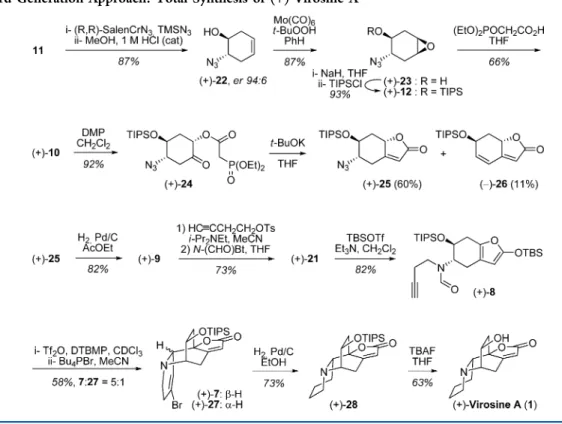
Hence, we developed a third generation approach, which
turned out to be much more efficient and reliable. To access
virosine A in a non-racemic form, the synthesis started with the
desymmetrization of epoxide 11 using Jacobsen
’s conditions to
afford enantioenriched azido-alcohol 22 in a 94:6 enantiomeric
ratio (Scheme 4),
11which compares to literature.
12Compound
22
was submitted to a hydroxy-directed epoxidation followed
by protection of the resulting alcohol as a silyl ether. Instead of
opening epoxide 12 with bromoacetic acid followed by an
Arbuzov reaction (as we did in the second generation approach,
Scheme 3), the epoxide 12 was rather opened with diethyl
phosphonoacetic acid, and the desired phosphonoester 10 was
Scheme 1. Retrosynthetic Analysis of Virosine A
Scheme 2. First Generation Approach towards the Core of
(
±)-Virosine A
Scheme 3. Second Generation Approach towards
(±)-Virosine A
generated in one step (Scheme 4). Again, only one
diastereomer and regioisomer for the opening of epoxide 12
was observed, for the reason explained in Scheme 5: the
opening through Route a leads to a twist-boat-like transition
state, higher in energy than the chair-like transition state for the
opening following Route b (preferred). Oxidation of the
resulting alcohol 10 using Dess
−Martin periodinane furnished
the corresponding ketone 24 in high yield (Scheme 4). Then,
intramolecular Horner
−Wadsworth−Emmons olefination
pro-moted by t-BuOK gave butenolide 25 in 60% yield, along with
11% of product 26 that suffered N
3elimination from 25.
13The
azide was reduced via a catalytic hydrogenation, and the
resulting amine 9 was initially formylated. However, all
attempts to alkylate the resulting formamide failed, presumably
due to steric hindrance engendered by the adjacent OTIPS.
Taking advantage of this steric encumbrance, substrate 9 was
cleanly monoalkylated (no dialkylation observed) and then
formylated. Enolization of butenolide 21 generated the key step
precursor 8, now in 10 steps from 11 instead of 14 steps as in
the second generation approach.
Upon activation of formamide 8 with triflic anhydride (1.5
equiv) in the presence of 2,6-di-tert-butyl-4-methylpyridine (3
equiv) as the base, the Vilsmeier
−Haack cyclization of the furyl
proceeded smoothly at rt over 20 min, and the addition of a
bromide salt (10 equiv) triggered a Mannich cyclization of the
alkyne. The optimized
14one-pot Vilsmeier
−Haack and
Mannich cyclizations generated amine 7 containing the
tetracyclic core of the natural product in 58% yield, in a
separable 5:1 mixture with epimeric adduct 27. The
stereo-chemical assignment of compound 7 was done by NOESY
experiments that showed correlations for protons indicated in
Figure 2. Treatment of vinylic bromide 7 with Pd/C and
hydrogen resulted in a fast hydrogenolysis of the C
−Br bond,
followed by reduction of the resulting disubstituted alkene
(Scheme 4). No hydrogenation of the butenolide trisubstituted
alkene was observed. It should be noted that the latter alkene is
quite hindered on both faces, by the OTIPS (top face) and the
piperidine ring (bottom face). Deprotection of the TIPS ether
finally afforded virosine A. The characterization of the synthetic
material matched that for the isolated natural product.
3Scheme 4. Third Generation Approach: Total Synthesis of (+)-Virosine A
Scheme 5. Diastereoselectivity in Epoxide 12 Opening
■
CONCLUSION
In summary, we demonstrated the use of one-pot Vilsmeier
−
Haack and Mannich cyclizations as an efficient synthetic
strategy for the construction of complex polycyclic alkaloids.
This strategy was applied to the first total synthesis of virosine
A, prepared in an enantioenriched form in only 13 steps and
3.4% overall yield. We therefore corroborate the absolute
configuration deducted by Ye
3for virosine A. Even though the
revised structure proposed by Arbain and Sargent
4for securinol
B is exactly the same as for virosine A, the absence of spectral
data for the former do not allow us to conclude that they are
indeed the same natural product.
■
EXPERIMENTAL SECTION
General Information. All reactions requiring anhydrous con-ditions were conducted in flame-dried glassware under a dry nitrogen or argon atmosphere. THF was distilled from Na and benzophenone under nitrogen immediately prior to use. Acetonitrile, dichloro-methane, benzene, toluene, diisopropylethylamine, and triethylamine were distilled from CaH2 under nitrogen immediately prior to use. Methanol was distilled over 4 Å molecular sieves. Triflic anhydride and CDCl3 were distilled over a small amount of phosphorus pentoxide (P2O5) under nitrogen immediately prior to use. Azidotrimethylsilane and tert-butyldimethylsilyl trifluoromethanesulfonate were distilled under nitrogen immediately prior to use. p-Toluenesulfonyl chloride was recrystallized in benzene prior to use. All other required fine chemicals were used directly without purification. Thin layer chromatography (TLC) was conducted with precoated 60 Å 250 μm silica gel plates with F-254 indicator and visualized using a combination of UV and anisaldehyde, ceric ammonium molybdate, iodine on silica, or potassium permanganate staining. Flash column chtomatography was performed using silica gel (230−400 mesh). Melting points are uncorrected. Optical rotations were measured at rt in a 1.0 dm cell (c in g cm−3). IR spectra were recorded with a FTIR instrument by applying substrates as thin films onto a KBr plate.1H and13C NMR spectra were recorded on 300 MHz and/or 400 MHz spectrometers. All chemical shifts are referenced to residual non-deutarated solvent. Data for proton spectra are reported as follows: chemical shift (multiplicity [singlet (s), doublet (d), triplet (t), quartet (q), quintet (quint), and multiplet (m)], coupling constants [Hz], integration). Carbon spectra were recorded with complete proton decoupling and the chemical shifts are reported in ppm.
Usual Reaction Workup and Purification. After addition of the indicated aqueous solution, layers were separated. The aqueous phase was extracted with the indicated solvent and washed with the indicated aqueous solution. The combined organic phases were dried over anhydrous Na2SO4, filtered, and concentrated under reduced pressure using a rotary evaporator. The crude material was purified by flash chromatography using silica gel with the indicated eluent.
(+)-Virosine A (1). To a solution of 28 (4.0 mg, 0.010 mmol) in THF (0.2 mL) at 0°C was added tetrabutylammonium fluoride (1.0 M in THF, 11μL, 0.011 mmol). The reaction mixture was stirred at rt for 20 min. Aqueous NaOH (1 N) and EtOAc were added, and layers were separated. The aqueous phase was extracted with EtOAc. The combined organic phases were dried over anhydrous Na2SO4, filtered, and concentrated under reduced pressure. The crude material was purified by flash chromatography (silica gel, 85% EtOAc in hexanes) to give virosine A (1) (1.5 mg, 63%) as an oily solid. [α]20
D+22.8 (c 0.35, 1,4-dioxane);15IR (film)ν 3394 (br), 2926, 2851, 1755, 1728, 1653, 1597, 1454, 1143 cm−1;1H NMR (300 MHz, CDCl 3)δ 5.71 (s, 1H), 4.43−4.34 (m, 1H), 3.02−2.86 (m, 3H), 2.85−2.66 (m, 4H), 1.87− 1.76 (m, 1H), 1.74−1.51 (m, 4H), 1.46 (dd, J = 12.4, 5.0 Hz, 1H), 1.38−1.26 (m, 1H), 0.86 (qd, J = 11.8, 4.0 Hz, 1H);13C NMR (100 MHz, CDCl3)δ 174.1 (s), 173.9 (s), 111.8 (d), 84.5 (s), 65.5 (d), 65.3 (d), 59.1 (d), 52.9 (t), 41.1 (t), 29.6 (t), 26.8 (t), 25.8 (t), 24.2 (t); MS (EI) m/z (rel %) 235 [M+] (60), 191 (100), 163 (15), 149 (20), 140 (45), 110 (55), 84 (30); HRMS (EI) calcd for C13H17NO3[M+] 235.1208, found 235.1210.
( + ) - ( 1S , 2 R , 8 S , 1 5 S ) 7 A z a 4 b r o m o 1 3 o x a 1 5 -(triisopropylsilyloxy)tetracyclo[6.5.2.0.2,701,10 ]pentadeca-3,10-dien-12-one (7) and (+)-(1 S,2S,8S,15S)-7-Aza-4-bromo-13-oxa-15-(triisopropylsi-lyloxy)tetracyclo[6.5.2.0.2,701,10 ]pentadeca-3,10-dien-12-one (27). Triflic anhydride (15μL, 0.087 mmol) was added to a solution of formamide 8 (30 mg, 0.058 mmol) and 2,6-di-tert-butyl-4-methylpyridine16(36 mg, 0.17 mmol) in CDCl3(5.8 mL) at 0 °C. The reaction mixture was stirred at rt for 20 min. Tetrabutylphosphonium bromide (197 mg, 0.577 mmol) and MeCN (5.8 mL) were added, and the mixture was stirred at 70°C for 15 h. Saturated aq Na2CO3was added, and then the layers were separated. The aqueous phase was extracted with EtOAc. The combined organic phases were washed with brine, dried over anhydrous Na2SO4, filtered, and concentrated under reduced pressure. The crude material was purified by flash chromatography (silica gel saturated with Et3N, 0% to 15% EtOAc in hexanes) to give 7 (13 mg, 48%) and 27 (2.8 mg, 10%).
Data for 7: beige solid, mp 82−84 °C; [α]20
D +33.0 (c 0.54, CHCl3);15 IR (film) ν 2937, 2866, 1788, 1769, 1653, 1465, 1140, 1053, 877 cm−1;1H NMR (300 MHz, CDCl3)δ 5.85, (br. s, 1H), 5.75 (br. s, 1H), 4.33 (dd, J = 8.0, 4.9 Hz, 1H), 3.99−3.94 (m, 1H), 3.31− 3.16 (m, 2H), 3.10 (dd, J = 14.3, 5.4 Hz, 1H), 2.99−2.93 (m, 1H), 2.76 (dd, J = 12.9, 8.5 Hz, 1H), 2.68−2.48 (m, 2H), 2.32−2.21 (m, 1H), 1.50 (d, J = 13.1 Hz, 1H), 1.13−0.96 (m, 21H);13C NMR (100 MHz, CDCl3)δ 173.4 (s), 172.3 (s), 127.6 (d), 122.7 (s), 112.0 (d), 84.8 (s), 67.3 (d), 59.2 (d), 58.8 (d), 49.7 (t), 42.5 (t), 34.1 (t), 27.2 (t), 18.1 (q), 12.1 (d); MS (ESI) m/z (rel %) 470 and 468 [M+] (100), 414 (10), 227 (10), 196 (10); HRMS (ESI) calcd for C22H34BrNO3Si [M+] 468.1570, found 468.1571.
Data for 27: oily solid. [α]20
D+16.7 (c 0.29, CHCl3);15IR (film)ν 2945, 2926, 2866, 1776, 1758, 1653, 1465, 1128, 1053, 881, 840 cm−1; 1H NMR (300 MHz, CDCl 3) δ 6.28 (br. s, 1H), 5.75 (br. s, 1H), 4.27−4.18 (m, 1H), 3.55 (br. s, 1H), 3.29−3.10 (m, 2H), 3.04 (dd, J = 14.6, 4.9 Hz, 1H), 2.99−2.94 (m, 1H), 2.92−2.81 (m, 1H), 2.69 (dd, J = 13.0, 9.4 Hz, 1H), 2.57−2.42 (m, 1H), 2.42−2.31 (m, 1H), 1.37− 1.29 (m, 1H), 1.12−0.96 (m, 21H);13C NMR (100 MHz, CDCl3)δ 175.3 (s), 173.5 (s), 128.8 (d), 122.3 (s), 111.5 (d), 84.6 (s), 67.1 (d), 61.4 (d), 61.1 (d), 49.1 (t), 36.7 (t), 35.1 (t), 29.0 (t), 18.2 (q), 12.2 (d); MS (ESI) m/z (rel %) 490 [M++ Na] (95), 446 (30), 393 (15), 349 (20), 301 (25), 289 (20), 202 (15); HRMS (ESI) calcd for C22H34BrNNaO3Si [M++ Na] 490.1389, found 490.1389.
(+)- N-(But-3-ynyl)-N-((5S,6S)-4,5,6,7-tetrahydro-2-(tert-bu- tyldimethylsilyloxy)-6-(triisopropylsilyloxy)benzofuran-5-yl)-formamide (8). To a solution of butenolide 21 (19 mg, 0.047 mmol) and Et3N (34μL, 0.24 mmol) in DCM (0.5 mL) at 0 °C was added tert-butyldimethylsilyl trifluoromethanesulfonate (28μL, 0.12 mmol). Saturated aq Na2CO3 was immediately added. The usual workup (DCM) and purification (silica gel saturated with Et3N, 30% EtOAc in hexanes) gave 8 (20 mg, 82%) as a colorless oil: [α]20
D+34.8 (c 0.85, CHCl3);15 IR (film) ν 3316, 2945, 2892, 2866, 1683, 1597, 1462, 1271, 1256, 1095, 885, 844 cm−1; 1H NMR (300 MHz, CDCl
3, mixture of rotamers)δ 8.19 (s) and 8.14 (s) (1H, rotamers), 4.92 (s) and 4.89 (s) (1H, rotamers), 4.87−4.77 (m) and 4.23−4.13 (m) (1H, rotamers), 3.69−3.33 (m, 2H), 3.33−3.19 (m, 1H), 3.02 (td, J = 16.1, 5.7 Hz, 1H), 2.76−2.34 (m, 5H), 2.06 (t, J = 2.5 Hz) and 2.01 (t, J = 2.5 Hz) (1H, rotamers), 1.08−1.03 (m, 21H), 0.98−0.94 (m, 9H), 0.24−0.20 (m, 6H); 13C NMR (100 MHz, CDCl3, mixture of rotamers)δ 163.9 (d), 163.7 (d), 156.7 (s), 156.3 (s), 135.5 (s), 135.1 (s), 116.0 (s), 115.2 (s), 84.0 (d), 83.8 (d), 81.6 (s), 80.5 (s), 71.4 (d), 70.1 (d), 69.2 (d), 68.1 (d), 61.5 (d), 60.6 (d), 49.2 (t), 42.1 (t), 33.4 (t), 32.8 (t), 26.5 (t), 25.6 (q), 24.1 (t), 20.4 (t), 18.6 (t), 18.3 (q), 18.2 (s), 13.0 (d), 12.9 (d),−4.8 (q); MS (EI) m/z (rel %) 519 [M+] (40), 476 [M+− C3H 7] (35), 422 (50), 248 (80), 224 (100), 210 (15), 73 (55); HRMS (EI) calcd for C28H49NO4Si2[M+] 519.3200, found 519.3193.
( + ) - ( 5S , 6 S, 7 aS ) 5 A m i n o 5 , 6 , 7 , 7 a t e t r a h y d r o 6 -(triisopropylsilyloxy)benzofuran-2(4H)-one (9). To a solution of azide 25 (754 mg, 2.14 mmol) in EtOAc (20 mL) at rt was added palladium on carbon (10 wt %, 223 mg). The reaction mixture was stirred for 2 h at rt under hydrogen atmosphere. The solution was filtered on Celite (EtOAc washings). The solvent was evaporated
under reduced pressure, and the usual purification (10% MeOH in EtOAc) gave 9 (573 mg, 82%) as a white solid: mp 61−64 °C; [α]20
D +57.7 (c 0.80, CHCl3);15IR (CHCl3)ν 3686, 3623, 3023, 2971, 2870, 1750, 1522, 1428, 1215, 1035, 930 cm−1; 1H NMR (300 MHz, CDCl3)δ 5.87 (s, 1H), 5.08 (dd, J = 11.0, 6.4 Hz, 1H), 4.09−4.00 (m, 1H), 3.42−3.36 (m, 1H), 3.02 (dd, J = 13.8, 4.4 Hz, 1H), 2.61 (d, J = 13.8 Hz, 1H), 2.57−2.47 (m, 1H), 1.76−1.65 (m, 1H), 1.55 (s, 2H), 1.18−1.01 (m, 21H);13C NMR (100 MHz, CDCl 3)δ 173.4 (s), 169.4 (s), 115.6 (d), 79.2 (d), 71.9 (d), 53.6 (d), 36.1 (t), 31.9 (t), 18.2 (q), 12.3 (d); MS (EI) m/z (rel %) 308 (5), 282 [M+− C3H 7] (100), 184 (2), 130 (10), 102 (5); HRMS (EI) calcd for C14H24NO3Si [M+ − C3H7] 282.1525, found 282.1527.
(+)-(1 S,2S,4S,5S)-4-Azido-2-hydroxy-5-(triisopropylsilyloxy)-cyclohexyl (diethylphosphono)acetate (10). To a solution of epoxide 12 (2.42 g, 7.77 mmol) in THF (78 mL) was added diethylphosphonoacetic acid (25.0 mL, 155 mmol). The solution was stirred for 15 h at 70°C. The reaction mixture was concentrated under reduced pressure, and the residue was dissolved in EtOAc and washed three times with saturated aq NaHCO3. The usual workup (EtOAc, H2O) and purification (50% EtOAc in hexanes) gave 10 (2.60 g, 66%) as a colorless oil: [α]20 D+38.5 (c 1.11, CHCl3);15IR (film)ν 3377, 2944, 2869, 2109, 1734, 1646, 1557, 1465, 1390, 1266, 1120 cm−1;1H NMR (300 MHz, CDCl3)δ 5.11 (ddd, J = 11.5, 9.1, 4.6 Hz, 1H), 4.40 (s, 1H), 4.23−4.10 (m, 4H), 4.05−3.99 (m, 1H), 3.93−3.82 (m, 1H), 3.82−3.77 (m, 1H), 3.12−2.81 (m, 2H), 2.16−1.97 (m, 3H), 1.84− 1.72 (m, 1H), 1.35 (dd, J = 13.2, 6.9 Hz, 6H), 1.18−0.98 (m, 21H); 13C NMR (75.5 MHz, CDCl 3)δ 165.2 (d, J13C−31 P= 5.5 Hz), 75.9 (d), 69.4 (d), 67.7 (d), 63.3 (td, J13 C−31 P= 5.8 Hz), 62.8 (td, J13C−31 P= 6.3 Hz), 62.0 (d), 35.0 (td, J13 C−31 P= 130.6 Hz), 32.7 (t), 30.8 (t), 17.9 (q), 16.3 (qd, J13 C−31 P= 4.9 Hz), 12.1 (d); MS (EI) m/z (rel %) 464 [M+− C3H7] (60), 309 (5), 281 (5), 240 (100), 222 (65), 179 (30), 123 (30); HRMS (EI) calcd for C18H35N3O7PSi [M+− C3H7] 464.1982, found 464.1993.
(+)-((1 R,3S,4S,6S)-4-Azido-7-oxabicyclo[4.1.0]heptan-3-yloxy)triisopropylsilane (12). Sodium hydride (60% in mineral oil, 1.88 g, 47.1 mmol) was added to a solution of alcohol 23 (6.09 g, 39.3 mmol) in THF (250 mL) at 0°C. The resulting mixture was stirred at rt for 1.5 h, TIPSCl was added at 0°C, and the reaction mixture was stirred at rt for 18 h. Water was added carefully, and the reaction mixture was concentrated under reduced pressure. The usual workup (EtOAc, brine) and purification (2% to 10% EtOAc in hexanes) gave 12(11.2 g, 93%) as a light brown oil: [α]20
D+11.1 (c 1.24, CHCl3);15 IR (film)ν 2940, 2105, 1465, 1256, 1110, 818, 681 cm−1;1H NMR (300 MHz, CDCl3)δ 3.64 (td, J = 10.0, 7.0 Hz, 1H), 3.40 (ddd, J = 11.0, 10.0, 5.0 Hz, 1H), 3.17 (dt, J = 4.0, 2.0 Hz, 1H), 3.08 (dd, J = 5.0, 4.0 Hz, 1H), 2.50 (ddd, J = 15.0, 5.0, 2.0 Hz, 1H), 2.40 (ddd, J = 15.0, 7.0, 5.0 Hz, 1H), 1.98 (dd, J = 15.0, 10.0 Hz, 1H), 1.67 (ddd, J = 15.0, 11.0, 2.0 Hz, 1H), 1.15−0.99 (m, 21H); 13C NMR (75.5 MHz, CDCl3)δ 71.2 (d), 61.4 (d), 52.3 (d), 50.5 (d), 34.1 (t), 30.4 (t), 18.0 (q), 12.7 (d); MS (CI) m/z (rel %) 312 [M++ H] (100), 240 (20); HRMS (CI) calcd for C15H30N3O2Si [M+ + H] 312.2107, found 312.2120.
But-3-ynyl p-Toluenesulfonate. To a solution of but-3-yn-1-ol (1.20 mL, 15.8 mmol), triethylamine (2.70 mL, 19.0 mmol), and 4-(dimethylamino)pyridine (39 mg, 0.32 mmol) in DCM (53 mL) at 0 °C was added p-toluenesulfonyl chloride (3.16 g, 16.6 mmol) in three portions. The reaction mixture was brought to rt and stirred 15 h. Aq NaOH (1 N, 30 mL) was added, and the mixture was vigorously stirred for 15 min at rt. The usual workup (DCM, brine) gave but-3-ynyl p-toluenesulfonate (3.46 g, 98%) as a yellowish oil. The product obtained is in agreement with published spectra:17 1H NMR (300 MHz, CDCl3)δ 7.81 (d, J = 8.2 Hz, 2H), 7.36 (d, J = 8.2 Hz, 2H), 4.10 (t, J = 7.1 Hz, 2H), 2.56 (td, J = 7.1, 2.7 Hz, 2H), 2.46 (s, 3H), 1.97 (t, J = 2.7 Hz, 1H).
rac-N-(But-3-ynyl)-N-((1S,6S)-3-(tert-butyldimethylsilyloxy)-6-(triisopropylsilyloxy)cyclohex-3-enylamine (17). A solution of but-3-ynyl p-toluenesulfonate (2.27 g, 10.1 mmol) in MeCN (30 mL) was added to a solution of amine 168(2.02 g, 5.06 mmol) and N,N-diisopropylethylamine (1.90 mL, 11.1 mmol) in MeCN (20 mL) at rt. The reaction mixture was stirred for 15 h at 70 °C. Saturated aq
NaHCO3and EtOAc were added. The usual workup (EtOAc, brine) and purification (silica gel saturated with Et3N, 5% EtOAc in hexanes) gave 17 (2.02 g, 88%) as a colorless oil: IR (film)ν 3314, 2933, 2869, 1676, 1464, 1252, 1194, 1098, 886, 839, 780, 680 cm−1;1H NMR (300 MHz, CDCl3)δ 4.72−4.66 (m, 1H), 3.80 (td, J = 8.1, 5.3 Hz, 1H), 2.91−2.64 (m, 3H), 2.43−2.28 (m, 4H), 2.16−2.02 (m, 2H), 2.00− 1.86 (m, 1H), 1.09−1.04 (m, 21H), 0.91 (s, 9H), 0.12 (s, 6H);13C NMR (75.5 MHz, CDCl3)δ 148.2 (s), 100.7 (d), 82.6 (s), 71.4 (d), 69.6 (d), 58.8 (d), 45.8 (t), 34.8 (t), 31.8 (t), 25.8 (q), 19.8 (t), 18.3 (q), 18.1 (s), 12.7 (d),−4.4 (q); MS (EI) m/z (rel %) 451 [M+] (15), 408 [M+ − C3H7] (30), 371 (30), 278 (100), 256 (70), 210 (25); HRMS (EI) calcd for C25H49NO2Si2[M+] 451.3302, found 451.3304. rac-(1S,4S,5S)-4-(But-3-ynylamino)-5-(triisopropylsilyloxy)-2-oxocyclohexyl Bromoacetate (18). Bromoacetic acid (3.50 g, 25.5 mmol) was added to a solution of m-chloroperbenzoic acid (77%, 372 mg, 1.66 mmol) in DCM (3.5 mL) at−25 °C. A solution of amine 17 (500 mg, 1.11 mmol) in DCM (3 mL) was added over 1 h, and the solution was stirred for 30 min at −25 °C. Saturated aq Na2SO3 was added, and the mixture was stirred for 30 min at rt. Aqueous NaOH (1 N) was added. The usual workup (DCM) and purification (20% EtOAc in hexanes) gave 18 (single diastereomer, 383 mg, 73%) as a yellowish oil: IR (film)ν 3752, 3734, 2944, 2869, 2335, 1734, 1650, 1562, 1504, 1465, 1275, 1107 cm−1;1H NMR (300 MHz, CDCl3)δ 5.55 (dd, J = 12.2, 6.9 Hz, 1H), 4.23−4.17 (m, 1H), 3.96 (s, 2H), 3.33−3.27 (m, 1H), 3.08 (dd, J = 13.8, 4.0 Hz, 1H), 2.84−2.64 (m, 2H), 2.46−2.23 (m, 6H), 1.22−1.00 (m, 21H); 13C NMR (75.5 MHz, CDCl3)δ 203.0 (s), 166.4 (s), 81.9 (s), 74.8 (d), 70.2 (d), 69.2 (d), 61.6 (d), 45.4 (t), 41.2 (t), 35.5 (t), 25.9 (t), 19.6 (t), 18.2 (q), 12.3 (d); MS (EI) m/z (rel %) 432 and 430 [M+ − C3H7] (20), 317 (70), 278 (100), 253 (25), 241 (35), 223 (20), 131 (20); HRMS (EI) calcd for C18H29BrNO4Si [M+− C3H7] 430.1049, found 430.1054.
rac-(1S,4S,5S)-4-(But-3-ynylamino)-5-(triisopropylsilyloxy)-2-oxocyclohexyl (Diethylphosphono)acetate (19). To a solution of bromide 18 (252 mg, 0.531 mmol) in toluene (11 mL) was added triethylphosphite (1.4 mL, 8.0 mmol) at rt. The reaction mixture was stirred for 3 h at reflux. Solvent and excess triethylphosphite were evaporated under reduced pressure. The usual purification (50% to 85% EtOAc in hexanes) gave 19 (253 mg, 90%) as a colorless oil: IR (film)ν 3297, 2945, 2870, 1754, 1735, 1638, 1465, 1391, 1267, 1106, 1053, 1024, 971, 881 cm−1;1H NMR (300 MHz, CDCl 3)δ 5.54 (dd, J = 12.2, 6.8 Hz, 1H), 4.26−4.12 (m, 5H), 3.33−3.26 (m, 1H), 3.18− 2.98 (m, 3H), 2.83−2.64 (m, 2H), 2.46−2.22 (m, 6H), 1.34 (td, J = 7.1, 1.2 Hz, 6H), 1.21−1.01 (m, 21H);13C NMR (75.5 MHz, CDCl 3) δ 203.1 (s), 164.9 (d, J13 C−31 P= 4.4 Hz), 81.9 (s), 74.1 (d), 70.1 (d), 69.2 (d), 63.7 (td, J13 C−31 P= 3.9 Hz), 62.8 (td, J13C−31P= 6.7 Hz), 61.7 (d), 45.3 (t), 41.2 (t), 35.6 (t), 34.0 (td, J13 C−31 P= 134.8 Hz), 19.6 (t), 18.2 (q), 16.4 (qd, J13 C−31 P= 5.2 Hz), 12.3 (d); MS (EI) m/z (rel %) 531 [M+] (10), 492 [M+− C3H 3] (20), 488 [M+− C3H7] (50), 331 (40), 313 (60), 153 (100); HRMS (EI) calcd for C25H46NO7PSi [M+] 531.2781, found 531.2787.
rac-(5S,6S,7aS)-5-(But-3-ynylamino)-5,6,7,7a-tetrahydro-6-(triisopropylsilyloxy)benzofuran-2(4H)-one (20). To a suspen-sion of sodium hydride (60% dispersuspen-sion in mineral oil, 7.7 mg, 0.19 mmol) in THF (0.6 mL) at −40 °C was added a solution of phosphonate 19 (92.4 mg, 0.174 mmol) in THF (0.6 mL). The reaction mixture was stirred for 2 h at−40 °C. Brine and Et2O were added. The usual workup (Et2O, H2O) and purification (30% EtOAc in hexanes) gave 20 (47.7 mg, 73%) as a white solid: mp 34−36 °C; IR (CHCl3)ν 3690, 3626, 3308, 3023, 2975, 2870, 1746, 1525, 1424, 1215, 1042, 922, 788 cm−1;1H NMR (300 MHz, CDCl 3)δ 5.83 (s, 1H), 5.06 (dd, J = 11.2, 6.3 Hz, 1H), 4.20−4.13 (m, 1H), 3.15−3.09 (m, 1H), 2.98−2.87 (m, 1H), 2.86−2.67 (m, 3H), 2.56−2.45 (m, 1H), 2.38−2.29 (m, 2H), 2.00 (t, J = 2.5 Hz, 1H), 1.76−1.64 (m, 1H), 1.18−1.00 (m, 21H);13C NMR (100 MHz, CDCl 3)δ 173.5 (s), 169.7 (s), 115.1 (d), 82.1 (s), 79.1 (d), 70.2 (d), 69.8 (d), 59.5 (d), 45.9 (t), 36.5 (t), 29.0 (t), 19.9 (t), 18.2 (q), 12.3 (d); MS (EI) m/z (rel %) 377 [M+] (15), 338 [M+− C3H 3] (15), 334 [M+− C3H7] (100), 280 (20), 73 (40); HRMS (EI) calcd for C21H35NO3Si [M+] 377.2386, found 377.2382.
(+)- N-(But-3-ynyl)-N-((5S,6S,7aS)-2,4,5,6,7,7a-hexahydro-6-triisopropylsilyloxy-2-oxobenzofuran-5-yl)formamide (21). Preparation from 20: To a solution of butenolide 20 (15.9 mg, 0.042 mmol) in THF (2.1 mL) was added N-formylbenzotriazole10 (49.6 mg, 0.34 mmol) at rt. The reaction mixture was stirred for 15 h at rt and then concentrated under reduced pressure. DCM was added, and the organic layer was washed twice with aq NaOH (1 N). The usual workup (DCM, brine) and purification (30% EtOAc in hexanes) gave 21 (11.8 mg, 69%) as a yellowish oil. Preparation from 9: A solution of but-3-ynyl p-toluenesulfonate (2.38 g, 10.6 mmol) in MeCN (9 mL) was added to a solution of amine 9 (574 mg, 1.76 mmol) and N,N-diisopropylethylamine (0.6 mL, 3.52 mmol) in MeCN (9 mL) at rt. The reaction mixture was stirred for 60 h at 70 °C. Saturated aq NaHCO3and EtOAc were added. After the usual workup (EtOAc, brine), the residue was dissolved in THF (88 mL), and N-formylbenzotriazole10(2.07 g, 14.1 mmol) was added at rt. The reaction mixture was stirred for 72 h at rt and then concentrated under reduced pressure. DCM was added, and the organic layer was washed twice with aq NaOH (1 N). The usual workup (DCM) and purification (30% to 50% EtOAc in hexanes) gave 21 (524 mg, 73%) as a yellowish oil: [α]20 D+70.0 (c 1.12, CHCl3);15IR (film)ν 3282 (br.), 2949, 2870, 1761, 1671, 1462, 1394, 1098, 1080, 1001, 900, 881 cm−1;1H NMR (300 MHz, CDCl 3, mixture of rotamers)δ 8.25 (s) and 8.17 (s) (1H, rotamers), 5.92 (s, 1H), 5.23 (dd, J = 12.0, 6.0 Hz, 1H), 4.60−4.53 (m), 4.37 (br. s), 4.28 (br. s) and 4.03−3.96 (m) (2H, rotamers), 3.76−3.64 (m), 3.44−3.35 (m), 3.28−3.10 (m), 3.02 (br. s) and 2.97 (br. s) (4H, rotamers), 2.67−2.39 (m, 3H), 2.13 (t, J = 2.6 Hz) and 2.02 (t, J = 2.7 Hz) (1H, rotamers), 1.70−1.46 (m, 1H), 1.25−1.02 (m, 21H); 13C NMR (100 MHz, CDCl3, mixture of rotamers)δ 172.7 (s), 172.2 (s), 169.5 (s), 168.2 (s), 164.4 (d), 161.8 (d), 114.8 (d), 114.3 (d), 81.2 (s), 78.6 (d), 78.1 (d), 72.6 (d), 70.5 (d), 69.5 (d), 68.6 (d), 60.4 (d), 54.6 (d), 43.7 (t), 43.6 (t), 35.9 (t), 34.3 (t), 28.0 (t), 25.9 (t), 22.2 (t), 18.1 (q), 17.7 (t), 12.1 (d); MS (EI) m/z (rel %) 362 [M+− C3H 7] (100), 294 (5), 210 (5), 74 (20); HRMS (EI) calcd for C19H28NO4Si [M+− C3H7] 362.1787, found 362.1782.
(+)-(1S,6S)-6-Azidocyclohex-3-enol (22). Nitrogen was bubbled in epoxide 11 (1.95 g, 20.3 mmol) for 10 min, and it was then brought to −25 °C. (R,R)-SalenCrN312,18 (975 mg, 1.52 mmol) and azidotrimethylsilane (2.80 mL, 21.3 mmol) were added, and the reaction mixture was stirred at−25 °C for 5 days. The mixture was filtered on a silica pad, eluting with a mixture of 15% EtOAc in hexanes. The filtrate was concentrated under reduced pressure and then diluted in methanol (70 mL). Aqueous 1 N HCl (5 drops) was added. The resulting mixture was stirred 1 h at rt, concentrated under reduced pressure, and then diluted in DCM. The organic phase was dried over anhydrous Na2SO4, filtered, and concentrated under reduced pressure. The usual purification (10% EtOAc in hexanes) gave 22 (2.47 g, 87%) as a yellowish oil: er 94:6 (GC, RT-BetaDexsp column, 30 m× 0.25 mm × 0.25 μm); [α]20 D+100.0 (c 1.25, CHCl3); IR (film)ν 3402 (br), 3035, 2914, 2108, 1658, 1254, 1062, 667 cm−1; 1H NMR (300 MHz, CDCl 3)δ 5.64−5.54 (m, 2H), 3.74 (tdd, J = 9.0, 6.0, 3.0 Hz, 1H), 3.55 (dt, J = 9.0, 6.0 Hz, 1H), 2.59−2.47 (m, 2H), 2.26 (d, J = 3.0 Hz, 1H), 2.22−2.05 (m, 2H);13C NMR (75.5 MHz, CDCl3)δ 124.4 (d), 123.2 (d), 69.8 (d), 63.0 (d), 32.8 (t), 30.0 (t); MS (EI) m/z (rel %) 139 [M+] (1), 94 (45), 83 (50), 55 (100); HRMS (EI) calcd for C6H9N3O [M+] 139.0746, found 139.0748.
(+)-(1R,3S,4S,6S)-4-Azido-7-oxabicyclo[4.1.0]heptan-3-ol (23). A solution of anhydrous tert-butyl hydroperoxide19 (2.30 M in toluene, 41.8 mL, 96.1 mmol) was added over 5 min to a solution of alkene 22 (6.08 g, 43.7 mmol) and Mo(CO)6(0.58 g, 2.2 mmol) in benzene (300 mL) at reflux. After 2 h at reflux, the reaction mixture was cooled to 0°C and quenched by carefully adding saturated aq Na2S2O3. Water was added, and the usual workup (EtOAc, brine) and purification (40% EtOAc in hexanes) gave 23 (5.90 g, 87%) as a white solid: mp 59−61 °C; [α]20 D+61.6 (c 1.02, CHCl3);15IR (film)ν 3327 (br), 3012, 2924, 2118, 1436, 1256, 1065, 953, 714 cm−1;1H NMR (300 MHz, CDCl3)δ 3.63−3.54 (m, 2H), 3.27−3.24 (m, 1H), 3.22 (t, J = 4.0 Hz, 1H), 2.59−2.58 (m, 1H), 2.54 (dd, J = 4.0, 1.0 Hz, 1H), 2.37 (ddd, J = 16.0, 5.5, 4.0 Hz, 1H), 2.06 (dd, J = 16.0, 7.0 Hz, 1H), 1.98−1.89 (m, 1H);13C NMR (75.5 MHz, CDCl3)δ 68.5 (d), 59.7 (d), 51.8 (d), 51.2 (d), 30.0 (t), 28.0 (t); MS (CI) m/z (rel %) 156 [M++ H] (35), 113 (50), 98 (75), 82 (100); HRMS (CI) calcd for C6H10N3O2[M++ H] 156.0773, found 156.0777.
(+)-(1 S,4S,5S)-4-Azido-5-(triisopropylsilyloxy)-2-oxocyclo-hexyl (Diethylphosphono)acetate (24). To a solution of phosphonate 10 (1.40 g, 2.76 mmol) in DCM (15 mL) at 0°C was slowly added a solution of Dess−Martin periodinane20(2.30 g, 5.52 mmol) in DCM (13 mL). The solution was stirred for 2 h at 0°C and 1 h at rt. Saturated aq Na2S2O3 was added, and the mixture was vigorously stirred for 1 h at rt. The usual workup (DCM, H2O) and purification (50% EtOAc in hexanes) gave 24 (1.16 g, 85%) as a colorless oil: [α]20 D+8.98 (c 1.66, CHCl3);15IR (film)ν 2948, 2869, 2114, 1743, 1650, 1557, 1456, 1270, 1116, 1027, 966, 882, 683 cm−1; 1H NMR (300 MHz, CDCl3)δ 5.56 (dd, J = 12.3, 6.9 Hz, 1H), 4.26− 4.09 (m, 6H), 3.18−2.98 (m, 3H), 2.64−2.56 (m, 1H), 2.37−2.18 (m, 2H), 1.34 (dt, J = 7.1, 1.8 Hz, 6H), 1.22−1.00 (m, 21H);13C NMR (100 MHz, CDCl3)δ 200.1 (s), 164.5 (d, J13 C−31 P= 5.8 Hz), 73.2 (d), 68.4 (d), 64.1 (d), 62.7 (td, J13 C−31 P= 6.3 Hz), 62.5 (td, J13C−31 P= 6.3 Hz), 39.7 (t), 35.0 (t), 33.7 (td, J13 C−31 P= 134.6 Hz), 17.8 (q), 16.2 (qd, J13 C−31 P= 6.2 Hz), 16.1 (qd, J13C−31 P= 6.2 Hz), 11.9 (d); MS (EI) m/z (rel %) 462 [M+− C3H7] (5), 419 (100), 281 (30), 235 (45), 179 (25), 151 (15), 123 (20); HRMS (EI) calcd for C18H33N3O7PSi [M+− C3H7] 462.1825, found 462.1810.
( + ) - ( 5S , 6 S , 7 a S ) 5 A z i d o 5 , 6 , 7 , 7 a t e t r a h y d r o 6 -(triisopropylsilyloxy)benzofuran-2(4H)-one (25) and ( −)-(6S,7aS)-7,7a-Dihydro-6-(triisopropylsilyloxy)benzofuran-2(6H)-one (26). To a solution of phosphonate 24 (1.99 g, 3.94 mmol) in THF (20 mL) at−78 °C was added over 2 h a solution of potassium tert-butoxide (442 mg, 3.94 mmol) in THF (20 mL). The reaction mixture was stirred for 3 h at−78 °C and then was allowed to warm up to rt. Water was added. The usual workup (EtOAc, H2O) and purification (10% to 20% EtOAc in hexanes) gave 25 (837 mg, 60%) along with 26 (132 mg, 11%) as white solids.
Data for 25: mp 86−89 °C; [α]20 D +156.8 (c 1.35, CHCl3);15IR (CHCl3) ν 3023, 2948, 2869, 2109, 1752, 1650, 1540, 1222, 1014, 926, 785 cm−1;1H NMR (300 MHz, CDCl 3)δ 5.91 (s, 1H), 5.07 (dd, J = 11.3, 6.5 Hz, 1H), 4.23−4.14 (m, 1H), 4.02−3.94 (m, 1H), 3.05− 2.88 (m, 2H), 2.59−2.47 (m, 1H), 1.77−1.65 (m, 1H), 1.19−0.97 (m, 21H);13C NMR (100 MHz, CDCl 3)δ 173.0 (s), 166.9 (s), 116.0 (d), 78.3 (d), 68.9 (d), 61.9 (d), 36.3 (t), 27.9 (t), 18.2 (q), 12.2 (d); MS (EI) m/z (rel %) 308 [M+− C3H 7] (90), 280 (70), 236 (40), 225 (20), 184 (100), 142 (20), 131 (45), 115 (25), 103 (60); HRMS (EI) calcd for C14H22N3O3Si [M+− C3H7] 308.1430, found 308.1436.
Data for 26: mp 73−77 °C; [α]20 D−182.7 (c 1.14, CHCl3);15IR (CHCl3) ν 3023, 2949, 2870, 2110, 1746, 1645, 1522, 1424, 1215, 1050, 926 cm−1;1H NMR (300 MHz, CDCl 3)δ 6.54 (d, J = 9.6 Hz, 1H), 6.28 (dd, J = 9.6, 5.1 Hz, 1H), 5.79 (s, 1H), 5.34 (ddd, J = 12.5, 4.9, 1.6 Hz, 1H), 4.72−4.63 (m, 1H), 2.64−2.55 (m, 1H), 1.75 (td, J = 12.5, 3.6 Hz, 1H), 1.18−0.94 (m, 21H);13C NMR (100 MHz, CDCl 3) δ 173.5 (s), 163.2 (s), 138.4 (d), 121.0 (d), 112.1 (d), 76.8 (d), 65.2 (d), 38.4 (t), 18.1 (q), 12.3 (d); MS (EI) m/z (rel %) 308 [M+] (5), 300 (5), 265 [M+− C3H 7] (100), 223 (5), 184 (5), 131 (10), 103 (20); HRMS (EI) calcd for C14H21O3Si [M+− C3H7] 265.1260, found 265.1266.
(+)-(1 S,2R,8S,15S)-7-Aza-13-oxa-15-(triisopropylsilyloxy)-tetracyclo[6.5.2.0.2,701,10]pentadec-10-en-12-one (28). To a solution of bromide 7 (6.6 mg, 0.014 mmol) in EtOH (1.4 mL) at rt was added palladium on carbon (10 wt.%, 0.15 mg). The reaction mixture was stirred for 2 h at rt under hydrogen atmosphere. The solution was filtered on Celite (EtOAc washings). The solvent was evaporated under reduced pressure and the usual purification (15% EtOAc in hexanes) gave 28 (4.0 mg, 73%) as a colorless oil: [α]20
D +16.9 (c 0.40, CHCl3);15IR (film)ν 2945, 2866, 1765, 1653, 1462, 1151, 1113, 1061, 1012, 881, 836 cm−1;1H NMR (300 MHz, CDCl 3) δ 5.69 (br. s, 1H), 4.39−4.31 (m, 1H), 3.00 (d, J = 18.2 Hz, 1H), 2.94−2.82 (m, 2H), 2.81−2.61 (m, 4H), 1.86−1.75 (m, 1H), 1.62− 1.40 (m, 4H), 1.37−1.20 (m, 1H), 1.11−0.96 (m, 21H), 0.92−0.78 (m, 1H);13C NMR (100 MHz, CDCl 3)δ 174.3 (s), 174.1 (s), 111.5 (d), 84.6 (s), 65.6 (d), 65.3 (d), 59.9 (d), 52.8 (t), 42.4 (t), 29.5 (t),
26.7 (t), 25.8 (t), 24.1 (t), 18.1 (q), 12.1 (d); MS (EI) m/z (rel %) 391 [M+] (25), 348 [M+ − C3H7] (85), 218 (30), 191 (100), 163 (10), 110 (10); HRMS (EI) calcd for C22H37NO3Si [M+] 391.2543, found 391.2536.
■
ASSOCIATED CONTENT
*
S Supporting InformationCopies
1H and
13C NMR spectra for all new compounds and
copy of NOESY spectrum for compound 7. This material is
available free of charge via the Internet at http://pubs.acs.org.
■
AUTHOR INFORMATION
Corresponding Author
*E-mail: [email protected].
Notes
The authors declare no competing financial interest.
■
ACKNOWLEDGMENTS
This research was supported by the Natural Science and
Engineering Research Council (NSERC) of Canada, the
Canadian Fund for Innovation (CFI), and the Universite
́ de
Sherbrooke. NSERC doctoral fellowship to R.L.-G. and
NSERC masters fellowship to M.D. are also gratefully
acknowledged.
■
REFERENCES
(1) Snieckus, V. iIn The Alkaloids; Academic Press: New York, 1973; Vol. 14, pp 425−506.
(2) Beutler, J. A.; Karbon, E. W.; Brubaker, A. N.; Malik, R.; Curtis, D. R.; Enna, S. J. Brain Res. 1985, 330, 135−140.
(3) Wang, G.-C.; Wang, Y.; Li, Q.; Liang, J.-P.; Zhang, Q.; Yao, X.-S.; Ye, W.-C. Helv. Chim. Acta 2008, 91, 1124−1128 . It should be noted that the structure of securinol A drawn in this article is erroneous: to be consistent with data and discussion in this article, the A ring should be a piperidine, not a pyrrolidine.
(4) Arbain, D.; Birkbeck, A. A.; Byrne, L. T.; Sargent, M. V.; Skelton, B. W.; White, A. H. J. Chem. Soc., Perkin Trans. 1 1991, 1863−1869. (5) (a) Horii, Z.; Ikeda, M.; Tamura, Y.; Saito, S.; Kotera, K.; Iwamoto, T. Chem. Pharm. Bull. 1965, 13, 1307−1311. (b) The same initially proposed structures for securinol A and B by Horii (ref 5a) were mistakenly used again by Raj in 2008 ( Raj, D.;Łuczkiewicz, M. Fitoterapia 2008, 79, 419−427 ), even though the structure had already been corrected by Arbain and Sargent in 1991 (ref 4).
(6) Horii, Z.; Yamauchi, M.; Ikeda, M.; Momose, T. Chem. Pharm. Bull. 1970, 18, 2009−2012.
(7) For the development of the Vilsmeier−Haack cyclization, see: (a) Bélanger, G.; Larouche-Gauthier, R.; Ménard, F.; Nantel, M.; Barabé, F. Org. Lett. 2005, 7, 4431−4434. (b) Bélanger, G.; Larouche-Gauthier, R.; Ménard, F.; Nantel, M.; Barabé, F. J. Org. Chem. 2006, 71, 704−712. For the development of one-pot Vilsmeier−Haack and Mannich cyclizations, see: (c) Bélanger, G.; O’Brien, G.; Larouche-Gauthier, R. Org. Lett. 2011, 13, 4268−4271.
(8) Larouche-Gauthier, R.; Bélanger, G. Org. Lett. 2008, 10, 4501− 4504.
(9) Mayr, H.; Kempf, B.; Ofial, A. R. Acc. Chem. Res. 2003, 36, 66− 77.
(10) (a) Katritzky, A. R.; Chang, H.-X.; Yang, B. Synthesis 1995, 503−505. (b) Pasqua, A. E.; Matheson, M.; Sewell, A. L.; Marquez, R. Org. Process Res. Dev. 2011, 15, 467−470.
(11) The enantiomeric ratio was determined by gas chromatography. See Experimental Section.
(12) Wu, M. H.; Jacobsen, E. N. Tetrahedron Lett. 1997, 38, 1693− 1696.
(13) Other bases (KHMDS, DIPEA, NaH), additives (LiCl, 18-crown-6 ether), solvents (MeCN, PhMe), and temperatures (−40, 0 °C) were screened without yield improvement.
(14) Lowering the amount of triflic anhydride and/or tetrabutyl-phosphonium bromide and/or base, using other solvents or solvent mixtures, and increasing the reaction time or temperature for either the Vilsmeier−Haack or the Mannich cyclizations all resulted in lower yields, often as the result of extensive decomposition of the iminium intermediate obtained after the Vilsmeier−Haack cyclization.
(15) The estimated enantiomeric ratio of this compound is 96:4 based on the enantiomeric ratio of compound (+)-22 from which it is derived.
(16) (a) Anderson, A. G.; Stang, P. J. Org. Synth. 1981, 60, 34−39. (b) Anderson, A. G.; Stang, P. J. J. Org. Chem. 1976, 41, 3034−3036. (17) Deng, B.-L.; Hartman, T. L.; Buckheit, R. W.; Pannecouque, C.; De Clercq, E.; Fanwick, P. E.; Cushman, M. J. Med. Chem. 2005, 48, 6140−6155.
(18) Leighton, J. L.; Jacobsen, E. N. J. Org. Chem. 1996, 61, 389−390. (19) Hill, G. J.; Rossiter, B. E.; Sharpless, K. B. J. Org. Chem. 1983, 48, 3607−3608.