HAL Id: hal-00930091
https://hal.archives-ouvertes.fr/hal-00930091
Submitted on 14 Jan 2014
HAL is a multi-disciplinary open access
archive for the deposit and dissemination of
sci-entific research documents, whether they are
pub-lished or not. The documents may come from
teaching and research institutions in France or
abroad, or from public or private research centers.
L’archive ouverte pluridisciplinaire HAL, est
destinée au dépôt et à la diffusion de documents
scientifiques de niveau recherche, publiés ou non,
émanant des établissements d’enseignement et de
recherche français ou étrangers, des laboratoires
publics ou privés.
Optimising QoE for Scalable Video multicast over
WLAN
Kamal Deep Singh, Kandaraj Piamrat, Hyunhee Park, César Viho,
Jean-Marie Bonnin
To cite this version:
Kamal Deep Singh, Kandaraj Piamrat, Hyunhee Park, César Viho, Jean-Marie Bonnin. Optimising
QoE for Scalable Video multicast over WLAN. IEEE 24th International Symposium on Personal Indoor
and Mobile Radio Communications (PIMRC’2013), Sep 2013, London, United Kingdom.
pp.2131-2136, �10.1109/PIMRC.2013.6666496�. �hal-00930091�
Optimising QoE for Scalable video multicast over
WLAN
Kamal Deep Singh
∗, Kandaraj Piamrat
†, Hyunhee Park
†, C´esar Viho
†and Jean-Marie Bonnin
∗ ∗ Telecom Bretagne, 2 rue de la Chˆataigneraie, CS 17607, 35576 Cesson S´evign´e cedex, FranceEmail:{kamal.singh, jm.bonnin}@telecom-bretagne.eu
† INRIA / IRISA / Universit´e de Rennes 1, Campus Universitaire de Beaulieu, 35042 Rennes cedex, France
Email:{kandaraj.piamrat, hyunhee.park, cesar.viho}@irisa.fr
Abstract—Quality of Experience (QoE) is the key to success
for multimedia applications and perceptual video quality is one of the important component of QoE. A recent video encoding scheme called Scalable Video Coding (SVC) provides the flexibility and the capability to adapt the video quality to varying network conditions and heterogeneous users. In this paper, we focus on SVC multicast over IEEE 802.11 networks. Traditionally, multicast uses the lowest modulation resulting in a video with only base quality even for users with good channel conditions. To optimize QoE, we propose to use multiple multicast sessions with different transmission rates for different SVC layers. The goal is to provide at least the multicast session with acceptable quality to users with bad channel conditions and to provide additional multicast sessions having SVC enhancement layers to users with better channel conditions. The selection of modulation rate for each SVC layer and for each multicast session is achieved with binary integer linear programming depending on network conditions with a goal to maximize global QoE. Results show that our algorithm maximizes global QoE by providing highest quality videos to users with good channel conditions and by guaranteeing at least acceptable QoE for all users.
Keywords—Quality of Experience (QoE), Scalable Video Coding (SVC), Wireless Multicast, Linear Programming
I. INTRODUCTION
One important share of multimedia market is video service, which is now available anywhere at any time. To support such service, a video service provider has to manage, store, and distribute content towards multiple types and scales of terminals, and over different and transient access technologies to reach the end user. A good user experience is the key to success for any video service. With multimedia applications, managing network resources with the goal of just optimizing QoS parameters can miss the essential point which is user satisfaction or user experience. User experience or currently called Quality of Experience (QoE) [1] is defined as the overall acceptability of an application or service as perceived subjec-tively by the end-user. QoE is different from QoS network indicators in terms of bandwidth, loss rate, jitter, which are not sufficient to get a precise idea about the visual quality of a received video sequence. QoE instead focuses on the overall experience of the end user. It depends on the global system behavior, going from the source of a given service up-to the final user, including the content itself and the network
This work was partly supported by the project CORRIDOR (ANR-11-VPTT-004) of the French national research organisation (ANR) and by the European project PROBE-IT.
TABLE I. MEANOPINIONSCORE(MOS)
MOS Quality Level of Impairment 5 Excellent Imperceptible 4 Good Perceptible but not annoying 3 Fair Slightly annoying 2 Poor Annoying 1 Bad Very annoying
performance. It can be evaluated in terms of Mean Opinion Score (MOS) as shown in Table I. Therefore, QoE is more appropriate when dealing with multimedia service.
Video scalability seems to be one of the most interesting solutions to some of the multimedia needs as it provides the capability to adapt to varying network conditions and heterogeneous users. One of the most well-known scalable standards is the Scalable Video Coding (SVC) extension of H.264/MPEG-4 AVC video compression [2]. It enables the transmission and decoding of partial bitstreams to provide video services with lower temporal or spatial resolutions or reduced fidelity while retaining a reconstruction quality that is highly relative to the rate of the partial bit streams. Therefore, SVC provides functionalities such as graceful degradation in lossy transmission environments as well as bit rate, format, and power adaptation.
We can also observe that today a significant amount of mul-timedia traffic is transmitted over IEEE 802.11 based wireless networks as numerous access networks are available free of charge or at very affordable price. In wireless environment, different factors such as path loss, fading, or interference in the channel have direct impact on the variation of the received signal to noise ratio (SNR), which results in variation in Bit Error Rate (BER). The lower the SNR the more difficult to decode the received signal, resulting in higher BER. To overcome this problem, the standard has provided multirate transmission capability. For example: 1, 2, 5.5, 11 Mbps data rates are available in IEEE 802.11b; or 6, 9, 12, 18, 24, 36, 48, 54 Mbps are also available in IEEE 802.11a. These different data rates result from different modulation techniques and channel encoding schemes. With this adaptation capability, wireless resources can be managed more intelligently.
In this paper, we will focus particularly on layered multi-cast over wireless with multiple transmission rates. We propose a mechanism that uses both layering transmission in SVC and rate adaptation capability in IEEE 802.11 to optimize QoE in the network. The idea is use multiple multicast session by selecting an optimized modulation for transmission of
each layer adapted to the channel conditions experienced by different users in the network environment. For that, the problem is formulated and solved with binary integer linear programming. The rest of this paper is structured as follows. Section II provides background concepts covered by this paper and Section III describes related works. Section IV presents our proposed mechanism for QoE optimization. In section V, results obtained by the proposed mechanism are analyzed. Finally, section VI provides conclusions and perspectives. II. OVERVIEW OFWIRELESSMULTICAST ANDSCALABLE
VIDEOCODING
A. Wireless Multicast
In this paper, we are interested in multirate IEEE 802.11 based wireless network, more particularly for multicast trans-mission. It can be noticed that multicast over wireless networks is a fundamental communication function because wireless network is inherently broadcast by nature. A packet has to be sent only once to reach all receivers. Therefore, multicast is an efficient method to transmit the same data to a group as it allows transmission of data to multiple destinations using fewer network resources.
However, multicast applications have some constraints. Multicast traffic is typically set to the lowest transmission rate (basic rate) in order to reach all stations especially the further ones that are subject to important signal fading and interference. The lower rates are disadvantageous to transmis-sion in terms of channel occupancy since they take longer time to send the same amount of data. Therefore, any slow host may considerably limit the throughput of other hosts roughly to its level of low rate [3]. Another constraint in multicast transmission is the lack of acknowledgment and retransmission due to huge overhead of these packets. This is severe with multicast as their numbers are multiplied by the number of recipients in the group. This behavior could lead to feedback implosion.
In this paper, we will not focus on the unreliable problem of multicast since we assume that for real-time traffics like UDP-based streaming, it is preferable to lose a few packets than waiting for retransmission, which delays packets delivery. Hence, we focus here on the performance of the network with respect to user satisfaction and network utilization.
B. Scalable Video Coding (SVC)
For wireless multicast of video, we consider SVC as explained before. SVC has three fundamental types of scala-bilities as depicted in Figure.1: spatial resolution (picture reso-lution), temporal resolution (frame rate), and quality (encoding quality). Its scalability is achieved via a layered approach. A typical SVC stream includes one base layer and one or several enhancement layers. The base layer in SVC is generally H.264/AVC compliant for backward compatibility, which de-livers the minimum quality requirements of the decoded video stream. Enhancement layers can be added via progressive refinement slices that are generated using a finer quantization step-size than the base layer. Spatial resolution enhancement is achieved with region-of-interest (ROI) by adding enhancement layers to the base-layer resolution at the bit stream level. Finally, temporal enhancement can be achieved with increased frame rate though at the expense of coding delay. SVC delivers graceful degradation in decoded video quality that might arise
Fig. 1. SVC scalabilities [4].
due to channel fluctuations and losses. In such conditions, the removal of an enhancement layer still leads to reasonable quality of the decoded video at reduced temporal, spatial or/and SNR level.
III. RELATEDWORKS
Even many studies exist, to the best of our knowledge, none of them gather all the aspects (QoE, multirate, and wireless multicast) that we handle in this paper. We describe below some representative propositions with close objectives to ours. A cross-layer approach introduced by Khalek et al. [5] is an APP/MAC/PHY architecture that enables optimizing perceptual quality for delay-constrained scalable video trans-mission. The authors propose an on-line QoS-to-QoE mapping technique to quantify the loss visibility of packets from each video layer using the ACK history and perceptual metrics. At the PHY layer, they develop a link adaptation technique that uses the QoS-to-QoE mapping to provide perceptually-optimized unequal error protection per layer according to packet loss visibility. At the APP layer, the source rate is adapted by selecting the set of temporal and quality layers to be transmitted based on the channel statistics, source rates, and playback buffer state.
Another scheme proposed by Zhai et al. [6] is QoE-oriented, the authors studied the problem of how to optimally exploit the trade off among the three dimensional scalabilities in order to maximize user experience, given the available resources. For that, they propose a low-complexity algorithm that executes at resource-limited user end to quantitatively and perceptually assess video quality under different spatial, temporal and SNR combinations. Based on the video quality measures, the authors further propose an efficient adaptation algorithm, which dynamically adapts scalable video to a suit-able three dimension combination.
Finally, Zhu et al. [7] propose an optimization framework for rate allocation among multiple video multicast sessions sharing a wireless network. Their optimization objective is to minimize the total video distortion of all peers without incurring excessive network utilization. The system model explicitly accounts for heterogeneity in wireless link capacities, traffic contention among neighboring links, as well as different video rate-distortion characteristics.
IV. OPTIMISINGQOE
Quality of Experience (QoE) can be used as relevant indicator for managing network resource. Several studies have demonstrated good performances using QoE as metric, for
example, packet scheduling or rate adaptation proposed by Pi-amrat et al. [8], [9]. In this paper, optimising QoE is considered as an objective for managing SVC video transmission using multicast. SVC streams can be adapted to user environment when several users have diverse network conditions. We study the problem of choosing optimal rate modulations for different SVC layers in order to maximise global QoE considering different wireless conditions.
A. QoE estimation tool
A general technology called Pseudo-Subjective Quality Assessment (PSQA) has been proposed in [10]. It is based on a specific type of queuing network, called Random Neural Network (RNN) [11], used as a learning tool. For every differ-ent context, such as when the video codec or the parameters affecting the QoE change, a new PSQA based module needs to be designed. This consists in the following steps:
1) Analysing the associated parameters and their impact on QoE.
2) Generating different distorted videos with different combination of the identified parameters.
3) Conducting new subjective tests to evaluate the dis-torted videos by a panel of human observers, 4) Training an RNN in order to capture the relation
between the parameters and the perceived quality. After that, the trained RNN will be used in real time to estimate the video quality. Thus, in order to use PSQA for SVC multicast, first the relevant parameters need to be identified and their effect on the perceived quality needs to be studied. Singh et al. [12] used PSQA to estimate QoE for dynamic HTTP streaming (DASH) having multiple levels of quality, but without considering multiple scalabilities of SVC. QoE estimation of SVC was provided in [13] with considered pa-rameters such as frequency of Instantaneous Decoder Refresh (IDR) and Network Abstraction Layer Unit (NALU) losses per SVC layer. However, quality loss due to video compression was not considered. With SVC, the quality loss due to video compression changes progressively with different SVC layers. In the following text, we describe the parameters that are considered for QoE estimation in the context of SVC multicast and quality loss due to video compression is captured by QP (Quantization Parameter) in our parametric QoE model. In this work, we do not consider spatial scalability and thus the resolution of the video is fixed to 720p. We consider temporal as well as coarse grain quality layer scalability (CGS).
We consider the following parameters for QoE estimation: Quantisation Parameter (QP) and frames per second (fps). QP values ranging from 1 to 51 are used to quantize the transform coefficients obtained while encoding the video. The trade-off is that a higher value means more loss of information and lower quality, but a lower bitrate; and vice versa. For QoE estimation, we consider the average of QP values, over all macroblocks in all video frames present over the measurement time window. Frames per second affects the video quality such that lower frame rate results in low bitrate at the cost of perceived quality because users prefer higher frame rates. Note that we do not consider other signal and content based parameters such as amount of motion and spatial complexity in the video because we target a real time estimation without high complexity.
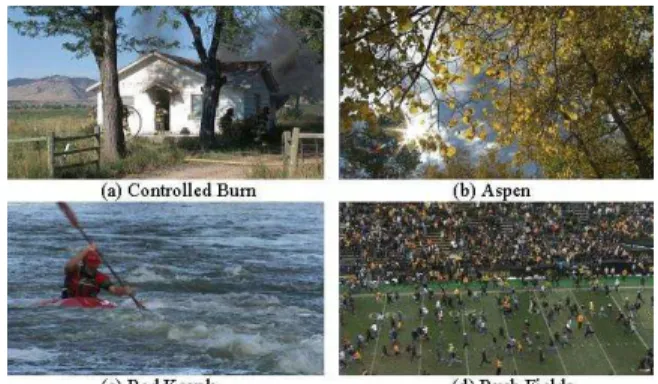
Fig. 2. Videos used for simulation.
7.5 15 30 48 40 32 24 161 2 3 4 5 fps QP MOS
Fig. 3. QoE estimation for SVC videos using PSQA tool.
The videos used to train the neural network are shown in Figure 2. JSVM (Joint Scalable Video Model) [14] encoder was used with interlayer prediction and IDR period as 32. CGS layers had same resolution 1280x720 with QP values from 16 to 48. Temporal layers had frame per second values of 7.5, 15, 30. A total of 40 videos were generated having different QP and fps values. A total of 15 users were used for video evaluations and neural network training. The QoE function obtained using PSQA methodology is shown in Figure 3 and RMSE (Root Mean Square Error) of 0.36 was obtained for real MOS scores vs the estimated PSQA scores, on the MOS scale of 1-5. Regarding only 15 users and subjective test conditions, we followed ITU R BT 500-11 [15] and ITU R P.910 [16]. P.910 recommends minimum 15 users and [17] explains that this number is reasonable and even 10 users can be enough if experiments are well designed.
B. QoE-driven resource management
Lets consider the case where each SVC layer can be transmitted using a different rate modulation thus effectively resulting in multiple multicast sessions for different clusters of users. As discussed in section II-A the trade-offs are described in the following lines. A layer transmitted with the lowest modulation requires highest channel occupancy for a given bitrate, but can be successfully decoded by a user far away from the Access Point (AP). Whereas, higher modulations with decreasing channel occupancy times may not be decodable by all users. Moreover, the SVC base layer has lowest bitrate requiring least resources and adding more enhancement layers plus base layer provide better quality at the price of higher overall bitrate.
Let us denote a SVC layer by l (1 ≤ l ≤ L), with total L layers, and let there be a set of K modulations mk with
(1 ≤ k ≤ K). The AP can transmit multiple multicast sessions and the users withmk ≥ mlcan correctly receive a SVC layer
l transmitted using the rate modulation ml.
The problem is to find the optimal modulation set {m1, m2, ..., ml, ..., mL} corresponding to L SVC layers that
will maximise Q, sum of QoE scores for all users, for a set of users {n1, n2, ...nk, ..., nK} such that nk corresponds to
the number of users that can support a maximum modulation of mk. Note that some SVC layers can be transmitted using
same modulation and also all layers need not be transmitted (ml = 0). Also consider the values {q
1, q2, ..., ql, ..., qL} as
the quality scores, corresponding to different layers, that are calculated by AP in real time by QoE estimation module described in next section. The value q1 is the QoE score for
the base layer, q2 is the delta of QoE score obtained with the
addition of layer 2 and so on.
C. Binary Integer Linear Programming
We solve the above problem using binary integer linear programming (BIP). Let us define an allocation matrix
Λ = λ1,1 · · · .. . . .. λk,l . .. ... · · · λK,L
such that λk,l = 1, if layer l is transmitted with modulation
mk andλk,l= 0 otherwise.
The objective is to maximiseQ, sum of QoE for all users, given by: Q = K X k=1 L X l=1 qlnk k X h=1 λl,h (1)
Also, there are some constraints to consider. The most im-portant constraint, in order to leave some resources for other traffic, is that we consider a channel occupancy limit ρ, equivalent to amount of total channel resources available for video multicast, such that the channel occupancy for all SVC transmissions should be less than the limitρ with (0 ≤ ρ ≤ 1). Also, a layerl can only be transmitted using a modulation mk
if and only if layer l − 1 is transmitted using mh withh ≤ k.
This ensures that the layerl can be successfully decoded as it depends on layerl − 1. Finally we consider that a layer should not take more than a single multicast session as transmitting a layer already with a given modulation is accessible to all users supporting that modulation and transmitting it with a higher modulation also will waste resources.
Thus, the optimisation problem, to findΛ, can be stated as follows: Objective Maximize K X k=1 L X l=1 qlnk k X h=1 λl,h (2) Constraints K X k=1 L X l=1 rltkλk,l≤ ρ 0 ≤ ρ ≤ 1 (3) λk,l− k X h=1 λh,l−1≤ 0 ∀k ∈ K, 2 ≤ l ≤ L (4) K X k=1 λk,l≤ 1 ∀l ∈ L (5)
where ρ is the channel occupancy limit , rl is the rate of
layer l in packets per second and tk is the time taken to
transmit a packet with modulation mk. The constraints are
as described before: the constraint (3) describes the channel occupancy limit, the constraint (4) ensures that a layer l is sent only if layer l − 1 is at least sent once using an equal or lower modulation and the constraint (5) ensures that any given layer is sent only once. Also, in order to guarantee at least a basic minimum quality to all users, one may encode the first layer with the minimum required MOS score, lets say 3.0 or bunch the lower layers totaling up to this score. Then in order to force that all the users receive at least minimum QoE another constraint can be added: λ1,1 ≥ 1 if there are
non zero users supporting onlym1 modulation else constraint
can be put onλ2,1 and so on to force one of them to1.
Note that the complexity of the BIP is reduced to a size L × K, independent of number of users. The above BIP is solved using GLPK (GNU Linear Programming Kit). The time required to solve it is small (≈10ms) for 8 SVC layers and 8 modulation rates on a 2 GHz processor with 1 GB RAM.
D. QoE estimation and optimisation
The AP implements a media aware network element (MANE) functionality as well as the function to estimate the maximum modulation rate supported by different users based on their SNR values. First the MANE estimates the MOS scores, ql ∀l ∈ L , for different SVC layers in real time
using the PSQA tool trained for SVC. The layers not sent are dropped. The AP also stores the number of users that can support a given modulation based on the SNR values to determine the values nk ∀k ∈ K. We do not target highly
mobile scenario and thus assume that the channel conditions of different users do not change fast. Thus, the AP can refresh the SNR statistics after a time period T which is of the order of some seconds. Such that the AP runs the binary integer program every T seconds to determine the optimal allocation matrix to transmit SVC video using multiple multicast sessions. We assume T to be a variable that can be changed according to the desire of the operator in order to adapt to changing user conditions. The parameter tk used in
(3) is provided by Xiao et al. [18] for 802.11a: tk= 2τ + tdif s+ tsif s+ cwmin
tslot
2 + tp+ tphy+
8(Ld+ Lh)
(106∗ m k)
where different parameters are as follows: slot time tslot =
9µs, SIFS and DIFS time tdif s = 34µs, tsif s = 16µs,
minimum back-off window size cwmin = 15 , propagation
delay τ = 1µs, transmission time of physical preamble tp = 16µs , transmission time of PHY header tphy = 4µs,
average payload size Ld = 1024 bytes and overhead size
100 200 300 400 0 10 20 30 40 50 60 70 80 90 100 Sum QoE No. of users adapt mod and layer
adapt layer base layer
Fig. 4. Sum QoE comparison.
V. RESULTS
In this section, we present some numerical results. We assume 802.11a and thus the available bitrates with different modulation are: 6, 9, 12, 18, 24, 36, 48, 54 Mbits/s. Multiple simulation runs are done to obtain the results. The distance of users from the AP is randomly picked to beDmaxd√u meters
where u is a uniformly distributed random variable between 0 and 1.0, Dmax is the maximum distance of a user from
the AP, d (with 0 ≤ d ≤ 1) is the distance factor used to simulate the cases of users nearer or further from the AP such that a lower value of d means higher number of users are near to AP and higher value of d means users are uniformly distributed. Parameter d is a simulation parameter. It is used to generate cases varying from “small d: many users near to AP, hence good reception conditions” to “d = 1: all users spread uniformly with some users near the coverage edge”. We simulate uniformly distributed users over a circle of radius Dmax∗ d meters. The default value of Dmax= 37m and an
indoor scenario is considered in our simulations.
We generated cases corresponding to varied videos and different videos, for simulation and obtaining results, from a rate model provided by Ma et al. [19]:
r = rmax(q/qmin)−α(f ps/f psmax)β (6)
where q is 2((QP −4)/6), qmin corresponds to the value of q
corresponding to the highest enhancement layer of SVC,rmax
corresponds to all the SVC layers for a given video and thus corresponds to qmin,α is the rate decay factor that simulates
the bitrates of lower layers andβ impacts the bitrate depending on motion intensity in the video. In order to consider videos with different encoding complexities, we varied the values of rmax: 44 Mbps and 32 Mbps and the rate decay factor α
that is randomly assigned a value between 0.9 and 1.3 for a given simulation run. These values and ranges are obtained empirically after encoding the videos used in subjective testing. We compare the proposed optimisation approach with 2 other approaches. First one transmits only the base layer of SVC with the lowest modulation (6 Mbits/s). In second scheme that we call “adaptive layer only” MANE uses the lowest modulation and adaptively selects some SVC layers such that the resulting bitrate satisfies the constraint in (3). Figure 4 shows the comparison and it can be seen that both the optimal and the second approach are significantly better than the first approach of transmitting only the base layer.
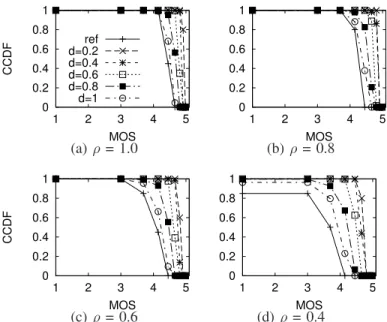
In order to compare the optimisation approach with the “adaptive layer only” approach, we plot CCDF (complemen-tary cumulative distribution function) of the MOS scores obtained by different users in Figure 5 when the total num-ber of users are 40. The approach “adaptive layer only” is
0 0.2 0.4 0.6 0.8 1 1 2 3 4 5 CCDF MOS ref d=0.2 d=0.4 d=0.6 d=0.8 d=1 (a)ρ = 1.0 0 0.2 0.4 0.6 0.8 1 1 2 3 4 5 MOS (b) ρ = 0.8 0 0.2 0.4 0.6 0.8 1 1 2 3 4 5 CCDF MOS (c)ρ = 0.6 0 0.2 0.4 0.6 0.8 1 1 2 3 4 5 MOS (d) ρ = 0.4
Fig. 5. CCDF of MOS scores with different values of ρ (available channel resources), and d (distance factor).
denoted as “ref” and all other data points correspond to the optimisation approach with varying available channel resources ρ and distance factor d. It can be seen that the optimisation approach always provides better QoE to the users for example forρ = 0.6 almost 95% users get a MOS score ≥ 4.0, whereas only 45% users are able to get MOS ≥ 4.0 with “adaptive layer only” when d = 0.8. This is because “adaptive layer only” approach doesn’t adapt the modulation with respect to the channel conditions whereas optimisation approach adapts the number of SVC layers as well as modulation of different multicast sessions. It can be seen that in all the cases op-timisation approach is better, however when lot of channel resources are available such that withρ = 1.0 and when many users can only support the lowest modulation as they are far away, d = 1.0, then our approach provides only a slight gain. Moreover note that the data corresponding to “ref” does not change withd as in that scheme the modulation is not adapted to the channel condition of the users.
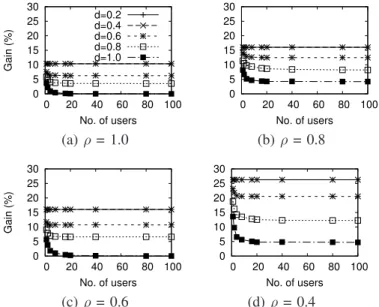
Figure 6 compares the two approaches and shows the value of gain for the optimisation approach. Whereas, the gain(%) is defined as100 ·Qopt
Qref − 100, where Qoptrefers to sum QoE
over all users for our approach and “ref” corresponds to the approach “adaptive layer only”. It can be seen in the Figure that optimisation approach provides better gain with compared to the “ref” for different cases ofρ and d. It can be seen that gain increases with decreasing values of distance factord and channel resourcesρ and vice versa. This is because when users are far away that higher SVC enhancement layers cannot be transmitted as the modulation is low. Moreover, when high channel resources are available then almost all the SVC layers can be transmitted using the lowest modulation rate. The number of layers that can be transmitted using low modulation depends on the bitrate values and quality enhancements of different SVC layers. Thus we varyrmaxand rate decayα and
the results are shown in Figure 7. It can be seen that when rate decay factor is high orrmaxis low then gain decreases. This is
because lower bitrate values of different SVC layers permit the scheme “adapt layer only” to transmit many SVC layers using
0 5 10 15 20 25 30 0 20 40 60 80 100 Gain (%) No. of users d=0.2 d=0.4 d=0.6 d=0.8 d=1.0 (a)ρ = 1.0 0 5 10 15 20 25 30 0 20 40 60 80 100 No. of users (b) ρ = 0.8 0 5 10 15 20 25 30 0 20 40 60 80 100 Gain (%) No. of users (c)ρ = 0.6 0 5 10 15 20 25 30 0 20 40 60 80 100 No. of users (d) ρ = 0.4
Fig. 6. Gain with different values of ρ (available channel resources), and d (distance factor). 0 10 20 30 40 50 60 0.9 1.1 1.3 Gain (%) Rate decay (α) d=0.2 d=0.4 d=0.6 d=0.8 d=1.0 (a) 32Mbps 0 10 20 30 40 50 60 0.9 1.1 1.3 Rate decay (α) (b) 44Mbps
Fig. 7. Gain with different values of Max SVC rate and Rate decay. The value of ρ = 0.6.
lowest modulation itself. However, the rate characteristics of the videos and modulation of the users change over time and hence our proposed scheme that is better in all cases with varying gain can optimise global QoE by adapting SVC layers as well as modulation of multicast sessions. Moreover as the time taken to solve the linear optimisation problem is of the order of 10ms, the algorithm can be run as soon as video bitrate characteristics or when the user modulation change.
VI. CONCLUSIONS ANDFUTUREWORKS
We have proposed a mechanism that optimises QoE for transmission of SVC in wireless multicast environment. The results demonstrate performance improvements upto 55% in terms of quantified overall QoE as compared to the default basic-rate and the adaptive-layer approach. Moreover, the QoE optimising mechanism, which is based on binary linear programming, also includes the possibility of adapting the QoE objective according to the available resources.
For future work, we will continue working on QoE-driven resource management approach, more particularly, with more detailed simulations, more comparisons and a detailed loss model. For example, the trade-off of transmitting streams to a downstream network offering lower bandwidth or suffering from congestion or increased packet losses; this happens often in wireless access networks. One possible solution can use a Media Aware Network Element (MANE) to adjust the number of layers sent to an end user. Based on the QoE feedback, the
MANE can take an action to drop some SVC layers. This will release more bandwidth for other traffic in the network. Furthermore, sometimes it is better not to decode the top-most SVC layer with high losses since QoE may be worst as compared to only decoding inferior layers.
REFERENCES
[1] ITU-International Telecommunication Union, “Definition of Quality of Experience (QoE),” January 2007.
[2] H. Schwarz, D. Marpe, and T. Wiegand, “Overview of the Scalable Video Coding Extension of the H.264/AVC Standard,” IEEE Trans.
Circuits Syst. Video Technol., vol. 17, no. 9, pp. 1103 –1120, sept.
2007.
[3] M. Heusse, F. Rousseau, G. Berger-Sabbatel, and A. Duda, “Perfor-mance anomaly of 802.11b,” in IEEE INFOCOM, march-april 2003, vol. 2, pp. 836–843.
[4] Seon-Oh Lee and Dong-Gyu Sim, “Hybrid bitstream-based video qual-ity assessment method for scalable video coding,” Optical Engineering, vol. 51, no. 6, pp. 067403–1, 2012.
[5] A.A. Khalek, C. Caramanis, and R.W. Heath, “A Cross-Layer Design for Perceptual Optimization Of H.264/SVC with Unequal Error Protec-tion,” IEEE J. Sel. Areas Commun., vol. 30, no. 7, pp. 1157 –1171, august 2012.
[6] Guangtao Zhai, Jianfei Cai, Weisi Lin, Xiaokang Yang, and Wenjun Zhang, “Three dimensional scalable video adaptation via user-end perceptual quality assessment,” IEEE Trans. Broadcast., vol. 54, no. 3, pp. 719 –727, sept. 2008.
[7] Xiaoqing Zhu, T. Schierl, T. Wiegand, and B. Girod, “Distributed media-aware rate allocation for video multicast over wireless networks,”
IEEE Trans. Circuits Syst. Video Technol., vol. 21, no. 9, pp. 1181 –
1192, sept. 2011.
[8] K. Piamrat, K. D. Singh, A. Ksentini, C. Viho, and J.-M. Bonnin, “QoE-Aware Scheduling for Video-Streaming in High Speed Downlink Packet Access,” in IEEE WCNC, april 2010, pp. 1–6.
[9] K. Piamrat, A. Ksentini, J.-M. Bonnin, and C. Viho, “Q-DRAM: QoE-Based Dynamic Rate Adaptation Mechanism for Multicast in Wireless Networks,” in IEEE GLOBECOM, nov.-dec. 2009, pp. 1–6.
[10] Samir Mohamed and Gerardo Rubino, “A study of real-time packet video quality using random neural networks,” IEEE Transactions on
Circuits and Systems for Video Technology, vol. 12, no. 12, pp. 1071–
1083, 2002.
[11] Erol Gelenbe, “Random neural networks with negative and positive signals and product form solution,” Neural computation, vol. 1, no. 4, pp. 502–510, 1989.
[12] Kamal Deep Singh, Yassine Hadjadj-Aoul, and Gerardo Rubino, “Qual-ity of experience estimation for adaptive HTTP/TCP video streaming using H.264/AVC,” in Consumer Communications and Networking
Conference (CCNC), 2012 IEEE. IEEE, 2012, pp. 127–131.
[13] Kamal Deep Singh, Adlen Ksentini, and Baptiste Marienval, “Quality of experience measurement tool for SVC video coding,” in 2011 IEEE
International Conference on Communications (ICC). IEEE, 2011, pp.
1–5.
[14] Joint Video Team, “SVC reference software(JSVM software),” 2011. [15] ITU-International Telecommunication Union, “ITU-R Recommendation
BT.500-11: Methodology for the subjective assessment of the quality of television pictures,” 2002.
[16] ITU-International Telecommunication Union, “ITU Recommendation ITU-T P.910, Subjective video quality assessment methods for multi-media applications,” 1996.
[17] Stefan Winkler, “On the properties of subjective ratings in video quality experiments,” in Quality of Multimedia Experience, 2009. QoMEx 2009.
International Workshop on. IEEE, 2009, pp. 139–144.
[18] Yang Xiao and Jon Rosdahl, “Throughput and delay limits of IEEE 802.11,” Communications Letters, IEEE, vol. 6, no. 8, pp. 355–357, 2002.
[19] Zhan Ma, Meng Xu, Yen-Fu Ou, and Yao Wang, “Modeling of rate and perceptual quality of compressed video as functions of frame rate and quantization stepsize and its applications,” IEEE TCSVT, vol. 22, no. 5, pp. 671 –682, may 2012.
![Fig. 1. SVC scalabilities [4].](https://thumb-eu.123doks.com/thumbv2/123doknet/12406330.332487/3.918.503.816.80.279/fig-svc-scalabilities.webp)