
T
T
H
H
È
È
S
S
E
E
En vue de l'obtention du
D
D
O
O
C
C
T
T
O
O
R
R
A
A
T
T
D
D
E
E
L
L
’
’
U
U
N
N
I
I
V
V
E
E
R
R
S
S
I
I
T
T
É
É
D
D
E
E
T
T
O
O
U
U
L
L
O
O
U
U
S
S
E
E
Délivré par l’Université Toulouse III Paul SabatierDiscipline ou spécialité : Informatique
Présentée et soutenue par Valentin BUTOIANU
Le 04 Avril 2013
Titre :
Share and Reuse of Context Metadata Resulting from Interactions
between Users and Heterogeneous Web-based Learning Environments
JURY
M. Thierry NODENOT, Professeur à l’Université de Pau, Président M. Serge GARLATTI, Professeur à TELECOM Bretagne, Brest, Rapporteur M. Alain MILLE, Professeur à l’Université Claude Bernard Lyon I, Rapporteur
M. Christophe REFFAY, MCF à l’ENS de Cachan, Examinateur
M. Julien BROISIN, MCF à l’Université Toulouse III Paul Sabatier, Encadrant
Ecole doctorale : Mathématiques, Informatique, Télécommunications de Toulouse (MITT) Unité de recherche : Institut de Recherche en Informatique de Toulouse CNRS - UMR - 5505
First of all I would like to express my gratitude to Mr. Julien Broisin, Associate Professor at Paul Sabatier University of Toulouse. His constant patience, encouragements, support and invaluable suggestions made this thesis work successful. His ability to answer questions in a very precise way has always been of great help. I have been very lucky to have a supervisor who cared so much about my work.
My sincere thanks go to Mr. Philippe Vidal, Professor at the Paul Sabatier University of Toulouse, for giving me the opportunity to make this thesis, for his confidence, his everyday kindness and his skill to promptly respond to all my requirements of various natures during all these years.
I would also like to thank the Human Computer Interaction Education (HCI) group of the Computer Science Department of Catholic University of Leuven, Belgium. The two months spent there, played an important role in my work. I want to thank Mr. Erik Duval, the head of the group, for his good advice, Mrs. Katrien Verbert for the fruitful collaboration we had, and Mr. Gonzalo Parra, for his help as a colleague and a friend.
Completing this work would have been all more difficult without the support and friend-ship provided by the other members of the SIERA research team, led by Mr. Abdelmalek Benzekri. I am indebted to them for their help, everyday sympathy and good humor. I must express my gratitude to M˘ad˘alina Mitran, my girlfriend, for her continuous support and encouragements. She was always near me, she understood me with patience, and gave me her good advice.
I would like to thank my best friend Dr. Petar Lukanov with whom I spent the best crazy moments of my life in Toulouse and I am sure we will remain friends forever.
I also thank my friends Dana Codreanu, Adrian Chifu, Andra Codreanu, R ´emi Venant, Cristina Stoican, Ana-Maria Mˆanzat and Anca Alim˘anescu for providing the comprehension, sup-port and friendship that I needed during the good as well as difficult moments. I have also to thank my roommates Tetiana Krachko and Mykhailo Ianchuk, for their everyday gentle-ness. The very good moments we spent together, I will always remember.
I want to thank also to Mrs. Nadia Yasinne-Diab, English teacher at Paul Sabatier University of Toulouse, for her kindness to accept to read this document in order to improve its quality
Finally, but most importantly, I would like to thank my family: my parents, Ion and Maria Butoianu and my sister, Elena Croitoru for their constant support. Without their everyday encouragements it would have been much harder for me to finish this work.
An interest for the observation, instrumentation, and evaluation of online educational sys-tems has become more and more important within the Technology Enhanced Learning community in the last few years. Conception and development of Adaptive Web-based Learning Environments (AdWLE) in order to facilitate the process of re-engineering, to help understand users’ behavior, or to support the creation of Intelligent Tutoring Systems rep-resent a major concern today. These systems handle their adaptation process on the ba-sis of detailed information reflecting the context in which students evolve while learning: consulted resources, mouse clicks, chat messages, forum discussions, visited URLs, quizzes selections, and so on.
The works presented in this document are intended to overcome some issues of the actual systems by providing a privacy-enabled framework dedicated to the collect, share and reuse of context represented at two abstraction levels: raw context (resulting from direct interac-tions between users and applicainterac-tions) and inferred context (calculated on the basis of raw context). The framework is based on an open standard dedicated to system, network and application management, where the context specific to heterogeneous tools is represented as a unified and extensible structure and stored into a central repository. To facilitate ac-cess to this context repository, we introduced a middleware layer composed of a set of tools. Some of them allow users and applications to define, collect, share and search for the con-text data they are interested in, while others are dedicated to the design, calculation and delivery of inferred context.
To validate our approach, an implementation of the suggested framework manages context data provided by three systems: two Moodle servers (one running at the Paul Sabatier Uni-versity of Toulouse, and the other one hosting the CONTINT project funded by the French National Research Agency) and a local instantiation of the Ariadne Finder. Based on the col-lected context, relevant indicators have been calculated for each one of these environments. Furthermore, two applications which reuse the encapsulated context have been developed on top of the framework: a personalized system for recommending learning objects to stu-dents, and a visualization application which uses multi-touch technologies to facilitate the navigation among collected context entities.
L’int´erˆet pour l’observation, l’instrumentation et l’´evaluation des syst`emes ´educatifs en ligne est devenu de plus en plus important ces derni`eres ann´ees au sein de la communaut´e des Environnements Informatique pour l’Apprentissage Humain (EIAH). La conception et le d´eveloppement d’environnements d’apprentissage en ligne adaptatifs (AdWLE - Adaptive Web-based Learning Environments) repr´esentent une pr´eoccupation majeure aujourd’hui, et visent divers objectifs tels que l’aide au processus de r´eing´enierie, la compr´ehension du comportement des utilisateurs, ou le soutient `a la cr´eation de syst`emes tutoriels intelli-gents. Ces syst`emes g`erent leur processus d’adaptation sur la base d’informations d ´etaill´ees refl´etant le contexte dans lequel les ´etudiants ´evoluent pendant l’apprentissage : les ressour-ces consult´ees, les clics de souris, les messages post´es dans les logiciels de messagerie in-stantan´ee ou les forums de discussion, les r´eponses aux questionnaires, etc.
Les travaux pr´esent´es dans ce document sont destin´es `a surmonter certaines lacunes des syst`emes actuels en fournissant un cadre d´edi´e `a la collecte, au partage et `a la r´eutilisation du contexte repr´esent´e selon deux niveaux d’abstraction : le contexte brut (r´esultant des interactions directes entre utilisateurs et applications) et le contexte inf ´er´e (calcul´e `a partir des donn´ees du contexte brut). Ce cadre de travail qui respecte la vie priv ´ee des usagers est fond´e sur un standard ouvert d´edi´e `a la gestion des syst`emes, r´eseaux et applications. Le contexte sp´ecifique aux outils h´et´erog`enes constituant les EIAHs est repr´esent´e par une structure unifi´ee et extensible, et stock´e dans un r´ef´erentiel central. Pour faciliter l’acc`es `a ce r´ef´erentiel, nous avons introduit une couche interm´ediaire compos´ee d’un ensemble d’outils. Certains d’entre eux permettent aux utilisateurs et applications de d ´efinir, col-lecter, partager et rechercher les donn´ees de contexte qui les int´eressent, tandis que d’autres sont d´edi´es `a la conception, au calcul et `a la d´elivrance des donn´ees de contexte inf´er´ees. Pour valider notre approche, une mise en œuvre du cadre de travail propos´e int`egre des donn´ees contextuelles issues de trois syst`emes diff´erents : deux plates-formes d’apprentis-sage Moodle (celle de l’Universit´e Paul Sabatier de Toulouse, et une autre d´eploy´ee dans le cadre du projet CONTINT financ´e par l’Agence Nationale de la Recherche) et une instan-ciation locale du moteur de recherche de la fondation Ariadne. A partir des contextes col-lect´es, des indicateurs pertinents ont ´et´e calcul´es pour chacun de ces environnements. En outre, deux applications qui exploitent cet ensemble de donn´ees ont ´et´e d´evelopp´ees : un
de visualisation fond´ee sur les technologies tactiles pour faciliter la navigation au sein de ces donn´ees de contexte.
Mots-cl´es : Environnements Informatiques pour l’Apprentissage Humain (EIAH), adapta-tion, contexte, donn´ees d’observaadapta-tion, partage et r´eutilisation
Contents
Contents ix
List of Figures xvii
List of Tables xxi
INTRODUCTION 1
Chapter 1 - General Introduction 3
1.1 Scientific Context . . . 3
1.2 Research Context . . . 4
1.3 Research Issue . . . 5
1.4 The Structure of the Manuscript . . . 7
1.4.1 Part I: State of the Art . . . 7
1.4.2 Part II: Share and Reuse of Context Metadata Resulting from Interactions between Users and Heterogeneous Web-based Learning Environments . . . 8
1.4.3 Part III: Implementation . . . 9
PART I - State of the Art 11 Chapter 2 - Web-based Learning Environments 13 2.1 Introduction . . . 13
2.2 Components . . . 14
2.2.1 Learning Objects . . . 14
2.2.1.1 Definition . . . 15
2.2.1.3 Metadata . . . 16
2.2.1.3.1 Dublin Core . . . 16
2.2.1.3.2 Learning Object Metadata . . . 17
2.2.2 Knowledge Pools . . . 17
2.2.3 Pedagogical Scenarios . . . 18
2.2.3.1 IMS-LD . . . 19
2.2.3.2 SCORM . . . 19
2.2.4 Learning Management Systems . . . 20
2.3 Adaptive Web-based Learning Environments . . . 20
2.3.1 Categories of Adaptation in Learning Environments . . . 21
2.3.2 Traditional WLEs vs Adaptive WLEs . . . 21
2.3.3 Components of an Adaptive Web-based Learning Environment . . . 22
2.3.3.1 Learner Model . . . 22
2.3.3.2 Content Model . . . 25
2.3.3.3 Tutoring Model . . . 26
2.3.4 Some Classes of Adaptive Web-based Learning Systems . . . 26
2.3.4.1 AdWLEs Based on Inferred Data . . . 26
2.3.4.1.1 Mirroring Tools . . . 27
2.3.4.1.2 Monitoring Tools . . . 28
2.3.4.1.3 Guiding Tools . . . 29
2.3.4.2 Intelligent Tutoring Systems . . . 30
2.3.4.2.1 Curriculum Sequencing . . . 31
2.3.4.2.2 Problem Solving Support . . . 31
2.3.4.3 Personalized Recommendation Systems . . . 32
2.4 Conclusions . . . 33
Chapter 3 - Context-aware Systems 35 3.1 Context . . . 36
3.1.1 Definition . . . 36
3.1.3 Our Vision about Context . . . 38
3.2 Design Principles of Context-aware Frameworks . . . 40
3.2.1 Design Principles of Context Models . . . 40
3.2.1.1 Raw Model . . . 40
3.2.1.2 Inferred Model . . . 41
3.2.2 Design Principles of Context-aware Architectures . . . 42
3.2.2.1 Context-aware Architectures . . . 42
3.2.2.2 Six-layered Architecture . . . 43
3.2.3 Design Principles of Privacy . . . 44
3.3 Approaches Dealing with Context . . . 46
3.3.1 TaskTracer . . . 46 3.3.2 CAM Framework . . . 47 3.3.3 WildCAT . . . 49 3.3.4 KnowledgeTree . . . 50 3.3.5 Dyonipos . . . 51 3.3.6 Aposdle . . . 52
3.3.7 Usage Tracking Language . . . 53
3.3.8 TBS-IM . . . 55 3.3.9 Learning Registry . . . 56 3.3.10 NSDL Paradata . . . 58 3.3.11 Comparative Tables . . . 59 3.3.11.1 Models . . . 59 3.3.11.1.1 Raw Model . . . 59 3.3.11.1.2 Inferred Model . . . 61 3.3.11.2 Architectures . . . 63 3.4 Conclusions . . . 65 PART II - Share and Reuse of Context Metadata Resulting from Interactions between Users and
Chapter 4 - Modeling the Web - based Learning Environments 69
4.1 The Common Information Model . . . 70
4.1.1 The Main Concepts of CIM . . . 70
4.1.2 The Levels of Abstraction . . . 70
4.1.3 CIM Qualifiers . . . 72
4.1.4 The Motivations of our Choice . . . 72
4.2 Representing Context of an AdWLE . . . 73
4.2.1 The User Context . . . 73
4.2.2 The Environment Context . . . 76
4.2.2.1 TEL Application Systems . . . 76
4.2.2.2 The Learning Resources . . . 77
4.2.2.3 Associations and Compositions . . . 77
4.2.3 The Usage Context . . . 78
4.2.3.1 Resources Activity Model . . . 78
4.2.3.2 Systems Activity Model . . . 79
4.2.3.3 Input Devices . . . 80
4.3 The Indicator Model . . . 82
4.3.1 The CIM Metrics Model . . . 82
4.3.2 The Indicator Model . . . 83
4.3.2.1 The Elementary Indicators . . . 85
4.3.2.2 The Composite Indicators . . . 85
4.3.2.2.1 The Arithmetic Indicators . . . 85
4.3.2.2.2 The Complex Indicators . . . 86
4.4 Conclusions . . . 86
Chapter 5 - The Global Architecture 87 5.1 The WBEM Management Architecture . . . 87
5.2 The Global Architecture . . . 89
5.2.1 The Context Layer . . . 89
5.2.1.2 Components Required to Manage Indicators . . . 91
5.2.2 The Middleware Layer . . . 92
5.2.2.1 The Session Management Service . . . 93
5.2.2.2 The Search Service . . . 95
5.2.2.3 The Insert Service . . . 98
5.2.2.4 The Model Management Service . . . 100
5.2.2.5 The Indicator Service . . . 102
5.2.3 The AdWLE Layer . . . 106
5.2.4 The User Layer . . . 107
5.3 Conclusions . . . 110
PART III - Implementation 113 Chapter 6 - Adopted Technologies and Formats 115 6.1 The Context Layer . . . 116
6.1.1 Selection of a Context Repository . . . 116
6.1.1.1 OpenPegasus - A Management Application . . . 116
6.1.1.2 eXist - An Open-source Native XML Database . . . 117
6.1.1.3 Oracle Object-relational Database . . . 117
6.1.1.4 Execution Time Performance Evaluation . . . 118
6.1.2 The Indicator Mechanism . . . 122
6.2 The Middleware Layer . . . 122
6.2.1 The Session Management Service . . . 122
6.2.2 The Search Service . . . 123
6.2.3 The Insert Service . . . 124
6.2.4 The Model Management Service . . . 125
6.2.5 The Indicator Service . . . 126
6.3 The AdWLE Layer . . . 126
6.4 The User Layer . . . 127
6.4.1 Storing Sensitive Data into a Local WBEM System . . . 127
6.4.2 Storing Sensitive Data into Cookies . . . 128
Chapter 7 - Sources of Context Data 131
7.1 Moodle from IUT A Paul Sabatier . . . 131
7.1.1 The Moodle Environment Model . . . 132
7.1.2 The Usage Model . . . 133
7.1.3 Indicators Calculation . . . 135
7.2 The CONTINT Project . . . 138
7.2.1 The Environment Model . . . 139
7.2.2 The Usage Model . . . 139
7.2.3 Collected Data . . . 140
7.2.4 Indicators Calculation . . . 142
7.3 ARIADNE Finder . . . 143
7.3.1 The Environment Model . . . 144
7.3.2 The Usage Model . . . 145
7.3.3 Collected Data and Calculated Indicators . . . 145
7.4 Conclusions . . . 146
Chapter 8 - Applications Built upon our Framework 149 8.1 A Personalized Recommendation Framework based on Context and Document Annotation149 8.1.1 Extending the Environment Context . . . 150
8.1.2 The Recommendation Algorithm . . . 151
8.1.3 Use case: Recommending Learning Objects . . . 152
8.2 Multi-touch Tracking Visualization System - MultiTravle . . . 154
8.2.1 The Visualization Model . . . 154
8.2.1.1 The Plan of Systems . . . 155
8.2.1.2 The Plan of Resources . . . 155
8.2.1.3 The Plan of Users . . . 156
8.2.2 Architecture . . . 157
8.2.3 Implementation . . . 157
8.3 Conclusions . . . 158
Chapter 9 - Conclusions and Future Works 161 9.1 A Unifying Model to Federate Heterogeneous Context Metadata . . . 161 9.2 A Distributed Architecture that Promotes the Share and Reuse of Context . . . 163 9.3 Ensuring Users’ Privacy . . . 164
APPENDICES 167
Appendix A - A MOF File 169
Appendix B - XML Schema Indexation 171
Appendix C - The Result Format 191
Appendix D - A Quiz from the CONTINT Project 193
Appendix E - French Summary 195
List of Figures
2.1 A traditional WLE. . . 14
2.2 Connecting repositories through federated search and harvesting [TVP+09]. . . . 18
2.3 Traditional vs adaptive web-based learning environments (inspired by [ST03]). . . 22
2.4 Generic student model, inspired by [MPG03]. . . 24
2.5 Example of knowledge structure [CGME02]. . . 25
2.6 Indicators design, calculation and use [Djo11]. . . 27
2.7 Examples of advising messages generated for a student by DEGREE [BF00]. . . 29
2.8 The main components of Intelligent Tutoring Systems [BHM06]. . . 30
2.9 The architecture of personalized recommendation systems, inspired by [BHM06]. . . 32
3.10 Five fundamental categories of context information [ZLO07]. . . 37
3.11 Our vision about context. . . 39
3.12 Conceptual view of context-aware modeling, inspired by [Hec05]. . . 40
3.13 The six-layered architecture [HI06]. . . 43
3.14 TaskTracer publisher-subscriber architecture [DDJ+05]. . . . 47
3.15 CAM schema [WNVD07]. . . 48
3.16 CAM architecture [WNVD07]. . . 48
3.17 WildCAT context model [DL05]. . . 49
3.18 KnowledgeTree distributed architecture [BSL+08]. . . . 50
3.19 User interaction context ontology [RDL09]. . . 51
3.20 Architecture of Dyonipos [RKL+08]. . . . 52
3.21 APOSDLE context [LFBG07]. . . 52
3.23 Conceptual model of a track in UTL [CI07]. . . 54
3.24 Architecture of the analysis tool in UTL [NICK09]. . . 54
3.25 The content of the primary trace in TBS-IM [DSP+10]. . . . 55
3.26 Architecture of SBT-IM [DSP+10]. . . . 56
3.27 Simplified Learning Registry paradata schema [NSW12]. . . 57
3.28 Architecture of Learning Registry [JR11]. . . 57
3.29 Simplified NSDL paradata schema [NSW12]. . . 58
3.30 NSDL architecture [Wea12]. . . 59
4.31 Basic elements of the CIM modeling approach. . . 71
4.32 CIM core and common models. . . 71
4.33 The context model. . . 74
4.34 The user context. . . 75
4.35 The environment context. . . 76
4.36 Resource activity model. . . 79
4.37 System activity model. . . 80
4.38 Input device model. . . 81
4.39 CIM Metrics model main classes. . . 84
4.40 Indicator model. . . 84
5.41 The management gap [Hob04]. . . 88
5.42 WBEM server components [Hob04]. . . 88
5.43 The global architecture. . . 90
5.44 Details of the context layer. . . 90
5.45 The Tracking Repository. . . 91
5.46 Details of the middleware layer. . . 93
5.47 Authentication and query process. . . 97
5.48 Inserting a context metadata record. . . 99
5.49 Details of the AdWLE layer. . . 107
5.50 Details of the user layer. . . 108
6.52 Mapping TEL Resource.mof to SQL. . . 118
6.53 Response time comparative charts. . . 119
6.54 Execution time for a one join query. . . 120
6.55 Two join response time charts. . . 121
6.56 The Oracle tables matching with our context models. . . 121
6.57 An example of SQL request. . . 123
6.58 Extending the TEL Resource class using the xmlCIM format. . . 126
6.59 Javascript function using WMI API to enumerate users’ names. . . 128
7.60 The environment context specific to Moodle. . . 133
7.61 The usage model specific to Moodle. . . 134
7.62 Proportion of actions indicator definition. . . 136
7.63 Definition and calculation of the PAI. . . 137
7.64 Listing the values of the indicator. . . 137
7.65 A question of one of the CONTINT project quizzes. . . 139
7.66 The environment model specific to a quiz. . . 140
7.67 The usage model specific to a quiz. . . 141
7.68 The SEF indicator definition. . . 144
7.69 A screenshot of the ARIADNE Finder. . . 144
7.70 The ARIADNE Finder environment model. . . 145
7.71 The usage model specific to ARIADNE Finder. . . 147
8.72 An extract of the context model: resources and users. . . 151
8.73 Synchronous recommendation through the ARIADNE Finder. . . 153
8.74 The visualization model. . . 155
8.75 Zoom on the world map. . . 156
8.76 The plan of resources. . . 156
List of Tables
3.1 Raw model comparative table. . . 60 3.2 Inferred model comparative table. . . 62 3.3 Architecture comparative table. . . 64 5.4 createAnonymousSession. . . 94 5.5 createSession. . . 94 5.6 destroySession. . . 95 5.7 The methods of the search service. . . 95 5.8 getAvailableClassFormats. . . 100 5.9 setClassFormat. . . 100 5.10 submitClass. . . 101 5.11 getAvailableDefinitionFormats. . . 102 5.12 setDefinitionFormat. . . 102 5.13 getAvailableAlgorithmLanguages. . . 103 5.14 setAlgorithmLanguage. . . 103 5.15 defineIndicator. . . 104 5.16 getIndicatorsDefinitions. . . 104 5.17 subscribeToIndicator. . . 105 5.18 unsubscribeFromIndicator. . . 106 7.19 Observed activities and collected metadata. . . 135 7.20 The experimentations of the CONTINT project. . . 142 7.21 Observed activities and collected metadata. . . 142
Chapter 1 - General Introduction
Contents
1.1 Scientific Context . . . . 3 1.2 Research Context . . . . 4 1.3 Research Issue . . . . 5 1.4 The Structure of the Manuscript . . . . 7
1.4.1 Part I: State of the Art . . . 7 1.4.2 Part II: Share and Reuse of Context Metadata Resulting from Interactions
be-tween Users and Heterogeneous Web-based Learning Environments . . . 8 1.4.3 Part III: Implementation . . . 9
1.1 Scientific Context
This manuscript presents the summary of four years of work conducted as part of a thesis. This work took place within the SIERA1research team of the IRIT2laboratory in Toulouse. IRIT is a joint research
unit (UMR3 5505) common to several institutions: University of Toulouse III Paul Sabatier4, CNRS5,
INPT6, and the Social Sciences University of Toulouse I, Capitole7. A priority of the laboratory is the
development of transversal projects open to national and international communities to promote and disseminate the technical and scientific culture, to transfer knowledge through the organization of reg-ular research/socio-economic world meetings and events dedicated to the general public and schools, and finally, to transfer the know-how and technologies through the creation of joint laboratories with industry.
1Service IntEgration and netwoRk Administration
2Institut de Recherche en Informatique de Toulouse (Toulouse Computer Science Research Institute) - http://www.irit.fr 3Unite Mixte de Recherche (Mixed Unit of Research)
4http://www.univ-tlse3.fr
5Centre National de la Recherche Scientifique (Scientific Research National Center) - http://www.cnrs.fr
6Institut National Polytechnique de Toulouse (Toulouse National Polytechnical Institute) - http://www.inpt-toulouse.fr 7http://www.ut-capitole.fr
Research topics of the SIERA team, led by Prof. Abdelmalek Benzekri, focus on the control and management of last generation infrastructure and communication services, but also of dynamically aggregated, distributed and cross-organizational, complex applications and systems. Thus, the work attempts to define and evaluate new management paradigms, and provides the community with ar-chitectures, platforms, tools and contributions to standardization. In this context, several themes are subject of specific studies and proposals: (1) a design process of management applications offering a double independence, one regarding the specific areas to manage and the other regarding the man-agement platforms, (2) evaluating the potential of SMA1to meet the requirements of cooperative and
autonomous management (or self-management), (3) the security management of information flows of a virtual organization through the refinement of policies for building and deploying cross-domain policies, and the definition of a management environment able to control the security policies and for-mally validate established security rules linked to the appropriate mechanisms and security protocols, and (4) the distribution and management of online learning environments that represent nowadays complex systems for the exploitation of learning objects on a large scale. The subject of this thesis is integrated within the last theme. This document presents the work we performed and the results we obtained.
1.2 Research Context
Its fast development, the increased popularity and ease of use of its tools, made the World-Wide Web the most important media for collecting, sharing and distributing information [Zai01]. Many orga-nizations and corporations use the web to provide various information and services such as customer support or on-line shopping. It is not surprising that the web is the architectural choice for any modern advanced distance educational systems.
The educational systems through which students acquire skills and knowledge, usually with the help of teachers or facilitators, learning support tools and technological resources, and use the web as a mean of content delivery and knowledge sharing, are called Web-based Learning Environments (WLE) [ASS+03]. Typical WLEs include course content delivery tools, synchronous and asynchronous
communication systems, quiz modules, virtual workspaces for sharing resources, white boards, grade reporting systems, assignment/submission components, etc.
The benefits of traditional web-based education have been demonstrated [Bru98]: classroom inde-pendence and platform indeinde-pendence. An application installed in one place can serve thousands of students all over the world equipped with an Internet capable device. The problem of these systems is that they are nothing more than a network of static web pages where the same content is provided independently of the target learner [Bru98]. Learners from different backgrounds are given the same
learning content at the same time, even if they may only be interested in a small part of the whole learning content.
To overcome the user independence of traditional WLEs, advanced web-based learning applica-tions able to adapt their content to every learner needs have appeared. With Adaptive Web-based Learning Environments (AdWLEs), it is possible to do better than to align learners to the same learning content; it is possible to actively engage the learner with a teaching strategy and material that appeal to his/her prior knowledge, needs, goals, motivations and learning style preferences [ST03]. As a con-sequence, students will be able to achieve learning goals more efficiently when pedagogical processes are adapted to their individual differences [Fed00].
1.3 Research Issue
Within traditional face-to-face learning sessions, teachers know their students in terms of knowledge, motivation, learning progress or learning style because they interact with them inside a classroom or during one-to-one tutoring sessions. They can further exploit this information to adapt or optimize their instructions by adding an explanatory sequence or a complementary exercise, or leaving an exer-cise for the next session. Within online and computer-based learning environments, the observation and evaluation of a learning session are often based on the analysis of data automatically collected dur-ing or after the learndur-ing session. Therefore, a prior step for adaptive systems to support users durdur-ing their pedagogical process is to capture the context in which they operate, and thus to collect a large amount of data resulting from the interactions of users with the adaptive systems and educational re-sources. Then, AdWLEs reuse the collected contextual data to build user profiles and to further match these profiles with a pool of resources and activities using various adaptation algorithms to find out what should be provided next to a specific user.
However, considering the popularity of the social web (or Web 2.0) over the recent years, users op-erate in a much larger computational context while learning, using non-learning tools and services such as instant messaging, blogs, social networks, etc. By capturing information resulting from inter-actions between users and all these tools, context information and thus user profiles would be much more accurate, detailed and precise. Also, by providing various adaptive systems with the opportunity of accessing this pool of data, they would be able to set up enhanced adaptation techniques and algo-rithms based on data describing users in wider environments, instead of reusing their single source of observational data only.
The following scenario highlights the need to federate multiple sources of observation data. The teacher creates his course on Moodle. Afterwards, he deploys the course content together with the associated laboratory subject. He proposes to his students to perform the laboratory activity using a
remote-lab platform. The students consult the course content together with the laboratory subject on Moodle, and perform the lab using the remote-lab platform. Moodle has already a mechanism to observe the interactions of their users. Nevertheless, the remote-lab platform usually does not have this option as shown by [BVB11a]. If we are able to federate the two sources of observation data, we can give the possibility to the teacher to evaluate his course, and to evaluate and provide live support to his students, using only one application. The students can also beneficiate from collaborative learning.
Therefore, the following research issue arises: how heterogeneous data issued from various sources can be represented in a unified way, and how this information can be easily shared and reused at a large scale?
To address the above question, our approach stands on two main proposals: a context metadata model able to federate heterogeneous data, and supported by an open architecture. From the modeling point of view, several objectives must be achieved:
• On the one hand, the context model should not be restricted to specific context elements, but rather support various entities describing contexts of multiple applications and tools. On the other hand, semantic constraints should reduce the number of admissible combinations be-tween entities but also the range of admissible values to reflect precise context information; • The model should provide various abstraction levels to represent high level context information
that is common to any system or application, but also low level data very specific to a given tool or resource;
• The model should allow the easy integration of new context, since new applications may have to be observed;
• The model should be simple to interpret and exploit: a rich but hard to use model is often unus-able.
To effectively support the model, we propose to design an architecture characterised by the follow-ing capabilities:
• A central repository to store data represented according to the context model. This repository has to manage a large amount of data to ensure scalability, since it acts as the context storage component of a large number of adaptive systems;
• A set of tools and services to ensure the easy indexation of context metadata into the repository, retrieval of this data, and extension of the model to promote integration of a wide range of appli-cation into the framework;
• Sensors dedicated to the gathering of context metadata from adaptive systems, together with adaptive components responsible for adaptation process. These components should not be tightly coupled with the above tools and services to facilitate their integration into existing applications; • As sensitive data related to personal information about users are stored into the repository, the designed architecture must comply with current legislation about privacy of users [Com95] and thus propose some organisational principles and/or guidelines to ensure the confidentiality of private data.
1.4 The Structure of the Manuscript
To present our proposals, this manuscript is divided into three main parts: (1) a presentation of nowa-days AdWLEs followed by a state of the art covering the various components and initiatives or projects involved in the collection and storage of context data, to highlight the borders to be crossed in order to reach the goals described above, (2) the solutions we propose to facilitate the share and reuse of this data, and (3) the validation of our proposals through their deployment within different existing e-learning environments. Finally, some conclusions and future works end this document.
1.4.1 Part I: State of the Art
The first part comprises two chapters. The first one presents the transition from static WLEs to learner-oriented adaptive WLEs in order to highlight the additional components required for adaptation, and express the need for AdWLEs to collect the context of the user. The second chapter exposes an analysis of several existing frameworks dedicated to the collection and storage of context data, and highlights their limitations.
Adaptive Web-based Learning Environments
Chapter 2 first identifies the components that are specific to adaptive WLEs: (1) the learner model composed of the domain dependent (i.e. the knowledge level of the learner about the topics of the do-main to be taught) and independent (i.e. demographic, previous background, learning style, interests, goals) characteristics of the learner, (2) the content model which maps learning resources to domain concepts, and (3) the tutoring model which incorporates the adaptive techniques while defining what can be adapted, as well as when and how it is to be adapted. Then this chapter focuses on three classes of adaptive web-based learning systems: mirroring/monitoring/guiding tools, intelligent tutoring sys-tems, and personalized recommendation systems. All these systems require a large amount of data
resulting from the interactions between users and systems. The systems able to collect contextual in-formation about the users are called Context-aware Systems; they are presented in the next chapter.
Context-aware Systems
Chapter 3 defines modeling, architectural and privacy design principles that Context-aware frame-works have to comply with in order to promote the share and reuse of encapsulated data:
• Model design. The context model should be designed at two levels: the raw level directly collected from observed applications, and the inferred level based on the raw level. The modeling approach must also be able to take into account data specific to heterogeneous applications;
• Architectural design. Context-aware systems should fulfill architectural requirements such as openness (to facilitate integrations of new collecting sensors and adaptive components), reparti-tion/distribution (to promote share and reuse of heterogeneous context data), and scalability (to offer access to context data to widely distributed and disparate applications);
• Privacy design. The seven principles of privacy established by the European Commission re-lated to the protection of personal data have to be addressed by the context-aware systems before rolling out within companies.
After defining these principles, Chapter 3 presents an overview of ten existing context-aware frame-works. A deep analysis of these approaches is further exposed to see how they meet the requirements we previously defined and to highlight the drawbacks that still remain to be tackled. Thus, in Part II, we present our proposals to fulfill the identified limitations.
1.4.2 Part II: Share and Reuse of Context Metadata Resulting from Interactions
between Users and Heterogeneous Web-based Learning Environments
This part is also composed of two chapters. The first chapter presents our approach for modeling context whereas the second chapter is dedicated to the global architecture supporting our models.
Modeling the Web-based Learning Environments
Chapter 4 presents our modeling approach that takes into account the design principles established in the previous chapter. Our models are based on the Common Information Model (CIM) proposed by the DMTF dedicated to the management of applications, systems, services and networks. The raw level comprises (1) the user context describing a user from a learner, teacher or tutor point of view, (2) the environment context representing the learning systems and resources, and (3) the usage context to link
the two previous models to describe the activities performed by a user on a system or resource. The inferred level process on this raw data to derive more abstract measures through the form of significant indicators, and distinguishes elementary, arithmetic, and complex indicators.
The Global Architecture
Chapter 5 introduces our architecture for collecting, storing and sharing context data. This architec-ture is inspired from the DMTF architecarchitec-ture and comprises four layers: (1) the context layer embeds a repository to store data together with a set of management components, (2) the intermediate layer provides AdWLEs with a set of services to easily manipulate data of the context layer, (3) the AdWLE layer is composed of the systems and tools from which context information is collected and reused, and (4) the user layer where sensitive context data is stored to ensure users’ privacy; moreover, some functional principles and guidelines are also presented.
1.4.3 Part III: Implementation
The third part presents the implementation of the models and architecture exposed in Part II and com-prises three chapters. The first chapter gives an overview of the technologies and formats used to im-plement our architecture, the second one presents some AdWLEs integrated within our framework to-gether with their context models, while the third one exposes some applications and tools that exploit the collected data.
Adopted Technologies and Formats
Chapter 6 depicts the technologies used to implement our architecture, together with the formats adopted by the intermediate layer to insert, query and expose context data. The tracking layer is im-plemented by an Object-Relational database which combines the advantages of both relational and object-oriented paradigms, whereas the middleware layer is implemented as a service-oriented archi-tecture.
Furthermore, the AdWLE layer from which contextual data is collected integrates a Moodle server (deployed within the IUT A Paul Sabatier), a specific tool built for a CONTINT project funded by the French National Research Agency, but also a local instantiation of the ARIADNE Finder search tool. Finally, the user layer suggests two approaches to store the sensitive data: into a local DMTF imple-mentation natively integrated within the Microsoft Operating System, and into cookies.
Sources of Context Metadata
Chapter 7 focuses on the context metadata (i.e. data about the context in which the user operates) col-lected during our experimentations. Step by step, we show how our models evolve to represent context specific to each application by adding new classes into the environment and usage context; at the end, the model is able to federate context produced by three heterogeneous applications. The unified view of users’ context among various applications is meant to enhance the adaptation process, since it rep-resents the interests of the users over a multitude of applications. Based on the collected context, we inferred various indicators, from simple ones such as the total number of activities performed over a learning resource, to complex ones such as the Proportion of Actions Indicator (PAI).
Applications Built upon our Framework
Chapter 8 presents two different tools that show how the context data can be reused. The first applica-tion is a personalized recommendaapplica-tion system able to recommend learning resources according to (1) context metadata gathered when a user performs an action on a resource, (2) the user and document models described in terms of semantic annotations based on the ACM taxonomy, and (3) an algorithm able to calculate similarities between these models. The recommendation service that implements this algorithm offers synchronous recommendations to online users.
The second application reusing the context data is MultiTravle (Multi-touch TRAcking VisuaLiza-tion systEm), a context visualisaVisuaLiza-tion applicaVisuaLiza-tion based on multi-touch technology. This applicaVisuaLiza-tion interacts with the services of the middleware layer to retrieve and display the enclosed context in a generic, intuitive and ergonomic way. The visualization is performed on three levels: the level of sys-tems, the level of resources, and the level of users.
The manuscript ends with the conclusions we have drawn after these years of thesis, and suggests some future works considered as a continuation of this labor.
Chapter 2 - Web-based Learning
Environments
Contents
2.1 Introduction . . . 13 2.2 Components . . . 14 2.2.1 Learning Objects . . . 14 2.2.2 Knowledge Pools . . . 17 2.2.3 Pedagogical Scenarios . . . 18 2.2.4 Learning Management Systems . . . 202.3 Adaptive Web-based Learning Environments . . . 20
2.3.1 Categories of Adaptation in Learning Environments . . . 21 2.3.2 Traditional WLEs vs Adaptive WLEs . . . 21 2.3.3 Components of an Adaptive Web-based Learning Environment . . . 22 2.3.4 Some Classes of Adaptive Web-based Learning Systems . . . 26
2.4 Conclusions . . . 33
2.1 Introduction
Internet technologies have had a significant impact on learning industry in the past few years. Tra-ditional institutions of higher education, universities and colleges have well understood the potential impact of these technologies, and the majority of them adopted e-learning within their own institu-tions as a means of delivering web-based courses to distant learners, or as support tools for courses delivered in the traditional classroom.
A web-based learning environment (WLE) is a set of teaching and learning tools designed to en-hance student’s learning experience by including Internet-based applications into the learning pro-cess. The main components of a WLE include curriculum mapping (breaking curriculum into sections
that can be assigned and assessed), student tracking, online support for both teacher and student, elec-tronic communication (e-mail, forums, chat, web publishing), and hyperlinks to external resources.
2.2 Components
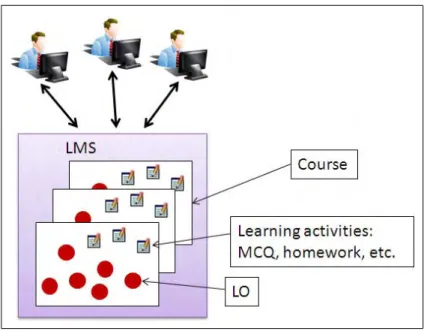
The main components of a web-based learning environment are described in Figure 2.1. The basics of a WLE are the Learning Objects (LO) which are defined as any document (a web page, an image, a simulation, a test) used for learning (red spots on Figure 2.1). These LOs are (re)used by teachers to create courses via Learning Management Systems (LMSs). The following sections will detail these components.
Figure 2.1: A traditional WLE.
2.2.1 Learning Objects
The origin of the term Learning Object is attributed to Wayne Hodgins, Director of Worldwide Learning Strategies Autodesk1. He had the intuition of a learning environment built on the basis of autonomous
elements in 1992, as he watched children playing with LegoTM blocks. Following his presentation in
different forums, several groups became interested and began to explore this concept both in U.S. and Europe. These LOs are currently the main focus of many works both in educational institutions and standardization organizations. The idea is to define components or pedagogical bricks to facilitate their aggregation, sharing and reuse.
2.2.1.1 Definition
The IEEE1LOM2P1484.12 working group gives two definitions for learning objects. The first definition
is in the final version describing the Learning Object Metadata (LOM): a learning object is defined as any entity, digital or not, which can be used for learning or teaching. This definition includes every-thing as a learning object. The second definition is on the LOM standard presentation page: a learning object is defined as any entity, digital or non-digital, which can be used, re-used or referenced during technology supported learning (computer-based training systems, interactive learning environments, in-telligent computer-aided instruction systems, distance learning systems, and collaborative learning en-vironments). This last definition restricts learning objects to entities used in computer-based learning systems.
In practice, a learning object can be a web page, an image, a simulation, a test or any other element involved in the learning process. Learning objects are not limited to a course or learning content, they may refer to procedures or guidelines to help learners during their learning process.
2.2.1.2 Learning Objects’ Granularity
The LegoTM metaphor has highlighted the concept of granularity. The Autodesk company defines 5
different levels of granularity [Hod02]:
• Raw data elements are located at the lowest granularity level and refer to content of the data level. Examples include single sentence or paragraph, illustration, animation, etc.;
• Information objects are composed of raw data elements in order to create granular, reusable chunk of information. They explain a concept, illustrate a principle or describe a procedure; • Application objects are a set of assembled information objects which focus on a single learning
objective;
• Aggregate (or assembly) extends to larger learning objectives (lessons or chapters); • Collections represent the highest granularity level, and depict courses, books, movies, etc. Insofar, as learning objects are very diverse and pursue various objectives, there must be a way to accurately describe these learning resources: these are descriptors, or metadata.
1Institute of Electronical and Electrics Engineers - http://www.ieee.org 2Learning Object Metadata - http://ltsc.ieee.org/wg12
2.2.1.3 Metadata
According to IEEE-LTSC1, metadata is data describing other data. It comprises a set of descriptors
and can be structured regarding a given schema. Another definition is given by [Sim02]: a metadata represents additional information to a text or software in order to provide details on its content. In the case of a computer file, the name, size or creation date represent metadata. Metadata ensures several functions [NIS04]:
• Unique identification of a resource;
• Resources discovery. They can be searched according to different criteria, identified, localized or aggregated around common criteria;
• Classification of resources based on audience or subject;
• Interoperability, thanks to various descriptions which can be understood by both human and machine;
• Archivation and preservation warranty which ensures that the resource will not be forgotten and that it will still be accessible in the future.
In the e-learning area, metadata supports effective identification of educational resources. The main objective of metadata is to allow various software or e-learning platforms to interpret the “de-scriptive file” of a resource, and to be able to treat the resource in accordance to its description. Then, some standards emerged: the most popular ones are Dublin Core (DC) and Learning Object Metadata (LOM), the later being considered as the dominant standard in the field.
2.2.1.3.1 Dublin Core
The Dublin Core is a generic metadata schema for describing digital or physical resources, and ap-peared as a reaction to the problem of finding resources on the growing World Wide Web [Stu09].
The Dublin Core emerged after a working group meeting in 1995 in the city of Dublin, in the U.S. state of Ohio, to define a common core of elements used by the U.S. government to describe digital resources of official records (defense, justice, etc.). Currently, eighty elements constitute the DC stan-dard. All elements are optional, and defined independently of each other. Dublin Core allows any number of combinations of elements to be used to describe a resource. The Dublin Core standard is maintained by an international multi-disciplinary working group, the DCMI (Dublin Core Metadata Initiative)2bringing together librarians, computer or museum specialists, researchers or practitioners
from public or private organizations.
1IEEE Learning Technology Standards Committee - http://www.ieeeltsc.org/ 2http://dublincore.org/
2.2.1.3.2 Learning Object Metadata
IEEE Learning Object Metadata standard has its origins in earlier work within the European Project ARIADNE and the IMS Global Learning Consortium, beginning in 1995. In June 2002, the IEEE Standard Organization finally approved LOM as an international standard used to describe a learning object and similar digital resources used to support learning. LOM consists of a single hierarchy of seventy six elements divided into nine categories (general, life cycle, meta-metadata, technical, educational, rights, relation, annotation and classification).
The LOM standard allows to extend and add new data elements as required by applications, thus creating so called “application profiles”; LOM-FR1is an application profile developed for education in
France first published in 2006. This flexibility in the standard has encouraged metadata developers to use IEEE-LOM over Dublin Core as the base standard for developing new application profiles that suit their application needs [AKD06].
2.2.2 Knowledge Pools
Knowledge pools, or Learning Objects Repositories (LOR), are systems in which learning objects are indexed and stored according to a metadata format. They often use harvesting protocols to gather metadata, the most popular being OAI-PMH (Open Archives Initiative Protocol for Metadata Harvest-ing)2[LS01]. It allows to create and automatically update centralized warehouses where metadata from
various sources can be queried simultaneously. Used especially by the Open Archives and institutional repositories, it is now widely used in cultural heritage institutions, including libraries.
The ARIADNE infrastructure is an example of LOR. It is a distributed network of repositories that encourages the sharing and reuse of learning objects [TVP+09], and comprises several components
(see Figure 2.2):
• Repositories store both metadata and learning objects. The repositories are enhanced with three interfaces: a search interface based on the Simple Query Interface (SQI) [SMVA+05] specification,
a publishing interface based on the Simple Publishing Interface (SPI)[TMVA+08], and a
harvest-ing interface based on OAI-PMH;
• The federated search engine offers transparent search to a network of repositories (including the Global Learning Objects Brokered Exchange - GLOBE3) using SQI;
• The harvester, built on OAI-PMH, harvests metadata from target repositories (ARIADNE cur-rently harvests from more that twenty repositories);
1http://www.lom-fr.fr/
2http://www.openarchives.org/pmh/ 3http://www.globe-info.org/
Figure 2.2: Connecting repositories through federated search and harvesting [TVP+09].
• The metadata validation service validates harvested metadata against a specific schema;
• Search Clients are graphical interfaces which allow users to search educational content and browse results. Examples of such clients are the federated search client (or Finder)1, or the Metadata
Ecol-ogy for Learning and Teaching (MELT) portal2.
Infrastructures such as ARIADNE are able to federate an important number of learning objects spread all over the world. However, the objects cannot be provided to students in an ad-hoc manner, there is a need for organizing and structuring the pedagogical scenario.
2.2.3 Pedagogical Scenarios
A pedagogical scenario (or learning scenario, or learning design) defines the activities which must be completed by learners, the sequencing of these activities as well as the mapping of learning objects to these activities in order to achieve predefined outcomes [PV05]. Two standards for designing pedagog-ical scenarios emerged.
1http://ariadne.cs.kuleuven.be/finder/ariadne/ 2http://info.melt-project.eu/
2.2.3.1 IMS-LD
Using the LOM standard only to describe learning resources is inadequate to describe the wide variety of learning situations encountered on the field [RvRK+02].
Based on this observation, a lot of works proposed formalisms to a priori describe learning situ-ations instrumented by communication and information technology. Thus, the Educational Model-ing Languages (EMLs) emerged. An EML is defined by the European Standardization Committee as a model of information and semantical aggregation, describing the contents and processes involved in a learning unit according to a pedagogical perspective and to ensure the reusability and interoperabil-ity. The abstract term “learning unit” refers to any granularity of learning resources (course, lesson, module, etc.).
In this context, the North American IMS consortium began studying a specification of such a lan-guage, and created in February 2003 the Learning Design specification V1.0 (IMS LD). This proposal, largely inspired from the EML developed by [KM04], provides a conceptual framework for modeling a learning unit and claims to offer a good compromise between genericity allowing to implement variate pedagogical approaches on the one hand, and expressive power offering a precise description of each learning unit on the other hand [Lej04].
2.2.3.2 SCORM
The Sharable Content Object Reference Model (SCORM) is a specification for content packaging intro-duced by the Advanced Distributed Learning Initiative (ADL)1[CHSW04]. SCORM promotes the
porta-bility of learning content from one Learning Management System (LMS) to another through packages, as well as the reusability of learning objects allowing instructional designers to distribute their content on a wide variety of e-learning platforms without rewriting efforts.
SCORM 1.1 was the first production version, but lacked a robust packaging method and support for metadata. It was quickly abandoned in favor of SCORM 1.2, the first version widely used and supported by most nowadays WLEs. SCORM 2004 is the current version.
The main difference between SCORM and IMS LD is that the SCORM initiative places learning ob-jects as the centric elements of the learning process, while in the case of IMS LD the centric elements are the activities associated to the learning objects [Per04].
The pedagogical scenarios are often provided to learners through learning management systems; scenarios are also called courses in these systems.
2.2.4 Learning Management Systems
Learning Management Systems (LMSs) are crucial within a WLE, because they represent systems by which learners study courses created by teachers or trainers. [Pau02] defines an LMS as a software that automates the administration of training events. The LMS registers users, tracks courses in a catalog, and records data from learners; it also provides reports to management. An LMS is typically designed to handle courses by multiple publishers and providers. It usually doesn’t include its own authoring capabilities; instead, it focuses on managing courses created by a variety of other sources. A multitude of platforms have been developed within public or private institutions in order to answer specific needs of learning, thus making various services and functionalities available to e-learning actors.
Even if standards such as SCORM and IMS LD promote the portability of learning content from one system to another, LMS remain closed systems that are not, or poorly, opened to other components of a WLE. Therefore, in order to allow exchanges of learning content between LMS and LOR, some works [BV05] suggested an intermediate layer making possible the communication between these two kinds of systems.
However, the content delivered to learners remains the same for all students enrolled into the class [LB11]. But students are different in age, culture, education background, way of learning, knowledge, attention, interests, etc. It is thus of vital importance to provide them with learning contents and teach-ing strategies that suit their individual needs.
2.3
Adaptive Web-based Learning Environments
Learners from different backgrounds are given the same learning content at the same time, even if they may only be interested in a small part of the whole learning content. Therefore, one challenge is to develop advanced web-based learning applications which adapt their content to every learners’ need. With adaptive web-based systems, it is possible to do better than to align learners to the same learning content: it is possible to actively engage the learner with a teaching strategy and material that appeals to his/her prior knowledge, needs, goals, motivation and learning style preferences [SZR12]. As a consequence, students will be able to achieve learning goals more efficiently, since pedagogical scenarios are adapted to their individual differences [SEBAM10].
A very comprehensive definition of an adaptive learning environment is provided by [PLR04]: a learning environment is considered adaptive if it is capable of: monitoring the activities of its users; interpreting these on the basis of domain-specific models; inferring user requirements and preferences out of the interpreted activities, appropriately representing these in associated models; and, finally, acting upon the available knowledge on its users and the subject matter at hand, to dynamically facilitate the learning process.
2.3.1 Categories of Adaptation in Learning Environments
[PLR04] provides a high-level categorization instead of exhaustively enumerating all types of adapta-tions. This classification comprises four categories:
• Adaptive interaction refers to adaptations which take place at the systems’ interface, and that are meant to facilitate and support the users’ interactions with the system without modifying the learning content itself;
• Adaptive course delivery represents the most common collection of adaptive techniques used in learning environments. This type of adaptation is meant to taylor a course or a set of courses to an individual learner. The most typical adaptations in this category comprise dynamic course (re)-structuring, adaptive navigation support and adaptive selection of alternative course material; • Content discovery and assembly refers to the application of adaptive techniques to discover and
assemble learning materials coming from potentially distributed sources / repositories. An ex-ample of this category is the discovery of learning content from Internet;
• Adaptive collaboration support is intended to adapt the learning process that involve multiple actors, and consists in facilitating the collaboration tasks.
Compared to the traditional web-based learning environments, where the adaptation features are not taken into account, the adaptive learning environments enclose a number of components dedi-cated to this purpose.
2.3.2 Traditional WLEs vs Adaptive WLEs
Figure 2.3 presents a parallel between the components of traditional web-based learning environments and those specific to adaptive systems. In a traditional WLE, teachers or learning designers use learn-ing management systems to build pedagogical scenarios on the basis of learnlearn-ing objects (sometimes retrieved through one or several learning object repositories). Thus, a traditional WLE may use two components: a LOR which contains the learning material to build pedagogical scenarios, and a LMS to deliver static scenarios to learners.
Compared to traditional WLEs, adaptive WLEs are continuously monitoring users activities in order to infer the needs of each student at any moment and apply some of the previous adaptation tech-niques. In order to ensure these tasks, beside the two components of traditional WLEs, an adaptive WLE requires some specific modules depicted on Figure 2.3:
• The learner model incorporates the characteristics of the learner. Two types of information is represented here: (1) domain independent data (demographic, previous background, learning
Figure 2.3: Traditional vs adaptive web-based learning environments (inspired by [ST03]).
style, interests, goals), and (2) domain dependent information which represents the knowledge level of the learner regarding the topics to be studied;
• The content model contains a learning object repository as a source of learning objects, and a domain model, or knowledge structure, which depicts the concepts related to the domain to be studied. Learning objects are then mapped to concepts in order to facilitate the process of peda-gogical scenarios (re)engineering;
• The tutoring model represents the adaptive engine, and thus integrates the adaptive techniques. Specifically, it defines what can be adapted, as well as when and how adaptation must be achieved.
2.3.3 Components of an Adaptive Web-based Learning Environment
2.3.3.1 Learner Model
[DBAC04a] makes a distinction between user profile and user model, depending on how it is built within the web-based learning environments. Some systems ask users to fill a form about themselves (administrative, preference, etc.) when they register; the user profile is only updated when the user modifies the contained information. Other systems ask users to register, but for authentication pur-pose only. Further, the system monitors the users’ behavior in order to create a user model representing the users’ characteristics. Adaptation is performed according to the user model which is updated on the fly during the learning session.
Despite this, literature shows that user profile or user model are used for the same meaning: to specify the individual characteristics of the user. We adopt this convention on this manuscript as well.
It is expected that the recognition of students’ learning needs, learning styles, preferences, as well as interests in specific learning modules will improve effectiveness of the learning process [MPG03]. Data describing a user model is illustrated on Figure 2.4 [MPG03]:
• Knowledge describes the level of understandings of the user about a concept [DBAC04a]. It is the single domain dependent component of the user model, and is seen as an overlay of the domain model [DBAC04b]. An AdWLE should be able to automatically update this information;
• Goals express learners’ purposes. It is the answer to the question: what do learners want to achieve during the learning process? There are two kind of goals: long-term goals may refer to graduating a cursus, while short-term goals (called problem-solving goals [ND08]) may refer to learners’ intention to solve a problem or exercise, acquire a skill or pass an examination;
• Learning style includes learning methods, particular to an individual, that are presumed to allow that individual to learn best. [FH95] claims that students’ learning style can be defined by an-swering five questions. 1. What type of information does the student preferentially perceive: sen-sory sights, sounds, physical sensations, or intuitive memories, ideas, insights? 2. Through which modality is sensory information most effectively perceived: visual pictures, diagrams, graphs, demon-strations, or verbal written and spoken words and formulas? 3. How does the student prefer to process information: actively through engagement in physical activity or discussion, or reflectively through introspection? 4. How does the student progress toward understanding: sequentially in a logical progression of small incremental steps, or globally in large jumps, holistically? 5. With which organization of information is the student most comfortable: inductive facts and observa-tions are given, underlying principles are inferred, or deductive principles are given, consequences and applications are deduced? [FC00] considers learning styles as particularly important vari-ables that influence the success of learning;
• Interests describe the short and long-term interests of a learner. Examples of long-term inter-ests may be history, literature, while short-term interinter-ests may include interwar period, adventure novel, etc. Usually, the long term interests are provided by the user during the registration pro-cess, while the short-term interests are deduced by the system during users’ interactions with the system;
• Background includes skills and knowledge that the learner gained in the past, and represents an important factor that influences the adaptive process;
• Demographic includes administrative information about the user such as name, surname, birth-day, gender, postal address, e-mail, telephone number, etc.
The six student model dimensions thus compose an hyperspace experience of the user which is further exploited by the adaptation engine to provide learners with adequate content. However, to
Figure 2.4: Generic student model, inspired by [MPG03].
generate and maintain user model, systems need relevant information about users. Therefore, user profile generation and maintenance require five design decisions [MLDLR03]: profile representation, initial profile generation, profile learning, source of relevant feedback, and profile adaptation.
The profile representation is the first point to focus on when designing adaptive web-based learning environments, since the other design decisions rely on it. According to [MLDLR03], profile representa-tion techniques include, among others, history of selecrepresenta-tions, vector space model where the user profile is represented as a vector of features (usually words or concepts of interests) with associated values, weighted n-grams where the user profile is represented as a network of words and weights, classifiers such as neural networks, decision trees or Bayesian networks, and user-item ratings matrix.
Once a profile representation is defined, the adaptive system has to learn as much as possible about the user, and as soon as possible, to build the initial profile. The acquisition of the user profile can range from manual input or semi-automatic procedures to the automatic recognition by the system itself.
In case of automatic recognition, profile learning mechanisms are required. They include: vectors of features extracted from the documents the user interacted with (each document being represented as a vector of weighted features), clusters of users in order to match these clusters against actual in-formation to conclude [XP01], or classifiers which receive as entry a data set and provide as output the interests of the user [AT01].
As the users’ interests change over time, adaptive systems need up-to-date information (also called relevance feedback). This feedback can be either explicit (e.g. users are required to explicitly evaluate items to indicate how relevant is the item for them) or implicit (e.g. the system automatically infers users’ preferences by monitoring their behavior).
to adapt the user profile to the new interests of the learner.
2.3.3.2 Content Model
The content model is composed of two entities: the learning object repository and the knowledge struc-ture. While the former was presented in section 2.2.2, we focus here on the latter.
The knowledge structure (also called domain ontology) is constituted by a set of knowledge ele-ments representing a concept, subject or topic of the domain. These concepts are organized as a hier-archical structure from high-level concepts (e.g. Analysis on Figure 2.5) to low-level concepts (e.g. L = Limits, D = Derivatives, I = Integrals, S = Series on Figure 2.5). Further, to each concept is associated a set of learning objects which are representative for that concept (e.g. LO1 for Limits, LO2 and LO3 for Derivatives, etc. on Figure 2.5). Finally, typical relations among concepts indicate a hierarchical rela-tionship or a constraint between two concepts (e.g. B = IsPart of, R = Requires, SO = SuggestedOrder, E = Explained by on Figure 2.5).
Figure 2.5: Example of knowledge structure [CGME02].
The building of the content model may be manual or semi-automatic, or even fully automatic (en-sured by the system itself). While the first method was appropriate for enclosed systems (where the collection of documents is already known from the very beginning), it is not adequate in the context of nowadays distributed content delivery systems (where resource providers communicate together to exchange data) anymore.
Thus, the content model provides the basis for the following features [ST03]: assessments (what is the current status of a particular concept or LO?), cognitive diagnosis (what is the source of the prob-lem?), and instruction (which LOs need to be selected next in order to fix a problem or introduce new topic?).
![Figure 2.5: Example of knowledge structure [CGME02].](https://thumb-eu.123doks.com/thumbv2/123doknet/2095046.7519/49.892.236.665.581.796/figure-example-of-knowledge-structure-cgme.webp)
![Figure 2.6: Indicators design, calculation and use [Djo11].](https://thumb-eu.123doks.com/thumbv2/123doknet/2095046.7519/51.892.234.663.200.582/figure-indicators-design-calculation-and-use-djo.webp)
![Figure 2.7: Examples of advising messages generated for a student by DEGREE [BF00].](https://thumb-eu.123doks.com/thumbv2/123doknet/2095046.7519/53.892.195.697.462.875/figure-examples-advising-messages-generated-student-degree-bf.webp)
![Figure 2.8: The main components of Intelligent Tutoring Systems [BHM06].](https://thumb-eu.123doks.com/thumbv2/123doknet/2095046.7519/54.892.201.704.744.1002/figure-main-components-intelligent-tutoring-systems-bhm.webp)
![Figure 3.14: TaskTracer publisher-subscriber architecture [DDJ + 05].](https://thumb-eu.123doks.com/thumbv2/123doknet/2095046.7519/71.892.250.650.253.488/figure-tasktracer-publisher-subscriber-architecture-ddj.webp)
![Figure 3.21: APOSDLE context [LFBG07].](https://thumb-eu.123doks.com/thumbv2/123doknet/2095046.7519/76.892.196.708.608.918/figure-aposdle-context-lfbg.webp)
![Figure 3.22: APOSDLE architecture [LBKL09].](https://thumb-eu.123doks.com/thumbv2/123doknet/2095046.7519/77.892.192.711.230.565/figure-aposdle-architecture-lbkl.webp)
![Figure 3.23: Conceptual model of a track in UTL [CI07].](https://thumb-eu.123doks.com/thumbv2/123doknet/2095046.7519/78.892.197.711.137.438/figure-conceptual-model-track-utl-ci.webp)
![Figure 3.25: The content of the primary trace in TBS-IM [DSP + 10].](https://thumb-eu.123doks.com/thumbv2/123doknet/2095046.7519/79.892.281.623.480.757/figure-content-primary-trace-tbs-im-dsp.webp)