HAL Id: hal-01126767
https://hal.archives-ouvertes.fr/hal-01126767
Submitted on 6 Mar 2015
HAL is a multi-disciplinary open access
archive for the deposit and dissemination of
sci-entific research documents, whether they are
pub-lished or not. The documents may come from
teaching and research institutions in France or
abroad, or from public or private research centers.
L’archive ouverte pluridisciplinaire HAL, est
destinée au dépôt et à la diffusion de documents
scientifiques de niveau recherche, publiés ou non,
émanant des établissements d’enseignement et de
recherche français ou étrangers, des laboratoires
publics ou privés.
Exploring new features for music classification
Rémi Foucard, Slim Essid, Gael Richard, Mathieu Lagrange
To cite this version:
Rémi Foucard, Slim Essid, Gael Richard, Mathieu Lagrange. Exploring new features for music
clas-sification. WIAMIS, Jul 2013, Paris, France. �10.1109/WIAMIS.2013.6616154�. �hal-01126767�
EXPLORING NEW FEATURES FOR MUSIC CLASSIFICATION
R´emi Foucard
(1), Slim Essid
(1), Ga¨el Richard
(1)and Mathieu Lagrange
(2)(1)
Institut Mines-T´el´ecom - TELECOM ParisTech, CNRS-LTCI
(2)Ircam - STMS, CNRS, UPMC
37, rue Dareau
1, place Igor Stravinsky
75014 Paris, France
75004 Paris, France
[email protected]
ABSTRACT
Automatic music classification aims at grouping unknown songs in predefined categories such as music genre or induced emotion. To obtain perceptually relevant results, it is needed to design appropri-ate features that carry important information for semantic inference. In this paper, we explore novel features and evaluate them in a task of music automatic tagging. The proposed features span various aspects of the music: timbre, textual metadata, visual descriptors of cover art, and features characterizing the lyrics of sung music. The merit of these novel features is then evaluated using a classifica-tion system based on a boosting algorithm on binary decision trees. Their effectiveness for the task at hand is discussed with reference to the very common Mel Frequency Cepstral Coefficients features. We show that some of these features alone bring useful information, and that the classification system takes great advantage of a description covering such diverse aspects of songs.
Index Terms— Music information retrieval, Features, Autotag-ging, Boosting, Missing features
1. INTRODUCTION
Automatic music classification is the task of predicting categories for previously unknown pieces of music. These categories can be as diverse as musical genre, vocalist gender or emotional content. They can be organized into labels (i.e. Emotion-Happy or Genre-Rock), often called tags. In this configuration, the two considered categories are: presence vs. absence of any particular tag.
Many works have been published in the recent years to deal with the problem of automatic tagging (autotagging) [1]. They usually include machine learning techniques to learn decision rules from an annotated corpus. The most common learning algorithms are: Support-Vector Machines (SVM) [2], Gaussian Mixture Mod-els (GMM) [3], and Boosting [4].
The representation of the song by features to be used by the learning algorithm is also a critical aspect of the system. As far as music is concerned, these features can be extracted not only from the audio recordings but also from a variety of information sources sur-rounding the musical content, in particular different types of meta-data usually attached to it, especially cover art and lyrics (in sung music).
Features extracted from the audio content appear to be the most popular ones. They often rely on some kind of energy levels over different frequency ranges. Those levels are computed over a short time interval in order to observe processes that are quasi-stationary.
This work was realized as part of the Quaero Programme, funded by OSEO, French State agency for innovation
Because this stationarity assumption will only hold over a short time scale, the issue is then to compute meaningful statistics on several features to discard noise and to focus on meaningful characteristics, during this step called integration, or pooling [5]. This integration can go from the simplest operators (average, max) to more complex ones like GMMs. In order to take temporality into account, integra-tion using Auto-Regressive (AR) modelling [6] or tokenizaintegra-tion using Hidden Markov Models (HMM)s [7] have been attempted. More re-cently, bags of model parameters, extracted over several temporal horizons, have been proposed as a representation which accounts for some temporal dynamics [8].
In addition to audio-content descriptors, some researchers have considered features relating to textual metadata or social tags [9].
The quest for a set of efficient features is indeed a vibrant field of research. The present paper falls within this research on the fea-tures, and proposes new (e.g. drum energy, instrument probabili-ties) or rarely used (e.g. psychoacoustic) descriptors, which cover a wider range of semantic levels, and are useful in certain classifica-tion cases. In particular, we explore new ideas of descriptors relating to editorial metadata, especially features extracted from song lyrics and cover art. Owing to the fact that such features are not always available (for instance lyrics are only valid for sung music), we re-sort to a particular boosting algorithm that can cope with missing features. In the following section, we describe the explored features. Then in Section 3, we present a classification algorithm adapted to their learning. In Section 4, we present our experiment and comment the results, and we conclude in Section 5.
2. EXPLORED FEATURES
Many aspects of music are potentially useful for a classification al-gorithm, namely timbral, tonal or rhythmical aspects. We choose to retain only timbral features, which have consistently proven to be superior to the two others in previous works (which was also veri-fied in our experiments), and to focus the study on the usefulness of original editorial and social metadata.
2.1. Timbral features
The following descriptors are extracted from the audio signal of each song.
MFCC-HMM
The timbre of a song can be commonly represented by the first 13 Mel Frequency Cepstral Coefficients (MFCC). In order to represent longer portions of the signal, one can compute the average and stan-dard deviation of the MFCC. But this appears quite simplistic as the
temporal evolution and dynamics of the timbre are not taken into account.
Thus, following an idea developed in [7] for music segmenta-tion, we use an integrated representation of MFCC, in which the MFCC sequence is seen as a realization of a Hidden Markov Model (HMM). Beforehand, MFCCs describing one eighth of a second of audio are extracted, by temporally averaging instantaneous MFCC (covering 23 ms, during which the signal is considered as station-ary). This gives a MFCC sequence for each song. Then, an HMM is estimated, using all the sequences from the training data as exam-ples. Subsequently, to describe a song, its HMM state sequence is decoded, and the feature description will be the histogram of these decoded states. In this paper, HMM have simple Gaussian probabil-ities and full covariance matrix.
Drum Energy
We have also supposed that the relative power of the drums could be useful for assessing some characteristics of a song, such as genre or emotion. To this end, we have used a drum separation algorithm [10], which yields two separated signals for each song. This algo-rithm runs fast and its code is freely available1. The relative power of the drums, compared to the other components, is first computed on frames of 200 ms. Then, we keep as descriptor the mean and standard deviation of this value over the whole song.
Instrument Presence Probabilities
The instrumentation constitutes a high-semantic-level information, that can be correlated to musical genre, or some other categories of tags. This leads us to represent it with a feature deduced from the output of an automatic musical instrument recognition system. Prior to the song analysis, we build rough SVM instruments classifiers, using a real-music solo performance database (similar to the one in [4]). The instruments are: double bass, drums, guitar, piano and voice. They use the following features: MFCC, Octave band signal intensity, and Line Spectral Frequency coefficients2. Then, the fi-nal feature consists in the predicted probability of presence for each instrument on the song.
Psychoacoustic Descriptors
We have also experimented a psychoacoustically-motivated repre-sentation of the signal content, which has been used in [11], but, to our knowledge, never separately evaluated on an automatic tag-ging task. It consists of 13 features representing timbral or percep-tual properties of the sound. Some are already widely used (spec-tral centroid, loudness), whereas most are very rare: tonal disso-nance, spectral dissodisso-nance, perceived size of the sound, number of perceived tones. . . They are extracted using Psysound3, and tempo-rally integrated (mean) on the whole song. As for MFCC and Drum Energy, these descriptors are computed over short frames, and then integrated over the whole song by mean and variance.
2.2. Editorial and social metadata
In the recent years, a vast amount of music metadata has become freely available online. All this data may be very useful for auto-matic classification.
1http://perso.telecom-paristech.fr/˜liutkus/ 2These features are extracted using Yaafe. For more details, visit
http://yaafe.sourceforge.net/
3http://www.psysound.org/)
Echo Nest Tags
User tags give a high-level description of the user perception of mu-sic. Even if the free vocabulary used by users may not be always relevant, user tags can still be used as a feature for automatically predicting other, more relevant and more reliable, tags. This kind of feature has already been used [9], but remains quite new in the field, and would then benefit from being evaluated in the present work.
To this end, we collect the tags given by The Echo Nest4. This
service provides a set of labels for each song, with their relative rel-evance (0 ≤ r < 1). We only keep the 20 tags that are most fre-quently given on our set of songs. All these tags are represented by their relevance.
Lyrics Topics
Another aspect of a song is the lyrics. Most pop songs contain some, and they can consitute indications on the genre, or emotion for in-stance. But they are quite difficult to extract accurately from the signal. Fortunately, a simple search on the Web with the title of the song and the name of the artist is likely to bring all the lyrics (given that the song is popular enough). Based on this observation, we have automatically queried ChartLyrics5to fetch the lyrics of the
analyzed songs. The texts are only queried by with the song title and artist name. Such a simple request is particularly attractive since it allows building fully automatic search systems. Thus, when this re-quest does not bring any response, we do not reformulate it and we consider the title to be the lyrics.
Of course, these raw lyrics are not expected to be meaning-ful enough for an automatic classifier. This is why we exploit a representation based on “latent lyrics topics”. We begin by com-puting a matrix M of dimension Nsongs× Nwords, indicating the
term frequency-inverse document frequency(TFxIDF) of each word in each song. TFxIDF takes into account the global frequency of the words, in order to represent the relative strength of a word to a particular song, compared to other songs. The word vocabulary is built on all songs (excluding the stop words). Then, we perform a Non-negative Matrix Factorization (NMF) on this matrix, similarly to [12]. This technique consists in factorizing matrix M into the product of two new matrices: M ≈ R · T , to prompt the emergence of the topics. The first matrix R (of dimension Nsongs× Ntopics)
gives the relevance of each topic for each song. And T (dimension Ntopics× Nwords) describes the contribution of each word to each
topic. The rows of R constitute our song “topic” feature.
Lyrics Emotions
Topics can be informative for automatic learning, but lyrics are also very likely to evocate particular emotions. Consequently, we have used a corpus, made by Bradley & Lang [13], which places 2477 common english words in an emotional space, with dimen-sions: valence, arousal and dominance. All words w in the text are replaced by their emotional value found in this D dictionary: v = D(w). When no exact matching entry is found in the dictio-nary , we use Lancaster stemming [14] to match a stemmed entry with the stemmed word: v = Dstemmed(stem(w)). Stemming is an
operation, calculating a base that is shared by different words which derive from the same root (i.e. love, loving, loved . . . ).Then, we represent each song by the mean and variance of the three emotion dimensions, for all words found in D or Dstemmed.
4http://www.echonest.com/ 5http://www.chartlyrics.com/
Cover Image Descriptors
All commercial records have a cover image. This image is supposed to be related to the music it illustrates. This is why we have re-trieved cover images on Discogs6 and last.fm7. These images are represented by many MPEG-7 descriptors : scalable color, dominant color, color layout, color structure, homogeneous texture, edge his-togram, contour shape and region shape. To these features, we add an estimated number of visible human faces, and color histograms.
3. CLASSIFICATION ALGORITHM
All our featured are processed by a boosting algorithm. Boosting is a learning technique, that iteratively trains several complementary ver-sions of a “weak” (performing slightly better than chance) classifier h. In this work, the weak classifier is a decision stump (decision tree with only two leaves), which boils down to a simple threshold on an optimal dimension. At the end, the trained versions of the weak classifier are gathered by a weighted sum, which can be thresholded for binary decision. This configuration has proven efficient [4] and can be trained fast.
Because our descriptors cannot be computed for all songs (for instance when the cover image was not retrieved, or when the song contains no lyrics), we have to handle missing features. Thanks to the flexibility of the boosting algorithm, it can be easily adapted to this configuration [15]. In this case, the weak classifier may abstain from answering, and the boosting algorithm minimizes a loss func-tion which takes this abstenfunc-tion into account.
4. EXPERIMENTS AND RESULTS
4.1. Experimental framework
The experiment is done on the CAL500 database [3]. It contains 500 pop songs, with tags describing emotion, genre, instrumenta-tion, general song characteristics (energy, major/minor tonality), the ideal listening context (“Usage”), and characteristics of the singing voice. This dataset, although of modest size, presents the advantage of having highly reliable ground-truth annotations. We use the same 61 tags as in [2], and aim at predicting their presence or absence. The tests are conducted with 10-fold cross-validation, keeping 450 songs for training, and 50 for testing. For complexity reduction, we only use 30 s of each song: between instants 30 s and 60 s.
To compare the prediction accuracy of the different systems on the test set, we use two different ranking metrics. Ranking metrics evaluate the list of examples ranked by predicted score, compared against the binary ground truth. Our first measure is the Mean Aver-age Precision (MAP). It can be interpreted as the averAver-age precision for each possible recall value. We also use the Area Under the Re-ceiver Operating Characteristic curve (AROC). This curve represents the correct detection rate with respect to the false alarm rate, com-puted at each element in the ranking. More information about these metrics can be found in [16].
4.2. Results and discussion
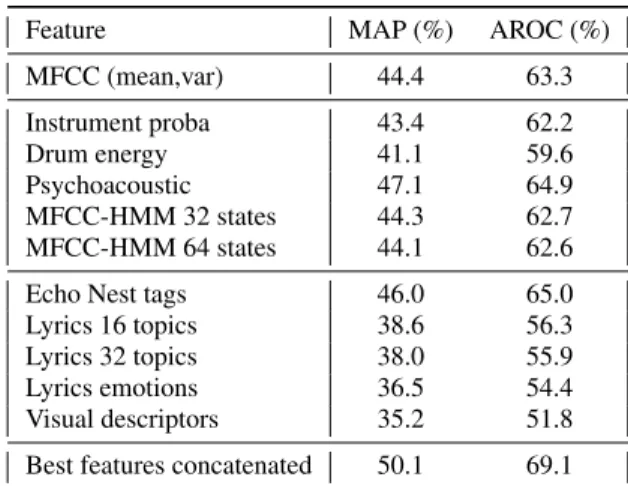
The global performance of the different descriptors on all tags is presented in Table 1, and compared to the common first 13 MFCC, integrated to the whole song duration by mean and variance. First, we can see that the psychoacoustic description is the best timbral
6http://www.discogs.com/ 7http://www.lastfm.fr/
Feature MAP (%) AROC (%) MFCC (mean,var) 44.4 63.3 Instrument proba 43.4 62.2 Drum energy 41.1 59.6 Psychoacoustic 47.1 64.9 MFCC-HMM 32 states 44.3 62.7 MFCC-HMM 64 states 44.1 62.6 Echo Nest tags 46.0 65.0 Lyrics 16 topics 38.6 56.3 Lyrics 32 topics 38.0 55.9 Lyrics emotions 36.5 54.4 Visual descriptors 35.2 51.8 Best features concatenated 50.1 69.1
Table 1. Global performance of the different descriptors
one, and EchoNest tags constitute the best feature based on meta-data. These two representations even lead to better performance than MFCC. We also see that the Drum energy performs surprisingly well, given that it consists in only two coefficients (mean,variance). Indeed, even though it has the lowest performance among timbre de-scriptors, it sustains comparison with all of them. A cross-validated Student t-test [17] on the whole set of tags confirmed that the 95% confidence interval in AROC is [58.9, 61.5]. We can also notice that the MFCC-HMM yield performance close to those of mean/var-MFCC, but do not beat the latter. This may be due to the small size of the training corpus.
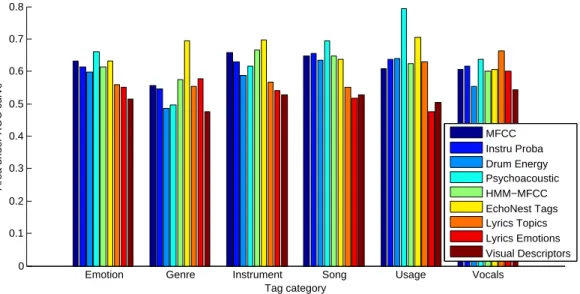
Figure 1 represents the AROC of the different songs, grouped by tag category. We can see that the performance of the HMM-MFCC is closely correlated to the one of mean/var-MFCC. We can also see that the EchoNest tags are particularly suitable for predicting Genre, Instrumentor Usage tags. Indeed, user tags are very often related to these categories. The lyrics topics, although yielding modest results on the whole tag set, are the best performing representation on the Vocalstags. The observation that the lyrics influence the singing, do not appear surprising. This processing of the lyrics performs better than Lyrics emotions, which are still quite good for the genre tags.
The performance of the Instrument presence probabilities can seem surprising, since they are beaten by MFCC on Instrument tags, but give more accurate predictions on the three last categories, which we expect to be less closely correlated to the audio signal. This may be due to the fact that the presence of instrument is a higher-semantic level description, and is more suitable for predicting tags less corre-lated to the audio. This result is still encouraging, because these instrument predictors are quite simple, and can be greatly improved. Also, the visual descriptors give the least accurate predictions among all representations. However, they perform better than random8,
which shows that some useful information is indeed contained in the cover image. Overall, Figure 1 shows also, that the representa-tions give information of different nature, because their relative per-formance is not constant among tags. This observation leads us to make a last experiment, in which we concatenate good and comple-mentary descriptors: mean/var-MFCC, Drum energy, Psychoacous-tic, EchoNest tags and Lyrics topics. The result of this experiment is shown at the bottom of Table 1, and shows that, indeed, these de-scriptors give complementary information, with limited redundancy,
8This difference has also been proved significant by a cross-validated
Emotion Genre Instrument Song Usage Vocals 0 0.1 0.2 0.3 0.4 0.5 0.6 0.7 0.8 Tag category
Area under ROC curve
MFCC Instru Proba Drum Energy Psychoacoustic HMM−MFCC EchoNest Tags Lyrics Topics Lyrics Emotions Visual Descriptors
Fig. 1. AROC obtained with the different features, grouped by tag category.
and benefit from being exploited together.
5. CONCLUSION AND PERSPECTIVES
We have explored original features for the classification of music, and shown their usefulness for this task. It was also demonstrated that the joint exploitation of these diverse descriptors permits to sig-nificantly improve classification performances. This supports the fact that the proposed features are both meaningful and complemen-tary to the classical MFCC.
Future work will be dedicated to the design of more accurate representations for both lyrics emotion and cover image. Indeed, it seems that the simple emotion description adopted here (only based on mean and variance) has shown the interest of this feature. But it is probably too crude to well capture the complexity and richness of this modality. Cover art has also been shown useful, but needs more advanced reflection on its representation.
6. REFERENCES
[1] T. Bertin-Mahieux, D. Eck, and M. Mandel, “Automatic Tag-ging of Audio: The State-of-the-Art,” in Machine Audition: Principles, Algorithms and Systems, Wenwu Wang, Ed. IGI Publishing, 2010.
[2] L. Barrington, M. Yazdani, D. Turnbull, and G. Lanckriet, “Combining Feature Kernels for Semantic Music Retrieval,” in ISMIR, 2008, pp. 614–619.
[3] D. Turnbull, L. Barrington, D. Torres, and G. Lanckriet, “Se-mantic Annotation and Retrieval of Music and Sound Effects,” TASLP, vol. 16, no. 2, pp. 467–476, Feb. 2008.
[4] R. Foucard, S. Essid, M. Lagrange, and G. Richard, “Multi-scale temporal fusion by boosting for music classification,” in ISMIR, 2011.
[5] Y. Boureau, F. Bach, Y. LeCun, and J. Ponce, “Learning mid-level features for recognition,” in CVPR. 2010, IEEE. [6] A. Meng, P. Ahrendt, J. Larsen, and L. K. Hansen, “Temporal
feature integration for music genre classification,” in TASLP, 2007, pp. 1654–1664.
[7] M. Levy, M. Sandler, and M. Casey, “Extraction of high-level musical structure from audio data and its application to thumb-nail generation,” in ICASSP. 2006, vol. 5, IEEE.
[8] K. Ellis, E. Coviello, and G. Lanckriet, “Semantic annotation and retrieval of music using a bag of systems representation,” in ISMIR, 2011.
[9] L. Barrington, D. Turnbull, M. Yazdani, and G. Lanckriet, “Combining audio content and social context for semantic mu-sic discovery,” in SIGIR. 2009, pp. 387–394, ACM.
[10] A. Liutkus, R. Badeau, and G. Richard, “Gaussian processes for underdetermined source separation,” IEEE Transactions on Signal Processing, vol. 59, no. 7, pp. 3155 –3167, July 2011. [11] R. Foucard, S. Essid, M. Lgrange, and G. Richard, “A
Re-gressive boosting approach to automatic audio tagging based on soft annotator fusion,” in ICASSP, 2012.
[12] F. Kleedorfer, P. Knees, and T. Pohle, “Oh Oh Oh Whoah! Towards automatic topic detection in song lyrics,” in Ismir, 2008, pp. 287–292.
[13] M. Bradley and P. Lang, “Affective norms for English words (ANEW): Instruction manual and affective ratings,” Tech. Rep., Center for Research in Psychophysiology, University of Florida, Gainesville, FL, 2010.
[14] C. Paice, “A word stemmer based on the Lancaster stemming algorithm,” in ACM SIGIR, 1990, pp. 56–61.
[15] F. Smeraldi, M. Defoin-Platel, and M. Saqi, “Handling missing features with boosting algorithms for protein-protein interac-tion predicinterac-tion,” in Data Integrainterac-tion in the Life Science, Aug. 2010, vol. 6254, pp. 132–147.
[16] J. Herlocker, J. Konstan, L. Terveen, and J. Riedl, “Evaluating collaborative filtering recommender systems,” Transactions on Information Systems, vol. 22, no. 1, pp. 5–53, Jan. 2004. [17] T.G. Dietterich, “Approximate Statistical Tests for Comparing
Supervised Classification Learning Algorithms,” Neural Com-putation, vol. 10, no. 7, 1998.