Advisor: Prof. Damien Ernst
Solutions for Integrating Photovoltaic Panels
Into Low-voltage Distribution Networks
2 0 1 8
Faculty of Applied Sciences
Liège Université
it is by standing on the shoulders of giants.
As more PhotoVoltaic (PV) units are being installed, some low-voltage (LV) distribution networks have already at-tained their maximum hosting capacity, i.e. the maximum amount of distributed energy resources that they can accommodate during regular operations without suffering problems, such as overvoltages. This thesis presents dif-ferent solutions to increase the hosting capacity and to prevent the disconnection of PV units, without resorting to network reinforcements.
The first action to increase the hosting capacity of an LV network with a high penetration of PV panels is to better balance production on its three phases. Indeed, the hosting capacity is reduced by the imbalance caused by the currents consumed by single-phase household appliances, or produced by single-phase distributed generation units. To do so, the Distribution System Operators (DSOs) have to know to which phase of their networks the houses and the PV units are connected. In other words, they need to know the phase identification of the meters. In this thesis, we propose two novel algorithms to identify the phases of the smart meters. Both algorithms solely rely on the correlation between the voltage measurements of the smart meters to solve the phase identification problem. The first one is dedicated to the identification of three-phase smart meters and uses graph theory as well as the notion of maximum weight spanning tree to associate the smart meters that have the most correlated voltages. The second algorithm overcomes the main drawback of the first one, its inability to identify both single-phase and three-phase smart meters. Our algorithm improves the quality of the clustering by taking into account the underlying structure of the LV distribution networks beneath the voltage measurements without a priori knowledge on the topology of the network. The performance of this algorithm is compared using real measurements to those of the constrainedk-means clustering method, which has been previously used for phase identification.
The second action to increase the hosting capacity is to control the power flows inside the network. This is called Active Network Management. We propose a distributed scheme that adjusts the reactive and active power output of inverters to prevent or alleviate the overvoltage problems that might arise from the integration of photovoltaic panels in LV networks. The proposed scheme is model free and makes use of limited communication between the controllers, in the form of a distress signal, only during emergency conditions. It prioritizes the use of reactive power, while active power curtailment is performed only as a last resort. The behaviour of the scheme is studied using balanced three-phase dynamic simulations on a single low-voltage feeder and on a larger network composed of 14 low-voltage feeders. This control scheme is then extended to the case of unbalanced three-phase four-wire distribution networks with single- and/or three-phase inverters. It works by first partitioning the inverters into four groups, three for the single-phase inverters (one for each phase), and one for the three-phase ones. Each group then independently applies a distributed algorithm similar to the one previously presented. Its performance is compared to those of two reference schemes, an on-off algorithm that models the default behaviour of PV inverters when there is an overvoltage, and the other one based on an unbalanced OPF.
Finally, as a way to implement active network management at the level of LV distribution, we introduce the concept of electricity prosumer communities, which are groups of people producing, sharing and consuming electricity locally. We focus on building a rigorous mathematical framework in order to formalise sequential decision-making problems that may soon be encountered within electricity prosumer communities. After introducing our formalism, we pro-pose a set of optimisation problems reflecting several types of theoretically optimal behaviours for energy exchanges between prosumers. We then discuss the advantages and disadvantages of centralised and decentralised schemes and provide illustrations of decision-making strategies, allowing a prosumer community to generate more distributed electricity (compared to commonly applied strategies) by mitigating overvoltages over a low-voltage feeder. We fi-nally investigate how to design distributed control schemes that may contribute to reaching (at least partially) the objectives of the community, by resorting to machine learning techniques to extract, from centralised solution(s), decision-making patterns to be applied locally.
Avec l’accroissement du nombre de panneaux photovoltaïques (PV), certains réseaux de distribution basse tension (BT) atteignent leur capacité d’accueil maximale, c’est-à-dire la quantité maximale de production décentralisée d’électricité qu’ils peuvent accueillir sans souffrir de problèmes opérationnels, comme des surtensions. Cette thèse présente différentes solutions pour augmenter la capacité d’accueil et prévenir la déconnexion des installations PV, sans recourir à un renforcement du réseau.
La première action pour augmenter la capacité d’accueil d’un réseau BT souffrant d’une forte pénétration des panneaux PV est de mieux équilibrer la production sur ses trois phases. En effet, la capacité d’accueil est réduite par le déséquilibre des réseaux de distribution BT qui est causé par les courants des appareils électroménagers monophasés ou des unités de production décentralisées monophasées. Pour ce faire, les gestionnaires de réseaux de distribution (GRD) doivent savoir à quelle phase de leurs réseaux les maisons et les installations PV sont connectées, c’est-à-dire qu’ils doivent connaître l’identification de phase des compteurs. Dans cette thèse, nous proposons deux nouveaux algorithmes pour identifier les phases des compteurs communicants. Les deux algorithmes reposent uniquement sur la corrélation entre les mesures de tension des compteurs intelligents pour résoudre le problème d’identification de phase. Le premier est dédié à l’identification des compteurs intelligents triphasés, et utilise la théorie des graphes ainsi que la notion d’arbre de poids maximum pour associer les compteurs qui ont les tensions les plus corrélées. Le second algorithme surmonte l’inconvénient principal du premier, son incapacité à identifier à la fois les compteurs monophasés et les compteurs triphasés. L’algorithme proposé améliore la qualité du clustering en prenant en compte la structure sous-jacente des réseaux de distribution BT sans avoir préalablement connaissance de la topologie du réseau. Les performances de cet algorithme sont comparées, à l’aide de mesures réelles, à celles de la méthode de constraintk-means clustering, qui a déjà été utilisée pour l’identification de phase.
La deuxième stratégie est de contrôler les flux d’énergie dans le réseau, connue sous le nom de gestion active des réseaux. Nous proposons un schéma de contrôle distribué qui ajuste la puissance réactive et active des onduleurs pour prévenir ou atténuer les problèmes de surtension qui pourraient survenir avec l’intégration des panneaux pho-tovoltaïques dans les réseaux BT. Le schéma proposé ne nécessite pas de modèle détaillé du réseau et fait appel à une communication limitée entre les contrôleurs, sous la forme d’un signal de détresse envoyé uniquement en cas d’urgence. Il donne la priorité à l’utilisation de la puissance réactive, tandis que la réduction de la puissance active n’est effectuée qu’en dernier recours. Le comportement du schéma est illustré grâce à des simulations dynamiques triphasées équilibrées sur un seul départ basse tension et sur un réseau plus large composé de 14 départs basse tension. Ce schéma de commande est ensuite étendu aux réseaux de distribution triphasés non équilibrés à quatre conducteurs avec onduleurs monophasés et/ou triphasés. Il fonctionne en divisant d’abord les onduleurs en quatre groupes, trois pour les onduleurs monophasés (un pour chaque phase) et un pour les onduleurs triphasés. Chaque groupe applique ensuite indépendamment un algorithme distribué similaire à celui introduit plus haut. Ses performances sont com-parées à celles de deux schémas de référence, un algorithme on-off qui modélise le comportement par défaut des onduleurs PV en cas de surtension, et l’autre, basé sur un écoulement de charge optimal non équilibré.
Enfin, pour mettre en place une gestion active au niveau des réseaux de distribution BT, nous introduisons les com-munautés de prosommateurs d’électricité, qui sont des groupes de personnes produisant, partageant et consommant de l’électricité localement. Nous nous concentrons sur la construction d’un cadre mathématique rigoureux afin de for-maliser les problèmes de prise de décision séquentielle qui y seront rencontrés. Après avoir introduit notre formalisme, nous proposons un ensemble de problèmes d’optimisation reflétant plusieurs types de comportements théoriquement optimaux pour les échanges d’énergie entre prosommateurs. Nous discutons ensuite les avantages et les inconvénients des schémas centralisés et décentralisés et fournissons des illustrations de stratégies de prise de décision, permettant à une communauté de prosommateurs de générer plus d’électricité de manière décentralisée (par rapport aux stratégies couramment appliquées) en atténuant les problèmes de surtensions dans le réseau. Nous étudions enfin comment concevoir des schémas de contrôle distribués qui peuvent atteindre (du moins partiellement) les objectifs de la com-munauté, en recourant à des techniques d’apprentissage pour extraire, à partir de solutions centralisées, des modèles de prise de décision à appliquer localement.
Le doctorat est une aventure de longue haleine, un parcours semé d’embuches et de doutes, mais aussi de moments extrêmement positifs et valorisants. Il est le fruit d’une réflexion aussi bien personnelle que partagée, et je souhaite-rais remercier les nombreuses personnes avec qui j’ai partagé cette aventure. Merci à mon promoteur, Damien Ernst, qui m’a proposé cette thèse et a été présent quand j’en avais vraiment besoin, merci pour sa sagacité et ses re-marques pertinentes sur mon travail.
Merci à Raphaël pour nos innombrables discussions, qu’elles soient techniques ou philosophiques. Elles m’ont permis d’ouvrir le champ des possibles. Merci aux personnes avec qui j’ai eu la chance de cosigner des articles
scien-tifiques : Petros Aristidou, Bertrand Cornélusse, Antoine Dubois, Damien Ernst, Alexis Fabre, Raphaël Fonteneau, Pierre Geurts, María-Emilia Hervás, Ramón López-Erauskin, Daniele Marulli, Sébastien Mathieu, Antonio Sutera, Thierry Van Cutsem, et Antoine Wehenkel. Chacun d’entre eux a apporté sa pierre à l’édifice.
Merci aux membres de mon Jury, Emmanuel De Jaeger, Damien Ernst, Raphaël Fonteneau, Jean-Claude Maun, Luc Warichet et Louis Wehenkel, de s’être intéressé à mon travail.
Merci à mes collègues qui ont mis une bonne ambiance dans l’équipe, et qui avaient toujours une idée intéressante quand j’étais bloqué sur un sujet. Merci à Yannick avec qui j’ai partagé mon bureau pendant plusieurs années. Merci aux différents Gestionnaires de Réseau de Distribution et de Transport
avec qui j’ai discuté et collaboré. Je les remercie également pour toutes les données qu’ils m’ont transmises à propos de leurs réseaux basse-tension. Merci au F.R.S.-FNRS de m’avoir octroyé une bourse FRIA.
Merci à ma maman et Étienne pour leur accueil lorsque j’avais besoin de m’isoler pour me concentrer sur mon travail.
Merci à ma famille et à mes amis pour leur soutien et leurs encouragements, en particulier mon papa qui m’a donné le goût d’aller plus loin, et ma maman qui m’a montré qu’il fallait être bien entouré pour le faire.
Introduction 17
1 The rise of distributed energy resources and the power system 17 2 How to increase the hosting capacity? 19
3 Contributions 22
1 Automatic phase identification of smart meter measurement data 29 1 Introduction 29
2 The phase identification problem 30 3 Existing solutions 30
4 Motivations for an alternative 31 5 Assumptions 31
6 The identification algorithm 32 7 Test network 34
8 Results 35 9 Conclusion 39
2 Phase identification of smart meters by clustering voltage measurements 41 1 Introduction 41
2 On the importance of phase identification 42 3 The phase identification problem 42 4 Existing solutions 43
5 Description of the proposed methods 44 6 Test system 49
7 Results for the test set: discussions on the selection of the root 50 8 Performance in different settings 51
9 Conclusion 54
3 Active Management of LV Networks for Mitigating Overvoltages due to PV Units 57 1 Introduction 57
2 PV unit dynamic model 60 3 Distributed control scheme 61 4 Performance evaluation 66 5 Simulation results 67 6 Conclusion 75
4 Distributed control of PV units in unbalanced LV distribution networks 77 1 Introduction 77
2 Modelling 79
3 Distributed control scheme 81 4 Comparison control schemes 84 5 Numerical simulations 86 6 Simulation results 88 7 Conclusion 95
5 Forseeing new control challenges in electricity prosumer communities 97 1 Introduction 97
2 The Electricity Prosumer Community 98 3 Formalising an Energy Prosumer Community 99 4 New Control Challenges 103
5 Control strategies 104 6 Centralised schemes 104 7 Distributed Schemes 106
8 One step further: taking into account the three phases 110 9 Conclusion 111
General conclusion 113
1 Identifying the phases of the smart meters 113 2 Distributed control algorithm 114
3 Local energy communities 115
4 Going one step further – From Research to Industry 116 A Modelling of three-phase four-wire low-voltage cables 121
1 Introduction 121
2 Electrical Line Modelling 122 3 Test cases 123
4 Test system and measurement campaign 124 5 Results 124
6 Conclusion 127
B Modelling and Emulation of an unbalanced LV feeder with PV Inverters 129 1 Introduction 129
2 Test platform and model in PowerFactory 130 3 Voltage fluctuation 133
4 Results and comparison 135 5 Conclusion 138
C Effect of voltage constraints on the exchange of flexibility services 141 1 Introduction 141
2 Literature review 142
3 Definition of the interaction models and their implementation in DSIMA 142 4 Linear power flow 144
5 Integration in the DSO operations 145 6 Test system and results 146
D An app-based algorithmic approach for harvesting renewable energy using EVs 151 1 Introduction 151
2 Main Strength 153 3 Incentives 156
1
The rise of distributed energy resources
and the power system
Everywhere around the world, governments take actions to favour the devel-opment of green energy. In many countries, especially European ones, this development was initially favoured by generous subsidies. However, the cost of renewable energy sources has now dropped, making it competitive with non-renewable generation in many parts of the world. In particular, the cost of PhotoVoltaic (PV) panels has been continuously decreasing during the last few decades, which, in certain sunny countries, makes it possible to offer a
price for photovoltaic energy that is largely competitive with that of the grid.1 1EPIA (Connecting the Sun: Solar
photo-voltaics on the road to large-scale grid inte-gration)
Renewable energy sources and distributed energy resources usually come hand in hand when thinking about small-scale PV units or small wind tur-bines. However, they should not be mistaken, as they are not one and the same.
Indeed, Distributed Energy Resources (DERs) are composed of three parts: distributed generation, storage and demand response or flexibility.
Distributed generation (DG) is composed of relatively small-scale elec-tricity production units connected to the distribution network, such as PV panels, small wind turbines, natural gas fuel cells, combined heat and power (CHP), diesel and gasoline engines, gas turbines, small hydro impoundments or run of the river hydro plants, etc. Even if the latest developments of DG are strongly linked to renewable energy sources such as PV panels, DG should not be confused with renewable energy sources, as large off-shore wind farms, for example, can hardly be called distributed generation, but are considered renewable. In addition to renewability, DG can be polarized along another axis: schedulability, which will impact the way DG is inte-grated in the power system. For example, small hydro impoundments which are renewable and schedulable are integrated differently in the system to PV panels, whose power production depends on solar irradiance. Properly in-tegrated, DG can allow the generation of power close to the consumption points, alleviate grid constraints such as congestions, reduce power losses, etc. If it is microgrid enabled, it can provide a reliable power supply in the event of a default of the power system. If it is renewable, it can help reach the target many countries have set in terms of percentage of production that should be renewable in order to reach the desired level of decarbonization.
Storage can be seen as a hybrid between production and consumption as it can both inject power into the network and withdraw it when needed. There are several types of storage, such as batteries, capacitors, thermal or
high-pressure air storage, flywheels, etc. which can be used to match peak load, compensate for the variations of non-schedulable production units (PV, wind...). They can reduce or offset investment in peak production and alle-viate grid constraints.
Finally, demand response (DR) is the last part of DERs as it allows for shedding or shifting consumption. It can be used to match demand to supply, to reduce demand in the event of a plant shut-down, alleviate grid constraints, etc. DR can be implemented via direct load control, rolling blackouts, or time-of-use tariffs, etc.
DERs are not new concepts as they have been deployed for a long pe-riod of time, even successfully accommodated on a small scale and occa-sional basis. What has changed is the number of DERs that are installed in the networks, as DG is strongly connected to the rise of renewable energy sources. This is the result of the development of new technologies and the continuing decrease in their prices. Moreover, DG has specific characteris-tics that, if massively deployed, become no longer negligible compared to those of the bulk power system, e.g. the low inertia of inverter-based pro-duction compared to that of rotating machines. The massive installation of power electronics-interfaced DG changes the behaviour of the system on all voltage levels.
The improper integration of DERs in electricity networks can lead to nu-merous problems.
First of all, DG changes the loading of the feeders. If the penetration level is low, DG offsets the load, thus decreasing the section loading. How-ever, if the penetration level is high, the production can exceed the load and a reverse power flow can occur. Distribution networks were not designed with two-way power flows in mind, so the coordination of protection de-vices might be erroneous. For example, overcurrent protections might not be
suited for reverse power flows and mistakenly trip.2 Regarding the losses, 2Barker and Mello (“Determining the
im-pact of distributed generation on power sys-tems. I. Radial distribution systems”)
a low penetration level can reduce them as power is generated close to the consumption point. If the penetration level is high and the feeder is exporting power, the losses can increase. A reverse power flow can also lead to unac-ceptable voltage rises that significantly endanger the security of the electrical network. Some basic protection schemes are utilized to protect the devices from over/under-voltages, such as automatically switching off the PV units
when the voltage at the terminal is too high.3 Norms impose the disconnec- 3IEEE (IEEE 1547 standard for
intercon-necting distributed resources with electric power systems IEEE Std 1547-2003.)
tion of a PV when the ten-minute average voltage at its connection point is higher than 110% of the nominal voltage, or when the instantaneous voltage surpasses 115% of the nominal voltage (cf. EN 50160). In networks with high penetration of PV units, they can be repeatedly switched off during a sunny day, leading to a loss of earnings for the producer and a loss in renew-able energy production, calling into question their profitability.
The rapid variations of unschedulable DG production cause voltage fluc-tuations, that leads to the prohibitive operations of capacitor banks, On-Load Tap Changer (OLTC) and voltage regulators, considerably reducing their lifetime.
Inverter-based DG can inject harmonics into the network, i.e. currents with frequencies that are multiples of the fundamental frequency. They
con-tribute to transformer overheating, degradation of meter accuracy and com-munication system interference.
Furthermore, DG must be equipped with an algorithm able to identify any fault in the power system and disconnect the unit in order to prevent islanding, i.e. a DG unit producing power in a section of the network that is no longer connected to the rest of the power system and maintaining wires live, thus endangering the personnel in charge of repairs, etc.
Finally, single-phase connected DG can increase the imbalance between the phases of the feeder. Some imbalance is naturally present in distribution networks, especially the low-voltage ones, because household appliances and small-scale DG are generally single-phase, but strong imbalances can dam-age three-phase motors, and more easily create under- or overvoltdam-age situa-tions.
This section is not intended to be exhaustive, but it details a few of the main problems arising when integrating DG in distribution networks. Those problems are tightly linked to the concept of hosting capacity, i.e. the max-imum amount of DG that can be connected to a network without having the above-mentioned issues becoming prohibitive.
In this thesis, we will focus on the integration of DG in low-voltage (LV) distribution networks, the part of the power system with the lowest voltage
(400 V), connecting the majority of customers4to the rest of the power sys- 4Some large industrial customers are
di-rectly connected to higher voltages.
tem. We will also limit ourselves to the study of PV panels since it is a type of DG commonly found in LV networks as they are primarily installed in private residences and small companies, either on their land, or on their buildings. However, the work done in this thesis could be extended to other small-scale inverter-based DG.
At the heart of this thesis is the desire to find solutions to increase the hosting capacity of LV networks and limit the occurrences of overvoltages that force PV units to disconnect from the network and create loss of earn-ings for the owners. This, in turn, can considerably slow down the energy transition if DERs are not properly integrated.
2
How to increase the hosting capacity?
Distribution networks are traditionally managed according to the fit and for-get doctrine. This consists of ensuring that investments made in network infrastructure (cables, lines, transformers, etc.) make it possible to avoid infringing operational limits (i.e. avoiding congestion or voltage problems) in all circumstances, without requiring permanent monitoring and control of energy flows or voltages in certain network locations.
2.1
Network reinforcement
The classical approach to increase the hosting capacity of networks is to rely on hefty investments to upgrade and reinforce the networks, in order to con-tinue to manage them historically. However, the significant increase in the number of DGs connected to the distribution networks calls into question the maintenance of this doctrine because it would be much too expensive. Indeed, the current electricity grid is the result of years of evolution and
con-tinuous investment. Updating the network would present a significant cost in terms of infrastructure, personnel and time. ORES, one of the largest Bel-gian DSOs which supplies energy to more than 1.3 million households and businesses, estimated the cost of updating its network to be several hundred
million euros.5 5ORES (“Les coulisses du
photo-voltaïques”)
For this reason, many companies and researchers are looking at better ways to use existing equipment by developing and designing flexible and in-expensive control schemes to limit those investments and increase the
host-ing capacity of the networks.6 This second strategy can be pursued in two 6J. P. Lopes et al. (“Integrating distributed
generation into electric power systems: A review of drivers, challenges and opportuni-ties”)
different ways:
1. By better balancing the production over the three phases of the network. 2. By controlling the power injections in the network,
by controlling the production of PV panels,
by storing part of the electricity production in batteries, by promoting self-consumption at critical moments. The following sections will further discuss these options.
2.2
Balancing the phases of the network
LV distribution networks are intrinsically unbalanced due to the currents that are consumed by phase household appliances, or produced by single-phase distributed generation units. This imbalance reduces the hosting ca-pacity of the network, i.e. the maximum amount of distributed power gen-eration that can be connected without violating the opgen-erational constraints. Thus, the first action to increase the hosting capacity of an LV network with
high penetration of photovoltaic (PV) panels7is to better balance production 7Walling et al. (“Summary of distributed
re-sources impact on power delivery systems”)
on the three phases of the network. To do so, the Distribution System Oper-ators (DSOs) have to know to which phase of their networks the houses and the PV units are connected, i.e. they need to know the phase identification of the meters. Without it, it is not possible to know from the measurements which phase of the network is the most loaded and how they can better bal-ance their network by changing the phase(s) to which their customers are connected. This can be achieved by solving the phase identification prob-lem, i.e. associating the phases of the network to those of the smart meter. It is equivalent to clustering the measurements into three groups, one for each phase of the network, keeping in mind that the physical nature of the problem imposes constraints on the clustering process.
The phase information is also crucial for multiple reasons: in the absence of the latter, (i) phase measurements such as line-to-neutral voltage cannot be used to identify key features of the network. For example, it is impossible to display a voltage profile of the feeder for each phase. (ii) For research purposes, it is impossible to properly use the measurements to perform load flow on a three-phase model of the network and compare the measured and simulated voltages. To obtain simulations accurately reflecting real opera-tions, the phase information is needed in order to know to which phase of the network the active and reactive power measurements correspond.
Two types of solution oppose each other to solve the phase identification problem: manual ones, which require a technician to proceed, manually, to the phase identification and automatic ones which either use a built-in function of the smart meters or perform an analysis of the measurements. Manual methods. On the one hand, phase identifiers comprise equipment usually composed of two parts, with one of them connected at a reference point in the network and the other one used by a technician to identify the phases at the customers’ premises. The main drawbacks are the equipment cost and the need to send a technician to the premises. Moreover, these methods may also be prone to human error.
Automatic methods. On the other hand, recent smart meters, which use Power Line Carrier (PLC) technology to transfer the measurements, have a built-in function to identify the phases. However, if they do not have this function or uses a technology other than PLC, e.g. General Packet Radio Service (GPRS), a remote solution would instead be to use the measurements collected by the smart meter to perform the phase identification.
2.3
Active network management as an alternative to the fit and forget
doctrine
After attempting to balance the phases, as a second alternative to costly in-vestments to upgrade and reinforce the distributions networks, the current trend is to design and develop flexible, inexpensive control schemes for deal-ing with voltage problems. In the case of PV units, recent inverters offer the possibility of setting an active power production set point lower than the maximum production. This value is achieved by deviating the inverters from their optimal operating mode. It is also possible to establish a consumption or reactive power production set point, which also allows voltage control.
These schemes, referred to under the term of Active Network Manage-ment, usually control the distribution networks’ power generation, consump-tion or storage to prevent or mitigate overvoltage and congesconsump-tion problems. Several schemes have been suggested in the literature, acting on the PV
ac-tive and reacac-tive power outputs, to control the voltage profile of the system.8 8Malekpour, Pahwa, and S. Das
(“Inverter-based var control in low voltage distribution systems with rooftop solar PV”)
Some of these schemes can be qualified as centralised, because modula-tion acmodula-tions are calculated by a common entity responsible for collecting information (e.g. network type data, consumption and production infor-mation, etc.), calculating modulation orders according to optimisation ob-jectives and constraints, and sending these modulation orders to actuators. For these schemes, the calculation of modulation orders is often based on solving an Optimal Power Flow (OPF) formulation of the problem. Such schemes usually require a large communication infrastructure and a detailed network model. As an example of such schemes, one can mention the one described by Liew9which proposes a formulation of the OPF problem where
9Liew and Strbac (“Maximising penetration
of wind generation in existing distribution networks”)
the objective is to minimise the market value of energy curtailed by wind tur-bines. A multi-step OPF can be used to determine the optimal location and management of distributed generation to minimize losses in the network.10
10L. F. Ochoa and Harrison (“Minimizing
energy losses: optimal accommodation and smart operation of renewable distributed generation”)
Gemine11develops a sequential decision-making problem under uncertainty
11Gemine et al. (“Active network
manage-ment: planning under uncertainty for ex-ploiting load modulation”)
where the distribution system operator calculates on D-1 the amount of flex-ible load it wishes to reserve and activates these flexflex-ible loads and/or
de-creases production in real time. Finally, in the field of LV PV panels, Tant12 12Tant et al. (“Multiobjective battery storage
to improve PV integration in residential dis-tribution grids”)
studies the possibility of battery storage of electricity that would otherwise have been lost. A multi-objective centralized optimization method is pro-posed to visualize the trade-off between voltage regulation, peak consump-tion reducconsump-tion and annual costs.
On the other hand, many of these schemes can also be qualified as dis-tributed, since the entities are controlled in a distributed manner without a central control entity and with little or no communication between the entities participating in the control scheme. In this case, distributed trollers often use local measurements to modulate the production and con-sumption of individual entities. In the field of photovoltaic panel
integra-tion, Xin13 proposes a self-organised cooperative strategy for modulating 13H. Xin et al. (“Cooperative control
strat-egy for multiple photovoltaic generators in distribution networks”)
the power of several installations. It requires the exchange of information to operate groups of installations at a certain percentage of the available power.
Turitsyn14describes a distributed scheme that controls reactive power gener- 14Turitsyn et al. (“Options for control of
reactive power by distributed photovoltaic generatorss”)
ation by inverters. Its actions are based on local voltage, power consumption and line parameters, in order to minimize network losses or regulate voltage.
3
Contributions
This section describes the different contributions of each chapter and the global organization of the thesis. It is organized as a collection of research papers divided into three main parts: the phase identification of the smart meters, the control of the active and reactive power outputs of the PV units with a distributed control scheme, and the formalization of the concept of Energy Prosumers Communities.
3.1
Phase identification
We have developed two novel algorithms to identify the phases of the smart meters. Both algorithms solely rely on the correlation between the voltage measurements of the smart meters to solve the phase identification problem. The first chapter details the first algorithm which is dedicated to the iden-tification of three-phase smart meters and uses graph theory as well as the notion of maximum weight spanning tree to associate the smart meters that have the most correlated voltages. The material of this chapter was presented at the 2017 International Conference on Electricity Distribution (CIRED) in Glasgow (Scotland) with the paper:
Frédéric Olivier, Damien Ernst, Raphaël Fonteneau. “Automatic phase identification of smart meter measurement data”. In: Proc. of the 2017 International Conference on Electricity Distribution (CIRED), Glas-gow, Scotland, 2017.
Chapter 2 presents the second algorithm which overcomes the main draw-back of the first algorithm, its inability to identify both single-phase and three-phase smart meters. The performance of this algorithm is compared to those of the constrainedk-means clustering method, which has been pre-viously used for phase identification.15 Our algorithm improves the quality
15W. Wang, Yu, Foggo, et al. (“Phase
iden-tification in electric power distribution sys-tems by clustering of smart meter data”)
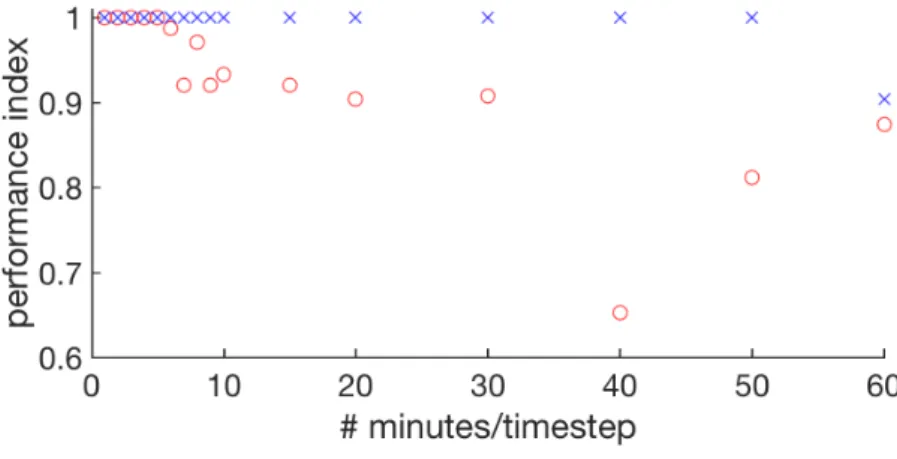
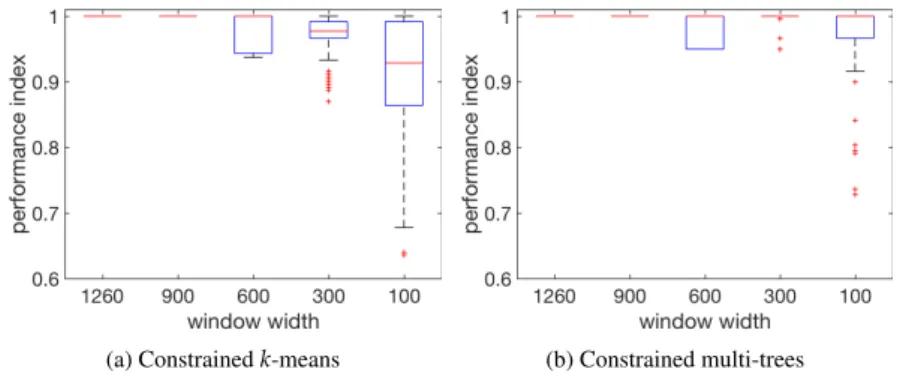
of the clustering, compared to the constrained k-means clustering. Indeed, it takes into account the underlying structure of the low-voltage distribution networks beneath the voltage measurements without a priori knowledge on the topology of the network. Both methods are analysed with real measure-ments from a distribution network in Belgium in order to give insight on how to parametrise them, and generalise their performance in different settings, by varying the ratios of single-phase over three-phase meters in the network, by increasing the period over which the voltages are averaged, etc.
The contributions are four-fold: (i) We propose a novel algorithm using the advantages of both graph theory and correlation to identify the measure-ments that should be linked together and cluster them. (ii) The performance of the algorithm is assessed in comparison to those of a constrainedk-means clustering performed on the voltage measurements. (iii) Unlike previous ref-erences, the algorithms are designed for the specificities of European LV distribution networks. (iv) The algorithms are tested on real measurements from a distribution network in Belgium, in a variety of settings.
This algorithm was detailed in the article:
Frédéric Olivier, Antonio Sutera, Pierre Geurts, Raphaël Fonteneau, Damien Ernst. “Phase identification of smart meters by clustering vol-tage measurements”. In: Proc. of the XX Power Systems Computation Conference (PSCC), Dublin, Ireland, 2018.
3.2
Active network management
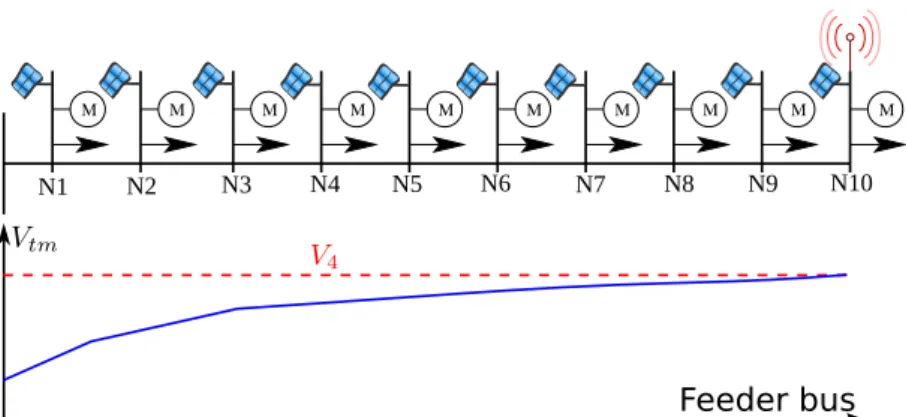
In Chapter 3, a distributed control scheme that changes the active and re-active power injected by PV units into LV DNs is proposed. The objective of the control algorithm is to mitigate overvoltage problems by directing PV units to consume reactive power and, if necessary, to curtail active power generation. The distributed controllers are implemented on the PV inverters with several modes of operation.
First, if there are no overvoltage problems in the LV feeder, the controllers act by preventively adjusting the PV units’ reactive power to avert the oc-currence of overvoltages while performing Maximum Power Point Tracking (MPPT) for active power. In this mode of operation, only local measure-ments are used and no communication among the controllers is needed. Sec-ond, if overvoltage problems occur, the controllers make use of limited com-munication for coordinating their reactive power consumption within each DN LV feeder. Third, if the overvoltage persists, even after all PV units have utilized their maximum reactive capabilities, the controllers switch to active power curtailment. Finally, the fourth and fifth modes of operation restore active and reactive power production to normal operation. The pro-posed scheme is model free, as knowledge of the topology, the parameters or even the PVs’ relative position in the LV feeder is not required by the con-trollers. Moreover, it is robust and fault-tolerant, as the lack of a centralised controller allows for the algorithm to work even if a number of PV units is malfunctioning or not participating.
The main contribution of the proposed scheme is that it does not require a network model or remote measurements, thus making it easy to deploy. Moreover, the use of communication is limited to a distress signal that can
be easily implemented with the use of Power-Line Communication (PLC).16 16Galli, Scaglione, and Z. Wang (“Power
line communications and the smart grid”)
This technology has been exploited for several decades to provide low-cost remote switching capabilities to utilities; one such example is the day/night
tariff signal used in some countries.17 17Carcelle (Power Line Communications in
Practice)
Additionally, it does not require a centralised entity to collect measure-ments, compute set-points and dispatch the PV units. Thus, it is more robust to component failure. Finally, when active power curtailment is required to secure the system, the proposed scheme is designed to proportionally share the burden among all the PV units in the problematic feeder.
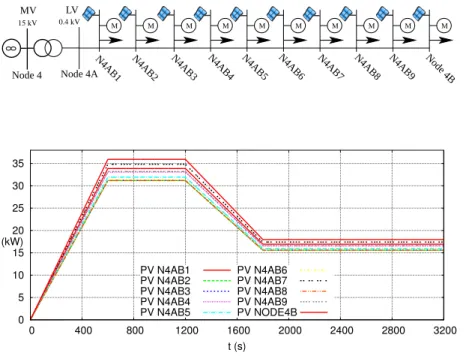
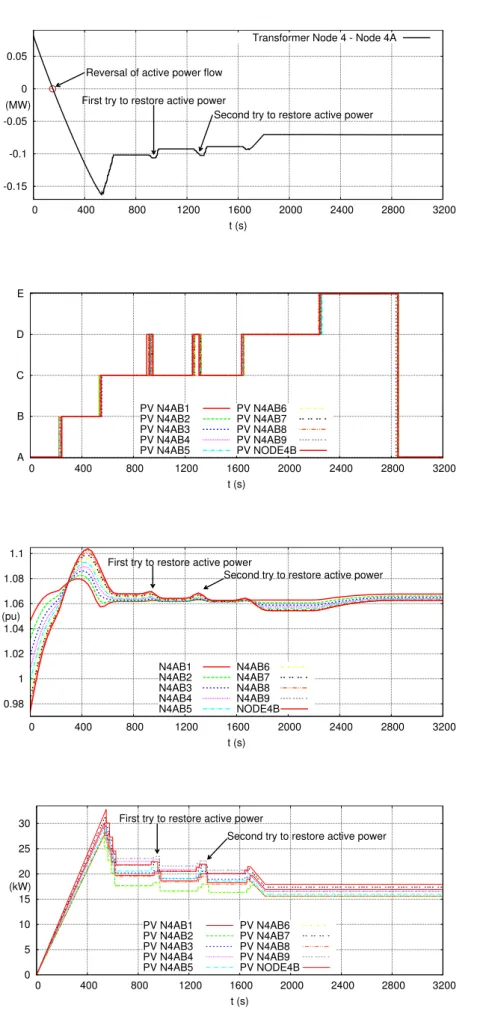
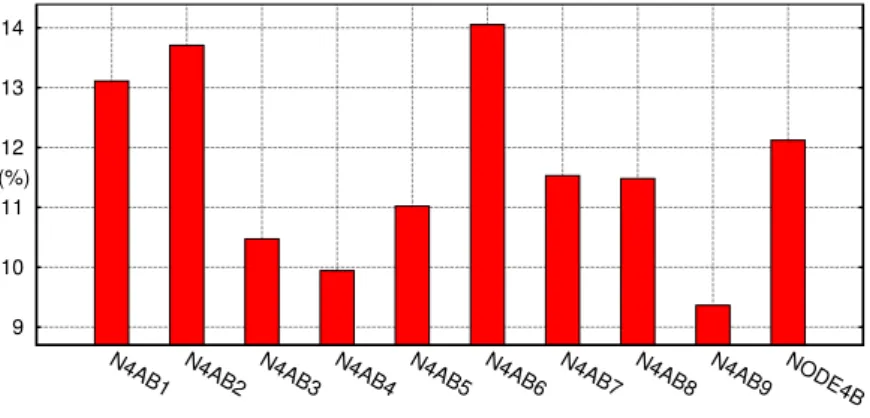
Assuming balanced three-phase network operations, the behaviour of the proposed control scheme is studied first on a single LV feeder and then on a larger network composed of 14 low-voltage feeders. Following, it is com-pared to a centralized OPF-based scheme applied to the same systems. Their performance is assessed based on their ability to alleviate the overvoltage problems and the amount of active power curtailed to achieve this. Both control schemes manage to ensure the security of the system. However, the OPF-based scheme does this with a little less curtailed active power.
The material of this chapter was published in:
Frédéric Olivier, Petros Aristidou, Damien Ernst, Thierry Van Cutsem. “Active management of low-voltage networks for mitigating overvolt-ages due to photovoltaic units”. In: IEEE Transaction on Smart Grid 7.2 (2016), pp. 926-936.
Imbalances can be generally neglected in High Voltage (HV) and Medium Voltage (MV) networks in Europe, so a simplification commonly made, when simulating power systems, is the balanced three-phase operations of the net-work, i.e the currents in the three phases are equal; the three phases are balanced. This hypothesis simplifies the modelling of the system and the analysis of the simulation results. However, imbalances are often present in LV DNs since household appliances and small-scale PV units are usually single phase. So, the hypothesis that the three phases are balanced in LV net-works is questionable but provides a good starting point. Chapter 4 is thus dedicated to the unbalanced operations of LV networks, explicitly taking into account and comprehensively modelling the three phases and the neutral, as well as the coupling between them.
In this chapter, the algorithm of Chapter 3 is extended to be used in unbal-anced phase four-wire distribution networks with single- and/or three-phase inverters. Its key principles remains as follows: (i) it should first make use of reactive power, (ii) it should use active power curtailment as a last resort, (iii) it should only need communication in the form of a distress sig-nal sent throughout the feeder to pool available resources, (iv) it should no require a detailed model of the network.
Using multi-step steady-state simulations, the behaviour of the algorithm is illustrated and its performance compared to that of two other algorithms. The first one is the default on-off behaviour of PV inverters when there is an overvoltage. They momentarily disconnect from the network until they try to restore production back to normal. The second one is based on a three-phase optimal power flow that is solved at each time step. The former represents the easiest solution to implement, whereas the latter is a more evolved scheme,
assuming perfect knowledge of the network, and thus providing a minimum bound on the curtailed energy
Their performances are compared in different PV connection scenarios impact the balance of the network, in terms of curtailed energy, reactive power usage and ohmic losses in the network.
The extension of the algorithm is presented in the article:
Frédéric Olivier, Raphaël Fonteneau, Damien Ernst. “Distributed con-trol of photovoltaic units in unbalanced LV networks to prevent over-voltages”. To be published.
3.3
Implementing active network management
in the form of energy prosumer communities
Chapter 5 presents a way to implement active network management in the form of Electricity Prosumer Communities (EPCs), which are groups of peo-ple producing, sharing and consuming electricity locally. Their members can be considered as prosumers, in the sense that they are both energy consumers and producers. They share resources in order to achieve a community goal. This goal may be related to electricity bills, but it can also be related to the nature of consumed electricity (for instance, maximising the consumption of renewable energy). The objectives that energy prosumers communities should explicitly or implicitly optimise, are related to the consumption of locally produced electricity, i.e. energy produced from renewable resources that is also consumed close to its place of production. Resources can be seen as distributed electricity generation using PV panels, flexibility means, distri-bution storage capacities such as batteries, and generation curtailment for PV units to mitigate possible over-voltages. In the case of a community of houses under the same low-voltage feeder, consuming locally means that when PV panels produce electricity, the power injection in the low-voltage feeder to grid should be avoided or minimised. Energy prosumer communities are a way to perform active network management at the level of an LV feeder: at the same time maximizing the goal of the community and minimizing the occurrence of operational constraints violations, such as overvoltages.
One of the main triggers for the emergence of the concept of energy com-munities is distributed electricity generation: PV units, small wind turbines and Combined Heat and Power (CHP) that may be installed close to con-sumers. In addition to electricity production and storage technology im-provements, one should also mention the emergence of information
tech-nologies facilitating interactions between prosumers18by offering a new way 18J. Wang, Costa, and Cisse (“From
distri-bution feeder to microgrid: an insight on op-portunities and challenges”)
of sharing goods and services. One should also note the existence of projects related to the use of distributed ledgers for managing energy exchanges19 19
Beitollahi and Deconinck (“Peer-to-peer networks applied to power grid”)
between microgrids.20
20See for instance the Brooklyn Microgrid
project.
As an example, a community could organise itself as follows:
1. At every time-step, algorithmic tools (either distributed and / or cen-tralised) should be able to identify which behaviour the community should adopt (consuming, producing, storing, curtailing, etc);
2. Members of the community should be informed in order to process the recommendation and act accordingly (either actively, either automatically);
3. The community should be rewarded for acting in accordance with the recommendation.
In the case of EPCs, our goal is to propose a rigorous mathematical work for studying their behaviour. We first propose a mathematical frame-work for modelling the interactions between several prosumers. We then formalise a few optimisation problems targeting several different objectives (e.g., maximising distributed production, taking losses into account, optimis-ing costs and revenues, etc). We address two ways to target these objectives: centralised and distributed control schemes, and we provide examples for each. In the centralised approach, we propose the design of a community strategy dedicated to the maximisation of the local renewable energy pro-duction by formalising it as an optimal power flow problem (OPF). Then, in the context where we want to minimise community costs, we propose to design a distributed strategy that may still approach community optimality.
To do so, we build upon Fortenbacher’s work21which proposes a centralised 21Fortenbacher, Zellner, and Andersson
(“Optimal sizing and placement of dis-tributed storage in low voltage networks”)
optimal strategy named Forward-Backward Sweep OPF (FBS-OPF). We use time series provided by FBS-OPF solutions to build learning sets in the form (input, output), where input contains only local measurements related to one single prosumer, and whereoutput contains an optimal value that was output by the FBS-OPF for this input configuration. The learning sets are processed by machine learning techniques in order to build regressors able to compute suggestions for any input configuration.
The formalization of EPCs was presented at the 2017 IREP Symposium in Espinho (Portugal) with the article:
Frédéric Olivier, Daniele Marulli, Damien Ernst, Raphaël Fonteneau. “Foreseeing New Control Challenges in Electricity Prosumer Commu-nities”. In: Proc. of the 10th bulk Power Systems Dynamics and Control Symposium (IREP), Espinho, Portugal, 2017.
3.4
Contributions in the Appendix
In addition to the chapters of the main body, this thesis collects four articles in the Appendix.
Chapter A aims at numerically assessing the influence of the modelling of the earth and the connection between the neutral and the earth, in terms of voltages and currents. Indeed, in order to simulate and optimise the be-haviour of LECs in unbalanced networks, the three phases and neutral must be modelled explicitly. The simulations are performed on an existing Bel-gian low-voltage feeder supplying 19 houses which are all equipped with a smart meter measuring the mean voltage, current, and active and reactive power every minute for each phase. The simulations show that the explicit modelling of the earth using Carson’s equations has a moderate effect on the simulation results. In particular, it creates differences in the simulations that are around ten-times smaller than the errors between simulations and measurements. The material of this chapter is detailed in the paper:
Frédéric Olivier, Raphaël Fonteneau, Damien Ernst. “Modelling of three-phase four-wire low-voltage cables taking into account the neutral connection to the earth”. In: Proc. of CIRED Workshop on Microgrids and Local Energy Communities, Ljubljana, Slovenia, 2018.
In Chapter B, the penetration of grid-connected photovoltaic systems is studied, experimentally tested and compared to simulation results. In partic-ular, how the reverse current flow and imbalance situations affect the voltage in the low-voltage grid. A test platform has been developed for obtaining ex-perimental results with grid-tied commercial inverters. Photovoltaic arrays are emulated and subjected to different irradiance profiles and the inverters are controlled to produce under different power conditions. An electrical model has been developed in order to reproduce the same operating con-ditions and working environment. The simulations are performed with the software PowerFactory and the results compared to the experimental ones. The results were presented in the article:
Ramón López-Erauskin, Johan Gyselinck, Frédéric Olivier, Damien Ernst, María-Emilia Hervás, Alexis Fabre. “Modelling and emulation of an unbalanced LV feeder with photovoltaic inverters”. In: Proc. of the 8th IEEE Benelux Young researchers symposium in Electrical Power Engineering, Eindhoven, The Netherlands, 2016.
Focusing on the flexibility aspect of DERs, in Chapter C, we studied dif-ferent possibilities to organise exchanges of flexibility within a distribution system at the medium voltage level. Such a possibility is called an interac-tion model. The DSIMA (Distribuinterac-tion System Interacinterac-tion Model Analysis) testbed allows one to compare quantitatively candidate interaction models by simulating a distribution system with actors taking decisions to maximise their own profit or minimise their costs. The original testbed focused on es-tablishing the procedures to exchange information between actors and used a network flow model considering only active power. This paper extends DSIMA with a linear approximation of the power flow equations, the line limits, and the voltage constraints. This linear flow model is compared to a network flow model through the simulation of three different interaction models governing the exchange of flexibility services within a Belgian power distribution system. Results show that changing the network model may sig-nificantly impact the quantitative results obtained from the simulations. The material of this chapter was presented at the 2018 ISGT Conference in Wash-ington (USA) with the paper:
Sébastien Mathieu, Frédéric Olivier, Damien Ernst, Bertrand Cornélusse. “Effect of voltage constraints on the exchange of flexibility services in distribution networks”. In: Proc. of the 9th Conference on Innova-tive Smart Grid Technology North America (ISGT), Washington, USA, 2018.
Finally, since the emergence of electric vehicles (EVs), combined with the rise of renewable energy production capacities, will strongly impact the way electricity is produced, distributed and consumed, Chapter D focuses on the problem of dispatching a fleet of electric vehicles in order to match,
at best, the harvesting of local, renewable energy. The combination of (mo-bile) EVs and (static) electricity sources is modelled as a multi-agent system, where mobile agents (the EVs) should gather, at best, renewable energy un-der travel distance and electricity production fluctuation constraints. The chapter exposes how a mobile application may offer an efficient solution for addressing this problem. Such an app would play two main roles: Firstly, it would incite and help people to play a more active role in the energy sec-tor by allowing PV unit owners to sell their electrical production directly to consumers. Secondly, it would help distribution system operators to more efficiently modulate the load due to the EV deployment by allowing them to influence EV charging behaviour in real time. It advocates for the introduc-tion of a two-sided market-type model between EV drivers and electricity producers. The material of this chapter was presented at the 2017 ICAART Conference with the article:
Antoine Dubois, Antoine Wehenkel, Raphael Fonteneau, Frédéric Olivier, Damien Ernst. “An app-based algorithmic approach for harvesting local and renewable energy using electric vehicles”. In: Proc. of the 9th In-ternational Conference on Agents and Artificial Intelligence (ICAART), Porto, Portugal, 2017.
Automatic phase identification
of smart meter measurement data
This paper highlights the importance of the knowledge of the phase identifi-cation for the different measurement points inside a low-voltage distribution network. Besides considering existing solutions, we propose a novel method for identifying the phases of the measurement devices, based exclusively on voltage measurement correlation. It relies on graph theory and the notion of maximum spanning tree. It has been tested on a real Belgian LV network, first with simulated unbalanced voltage for which it managed to correctly identify the phases of all measurement points, second, on preliminary data from a real measurement campaign for which it shows encouraging results.
1
Introduction
PR E M A S O L is a project which aims a predicting, analysing and control-ling photovoltaic production in low-voltage distribution networks. Within the framework of this project, a measurement campaign is ongoing in a sub-urban low-voltage (LV) distribution network in Belgium. Each house is equipped with a smart meter measuring the voltages, the currents, the active and reactive power of the three phases. This measurement campaign has two goals: (i) The first goal is to validate the modelling that has been developed in a LV distribution system analysis tool. The active and reactive powers will be used as input and the resulting voltages will be compared to the measured ones. (ii) Another goal is for the distribution system operator (DSO) to gain insight on the three phase power flows inside its networks. Since all mea-surements are three-phase, it is critical to be able to associate each of them to a physical phase of the network. However, this information may not be easily available depending on the technology used to transfer the data from the smart meters. Several solutions exist and will be discussed. However, none of them suited our requirements. As result, in this paper, we propose a methodology for automatically pairing the phases of any number of mea-surement devices with those of the network, solely using meamea-surement data. The paper is organized as follows. We first discuss the importance of being able to identify the phases of the smart meters. We then formalize the phase identification problem, shortly introduce the existing solutions, and describe our methodology. We finally provide an illustration of our method using both pseudo-measurements generated for the purpose of this study and real smart
meter data. On the importance of phase information When a measurement device — smart meter or other — is placed in a low-voltage distribution net-work, it is critical to know to which phase of the network the three phase measurements correspond. This information is crucial for multiple reasons: In the absence of the latter, (i) phase measurements such as line to neutral voltage cannot be used to identify key features of the network. For example, it is impossible to display a voltage profile of the feeder for each phase. (ii) It is not possible to know from the measurements which phase of the net-work is the most loaded and how the DSO can better balance its netnet-work by changing the phases at customer place. This can help to increase the hosting capacity of a LV network with high penetration of photovoltaic (PV)
pan-els1by mitigating the overvoltages that cause PV inverters to disconnect and 1Walling et al. (“Summary of distributed
re-sources impact on power delivery systems”)
induce a loss of earnings for the owner.2 (iii) For research purposes, it is 2
Olivier, Aristidou, et al. (“Active manage-ment of low-voltage networks for mitigating overvoltages due to photovoltaic units”)
impossible to properly use the measurement to perform load flow on a model of the network and compare the resulting voltages.
2
The phase identification problem
For the purpose of explaining the phase identification problem, we will de-noteNA,NBandNCthe phases of the network andMiA,MiBandMiCthe
phases of the measurement deviceMi. We already have established that the
identity pairingNA−MiA,NB−MiBandNC−MiCcannot be guaranteed
because it depends on the connection of the cables of the smart meter and of the cables between the network and the house, an information not in the possession of the DSO of the network. The goal of the phase identification problem is, for each measurement point, to uniquely associate one phase of the measurements to one phase of the network. Since the reference is rel-ative, the problem consists in clustering all the phase of the measurement points in three groups and then arbitrarily deciding which one corresponds toNA,NBorNC.
3
Existing solutions
Different approaches can be used to solve the phase identification problem.
3.1
Smart meters with PLC capabilities
To begin with, the measurements of the smart meter can be repatriated thanks to Power Line Communication (PLC). In such a case, the measurements are gathered at the secondary substation and PLC can be used to directly identify the measured phases for each smart meter. The smart meter sends a different signal on each phase, a signal that is then used by the receiver to find the matching between it and the smart meter.
3.2
Phase identifiers
The second solution is to use a specific device which is based on GPS timing signals to compare the phase of an unknown voltage to a phase reference at the same instant of time. For this purpose, a base station is connected
to a known phase, for example at the distribution transformer. A techni-cian then proceeds to the phase identification of each house by reading the phase shift between the phase reference and the phase of the voltages at the smart meter. Examples of such phase identification devices are the “Phase ID 6000” by Power Systems Integrity, the “PVS 100i” by Megger or the “Phase Identifier” from Orgo Corporation. The drawbacks are their cost and the manpower required to perform the identification. Moreover, this opera-tion requires access to smart meters located inside houses, which depends on customer availability.
4
Motivations for an alternative
For the present application, one would certainly advise in favour of the de-ployment of PLC-enabled smart meters to repatriate the data. However, there exists several cases where this is not a viable option:
1. The technical infrastructure is already up and running and does not use PLC (e.g. GPRS).
2. The measurement devices are not smart meters but mobile measurement devices storing data in a local memory that has to be manually harvested, such as PQ boxes.
3. The measurements to be analysed are from previous measurement cam-paigns and no record of the phases has been included.
This highlights the need for an alternative. Two directions oppose each other: one based on equipment and man power, the other based on the analysis of the measurements themselves, which is the topic of this paper. Of course, the two are not mutually exclusive and the solution chosen by DSOs will most likely be based on their financial appeal. In that regard, the proposed method should be of interest as it can be significantly cheaper. This situation was observed within the PR E M A S O Lproject. One of the partners specialises in
photovoltaic monitoring and already possesses an infrastructure to repatriate data through GPRS so this option was favoured over PLC. Moreover, the DSO wanted a less expensive solution than to invest in phase identification equipment and dedicate manpower to this task. In this paper, we propose an alternative based on the measurements and the unbalanced nature of the power flow inside the networks, to cluster the measurements by phase using
correlation. Although time-series clustering is a well-studied problem,3 it 3Warren Liao (“Clustering of time series
data—a survey”)
has, to the best of our knowledge, never been applied to the phase identifica-tion problem.
5
Assumptions
The methodology is designed for unbalanced three-phase low-voltage distri-bution networks where houses have a smart meter — and/or where mobile measurement devices are placed — measuring phase-to-neutral voltages for each phase. We also assume that the measurements are synchronized and have the same sampling period of at least one minute to be able to capture the voltages variations. “Averaging data over periods longer than a minute
is shown to under-estimate the proportions of both [electricity] export and
import.”4 4Wright and Firth (“The nature of domestic
electricity-loads and effects of time averag-ing on statistics and on-site generation cal-culations”)
6
The identification algorithm
The key idea on which the identification algorithm relies is that LV distri-bution networks are intrinsically unbalanced. Indeed, house appliances are mainly single phase. This unbalanced load creates an unbalance in voltages which can be used to cluster the measurements, phase by phase. The algo-rithm relies on graph theory, more specifically on the notion of a maximum spanning tree (MST), to select the pairings that will maximize the correla-tion between the voltages of the nodes. Using graph theory and maximum spanning trees comes naturally since any electrical network can be viewed as graph where nodes are buses and branch electrical lines, and distribution networks are usually operated in a radial fashion, so they can be viewed as trees. The different steps of the algorithm are the selection of the data, the creation of a complete graph where the branches are weighted by a correla-tion coefficient, and the seleccorrela-tion of the most relevant branches by a maxi-mizing spanning tree algorithm. The algorithm ends with the clustering of the measurements into three groups. The next subsections discuss these steps in more detail.
6.1
Selecting a time window for the data
First, a time window is selected; for example, one day, and to each measure-ment point three voltage time series are associated, one for each phase-to-neutral voltage.
6.2
Creating the graph
Let us define a pairing between a measurementMiand a measurementMj as a set of two mappings: a mapping from the three phases of Mi to the
three phases ofMj, and an associated mapping from the three phases ofMj
to three phases of Mi. Given that there are three phases, there are at most
3! = 6 different sets of pairings, detailed in Table 1.1. Pairing 1 Mi A−MjA MiB−MBj MCi −MCj Pairing 2 Mi A−MjA MiB−MjC MCi −MjB Pairing 3 Mi A−MBj MiB−MjA MCi −MCj Pairing 4 MiA−MBj MiB−MjC MiC−MjA Pairing 5 Mi A−MjC MiB−MjA MCi −MjB Pairing 6 Mi A−MjC MiB−MBj MiC−MjA
Table 1.1: Different pairings between the measurements triplets ofMiandMj.
At this point, it can be noted that pairings 1 to 3, and 6, are symmetrical in the sense that the two associated mappings are identical. This is not the case for pairings 4 and 5: pairing 4 becomes pairing 5 and vice versa.
The next step of the algorithm is the creation of a complete graph where each node is connected to all the others. It means that, for a graph with n nodes, there aren(n−1)/2 branches. For each branch and its two end nodes, there are 6 different possible pairings as defined above. For each pairing, the
sum of the correlation coefficients between the three pairs of voltage time series is computed. For example, the correlation coefficient for the first and second pairing are computed in Equations (1.1) and (1.2).
ρ1i,j= corr(MiA, MjA) + corr(MBi, MjB) + corr(MCi, MjC) (1.1) ρ2i,j= corr(MiA, MjA) + corr(MBi, MjC) + corr(MiC, MBj) (1.2)
The same formula can be applied for the other pairings. Pearson’s measure is used is assess the correlation between the time series:
corr(X, Y) = ∑Tt=1(Xt− ¯X) (Yt− ¯Y) q ∑Tt=1(Xt− ¯X)2 q ∑Tt=1(Yt− ¯Y)2 (1.3) whereX and Y are to time series of length T with a mean value of ¯X and ¯Y. Each branch of the graph represents the pairing that results in the maxi-mum correlation coefficient, the weight of the branch being this maximaxi-mum coefficient.
wi,j= max(ρi,j1 , ρi,j2, ρ3i,j, ρi,j4, ρi,j5, ρi,j6) (1.4)
When storing the information on the pairing that maximizes correlation be-tween two nodes, it is important to have a data structure that can differentiate between the two directions the branch can be traversed, because, as explained above, pairing 4 in one direction is pairing 5 in the other.
6.3
Finding the maximum spanning tree
Next, the Prim algorithm5is used to find the maximum spanning tree of the 5Prim (“Shortest connection networks and
some generalizations”)
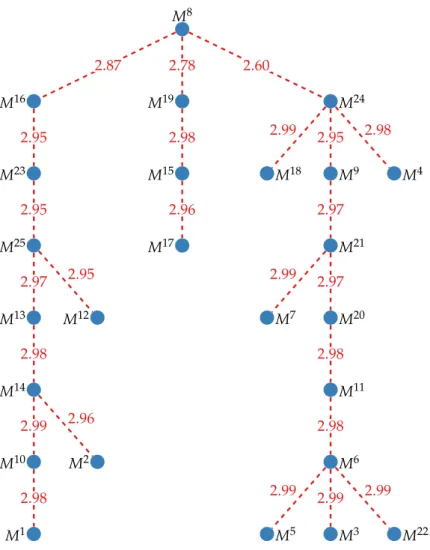
complete graph. It selects the edges that will bring the maximum total corre-lation between the nodes. The result is a tree where each branch represents the pairing which must be used to link measurements from the parent node to the child node. By using a tree, we ensure that there is no cycle inside the network and that there is only one possible succession of pairings from one node to any other.
6.4
Selecting the reference and clustering the phases
Once the tree is computed, we know how the phases of two adjacent nodes are paired, but this information is relative to the phases of the parent. The final step is to select a reference node to start from, and to traverse the entire tree structure, from parent to children, applying the pairing of each branch to uniquely select which cluster each phase measurements belongs to. The final results of the algorithm are three sets,CA,CBandCCwhere, for example,
CA={M1A, M2B, M3B, ...} (1.5)
CB={M1B, M2A, M3C, ...} (1.6)
CC={MC1, M2C, M3A, ...} (1.7)
that can be arbitrarily associated to the phases of the network N1, NB and
6.5
Including information on the topology of the distribution
net-work
If more information on the structure of the electrical network is available, it can be used to reduce the number of branches from the complete graph. If nodes are far apart and on different feeders, the branch linking them can be discarded, reducing the number of edges and thus simplifying the resolution of the maximum spanning tree problem. One extreme option could be to directly define the tree by linking the nodes that are closest to each other, thus eliminating the need for the maximum spanning tree step. However, it is obviously not recommended because this eliminates a powerful step of the algorithm which can restructure the network based on correlation. For exam-ple, if measurement data were corrupted or if one house was associated with the wrong feeder, the algorithm will be able to circumvent those errors. Fi-nally, it would be a strong shortcut to assume that the closer the measurement points are geographically, the stronger the correlation between the voltages as voltage variations are mainly due to the line impedance. So, we advise the reader to suppress branches with parsimony and only those that are without doubt irrelevant.
7
Test network
The test network used for this study is an existing Belgian low-voltage dis-tribution network, composed of three feeders made with underground cables of the type EVAVB-F2 3x95 + 1x50. It is located in a suburban area and
has been modelled according to Ciric’s work6 based on the data provided 6Ciric, Feltrin, and L. Ochoa (“Power flow
in four-wire distribution networks-general approach”)
by the DSO (topology, line length, cable type, etc.). Detailed unbalanced three-phase four-wire modelling of the network has been used.
7.1
Model for the dwellings: load and photovoltaic units
The network is composed of 32 houses, all of which have a three-phase 400/230 V connection of various length with a cable of type EXAVB 4x10. Five of these houses are equipped with photovoltaic units. The energy con-sumption of the house is modelled using concon-sumption profiles created with
Widen’s tool.7 Several alterations have been made to the code created by 7Widén and Wäckelgård (“A
high-resolution stochastic model of domestic activity patterns and electricity demand”)
Widén and Wäckelgård in order to allow the creation of unbalanced load pro-files. First, the appliances have been classified as single phase or three phase. Each single-phase appliance has been allocated to one of three groups based on good practice, trying to balance the load in each group as optimally as possible. Each time the profile generator is run, appliances are clustered in the same groups, however, the clusters are randomly allocated to a specific phase. At this point, rather than calculate the sum of the consumption of all appliances, appliance consumptions are summed phase by phase, adding one third of the three-phase appliances. An example of a load profile can be seen in Figure 1.1.
The production of the photovoltaic panels is based on the production of a typical photovoltaic unit in Belgium, scaled with respect to the peak power of each unit. The consumption and production profile have been generated for an arbitrarily chosen day: Thursday, the 5th of May, 2016.
00:00 03:00 06:00 09:00 12:00 15:00 18:00 21:00 0 1 000 2 000 3 000 4 000 Time Activ e p ow er [W] Phase A Phase B Phase C
Figure 1.1: Example of an unbalanced load profile.
7.2
Model for the medium voltage network
The medium voltage network is modelled as a Thevenin equivalent. The phase-to-phase voltage of the equivalent is fixed at 420 V and the impedance at0.0059 + j·0.0094 Ω.
7.3
Pseudo-measurement generation
An unbalanced load flow algorithm8implemented in Python is used to com- 8Ciric, Feltrin, and L. Ochoa (“Power flow
in four-wire distribution networks-general approach”)
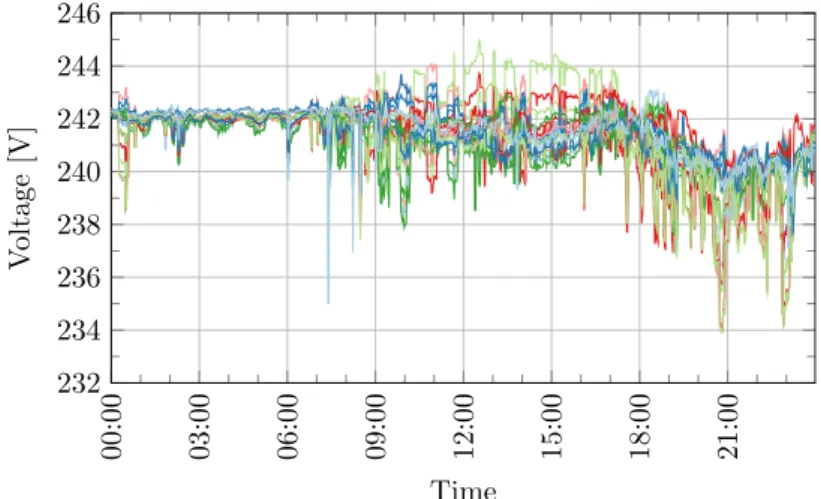
pute the currents in the lines and the voltages at each node with a resolution of 1 minute to capture the variability of the loads. The three phase-to-neutral voltages at the bus where a house is connected are exported so that they can be used in the next step. Such voltages are displayed in Figure 1.2 for mea-surement pointM25. 00:00 03:00 06:00 09:00 12:00 15:00 18:00 21:00 234 236 238 240 242 244 Time V oltage [V] Phase A Phase B Phase C
Figure 1.2: Voltages for measurement point M25.
8
Results
The algorithm was implemented in Matlab. To compute the maximum span-ning tree, the Prim algorithm (minimum spanspan-ning tree) is used with the op-posite of the branches’ weight.