La stigmatisation reliée à la déficience auditive
par
Kenneth Southall
École d’orthophonie et d’audiologie Faculté de Médecine
Thèse présentée à la Faculté de Médecine
en vue de l’obtention du grade de Philosophiae Doctor (Ph.D.) en Sciences biomédicales
juillet, 2010
Faculté des études supérieures et postdoctorales
Cette thèse intitulée :
La stigmatisation reliée à la déficience auditive
Présentée par: Kenneth Southall
a été évaluée par un jury composé des personnes suivantes :
Jacqueline Rousseau, président-rapporteur Jean-Pierre Gagné, directeur de recherche
Tony Leroux, co-directeur Alain Legault, membre du jury Lesley Jones, examinateur externe Louise Getty, représentant du doyen de la FES
Résumé
Certaines personnes peuvent être stigmatisées quand elles présentent un attribut relié à une identité sociale qui est dénigrée dans un contexte particulier. Il existe plusieurs stéréotypes au sujet des personnes qui ont une perte d'audition. Le grand public associe souvent la perte d'audition à des comportements indésirables, au vieillissement et à une capacité intellectuelle réduite. Ces stéréotypes affectent négativement la participation des personnes ayant une perte auditive à diverses activités. Malgré les impacts évidents et importants que la stigmatisation a sur la participation sociale des personnes ayant une perte auditive et leur propension à recourir aux services de réadaptation, on constate une pénurie relative de recherche sur le stigmate lié à la perte d'audition.
Ces dernières années, les chercheurs en sciences sociales ont fait de grands pas pour conceptualiser le stigmate selon la perspective des personnes qui sont la cible des attitudes nuisibles. La plupart de ces concepts peuvent s'appliquer au stigmate social lié à la perte d'audition. Le premier article de cette thèse tente de placer le stigmate lié à la perte d'audition dans un modèle de menace à l’identité induite par le stigmate (stigma-induced identity threat model). Ce chapitre explore comment les services pourraient être modifiés pour mieux soutenir les individus qui montrent des signes que leur identité personnelle est compromise à cause de leur perte d'audition. De façon générale, les buts de ce manuscrit sont a) de dresser un bref résumé de la question du stigmate lié à la perte d'audition ; b) de présenter un modèle spécifique de menace d'identité induite par le stigmate et d’incorporer des notions propres au stigmate lié à la perte d'audition à cette conceptualisation générale du stigmate et c) de réfléchir sur la pertinence de ce modèle pour la réadaptation audiologique.
L'intention de la deuxième étude est de mieux comprendre comment le stigmate affecte les comportements de recherche d’aide des adultes ayant une perte d'audition acquise. Dix personnes ayant une perte d'audition, et appartenant à des groupes de soutien par les pairs ont participé à des entrevues semi-structurées audio-enregistrées. Les
transcriptions de ces entrevues ont été analysées au moyen d’analyses thématiques. Les analyses ont indiqué que les répondants montre une plus grande propension à chercher de l'aide à la suite d’étapes charnières, où l’équilibre entre le stress négatif et l'énergie positive était rompu : a) un moment où le stress était de loin supérieur à l'énergie positive (première étape charnière) et b) un moment où l'énergie positive était de loin supérieure au stress négatif (deuxième étape charnière). On propose une série de représentations graphiques qui dépeignent comment les influences positives et négatives présentes dans l'environnement social et physique du répondant influencent la recherche d'aide.
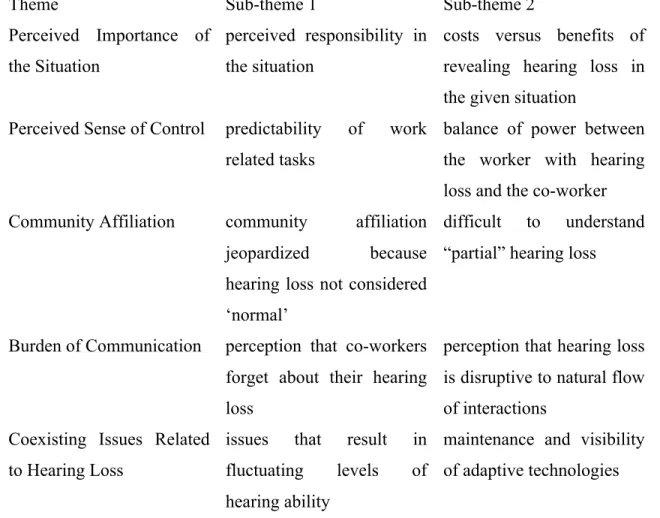
Le but de la troisième étude est d'identifier les facteurs qui amènent des individus à cacher ou révéler leur perte d'audition dans leur lieu de travail. Des entrevues semi-structurées ont été menées en utilisant une technique d’élicitation par photographies pour susciter des informations liées à la révélation de la perte d'audition. Les thèmes dégagés des entrevues incluent : l'importance perçue de la situation, la perception du sentiment de contrôle, l'affiliation à la communauté, le fardeau de communication et la présence de problèmes connexes à la perte d'audition. Les résultats de cette étude offrent un aperçu du monde caché des travailleurs ayant une perte d'audition. Cette étude sert à documenter certaines stratégies que les travailleurs avec une perte d'audition utilisent pour contrôler leur identité professionnelle et, plus spécifiquement, comment certains gèrent le dévoilement de leur perte d'audition dans leur lieu de travail. Les résultats fournissent des informations utiles pour le développement de programmes d'intervention appropriés pour des travailleurs ayant une perte d'audition.
Mots-clés : déficience auditive acquise, stigmatisation, menace à l’identité induite par le stigmate, stéréotypes, préjudices, discrimination, travail, dissimulation, dévoilement, recherche qualitative, élicitation par photographies.
Abstract
Individuals are stigmatized when they possess, or are thought to possess, an attribute or characteristic that conveys a social identity that is devalued in a particular social context. There are several stereotypes, or commonly held (often erroneous) beliefs about people who have hearing loss. The general public often associate people with hearing loss to undesirable behaviours, ageing, and reduced intellect. Stereotypes such as these negatively impact upon activities of daily living engaged in by people with hearing loss. In spite of the obvious and important impacts that stigma has on social participation and inclination to use rehabilitative strategies, there has been a relative dearth of research on the stigma associated with hearing loss.
In recent years, researchers in the social sciences have made great strides to conceptualize “stigma” from the perspective of people who are the target of prejudicial attitudes. Most of these concepts are applicable to the social stigma associated with hearing loss. The first study presented in this dissertation attempts to position hearing loss stigma within a model of stigma-induced identity threat. Overall, the goals of this paper are to a) offer a brief summary of hearing loss stigma; b) present a specific stigma identity threat model and incorporate ideas about hearing loss stigma into this general conceptualization of stigma; and c) reflect on the appropriateness of this model for the domain of rehabilitative audiology.
The intent of the second study was to better understand how stigma impacted upon the help-seeking activities of adults with an acquired hearing loss. Ten people who had hearing loss, and were members of peer-support groups participated in audio-recorded semi-structured interviews. Thematic analyses of verbatim transcripts revealed that respondents experienced a heightened propensity to seek help following Critical Junctures,
when negative stress and positive energy were out of balance: 1) a time when negative stress far outweighed positive energy (i.e., Critical Juncture One); and 2) a time when positive energy far outweighed negative stress (i.e., Critical juncture Two). A series of graphic representations are proposed that depict how positive and negative influences found in the respondent’s social and physical environment influenced help seeking.
The purpose of the third study was to identify the factors that lead individuals to conceal or disclose their hearing loss in the workplace. We conducted semi-structured interviews using a photo-elicitation technique to aid in probing issues related to disclosure of hearing loss. Emergent themes included: Perceived importance of the situation, Perceived sense of control, Community affiliation, Burden of Communication and Coexisting issues related to hearing loss. This study serves to document some of the ways that workers with hearing loss manage their workplace identity, and more specifically, how some people manage revealing their hearing loss in workplace settings. The findings also inform the development of pertinent intervention programs for workers with hearing loss.
Keywords : hearing loss, acquired hearing loss, stigma, stigmatization, stigma-induced identity threat, stereotypes, prejudice, discrimination, help seeking, peer-support, work, workplace, concealment, disclosure, qualitative research, qualitative description, photo elicitation
Table of contents
Introduction...1
Literature review ...2
Definitions of stigma...3
Dimensions of stigmas ...5
The nature of hearing loss stigma ...6
Individuals with hearing loss ...7
Identification with disability and age...8
Conceptualizations of the stigmatization process ...11
Stigma from a socio-cognitive perspective...12
Stigma from a sociological perspective ...13
Overview of dissertation organization ...15
Chapter One: Article 1 - The application of stigma-induced identity threat to individuals with hearing loss ...17
Background ...20
Hearing loss stigma ...22
Model of stigma-induced identity threat ...24
Collective representations ...26
Situational cues ...28
Personal characteristics ...29
Identity threat appraisals ...30
Coping responses...31 Volitional responses...31 Nonvolitional responses...33 Outcomes...34 Self-esteem...34 Communication satisfaction...35
Implications for practice ...36
References...41
Chapter Two: Methodology ...47
Qualitative description ...48
Personal beliefs and characteristics that shaped methodological design ...49
Sampling ...50
Data collection ...52
Data analysis and presentation...54
Chapter Three: Article 2 - Stigma: a negative and a positive influence on help-seeking for adults with acquired hearing loss ...59
Introduction...62
Definitions...62
Stigma-induced identity threat model ...63
The stigma associated with hearing loss acquired in adulthood ...65
Methodology ...68
Results...74
A gradual build-up of negative stress...74
Critical Juncture One – mounting losses lead to unmanageable stress and an abrupt intensification of the need to seek help ...76
Mounting losses ...76
Unmanageable stress and an abrupt intensification of the need to seek help ...78
Critical Juncture Two – build-up of positive energy initiates involvement in peer-support group and transformation ...80
Discussion ...83
Limitations ...88
Clinical implications ...88
References...90 Chapter Four: Article 3 - Factors that influence disclosure of hearing loss in the workplace
Introduction...100
Workplace challenges confronted by people with hearing loss ...101
Accommodations for workers who have hearing loss ...103
The stigma associated with hearing loss ...103
Methods...108
The respondents...109
Data collection...110
Data preparation and analyses...112
Findings...114
Theme 1: Perceived importance of the situation...115
Perceived responsibility in the situation ...115
Costs versus benefits of revealing hearing loss in the given situation...116
Theme 2. Perceived sense of control...116
Predictability of work related tasks...117
Balance of power between the worker with hearing loss and the co-worker ...118
Theme 3. Community affiliation...119
Community affiliation jeopardized because hearing loss not considered ‘normal’119 Difficult to understand “partial” hearing loss ...120
Theme 4. Burden of communication...121
Perception that co-workers forget about their hearing loss...121
Perception that hearing loss is disruptive to natural flow of interactions ...122
Theme 5. Coexisting issues related to hearing loss...123
Issues that result in fluctuating levels of hearing ability...123
Adaptive technologies and other accommodations...124
Discussion ...125
Clinical implications ...129
Conclusion ...132
References...133
Practical/clinical implications ...150
Avenues for future research ...152
Discussion of methodological choices...154
Conclusion ...156
Bibliography...158
Appendix 1: Consent form – article 2... i
Appendix 2 : Consent form – article 3... vi
Appendix 3: Workplace questionnaire... xiv
Appendix 4: Codes, definitions and representative excerpts – article 2 ... xvii
List of tables
Table 1: Interview guide – article 2………....70 Table 2: Interview guide – article 3………..110 Table 3: Themes and Sub-themes arising from the content analysis………113
List of figures
Model of stigma-induced identity threat ……….24 Representative Scales ………..………83
Acknowledgements
I am grateful to my supervisors Jean-Pierre Gagné and Tony Leroux for the support and guidance provided to me over my Master’s thesis and doctoral dissertation. Both have been enthusiastic, encouraging, and generous mentors. I would also like to express my appreciation to Dr. Mary Beth Jennings for the support she provided to me.
I wish to thank the trainees and mentors of the CIHR training grant on
communication and social interaction in healthy aging (03-08). In particular I would like to express my appreciation to Dr. Bruce Schneider for heading up this group.
I would like to express my gratitude to all of the staff at Centre de recherche – Institut universitaire de gériatrie de Montréal. In particular, thank you to Sylvie Bouchard and the staff of the Institute Library.
I also want to thank Dr. Lisa Given for the important role she has played in my development as a qualitative researcher. My discussions with her are always enriching and enjoyable.
I am grateful to all of the research participants who were interviewed during this research. It was a pleasure and a privilege to listen to their stories.
Finally, I wish to express my deep gratitude to Natacha. Her love, understanding and support have made my studies possible.
Introduction
The purpose of this dissertation is to characterize and better understand how people with acquired hearing loss adapt to and manage this chronic disability in light of challenges presented by social and self-stigma1. Over the past fifty years, there have been noteworthy changes in the way social psychologists view the stigmatization process (Dovidio, Major, & Crocker, 2000). While it was once assumed that people who stigmatize others suffered from innate or subconscious turmoil, it is now thought that stigmatization is an unfortunate albeit natural result of normal cognitive processes and interpretation of social experience. Similarly, the understanding of people who are stigmatized has evolved. Social scientists once believed that possessing a stigmatizing trait invariably led to a range of negative consequences. However, current thinking suggests that people who are stigmatized cope with episodes of stigmatization similar to the way individuals who do not possess a stigmatizing trait experience any other psychological threat (Crocker, Major, & Steele, 1998; Miller & Major, 2000). Based on this new information, the primary aims of this dissertation are to present a contemporary perspective of the stigma process, and to examine the appropriateness of this model when it is applied to the case of help-seeking for hearing difficulties, and to the case of disclosing hearing loss in the workplace.
1 It is important to note the differences between: individuals who acquire a hearing loss in
adulthood; and those individuals who are born deaf, who have a profound hearing loss, who may use sign language (i.e., the culturally Deaf).
Literature review
The objectives of this chapter are to familiarize readers with the basic concepts of stigma, and its manifestations in people who have hearing loss. First, several of the most influential definitions of stigma are presented, and key dimensions of stigma are outlined. Next, is a description of some of the historical stereotypes assigned to people who are deaf and speculate on how these may influence the experiences of people who have hearing loss. That is followed by the presentation of two identity integration models (one for adaptations following onset of disability, and one specific to changes that come with age) that help us understand how self-concept contributes to the experience of stigma. And finally, two models of stigmatization are outlined: one model that originated with social psychologists who asserted that coping with stigma is very similar to coping with stress; and one model that emphasizes sociological influences on the stigmatization process.
Definitions of stigma
Individuals are stigmatized when they possess, or are thought to possess, an attribute or characteristic that conveys a social identity that is devalued in a particular social context (Crocker, et al., 1998). Stigmas are a complex and multifaceted phenomenon. In Erving Goffman’s essay Notes on the management of a spoiled identity, the author defined stigma as “an attribute that is deeply discrediting” that reduces the individual “from a whole and usual person to a tainted, discounted one” (p.3: Goffman, 1963). It is generally agreed that stigmatization may occur when two groups of people exist: insiders (people who have a stigmatizing trait); and outsiders (people who do not have this trait). When the outsiders (i.e., the governing group) perceive a trait to be stigmatizing, they might devalue, prejudice and discriminate against the insiders (Dovidio, et al., 2000; Heatherton, Kleck, Hebl, & Hull, 2000). Stigmatization can affect the cognition and behaviours of the insiders, and can
figure into the evolution of the self-identity of people who possess stigmatizing traits (Dovidio, et al., 2000; Miller & Major, 2000).
Among stigma theorists, there is a general consensus that stigma is a social construction (Crocker, et al., 1998; Dovidio, et al., 2000; Goffman, 1963). The social and physical environments, as well as macro-level socio-political factors determine which traits are perceived to be stigmatizing (Link & Phelan, 1999, 2001). According to Goffman (1963), the relationship between a trait and a stereotype is at the root of stigmatization. It is in social settings that the requisite “relationship between an attribute and a stereotype” is established. Goffman spoke of a discrepancy between one’s “virtual social identity” (how a person is viewed by society) and their “actual social identity” (how a person views himself or herself) (p.2: Goffman, 1963). Social stigma (sometimes referred to as public stigma) occurs when the general public reacts to a group of people based on stigmatizing attributes about that group (Watson, Corrigan, Larson, & Sells, 2007). Jones, Farina, Hastorf, Miller, and Scott (1984) generally supported Goffman’s assertion that social environments define what is stigmatizing, and the circumstantial and situational factors inherent to social settings impact upon stigma. Notably however, Jones et al. expanded upon Goffman, by suggesting that stigma sometimes results in an individual who possesses stigmatizing traits devaluing himself or herself, something that is now referred to as self-stigma (Major & O'Brien, 2005). Self-stigma occurs when individuals who are members of a stigmatized group turn against themselves by directing prejudicial attitudes inward (Watson, et al., 2007).
Dimensions of stigmas
Goffman (1963) proposed a taxonomy of stigmas: “abominations of the body” (e.g., amputated limbs), “blemishes of individual character” (e.g., ex-convicts), and “tribal identities” (e.g., some religious belief systems). Stigmatizing marks or attributes of this kind brought discredit to individuals who possess them (Goffman, 1963). Jones et al (1984) identified six key dimensions of stigmas. Several of the dimensions identified by Jones et al. are particularly relevant to the stigma associated with hearing loss. Concealability refers to the extent to which a stigmatizing trait is apparent to others. As many authors have reported, the presence of hearing loss is often concealable to others (Gagné, Southall, & Jennings, 2009; Hétu, 1996). The course of the mark refers to the possibility that the attribute may become more prominent over time. Hearing loss acquired in adulthood most often starts out concealable, and becomes more prominent (depending on the extent to which the individual is successful at incorporating rehabilitative strategies into daily routine). Disruptiveness is in reference to how the stigmatizing trait interferes with social interactions. This dimension of stigmas has obvious ramifications for people with hearing loss. Aesthetics relates to the level of unattractiveness of the stigma as perceived by others. On more than one occasion, Kochkin has reported that cosmetics detract some people from using hearing aids (Kochkin, 1993, 1994, 2000, 2007). Origin refers to the perceived responsibility of the individual in acquiring or creating the trait. Although there is an absence of empirical evidence on this subject, it is reasonable to assume that the intensity of stigmatization varies based on type of hearing loss (e.g., presbycusic hearing loss, and its association with ageing may be more stigmatizing than a hearing loss that was caused by an accident). Finally, peril relates to the perceived danger of the stigma to others in the social setting. Of these dimensions of stigma, Crocker and colleagues (1998) proposed that concealability and origin (i.e., controllability) are the most influential in terms of giving rise to stigmatization.
The nature of hearing loss stigma
Stigma is a social phenomenon that is greatly influenced by both historical and cultural forces (Dovidio, et al., 2000). Although it is difficult to pinpoint the exact origins of a stereotype, many of the present day stereotypes attributed to people with hearing loss date back to prejudicial attitudes held against people who were deaf in Ancient Greek societies (Higgins, 1980). Aristotle, for example wrote that people who could not hear were speechless, and most likely senseless. At this time, the word used to express that someone is speechless, was identical to the word used to express that someone is senseless. This is a good example of how language used in social settings can influence social and self-stigma, an observation made by Goffman (1963). In the present day, we live in a society that relies upon “traditional communication” (i.e., vocalized speech). Should one encounter a person who is unable to communicate in a “normal” manner, one might revert to (rely upon) historically and culturally constructed stereotypes in order to understand what is perceived to be “deviant” behaviours. Like other cultural beliefs, prejudicial beliefs are transmitted from one generation to the next. In his examination of the experiences of people who are Deaf, Higgins (1980) provided compelling evidence that derivations of ancient prejudices toward people who are deaf continue to impact upon the present day community of people who have hearing loss. In many ways, the stereotypes about people who are deaf have impacted upon the rights of people who have hearing loss. In North America for example, people who are Deaf have endured a range of prejudicial and discriminatory policies and practices, related to land ownership, the right to marry and right to vote, just to name a few. As with some other chronic impairments (most notably vision), the general public does not easily make the distinction between absolute and partial loss of function (Bunting, 1981). Thus, the general public may stigmatize people with hearing loss in the same manner that they would stigmatize people who are Deaf. For example, the general public associates hearing loss with reduced intellectual capacity and mental health problems, two stereotypes commonly associated with people who are deaf (Waridel, 1993).
Individuals with hearing loss
Hearing loss is one of the most commonly occurring impairments in Canada. According to the National Advisory Council on Aging (1997) hearing loss affects approximately 4 of every 100 Canadians. The prevalence of hearing loss gradually increases with age (Erber, 2002; Heine & Browning, 2002). While less than 1% of persons under the age of 25 years of age report hearing impairment, that percentage increases to 47.5% of persons over the age of 85 (Statistics Canada, 1992), making hearing loss one of the most commonly reported chronic disabilities for older adults (National Council on the Aging, 1999; Statistics Canada, 1992; Weinstein, 2000).
Like many other chronic health conditions, there is a stigma associated with acquired hearing loss. In part due to association with deafness and ageing processes, there exist several stereotypes about people who have hearing difficulties. In industrialized countries, people with hearing loss are perceived to be old (Oyer & Oyer, 1985), less interesting than people with normal hearing (Hétu, 1996; Jones, et al., 1984), and less intelligent than those with normal hearing (Heine & Browning, 2002). Stigma theorists assume that stereotypes are known to individuals who possess stigmatizing attributes (Goffman, 1963). It is generally accepted that stigma has an impact on how individuals manage all social situations, including workplace interactions, leisure pursuits, family life and intimate relations (Crocker, et al., 1998; Gagné, et al., 2009; Jones, et al., 1984). To avoid potentially stigmatizing situations, many people employ (mal)adaptive coping strategies such as concealment, denial, avoidance, and social isolation (Hallberg & Carlsson, 1993; Hallberg & Barrenas, 1995; Hétu, Getty, & Waridel, 1994; Major & Schmader, 1998; Steele, 1997).
Identification with disability and age
There is a general consensus that identity is central to the perception of stigma and subsequent responses to being stigmatized. Individuals possess a self-identity and (more than one) social identities (Tajfel, 1981). At its core, stigma is the devaluation of one’s identity (Crocker, et al., 1998; Goffman, 1963; Jones, et al., 1984). Modern conceptions of identity typically describe the self as a reflexive entity (for which the individual is responsible), this reflexivity is continuous, and the self formulates a trajectory of development, from past to anticipated future (Giddens, 1991). Stigma can distort self-reflections and impact upon an individual’s trajectory. Stigma involves the identities of people who possess stigmatizing traits being devalued by others, and the people who possess stigmatizing traits devaluing themselves. Although it is not always the case, being the object of stigmatization can lead to losses in self-worth and self-esteem, isolation and depression (Hétu, 1996).
The discussion of how possessing a stigmatizing trait impacts upon identity is closely tied with symbolic interactionism (Blumer, 1969; Mead, 1934). According to symbolic interactionism, people and actions are considered to be “social objects” that become meaningful through social interactions. Humans are continuously (consciously and not) interpreting how others in social settings view and respond to one’s social identity. This practice influences self-concept (Markowitz, 2005). Mead (1934) conceived the “looking glass self “, a metaphor that suggested that we often see ourselves as others see us. Over the years this metaphor as been modified slightly to be, we see ourselves as we believe others see us (Cioffi, 2000). Based on symbolic interactionism, social deviance is interpreted through spoken language and symbols present in social settings (Becker, 1963). The application of deviant labels to an individual (or even the knowledge that other people
in one’s immediate surroundings may attribute a trait to a stereotype) changes self-perceptions and modifies inner dialogue, thus altering interpretations of social experiences. According to this conceptualization, the meanings assigned to social interactions determine responses to stigmatizing situations (Mead, 1934).
In the United States of America, Kathy Charmaz reported that older adults with chronic illness avoid disclosure as a way of preserving “control of identity, control over information, control over emotional response, and control over one’s life” (p. 110: Charmaz, 1991). Charmaz also wrote that “The ill individual draws upon past social experiences, cultural meanings and knowledge to engage in a mental dialogue about the meanings of present physical and social existence, specifically, the emergent indications of identity elicited by illness." (p. 170: 1983)
According to a symbolic interactionist approach, the onset of illness can initiate the formation of new, modified or alternative identities, and subsequent forms of social interaction. It is now widely accepted that humans have several social identities, each of which becomes more or less dominant depending on the social situation (Ashmore, Deaux, & McLaughlin-Volpe, 2004; Deaux, 1996; Hewstone, Hassebrauck, Wirth, & Waenke, 2000; Schmid, Hewstone, Tausch, Cairns, & Hughes, 2009). Various social scientists have conceived theories and conceptual models that outline how stigma and identities may interact. Two of these will be described below.
One model by Cass (1979) has received a certain degree of acceptance within the gay-lesbian-transgender literature (Corrigan, 2005). Cass proposed a series of landmarks inherent to integrating a gay-lesbian-transgender identity into the self-concept. Many of the identity transformation processes described by Cass are relevant to the discussion of people
with acquired hearing loss. According to Cass (1979), there are six landmarks of integrating a stigmatizing trait into one’s self-concept: identity confusion, identity comparison, identity tolerance, identity acceptance, identity pride and identity synthesis. In the first two stages, the person with the stigmatizing trait begins to question their identity. The person is aware that manifestations of their stigmatizing trait distinguishes or sets them apart from “outsiders”, and they begin to feel isolated or set apart from other people in their daily activities who do not seem to have the same problems. Over time, the person with the stigmatizing trait begins to tolerate this new identity, and searches out opportunities to associate with other people who also have this stigmatizing trait in order to learn how to adapt to these new challenges. Identity tolerance is followed by identity acceptance, when the person selects certain people in their environment to whom they will disclose their stigmatizing trait. This decision is influenced by a judgment regarding how another person is likely to respond to this disclosure. Some people proceed to identity pride, when they immerse themselves in activities for people who possess this stigmatizing trait. Through identity pride, one reaches identity synthesis, whereby the identity associated with the stigmatizing trait makes up one piece of the total self. In many ways, Cass’ model is similar to the normalization model proposed by Hétu (1996), described in Chapter One.
An alternative to Cass’ perspective on identity integration comes from the ageing literature. Within industrialized societies, the general public hold negative perceptions towards older adults and ageing (Palmore, 1982). In popular media, the process of ageing is often portrayed as a process that should be stopped or controlled. Meta-analyses reveal that older adults are perceived as frail, unattractive, ill (Barrett & Cantwell, 2007), worthless, perplexed, senile, ineffective, isolated and depressed (Palmore, 1999); self-centered, demanding (Hummert, Garstka, Shaner, & Strahm, 1994) and asexual (Kane, 2006). These stereotypes often result in older adults being marginalized and socially excluded.
Individual responses to the onset of any physical or social age-acquired change are closely tied with self-identity and self-concept. Whitbourne and Collins (1998) proposed the Identity Processing Model as an explanatory framework for adult development and ageing in relation to self concept over time. The Identity Processing Model has two fundamental processes: identity assimilation and identity accommodation. Identity assimilation is characterized by attributing age-related changes in a manner consistent with current conceptualization of the self, in terms of appearance, competence and health. Based on identity assimilation a middle-aged man who perceives himself to be young and vital, but has difficulty hearing his spouse in the next room, would attribute this difficulty to something other than potential hearing loss. In doing so, the man preserves current self-concept. Identity accommodation is characterized by incorporating age-related changes into the self-concept. Both processes are described as adaptive in some circumstances, while maladaptive in others. For example, a woman who has a profound hearing loss puts herself in harm’s way if she always assimilates changes in hearing, and does not attempt to seek help. It would be equally unhealthy to accommodate situational or transient functional difficulties, as if they were related to ageing.
Conceptualizations of the stigmatization process
According to Crocker and Garcia (2006), Goffman’s treatise Notes on the management of a spoiled identity was published at an interesting point in the history of social psychology, because it coincided with the cognitive revolution of psychology. Goffman’s work inspired many stigma researchers, however, because of the overlap with the cognitive revolution, the preponderance of subsequent research focussed on outsiders (i.e., stigmatizers). From the 1960s to the 1990s, stigma research was dominated by social psychologists who approached inter-group relations with a cognitive perspective. “Categorization” was the foundation of the cognitive approach to understanding stereotypes (Allport, 1954). All groups of people categorize, based on gender, age, vocation, appearance, etc., because by grouping items found in the environment into
self-defined categories, it is easier to generate reasonable expectations of future events (Ottati, Bodenhausen, & Newman, 2005). Categorization also simplifies the generation of appropriate reactions to changes that occur in social environments. During this period of time, there were numerous important contributions to understanding how cognitive processes such as categorization can aggravate and intensify inter-group strain. However, research that attempted to characterize the experiences of people who possess stigmatizing attributes was rare. The direction of stigma research took a dramatic change when it was reported that African Americans did not always demonstrate lower self-esteem in response to stigmatization (Porter & Washington, 1979). This finding inspired a small group of researchers to investigate the experiences of people who are stigmatized by others, and likely served as an important antecedent to the conception of the stigma-induced identity threat model presented below. The second conceptual model described below illustrates an alternative viewpoint that originates in sociological literature.
Stigma from a socio-cognitive perspective
Within the social sciences, there are several conceptualizations of stigma. Some authors have proposed that the experience of stigmatization is similar to the experience of stress (Crocker, Major, & Steele, 1998; Major & O'Brien, 2005; Steele, Spencer, & Aronson, 2002). For example, Major and O’Brien (2005) have described a stigma-induced identity threat model that is based on the transactional models of stress and coping (Lazarus & Folkman, 1984). The stigma-induced identity threat model is based on two premises. The first premise is that experiencing stigma is, in many respects similar to the way that we experience stress. The second premise is that stigma threatens one’s identity. Individuals are thought to approach situations that are potentially stigmatizing by appraising collective representations, situational cues and relevant personal characteristics. This model is described in much more detail in Chapter One.
Stigma from a sociological perspective
Sociologists have examined deviance and stigmatizing traits by means of labelling theory (Becker, 1963). Based on symbolic interactionism (Blumer, 1969; Mead, 1934), labelling theory is an explanatory framework that accounts for the stigmatization of marginalized groups (Markowitz, 2005). As described earlier, symbolic interactionism proposes that there does not exist inherent meanings to social behaviours, but instead, the meanings of people and their actions are interpreted through language and symbols. An important presumption of labelling theory is that there are social groups in society that have power (i.e., a governing status) to dictate what does and what does not represent deviant behaviour. This governing group: a) has the resources to repel suggestion of deviant status, and b) acts in such a way to maintain their position of power. Conversely, it is assumed that the devalued groups are less able to repel accusations of deviance. Although early conceptualizations of labelling theory were criticized for overstating the importance of labelling and societal factors in the stigma process (Gove, 1970, 1975), Link and colleagues proposed a modified labelling theory (Link, Cullen, Struening, Shrout, & et al., 1989) that has received general support among mental health theorists. According to the modified labelling theory, learning stereotypes about behaviours, objects and attributes is an integral part of socialization. Familiarization with these views is strengthened through daily social interactions (Link, et al., 1989; Scheff, 1966). The general public comes to understand that people who possess certain attributes are devalued in society (e.g., through reporting in the media), and the general public discriminates against them (e.g., distances themselves from the individuals who have the stigmatizing trait). Certain stereotypes become personally relevant following confirmation that one possesses a stigmatizing attribute (e.g., diagnosis or entrance into treatment). Some of the stereotypes learned earlier in life suddenly becomes applicable to oneself, and results in reduced self-esteem. Labelled individuals expect to be devalued and discriminated against, and anticipate these outcomes when they
enter into social settings. To avoid negative outcomes, individuals use a variety of strategies, such as withdrawing from certain social events, secrecy-disclosure or educating others about the nature of the stigmatizing attribute. The Labelling theory predicts that beliefs about societal attitudes and the coping strategies employed enhance anticipation of stigma, lead to negative outcomes (such as a restricted social network, and negative impacts on work opportunities). Thus, for people who possess a stigmatizing attribute, the stigma process becomes a self-fulfilling prophecy.
It is important to note that social-cognitive and sociological conceptualizations of stigma do not exist in isolation of one another. That is to say, the tenets and underlying assumptions of labelling theory and the stigma-induced identity threat model (and other stress process models) may be combined in some ways. For example, one could reasonably assume that the reduced self-esteem and negative outcomes predicted by labelling theory would result in elevated levels of stress experienced by the individual who possesses the stigmatizing attribute. Similarly, one could integrate a greater contribution of macro-level factors into several levels of the stigma-induced identity threat model (construals, coping responses and outcomes) without negatively impacting upon its predictatory properties. Further, the intent of introducing these two conceptualizations of stigma is not to enter into a discourse to determine which conceptualization is most right or most wrong. Rather, it was anticipated that acknowledging that there is more than one perspective on stigma, would allow for a more in-depth analysis of the findings from the studies presented herein. The overall purpose of this thesis is to examine how adults manage stigma following the onset of an acquired hearing loss.
Overview of dissertation organization
The remainder of this dissertation is divided into five chapters. Chapter One is an article entitled “The application of stigma-induced identity threat to individuals with hearing loss”. The purpose of this article was to apply a contemporary model of the stigmatization process to the case of individuals who have an acquired hearing loss, and to speculate on the implications for intervention services and service providers. This article has been published in the Journal of the Academy of Rehabilitative Audiology.
Chapter Two is an overview of the methodological protocols employed for the studies presented in Chapters Three and Four. Specifically, a rationale is provided for the research designs, sampling strategies, and data collection and analysis techniques employed in these studies. Finally, efforts employed to maximize the rigor of these two studies are described.
Chapter Three is an article entitled “Stigma: A negative and a positive influence on help-seeking for adults with acquired hearing loss”. The purpose of the study was to better understand how stigma impacted upon the help-seeking activities of adults with an acquired hearing loss. This article has been published in the International Journal of Audiology.
Chapter Four is a manuscript entitled “Factors that influence disclosure of hearing loss in the workplace”. The purpose of the study was to identify the factors that lead individuals to conceal or disclose their hearing loss in the workplace. This manuscript has been submitted to the International Journal of Audiology.
In Chapter Five, the Discussion, the findings from the three papers are summarized, the appropriateness of the stigma-induced identity threat model for the case of the stigma associated with hearing loss is explored, the implications of this research for health care practitioners is outlined, methodological choices are reflected upon, and avenues for developing and expanding this program of research are proposed.
Finally, concerning the organization of the thesis itself, the citations included within the body of the articles are referenced in (both) the article bibliography as well as in the dissertation bibliography. Also, the appendices cited within the articles as well as body of the thesis appear at the end of the thesis.
Chapter One: Article 1 - The application of
stigma-induced identity threat to individuals with hearing loss
Chapter One: Article 1 - The application of
stigma-induced identity threat to individuals with hearing loss
Title: The application of stigma-induced identity threat to individuals with hearing lossResearchers’ names and affiliations: Kenneth Southall 1, 2 Jean-Pierre Gagné 1, 2 Mary Beth Jennings 3, 4
1) École d’orthophonie et d’audiologie, Université de Montréal, C.P. 6128, succursale centre-ville, Montréal Québec, Canada H3C 3J7
2) Centre de recherche de l’Institut universitaire de gériatrie de Montréal, Université de Montréal, 4565, chemin Queen-Mary Montréal, Québec, H3W 1W5
3) School of Communication Sciences and Disorders, Faculty of Health Sciences, The University of Western Ontario, London, Ontario, Canada, N6G 1H1
4) National Centre for Audiology, Faculty of Health Sciences, The University of Western Ontario, London, Ontario, Canada, N6G 1H1
** This article has been published**
Southall, K., Gagné J.-P., & Jennings, M.B. (2009). The application of stigma-induced identity threat to
Title: The application of stigma-induced identity threat to individuals with hearing loss
Abstract
Conventional wisdom within audiologic rehabilitation suggests that hearing loss stigma and the stigma associated with hearing aids act as a barrier to persons with hearing loss entering rehabilitative services. Regrettably, this knowledge has led to few investigations attempting to better understand this phenomenon. In recent years, researchers in the social sciences have made great strides to conceptualize “stigma” from the perspective of people who are the target of prejudicial attitudes. Most of these concepts proposed are applicable to the social stigma associated with hearing loss. In the present article we attempt to position hearing loss stigma within a model of stigma-induced identity threat. Based on this new information, we explore how intervention services could be modified to better serve individuals who show signs that their personal identity is diminished due to the fact that they have a hearing loss.
Background
In North America, hearing loss stigma is a powerful social and psychological force. Stigma acts to delay the help-seeking behaviours of adults who develop hearing loss in a variety of ways. Hearing loss stigma has been associated with reduced self-esteem (Hétu, 1996); decreased levels of confidence, friendliness and intelligence (Doggett, Stein, & Gans, 1998; Hétu, 1996); constraints on social participation (Hétu, Riverin, Lalande, Getty, & St-Cyr, 1988); denial and/or minimization of the hearing problem (Hétu, Riverin, Getty, Lalande, & St-Cyr, 1990); concealment of hearing-related problems (Hallberg & Barrenas, 1995; Hallberg & Jansson, 1996; Hétu, Getty, & Waridel, 1994) and a reluctance to use hearing aids due to unfavourable cosmetics (Blood, 1997). The origins of contemporary perspectives on hearing loss stigma date back to Raymond Hétu’s ground-breaking article The stigma attached to hearing impairment (Hétu, 1996). In this article, Hétu described how hearing loss stigma acts as a threat to one’s social identity, and that reactions to stigma might be explained using shame as a foundational base. Hétu’s (1996) treatise on the stigma associated with hearing loss has become one of the most influential documents on this topic in the domain of audiologic rehabilitation.
Evidence suggests that The stigma attached to hearing impairment (Hétu, 1996) was published during a time of strong growth in the quantity of stigma focused research. A keyword search for “stigma” in the database PsycInfo for the period 1860-1986 reveals just 585 articles. However, in the ten years prior to the Hétu article (1986-1996) 1133 articles are uncovered. While for the ten years following Hétu’s article (1996-2006) the number of hits increases to 3716. An additional 1673 articles are flagged by adding the years 2006-2009. As a research topic, stigma is booming.
In the Social Sciences it is generally accepted that stigmatization occurs in social settings in which two groups exist: the outsiders and the insiders (Link & Phelan, 2001; Link & Phelan, 2006; Oyserman & Swim, 2001). The outsiders are a dominant group that possess and exercise power over the insiders. The insiders are subordinate to the outsiders because they possess an attribute that is distinct from the outsiders. Stigma research might take a number of different perspectives; however, the literature has two main trends. There is research that examines the insiders (i.e., the person being stigmatized). Research of this kind typically focuses on the psychological traits of insiders as opposed to aspects of the sociological scene. Conversely, there is research that investigates the outsiders and the macro-social level contributors to stigmatization. This research tends to focus on the impact of social inequities linked to behaviours of the stigmatizers. Discussion will be limited to the individual, and more specifically to the person being stigmatized.
In the past two decades, theories and models have been proposed that explain individual attempts to preserve self-integrity in response to identity threats (Crocker, Major, & Steele, 1998; Major & O'Brien, 2005; Steele, Spencer, & Aronson, 2002). For example, Steele, Spencer and Aronson (2002) described “stereotype threats”, the basic premise of which is that confirmation of cultural stereotypes leads to predictable negative consequences (e.g., anxiety, stress and under-performance on tasks) for individuals under observation. Crocker and her colleagues (1998) proposed the theory of “attributional ambiguity”. Here, the idea is that individuals with stigmatizing traits may attribute feedback (both positive and negative) from an ambiguously prejudicial source to be the result of stigmatizing trait, as opposed to alternative explanations. Simply stated, individuals who have stigmatizing attributes misinterpret events that occur in social settings. Finally Major and O’Brien (2005) proposed the “stigma-induced identity threat model”. According to this conceptualization, the intensity of perceived stigmatization is determined by the relevant stereotype, characteristics of the individual and of situational cues. According to Major and
O’Brien (2005) identity threat models “dominate” the current stigma research landscape. A more detailed description of the Major and O’Brien model will be provided in Chapter Two.
The stigma-induced identity threat model is founded on the assumption that the impact of stigmatization is determined by the motives of the person who possesses the stigmatized attribute, by their understanding of the particular social scene, and by their understanding of what other people think of them (Major & O'Brien, 2005). Although not explicitly incorporated into his model of stigma, to his credit Hétu (1996) addressed the issue of social identity and (albeit briefly) described how elements inherent to the situation influence one’s perception of stigmatization. Although an introduction to this model will likely lead to insights into how to optimally address stigma within the realm of audiologic rehabilitation, the primary intent of this article is to extend understanding of hearing loss stigma by way of introducing a contemporary stigma identity threat model. Discussion will be limited to the perspective of people who acquire a permanent hearing loss in adulthood. Overall, the goals of this paper are to a) offer a brief summary of hearing loss stigma; b) present the stigma-induced identity threat model and incorporate ideas about hearing loss stigma into this general conceptualization of stigma; and c) reflect on the appropriateness of this model for the domain of rehabilitative audiology.
Hearing loss stigma
In ancient Greece, the word stigma represented the cuts and burns inflicted on people thought to be traitors, criminals or slaves (Goffman, 1963). Over time, the definition of stigma evolved to focus on how these marks or attributes designate the bearer of a spoiled identity, or someone who is valued less in society (Goffman, 1963). In Stigma: Notes on the management of a spoiled identity, Goffman (1963) proposed that
stigmatization takes place when a person possesses an attribute (e.g., abominations of the body, of the character or of race / religion) that is other than what is anticipated, and therefore undesirable, leading this person to be devalued as a human being. For the purpose of this paper, stigma refers to the possession of, or belief that one possesses an attribute or characteristic that conveys a social identity that is devalued in a particular social context (Crocker, et al., 1998).
Goffman (1963) reported that people with hearing loss often experience archetypal elements of stigmatization. Hearing difficulties (the devalued attribute) is often generalized to other aspects of a person’s social identity. Specifically, the reduced capacity to hear is often misunderstood as an intellectual challenge or deficiency in personality ⁄ character (Goffman, 1963). One key dimension of stigma that is particularly relevant to the discussion of stigma associated with hearing loss is the capacity for the stigmatized person to conceal the stigmatizing trait from others (Jones, Farina, Hastorf, Miller, & Scott, 1984). Many individuals who have a concealable stigma attempt to “pass as normal”, in effect keeping the devalued attribute a secret (Goffman, 1963). In the case of a progressive hearing loss however, over time the stigmatized attribute becomes more apparent to communication partners. Therefore, the inherent risks associated with concealing hearing loss gradually become greater, as do the penalties of being caught in this deception.
A second key dimension of stigma that is particularly relevant to the discussion of hearing loss is the extent to which a person’s hearing difficulties become disruptive in social settings. Disruptiveness is a subjective measure of the extent to which a stigmatizing condition interferes with the normal course of a social interaction. Dovidio, Major and Crocker (2000) reported that people who have stigmatizing conditions make poor partners for social interactions. One particularly distressing aspect of stigmas is that the individual is
aware that the quality of his or her social identity is being devalued, yet the person is uncertain as to whether this evaluation is based on their stigmatizing attribute (Goffman, 1963). This uncertainty surrounding the reasoning for mistreatment imparts a constant stress on the individual (Miller & Major, 2000). Goffman (1963) also proposed that it is particularly psychologically difficult for people who “bought into“ prejudicial attitudes about a stigmatized group early in life to subsequently become a member of that stigmatized group later in life. Individuals who acquire hearing loss in adulthood might experience difficulties of this kind.
Model of stigma-induced identity threat
According to the model of stigma-induced identity threat proposed by Major and O'Brien (2005), stigmatization can threaten one’s social identity. These authors suggested that experiencing a potentially stigmatizing event (and the coping responses that follow) is fundamentally similar to experiencing a stressful situation. A block diagram depicting the conceptualization of stigma as proposed by Major and O’Brien (2005) is shown in Figure 1. The core element of this model is box D, appraisals of identity threat. When confronted with a potentially stigmatizing situation, the person who possesses the stigmatized attribute appraises (consciously or at a pre-conscious level) the threat to his or her social identity. This is an “on the spot” assessment of the meaning and significance of this mistreatment (i.e., stigma). If the demands of the situation tax or exceed available personal resources, the event is deemed threatening, thereby creating need for a response. The appraised identity threat is based on three construals: the collective representation present (box A), situational cues inherent to this event (box B), and personal characteristics of the person who possesses the stigmatizing attribute (box C). The person responds to a threatening event with nonvolitional responses (box E), and with volitional responses (box F). The outcomes
(box G) of coping responses likely feed back to the construals level of the model (i.e., to the collective representations, situational cues and personal characteristics) and the appraised identity threat levels (note: although these feedback loops exist, they are not displayed in the visual representation of Figure 1).
Note that the design of this specific stigma-induced identity threat model is general enough to consider a wide range of stigmatizing traits and individual characteristics. We consider this to be a strength of the model. For example, concerning hearing loss, it is likely that characteristics such as the age of onset of hearing loss, the degree and type of hearing loss, and the mode of communication used will have an influence on the magnitude and the type of identify threat a person with hearing loss will experience (these factors are grouped under the personal characteristics component of the stigma model proposed by Major and O’Brien, 2005).
Collective representations
Collective representations are the shared (societal) understandings and beliefs about stigmatizing conditions (Crocker, 1999). As a first approximation, this term can be thought of as being synonymous with the term stereotype. Evidence suggests that currently, in Western societies, to have a hearing loss is to be perceived by others as unacceptably different (Erler & Garstecki, 2002). Although most collective representations about hearing loss in North America are negative, in some communities such as the Deaf community hearing loss is not devalued.
From a general perspective, even toward the end of the twentieth century, there remained a lack of understanding of the manifestations of hearing difficulties (Garstecki, 1990). Hearing loss is often being mistaken for senility (Oyer & Oyer, 1985). Communication partners often perceive hearing loss to be annoying because of the disruptive influence that it has on the natural flow of social interactions (Jones, et al., 1984). To make matters worse, commonly employed approaches to rehabilitation (i.e., hearing aids and hearing assistance technologies) act as symbols of stigma that perpetuate stereotypes (Goffman, 1963). The “hearing aid effect” (i.e., negative perceptions of hearing aid users) has been described by numerous authors (Blood, Blood, & Danhauer, 1977; Doggett, et al., 1998; Kochkin, 2007). Low hearing aid utilization rates by people with an acquired hearing loss suggest that many adults “buy into” prevalent collective representations and choose to attempt to conceal their hearing difficulties rather than risk being perceived as old, weak or disruptive (Kochkin, 2007).
Recent evidence suggests that some people might be more resilient to the negative effects of stereotyping than others. Link and Phelan (2001) suggested that the extent that one “buys into” a collective representation (in part) determines resilience to threatening situations. For example, based on the stigma-induced identity threat models, a person with an acquired hearing loss who buys into the belief that people with hearing loss have intellectual deficiencies, would likely experience elevated levels of stress during occasions when he or she is stigmatized based on intellect. Elevated levels of stress would in turn prompt expenditures of cognitive, psychological and emotional resources to cope with this threat, perhaps making the person more vulnerable to subsequent stigma threats. By contrast, it is also reasonable to suggest that a person who does not buy into the link between hearing difficulties and intelligence will maintain proportionately lower levels of stress during the same event, would preserve cognitive, psychological and emotional resources, and may build up resilience to stigmatization. Identity threat appraisals have
obvious implications for audiologic rehabilitation. This will be described in more detail in the clinical implications section.
Situational cues
Situational cues are matters related to the physical and social environment inherent in a potentially stigmatizing event. Situational cues are influenced by the meanings assigned to situations or events by the key players (Crocker & Quinn, 2000). Related to audiologic rehabilitation, the relevance of physical situational cues is found in Hallberg and colleague’s examination of coping with situations of handicap (Hallberg & Carlsson, 1993; Hallberg & Barrenas, 1995). In these studies, background noise (i.e., a physical cue) was appraised in some instances to be problematic (and stigma inducing), while relatively manageable in other instances. In one study, Hallberg and Barrenas (1995) reported that the background noise found on the shop floor to be a manageable situational cue, because co-workers were in the habit of speaking loudly to one another. This situational cue resulted in few communication breakdowns, presumably little stress and little risk of stigmatization. By contrast, in a second study, (Hallberg & Carlsson, 1993) participants expressed that the noise typically found in meetings (e.g., shuffling papers) caused elevated levels of stress. This background noise caused communication breakdowns, fear of the need to disclose hearing loss, and potentially an increased risk of stigmatization. These two examples demonstrate how one physical situational cue (i.e., background noise) can result in two distinctly different levels of stress.
An example of the impact of social situational cues is found in Hétu’s (1996) examination of adult male workers with hearing loss. While workers often concealed or denied hearing loss at work, the same men admitted (albeit reluctantly) difficulty hearing at home. Disclosure of hearing loss varied across different scenarios. This finding was corroborated in a study that examined disclosure / nondisclosure of epilepsy. Troster (1997)
reported that willingness to disclose epilepsy was dependent upon a subjective evaluation of 1) the perceived risk of unwittingly being detected or identified as a person who has epilepsy; and 2) the anticipated consequences of disclosure. Again, willingness to disclose this stigmatized attribute varied across different scenarios.
The salient point is that the level of stress induced by situations of stigma is determined in part by aspects of the physical and social environment, and by meanings assigned to interactions by communication partners. Cues inherent to the situation play a key role in identity threat appraisals. For example, a person without paid employment may experience an elevated level of stress due to stigmatization during a job interview, compared to the stress induced by stigmatization while purchasing a carton of milk at their local corner store.
Personal characteristics
Within the context of the model, personal characteristics are attributes or aspects of a person that influence how one appraises a situation of stigma-induced identity threat. These might be any characteristic that distinguishes one person from another. Thus, this category is comprised of (but not limited to): age, gender, personality, ethnic and/or cultural identity, presence or absence of other stigmatizing traits, religious beliefs and practices, marital status, significant life events, etc.
A growing body of evidence in the social sciences suggests that personal differences impact how we appraise situations of stigma (Crocker, et al., 1998; Major & O'Brien, 2005; Steele, et al., 2002). Similar findings have been reported in rehabilitative audiology. For
example, women with hearing loss are less likely than men to allow stigma to act as an obstacle to social involvement (Erdman & Demorest, 1998; Garstecki & Erler, 1999). Relative to men (and to younger women), the stigma associated with hearing aids tends to become less important to women as they age (Erler & Garstecki, 2002; Gilhome Herbst, Meredith, & Stephens, 1990). Younger adults are more likely than older adults to reject hearing aids because of stigma (Kochkin, 1993). Differences in help-seeking behaviours have been reported based also on personality type. In this case, Cox, Alexander and Gray (2005) found that compared to the typical adult, individuals who actively seek to purchase hearing aids tended to have a greater internal locus of control. It has also been suggested that a positive attitude is associated with greater hearing aid use (Goldstein & Stephens, 1981; Hickson, Hamilton, & Orange, 1986).
A complete analysis of the personal characteristics that influence behavioural responses to stigma is beyond the scope of the current discussion. Nonetheless, the examples of individual differences presented above suggest that personal characteristics may affect the appraisal of identity threat and the subsequent coping responses arising from a stigmatizing situation.
Identity threat appraisals
According to the stigma-induced identity threat model proposed by Major and O'Brien (2005), identity threat appraisals are multi-factorial assessments made by a person when confronted with a stigmatizing event. The individual who possesses the stigmatized trait evaluates his or her motives in the particular social setting, their understanding of the particular social event, and their understanding of how they are perceived by the other people present to determine if he or she has the resources to cope with this threat (Lazarus
& Folkman, 1984). If the situation is appraised as “threatening” (as described earlier), the individual will formulate (a) coping response(s). As illustrated in Figure 1, responses to appraised identity threats are modulated by collective representations, personal characteristics and situational cues relevant to the specific social scene (Major & O'Brien, 2005).
Coping responses
For the purposes of this article, coping responses can be thought of as efforts made by an individual to regulate emotion, thought, behaviour, physiology and the environment in response to a stigma-induced identity threat (Miller & Kaiser, 2001). The section that follows describes and provides examples of volitional and nonvolitional responses to appraised stigma threats (illustrated as boxes E and F respectively in Figure 1). Moreover, this section will describe how this conceptualization of coping is relevant to hearing loss stigmatization. It should be noted that some coping responses might be assigned to both volitional and nonvolitional categories. This apparent ambiguity is consistent with the contention that stigmatization and responses to stigmatization are highly individualized and situation specific.
Volitional responses
Volitional responses are voluntary efforts to change or adapt to stressful situations. When confronted with an appraised identity threat an individual might attempt to change the course of a stressful event by problem-solving, or by regulating emotions (Miller & Kaiser, 2001). For example, one might attempt to adapt personal behaviours in social interactions as a means to manage a stressful event (Shih, 2004). Evidence suggests that