HAL Id: hal-00269295
https://hal.archives-ouvertes.fr/hal-00269295
Submitted on 2 Apr 2008HAL is a multi-disciplinary open access
archive for the deposit and dissemination of sci-entific research documents, whether they are pub-lished or not. The documents may come from
L’archive ouverte pluridisciplinaire HAL, est destinée au dépôt et à la diffusion de documents scientifiques de niveau recherche, publiés ou non, émanant des établissements d’enseignement et de
Bifurcated current sheet: model and Cluster
observations
Vincent Génot, F. Mottez, G. Fruit, P. Louarn, J.-A. Sauvaud, A. Balogh
To cite this version:
Vincent Génot, F. Mottez, G. Fruit, P. Louarn, J.-A. Sauvaud, et al.. Bifurcated current sheet: model and Cluster observations. Planetary and Space Science, Elsevier, 2005, 53, pp.229-235. �10.1016/J.PSS.2004.09.048�. �hal-00269295�
Bifurcated current sheet: Model and Cluster
observations
Vincent G´enot
CESR, Toulouse, France
F. Mottez
CETP, V´elizy, France
G. Fruit, P. Louarn, J. A. Sauvaud
CESR, Toulouse, France
A. Balogh
Imperial College, London, UK
Abstract
Cluster observations have recently confirmed previous ISEE and Geotail observa-tions showing that the magnetotail current sheet can present a bifurcated structure with two off-centre current peaks. We show in this paper that such a structure can be described by a kinetic tangential equilibrium which is an exact solution of the Vlasov-Maxwell equations. A tangential equilibrium is characterized by a bulk plasma velocity and magnetic field perpendicular to the density and/or tempera-ture gradient direction. The particle distribution functions are sums of an infinite number of elementary functions parametrized by a vector potential. The model is consistent with Cluster observations of a plasma density plateau between the cur-rent peaks and the typical size and amplitude of the curcur-rent distribution. We briefly review existing models and propose some studies which could be carried out with our model.
Key words: Magnetotail, Current sheet, Cluster observations, Kinetic equilibrium PACS:94.30.Ch, 94.30.Ej, 52.25.Dg
1 Introduction
The structure of the tail of the Earth magnetosphere has attracted much at-tention both on the theoretical and observational points of view. Since the first analytical work by Harris (1962) our view of the tail has changed a lot. Indeed in this pioneering study the plasma/magnetic equilibrium is described by ele-mentary functions (for the magnetic field and density) in a 1D configuration. Birn et al. (1975) have included a second dimension to account for non van-ishing magnetic component across the sheet which induces particle exchanges between the upper and lower regions of the sheet. However the description of the sheet made a step forward thanks to spacecraft observations in particular regarding thin current sheet (TCS). Recently it was revealed that the loca-tion of strong magnetic varialoca-tions could be separated in two distinct regions instead of a single layer concentrating the electric current of the TCS. This configuration is at odds with the initial Harris-like shape and has been termed bifurcated current sheet, hereafter BCS. They have initially been observed by ISSE (Sergeev et al. , 1993) and in the distant tail by Geotail (Hoshino et al. , 1996), and this result has been corroborated by several Cluster observations which have revealed most their characteristics (Nakamura et al. , 2002; Runov et al. , 2003a,b; Sergeev et al. , 2003). Their generation process remains un-clear but they are associated with the activation of substorms. If it seems, schematically, rather straightforward to associate them with magnetic recon-nection, a closer look is not so categorical. Runov et al. (2003a) and Sergeev et al. (2003) cannot find any evidence of reconnection whereas Runov et al. (2003b) observes a distinct quadrupolar magnetic field component linked to reconnection. Observationally, the BCS presents two peaks in the electric cur-rent with a region of weak magnetic field in the middle. The associated density profile plateaus in the centre of the sheet with sharp boundaries towards the lobe regions. Regarding current carriers, simulations by Sitnov et al. (2003) tend to show that electron should play a major role in the centre of the sheet whereas ion dominate elsewhere.
Following studies devoted to the usual single-humped sheet it has been tempt-ing to model analytically these BCS. Basically, this has been achieved by mod-ifying the single current approach. The ability to cope with new configuration proved the robustness and the generality of the early works. The present paper follows this line in the sense that we extend the work of Harris (1962), Chan-nell (1976) and Mottez (2003) to present a 1D kinetic model with Bn = 0.
Kinetic TCS models with Bn 6= 0 have been developed (Sitnov et al. , 2000)
and modified to account for the current bifurcation (Sitnov et al. , 2003). For a more extensive description of TCS models see Zelenyi et al. (2002).
The general outline of the paper is the following: in section 2 we develop the basic equations of the model (summing up the theory described in Mottez
(2003)) and in section 3 we specify the parameters leading to the formation of the BCS. In section 4 we confront our model with Cluster data and in section 5 comparison with other existing models is presented.
2 Equations of the model
Mottez (2003) gives a general framework to construct kinetic tangential equi-libria in which the bulk plasma velocity and magnetic field are perpendicular to the density and/or temperature gradient direction. The motivation behind this work was to establish an analytical model of equilibrium for the small scale density cavities observed in auroral zones. The role of such cavities in parti-cle acceleration (among other processes) has been investigated in simulation works by G´enot et al. (2000) who also predicted the stability of these struc-tures. The equilibria are based on distribution functions which are products of a Maxwellian and an arbitrary function g of py, the generalized momentum
(see also Schindler and Birn (2002) where modified Maxwellian functions are used to describe TCS equilibria). The basic idea is to decompose g linearly over a set of elementary distribution functions which correspond to an analytical equilibrium solution. A mono-dimensional geometry is chosen ∇ = (dx, 0, 0)
and ∂t = 0. We set ~B = (0, 0, Bz(x)), ~A = (0, Ay(x), 0), Bz = dxAy. Note
that these notations are consistent with Mottez (2003); they differ from the ones associated to GSE or GSM frame generally used in magnetotail stud-ies. To get a kinetic equilibrium, the Vlasov-Maxwell set of equations needs to be solved. Any distribution of the form f = f (E, py, pz) is a solution of
the Vlasov equation with E the energy and py = mvy + qAy. We solve the
charge neutrality equation ne = ni and impose a null electric field. Finally the
Maxwell equations reduces to the Amp`ere equation:
d2A y
dx2 = −µ0Jy(x) (1)
Jy can be expressed as a function of Ay when the distribution function is
completely explicit. This gives the Grad-Shafranov equation which can be solved for Ay (or x).
The modified Maxwellian f , parametrized by the vector potential a, is of the form (v2
⊥= vx2+ vy2, uz is a drift velocity along ~B):
f = a2 Z a1 da à αz(a)α⊥2(a) π3 !1 2
with ga(py) = ng(a) exp[−η(a)( py m − q ma) 2 + ν(a)(py m − q ma)] (3)
The functions ng, η and ν are defined almost arbitrarily (only η > 0 is
nec-essary) and provide degrees of freedom to control the equilibrium, i.e. the density and magnetic field profiles. a1 and a2 may be finite or not. Harris-like
solutions are recovered for ng = 1, η = 0. Furthermore we allow the
tempera-ture to vary: αz = m/2Tz and α⊥ = m/2T⊥; this is particularly useful in the
auroral density cavity context but is less so in the tail as the temperature is mostly constant (see Figures 1 and 2). Therefore, integrating vyf over vx and
vz gives the following expression for Jy :
Jy(x) = a2 Z a1 daq à α⊥(a) π !1 2 Z dvyexp[−α⊥(a)v2y]ga(mvy+ qAy(x)) (4)
which can be simplified in (na =R R R dvxdvydvzf )
Jy = a2 Z a1 daT⊥(a) dna dAy (5)
From this expression we see that the contribution of each species to the total current is directly proportional to the temperature (at least in the isothermal case). This shows that this type of model applied in the magnetotail will not be able to reproduce electron current dominated processes as the ion temperature is usually higher in this region.
The last step in the calculation is to integrate Amp`ere equation. This is achieved by variable separation and, for a given vector potential domain, one can solve for the position across the sheet:
x = s Ay(x) Z Ay(0) dA q C +Ra2 a1 dak(a) exp[−ξ(a)(A − a) 2+ δ(a)(A − a)] (6)
The sign of the magnetic field is given by s = ±1, C is an integration constant equal to the square of the magnetic field value in the lobes, and the functions k, ξ and δ are combinations of ng, η, ν and ion and electron temperatures (see
Mottez (2003) for details).
This integral is computed numerically. From the knowledge of x(Ay), one can
Jy). In the following section we set the correct parameters necessary to obtain
a BCS. This generalization of the early works of Harris (1962) and Channell (1976) shows that a wide variety of solutions satisfying the Vlasov-Maxwell set of equations can be constructed. It is clear that our present method could be extended and that other free parameters could be added to the distribution function. A given set of quantities derived from observations could therefore always be fitted by more than one modeled distribution functions. The non-uniqueness of the solution is inherent to this kinetic description and cannot be escaped unless constraints are directly applied on the distribution functions (like on the temperature anisotropy; see below for a discussion related to this topic).
3 Obtaining a bifurcated sheet
The choice of an adequate set of parameters and functions leads to BCS pro-files. We chose a Gaussian profile for ng whose scale in the vector potential
space controls the size of the BCS (In Harris’ and Channell’s model ng = 1).
For ν = 0 a BCS with a vanishing current in the centre is obtained; then for decreasing (negative) ν the minimum value of the current in the centre increases and the two peaks get closer from each other until they merge in a single peak. The solution is then closely equivalent to a Harris solution. For increasing (positive) ν the solution has a local minimum with B < 0 at X > 0 which gives peculiar profiles that we are not investigating in the present work. The variation of η gives another monitoring of the shape of the magnetic profile: it acts on the size of the current sheet L (roughly, L ∼ η−1
2).
Once the functions of the potential vector a are set, together with the integral limits a1 and a2, it then possible to reconstruct the total distribution function.
However no special features are to be expected : the temperature anisotropy is not modified across the discontinuity as the parallel temperature does not intervene in the calculation. This is indeed a particularity of the model that the anisotropy is not a controlling parameter like in other models (see section 5). In fact, only the peak values of the distribution functions are affected by the potential vector-dependent functions (and particularly ng). In the case of the
BCS we shall find that the distribution functions have a maximum value in the centre of the sheet whereas the minima are found on the sides (in agreement with the expected variations of the density). In conclusion, varying Ay or
the position along the discontinuity only induces a scaling of the distribution function and does not affect the overall shape (no cooling/heating).
4 Comparison model/data
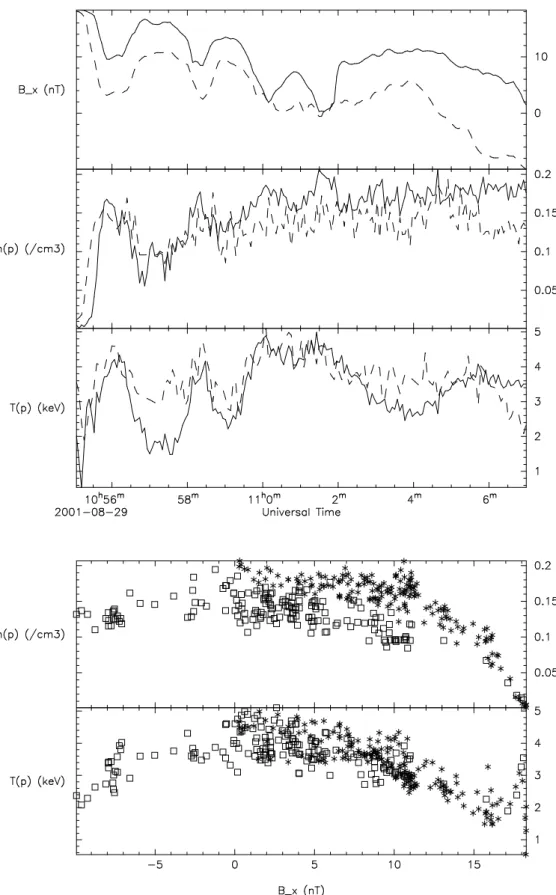
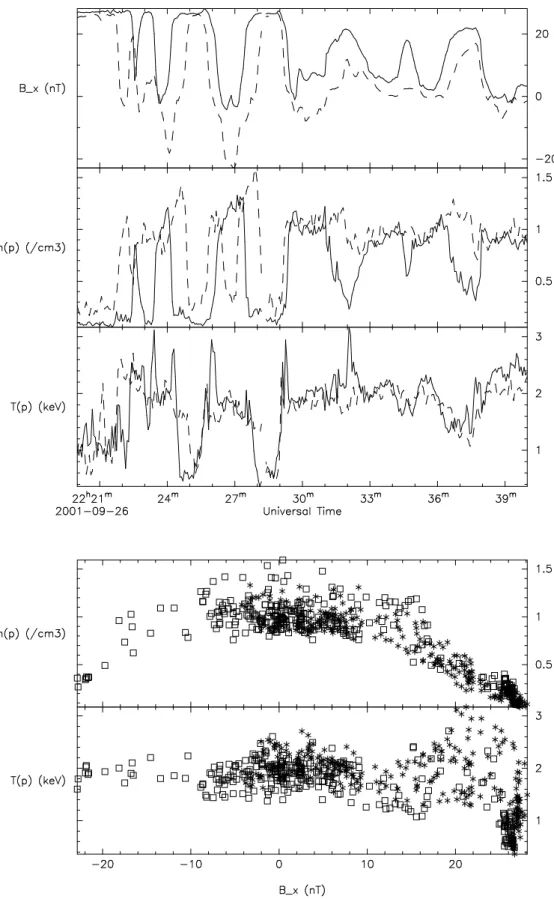
We use CLUSTER observations of BCS described in two different papers: the 29/08/01 event (Runov et al. , 2003a) and the 26/09/01 event (Sergeev et al. , 2003) both occurring during substorms. The data are displayed in Figure 1 (12 min of data) and Figure 2 (20 min of data) : the upper stack panel shows the Bx component of the magnetic field from FGM, the proton density np
and the proton temperature T from CIS, both for S/C 1 and 3 (S/C 2 and 4 signatures are close to S/C 1 in both events). The lower panel shows np and
T ordered by Bx. In both Figures, the beginning of the interval starts in the
lobe region (very low density values) before the entry in the central plasma sheet.
In Runov et al. (2003a) a wide region (∼2000 km) of weak magnetic field (<2 nT seen by all 4 S/C) extends above z = 0; above it, is superimposed a region of relatively strong current (∼ 5 − 10 nA/m2) and a symmetric counterpart is
suspected. The nature of the global oscillation of the sheet (kink or sausage) remains unclear. Sergeev et al. (2003) uses three different methods to infer the existence of the bifurcation and obtain a similar picture to Runov et al. (2003a). They show that the current peaks where |Bx| ∼ 0.5Blobe with a
minimum current about 2-3 times smaller than the peak value. We summarize in the following table the observed physical parameters which constrain our model in each case. Uniform temperature is used.
Table 1
Key parameters of the observed BCS.
Blobe (nT) Nlobe (cm−3) Nmax (cm−3) Ti (keV)
29/08/01 19 0.01 0.15 3.9
26/09/01 27 0.2 1.5 2
To model the BCS we chose ν = 0 in both cases and η = 3.10−19 s2/m2 in
the first case and η = 7.10−19 s2/m2 in the second case. The results for the
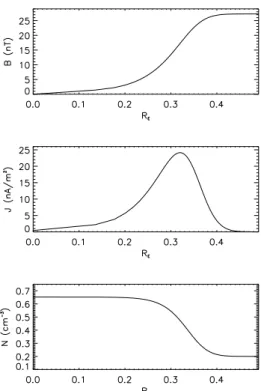
modeled profiles of the magnetic field, the electric current and the density are displayed on Figures 3 and 4 (half sheet is shown, the density and current being symmetric, the magnetic field being anti-symmetric). The general trend of these profiles fits the observations: the centre of the sheet is a region of weak magnetic field and almost constant density; the electric current is also low, but peaks at a fraction of one RE.
Runov et al. (2003a) determined that Jmax ≃ 7 nA/m2 and that the scale of
the weak uniform field region (B < 2 nT) is on the order of the spacecraft separation : 2000 km or 0.31 RE. According to Sergeev et al. (2003) Jmax ≃ 20
nA/m2, the average half-thickness of the sheet is 2300 km or 0.36 RE, the
current peaks where Bx ≃ 0.5Blobe. These features are closely reproduced on
Figures 3 and 4. The model generally gives slightly higher values of the current than those estimated from the observations (using the curlometre technique for instance). On the contrary the observed density in the centre of the sheet is larger than the modeled one. However the measures may be questionable in very low density regions, and the plasma may not obey strictly this kinetic equilibrium. Indeed, if the peak value of the current can be slightly adjusted by varying the model parameters, this is not the case of the density in the central region. This value is inherent to the equilibrium set by the lobe values of the density and magnetic field.
5 Discussion
In our model the magnetic pressure is balanced by the kinetic pressure. This differs from Sitnov et al. (2000, 2003); Zelenyi et al. (2002) in which the mag-netic tension is balanced by the finite inertia of ions having meander motion as described by Speiser (1965). These TCS are known as forced current sheets. Their associated models rely on the quasi-adiabaticity in the sense that the solution to Vlasov-Maxwell system of equations is not based on the conser-vation of the energy but instead uses the quasi-adiabatic invariant of motion, Iz ∝ mR vzdz. In Zelenyi et al. (2002), the competition between trapped and
transient ion orbit provides the source of the bifurcation. A major difference between our model and Sitnov et al. (2003)’s is that this last model requires positive ion temperature anisotropy (Ti⊥ > Ti//) to exhibit BCS solutions. For
the two BCS events exposed here Ti⊥ is slightly smaller or equal to Ti// (not
shown) which would not lead to a BCS solution, at odds with observations. However, in this region, as the temperature measurements are not reliable to more than ∼20%, it is not clear whether or not anisotropy takes place. Sitnov et al. (2003)’s model predicts BCS solution for Ti⊥/Ti// > 1.1 which is
ex-actly within the error bar. Our model provides the advantage of quick, easily parametrizable and non-normalized solutions which can directly be used to fit data. Let us note that Sitnov et al. (2003)’s model is still valid for Bn 6= 0,
as long as Bn ≪ B0.
On the simulation side, if BCS are studied it is more as a by-product of re-connection or turbulence mechanisms than for their own generation process. Recently, Greco et al. (2002) have shown that current splitting could form as a result of ion scattering due to magnetic turbulence; they also show how the normal magnetic component limits the splitting, in competition with the tur-bulence. These simulations rely on test particles in imposed electromagnetic field, but in the centre of the sheet the rather dense, hot ions may in turn mod-ify the magnetic structure. Asano (2001); Asano et al. (2003) have reported further evidence of current bifurcation, in the Geotail context, and developed
a qualitative 2D model of BCS which takes into account the Hall currents system. They confirmed kinetic and MHD simulation studies by Arzner and Scholer (2001). With recent 3D kinetic simulation results, Ricci et al. (2004) excluded the action of reconnection as the bifurcation trigger, but privileged the role of current aligned instabilities like the lower-hybrid drift instability or the Kelvin-Helmholtz instability.
Finally, a key point of this paper is to emphasize the fact that it is possible to construct an infinity of kinetic equilibria from modified Maxwellian distri-bution functions. Specializing these functions for a particular situation (i.e. auroral density cavity, Harris sheet, BCS) provides kinetic models of the stud-ied region. These models then constitute solid ground from which further work can be lead. In the case of BCS, we list below some suggestions on the way to use the model:
• Initial conditions for particle simulation: starting a PIC simulation is not trivial if one wants to be sure to initialize the code with a strict equilib-rium (on which perturbations are then added). We presented here a way to initialize the distributions functions kinetically.
• The stability of the BCS can be investigated using MHD or PIC code. Indeed as the origins of the BCS are still unclear, it is even more difficult to estimate their life time. Structures lasting ∼10-20 min have been observed. • Particle dynamics in these complex structures can also be studied with this model. From a simple ad-hoc model (polynomial Bx) Delcourt et al. (2003)
showed that the double-humped structure leads to two successive centrifugal perturbations; this may induce magnetic moment damping for particles that previously experienced enhancement and vice versa.
• Finally, following the work of Fruit et al. (2002a,b) we started investigating the propagation of MHD modes in such structures, exhibiting differences with Harris-like configuration, and comparing with Cluster observations. Using a physical model is essential for a thorough analysis.
6 Conclusion
Based on Mottez (2003)’s resolution method we present a one-dimensional kinetic model of bifurcated current sheet at equilibrium. With a relevant choice of parameters it is possible to mimic observations of BCS, in particular the low magnetic field valley, the density plateau and the double current peaks occurring where Bx ∼ 0.5Blobe. Good agreement with observations regarding
typical length scales and orders of magnitude is also obtained. The model may be useful for further studies concerning stability, particle dynamics, and wave propagation.
References
Arzner, K., and M. Scholer, Kinetic structure of the post plasmoid plasma sheet during magnetic reconnection, J. Geophys. Res., 106, 3827, 2001. Asano, Y., Configuration of the thin current sheet in substorms, Ph.D. thesis,
Univ. Tokyo, 2001.
Asano, Y., T. Mukai, M. Hoshino, Y. Saito, H. Hayakawa, and T. Nagai, Evolution of the thin current sheet in a substorm observed by Geotail, J. Geophys. Res., 108, 1189, 2003.
Birn, J., R. Sommer, and K. Schindler, Open and closed magnetospheric tail configurations and their stability, Astrophys. Space Sci., 35, 389, 1975. Channell, P. J., Exact Vlasov-Maxwell equilibria with sheared magnetic fields,
Phys. Fluids, 19, 1541, 1976.
Delcourt, D. C., Malova, H. V., Zelenyi, L. M., Nonlinear dynamics of charged particles in double-humped current sheets, J. Geophys. Res., submitted, 2003.
Fruit G., Louarn P., Tur A., Le Qu´eau D., On the propagation of magneto-hydrodynamic perturbations in a Harris-type current sheet: 1. Propagation on discrete modes and signal reconstruction, J. Geophys. Res., 107, 1411, 2002.
Fruit G., Louarn P., Tur A., Le Qu´eau D., On the propagation of magneto-hydrodynamic perturbations in a Harris-type current sheet: 2. Propagation on continuous modes and resonant absorption, J. Geophys. Res., 107, 1412, 2002.
G´enot V., Louarn P., Mottez F., Electron acceleration by Alfv´en waves in density cavities, J. Geophys. Res., 105, 27611, 2000.
Greco A., Taktakishvili A. L., Zimbardo G., Veltri P., Zelenyi L. M., Ion dynamics in the near-Earth magnetotail: Magnetic turbulence versus normal component of the average magnetic field, J. Geophys. Res., 107, 1267, 2002. Harris, E. G., On a plasma sheath separating regions of oppositely directly
magnetic field, Nuovo Cimento, 23, 115, 1962.
Hoshino, M., A. Nishida, T. Mukai, Y. Saito, T. Yamamoto, and S. Kokubun, Structure of plasma sheet in magnetotail: Double-peaked electric current sheet, J. Geophys. Res., 101, 24775, 1996.
Mottez F., Exact nonlinear analytic Vlasov-Maxwell tangential equilibria with arbitrary density and temperature profiles, Phys. Plasma, 10, 2501, 2003. Nakamura R., Baumjohann W., Runov A., Volwerk M., Zhang T. L., Klecker
B., Bogdanova Y., Roux A., Balogh A., Reme H., Sauvaud J. A., Frey H. U., Fast flow during current sheet thinning, Geophys. Res. Lett., 29, 2140, 2002.
Ricci, P., G. Lapenta, and J. U. Brackbill, Structure of the magnetotail cur-rent: kinetic simulation and comparison with satellite observations, Geo-phys. Res. Lett., In Press, 2004.
Runov A, Nakamura R, Baumjohann W, Zhang TL, Volwerk M, Eichelberger HU, Balogh A, Cluster observation of a bifurcated current sheet, Geophys.
Res. Lett., 30, 1036, 2003.
Runov A., Nakamura R., Baumjohann W., Treumann R. A., Zhang T. L., Volwerk M., Voros Z., Balogh A., Glassmeier K. H., Klecker B., Reme H., Kistler L., Current sheet structure near magnetic X-line observed by Cluster , Geophys. Res. Lett., 30, 1579, 2003.
Schindler, K., and J. Birn, Models of two-dimensional embedded thin current sheets from Vlasov theory, J. Geophys. Res., 98, 2002.
Sergeev V., D. G. Mitchell, C. T. Russell, and D. J. Williams, Structure of the tail plasma/current sheet at ∼ 11RE and its changes in the course of a
substorm, J. Geophys. Res., 98, 17345, 1993.
Sergeev V, Runov A, Baumjohann W, Nakamura R, Zhang TL, Volwerk M, Balogh A, Reme H, Sauvaud JA, Andre M, Klecker B, Current sheet flap-ping motion and structure observed by Cluster , Geophys. Res. Lett., 30, 1327, 2003.
Sitnov MI, Zelenyi LM, Malova HV, Slarma AS, Thin current sheet embedded within a thicker plasma sheet: Self-consistent kinetic theory, J. Geophys. Res., 10(, 13029, 2000.
Sitnov, M. I., P. N. Guzdar, and M. Swisdak, A model of the bifurcated current sheet, Geophys. Res. Lett., 30, 1712, 2003.
Speiser, T. W., Particle trajectories in model current sheets, 1, Analytical solutions, J. Geophys. Res., 76, 8211, 1965.
Zelenyi LM, Delcourt DC, Malova HV, Sharma AS, Popov VY, Bykov AA, Forced current sheets in the Earth’s magnetotail: Their role and evolution due to nonadiabatic particle scattering , Adv. Space. Res., 30, 1629, 2002.
Fig. 1. Cluster data for the 29/08/2001 event. Upper panel: from top to bottom, temporal variations the magnetic component Bx, the proton density, and proton temperature. Lower panel, as functions of Bx, the proton density and temperature. The solid line and the star symbol are for S/C 1, the dashed line and square symbol
Fig. 3. Model of bifurcated current sheet for the 29/08/2001 event. From top to bot-tom : the magnetic component Bx, the electric current and the proton (or electron) density as functions of the position across the sheet from the centre of the sheet.
Fig. 4. Model of bifurcated current sheet for the 26/09/2001 event. Same as Figure 3.