PARALLELIZATION STRATEGIES FOR MODERN COMPUTING PLATFORMS: APPLICATION TO ILLUSTRATIVE IMAGE PROCESSING AND COMPUTER
VISION APPLICATIONS
TAIEB LAMINE BEN CHEIKH
DÉPARTEMENT DE GÉNIE INFORMATIQUE ET GÉNIE LOGICIEL ÉCOLE POLYTECHNIQUE DE MONTRÉAL
THÈSE PRÉSENTÉE EN VUE DE L’OBTENTION DU DIPLÔME DE PHILOSOPHIÆ DOCTOR
(GÉNIE INFORMATIQUE) AVRIL 2015
c
ÉCOLE POLYTECHNIQUE DE MONTRÉAL
Cette thèse intitulée :
PARALLELIZATION STRATEGIES FOR MODERN COMPUTING PLATFORMS: APPLICATION TO ILLUSTRATIVE IMAGE PROCESSING AND COMPUTER
VISION APPLICATIONS
présentée par : BEN CHEIKH Taieb Lamine
en vue de l’obtention du diplôme de : Philosophiæ Doctor a été dûment acceptée par le jury d’examen constitué de :
M. DAGENAIS Michel, Ph. D, président
Mme NICOLESCU Gabriela, Doctorat, membre et directrice de recherche M. TAHAR Sofiene, Ph. D., membre et codirecteur de recherche
Mme CHERIET Farida, Ph. D., membre M. ZENG Haibo, Ph. D., membre externe
DEDICATION
I dedicate my Ph.D work to
My parents : Beya and Khemaies,
My family : Leila, Mohamed Ali, Walid and Olfa
My darling nieces and nephews : Skander, Norhene, Omar, Houssem, Nour and Yesmine
My family in law : Habib, Feten, Sonda, Omar and Fekher
My professors in Tunisia from primary school to the University
And last but not least,
To you, my Hana, my wife : We did it !
You always make me feel on top of things. . . ————
ACKNOWLEDGEMENTS
Firstly, I would like to thank my supervisor Dr. Gabriela Nicolescu for all of the guidance she has given me throughout my Ph.D studies. I am indebted to her for all of the time and patience she extended to me to complete my degree. I acknowledge you for your lasting sup-port through this whole period.
I would also like to thank my thesis co-director Dr. Sofiène Tahar for his interesting dis-cussions around my work.
An appreciative thanks is extended to the members of the jury who accepted to read, exa-mine and evaluate my work.
I would like to express thanks to Dr. Giovani Beltrame, Dr. Jelena Trajkovic, for all of their assistance and the critical reading of my academic reports during my Ph.D. Thanks for the many fun hours we have spent discussing my work.
To ST Microelectronics team and CMC Microsystems team, especially Pierre Paulin, Youcef Bouchebaba and Yassine Hariri. I greatly appreciate your collaboration in the project. Thank you for your critical discussions of my results, it is always beneficial to get another perspective on things.
A special thought goes to Rabeh, Alain, and Felippe, with whom I shared the office, for great support and friendship during these years. A special appreciation goes to Mahdi and Alexandra ; who have challenged and inspired me through their critical reading of my thesis.
To you my best friend Imen, thank you for the motivation and close friendship we have developed over these years- You have been and you’re still a huge support. To you guys : Mohamed, Rafik, Jihed, Wael, Sami, Haithem and Rachid. I want to thank you not only for sharing hours of Tennis-Volleyball-Football or Ping-Pong :) but also for your close and good friendship. I am happy to have all of you and to be able to share both the hard but also the enjoyable times with.
I am greatly thankful to the staff of Ecole Polytechnique de Montreal ; all contributed to the environment and atmosphere of the University, making it an exciting place to come to every day, be it for work or socializing, and often both.
RÉSUMÉ
L’évolution spectaculaire des technologies dans le domaine du matériel et du logiciel a per-mis l’émergence des nouvelles plateformes parallèles très performantes. Ces plateformes ont marqué le début d’une nouvelle ère de la computation et il est préconisé qu’elles vont rester dans le domaine pour une bonne période de temps. Elles sont présentes déjà dans le domaine du calcul de haute performance (en anglais HPC, High Performance Computer) ainsi que dans le domaine des systèmes embarqués. Récemment, dans ces domaines le concept de cal-cul hétérogène a été adopté pour atteindre des performances élevées. Ainsi, plusieurs types de processeurs sont utilisés, dont les plus populaires sont les unités centrales de traitement ou CPU (de l’anglais Central Processing Unit) et les processeurs graphiques ou GPU (de l’anglais Graphics Processing Units).
La programmation efficace pour ces nouvelles plateformes parallèles amène actuellement non seulement des opportunités mais aussi des défis importants pour les concepteurs. Par consé-quent, l’industrie a besoin de l’appui de la communauté de recherche pour assurer le succès de ce nouveau changement de paradigme vers le calcul parallèle. Trois défis principaux pré-sents pour les processeurs GPU massivement parallèles (ou “many-cores”) ainsi que pour les processeurs CPU multi-coeurs sont : (1) la sélection de la meilleure plateforme parallèle pour une application donnée, (2) la sélection de la meilleure stratégie de parallèlisation et (3) le réglage minutieux des performances (ou en anglais performance tuning) pour mieux exploiter les plateformes existantes.
Dans ce contexte, l’objectif global de notre projet de recherche est de définir de nouvelles so-lutions pour aider à la programmation efficace des applications complexes sur les plateformes parallèles modernes.
Les principales contributions à la recherche sont :
1. L’évaluation de l’efficacité d’accélération pour plusieurs plateformes parallèles, dans le cas des applications de calcul intensif.
2. Une analyse quantitative des stratégies de parallélisation et implantation sur les plate-formes à base de processeurs CPU multi-coeur ainsi que pour les plateplate-formes à base de processeurs GPU massivement parallèles.
3. La définition et la mise en place d’une approche de réglage de performances (en Anglais performance tuning) pour les plateformes parallèles.
Les contributions proposées ont été validées en utilisant des applications réelles illustratives et un ensemble varié de plateformes parallèles modernes.
ABSTRACT
With the technology improvement for both hardware and software, parallel platforms started a new computing era and they are here to stay. Parallel platforms may be found in High Performance Computers (HPC) or embedded computers. Recently, both HPC and embed-ded computers are moving toward heterogeneous computing platforms. They are employing both Central Processing Units (CPUs) and Graphics Processing Units (GPUs) to achieve the highest performance. Programming efficiently for parallel platforms brings new opportunities but also several challenges. Therefore, industry needs help from the research community to succeed in its recent dramatic shift to parallel computing.
Parallel programing presents several major challenges. These challenges are equally present whether one programs on a many-core GPU or on a multi-core CPU. Three of the main challenges are: (1) Finding the best platform providing the required acceleration (2) Select the best parallelization strategy (3) Performance tuning to efficiently leverage the parallel platforms.
In this context, the overall objective of our research is to propose a new solution helping designers to efficiently program complex applications on modern parallel architectures. The contributions of this thesis are:
1. The evaluation of the efficiency of several target parallel platforms to speedup compute intensive applications.
2. The quantitative analysis for parallelization and implementation strategies on multi-core CPUs and many-multi-core GPUs.
3. The definition and implementation of a new performance tuning framework for hetero-geneous parallel platforms.
The contributions were validated using real computation intensive applications and modern parallel platform based on multi-core CPU and many-core GPU.
TABLE OF CONTENTS
DEDICATION . . . iii
ACKNOWLEDGEMENTS . . . iv
RÉSUMÉ . . . v
ABSTRACT . . . vi
TABLE OF CONTENTS . . . vii
LIST OF TABLES . . . xi
LIST OF FIGURES . . . xii
LIST OF SYMBOLS AND ABBREVIATIONS . . . xiv
CHAPTER 1 INTRODUCTION . . . 1
1.1 Context : Programming Parallel Platforms . . . 1
1.2 Parallel Programming - Challenges . . . 2
1.3 Objectives and Contributions . . . 2
1.3.1 Evaluation of the Efficiency of Several Target Parallel Platforms to Speedup Compute Intensive Applications . . . 3
1.3.2 Performance Evaluation of Parallelization and Implementation Strate-gies on Multicore CPUs and Manycore GPUs . . . 3
1.3.3 A New Performance Tuning Framework for Heterogeneous Parallel Platforms . . . 4
1.3.4 Document Plan . . . 4
CHAPTER 2 BACKGROUND AND BASIC CONCEPTS . . . 5
2.1 Context . . . 5
2.2 Basic Concepts of Parallel Programming . . . 6
2.3 Hardware Parallel Architectures . . . 7
2.4 Examples of Parallel Platforms . . . 9
2.4.1 Multicore CPU-based Platforms . . . 9
2.4.2 Manycore GPU-based Platforms . . . 9
2.5.1 Parallelization Granularities . . . 13
2.5.2 Types of Parallelism . . . 14
2.6 Parallel Programming Models . . . 15
2.6.1 Shared Memory Programming Model . . . 16
2.6.2 Distributed Memory Programming Model . . . 16
2.6.3 Data Streaming Programming Model . . . 16
2.7 Examples of Parallel Programming Models for Multicore CPUs and Manycore GPUs . . . 17
2.7.1 Examples of Parallel Programming Models for CPUs . . . 17
2.7.2 Examples of Parallel Programming Models for GPUs . . . 18
2.8 Conclusion . . . 20
CHAPTER 3 ACCELERATION OF IMAGE PROCESSING AND COMPUTER VI-SION APPLICATIONS ON PARALLEL PLATFORMS . . . 21
3.1 Introduction . . . 21
3.2 Related Work . . . 21
3.3 Evaluation Approach Overview . . . 23
3.4 Case Study Applications . . . 24
3.4.1 Canny Edge Detection CED) . . . 26
3.4.2 Shape Refining : Thinning . . . 28
3.4.3 2D Euclidean Distance Transform . . . 28
3.5 Target Parallel Hardware Platforms . . . 30
3.5.1 HPC CPU-Based Platform . . . 30
3.5.2 HPC GPU-Based Platforms . . . 31
3.5.3 Embedded Parallel Platforms . . . 35
3.6 Parallelization Approach . . . 38
3.6.1 Algorithm Analysis . . . 38
3.6.2 Parallelization Strategies . . . 42
3.7 Experimental Results . . . 44
3.7.1 Parallelization Performance of CED . . . 44
3.7.2 Parallelization Performance of Thinning . . . 48
3.7.3 Parallelization Performance of EDT . . . 49
3.7.4 Performance Comparison Between STHORM and Tegra K1 . . . 53
3.8 Conclusion . . . 54
CHAPTER 4 PERFORMANCE EVALUATION OF PARALLELIZATION STRATE-GIES - CASE STUDY : extCED . . . 55
4.1 Introduction . . . 55
4.2 Related Work . . . 55
4.2.1 Related Work on Comparing Parallelization Granularities . . . 56
4.2.2 Related Work on Comparing Parallelism Models . . . 56
4.2.3 Related Work on Comparing Programming Models . . . 57
4.3 Motivation and Example : Extended Canny Edge Detection (extCED) . . . . 59
4.3.1 Case Study : Extended Canny Edge Detection (extCED) . . . 59
4.4 Parallelization Strategies For extCED . . . 61
4.4.1 Parallelization Granularities . . . 61
4.4.2 Parallelism Models . . . 63
4.5 Parallel Platforms and Programming models . . . 64
4.5.1 Multicore CPU and Programming Models . . . 65
4.5.2 Manycore GPU and Programming Models . . . 65
4.6 Design Challenges and Approach . . . 65
4.7 Experiments and Results . . . 66
4.7.1 Implementation Details and Experimental Setup . . . 67
4.7.2 Fine-grain vs. Coarse-grain Parallelism . . . 68
4.7.3 Nested Task- and Data-parallelism vs. Data-parallelism . . . 71
4.8 Conclusion . . . 73
CHAPTER 5 TUNING FRAMEWORK FOR STENCIL COMPUTATION . . . 75
5.1 Introduction . . . 75
5.1.1 GPU-based Heterogenous Parallel Platforms . . . 75
5.1.2 Stencil Computation . . . 76
5.1.3 Parallelization Strategies for Stencil Computation . . . 78
5.1.4 Contribution . . . 80
5.2 Related Work . . . 80
5.2.1 Related Work on Improving Stencil Computation Runtime . . . 81
5.2.2 Related Work on Performance Tuning Tools . . . 81
5.2.3 Evaluation of Stencil Computation Implementations . . . 81
5.2.4 Positioning Our Approach . . . 82
5.3 The Proposed Framework . . . 82
5.3.1 Formulation of Stencil Computation Running on HPP (Step 1) . . . . 83
5.3.2 Fusion and Thread Configuration (Step 2) . . . 92
5.3.3 Influential Factors on Performance . . . 100
5.3.5 Performance Model for Stencil Computation (Step 4) . . . 103
5.4 Experimental Results . . . 105
5.4.1 Experimental Environment . . . 105
5.4.2 Case Study : Gaussian Blur . . . 105
5.4.3 Case Study : Canny Edge Detection Application . . . 107
5.5 Conclusion . . . 110
CHAPTER 6 CONCLUSION AND PERSPECTIVES . . . 112
6.1 Conclusion . . . 112
6.2 Perspectives . . . 113
LIST OF TABLES
Table 3.1 GPU Architectures Specifications . . . 34
Table 3.2 GPU Runtime Constraints . . . 35
Table 3.3 Tegra K1 Architecture Specifications . . . 37
Table 3.4 Computation Features of the Studied Algorithms . . . 42
Table 3.5 Execution Time in (ms) of CED on HPC Multicore CPU (Image Size = 1024x1024) . . . 44
Table 3.6 Execution Time in (ms) of CED on Tegra K1 CPU (Image Size = 1024x1024) . . . 45
Table 3.7 Execution Time in (ms) of CED on GTX 780 (Image Size = 8192x8192) 46 Table 3.8 Parallelization Performance of CED on HPC Platforms (Image Size = 1024x1024) . . . 47
Table 3.9 Execution Time in (ms) of Thinning on HPC Multicore CPU (Image Size = 1024x1024) . . . 48
Table 3.10 Execution Time in (ms) of Thinning on Tegra K1 CPU (Image Size = 1024x1024) . . . 48
Table 3.11 Execution Time in (ms) of EDT on HPC Multicore CPU (# of Edges = 177) . . . 49
Table 3.12 Execution Time in (ms) of EDT on Tegra K1 CPU (# of Edges = 177) 50 Table 3.13 Parallelization Performance of EDT on HPC Platforms (# of Edges = 177) . . . 52
Table 3.14 Parallelization Performance of CED+Thinning and EDT on Manycore Embedded Platforms) . . . 53
Table 5.1 Summary of Main Formulation Terms and Notations . . . 85
Table 5.2 Gaussian Blur Stencils . . . 97
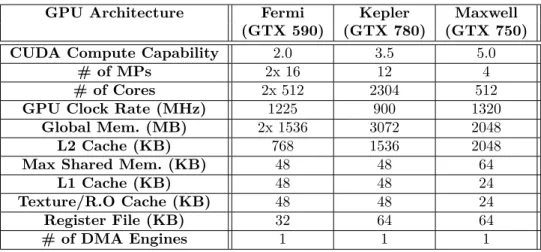
Table 5.3 Platform Specification . . . 99
Table 5.4 # Transactions per Request (1D Horizontal Stencil) . . . 102
Table 5.5 # Transactions per Request (1D Vertical Stencil) . . . 102
Table 5.6 # Transactions per Request (2D Stencil) . . . 103
Table 5.7 Throughput of Main Operations per Clock Cycle (Nvidia, 2012) . . . 104
Table 5.8 Average Memory Latency in Clock Cycles (Nvidia, 2012) . . . 105
Table 5.9 Gaussian Blur Stencils . . . 107
Table 5.10 CED Stencils . . . 109
LIST OF FIGURES
Figure 2.1 SIMD : GPU Architecture vs. MIMD : CPU Architecture (Cheng et al.,
2014) . . . 8
Figure 2.2 Typical Multicore CPU Architecture (Cook, 2012) . . . 10
Figure 2.3 CPU and GPU Peak Performance in GFLOPs (Cook, 2012) . . . 11
Figure 2.4 Example of GPU Architecture . . . 12
Figure 2.5 Thread Arrangement in GPU Programming Models - Example : CUDA 19 Figure 2.6 Thread Block Mapping on GPU Multiprocessors . . . 20
Figure 3.1 Smoothing Edges Comparison : Output Images of Different CED Im-plementations . . . 23
Figure 3.2 Performance Evaluation Approach . . . 24
Figure 3.3 Augmented Reality System for spinal MIS (Windisch et al., 2005) . . 25
Figure 3.4 Instrument Detection Stages . . . 26
Figure 3.5 Canny Edge Detection Stages . . . 27
Figure 3.6 Thinning Application . . . 28
Figure 3.7 Distance Transform Application . . . 29
Figure 3.8 Multicore CPU Architecture . . . 30
Figure 3.9 Fermi SM Architecture . . . 32
Figure 3.10 Kepler SMX Architecture . . . 33
Figure 3.11 Maxwell SMM Architecture . . . 34
Figure 3.12 STHORM Architecture . . . 36
Figure 3.13 Tegra K1 Architecture . . . 37
Figure 3.14 CED Algorithm Analysis . . . 40
Figure 3.15 Thinning Algorithm Analysis . . . 41
Figure 3.16 EDT Algorithm Analysis . . . 41
Figure 3.17 Speedup of CED on Multicore CPU Platforms . . . 45
Figure 3.18 CED Without Compute and Data Transfer Overlap . . . 46
Figure 3.19 CED With Compute and Data Read Overlap . . . 46
Figure 3.20 CED With Compute and Data Write Overlap . . . 47
Figure 3.21 Data Transfer Analysis and Transfer Improvements on GTX 780 . . . 47
Figure 3.22 Speedup of Thinning on Multicore CPU Platforms . . . 49
Figure 3.23 Speedup of EDT on Multicore CPU Platforms . . . 50
Figure 3.24 EDT Load Balancing Without Data Arrangement on GTX 750 . . . 51
Figure 3.26 Execution Time of CED and EDT on HPC GPU Platforms . . . 51
Figure 4.1 Canny Edge Detector Diagram . . . 60
Figure 4.2 Parallelization Granularities . . . 62
Figure 4.3 Design Challenges and Approach . . . 67
Figure 4.4 Exploration Space . . . 69
Figure 4.5 Execution Time of Section 1 on Multi-core CPU . . . 70
Figure 4.6 Execution Time of Section 3 on Multi-core CPU . . . 70
Figure 4.7 Fine-grain vs. Coarse-grain on Many-core GPU . . . 71
Figure 4.8 Gradient Processing Execution Time on Multi-core CPU . . . 73
Figure 4.9 Non Maxima Suppression Processing Execution Time on Multi-core CPU 73 Figure 5.1 Stencil . . . 76
Figure 5.2 Stencil Shapes . . . 77
Figure 5.3 Tiling Variants . . . 79
Figure 5.4 Proposed Methodology . . . 84
Figure 5.5 Abstracted Model of Heterogeneous Parallel Platform . . . 86
Figure 5.6 Image Blending . . . 88
Figure 5.7 Convolution on Rows . . . 90
Figure 5.8 Fusion Combinations . . . 93
Figure 5.9 Representation of Fused Stencils . . . 95
Figure 5.10 Gaussian Blur Fusion . . . 97
Figure 5.11 Tiling and Thread Block Configuration . . . 98
Figure 5.12 Execution Time of Convolution on Rows Kernel (ms) . . . 99
Figure 5.13 Performance Comparison of Different Separate Gaussian Blur Stencils Implementations . . . 106
Figure 5.14 Performance Comparison of Different Implementations of Non Fused and Fused Gaussian Blur . . . 107
Figure 5.15 Canny Edge Detection Stencils . . . 108
Figure 5.16 Performance Comparison of Basic and Tuned Implementation For Dif-ferent Fusions on NVIDIA GPUs . . . 110
LIST OF SYMBOLS AND ABBREVIATIONS
APU Accelerated Processing Unit ALU Arithmetic and Logical Unit AQUA Adiabatic QUantum Algorithm CED Canny Edge Detection
CP Controller Processor CPU Central Processing Unit
CU Compute Unit
CUDA Compute Unified Device Architecture DAG Direct Acyclic Graph
DMA Direct Memory Access DP Double Precision
DSL Domain Specific Language DT Distance Transform
EDT Euclidean Distance Transform extCED Extended Canny Edge Detection FPU Floating Point Unit
GDLS Globally Distributed Locally Shared GPU Graphics Processing Unit
HLSL High Level Shader Language HPC High Performance Computing HPP Heterogeneous Parallel Platform ISL Iterative Stencil Loops
MIMD Multiple Instruction Multiple Data MIS Minimally Invasive Surgery
MP Multiprocessor
MPI Message Passing Interface NUMA Non Uniform Memory Access NOC Network On-Chip
OpenCL Open Computing Language
PCI Peripheral Component Interconnect PDE Partial Derivative Equation
PE Processing Element
RO Cache Read Only Cache SFU Special Function Unit
SIMD Single Instruction Multiple Data SIMT Single Instruction Multiple Thread SM Streaming Multiprocessor
SP Streaming Processor TBB Threading Building Block UTS Unbalanced Tree Search
CHAPTER 1 INTRODUCTION
1.1 Context : Programming Parallel Platforms
Modern applications, such as image processing and computer vision, are becoming more and more complex (Djabelkhir and Seznec, 2003). This complexity implies a large amount of pro-cessed data and high computation loads, under very tight constraints : more constraints are added to enforce high quality and accuracy such as real-time execution and power consump-tion awareness. Therefore, optimizaconsump-tion techniques and high performance hardware platforms are required. Considering the domains of image processing and computer vision, it is safe to say that they present many opportunities for parallelism, that can be exploited in parallel platforms.
With the technology improvement for both hardware and software, parallel platforms started a new computing era and they are here to stay (Jerraya and Wolf, 2004). Parallel platforms may be found in High Performance Computers (HPC) or embedded computers. Recently, both HPC and embedded computers are moving toward heterogeneous computing. They are employing both Central Processing Units (CPUs) and Graphics Processing Units (GPUs) to achieve the highest performance. For instance, the supercomputer code-named Titan uses al-most 300,000 CPU cores and up to 18,000 GPU cards (Cook, 2012). Programming efficiently for parallel platforms bring new opportunities but also several challenges (Williams et al., 2009). Therefore, industry needs help from the research community to succeed in its recent dramatic shift to parallel computing.
Currently, two main approaches are used for parallel programming : (1) writing new parallel code from scratch, which is an effective way to accelerate applications but time consuming or (2) mapping existing sequential algorithms to parallel architectures to gain speedup. Since, usually, existing algorithms are initially described as high-level sequential code (such as MAT-LAB and C/C++ code), currently the approach (2) presents a substantially less expensive alternative, and does not require to retrain algorithm developers. This requires the paralle-lization of sequential code, and the exploitation of set of parallel programming models. This approach is not trivial, as many different hardware target architectures are available : the target platform can be heterogeneous and involve diverse computational architectures and different memory hierarchies. Moreover, for new parallel implementations, the programmer starts by extracting the parallelization opportunities of the application and then expresses
these opportunities by employing a number of parallelization strategies. These parallelization strategies should be suitable for both application programming features and the architecture specificity.
1.2 Parallel Programming - Challenges
Parallel programing presents several major challenges. These challenges are equally present whether one programs on a many-core GPU or on a multicore CPU. Unfortunately, there is little compiler technology that can help programmers to meet these challenges today. Three of the main challenges are :
- Finding the best platform providing the required acceleration – although performance studies of individual platforms exists, they have been so far limited in scope and desi-gners still face daunting challenges in selecting a new appropriate parallel platform in order to accelerate their application (Calandra et al., 2013).
- Selecting the best parallelization strategy – using a proper parallelization strategy is crucial in order to achieve the optimal performance, such that the calculation takes the shortest possible time. It is very difficult to give a universal method for finding the optimal strategy, since it depends not only on the platform, but also on the application itself (Kegel et al., 2011a). Designers need today some guidelines in their search for the parallelization strategy.
- Performance tuning – performance is the primary goal behind most parallel program-ming efforts. In order to achieve high performance, designers need to tune several pa-rameters (data and task decomposition granularity and threads and data mapping on the target hardware resources) and explore a huge space of solutions. Currently, the performance tuning can take significant time and effort (Kamil, 2013).
1.3 Objectives and Contributions
To alleviate the challenges described in the previous section, the global objective of this thesis is to propose a new solution helping designers to efficiently program complex applications on modern parallel architectures. The specific objectives are :
- Integrating, in the programming stage, some key aspects such as the parallelization strategies : parallelism models, parallelization granularity and programming models. - Accelerating the programming stage and improving the exploration of the solutions
The main contributions of this project are :
1. The evaluation of the efficiency of several target parallel platforms to speedup compute intensive applications
2. Performance Evaluation of parallelization and implementation strategies on multicore CPUs and manycore GPUs.
3. The definition and implementation of a new performance tuning framework for hetero-geneous parallel platforms.
These contributions are briefly described in the next three sections.
1.3.1 Evaluation of the Efficiency of Several Target Parallel Platforms to Spee-dup Compute Intensive Applications
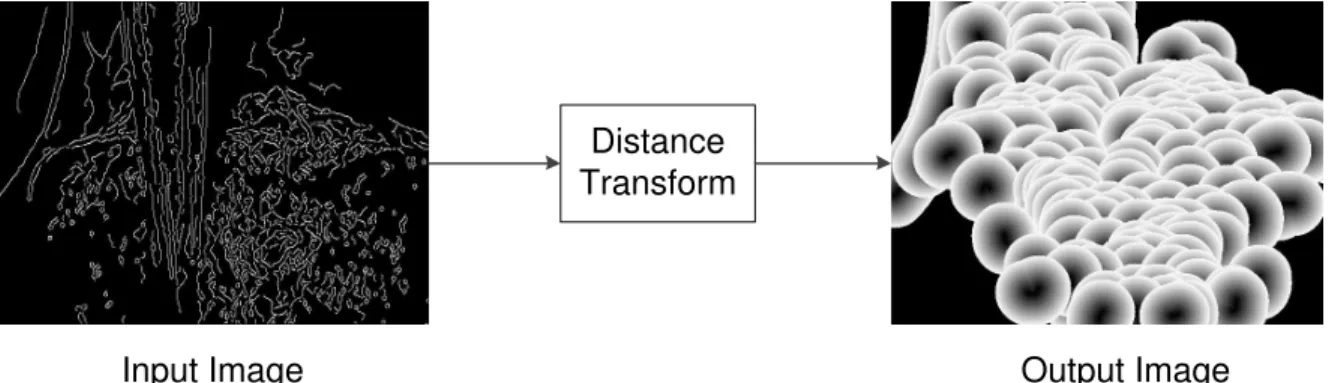
The performance evaluation is performed through three fundamental algorithms used in image processing and computer vision : (1) Canny Edge Detection (CED), (2) Shape Refining and (3) Distance Transform (DT). These algorithms are compute intensive and highly data parallel. We developed for each algorithm a number of parallel implementations targeting a wide range of architectures covering both HPC and embedded parallel platforms. A number of optimizations is investigated depending on the applications and the target architecture. We show the impact of such optimizations on performance via a large number of experiments.
1.3.2 Performance Evaluation of Parallelization and Implementation Strategies on Multicore CPUs and Manycore GPUs
Since applications are increasing in complexity and present a wide variety of parallel features, it becomes difficult to decide which parallelization strategy is suitable for a given platform to reach peak performance. We propose a comprehensive performance evaluation of a large variety of parallelization and implementation strategies for different parallel structures on two most common parallel platforms : a multicore CPU (Dual AMD Opteron 8-core CPU) and a manycore GPU (NVIDIA GTX 480 GPU). Moreover, we consider a wide spectrum of parallel programming models : OpenMP and TBB targeting multicore CPU, and CUDA and OpenCL targeting manycore GPUs. We also aim at determining guidelines for the efficient parallelization strategies of common application classes.
1.3.3 A New Performance Tuning Framework for Heterogeneous Parallel Plat-forms
In order to implement efficiently compute intensive applications on heterogeneous parallel platforms, a number of parameters have to be considered : data and task decomposition granularity and threads and data mapping on the target hardware resources.
The knowledge acquired during the two first contributions help us to efficiently delimit the exploration space and to define precisely the influential parameters on performance such as the data and task granularity level and the data access pattern.
As contribution, we propose a performance tuning framework for stencil computation tar-geting heterogeneous parallel platforms. The emphasis is put on platforms that follow the host-device architectural model where the host corresponds to a multicore CPU and the de-vice corresponds to a manycore GPU. This framework guides the developer to select (i) the best task and data granularity also known as, respectively, fusion and tiling, and (ii) the best thread block configuration to fit the problem size.
1.3.4 Document Plan
This thesis is structured in five chapters. In Chapter 1, we presented the context and chal-lenges of our research work and we introduced the objectives and contributions of this thesis. Chapter 2 presents the basic concepts concerning the parallel programming of complex ap-plications on modern parallel platforms. Chapter 3 introduces the evaluation of the parallel platforms for accelerating compute intensive applications. Chapter 4 describes our perfor-mance evaluation of the parallel programming and implementation strategies. In Chapter 5, we present a new framework enabling the performance tuning for complex applications run-ning on heterogeneous parallel platforms. Finally, in Chapter 6, we present the conclusions and the perspectives of our research work.
CHAPTER 2 BACKGROUND AND BASIC CONCEPTS
The main goal of this chapter is to introduce the parallel programming world to the reader. In more details, Section 2.1 presents the context of the use of parallel programming to accelerate current applications and in particular image processing and computer vision. Section 2.2 describes basic parallel programming concepts, which are necessary to understand an efficient parallel implementation. Section 2.3 lists the main basic multiprocessor architectures used as target platforms for current parallel applications. Some examples of these platforms are given in Section 2.4. Section 2.5 classifies parallelization strategies according to the parallelization granularity and the types of parallelism. Finally, Section 2.6 gives an overview of existing parallel programming models followed by Section 2.7 which lists some examples of parallel programming models used for both Multicore CPUs and Manycore GPUs.
2.1 Context
Modern applications are becoming more and more complex (Djabelkhir and Seznec, 2003) due to the increasing need of both high quality and accurate computation results. As a consequence, this complexity is translated into a large amount of processed data and high computation loads which require optimized algorithms and high performance hardware plat-forms to run these algorithms within a reasonable amount of time. More constraints could be added to high quality and accuracy such as real-time execution and power consumption awareness. Image processing and computer vision the are typical domains which follow this trend. The main particularity of these two domains is the presence of high amounts of pa-rallelism which makes the parallel platforms an appropriate hardware platform to satisfy the above mentioned constraints.
Parallel platforms are showing an extraordinary expansion, especially with the technology improvement for both hardware and software, making them a new trend for the computer science domain. parallel platforms may be found in High Performance Computers (HPC) or embedded computers. Recently, both HPC and embedded computers are moving toward heterogeneous computing. They are employing both Central Processing Units (CPUs) and Graphics Processing Units (GPUs) to achieve the highest performance. As an example, the supercomputer code-named Titan uses almost 300,000 CPU cores and up to 18,000 GPU cards (Cook, 2012).
In order to program parallel platforms, there are two approaches for parallel programming : (1) writing a new parallel code from scratch, which is an effective way to accelerate ap-plications but time consuming, or (2) mapping existing sequential algorithms to parallel architectures to gain speedup. As existing algorithms are initially described as high-level se-quential code (such as MATLAB and C/C++ code), currently the approach (2) presents a substantially less expensive alternative, and does not require to retrain algorithm developers. This requires the parallelization of sequential code, and requires involving a convenient set of parallel programming models. This step is not trivial, as many different hardware target architectures are available : the target platform can be heterogeneous and involve diverse computational architectures and different memory hierarchies.
In parallel programming, the programmer’s role is to extract the parallelization opportunities of the application and express such opportunities by employing a number of parallelization strategies. These parallelization strategies should be suitable for both application program-ming features and the architecture particularity.
2.2 Basic Concepts of Parallel Programming
In this section, we present some of the basic concepts of parallel programming that are un-derlined in parallel programming.
Concurrency is the decomposition of a program into parallel running sections. The main idea is to look at the task and data dependencies and divide the sections of the program into independent sets.
Locality is to maintain processed data close to the processing units. We can distinguish two kinds of locality : (1) temporal locality - data previously accessed will likely be accessed again and (2) spatial locality - data that is close to the lately accessed data will likely be accessed in the future. Data locality is managed by the cache hierarchy present in multicore CPUs and even in GPUs.
Parallel Patterns are abstracted models that describe the implementation of parallel pro-grams according to some parallelization features. Some of the common parallel patterns are listed below :
- Loop-based Pattern is the implementation of a parallel program at the loop-level where each iteration or a group of iterations could be executed independently. The loop-based pattern may be embraced to implement a large number of applications, in
particular in image processing applications.
- Fork/join Pattern describes the implementation of programs that are composed of a sequence of sequential and parallel sections. At the beginning, only one master thread is running and, when a parallel section is encountered, it creates a group of threads. This action is known as Fork. Once the parallel section is finished, groups of threads are joined at a synchronization point. This action is known as Join. One of the common programming models suitable for this pattern is OpenMP.
- Tiling or Domain Decomposition Pattern consists in splitting the data space into smaller data parts named tiles. Each tile is processed by one or a group of threads. At the end, the resultant tiles build the final result.
- Divide and Conquer Pattern consists in dividing a large problem into small sub-problems where each could be solved separately. The final result is the sum of the partial sub-problem results. This pattern is often used to implement recursive programs.
2.3 Hardware Parallel Architectures
We can classify parallel architectures according to two aspects : (1) their computation models or (2) their memory organizations.
we distinguish mainly two classes of parallel systems according to their computation model : - SIMD Systems : SIMD stands for Single Instruction Multiple Data. The SIMD ar-chitecture is arithmetic units-centric with the cost of a simple control unit (see Figure 2.1(a)). This makes SIMD more suitable for data-oriented applications. By removing control logic complexity and adding more ALUs, SIMD is able to run at high clock rate with low power consumption. GPUs adopts more a relaxed computation model than SIMD. It implements the Single Instruction Multiple Threads (SIMT) model, which is a thread-centric model that gives more flexibility to implement complex data-parallel applications.
- MIMD Systems : MIMD stands for Multiple Instruction Multiple Data. MIMD sys-tems integrate a complex control unit for each physical core (see Figure 2.1(b)). This offers the ability to fetch and decode different instructions on each core at the same time. MIMD systems offer more flexibility than SIMD systems to parallelize a wide range of applications. However, they usually suffer from low degree of concurrency compared to SIMD systems. As example of MIMD systems, we name the mainstream multicore CPUs and STHORM, the ST embedded platform.
(a) SIMD : GPU Architecture (b) MIMD : CPU Architecture
Figure 2.1 SIMD : GPU Architecture vs. MIMD : CPU Architecture (Cheng et al., 2014)
We can distinguish essentially three main system architectures according the memory orga-nization : (1) shared memory systems, (2) distributed memory systems, and (3) distributed shared memory systems (Protic et al., 1998).
- Shared Memory Systems : In shared memory systems, one single memory space is shared between processors. The main advantages of this architecture are : (1) commu-nications are implicit and efficient, (2) easy to convert sequential program to parallel version, (3) existence of parallel programming models and tools suitable for this archi-tecture. However, the limitations of this architecture are : (1) Not scalable for massive parallel platforms limited by memory contention (Gordon et al., 2006) and (2) need of data coherency and race condition avoidance mechanisms. This form of architecture is adopted in the existing multicore architectures.
- Distributed Memory Systems : In distributed memory systems, each processor has its own memory. The advantages of this architecture are : (1) scalability for massive multiprocessor systems and (2) exclusion of data race conditions. However, the limita-tions of this architecture are : (1) the communicalimita-tions overhead, and (2) the difficulty to balance the work load on Processing Elements (PEs) (Kumar et al., 1994).
- Distributed Shared Memory Systems : Distributed shared memory systems are also known as a Globally Distributed Locally Shared (GDLS) systems. GLDS System is composed of clusters where each cluster has its own memory space and each cluster is composed of cores that share a local memory space. The Advantages of this archi-tecture are : (1) the flexibility to organize the shared memory, (2) The scalability to a large number of cores, since the memory contention is avoided by the multilevel me-mory hierarchy, and (3) transparent programming (shared). We can find this kind of architectures in multi-sockets or multi-nodes multicore CPUs systems to build a NUMA
architecture. More often, we find GDLS systems in existing manycore systems and in particular in current GPUs.
2.4 Examples of Parallel Platforms
We may find basically two main parallel platforms as most used target platforms for parallel applications : (1) Multicore CPU-based Platform and (2) Manycore GPU-based Platform.
2.4.1 Multicore CPU-based Platforms
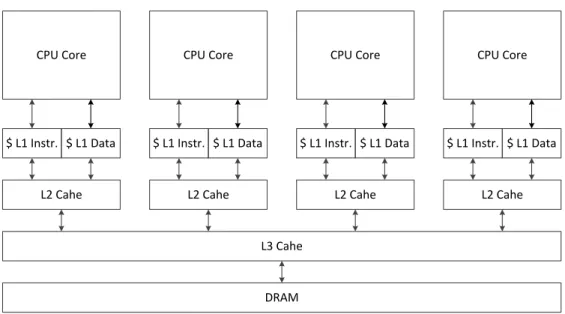
Multicore CPUs refer to general purpose processors integrating multiple cores in the same die. In general, these cores are identical and they are based on x86 architecture with complex control units which allow large coverage of types of parallelism. Typically CPU cores may handle a maximum of two concurrent threads due to the limited size of the register file. Each context switch between threads introduces additional overhead unlike GPUs which offers a nearly zero overhead through a large register file size. Multicore CPUs are cache-based architectures since they integrate a multi-level cache hierarchy (see Figure 3.8). The memory model multicore architectures follow is the Shared memory model where all cores are connected to the same memory and share the same address space (Ourselin et al., 2002). This particular feature offers more data locality but may yield memory contention due to the simultaneous access to the same address space. This fact limits the number of cores per node. One solution to expand the number of cores is to group a small number of cores into nodes to form a Non Uniform Memory Access (NUMA) system. Cores from the same node share the same address space with low latency access and access to remote node memory with high latency. The programming challenge of such platforms is to ensure : both thread affinity (to keep thread assigned to the same core to avoid thread migration and data migration overhead) and data affinity (to keep data close to the processing thread). Still, multicore CPUs are limited to the order of tens of cores which limits the degree of concurrency.
2.4.2 Manycore GPU-based Platforms
The application of GPUs is no longer restricted to graphics applications. The GPU Plat-form found its way to a large variety of general purpose computing tasks. In the last years, many algorithms were implemented on graphics hardware (Navarro et al., 2014). In many domains, GPU based hardware architectures are considered among the cost-effective parallel architectures to implement data-oriented applications. Image processing and computer vi-sion applications are taking advantage of performance features offered by GPUs such as high
CPU Core CPU Core CPU Core CPU Core $ L1 Instr. $ L1 Data L2 Cahe $ L1 Instr. $ L1 Data L2 Cahe $ L1 Instr. $ L1 Data L2 Cahe $ L1 Instr. $ L1 Data L2 Cahe L3 Cahe DRAM
Figure 2.2 Typical Multicore CPU Architecture (Cook, 2012)
degree of data-parallelism, floating point units reaching 3 TFLOPS (compared to only 200 GFLOP for CPUs) and a high memory bandwidth of around 320 GB/s (versus 20 GB/s for CPU, see Figure 2.3).
The evolution of these architectures took a relatively, long time to be considered as a ge-neral purpose architecture. This is due to the absence of effective and simple programming languages and tools. Mainly, GPUs were used in specific applications such as games and image rendering. The existing programming languages at that time were essentially shader programming languages such as Cg (Mark et al., 2003), High Level Shader Language (HLSL) (Peeper and Mitchell, 2003)and OpenGL (Rost et al., 2009). All of these programming lan-guages are based on the image rendering process. So, they are compiled into vertex shader and fragment shader to produce the image described by the program. Although, these high level programming languages abstract the capabilities of the target GPU and allow the pro-grammer to write GPU programs in a more familiar C-like programming language, they do not stay far enough from their origins as languages designed to shade polygons.
With the venue of general purpose GPU (GPGPU) ecosystems (architecture, language, run-time, libraries and tools), programs may conceptually have nothing to do with drawing geo-metric primitives and fetching textures, unlike with the shading languages. Rather, GPGPU programs are often best described as memory and math operations, concepts which are more
2006 2007 2008 2009 2010 2011 2012 0 1,000 2,000 3,000
42.6 51.2
55
58
86
187 243
518 576
648
1,062
1,5811,581
3,090
Year GFLOPsCPU
GPU
Figure 2.3 CPU and GPU Peak Performance in GFLOPs (Cook, 2012)
familiar to CPU programmers. To make this possible, some work was done such as the Brook programming language which extends ANSI C with concepts from data stream programming (Buck et al., 2004), Scout programming language designed for scientific visualization (Mc-Cormick et al., 2004) and Glift template library which provides a generic template library for a wide range of GPU data structures (Lefohn et al., 2006). In 2007, NVIDIA brought GPUs to the GPGPU programming domain by developing a developer friendly program-ming model called Compute Unified Device Architecture (CUDA) (Nvidia, 2007) considered as a most efficient parallel programming model for NVIDIA GPUs. Similarly AMD designed GPGPU architectures and contributed to the development of the Open Computing Language (OpenCL) (Stone et al., 2010) to program their GPUs. Since then, other parallel program-ming models are developed for GPUs such as DirectCompute (Ni, 2009), and OpenACC (Group et al., 2011).
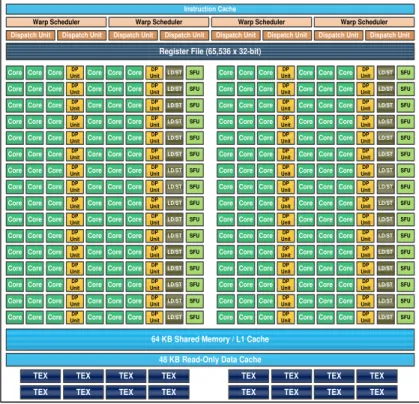
Both NVIDIA and AMD GPUs are composed of a number of multiprocessors (MP) named respectively by NVIDIA as Streaming Multiprocessors (SM) and by AMD as Compute Units (CU) (see Figure 2.4). Each MP integrates a large number of streaming processors (SPs) where in NVIDIA GPUs, each SM is a basic core integrating an integer arithmetic and logical unit (ALU), and a floating point unit (FPU). On the other side, AMD GPUs follow the SIMD fashion where cores integrate ALUs and are grouped into SIMD engines. Each MP is equipped with a number for schedulers and dispatch units responsible of scheduling threads
on the available cores and allocating the appropriate hardware resources. Besides processing units, each MP integrates a relatively small fast local memory that is accessed only by the SPs of the same MP via a network on-chip (NOC). In NVIDIA GPUs, this memory may be configured in part as an L1 cache and the rest as explicitly managed memory (scratchpad memory). In AMD GPUs, the L1 cache and the scratchpad memory are integrated as separate memories. In addition to memories, a huge number of registers is integrated in each MP to allow the support of a large number of threads working together with negligible switch context overhead. MPs from both GPU vendors share an L2 cache and a large high latency memory known as global or device memory.
MP 1 MP N SP SP SP SP Shared Memory Register File SP SP SP SP SP SP SP SP SP SP SP SP
Dispatch Unit Dispatch Unit
Warp Scheduler Warp Scheduler
L2 Cache Global Memory SP SP SP SP SP SP SP SP SP SP SP SP SP SP SP SP L1 Cache SP SP SP SP SP SP SP SP SP SP SP SP SP SP SP SP SP SP SP SP SP SP SP SP SP SP SP SP SP SP SP SP
Figure 2.4 Example of GPU Architecture
2.5 Parallelization Strategies
Parallelization Strategies define how to implement parallelization opportunities extracted from an application. In the following, we classify parallelization strategies according the parallelization granularity and types of parallelism.
2.5.1 Parallelization Granularities
Parallelization granularity refers to the size of parallel entities at which we can divide an application. Parallel entity may be tasks or processed data. We can distinguish two levels of parallelization : (1)task-level parallelization and (2) data-level parallelization. For both levels we may define mainly two granularities : (1) fine-grain and (2) coarse-grain.
Task-level Granularity
Task-level granularity is directly related to the program decomposition into independent tasks.
- Fine-grain tasking consists in dividing the program in elementary separate tasks and each single task is parallelized apart. This process is called fission. The benefit of the fine-grain parallelization strategy is the high reusability since each task may be found in more than one algorithm which is the case of most image processing algorithms. This means that a parallel version of this operation can be reused more than once in dif-ferent applications without any modification to ensure high portability among difdif-ferent applications. However, this strategy may suffer from (1) the overhead introduced by successive threads launches and (2) from poor temporal data locality.
- Coarse-grain tasking consists in packing a sequence of tasks into a macro task. This process is called fusion. Each macro task is assigned to a single thread which processes a part of data array. The implementation of this parallelization strategy needs additional programming effort to manage dependencies between neighbors data in order to minimize the synchronization barriers and data communication. When the implementation of the coarse-grain strategy is optimized, runtime performances may be improved by increasing temporal data locality and by avoiding overhead caused by threads launches and data transfers.
Data-level Granularity
Data-level granularity defines the degree of decomposition of initial data into data subsets.
- Fine-grain Tiling consists in decomposing the data into small subsets (small tiles in the case of image processing). These small tiles are assigned to small groups of threads.
This strategy exposes a high degree of concurrency and takes advantage of architec-tures supporting a huge number of threads. In addition, this strategy is usually not constrained by the hardware resources limitations. However, it suffers from a signifi-cant overhead in processing replicated data at borders to handle boundary dependen-cies. The data replication overhead is proportional to the number decomposed data. This strategy also suffers from poor space locality.
- Coarse-grain Tiling consists in decomposing data into large data subsets and in-volving large groups of threads. This strategy reduces the data replication at borders and offers high space data locality. However large tiles may not fit well with available resources, cache or local memory size, which may degrade performance.
2.5.2 Types of Parallelism
Types of parallelism or, also known as parallelism models, define the way to organize inde-pendent workflows. We can distinguish three main types of parallelism : (1) data parallelism, (2) task parallelism and (3) pipeline parallelism.
Data Parallelism
Data parallelism refers to work units executing the same operations on a set of data. The data is typically organized into a common structure such as arrays or vectors. Each work unit performs the same operations as other work units but on different elements of the data structure. The first concern of this parallelism type is how to distribute data on work units while keeping them independent. Data parallelism is generally easier to exploit due to the simpler computational model involved (Orlando et al., 2000). However, data parallelism is limited to some application aspects and it cannot exist alone with the increasing complexity of modern applications (Gordon et al., 2006).
Task Parallelism
Task parallelism is known also as functional parallelism or control parallelism. This type of parallelism considers the case when work units are executing on different control flow paths. Work units may execute different operations on either the same data or different data. In task parallelism, work units can be known at the beginning of execution or can be generated at runtime.
Task parallelism could be expressed in the GPU context in two ways. In a multi-GPU en-vironment, each task could be processed by a separate GPU. In a single GPU enen-vironment, the task parallelism is expressed as independent kernel queues called respectively streams and command queues in CUDA and OpenCL. kernel queues are executed concurrently where each kernel queue performs its workload in a data-parallel fashion.
Pipeline Parallelism
Pipeline parallelism is also known as temporal parallelism. This type of parallelism is applied to chains of producers and consumers that are directly connected. Each task is divided in a number of successive phases. Each worker processes a phase of a given task. The result of each work unit is delivered to the next for processing. At the same time, the producer work unit starts to process a given phase of a new task. Compared to data parallelism, this approach offers reduced latency, reduced buffering, and good locality. However, this form of pipelining introduces extra synchronization, as producers and consumers must stay tightly coupled in their execution (Gordon et al., 2006).
One form of pipelining parallelism that is often used in parallel programming is overlapping data transfer and processing. This form of pipelining is performed via the Direct Memory Access (DMA) mechanism. In GPU architectures, DMA is used to transfer data between host memory and GPU global memory via PCI.
2.6 Parallel Programming Models
The programming models expose the parallelism capabilities to the programmer while they abstract the underlying architecture away. The programming models have to show certain architecture features such as the parallelism level, the type of parallelism, and the abstrac-tion degree of the components’ funcabstrac-tions. Parallel programming models are implemented as a set of languages, extensions of existing languages, libraries and tools to map applications on parallel architectures.
Inspired by the classification of the parallel programming models proposed by P. Paulin et al. in (Paulin et al., 2006), we can group the parallel programming models in three main classes : (1) Shared memory programming models, (2) distributed memory programming models and (3) Data streaming parallel programming models.
2.6.1 Shared Memory Programming Model
It is known as the simplest way for parallel programming. It refers to shared memory sys-tems in which the application is organized as a set of processes sharing the same memory. By programming with this model, some form of load balancing is satisfied (Nicolescu and Mos-terman, 2009). However, it is necessary to ensure the data coherency which is the greatest challenge of this parallel programming model. The main limitation of the shared-memory programming model is that it does not support heterogeneous systems (Nicolescu and Mos-terman, 2009).
2.6.2 Distributed Memory Programming Model
Inspired from the client-server model, the distributed memory parallel programming model is still appropriate for heterogeneous systems and control-oriented applications. The distributed memory parallel programming is scalable with the increasing number of processing elements. Moreover, it is well suited to express the coarse-grained parallelism by offering generalized communication mechanisms. However, these mechanisms demand more effort to fit them to the infrastructure which implies performance overhead.
Message Passing Interface (MPI) (Pacheco, 1997) is considered the de-facto standard for deploying applications on distributed memory systems. We can find several implementations of MPI such as OpenMPI (Graham et al., 2006), MVAPICH Team (2001).
2.6.3 Data Streaming Programming Model
Data streaming parallel programming models are motivated by the architecture evolution which is shown in the graphical processing architectures offered by NVIDIA and AMD. In addition, the emerging need to map aerospace applications, network applications and mul-timedia applications on such architectures make this parallel programming model more re-quired. Based on its nature suitable for data-oriented parallelism, this programming model helps programmers to reach high performance by reducing the communication overhead. This programming model is implemented by languages such as StreamIt (Thies et al., 2002) and Brook or language extensions such as CUDA or OpenCl.
Data streaming parallel programming is based on two basic concepts :
Streams : contain a set of elements of the same type. Streams can have different lengths and the elements can be simple as float or complex as structure of floats, as
defined in the Brook language. One should not confuse this with stream in the CUDA terminology which defines an execution queue of operations.
Kernels : consist of a loop that processes each element from the input stream. The body of the loop first pops an element from its input stream, performs some computation on that element, and then pushes the results into the output stream.
In the data streaming parallel programming model, a program is represented as a set of au-tonomous kernels that are fired repeatedly by stream elements in a periodic schedule. The central idea behind stream processing is to organize an application into streams and kernels to expose the inherent locality and concurrency in media-processing applications. The main limitation of this parallel programming model is its poor support for control-oriented com-putations.
2.7 Examples of Parallel Programming Models for Multicore CPUs and Many-core GPUs
In this section we give an overview of most used parallel programming models for Multicore CPUs and Manycore GPUs.
2.7.1 Examples of Parallel Programming Models for CPUs
We focus in this thesis on two most used high-level parallel programming models in program-ming multicore CPUs mainly OpenMP and Intel TBB.
OpenMP
OpenMP is a standard shared-memory programming model (Dagum and Menon, 1998). It is designed as an API used to explicitly command multi-threaded shared memory parallelism. OpenMP consists of a set of compiler directives, runtime library routines and environment variables. It targets two languages C/C++ and Fortran. OpenMP was a thread-centric gramming model in previous versions but, since OpenMP 3.0, it is also a task-centric pro-gramming model to parallelism at the task-level.
The OpenMP model follows a Fork-Join Model (Lee et al., 2009) where all OpenMP pro-grams begin as a single process : the master thread. The master thread executes sequentially until the first parallel region construct - a directive which indicates that the region of the
program following this directive will be processed in parallel by the available threads. Here is an example of a directive used in OpenMP-C : #pragma omp parallel.
The main feature of OpenMP is the ease of use by providing the capability to incrementally parallelize a sequential program. Moreover, it is capable of implementing both coarse-grain and fine-grain parallelism. However, since it is a compiler-based programming model, the performance of applications implemented in OpenMP may change, depending on the compiler used.
TBB
Intel Threading Building Blocks (TBB) (Pheatt, 2008) is a library-based programming model for multi-core CPUs. It provides a higher level of abstraction to express parallelism : the work units in TBB are specified as tasks, and not threads. TBB targets C++ as the programming language and provides some templates to express a number of defined parallel algorithms. TBB has an asset compared to OpenMP by providing thread-safe concurrent containers.
2.7.2 Examples of Parallel Programming Models for GPUs
In order to program GPU-based platforms, specific APIs known as parallel programming models are developed. In this thesis, we focus on the most used programming models for GPU-based platforms : namely CUDA and OpenCL. Both CUDA and OpenCL are exten-sions of the C language and implement a particular runtime to manage the computation on a GPU. The two programming models present lots of similarities but differ in portability and performance, depending on the target architecture. While CUDA is running only on NVIDIA GPUs, OpenCL is ported to several heterogeneous platforms including NVIDIA and AMD GPU-based platforms. The program in both programming models is written as a host-side (CPU) program and a device-side (GPU) program. The host-side program is responsible to initialize the device, allocate data in both host and device, exchange data between host and device and launch work on the device. In both programming models, a device-side program is expressed as a compute kernel, which is the elementary execution unit. A compute kernel is basically a C function that expresses the processing assigned to a single thread. In order to accomplish a parallel execution of the same kernel on a collection of data, the kernel is instantiated on a number of threads by means of the programming model-specific syntax.
terminology, or work items in OpenCL terminology, are organized in blocks called respec-tively thread blocks in CUDA and work groups in OpenCL. Threads inside one block are organized in a 1D, 2D or 3D grid (see Figure 2.5). Threads belonging to the same block are assigned to the same MP and share the same portion of the local memory and the syn-chronization between them is allowed via barriers (see Figure 2.6). Simultaneous accesses of Threads to the local memory have to be memory conflict-free to take advantage of the full local memory bandwidth. The total number of threads is scheduled as execution units called warp in CUDA and wavefront in OpenCL. Threads belonging to the same execution unit have to follow the same execution path to avoid any execution serialization. Both CUDA and OpenCL runtimes provide a mechanism to support the parallelism between different compute kernels or between compute kernels and data-transfer, which is called stream in CUDA and command queue in OpenCL. This mechanism gives an additional flexibility in expressing computations and improving performance by tailoring the appropriate number of threads to the computation, and hiding the access overhead to the data resident in device memory by overlapping computation and memory transfer.
Thread Grid
Thread Block (0,1) Warp 3 Warp N Thread Block (0,BLKx) Thread Block (Blky,0) Thread Block (BLKy,BLKx) Thread Block (Blky,1) Thread (0,0) Thread (0,1) Thread (0,31) Thread (1,0) Thread (1,1) Thread (1,31) Thread (0,32) Thread (0,33) Thread (0,63)Figure 2.5 Thread Arrangement in GPU Programming Models - Example : CUDA
Recently a new programming model has emerged : OpenACC is considered as an alternative to low-level parallel programming models as CUDA and OpenCL. OpenACC is a directive-based programming model like OpenMP but it targets GPUs with the ability to map data on specific type of memory via simple program annotation. It is a good solution for programmers
looking for functional programs on GPUs with less effort and time. However, this comes with the cost of lower performance compared to low-level parallel programming models.
Thread Grid Thread Block (0,1) Thread Block (0,2) Thread Block (0,7) Thread Block (0,8) Thread Block (0,9) Thread Block (0,15) Thread Block (1,1) Thread Block (1,2) Thread Block (1,7) Thread Block (1,8) Thread Block (1,9) Thread Block (1,15) MP 0 MP 1 MP 2 MP 3
Figure 2.6 Thread Block Mapping on GPU Multiprocessors
2.8 Conclusion
In this chapter, we presented some basic concepts that are necessary to address parallel programming. Also, an overview of the main existing parallel hardware platforms is presen-ted, their programming models and the parallelization strategies that may be employed to parallelize an application. In the next chapter, we go into details for some of the above men-tioned concepts through a practical application. To do so, a number of image processing and computer vision applications are implemented on a variety of parallel platforms.
CHAPTER 3 ACCELERATION OF IMAGE PROCESSING AND COMPUTER VISION APPLICATIONS ON PARALLEL PLATFORMS
3.1 Introduction
In this chapter, we evaluate the efficiency of several target parallel platforms to speedup image processing and computer vision applications. The performance evaluation is perfor-med through three fundamental applications used in image processing and computer vision : (1) Canny Edge Detection (CED), (3) Shape Refining : thinning as example and (3) Dis-tance Transform (DT). These applications are compute intensive and highly data parallel. We developed for each application a number of parallel implementations targeting a wide range of architectures including : (1) high performance computers and (2) embedded parallel platforms. A number of parallelization strategies and optimizations techniques are investiga-ted depending on the applications and the target architecture. We show the impact of such optimizations on performance via a large set of experiments.
The chapter is organized as follows. Section 3.2 provides a state-of-art on the paralleliza-tion of image processing applicaparalleliza-tions on different hardware platforms. Secparalleliza-tion 3.3 presents an overview of the used approach to evaluate different parallelization strategies on parallel platforms. Section 3.4 presents the applications context and describes their functionalities. Section 3.5 provides a detailed description for the architecture specifications of the target parallel platforms. Section 3.6 describes in details our approach to parallelize the selected applications on the target platform. Section 3.7 presents the experimental results of different implementations of the studied applications on the target platforms. Finally, Section 3.8 concludes this chapter with a summary of the obtained results.
3.2 Related Work
We provide in this section an overview of a number of work accelerating image processing and computer vision applications on parallel target platforms.
Several acceleration efforts of medical imaging processing on GPU are surveyed in (Eklund et al., 2013). The review covers GPU acceleration of commonly used image processing ope-rations in medical imaging (image registration, image segmentation and image denoising). Those operations are filtering, histogram estimation and distance transform.
In Chen et al. (2007a), an improved parallel implementation of the CED application as part of an articulated body tracking application is proposed. The proposed implementation out-performs a non optimized original implementation with respect of speedup (19.91x vs. only 4.16x on 32 threads). These results are obtained on a simulated future multi-core architecture running 32 threads. However, there is no comparison between these two implementations on a real multi-core architecture, while only the original implementation is tested on a real 8 Intel Xeon processors and which reaches only 2.4x as speedup with 8 threads. In Swargha and Rodrigues (2012), three image processing applications (Laplace, Sobel and CED) are implemented using OpenCL on the AMD Radeon HD 6450 GPU which integrates 160 multi-threaded streaming processors (SPs). The parallel implementation of CED on GPU reaches a speedup of 50x compared to a serial implementation on Intel Core i3 CPU running at 2.1 GHz. However, the proposed implementation provides poor detection due to assumptions made toward a reliable implementation on GPU. In Ogawa et al. (2010) and Niu et al. (2011) more accurate parallel CED implementation are proposed using CUDA on NVIDIA GPUs. The former reaches 50x speedup on Tesla C1060 GPU which integrates 240 SPs running at 1.3 GHz. The speedup is achieved compared to Intel Xeon E5540 processor running at 2 GHz. The latter proposes an improved CED on GPU which reaches a speedup between 22x and 55x compared to Intel core 2 Q8400 running at 2.66 GHz. Nevertheless, the proposed CED implementation remains more accurate and most suitable for medical applications. Other works are presented targeting embedded multiprocessor platforms. In Ensor and Hall (2011), a performance evaluation of a number of heterogeneous multiprocessor architectures involving multi-core CPUs and GPUs for mobile devices is provided. In this context, a GPU shader-based implementation of CED application on OpenGL ES Munshi et al. (2008) is evaluated on several mobile devices : Google Nexus One, iPhone4, Samsung Galaxy S, Nokia N8, HTC Desire HD and Nexus S. The results show that for some devices, the offloading of the edge detection from CPU to the GPU may offer a 50% performance benefit, but for other cases it may be insignificant due to the inter CPU-GPU data transfer overhead. In Patil (2009) and Brethorst et al. (2011), two specific purpose multiprocessor architectures are targeted. The former deals with video games through Cell Be PlayStation 3 architecture which is composed of a host CPU and eight synergetic processing elements. The latter deals with spatial mission through a Tilera Tile 64 processor which is a 64-tiled multi-core architecture. The CED implemented on Cell Be reaches a speedup of 7x compared to Intel Core 2 Duo processor running at 2 GHz and an execution time around 28 ms for 1024x1024 images. The results of the implementation of the CED on Tilera are shown for only 8 cores while it integrates 64 cores. The speedup reached on 8 cores remains poor around 5x and an execution time around seconds.
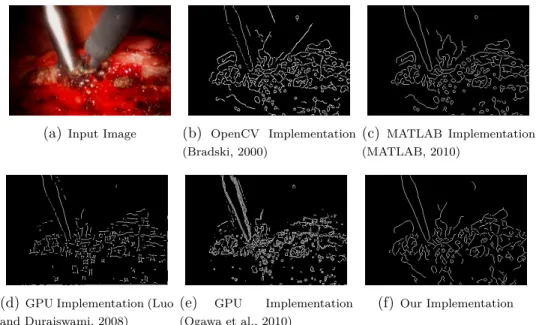
In Figure 3.1, we provide a quality comparison of detected edges of our implementation ver-sus some of the previously mentioned CED implementations. While OpenCV on CPU and the two GPU reference implementations are fast enough to reach real time execution, they remain inaccurate with non continuous edge lines or noisy extra lines. On the other hand, our implementation, running on low-power SoC at frame rate of 10 frames/s provides accurate smooth line edges.
The most interesting work is reported in (Pallipuram et al., 2012) which provides a rich comparative study of different implementations of Neural Network on two different GPU vendors Nvidia and AMD. Despite the several work on accelerating image processing appli-cations, only few work are performing a deep comparison of the parallelization efficiency of the existing hardware parallel platforms.
(a) Input Image (b) OpenCV Implementation (Bradski, 2000)
(c) MATLAB Implementation (MATLAB, 2010)
(d)GPU Implementation (Luo and Duraiswami, 2008)
(e) GPU Implementation (Ogawa et al., 2010)
(f)Our Implementation
Figure 3.1 Smoothing Edges Comparison : Output Images of Different CED Implementations
3.3 Evaluation Approach Overview
In this section, we present an overview of our approach to evaluate the efficiency of a large set of parallel platforms to run parallel applications (see Figure 3.2). This approach takes the studied applications as input and preforms the following three steps :
1. Analyze each application complexity and available parallelization opportunities, 2. Select appropriate parallelization strategies depending on the target platform
3. Implement the parallel versions using each parallelization strategy on target platforms and evaluate the parallelization efficiency.
Multi-core CPU Many-core
HPC Platforms Embedded Platform
NVIDIA GPU GTX 590 (Fermi) NVIDIA GPU GTX 780 (Kepler) NVIDIA GPU GTX 750 (Maxwell) NVIDIA Tegra K1 (Kepler) ST STHORM (Many-core CPU) NVIDIA Tegra K1
(4-core ARM Cortex A15) Dual Socket (8-core AMD Opteron 6128) 1- Application Analysis CED Application Thinning Application EDT Application 2- Selection of Appropriate Parallelization Strategies
HPC Platforms Embedded Platform 3- Implementation and
Performance Evaluation
Influential
factors Application Approach Step
Hardware Platform
Legend:
Figure 3.2 Performance Evaluation Approach
3.4 Case Study Applications
As a case study, we target the augmented reality system for Minimally Invasive Surgery (MIS) used for spinal surgery. MIS imposes high difficulty to the surgeon since he has to handle surgical instruments relying on a narrow field of view captured from an endoscope (monocu-lar camera introduced in the patient body via a small hole). An augmented reality system based on two processing stages is the solution to get over the loss of depth perception and the narrow field of view. The first stage consists of a real-time detection of surgical instruments and their positions in the captured video. The second stage consists of mapping the captured
positions on the preoperative 3D spinal model to build an augmented reality scene (see Fi-gure. 3.3). In this thesis, we focus on the processing involved in the first stage (see FiFi-gure. 3.4).
As a starting point, we use the application developed by (Windisch et al., 2005). The ap-plication is developed in MATLAB (MATLAB, 2010) where all the functional aspects are met. The main issue of the developed application is the long execution time which makes it not suitable for practical clinical use. The challenge is how to speedup such application and maintain high accurate instrument detection. First, we identified the main applications involved in first stage which are : (1) Canny Edge Detection (CED), (3) Shape Refining : thinning as an example and (3) Euclidean Distance Transform (EDT). We used these appli-cations as a case study to evaluate the parallel computation capability of several hardware parallel platforms. In the following, we detail the parallelized applications.