HAL Id: hal-01147718
https://hal-imt.archives-ouvertes.fr/hal-01147718
Submitted on 21 Jan 2017HAL is a multi-disciplinary open access archive for the deposit and dissemination of sci-entific research documents, whether they are pub-lished or not. The documents may come from teaching and research institutions in France or abroad, or from public or private research centers.
L’archive ouverte pluridisciplinaire HAL, est destinée au dépôt et à la diffusion de documents scientifiques de niveau recherche, publiés ou non, émanant des établissements d’enseignement et de recherche français ou étrangers, des laboratoires publics ou privés.
Physical Loci: Leveraging Spatial, Object and Semantic
Memory for Command Selection
Simon T. Perrault, Eric Lecolinet, Yves Guiard, Yoann Bourse, Shengdong
Zhao
To cite this version:
Simon T. Perrault, Eric Lecolinet, Yves Guiard, Yoann Bourse, Shengdong Zhao. Physical Loci: Leveraging Spatial, Object and Semantic Memory for Command Selection. CHI’15: Proceedings of the ACM SIGCHI Conference on Human Factors in Computing Systems, Apr 2015, Seoul, South Korea. pp.299-308, �10.1145/2702123.2702126�. �hal-01147718�
S
A P t s m c lo l M w o th s p w A S a A H I G c P c fo c th o p C C A hPhysi
Simon T. Pe
1National U
perrault
Figure 1. Prin room (e.g. livin ABSTRACT Physical Loci, echnique, allo set by levera memory to cr commands and oci). We first r earning 25 ite Marking Menu with 48 items one week later he command/ somebody else performance is whether system Author Keywo Spatial memory association; me ACM Classific H5.2. [User Int NTRODUCTIO Gestural short commands. Ho Permission to make d lassroom use is gran or profit or commer itation on the first p han ACM must be ho or republish, to post permission and/or a fe CHI 2015, April 18 - Copyright is held by t ACM 978-1-4503-314 http://dx.doi.org/10.1ical Loc
M
errault
1,2E
NUS-HCI L
University o
t.simon@gm
z
ciple of the Phy ng room), called (c) actual exam a technique b ws users to qu aging spatial, reate a cognit d nearby physi report on an ex ems Physical u baseline. A lo then showed r and, surprisi /locus mappin e’s. A final robust to alter matic or random ords y; memorizatio ethod of loci; m ation Keyword terfaces]: Intera ON tcuts provide owever, gestur
digital or hard copies nted without fee prov rcial advantage and page. Copyrights for
onored. Abstracting w t on servers or to r ee. Request permissio
23 2015, Seoul, Rep the owner/author(s). 45-6/15/04…$15.00 145/2702123.270212
ci: Leve
Memory
Eric Lecolin
Lab
of Singapore
mail.com, eri
haosd@com
ysical Loci techn d loci (b) To cre
mples of associa
based on an a uickly learn a object and tive link betw ical objects in xperiment that Loci outperfo ong-term reten that recall wa ingly, indepen g was one’s study sugges rations of the le m. on; command mnemonic devi ds action Styles. an effective al shortcuts ar
s of all or part of thi ided that copies are n that copies bear th components of this with credit is permitt edistribute to lists, ons from Permission ublic of Korea Publication rights lic
26
eraging
y for Co
net
2Yoan
ic.lecolinet@
mp.nus.edu.sg
nique: (a) The u eate the associat ations between ancient memo large comman verbal/semant ween individu n a room (calle t showed that f ormed a mid-a ntion experime as nearly perfe dent of wheth own choice sted that reca earned mappin
selection; inpu ice.
way to issu re only effectiv
is work for personal not made or distribut his notice and the f work owned by othe ted. To copy otherwi
requires prior speci [email protected]. censed to ACM.
g Spatia
omman
n Pascal Bo
2Télécom
4
@mines-telec
g, yves.guiar
user creates ass tions or invoke commands and ory nd tic ual ed for air ent ect her or all ng, ut; ue ve if user handlin increas therefo gestura In this gestura loci [36 impres implem interac which The m which recall this cla spatial such a mental each disting achiev to activ has be Indeed recall l Althou has ye motiva method facilita or ted full ers se, ific
al, Obje
nd Sele
ourse
2Sh
m ParisTech –
46, rue Barra
com.fr, yoan
rd@mines-t
sociations betwe commands, the d loci, in our exprs can easily ng a few sho sing the numbe ore limiting th al shortcuts. s paper we in al shortcuts w 6], an ancie ssive learning mentation of t cting with a sm is well suited f method of loci uses images information. “ assic technique structures tha as a building, lly 'walks' thro by forming guishing feature ed by 'walking vate the desire een well establ d, it has been u
large amounts ugh the effectiv et to be applied ated us to inve d for HCI u ating quick me
ect and
ection
engdong Zh
– CNRS LTC
ault, Paris, Fr
nn.bourse@n
elecom.fr
een commands e user points at perimental room y learn and r ortcuts may be er of shortcuts he applicabili ntroduce a nov which is inspir ent memory g capabilities. this method, c mart home envir for applying th is a method o and spatial le “Loci” refers t e first memori at have a numb or shops on ough these locan image o e of that locus g' again throug ed items. The e lished in psych used by memo of faces, digits veness of this m d to human-co estigate the po use and stud emorization of
Seman
hao
1Yves
CI UMR 514
rance
normalesup.o
and physical ob the correspond m setting. remember the e easy for mo s makes the rec ty and effect vel way of m red from thetechnique th We also p called Physica ronment, a con his technique. of memory en earning to org to locations. T izes the layout ber of discrete a street, then ci and assigns
of the item . The retrieval h the loci, allo efficacy of this hology literatu ory contest cha s, and lists of w method is well omputer intera ossibility of ad dy its effecti an unusually l
ntic
s Guiard
241
org,
bjects in a ding locus; em. While ost people, call harder, tiveness of memorizing method of hat offers ropose an l Loci, for ntext of use nhancement ganize and The user of t of certain e locations, n the user an item to and any of items is owing them s technique ure [11,12]. ampions to words [28]. l known, it ction. This dapting this iveness in large set ofgesture shortcuts. In our adaptation of the method, Physical Loci (summarized in Figure 1), the users’ task is easier as they are asked to associate the items to be memorized to objects and places of the surrounding physical environment, typically a room. Hence the mnemonic device involves visible, physical objects, rather than mental loci.
We conducted three experiments in which we examined learning and recall performances of Physical Loci. Experiment 1 was to validate our adaptation of the method of loci. We compared a Kinect-based implementation of Physical Loci with a mid-air Marking Menus baseline and found that Physical Loci significantly outperformed mid-air Marking Menus in facilitating memorization of shortcuts. Experiment 2 was a Wizard-of-Oz study designed to investigate two issues: whether the loci defined by one person could be used by another, and whether learned associations of 48 loci could be remembered after a day, a week, and two months. Our results indicate that loci can easily be shared among users and that retention is quite high. Our third experiment evaluated the perturbation effect of object displacement in the environment. In general recall times increased but recall rates were essentially preserved. Overall our results suggest that Physical Loci is easy to learn, sharable among users, robust to simple environmental changes, and allows long term retention, which makes this technique promising for HCI. We also suggest scenarios where Physical Loci could be used in different contexts.
BACKGROUND AND RELATED WORK The Classic Method of Loci
The method of loci, which dates back to the time of Aristotle, was popularized in the 1960s by Yates [36]. This method was used to remember long speeches without notes until the middle of the 17th century, and was described by Higbee [17] thusly: “Orators visualized objects that represented the topics to be covered in their speeches, and then mentally placed the objects in different locations— usually parts of a building. They then moved through this building mentally while delivering the speech, retrieving the object images from the locations as they came to them”. In the classic technique creating loci involves two steps. First, users must memorize mental images of familiar locations in some natural or logical order. Next they will associate a visual image of each item to be remembered with a location in the series. The first step is by far the most demanding but it needs to be performed only once since the same series of locations can be used for different lists of items with little interference [10].
The efficacy of this technique has been demonstrated in numerous studies since the mid-1960s [10,11,12]. Many of the studies, often conducted with students, typically were designed for remembering lists of 20, 40 or 50 words [11,12,17]. Some people have been known to achieve amazing performance, such as remembering thousands of digits in memory contests [22,28].
Practical use and application to HCI
Although efficient, the method of loci has several drawbacks. As explained above, the method of loci first requires creating and perfectly memorizing a mental representation of an ordered list of familiar locations. As one can easily verify on their own, this is a demanding and tedious task, especially for large item sets (e.g., more than 10 or 20 items). This constraint makes it difficult to apply the loci technique to HCI in its original form. A technique requiring too much initial effort is unlikely to be adopted by users. Moreover, the loci technique is purely a mental exercise. Applying it to HCI, and, more specifically, command selection, requires finding an appropriate implementation.
Personal and spatially constant mental representation
As a mnemonic device, an instance of the method of loci is created by the user, which means that people using that method can create association between any loci they are familiar with and the items they want to remember. Since places used are mental images, they rely on a spatial configuration and positioning of loci which is specific to the user. This limitation can be problematic in the context of HCI as several people may need to interact with the same system and use the same set of shortcuts. Moreover, this mental representation is not supposed to change, which means that loci are not meant to move.
Mnemonics techniques and HCI
Some mnemonics techniques inspired HCI research, such as Angesleva et al. [3], where the body image of the user serves as a mnemonic frame of reference, or Ikei et al. [18], where image annotations shown on a head-mounted display help users memorize places they visited before.
Memorization
Human memory has been extensively studied in the field of psychology (i.e., Baddeley's survey [5]). In their Working Memory model Baddeley and Hitch [5] illustrate the distinction between verbal and visuospatial information. Further, neuropsychological and neuroimaging studies distinguish between visual object and visual spatial information; we examine this distinction below [5].
Object memory involves processing features of an object or
material such as texture, color, size, and orientation. In the case of the loci method, object memory plays a role in remembering precise details of the room. Yates [36] notes the importance of imagery in the method of loci because the more stunning, disturbing, or noticeable the mental images are, the better items will be memorized.
Spatial memory is another key component of the loci
method as users must mentally "place" the items they want to remember in different locations. This mental place aspect increases the specificity of the loci technique, as opposed to other mnemonic devices. Spatial memory has garnered much attention in psychology [2,5,19,22] and, to a lesser extent, in HCI [4,8,29,30]. Partly because spatial learning occurs automatically, even without focused attention [2],
spatial memory can help users to remember large numbers of items [5]. Maguire et al. [22] found that most of the champion memorizers they observed used a spatial learning strategy. Using functional neuroimaging, they also noted that this strategy engaged specific brain regions such as the hippocampus, which are critical for memory (and spatial memory in particular).
The utility of spatial metaphors has been shown since the development of HCI [8]. An interesting example is Data Mountain, which used a spatial 3D representation and thumbnails to help users organize, store, and retrieve 100 Web bookmarks [14,29]. This technique was shown to be faster than Internet Explorer's bookmark tree and remained effective after several months. However, this technique did not require users to recall the exact locations of bookmarks (whose names were visible on demand) but rather helped them to find their location faster. Command selection was considered in ListMaps [15], which illustrated the efficiency of grid interfaces for experts. Spatial memory was used in CommandMaps [30], in combination with hierarchy flattening, to improve GUI performance and in FastTap [16] to allow faster command selection on tablets. Finally, Virtual Shelves [21] relied on spatial awareness and kinesthetic memory for pointing accuracy, but not for the memorization of commands.
Verbal/semantic encoding also occurs in the method of loci.
Items were clustered into categories in our experiments, as in most actual user interfaces. Structure is known to improve memorability [9]. Not only people recall more items if they are grouped by category [5, 23] but long-term retention increases when the structure of a set of gestural shortcuts reflects the structure of the corresponding command set [33]. Moreover, mental images used with the loci method can involve stories [36] (e.g. a painting, a place related to an historical event, etc.).
Combinations and complementary processes. Combining
spatial memory with other cues has been shown to improve performance in terms of memorization [19]. According to Pavio's Dual Coding Theory [27] one can expand on learned material through verbal associations and visual imagery. Visual and verbal information are processed differently, along distinct channels, which increases the chance of remembering a given item versus the stimulus being coded one way. Moreover, imagery potentiates recall of verbal material and vice-versa, so that both channels should reinforce each other. Elaborative encoding, which is the process of actively relating new information to knowledge that is already in memory, may also improve long-term retention.
In conclusion, embedding memory in a detailed surrounding or context should help remembering it later and the combination of different memory channels is likely to improve memorization.
PHYSICAL LOCI
Physical Loci are a practical implementation of the loci method for gestural invocation in the context of a smart home environment. The significant difference is that this technique uses physical objects for recall (e.g. objects in the living room) and does not require the creation and memorization of an imaginary place, which is a tedious operation.
The user must first set up a mapping between a set of desired commands and loci in the room (Figure 1-a). For each command, he must point to the corresponding locus with his arm and validate to store this mapping. Commands can then be activated just by pointing to the corresponding loci and performing a validating action (Figure 1-b). Depending on the available technology, the pointing action can be done using a gesture- and location-aware remote control [34] or through free-hand interaction. While a button suffices to validate in the first case, a drawback of the second solution is that it requires a gesture delimiter, such as a quick opening of the hand [7] to distinguish command shortcuts from ordinary, everyday gestures. There is little constraint on the choice of loci except that they should be reasonably distant from one another to avoid confusion and easily identifiable by the system when the user points to them (e.g. pointing to the back wall should be avoided if using a Kinect).
Novice-to-expert transition is of particular importance in
gestural interfaces. Norman [25] states a pure gestural system would make it difficult to discover its set of possibilities. We attempted to preserve the advantages of a smooth novice-to-expert transition, as in Marking Menus [20] where the user can learn expert interaction seamlessly through the force of repetition. Therefore, we provided a visual help which is displayed on demand. This visual representation, which is typically displayed on a living room TV screen, shows the locations of the loci and the corresponding commands. Figure 2 and Figure 5 illustrate different implementations of this visual cue.
EXPERIMENTS
Three experiments were conducted to investigate the following research questions.
Exp. 1: Can Physical Loci facilitate memorization and invocation of gestural commands compared to a well-known gestural invocation method?
Exp. 2: Once learned, how long can the loci command mapping be remembered? Can users use loci created by other people, and how does this use compare to loci created by the initial user?
Exp. 3: How do changing object locations affect accuracy and selection times?
EXPERIMENT 1: PHYSICAL LOCI VS. MID-AIR MARKING MENUS
In this first experiment, we evaluate the ease with which gestures could be remembered with Physical Loci in comparison to a mid-air Marking Menu (mid-air MM) for
in-air interaction because of its efficiency for remembering gestural shortcuts. Our implementation of marking menus was reminiscent of 2-level multi-stroke marking menus. It consisted of mid-air 2D strokes for its reliability and accuracy [37]. In essence, Physical Loci relies on pointing gestures (given location), whereas mid-air MM relies on directional gestures. In this experiment, we wanted to investigate how fast users would learn the mapping between gestures (mid-air MM) or loci (Physical Loci) with commands. Both techniques offer a smooth novice-to-expert transition, which allows measuring precisely when this transition happens.
The gestures were performed with the dominant hand. For simplicity we did not use a gestural delimiter [7] but a mouse held in the other hand. A left button press served to validate a Physical Loci pointing gesture and to mark the beginning and end of a mid-air MM gesture.
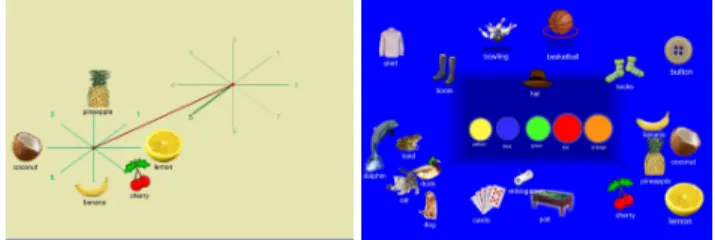
Figure 2. Visual feedback in novice mode for mid-air MM (left) and for Physical Loci (right). A virtual 3D representation of the
loci on the walls was shown in this experiment.
Both techniques had a novice and an expert mode. In both cases novice mode is triggered using a click on the right button of the mouse (in a real system an appropriate gesture might serve this purpose). In a standard marking menu, the novice display normally appears after a short delay, but maintaining an extended-arm posture repeatedly in the experiment would have induced fatigue. We used a standard 2D representation for the mid-air MM novice mode (Figure 2-left) and a projected 3D representation showing the approximate location of the loci in the room for Physical Loci (Figure 2-right).
Participants and Apparatus
Participants were 3 females and 9 males aged 15-30 (average age 23); all were right-handed. The 12 participants performed a within-subjects experiment with the order of the techniques counterbalanced among participants following a Latin square. The experiment was conducted in a room (6 × 4.5 × 2.7 m) emulating a home environment (with a sofa, a table, two cupboards and posters on the walls). Participants stood 2.5m in front of a 42″ TV screen that displayed the stimuli and the visual help (Figure 2). Tasks were to first create a mapping by assigning commands to loci; then to recall the defined mappings. Pointing, performed in the air using the dominant hand, was detected by a recognition system developed for this experiment using a Kinect for Windows 1.5. To facilitate tracking and avoid errors, loci had to be large and
well-spaced from each other, were not permitted on the back wall and several loci could not be part of the same object. Participants were asked to name aloud the item they were selecting as to distinguish between recall errors and detection errors by the system.
Vocabulary and Stimuli
Experiment 1 used a vocabulary of 25 items divided into five categories of five items each (animals, clothing, colors,
fruits, and leisure activities). We used categories to mimic
realistic tasks, where commands usually belong to different categories. This 5×5 configuration also avoided penalizing the 2-level marking menu as participants could map each category to a single submenu. Stimuli were displayed on the screen as both text and image. We used a vocabulary of names that all participants would equally recognize and avoided names with an obvious relationship to loci.
Procedure
After a 10-minute familiarization stage, the mapping phase began. Participants were asked to associate a particular gestural response, either a 2-segment marking menu gesture (mid-air MM condition) or a locus in the surrounding space (Physical Loci condition), to each stimulus. For conformity, only posters could be chosen as loci in this experiment. Items were presented sequentially in a random order. In the retrieval phase, participants were asked to first remember the particular location or gestures associated to an item and then select the item as quickly and accurately as possible. For each block, each stimulus was presented once, in a randomized order. Upon selection, users received feedback letting them know if the retrieval was correct. Each technique was tested by participant on four blocks, for a total of 200 selections (25 items × 2 techniques × 4 blocks). In the first three blocks, the system was in expert mode by default, but the user could trigger the novice mode, if desired. In these phases, a trial would only end when the user selected the right item: in case the first selection of a trial was incorrect, the novice display would appear, forcing the user to select the correct command in novice mode. In the fourth phase, only the expert mode was available. The entire experiment lasted around one hour.
Results and Discussion
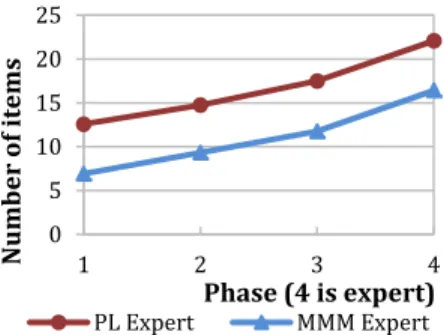
We were interested in both recall rates and system detection accuracy. We first present the results obtained from the data collected by the experimenter using mouse click data and spoken targets. Figure 3 illustrates the average number of correct selections for both techniques in expert mode only. The participants were free to interact in novice or expert mode in all but the final phase (forced expert mode). The two learning curves are remarkably parallel except that the Physical Loci technique (PL) starts at a higher level. The difference in expert recall is a constant six items in favor of PL. Participants often felt confident enough to begin in expert mode during the first recall phase, particularly when using PL. Here, without assistance, they
correctly selected more than 12 items on average. With both techniques there was a smooth and efficient novice to expert transition, with an average of 3.1 items learned in each phase. In the third phase, many Physical Loci participants felt confident enough to try the expert mode, correctly selecting ~17 items on average. In the fourth phase (compulsory expert mode), PL substantially outperformed the baseline technique. Participants recalled 22.1 items on average for Physical Loci vs. 16.4 for mid-air MM (MMM). A t-test for correlated samples confirmed the statistical significance of this difference (t11 = 1.31, p<.01).
Although the experimental setup was different, and thus hard to compare, MMM results were roughly in phase with former results on memorization with similar 2D techniques (e.g., 12.9 over 16 items in [6]).
Figure 3. Average number of items remembered over time by users. Block 4 is expert-only block.
Time Performance. A t-test on total time (time elapsed to
the user's mouse click) on the last block showed that PL was significantly faster than MMM (t11= 1.36, p<.01),
ending up at 3.89s against 5.27s for MMM. Reaction time was also noticeably shorter for PL (0.92s vs. 3.14s.)
System and Pointing Errors. As already mentioned, a
Kinect-based system was employed to track the user's hand. In the final block, participants correctly selected an average of 14.4 items using MMM (vs. 16.4 indicated orally; thus 14.4/16.4 = 88% of these correctly recognized by Kinect) and 17.8 with PL (versus 22.1; thus 17.8/22.1 = 81%). While these results are still insufficient for real applications they are encouraging given the limited resolution of this depth camera and the pace of technological progress. While the recall performance of the Physical Loci technique was encouragingly high, the design of the experiment did not provide data about longer-term recall; we investigated that next.
EXPERIMENT 2: TRANSFER AND LONG TERM RECALL
First, we wanted to know how the technique would perform with a larger number of items. Taking into account former experiments with the method of loci [11,12,17] and the fact that the experiment should not be lengthy, we chose 48 items, a rather large size relative to previous studies on expert command selection in HCI. As in the previous experiment, items were divided in categories, but of different sizes. This choice was made for the sake of
external validity, as commands are generally grouped in categories of varying sizes.
Second, we added recall testing on the following day and one week later to evaluate memory retention. We also performed a recall test after two months with the (11 among 16) participants that were still available.
Third, while the original loci method was developed for personal use, we wanted to see whether participants could efficiently use a mapping somebody else created. We thus performed a between-subjects experiment with two groups: the active mapping group created their own mapping while the passive group used someone else’s.
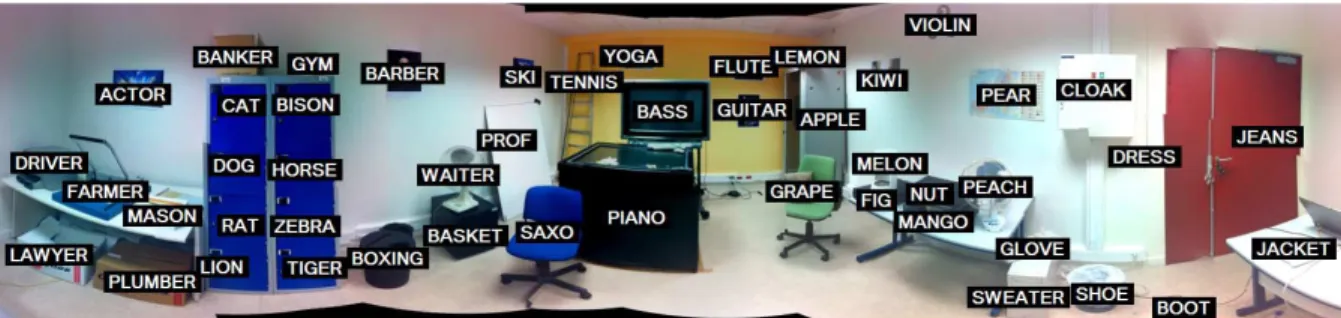
Finally, in order to release constraints about what could be a locus and still achieve sufficient precision we used a laser pointer and a Wizard-of-Oz approach. The only condition was that participants could clearly name what they were pointing to when defining loci associations in the mapping phase so that the experimenter could verify if they were pointing to the right loci during the experiment. Moreover, we improved the technique in several ways from Exp 1. During the mapping phase, all the items were presented at the same time, instead of presenting them one by one. This allowed participants to create clusters more easily. We also improved the novice mode by using a panoramic view (Figure 5) displaying loci/items associations more clearly, thus making it easier to get a global view of the mapping.
Task, Stimulus and Visual Help
For each trial, participants used the laser pointer to indicate the locus associated to the stimulus. To validate their selection they had to press a mouse button (allowing the accurate measurement of execution times). As previously, we asked participants to indicate the selected locus orally so we could distinguish pointing and mapping errors, although, ultimately no pointing errors were identified. The human wizard then clicked on the corresponding object in the experimental software. Upon selection, the system displayed the name of the selected item on the screen for three seconds, and proceeded to the next trial.
We used a neutral command vocabulary of 48 items consisting of 6 categories (animals, clothing items, fruits,
jobs, leisure activities, and musical instruments). Each
category had 6, 8 or 10 items. The stimulus and the visual help were displayed on a 42” TV screen at a 2.5m distance from the participant. We improved the visual help to provide a panoramic image of the room showing the name of the items associated to the loci (Figure 5). Names without icons were used to save space, avoid collision of items and hide parts of the panoramic image.
Participants
This experiment consisted of 16 new participants: 12 males and 4 females aged 22–36 (M=26.4). Eight participants performed the experiment in the active condition; eight participants in the passive condition.
0 5 10 15 20 25 1 2 3 4 Number o f items Phase (4 is expert) PL Expert MMM Expert
Procedure
The experiment was divided in three sessions that consisted of training and recall blocks (Table 1). In training blocks, the visual help was delivered on user demand, after an erroneous selection, or 10 seconds after the beginning of the trial if no selection was made. In recall blocks, users could not receive help eliciting one answer per trial. As in Experiment 1, each item appeared once in each block; hence, a block was composed of 48 randomized trials.
Session (time) Blocks
1 (t) Initial phase, 1 training, 1 recall, 1 training, 1 recall block 2 (t+1 day) 1 recall, 1 training, 1 recall block 3 (t+7 days) 1 recall block
Table 1. Sessions in terms of recall or training blocks. Initial phase in Session 1
The experiment started with a mapping phase, where participants were shown the list of items they had to remember. Then members of the active group were allotted up to 20 minutes (M=14.5 min) to create their own mapping. For each item, participants had to provide a short, non-ambiguous description of the locus they decided to associate with the item (e.g., “I am putting the cat on the
New York Poster”). The experimenter recorded that
description on the experimental software.
Using the visual help, members of the passive group were given a panoramic image with items already in place (Figure 5). The mapping assigned to a passive participant was created by the previous active participant. Participants had 4.5 to 5 minutes (M=4.7 min) to learn the arrangement of items and to provide a short, non-ambiguous description of each locus. At no point during this phase were the participants given additional insight about the mapping.
Design
There were two crossed factors: mapping (active or
passive) and block. Recall performance was tested 5 times,
twice for sessions 1 and 2; once for Session 3. Thus, each participant ran a total of 384 trials: 48×2 training blocks (TB) + 48×2 recall blocks (RB) = 192 in Session 1, followed by 48×2 RB + 48×1 TB = 144 trials in Session 2, and 48 trials in Session 3. The dependent variables were selection time (the time spent to recall the position of an item and to point at it) and the number of correct expert-mode selections in each block.
Results
To evaluate the impact of the block and mapping factors on users’ performance, we ran 2-way ANOVAs with repeated measures on the block factor.
Active vs. passive mapping
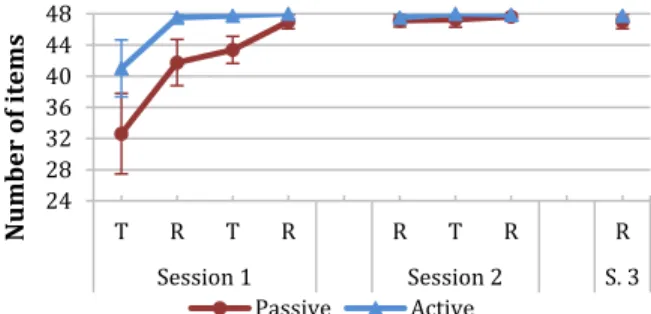
The mapping factor had an effect on the number of correct recalls (p<.001, F1,14=21.41): members of the active group
remembered more items (Mactive=47.8/48 items vs. Mpassive=
46.4). Surprisingly, members of the active group could
remember almost all items (M=47.5) at the first recall block, and all of them at the second recall block of Session 1 (Figure 4 and Table 2).
Members of the passive group needed more blocks to learn the mapping which explains the interaction between block ×
mapping factors (p<.001, F2,28=13.47). However, passive
users reached similar performance (M=47) at the second recall block. A post-hoc TukeyHSD test suggested that the gap between the two groups became insignificant (p>.05) after second recall block of Session 1. In Session 2, we noted no difference between the two groups of users (p=.22), and a marginal one in Session 3 (p=.07).
Figure 4. Mean number of items correctly recalled in expert mode for both groups. R denotes a recall block, T a training
block. Error bars represent .95 confidence intervals. Retention over time
We compared the results between the last recall block of Session 1 and first recall block in Session 2 (Table 2). For the active condition, we observed a marginally significant (p=.06) small decrease of performance (48 to 47.5). Passive condition showed a non-significant increase of performance (p=.4; 47 to 47.1 items). A comparison of the last recall block of Session 2 with Session 3 brought similar results, with a non-significant decrease of performance. Hence, performance was remarkably stable over this period.
Mapping Condition
Session 1 Session 2 Ses. 3
T R T R R T R R
Active 41 (0) 47.5 (5) 47.8 (6) (8) 48 47.5 (5) 48 (8) 47.9 (7) 47.8 (6) Passive 32.6 (0) 41.8 (0) 43.4 (1) (4) 47 47.1 (4) 47.3 (6) 47.6 (5) 47 (4)
Table 2. Average number of items recalled over time depending on the mapping condition. Bracketed figures indicate the number of participants that managed to recall all
48 items in the block. R = recall block; T = training block. Time Performance
We expected the task to be more demanding for members of the passive mapping group, and therefore to require more time. However, as shown in Figure 6, the mapping factor did not influence trial completion time (p=.71). Moreover, the average time decreased between sessions (p<.001, F4,75=11.42). More precisely, time significantly decreased
between the recall blocks within sessions (Figure 6), with a minimum of 2.9s for the last recall block of Session 2.
24 28 32 36 40 44 48 T R T R R T R R Session 1 Session 2 S. 3 Number o f items Passive Active
Figure 5. Panoramic picture of the room, with item labels placed on loci, used both for the mapping and as memory aid.
As seen above, passive users needed more blocks to achieve equivalent performance to active users. However, the initial phase was longer for active users (14.5 vs. 4.7 min). As memorization is known to depend on time, we compared the overall time required to achieve a nearly-perfect recall rate of 47 items or more. The values for both groups are very close:
Mactive=24.9 min for active users vs. Mpassive=25.6 min for
passive users. Hence, contrary to our expectation, this
technique seems to have little or no dependence on whether the mapping is user-defined or not
Figure 6. Average time to complete trial for each mapping condition over blocks in export mode.
Subjective results
At the end of the experiment, we asked users to rate the cognitive load on a 5-point Likert scale. A Mann-Whitney test indicated no significant differences between the two groups (Mactive=2/5 vs. Mpassive=2.2/5, p=.31). There were no
reports from participants that they had trouble remembering the mapping, with no significant difference between groups (Mactive=1.5 vs. Mpassive=2.1, p=.17), suggesting no objective
or subjective difference in terms of cognitive load.
We asked the participants to rate their surprise towards the results on a 5-point Likert scale. Participants were impressed by the results (3.4/5), especially those who had not previously heard about mnemonic devices and memory contests (3.9/5). This is not a surprising result as users tend to underestimate their memory capabilities [5]. More remarkable was that no difference in terms of surprise was found between the two groups (p=.42), although the passive mapping condition might seem harder.
Follow-up study two months later
We also performed a recall test 60 (+/-3) days after the experiment with the 11 participants (4 active, 7 passive) that were still present at our university at that time. A t-test on
recall rates did not yield any significant differences between both populations (p=.11), with active participants recalling 45.5 items and passive participants 43 items on average. Recall times were not significantly different between the two groups (M=7.1s, p=.55), but they were quite high, especially compared to the ones observed in the sessions 1, 2 and 3 of the experiment. These results suggest that the technique is quite resilient over time, with an overall average of 43.9 items recalled after two months.
User Strategies Active group
Although we did not give them specific cues, most participants used similar strategies during the mapping phase. They would typically start by imagining semantic links between the items and the loci, either through simple relationships (“the peach goes with the red door” – P3) or more complex associations of ideas (“the waiter goes with the coffee machine because waiters deal with coffee machines in real life, the professor with books, etc.” – P7). After a few key items were placed, participants would generally try to associate items of the same category to loci located in the same spatial area. When participants could not manage to do so (e.g. for large categories with many items) they tended to create subcategories (e.g. wind vs. string instruments). Participants also created semantic groups, e.g., by mapping all items of the sports category with all the
posters of the room. Finally, participants sometimes used
alphabetical ordering within a set of loci.
Participants were remarkably inventive at building up stories to link loci corresponding to the same item category (“the
dog barks at the cat from the floor” – P5, who placed the cat
on top of the table and the dog at the foot of the table). Altogether, these grouping strategies, using either spatial or semantic relationships through storytelling seemed to play an important role for finding the item/loci associations. For instance, when unsure about an item/locus association during the testing phase, participants would typically look at the area corresponding to this category and proceed by elimination. Moreover, as P11 said “It was easy to remember grouped items. It wasn’t important how big the group was, just the sense of them being together.”
Passive group
Similar strategies emerged for the passive group although the item/loci associations of these users were generally unrelated
0 1.5 3 4.5 6 T R T R R T R R Session 1 Session 2 S. 3 Time (in s) Passive Active
to those of the active group. For instance, while P11 (active participant) associated tennis with the scanner printer because it was in the same spatial area as other loci related to sports, P12 (passive participant using the same mapping) invented a semantic relationship between this locus and this item (“the scanner-printer is flat, like a tennis court”). Such re-interpretations occurred frequently, suggesting that participants could very easily create their own stories whatever the mapping.
Discussion
In the Background and Related work section we mentioned three components involved in memorization: object, spatial memory and semantic encoding. Previous observations suggest that spatial and semantic memory play an important role. Semantic memory was used for mapping items to loci and for creating groups of related loci. Spatial memory may be involved either globally (absolute loci positions in the room help remembering the items) or locally (relative loci positions in a group to help remembering the items).
By construction, the method of loci heavily relies on spatial organization. Practically, this could be a limitation of our technique as objects may be moved from time to time in a real-life setting. Hence, we designed a follow up study to investigate how moving loci across the room would affect recall.
FOLLOW-UP STUDY: MOVING OBJECTS
This new experiment used the same task and visual aid as the previous one but was divided into two sessions, with the spatial configuration of the room changing between sessions. The first session mirrored the previous study, with the same number of blocks. The second session was conducted the next day and consisted of two recall blocks.
Five categories of five items were used in this experiment (animals, clothes, jobs, music instruments and sports). The mapping phase was more constrained than in Experiment 2: five sets of 5 loci were pre-identified in the room and participants were asked to map these 5 sets with the 5 categories. This constraint allowed us to move or reorganize these 5 sets in the same way for all participants. Somehow, this constraint just operationalized what users naturally tended to do in the previous experiment.
Loci Reconfiguration
We considered global and local changes to object locations. In the first case, the set of loci is moved to another side of the room but the relative positions of the loci within the set remain the same. In the second case, only the positions of the loci within the set are changed (and remain in the same spatial area). The remaining cases were baseline (no change),
global+local, and scattered. In the last case, the loci were
scattered and relocated haphazardly in the room, breaking spatial consistency. Each of the 5 sets was moved according to one these 5 configurations. All groups were reconfigured at the same time, between the two sessions.
Participants and Design
This experience consisted of 9 participants, 7 males and 2 females aged 20–30 (M=25.8). The only factor of the experiment was loci reconfiguration (Figure 7). For the sake of brevity, we focus on recall rates and times on both blocks of Session 2 (next day), that show the same trends. Each participant completed a total of 150 trials: 25×2 T + 25×2 R = 100 trials in Session 1, and 25×2 = 50 trials in Session 2. We measured the selection time and the number of correct selections in each block.
Figure 7. Mean trial times on both blocks of Session 2 for each reconfiguration. Error bars are .95 confidence intervals. Results
An ANOVA showed no significant effect of loci reconfiguration on recall rate (p=.67) with a nearly perfect recall rate of 99.3% on Session 2, but had a significant main effect on recall times (p<.01, F4,32=4.26). Pairwise t-tests with
Bonferroni correction showed significant differences between baseline (M=3.07s) on one hand, and scattered (M=3.97s, p=.02), global+local (M=3.84s, p<.01) and
global (M=4.1s, p=.03). No significant difference was found
between baseline and local (M=3.66s, p=.4).
Condition B1 B2 Session B1 B2 Session Recall rates (in %) Mean recall time (in s)
Baseline 100 100 100 3.67 2.47 3.07 All but baseline 98.9 99.4 99.2 4.66 3.09 3.88
Global 100 100 100 4.7 3.34 4.02 Local 100 97.7 98.9 4.41 2.9 3.66 Global+Local 97.7 100 98.9 4.51 3.19 3.85
Scattered 97.7 100 98.9 5.04 2.93 3.99
Table 3. Performances for each block (B1, B2) and the session.
During Session 2, when looking for a particular object, users would usually turn around and look at the previous location of the locus, and then be puzzled when they discovered the new configuration. After that, they would perform a visual search to locate the new position of each object, explaining the differences between baseline and the other configurations. However, participants could gradually adapt to the new configurations. Recall times indeed decreased between blocks 1 and 2 (Table 3), and the difference between baseline and other configurations tended to decrease (from 0.99s on average to 0.62s).
Discussion
This follow-up experiment was intended to simulate a real-life situation where a few objects are moved at the same time, either globally (e.g., a cupboard consisting of several loci),
0 1.5 3 4.5 6 Time (in s)
Session 2 (Both blocks)
Baseline Global Local Global + Local Scattered
locally (e.g., a vase, books, etc. remaining in the same area), or randomly. The results suggest that users can still retrieve the corresponding items when spatial information is partly lost but that this loss of information leads to longer retrieval time (26.3% slower on average). While the number of moved items was relatively large for a realistic scenario, it is important to notice that not all spatial information was lost. For instance, results may have been different if all objects were moved randomly or the categories were larger.
GENERAL DISCUSSION
The most remarkable result of these experiments is that participants were able to efficiently learn an unusually large vocabulary of command shortcuts (48 items). With only slight exception, members of the active mapping group were able to correctly recall the full set of items in the first recall block: on average, they correctly recalled 47.5 items (98.9% of the set) in expert mode (2nd block of Session 1 of
Experiment 2). Thus a single training block, with each item presented just once, was sufficient to learn our arbitrary vocabulary after the mapping phase. However, while impressively high, these results are in keeping with previous research on the loci technique (e.g. [12]).
Members of the passive mapping group achieved roughly the same result (47 correct recalls, 97.9%) by the second recall phase (4th block of Session 1). The total amount of time
needed to achieve a recall rate of 47 items or more was roughly the same for both groups (Mactive=24.9 min vs.
Mpassive=25.6 min). These results contrast with those of
Nacenta et al. [24], who showed that user-defined gestures are easier to remember. This is probably because users were able to appropriate mappings created by others by creating new stories, as seen in the User Strategies subsection. From a practical point of view, this means that the same items/loci mapping can easily be shared among users.
Retention over time was quite high for both groups, with a recall rate of 98.9% (active group) and 98.1% (passive group) for the first block of Session 2, after one day delay. Session 3 (one week later) produced similar scores (99.5% and 97.9% correct recall). Two months later, the average recall rate of the participants still present at our lab was 91.5% (no significant difference between the two groups). Obviously, these participants did not use the system during this lapse of time, which differs from real-life, where users would relearn the mapping through continuous practice. While our study does not precisely measure the relative contributions of the three main components involved in the memorization process (object, spatial and verbal/semantic memory) it provides some interesting hints. First, Experiment 2 showed that participants heavily relied on semantic memory for mapping items to loci and for creating imaginary relationships between loci. Participants were never out of ideas and had fun doing it. In fact, the creative process of creating stories was not only natural but enjoyable for them.
The last follow-up study clearly showed that retrieval time increases when spatial information is partly lost. However, participants could still manage to retrieve the correct items in most cases. This means that semantic and object memory could compensate for the missing information. Moreover, participants could quickly adapt to the new configurations.
APPLICATIONS
Smart home and multimedia. Smart homes offer numerous
functions spanning from multiple multimedia capabilities to home security, smart energy and intelligent lighting or temperature control, etc. Remote controls have proliferated and tend to be overcrowded with buttons and confused by users. On the other hand, multi-purpose devices like smartphones or tablets often require users to select the desired appliance by searching through menus or long lists. Physical Loci offers a simple and elegant solution to these problems. An actual system could nowadays rely on a location-aware remote control [34] or, in the near future, on an improved Kinect-like device. As in our second experiment, the system would let users create associations between loci and favorite commands by using the TV set. The user would first choose the command he wants to control (favorites TV channels, Youtube, lighting, etc.) through a conventional menu interface then point and select the desired loci with the remote control. After registration, commands would be executed by pointing on the locus and pressing the button of the remote control.
Virtual reality. As in the previous case, Physical Loci could
be used in virtual environment to invoke commands without the need of displaying a menu that would interrupt the immersion of the user in the virtual world.
PCs, mobile devices. Physical Loci could serve to place
invisible shortcuts at particular places on the desktop of a PC or a mobile device, thus allowing activating favorite commands very quickly. It could also serve as an unlocking mechanism for mobile devices. Instead of typing a PIN or drawing a pattern, users would select loci in a specific order to unlock the device, thus providing little visual feedback in case somebody else is watching the screen.
CONCLUSION AND FUTURE WORK
We presented Physical Loci, a selection technique reminiscent of the method of loci that leverages spatial memory, object memory and semantic associations. Results of the three experiments showed Physical Loci is easy to learn, sharable among users, robust to environmental changes, and facilitates long term retention, making it a highly promising technique for users to learn and perform spatial gestures. In further research, we plan to investigate more precisely the role of each of the components that have a role in the recall mechanism, namely spatial memory, object memory and semantic association.
ACKNOWLEDGMENT
This work was supported by the National University of Singapore Academic Research Fund R-252-000-547-112.
We also thank Joey Scarr, Gilles Bailly, Sylvain Malacria, Dong-Bach Vo and James Eagan for their suggestions.
REFERENCES
1. Anderson, F. and Bischof, W.F. Learning and
performance with gesture guides. In Proc. CHI'13, ACM (2013), 1109–1118.
2. Andrade, J., Meudell, P. Is spatial information encoded automatically in memory? The Quarterly Journal of
Experimental Psychology 46, 2 (1993), 365–375.
3. Angesleva, J., Oakley, I., Hughes, S., O’Modhrain, Body mnemonics: portable device interaction design concept. In Adjunct Proc UIST’03, ACM.
4. Ark W., Dryer, Selker T., Zhai S. Representation Matters: The Effect of 3D Objects and a Spatial Metaphor in a Graphical User Interface. In Proc. HCI'98, ACM (1998), 209 –219.
5. Baddeley, A.D. Essentials of Human Memory (Classic
Edition). Psychology Press Classic Editions, 2013.
6. Bailly, G., Lecolinet, E. and Nigay, L. Wave menus: improving the novice mode of hierarchical marking menus. In Proc Interact 2007, Springer, 475-488.
7. Bailly, G., Müller, J., Lecolinet, E. Design and Evaluation of Finger-Count Interaction: Combining multitouch gestures and menus. Int. Journal of Human-Computer
Studies 70, 10 (2012), 673–689.
8. Bolt, R. A. “Put-that-there”: Voice and gesture at the graphics interface. In Proc. SIGGRAPH‘80, 262-270. 9. Bower, G. H., Clark, M.C., Lesgold, A.M., and Winzenz,
D. Hierarchical retrieval schemes in recall of categorized word lists. Journal of Verbal Learning and Verbal
Behavior 8, 3 (1969), 323–343.
10. Bower, G. Analysis of a Mnemonic Device. American
Scientist 58 (1970), 496-510.
11. Briggs, Gary G., Hawkins, Stephen; Crovitz, Herbert F. Bizarre images in artificial memory. Psychonomic
Science 19, 6 (1970), 353-354.
12. Crovitz, Herbert F. Memory loci in artificial memory.
Psychonomic Science 16, 2 (1969), 82-83.
13. Cloutier, J., and Neil Macrae, C. The feeling of choosing: Self-involvement and the cognitive status of things past.
Consciousness and cognition 17, 1 (2008).
14. Czerwinski, M., Van Dantzich, M., Robertson, G., and Hoffman, H. The contribution of thumbnail image, mouse-over text and spatial location memory to web page retrieval in 3D In Proc. Interact (1999), 163–170. 15. Gutwin, C., Cockburn, A. Improving List Revistation
with ListMaps. In Proc. AVI'06, ACM, (2006), 396-403. 16. Gutwin, C., Cockburn, A., Scarr, J., Malacria, S. and
Olson, S. C. Faster command selection on tablets with FastTap. In Proc. CHI '14. ACM, 2617-2626.
17. Higbee K.L. Your Memory: How It Works and How to Improve It. Marlowe & Company, 2001.
18. Ikei Y., Ota1 H., and Kayahara T. Spatial Electronic Mnemonics: A Virtual Memory Interface. In Proc.
HCII’07, LNCS 4558, Springer (2007), 30–37.
19. Jones, W., and Dumais, S.T. The Spatial Metaphor for User Interfaces: Experimental Tests of Reference by Location versus Name. ACM Trans. Office Information
Systems 4,1 (1986), 42-63.
20. Kurtenbach, G. and Buxton, W. User Learning and Performance with Marking Menus. In Proc. CHI'94. 21. Li, F., Dearman, D., and Truong, K. Virtual shelves: interactions with orientation aware devices. In Proc.
UIST’09, ACM (2009), 125–128.
22. Maguire, EA, Valentine, ER, Wilding, JM and Kapur, N. Routes to remembering: the brains behind superior memory. Nature Neuroscience 6, 1 (2003), 90-5. 23. Mandler, G. Organization and memory. The psychology
of learning and motivation (1967), 381.
24. Nacenta, M.A., Kamber, Y., Qiang, Y., and Kristensson, P.O. Memorability of pre-designed and user-defined gesture sets. In Proc CHI'13, ACM (2013), 1099–1108. 25. Norman, D. A. Natural user interfaces are not natural.
Interactions 17, 3 ACM (2010), 6-10.
26. Oakley, I. and Park, J. Motion marking menus: An eyes-free approach to motion input for handheld devices. Int. J.
Human-Computing Studies 67, 6 (2009), 515-532.
27. Paivio, A. Imagery and verbal process. Holt, Rinehart, & Winston, 1971.
28. Raz, A., Packard, M. G., Alexander, G. M., Buhle, J. T., Zhu, H., Yu, S., Peterson, B. S. A slice of π : An exploratory neuroimaging study of digit encoding and retrieval in a superior memorist. Neurocase 15, 5 (2009), 361–372.
29. Robertson, G., Czerwinski, M., Larson, K., Robbins, D., Thiel, D., and Van Dantzich, M. Data mountain: using spatial memory for document management. In Proc.
CHI'98, ACM (1998), 153–162.
30. Scarr, J., Cockburn, A., Gutwin, C. and Bunt, A. 2012. Improving command selection with CommandMaps. In
Proc. CHI'12, ACM (2012), 257-266.
31. Scarr, J., Cockburn, A., Gutwin, G. and Malacria, S. Testing the Robustness and Performance of Spatially Consistent Interfaces. In Proc. CHI'13, ACM (2013). 32. Serrano, M., Lecolinet, E. and Guiard, Y. Bezel-Tap
gestures: quick activation of commands from sleep mode on tablets. In Proc. CHI'13 (2013), 3027-3036.
33. Wagner, J., Lecolinet, E., Selker, T. Multi-finger Chords for Hand-held Tablets: Recognizable and Memorable. In
Proc. CHI'14, ACM, (2014), 2883–2892.
34. Wilson, A. and Shafer, S. XWand: UI for intelligent spaces. In Proc. CHI'03, ACM (2003), 545-552. 35. Wobbrock, J., Morris, M., and Wilson, A. User-defined
gestures for surface computing. In Proc. CHI'09, ACM 1083–1092.
36. Yates, F. The art of memory, Random House, 1992. 37. Zhao, S., and Balakrishnan, R. Simple vs. compound
mark hierarchical marking menus. In Proc. UIST’04, ACM (2004), 33–42.