Faculty of Economics and Social Sciences
Earnings Management by Firms
Applying International Financial Reporting Standards:
Implications for Valuation
Thesis
Presented to the Faculty of Economics and Social Sciences of the University of Fribourg (Switzerland) in fulfillment of the requirements for the degree of
Doctor of Economics and Social Sciences
by
Levon Babalyan
from Armenia
Accepted by the Faculty’s Council on 18 May 2004 at the proposal of Professor Jacques Pasquier-Dorthe (First Reporter)
and
Professor Martin Wallmeier (Second Reporter)
Fribourg (Switzerland) 2004
The Faculty of Economics and Social Sciences at the University of Fibourg neither approves nor disapproves the opinions expressed in a doctoral dissertation. They are to be considered those of the author (decision of the Faculty council of 23 January 1990)
I would like to express my gratitude to Professor Jacques Pasquier-Dorthe for his sound advice and overall support in all my professional and educational undertakings. His encouragement and willingness to help were crucial in various situations.
Many thanks go to Professor Martin Wallmeier. His constructive remarks were of great value for the research carried out in preparation of this thesis. I also greatly appreciate his understanding and kind attitude.
It would be much harder for this thesis to see light without the constant support of my dear Nadia. She also contributed to improving the English of the text that follows.
Amos F.C. Poncini was among the first readers of this work. He was one of the first critics as well and many of his insightful comments were incorporated into the final version. His friendship has been of a great support since my arrival to Switzerland.
I gratefully acknowledge the contribution of Thomson Financial for providing earnings per share and other forecast data, available through the Institutional Brokers Estimate System. This data has been provided as part of a broad academic program to encourage earnings expectations research.
INTRODUCTION 1
CHAPTER 1. Earnings Management in Practice and Academic Research 6
1.1 Earnings Management Defined 6
1.2 Earnings Management in the Academic Literature 17
1.3 A Generalized Framework of the Earnings Management Process 36
1.4 Beyond the Anglo-Saxon Environment 43
CHAPTER 2. Measurement of Earnings Management 54
2.1 Critique of Existing Approaches 54
2.2 The Generalized Target-Deviation Model 67
2.3 Application of the Target-Deviation Model 74
2.4 Sample Selection and Data Collection 94
2.5 Empirical Results 103
2.6 Sensitivity Analysis 120
CHAPTER 3. Implications for Valuation: Discretionary versus Unexpected Accruals 128
3.1 Earnings Components and Performance Forecasting 128
3.2 Pricing of Earnings Components 140
3.4 Sensitivity Analysis 150
SUMMARY AND CONCLUSIONS 161
REFERENCES 166
1
INTRODUCTION
By the time I started working on the present subject it would have been a great surprise to find a person having access to media, who had not heard yet about the accounting scandals that “shook the corporate America”. Since then numerous books and articles have been written, conferences held and rules changed. It has almost become a tradition, especially in the popular and business press, to begin a discussion more or less related to the subject of financial reporting with references to and examples of these affairs. I cannot avoid following the tradition just because for the ear of an ordinary person such related terms as “earnings management”, “accounting manipulations” and “creative accounting” are necessarily associated with the above mentioned events. However, the subject of my work is by far not these extreme cases of accounting fraud that made so much noise at the turn of the century. A reference to themis nevertheless useful in order to distinguish the place and the objectives of the present thesis from related but different issues of financial reporting, agency settings and regulation.
Before the issue of accounting manipulation became one of the central problems for the financial community, the phenomenon of earnings management had already drawn the attention of academic researchers and regulators. The subject of earnings management (EM hereafter) in accounting literature grew in popularity during the last decade of the 20th century. Numerous published and unpublished papers investigated theoretically and empirically different hypothesis related to EM. Some researchers aimed simply to provide evidence of EM, others investigated its role in agency problems, financial markets and information asymmetry. As a consequence, purely methodological papers appeared testing and criticizing the research designs. At the end of the 90’s several articles summarizing what had been done and what should still be
attempted were brought to light. In the first chapter of this work I review the main directions of the past research together with some general methodology aspects. On this I will build the general framework for the EM process providing a classification of its various elements. This part should help the reader to understand the motivation for the following chapters as well as some critical features of the research design.
Chapter 1, however, begins with the introduction to the notion of earnings management and discusses some of the numerous definitions given by academics, practitioners and regulators. Some hypothetical and practical examples of earnings management will be provided. Overall, the first chapter has a relatively general character and serves as a building foundation for the rest of the work. A reader having a good knowledge of EM literature can skip this part without impairing his or her ability to understand the next two chapters. Nevertheless, I strongly recommend the reading of this part because it views and systematizes the EM process from a new angle. In its turn, this new view is the core element of the research design developed in Chapter 2.
The main contribution of this thesis to the literature is the development and application of a conceptually new model intended to estimate the approximate amount of EM from the publicly available information. I call this technique the “Target-Deviation Model” for the reasons which will become clear later. The model overcomes some of the major drawbacks of the existing approaches and permits to test directly for the presence of earnings management in a sample of publicly traded firms. However, as it is the case for the overwhelming majority of earnings management studies, the procedure is statistical and all the inferences are valid only “on average”.1 Given the flexibility of contemporaneous international accounting rules, the ability to
1 Schipper (1989, p. 97) notes some reasons why researchers are able to detect EM while the practitioners cannot. For example, “A research using large historical data sets might be able to document statistically a pattern of behavior consistent with EM within the sample, without being able to say with confidence whether the earnings were managed for a particular firm in the sample”
3
identify EM practices in the accounts of a particular firm will remain the privilege of auditors and regulators in the foreseeable future.
Thus, the second chapter begins with the description of the existing techniques, their main assumptions and drawbacks. The following section derives theoretically the generalized form of the Target-Deviation Model accompanied by a discussion of its advantages over the most popular existing models as well as of its weak sides. In section 2.3 I introduce an empirical version of the Target-Deviation Model accompanied by theoretical and empirical motivation for the choice of various variables.
Although the empirical EM literature has grown substantially, most of the studies were applied to Anglo-Saxon countries and especially to US markets. Relatively little is known about this issue in continental Europe. Among one of the reasons for this lack of research is the problem of data availability to which I will have to return later.
One of the contributions of my study is the use of a sample of Swiss and German listed companies in the empirical analysis. All the firms report their annual accounts under the framework of International Financial Reporting Standards (IASB, London)2. One of the reasons for choosing such a sample is the decision of the European Commission to make IFRS (IAS) mandatory for the presentation of consolidated financial statements for all listed EU firms beginning from 2005. Consequently, the importance of empirical research related to IFRS is growing considerably in importance. Some hypotheses suggested in the EM literature refer to the comparative ability of standard frameworks to restrict the discretion in the accounting process. Although my thesis does not address this question directly, to the best of my knowledge, it is the first study that selects a sample exclusively of companies reporting under IAS. It is an opportunity for the future research to investigate whether my
2 The series of standards issued by International Accounting Standards Board (IASB) called International accounting Standards (IAS) was officially renamed as International Financial Reporting Standards in 2001. The separate standards adopted by that time are continued to be called IAS. Accordingly, in this work I refer to these particular standards using the “IAS” abbreviation.
4
empirical results are attributable to differences in accounting rules or to the research design and selected samples.
Other reasons for focusing on IFRS-reporting companies are discussed in detail in section 2.4. Also, in this section I describe the various data sources and the data collection procedure. Section 2.5 reports and discusses the empirical results of testing the theory exposed in Chapter 2. Finally, in section 2.6 I check the sensitivity of the empirical results to some alternative specifications of the models, the variables and the sample.
There is no doubt that accounting earnings is one of the main indicators of financial performance of a firm. Naturally, the relation of earnings management, of its extent and objectives to the measurement and forecasting of performance are of great interest. Again, the consequences are well known in the extreme cases of creative accounting often having fraudulent character that are detected and made public by the regulators. However, the researchers are also interested in much less blatant EM activity which should not even be in violation of GAAP3 and consequently, can be measured only by applying econometric procedures to large samples. A few papers addressed the implication of EM for the valuation. However, they were applied to the US markets and estimated the EM magnitudes using the conventional models. Chapter 3 is dedicated entirely to the analysis of EM implications for the valuation process. More precisely, I use the results of Chapter 2 to decompose the earnings into different managed and unmanaged components and compare their properties in relation to performance-related variables. Except for the differences in measurement of some variables, the techniques used in this part are mostly inherited from the previous research. The results often appear to be inconsistent with prior findings. Therefore, I discuss some alternative explanations of such differences. To summarize, Chapter 3 is divided into four main sections. In section 3.1 I test
3 Generally accepted accounting principals, here and afterwards used to refer to a system of accounting standards compulsory for a reporting entity. In reference to a particular national system the abbreviation will be preceded by corresponding indication as for example, US GAAP or UK GAAP.
and compare the alternative measures of the manipulated portion of earnings in terms of its relationship to the future performance. Section 3.2 investigates how the managed and unmanaged portions of earnings are priced by the market. Again, alternative EM estimates are compared. Section 3.3 logically follows from the two preceding ones investigating how rational the market is in pricing the different earnings components. The chapter ends by examining the sensitivity of the results in the three preceding sections to various factors.
The thesis ends with conclusions, where I summarize the overall results as well as the limitations and implications they bear. Here I also suggest the opening avenues for future research.
6
CHAPTER ONE
_________________________________________________________________________
Earnings Management in Practice and in Academic Research
1.1 Earnings Management Defined
There is no common definition of earnings management in the literature and authors use a wide range of expressions to describe the same phenomenon or its different aspects. Providing a complete list of the definitions encountered in the literature is beyond the scope of this thesis1. Hence, I discuss some definitions, which, in my opinion, best describe the activity being in the focus of the present study. First of all, however, some additional notions are provided in order to place EM relative to more general phenomena. This will allow to move from wide notions to more specific ones and to create a general framework for the EM process. An attempt is made to create a system, which will encompass the whole process, but at the same time will remain focused on the theoretical settings analyzed in the following chapters.
Notwithstanding the abundance of literature on the subject, there are not many works that try to summarize and classify all the existing knowledge. Mulford and Comiskey (2002) and Stolowy and Breton (2000) are the notable exceptions. As opposed to the paper by Stolowy and Breton, which mainly focuses on academic literature, the book by Mulford and Comiskey is intended for a wider spectrum of financial statement users including less sophisticated investors. The book is entitled “The Financial Numbers Game” and this is maybe the only term which is large enough to embrace all types of activities commonly labeled as account manipulation, earnings management, fraudulent reporting and so on. The actions designed by each of these terms are often similar in nature but some differences, albeit sometimes very subtle, do exist.
1 See Mulford and Comiskey (2002) and Stolowy and Breton (2000) for various definitions and examples.
7
Thus, Mulford and Comiskey note that EM is generally viewed as an interperiod concept, where some portion of earnings is moved from one period to the next. In comparison, the financial numbers game is a larger notion also comprising, for example, discretionary disclosure practices. However, not all authors make such a distinction. Some papers (see e.g. Kinney and Trezervant (1997)) regard classificatory manipulations and selective disclosures as a form of EM. Simple examples of such a manipulation include a disclosure of operating losses as extraordinary, or netting an unusual gain with recurring expenses. These tricks are not necessarily an alternative but might be also a complement to the interperiod EM. Also, they are most often, but not always, applied to the profit and loss statement, so that one cannot reject unequivocally that this is another type of EM. I believe, however, that in order to obtain a clearly classified view of the whole picture we should understand by EM the manipulation of earnings numbers, which are overstated or understated at the expense of the adjacent periods. Another question is which of the earnings measures is the object of EM, given the abundance of pro forma definitions other than the one set by accounting standards. Here we deal with disclosure or impression management. I classify this type of activity separately for two reasons. First, the bottom line earnings numbers as defined by GAAP are not affected1 in case the discretion is exercised on classification and disclosures in the income statement. Second, discretionary disclosures and classification can be successfully used on the balance sheet, in the cash flow statement2 and even in the notes. So, calling these manipulations just "a kind of EM" brings to a loss of generality.
Stolowy and Breton (2000) generalize the literature on the subject under the term of account manipulations. Although general enough, this notion emphasizes the accounting nature of the financial numbers game. Meanwhile, a good deal of literature considers real operating decisions like assets sales or
1 The gains and losses that bypass the income statement to be reported directly to owner’s equity are the exceptions from this rule. However, the range of such transactions is rather narrow and strictly defined, at least by IFRS and US GAAP. US GAAP have recently introduced a notion of comprehensive income where such transactions should be reported.
varying R&D expenditures as a way to manage earnings. Of course, as far as the real operations are concerned it becomes really difficult to distinguish EM from normal operating decisions of the management. For example, it may be a positive net present value (NPV) decision for a company to sell assets when its cash earnings are low to avoid a short-term liquidity problem. Also, there are authors who do not agree with interpreting any real actions as EM (see e.g. Beneish 2001). Nevertheless, I believe that such activities should not be excluded from the domain of EM. First of all, in many cases it is impossible to affirm with certainty whether the main motivation for a “real” decision is maximizing the firm’s efficiency and profitability or just creating a temporary impression. Consider an example of disposal of a piece of equipment. The primary reason for the management may be the desire to replace it with a new one with a higher NPV but the sale maybe also accomplished to realize a book gain. As a matter of fact, in the second case the disposal may logically complement a purely accounting decision to underestimate the useful life of the asset and so to overestimate the regular depreciation. But this is exactly a way to alter the earnings numbers at the expense of the adjacent periods. Besides, there is nothing in the term earnings management suggesting that it is a purely accounting phenomenon. Rather there is a kind of EM that does not represent purely accounting manipulations. Notwithstanding this larger scope, this study will focus exclusively on accounting actions to affect earnings. This is done for methodological reasons.
At the same time, maybe more rarely, accounting manipulations are intended to affect not the earnings numbers but, for example, the balance sheet. A popular target is the leverage ratio which is assumed in the literature to be an object of debt covenants. Even though most of the transactions affecting the balance sheet should be reflected in the income statement as well, this is not necessarily the case1. Moreover, even if this is the case, the primary object of the
1 A good example is the revaluation of fixed assets permitted by IAS 16, which is reported directly to equity.
manipulation here is not the earnings numbers. To conclude, not all the accounting manipulations are earnings management, and earnings management does not always imply accounting manipulation.
Another term which is often associated with EM is fraudulent financial reporting or simply accounting fraud. As opposed to perceptions of ordinary people, it is widely accepted in the literature that a considerable portion of EM remains within the boundaries of the flexibility embedded in accounting standards. This is one of the reasons why auditors might not find formal grounds to undo the EM actions. Moreover, while some authors emphasize the misleading purpose of EM (Healy and Wahlen (1999)), others do not agree with completely negative definitions and try to show theoretically and empirically its informative versus opportunistic nature (Wang 1994).
However, as the accounts deviate substantially from the benchmark set by GAAP and materially misrepresent the financial conditions of a business, the terms accounting fraud, abusive accounting or accounting irregularities become more relevant. Mulford and Comiskey note a technical detail pointing out that the determination of fraud requires establishment of the fact that misstatement was to the detriment of someone. Such determination, in its turn, implies that the violations of GAAP are detected and proven usually by the regulatory bodies.1 As it might be the case that by far not all deviations from the rules are detected, the term abusive accounting may be used more generally.
Mulford and Comiskey use the term fraudulent reporting only in conjunction with EM. Again, although the abusive earnings management is the most often encountered form of abuse, the balance sheet may also become the primary object of misleading accounting. The classic example is Enron with its off-balance-sheet liabilities. Thus, we conclude that not every accounting fraud is earnings management and it is by far not always the case that EM is fraudulent. Although the fraudulent or abusive accounting is not excluded by the
1 The richest experience on such cases is gathered from the activity of the US Securities and Exchange Commission (SEC).
10
research design in the next chapter, to my knowledge none of the firms included in the empirical sample was investigated and censured by regulators. So without ruling out such a possibility we should implicitly assume that the main focus of the study is not the flagrant and extreme cases of accounting misreporting.
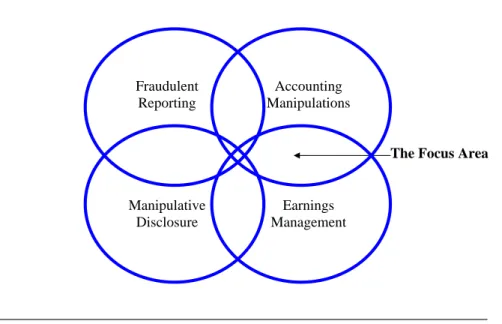
Figure 1 shows symbolically the intersection between the close but not identical notions which are sometimes used interchangeably by mistake. The only term which is general enough to encompass all the notions is financial numbers game. The intersection of the domains of accounting manipulations and earnings management is the focus area of this study. As it was explained earlier
I will consider neither accounting manipulations which are not aimed to affect earnings nor EM actions which do not have purely accounting nature. The fraudulent EM is not ruled out in the following analysis, however, it remains largely beyond the main focus area. As far as the income statement is concerned, the manipulative disclosures will be taken into consideration where it is Figure 1. The Financial Numbers Game
The Focus Area Accounting Manipulations Earnings Management Fraudulent Reporting Manipulative Disclosure 11
necessary and possible. In particular I will discuss the possible impact of the classificatory manipulations on the research design and the results.
Other terms which are often used interchangeably with those in Figure 1 are creative accounting, income smoothing, aggressive accounting, abusive accounting and accounting irregularities. The term creative accounting can be regarded as a synonym for accounting manipulations. Income smoothing is just a kind of EM, which will be discussed later in more details. Aggressive accounting is also close to creative accounting but has a more negative tint. It is often used as opposed to the principles of prudence and conservatism in accounting. In this sense, by aggressive accounting we should typically understand the overstatement of earnings and assets or/and the understatement of liabilities. As discussed above, the last two notions usually denote practices beyond the GAAP boundaries and therefore get closer to fraudulent reporting.
After having analyzed and distinguished between several related notions let us look closer at some often cited definitions of EM.
EM is “a purposeful intervention in the external financial reporting, with the intent of obtaining some private gain (as opposed to say, merely facilitating the neutral operation of the process).”…“A minor extension of this definition would encompass “real” earnings management, accomplished by timing of financing decisions to alter reported earnings or some subset of it.” Schipper (1989 p. 92)
“Earnings management occurs when managers use judgement in financial reporting and in structuring transactions to alter financial reports to either mislead some stakeholders about the underlying economic performance of the company or to influence contractual outcomes that depend on reported accounting numbers.” Healy and Wahlen (1999, p.386)
“Earnings Management is the active manipulation of accounting results for the purpose of creating an altered impression of business performance.” Mulford and Comiskey (1996, p. 360)
“Abusive earnings management involves the use of various forms of gimmickry to distort a company’s true financial performance in order to achieve a desired result.” SEC, Annual Report (1999, p.84)
Let us look at the common points and the particularities of these definitions. All the four definitions can be symbolically divided into two parts. One says how things are done and the other puts the emphasis on the objectives of EM. The first three definitions explicitly mention some purposeful intervention in the accounting and reporting process. Although the SEC definition uses the word gimmickry, their accounting nature is assumed implicitly. Only Shipper allows a broader range of EM techniques including the possibility of “real” actions. A bit later we will see what is meant exactly by intervention in the accounting process but now let us focus on the other part of the definitions.
Only the definition of Mulford and Comiskey is general enough not to rule out any of the major perspectives on EM suggested in the literature. For example, as it was mentioned above, there are two competing hypotheses in the literature about the nature of EM. The proponents of the opportunistic nature argue that management uses discretion to mislead the users of financial statements by hiding the true business performance. Some researchers however argue in favor of the informative function of EM, by the means of which management signals about changing performance. In their view this happens because without discretion GAAP rules are not flexible enough to allow such a communication. As Beneish (2001) notes, prior research was not able to establish whether and when any of these functions prevails in practice. Among the practitioners the negative opinion on EM seems to dominate. Thus, in their
survey of financial professionals Mulford and Comiskey (2002) report that they receive 121 written statements indicating how EM can harm investors and only 66 statements on how EM can help investors.
We will still have to come back to these competing hypotheses but for the moment one can note that the word “mislead” in the definition of Healy and Wahlen rules out the possibility for the informative nature1. As “to influence contractual outcomes” also does not imply such a possibility the whole definition forgoes a possible positive function of EM. “The intent to obtain a private gain” may also come into contradiction with a possible informative function. Also, some authors argued that in certain circumstances EM maximizes the shareholders’ wealth. As is could be expected, the definition of the SEC, emphasizes the abusive, that is, the more flagrant cases of EM. Therefore, this definition is the narrowest among those cited above. Regarding the differences in attitudes of practitioners and regulators from those of academics, Deshow and Skinner (2000, p.235) write:
“Practitioners and regulators often see earnings management as pervasive and problematic and in need of immediate remedial action. Academics are more sanguine, unwilling to believe that earnings management is actively practiced by most firms or that the earnings management that does exist should necessarily concern investors”
The definition of Mulford and Comiskey does not mention the possibility of non-accounting actions and hence, does not precisely fit the EM domain in Figure 1. Nevertheless, as far as the objectives of EM are concerned, it is general enough and appears to be the closest to the focus of my empirical research.
1 This is also noted in Beneish (2001)
14
Until now we have seen that EM happens through some intervention in the accounting process. Not a word has been said on how this intervention actually occurs or, simply speaking, how the accounting manipulation of earnings is accomplished. Provision of the whole range of available techniques is beyond the scope of this analysis. Smith (1996) and Mulford and Comiskey (2002) provide a wide spectrum of the possible methods and tricks supported with a rich practical experience and numerous examples. Here, I describe how it happens only in general terms. Some more precise examples will be given when the models of EM estimation are analyzed.
It was already mentioned that EM is accomplished using the flexibility inherent in accounting standards. This flexibility mostly regards accounting accruals, which represent non-cash revenues and expenses as well as book gains and losses. Accrual process is intended to mitigate the timing and matching problems of cash flows, so that earnings better reflect the firm’s performance. Management has relatively low discretion in reporting the cash inflows and outflows as at the end of the fiscal period the cash balances must be equal to the beginning balances plus the net flows occurred during the period. Researchers also assume that cash is costly to manipulate. Consequently, except for the studies that consider real operating decisions, the literature has focused on management of accrual earnings1. Examples of most important accruals for the majority of manufacturing firms are depreciation and trade accounts receivable, which accrue the earned but not yet received revenues. Empirical studies showed (see e.g. Dechow 1994) that accruals perform their function on average, enhancing the information content of earnings over cash flows. At the same time, EM studies hypothesize that at least some portion of accruals may result from management discretion and have other purposes than neutrally reflecting the current financial performance.
1 Although it is difficult to manipulate the total cash flows and doing so requires actions, which are surely in contradiction to law, the classificatory manipulations are still relatively easy. As EM estimation models usually ignore this fact, I will have to get back on this issue later.
15
The flexibility and consequently the discretion in accrual accounts come from two sources. These are the flexibility in choosing accounting methods and the flexibility in making estimates and assumptions. This choice is left to reporting firms to allow for industry diversity and changing business conditions. By flexibility in methods it is usually meant the availability of “hard” accounting choices. The examples are LIFO versus FIFO inventory costing, linear as opposed to declining balance depreciation, capitalizing or expensing R&D costs. There are reasons to believe that the continuing elaboration of accounting standards and enhanced disclosure requirements should have significantly reduced the use of the accounting method choice for EM purposes in recent times. For example, FASB1 virtually abolished the use of pooling of interests method in accounting for corporate mergers. Allowing the capitalization of development expenses IASB set quite strict criteria for the application of this method. Also, alternative methods are often allowed by the standards but firms must disclose the impact on earnings of the other than the adopted alternative. Under both US GAAP and IFRS the impact of method changes on earnings should be disclosed separately. That permits the readers of financial statements to identify whether the earnings changes result from changes in real performance or they are simply accounting notes.
As opposed to the flexibility in method choice the accounting estimates still largely remain in the obscure corner of the financial reporting area. In spite of the more and more detailed disclosures imposed by standard settlers it often becomes impossible to see the boundary of objectivity and discretion as it comes to probabilities and uncertain amounts. Auditors are supposed to waive an accounting estimate when they establish that it goes too far from the objective grounds or if management cannot provide sufficient justification for their judgement. Often, however, auditors do not have sufficient ground to judge an estimate as overstated or understated. In such contentious cases they can also
1 Financial Accounting Standards Board is the organization responsible for establishment and improvement of the US GAAP.
prefer to close the eyes even if they believe the assumptions to be slightly biased. In doing so they think to avoid potential allegations and preserve good relationships with valuable customers. Consider a case where the management decides to reduce the allowance for bad debts from 3% to 2.5% of total receivables outstanding. The decision may be justified by “some signs of improvement of the market conditions” or “improvements in customer portfolio”. The change in the estimate may be not significant enough to judge the “improvements” unsatisfactory but important enough to help report the desired earnings numbers. Interestingly, if such EM actions take place, the auditors and regulators are less likely to detect them than the approximate statistical models. It will become clear why this might be possible during the discussion of these models.
The above discussion helps to understand why more and more EM studies explicitly or implicitly assume manipulations to occur through changes in estimates rather than by method choice or change. Moreover, the empirical evidence suggests that voluntary changes of accounting methods are relatively infrequent.1 On the other hand, given the large number of circumstances in which EM was hypothesized to be present, many researchers tend to accept its widespread nature. Consequently, it is reasonable to suppose that most of the EM activity happens by playing with estimates in accrual accounts. This, opinion will be implicit throughout the rest of this study.
The use and even the abuse of the mentioned flexibility in accrual accounting mostly results in EM cases which are either within or on the edge of boundaries defined by GAAP. Some manipulations of accrual accounts, however, clearly go beyond the discretionary choice of methods or estimates. Such actions are almost irrevocably dubbed as fraudulent because the intent to deceive is quite obvious. Examples include fictitious recognition of receivables without acceptance of goods by customers or distributors and backdating sales
1 See Moses (1987) and section 2.6 of this study.
invoices among others. As such actions are more costly in terms of potential penalties they must be supposed to be less frequent.
To this point we have defined in general terms what EM is, and how it is accomplished. However, I have not spoken purposefully about the objectives of EM. This will be done along the discussion of the main directions in prior literature that follows.
1.2 Earnings Management in the Academic Literature
There are at least two possible ways to classify the literature on EM: according to the research design used or according to the various variables hypothesized to be related to EM, such as objectives or incentives. In this section the terms objectives, determinants, motivation, purpose, incentives and so on will be used interchangeably which reflects their often unsystematic utilization in prior research. In the following section, however, I provide stricter definitions and classification of various elements of the EM process. As the objectives often make part of the research design, let us begin with the first classification criteria. McNichols (2000) distinguishes three main research designs commonly used in the EM literature: those based on aggregate accruals, those based on specific accruals and those based on the distribution of earnings after management. Let us discuss separately each of them together with their main advantages and drawbacks. A more technical and detailed analysis of some methodologies is carried out in the next chapter.
The central feature of the aggregate accrual studies is the use of a statistical procedure to decompose total accruals into presumably discretionary and nondiscretionary components. The basic versions of total accrual models appeared in the early papers by Healy (1985) and DeAngelo (1986), who used correspondingly levels and changes in total accruals as a proxy for management’s discretion over earnings. Later, Jones (1991) introduced a linear
18
regression approach to control for nondiscretionary determinants of accruals, including changes in sales and property plant and equipment (PPE) as explanatory variables. This model and some of its modifications have become by far the most popular methodology for the following decade.
After having obtained an estimate of discretionary accruals (DA) in the first stage, a usual approach for the second stage is to test for the relationship of this estimate with some variable(s) supposed to be related to EM activity1. This is done in an attempt to provide simply an evidence of EM or an evidence of EM in some particular context. When a statistically significant relationship is found between the DA estimate and those EM-related variables, researchers interpret it as an evidence of earnings manipulations. McNichols and Wilson (1988) point to a potential drawback of such a research design. The authors characterize a test of EM in terms of a regression of the DA estimate on a partitioning variable (PART) which splits up the sample into two groups2, for which differences in EM behavior are predicted. However, researchers do not observe the true DA but only its estimate containing a measurement error. If this measurement error is correlated with the partitioning variable the estimate of the coefficient on PART will be biased. In particular, if the true DA is not at all correlated with the partitioning variable but the measurement error is significantly related to the latter the test of EM may lead to falsely rejecting the null of no EM.
In some cases the assumption of no correlation between the measurement error and PART is clearly unreasonable. This is the case when the theory suggests that the indicator variable should be related to the nondiscretionary accruals (NDA). As it is often suggested the unexplained variation in the latter may be a major component of the measurement error. Even if researchers may somehow be confident that the measurement error is not an issue we still have some problems.
1 Examples of such variables will be provided when I discuss the EM literature in the context of related factors. 2 Although McNichols and Wilson (1988) used an indicator or a dummy variable the conclusions are equally
applicable to any continuous or discrete variable.
19
First, if the described tests do not show a significant relationship an alternative explanation is that the DA is not precise enough. The other problem is related to a different research question which is the subject of Chapter 3. Thus, a number of studies (see e.g. Subramanyam (1996) and Xie (2001)) used the estimates from the aggregate accrual models to test how the market prices the different accrual components. In such a context the precision of accruals decomposition is of a greater importance. Moreover, as no partitioning variable is used in estimating EM amounts in these studies, we cannot be sure if the differences in implications for valuation are attributable to managerial discretion or something else. This problem has led many authors to change the terminology and call abnormal or even unexpected what they used to designate by discretionary accruals. Healy (1996) notes that what researchers are used to call discretionary accruals are only residual accruals not captured by factors supposed to proxy for changes in real business conditions. As these residuals may contain, besides management discretion, various effects not controlled for by those factors, these models are rather accrual expectation models.
The second by popularity research design involves specific accrual tests for EM.1 McNichols (2000) identifies some advantages and disadvantages to this approach relative to aggregate accrual models. One advantage is that the knowledge of GAAP can be exploited more effectively to identify the factors that influence the behavior of a specific accrual account. Second, in some industries particular accrual accounts are very material because of the specific nature of the business. A good example is the property and casualty insurance industry where the claim loss reserve is a very material account. McNichols and Wilson (1988) chose industries with the highest ratios of receivables to total assets to identify firms for which the allowance for uncollectibles is likely to be a material account. Another advantage of specific accrual modeling is that it is easier to identify how some factors would influence a single account in the
1 See Table 2 Panel C in McNichols (2000).
absence of discretion. For example, we can assume how a shock to the price of raw materials may influence the changes in the inventory accounts. The impact, of the same variable on receivables and payables is less clear, however. When including all the range of factors in one equation to explain the total accruals, the model may quickly become extremely cumbersome and costly.
McNichols (2000) points out three potential disadvantages of the specific accrual approach. If a researcher focuses on one accrual account, while the management may manipulate the others, the power of a test will be reduced. Moreover, the goal may be to estimate the magnitudes of EM, as one needs to do, for example, in valuation studies. In such a case one would require a model for each separate accrual account likely to be manipulated. The second problem is that specific accrual analysis generally requires more institutional knowledge and more detailed data than aggregate accrual approaches. Finally, the number of firms for which a specific accrual is managed may be small relative to the number of firms that managed at least one of the accounts and so the aggregate accruals. This may limit the generalizability of findings.
There are also some problems with modeling specific accruals less emphasized by McNichols. For example, there are really few industries where a single accrual can be identified to be significantly more important than the others in terms of materiality and available discretion. Insurance and banking industries are the few exceptions. Here the loss reserve account is obviously distinguished from other accruals and in most countries it is subject to special regulations and disclosure requirements. On the contrary, for most manufacturing companies several accrual accounts are equally important and there are no good reasons to focus only on one of them. Furthermore, when the focus is on individual industries, the industry-average parameters are usually chosen as a benchmark to gauge the extent of manipulation. At the same time most researchers agree that the EM activity is not independent from the firm’s performance. The performance of firms in the same industry can be expected to be highly correlated because of similar market conditions or business cycle
effects. This implies that in the same fiscal period firms from the same industry can have similar incentives to manage their earnings. In these circumstances comparison with industry peers only permits to detect “stronger than average” EM.1 There might be cases when this will limit the power of the tests. Also, in order to use an industry benchmark the “industry” should be sufficiently narrowly defined. In this case, however, the number of firms in the industry decreases raising statistical issues. Finally, the correlated measurement error problem mentioned in the context of the aggregate accruals approach cannot be completely ruled out in the specific accrual design. One should hope that using the latter methodology the measurement error can be minimized or at least it might be easier to assume that it is not likely to be correlated with partitioning variables.
Even if all of the above mentioned problems are somehow overcome, the biggest issue with using specific accrual approach is, in my opinion, the data availability. The problem is especially crucial for studies of non-US firms, which are subject to less stringent disclosure requirements. In addition, the quality of easily available databases leaves much to be desired. Even the standards of IASB, considered to be the closest to US GAAP, still have substantially less detailed disclosure requirements in some cases. For example, the US standards require disclosing the allowance for doubtful accounts receivable and the current period provision. There is no a similar explicit requirement under IFRS, which makes a study in the spirit of McNichols and Wilson (1988) virtually impossible2. It is reasonable to acknowledge that accounting standards are in a process of continuous evolution with a trend of increasing disclosure requirement. We should hope that one day the study of specific accrual accounts will become a more available technique. The potential
1 A similar problem arises with some versions of the aggregate accrual models. I return to this question in section 2.1.
2 Although many firms of those included in my sample make voluntary disclosures on this allowance, it is obviously impossible to make inferences from studying only these companies because of the potential sample selection bias.
22
results of the specific accrual studies might be of a greater use in answering some questions than the implications of aggregate accrual studies. Particularly, investors and standard setters are interested to know which accrual accounts are used to influence the reported numbers more often and which less often.
The third research design, considered relatively new in the literature, refers to distributional tests. Burgstahler and Dichev (1997) and Degeorge et al. (1999) suggested and applied a new approach, which consists in focusing on the density of the distribution of earnings after management. The main hypothesis of these studies is that firms usually have greater incentives to achieve some benchmarks. Hence, the distribution of earnings after management should have fewer observations than expected just below the benchmark, and more observations than expected just above the benchmark. Burgstahler and Dichev (1997) use annual numbers and find such discontinuities around zero earnings and prior period’s earnings. Degeorge et al. (1999) use quarterly numbers and find the anomaly around the analysts’ consensus forecast in addition to the above mentioned two benchmarks.
The evidence from these studies seemed to strongly confirm the presence of intent to influence the numbers. No arguments could be found to justify why earnings should have such distributional properties absent any purposeful intervention. Also, the research design involves no decomposition of accruals subject to measurement error. These considerations led some authors to refer to these papers as to the most convincing evidence of EM. This opinion has been recently questioned by Dechow et al. (2003). The authors combine the distributional approach with aggregate accruals models and fail to confirm that boosting of discretionary accruals is the driver of the “kink” in the distribution around zero. Although they acknowledge that such a conclusion may be a result of the low power of accrual models, they also provide a number of alternative explanations for the observed discontinuities. Even though Dechow et al. (2003) focus on non-EM explanations for the kink around zero earnings, some of the arguments equally apply to the other thresholds.
23
One of their explanations is that management takes real actions to improve performance. As making profits is among the firm’s objectives, mangers can simply make themselves and employees work harder and more efficiently when the profitability comes into question.
Dechow et al. (2003) also show that listing requirements and scaling by market value can each provide a partial but not complete explanation of the kink. The first factor is present because stock exchanges usually state minimal profitability requirements causing what the authors call a listing bias. The second argument is supported by the findings that small loss firms have significantly higher market values than small profit firms, which may be consistent with different valuation methods being applied to profit versus loss firms.
The next potential explanation for the kink in the distribution is the accounting conservatism. Accounting rules encourage immediate loss recognition, but restrict premature gain recognition. The effect of these types of rules is that the numbers move from the small loss region to the left tail of the earnings distribution.
Finally, Dechow et al. (2003) suggest that the presence of financial assets on the balance sheet can contribute to a concentrated mass of small profit firms. Because financial assets earn dividends or interest, neither of which can be negative, adding the distribution of financial income to the distribution of operating income could result in a kink.
The thorough discussion of each of these potential alternatives to EM is beyond the scope of this study. However, these views and findings on the distributional discontinuities are worth mentioning because the latter play an important role in the application of the Target-Deviation model developed in the next chapter. Here, I would only mention, that from all the alternative explanations for the kink only the first one can be plausible for the other thresholds such as meeting analysts’ expectations and avoiding decreases from prior periods. Also, although some of these alternatives to EM cannot be
rejected, some research design issues in Dechow et al. (2003) do not allow us to rule out completely the EM hypotheses.
Coming back to the distributional approach it should be mentioned that some of its advantages are at the same time its disadvantages. For example, we do not have to rely on an error-prone accrual decomposition model but we also cannot measure the magnitudes of EM. In addition, suppose we observe a kink in the distribution of reported earnings and we are sure that it is produced by EM. It still remains unknown which firms among those that just crossed the threshold appeared there by means of manipulating accounts and which firms are there according to the underlying distribution of pre-managed earnings. We also cannot infer anything about the EM activity in the other regions of the distribution. So the researches were only able to derive that there is an increased probability of finding a manipulator in the region around the kink without being able to identify such firms.1 Consequently, using the distributional approach per se does not allow to infer anything about the context in which earnings are managed. It is silent about the features of the firms engaging in EM, about the incentives and constraints faced by management. We also cannot say whether the EM is exercised through accrual estimates, timing of asset sales, fraudulent tricks or some other method.
Another problem with distributional approach being of smaller concern for the US studies is the sample size. For example, Burgstahler and Dichev (1997) and Degeorge et al. (1999) use several thousands of observations to plot the earnings distributions. A great number of observations is necessary in order to allow the sample histogram to well approximate the true distribution and make a potential kink salient enough. Moreover, the tests comparing the frequency of observations in small areas around the hypothesized threshold require a minimal number of observations to be meaningful.
1 The indication of the frequency of EM hinges on an assumption about the distribution of earnings absent manipulation. The assumption is that the expected frequency in a given region is the average of observed frequencies in the adjacent regions of the distribution.
There are also two significant research designs that have lost popularity in recent times and were not discussed in McNichols (2000). The first one involves using the amount of impact of accounting method changes as a proxy for discretion. Similar to aggregate and specific accrual studies the estimated amounts were used then in conjunction with some EM-related variables. Because of the reasons mentioned in previous section this approach has been rarely used in recent times.
The second research design has a narrower application as it has been used in the context of a specific form of EM known as income smoothing (IS). IS has been given special place in the literature. The reason is that as opposed to other EM forms supposed to affect the level of earnings, IS is mainly intended to reduce the temporal volatility of earnings. At least, this is the opinion of most authors. Among the first papers, that suggested the existence of IS, were Hepworth (1953) and Gordon (1964). Stolowy and Breton (2000) provide a detailed summary of the literature on smoothing. Here, I only discuss the subject to the extent necessary to understand the research design often employed and particular to IS studies. I will have to return to more technical aspects in the next chapter. Let us first look at some definitions given by researchers to IS.
“By smoothing, we mean the dampening of the variations in income over time.” Ronen and Sadan (1975)
“Income smoothing is the process of manipulating the time profile of earnings or earnings reports to make the reported income stream less variable, while not increasing reported earnings over the long run.” Fudenberg and Tirole (1995)
“…to characterize income smoothing as earnings management, we need to define the point at which managers’ accrual decisions result in “too
26
much” smoothing and so become earnings management.” Dechow and Skinner (2000)
At early stages researchers simply separated firms into groups with more and less smooth reported earnings according to some over-time volatility measure. Then different characteristics of those groups were compared. Already Imhoff (1977) recognizes the problems of this approach suggesting that naturally smooth earnings should be distinguished from intentionally smoothed earnings. Thus, it is now common knowledge that some industries because of the product nature are less affected by business cycles and so should have a less volatile income ceteris paribus.
Researchers responded to this issue integrating some specifications of normalized earnings into their methodologies. The presence of artificial smoothing was gauged by testing if the volatility of normalized earnings is reduced by the inclusion of a potential smoothing variable on which management has some discretion. This has been the most popular research approach in IS studies in recent times. Because of its focus on volatility, I believe this approach should be classified separately from those previously mentioned. However, it should be noted that this smoothing design should not be necessarily opposed to aggregate or specific accruals approaches discussed earlier. Moreover, these methodologies were often used to complement the smoothing design, particularly by estimating the smoothing variable (see e.g. Scheiner (1981) and Subramanyam (1996)).
Imhoff (1977) and Eckel (1981) suggested using the variability of sales to approximate the normalized volatility of earnings. Therefore, if the variance of profit is smaller than the variance of sales the firm should be seen as a potential smoother. In later papers, as for instance in Wang and Williams (1994), it was suggested using the volatility of cash flows as a control for real smoothing. The idea is that cash flows are less subject to discretion than accruals. So, firms with high volatility of cash flows relative to earnings volatility are likely to engage in
27
IS. Potential smoothing variable or variables should be selected from accrued or deferred revenues or expenses. Such an approach was applied in many studies. In recent times, however, this idea has been also criticized as reflected in the third definition of IS cited above. The critics argue (see e.g. Dechow and Skinner 2000) that the very purpose of accrual accounting inherent in GAAP is to smooth earnings relative to cash flows in order to provide better information to investors. An obvious example of such smoothing is the matching principle incorporated in many accounting standards. According to the matching principle expenses should be recognized in income statement not in the period the related cash outflows occur but when the corresponding revenues are earned. Given the above, it becomes extremely difficult to separate empirically the normal smoothing provided by GAAP, from excessive smoothing through recognition of accruals not related to the period. Incorporating into the research design variables more closely related to the objectives of the artificial smoothing and at the same time unlikely to be related to the natural smoothing process might be a solution to the problem.
After reviewing the main research designs used in the empirical literature, I turn to the discussion of variables suggested to be somehow related to EM activity. Later it will become clear that all these variables are directly or indirectly used as partitioning variables in the sense of McNichols and Wilson (1998). To the best of my knowledge no general and exhaustive classification of such factors has been proposed until present.
Dechow and Skinner (2000) focus on incentives to manage earnings. They distinguish the papers that address capital-market incentives from those covering incentives entailed by contractual arrangements. Furthermore, the authors separate four sets of studies that build on the market incentives for EM: 1) analysis of incentives provided by stock market participants to meet relatively simple earnings benchmarks, 2) analysis of EM around seasoned equity offerings (SEO), 3) tests of whether investors are fooled by EM, and 4) evidence on capital market consequences of EM.
The simple benchmarks already mentioned previously comprise avoiding losses and decreases and meeting analysts’ expectations. Although researchers usually try to explain the incentives, the empirical tests are first of all intended to provide an evidence of such benchmarks usually employing the distributional design. Some studies, like for example Dechow et al. (2003), compare statistics on such variables as growth, size, age or leverage between firms that miss or beat a benchmark. Then researchers try to infer about incentives from these indirect indicators. Bartov et al. (2002) examine the rewards to meeting or beating analysts’ expectations providing an ex post indirect explanation of incentives.
Studies of equity offerings are motivated by the following argument. If managers can undetectably increase reported earnings in the period(s) preceding share issues, they can improve the terms on which the shares are sold to the public. For instance, Theoh et al. (1998) find that reported earnings of firms are unusually high at the time of SEOs and these high earnings are attributable to discretionary accruals. Also the earnings and stock price performance of the firms with highest accruals is unusually poor in the years following the SEO. This evidence is consistent with investors being misled by EM.
Among the studies testing whether the market is “fooled” by EM Dechow and Skinner (2000) mention the papers by Sloan (1996) and Xie (2001). We return to these studies in Chapter 3.
Finally, the papers investigating the capital market consequences of EM focus on those extreme cases that result in SEC enforcement actions. Dechow et al. (1996) find that for their sample of SEC enforcement actions occurred in the period from 1982 to 1992 the stock price fell on average by 9% in reaction to the announcement. They also show that a firm’s identification as a GAAP violator is associated with an increase in bid-ask spreads, a decline in following by analysts and an increase in short interest.
Although Dechow and Skinner (2000) identify the capital market incentives as the common criterion for all the mentioned studies most of them
rather motivate the choice of the partitioning variable by the existence of such incentives. That is to say, they do not directly model those incentives. Later it will become clear why this might happen.
Regarding EM as intended for stock market participants is a relatively new direction in the literature as opposed to EM exercised to influence contractual outcomes. These contractual agreements include lending contracts, management compensation contracts and regulation as summarized in Healy and Wahlen (1999). There are a few reasons for such a shift in direction. First, earlier the view of at least semi-strong form of market efficiency prevailed among accounting academics. Their opinion was that markets were efficient and information-processing costs were low. Managers were also supposed to understand this and consequently, the possibility that EM could affect the market was ignored. On the other hand, the contractual terms are usually available to a much narrower scope of users of financial statements and so the information costs should be higher. This makes EM more likely to be effective. The reflection of this view is the positive accounting theory suggested by Watts and Zimmerman (1978)1. Second, as noted by Dechow and Skinner (2000), the stock market valuations, relative to accounting benchmarks such as earnings, substantially increased during the 1990s making prices more sensitive to changes in accounting measures of performance. At the same time, in an attempt to align the interests of shareholders and management, the importance of equity-based compensation also grew significantly. Consequently, managers’ personal wealth becomes more sensitive to their firm’s stock prices and ultimately on earnings. On the other hand, there is growing evidence, especially from the behavioral field of finance that markets are far from being efficient and participants are far from being rational.2 All this has influenced researchers to shift the attention to the market-related contexts.
1 The positive theory focuses on accounting choice in general rather than only on a particular case of EM. 2 See for example Montier (2002) for numerous examples of irrationality and Hirst and Hopkins (2000) for
30
Notwithstanding this shift in focus, it is useful to review some studies based on contractual settings. Thus, a number of papers investigated whether the firms close to violation of debt covenants manage earnings to avoid the pending breach. For example, DeAngelo et al. (1994) suggest the dividend constraint as a potential covenant. They examine whether the firms close to cutting their dividend change accounting methods or accounting estimates to avoid such an action. This and similar studies find little evidence of EM close to their dividend covenant.
DeFond and Jiambalvo (1994) and Sweeney (1994) focus on a sample of firms that actually violated a lending covenant. The evidence from these studies is mixed. For example, Sweeney (1994) concludes that from 22 firms that violated a debt covenant only 5 managed to delay the technical default by a few quarters through accounting choice. However, because the sample does not include firms that successfully avoided a technical default the frequency of EM can be understated. One potential reason for the failure to provide evidence of EM is that covenant terms were not directly observed and researchers had to use observable proxies. Dichev and Skinner (2001) use a large database of private corporate lending agreements including extensive actual covenant details. They report that debt to equity ratio, which is often used as a proxy for closeness to covenant, was embedded only in 144 from 8'804 identified loan agreements.
The studies of management compensation are classified with those based on contractual motivations because they consider that contracts do not explicitly link the remuneration to the market performance but only to some accounting measures. As long as the equity-based compensation plans are taken into consideration (see e.g. Gao and Shrieves (2000)) the incentives cannot be considered as purely contractual. Healy (1985) and Holthausen et al. (1995) examine the bounds of management bonus plans linked to earnings numbers. They show that firms with an upper bound on bonus awards are more likely to report accruals that defer income to later periods when the bound is reached.
31
Several studies have suggested considering top manager’s job security as an implicit compensation contract. DeAngelo (1988) finds that during a proxy fight, incumbent managers exercised accounting discretion to report higher earnings. On the whole, the evidence reported in the compensation contract studies is consistent with managers using accounting judgement to maximize their awards.
In many countries some industries such as banking, insurance and utility face regulations often based on accounting measures. There is considerable evidence that banks close to capital adequacy requirements overstate reserves or recognize book gains selling securities (see e.g. Moyer (1990), Collins et al. (1995)).
A number of studies examine the incentives to avoid anti-trust investigations, to obtain government protection or subsidy by appearing less profitable. In her well-known paper1 Jones (1991) reports that firms in the industries seeking import relief tend to recognize negative abnormal accruals to defer income in the year of application. Key (1997) examines accruals for US firms in the cable TV industry at the time when deregulation plans were being debated in Congress. The evidence is again consistent with earnings understatement.
Another possible objective of EM related to regulation is the minimization of income tax. Given the separation of tax and financial reporting in the US this objective was not paid much attention in the empirical EM literature. Chaney and Lewis (1995) showed analytically that if taxable income were linked to accounting income it would create an automatic safeguard against EM within the suggested framework.
Until here, following Dechow and Skinner (2000), I classified the partitioning variables according to their relationship to capital market incentives versus contractual incentives. However, some variables used in the literature
1 The paper is one of the most often cited in the EM literature because of the suggested accrual decomposition model mentioned previously and analyzed in detail in section 2.1.
cannot be attributed unequivocally to one of these two groups. Furthermore, some partitioning variables are related to constraints rather than to incentives to manage earnings.
It was already mentioned that as far as compensation contracts are concerned, it becomes difficult to distinguish between market and contractual incentives. Whether EM is intended directly to the market participants or to the remuneration committee depends on whether the remuneration is linked to accounting or to market performance measures. Studies that take into consideration the whole compensation structure use proportions of different forms of pay as partitioning variables (see e.g. Gao and Shrieves (2002) and Baker et al. (2003)). Therefore, these variables implicitly reflect the interaction between the two incentive sources.
Several papers examined the ownership structure in relation to EM. For example, Dempsey et al. (1993) find that non-owner managers selected income-increasing reporting alternatives more often than owner-managers. The authors present two theoretical arguments to support such a relation. According to the first, an owner-manager with a controlling interest has a higher job security and less fear of a hostile takeover or of claims from unsatisfied shareholders. A manager with no or insignificant ownership is more likely to engage in EM trying to mask the poor performance in order to keep shareholders satisfied. The second explanation is that firms with non-owner managers are more likely to have an earnings-based bonus plan, which were shown to induce EM. On the whole, without inclusion of additional variables, one cannot deduce whether EM related to the ownership structure is intended to influence either contractual outcomes, or the market participants, or both.
Articles in the financial press suggest that institutional investors have short-term focus leading managers to manipulate earnings. They do so fearing that a short-term profit disappointment will lead institutions to liquidate their holdings. Radjgopal et al. (1999) show that, contrary to the above opinion, the absolute value of discretionary accruals declines with institutional ownership.
Among the explanations for such results the authors suggest that managers recognize institutional owners as being more informed and sophisticated than individual owners. This fact reduces the perceived benefits of EM. If this explanation is valid, then the institutional ownership should be viewed as a constraint to EM rather than in the context of any incentives. Koh (2003) completes the above findings. Using a sample of Australian firms the author finds non-linear associations between institutional ownership and income-increasing accruals. A positive association is found at low ownership levels, consistent with short-term oriented institutions creating incentives for EM. On the other hand, a negative association is found at the higher institutional ownership levels, consistent with the view that monitoring by the long-term oriented institutions would limit the managerial discretion.
Some partitioning variables used in the literature are more closely related to constraints rather than to incentives to manage earnings. One of them is the auditors’ quality. The underlying hypothesis is that auditors of high quality are either more able, or more determined, or both, to prevent EM. An indicator variable taking value of one (high quality) if a firm’s auditor is one of the biggest international auditing companies is a standard proxy for the audit quality. Becker et al. (1998) showed that clients of non-Big Six auditors report income-increasing discretionary accruals relatively more often than clients of the Big Six auditors.
Many more studies investigated the influence of different corporate governance characteristics on EM. The general hypothesis is that stronger corporate governance structures are more likely to prevent excessive manipulations. For instance, Klein (2002) investigates the independence of boards and audit committees. Measuring independence as the relative number of outsider board members the author finds negative relation between the board independence and the abnormal accruals. A negative relationship is also found between the audit committee independence and abnormal accruals. Xie and al. (2003) go further and examine the financial sophistication of the board and audit