Optimizing The Effectiveness Of HACCP In
Agri-Food SMEs
Arnaud Fabrice Goue
Ayi Ayayi Gavriel
Université du Québec à Trois-Rivières (UQTR), Canada
Patrick Drogui
Institut national de recherche scientifique (INRS), Canada
doi: 10.19044/esj.2016.v12n24p18 URL:http://dx.doi.org/10.19044/esj.2016.v12n24p18
Abstract
Improving the safety of food products manufactured and marketed by agri-food businesses, and in particular by small and medium-sized enterprises (SMEs) of this industry, was the aim of this study focusing on optimizing the effectiveness of the HACCP system. The main objective was to determine which of the parameters involved in the operation of the HACCP system significantly influenced its effectiveness in order to make suggestions to SME managers on how to improve the safety of their food products.
Keywords: HACCP effectiveness, Agri-food SMEs, Mantel-Haenszel
LBLA test, Pearson’s chi-square test
Introduction
According to the World Health Organization (WHO), unsafe food is responsible for 200 different illnesses such as diarrhea and cancers (WHO, 2015). Unsafe food products cause two million deaths each year including many children (WHO, 2015). Several food-safety problems have arisen in the last few years (mad cow disease, hormones in poultry, listeria, etc.) such that food safety has become a major concern among consumers of the developed countries (Cahuzac et al., 2007).
An effective worldwide system to guarantee healthy food to the populations is thus required. To address the problem of unsafe food, the Codex Alimentarius Commission recognized the importance of the Hazard Analysis Critical Control Point (HACCP) approach for food control and has adopted guidelines for its application in its 20th session held in Geneva, Switzerland, from 28 June to 7 July 1993 (FAO, 2001).
But how the effectiveness of HACCP can be optimized to ensure better results in terms of public health safety related to food products manufactured by small and medium-sized enterprises (SMEs) in the agri-food industry? This was the main objective of this study; to identify among several parameters involved in the operation of a HACCP system those that significantly influence its effectiveness in order to come up with solutions to reduce the number of non-conforming products in terms of food safety at the end stage of the production process in agri-food SMEs. To achieve this goal, a survey targeting Quebec-based agri-food SMEs has been carried out. Using simple random sampling procedure, 600 SMEs were selected from the sample population.
Statistical analysis of the results reveal that among the parameters examined only the following had a significant influence on the effectiveness of HACCP to reduce the percentage of non-conforming products in terms of food safety at the end stage of the production process in agri-food SMEs: level of use of the HACCP system, interval length between system updates, staff training on Good Manufacturing Practices (GMP), commitment of the management team, and willingness of the staff to comply with the rules and requirements of HACCP.
This paper is divided into 5 sections: Introduction, Background and key issues (includes literature review), Methodology, Results and Discussion, and Conclusion.
Background and key issues
According to the MAPAQ, Quebec’s Ministry for Agriculture, Fisheries and Food, several cases of food poisoning have occurred in 2011-2012 in some (approximately 1.9%) of the province food establishments (Danielle Ramsay, 2012).
Unlike the presence of chemical contaminants in food, that of microorganisms is not perceived by consumers as a major risk, even though food poisoning is the foremost public health problem as is affects large numbers of individuals, especially in developing countries (Panisset, 2003). However, globalization of trade and the increased complexity of the agri-food industry raise many concerns among consumers and governments in relation to food safety, and in particular in the case of imported food from abroad (FAO, 2016).
However, client requirements and international trade regulations impose to the food industry a robust quality assurance system which guarantees food safety at the end stage of the production process. According to the FAO and WHO, the current global food trade brings major obligations to importing and exporting countries to reinforce their food control systems
and to implement risk-oriented strategies in the food sector (FAO and WHO, 2003).
Ensuring the safety of food products intended for human consumption is a shared responsibility between the public and private sectors. Effective systems to guarantee food safety are essential. As such, the Hazard Analysis Critical Control Point (HACCP) approach constitutes an excellent method to satisfy the clients and to prevent food poisoning events. HACCP is a food safety management system recognized by the international community as a guideline to control the risks of food contamination (Youssef M.K., 2013). In Europe, its implementation has been the answer to clients and customers’ demands for quality and to conform to the European Union Council Directive 93/43/EEC and to the decree of 28 May 1997 amended on 30 July 1999 (French Ministry of Agriculture and Fisheries, 1999).
HACCP principles are included in the national legislation on food safety of many countries and are recommended by the WHO and FAO for the food trade. It is the best tool available to guarantee food safety and it can be entirely integrated within the quality assurance system of a company (Jouve, 1995). The HACCP approach takes into account all possible food safety hazards that could make a product unsafe for consumption (Kohilavani, 2013; Youssef, 2013) and thus reduces the risks associated with food production (Featherstone, 2015). Indeed, the HACCP approach plays a crucial role in ensuring the health of consumers by preventing contamination and crossed contamination during production, and by facilitating continuous improvements in quality management in the food industry (Doménech, 2011; Junchao et al., 2014; Farid, 2004). For Masanganise, Matope, and Pfukenyi, improvements in the quality and safety of food products is the main advantage of applying HACCP (Masanganise et al., 2013). Moreover, its use by agri-food businesses can prevent legal problems and also increase customers’ confidence (Karaman, 2012). In fact, HACCP is a complete risk management system already used by several companies because of its effectiveness in preventing and reducing food safety issues (Ilija et al., 2016).
However, to guarantee food safety for the consumers, agri-food businesses must implement and operate HACCP in an optimal way. For Trafiałeka and Eves, some incoherence in the definition of terms (CCP for example), insufficient knowledge, problems related to the time required for monitoring, excessive documentation, and the need to convince the staff of the importance of the system, all constitute obstacles to the effective application of the HACCP approach (Trafiałeka, 2015; Eves, 2005). In addition, training in personal hygiene, Good Manufacturing Practices (GMP), cleaning and hygiene procedures, and reorganization of the
installations are factors that greatly affect the effectiveness of the HACCP approach to guarantee food safety at the end stage of the production process (Soriano and Molto, 2002; Sjöberg, 2002; Roncesvalles et al., 2014). A company’s characteristics (procedures of previous programs, equipment, and monitoring) and those of its human resources (staff availability, willingness, and training) are very important for the success of HACCP application (Fotopoulos, 2009; Kafetzopoulos, 2014; Wallace, 2012).
Two indicators of the effectiveness of the HACCP approach are commonly found in the literature on the assessment of its use. The first one is the extent to which the system’s objectives are achieved (identification, assessment, and control of food safety hazards) measured using non parametric tests (Pearson’s chi-square, Mantel-Haenszel LBLA, and Mann-Whitney) for statistical analysis (Dimitrios et al., 2013). Assessment of the health quality of the finished food products is another excellent way of measuring the effectiveness of HACCP (Cormier, 2007; Doménech, 2011).
This paper’s objective is two-fold. First, to consolidate the assets already described in the literature on the importance of HACCP to guarantee food safety in the agri-food industry. Second, to identify key parameters that can be improved and to recommend optimal solutions to maximize the effectiveness of the HACCP approach, in particular for SMEs of the food sector.
Methodology
This research work used an empirical approach. Data was collected through a questionnaire containing five sections: the company’s profile, its HACCP system (implementation, rules, and operation), food safety, customer satisfaction, and sales. The time required to fill the questionnaire was estimated at about 20 minutes. The questions were closed-ended to simplify the task for the quality manager/HACCP coordinator. The answers were either of binary type (yes/no), multiple choice type, or rated on a Likert scale with six levels (0 to 5).
The study population consisted of small and medium-sized enterprises (SMEs) of the agri-food sector in Quebec obtained from the database of the “Centre de recherche industrielle du Québec” (CRIQ). The selection criteria were: all regions of Quebec; company type: manufacturers; industry sector: agri-food; number of employees: from 0 to 499.
A scientifically rigorous selection of SMEs was made to constitute the study sample based on the simple random sampling method. The sampling interval (Action contre la faim (ACF)) was calculated using the following formula:
K= N / n, with N the size of the study population and n the sample size.
A sample size of 600 was chosen in order to maximize the number of filled out and returned questionnaires. The selection criteria cited above yielded a total of 1239 agri-food SMEs from the CRIQ database. The sampling interval is: K= Nn =1239 2.065 2600 = ≈
Hence for each interval of 2, a company was selected from the list of 1239 SMEs until the sample size of 600 was reached.
The description of the SMEs that filled the survey and the result trends (observed frequencies) were obtained using descriptive statistics. Inferential statistical analysis was used to determine which parameters influenced significantly the effectiveness of HACCP. Pearson’s chi-square test was used for cross analysis of categorical variables and Mantel-Haenszel Linear-By-Linear Association (LBLA) test was used for ordinal variables. All statistical tests were carried out using IBM SPSS Statistics 21.0. The significance threshold was chosen at 5% (a statistical test was considered significant if and only if the value was lower than 0.05). The table below presents all the study variables (Table 1).
Table 1 Main Variable of the study
Variables/Titles Measure Variable Modal Variable Use of HAACP HAACP level of use Likert Scale (0
to 5)
Independent variable HAACP update Year Interval Ordinale scale Independent
variable
HAACP efficacy
Amount of NCFP1 identified on average per package at the end of the
production
Discrete
Dependent variable
Size of SME Number of Employee Ordinal scale Independent variable Training of the Quality
Manager
Quality Manager’s Education background
Ordinal scale Independent variable Training the staff in
GMP2
Training rate Ordinal scale Independent variable Senior Management
commitment
Commitment level Likert scale (0 to 5)
Independent variable Employee knowledge
of HACCP
Knowledge level Likert scale (0 to 5)
Independent variable Employee will to
follow HACCP rules
Commitment level Likert scale (0 to 5)
Independent variable
Eight research hypotheses were formulated:
Hypothesis 1: Agri-food SMEs that have levels of HACCP use
between 0 and 2 (low levels of use) and those that have levels of use between
1
health non-compliant products identified on average in a lot after production 2
3 and 5 (high levels of use) show significantly different percentages (%) of non-conforming food products (NCFP) in terms of safety (mean number of products per finished production batch).
Hypothesis 2: Agri-food SMEs with 0 to 99 employees, 100 to 299,
and 300 to 499 employees, all show significantly different percentages (%) of NCFP.
Hypothesis 3: Agri-food SMEs that train their staff to Good
Manufacturing Practices (GMP) at a frequency ranging between 0 and 5 months, 6 and 11 months, and one year or more, all show significantly different percentages (%) of NCFP.
Hypothesis 4: The percentages (%) of NCFP in agri-food SMEs that
update their HACCP system within less than a year is significantly different from those of SMEs updating their HACCP system less frequently (at one year interval or more).
Hypothesis 5: The percentages (%) of NCFP in agri-food SMEs
whose quality manager/HACCP coordinator higher level of education is high school, college, or university, are significantly different from each other.
Hypothesis 6: Agri-food SMEs that have low levels of commitment
of their management team (levels between 0 and 2) show significantly different percentages (%) of NCFP from those that have higher levels of commitment of their management team (levels between 3 and 5).
Hypothesis 7: Agri-food SMEs in which the knowledge of the staff
about HACCP is low (levels between 0 and 2) show significantly different percentages (%) of NCFP from those whose staff has a better knowledge of the HACCP system (levels between 3 and 5).
Hypothesis 8: There is a significant difference in the percentages (%)
of NCFP of agri-food SMEs in which the staff willingness to comply with the rules of HACCP is low (levels between 0 and 2) from those whose staff is more willing (levels between 3 and 5).
Results and discussion
Of the 600 questionnaires sent to agri-food SMEs in Quebec, 66 have correctly filled out and returned the questionnaire. Thus, the following statistical analysis includes 66 SMEs.
Description of the SMEs included in the analysis
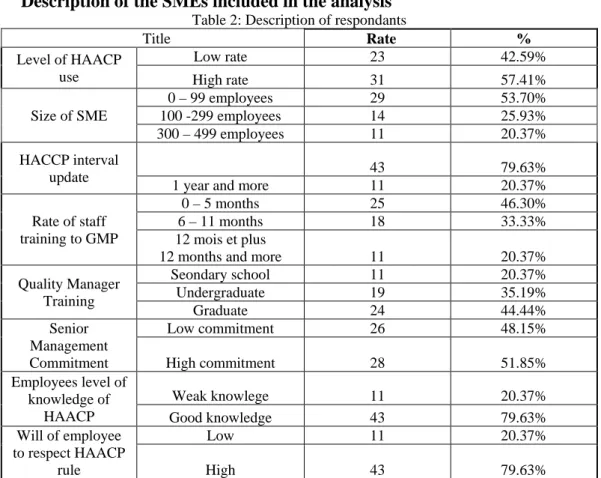
Table 2: Description of respondants
Title Rate % Level of HAACP use Low rate 23 42.59% High rate 31 57.41% Size of SME 0 – 99 employees 29 53.70% 100 -299 employees 14 25.93% 300 – 499 employees 11 20.37% HACCP interval update 43 79.63%
1 year and more 11 20.37%
Rate of staff training to GMP
0 – 5 months 25 46.30%
6 – 11 months 18 33.33%
12 mois et plus
12 months and more 11 20.37%
Quality Manager Training Seondary school 11 20.37% Undergraduate 19 35.19% Graduate 24 44.44% Senior Management Commitment Low commitment 26 48.15% High commitment 28 51.85% Employees level of knowledge of HAACP Weak knowlege 11 20.37% Good knowledge 43 79.63% Will of employee to respect HAACP rule Low 11 20.37% High 43 79.63%
Using descriptive statistical analysis, the profile of the 66 SMEs having correctly filled out and returned the questionnaire has been determined. The results presented in the table 2 show that among the 66 companies, 54 have a HACCP system, while 12 do not. Among the 54 SMEs using HACCP, 31 (57.41%) have a very good level of use, and 23 (42.59%) have a lower level of use of their HACCP system. With regards to the size of the SMEs, 29 of the 54 (53.70%) using HACCP have between 0 and 99 employees, 14 (25.93%) have 100 to 299 employees, and 11(20.37%) have 300 to 499 employees. Among the 54 SMEs having a HACCP system, 43 of them update their system within less than a year, while 11 take one year or more to update their system. In the same group of 54 SMEs, 25 train their staff in GMP at a frequency of less than 5 months, while 18 and 11 of them respectively have frequencies of training between 6 and 11 months, and one year or more. The higher level of education of the quality manager/HACCP coordinator is high school for 11 of the SMEs, college for 20 SMEs, and university for 23 SMEs. In the same group of 54 SMEs, 28 have management teams with high levels of commitment to provide the required
material, human, and financial resources to effectively operate their HACCP system, whereas in 26 of the SMEs the management team has a low level of commitment. With regards to the level of knowledge of the staff about HACCP, the staff has good knowledge in 43 of the SMEs, but in 11 of them the knowledge of the staff is poor. Finally, the analysis reveals that in 43 of the SMEs, the staff is willing to comply with the rules and requirements of HACCP, whereas in 11 of them, the staff is much less willing to do so.
Statistical analysis
The results of the statistical tests are presented in this section (significance level of 0.05). Only the 54 SMEs having a HACCP system are included.
Influence of the level of use of HACCP
The results of the statistical test are presented in Table 3. The significance level of 0.003 indicates that agri-food SMEs with low levels of use of their HACCP system (levels between 0 and 2) have percentages of non-conforming food products (NCFP) in terms of safety (mean number of products per finished production batch) significantly different from those of SMEs with higher levels of use (between 3 and 5). Consequently, the level of use of HACCP has a significant influence on its effectiveness to guarantee food safety in agri-food SMEs. This result agrees with the literature (Kaurai et al., 2013; Doménech, 2011; Junchao et al., 2014; Farid, 2004).
Table 3: results influence the HACCP level of use
Title HACCP efficacy Total Statisitics Test (LBLA) Sign*. 0 - 2% of NCFP (high efficacy) 3 - 5% of NCFP (low efficacy) Level of HAACP use Low level (0 – 2) 30.40% 69.60% 23 8.563 0.003 High level (3 – 5) 71.00% 29.00% 31 Total 29 25 54 * < 0.05
Influence of SME size (number of employees)
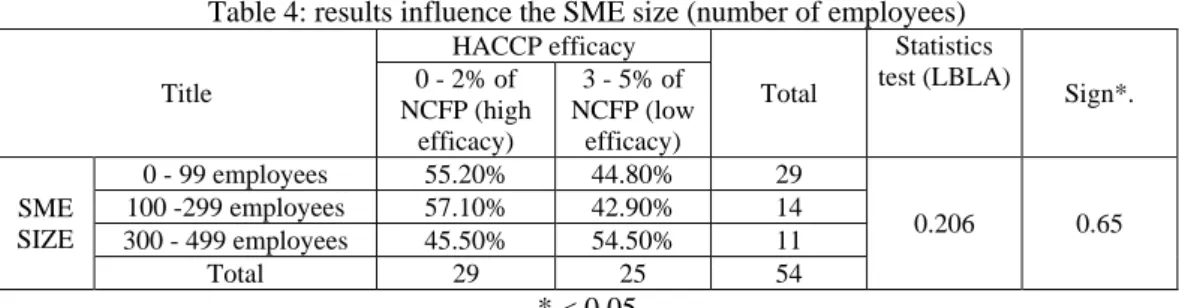
The results of the statistical test are presented in Table 4. The test is non-significant (0.65) which means that the number of employees has no impact on the effectiveness of HACCP in agri-food SMEs. The percentages of NCFP are approximately the same whether the company has between 0 and 99, 100 and 299, or 300 to 499 employees.
Table 4: results influence the SME size (number of employees) Title HACCP efficacy Total Statistics test (LBLA) Sign*. 0 - 2% of NCFP (high efficacy) 3 - 5% of NCFP (low efficacy) SME SIZE 0 - 99 employees 55.20% 44.80% 29 0.206 0.65 100 -299 employees 57.10% 42.90% 14 300 - 499 employees 45.50% 54.50% 11 Total 29 25 54 * < 0.05
Influence of the frequency of staff training to GMP
The results of the statistical test are presented in Table 5. The significant test (0.009) reveals that the frequency of staff training to Good Manufacturing Practices (GMP) has a significant influence on the effectiveness of HACCP in agri-food SMEs. It can conclude that the hypothesis according to which agri-food SMEs having a frequency of staff training to GMP ranging between 0 and 5 months, 6 and 11 months, and one year or more have percentages of NCFP significantly different from each other, is true.
Table 5: Results influence the rate of staff GMP training
Title HACCP Efficacy Total Statistics Test (LBLA) Sign*. 0 - 2% of NCFP (high efficacy) 3 - 5% of NCFP (low efficacy) Rate of staff training to GMP 0 - 5 months 80.00% 20.00% 25 6.826 0.009 6 - 11 months 22.20% 77.80% 18
12 months and more 45.50% 54.50% 11
Total 29 25 54
* < 0.05
Influence of the length of the update interval of the HACCP system
The results of the statistical test are presented in Table 6. Since the test is significant (0.009), it can be concluded that there is a significant difference in the percentages of NCFP between agri-food SMEs that update their HACCP system within less than a year and those with longer update intervals. Thus, the length of the update interval of the HACCP system has a significant influence on its effectiveness in agri-food SMEs.
Table 6: results influence HACCP update interval
Title HACCP Efficacy Total Statistics test (LBLA) Sign*. 0 - 2% of NCFP (high efficacy) 3 - 5% of NCFP (low efficacy) HACCP update interval
Less than 1 year 62.80% 37.20% 43
6.881 0.009
1 year and more 18.20% 81.80% 11
Total 29 25 54
Influence of the level of education of the quality manager/HACCP coordinator
The results of the statistical test are presented in Table 7. The test is non-significant (0.115) which means that the percentages of NCFP in agri-food SMEs with quality managers/HACCP coordinators having different higher levels of education (high school, college, university) are not significantly different from each other. Hence, the level of education of the quality manager/HACCP coordinator does not have a significant influence on the effectiveness of the HACCP system.
Table 7: Results of the Quality Manager Education influences
Title HACCP Efficacy Total Statisitics Test (LBLA) Sign*. 0 - 2% of NCFP (high efficacy) 3 - 5% of NCFP (low efficacy) Training Quality Manager Secondary 45.50% 54.50% 11 1.129 0.288 collegiate 47.40% 52.60% 19 University 62.50% 37.50% 24 Total 29 25 54 * < 0.05
Influence of the level of commitment of the management team
The results of the statistical test are presented in Table 8. The highly significant test (0.00) indicates that there is a significant difference in the percentages of NCFP between agri-food SMEs whose management team has low levels of commitment (levels between 0 and 2) and those in which the level of commitment is higher (between 3 and 5). Consequently, the level of commitment of the management team has a significant influence on the effectiveness of the HACCP system to ensure food safety in agri-food SMEs.
Table 8: Results of influence of the Senior Management commitment
Title HACCP Efficacy Total Statistics Test (LBLA) Sign*. 0 - 2% of NCFP (high efficacy) 3 - 5% of NCFP (low efficacy) Senior Management Commitment Low commitment (0 - 2) 23.10% 76.90% 26 18.567 0.00 High commitment (3 - 5) 82.10% 17.90% 28 Total 29 25 54 * < 0.05
Influence of the staff knowledge about HACCP
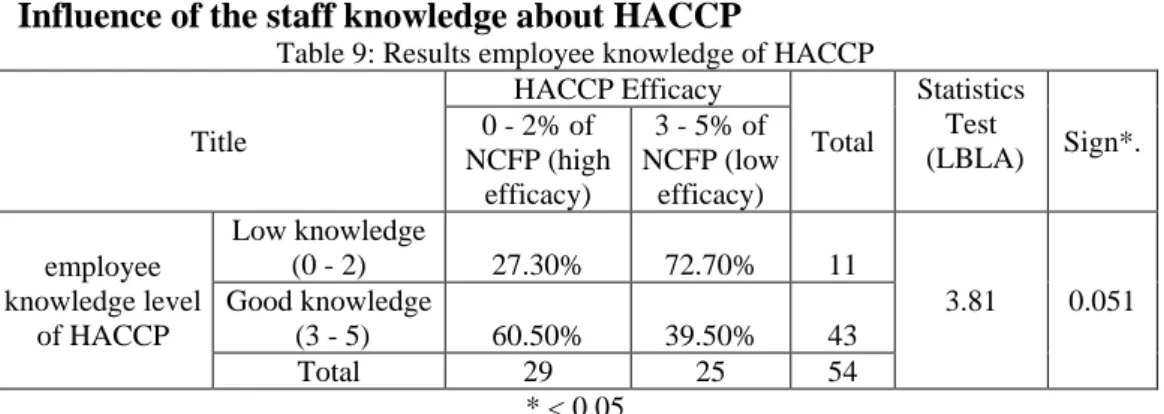
Table 9: Results employee knowledge of HACCP
Title HACCP Efficacy Total Statistics Test (LBLA) Sign*. 0 - 2% of NCFP (high efficacy) 3 - 5% of NCFP (low efficacy) employee knowledge level of HACCP Low knowledge (0 - 2) 27.30% 72.70% 11 3.81 0.051 Good knowledge (3 - 5) 60.50% 39.50% 43 Total 29 25 54 * < 0.05
The results of the statistical test are presented in Table 9. The non-significant test (0.051) reveals that there is no non-significant difference in the percentages of NCFP between agri-food SMEs whose staff does not have good knowledge about HACCP (levels between 0 and 2) and those in which the staff has good knowledge (between 3 and 5). Hence, the level of knowledge of the staff about HACCP in agri-food SMEs does influence significantly the effectiveness of the quality system.
Influence of the willingness of the staff to comply with HACCP rules
The results of the statistical test are presented in Table 10. The highly significant test (0.001) indicates that the percentages of NCFP of agri-food SMEs in which the willingness of the staff to comply with the rules of HACCP is low (levels between 0 and 2) are significantly different from those whose staff is willing to comply with HACCP rules (between 3 and 5). Consequently, the willingness of the staff to comply with the rules has a significant influence on the effectiveness of HACCP in agri-food SMEs.
Table 10: Results influence the will of employee to respect HAACP rules
Titles HACCP Efficacy Total Statistics Test (LBLA) Sign*. 0 - 2% of NCFP (high efficacy) 3 - 5% of NCFP (low efficacy) Employee will to respect HAACP rules Low (0 – 2) 9.10% 90.90% 11 10.853 0.001 High (3 – 5) 65.10% 34.90% 43 Total 29 25 54 * < 0.05 Conclusion
This paper examined how the effectiveness of HACCP can be optimized in agri-food small and medium-sized enterprises (SMEs). The main objective was to determine among several parameters related to the operation of a HACCP system, those that significantly improved its
effectiveness to guarantee the safety of food products at the end stage of the production process in agri-food SMEs. The results of the Mantel-Haenszel LBLA tests showed that the significant parameters for an effective application of HACCP were: level of use of the HACCP system, interval length between system updates, frequency of staff training to Good Manufacturing Practices (GMP), commitment of the management team, and willingness of the staff to comply with HACCP rules.
Recommended solutions
To improve the safety level of manufactured food products at the end stage of the production process, we recommend to agri-food SME managers the following measures:
• Maintain a high level of use of HACCP as a quality assurance
system;
• Update the HACCP system frequently, within less than a year;
• Regularly train the production staff to GMP at a frequency of less
than 5 months;
• Give to the person in charge of the safety of the manufactured food
products (quality manager/HACCP coordinator) all the necessary material, human, and financial resources, and also full authority, to effectively implement and operate the HACCP system;
• Make sure that the production staff comply with the rules and
requirements of HACCP through awareness campaigns and, if need be, disciplinary measures.
Further research should widen the study population to include the rest of Canada and also other countries. Some of the limiting factors for this research work included the relatively small sample size and insufficient material and financial resources.
References:
Action contre la faim (ACF). (Consulté en 2014). Guide méthodologique
enquête terrain - Sécurité alimentaire ACF. Récupéré sur :
http://www.parkdatabase.org/files/documents/0000_Echantillonnage_ACF.p df
Al-Kandari. D, J. D. (2011, Juin). Incorporating HACCP into national food control systems - Analyzing progress in the United Arab Emirates. Food Control, pp. 851-861.
Baş. M, Y. ç. (2007). Difficulties and barriers for the implementing of HACCP and food safety systems in food businesses in Turkey. Food Control, 124-130.
Cahuzac, É., Hassan, D., & Monier-Dilhan, S. (2007). Sécurité sanitaire des aliments : fausse alerte et vraie crise. Economie & prévision, 148.
Carol A. Wallace, L. H. (2012, July). Re-thinking the HACCP team: An investigation into HACCP team knowledge and decision-making for successful HACCP development. Food Research International, 236–245. Chemat Farid, H. N. (2004). Hazard analysis and critical control point (HACCP) for an ultrasound food processing operation. Ultrasonics Sonochemistry, 257 - 261.
Danielle Ramsay, M.-F. D. (2012). Toxi-infections alimentaires : Bilan du 1er avril 2011 au 31 mars 2012. Québec : © Gouvernement du Québec - Direction générale de la santé animale et de l'inspection des aliments - Direction du soutien à l'inspection. Récupéré sur :
http://www.mapaq.gouv.qc.ca/fr/Publications/Bilan_toxi-infections20112012.pdf
E. Doménech, J. A.-G. (2011). Implementation and effectiveness of the HACCP and pre-requisites in food establishments. Food Control, 1419-1423. Eves. A, D. P. (2005). Experiences of the implementation and operation of hazard analysis critical control points in the food service sector. International Journal of Hospitality Management, 3-19.
FAO/Département Agriculture. (s.d.). Archives de documents de la FAO / Systèmes de qualité et de sécurité sanitaire des aliments : Manuel de formation / Historique et bases du système HACCP. Récupéré sur : http://www.fao.org/docrep/005/w8088f/w8088f23.htm
FAO. (2001). SYSTÈMES DE QUALITÉ ET DE SÉCURITÉ SANITAIRE DES ALIMENTS : Manuel de formation sur l'hygiène alimentaire et le Système d'analyse des risques - points critiques pour leur maîtrise (HACCP). Récupéré sur : http://www.fao.org/docrep/005/w8088f/w8088f00.htm#toc FAO. (2016). Sécurité sanitaire et qualité des aliments. Récupéré sur : http://www.fao.org/food/food-safety-quality/empres-food-safety/fr/
FAO and WHO. (2003). GARANTIR LA SÉCURITÉ SANITAIRE ET LA QUALITÉ DES ALIMENTS : DIRECTIVES POUR LE RENFORCEMENT DES SYSTÈMES NATIONAUX DE CONTRÔLE
ALIMENTAIRE. Récupéré sur : ftp://ftp.fao.org/docrep/fao/006/y8705f/y8705f00.pdf
FAO. (s.d.). Qualité et sécurité sanitaire des aliments. Récupéré sur FAO: http://www.fao.org/worldfoodsummit/french/fsheets/fsafety.pdf
Featherstone, S. (2015, January). Hazard analysis and critical control point (HACCP) systems in food canning. Microbiology, Packaging, HACCP and Ingredients, 2, 215–234.
Fotopoulos, C. K. (2009). Assessing the critical factors and their impact on the effective implementation of a food safety management system. International Journal of Quality and Reliability Management, 894-910.
G. Moy, F. K. (1994). Application of HACCP to food manufacturing: some considerations on harmonization through training. Food Control, 5, 131–139.
J.-L., J. (1995). Quality and quality assurance Microbiological quality and the HACCP system. OCL. Oléagineux, corps gras, lipides, 290-296.
Jean-claude Panisset, E. D.-L. (2003). Contamination alimentaire. Environnement et santé publique - Fondements et pratiques, pp. 369-395. Joanna Trafiałeka, M. L.-K.-K. (2015). HACCP-based procedures in Germany and Poland. Food Control, 66–74.
Junchao Lu, Xiao-Hui Pu, Chi-Te Liu & Che-Lang Chang, Kuan-Chen Cheng. (2014, Septembre). The implementation of HACCP management system in a chocolate ice cream plant, 22, 391–398.
Kaferstein, F. K. (1997). Food safety: a commonly underestimated public health issue. Worl health statistics quaterly, pp. 3-4.
Kafetzopoulos, D.. (2014). Critical factors, food quality management and organizational performance. Food Control, 1-11.
Kafetzopoulos, E. L. (2015). HACCP effectiveness between ISO 22000 certified and non-certified dairy companies. Food Control, 53, 134–139. Kohilavani, W. Z. (2013). Embedding Islamic dietary requirements into HACCP approach. Food Contrôl, 607-612.
Lambiri, M. M. (1995). Effect of introduction of HACCP on the microbiological quality of some restaurant meals. Journal of the Royal Society of Health, 26-30.
Masanganise, K. E., Pfukenyi & Matope, G. (2013). A survey on auditing, quality assurance systems and legal frameworks in five selected slaughterhouses in Bulawayo, south-western Zimbabwe. Journal of veterinary research, 575-583.
Ministère Français de l'agriculture et de la Pêche. (1999). Journal Officiel de
la république Française. Récupéré sur : https://www.legifrance.gouv.fr/jo_pdf.do?id=JORFTEXT000000212485
Milios. K, D. E. (2012). Factors influencing HACCP implementation in the food industry. Journal of the Hellenic Veterinary Medical Society, 283-290. WHO. (2015). Journée mondiale de la Santé 2015 : la sécurité sanitaire des aliments. Récupéré sur Organisation mondiale de la santé : http://www.who.int/campaigns/world-health-day/2015/event/fr/
Peter M. Horchner, D. B. (2006). HACCP-based approach to the derivation of an on-farm food safety program for the Australian red meat industry. Food Control, 497-510.
R.J. Cormier, M. M. (2007). Effectiveness and performance of HACCP-based programs. Food Control, 665-671.
SJÖBERG A-M, S. J.-M. (2002). An implementation of the HACCP system in the production of food-packaging material. Journal of industrial microbiology & biotechnology, 213-218.
Soriano, J. R. (2002). The application of Hazard Analysis Critical Control Point (HACCP) in a flight catering establishment improved the bacteriological quality of meals. Food Control, 253-261.
Wikipedia. (2015, Avril). Récupéré sur Wikipédia: http://fr.wikipedia.org/wiki/W._Edwards_Deming
Youssef M.K, Y. X. (2013). Survival of acid-adapted Escherichia coli O157: H7 and not-adapted E. coli on beef treated with 2% or 5% lactic acid. Food Control, 13-18.