
HAL Id: tel-02389064
https://pastel.archives-ouvertes.fr/tel-02389064
Submitted on 2 Dec 2019HAL is a multi-disciplinary open access archive for the deposit and dissemination of sci-entific research documents, whether they are pub-lished or not. The documents may come from teaching and research institutions in France or abroad, or from public or private research centers.
L’archive ouverte pluridisciplinaire HAL, est destinée au dépôt et à la diffusion de documents scientifiques de niveau recherche, publiés ou non, émanant des établissements d’enseignement et de recherche français ou étrangers, des laboratoires publics ou privés.
Surface evolution of corroding magnesium : new
analytical approaches to understand corrosion
mechanisms and protection strategies
Alina Maltseva
To cite this version:
Alina Maltseva. Surface evolution of corroding magnesium : new analytical approaches to understand corrosion mechanisms and protection strategies. Theoretical and/or physical chemistry. Université Paris sciences et lettres, 2018. English. �NNT : 2018PSLEC002�. �tel-02389064�
THÈSE DE DOCTORAT
de l’Université de recherche Paris Sciences et Lettres
PSL Research University
Préparée à Ecole Nationale Supérieure de Chimie de Paris
Evolution de surface lors de la corrosion du magnésium:
nouvelles approches analytiques pour comprendre les mécanismes
de corrosion et de protection
COMPOSITION DU JURY :
Mme. COURTY Alexa
Université Pierre et Marie Curie, France, Président du jury
M. WILLIAMS Geraint
Swansea University, Royaume-Uni, Rapporteur
M. FERON Damien
INSTN, CEA, France, Rapporteur Mme. VOLOVITCH Polina
Chimie ParisTech, Université PSL, France, Examinateur
M. LEFEVRE Grégory IRCP, France, Examinateur
Mme. LAMAKA Sviatlana
Helmholtz-Zentrum Geesthacht, Allemagne, Examinateur
Soutenue par Alina MALTSEVA
le 26 septembre 2018
h
Ecole doctorale n°388
CHIMIE PHYSIQUE ET CHIMIE ANALYTIQUE
Spécialité Physico-chimie
Dirigée par Polina VOLOVITCH
et Grégory LEFEVRE
PhD thesis
Surface evolution of corroding magnesium:
new analytical approaches to understand
corrosion mechanisms and protection
strategies
Acknowledgements
Time flies, three years of PhD passed so fast… I should note that it was a great time, full
of interesting work, new discoveries, and bright impressions!
First of all, I would like to express my sincere gratitude to my supervisors, Polina
Volovitch and Grégory Lefèvre. Without them my doctoral thesis would not be possible. Polina,
thanks a lot for your help and support, for teaching me, spending hours, days and even nights in
reviewing my presentations, posters and writing! Grégory, Merci Beaucoup for your help, fruitful
discussions and patience.
I would like to thank my reviewers, Geraint Williams and Damien Ferron, who found a
time to evaluate my thesis manuscript, besides the precious vacation time and a huge amount of
work. Thanks to the jury members, Sviatlana Lamaka and Alexa Courty, for coming to my PhD
thesis defense and interesting questions. I am also grateful to invited persons taking part of jury
commission, Viacheslav Shkirskiy and Patrick Chapon for the participation in the discussion,
their valuable comments and wise advices.
I also want to say thanks to Michel Cassir, the director of our group, Armelle Ringuede,
Kevin Ogle, Virginie Lair, Valerie Albin, who welcomed and helped me since my first days at
the lab.
It is not enough space in this section to express my gratitude to Dr. Slava! Thank you for
your warm support, for the huge help in work (the software deserves the highest praise) and
everyday life! You were always ready to prepare the hot drinks at the moments of sadness and
encourage me with your very special jokes!
I can not forget my lab mates, who shared with me everyday life during these happy 3
years.
Xuejie and Peng, many thanks for sharing office, meals, jokes with me, for providing me
the best Chinese tea and the advanced-level Chinese vocabulary. 谢谢! Muchas gracias, Dieguito,
for your emotional support, soulful crous-coffee-breaks, lessons of Spanish, for providing me the
good music and encouraging smile! Merci beaucoup, Thomas, Cyril, Perrine! You were the
first persons with whom I started to speak French, thanks a lot for your patience to my “Je n’ai pas
compris, tu peux répéter, s'il te plait ?” Thank you to the chief of the lab upstairs, Abdelilah, for
your kindness! Many thanks to interns who helped me a lot with experimental work, Ksenia,
Elvina, Dima! Of course, thanks a lot to my lab-mates not mentioned yet: Katrinka, Romain,
Junsoo, Andrey, Haitam, Aurélie, Manel, Arturo, Oumaïma, etc…
Special thanks to the members of “Crystal band” with whom we organized small concerts
in our school. Jean-François, Sacha, Philippe, Diana, Gilles and Franz, thank you for the good
music you played, I evolved a lot as a musician with your help!
Here I should put the long list of my Russian friends and express my БОЛЬШОЕ
СПАСИБО for inspiring and supporting me with your “берешь и делаешь” at every moment of
my life!
Finally, I would like to thank all my family, who was always with me, calling me almost
every day, supporting me on the conferences and thesis defense!
CURRICULUM VITAE
Alina Maltseva, 3rd year PhD student
E-mail: [email protected]
Address: 11 Rue Pierre et Marie Curie, 75005 Paris
Research interests:
physical and analytical chemistry, corrosion science, in situ vibrational
spectroscopy, local electrochemical methods
Quantitative results: 1 article published, 2 articles submitted, 5 international conferences
(1 oral, 4 posters, 3 Poster‐Prizes) + 1 oral presentation accepted
EDUCATION
2015 – present
PhD student in physical and analytical chemistry, PSL Research University,
Chimie ParisTech, Institut de Recherche de Chimie Paris, I2E team
PhD project: Surface films on corroding magnesium: new analytical
approaches to understand corrosion mechanism and protection strategies
Scientific supervisors: Dr. Polina Volovitch and Dr. Grégory Lefèvre
2015
Master in Chemistry, Diploma with Honors, Lomonosov Moscow State
University, Moscow, Laboratory of Kinetics and Catalysis, Division of
Physical Chemistry
RELEVANT SKILLS AND EXPERIENCE
Techniques, expert level:
Raman spectroscopy, GD‐OES
Techniques, user level:
IR spectroscopy, UV‐VIS spectroscopy, XRD, SEM, EDX,
XPS, chromatography, nitrogen adsorption, acidity
measurements, NMR characterization
Teaching activity:
2018
supervisor of M1‐M2 internship students
practical works for M1 students (ENSCP)
2017
GD‐OES training for PhD students in ENSCP
2016
theoretical lecture and practical classes (6h) in Raman
spectroscopy for PhD and Master students in ENSCP
2012‐2015
private lessons in chemistry for high school students
Language:
English (advanced), French (fluent), Russian (mother‐tongue)
AWARDS
June 2018
1
stPoster Prize, The 1
stInternational Surface Fest, Bordeaux, France
July 2016
1
stPoster Prize, The 1
stinternational summer school “Multifunctional Smart
coatings and surfaces”, University of Aveiro, Portugal
June 2016
2
ndPoster Prize, 10
thInternational Symposium on Electrochemical
PUBLICATIONS
•
V. Shkirskiy, A. Maltseva, K. Ogle, P. Volovitch, Environmental effects on selective
dissolution from ZnAlMg alloy under low frequency alternating current perturbations,
Electrochimica Acta
http://dx.doi.org/10.1016/j.electacta.2017.03.210
•
V. Shkirskiy, M. Uebel, A. Maltseva, G. Lefèvre, P. Volovitch and M. Rohwerder, New
Insights on the Mechanism of Cathodic Driven Coating Delamination: Suppressed Cation
Migration along Zn/Polymer Interface in Atmospheric CO
2(submitted to Nature publishing
journal Materials Degradation)
•
Y. Yan, O. Gharbi, A. Maltseva, X. Chen, Z. Zeng, S. Xu, W. Xu, P. Volovitch, M. Ferry, N.
Birbilis,
Investigating the structure of the surface film on a corrosion resistant Mg‐Li(‐Al‐Y‐
Zr) alloy (submitted to Corrosion)
•
A. Maltseva, S. Lamaka, G. Lefèvre, P. Volovitch, Inhibition Mechanisms of Mg Corrosion
by Selected Carboxylates: Contribution of in situ Raman Spectroscopy and Glow Discharge
Optical Emission Spectroscopy, June 2018, Bordeaux, France (poster)
•
A. Maltseva, V. Shkirskiy, G. Lefèvre, P. Volovitch, Corrosion products films on high purity
Mg, European Corrosion Congress 2017, Prague, Czech Republic, September 2017 (oral)
•
A. Maltseva, V. Shkirskiy, G. Lefèvre, P. Volovitch, Corrosion products films on low alloyed
Mg: Raman spectroscopy, Ecole thèmatique CNRS organisée par le Groupe Français de
Spectroscopies Vibrationelles (GFSV), Ile de Porquerolles, France, Octobre 2016 (poster)
•
A. Maltseva, A. Michot Mignucci, C. de Faria Barros, K. Ogle, S. Gaiaschi, P. Chapon, N.
Birbilis, P. Volovitch, Corrosion product films on high purity Mg alloys, 8th International
GD Day, Synchrotron SOLEIL, Gif sur Yvette, France, September 2016 (poster)
•
P. Volovitch, A. Maltseva, C. de Faria Barros, V. Shkirskiy, G. Lefèvre, Effect of pH on growth
and barrier properties of brucite film on Mg, 67th Annual meeting of the ISE, the Hague,
Nederland,
21‐26
August
2016
(lecture,
abstract
book
http://www.ise‐
online.org/annmeet/folder/67th‐AM‐abstracts.pdf p. 405), August 2016
•
A. Maltseva, V. Shkirskiy, K. Ogle, P. Volovitch, Selective dissolution from ZnMgAl alloy
under low frequency AC perturbations and its consequence for the interpretation of
electrochemical signal, 1st International Summer School of Multifunctional Smart Coating
and Surfaces, Aveiro, Portugal, July 2016 (poster)
•
A. Maltseva, V. Shkirskiy, K. Ogle, P. Volovitch, Selective dissolution from ZnMgAl alloy
under low frequency AC perturbations and its consequence for the interpretation of
electrochemical signal, 10th International Symposium on Electrochemical Impedance
Spectroscopy EIS’16, Toxa, Spain, June 2015 (poster)
Résumé de la thèse
La réactivité des alliages de Mg est fortement influencée par la formation et la stabilité du film de surface, rendant primordiale leur compréhension au niveau fondamental pour concevoir une stratégie anticorrosion. Ces films sont considérés comme à l’origine de la barrière de protection à la corrosion. Néanmoins, des inhomogénéités locales dues à une formation non-uniforme, une rupture, ou une accumulation d’impuretés métalliques plus nobles que le magnésium, peuvent conduire à une corrosion localisée et accélérer la dégradation du matériau. Ainsi, ce travail a pour but d’abord de développer des méthodologies permettant d’une part une investigation in situ de l’évolution locale du film d’oxy-hydroxyde (composition, distribution spatiale, morphologie, cinétique de croissance et de rupture), et d’autre part une analyse ex situ de la distribution élémentaire en profondeur. Par la suite, la réactivité de Mg est corrélée à la composition du film et son évolution caractérisée par les méthodes développées.
La spectroscopie Raman confocale a été adaptée pour cartographier in situ la cinétique de l’évolution du film de surface lors des étapes initiales de corrosion de Mg grâce à une cellule en circulation. L’approche proposée a été appliquée pour visualiser les zones de croissance de Mg(OH)2, qui a été décrite par différentes lois cinétiques selon l’environnement et la localisation sur la surface. L’analyse in situ a été complétée par la spectroscopie infrarouge en mode réflexion totale atténuée (ATR-IR) et la spectroscopie à décharge luminescente (GD-OES).
La GD-OES a été utilisée pour évaluer l’enrichissement du film, en explorant les limites analytiques propres aux surfaces corrodées. L’interprétation brute des profils de concentration obtenus avec un plasma d’argon pouvait mener à des conclusions erronées, et une procédure a été proposée pour obtenir des résultats plus fiables tenant compte de la modification du plasma durant la pulvérisation du film d’oxy-hydroxyde à cause de la présence d’hydrogène.
Ces développements analytiques ont contribué à la compréhension des corrélations entre la composition de la solution, l’évolution du film de surface et la réactivité de Mg. Dans des solutions de NaCl, au niveau des zones n’évoluant pas en microscopie optique, la cinétique de croissance de Mg(OH)2 était parabolique (limitée par la diffusion) à pH 13 mais linéaire (limitée par des réactions de surface) à pH 7-10.5. Une brutale accélération était observée près des sites de corrosion (filaments noirs). L’apparition de cette accélération coïncide avec l’observation des premiers filaments de la zone étudiée. Les spectres Raman ont été analysés pour obtenir des informations sur la taille des cristaux et la morphologie du film. Un mécanisme de formation de Mg(OH)2 a été proposé, basé sur la dissolution-précipitation d’une solution sursaturée, qui était cohérent avec l’effet du pH sur l’évolution de la cinétique et la taille des cristaux.
En présence d’inhibiteurs, deux tendances différentes ont été observées pour la croissance de Mg(OH)2. Pour le fumarate, la croissance est ralentie par rapport à une solution de NaCl 0,1 M. La présence de salicylate ou de 2,5-pyridinedicarboxylate (PDCA) n’a pas d’effet sur la croissance pendant environ 40 minutes, puis la cinétique rejoint celle observée pour le fumarate. Une analyse fine des spectres révèle une interaction spécifique entre le salicylate et le fer ou Mg(OH)2 formé dans les zones cathodiques. Ceci est cohérent avec l’inhibition cathodique reportée dans la littérature, mais qui n’est pas observée sur du Mg de haute pureté (faible teneur en Fe). Le fumarate et le PDCA conduisent à la formation de films homogènes, cohérents avec l’inhibition de la réactivité anodique. Tous les films formés en présence d’inhibiteurs contenanient des cristaux de Mg(OH)2 de taille réduite par rapport à des solutions sans inhibiteurs, bloquant l’accès aux Cl- (d’après le GD-OES), diminuant la corrosion localisée.
Thesis abstract
The reactivity of Mg alloys is strongly affected by formation and stability of surface films making their fundamental understanding critical for intelligent anticorrosion strategy. These films are regarded as a source of the initial barrier corrosion protection. However, any local inhomogeneity caused by a non-uniform film formation, or film breakdown or accumulation of more noble than Mg metallic impurities can result in localized corrosion and accelerated material degradation. Thus, this work aims firstly to develop methodologies which permit both, in situ investigation of local oxide/hydroxide layer evolution (chemical composition, spatial distribution, morphology, growth and breakdown kinetics), and ex situ observation of elemental distribution within the layer depth. Secondly, to correlate environmental composition, surface film evolution and Mg reactivity with help of these methodologies.
In-situ confocal Raman spectroscopy was adapted to map the local kinetics of surface film evolution at initial stages of Mg corrosion in thin layer cell. Proposed approach was applied to visualize zones with Mg(OH)2 growth described by different kinetic laws and to compare kinetics trends in different environments as well as in different locations on the surface. The in-situ surface analysis was completed by ex-situ Attenuated Total Reflectance Fourier-Transform Infrared Spectroscopy (ATR-FTIR) and Glow Discharge Optical Emission Spectroscopy (GD OES).
GD OES was used to survey the film enrichment. Analytical limits related to the application of GD OES to corroded surfaces were explored. It was evidenced that simple interpretation of depth profiles obtained in Ar plasma can be misleading and a correction procedure was proposed that takes into account plasma modifications during the sputtering of oxide/hydroxide layer because of the presence of H.
Developed analytical approaches contributed to understanding of the correlations between solution composition, the surface film evolution and the reactivity. In NaCl solutions, on the areas, which did not evolve in optical images during immersion, Mg(OH)2 growth kinetics was parabolic (diffusion limited) at pH 13 but linear (surface reaction limited) at pH 7-10.5. A jump in the kinetics curve was observed near local corrosion sites (black filaments). The time of this jump in kinetics curve coincided with the first visual observation of the filament in studied zone. The spectra were also tentatively analyzed in order to extract information about the in-situ evolution of the crystal size and morphology. Proposed Mg(OH)2 evolution mechanism, described as a dissolution-precipitation from supersaturated solution, was coherent with the observed pH effect on the kinetics trends and crystal size.
In presence of inhibitors, two different trends in the brucite growth kinetics were observed. For fumarate the growth was slower compared to 0.1 M NaCl solution. The presence of salicylate and 2,5-pyridinedicarboxylate (PDCA) did not affect the growth kinetics for approximately 40 minutes, and then the slope of kinetics curve became similar to observed in fumarate solution. Deep spectra analysis revealed the nature of specific interactions of salicylate with Fe and Mg(OH)2 rapidly formed at cathodic areas. This is coherent with cathodic inhibition reported in the literature and the absence of the inhibition for high purity Mg (low Fe content). Fumarate and PDCA form homogenous surface films that is coherent with inhibition of anodic reactivity. All the films formed in the presence of inhibitors contained Mg(OH)2 nanocrystals with a reduced size compared to the films formed w/o inhibitors, and blocked Cl- access to the surface (from GD-OES), reducing probability of localized corrosion.
1
Résumé de la thèse
L'origine et les objectifs de l'étude doctorale
Les alliages à base de magnésium (Mg) sont des matériaux intéressants pour une large gamme d’applications comme l’industrie automobile, aéronautique, électronique ou la médecine [1], du fait de leur rapport résistance masse élevé, leur biocompatibilité, l’abondance de Mg. La réactivité élevée de ces matériaux en environnement aqueux peut être considéré comme problématique (corrosion) ou au contraire avantageux (implants résorbables, batteries). Le contrôle de la réactivité en milieu aqueux est donc primordial pour assurer de bonnes propriétés en service. Une compréhension fine de la réactivité de Mg est un point-clé pour développer une stratégie efficace de son contrôle.
Il est communément accepté que la chimie et la morphologie des films de surface et des produits de corrosion a un effet significatif sur la réactivité des substrats métalliques. Dans le cas des alliages de Mg, le film natif d’oxyde s’hydrate spontanément en milieu aqueux, formant Mg(OH)2 (brucite), un minéral dont la solubilité est inférieure à MgO. De nombreuses
études indiquent une structure duplex à la surface de Mg corrodé [2–5]: une fine couche interne de MgO (inférieure au micron) et une couche externe de Mg(OH)2. Ce film
2
Fig. 1 Diagramme E-pH (Pourbaix) du magnésium pur en solution aqueuse à 25 °C [8].
Selon le diagramme E-pH (Fig. 1), Mg(OH)2 est stable en milieu très alcalin et peut
passiver Mg. Néanmoins, en milieu faiblement alcalin ou neutre, ce film n’est thermodynamiquement pas stable et peut perdre ses propriétés de protection. Le film peut se rompre du fait de plusieurs facteurs, comme la modification de l’environnement chimique local (pH, anions, …). La présence d’inhomogénéités, causée par la croissance non-uniforme ou la rupture du film, peut conduire à des couplages micro-galvaniques accélérant la dégradation de Mg [9,10]. La corrosion localisée peut également être favorisée par l’enrichissement de la surface en impuretés métalliques plus nobles que Mg (Fe, Ni, Cu) qui sont présentes à de faibles concentrations (ppm) après les procédés de mise en forme [3,11– 13]. Ces deux mécanismes de corrosion localisée sont illustrées dans la Fig. 2.
Ainsi, du fait de l’importance du film de surface sur la réactivité de Mg, ces deux aspects, l’évolution du film duplex en milieu aqueux et l’enrichissement de surface par des impuretés métalliques, doivent être compris. De nombreuses données obtenues de façon ex situ sur la morphologie et la composition chimique de surfaces de Mg corrodées ont été publiées [14], mais la surface analysée ex situ peut être différente de l’interface en présence de solution. Pour cette raison, des méthodes in situ pourraient apporter des données pertinentes, notamment sur la cinétique, pour aider à comprendre la croissance et la rupture du film. Peu d’observations de ce type ont été publiées, et aucune n’a pour l’instant permis d’apporter des informations à des échelles macroscopique et microscopique simultanément [7,15].
3
Considérant l’évolution non-uniforme d’une surface de Mg se corrodant, le premier objectif de cette thèse était de développer une méthodologie pour cartographier in situ la cinétique de l’évolution du film d’oxy-hydroxyde en milieu aqueux sur des surfaces assez étendues et avec une résolution latérale élevée. Cette méthodologie pourra être étendue à différents phénomènes pour lesquels une mesure in situ d’une évolution locale peut être intéressant.
Le second objectif était de trouver une technique peu couteuse, rapide, simple (comparée à des méthodes analytiques sous vide comme l’XPS, le ToF SIMS, …) pour vérifier l’enrichissement de la surface par des impuretés métalliques et des ions provenant de l’électrolyte, dont les limites seront testées. La méthodologie proposée pour Mg pourra alors être utilisée pour la corrosion d’autres métaux.
Le troisième objectif de ce travail était de corréler composition de l'environnement, l’évolution de la surface corrodée et la réactivité de Mg à l'aide de l’approche analytique développée.
Les résultats devraient contribuer à la compréhension fondamentale des mécanismes de la corrosion de Mg, en particulier l’effet de la composition de la solution. Cela peut également aider à un choix de stratégies anticorrosion. Parmi différents facteurs pouvant être pris en compte, nous avons sélectionné l’effet du pH, des ions chlorure et de plusieurs inhibiteurs organiques
Malgré les nombreux inhibiteurs proposés pour le Mg et ses alliages [16,17], les mécanismes d’inhibition sont mal compris. Les conclusions sur les mécanismes basés sur des mesures électrochimiques sont limitées par l'attribution d'un additif particulier au type anodique / cathodique / mixte ou au type adsorption / précipitation. La caractérisation in situ de l'évolution de la surface en présence d'inhibiteurs serait un élément essentiel pour comprendre les mécanismes d'inhibition.
4
Ainsi, ce travail a pour but d’abord de développer des méthodologies permettant d’une part une investigation in situ de l’évolution locale du film d’oxy-hydroxyde (composition, distribution spatiale, morphologie, cinétique de croissant et de rupture), et d’autre part une analyse ex situ de la distribution élémentaire en profondeur. Par la suite, la réactivité de Mg est corrélée à la composition du film et son évolution caractérisée par les méthodes développées.
L’approche analytique
La cartographie à résolution micrométrique fournie par la microscopie confocale Raman (CRM) semble être une méthode prometteuse pour l'analyse in situ des produits de corrosion avec une bonne résolution latérale. La spectroscopie Raman est sensible aux vibrations des espèces OH- et CO
32, ainsi elle peut être utilisée en routine pour l'identification
des produits de corrosion dans les solutions aqueuses [18–21]. L'intensité de la lumière diffusée Raman provenant d'un échantillon est proportionnelle au nombre de liaisons actives dans le volume analysé [22] , cela permet une analyse semi-quantitative et le suivi de la cinétique de croissance en utilisant la procédure de normalisation des spectres. En principe, des informations sur la forme et la morphologie des cristaux peuvent également être obtenues à l’aide des spectres Raman [23].
Bien que la spectroscopie Raman in situ soit couramment utilisée pour l'identification des produits de corrosion, les mesures cinétiques in situ de la croissance ou de la dégradation du film, en particulier dans un mode de cartographie, n'ont jamais été publiées.
Dans ce travail, la spectroscopie Raman confocale a été adaptée pour cartographier in situ l’évolution du film de surface (composition chimique, morphologie, cinétique de croissance et de rupture). Cette technique était utilisée pour étudier l’effet du pH, des ions chlorure et de plusieurs inhibiteurs organiques dans les mécanismes de développement du film de surface.
De toute évidence, la spectroscopie Raman a des limites; la plus importante est que certains composés sont inactifs. Ainsi, il est impossible d’étudier directement l’évolution de
5
MgO, en particulier s’il est enrichi par des inclusions métalliques ou des espèces agressives telles que Cl-.
Dans cette perspective, le profil de profondeur élémentaire ex situ de matériaux corrodés peut fournir une information complémentaire. Parmi d'autres techniques d'analyse de surface, la spectrométrie d'émission optique à décharge luminescente (GD-OES) offre une combinaison unique de pulvérisation rapide (le temps d'une mesure varie entre 2 et 10 minutes pour les échantillons de Mg) ; une capacité multi-élément et une simplicité expérimentale sans nécessité d'un ultra-vide ou d'une préparation de surface spéciale [24]. Son application aux surfaces corrodées reste toutefois difficile en raison de l'interprétation des données analytiques de couches poreuses qui reste inexplorée, compliquée par une modification importante du plasma lors de la pulvérisation des couches d'oxy-hydroxyde [25,26].
Dans cette thèse, les limites analytiques liées à l'application de GD-OES sur les surfaces corrodées sont explorées et la technique est appliquée pour suivre la distribution de profondeur élémentaire dans la couche d'oxy-hydroxyde sur Mg corrodé et ses alliages. Cette technique a significativement contribué à la compréhension du mécanisme d’inhibition de Mg.
Le résumé et la structure de la thèse de doctorat
Cette thèse est organisée en 4 parties principales: Introductory section, Methodology, Results section et Concluding remarks.
La partie introductive présente les questions scientifiques à travers une revue bibliographique. Cette partie contient 3 chapitres. 1) “Introduction”, qui présente un aperçu global et le résumé de la thèse; 2) “Surface films on corroded Mg” qui détaille l'état des connaissances concernant les films de surface, leur stabilité et leur rôle dans la réactivité de Mg; 3) “Corrosion inhibition of Mg” qui représente l'état de l'art dans les approches pour la protection anti-corrosion de Mg.
Les mécanismes proposés pour la réactivité et la protection de Mg sont analysés dans les Chapitres 2 et 3. En marge de la partie introductive, chaque chapitre dans la partie Results section contient une étude bibliographique.
La 2ème partie, Experimental section, décrit les méthodologies principales utilisées dans ce travail, notamment La spectroscopie Raman in situ et la spectroscopie à décharge
6
luminescente. La Chapitre 4 présente les principes des deux techniques, leurs avantages et leurs limites.
La 3ème partie de la thèse est la plus importante et elle est composée des 3 chapitres présentés sous la forme des publications préparées pour la soumission dans différents journaux.
La Chapitre 5 “pH effect on MgO/Mg(OH)2 film evolution on corroding Mg by
in-situ Kinetic Raman Mapping (KRM)” décrit la mise au point de la méthodologie de cartographie Raman in situ (KRM) et démontre sa capacité à décrire l’effet de la composition de la solution (pH, présence de Cl-) sur l’évolution locale du film superficiel aux stades
initiaux de la corrosion de Mg en couche mince. L'utilisation d'une procédure de normalisation spécifique pour l'évolution du pic de brucite A1g (3652 cm-1) lors de l'immersion permet
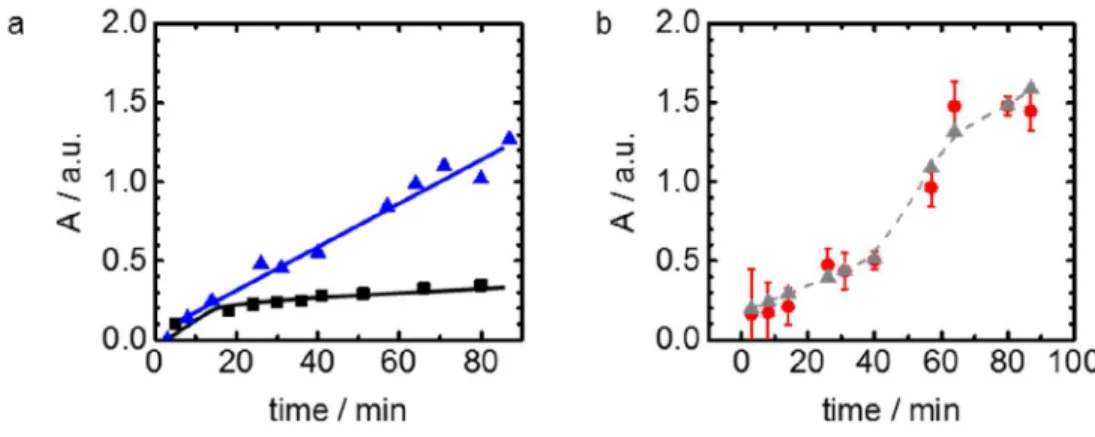
d'extraire la cinétique de croissance du film d'une surface suffisamment grande avec une résolution spatiale d'environ 10 µm. Sur les zones n'ayant pas évolué sur les images optiques pendant l'immersion, la cinétique de croissance de la brucite était parabolique (limitée par la diffusion) à pH 13 mais linéaire (limitée par des réactions de surface) à pH 7-10,5 (Fig. 3a). Un saut de la courbe de cinétique a été observé à des endroits particuliers de la surface (Fig. 3b).
Fig. 3. Exemples de la cinétique de croissance de Mg (OH)2 localisée in situ sur Mg immergé dans
une solution de 10 mM NaCl à différents pH: a) zones "intactes" à pH 9 (triangles bleus) et pH 13 (carrés noirs); et b) dans un filament noir à pH 9, résultats expérimentaux (cercles rouges) et simulation théorique de la précipitation de Mg (OH)2 suite à une augmentation instantanée du pH.
Le traitement statistique des données montre que ce type de cinétique est associé à la proximité des filaments noirs (Fig. 4a) et que le temps de la forte augmentation de la cinétique coïncide avec la première observation visuelle du filament dans la zone étudiée (Fig. 4b). Dans la Fig. 4b, le code couleur reflète le temps du saut dans la courbe de croissance de Mg
7
(OH)2. La fraction de surface avec un film "rompu" en fonction du temps a également été
tracée, montrant une cinétique de dégradation linéaire.
Fig. 4 (a) Exemple de l’apaprence d’une surface de Mg surface après 80 minutes en contact avec une solution de NaCl 0,1 M ; (b) cartographie cinétique (temps du saut dans la courbe de croissance pour chaque point) pour la même zone.
Les spectres ont également été analysés afin d’extraire des informations sur l’évolution in situ de la taille et de la morphologie des cristaux. L'augmentation de l'alcalinité a favorisé l'apparition de pics de "satellites" dans les spectres Raman (exemple dans Fig. 5c). Les bandes à 3675 cm-1 et 3710 cm-1 ont été attribuées aux vibrations des groupes de surface Mg-OH avec
des plans cristallographiques orientés différemment, (0001) et (10-10) respectivement [27]. La présence de « satellites » peut donc être considérée comme une preuve de la surface spécifique élevée et de la taille plus petite des cristaux de Mg(OH)2 à pH élevé, cela a été
confirmé par microscopie électronique à balayage ex situ (Fig. 5). Une cinétique similaire de croissance (pic de brucite et pics satellites) a été obtenue à pH 13 après environ 10 minutes de période d'induction, ce qui indique que la morphologie cristalline atteint l'équilibre à ce moment.
L'effet du pH sur la cinétique de croissance, la taille et la morphologie des cristaux est cohérent avec le modèle de dissolution-précipitation de la formation de Mg(OH)2. À cet égard,
une croissance de Mg(OH)2 à proximité des filaments pourrait s’expliquer par une dégradation
du film de surface dans ces endroits entraînant la libération d’ions Mg2+ et / ou OH
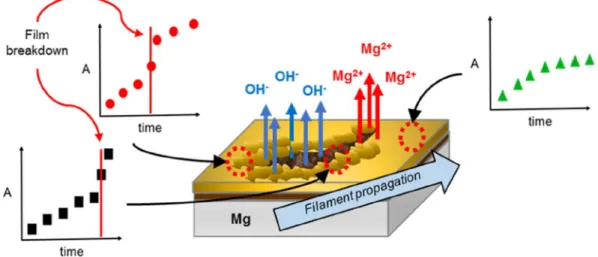
-excédentaires, provoquant une précipitation supplémentaire de la brucite (Fig. 6)
Un calcul simple de la cinétique de croissance du film autour des filaments en utilisant une précipitation de la solution sursaturée donne des résultats qui correspondent bien au saut observé (la cinétique simulée est représentée par la courbe grise dans la Fig. 3b).
8
L'enrichissement de la surface par des impuretés métalliques est en focus du Chapitre 6 “On the application of Glow Discharge Optical Emission Spectroscopy (GD OES) for depth profiling of corroded materials: example of pH effect on Fe and Mn enrichment on corroding Mg”.
Malgré la simplicité expérimentale, l'interprétation des données de GD OES n'est pas toujours évidente, surtout pour l'estimation de l'enrichissement de la couche de surface par des impuretés au niveau du ppm provenant du volume de métal. Le problème principal est que l’hydrogène atomique dans le plasma, provenant de l'échantillon (couche d'hydroxyde externe), peut modifier de manière significative la vitesse de pulvérisation, les limites de détection et le rendement d'émission de certaines bandes d'émission. Cela entraîne une interprétation ambiguë des variations d'intensité d'éléments dans la couche d'oxy-hydroxyde par rapport au volume de métal. Les effets de H sur les paramètres analytiques de GD OES, les conséquences de ces effets pour l'interprétation des profils de profondeur des surfaces corrodées, et la manière d'obtenir des profils qualitatifs sont discutés dans le travail.
La Fig. 7a présente un exemple de profil de profondeur GD OES obtenu dans un plasma d’Ar sur Mg pur (pureté commerciale : 280 ppm de Fe, 50 ppm de Mn, 10 ppm d'Al) après 12 h d'immersion dans de l'eau à pH 9. Interprétation brute des résultats obtenus dans le plasma Ar peut conduire à une conclusion erronée à propos de l'appauvrissement en Mn de la couche d'oxy-hydroxyde. Ainsi, le traitement de données proposé (correction H) conduit à conclure que l'appauvrissement apparent en Mn résulte de l'effet de H dans le plasma. La correction H ainsi que les expériences dans le plasma Ar/H2 ont montré dans ces conditions
que la surface était enrichie par Mn dans les conditions étudiées. Le GD OES a également démontré que H n'influence pas le comportement du Cl et que la couche d'oxyde-hydroxyde est enrichie en Cl.
9
Fig. 5. Exemples de spectres Raman in situ de Mg en contact avec la solution de 0,1 M NaCl à pH 9 (a) et 13 (b) et images MEB ex situ des surfaces correspondantes après immersion.
Fig. 6. Schéma de croissance de Mg(OH)2 dans un environnement aqueux contenant Cl-, à proximité
10
Fig. 7. Profils de profondeur élémentaires GD OES obtenus pour Mg pur (280 ppm Fe, 50 ppm Mn, 10 ppm Al) après 12 h d'immersion dans l'eau à pH 9: (a) données brutes; (b) profil de Fe et Mn après la correction H.
L’utilisation de Ar / H2 à la place du gaz conventionnel peut éviter certains artefacts
liés à la vitesse de pulvérisation de l'oxyde et du métal et à des modifications significatives du plasma entre ces deux couches. Malheureusement, la limite de détection du Fe est significativement dégradée en présence de H2, il n’a donc pas été possible de confirmer
l’enrichissement en ppm du film d’oxyde dans le plasma Ar/H2.
Le Chapitre 7 “Mechanisms of Mg corrosion inhibition by selected organic inhibitors” illustre l'application des méthodes analytiques proposées pour explorer les mécanismes d'inhibition de la corrosion par plusieurs molécules organiques, à savoir les sels de sodium des acides salicylique, 2,5-pyridine-dicarboxylique (PDCA) et fumarique (Fig. 8).
Fig. 8. Formule développée des inhibiteurs de corrosion Mg étudiés dans ce travail: (a) salicylate, (b) 2,5-pyridinedicarboxylate, (c) fumarate.
Les deux méthodologies établies aux chapitres 6 et 7 sont utilisées et complétées par d’autres techniques afin de comparer la formation de film dans une solution de 0,1 M NaCl
11
avec et sans inhibiteurs sur deux types de Mg pur. La différence principale entre les compositions de Mg était la quantité d'impuretés de Fe, 342 et 50 ppm respectivement pour le Mg commercial et de haute pureté. Tous les inhibiteurs retardent efficacement la corrosion de Mg, à l'exception du salicylate, qui inhibe uniquement la corrosion de Mg avec une teneur de Fe élevée.
Tout d'abord, les profils de profondeur ex situ GD-OES après l’immersion de Mg dans des solutions de NaCl 0,1 M avec et sans inhibiteurs Fig. 9 ont confirmé que tous les inhibiteurs étaient incorporés dans le film oxyde / hydroxyde (signal de C est assez fort) et diminué efficacement la quantité de Cl- adsorbé.
Fig. 9. Profils de profondeur élémentaire GD OES (Ar/H2 plasma) de Mg pur (pureté commerciale)
après 2 h d'immersion dans la solution de 0,1 M NaCl sans inhibiteurs (a) et en présence d'inhibiteur: salicylate de sodium (b), PDCA (c) ou fumarate de sodium.
12
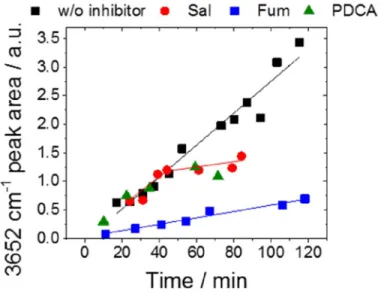
La spectroscopie Raman in situ a révélé deux tendances différentes de la cinétique de croissance de Mg (OH)2 en présence d'inhibiteurs (Fig. 10). Pour le fumarate, la croissance a
été plus lente par rapport à une solution de 0,1 M NaCl. Pour le salicylate et le PDCA, la croissance a évolué en 2 périodes. Initialement, elle était similaire à l'évolution de la croissance en absence des inhibiteurs. Après environ 40 minutes d’immersion, la croissance était plus lente et ressemblait à la solution de fumarate. En présence de tous les inhibiteurs, les pics satellites étaient visibles, révélant une taille de cristal plus petite que dans les solutions sans inhibiteurs.
Fig. 10. Cinétique de croissance typique de Mg (OH)2 dans la solution de 0,1 M NaCl en absence
d’inhibiteur (carrés noirs) et en présence de sels de sodium des acides fumarique (carrés bleus, Fum) salicyliques (cercles rouges) et 2,5-pyridindicarboxylique (triangles verts, PDCA).
L'interaction des inhibiteurs avec le film de surface a également été analysée. Pour le Mg de pureté commerciale, les pics Raman caractéristiques et les positions des bandes IR des groupes -COO- et -OH du salicylate ont été décalés par rapport à la position observée dans le
spectre de la solution (Fig. 11). Ceci a été interprété comme une interaction spécifique du salicylate avec la surface de Mg. Pour le fumarate, aucune interaction spécifique n'a été observée. Pour le PDCA, aucun décalage dans la position des pics dans les spectres Raman n'a été enregistré pendant les 40 premières minutes, puis le fond de fluorescence élevé est apparu, gênant le signal Raman. Cela pourrait s'expliquer par la formation d'un ensemble spécifique de molécules organiques possédant une chaîne de liaisons doubles et simples alternées, appelée conjugaison [28]. L'analyse ex situ par spectroscopie IR a confirmé les légers décalages des positions des pics caractéristiques des vibrations des cycles aromatiques pour le PDCA.
13
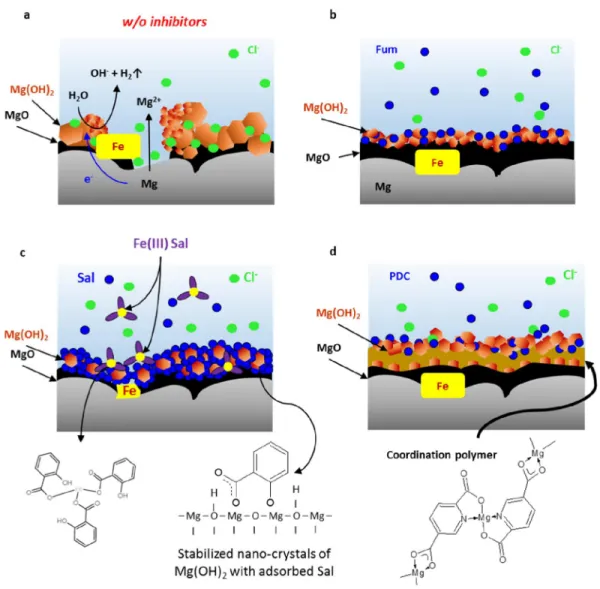
Trois types d'interaction des molécules organiques avec la surface de Mg ont été proposés pour les inhibiteurs étudiés. L'adsorption physique du fumarate, la chimisorption du salicylate sur Mg (OH)2 ou sur les particules contenant du Fe, et la formation de polymère de
coordination à l'interface entre des couches d'oxy-hydroxy dans le cas du PDCA, sont les mécanismes les plus probables de l’évolution de surface. En ce qui concerne les mécanismes d'inhibition, l'interaction spécifique du salicylate avec Fe est cohérente avec l'inhibition cathodique rapportée dans la littérature [29] ainsi que l'absence d'effet d'inhibition pour le Mg de haute pureté. Le fumarate et le PDCA forment des films de surface homogènes plus cohérents avec l'inhibition de la réactivité anodique. Tous les films de surface formés en présence d'inhibiteurs contiennent des nanocristaux de Mg (OH)2 de taille réduite par rapport
aux films formés sans inhibiteurs et bloquent l'accès de Cl- à la surface, réduisant la possibilité
de la corrosion localisée. Les mécanismes proposés pour la formation des films en présence des inhibiteurs et ses conséquences sur la réactivité sont résumés dans la Fig. 12.
Fig. 11. Spectres Raman in situ de Mg de pureté commerciale (CP-Mg342) et de Mg de haute pureté (HP-Mg50) en contact avec une solution de 0,1 M NaCl + 0,05 M salicylate de Na comparés aux spectres Raman de la solution de salicylate de Na.
Le Chapitre 8 “Conclusions and perspectives” présente la conclusion générale ainsi que les perspectives issues de ce travail.
Dans l’annexes, les résultats supplémentaires illustrant l’application des méthodologies développées dans plusieurs systèmes présentant un intérêt potentiel sont inclus. Parmi eux, l'effet de Li sur la chimie des films de surface des alliages de MgLi
14
corrodés ; l'effet de l'auto-assemblage des molécules organiques de monocouches sur la cinétique de croissance du film.
Fig. 12. Représentation schématique de la réactivité de Mg en l'absence d'inhibiteurs (a) et mécanismes d'inhibition de la corrosion de Mg en présence de (b) fumarate - adsorption physique, (c) salicylate - stabilisation de nano cristaux de Mg(OH)2 ; adsorption spécifique de Sal, (d) 2,5-pyridinedicarboxylate
15
Contents
CONTENTS ... 15 INTRODUCTORY SECTION ... 17
Introduction ... 19 Context and objectives of the study ... 19 Analytical approach of the work ... 22 Summary and structure of the manuscript ... 23
Surface films on corroded Mg ... 33 Basics of Mg reactivity ... 33 Corrosion products in Mg reactivity ... 35 Impurities incorporation in corrosion products ... 42
Strategies for Mg inhibition ... 49 Phase film formation inhibitors for Mg ... 51 Adsorption-type inhibitors for Mg ... 51
EXPERIMENTAL APPROACH ... 57
Methodologies ... 59 Raman spectroscopy ... 59 Glow Discharge Optical Emission Spectroscopy (GD OES)... 68
RESULTS SECTION ... 73
The effect of pH on the Mg(OH)2 film evolution on corroding Mg by in situ Kinetic Raman Mapping
(KRM) ... 75 Abstract ... 76 Introduction ... 76 Experimental details ... 79 Results ... 81 Discussion ... 88 Conclusions ... 91
16
Supplementary 1 ... 92 Supplementary 2 ... 92 Supplementary 3 ... 93
On the application of Glow Discharge Optical Emission Spectroscopy (GD-OES) for depth profiling of corroded materials: example of pH effect on Fe and Mn enrichment on corroding Mg ... 95
Abstract ... 96 Introduction ... 96 Experimental and calculation details ... 98 Results ... 100 Discussion ... 105 Conclusions ... 108
Inhibition Mechanisms of Mg Corrosion by Selected Carboxylates ... 109 Introduction ... 110 Experimental details ... 111 Results ... 114 Discussion ... 125 Conclusions ... 130
Conclusions and Perspectives ... 131 Development of new analytical approaches for investigation of Mg corrosion and protection
mechanisms ... 131 Understanding the solution chemistry effects on the evolution of oxide/hydroxide films on corroding Mg: corrosion and protection mechanisms ... 132
Perspectives ... 139
BIBLIOGRAPHY ... 141 APPENDICES ... 163
Investigating the surface film on a corrosion resistant Mg-Li(-Al-Y-Zr) alloy ... 165 On the application of in situ Raman spectroscopy to investigation of effect of self-assembling
monolayers on the film growth kinetics ... 193 Environmental effects on selective dissolution from ZnAlMg alloy under low frequency alternating current perturbations ... 195
17
Introductory section
This part of the PhD thesis defines the context of the study and the scientific questions, which should be answered.
19
Chapter 1
Introduction
Context and objectives of the study
Magnesium (Mg) based alloys are attractive materials for a wide range of applications such as automotive, aerospace, electronics, medicine [1] due to their high strength to weight ratio, biocompatibility, high abundance of Mg, etc. High reactivity of these materials in aqueous environments can be considered as a harmful (for corrosion / durability) or an advantageous (resorbable implants, battery applications) property. The control of this aqueous reactivity becomes critical to ensure good service properties and service life. Deep understanding of the mechanisms of Mg reactivity is the key to the development of efficient strategies for its control.
It is commonly accepted that the chemistry and morphology of the surface films and corrosion products significantly affect the reactivity of metallic substrates. In case of Mg alloys, the natural oxide film spontaneously hydrates in aqueous environments forming Mg(OH)2
(brucite), a mineral with a lower solubility than MgO. Numerous works have reported the bi-layered structure of the film on corroded Mg surfaces [2–5]: a thin inner MgO layer and a thick (up to µm) outer layer of Mg(OH)2. This oxide-hydroxide film can be considered as protective at
initial stages of corrosion [6,7]. According to the E-pH diagram (Fig. 1), at a strong alkaline pH Mg(OH)2 is stable and hence could passivate Mg, however, at neutral and slightly alkaline pH,
Mg(OH)2 film is not thermodynamically stable and could not hence be protective. Film breakdown
can be due to numerous factors [8], including modification of local chemical environment (pH, anions, etc.).
20
Fig. 1 Potential-pH (Pourbaix) diagram for pure magnesium in water at 25 °C [9].
Any inhomogeneity, caused by either the non-uniform growth or breakdown of the film can result in micro-galvanic coupling contributing to accelerated Mg degradation [10,11]. Localized corrosion can be also enhanced by the surface enrichment of more noble than Mg metallic impurities (Fe, Ni, Cu,) which are always present in Mg matrix at ppm level after casting process [3,12–14]. These two mechanisms of localized corrosion are schematically shown in Fig. 2.
Thus, considering the effect of surface films on the reactivity of Mg, these two aspects, the oxide/hydroxide evolution in aqueous environment and the surface enrichment by more noble than Mg inclusions should be understood. Numerous ex situ data about morphology and chemical composition of corroded Mg surfaces were published [15], however the surface analyzed ex situ can be very different from the surface reacting in aqueous solution. In this respect, in situ methods Fig. 2. Schematic representation of the effect of surface film on the enhanced localized corrosion.
21
could bring more valuable data. In particular, the kinetic information could be helpful for understanding the film growth and breakdown mechanisms. Very limited in-situ observations related to the evolution of Mg surface films were communicated [7,16] and neither of them was able to obtain simultaneously global and local information.
Taking into account non-uniform surface evolution of corroding Mg, the first objective of this PhD was hence to develop a methodology able to survey in-situ the kinetics of the oxide/hydroxide film evolution in aqueous solutions on significantly large surfaces and with sufficient lateral resolution (mapping mode). From the methodological point of view such a technic should be easily extended to multiple processes for which in-situ measurement with local resolution can be of interest.
The second objective of the PhD was to find a relatively non-expensive and simple way to verify the surface enrichment by different metallic impurities and ions coming from the electrolyte and test the limits of the chosen method. The proposed analytical techniques developed for Mg corroded surfaces could be also used for other corroded materials.
Once the analytical approaches are found and tested, the third objective was to correlate environmental composition, evolution of the surface film and Mg reactivity with help of these methodologies.
The results should contribute to fundamental understanding of Mg corrosion mechanisms, in particular the effect of solution composition on the evolution of the surface films. It can also help for a comprehensive choice of anticorrosion strategies. Among different factors which could be taken into account, we selected the effects of solution pH, concentration of Cl- ions and the
presence of selected organic inhibitors. Despite the numerous inhibitors proposed for Mg and its alloys [17,18], there is a lack of understanding of the inhibition mechanisms. The mechanistic speculations based on electrochemical measurements are limited by attributing of particular additive to anodic/cathodic/mixed inhibitor type or adsorption/precipitation type. In-situ characterization of the surface evolution in the presence of inhibitors can help to understand the inhibition mechanisms.
To conclude, this work aims firstly, to develop methodologies which permit both, in situ investigation of local oxide/hydroxide layer evolution (chemical composition, spatial distribution, morphology, growth and breakdown kinetics), and ex situ observation of elemental distribution within the layer depth. Secondly, to correlate environmental composition, surface film evolution and Mg reactivity with help of these methodologies.
22
Analytical approach of the work
Mapping at micrometric resolution provided by Confocal Raman Microscopy (CRM) seems to be a promising method for in-situ analysis of corroding surfaces with high lateral resolution. Raman spectroscopy is sensitive to OH- and CO
32- vibrations that allows its routine use
for identification of corrosion products in aqueous solutions [19–22]. The intensity of Raman scattered light from a sample is proportional to the number of Raman active bonds in the analyzed volume [23] making possible a semi-quantitative analysis and monitoring of film growth kinetics using the spectra normalization procedure. In principle, information on crystal shapes and morphology can be obtained from Raman spectra as well [24].
Although in-situ Raman spectroscopy in corrosion field is commonly used for identification of corrosion products, in-situ kinetic measurements of the film growth or breakdown and in particular in a mapping mode have never been published in this area.
In this work, for the first time, Confocal Raman Microscopy was adapted to map in-situ on large surfaces (mm2) and with high lateral resolution ( tens of µm) the local evolution
(chemical composition, morphology, and growth kinetics and disruption kinetics) of surface films during aqueous corrosion of Mg. This technique was used to study the effect of pH, Cl
-concentration, inhibitors on the surface film formation and evolution.
Obviously, Raman spectroscopy has its own limitations; the most significant being that some compounds are Raman inactive. Thus, it is impossible to survey directly what happens with MgO, in particular if it is enriched by metallic inclusions or aggressive species such as Cl-. In this
regard, ex situ elemental depth profiling of corroded material can provide a complementary information. Among others surface-sensitive analytical techniques, Glow Discharge Optical Emission Spectrometry (GD-OES) offers a unique combination of a fast sputtering rate (time of one measurement varies between 2 and 10 minutes for Mg samples), high depth resolution, excellent sensitivity, multi-element capability and experimental simplicity with no requirement for an ultrahigh vacuum or special surface preparation [25]. Its application to corroded surfaces is however, still challenging because of formation of porous layers and unexplored analytical data interpretation complicated by a significant plasma modification when sputtering the oxide/hydroxide layers [26,27].
23
In the PhD, the analytical limits related to the application of GD OES to corroded surfaces are explored and the techniques is successfully applied to monitor the elemental depth-distribution within the oxide/hydroxide layer on corroded Mg and its alloys. This technique significantly contributed to understanding of the Mg inhibition mechanism.
Summary and structure of the manuscript
The manuscript is composed of four main parts: Introductory section, Methodology, Results section and Concluding remarks.
The Introductory section defines the context and the scientific questions, which should be answered. This part contains 3 chapters: 1) “Introduction”, which explain the context of the study and gives the summary of the dissertation; 2) “Surface films on corroded Mg” which reviews the existing knowledge about the surface films, their stability and their role for Mg reactivity; and 3) “Corrosion inhibition of Mg” representing state of the art in mechanistic approaches for Mg anticorrosion protection. The most important works are listed and the proposed in the literature mechanisms of Mg reactivity as well as inhibition strategies are analyzed in Chapters 2 and 3. It should be noted that in addition to this section, each chapter in the Results part includes a short introductory bibliographic section.
The second part, Experimental section, describes the main techniques used in this work, namely in situ Raman Spectroscopy and Glow Discharge Optical Emission Spectroscopy. Chapter 4 presents the principles of both techniques, their advantages and limitations.
The third part, Results section, present the most important results obtained during the PhD study and their discussion. This part consists of 3 chapters presented in the form of publications prepared for submission to different journals.
Chapter 5 “pH effect on MgO/Mg(OH)2 film evolution on corroding Mg by in-situ
Kinetic Raman Mapping (KRM)” develops in-situ kinetics Raman mapping (KRM) methodology and demonstrates its applicability to describe the effect of solution composition (pH, presence of Cl-) on the local evolution of surface films at initial stages of Mg corrosion in thin
layer cell. The use of a specific normalizing procedure for the evolution of A1g brucite peak (3652
cm-1) during immersion in different locations allows extracting film growth kinetics from
sufficiently large surface with about 10 µm spatial resolution within the same experiment. On the areas, which did not evolve in optical images during immersion, brucite growth kinetics was
24
parabolic (diffusion limited) at pH 13 but linear (surface reaction limited) at pH 7-10.5 (Fig. 3a). A jump in the kinetics curve was observed in particular locations on the surface (Fig. 3b).
Fig. 3. Examples of localized in-situ Mg(OH)2 growth kinetics on corroding Mg immersed in 10 mM NaCl
at different pH: a) “intact” areas at pH 9 (blue triangles) and pH 13 (black squares); and b) in black filament at pH 9, experimental results (red circles) and theoretical simulation of enhanced Mg(OH)2 precipitation
due to spontaneous pH increase.
Statistical data treatment shows that this type of kinetics is associated with the proximity of black filaments (Fig. 4a) and the time of the steep increase in kinetics curve coincides with the first visual observation of filament in studied zone (Fig. 4b). On Fig. 4b the color code reflects the time of the jump in the Mg(OH)2 growth kinetics curve. Fraction of the surface with “broken” film as a
function of time was also plotted showing the linear breakdown kinetics.
Fig. 4 (a) Example of Mg surface appearance at 80 minutes of contact with 0.1 M NaCl solution; (b) kinetic map (time of sharp growth rate increase for each point) for the same surface.
The spectra were also tentatively analyzed in order to extract information about the in-situ evolution of the crystal size and morphology. Alkalinity increase favored the appearance of “satellites” peaks in Raman spectra (example in Fig. 5c ). Bands at 3675 cm-1 and 3710 cm-1 were
25
attributed to the vibrations of surface Mg-OH groups with different crystallographic oriented planes, (0001) and (10-10) respectively [28]. The presence of “satellites” hence can be considered as an evidence of high surface area and smaller Mg(OH)2 crystal size at high pH, which was
confirmed by ex-situ Scanning Electron Microscopy (SEM) (Fig. 5). Similar kinetics of the bulk and satellite peaks growth were obtained at pH 13 after about 10 minutes of induction period indicating that the crystal morphology reaches equilibrium at this time.
pH effect on the kinetics of the brucite film growth and the crystals size and morphology is coherent with dissolution-precipitation model of its formation. In this regard, enhanced growth of Mg(OH)2 in proximity of filaments could be explained by surface film breakdown in this
locations resulting in the injection of the excess Mg2+ and/ or OH- ions and causing additional
brucite precipitation as schematically present in Fig. 6.
A simple calculation of film growth kinetics around the filaments using a precipitation from supersaturated solution gives results which fit well with the observed jump (simulated kinetics is shown by the grey curve in Fig. 3b).
Surface enrichment by metal impurities is in the center of Chapter 6 “On the application of Glow Discharge Optical Emission Spectroscopy (GD OES) for depth profiling of corroded materials: example of pH effect on Fe and Mn enrichment on corroding Mg”. Despite its experimental simplicity, the results interpretation of GD OES is not always evident, especially for the estimation of the surface layer enrichment by ppm-level impurities from the metal bulk. The problem is that atomic H in plasma, coming from the sample (outer hydroxide layer), can significantly modify not only the sputtering rate but also detection limits and emission yields for particular emission lines. This causes the ambiguous interpretation of elements intensities changes in oxide/hydroxide layer compared to metal bulk. The effects of H on the analytical parameters of GD OES, the consequences of these effects for the interpretation of depth profiles of corroded surfaces and the way to obtain simply interpretable qualitative profiles are discussed in the work. Fig. 7a shows an example of a GD OES depth profile obtained in Ar plasma on commercially pure Mg (280 ppm Fe, 50 ppm Mn, 10 ppm Al) after 12 h of immersion in water at pH 9. Raw interpretation of the results obtained in Ar plasma can lead to a wrong conclusion about the depletion of the oxide/hydroxide layer in Mn. Thus, the proposed data treatment (H-correction), shows that the apparent Mn depletion is a result of H effect in plasma. The H correction as well as the experiments in Ar/H2 plasma demonstrated that the surface was enriched by Mn in
studied conditions. GD OES has also demonstrated that H does not influence Cl behavior and that the oxide-hydroxide layer is enriched by Cl.
26
Fig. 5. Examples of in-situ Raman spectra Mg surface in contact with 0.1 M NaCl at pH 9 (a) and 13 (b) and ex-situ SEM images of the corresponding surfaces after immersion.
Fig. 6. Schematic representation of Mg(OH)2 growth in Cl- containing solution around filament and in intact
27
Fig. 7 Elemental GD OES depth profiles obtained for commercially pure Mg (280 ppm of Fe, 50 ppm of Mn, 10 ppm of Al) after 12 h of immersion in water at pH 9: (a) raw data; (b)Fe and Mn profile after H-correction.
Working in Ar/H2 in place of conventional Ar gas can prevent some artefacts related to the
different sputtering rates of corrosion products and the metal and significant plasma modifications between these two layers. Unfortunately, detection limit for Fe is significantly degraded in presence of H, thus, it was not possible to confirm the ppm-level enrichment of the oxide film in Ar/H2 plasma, however the results of theoretical H-correction taking into account the measured in
Ar/H2 plasma interferences of H signal on the Fe background signal can at least help to verify for
the cases with higher Fe content if the enrichment can be considered by GD OES.
Chapter 7 “Inhibition mechanisms of Mg corrosion selected carboxylates” applies the proposed analytical methods to explore the mechanisms of Mg corrosion inhibition by several organic molecules, namely sodium salts of salicylic, 2,5-pyridine-dicarboxylic (PDCA) and fumaric acids (see Fig. 8)
Fig. 8. Structural formula of Mg corrosion inhibitors studied in this work: (a) salicylate, (b) 2,5-pyridinedicarboxylate, (c) fumarate.
28
Both methodologies established in Chapters 6 and 7 were used and completed by other techniques in order to compare the film formation in 0.1 M NaCl solution with and without inhibitors on two types of pure Mg. The principal difference between the Mg compositions was amount of Fe impurities, 342 and 50 ppm for commercial and high purity Mg respectively. All of inhibitors efficiently retarded Mg corrosion, except salicylate, which inhibited only Mg with higher content of Fe inclusions and, conversely, accelerated corrosion for high purity Mg.
First of all, ex-situ GD-OES depth profiles after immersion of Mg in 0.1 M NaCl solutions with and w/o the inhibitors (Fig. 8) confirmed that all inhibitors were incorporated into the oxide/hydroxide film (strong C signal) and efficiently decreased the quantity of adsorbed Cl-,
which is known as a film destabilizing agent responsible for the initial pitting.
Fig. 9. Elemental GD OES depth profiles obtained in Ar/H2 plasma for commercial purity Mg (ppm
impurities level) after 2 h of immersion in 0.1 M NaCl without inhibitors (a) and with addition of a selected inhibitor: sodium salicylate (b), PDCA (c) or sodium fumarate (d).
29
In situ Raman spectroscopy revealed two different trends in Mg(OH)2 growth kinetics in
presence of inhibitors (Fig. 10). For fumarate, the growth was slower as compared with 0.1 M NaCl solution. For salicylate and PDCA the growth rate evolved in 2 periods. Initially, it was similar to the growth rate evolution w/o inhibitors. After approximately 40 minutes of the surface contact with the solution, the growth was slower and looked similar to fumarate solution. In presence of all inhibitors the satellite peaks were visible, revealing smaller crystal size than in solutions w/o the inhibitors.
Fig. 10. Typical localized Mg(OH)2 growth kinetics on corroding Mg immersed in 0.1 M NaCl w/o
inhibitors (black squares), with addition of 0.05 M sodium salts of fumaric (blue squares, Fum) salicylic (red circles) and 2.5-pyridindicarboxylic (green triangles, PDCA) acids.
The interaction of the inhibitors with the surface film was also analyzed. On the corroding Mg of commercial purity, the characteristic Raman shifts and IR bands positions of -COO- and
-OH groups of salicylate were shifted as compared with the positions observed for the unbounded inhibitor (Fig. 11). This was interpreted as a specific interaction of salicylate with the surface. For fumarate, no specific interaction was observed. For PDCA no shifts in bands position in Raman spectra were registered during the first 40 minutes, and then the high fluorescence background appeared hindering the Raman signal. This could be explained by formation of a specific network of the organic molecules which has a chain of alternating double and single bonds, called conjugation [29]. Ex situ analysis by IR spectroscopy confirmed slight shifts of the peaks positions characteristic for aromatic ring vibrations for PDCA.
Three different types of interaction of the organic molecules with the Mg surface were proposed for the studied inhibitors. Physical adsorption of fumarate, chemisorption of salicylate on Mg(OH)2 or Fe-containing particles on cathodic areas and coordinated polymer formation at
30
probable mechanisms of the surface modification. Concerning the inhibition mechanisms, specific interaction of salicylate with Fe is coherent with cathodic inhibition reported in the literature [30] as well as with the absence of the inhibition effect for high purity Mg. Fumarate and PDCA form homogenous surface films which is coherent with the inhibition of anodic reactivity. All the surface films formed in the presence of inhibitors contain Mg(OH)2 nanocrystals with a reduced
size as compared with the films formed w/o inhibitors and block Cl- access to the surface, reducing
the possibility of localized corrosion due to the film breakdown. The proposed mechanisms of the films formation in the presence of the inhibitors and its consequence for the reactivity are summarized in Fig. 12.
Fig. 11. Examples of in-situ Raman spectra of commercial purity Mg (CP–Mg342) and high purity Mg (HP-Mg50) in contact with 0.1 M NaCl + 0.05 M Na salicylate solution compared with Raman spectrum of sodium salicylate solution.
The Chapter 8, “Conclusions and perspectives”, summarizes the main findings, their importance for corrosion mechanisms and the perspectives open by the proposed analytical approach.
In Appendices, some additional results obtained during the PhD and illustrating the application of developed methodologies to several systems with potential applied interest are included. Among them, the effect of Li alloying in the chemistry of the surface films and the effect of self assembling monolayers on the film growth kinetics.
31
Fig. 12. Schematic representation of Mg reactivity in absence of inhibitors (a) and Mg corrosion inhibition mechanisms for (b) fumarate – physical adsorption, (c) salicylate – dissolution of Fe-rich inclusions and stabilization of Mg(OH)2 crystals due to specific adsorption of Sal, (d) 2,5-pyridinedicarboxylate –
33
Chapter 2
Surface films on corroded Mg
Basics of Mg reactivity
The high rate of Mg aqueous corrosion is usually associated with to two key factors. Firstly, the electrochemical nature of the metal: the highly electronegative potential of Mg (1) implies that the water reduction is the cathodic half-reaction (2), therefore Mg corrosion proceeds even in the absence of oxygen. Secondly, surface films naturally formed on Mg (3) have poor protective properties because of their high solubility (see section “Composition of corrosion products”).
Mg → + 2 , ( = −2.37 ) (1)
2 + 2 → + , ( = −0.82 ) (2)
+ 2 → Mg( ) , = 11.2 (3)
Perhaps, the main topic concerning the mechanism of Mg corrosion in the last decades was so-called Enhanced Hydrogen Evolution (hydrogen evolution rate, HER). The fact that H2


![Fig. 13. TEM micrograph and a diffraction pattern detecting nanocrystalline MgO at the interface region, after exposure to pure water for 48 h [4]](https://thumb-eu.123doks.com/thumbv2/123doknet/2736963.65136/45.918.175.801.520.739/micrograph-diffraction-pattern-detecting-nanocrystalline-interface-region-exposure.webp)
![Fig. 19. Schematic representation of HER governed by precipitation of Mg(OH) 2 presented in [10]](https://thumb-eu.123doks.com/thumbv2/123doknet/2736963.65136/50.918.179.796.382.661/fig-schematic-representation-governed-precipitation-mg-oh-presented.webp)
![Fig. 23. Examples of polarization curves for (a) anodic [90], (b) cathodic [30] and (c) mix-type [91] inhibitors](https://thumb-eu.123doks.com/thumbv2/123doknet/2736963.65136/60.918.176.813.173.735/fig-examples-polarization-curves-anodic-cathodic-type-inhibitors.webp)
