WHAT ADDED VALUE TO BE EXPECTED
FROM ROBOTIC SOLUTIONS FOR ELDERLY INDIVIDUALS WITH A
LOSS OF AUTONOMY?
A CO CREATION APPROACH
Guiot D., Sengès E., Kerekes M.Contact : Denis Guiot
Professeur, Université Paris-Dauphine DRM-Ermes
Place du Mal de Lattre de Tassigny 75775 Paris cedex 16
T : 01 44 05 45 72
6 ruelle du grand lavoir 78530 Buc
P: 06 50 52 44 45
Remerciement : nous remercions la Commission Européenne pour son soutien à cette recherche (projet ACCRA,
H2020 no. 738251)
WHAT ADDED VALUE TO BE EXPECTED
FROM ROBOTIC SOLUTIONS FOR ELDERLY INDIVIDUALS WITH A
LOSS OF AUTONOMY?
A CO CREATION APPROACH
AbstractIn line with the successful aging models, a preliminary qualitative study with phenomenological interviews was implemented with 40 elderly individuals and caregivers. Complementary results from 8 cocreation meetings allowed us to prioritize the robotic functionalities to be improved and determine the added value of robots in comparison with those of other IT solutions. In particular, we highlight the role that robots can play in facilitating aging adjustment strategies.
Keywords
:
Robot – Aging Well – Co-creation – Aging adjustment strategiesLES SOLUTIONS ROBOTIQUES POUR LES PERSONNES AGEES EN
PERTE D’AUTONOMIE : QUELLE VALEUR AJOUTEE ?
UNE APPROCHE PAR LA CO CREATION
RésuméDans la perspective des modèles de vieillissement réussi, une étude qualitative préliminaire comportant des entretiens phénoménologiques est mise en œuvre auprès de 40 personnes âgées et d’aidants. Les résultats complémentaires de 8 réunions de co création ont permis de hiérarchiser les fonctionnalités robotiques à améliorer et de déterminer la valeur ajoutée des robots en comparaison à d’autres solutions technologiques. Nous soulignons, en particulier, le rôle que les robots peuvent jouer pour faciliter les stratégies d'ajustement au vieillissement.
INTRODUCTION
Many countries currently face the challenge of an aging population because of the increase in life expectancy and the aging of the baby-boom generation. The aforementioned implies providing care to a growing number of elderly individuals whose health tends to physically and cognitively
decrease over time. At the same time, many countries cannot face the lack of professional caregivers and possibilities in appropriate home structures. New issues are emerging surrounding the concept of Desired Aging Well (Sengès, Guiot and Chandon, 2018) and more specifically with the problem of taking care of elderly individuals with a loss of autonomy in their homes or in noncaring residences. Developing new solutions to help elderly individuals on a daily basis therefore has become
imperative.
Within this context, technical innovations are promising and can help better monitor elderly individuals in their everyday lives or remotely assist them, specifically for those suffering chronic diseases (Coughlin, Pope, and Leedle, 2016). Robotic solutions can help fill the gap between the growing needs in healthcare and the services that occidental countries can provide today. Hence, many companies are interested in this market.
The latter reflects a major change because until now, elderly individuals have not been considered an attractive market for robotic solutions that are complex to understand. In addition to the negative perceptions of certain individuals towards technologies, the population of elderly individuals can be reluctant and suspicious. This target population has been misunderstood both in terms of the needs to meet through technological innovations and in terms of the environment (stakeholders and living areas) within which these innovations are implemented (Caic et al., 2018).
The goal of this paper is to understand the perceived benefits of robotic solutions by the elderly individuals with a loss of autonomy who wish to age well.
Based on a preliminary needs analysis, we have identified potential perceived benefits of using a companion robot from a successful aging perspective (Baltes et Baltes, 1998) and a possible transposition into robotic functions. Within the cocreation approach (Humphreys and Grayson, 2008), a qualitative study has been implemented in several countries involving phenomenological interviews with elderly individuals and with caregivers who are also taking part in this specific adoption process.
The results provided a better understanding of how a robot could contribute to aging well by offering complementary means of adjusting to aging. They also allowed to prioritize the robotic functionalities to be improved and determine the real added value of robots in comparison with those of other devices.
LITERATURE REVIEW
The well-being of elderly individuals and their networks of caregivers can be enhanced by
companion robots. These robots, by having an impact on the life quality of elderly individuals, can diminish their feelings of loneliness and isolation (Augusto et al., 2012). Nevertheless, elderly individuals and their caregivers seem to be reluctant to adopt robotic solutions (Broadbent et al., 2009). Even if divergences can be noticed in the literature, this reluctance is a key challenge to overcome (Caic, 2018). Our research question is thus to understand the perceptions of elderly individuals with a loss of autonomy towards robotic solutions.
The global literature reveals a rather positive view of technological innovations in people over the age of 50. The role of acquaintances and the ecosystem of elderly individuals can have a large impact on the technological innovation’s adoption process for individuals who are no longer autonomous in their decisions (Caradec, 2001). However, little research has been conducted on the acceptance of robots by elderly individuals with a loss of autonomy: samples are often composed of younger elderly individuals under 65 years of age. Nevertherless Peek et al. (2014) showed that the more elderly individuals want to grow old autonomously, the more they will be inclined to accept new technologies to stay home as long as possible.
However, despite these encouraging perspectives, elderly individuals are distrustful regarding certain potential negative consequences of these technologies. Robots can give elderly individuals the impression of being permanently watched while the individuals do not want to be treated as children and dislike being supervised (Rivière & Brugière, 2010).
At least, even if elderly individuals are open-minded and are hopeful of robotic solutions, they do not forget the downsides: stigmatization, isolation because of the use of a robot and communication via virtual networks, and dependence on technology (Glende et al., 2016).
The role of a third party – the caregiver or health professional – can provide confidence to elderly individuals and contribute to an improved perception of the robot.
All of the divergences identified in the literature have assumed needs that are largely not being satisfied with today’s robotic solutions.
Our research lies within the successful aging model of Baltes and Baltes (1990): successful aging stems from the implementation of effective aging adjustment strategies where the individual optimizes and compensates for the losses and gains associated with aging (the SOC model, Baltes and Baltes, 1990). To question how more specifically robotic solutions can contribute to the well-being of elderly individuals with a loss of autonomy, we used the concept of Desired Aging Well which refers to the psychological, physical, social and financial objectives of aging well and can be conceptualized, within the SOC model, as the selection of ageing-related objectives (Sengès, Guiot and Chandon, 2018). Ultimately, this article raises the question of whether robots can contribute to optimization and compensation strategies aimed at achieving the seniors’ Desired Aging Well (i.e. the selected objectives they pursue in the quest for aging well).
RESEARCH METHODOLOGY
Our study was implemented within the European research project Agile CoCreation of Robots for Aging (ACCRA). The objective of this research project was to provide robotic solutions to fulfill the needs of elderly individuals coping with a loss of autonomy. By placing the users (dependent elderly individuals and caregivers) at the heart of the innovation process, the ACCRA project was aimed at conceiving robotic solutions and service offerings that could efficiently meet the needs, expectations and uses of dependent elderly individuals and their caregivers.
The methodology adopted in this project consisted of 4 steps: needs analysis, cocreation,
experimentation and sustainability analysis. In this paper, we will focus on the first two phases. The needs analysis consisted of a cross-cultural study in 3 countries (France, the Netherlands and Italy). This study was conducted using the robot Buddy, which was under development and was made available by a robot developing company. Due to Buddy’s initial functionalities, the ACCRA project focused on 3 main applications (mobility, daily life and communication), which led, in combination with literature review, to the construction of baseline scenarios (specific use cases). These scenarios served as the basis for the interview guide used for the needs analysis. Here, we are describing only the studies conducted in France and in the Netherlands that were related to the applications to daily life, which were aimed to help in aging well at home.
For this application, the 3 baseline scenarios were based on Virginia Henderson’s nursing need theory (1994) and its classification of needs for day-to-day activities: need for detections, reminders and notifications of situations; security needs (prevent, detect, and alert in case of danger); and communication, entertainment and esteem needs.
Phenomenological interviews were conducted in the Netherlands and in France to determine the needs. Two types of people were selected. On the one hand, elderly individuals between 65 and 91 years old were selected according to their degree of loss of autonomy assessed by the AGGIR multidimensional scale,
half
of whom living at home and half in senior residence and who were not mentally impaired but needed help to perform activities of daily living. On the other hand,professional and informal caregivers (informal caregivers being relatives of the elderly) were selected. In each country, 10 elderly individuals and 10 caregivers were interviewed, with a total of 40 semi-structured interviews.
All interviews were recorded. In the Netherlands and France, participants watched a video of the
Buddy robot functionalities. The recorded interviews were fully transcribed and analyzed with a
thematic content analysis.
The information was coded, categorized and classified. The content analysis allowed to determine the importance level of each need and the utility level of the robot functionalities and to prioritize, consequently, the elderly needs and the corresponding robot functionalities. These results were confirmed by the calculation the occurrence frequencies of several categories of themes and
subthemes based on the evaluation of a number of individuals who had agreed with the needs and functionalities suggested.
The purpose of the cocreation phase (2nd step) was to develop robotics solutions in close collaboration with the end users and caregivers. Although we followed the cocreation for
use/cocreation for others approach guidelines (Humphreys and Grayson, 2008), we adapted the methodology to the specificities of elderly individuals by using techniques such as guardian angels, caregiver-elderly individual dyads, visual device adaptations and roleplaying.
Eight cocreation meetings were held (4 in each country). For each session, 8 elderly individuals and 4 professional caregivers accepted the invitation to participate. From the ACCRA consortium, 2 researchers, a care organization manager and 4 engineers (robot developers) attended each cocreation session. The participants were recruited through care organizations.
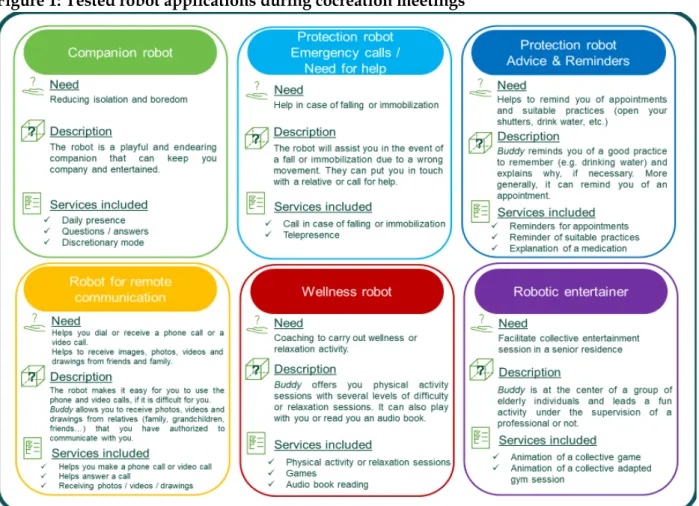
Members of a market research company facilitated the cocreation session with support from technical members who provided details on robotic functionalities and performed demonstrations on 6 applications (Figure 1): companion, emergency, advice and reminders, remote communication, well-being, and entertainment. Participants in the cocreation sessions were asked to state whether they would use the application and which improvements should be implemented.
Each cocreation session lasted approximately 4 hours and was recorded with camera recorders and then fully transcribed. Inputs for robot improvements were noted on a board and were viewable by all participants.
Figure 1: Tested robot applications during cocreation meetings
RESULTS AND IMPLICATIONS
The general levels of acceptance and perception of elderly individuals of the robot were generally positive. Most elderlies in both countries believed that Buddy could be useful to them, even when they were not familiar with this type of technology or when they had little experience with tablets and smartphones.
The analysis through the prism of the SOC model (Baltes and Baltes, 1990) highlights how robotic solutions may contributes to a better adjustment to the adverse effects of aging: the results
underlines that the robot's functions are primarily part of a compensation strategy1 and, secondarily, part of an optimization strategy2 (Table 1).
Table 1. Compensation and optimization strategies associated with robot functions by seniors Compensation strategies
Protection functions such as fall detection and warning a caregiver in case of danger help elderlies to compensate for the loss of the safety feeling linked to the increasing risk of falling, without presenting the stigmatizing nature of telepresence bracelets (the possession of the robot is, on the contrary, perceived as rewarding because of its novel, innovative and playful nature). The reminders functions contributes to compensate for memory failure.
Companion functions compensate for the loss of social ties by the companionship of a robot that talks, simulates emotions and arouses attachment. The pleasure of stroking the robot compensates for the loss of emotional ties associated with isolation. The robot's spontaneous activities (speaking, dancing, singing, expressing feelings: boredom, desire to sleep, joy...) help to compensate for the loss of social stimuli and reduce the feeling of emptiness and loneliness.
Communication functions (audio and video call) compensate for the decrease or absence of visits to family and grandchildren due to the loss of physical autonomy, especially in the case of significant geographical distance. Video calls and photo exchanges allow, in particular, elderly people to see grandchildren grow up and maintain the bond despite the distance.
Entertainment functions (games, learning...) seem to compensate for the loss of social stimulation. Buddy's audio book function compensates for book reading made difficult by poor vision and a source of boredom and even suffering for seniors who then lose a source of entertainment, stimulation and mental escape.
Optimization strategies
Communication functions (audio and video call) help to maintain social links at a distance. The physical coaching function (adapted physical activities) helps to maintain physical fitness and autonomy. Relaxation activities contribute to maintaining emotional well-being that is sometimes affected by anxiety caused by health problems or isolation.
While safety and reminder services were highly appreciated by elderly individuals, the main motivation for the robot’s adoption was the companionship function, as it was a central added value of the robot compared to those of other existing devices. The anthropomorphic functionalities of facial expressions of emotions and reactions to contacts (e.g., caresses) generated levels of
affection and attachment to the robot.
This point of view was generally shared among the caregivers, even if some of them believed that the robot would be more useful for elderly individuals from younger generations. A few caregivers thought that the robot could suppress the level of human contact.
Few individuals believed that they did not need a robotic solution, which they perceived to be a gadget or as useless.
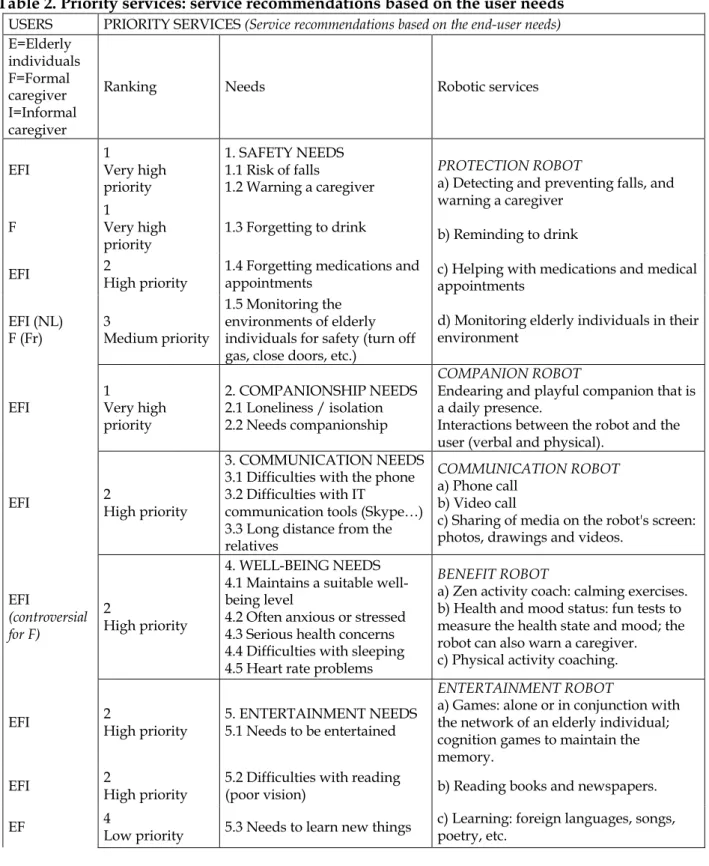
The needs analysis performed in France and in the Netherlands had the main goal of prioritizing the needs and services of the robots for the three types of respondents (elderly individuals and formal and informal caregivers). In addition to the security needs (risk of falls, calls to a caregiver in cases of emergency, and forgetting to drink during warm periods), which were considered vital, we could observe the importance of the companionship and communication needs (in particular to communicate with relatives in France) to alleviate loneliness (Table 2). The entertainment, physical and mental well-being needs were also important, but the meal needs were treated as secondary. The needs analysis helped in orienting the cocreation process to develop and test joint robotic services in both countries. The cross-country needs synthesis helped in fostering synergies and preventing the development of services that were too specific for each country.
As shown by the needs analysis and the resulting priority services (Table 2), the companionship functions through several interaction possibilities (verbal and emotional exchanges, reactions to
1 As people grow older, they are faced with the loss or decline of some of their abilities and resources (temporarily or permanently). Compensation consists of using alternative means to attain the objectives selected when the initial means are no longer available or effective (Freund and Baltes, 2002)
2 Optimization involves developing means in relation to goals (Freund and Baltes, 2002). It consists of acquiring, allocating, maintaining or improving the means and resources needed to attain the objectives selected while aging.
caresses, and movements), communication possibilities (audio and video calls, and sharing of photos and videos), and well-being possibilities (coaching to help regulate emotions and to perform physical activities) constituted the robot’s main benefits in comparison with the security functions already assumed by today’s teleassistance devices. With regards to the security aspect, the robot seemed to be complementary to traditional teleassistance solutions, in comparison to which it had two advantages. On the one hand, the robot was more easily accepted than were teleassistance products because the robot was perceived as less stigmatizing; on the other hand, the robot could have a complementary role because elderly individuals tended to forget to wear their teleassistance devices.
Table 2. Priority services: service recommendations based on the user needs
USERS PRIORITY SERVICES (Service recommendations based on the end-user needs)
E=Elderly individuals F=Formal caregiver I=Informal caregiver
Ranking Needs Robotic services
EFI 1 Very high
priority
1. SAFETY NEEDS 1.1 Risk of falls
1.2 Warning a caregiver
PROTECTION ROBOT
a) Detecting and preventing falls, and warning a caregiver
b) Reminding to drink
c) Helping with medications and medical appointments
d) Monitoring elderly individuals in their environment
F
1
Very high
priority 1.3 Forgetting to drink
EFI 2 High priority 1.4 Forgetting medications and appointments EFI (NL)
F (Fr) 3 Medium priority
1.5 Monitoring the environments of elderly individuals for safety (turn off gas, close doors, etc.)
EFI 1 Very high
priority
2. COMPANIONSHIP NEEDS 2.1 Loneliness / isolation 2.2 Needs companionship
COMPANION ROBOT
Endearing and playful companion that is a daily presence.
Interactions between the robot and the user (verbal and physical).
EFI 2 High priority
3. COMMUNICATION NEEDS 3.1 Difficulties with the phone 3.2 Difficulties with IT
communication tools (Skype…) 3.3 Long distance from the relatives
COMMUNICATION ROBOT
a) Phone call b) Video call
c) Sharing of media on the robot's screen: photos, drawings and videos.
EFI (controversial for F) 2 High priority 4. WELL-BEING NEEDS 4.1 Maintains a suitable well-being level
4.2 Often anxious or stressed 4.3 Serious health concerns 4.4 Difficulties with sleeping 4.5 Heart rate problems
BENEFIT ROBOT
a) Zen activity coach: calming exercises. b) Health and mood status: fun tests to measure the health state and mood; the robot can also warn a caregiver. c) Physical activity coaching.
EFI 2 High priority 5. ENTERTAINMENT NEEDS 5.1 Needs to be entertained
ENTERTAINMENT ROBOT
a) Games: alone or in conjunction with the network of an elderly individual; cognition games to maintain the memory.
EFI 2 High priority 5.2 Difficulties with reading (poor vision) b) Reading books and newspapers.
EF
(controversial for F)
4
Low priority 6. MEAL NEEDS MEAL COACH Menu ideas and nutritional advice.
NL = Netherlands; Fr= France
These preliminary results helped in guiding the evolution of Buddy’s programming to the
implementation of essential characteristics that Buddy would have in its future interactions with the end user (elderly individual or caregiver).
The needs analysis highlighted the importance of several parameters. There must be a quality voice interaction functionality (voice command). The ergonomics, specifically the screen size, must be adapted to the end user. The robot must be easy to use. The companionship, communication and entertainment possibilities (in comparison to rival robotic solutions) were emphasized.
Furthermore, the analysis revealed the pitfalls that the robotic solutions company had to avoid:
Buddy should not replace caregivers to preserve social contacts. The robot should be fully turned off
when not solicited and should not record data without the agreement of the user. The robot should not provide help with medication (medication reminders or instructions) as it could endanger the user who is elderly. Finally, the price should be affordable.
The cocreation approach made it possible to guide the technological development of the robot through the technical specifications resulting from successive needs analyses and cocreation meetings. As a prototype will be tested later during the experimentation phase among elderly individuals at home and at senior residences, this research constituted the first step in the development of solutions through the evolution of a robot and the services that could be used to help elderly individuals to age well. In comparison with other devices such as teleassistance
products or tablets, the companionship, communication, well-being and entertainment functions of associated services were rated as more important. Hence, as one of the participants stated during the final cocreation meeting: “Buddy helps us to age well” (Serge, 82 years old); This illustrates how the robot whose physical presence allows the deployment of adjustment strategies (optimization and compensation) and to achieve all or part of the goals associated with the Desired Aging Well concept. In particular, this research, by highlighting the importance of affective goals to optimize social resources and compensate for loneliness, reveals a complementary facet of the social
dimension of the Desired Aging Well concept which originally gauged the importance of assuming and social and family responsibilities while aging (Sengès and al., 2018).
This results in essential functionalities of the robot to be implemented to promote its adoption with a view to successful aging (Baltes and Baltes, 1990). In this perspective, our research argued in favor of the implementation of a geron-robot-servuction approach, marketing services management approach to be designed for the use of robots by elderly individuals with a loss of autonomy who wish to age well.
REFERENCES
Augusto J.C., Huch M., Kameas A., Maitland J., McCullagh P., Roberts J., Sixsmith, A. & Wichert R. (2012), Handbook of Ambient Assisted Living: Technology for Healthcare, Rehabilitation and Well-Being, Vol. 11, Amsterdam: IOS Press.
Baltes, Paul B. and Margret M. Baltes (1990), “Psychological perspectives on successful aging: The model of selective optimization with compensation,” in Successful aging: Perspectives from the behavioral sciences, ed. Paul B. Baltes, Margret M. Baltes , New York: Cambridge University Press, 1-34.
Broadbent E., Stafford R., & MacDonald B. (2009), Acceptance of healthcare robots for the older population: Review and future directions. International Journal of Social Robotics, 1, 4, 319. Čaić M., Odekerken-Schröder G. & Mahr D. (2018), Service robots: value creation and
co-destruction in elderly care networks, Journal of Service Management, 29, 2, pp.178-205.
Caradec V. (2001), Personnes âgées et objets technologiques: Une perspective en termes de logiques d'usage [Elderly and technological objects: A perspective in terms of use]. Revue française de sociologie, 117-148.
Freund A.M. & Baltes P.B. (2002), Life-management strategies of selection, optimization and
compensation: Measurement by self-report and construct validity. Journal of Personality and Social Psychology 82(4): 642-662.
Glende, S., Conrad, I., Krezdorn, L., Klemcke, S., & Krätzel, C. (2016). Increasing the acceptance of assistive robots for older people through marketing strategies based on stakeholder needs, International Journal of Social Robotics, 8(3), 355-369.
Henderson V., (1994), La nature des soins infirmiers [The Principles and Practice of Nursing], Paris: InterEditions.
Humphreys A. & Grayson K. (2008), The intersecting roles of consumer and producer: a critical perspective on co-production, co-creation and prosumption, Sociology Compass, 2, 3, 963-980. Peek S. T., Wouters E. J., van Hoof J., Luijkx K. G., Boeije H. R. & Vrijhoef H. J. (2014), Factors
influencing acceptance of technology for aging in place: a systematic review. International journal of medical informatics, 83, 4, 235-248.
Sengès E., Guiot D. & Chandon J-L. (2018), Desired Aging Well: Predictive validity for consumers aged 50–80, Recherche et Applications en Marketing (English edition).