Estimating pushrim temporal and kinetic measures using an
instrumented treadmill during wheelchair propulsion: A
concurrent validity study
Dany H Gagnon, Camille Jouval, Félix Chénier
This is the author’s copy of this article :
D. H. Gagnon, C. Jouval, and F. Chénier, “Estimating pushrim temporal and kinetic measures using an instrumented treadmill during wheelchair propulsion: A concurrent validity study,” Journal of biomechanics, vol. 49, no. 9, pp. 1976–1982, 2016.
Revised Manuscript submitted for initial review on March 8th 2016 Initial review received on April 20th, 2016 Revised manuscript submitted on April 23, 2016
Abstract
Using ground reaction forces recorded while propelling a manual wheelchair on an instrumented treadmill may represent a valuable alternative to using an instrumented pushrim to calculate temporal and kinetic parameters during propulsion. Sixteen manual wheelchair users propelled their wheelchair equipped with instrumented pushrims (i.e., SMARTWheel) on an instrumented dual-belt treadmill set a 1 m/s during a 1-minute period. Spatiotemporal (i.e., duration of the push and recovery phase) and kinetic measures (i.e. propulsive moments) were calculated for 20 consecutive strokes for each participant. Strong associations were confirmed between the treadmill and the instrumented pushrim for the mean duration of the push phase (r=40.98) and of the recovery phase (r=40.99). Good agreement between these two measurement instruments was also confirmed with mean differences of only 0.028 s for the push phase and 0.012 s for the recovery phase. Strong associations were confirmed between the instrumented wheelchair pushrim and treadmill for mean (r=40.97) and peak (r=40.96) propulsive moments. Good agreement between these two measurement instruments was also confirmed with mean differences of 0.50 Nm (mean moment) and 0.71 Nm (peak moment). The use of a dual-belt instrumented treadmill represents an alternative to characterizing temporal parameters and propulsive moments during manual wheelchair propulsion.
INTRODUCTION
Manual wheelchair propulsion is an alternative form of mobility that exposes upper limbs to an increased risk of secondary musculoskeletal (MSK) impairment (Subbarao et al., 1995). Comprehensive biomechanical studies of manual wheelchair propulsion have allowed clinicians and researchers to gain additional insight into the potential predictors and determinants of secondary MSK impairment linked to this functional task (Boninger et al., 2002; Collinger et al., 2008; Desroches et al., 2010; Finley et al., 2004;
Mercer et al., 2006; Morrow et al., 2010; Rozendaal et al., 2003). Moreover, these studies have accelerated the development of new wheelchair designs and features and the translation of knowledge into novel therapeutic approaches, all aiming to minimize secondary MSK impairment and optimize performance during manual wheelchair propulsion. These positive research effects are largely due to the development of instrumented pushrims that have transformed the field of wheelchair propulsion biomechanical research (Cooper, 2009).
The SmartWheel, the most commonly used and commercially available instrumented pushrim, measures the triaxial forces and moments exerted by the hand on the pushrim during the push phase of the propulsion cycle (Cooper, 2009). This instrumented pushrim also allows the duration and distance traveled to be calculated for each propulsion cycle. The SmartWheel can be easily attached to the axle of most wheelchairs and replaces the typical rear wheel. By using the SmartWheel, the position of the axle and other rear wheel characteristics (e.g., orientation and diameter) are not altered. However, the width of the wheelchair is slightly increased (~2 cm/wheel), the weight of the SmartWheel (~5 kg/wheel) is typically much heavier than the user’s regular rear wheel and the pressure/material of the tire and pushrim characteristics (e.g., thickness, shape, texture) may differ from those of the user’s regular rear wheel.
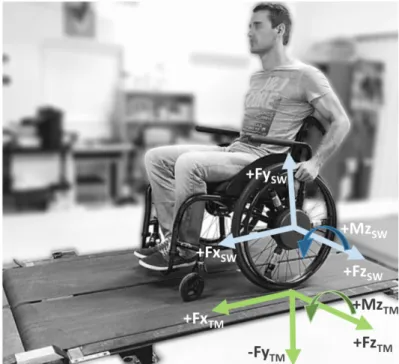
Instrumented dual-belt treadmills that measure ground reaction forces (GRF) have been increasingly used for gait analysis. In addition to the growing interest in gait analysis using dual-belt instrumented treadmills, manual wheelchair propulsion is now being assessed on these treadmills (Figure 1), especially since it closely duplicates overground propulsion (Kwarciak et al., 2011) and allows clinicians and researchers to control key testing conditions (Gagnon et al., 2015; Gagnon et al., 2014). Until now, there has been no report focusing on the GRFs recorded during manual wheelchair propulsion on an instrumented treadmill. It is plausible that these GRFs, especially those in the anteroposterior direction that are the largest force component during rectilinear displacement, relate well to the cyclic propulsive moments exerted at the rear wheel axle. The propulsive moments, generated via the tangential force applied at the pushrim, cause the horizontal accelerations of the wheelchair and its user during manual wheelchair propulsion. The use of the GRFs as a novel alternative for computing temporal and kinetic parameters during treadmill propulsion could simplify some assessment and training protocols and could help in overcoming some of the limitations related to the availability or use of an instrumented wheel (e.g., increased wheelchair width and weight) in a way up until now has not been possible.
This study assessed the concurrent validity of the temporal parameters (i.e., push and recovery phases) and the propulsive moments (Mz) measured directly by an
instrumented pushrim and indirectly using anteroposterior GRF (Fy) recorded with an instrumented split-belt treadmill during manual wheelchair propulsion among manual wheelchair users. It was hypothesized that the temporal parameters and the propulsive moments measured with the instrumented treadmill would be comparable (i.e., strong correlation and good agreement) to those measured with an instrumented pushrim (i.e., criterion measures) during manual wheelchair propulsion.
METHODS
Participants
Sixteen manual wheelchair users with sensorimotor impairments were recruited (Table I). All participants used a manual wheelchair as their primary mode of mobility for at least one year, had the ability to propel continuously for about one minute and had no medical contraindications to physical exercise. All participants reviewed and signed an informed consent form before initiating the study. The research ethics committee of the Centre for Interdisciplinary Research in Rehabilitation of Greater Montreal (CRIR-943-0314) approved this experimental protocol. Table 1 : List of Participants Participants Gender Age (years) Height (m) Mass (kg) Body Mass Index Time Since injury
(year) 1 M 36.5 1.70 63.6 22.0 7.0 2 M 61.4 1.74 64.9 21.4 39.0 3 M 23.6 1.81 48.6 14.8 23.6 4 M 31.3 1.85 71.2 20.8 13.5 5 M 34.8 1.78 67.6 21.3 10.8 6 F 25.0 1.65 66.0 24.2 25.0 7 M 60.7 1.88 100.0 29.2 5.7 8 M 40.1 1.81 86.0 26.3 9.7 9 M 57.9 1.73 83.5 27.9 15.8 10 F 19.1 1.45 45.5 21.6 19.1 11 M 35.5 1.92 82.0 22.2 10.1 12 M 46.6 1.86 71.9 20.78 13.0 13 M 28.3 1.77 54 17.23 1.1 14 M 31.3 1.85 75.2 21.97 13.5 15 M 62.6 1.74 79.3 26.19 0.6 16 F 46.5 1.67 83.9 30.08 1.0 Mean (SD) 13M/3F 40.1 (14.3) 1.76 (0.11) 71.45 (14.52) 23.00 (4.12) 13.0 (10.1) Experimental task
Following a 5-minute familiarization period, participants propelled their own wheelchair on an instrumented dual-belt treadmill set at a predetermined steady speed of 1 m/s during a 1-minute period. This speed was selected based on self-selected and comfortable speeds reported during propulsion on a stationary ergometer (Slowik et al., 2015a) or a motorized treadmill (Gagnon et al., 2015; Gagnon et al., 2014). No specific propulsion pattern or frequency was imposed during this experimental task.
Measurement instruments
Instrumented pushrim
Each participant’s wheelchair was equipped bilaterally with wheels with urethane tires to which an instrumented pushrim was attached (SMARTWheel™; Three River Holdings, Mesa, Az, USA). Each instrumented pushrim recorded the triaxial force and moment components applied at the pushrim at 240 Hz using the research mode of the SMARTWheel™ datat acquisition software. The propulsive moment (MzSW) was selected
as the instrumented pushrim main outcome since it contributes directly to the propulsion of the wheelchair.
Instrumented treadmill
The treadmill had a length of 1.85 m and a width of 0.84 m with two separate force platforms embedded underneath a right and a left rubber band (Bertec Corporation; Columbus, Ohio). Both the right front and rear wheels of each participant’s wheelchair rested over the right belt (i.e., right force platform) when performing the experimental tasks and vice-versa for the left front and rear wheels. Each force platform recorded the triaxial components of the GRFs and moments at 600 Hz. The propulsive moment measured by the instrumented treadmill (MzTM), whose calculation is described below in
the Data Processing section, was selected as the instrumented treadmill main outcome.
Synchronization between the instrumented pushrim and treadmill
Before the experimental task, a synchronization event was generated by knocking the instrumented pushrim with a rubber hammer equipped with an accelerometer synchronized with the instrumented treadmill. The instrumented pushrim was synchronized with the instrumented treadmill by matching the instrumented pushrim peak force generated by the hammer with the recorded deceleration peak of the hammer.
Figure 1. Overview of a manual wheelchair equipped with the instrumented pushrim (i.e., SMARTWheel) while propelling on the instrumented dual-belt treadmill during the experiment and of the reference frames for the pushrim (SW) and the treadmill (TM).
Data processing
Instrumented wheel
The propulsive moment was obtained directly from the SMARTWheel® data acquisition
program. All kinetic data obtained via the SMARTWheel® data acquisition program were filtered using the built-in signal processing 32-tap finite impulse response (FIR) low pass digital filter with a cut-off frequency of 20 Hz. No additional post-processing signal filtering was applied. Instrumented dual-belt treadmill The propulsive moment (MzTM) was calculated based on the anteroposterior GRF (FxTM). First, the FxTM was expressed as a function of MzTM: FxTM = [MzTM / rR] - Fdrag (equation 1)
where rR is the radius of the wheel and Fdrag is the rolling resistance force to be
computed. During a manual wheelchair propulsion condition similar to the one tested in the present study, the recovery phase is expected to account for more than 50% of the duration of the propulsion cycle (Boninger et al., 2002). Consequently, the median value of FxTM can be used as the Fdrag during the recovery phase. As MzTM is null during the
recovery phase, then Fdrag can be estimated by:
Fdrag = - median (FxTM) (equation 2)
Last, combining equations 1 and 2 yield the following: MzTM = rR (FxTM – median (FxTM)) (equation 3) The MzTM was calculated separately for the right and left belts with equation 3 based on raw instrumented treadmill data, then filtered at 120 Hz using a low-pass second-order Butterworth filter before being down-sampled to 240 Hz (i.e., same as instrumented wheel recording frequency). Afterwards, event markers were automatically positioned along the recorded Mzsw and computed MzTM to define the successive push and recovery
phases. Thresholds of 2.3 Nm (representing 15% of the group mean peak propulsive moment) and 0.5 Nm (representing 3% of the group mean peak propulsive moment) were used to define the start and end of each push phase, respectively (Figure 2). Although slightly conservative, these thresholds values compare well to those previously reported (Boninger et al., 1997; Gil-Agudo et al., 2010; Kwarciak et al., 2009; Siyou Fotso et al., 2015; Slowik et al., 2015b) and completely prevented false push detection and facilitated the comparison between MzTM and MzSW. These event markers
allowed the absolute duration of the push and recovery phases (i.e., propulsion cycle) and the mean and peak propulsive moments for both MzTM and MzSW to be calculated
during each push phase. The first five propulsion cycles were excluded from analysis (i.e., adaptation period), and participant-specific mean and maximum values were computed using the next 20 propulsion cycles recorded on the non-dominant side. Thereafter, group mean and maximum values were calculated.
Statistical analysis
Descriptive statistics were calculated for all temporal and kinetics measures. Pearson product-moment correlation coefficients (r values) were calculated to determine the association between the instrumented pushrim and treadmill for the temporal (i.e.,
mean duration of the push and recovery phases) and kinetic outcomes (i.e., mean propulsive moment). The r values obtained were interpreted according to the guidelines proposed by Altman (Bland and Altman, 1986): poor (r ≤ 0.20), fair (r = 0.21–0.40), moderate (r = 0.41–0.60), good (r = 0.61–0.80) and very good association (r = 0.81– 1.00). Bland & Altman diagrams were generated to determine absolute agreement, along with the 95% limits of agreement (mean difference ± 1.96 standard deviation of the difference), between the instrumented pushrim and treadmill for the temporal and kinetic outcomes (Bland and Altman, 1986; Hol et al., 2007). All statistics were computed using Matlab.
Figure 2. A sample of the propulsive moments measured by the instrumented pushrim (A: grey curve) and treadmill (B: black curve) during consecutive propulsion cycles. Grey circles represent the beginning and the end of each push phase automatically identified with their thresholds.
RESULTS
Temporal parameters
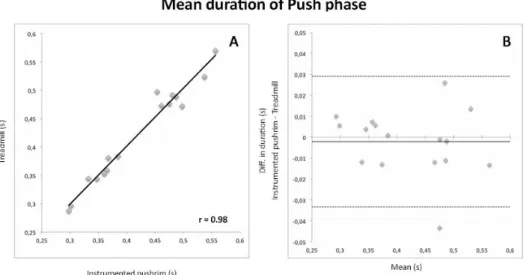
The temporal parameters are summarized in Table II and Figure 3. Small differences in the duration of the propulsion cycle (0.29%), push phase (2.38%), and recovery phase (1.59%) were found between the instrumented pushrim and treadmill. A very good association between the instrumented pushrim and treadmill was confirmed for the propulsion cycle (r=0.99), the push phase mean duration (r=0.98) and the recovery phase mean duration (r=0.99). A very good agreement between both instruments was also found with mean absolute differences of only 0.004 s (propulsion cycle), 0.028 s (push phase) and 0.012 s (recovery phase).
Kinetic parameters
The kinetic parameters are summarized in Table II and Figure 4. Small differences in the
mean (7.34%) and peak (7.50%) propulsive moments were found between the
instrumented pushrim and treadmill. A very good association between the instrumented pushrim and treadmill was confirmed for the mean (r=0.97) and peak (r=0.96) propulsive moments. A good agreement between both instruments was also found with mean absolute differences of only 0.50 Nm (mean moment) and 0.71 Nm (peak moment).
Figure 3. Correlation scatter graph and line of best fit between both measurement instruments for the mean push time (A), mean recovery time (C) and mean propulsion cycle time (E); Bland & Altman plot of the difference between the instrumented pushrim and treadmill for the mean push time (B), mean recovery time (D) and mean propulsion cycle time (F).
Figure 4. Correlation scatter graph and line of best fit between both measurement instruments for the mean propulsive moment (A) and peak propulsive moment (C); Bland & Altman plot of the difference between the instrumented wheel and instrumented treadmill for the mean propulsive moment (B) and the peak propulsive moment (D).
DISCUSSION
For the temporal parameters, the results strongly support the hypothesis since excellent association and agreement between the two measurement instruments were confirmed. Despite these excellent results, the outcomes computed during the push phase revealed a slightly higher absolute difference than those computed during the recovery phase. This difference may be explained in part by the fact that the construct of the propulsivemoments is slightly different between the instrumented pushrim (direct measure) and treadmill (indirect measures) as will be discussed in the next paragraph on kinetic parameters. Nonetheless, the position of the temporal event markers determined with fixed propulsive moment threshold values may differ slightly between the two measurement instruments and partly explain the very small temporal differences reported in the present study.
For the kinetic parameters, the results (i.e., mean and peak propulsive moments) also strongly support the hypothesis of the present study since very good association and agreement between the two measurement instruments were also confirmed, although they were slightly lower than those reported for the temporal parameters. These differences between the instrumented pushrim and treadmill outcomes may be explained by various factors. Among those, one needs to consider that the kinetic parameters recorded by the instrumented pushrim are solely generated by the forces and moments directly applied by the hand on the pushrim (1), whereas the kinetic parameters recorded on the treadmill are influenced by the manual wheelchair, its user and the interactions between both. For example, the acceleration of the head-trunk-upper limb segment that represents 60% of the body mass during manual wheelchair propulsion (i.e., inertial effects) most likely affects the kinetic outcomes obtained with the instrumented treadmill. Other factors potentially affecting the propulsive moments such as rolling resistance (Sauret et al., 2013), influenced in great part by the combined weight of the wheelchair and the wheelchair user, may also warrant attention. Lastly, when calculating the propulsive moments using equation 3, rolling resistance (Fdrag) is
defined as a constant although rolling resistance may vary in a range of about ±25 % from its nominal value during propulsion (Sauret et al., 2013). This variation of the rolling resistance remains difficult to model, particularly during the push phase, and motivates the use of a constant value in the present study (i.e., Fdrag = - median (FxTM)).
This possible source of error may explain part of the small difference found for the mean (7.34%) and peak (7.50%) propulsion moments between the instrumented pushrim and treadmill, with slightly lower values found during treadmill propulsion for the majority of participants. Temporal and kinetic outcomes measured with an instrumented treadmill represent an alternative whenever instrumented wheels are not available, cannot be used easily in a specific clinical or research context or are simply not necessary for the purpose of the clinical or research assessment being conducted. Hence, the use of an instrumented treadmill represents a potential alternative to characterizing manual wheelchair propulsion (i.e., temporal parameters and propulsion moment) while also optimizing external validity as manual wheelchair users can propel with their own rear wheels. However, a major drawback with an instrumented treadmill at the present time is that the total force applied on the pushrim and the mechanical efficiency, defined either as the mechanical effective fraction of force (MEF= FtangentialSW2/ FtotalSW2) (Boninger et al.,
2002) or fraction of effective force measure (FEF= FtangentialSW/ FtotalSW) (Dallmeijer et al.,
1998), cannot be extracted. Future research should attempt to determine the total force or moment applied on the pushrim, along with an indicator of mechanical efficiency, during wheelchair propulsion on an instrumented treadmill. Future research should also attempt to investigate different wheelchair propulsion paradigms (e.g., lower or higher speeds, various inclination angles).
Study limitations
Since the present study included a relatively small sample size (N=16) of experienced manual wheelchair users and only assessed level-ground manual wheelchair propulsion at a single velocity (1 m/s), results should be interpreted cautiously (Arnet et al., 2012). Since manual wheelchair characteristics (e.g., seat and backrest angles, axle position) were not similar across participants, clinicians and researchers may also need to account for this when interpreting the kinematic outcomes as they may be affected by body weight distribution and wheelchair propulsion dynamics.
CONCLUSION
Excellent to very good concurrent validity and agreement were confirmed between the instrumented wheels and treadmill for the temporal and kinetic outcomes during manual wheelchair propulsion on an instrumented dual-belt treadmill, respectively. The use of a dual-belt instrumented treadmill represents a potential alternative to characterize the duration of the propulsion cycles (i.e., push and recovery phases) and the propulsion moments during manual wheelchair propulsion.
Acknowledgements
The authors would like to thank Philippe Gourdou (Ing) and Cindy Gauthier (PT) for their assistance in recruiting participants and conducting the laboratory assessments. Dany Gagnon co-chairs the Initiative for the Development of New Technologies and Practices in Rehabilitation (INSPIRE) funded by the LRH Foundation. He is a member of the Multidisciplinary SensoriMotor Rehabilitation Research Team supported by the Canadian Institute of Health Research (CIHR) and of the Quebec-Ontario Spinal Cord Injury Mobility (SCI-MOB) Research Group funded by the Quebec Rehabilitation Research Network (REPAR) and the Ontario NeuroTrauma Foundation (ONF). Félix Chénier was funded by the Natural Sciences and Engineering Research Council of Canada (NSERC).
Conflict of interest statement
References
Arnet, U., van Drongelen, S., Veeger, D.H., van der Woude, L.H., 2012. Are the force characteristics of synchronous handcycling affected by speed and the method to impose power? Medical engineering & physics 34, 78-84.
Bland, J.M., Altman, D.G., 1986. Statistical methods for assessing agreement between two methods of clinical measurement. Lancet 1, 307-310.
Boninger, M.L., Cooper, R.A., Robertson, R.N., Rudy, T.E., 1997. Wrist biomechanics during two speeds of wheelchair propulsion: an analysis using a local coordinate system. Archives of physical medicine and rehabilitation 78, 364-372.
Boninger, M.L., Souza, A.L., Cooper, R.A., Fitzgerald, S.G., Koontz, A.M., Fay, B.T., 2002. Propulsion patterns and pushrim biomechanics in manual wheelchair propulsion. Archives of physical medicine and rehabilitation 83, 718-723.
Collinger, J.L., Boninger, M.L., Koontz, A.M., Price, R., Sisto, S.A., Tolerico, M.L., Cooper, R.A., 2008. Shoulder biomechanics during the push phase of wheelchair propulsion: a multisite study of persons with paraplegia. Archives of physical medicine and rehabilitation 89, 667-676.
Cooper, R.A., 2009. SMARTWheel: From concept to clinical practice. Prosthetics and orthotics international 33, 198-209.
Dallmeijer, A.J., van der Woude, L.H., Veeger, H.E., Hollander, A.P., 1998. Effectiveness of force application in manual wheelchair propulsion in persons with spinal cord injuries. American journal of physical medicine & rehabilitation / Association of Academic Physiatrists 77, 213-221.
Desroches, G., Dumas, R., Pradon, D., Vaslin, P., Lepoutre, F.X., Cheze, L., 2010. Upper limb joint dynamics during manual wheelchair propulsion. Clinical biomechanics 25, 299-306.
Finley, M.A., Rasch, E.K., Keyser, R.E., Rodgers, M.M., 2004. The biomechanics of wheelchair propulsion in individuals with and without upper-limb impairment. Journal of rehabilitation research and development 41, 385-395.
Gagnon, D., Babineau, A.C., Champagne, A., Desroches, G., Aissaoui, R., 2015. Trunk and shoulder kinematic and kinetic and electromyographic adaptations to slope increase during motorized treadmill propulsion among manual wheelchair users with a spinal cord injury. BioMed research international 2015, 636319.
Gagnon, D.H., Babineau, A.C., Champagne, A., Desroches, G., Aissaoui, R., 2014. Pushrim biomechanical changes with progressive increases in slope during motorized treadmill manual wheelchair propulsion in individuals with spinal cord injury. Journal of rehabilitation research and development 51, 789-802.
Gil-Agudo, A., Del Ama-Espinosa, A., Perez-Rizo, E., Perez-Nombela, S., Crespo-Ruiz, B., 2010. Shoulder joint kinetics during wheelchair propulsion on a treadmill at two different speeds in spinal cord injury patients. Spinal cord 48, 290-296.
Hol, A.T., Eng, J.J., Miller, W.C., Sproule, S., Krassioukov, A.V., 2007. Reliability and validity of the six-minute arm test for the evaluation of cardiovascular fitness in people with spinal cord injury. Archives of physical medicine and rehabilitation 88, 489-495.
Kwarciak, A.M., Sisto, S.A., Yarossi, M., Price, R., Komaroff, E., Boninger, M.L., 2009. Redefining the manual wheelchair stroke cycle: identification and impact of nonpropulsive pushrim contact. Archives of physical medicine and rehabilitation 90, 20-26.
Kwarciak, A.M., Turner, J.T., Guo, L., Richter, W.M., 2011. Comparing handrim biomechanics for treadmill and overground wheelchair propulsion. Spinal cord 49, 457-462.
Mercer, J.L., Boninger, M., Koontz, A., Ren, D., Dyson-Hudson, T., Cooper, R., 2006. Shoulder joint kinetics and pathology in manual wheelchair users. Clinical biomechanics (Bristol, Avon) 21, 781-789.
Morrow, M.M., Kaufman, K.R., An, K.N., 2010. Shoulder model validation and joint contact forces during wheelchair activities. Journal of biomechanics 43, 2487-2492.
Rozendaal, L.A., Veeger, H.E., van der Woude, L.H., 2003. The push force pattern in manual wheelchair propulsion as a balance between cost and effect. Journal of biomechanics 36, 239-247.
Sauret, C., Vaslin, P., Lavaste, F., de Saint Remy, N., Cid, M., 2013. Effects of user's actions on rolling resistance and wheelchair stability during handrim wheelchair propulsion in the field. Medical engineering & physics 35, 289-297.
Siyou Fotso, V.S., Nguifo, E.M., Vaslin, P., 2015. Symbolic representation of propulsion cycles in manual wheelchair locomotion. Computer methods in biomechanics and biomedical engineering, 1-2. Slowik, J.S., Requejo, P.S., Mulroy, S.J., Neptune, R.R., 2015a. The influence of speed and grade on wheelchair propulsion hand pattern. Clinical biomechanics (Bristol, Avon) 30, 927-932. Slowik, J.S., Requejo, P.S., Mulroy, S.J., Neptune, R.R., 2015b. The influence of speed and grade on wheelchair propulsion hand pattern. Clinical biomechanics.
Subbarao, J.V., Klopfstein, J., Turpin, R., 1995. Prevalence and impact of wrist and shoulder pain in patients with spinal cord injury. The journal of spinal cord medicine 18, 9-13.