Cahiers de la Chaire Santé
Power of incentives with
motivated agents in public
organizations
Auteurs: Michel Mougeot, Florence Naegelen
Power of incentives with motivated agents in
public organizations
Michel Mougeot* and Florence Naegelen**
*University of Franche-Comte, CRESE, UFR SJEPG,
Avenue de l’Observatoire, 25030, Besancon Cedex, France
University of Franche-Comte, CRESE, UFR SJEPG,
Avenue de l’Observatoire, 25030, Besancon Cedex, France
June 10, 2010
Abstract
Public service motivation is often considered as an argument for low-powered incentive schemes in the public sector. In this paper, we character-ize the optimal contract between a public regulator and an altruistic agent according to the degree of public service motivation, when the type of the public service consumer is privately observed. We show that the requested e¤ort is non decreasing with and can be higher than the …rst best level. Moreover we show that the agent is put on a high powered contract when some customers are served but that this contract is associated with di¤er-ent types of consumers according to : In contrast, the agent is never put on a cost-plus contract. Finally, we show that the …rst best allocation can be achieved under budget balance for a degree of altruism higher than a threshold that we characterize.
JEL classi…cation: D2, D8, L3.
Keywords: altruism; power of incentive schemes; regulation; counter-vailing incentives; public organization.
Acknowledgement 1. We gratefully acknowledge the …nancial support of the Risk Foundation (Health, Risk and Insurance, Allianz). We thank two anonymous referees and an associate editor for helpful comments. The usual disclaimer applies.
1. Introduction
Optimal incentive structures in the public sector generally di¤er from those in the private sector. Economic theory suggests many arguments against the use of high-powered incentive schemes in public organizations. Multi-tasking, multi-ple principals, lack of competition, measurement problems, team-based rewards and intrinsic motivation involve that low-powered incentive mechanisms may be appropriate in such organizations. Among these arguments, intrinsic motivation plays a key role. People who choose to work in public-service delivery have pref-erences di¤erent from those who choose to work in the private sector (see Grout and Stevens (2003)). Public service motivated agents care about their output and share to some extent the same objective function as the principal. For instance, they are motivated to serve the interests of the state because they share some ide-alistic or ethical purpose served by the government1. Hence the provision of public
services is often viewed as "mission oriented" (Wilson (1989)). When the goals of the agent are aligned with the principal’s mission, civil servants’social concern can motivate their performance without the need of …nancial incentives. Thus, Besley and Ghatak ((2003), (2005)) consider that the public sector incentives are likely to be more low-powered than in the private sector.
When the agent gets disutility from the e¤ort he exerts and utility from the task, there is an altruistic e¤ect. This e¤ect is well-known in health economics. According to the Hippocratic Oath, physicians have to do everything possible to care patients. Thus, a great number of papers on the design of optimal payment systems for health services2 assume that hospitals are partially benevolent and
trade o¤ their bene…t and the bene…t of their patients. This issue is particularly important when the hospital is paid a …xed price per patient treated when the …xed price for a given DRG3 is calculated on the basis of the average cost incurred
for that DRG nationally. If the hospital can observe patients’ severity, there is a scope for dumping or cream-skimming when a hospital with a low degree of benevolence faces an excessively costly patient. In contrast, hospitals with a high degree of benevolence may invest in an e¤ort level greater than the socially optimal
1See Dixit (2003). Le Grand (2003) reviews the empirical evidence concerning the existence
of altruistic motivations in individuals working in the public sector. See also the references on pro-social motivation given by Francois and Vlassopoulos (2008).
2Chalkley and Malcomson (1998), Ellis and McGuire (1986), Ma (2004), Ma and McGuire
(1997).
3Under the Diagnosis related group (DRG) system, patients are classi…ed according to their
e¤ort when treating a high cost patient and then may incur some …nancial losses. The same problem can arise between a doctor and a hospital administration.
This phenomenon arises in situations in which civil servants are concerned about the quality of the public sector’s output and consequently are willing to donate labour. It can appear in many cases when public agencies or not-for-pro…t organizations are involved in the provision of public services directly to the public (such as health care services, education, job training or social services) and when the type of the bene…ciaries of these services is privately observed by the supplier. Altruistic agents may care about the sickest patients in hospitals, about the least well-o¤ in job training organizations or the least able pupils in schools. However, these workers can reduce the performance of their agency. For instance, hospitals may incur some …nancial losses or get a bad recovery record. In the same way, a job training center can realize a bad placement record and a school a poor average performance in standardized tests4. Hence the balance
of the self-interested and altruistic motivations of the civil servants appears as a special feature that could explain that incentives are generally weaker in the public sector. This is the argument developed by Francois (2000) that shows that there is no need for high-powered incentives schemes when the agents care about the level of services supplied by their organization, provided there is no residual claimant.
Assume that the cost of provision of services to a consumer is increasing with (for instance the patient’s severity or the pupil’s unability) and decreasing with the e¤ort level (as in the standard La¤ont and Tirole’s model (1986)) and that a principal can neither observe nor monitor the e¤ort level. This principal can be the government, a public regulator or a government agency. Under this asymmetric information, a trade-o¤ between e¢ ciency and rent extraction arises when the principal designs a contract. If the agent is self interested, his incentive is always to overstate his cost i.e., the type of the consumer. For instance, a doctor can say to the hospital administration that it is very costly to treat a patient and that a high compensation is needed. To obtain this compensation, he has an incentive to overstate the severity. To reduce the rent of the agent, the principal must reduce the e¤ort level requested from the agent below the …rst best level for all values of except the lowest. If the agent cares about the utility
4According to Heckmann et al. (1996), though job training centers receive a reward based
on the employment level and wage rates attained by graduates of the JTPA programme, people with lower expected gains are more likely to be accepted. This suggests preferences of the job training agency for helping the least employable applicants.
V ( ) of the consumers, with V ( ) increasing in , the trade-o¤ may be reversed and the principal faces a countervailing incentives problem5. Indeed, the agent
may wish to understate his private information when is high to convince the principal that the altruistic component V ( ) of his utility function is really low and that greater compensation is needed. In our previous example, the doctor may wish to say to the hospital administration that he gets a low altruistic utility when treating a patient. So he has to be paid a lot to do it. To mitigate this incentive to understate ; the principal should request an e¤ort level higher than the …rst best level for all except the highest.
When countervailing incentives exist, the agent’s incentive to overstate (resp. understate) dominates his incentive to understate (resp. overstate) for any realizations for a low (resp. high) degree of altruism, being the weight attached to V ( ) in the agent’s utility function. For some intermediate degree of altruism, the dominant incentive will depend on the realization of : In this case, which of the two countervailing incentives dominates determine the nature of the distortions and the form of the contract depends on the shape of the utility function. These insights hold in the absence of budget constraint. When the agent has to balance his expected budget, the optimal contract is modi…ed because agents trade o¤ their expected pro…t and their utility di¤erently. When the degree of altruism is low, the principal must leave an expected monetary rent to the agent if she wants all consumers to be served. When this degree is high, the budget constraint is binding and the agent agrees losses on high cost consumers being o¤set by gains on low cost consumers as long as the budget is balanced.
In this paper, we analyze cost reduction incentives when agents are public ser-vice motivated. In the absence of budget constraint, we completely characterize the optimal fully separating contract that a utilitarian principal can design ac-cording to the level of altruism of the agent when the social cost of public funds is taken into account. We show how public service motivation does not change the nature of optimal contracts but involves special features. Hence, the agent is put on a high-powered incentive scheme for di¤erent types of consumer according to his degree of altruism. Moreover, we show how the requested e¤ort is non decreas-ing with the degree of public service motivation and that total payment can be negative. Then we consider the in‡uence of an expected budget balance constraint. We show that the principal can use this instrument to achieve the …rst best level of e¤ort for any degree of altruism greater than a cut-o¤ value that we characterize.
5On countervaining incentives, see Lewis and Sappington (1991), Maggi and Rodriguez-Clare
Thus, whereas the optimal contract is fully separating in the absence of budget constraint, it involves pooling when the agent must break even. Furthermore, we show that the expected welfare is always higher under budget balance. Hence expected budget balance is a means to increase social welfare whatever the value of and to achieve the …rst best allocation when agents’intrinsic motivation is su¢ ciently high.
The paper is organized as follows. The model is presented in section 2. The optimal mechanism is characterized in section 3 in the absence of budget constraint and in section 4 when the agent balances his expected budget. Section 5 draws some conclusions.
2. The model
We consider an agent ( a civil servant for instance) that provides services to the public. We assume that the cost of this service depends on the type of the consumer and on the cost-reduction e¤ort e exerted by the agent. When the agent provides the service to a consumer (or a bene…ciary of the public service) ; his cost is C( ; e) = c + e; where c is a common knowledge cost common to all consumers. When the agent exerts e¤ort level e; he incurs a disutility '(e) in monetary unit, increasing with e¤ort at an increasing rate. To obtain closed-form solutions6, we assume that '(e) = e2d2; where d; d > 0; is a measure of moral hazard.
We assume that the agent provides services to a whole population of bene…ciaries: He can observe privately the type of each consumer, but the principal only knows its distribution function. The principal’s uncertainty about is represented by a common knowledge distribution function F ( ) and an associated density function f ( ) > 0 on a support ; ; with F ( )f ( ) non decreasing in and 1 F ( )f ( ) non in-creasing in : If the realized cost is observable ex post, the principal can reimburse C and compensate the agent by an additional payment t: Then the pro…t of the agent when serving a consumer with a cost-reduction e¤ort e is (e; t) = t '(e): Let us consider that the principal attaches a social bene…t V ( ) to having services provided to consumer ; with V0( ) > 0 and V00( ) 0: If the agent is public
service motivated, he partially shares the same bene…t function as the principal.
6However, our insights carry over to more general settings with an increasing and convex
Then, his utility function can be written
U ( ; e; t) = t '(e) + V ( ) (1) where ; 2 [0; 1] ; represents the degree to which the agent takes the consumer’s interest (or the social goal) V ( ) into account. In the following, we assume that is common knowledge. However, the altruistic component of the utility function is uncertain for the principal who does not observe :
The principal is assumed to be utilitarian and to take the social cost of public funds ; caused by distortionary taxation, into account, with > 0: As the agent is altruistic, there is an issue about how to treat V ( ) in the social welfare W . In our context, including V ( ) in W would involve double counting. As it is noted by Chalkley and Malcomson (1998), benevolence represents a desire to do what is in the social interest and should have no role in determining what the social interest is. Then the altruistic component should be excluded to avoid double counting7. Under complete information, when a consumer is served,
social welfare can then be written, 8
W ( ) = V ( ) (1 + )(c + e + t) + = (1 + )V ( ) (1 + )(c + e + e
2
2d) U In this case, the …rst best allocation is such that e = d and U ( ) = 0; 8 :
Under incomplete information, the principal has to design a contract to maxi-mize expected welfare subject to the constraints imposed by its lack of information about : According to the revelation principle, we look for a direct revealing mech-anism. Let us …rstly consider the realizable mechanisms.
2.1. Realizable mechanisms
Assume that the principal designs a contract ft( 0); e( 0)g or equivalently ft( 0); C( 0)g where t( 0)is the net transfer received by the agent, e( 0)the e¤ort level and C( 0)
7See also Hammond (1987). Note that this approach di¤ers from the theory of charitable
giving which considers charity as a privately provided public goods. For instance Andreoni (1989, 1990) considers that an agent can be either altruistic (his utility depends on the level of public good) or impurely altruistic (his utility depends on the act of giving per se). In the …rst case, double counting must be avoided while there is no double counting problem in the second case (the "warm glow" case). In our model, we are not in a public good context in which other agents could produce the service.
8In the following, we assume that V ( ) is high enough relative to the cost for all so that it
the cost level that the agent must realize when he announces 0: Three types of constraints must be considered.
i) Participation constraints (or no dumping constraints) that ensure that all consumers are served:
U ( ; e( ); t( )) = t( ) '(e( )) + V ( ) 0 8 (2) when the reservation utility is equal to zero.
ii) Incentive compatibility constraints that ensure that the agent reveals the type of the consumer:
=argmax
0
t( 0) '(e( 0= )) + V ( ) 8 ; 8 0 (3) with e( 0= ) = 0 + e( 0).
Standard arguments imply that the necessary and su¢ cient conditions for incentive compatibility are given by the local optimality condition:
:
U ( ) = '0(e( )) + V0( ) = e( )=d + V0( ) (4) and the monotonicity condition
:
e( ) 1 (5)
iii) Budget balance constraint
As a public service motivated agent is willing to donate labour, he can accept to make losses when serving a high cost consumer. For instance, organizations pro-ducing public services may have endowments and then wealth they are prepared to commit to the project. When they are highly altruistic, they can accept losses because mission’s arguments and monetary rewards are substitutes. In contrast, a self interested agent can accept to serve all consumers only if he gets a positive pro…t on each consumer. As a whole population of consumers is served, the principal can impose that the agent’s expected revenue must cover his expected cost, including managerial compensation t: Taking the de…nition of the agent’s utility into account, the expected budget constraint can be written
Z
(U ( ) V ( ))f ( )d( ) 0 (6) When the agent is self interested, imposing a budget constraint is not socially costly because he does not produce when he does not break even. When the agent
is highly altruistic, he is willing to produce even when his revenue does not cover his cost. Then the shadow price of the budget constraint increases with the degree of altruism : Consequently, budget balance can change the nature of the optimal contract.
2.2. Public service motivation and rent extraction-e¢ ciency trade-o¤ Assume …rstly that there is no budget constraint. To understand the nature of the optimal contract between the principal and the agent, we can consider how the rent extraction-e¢ ciency trade-o¤ changes when the degree of public service motivation changes. According to the local incentive compatibility condition (4), the information rent changes with and its slope depends on the degree of altruism because U0( ) can be positive or negative for any or change sign on
; . If we assume = 0; the agent has an incentive to overstate the type of the consumer for all . To reduce the informational rent of the agent, the principal must distort the level of e¤ort downward for all except . In this case, the e¤ort level requested from the agent is the standard La¤ont and Tirole’s level of e¤ort eL( ) = d 1+ F ( )f ( ) and the informational rent is decreasing in : When
> 0; the agent has also an incentive to understate his private information to convince the principal that the altruistic component of its utility function is low so as to obtain a greater payment. When the dominating incentive for all is to understate ; i.e., when the degree of public service motivation is su¢ ciently high, the principal must distort upward the level of e¤ort for all except to reduce informational rents. In this case, straighforward arguments show that the optimal e¤ort level requested from the agent is eH( ) = d 1+ F ( ) 1f ( ) and that
the informational rent is increasing in :
For an intermediate level of public service motivation, U0( ) may change sign.
Then the principal faces "countervailing incentives" and the analysis of the optimal regulation of an altruistic agent is close to the analysis of the optimal contract in the case of adverse selection with a type-dependent reservation utility (Maggi and Rodriguez-Clare (1995), Jullien (2000)). As V ( ) is concave, two cases are possible. Whereas a non-degenerate interval of types earn zero rent when V ( ) is weakly concave, the rent can be equal to zero for and when V ( ) is highly concave, but the allocation of e¤ort is fully separating in both cases.
As an altruistic agent may obtain a non negative utility but either a monetary loss or a monetary gain according to the type of the consumer, the nature of the optimal contract changes when the expected budget constraint is taken into
account. Then we must consider the optimal mechanism in both cases.
3. Optimal mechanism without budget constraint
To …nd the optimal mechanism, we can solve the relaxed program in which (5) is ignored and check ex post that it is satis…ed. In solving this relaxed program, the usual procedure involves replacing (3) with (4) assuming that (2) binds only at one extreme and converting the program to one of pointwise maximization. However, as shown by Maggi and Rodriguez-Clare (1995), the solution given by this procedure can violate the participation constraint because the sign of U0( )
may change when the principal faces countervailing incentives.
Introducing (2) explicitly into the problem involves using control theory tools. However, a Hamiltonian cannot be used when comparing expected welfare. As we want to focus on the in‡uence of public service motivation on the optimal contract, we base our analysis on pointwise maximization after taking the results of Maggi and Rodriguez-Clare (1995) and Jullien (2000) into account. When V0( ) is
su¢ ciently low, the agent has always an incentive to overstate : In the contrary, when V0( )is su¢ ciently high, the agent has always an incentive to understate : For intermediate values of V0( ); V0( )may intersect e
L( )=d, eH( )=d or both
in the support of and the dominating incentive depends on the slope of V0( ):
When V0( ) decreases at a slow rate, the agent has an incentive to overstate (resp. understate) when is close to (resp. ) whereas when V0( ) decreases
at a fast rate, the incentive is to understate (resp. overstate) when types are close to (resp. ): Let us consider these two cases which correspond respectively to V ( ) weakly and highly concave.
3.1. Weak concavity
When V0( )decreases at a rate lower than e
L( )=dand eH( )=d, V0( )is lower
(resp. higher) than eL( )=d and eH( )=d for the low (resp. high) values of :
Then utility is decreasing (resp. increasing) for the low (resp. high) values of : When the standard solution e¤ort eL( ) associated with U ( ) is a candidate
solution, this implies that U ( ) is negative for the high values of ; which violates the participation constraint. When the standard solution e¤ort eH( ) associated
with U ( ) is a candidate solution, it implies that the participation constraint is violated for the low values of : Then, to satisfy the no dumping constraint, it
is optimal to impose U ( ) = 0 on a single interval e; ee 9: Consequently, the optimal mechanism is characterized by the requested e¤ort functions e1( ); e2( )
and e3( ) in the intervals
h
; ei , e; ee and ee; : From (4), e2( ) = dV0( ):
If we assume that e < ee ; and if we denote respectively U1( ); U2( ) and
U3( ) the corresponding utilities; the expected welfare can be written
EW = Z (1 + )V ( )f ( )d Z e f(1 + )(c + e1( ) + e2 1( ) 2d ) + U1( )gf( )d Z ee e f(1 + )(c + e2( ) + e2 2( ) 2d ) + U2( )gf( )d Z e e f(1 + )(c + e3( ) + e23( ) 2d ) + U3( )gf( )d (7) In this case, the optimal mechanism is characterized by Proposition 1 (see the proof in Appendix 6.1)
Proposition 2. When d(1 + )[ (V "( )f ( ) + V0( )f0( )) f0( )] + f ( ) > 0
for 2 e;ee ; the optimal regulated e¤ort level is given by e1( ) = eL( ) = d 1+
F ( )
f ( ) for < eand U (e) = 0
e2( ) = d V0( ) and U ( ) = 0 for e ee
e3( ) = eH( ) = d 1+ F ( ) 1f ( ) for > ee and U(ee) = 0
with e and ee respectively solutions of (8) and (9)
d(1 + )( V0(e) 1)f (e) + F (e) = 0 (8) d(1 + )( V0(ee) 1)f(ee) + (F (ee) 1) = 0 (9) Firstly, we can remark that in the absence of distributional concern ( = 0); the …rst best level of e¤ort (e = d) is attained because there is no trade-o¤ between
rent extraction and e¢ ciency. When the social cost of public funds is strictly positive, the optimal regulated e¤ort level can be greater or lower than the …rst best level depending on the value of : The thresholds e and ee are decreasing in and such that eL(e) = dV0(e) and eH(ee) = dV0(ee): Then we can characterize
the optimal contract according to the degree of altruism of the agent. From (8) and (9), we obtain: e = when =b = 1 V0( ) and e = when = = d(1 + )f ( ) V0( )d(1 + )f ( ) < b ee = when = = d(1 + )f ( ) + V0( )d(1 + )f ( ) and ee = when = bb = 1 V0( ) <
Then e 2 [ ; ] when b and ee 2 [ ; ] when bb. As V0( )is decreasing, b <
bb and there is no such that e and ee 2 [ ; ] simultaneously. Taking the di¤erent values of the thresholds into account; the optimal contract is characterized by Corollary 2.
Corollary 3. The optimal contract has the following features:
i) when 0 ;i.e., for a very low degree of altruism, e = and e = eL( )
8 2 ;
ii) when b; i.e., for a low degree of altruism, e 2 ; ; ee = ; e = eL( ) when 2
h
; eh and e = dV0( ) when 2he; i
iii) when b bb; i.e., for an intermediate degree of altruism, e = ; ee = and e = d V0( ) 8 2 ;
iv) when bb ; i.e., for a high degree of altruism, e = ; ee 2 ; ; e = dV0( ) when 2 ; ee and e = e
H( ) when 2 ee;
v) when 1;i.e., for a very high degree of altruism, ee = and e = eH( )
8 2 ;
One can check that the monotonicity condition is satis…ed by this mechanism under our assumptions on the hazard rates. We show in Appendix 6.1 that these results hold when d(1 + )[ (V "( )f ( ) + V0( )f0( )) f0( )] + f ( ) > 0; i.e.,
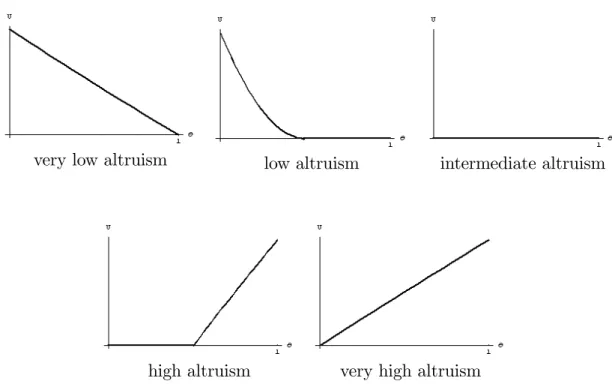
e¤ort requested for a consumer ( and then the cost that the agent must realize) does not vary with the degree of altruism when is lower than a value ( = e) such that (8) is satis…ed when = e: It increases linearly with the degree of altruism between ( = e) and ( = ee) and is constant for a higher degree of altruism. Moreover, the optimal contract is fully separating and the agent earns no information rent for all consumer types between e and ee: This occurs for all types when the agent has an intermediate degree of altruism, for high types when the agent has a low degree of altruism and for low types when the agent has a high degree of altruism. When the agent has a very low degree of altruism, he earns no information rent for a consumer’s type equal to whereas he earns no information rent for a consumer’s type equal to when the degree of altruism is very high. Figure 1 summarizes these results.
very low altruism low altruism intermediate altruism
high altruism very high altruism
Figure 1: Agent’s utility in the weak concavity case
The …rst best level of e¤ort (e = d) is obtained for = when the agent’s altruism is low or very low whereas it is obtained for = when the altruism is
high or very high. For an intermediate degree of altruism ( 2hb; bbi), this …rst best level of e¤ort is obtained for a value of such that V0( ) = 1: Moreover,
to reduce information rent, the requested e¤ort is always distorted downward (resp. upward) when the agent’s altruism is very low (resp. very high). For all the intermediate degrees of altruism, the e¤ort can be distorted downward or upward according to the value of : Hence the trade-o¤ between e¢ ciency and rent extraction depends crucially on the degree of altruism.
3.2. High concavity
When d(1 + )[ (V "( )f ( ) + V0( )f0( )) f0( )] + f ( ) < 0for 2 e;ee ; the previous solution cannot be an optimal solution. As V0( ) decreases at a rate faster than eL( )=d and eH( )=d, V0( ) is higher (resp. lower) than eL( )=d and
eH( )=d for the low (resp. high) values of : Then the utility function obtained
with the standard solutions is increasing (resp. decreasing) for the low (resp. high) values of and the participation constraint is not violated as soon as U ( ) or U ( ) are non negative. Following the approach of Maggi and Rodriguez-Clare (1995), we have to look for a solution involving the same e¤ort function for any : It could be eL( ); or eH( ) or an intermediate function such that the marginal
utility changes sign for a unique value b 2 ; ; according to the value of . To elicit the di¤erent cases (U ( ) < U ( ); U ( ) > U ( ) or U ( ) = U ( )), let us split the expected welfare in two parts, i.e., for 2 [ ; ] and for 2 ; : EW can be rewritten EW = Z f(1 + )V ( ) (1 + )(c + e( ) + e( ) 2 2d ) U ( )gf( )d + Z f(1 + )V ( ) (1 + )(c + e( ) + e( ) 2 2d ) U ( )gf( )d with U ( ) = U +R ( e(s)=d + V0(s))dson [ ; ]and U ( ) = U R ( e(s)=d +
V0(s))ds on ; : In this case, the optimal mechanism is characterized by
Proposition 3 (whose proof is in Appendix 6.2):
Proposition 4. When d(1 + )[ (V "( )f ( ) + V0( )f0( )) f0( )] + f ( ) < 0
i) when 0 < =
R eL( )d
V ( ) V ( ); e( ) = eL( ) 8 2 ; and U ( ) = 0: If
< b < ; U ( ) is decreasing in and if b < < ; U ( ) has an interior maximum in b solution of eL(b) + d V0(b) = 0
ii) when 1 > =
R eH( )d
V ( ) V ( ); e( ) = eH( ) 8 2 ; and U ( ) = 0: If
< < bb; U( ) has an interior maximum in b solution of eH(b)+d V0(b) = 0
and if bb < 1; U ( )is increasing in
iii) when ; e( ) = e ( ) = d 1+ F ( ) F (f ( ) ) 8 2 ; and U ( ) = U ( ) = 0: F ( ) is solution of U ( ) U ( ) =R ( e ( ) + d V0( ))d = 0
and U ( ) has an interior maximum in b solution of e (b) + d V0(b) = 0
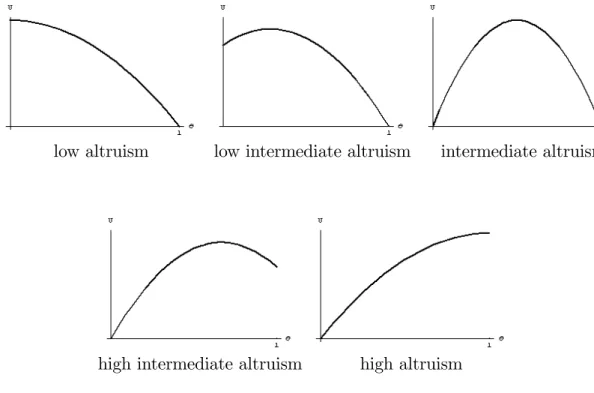
Under the assumption of high concavity, the optimal mechanism is fully sepa-rating and satis…es the monotonicity condition: Corollary 4 shows how it depends on the degree of altruism (see Figure 2):
low altruism low intermediate altruism intermediate altruism
high intermediate altruism high altruism
Corollary 5. In the high concavity case, the optimal contract has the following features:
i) When the agent’s altruism is low ( <b); the incentives to overstate dom-inate. The optimal e¤ort is downward distorted for all except and the agent utility is decreasing with :
ii) When the agent’s altruism has a "low" intermediate value (b < < );the incentives to overstate still dominate and the optimal e¤ort is downward distorted for all except but the agent utility has a maximum for b such that eL(b) +
d V0(b) = 0:
iii) When the agent’s altruism has an intermediate value ( ), countervailing incentives are balanced. The …rst best e¤ort is obtained for ( ) varying with the degree of altruism. For all types < ; the optimal e¤ort is downward distorted whereas it is upward distorted for all types > 10. The agent’s utility is increasing in for < b and decreasing in for > b:
iv) When the agent’s altruism has a "high" intermediate value ( < < bb); the incentives to understate dominate. The optimal e¤ort is upward distorted for all except and the agent utility has a maximum for b such that eH(b) +
d V0(b) = 0:
v) When the agent’s altruism is high ( > bb); the incentives to overstate still dominate. The optimal e¤ort is upward distorted for all except and the agent’s utility is increasing in :
In this mechanism, the …rst best level of e¤ort is achieved for = when the altruism is low, for = when the agent’s altruism has an intermediate value and for = when the altruism is high. As F ( ) is increasing in ; the e¤ort requested for a type increases (and then the cost that the agent must realize decreases) with the degree of altruism when whereas it is a constant function of when < and when > .
3.3. Properties of the optimal contract
In this section, we have shown how the form of the contract depends crucially on the shape of the altruistic component of the agent’s utility function. For simplicity, assume that F ( ) is uniform on [0,1] and that d = 1: The concavity condition implies that V00( ) is lower (resp. greater) than the Ramsey number
10This mechanism is similar to the mechanism obtained by Maggi and Rodriguez-Clare (1995)
1+ in the weak (resp. high) concavity case. Then it depends on the value of the
shadow cost of public funds. According to this shape, incentives to misrepresent change. We have also shown how the optimal policy can be characterized according to the degree of altruism of the agent. Figures 1 and 2 indicate how the trade-o¤ between e¢ ciency and rent extraction and consequently the rent obtained by the civil servant vary with his public service motivation.
It is now possible to characterize the properties of the optimal contracts. First, we can note that the requested e¤ort e( ) is non decreasing with for any in the high and weak concavity cases. This implies that the realized cost must be non increasing with the degree of public service motivation. Second, we can consider the payment rule of the optimal mechanism in both cases. From the no dumping constraint, the optimal payment is t ( ) = U ( ) + '(e( )) V ( ):This optimal mechanism can be implemented by a menu of linear contracts11t( ; C) = a( ) b( )C where the share of cost borne by the agent is b( ) = e( )=d, the …xed payment is a( ) = t ( ) + C ( )e( )=d and C ( ) is the level of cost when the agent exerts the requested e¤ort. This menu of linear contracts can be written t( ; C) = V ( ) + eL( ) 2d [2c + 2 eL( )] + Z e L( ) d d eL( ) d C when e = eL( ) t( ; C) = V ( ) + V 0( ) 2d [2c + 2 V 0( )] V0( )C when e = d V0( ) t( ; C) = V ( ) + eH( ) 2d [2c + 2 eH( )] Z e H( ) d d eH( ) d C when e = eH( ) t( ; C) = V ( ) + e ( ) 2d [2c + 2 e( )] Z e ( ) d d e ( ) d C when e = e ( ) In each case, the optimal contract is a …xed-price contract for a peculiar value of : when e = eH( ); when e = eL( ); b such that V0(b) = 1 when
e = d V0( ) and when e = e ( ): On the one hand, whatever the degree of
public service motivation, there is always a type of consumer for which the agent faces a …xed-price contract. However, the residual claimant for cost savings is not associated with the same type of consumer according to the degree of public service motivation and according to the slope of V ( ): On the other hand, all the other types are given incentive contracts whose general form is a( ) b( )C with b( ) 6= 1:
Hence, the di¤erences between optimal contracts with self-interested and al-truistic agents are not matters of kind. However, these contracts have speci…c features depending on the degree of altruism. On the one hand, the …xed pay-ment may be negative when is su¢ ciently high. On the other hand, the share of cost borne by the agent may be greater than 1 when is high. Thus, when the degree of altruism is high, b( ) = eH( ) > d and total payment
T ( ; C) = t( ; C)) + C = a( ) + (1 b( ))C with (1 b( )) < 0 if d > 1: Note that a( ) < 0 if > eH( )[2c + 2 eH( )]=2dV ( ) and a( ) < 0 when
> [2c d + 2 ]=2V ( ): When the degree of public service motivation is suf-…ciently high, civil servants volunteer their services for free. Then the principal can lower the payment to these agents and can even ask a payment to the agent getting utility from his action and still obtain the optimal level of e¤ort.
As missions’alignments and monetary reward are substitutes, the principal can choose a menu of contracts with a negative …xed payment and a negative share of the cost, but the general form of this menu is the same as in the case of a self-interested agent. Then intrinsic motivation cannot be considered as an argument for low-powered contracts. As in the standard false moral hazard models, the agent is put on a high-powered incentive scheme when some customers are served ( ; ; or b according to the value of ). Is he on a low-powered incentive scheme when some other customers are served? The answer depends on the meaning of the power of incentives. As noted by Lazear (2000), there is a confusion in the literature. If the use of the terms high power and low power incentives connote di¤erence in the ability to elicit agent e¤ort, the agent is put on a low-powered incentive scheme for some customer’s types ( when is low or when is is high) when the agent exerts the level of e¤ort the most distant from the …rst best. In contrast, if a low-powered incentive scheme is considered as akin to a cost-plus contract (La¤ont and Martimort (2002)), the agent is never put on a low-powered incentive scheme when is high because he over provides e¤ort and gets a part of his managerial e¤ort greater than 1. As C is reimbursed, the agent must pay an additional part of the cost ((1 b( )) < 0)to the principal and the contract is never cost plus.
4. Optimal mechanism under budget balance
If the agent must balance his expected budget, the principal takes (6) into ac-count in its program. Under this assumption, we …rstly characterize the optimal contract. Then we show that imposing a budget constraint is welfare-improving.
4.1. Optimal contracts
Let us denote the Kuhn and Tucker multiplier associated with this constraint. In the case of high concavity, the expected Lagrangian can be written:
EL = Z f(1 + ( ))V ( ) (1 + )(c + e( ) + e( ) 2 2d ) +( )( e( )=d+ V0( ))F ( ) F ( ) f ( ) gf( )d ( )(U F ( )+U (1 F ( ))) Note that the optimal value of is increasing in but cannot be strictly greater than : Assume > in the three cases previously considered.
i) If U > U ; the optimal mechanism is characterized by e( ) = d
1 +
F ( ) 1
f ( ) and U = 0 (10) The expected pro…t can be rewritten
E = V ( ) + Z
e( )
d (F ( ) 1)d < 0
Then the budget constraint cannot be satis…ed when > :Consequently, = and e( ) = d for any :
ii) If U = U ; the optimal mechanism is characterized by e( ) = d 1 + F ( ) F ( ) f ( ) and Z ( e( ) + d V0( ))d = 0 (11)
ThenR e( )d = d (V ( ) V ( )):If the budget is balanced, we haveR e( )F ( )d = d V ( ):Taking these conditions together involves that
Z e( )
d (1 F ( ))d = V ( )
As this is impossible, we must have = and e( ) = d for any : iii) If U > U ; the optimal mechanism is such that
e( ) = d 1 +
F ( )
The expected pro…t can be rewritten E = V ( ) + Z (1 d(1 + ) F ( ) f ( ))F ( )d E > 0 if o = R eL( )F ( )d
dV ( ) and the expected budget is balanced for a value
of the multiplier = " d (1 + )V ( ) Z (f ( )(1 + )d F ( ))F ( ) f ( )d # = Z F ( )2 f ( ) d (13)
is positive when > o and lower than when < 1 = R
F ( )d
V ( ) =
E V ( ):
In the case of weak concavity, the same reasoning applies. When e( ) is given by (10), the expected budget cannot be balanced for > when > 0: When e( ) = d V0( ); E < 0 when > and when e( ) is given by (12); = 0
and E > 0 when o and E = 0 and > when 1: Consequently,
the di¤erence between the optimal mechanisms in the high concavity and weak concavity cases vanishes. In both cases, the optimal mechanism is characterized by the following proposition:
Proposition 6. When the agent must balance his expected budget, the optimal mechanism is characterized by e( ) = eL( ) = d 1+ F ( ) f ( ); U = 0 and E > 0 when o = R eL( )F ( )d dV ( ) e( ) = e ( ) = d 1+ F ( )f ( ); U = 0 and E = 0 when o < 1 = V ( )E ; with given by (13) e( ) = d 8 and E = 0 when > 1
This mechanism is the standard La¤ont and Tirole’s mechanism for o
and a modi…ed La¤ont and Tirole’s mechanism for o < 1: When > 1;
the requested e¤ort is the …rst best e¤ort for any level of . The e¤ort requested for a type does not depend on the degree of altruism when 0 and 1:
It increases with when 0 1: This mechanism involves pooling for
all types when the degree of altruism is greater than 1. In this case, U U =
U =<
> U if <
=
> 2 = V ( ) V ( ): Moreover U ( ) = U + V ( ) + V ( ) and
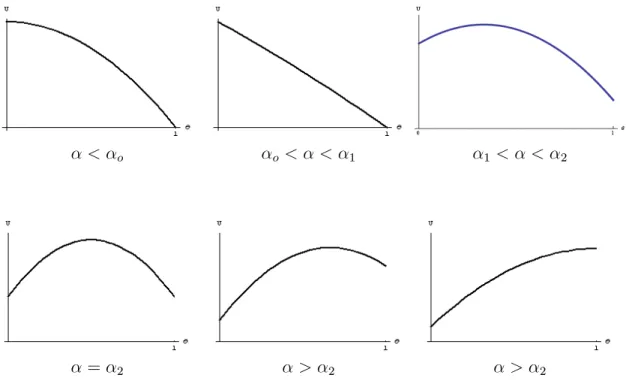
E = U + V ( ) E = 0: Then U = V ( ) + E depends on and is always positive. In the same way, U = V ( ) + E is also always positive: Consequently, the principal must leave information rents U ( ) = V ( ) + E for all consumer’s types when the expected budget is balanced and the agent’s degree of altruism greater than 1. Figure 3 summarizes these results.
< o o < < 1 1 < < 2
= 2 > 2 > 2
Figure 3: Agent’s utility under budget constraint
These results deserve some comments. When the agent is required to break even and when his degree of public service motivation is su¢ ciently high, the complete information level of e¤ort can be achieved. The main reason is that the budget constraint is an ex ante constraint while no dumping constraints are interim constraints. When the principal commits to a mechanism imposing an expected balanced budget constraint, he contracts under conditions of symmetric information with a risk neutral agent. Then all monetary rents for the agent can be eliminated without distorting e¤ort decisions. This incurs for a degree of public
service motivation such that the no dumping constraints are not binding. Public service motivation reduces the agent’s willingness to dump high cost consumers even if he is not reimbursed for their cost provided budget is balanced. In this case, insuring participation of the agent for all is socially costless. As the principal can extract the expected monetary rent, high cost consumers are subsidized by low cost consumers. The only rent earned by the agent is a non monetary rent. Hence, rent extraction is not a concern and productive e¢ ciency is the only goal of the principal. For a lower degree of altruism, the allocation must be distorted because the no dumping constraints are active.
Consequently, the optimal mechanism is characterized by a downward distor-tion of the requested e¤ort and no informadistor-tion rent at the top for the agents with a degree of altruism lower than 1 and by the …rst best level of e¤ort, information
rents for all but no monetary rents for the agents with a degree of altruism greater than 1: Hence, imposing a break-even constraint is a means to achieve a
…rst best allocation when the degree of public service motivation is higher than
1:
As the optimal contract induces a …rst best level of e¤ort when 1;
the agent faces a …xed-price contract for all the consumer’s types. As U ( ) = V ( ) + E ; t ( ) = E + d=2 when e = d: Therefore, total payment t( ) + C( )is equal to c + E d=2;i.e. the mean value of the cost C( ) + '(d): Under this …xed-price contract, the agent is residual claimant for his cost savings. When < 1; the optimal menu of contract is such as the agent faces a …xed
price only when is served.
4.2. Expected welfare comparison
One may wonder if it is in the interest of the principal to impose a budget con-straint to the agent. Let us compare expected welfare in both cases. Under a budget constraint; the expected welfare can be written
EWB(d) = (1 + )EV ( ) (1 + )(c + E d=2) when > 1 and e = d and
EWB( ) = (1 + )EV ( ) (1 + )(c + E ) + ( ) Z ( V0( ) e ( ) d )F ( )d( ) 1 + 2d Z (e ( )2 2de ( ))f ( )d( )
when 0 < < 1: In the absence of a budget constraint, the expected welfare
depends on the requested e¤ort level according to the degree of public service motivation. We prove in Appendix 6.3 the following Proposition:
Proposition 7. When the degree of public service motivation is higher than 0;
expected welfare is always greater when the agent must break even whereas the same level of expected welfare is achieved when < 0.
Thus, imposing a break-even constraint is welfare-improving. The intuition of this result can be found by considering the di¤erent levels of e¤ort. When > 1;as the …rst best level of e¤ort is achieved instead of either an insu¢ cient
or an excessive e¤ort, expected welfare is higher under budget balance. When
0 < < 1; the downward distortion of e¤ort is lower under budget balance
whereas the same expected welfare is achieved when < 0: Then the
break-even constraint is an instrument that the principal can use to achieve the …rst best allocation when the agent is su¢ ciently altruistic but also to increase social welfare for any degree of public service motivation.
These results could explain why governments do not want to exploit the pub-lic service motivated civil servants by getting them to work for less than their alternative wage. This would be analogous to obtaining a negative payment and violating the balanced budget constraint. As social welfare is greater under bud-get balance, that could explain why individuals working in the public sector do not seem to be "paying" for the privilege of doing so by obtaining lower wages than reservation12.
5. Conclusion
In this paper, we have considered a principal-agent setting in which the agent shares some purpose served by a public regulator. In this public service motiva-tion framework, we have shown how the principal faces a countervailing incentives problem when the agent is su¢ ciently altruistic. We have characterized the op-timal contract without budget balance and under budget balance as a function of the degree of altruism. When there is no budget constraint, we show that the di¤erence between optimal contracts with a self-interested agent and an altruistic agent is not matter of kind though these contracts have special features. First, the requested e¤ort is non decreasing when the degree of public service motivation
increases and can be higher than the …rst best level. Second, the agent faces a …xed-price contract when some customers are served but this high-powered in-centive contract is associated with di¤erent types of consumers according to the degree of altruism. Third, the …xed payment can be negative and the share of cost borne by the agent can be greater than 1 when the degree of altruism is high. Then, if a low-powered incentives scheme is akin a cost-plus contract, the altruistic agent is never put on such a scheme. As public service motivated agents receives satisfaction from providing services to the bene…ciaries of the public ser-vice, they can accept a lower payment. As they volunteer their services for free, the principal can ask a payment to agents getting utility from their action. Thus, though these contracts have special features, public service motivation cannot be considered as an argument for low-powered incentives schemes in the public sector. Under expected budget balance, the principal can achieve the …rst best allocation for a degree of altruism higher than a threshold that we characterize. Moreover, we show that expected welfare is always higher than in the absence of budget constraint.
Our analysis shows how the choice of an optimal policy depends on the degree to which civil servants take the customer’s interests into account. It shows that the degree of altruism matters when de…ning the optimal policy. However this degree is likely to vary across agents and is private information. Jack (2005) has considered a model in which there is asymmetric information about altruism but he does not assume that the cost parameter is private information. Then our analysis could be extended by considering simultaneously that the principal does not observe and :We would have to deal with multidimensional adverse selec-tion problem. Another extension could consider the case of agents with di¤erent degrees of public service motivation competing to supply the service in the line of the works of Delgaauw and Dur (2009). These issues will be considered in further research.
6. Appendix
6.1. Proof of Proposition 1 0n h ; e h ; eU U1( ) = ReU10(s)ds; with eU U (e): In the same way, on ee; ; U3( ) eeU = Ree U30(s)ds;with eUe U (ee): 0n e; ee ; U2( ) = eU = eUe and U20( ) = 0:
Replacing Ui( ) in (7) and integrating by parts, we obtain EW = Z (1 + )V ( )f ( )d + Z e f (1 + )(c + e1( ) + e2 1( ) 2d ) + U 0 1( ) F ( ) f ( )gf( )d + Z ee e f (1 + )(c + e2( ) + e2 2( ) 2d )gf( )d + Z e e f (1 + )(c + e3( ) + e2 3( ) 2d ) + U 0 3( ) F ( ) 1 f ( ) gf( )d A with A = [ eU F (e) + eU (F (ee) F (e)) + eeU (1 F (ee))] = eU = eU ; Ue 0
1( ) = e1( )=d +
V0( ) and U0
3( ) = e3( )=d + V0( )from (4): After pointwise maximization of
EW with respect to e1 and e3, we obtain
e1 = eL( ) = d 1 + F ( ) f ( ) and e3 = eH( ) = d 1 + F ( ) 1 f ( ) As U0 2( ) = 0 8 2 e;ee ; e2( ) = d V0( ):
Maximizing EW with respect to e and replacing e1 and e2;we obtain e solution
of
K(e) = d(1 + )( V0(e) 1)f (e) + F (e) = 0 (A1) In the same way, maximizing EW with respect to ee and replacing e3 and e2;
we obtain ee solution of
K(ee) = d(1 + )( V0(ee) 1)f(ee) + F (ee) = (A2) As e < ee and > 0; K( ) = d(1 + )( V0( ) 1)f ( ) + F ( ) must be increasing in ; which implies
K0(:) = d(1 + )[ (V "( )f ( ) + V0( )f0( )) f0( )] + f ( ) > 0 (A3) From (A1), (A3) and the implicit function theorem, it can be shown that
de
d < 0: The same result is obtained from (A2) and (A3): dee d < 0:
6.2. Proof of Proposition 2.
On [ ; ] ; U ( ) = U +R ( e(s)=d + V0(s))ds;with U U ( ):In the same way,
on ; ; U ( ) = U R ( e(s)=d + V0(s))ds; with U U ( ): Replacing U ( )
in EW , we obtain EW = Z (1 + )V ( )f ( )d Z f(1 + )(c + e( ) + e 2( ) 2d ) + ( e( ) d + V 0( ))F ( ) F ( ) f ( ) gf( )d Z f(1 + )(c + e( ) + e 2( ) 2d ) + ( e( ) d + V 0( ))F ( ) F ( ) f ( ) gf( )d (U F ( ) + U (1 F ( ))
After pointwise maximization of EW with respect to e on [ ; ] and ; , we obtain
e( ) = e ( ) = d 1 +
F ( ) F ( ) f ( ) and EW can be rewritten
EW = Z (1 + )V ( )f ( )d Z f(1 + )(c + e( ) + e 2( ) 2d ) + ( e( ) d + V 0( ))F ( ) F ( ) f ( ) gf( )d (U F ( ) + U (1 F ( )))
Three cases must be considered to elicit F ( ):
i) If U > U ; as U U =R ( e( )=d+ V0( ))d ; (U F ( )+U (1 F ( ))) = [U + (1 F ( ))R ( e( )=d + V0( ))d ], we obtain EW = Z (1 + )V ( )f ( )d + Z f (1 + )(c + e( ) + e 2( ) 2d ) + [( e( ) d + V 0( ))F ( ) 1 f ( ) ]gf( )d U
Then, EW is maximized for U = 0 and e = eH( ). Moreover U > 0 when > = R 1 1+ F ( )f ( )1d d(V ( ) V ( )) and b is solution of 1 + d(1 + ) F (b) 1 f (b) + V 0(b) = 0
ii) If U > U , EW can be rewritten EW = Z (1 + )V ( )f ( )d Z (1 + )(c + e( ) + e 2( ) 2d ) + [( e( ) d + V 0( ))F ( ) f ( )]gf( )d U Then, EW is maximized for U = 0 and e( ) = eL( ). Moreover U > 0 when
< = R 1 1+ F ( )f ( )d d(V ( ) V ( )) and b is solution of 1 + d(1 + ) F (b) f (b) + V 0(b) = 0
iii) If U = U ; EW is maximized for U = U = 0: Then (U F ( ) + U (1 F ( ))) = 0and e( ) = e ( ), with F ( ) such that the utility di¤erential between
and is equal to zero, i. e., Z ( 1 + d(1 + ) F ( ) F ( ) f ( ) + V 0( ))d = 0
This occurs when < < : 6.3. Proof of Proposition 3.
In the absence of budget constraint, the requested level of e¤ort can be eL; e2; eH
or e : Let us compare the expected welfare in these di¤erent cases with EWB(d):
When e( ) = eH( ); EWB(d) EW (eH( )) = Z (1 F ( ))[ V0( ) eH( ) d + (1 F ( )) 2d(1 + )f ( )]d 0
When e( ) = d V0( ); EWB(d) EW (d V0( )) = 1 + 2 Z d( V0( ) 1)2f ( )d > 0 When e( ) = eL( ); EWB(d) EW (eL( )) = 1 + 2 Z d(eL( ) 1)2f ( )d Z ( V0( ) eL( ) d )F ( )d = 1 + 2 Z d(eL( ) 1)2f ( )d + Z U ( )f ( )d > 0 When e( ) = e ( ); EWB(d) EW (e ( )) = Z (F ( ) F ( ))2 2d(1 + )f ( ) d + Z U ( )f ( )d > 0 In the same way, we can show that EWB(e ( )) > EW (e ( )); EWB(e ( )) > EW (e2( )) and EWB(e ( )) > EW (eL( )):
References
[1] Andreoni J. (1989), Giving with Impure Altruism: Applications to Charity and Ricardian Equivalence, Journal of Political Economy, 97(6), 1447-1458. [2] Andreoni J. (1990), Impure Altruism and Donations to Public Goods: A
Theory of Warm-Glow Giving, Economic Journal, 100(401), 464-477.
[3] Besley T. and M. Ghatak (2003), Incentives, Choice and Accountability in the Provision of Public Services, Oxford Review of Economic Policy, 19(2), 235-249.
[4] Besley T. and M. Ghatak (2005), Competition and Incentives with Motivated Agents, American Economic Review, 95(3), 616-636.
[5] Chalkley M. and J.M. Malcomson (1998), Contracting for Health Services when Patient Demand does not Re‡ect Quality, Journal of Health Economics, 17(1), 1-19.
[6] Delfgaauw J. and R. Dur (2009), From Public Monopsony to Competitive Market: More E¢ ciency but Higher Prices, Oxford Economic Papers, 61(3), 586-602
[7] Dixit A. (2003), Incentives and Organization in the Public Sector: an Inter-pretative Review, Journal of Human Resources, 37(4), 696-727.
[8] Ellis R.P. and Th. McGuire (1986), Provider Behavior under Prospective Reimbursement: Cost Sharing and Supply, Journal of Health Economics, 5, 129-152.
[9] Francois P. (2000), Public Service Motivation as an Argument for Govern-ment Provision, Journal of Public Economics, 78(3), 2756299.
[10] Francois P. and M. Vlassopoulos (2008), Pro-social motivation and the de-livery of social services, CESifo Economic Studies, 2008.
[11] Grout P. and M. Stevens (2003), The Assessment: Financing and Managing Public Services, Oxford Review of Economic Policy, 19(2), 215-234.
[12] Hammond P. (1987), Altruism, in Eatwell J., M. Milgate, P. Newman (eds.), The New Palgrave: A Dictionary of Economics, MacMillan, London.
[13] Heckman J., J. Smith and C. Taber (1996), What do Bureaucrats Do? The E¤ects of Performance Standards and Bureaucratic Preferences on Accep-tance into the JTPA Program, in G. Libecap, ed., Advances in the Study of Entrepreneurship, Innovation and Growth. vol 7, Greenwich, CT: JAI Press, 191-217.
[14] Jack W. (2005), Purchasing Health Care Services from Providers with Un-known Altruism, Journal of Health Economics, 24, 73-93.
[15] Jullien B. (2000), Participation Constraints in Adverse Selection Models, Journal of Economic Theory, 93, 1-47.
[16] La¤ont J.J. and D. Martimort (2002), The Theory of Incentives: The Principal-Agent Model, Princeton, Princeton University Press
[17] La¤ont J.J. and J. Tirole (1986), Using Cost Observations to Regulate Firms, Journal of Political Economy, 94, 614-641.
[18] Lazear E. (2000), The Power of Incentives, American Economic Review, 90(2), 410-414.
[19] Lewis T. and D. Sappington (1989), Countervailing Incentives in Agency Problems, Journal of Economic Theory, 49, 294-313.
[20] Le Grand J. (2003), Motivation, Agency and Public Policy: on Knights and Knaves, Pawns and Queens, Oxford, Oxford University Press.
[21] Ma C.T.A. (2004), Altruism and Incentives in Public and Private Health Care, mimeo.
[22] Ma C.T.A. and Th. McGuire (1997), Optimal health Insurance and Provider Payment, American Economic Review, 87(4), 685-704.
[23] Maggi G. and A. Rodriguez-Clare (1995), On Countervailing Incentives, Jour-nal of Economic Theory, 66, 238-263.
[24] Wilson J.Q. (1989), Bureaucracy: What Governemnt Agencies Do and why they Do it? New York, Basic Books.