The Client
’s Intervention Priorities (CIP)©: A
person-centered tool to support goal setting
during interdisciplinary neurorehabilitation
Eduardo Cisneros, Alexander Moreno, Geneviève Léveillé, Gilles Charette, Marie-Claude
Guerrette and Michelle McKerral
CLINICAL PSYCHOLOGY & NEUROPSYCHOLOGY | RESEARCH ARTICLE
The Client
’s Intervention Priorities (CIP)©: A
person-centered tool to support goal setting
during interdisciplinary neurorehabilitation
Eduardo Cisneros1,2§, Alexander Moreno1§, Geneviève Léveillé1, Gilles Charette1, Marie-Claude Guerrette1,2and Michelle McKerral1,2*Abstract: Evidence-based neurorehabilitation must be informed by the values,
expectations, and goals of individuals with acquired brain injury (ABI). The Client
’s
Intervention Priorities (CIP)© is a person-centered tool for defining rehabilitation
priorities according to self-perceived functioning. The use of the CIP tool is
encour-aged to promote self-determination and optimal involvement of individuals with
ABI in interdisciplinary neurorehabilitation. The objective of this study was to
determine the reliability (internal consistency, temporal stability) and content
validity (expert agreement) of the CIP tool. Thirty individuals with ABI (66.7% with
traumatic brain injury, 33.3% with stroke) with a mean age of 44.8 (SD = 12.6) years
were administered the CIP twice at a test-retest interval of 2.3 (SD = 0.7) weeks. An
expert panel of 17 neurorehabilitation clinicians and researchers participated in the
validation. The CIP tool showed excellent (total score
α = .90) and good (CIP
subscales
α = .83-.87) internal consistencies, with excellent temporal stability
(intraclass correlation coefficients = .78-.90). Experts agreed that the CIP items
reflect the Disability Creation Process model (89.4% scored as having high to very
high correspondence) and were comprehensibly stated (98% rated as clear to
REAC-TBI Clinical Research Laboratory
ABOUT THE AUTHOR
The research program that Dr. Michelle McKerral has implemented with her team since 2001 in the REAC-TBI Clinical research laboratory of the CRIR-IURDPM focuses on enhancing rehabilitation effectiveness (i.e. implementation of evidenced-based cognitive and interdisciplinary interven-tions), and monitoring recovery of cognitive function and social participation (i.e. use of mixed methods: neuropsychological, electrophysiologi-cal brain imaging, outcomes reported by clini-cians, users, family caregivers) in adults with traumatic brain injury or other acquired brain injuries (e.g. stroke), in order to positively influ-ence their short- and long-term outcomes (e.g. return to work, quality of life).
PUBLIC INTEREST STATEMENT
Every individual with a brain injury has a personal history and identity, making each recovery pro-cess unique. A team of interdisciplinary rehabili-tation professionals in Quebec, Canada, developed the Client’s Intervention Priorities (CIP) tool to capture the singularity, needs, and expectations of people who are in the process of reintegrating their community following a brain injury. Through the self-evaluation of their own level of functioning and self-identification of intervention priorities, the CIP is a valid person-centered tool providing individuals with acquired brain injury with the opportunity to take an active and formal role in the design and ongoing evaluation of their rehabilitation process. This innovative tool helps individuals to express their priorities during rehabilitation in a format adapted to their possible limitations and respecting their uniqueness. The CIP tool gives them voice and fosters self-determination, autonomy and empowerment, providing hope throughout their journey to recovery.
Received: 07 September 2018 Accepted: 02 April 2019 First Published: 16 April 2019
*Corresponding author: Michelle
McKerral, Center for Interdisciplinary Research in Rehabilitation of Greater Montreal, Lindsay Pavillon, 6300 Darlington Avenue, Montreal, Quebec, Canada H3S 2J4 E-mail: [email protected]
§These two authors contributed
equally to this work and are co-first authors.
Reviewing editor:
Jacqueline Ann Rushby, Psychology, University of New South Wales, Australia
Additional information is available at the end of the article
absolutely clear). The CIP is a valid and reliable self-assessment tool to assist
professionals and their clients in developing and prioritizing rehabilitation goals.
Subjects: Neuropsychiatry; Clinical Testing & Assessment; Rehabilitation Medicine; Disability; Neurology; Stroke; Neurological RehabilitationKeywords: neurorehabilitation; person-centered; intervention priorities; goal setting; interdisciplinarity; social participation; reliability; validity; acquired brain injury 1. Introduction
It is widely accepted that the lives of individuals with acquired brain injury (ABI) and the lives of their families can be improved independently of the degree of impairment and the presence of different problems (Wilson, Winegardner, van Heugten, & Ownsworth, 2017). When relevant, person-centered, and meaningful goals are identified and put forward, rehabilitation can lead to improved outcomes. Evidence-based neurorehabilitation must encompass the client’s values, expectations, priorities, and goals in the decision-making process because they are key elements for rehabilitation success (Cicerone,2009). There is a consensus that rehabilitation for ABI should be tailored to the individuals’ cognitive profile, premorbid activities, and life goals (Bayley et al.,
2014). As such, focusing on personally meaningful activities increases the successful general-ization of the individual’s progress to their environment. Furthermore, rehabilitation involving an interdisciplinary intervention approach to address post-injury physical, cognitive, and psychosocial challenges is crucial for optimal community integration and social participation (Cernich, Kurtz, Mordecai, & Ryan,2010).
Theory-based research suggests that making decisions about one’s own neurorehabilitation process can be a major motivational factor for active participation in treatment and can contribute to the development of increased autonomy, self-determination, and empowerment (Aujoulat, d’Hoore & Deccache, 2007; Scobbie & Wyke,2009; Siegert & Taylor,2004). Seminal work in the area of therapeutic outcomes showed that greater involvement in goal setting essentially takes the form of a therapeutic contract that increases the person’s satisfaction and goal attainment (Willer & Miller,1976). A person-centered approach to neurorehabilitation, especially during out-patient rehabilitation focusing on social and professional reintegration, is encouraged because it empowers the person in their rehabilitation process and gives them increased control over their lives. Self-evaluation of functioning and shared decision-making during goal setting can some-times represent a challenge for both the person receiving care and rehabilitation professionals (e.g., diverging perceptions of daily functioning and goal attainability) (Murphy & Boa,2012). It is thus important to develop mechanisms that enable the concerned parties to work together towards defining common achievable and, ideally, ambitious goals (Playford, Siegert, Levac, & Freeman,2009).
Hence, neurorehabilitation is a relatively long-term collaborative process involving the contribu-tion of different partners in goal setting (e.g., individuals with ABI, professionals of various disciplines, family, friends) (Lexell, Alkhed, & Olsson,2013). This process must ensure the continual assessment of treatment goals involving the family and/or important others. However, it has been shown that approaches for goal setting and monitoring of goals’ progression show important variations across settings (Evans & Krasny-Pacini,2017). These variations can be explained by the goal setting process itself, the way in which monitoring is done, and the level of involvement of the client in the process.
An instrument that was developed to assess functioning in daily life is the Assessment of Life-Habits (LIFE-H). LIFE-H, which is based on the Disability Creation Process (DCP) model (Fougeyrollas,2005a,2005b), evaluates social participation and documents the extent to which life habits are carried out by people with disabilities, regardless of the type of underlying impair-ment (Fougeyrollas, Bergeron, Cloutier, Côté, & St-Michel,1998; Fougeyrollas, Noreau, et al.,1998).
The LIFE-H tool (version 3.0) contains a long (240 items) and a short version (77 items). LIFE-H has been validated in both children (Noreau et al.,2007) and adults (Labbé,1999; Noreau et al.,2004). While LIFE-H was shown to be a sound measure of social participation, it was not designed to formally guide individuals in determining their rehabilitation priorities and goals. The LIFE-H format (e.g., fairly long sentences, the complexity of scoring on three levels) and length of administration (i.e., 1.5 hours minimum, two separate sessions often needed) are not ideal for self-administration in individuals with ABI.
Other tools have been developed to address goal setting in rehabilitation. Talking Mats is a low-tech communication tool created to allow individuals with communication difficulties to partici-pate in goal setting (Murphy & Boa,2012). Based on the World Health Organization International Classification of Functioning Disability and Health (WHO-ICF), Talking Mats focuses on the indivi-dual’s functioning in everyday life. It has been used in adults with aphasia (Murphy,2000), young adults with intellectual disability (Murphy & Cameron, 2008), and individuals with dementia (Murphy, Gray, van Achterberg, Wyke, & Cox,2010). Talking Mats focuses on activities and parti-cipation to identify goals that are relevant to the person with communication impairments. Despite its use in clinical practice and research, the psychometric properties of Talking Mats and its use in individuals with traumatic brain injuries have not been documented. Also, Talking Mats is mainly used during the acute stage of rehabilitation (Harty, Griesel, & van der Merwe,2011) and can be time-consuming and difficult for individuals with cognitive problems (Stevens, Beurskens, Köke, & van der Weijden,2013).
The results of a systematic review on the feasibility of 11 person-specific instruments used in the process of goal setting (e.g., time of administration, instructions, training, costs, perceived useful-ness) showed that there was no single good instrument available for all types of clients and settings, and that applying the strengths of each instrument during specific phases could improve goal-setting (Stevens et al., 2013). The Client’s Intervention Priorities (CIP)© tool (Charbonneau
et al.,2002) is a step forward in this matter.
The CIP, which is also based on the DCP model, was conceived for defining rehabilitation priorities according to self-perceived functioning during outpatient neurorehabilitation. It was developed by an interdisciplinary team of clinicians (psychologists/neuropsychologists, occupa-tional therapists, special educator, education specialist) from the Traumatic Brain Injury Program at the Lucie-Bruneau Rehabilitation Center in Montreal, Quebec, Canada. The CIP is a self-assessment instrument designed to assist individuals with ABI in determining their goals and priorities throughout the rehabilitation process according to their perceived functioning in daily life situations. Through the self-assessment of functioning (Part 1) and self-identification of interven-tion priorities (Part 2), the CIP is a person-centered tool providing individuals with ABI with the opportunity to take an active and formal role in the design and ongoing evaluation of their rehabilitation process (Charette, Cisneros, McKerral, Léveillé, & Barbeau,2011; Cisneros, Barbeau, Charette, & McKerral,2010).
The CIP is a comprehensive tool used to promote participation, increase motivation, develop a treatment plan, evaluate progress, measure outcomes, and foster self-determination, empower-ment, and autonomy. As such, the dissemination of this innovative tool is warranted. The CIP tool is currently used in several rehabilitation centers across the province of Quebec, mostly with individuals with traumatic brain injury (TBI). However, the psychometric properties of the CIP tool have not yet been published. To disseminate the CIP tool and extend research on its psycho-metric properties, the current study examined: a) the reliability (internal consistency and temporal stability), and b) the content validity (agreement by a panel of experts) of Part 1 of the CIP tool (i.e., self-assessment of life habits: nutrition, fitness, personal care, communication, housing, mobility, responsibilities, interpersonal relationships, community life, education, employment, recreation).
2. Methods 2.1. Participants
Clinical coordinators and rehabilitation professionals in a neurorehabilitation center in Montreal contacted a total of 50 individuals with ABI who were participating in an outpatient multidisci-plinary rehabilitation program. They were invited to participate in the study based on the following inclusion criteria: a) individuals having received a diagnosis of ABI; b) two or more months post-injury; c) 18 years or older; and d) reporting to be able to read and speak French. Eight individuals with ABI refused to participate in the study and 12 were excluded either for not meeting the inclusion criteria (n = 4) or attrition at retest (n = 8). The total sample for the current study consisted of 30 individuals with ABI with a mean age of 44.8 (SD = 12.6) years. The majority were men (66.7%). Most participants reported having at least a high school education (46.7% high school, 46.7% college or university). A diagnosis of TBI followed the TBI guidelines put forward by the Quebec Ministry of Health (Government of Quebec, 2005), with participants having a mild (Glasgow Coma Scale—GCS score 13–15), moderate (GCS score 9–12) or severe TBI (GCS score 3–8), as documented in their admission file. TBI was the most prevalent diagnosis (66.7%) followed by stroke (33.3%). The demographic and injury-related characteristics of the sample are reported in Table1.
2.2. Instruments
2.2.1. The Client’s Intervention Priorities (CIP)© tool
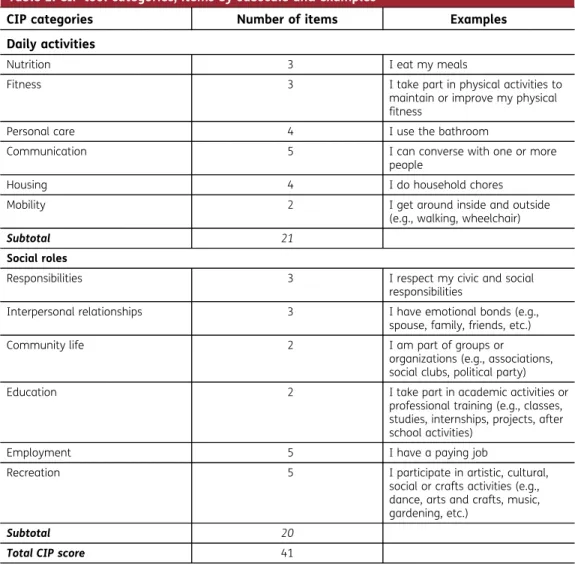
With the CIP tool, individuals are asked to judge their degree of functioning in 41 everyday/life situations corresponding to six categories representing daily activities (21 items: nutrition, fitness, personal care, communication, housing, mobility) and six categories representing social roles (20 items: responsibilities, interpersonal relationships, community life, education, employment, recrea-tion). As shown in Table2, the number items in each of these 12 categories ranges from two to five. The life situations included in the CIP tool reflect the conceptual framework of the DCP model
Table 1. Demographic and injury-related characteristics for individuals with ABI (N = 30)
Variables n (%) M (SD) Range Gender Male 20 (66.7) Female 10 (33.3) Age (years) 44.8 (12.6) 21–68 Education High school 14 (46.7) College 9 (30) University 5 (16.7) Missing 2 (6.6) Test-retest interval (weeks) 2.3 (0.7) 1–4
Time since injury (months) 11.7 (10.4) 2–60 Diagnosis Mild TBI 7 (23.3) Moderate TBI 8 (26.7) Severe TBI 2 (6.7) Stroke 10 (33.3) Musculoskeletal injury with mild TBI
according to those 12 categories and their corresponding specific life habits. Life habits are“daily activities and social roles that ensure the survival and development of a person in society throughout his or her life” (Fougeyrollas, Bergeron, et al.,1998). The DCP model was developed (in both French and English) in the context of a mandate from the World Health Organization to propose a revision of the concept of handicap as it was conceptualized in the International Classification of Impairments, Disabilities and Handicaps. The DCP is widely known and used in Canada (mostly in the province of Quebec) as well as in Europe (Desrosiers, 2005; Levasseur, Desrosiers, & St-Cyr Tribble,2007). It is a dynamic model that conceptualizes disability or handicap situations as limitations in the accomplishment of life habits and social participation that result from interactions between personal factors (i.e., abilities and impairments/disabilities) and envir-onmental factors (i.e., facilitators and barriers).
Within this framework, an iterative process conducted with the clinicians involved in the devel-opment of the CIP instrument led to the formulation and phrasing of the CIP items. The items were worded to inclusively represent examples of most daily activities and social roles that can be accomplished by a person, based on the DCP model categories and their specific life habits definitions. CIP items were reviewed by the clinicians on the tool development team during consecutive work sessions to remove any redundant items and assure that all DCP life habits
Table 2. CIP tool categories, items by subscale and examples
CIP categories Number of items Examples Daily activities
Nutrition 3 I eat my meals
Fitness 3 I take part in physical activities to
maintain or improve my physical fitness
Personal care 4 I use the bathroom
Communication 5 I can converse with one or more
people
Housing 4 I do household chores
Mobility 2 I get around inside and outside
(e.g., walking, wheelchair)
Subtotal 21
Social roles
Responsibilities 3 I respect my civic and social
responsibilities
Interpersonal relationships 3 I have emotional bonds (e.g.,
spouse, family, friends, etc.)
Community life 2 I am part of groups or
organizations (e.g., associations, social clubs, political party)
Education 2 I take part in academic activities or
professional training (e.g., classes, studies, internships, projects, after school activities)
Employment 5 I have a paying job
Recreation 5 I participate in artistic, cultural,
social or crafts activities (e.g., dance, arts and crafts, music, gardening, etc.)
Subtotal 20
were covered by the 41 items retained. Clinicians not directly involved in the tool development were also consulted to that effect. The CIP includes statements articulated in the first-person perspective using clear and accessible language to address the different categories of life habits (see examples in Table2). As such, the statements represent common terms used by individuals with ABI, family members, and rehabilitation professionals. The use of a common and accessible language facilitates communication among professionals, as well as between professionals, indi-viduals with ABI, and their families.
The CIP tool was also specifically designed to suit the challenges of individuals with ABI in the post-acute recovery phase related to cognitive impairment and fatigue, as well as to foster their full involvement and effort during the task. Statements are written in relatively short sentences, in accessible language, and remain visible throughout the sorting exercise, requiring minimal cogni-tive demands (e.g., reading, attention, working memory). Also, the life habits cards are presented in a random fashion to reduce the probability of perseverative or recurring answers within the different statements for each of the categories of life habits. The CIP tool has an unlimited length of administration to minimize the impact of information processing speed and validity issues associated with fatigue. Clinical practice has shown that the duration of the CIP administration is rarely more than 60 minutes, with the possibility to take breaks when necessary.
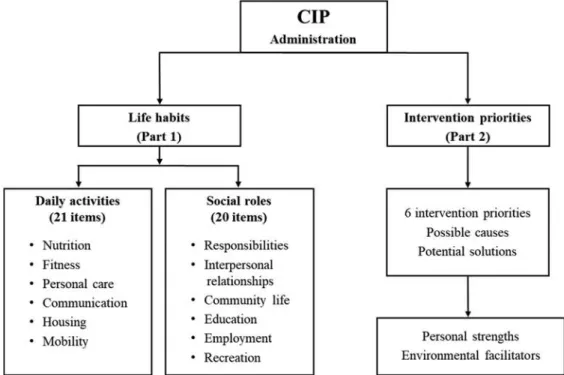
Figure 1 shows a flow diagram representing the administration process of the CIP tool. A rehabilitation professional administers the CIP tool in two parts. In the first part, a cardboard header with labels representing the six levels of ability from left to right (“This is not part of my usual life habits”; “I do not do it because of my present condition—somebody else does it for me”; “I cannot do it by myself—I need significant monitoring or I do about 50% alone with important physical or verbal assistance of somebody else”; “I need someone to be there, just in case”; “I do it alone, but with some difficulty”; and “I do it alone, without difficulty”), is placed on the table in front of the individual. The person is then handed a previously shuffled deck of 41 cards with the different statements related to the 12 categories of life habits and is asked to self-assess their functioning according to each card, sorting them into piles in front of the corresponding level of ability label. The cards contain statements formulated in a clear and accessible language (e.g.,“I
Figure 1. Flow diagram of the administration process of the CIP tool.
have a paying job”; “I prepare my meals”; “I read newspapers, magazines, books or on the Internet”). As such, the individual sorts all the cards according to their level of participation by placing each card in front of the heading corresponding to their degree of ability. Because statements for each card are visually displayed and remain visible during the sorting process, the person can clearly identify both life habits and the ability level to rate them. When the sorting process is finished, the person is asked to review their cards and make changes as needed in their classification according to ability levels.
In the meantime, the categorization the client makes for each of the CIP 41 items is recorded by the rehabilitation professional on a scoring sheet according to a 6-point Likert-type response scale (i.e.,“0” represents “This is not part of my usual life habits” to “5” indicates “I do it alone, without difficulty”). Mean scores are calculated by including all items scored 1–5 for both daily activities and social roles subscales, as well as a total CIP total score. Items scored“0” are not computed in mean scores since they were not part of the individual’s life habits before the brain injury. Lower scores on the CIP represent lower levels of participation and more frequent handicap situations. Conversely, higher scores of the CIP indicate greater levels of independence, social participation, and integration. The objective of the second part of the CIP administration is to help the individual to identify their intervention priorities and rehabilitation goals. After removing the cards sorted under the heading “This is not part of my usual life habits” and “I do it alone, without difficulty”, the professional gathers in a pile the cards of the life habits that were placed under the remaining headings (i.e.,“I do not do it because of my present condition—somebody else does it for me”; “I cannot do it by myself—I need significant monitoring or I do about 50% alone with important physical or verbal assistance of somebody else”; “I need someone to be there, just in case”; and “I do it alone, but with some difficulty”). At this time, the person is asked to read the remaining cards again and make two separate piles: a) the first pile with life habits that they identify as needing immediate attention in terms of treatment or intervention (i.e., selection of intervention priorities); and b) a second pile with life habits that are important to them, but not a short-term priority. Next, the individual is asked to organize the first pile by preference for intervention (i.e., prioritization process). As such, they rank the life habits that they wish to include as rehabilitation goals for the next few months. The professional then records this information on a form entitled“My priorities” provided with the CIP tool. For each of the first six life habits identified as priorities, the individual with ABI is asked to explain the reasons they see as causing their limitations in these life habits, and potential solutions that they can think of to alleviate these limitations. Finally, the professional asks the person to focus on the cards that were placed under the heading“I do it alone, without difficulty” and to reflect on and raise personal strengths or facilitators based on self-knowledge and their evaluation of their environment that could eventually help them overcome their diffi-culties and achieve their rehabilitation goals.
At the end of the CIP administration, the individual reviews the“My priorities” CIP form and signs it to confirm that it reflects their chosen intervention priorities. This document serves as a contract aiming to inform the neurorehabilitation process. The person receives a copy of the document and it is shared with other members of the rehabilitation team. The “My priorities” form and the detailed CIP scoring sheet are filed in their medical records. The priorities constitute a basis for discussion, between the individual with ABI, family caregivers, and the rehabilitation team, leading to the definition of interdisciplinary rehabilitation goals that are included in the individualized intervention plan. The CIP tool is then administered at each review of the intervention plan (e.g., every 12 weeks). This ongoing evaluation of goal attainment allows rehabilitation professionals to document the client’s self-perceived progress in accomplishing their life habits and contributes to updating goal setting.
2.3. Procedure
The current study was approved by the Research Ethics Board (REB) of the Center for Interdisciplinary Research in Rehabilitation of Greater Montreal. Participants gave written informed consent to participate.
2.3.1. Reliability testing
The reliability of an instrument refers to its ability to produce consistent results when the same variables are measured under different conditions (Johnston, Keith, & Hinderer,1992). To evaluate the reliability of Part 1 of the CIP tool (i.e., self-assessment of life habits), we calculated its internal consistency and temporal stability. The internal consistency, quantified by Cronbach’s alpha (α), evaluates the extent to which the items measuring the same construct are interrelated (Bolton & Parker,2008). A high alpha value represents items that are closely related. The temporal stability was measured using a test-retest method. The comparison between the participants’ responses at two different time points and the calculation of intraclass correlation coefficients (ICC) are an estimate of temporal stability. High ICC values indicate consistency and agreement between quantitative measurements (Dittmar & Gresham,1997).
To ensure the administration of the CIP was systematic across evaluators, two research assis-tants were trained by the tool developers on the administration of the CIP. They administered the entire CIP tool (i.e., Parts 1 and 2) twice to individuals with ABI at a test-retest interval of 2.3 (SD = 0.7) weeks. The same research assistant conducted the first and the second administrations for the same participant. The second evaluation was scheduled at the end of the first administra-tion of the CIP tool.
2.3.2. Content validity testing
The validity of an instrument refers to its ability to measure the characteristics for which it was designed and an instrument is considered valid if it actually measures what it claims to measure (Bolton & Parker,2008; Streiner & Norman,2003). Content validity, a component of construct validity, is“the degree to which elements of an assessment instrument are relevant to and representative of the targeted construct for a particular assessment purpose” (Haynes, Richard, & Kubany, 1995, p. 238). Content validation provides evidence about the construct validity and can be established with the help of experts during the development process of an instrument. To assess the content validity of the CIP tool, we consulted an expert panel of 17 clinicians and researchers that had been working in the field of neurorehabilitation for at least 10 years (i.e., 13 clinicians—eight of which had part-time or full-time clinical coordination/program management responsibilities—including five occupational therapists, four physical therapists, three psychologists/neuropsychologists, and a speech-language pathologist; as well as four researchers, with respective backgrounds in neurop-sychology, occupational therapy, nursing, and anthropology, including the principal author of the DCP model). Participants in the panel of experts were familiar with the DCP model but not with the CIP tool and completed an online survey using Survey Monkey (Waclawsky,2012). The panel of experts was presented with the content of the CIP items (i.e., the 41 statements) and life habits taxonomy as defined in the DCP model (Fougeyrollas, Bergeron, et al.,1998). They were asked to rate to what degree each CIP item statement (e.g., Nutrition:“I choose my food according to my eating habits”, “I prepare my meals”, “I eat my meals”) corresponded to its respective life habits description (e.g., Nutrition:“diet”, “meal preparation”, “eating”) and definition in the DCP model, with the following options: a) very poor, b) poor, c) moderate, d) high, or e) very high. Experts were also asked to judge the clarity of the wording of the CIP statements, with the following options: a) not clear at all, b) somewhat clear, c) clear, d) very clear, or e) absolutely clear.
2.4. Statistical analyses
Statistical analyses were conducted with SPSS Statistics for Windows—version 25 (IBM, 2017). Internal consistency was estimated for both the first and second CIP administrations with Cronbach’s alpha (α) for the subscales (i.e., daily activities and social roles), the CIP life habits categories, and the total score. The following criteria were used to interpret alpha values: ≥
.9 = excellent, ≥.8 = good, ≥.7 = acceptable, ≥.6 = questionable, ≥.5 = poor, <.5 = unacceptable (George & Mallery, 2011). Test-retest reliability of the CIP tool was calculated with intraclass correlation coefficients (ICC) for each of the 12 categories, the two subscales (i.e., daily activities and social roles), and the total score, using a two-way mixed effects model with measures of absolute agreement. For each ICC value, 95% confidence intervals (CI) were calculated. The following guidelines were used to interpret ICCs and their CIs: .75–1 = excellent, .60-.74 = good, .40-.59 = fair, and < .4 = poor (Cicchetti,1994). To test content validity, the responses from the panel of experts were analyzed in terms of frequencies.
3. Results 3.1. Reliability
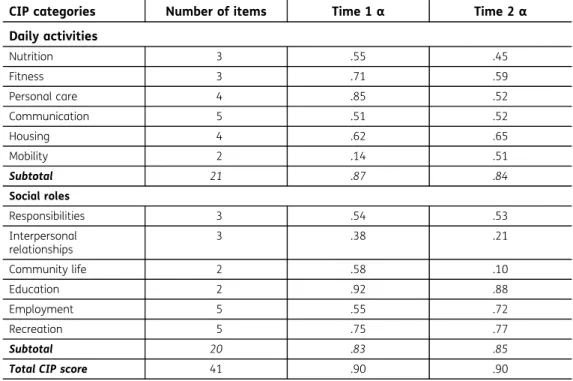
Cronbach alpha coefficients are provided separately for the first (T1) and second (T2) CIP admin-istrations in Table3. Overall, the CIP tool showed excellent internal consistency at T1 and T2. In addition, the daily activities subscale and the social roles subscale showed good internal consis-tency at both CIP administrations. For the individual categories, acceptable to excellent internal consistencies were found for four categories at T1 (fitness, personal care, education, recreation), and three categories at T2 (education, employment, recreation). A lower internal consistency was found for the other categories at T1 (mobility, interpersonal relationships) and T2 (nutrition, interpersonal relationships, community life).
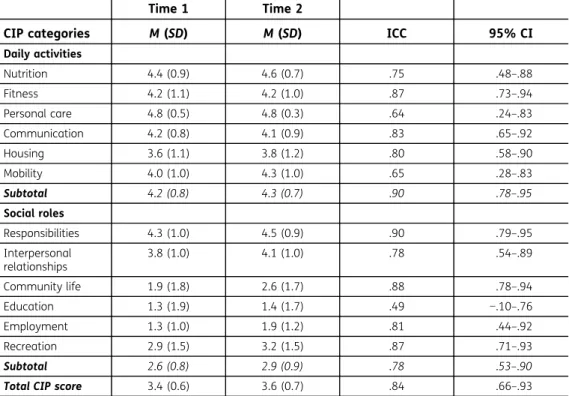
Table4provides the intraclass correlation coefficients and their 95% confidence interval esti-mates corresponding to the test-retest values of the CIP categories, subscales, and the total score for the first and second administrations. The CIP tool total score and the two subscales’ scores (daily activities and social roles) showed excellent reliability, as indicated by ICC values. Also, 95% CI limits were in the excellent (daily activities), good to excellent (total score), or fair to excellent
Table 3. Internal consistency of the CIP categories, subscales, and total score for the first and second administrations
CIP categories Number of items Time 1α Time 2α Daily activities Nutrition 3 .55 .45 Fitness 3 .71 .59 Personal care 4 .85 .52 Communication 5 .51 .52 Housing 4 .62 .65 Mobility 2 .14 .51 Subtotal 21 .87 .84 Social roles Responsibilities 3 .54 .53 Interpersonal relationships 3 .38 .21 Community life 2 .58 .10 Education 2 .92 .88 Employment 5 .55 .72 Recreation 5 .75 .77 Subtotal 20 .83 .85
(social roles) range. Nine of the twelve individual categories (i.e., nutrition, fitness, communication, housing, responsibilities, interpersonal relationships, community life, employment, and recreation) showed excellent reliability. Their lower and upper 95% CI limits were in the fair to excellent range. The personal care and mobility categories showed good reliability and the education category had fair reliability, with lower and upper 95% CI limits in the poor to excellent range.
3.2. Content validity
The results of the assessment of the level of correspondence between the CIP items and corre-sponding DCP life habits descriptions and definitions by the panel of 17 experts are shown in the top panel of Figure2. Experts evaluated the correspondence between the CIP tool items and the DCP taxonomy as being mostly high or very high. None of the CIP items were rated as having poor or very poor correspondence with the DCP descriptions and definitions. Regarding the clarity of CIP items, experts agreed that almost all CIP items were rated as being clear, very clear or absolutely clear, as illustrated in the bottom panel of Figure2.
4. Discussion
This paper presents an innovative and promising tool to promote the participation of individuals with ABI in their outpatient rehabilitation process and community reintegration. The CIP is a person-centered instrument allowing individuals with ABI to self-assess their level of functioning and to determine their intervention priorities, based on their preferences and expectations, for their personalized rehabilitation plan. Results show that the CIP tool has solid psychometric properties. According to a group of 17 experimented rehabilitation clinicians and researchers from various disciplines and domains, the CIP tool showed excellent content validity established through the relationship with the life habits descriptions of the DCP model and in terms of clarity of the CIP item statements. In terms of reliability, the total score and both subscales (daily activities and social roles) of the CIP tool showed excellent or good internal consistency at the two testing times, and excellent temporal stability with satisfactory confidence intervals.
Table 4. Test-retest values of the CIP categories, subscales, and total score for the first and second administrations, intraclass correlation coefficients and 95% confidence intervals
Time 1 Time 2
CIP categories M (SD) M (SD) ICC 95% CI
Daily activities Nutrition 4.4 (0.9) 4.6 (0.7) .75 .48–.88 Fitness 4.2 (1.1) 4.2 (1.0) .87 .73–.94 Personal care 4.8 (0.5) 4.8 (0.3) .64 .24–.83 Communication 4.2 (0.8) 4.1 (0.9) .83 .65–.92 Housing 3.6 (1.1) 3.8 (1.2) .80 .58–.90 Mobility 4.0 (1.0) 4.3 (1.0) .65 .28–.83 Subtotal 4.2 (0.8) 4.3 (0.7) .90 .78–.95 Social roles Responsibilities 4.3 (1.0) 4.5 (0.9) .90 .79–.95 Interpersonal relationships 3.8 (1.0) 4.1 (1.0) .78 .54–.89 Community life 1.9 (1.8) 2.6 (1.7) .88 .78–.94 Education 1.3 (1.9) 1.4 (1.7) .49 −.10–.76 Employment 1.3 (1.0) 1.9 (1.2) .81 .44–.92 Recreation 2.9 (1.5) 3.2 (1.5) .87 .71–.93 Subtotal 2.6 (0.8) 2.9 (0.9) .78 .53–.90
The CIP appears to be a valid and reliable measure of self-perceived life habits and participation to formally assist persons with a brain injury and professionals during the process of goal setting, prioritiza-tion of treatment objectives, and the monitoring of goal attainment. The preliminary psychometric evidence of the current study supports the use of the CIP tool in neurorehabilitation. However, a few points deserve further discussion. The diversity of activities involved within some of the categories could be reflected in their lower internal consistency or temporal stability. It is important to note that the CIP categories are conceptual in nature and that their items do not necessarily have inherent functional implications (e.g., an individual with ABI may accomplish one item in a category without difficulty but need important assistance on another item in the same category). Alternative explanations can include differences in the interpretation of the items at the two time-points, the fact that the individual with ABI has had the time to reflect on the activities during the two-week administration interval, and actual changes in functioning during the test-retest period. These variations are also possibly inherent to the DCP model and the clinical characteristics of the ABI population. However, they do not affect the overall reliability of the tool’s total score, daily activities, and social roles subscale scores.
Currently, most neurorehabilitation professionals follow a goal-setting approach in partnership with clients and their families to integrate their expectations during treatment planning (Wilson & Gracey,
2009). Accepting that goals can vary depending on the individual means that people with similar types of brain injury can have different rehabilitation goals (Evans & Krasny-Pacini,2017). The CIP tool allows professionals to individualize treatment plans through a collaborative process. The use of the CIP tool is encouraged in interdisciplinary outpatient neurorehabilitation to promote motivation and full involvement in the rehabilitation and community reintegration process. The repeated administration of the CIP tool can also help to inform individuals with ABI and their families about their progress and
0 10 20 30 40 50 60 70 80 90 100
Very Poor Poor Moderate High Very High
Percentage Level of Correspondence 0 10 20 30 40 50 60 70 80 90 100 Not clear at all Somewhat clear
Clear Very clear Absolutely
clear
Percentage
Level of Clarity
Figure 2. Experts’ ratings (per-centage of items) by level of correspondence between CIP items and corresponding DCP life habits descriptions and definitions (top) and by level of clarity of the items (bottom).
The CIP tool overcomes the limitations of complex wording of the items and working memory demands (e.g., items and categorization options displayed during the administration), episodic mem-ory problems (e.g., individuals receive a copy of the form with their priorities), executive problems (e.g., guidance through the administration process by a rehabilitation professional), and fatigue associated with long assessments (e.g., relatively short format and flexibility allowing breaks during its adminis-tration). This helps individuals with ABI to formulate realistic outpatient rehabilitation goals and to prioritize them. Also, it reduces the complexity of exploration of obstacles, strengths, and possible solutions to achieve realistic therapeutic goals by guiding the individual with ABI through the entire process of self-assessment of functioning, self-exploration, and personal choice. The CIP can represent a powerful tool to enhance the effects of neurorehabilitation since it has been suggested that the setting of carefully identified and personally meaningful goals may represent a practical form of psychotherapy (Wilson, Evans, & Gracey,2009).
Like other instruments, the CIP tool has some limitations that must be acknowledged. For instance, some individuals with severe ABI and important neuropsychological deficits (e.g., global aphasia, extremely limited self-awareness) can be too impaired to participate effectively in the goal-setting process (Evans & Krasny-Pacini,2017). In such cases, establishing rehabilitation goals with families and significant others should be pursued in accordance with the person’s pre-injury values, and considering the individual’s best interest. It is important to mention that the CIP tool should not be the only source of information on which decisions about treatment goals are based, particularly in individuals with ABI with reduced self-awareness. The CIP results can be contrasted with other available sources of information (e.g., formal neuropsychological, physical and occupa-tional therapy assessments, behavioral observations, among others) to appreciate differences between the client’s self-perceived functioning, and that perceived by the treating rehabilitation professionals or significant others. As the process of developing self-awareness after brain injury involves recalling experiences and comparing current performance with preinjury levels (i.e., who I was with who I am now) (Ownsworth,2017), the CIP tool could help clients gain insight about post-ABI changes. This hypothesis needs further investigation in future developments to describe the clinical utility of the CIP tool.
Although the CIP tool is used to guide self-assessment of life habits and to determine barriers and strengths toward the attainment of prioritized goals, the CIP tool does not lead to the formulation of rehabilitation goals by itself. Rehabilitation professionals need to translate, with the participation of the individual with ABI, their priorities into meaningful, challenging, and achievable goals. Doing this using, for example, a SMART approach to goal setting (i.e., Specific, Measurable, Achievable, Relevant/Realistic and with a Timeframe) can represent an ideal metho-dology for developing individualized interdisciplinary intervention plans in rehabilitation. Also, the CIP can be used to track progress in terms of self-perceived functioning and goal achievement, but it should be combined with other methods allowing to objectively and systematically quantify levels of expected achievement of rehabilitation goals, such as the Goal Assessment Scaling (GAS) method (Grant & Ponsford,2014; Malec,1999).
4.1. Future directions
Even though priorities can change in the short-term, future studies could address the temporal stability of the priorities chosen during the administration of the CIP tool (i.e., the second part of the CIP), as this was not an objective of this study. The priorities chosen in the second part of the CIP tool would be expected to remain relatively stable in a short time period (e.g., two weeks). Although the CIP items are formulated in a clear and accessible language, the few CIP statements judged as having only moderate correspondence with the DCP descriptions could be reviewed to improve the quality of the instrument. Further investigation of the psychometric properties of the CIP is needed. Concurrent and divergent validity need to be examined, as well as the confirmation of the factorial structure of the scale (i.e., daily activities and social roles) with larger samples. Also, studies conducted in samples with lower educational levels could allow verifying if education can affect the validity of the instrument and determine if further adaptation is warranted. Furthermore, the translation and
adaptation to other languages are necessary as the CIP tool is currently only available in French. Cross-cultural validation would also be important to understand whether the life habits represented in the CIP tool and reflecting the DCP model are culturally sensitive. This is important since life habits, their meaning, and expressions may vary between cultures (Pereira, Fish, Malley, & Bateman,2017). We anticipate that the CIP tool is culturally sensitive as the DCP is based on an anthropological model of handicap. Future research on anosognosia could use the CIP tool to examine the consistency between self-assessment of life habits by the individual with ABI and the evaluation of their function-ing in life habits as perceived by a significant other. It would also be interestfunction-ing to investigate the effect of awareness deficits on rehabilitation priorities of the person with ABI and how they align with those of the family caregiver. Finally, the CIP tool was developed to guide outpatient neurorehabilita-tion of adults with ABI. Further developments could include the adaptaneurorehabilita-tion/validaneurorehabilita-tion of the CIP tool to older adults, children, and adolescents with different neurodisabilities.
In conclusion, we presented the internal consistency, temporal stability, and content validity of the CIP, a tool to help define rehabilitation priorities according to self-perceived functioning in individuals with ABI. The preliminary findings documented in this study serve as a basis to further investigate this promising and innovative tool. Neurorehabilitation is concerned with the improvement of cognitive, emotional, and behavioral deficits caused by an insult to the brain, and with helping individuals with ABI achieve maximal social participation (Wilson et al.,2017). As such, to guide individuals with ABI in the construction of a life plan that makes sense to them, rehabilitation clinicians and scientists have the responsibility to develop assessment and intervention tools involving the full participation of individuals with ABI, as well as programs and policies that coherently follow those principles.
Acknowledgements
This study was supported by the Lucie-Bruneau Rehabilitation Center of the CIUSSS Centre-Sud-de-l’Île-de-Montréal (special research projects fund). The authors would like to thank the clinicians who participated in the development of the CIP tool (Anick Charbonneau, Jean-Pierre Drouin, Édith Lemay and Sylvie Massicotte) with authors EC, GL, GC and MM, as well as the research assis-tants who contributed to various stages of the project (Audrey-Kristel Barbeau, Sheila Schneiberg) and the indi-viduals with ABI who participated in the study.
Disclosure of interest
The authors report no conflict of interest. Funding
This work was supported by the Lucie-Bruneau Rehabilitation Center of the CIUSSS Centre-Sud-de-l’Île-de-Montréal (special research projects fund).
Author details Eduardo Cisneros1,2 E-mail:[email protected] Alexander Moreno1 E-mail:[email protected] Geneviève Léveillé1 E-mail:[email protected] Gilles Charette1 E-mail:[email protected] Marie-Claude Guerrette1,2 E-mail:[email protected] Michelle McKerral1,2 E-mail:[email protected]
1Center for Interdisciplinary Research in Rehabilitation of
Greater Montreal, Lucie-Bruneau Rehabilitation Center, CIUSSS Centre-Sud-de-l’Île-de-Montréal (CCSMTL), Montréal, Quebec, Canada.
2Department of Psychology, Université de Montréal,
Montreal, Quebec, Canada. Cover image
Correction
This article has been republished with minor changes. These changes do not impact the academic content of the article. Citation information
Cite this article as: The Client’s Intervention Priorities (CIP) ©: A person-centered tool to support goal setting during interdisciplinary neurorehabilitation, Eduardo Cisneros, Alexander Moreno, Geneviève Léveillé, Gilles Charette, Marie-Claude Guerrette & Michelle McKerral, Cogent Psychology (2019), 6: 1603614.
References
Aujoulat, I., . W., D’ Hoore, A., & Deccache, A. (2007). Patient empowerment in theory and practice: Polysemy or cacophony? Patient Education and Counseling, 66(1), 13–20. doi:10.1016/j.pec.2006.09.008
Bayley, M., Tate, R. L., Douglas, J., Turkstra, L., Ponsford, J., Stergiou-Kita, M.,… Bragge, P. (2014). INCOG guide-lines for cognitive rehabilitation following traumatic brain injury: Methods and overview. The Journal of Head Trauma Rehabilitation, 29(4), 290–306. doi:10.1097/HTR.0000000000000070
Bolton, B., & Parker, R. (2008). Handbook of measurement and evaluation in rehabilitation (4th ed.). Austin, Tex.: Pro-Ed, Inc.
Cernich, A., Kurtz, S., Mordecai, K., & Ryan, P. (2010). Cognitive rehabilitation in traumatic brain injury. Current Treatment Options in Neurology, 12(5), 412–423. doi:10.1007/s11940-010-0085-6
Charbonneau, A., Charette, G., Cisneros, E., Drouin, J.-P., Lemay, E., Léveillé, G. & McKerral, M. (2002). Client’s Intervention Priorities (PIC) tool. In Traumatic brain injury program. Montreal, Quebec: Lucie-Bruneau Rehabilitation Center - Copyright 495631. Charette, G., Cisneros, E., McKerral, M., Léveillé, G., &
Barbeau, A.-K. (2011). Des outils cliniques facilitant la résilience auprès de la clientèle ayant subi un trau-matisme craniocérébral en réadaptation. Journal of Human Behavior in the Social Environment, 19(1), 51–55. [Article in French].
Cicchetti, D. V. (1994). Guidelines, criteria, and rules of thumb for evaluating normed and standardized assessment instruments in psychology. Psychological Assessment, 6(4), 284–290. doi: 10.1037/1040-3590.6.4.284
Cicerone, K. D. (2009). Preface. In B. Wilson, F. Gracey, J. Evans & A. Bateman (Eds.), Cambridge medicine (pp. ix–x). Cambridge, UK: Cambridge University Press.
Cisneros, E., Barbeau, A.-K., Charette, G., & McKerral, M. (2010). Traumatisme craniocérébral et
autodétermination: L’outil priorités d’intervention du client - PIC. Frontières, 22(1–2), 85–88. Article in French. doi:10.7202/045031ar
Desrosiers, J. (2005). Muriel driver memorial lecture: Participation and occupation. Canadian Journal of Occupational Therapy. Revue Canadienne D’ergotherapie, 72, 195–204. doi:10.1177/ 000841740507200401
Dittmar, S., & Gresham, G. (1997). Functional assessment and outcome measures for the rehabilitation health professional. Gaithersburg, MD: Aspen Publishers. Evans, J., & Krasny-Pacini, A. (2017). Goal setting in
rehabilitation. In B. A. Wilson, J. Winegardner, C. van Heugten & T. Ownsworth (Eds.), Neuropsychological rehabilitation: The international handbook (pp. 49–57). London, England: Routledge.
Fougeyrollas, P. (2005a). Comprendre le processus du production du handicap (PPH) et agir pour la partici-pation sociale, une responsabilité sociale et collective. Paper presented at the Journée d’étude ANDESI pour l’égalité des droits et des chances, la participation et la citoyenneté des personnes handicapées, Paris. Retrieved fromhttp://giffoch.org/modules/uploadma nager11/admin/index.php?action=file_download& file_id=36&location_id=0
Fougeyrollas, P. (2005b). Convergences et différences entre la CIF et le PPH. Paper presented at the Réseau partenarial francophone pour la formation et la recherche sur la CIF et le PPH, Paris. Retrieved from
http://www.gravir.be/IMG/pdf/ ConvergencesDivergencesCIF-PPH.pdf
Fougeyrollas, P., Bergeron, H., Cloutier, R., Côté, J., & St-Michel, G. (1998). Classification québécoise: Processus de production du handicap. Retrieved from
www.ripph.qc.ca
Fougeyrollas, P., Noreau, L., Bergeron, H., Cloutier, R., Dion, S. A., & St-Michel, G. (1998). Social conse-quences of long term impairments and disabilities: Conceptual approach and assessment of handicap. International Journal of Rehabilitation Research. Internationale Zeitschrift Fur
Rehabilitationsforschung. Revue Internationale De Recherches De Readaptation, 21(2), 127–141. George, D., & Mallery, P. (2011). SPSS for windows step by
step: A simple guide and reference 18.0 update (11th ed.). Boston, MA: Allyn & Bacon/Pearson.
Government of Quebec/Ministère de la Santé et des Services Sociaux, & Société de l‘assurance automo-bile du Québec. (2005). Orientations ministérielles pour le TCCL. Retrieved fromhttp://fecst.inesss.qc.ca/ fileadmin/documents/orientations_ministerielles.pdf
Grant, M., & Ponsford, J. (2014). Goal attainment scaling in brain injury rehabilitation: Strengths, limitations and recommendations for future applications. Neuropsychological Rehabilitation, 24(5), 661–677. doi:10.1080/09602011.2014.901228
Harty, M., Griesel, M., & van der Merwe, A. (2011). The ICF as a common language for rehabilitation
goal-setting: Comparing client and professional
priorities. Health and Quality of Life Outcomes, 9(1), 87. doi:10.1186/1477-7525-9-40
Haynes, S. N., Richard, D. C. S., & Kubany, E. S. (1995). Content validity in psychological assessment: A functional approach to concepts and methods. Psychological Assessment, 7(3), 238–247. doi:10.1037/1040-3590.7.3.238
IBM. (2017). IBM SPSS statistics version 25: Concurrent license administrator’s guide. Retrieved fromftp:// public.dhe.ibm.com/software/analytics/spss/docu mentation/statistics/25.0/en/client/
InstallationDocuments/Windows/Concurrent_ License_Administrator_Guide.pdf
Johnston, M. V., Keith, R. A., & Hinderer, S. R. (1992). Measurement standards for interdisciplinary medical rehabilitation. Archives of Physical Medicine and Rehabilitation, 73(12–S), S3–23.
Labbé, A. (1999). Propriétés psychométriques d’un instru-ment de mesure du concept de habdicap (MHAVIE 3.0). (Master of Science), Laval University. Retrieved fromhttp://www.collectionscanada.gc.ca/obj/s4/f2/ dsk1/tape9/PQDD_0026/MQ41926.pdf
Levasseur, M., Desrosiers, J., & St-Cyr Tribble, D. (2007). Comparing the disability creation process and inter-national classification of functioning, disability and health models. Canadian Journal of Occupational Therapy. Revue Canadienne D’ergotherapie, 74(3 Suppl.), 233–242. doi:10.1177/000841740707405S02
Lexell, E., Alkhed, A., & Olsson, K. (2013). The group rehabilitation helped me adjust to a new life: Experiences shared by persons with an acquired brain injury. Brain Injury, 27(5), 529–537. doi:10.3109/ 02699052.2013.765598
Malec, J. F. (1999). Goal attainment scaling in
rehabilitation. Neuropsychological Rehabilitation, 9(3/ 4), 253–275. doi:10.1080/096020199389365
Murphy, J. (2000). Enabling people with aphasia to dis-cuss quality of life. British Journal of Therapy and Rehabilitation, 7(11), 454–458. doi:10.12968/ bjtr.2000.7.11.13835
Murphy, J., & Boa, S. (2012). Using the WHO-ICF with Talking Mats to enable adults with long-term com-munication difficulties to participate in goal setting. Augmentative and Alternative Communication (Baltimore, Md. : 1985), 28(1), 52–60. doi:10.3109/ 07434618.2011.653828
Murphy, J., & Cameron, L. (2008). The effectiveness of Talking Mats® with people with intellectual disability. British Journal of Learning Disabilities, 36(4), 232–241. doi:10.1111/bld.2008.36.issue-4
Murphy, J., Gray, C. M., van Achterberg, T., Wyke, S., & Cox, S. (2010). The effectiveness of the Talking Mats framework in helping people with dementia to express their views on well-being. Dementia, 9(4), 454–472. doi:10.1177/1471301210381776
Noreau, L., Desrosiers, J., Robichaud, L., Fougeyrollas, P., Rochette, A., & Viscogliosi, C. (2004). Measuring social participation: Reliability of the LIFE-H in older adults with disabilities. Disability and Rehabilitation, 26(6), 346–352. doi:10.1080/09638280410001658649
Noreau, L., Lepage, C., Boissiere, L., Picard, R., Fougeyrollas, P., Mathieu, J.,… Nadeau, L. (2007). Measuring participation in children with disabilities using the assessment of life habits. Developmental Medicine & Child Neurology, 49(9), 666–671. doi:10.1111/j.1469-8749.2007.00666.x
Ownsworth, T. (2017). Managing self-awareness and identity issues following brain injury. In B. A. Wilson, J. Winegardner, C. van Heugten & T. Ownsworth (Eds.), Neuropsychological rehabilitation: The
international handbook (pp. 340–353). London, England: Routledge.
Pereira, A., Fish, J., Malley, D., & Bateman, A. (2017). The importance of culture in holistic neuropsychological rehabilitation: Suggestions for improving cultural competence. In B. A. Wilson, J. Winegardner, C. van Heugten, & T. Ownsworth (Eds.), Neuropsychological rehabilitation: The international handbook (pp. 492–499). London, England: Routledge.
Playford, E. D., Siegert, R., Levack, W., & Freeman, J. (2009). Areas of consensus and controversy about goal setting in rehabilitation: A conference report. Clinical Rehabilitation, 23(4), 334–344. doi:10.1177/ 0269215509103506
Scobbie, L., & Wyke, S. (2009). Identifying and applying psychological theory to setting and achieving reha-bilitation goals. Clinical Rehareha-bilitation, 23(4), 321–333. doi:10.1177/0269215509102981
Siegert, R. J., & Taylor, W. J. (2004). Theoretical aspects of goal-setting and motivation in rehabilitation. Disability and Rehabilitation, 26(1), 1–8. doi:10.1080/ 09638280410001644932
Stevens, A., Beurskens, A., Köke, A., & van der Weijden, T. (2013). The use of patient-specific measurement instruments in the process of goal-setting: A systematic review of available instruments and their feasibility. Clinical Rehabilitation, 27(11), 1005–1019. doi:10.1177/0269215513490178
Streiner, D., & Norman, G. (2003). Health measurement scales: A practical guide to their development and use (3rd ed.). Oxford, NY: Oxford University Press. Waclawsky, E. (2012). How I use it: Survey monkey.
Occupational Medicine, 62, 477. doi:10.1093/occmed/ kqs075
Willer, B., & Miller, G. (1976). Client involvement in goal setting and its relationship to therapeutic outcome. Journal of Clinical Psychology, 32(3), 687–690. Wilson, B., Evans, J., & Gracey, F. (2009). Goal setting
as a way of planning and evaluating neuropsy-chological rehabilitation. In B. Wilson, F. Gracey, J. Evans & A. Bateman (Eds.), Neuropsychological rehabilitation: Theory, models, therapy and out-come (pp. 37–46). Cambridge, UK: Cambridge University Press.
Wilson, B., & Gracey, F. (2009). Towards a comprehensive model of neuropsychological rehabilitation. In B. Wilson, F. Gracey, J. Evans & A. Bateman (Eds.), Cambridge medicine (pp. 1–21). Cambridge, UK: Cambridge University Press.
Wilson, B., Winegardner, J., van Heugten, C., & Ownsworth, T. (2017). General issues in neuropsy-chological rehabilitation: Introduction. In B. A. Wilson, J. Winegardner, C. van Heugten & T. Ownsworth (Eds.), Neuropsychological rehabilita-tion: The international handbook (pp. 1–5). London, England: Routledge.
© 2019 The Author(s). This open access article is distributed under a Creative Commons Attribution (CC-BY) 4.0 license. You are free to:
Share— copy and redistribute the material in any medium or format.
Adapt— remix, transform, and build upon the material for any purpose, even commercially. The licensor cannot revoke these freedoms as long as you follow the license terms. Under the following terms:
Attribution— You must give appropriate credit, provide a link to the license, and indicate if changes were made. You may do so in any reasonable manner, but not in any way that suggests the licensor endorses you or your use. No additional restrictions
You may not apply legal terms or technological measures that legally restrict others from doing anything the license permits.
Cogent Psychology (ISSN: 2331-1908) is published by Cogent OA, part of Taylor & Francis Group. Publishing with Cogent OA ensures:
• Immediate, universal access to your article on publication
• High visibility and discoverability via the Cogent OA website as well as Taylor & Francis Online • Download and citation statistics for your article
• Rapid online publication
• Input from, and dialog with, expert editors and editorial boards • Retention of full copyright of your article
• Guaranteed legacy preservation of your article
• Discounts and waivers for authors in developing regions