International Review of Automatic Control (I.RE.A.CO.), Vol. 4, N.2 March 2011
Computed Torque Control of a Puma 600 Robot
by Using Fuzzy Logic
Ouamri Bachir
1, Ahmed-Foitih Zoubir
2Abstract – The strong dependence of the computed torque control (CTC) of the dynamic model of
the robot manipulator makes this one very sensitive to uncertainties of modelling and to the external disturbances. In general, the vector of Coriolis torque, centrifugal and gravity is very complicated, consequently, very difficult to modelled. In order to improve the performance of this control, we propose in this paper a simple and more robust technique based on the fuzzy logic control (FLC) while retaining the architecture of this method. The contribution of this technique was shown by simulation results.
Keywords: Computed torque control, Puma 600 robot, Fuzzy logic control.
Nomenclature
Γ The n×1 vector of actuator joint torque )
(q
M The n×n symmetric positive-definite inertia matrix
q q q
C( , &)& The n×1 vector of Coriolis and
centrifugal torque )
(q
G ) The n×1 vector of gravitational torques
q q
q, &, && The joint displacement, velocity, and acceleration vectors
) (q
F & The n×1 vector of actuator joint
friction forces
n The number of degrees of freedom of the robot.
q q q
e= ~= d− Vector of the position error
q q q
e&= ~&= &d−& Vector of the velocity error
q q q
e&&= ~&&= &&d−&& Vector of the acceleration error
d d q
q ,& ,q&&d are respectively the vectors of desired
position, desired velocity and desired acceleration.
0
Γ Auxiliary input of the select controller
p
K , Kv positive definite diagonal matrices gains 1
G , G2 the gains of normalization '
1
G , G2' the gains of denormalization
PN Z PP
P, , , ,N are linguistic variables which mean respectively: positive, small positive, zero, small negative and negative.
I.
Introduction
The control of robot manipulators presents nowadays a major concern of research in robotics. Indeed the majorities of the tasks entrusted to the robots are delicate and require great precision in the fast trajectories. The use of the control by nonlinear decoupling constitutes a good approach in this direction. Such control is also known as dynamic control or computed torque (CTC) because it is based on the use of dynamic model of the robot [1].
Implementing this controller requires knowledge accurate and complete model of the robot. In such a situation, this control is perfect. However, in practice this requirement is very difficult to satisfy considering the external disturbances acting on the robot. Under such conditions, this control technique is very sensitive and inefficient [2].
These drawbacks of the linearization control have motivated researchers to develop new versions and strategies of intelligent and adaptive control to limit their effects and to regain the effectiveness of this method [3-4] [5].
In this sense, we present a simple technique and more robust based on the fuzzy logic control (FLC) while retaining the architecture of the computed torque control (CTC) to limit the effects of disturbances and element non-modelled acting on the dynamics of the robot.
The originality of our work is to apply this technique in the joint space for 5 rules contrary to what has been previously applied by [6] in the operational space with 4 rules. The improvement made with this alternative is validated by simulation results.
Ouamri Bachir, Ahmed-Foitih Zoubir
II.
Model motion of the Robot
Manipulator
A robot manipulator consists of a mechanical structure, usually a set of rigid bodies connected in series by joints, with an end on the ground, which is the base of the robot, and the end body or effector.
The model of motion (or dynamics) of such a mechanism is usually described by the following matrix equation:
Γ=M(q)q&&+C(q,q&)q&+G(q)+F(q&) (1) We pose in the following:
e= ~q=qd−q : Vector of the position error, e&= ~q&=q&d−q& : Vector of the velocity error, e&&= ~q&&=q&&d−q&& : Vector of the acceleration error. To ensure the linearization and the decoupling of the nonlinear system describes by the equation (1) in closed loop, we introduce a linearization control (CTC) based on exact knowledge of the robot model and its implementation allows us direct. The loop of the linearization is achieved by choosing a torque Γ applied to the robot, as follows:
Γ=M(q)Γ0+C(q,q&)q&+G(q)+F(q&) (2) Substituting Γ in expression (1) and taking into account M(q)that is a regular matrix, we have n decoupled linear systems:
q&&=Γ0 (3)
Where Γ0 is an auxiliary input of the select
controller. A proportional derivative control (PD) is a typical choice forΓ0, given by the equation:
Γ0=q&&d+Kv(q&d−q&)+Kp(qd−q) (4) By the replacement of (4) in (3), we get the following error equation:
e&&+Kve&+Kpe=0 (5)
The error equation (5) is a linear differential equation of second order.
Where Kp and Kv are positive definite diagonal
matrices, so the closed loop system becomes linear decoupled.
This equation has solution for an error e(t) that exponentially tends to zero. The closed-loop system with
this controller, where the model of the robot is known with accuracy, is asymptotically stable. In the case of an imprecise knowledge of parameters of the robot and/or presence of some unmodelled dynamics, the computed torque control (CTC) shows its limits.
The solution we propose is to use a fuzzy controller (FC) whose role is to adapt the values of coefficientsKp
and of Kv to compensate for neglected parts of the
dynamic model while keeping the architecture of the method.
III. Computed Torque Control Based on
Fuzzy Logic
In order to keep the robot, in joint space, a desired trajectory qd(t) and its successive derivatives q&d(t) and
) (t
q&&d , which describe respectively the desired velocity and desired acceleration, the strategy of the fuzzy control consists to give to values of corrector gains in a progressive manner differing to the classical corrector that are fixed [7-10].
The fuzzy controller (FC) comprises the three following blocks:
Fuzzification of input variables by using triangular functions, then the inference that these variables are fuzzifiate compared with presets to determine the appropriate response. And finally the defuzzification to convert the subsets fuzzifies into actual values by using the centroïd defuzzification. The basic structure of our fuzzy controller is given by figure 1.
Fig.1. Basic structure of the fuzzy logic controller
With: G1 and G2 represent the gains of normalization
(scale factors) transforming the physical values
(
e, e&)
of inputs in the normalized values(
en, e&n)
belonging tothe interval
[
−1 1]
. Gains G1' and ' 2G allows denormalized the values normalized of the variables control
(
∆unp,∆unv)
in actual values(
K ,p Kv)
.Ouamri Bachir, Ahmed-Foitih Zoubir
III.1. Inference Method
The rules of inference that we have adopted for our controller are the following:
Rule 1: If e is P Then Ki is P.
This means that: If the trajectory of the robot moves away from an significant way, in the positive direction, of the desired trajectory Then to increase to the maximum the gain control (the same reasoning for the other rules).
Rule 2: If e is PP Then Ki is PP
Rule 3: If e is Z Then Ki is Z
Rule 4: If e is PN Then Ki is PN
Rule 5: If e is N Then Ki is N
We have chosen in our case the method of inference Max / Min of Mamdani [11], who consists to realizing the operator "AND" and the conclusion " THEN " of each rule by the Min function and the operator "OR" of the connection between all the rules by the Max function and defuzzification by center of gravity (centroid).
Figure 2 shows the membership function used in a fuzzification of inputs and defuzzification of the outputs linguistic variables.
Fig.2. Membership function of the inputs and the outputs of the fuzzy controller
IV. Simulation Results
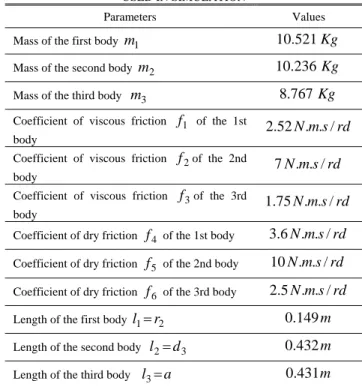
To show the contribution of the control by fuzzy logic (FL) and its improvements compared to the classical method, a simulation was approved on a model of a robot manipulator puma 600, for the first three DOF, whose parameters are presented on table I [12]. We considered a reference trajectory, ensuring continuity in position, velocity and acceleration, given by:
⎪ ⎪ ⎩ ⎪⎪ ⎨ ⎧ + + = + + = + + = ) 2 cos (sin 5 4 ) 2 sin (cos 4 2 ) 2 sin (sin 6 3 3 2 1 t t q t t q t t q d d d
For the classical method, we took the following parameters:
(
300,300,300)
; K diag(
35,35,35)
diag
Kp= v=
TABLE I
PARAMETERS OF THE PUMA 600 ROBOT MANIPULATOR USED IN SIMULATION
Parameters Values
Mass of the first body m1 10.521Kg
Mass of the second body m2 10.236Kg
Mass of the third body m3 8.767Kg
Coefficient of viscous friction f1 of the 1st body rd s m N. . / 52 . 2 Coefficient of viscous friction f2of the 2nd
body rd s m N. . / 7 Coefficient of viscous friction f3of the 3rd body rd s m N. . / 75 . 1
Coefficient of dry friction f4 of the 1st body 3.6N.m.s/rd
Coefficient of dry friction f5 of the 2nd body 10N.m.s/rd Coefficient of dry friction f6 of the 3rd body 2.5N.m.s/rd
Length of the first body l1=r2 0.149m
Length of the second body l2=d3 0.432m
Length of the third body l3=a 0.431m
Figure 3 (a, b, c), shows the behaviour of the robot in pursuit of the desired trajectory in both cases of the computed torque control (CTC), classical and by fuzzy logic (FLC). We see clearly that the control performances by fuzzy logic (FL) are better than those in the classical computed torque control (CTC); this is interpreted by the faster convergence of position tracking error to zero, in the case of fuzzy controller. The robot reaches the desired trajectory in a time less than that of classical control. We found similar results for the case of the pursuit in velocity and acceleration.
V.
Conclusion
In this article, we have presented a simple technique of control by fuzzy logic that contributes to improved performance of the linearizing control applied to robot manipulators.
The interest offered by the use of a fuzzy controller has been clearly demonstrated by the simulation results. The strategy of determination of gains control (with FLC) presents, compared with fixed gains (conventional CTC), the following benefits:
• A high gain is applied only when the variation is very important;
• If the variation is low, the gain is also low. The robustness of this control (FLC) lies in its adaptive character to the determination of gains from the
Ouamri Bachir, Ahmed-Foitih Zoubir
regulator, which means a direct adaptive control. These adaptive gains allow smoothing control signals thus, avoiding any solicitation of actuators.
0 0.1 0.2 0.3 0.4 0.5 0.6 0.7 0 0.5 1 1.5 2 2.5 3 3.5 E rr o r 1 (r ad)
Position tracking error 1
Time (s)
fuzzy control classical control
Fig. 3(a) First segment
0 0.1 0.2 0.3 0.4 0.5 0.6 0.7 0 1 2 3 4 5 6 E rro r 2 (r a d )
Position tracking error 2
Time (s)
fuzzy control classical control
Fig. 3(b) Second segment
0 0.1 0.2 0.3 0.4 0.5 0.6 0.7 0 2 4 6 8 E rr o r 3 (r a d )
Position tracking error 3
Time (s)
fuzzy control classical control
Fig. 3(c) Third segment
Figs. 3. Trajectory pursuits of position and position errors with the computed torque control law and that by the fuzzy logic
References
[1] Spong M. W. and M. Vidyasagar, Robot Dynamics and Control.
John Wiley and Sons, Inc., 1989.
[2] Egeland O., On the robustness of the computed torque technique in manipulator Control, Proc.IEEE. Intern. Conf. Robotics and
Automation, p. 1203-1208, 1986.
[3] SUFIAN Ashraf Mazhari., Surendra Kumar Member IEEE, Heuristic Search Algorithms for Tuning PUMA 560 Fuzzy PID Controller. International Journal of Computer Science, pp. 277-286, Jun. 2008.
[4] Hala Bezine., Nabil Derbel and Adel M. Alimi., Fuzzy control of robot manipulators: some issues on design and rule base size reduction. Engineering Applications of Artificial Intelligence, vol. 15, Issue 5, pp. 401-416, Sep 2002.
[5] G. Mkhoury, M. Saad, H. Y. Kannan, C. Asmar., Fuzzy PID control of a Five DOF Robot Arm, Journal of intelligent and
robotic systems, vol. 40, pp. 299-320, ISSN: 0921-0296, July
2004.
[6] Ben Ghalia M., Alouani A. T., A Robust Trajectory Tracking Control of Industrial Robot Manipulators Using fussy logic. IEEE
Trans. Robotics and Automation, 1995.
[7] Tang, Kwok L., Mulholland, Robert J., Comparing Fuzzy Logic with Classical Controller Designs. IEEE Trans. on SMC, Vol. 17,
no.6, pp. 1085-1087, 1987.
[8] Rakesh K Arya., Analytical Structures and Analysis of Simplest Fuzzy PD Controller with Asymmetrical/Symmetrical, trapezoidal/Triangular/Singleton Output Membership Function,
international journal of computational cognition, vol. 5, no. 2, pp.
10-24, June 2007.
[9] Moon B. S., Equivalence between fuzzy logic controllers and PI controllers for single input systems - Fuzzy sets and Systems, 69: 105-113, Elsevier Science, 1995.
[10] Petr Pivonka. May, Comparative analysis of fuzzy PI/PD/PID Controller Based on Classical PID Controller approach,
0 0.5 1 1.5 2 2.5 3 3.5 4 -6 -4 -2 0 2 4 6 8 10 Time (s) P o s iti on 2 ( rad)
Position tracking of the 2nd segment desired fuzzy control classical control 0.2 0.3 0.4 6 7 8 0 0.5 1 1.5 2 2.5 3 3.5 4 0 2 4 6 8 10 12 14 Time (s) P o s iti on 1 ( ra d)
Position tracking of the 1st segment desired f uzzy control classical control 0.15 0.2 0.25 0.3 4 5 6 7 8 0 0.5 1 1.5 2 2.5 3 3.5 4 -2 0 2 4 6 8 10 Time (s) P o s iti on 3 ( rad )
Position tracking of the 3rd segment desired fuzzy control classical control 0.2 0.3 0.4 0.5 7.5 8 8.5 9 9.5
Ouamri Bachir, Ahmed-Foitih Zoubir
Proceedings of IEEE international conference on fuzzy systems,
vol. 1, pp.541-546, 2002.
[11] Mamdani E. H., Application of Fuzzy Algorithm for Control of a Simple Dynamic Plant. Proc. Inst. Elect. Eng. Contr. Sci, Vol. 121, pp. 1588-1588, 1974.
[12] Kaddour E. L. , Simulation de la commande dynamique d’un bras manipulteur à 6 ddl appliqué au robot puma 600, USTO, 1995.
Authors’ information
1Faculté des sciences,Département de technologie, Université de Bechar, Bp 417, Bechar 08000, Algeria.
Email : [email protected]
2Faculté de génie électrique,
Laboratoire de robotique et de productique, Université des Sciences et de la Technologie d’Oran, 31000, Algeria.
Email: [email protected]
Ouamri Bachir was born in 1972 in Bejaïa,
Algeria. He received his BS degree from the Electrical Engineering Institute of the University of Bejaïa in 1998, and the MS degree from the University of Oran in 2004. He is currently Assistant Professor of Electrical and Computer Engineering at the University of Bechar (Algeria). His current research interest includes intelligent process control, teleoperation, telerobotic and automation.
Ahmed-Foitih Zoubir is a professor in the Department of Electronic
Engineering at the USTO, in Oran Algeria. His research activities include the intelligent process control teleoperation and telerobotic, automation, virtual realty and real time programming.