O
pen
A
rchive
T
OULOUSE
A
rchive
O
uverte (
OATAO
)
OATAO is an open access repository that collects the work of Toulouse researchers and makes it freely available over the web where possible.
This is an author-deposited version published in : http://oatao.univ-toulouse.fr/
Eprints ID : 10203
To link to this article : DOI:10.1007/s10750-013-1464-2 URL : http://dx.doi.org/10.1007/s10750-013-1464-2
To cite this version : Dézerald, Olivier and Talaga, Stanislas and Leroy, Céline and Carrias, Jean-François and Corbara, Bruno and Dejean, Alain and Céréghino, Régis Environmental determinants of macroinvertebrate diversity in small water bodies: insights from tank-bromeliads. (2013) Hydrobiologia . ISSN 0018-8158
Any correspondance concerning this service should be sent to the repository administrator: [email protected]
Environmental determinants of macroinvertebrate diversity
in small water bodies: insights from tank-bromeliads
Olivier Dézerald · Stanislas Talaga · Céline Leroy· Jean-François Carrias ·
Bruno Corbara · Alain Dejean · Régis Céréghino
Abstract The interlocking leaves of tank-forming bromeliads (Bromeliaceae) collect rainwater and detritus, thus creating a freshwater habitat for special-ized organisms. Their abundance and the possibility of quantifying communities with accuracy give us unparalleled insight into how changes in local to regional environments influence community diversity in small water bodies. W e sampled 365 bromeliads (365 invertebrate communities) along a southeastern to northwestern range in French Guiana. Geographie locality determined the species pool for bromeliad invertebrates, and local environments determined the
O. Dézerald · S. Talaga · A. Dejean
CNRS, Ecologie des Forêts de Guyane (UMR-CNRS 8172), Campus Agronomique, 97379 Kourou Cedex, France
C. Leroy
IRD-UMR AMAP (botAnique et bioinforMatique de l'Architecture des Plantes), boulevard de la Lironde, TA A-51/PS2, 34398 Montpellier Cedex 5, France
abundance patterns through the selection of traits that are best adapted to the bromeliad habitats. Patterns in community structure mostly emerged from patterns of predator species occurrence and abundance across local-regional environments, while the set of detriti-vores remained constant. W a ter volume bad a strong positive correlation with invertebrate diversity, mak:-ing it a biologically relevant measure of the pools' carrying capacity. The significant effects of incoming detritus and incident light show that changes in local environments (e.g., the conversion of forest to crop-ping systems) strongly influence freshwater commu-nities. Because changes in local environments do not affect detritivores and predators equally, one may expect functional shifts as sets of invertebrates with particular traits are replaced or complemented by other sets with different traits.
Keywords Freshwater biodiversity · Linear mixed effect modelling · Microcosms · Phytotelmata · Ponds
J.-F. Carrias · B. Corbara
Clermont Université, Université Blaise Pascal, BP 10448, 63000 Clermont-Ferrand, France
J.-F. Carrias · B. Corbara
CNRS, Laboratoire Microorganismes: Génome et Environnement (UMR-CNRS 6023), 63177 Aubière, France
Introduction
Ponds are subject to anthropogenic pressure (e.g., agriculture, industry, urbanism, deforestation) even though these ecosystems have obvious ecological functions (Hansson et al., 2005) and recognized social and economie uses (Chapman et al., 2001). In light of recent economie development, a major challenge is to understand the turnover of pond communities in relation to changes in local-regional environments and pond habitat characteristics (EPCN, 2008). More specifically, our ability to predict the responses of the biota to changes in landscape and aquatic habitat resources will contribute to the success of future conservation actions. Incoming detritus (e.g., leaf litter, an important food resource at the base of the food webs) and light regime (i.e., energy available for photosynthesis) play key roles in shaping community diversity in ponds through nutrient availability (Ruggiero et al., 2005). The surrounding land-cover ( <200 rn, Declerck et al., 2006) can therefore exp lain significant variation in pond community diversity, because the extent and nature of perennial vegetation affects allochthonous and autochthonous contribu-tions to the aquatic food webs through direct (nutrient inputs) and indirect (light) effects, ultimatel y changing the communities (Céréghino et al., 2008). However, the responses of biological communities to these variables also depend on interactions between envi-ronmental changes and intrinsic pond features, such as size (Oertli et al., 2002) or trophic status (Ruggiero et al., 2005).
It is challenging to study the effects of environ-ments on entire pond communities, first because different taxonomie groups with high species diversity do not respond equally to environmental changes (Oertli et al., 2002), and, second, because high population densities and the diversity of pond micro-habitats often preclude the accurate quantification of biological diversity (Oertli et al., 2005). To tackle
A. Dejean · R. Céréghino
Université de Toulouse, INP, UPS EcoLab (Laboratoire Ecologie Fonctionnelle et Environnement), 31062 Toulouse, France
R. Céréghino (121)
CNRS, EcoLab (UMR-CNRS 5245), 118 Route de Narbonne, 31062 Toulouse, France
e-mail: [email protected]
these issues, we focused on small, spatially discrete pools that are highly frequent and naturally span a broad range of environmental gradients. Bromeliaceae are flowering plants represented by 59 genera and sorne 3,140 species native mainly to the Neotropics (Givnish et al., 2011). The interlocking leaves of tank-bromeliads form pools that collect rainwater (from a few millilitres to a few litres), leaf litter and other organic detritus. These pools, or phytotelmata ("plant-held waters"), provide a habitat for aquatic organisms, notably bacteria, algae, fungi, protozoa, zooplankton, macroinvertebrates, and amphibians (Kitching, 2000; Frank & Lounibos, 2009). Because they host simple communities but yet contain multiple trophic levels, bromeliad pools and their aquatic biota have proven to be ideal model systems for studying the rules by which communities are assembled (Armbruster et al., 2002). While there bas been increasing interest in the study of habitat and the spatial distribution of invertebrates in ponds and pools (Boix et al., 2012), most studies have focused on one scale, e.g., a region (Trigal et al.,
2007), a network of ponds (Angélibert & Giani, 2003), or the sui table micro habitats within a pond (V an de Meutter et al., 2005). Our study focused on the macroinvertebrate communities inhabiting tank-bro-meliads in French Guiana, where the juxtaposition of contrasting environments (i.e., pioneer growths, plan-tations, savannahs, primary forest) offered us opportu-nities to analyse patterns of invertebrate diversity at multiple spatial scales. Specifically, we sampled 365 bromeliads (i.e., 365 invertebrate communities) repre-senting a range of food and habitat resources (i.e., amount of detritus and pool size), surrounding vegeta-tion (i.e., open to closed forest environments), and geographie locations (i.e., southeastern to northwestern French Guiana). Assurning that the bromeliads that grow in primary forests consistently receive higher litter inputs and lower incident radiation than bromel-iads in more open sites, we predicted that, for a given geographicallocation (or species pool), local environ-ments and bromeliad habitats shape community com-position and, more specifically, the proportions of detritivores and predators. To test these assumptions, multivariate ordination was used to interpret changes in the quantitative and qualitative structure of the macr-oinvertebrate communities in relation to geography. Then, we used linear mixed effect modelling to further examine the effects of small-scale variables on species richness and abundance and on predator:detritivore
ratios (both in tenDs of richness and abondance), while controlling the effects of SUIIUunding vegetaûon types ("site") and geography ("locality"). We discuss bro-meliad freshwater invertebrate diveJsi.ty and distribu-tion in the context of pond research and conservation in an attempt to dmw the attention of pond ecologists to
miniahJte pools tbat effeclively
nmror
whatcan
beseen
in larger systems.Materials aad methods Study
aœa
and bromeliadsThis study was conducted in French Guiana, East Amazonia, from March 2006 to October 2011. The climate is tropical moist with
3,000-3,400
mm ofyearly precipitation mainly distributed over 280 days. There i.s a major drop in rainfall between September and November and another shorter and more iiTegular dry period in March. The maximum monthly temper-ature averages 33.5°C (32.1-35.8°C), and the monthly minimum averages 20.3°C (19.7-21 °C).
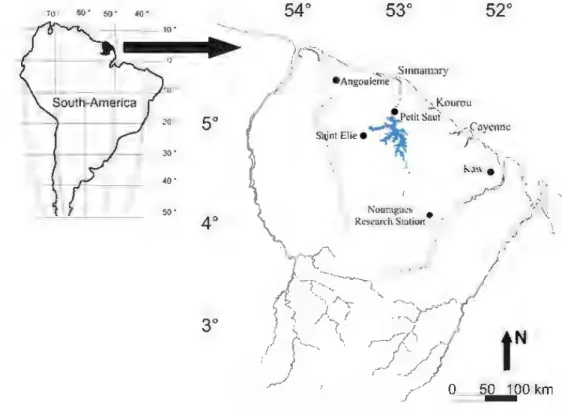
We selccted five sampling localitics distributed across a south-east to north-west range (Fig. 1) and
sampled 365 bromeliad pools in the understorey of
primary fo.rests, in pioueer growths, a rock savannah,
Fig. 1 Distribution of
sampling localities (Nouragues. Kaw, Petit
Saut. Angoulème. Saint
Elie) across a south-eastern to nordt-westem range in
Fmu:h Guiana
and plantations. Full descriptions of the Nomagues, Petit Saut and Kaw localiti.es and their bromeliads can be found in Bongers et al. (2001), Céreghino et al. (2011), and Browml et al. (2012), respectively. Saint Elie and Angoulème are Citrus grandi& plantations. The main characteristics of the sampling localiti.es, vegetation types (hereafter "sites", within localities) and number of sampled bromeliads are provided in Table 1. The
seven
bromeliad specics representedhere were either epiphytes ( <2 m above ground) or had taken root on the ground.
The percentages of total incident radiation above
the bromeliads (IR) were cal.culated using hemispher-ical photographs and an image processing
software
(Gap Light Analyzer 2.0) (Frazer et al., 1999),as
described in Leroy et al. (2009). To characterizehabitat size, we emptied the wells in each plant by sucking the water out (see invertebrate sampling) and recorded the corresponding volume of water (WV,
ml). In order to prevent the inftuence of seasonality (i.e., dry vs. rainy season) on water volume, we sampled bromeliad tanks that were full of water at the time of sampling. The amount of fine particulate organic matter (FPOM; 1000-0.45 J.1.111 in size, the food resources at the base of the food webs) was expressed
as
preserved volum.e (ml after decantation into graduated test-tubes; see also Paradise. 2004).Aquatic invertebrate communities
For both ethical (extensive sampling could des troy local populations) and legal reasons (the Nouragues Research Station is located in a nature reserve), we used a non-destructive sampling technique. To sample the water retained in the tanks, we used 5- and 10-ml micropipettes with the end trimmed to widen the orifice. Although less efficient than plant dissection, we and other researchers have already successfully used this technique (Céréghino et al., 2010; Jocqué et al.,
2010a). It was consistent! y used for ail of the samples. The samples were preserved in the field in 4% formalin (final concentration). The invertebrates were sorted in the laboratory and preserved in 70% ethanol. They were identified to genus, species or morphospecies and enumerated. Species abundance data were expressed as number of individuals per plant. lnvertebrate taxa were partitioned into predators (carnivorous species which attack and consume living prey organisms) and detri-tivores (species which sift fine particulates from the water column and/or gather FPOM from the accumu-lated debris), and these functional groups were used to calculate predator:detritivore richness ratios (PDRR) and predator:detritivore abundance ratios (PDAR). The distribution of invertebrate taxa (and the corresponding functional groups) among sites is given in the supple-mentary online material.
Data analysis
First, a correspondence analysis (CA; Jongman et al.,
1995) was used to ordinate the samples (bromeliads) according to macroinvertebrate morphospecies abun-dances (after log n
+ 1 transformation), thus
summa-rizing the variability of the data and providing insights for the elaboration of the subsequent richness and abundance models. The significance of the axes was determined at P<
0.05 by testing the eigenvalues of the inertia matrix. The plots of the first two ordination axes usually capture most of the variance and conse-quently contain most of the information that is likely to be interpretable (Waite et al., 2000). The bromeliads which were neighbours in the scatterplot were expected to host similar invertebrate communities. Conversely, the bromeliads that were separated from each other by a large distance were expected to be distant in the feature space based on their macroin-vertebrate communities.To further analyze the relationship between species richness, overall invertebrate abundance, PDAR and PDRR (dependent variables) and environmental vari-ables (independent varivari-ables), we used linear mixed effect modelling. "Site" (vegetation types) was nested within 'locality'. In contrast, a given bromeliad species could be sampled in many localities or many sites, therefore the variable "bromeliad species" was not nested within the former or the latter. Since "locality", "site", "site nested within locality" or "bromeliad species" (i.e., various spatial components) could be included as random factors, we conducted a model selection based on the Bayesian Information Criterion (BIC) of the full models (models considering ail environmental variables) for each dependent var-iable. This procedure allowed us to identify the spatial scale that best accounted for patterns for each dependent variable. Then, for a selected random factor (lowest BIC), the relationships between depen-dent and independepen-dent variables were explored using a stepwise backwards removal procedure and only the final models containing significant variables were presented. We used the glmer function in R software V.2.14.1 (nlme package) to analyse species richness and invertebrate abundance because these dependent variables followed a Poisson distribution. PDAR and PDRR were ranked because they were not normalized by the usual transformations (Aulchenko et al., 2007), and we used the lme function (lme4 package) to analyse these variables. Generalized linear mixed models with species richness and abundance were fit using the Laplace approximation while models with predator-to-prey ratios were fit using restricted max-imum likelihood (REML). Based on model residuals, the violation of homogeneity and normality was assessed graphically. All statistical analyses were evaluated under a 95% confidence level.
Results
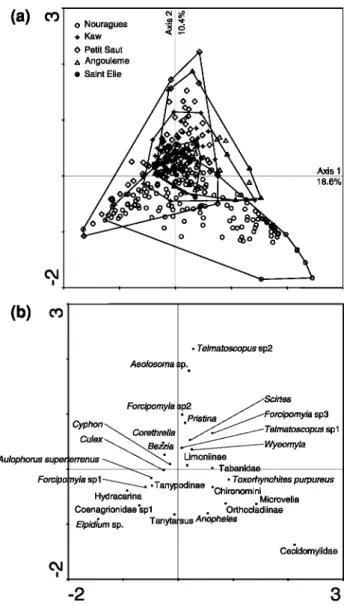
When a CA was carried out on the invertebrate abundance matrix (Fig. 2), the first two axes contrib-uted 18.6 and 10.4% to the overall variance, respec-tively. The distribution of invertebrate taxa (Fig. 2b) compared to the grouping of samples by locality (envelopes in Fig. 2a) showed that (i) with the exception of the Nouragues locality, invertebrate taxa found in species-poor localities (e.g., Saint Elie, Kaw)
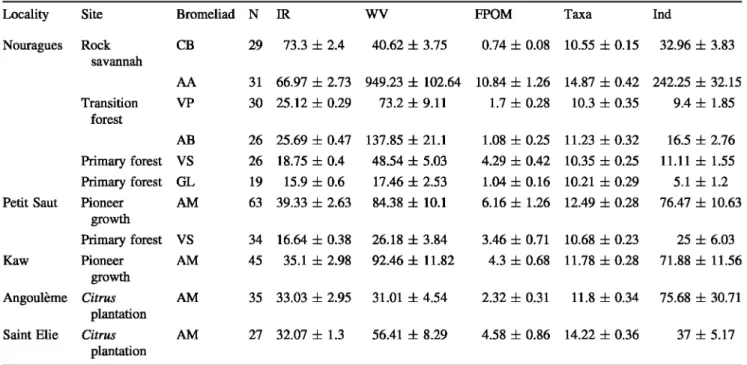
Table 1 Main characteristics of the sampling sites and plants sampled (seven bromeliad species)
Locality Site Bromeliad N IR
wv
FPOM Taxa IndNouragues Rock CB 29 73.3 ± 2.4 40.62 ± 3.75 0.74 ± 0.08 10.55 ± 0.15 32.96 ± 3.83 savannah AA 31 66.97 ± 2.73 949.23 ± 102.64 10.84 ± 1.26 14.87 ± 0.42 242.25 ± 32.15 Transition VP 30 25.12 ± 0.29 73.2 ± 9.11 1.7 ± 0.28 10.3 ± 0.35 9.4 ± 1.85 forest AB 26 25.69 ± 0.47 137.85 ± 21.1 1.08 ± 0.25 11.23 ± 0.32 16.5 ± 2.76 Primary forest
vs
26 18.75 ± 0.4 48.54 ± 5.03 4.29 ± 0.42 10.35 ± 0.25 11.11 ± 1.55 Primary forest GL 19 15.9 ± 0.6 17.46 ± 2.53 1.04 ± 0.16 10.21 ± 0.29 5.1 ± 1.2Petit Saut Pioneer AM 63 39.33 ± 2.63 84.38 ± 10.1 6.16 ± 1.26 12.49 ± 0.28 76.47 ± 10.63
growth Primary forest
vs
34 16.64 ± 0.38 26.18 ± 3.84 3.46 ± 0.71 10.68 ± 0.23 25 ± 6.03 Kaw Pioneer AM 45 35.1 ± 2.98 92.46 ± 11.82 4.3 ± 0.68 11.78 ± 0.28 71.88 ± 11.56 growth Angoulème Citrus AM 35 33.03 ± 2.95 31.01 ± 4.54 2.32 ± 0.31 11.8 ± 0.34 75.68 ± 30.71 plantationSaint Elie Citrus AM 27 32.07 ± 1.3 56.41 ± 8.29 4.58 ± 0.86 14.22 ± 0.36 37 ± 5.17
plantation
CB: Catopsis berteroniana; AA: Aechmea aquilega; VP: Vriesea pleiosticha; AB: Aechmea bromeliifolia; VS: Vriesea splendens; GL: Guzmania lingulata; AM: Aechmea mertensii; N number of plants sampled; IR incident radiation (% ); WV water volume extracted (ml); FPOM fine particulate organic matter (ml after decantation in test-tubes); Taxa number of taxa per plant. /nd number of individuals per plant. Values are means ± standard errors
were mostly subsets of the taxa found in richer localities (e.g., Angoulème, Petit Saut), (ii) a small set of detritivores (e.g., Culex spp., Wyeomyia spp., Cyphon sp1, Telmatoscopus sp1, Limoninae, Forc-ypomyia sp1, Aulophorus superterrenus) remained fairly common across localities and sites, and (iii)
localities with larger species pools (i.e., Petit Saut, Nouragues, Saint Elie) had additional detritivores (e.g., Tanytarsus sp., Telmatoscopus sp2, Anopheles sp., Orthocladinae, Elpidium sp., Aeolosoma), but notably included predators (e.g., Toxorhynchites pur-pureus, Microvelia spp., Tabanidae, Coenagrionidae) in the bromeliad communities.
Overall, mean invertebrate abundance was higher in open areas than in the primary forest understorey (see Table 1), while mean taxonomie richness showed little variability (10--14 morphospecies) between sites and localities; for instance, abundance was up to 48-times higher in A. aquilega bromeliads in a rock savannah (242.25 ± 32.15 individuals per plant) compared to G. lingulata in a nearby primary forest (5.1 ± 1.2 ind. planC1). Invertebrate abundance was also higher in pioneer growths and plantations (37 ± 5.17 to 76.47 ± 10.63 ind. planC1) than in the primary forest (up to 25 ± 6.03 ind. planC1).
The lowest BIC values were obtained with "local-ity" as the random factor for the species richness model (138.92; Table 2), and with "site" a random factor for the abundance, PDRR and PDAR models (14238.47, 1002.05, and 980.64, respectively; Table 2). Whatever the geographicallocality, the number of taxa per pool increased with water volume (P
<
0.0001; Table 3). Other variables were not significantly correlated with taxonomie richness in a given locality. At the scale of "site", there was a negative correlation between invertebrate abundance and the ratios IR:WV and WV:FPOM (P<
0.0001; Table 3). For a fixed water volume, the number of individuals per pool thus decreased with increasing incident radiation and amounts of FPOM. There was also a positive correla-tion between abundance and the ratio IR:FPOM(P
<
0.0001), so that, for a given light environment, invertebrate abundance increased with increasing amounts of FPOM. In terms of taxonomie richness, the predator to detritivore ratio (PDRR) had a mean value (±SE) of0.38 ± 0.01. In terms of abundance, the predator to detritivore ratio (PDAR) had a mean value of 0.27 ± 0.01. Both PDRR and PDAR increased with increasing water volume (P=
0.004 and P=
0.002, respectively) and decreased with increasing incident(a) M C\1 o Nouragues + Kaw <> Petit Saut "Angouleme • Saint Elie 1 ~---4---~---~ (b) ('1) • Telmatoscopus sp2 Aeo/osoma P·. ~Scil19s Forcipomyia p2 . .
~~
".P Forc1pomy1a sp3Culex~::
~Telmatoscopussp1 Wyeomyiaerrenus--..._ • Limoniinae
o T. •
Aulophorus supe
Forcip onyiasp1~TanYJ: od" • Toxorhynchites purpureus lnae ·chironomini
Hydracarina • • Microvelia Coenagrionidae sp1 • • Orthocladiinae ElpidÏum sp. T anyta sus Anopheles
Ce~idomyiidae
(\J
1
-2
3
Fig. 2 Correspondence analysis (CA) of invertebrate taxa and bromeliads (axes 1 and 2). Distribution of: a bromeliads according to geographical locations, and b taxa on the first two axes of the CA
Table 2 BICs of the full models with species richness, overall
invertebrate abundance, predator:detritivore richness ratio (PDRR), and predator:detritivore abundance ratio (PDAR) as dependent variables and four random effects: site, locality, the site nested within the locality (locality/site), and the bromeliad species
Models Random effects
Site Locality Locality/ Bromeliad
site species
Richness 143.57 138.92a 144.82 145.00
Abundance 14238.47a 16810.9 14244.28 15591.84
PDRR 1002.05a 1002.6 1007.04 1005.41
PDAR 980.64a 984.77 984.44 995.35
a Lowest BIC values
radiation (P
=
0.001 in both cases). Moreover, both models showed a positive and significant interaction between incident radiation and amounts of FPOM(P = 0.03 for the two models; Table 3).
Discussion
Not surprisingly, in our study there was a trend for invertebrate communities from different localities to exhibit differences in taxonomie composition and species abundance, a common pattern in freshwater invertebrate communities. Nevertheless, it is worth noting that patterns of taxonomie richness and overall invertebrate abundance mostly emerged from patterns of predator species occurrence and abundance across local/regional environments, while a set of generalist species remained relatively constant at lower trophic levels ("detritivores" sensu lata). Future research could therefore examine whether the composition of the biological traits of pond detritivores is independent of geography (on a regional scale) de spi te a spatial turnover in the taxonomie composition. If generalist detritivores share biological traits that determine sensitivity to disturbance (e.g., resistance to desicca-tion, dispersal ability), then larger changes in com-munity diversity could be expected under future regional development scenarios.
The model selection based on BICs for taxonomie richness and invertebrate abundance suggested that geographical locality determined the potential species richness for bromeliad pools, then local conditions (sites) determined species abundance patterns through the selection of traits that are best adapted to the bromeliad habitats. In general, ponds and pools tend to show positive species-area relationships (e.g., Ruggiero et al., 2008) with larger habitats being more easily colonized by immigrants (Drakare et al., 2006). W e also noted that, regardless of locality or site, water volume (habitat size) had a strong correlation with both invertebrate richness and abundance, making it a bio-logically relevant measure of the pools' carrying capacity. There was, however, a trend for pools with higher radiation incidence to accumulate more water
(WV to IR ratio, r = 0.32, P
<
0.05, log-transformed data) certainly because in open areas there are fewer overhanging trees to keep most or ail of the rain from reaching the bromeliads. Hence, even for a given bromeliad species and/or bromeliad size, the containersTable 3 Models assessing the influence of environmental variables and their interactions on the overall species richness, overall invertebrate abundance, predator:detritivore richness ratio (PDRR), and predator:detritivore abundance ratio (PDAR)
Fixed effect Estimate ± SE DF z p Random effect
Richness Locality Intercept 2.043 ± 0.067 359 30.334 <0.0001 Slope
wv
0.116 ± 0.013 359 9.117 <0.0001 Abundance Site Intercept 1.119 ± 0.35 350 3.198 0.0014 Slope IR -0.243 ± 0.05 350 -4.817 <0.0001wv
0.859 ± 0.04 350 17.18 <0.0001 FPOM 0.522 ± 0.066 350 7.957 <0.0001 IR:WV -0.061 ± 0.012 350 -4.961 <0.0001 IR:FPOM 0.142 ± 0.018 350 7.700 <0.0001 WV:FPOM -0.141 ± 0.007 350 -19.412 <0.0001 PDRR Site lntercept 1.067 ± 0.644 352 1.655 0.099 Slope IR -0.495 ± 0.168 352 -2.947 0.003wv
0.161 ± 0.055 352 2.908 0.004 FPOM -0.835 ± 0.386 352 -2.163 0.031 IR:FPOM 0.242 ± 0.108 352 2.231 0.026 PDAR Site Intercept 1.233 ± 0.656 352 1.879 0.061 Slope IR -0.542 ± 0.167 352 -3.239 0.001wv
0.173 ± 0.054 352 3.174 0.002 FPOM -0.831 ± 0.375 352 -2.215 0.027 IR:FPOM 0.231 ± 0.105 352 2.201 0.028Only significant variables are presented in the table (SE = standard error)
IR incident radiation, WV water volume, FPOM fine particulate organic matter
hold more water at sun-exposed sites. In any case, larger pools hosted more species, and richer pools contained higher proportions of large-bodied predators (e.g., Coenagrionidae damselfties, Tabanidae and Tox-orhynchites dipterans). In addition to their intrinsic value for biodiversity (e.g., damselfiies), predators satisfy the criterion of "more easily surveyed taxa" because they are mostly represented by large organisms. They are easier to observe and, thus, more difficult to overlook. Surrogacy, or how easily surveyed taxa do well at representing other taxa, is a critical question in pond conservation planning (Oertli et al., 2005). How-ever, Heino et al. (2005) demonstrated that congruence in species richness among freshwater taxa is generally
low, mainly because of their di:ffering responses to major environmental gradients. Our results therefore suggest a functional (rather than taxonomie) approach to surrogacy for small water bodies where the diversity of predators could be an efficient surrogate for the assessment of the broadest communities they belong to. Our models did show that the predator to detritivore ratio (both in terms of richness and abundance) is positively correlated with water volume, thus suggesting that predators largely account for patterns in overall diversity. As a first approximation, the number of predator taxa indeed shows linear relationships with the overall number of taxa (Pearson's r = 0.75). Hence, further analyses could test the relationship between the
species richness of predators and the overall invertebrate species richness in ponds and pools.
Detritus in the form of leaf litter is a main source of energy in tank-bromeliad ecosystems (Benzing,
2000). Debris-chewing invertebrates process incom-ing litter. Small particles of organic matter, includincom-ing faeces, then collect in the plant pools and are further processed in the gut of invertebrate collectors and filterers (Kitching, 2000). In a review of leaf traits and decomposition, Hattenschwiler et al. (20 11) reported that tree species native to French Guiana share traits that provide an exceptionally poor decomposer sub-strate. Citrus grandis (Saint Elie and Angoulème plantations) has an Asiatic origin, but the waxy coating of its leaves, and not its origin, probably accounts for its poor quality as a decomposer substrate. Therefore, leaf species origin probably has little or marginal effect on invertebrate community patterns. However, while the bromeliads in plantations and in the rock savannah had only one leaf species (Citrus grandis trees and Clusia minor shrubs, respectively), overhanging trees in pioneer growths (Vismia spp. Clusiaceae; Miconia sp. and Bellucia sp. Melastomataceae) and primary forests (mostly species from the Caesalpiniaceae family, namely Eperua spp., Vouacapoua americana, Dicorynia guianensis, and Hymenaea sp. and also species from the Burseraceae, Meliaceae, and Sapotaceae families) contributed a higher number of leaf species to individual iads. Although this aspect should be tested in bromel-iads pools, it has been demonstrated that leaf species mixtures decompose slightly faster than single leaf species in freshwater, a pattern determined by the responses of detritivores to resource heterogeneity (Sanpera-Calbet et al., 2009). Nevertheless, whilst bromeliads in primary forests consistently had more diverse leaf species and higher litter inputs than bromeliads in other sites, the amount of FPOM inside bromeliad pools from primary forests was not neces-sarily higher than those from more open areas (see, e.g., Aechmea aquilega and A. mertensii in a rock savannah and a plantation, respectively; Table 1). However, FPOM concentrations (the FPOM to WV ratios) show that bromeliads in primary forests had higher concentrations (0.011-0.018 ml FPOM/ml WV) than bromeliads in open areas (0.047--0.088 ml FPOM/ml WV). This indicates that particle concen-tration rather than amount sensu stricto affects species abundance. Hence, the ratio WV:FPOM negatively
correlated with invertebrate abundance at a given site (fewer individuals at a higher particulate con-centration for a fixed water volume), and inverte-brate abundance was the lowest at forested sites (higher FPOM concentrations). FPOM concentration is related to the extent of open water in small pools. Higher FPOM concentration could therefore decrease the amount of available space in tank-bromeliads to the detriment of open-water swimmers (culicid larvae are typically less abundant in FPOM-rich pools). The amount of FPOM is seen as a relevant indicator of available resources at the lower end of the food chain in plant-held waters (Frank, 1983; Céréghino et al.,
2010), and nutrient rich habitats are expected to sustain more species than nutrient-poor habitats (Par-adise, 2004). Hence, our results suggest that the relationship between FPOM and community diversity in small pools is not exclusively generated through trophic effects, but also through the physical quality of the habitats.
Throughout the world, ponds and pools come in ali shapes and sizes. Ecologists have a long history of documenting freshwater organisms from even the smallest pools like bromeliads (Picado, 1911), tree hales (Kitching, 1987) and rockpools (Jacqué et al.,
2010b) to the largest shallow lakes (Batzer & Wissinger, 1996). However, natural microcosms have on1y recently been exploited as "shortcuts" to high-lighting ecological patterns in nature (Srivastava et al.,
2004; Brendonck et al., 2010). The success of current and forthcoming pond action plans will be measured in terms of biodiversity and/or the status of target species of conservation interest. A related problem is the lack of understanding of the potential colonisation of rehabilitated systems by "desired" species and/or assemblages. Previous studies suggested that insect predators play an important role in small water bodies with rapid community development and strong abiotic constraints (Magnusson & Williams, 2009). The significant effects of water volume, fine detritus (amount and concentration), light environment, and certainly predation (this study) show that local-scale factors play a crucial role in shaping community structure, and, more importantly, that changes in local environments (e.g., the conversion of forest to crop-ping systems, pioneer growths along forest roads) strongly influence freshwater communities. Moreover, because local environments do not equally impact the abundance and richness patterns of detritivores and
predators, one may expect functional shifts ( e.g.,
nutrient dynamics in bottom-up vs. top-down controls) as sets of invertebrate species with particular traits are either replaced or complemented by other sets with different traits when shifting from forest under stories to anthropogenically-disturbed, open areas.
Acknowledgments We are grateful to the Nouragues Field
Station of the French Centre National de la Recherche Scientifique (CNRS) and to the lAboratoire Environnement de Petit Saut (HYDRECO) for their logistical help. This study bas benefited from an "Investissement d'A venir" grant managed by Agence Nationale de la Recherche (CEBA, ref. ANR-10-LABX-0025). Andrea Yockey-Dejean proofread the English text, and two anonymous reviewers made relevant comments on an earlier version of this paper.
References
Angélibert, S. & N. Giani, 2003. Dispersal characteristics of three odonate species in a patchy habitat. Ecography 26: 13-20.
Armbruster, P., R. A. Hutchinson & P. Cotgreave, 2002. Factors influencing community structure in a South American tank bromeliad fauna. Oikos 96: 225-234.
Aulchenko, Y. S., S. Ripke, A. Isaacs & C. M. van Duijn, 2007. GenABEL: an R library for genome-wide association analysis. Bioinformatics 23: 1294-1296.
Batzer, D. P. & S. A. Wissinger, 1996. Ecology of insect com-munities in nontidal wetlands. Annual Review of Ento-mology 41: 75-100.
Benzing, D. H., 2000. Bromeliaceae: Profile of an Adaptive Radiation. Cambridge University Press, Cambridge, UK. Boix, D., J. Biggs, R. Céréghino, A. P. Hull, T. Kalettka &
B. Oertli, 2012. Pond research and management in Europe - small is beautiful. Hydrobiologia 689: 1-9.
Bongers, F., P. Charles-Dominique, P. M. Forget & M. Théry, 2001. Nouragues. Dynamics and Plant-Animal Interac-tions in a Neotropical Rainforest. Kluwer Academie Pub-lishers, Dordrecht, The Netherlands.
Brendonck, L., M. Jocqué, A. Hulsmans & B. Vanschoenwin-kel, 2010. Pools 'on the rocks': freshwater rock pools as model system in ecological and evolutionary research. Limnetica 29: 25-40.
Brouard, 0., R. Céréghino, B. Corbara, C. Leroy, L. Pélozuelo, A. Dejean & J.F. Carrias, 2012. Understory environments influence functional diversity in tank-bromeliad ecosys-tems. Freshwater Biology 57: 815-823.
Céréghino, R., J. Biggs, S. Declerck & B. Oertli, 2008. The ecology of European ponds: defining the characteristics of a neglected freshwater habitat. Hydrobiologia 597: 1--6. Céréghino, R., C. Leroy, A. Dejean & B. Corbara, 2010. Ants
mediate the structure of phytotelm communities in an ant-garden bromeliad. Eco1ogy 91: 1549-1556.
Céréghino, R., C. Leroy, J.F. Carrias, L. Pélozuelo, C. Ségura, C. Bosc, A. Dejean & B. Corbara, 2011. Ant-plant
mutualisms promote functional diversity in phytotelm communities. Functional Ecology 25: 954-963.
Chapman, L. J., J. Balirwa, F. W. B. Bugenyi, C. Chapman & T. L. Crisman, 2001. Wetlands of East-Africa: biodiver-sity, exploitation and policy perspectives. In Gopal, B., W. J. Junk & J. A. Davis (eds), Biodiversity in Wetlands: Assessment Function and Conservation, Vol. 2. Backhuys Publishers, Leiden, The Netherlands: 101-131.
Declerck, S., T. De Bie, D. Ercken, H. Hampel, S. Schrijvers, J. VanWichelen, V. Gillard, R. Mandiki, B. Losson, D. Bauwens, S. Keijers, W. Vyverman, B. Goddeeris, L. De Meester, L. Brendonck & K. Martens, 2006. Ecological characteristics of small farmland ponds: associations with land use practices at multiple spatial scales. Biological Conservation 131: 523-532.
Drakare, S., J. J. Lennon & H. Hillebrand, 2006. The imprint of the geographical, evolutionary and ecological context on species-area relationships. Ecology Letters 9: 215-227. EPCN, 2008. The pond manifesta [free download at
http://campus.hesge.chlepcnlprojects.asp ].
Frank, J. H., 1983. Bromeliad phytotelmata and their biota, especially mosquitoes. In Frank, J. H. & L. P. Lounibos (eds), Phytotelmata: Terrestrial Plants as Host for Aquatic Insect Communities. Plexus Publishing Inc, Medford: 101-128.
Frank, J.H. & L. P. Lounibos, 2009. Insect and allies associated with bromeliads: a review. Terrestrial Arthropod Reviews 1: 125-153.
Frazer, G. W., C. D. Canham & K. P. Lertzman, 1999. Gap Light Analyzer (GLA) 2.0: Imaging Software to Extract Canopy Structure and Gap Light Transmission Indices from True-Colour Fisheye Photographs: Users Manual and Program Documentation. Simon Fraser University, Burnaby, BC, and the Institute of Ecosystems Studies, Millbrook, NY. Givnish, T. J., M. H. Barfuss, B. V. Ee, R. Riina, K. Schulte,
R. Horres, P. A. Gonsiska, R. S. Jabaily, D. M. Crayn, J. A. Smith, K. Winter, G. K. Brown, T. M. Evans,
B. K. Holst, H. Luther, W. Till, G. Zizka, P. E. Berry & K. J. Sytsma, 2011. Phylogeny, adaptive radiation, and historical biogeography in Bromeliaceae: insights from an eight-locus plastid phylogeny. American Journal ofBotany 98: 872-895.
Hansson, L. A., C. Bronmark, P. A. Nilsson & K. Âbjomsson, 2005. Conflicting demands on wetland ecosystem services: nutrient retention, biodiversity or both? Freshwater Biol-ogy 50: 705-714.
Hattenschwiler, S., S. Coq, S. Barantal & 1. T. Handa, 2011. Leaf traits and decomposition in tropical rainforests: revisiting sorne commonly held views and towards a new hypothesis. New Phytologist 189: 950-965.
Heino, J., R. Paavola, R. Virtanen & T. Muotka, 2005. Searching for biodiversity indicators in running waters: do bryo-phytes, macroinvertebrates, and fish show congruent diversity patterns? Biodiversity and Conservation 14:
415-428.
Jocqué, M., A. Kemahan, A. Nobes, C. Willians & R. Field, 2010a. How effective are non-destructive sampling meth-ods to assess aquatic invertebrate diversity in bromeliads? Hydrobiologia 649: 293-300.
Jacqué, M., B. Vanschoenwinkel & L. Brendonck, 2010b. Freshwater rock pools: a review of habitat characteristics,
faunal diversity and conservation value. Freshwater Biol-ogy 55: 1587-1602.
Jongman, R. H. G., C. J.F. Ter Braak & O. F. R. van Tongerenm, 1995. Data Analysis in Community and Landscape Ecol-ogy. Cambridge University Press, Cambridge, UK. Kitching, R. L., 2000. Food Webs and Container Habitats: The
Natural History and Ecology of Phytotelmata. Cambridge University Press, Cambridge, UK.
Kitching, R. L., 1987. Spatial and temporal variation in food webs in water-filled treeholes. Oikos 48: 280--288. Leroy, C., B. Corbara, A. Dejean & R. Céréghino, 2009. Ants
mediate foliar structure and nitrogen acquisition in a tank-bromeliad. New Phytologist 183: 1124-1133.
Magnusson, A. K. & D. D. Williams, 2009. Top-down control by insect predators in an intermittent pond - a field experiment. Annales de Limnologie- International Journal ofLimnology 45: 131-143.
Oertli, B., D. A. Joye, E. Castella, R. Juge, D. Cambin & J. B. Lachavanne, 2002. Does size matter? The relationship between pond area and biodiversity. Biological Conser-vation 104: 59-70.
Oertli, B., J. Biggs, R. Céréghino, P. Grillas, P. Joly & J.
B. Lachavanne, 2005. Conservation and monitoring of pond biodiversity: introduction. Aquatic Conservation: Marine and Freshwater Ecosystems 15: 535-540. Paradise, C. J., 2004. Relationship of water and leaf litter
vari-ability to insects inhabiting treeholes. Journal of the North American Benthological Society 23: 793-805.
Picado, C., 1911. Les broméliacées épiphytes comme milieu biologique. Comptes Rendus de l'Académie des Sciences de Belgique 153: 960--963.
Ruggiero, A., A. G. Solirnini & G. Carchini, 2005. The alter-native stable state concept and the management of Apen-nine mountain ponds. Aquatic Conservation: Marine and Freshwater Ecosystems 15: 625--634.
Ruggiero, A., R. Céréghino, J. Figuerola, P. P. Marty & S. Angélibert, 2008. Farm ponds make a contribution to the biodiversity of aquatic insects in a French agricultural landscape. Comptes Rendus Biologies 331: 298-308. Sanpera-Calbet, 1., A. Lecerf & E. Chauvet, 2009. Leaf diversity
influences in-stream litter decomposition through effects on shredders. Freshwater Biology 54: 1671-1682. Srivastava, D. S., J. Kolasa, J. Bengtsson, A. Gonzalez,
S. P. Lawler, T. E. Miller, P. Munguia, T. Romanuk, D. C. Schneider & M. K. Trzcinski, 2004. Are natural microcosms useful model systems for ecology? Trends in Ecology and Evolution 19: 379-384.
Trigal, C., F. Garcia-Criado & C. Femandez-Alaez, 2007. Macroinvertebrate communities of mediterranean ponds (North Iberian Plateau): importance ofnatural and human-induced variability. Freshwater Biology 52: 2042-2055. Van de Meutter, F., R. Stoks & L. De Meester, 2005. The effect
of turbidity state and microhabitat on macroinvertebrate assemblages: a pilot study of six shallow lakes. Hydrobi-ologia 542: 379-390.
Waite, 1. R., A. T. Herlihy, D. P. Larsen & D. J. Klemm, 2000. Comparing strength of geographie and nongeographic classifications of stream benthic macroinvertebrates in the Mid-Atlantic Highlands, USA. Journal of the North American Benthological Society 19: 429-441.