UNIVERSITÉ DU QUÉBEC À MONTRÉAL
LA PERFORMANCE DE LA LIVRÉE DES FORÊTS (MALACOSOMA DISSTRIA
HBN.) DANS UN CONTEXTE DE MIGRATION ENTRE CLONES DE
PEUPLIERS HYBRIDES (POPULUS SPP.) ET HÔTES NATURELS
MÉMOIRE
PRÉSENTÉ
COMME EXIGENCE PARTIELLE
DE LA MAÎTRISE EN BIOLOGIE
PAR
CATHERINE DION
,
-UNIVERSITÉ DU QUÉBEC À MONTRÉAL Service des bibliothèques
Avertissement
La diffusion de ce mémoire se fait dans le respect des droits de son auteur, qui a signé le formulaire Autorisation de reproduire et de diffuser un travail de recherche de cycles supérieurs (SDU-522 - Rév.01-2006). Cette autorisation stipule que «conformément à l'article 11 du Règlement no 8 des études de cycles supérieurs, [l'auteur] concède à l'Université du Québec à Montréal une licence non exclusive d'utilisation et de publication de la totalité ou d'une partie importante de [son] travail de recherche pour des fins pédagogiques et non commerciales. Plus précisément, [l'auteur] autorise l'Université du Québec à Montréal à reproduire, diffuser, prêter, distribuer ou vendre des copies de [son] travail de recherche à des fins non commerciales sur quelque support que ce soit, y compris l'Internet. Cette licence et cette autorisation n'entraînent pas une renonciation de [la] part [de l'auteur] à [ses] droits moraux ni à [ses] droits de propriété intellectuelle. Sauf entente contraire, [l'auteur] conserve la liberté de diffuser et de commercialiser ou non ce travail dont [il] possède un exemplaire.»
REMERCIEMENTS
Je tiens à remercier les nombreuses personnes qui m'ont appuyée tout au long de la maîtrise. En premier lieu, mon codirecteur, le Dr François Lorenzetti, qui m'a conseillée et encouragée du début à la fin. Mon directeur, le Dr Yves Mauffette ainsi que les membres de mon comité de correction les Drs Emma Despland et Timothy Work pour leurs conseils pertinents par rapport au projet. Mes aides de terrain qui m'ont soutenue dans les élevages de chenilles au sous-sol de l'IQAFF, Nadia Bergeron, Julie Poirier et Andrée-Anne Bock. Tous les gens qui m'ont aidée au laboratoire de biochimie au Pavillon Abitibi-Priee de l'Université Laval, Martin Charest, Paule Huron, Louis-Philippe Rodier, Gabriel Landry et Lauréanne Jacques. Pour leur aide statistique sur R et JMP, Pierre Mérian, Jonathan Boucher et Guillaume Perrette. Sans oublier toute l'équipe de l'IQAFF/ISFORT qui ont agrémenté mon séjour dans la Petite-Nation. Je n'en garde que de bons souvenirs ! Un énorme merci à mes parents qui malgré la distance ont toujours été là pour me soutenir et m'encourager à persévérer ! Bien entendu, un gros merci à toute la gang de la Petite-Nation et surtout du P'tit Café de l'Auberge sans qui ces deux années et quelques mois de maîtrise n'auraient pas été aussi agréables ! Merci beaucoup à John Dedes du Centre de foresterie des Grands-Lacs à Sault Ste Marie, qui nous a fourni les masses d'œufs de Livrée des forêts, de même qu'à Pierre Périnet, de la Direction de la recherche forestière du ministère des Ressources naturelles du Québec, pour les plants de peupliers hybrides, sans qui le projet n'aurait pas pu naître. Pour erminer, j'aimerais aussi remercier mes petites livrées, qui m'ont écoutée sans chigner pendant
AVANT-PROPOS
Ce mémoire de maîtrise est présenté sous la forme d'un article scientifique rédigé en anglais et intitulé : «Deployment of hybrid poplar plantations on cleared forest land : Lessons from a capital breeder insect folivore with plastic development time ». L'article sera soumis à la revue Forest Ecology and Management avec comme auteurs moi-même, François Lorenzetti, Yves Mauffette, Emma Despland et Éric Bauce.
Le design expérimental spécifique à l'étude, la réalisation des expériences, l'analyse de 1' ensemble des données, la réalisation des figures et la rédaction de l'article sous sa forme présente ont été effectués par moi sous la supervision du Dr. Lorenzetti et du Dr. Mauffette. Sous sa forme présente, 1' article a également été bonifié par les commentaires des réviseurs du mémoire, les Drs Rochefort et Guertin. Les Drs Despland et Bauce, co-auteurs de l'article, ont contribué au développement conceptuel de 1' étude avant sa réalisation. Le Dr. Bau ce a également supervisé les analyses chimiques réalisées dans son laboratoire.
Cette étude n'aurait pas été possible sans le support financier apporté au Consortium de recherche sur les insectes forestiers (iFor) par le Conseil de recherches en sciences naturelles et en génie du Canada (CRSNG), le ministère des ressources naturelles du Québec (MRNQ), le Conseil de l'industrie forestière du Québec (CIFQ) et la Société de protection des forêts contre les insectes et les maladies du Québec (SOPFIM).
TABLE DES MATIÈRES
REMERCIEMENTS ... .-... ii
AVANT-PROPOS ... iii
TABLE DES MATIÈRES ... iv
LISTE DES FIGURES ... : ... vi
LISTE DES TABLEAUX ... x
RÉSUMÉ ... xi
INTRODUCTION GÉNÉRALE ... 1
0.1 Problématique ... 1
0.2 État des connaissances ... 3
0 .2.1 Peupliers hybrides ... 3
0.2.2 Contenus en eau et en azote des feuilles ... 4
0.2.3 Livrée des forêts ... 5
0.2.4 Développement larvaire ... 5 0.3 Hypothèses ... 8 CHAPITRE I. ... 1 0 1.1 Abstract ... 11 1.2 Introduction ... 12 1.3 Methods ... 15
1.3 .1 Hybrid pop lars, natural host trees and leaf sampling ... 15
1.3.2 Insect material, rearings and host switching ... 16
1.3 .3 Larval performance ... 17
1.3.4 Water and nitrogen content ofthe foliage ... 18
1.3 .5 Statistical analyses ... 18
1.4 Results ... 20
1.4.1 Time and survivorship to, and weight at, pupation ... 20
v
1.4.3 Water and nitrogen contents in relation to larval performance ... 26
1.4.4 Hosts and insect phenologies ... 27
1.5 Discussion ... 29
1.5.1 Emerging growth model for the forest tent caterpillar ... 30
1.5.2 Switching hosts: instar-dependent or size-dependent? ... 33
1.5.3 Phenology ofFTC development and deployment of plantations ... 34
1.5.4 Resistance factors in light of the FIC response to an inadequate diet. 35 1.6 Conclusion ... 37 1. 7 Acknowledgements ... 3 9 1.8 References ... 56 CONCLUSION GÉNÉRALE ... 64 ANNEXE ... 68 RÉFÉRENCES ... 72
Figure 1.1
LISTE DES FIGURES
Map showing reg10ns of Quebec for which plantations of the hybrid poplar clones used in this study are recommended by the Quebec Ministry of Natural Resources. The limit between the northem and the southern zones, depicted by a thick white dashed line, is based on the delineation between major bioclimatic domains (Saucier et al., 2011 ). Northem clones (BMl, BM2 and MB3) are all hybridizations between P. bdlsamifera and P. maximowiczii. Southem clones (DNl, DN2 and DN3) are all hybridizations between P. deltoïdes and P. nigra. The underlying shades of green and red represent the various proportions ofbasal areas of quaking aspen (Populus tremuloides Michx.) and sugar maple (Acer saccharum Marsh), respectively. The darker the color, the greater the absolute combined basal areas of the two natural hosts of the FTC (Malacosoma disstria Hbn.). Yellows indicate equal contribution of quaking aspen and sugar maple to the absolute basal area. The location of the common hybrid poplar clones plantation in Ripon is indicated by a white star.
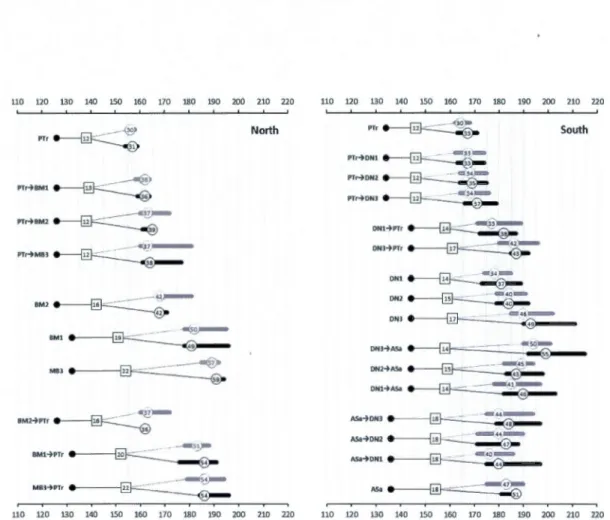
1.2 Pupal weight in relation to time to pupation for FTC larvae fed foliage of natural hosts ( quacking as pen or sugar maple ), hybrid poplar clones from a common plantation in Ripon, Quebec, or switching at the fourth instar from natural hosts to clones, or from clones to natural hosts. a) and b) : results from the northem experiment in which hybrid poplar clones recommended for the north of Que bec were tested. c) and d): results from the southem experiment in which hybrid poplar clones recommended for the south of Quebec were tested. Results of both experiments are presented separately for females (a) and c)) and for males (b) and d)). Replicate values are presented for each treatment. Bubble size indicates survival rate; the corresponding legend appears at the bottom right of graph d). Bubbles with thick outlines are replicate values for larvae fed foliage of natural hosts ( aspen, shown in green and sugar maple, shown in redor of hybrid poplar clones (Northem experiment clones: dark orange. Southem experiment
Page
clones: light orange.). Bubbles with thin outlines and with two colours are replicate values for larvae switching at the fourth instar from natural hosts to clones, or from clones to natural hosts. The colors on the left and right sides of the bubbles identify the host before or after switching, respectively. Power curves (thick black lin es) for the relationships between pu pal weights and time to pupation for larvae fed foliage of natural hosts or clones are presented, along with estimated equations, R-squared values and p values. Solid and dotted line boxes: spread in the X-Y plane of replicate values for larvae switching at the fourth instar from natural hosts to clones, or from clones to natural hosts (aspen to, or from, clones: green; sugar maple to, or from, clones: red), respectively. Colored zones represent size and time at pupation ranges on aspen (light green) and sugar maple (light tan) observed in other studies (Lorenzetti et al. 1999; Trudeau et al., 201 0) (see text for details) ... . 1.3 Results of canonical discriminant analyses, with time to pupation
(TP), pupal weight (PW) and survival rate (SR) of FTC larvae as independent variables, for the northern experiment (a: females; b: males) and the southern experiment, with aspen (c: females; d: males) or sugar maple (e: females; f: males) as the natural host. Feeding treatments were (P) aspen or (A) sugar maple (filled black circles ), (C) clones (filled black triangle), switching from (PC) aspen or from (AC) sugar maple to clones (empty circles), switching from clones to (CP) aspen or to (CA) sugar maple (empty triangles). Treatment means are indicated by a plus sign (+). 95 % confidence regions of the means are indicated by 1.4
1.5
circles ... . Mean (±SD) mortality rates before (B4) and after (A4) the fourth instar for FTC larvae in the northern and southern experiments. Data for the three clones in each experiment were grouped. PTr: quaking aspen (Populus tremuloides). ASa: sugar maple (Acer saccharum ). Asterixes above the bars indicate significant differences between B4 and A4 as determined by Wilcoxon signed-rank (pairwise) tests ... . (a) FTC mean larval weight (shown on a log scale) relationships with mean time to reach a given larval stage (instar) or pupation,
vii
41
46
1.6
i.e., growth trajectories, for the northern experiment. Each symbol represents the start of an instar, except for the symbols at the end of the growth trajectories, which are mean pupal weights. Bold growth trajectories: larvae fed foliage from quacking aspen (Ptr; solid line) or from northern hybrid poplar clones (BM 1, BM2 and MB3; dashed lines). Thin growth trajectories: larvae switching from aspen to clones (solid line) or from clones to aspen (dashed lines). Power curves for the relationships between larval weights and time since hatching for larvae fed foliage of natural hasts or clones at the start of the 2nct, 4th and the ultimate instars (bold !ines) were estimated on replicate treatment values and are presented along with equations and p- and R-squared values. The thin power curve for the ultimate instar includes data for larvae switching at the 4th instar from aspen to clones, or from clones to aspen. The dotted line represents the threshold size for pupation. (b) Time since hatching for larvae in the southern experiment: time to complete each of the first three instars (light grey); time to complete the 4th, 5t11, and 6th instars (black; note that only the larvae fed clone DN3, or switching from clone DN3 to natural hosts, completed an extra instar). ASa: sugar maple. DNl, DN2, and DN3: southern hybrid poplar clones. Only fe male pu pal
weight and time to pupation were
presented ... · ... . (a) The relationship, for the northern experiment, between the difference in larval size at the onset of the ultimate instar and an estimated threshold size to pu pate (Diftsize) and larval growth trajectories (GR), calculated as the observed growth rates during the 4th through the penultimate instar ( calculated on logged mean repli ca te weights) . The linear regression line has been estimated after an ANCOVA determined there were no differences between feeding treatments. (b) Between-instar weight ratios for the four feeding treatments in the northern experiment (Ptr: quaking aspen [ solid line]; clones [ dashed-dotted line]; Ptr to clones [ dashed line]; clones to Ptr [dotted line]). All ratios shawn backwards relative to the pupal stage (Pp/P_1: weight ratio between pupal weight and weight at the onset of the ultimate instar; PxiPx-I: weight ratio between weight at the onset of the X instar and weight
viii
at the onset of the X -1 instar. ( c) Relationships between pu pal weight and DiffSize. AN COV A analysis determined that the intercept for the combined Ptr and clones treatments (solid line) was different from that of the Ptr to clones treatment ( dashed line ). There was no significant relationship for the clones to Ptr
ix
treatment (dotted line)... .. . . .. . . .. 52 1.7 Hosts and FTC phenologies in the northern and southern
experiments: Julian day for larval hatch synchronized with budbreak (filled black circles) of quacking aspen (PTr), sugar maple (ASa), hybrid poplar northern clones (BMl, BM2 and MB3), and hybrid poplar southern clones (DNl, DN2 and DN3); Julian day for larvae to reach the 4th instar, when host switching was performed ( empty squares; values within indicate the number of da ys sin ce hatching); Julian day range for initiation of pupation (males: grey horizontal bars; females: black horizontal bars); Julian day to reach 50% of the larvae initiating pupation ( empty circles; values within indicate the number of days since the 41h instar). Gray zones represent pupation ranges on aspen and sugar maple observed in other studies (see text for details). Note: all male larvae pupated the same day in the BM2 to PTr
Table 1.1
LISTE DES TABLEAUX
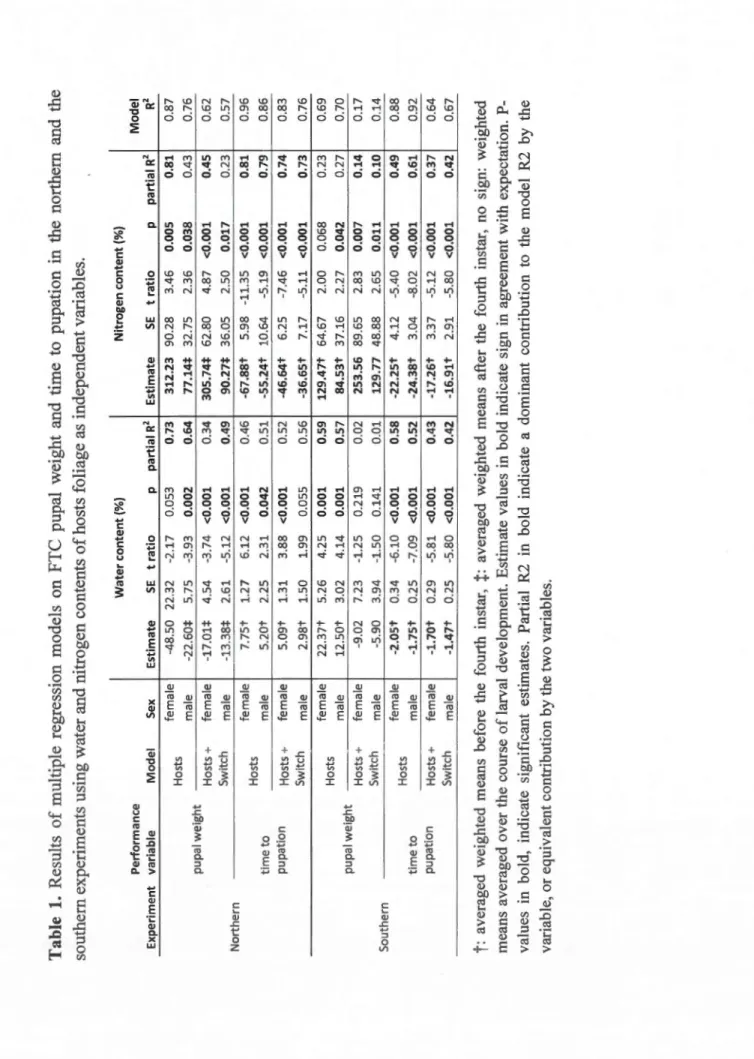
Results of multiple regression models on FTC pupal weight and time to pupation in the northern and the southern experiments using water and nitrogen contents of hosts foliage as independent
Page
RÉSUMÉ
Le déploiement des plantations de peupliers hybrides en milieu forestier les expose à un ensemble d'espèces d'insectes herbivores qui s'attaquent déjà aux arbres du genre Populus. La Livrée des forêts (Malacosoma disstria Hbn.) est un de ces insectes indigènes qui pourrait s'attaquer aux peupliers hybrides. La livrée étant généraliste dans ses habitudes alimentaires, les plantations de peupliers hybrides pourraient être attaquées tant en forêt boréale où le peuplier faux-tremble (Populus tremuloides Michx.) est abondant, qu'en forêt tempérée, où l'érable à sucre (Acer saccharum Marsh.) domine le paysage. Dans cette étude, la performance des larves de Livrée des forêts a donc été examinée sur ces hôtes naturels et sur les clones de peupliers hybrides recommandés pour les domaines bioclimatiques boréaux et tempérés du Québec. La performance a aussi été examinée lors de transferts des clones vers les hôtes naturels et des hôtes naturels vers les clones. Les clones recommandés pour le nord (hybridation entre P. balsamifera et P. maximowiczii) se sont avérés être résistants comparativement au peuplier faux-tremble. Les clones recommandés pour le sud (hybridation entre P. deltoides et P. nigra) ont montré une résistance intermédiaire entre le peuplier faux-tremble et l'érable à sucre. La résistance des clones était diminuée lorsque les larves de Livrée des forêts étaient transférées du peuplier faux-tremble vers les clones du nord ou du sud, mais ce ne sont pas toutes les variables de performance qui ont été affectées. Le dénominateur commun parmi toutes les réponses aux diètes était un allongement du temps de développement comparativement au meilleur hôte, le peuplier faux-tremble. Cette plasticité dans le temps de développement permet l'atteinte d'un poids minimal pour la pupaison. Une augmentation du temps de développement réduit la probabilité que les livrées s'étant alimentées sur les clones résistants se reproduisent avec celles s'étant nourrit de clones plus susceptibles, sur le peuplier faux-tremble et dans certains cas, avec des individus qui auront migré des peuplements naturels vers les plantations. Le risque de développer une contre-résistance pourrait augmenter sous ces conditions. Les stratégies de déploiement ont été discutées suite à ces résultats.
Mots-clés : Livrée des forêts, peuplier hybride, résistance, transfert de diète, poids critique
INTRODUCTION GÉNÉRALE
0.1 Problématique
Un des corolaires de l'aménagement écosystémique dans les forêts publiques est l'intensification de la production de bois sur de petites superficies. Cette sylviculture intensive est notamment rendue possible grâce aux arbres à croissance rapide tels que les peupliers hybrides (Populus spp.) qui, en plantation, permettent la récolte d'une grande quantité de bois sur une courte rotation et un petit territoire (Fortier, 2008). Outre pour leur croissance rapide, le programme d'amélioration génétique du peuplier de la Direction de la recherche forestière du ministère des Ressources naturelles du Québec (DRF-MRN) sélectionne des clones de peupliers hybrides pour leur rusticité, la qualité de leur bois, leur rectitude ainsi que leur résistance aux pathogènes (Réseau ligniculture Québec, 2011 ). Par contre, en ce qui a trait à la résistance des peupliers hybrides aux insectes, elle n'est pas encore considérée systématiquement dans la sélection des clones de peupliers hybrides.
Les espèces du genre Populus genus sont attaqués par de nombreuses espèces de pathogènes et d'insectes (Tillesse et al., 2007). Ils sont les hôtes d'environ 770 espèces d'insectes en Amérique du Nord. Au Canada, la Livrée des forêts a été identifiée comme étant un risque majeur pour les plantations de peupliers hybrides (Volney et al., 2005).
La Livrée des forêts (Malacosoma disstria Hbn.), un important défoliateur des peupliers naturels et d'autres feuillus, est endémique à toutes les régions du Québec méridional (sous le 49e degré de latitude) où l'on retrouve les plantations de peupliers hybrides (Cooke et Lorenzetti, 2006). Dans le sud de la province, elle s'attaque surtout aux érables à sucre (Acer saccharum Marsh. ), car cette espèce est dominante
2
dans le paysage, alors que plus au nord, elle s'attaque plutôt au peuplier faux-tremble
(P. tremuloides Michx.) qui est l'espèce feuillue qui domine dans ces régions. Les épidémies de Livrée des forêts pourraient s'étendre dans les plantations de peupliers
hybrides suite à une migration des larves pour s'alimenter ou encore par la ponte des
femelles directement sur ces peupliers hybrides.
Historiquement, les épidémies de Livrée des forêts ont été récurrentes aux 9 ans en
Abitibi-Témiscamingue et aux 13 ans en Estrie (Cooke et Lorenzetti, 2006). Au
Québec, la durée des infestations est en moyenne de 2.6 ans dans les ·régions où les
épidémies sont cycliques (Cooke et al., 2009). Considérant la durée des cycles épidémiques de la livrée dans le nord et le sud du Québec et qu'une rotation chez les
peupliers hybrides est généralement de 20 ans (Réseau ligniculture Québec, 2011 ), il
pourrait théoriquement y avoir deux épidémies dans les plantations dans les régions
plus au nord et une dans les régions du sud au cours d'une rotation. Une forte
défoliation par la Livrée des forêts peut causer une importante réduction de la
croissance radiale des peupliers faux-tremble (Cooke et Roland, 2007; Froelich et al.,
1955). De plus, la mortalité des peupliers faux-tremble est fonction du nombre
d'années consécutives de défoliation (Churchill et al., 1964; Moulinier et al., 2011). A cause des effets cumulatifs des défoliations consécutives, les effets sur les
plantations seraient probablement moindres dans le cas où les épidémies débuteraient
sur les hôtes naturels pour ensuite migrer vers les plantations en cours de cycle. Par contre, si la Livrée des forêts pond dès l'ini ia ion d'un cycle épidémiqu dans les plantations de peupliers hybrides, les effets sur la croissance et la mortalité des arbres pourraient être plus importants.
Mis à part les travaux réalisés au sein du Consortium de recherche sur les insectes forestiers (iFor) qui ont porté sur la préférence de la livrée en laboratoire envers différents clones de peupliers hybrides (Ralph, 2012; Rajalingham et al., 2011), il n'existe aucune étude sur le développement larvaire de la Livrée des forêts sur les
3
clones spécifiques au Québec pour lesquels une prise alimentaire a pu être démontrée. Les connaissances sur les facteurs chimiques de résistance des peupliers hybrides sont aussi peu nombreuses en général (Robison & Raffa, 1994, 1997) et inexistantes pour les clones spécifiques au Québec. En revanche, les espèces parentes américaines utilisées pour les croisements au Québec (P. deltoides, P. balsamifera et P. trichocarpa) sont toutes des hôtes, à divers degrés, des espèces du genre Malacosoma auquel appartient la Livrée des forêts (Burns & Honkala, 1990).
Dans un contexte écologique, le changement d'hôte entre les clones de peupliers hybrides et les hôtes naturels dominants dans chaque région est à considérer. Une modification du développement larvaire, soit au niveau de la fécondité (qui peut être inférée à partir du poids des pupes femelles) ou encore un effet sur la survie, pourrait influencer la dynamique épidémique. Une évaluation de la composition des feuilles en eau et en azote des différents hôtes pourrait amener des explications sommaires sur les différences développementales des larves sur chacun des hôtes. En effet, bien que les insectes qui s'attaquent aux peupliers sont affectés dans leur développement par les phénols glycosidiques produits par ces espèces forestières, les variations interclonales en azote chez ces hôtes se sont également avérées très importantes (Lindroth et al., 1987; Osier et al., 2000a,b ).
0.2 État des connaissances
0.2.1 Peupliers hybrides
Au Québec, le MRNQ a développé une quarantaine de clones adaptés pour les différentes régions et sous-régions écologiques (Périnet et al., 2007). Pour le sud du Québec, ce sont surtout les clones issus du croisement entre P. deltoides et P. nigra
4
qui sont les m1eux adaptés, tandis que pour le nord du Québec, ce sont les croisements entre P. balsamifera et P. maximowiczii qui dominent.
Les deux seules études qui ont concerné la performance de la Livrée des forêts sur des peupliers hybrides (Robison et Raffa, 1997, 1994) portaient sur des clones et des croisements différents de ceux utilisés au Québec. Il est donc difficile de faire des prédictions spécifiques sur la performance des larves de Livrée des forêts sur les différents clones de peupliers hybrides recommandés au Québec. Par contre, certaines études démontrent une plus grande résistance aux insectes chez les clones de peupliers hybrides contenant P. maximowiczii (Broberg et Borden, 2005; Kruse et Raffa, 1996; Ramirez et al., 2004; Robison et Raffa, 1994).
0.2.2 Contenus en eau et en azote des feuilles
L'azote est un élément essentiel à la croissance des organismes étant donné qu'il est un important constituant des protéines (Mattson, 1980). Une diète faible en protéines et par le fait même en azote, limite en effet la croissance des larves de la livrée (Colasurdo et al., 2009). Selon Hemming et Lindroth (1995), il y aurait une corrélation positive entre la concentration en azote et le poids des pupes. Il y aurait aussi une corrélation positive entre la performance des larves et le contenu en eau des feuilles (Scriber & Slansky, 1981). Par contre, les contenus en eau et en azote co-varient dans le temps à l'échelle de l'arbre, de même qu'avec certains composés
secondaires (Mattson & Scriber, 1987). Ainsi, il est difficile de présumer d'une
5
0.2.3 Livrée des forêts
Les larves de Livrée des forêts émergent au début du printemps, généralement en
synchronie avec le débourrement de leur hôte primaire. Le cycle larvaire s'étire
jusqu'au milieu de 1' été en passant par généralement 5 à 6 stades. Elles passeront 1 0 à
15 jours sous forme de chrysalides à l'intérieur d'un cocon. Une fois adulte, la Livrée
des forêts ne s'alimente pas, elle s'accouple et meurt après quelques jours (Fitzgerald,
1995). Une seule masse d'œufs est produite par femelle, contenant entre 80 et 480
œufs (Witter et Kulman, 1969). Les Livrées des forêts passent l'hiver sous forme de
larves pharates (Fitzgerald, 1995). Lors des épidémies, si la nourriture vient à
manquer, elles migreront vers de nouveaux arbres. Ceci se fait surtout au 4e et Se
stade larvaire, stades auxquels la prise de nourriture est plus importante (MRNQ,
2013).
0.2.4 Développement larvaire
La performance des larves peut être évaluée par le poids de la chrysalide, notamment
chez un insecte qui ne se nourrit pas à 1' état adulte et dont les réserves accumulées
durant la vie larvaire vont déterminer la fécondité (Fitzgerald, 1995 ; Colasurdo et
al., 2009). Les espèces d'insectes qui ont évolué vers cette stratégie sont référées
comme des capital-breeders dans la littérature scientifique anglophone. Ainsi, chez cette catégorie d'insectes, le poids des femelles est corrélé fortement et positivement
avec leur fécondité (Honek, 1993). Une bonne performance larvaire peut aussi être
représentée par un court temps de développement, ce qui aura pour effet de diminuer
la susceptibilité des larves aux ennemies naturels (Parry et al., 1998). La performance
6
donc la composition en eau et en azote de l'hôte sur lequel elles s'alimentent, est
déterminante.
Malgré le fait que le peuplier faux-tremble et l'érable à sucre soient les hôtes naturels
de la Livrée des forêts, ses performances larvaires sont meilleures sur le peuplier
faux-tremble que sur l'érable à sucre. En effet, le temps de développement des larves
est plus long lorsqu'elles s'alimentent sur l'érable à sucre et la masse pupale est plus
faible (Lorenzetti et al., 1999; Trudeau et al., 2010).
La qualité de la diète durant les premiers stades larvaires est un facteur
particulièrement important dans la performance globale du développement larvaire
(Zalucki et al., 2002) et ceci est particulièrement bien démontré par les études sur la synchronisation entre le début de 1 'alimentation et le débourrement des hôtes (V an Asch & Visser, 2007). Par exemple, une mauvaise synchronisation chez la livrée entraîne une prolongation de la période larvaire et parfois l'ajout de stades, de même
qu'une faible masse pupale ainsi qu'un plus haut taux de mortalité (Jones et
Despland, 2006).
En ce qui a trait aux études sur les changements d'hôtes au cours du développement
larvaire, une tendance ressort concernant l'importance de l'hôte consommé et du
moment auquel l'hôte est consommé durant le cycle larvaire (Hwang et al., 2007; Stoyenoff et al., 1994a,b) : l'hôte consommé en début de dé eloppement s'avère
d'une grande influence sur la performance globale. Ceci est dû aux différences dans la qualité nutritionnelle et le contenu en métabolites secondaires selon l'âge des feuilles ainsi que la sensibilité des larves selon leur stade à ces variations phénologiques dans la diète.
7
Le concept de résistance
Le concept de résistance aux insectes est utilisé autant en foresterie' qu'en
agriculture. La résistance est définie comme_ la capacité d'une plante à limiter les dommages fait par les insectes ainsi qu'à diminuer son intérêt comme plante hôte pour ces insectes (Painter, 1951). Cette capacité de la plante est exprimée par des traits fonctionnels qui peuvent être autant physiques que chimiques. La présence de poils, d'épines ou encore de toxines peuvent conférer une résistance à la plante face
aux insectes. De plus, la résistance est considérée comme relative, c'est-à-dire que pour statuer qu'un arbre est résistant à une espèce d'insecte, il faut le comparer à un autre arbre sur lequel on observe des dommages plus importants causés par ces mêmes insectes (Owens, 1975).
Ceci dit, la résistance peut aussi être évaluée au niveau des conséquences qu'elle a sur les insectes (Beek, 1965). D'ailleurs, l'une des trois catégories de résistance des plantes aux insectes selon Painter (1951), soit l'antibiose, implique nécessairement la mesure des effets délétères sur l'une ou l'autre des variables de performance suite à
l'alimentation. Plus récemment, Larson (2002), traitant de la résistance des arbres
aux insectes en relation avec leur longévité plus grande que celle des plantes
agricoles, abonde dans le sens de Beek (1965). Sur un hôte hautement favorable, les
insectes se développement rapidement, atteignent un poids élevé, ont un haut taux de
fécondité et ont un faible taux de mortalité. À l'inverse, les insectes utilisant un hôte
résistant auront une plus faible performance, soit un développement ralenti, un faible
taux de fécondité, un taux de mortalité plus élevé, ou une combinaison de ces
réponses. Dans ce mémoire, la résistance des clones de peupliers hybrides sera
mesurée selon la performance de la Livrée des forêts sur ceux-ci relativement à sa performance sur ses hôtes naturels, le peuplier faux-tremble et l'érable à sucre.
8
1
Le concept de résistance, bien que développé initialement dans un contexte d'amélioration
des végétaux utilisés en agriculture, est toujours d'actualité en sciences forestières, de même
que l'utilisation de cette terminologie. Par exemple, un important congrès international sur la
résistance des arbres s'est tenu en 2011, à Eugène, en Orégon : The Fourth International
Workshop on the Genetics of Host-Parasite Interactions in Forestry: Disease and Insect
Resistance in Forest Trees (http://www.fs.fed.us/psw/publications/documents/psw_gtr240/).
0.3 Hypothèses
La meilleure performance de la Livrée des forêts sur le peuplier faux-tremble que sur
l'érable à sucre n'étant plus à démontrer (Lorenzetti et al. 1999; Trudeau et al., 201 0), aucune hypothèse à ce niveau ne sera formulée. D'autre part, l'objectif de cette étude n'étant pas d'examiner la performance de l'insecte sur les différents clones, mais bien entre les clones et les hôtes naturels, aucune hypothèse n'est avancée au niveau des variations clonales dans la résistance à la livrée. Ceci dit, on s'attend à une résistance à la Livrée des forêts plus importante chez les clones du nord considérant les espèces
parentes utilisées. Les clones contenant le parent P. maximowiczii montrent une plus
grande résistance à la Livrée des forêts (Robison et Raffa, 1994) et à d'autres insectes (Broberg et Borden, 2005; Kruse et Raffa, 1996; Ramirez et al., 2004). De plus, les
clones contenant P. balsamifera dans l'étude de Robison et Raffa (1994) montrent
aussi une certaine résistance contre la livrée. Chez les clones du sud, P. deltoïdes est
un hôte naturel de la livrée (Morris et al., 1975) tandis que pour P. nigra, aucune
résistance particulière à la livrée n'a été déterminée.
Dans cette étude, il est apparu utile de formuler des hypothèses qui, si elles sont
confirmées, permettraient d'anticiper les réponses de la Livrée des forêts dans un
9
d'hôtes naturels. Considérant l'importance de la diète pour les premiers stades
larvaires et la plus grande capacité des larves plus âgées de la livrée à migrer d'un
hôte à l'autre, deux hypothèses générales sont formulées
+
Hypothèse 1: La performance des larves ayant fait un changement de diète au cours de leur développement sera similaire si la performance sur le clone est de valeur égale à celle observée sur l'hôte naturel alors qu'elle seraintermédiaire aux performances sur le clone et l'hôte naturel si elles différent
sur ces hôtes.
+
Hypothèse 2: Les larves s'étant alimentées de l'hôte de qualité supérieuredurant les premiers stades larvaires seront plus performantes que celles ayant
fait le changement de diète dans le sens inverse.
Enfin, il est attendu de façon générale que la performance larvaire soit meilleure sur
CHAPITRE I
DEPLOYMENT OF HYBRID POPLAR PLANTA TI ONS ON CLEARED FOREST LAND: LESSONS FROM A CAPITAL BREEDER INSECT FOLIVORE WITH
PLASTIC DEVELOPMENT TIME
Catherine Dionl,S, François Lorenzetti2'5*, Yves Mauffette1'5, Emma Despland3'5, and Éric Bauce4'5
'Université du Québec à Montréal, Département des sciences biologiques, Montréal (Québec) H3C 3P8, Canada.
2
Institut des Sciences de la Forêt tempérée (ISFORT), Université du Québec en Outaouais, Département des sciences naturelles, Ripon (Québec) JOV 1 VO, Canada. 3Concordia University, Department of Biology, Montréal (Québec) H4B 1R6, Canada.
4
Université Laval, Département des sciences du bois et de la forêt, Québec (Québec) G 1 V OA6, Canada.
5
iFor Research Consortium (http://www.consortiumifor.ulaval.ca/)
11
1.1 Abstract
Deploying hybrid poplar plantations on cleared forest land expose them to a suite of insect herbivores which can have tree species from the natural forest matrix and Populus Spp. as shared hosts. The most ubiquitous defoliator in North America is the forest tent caterpillar (FTC; Malacosoma disstria Hbn.). This native insect feeds on most deciduous trees species, especially on quaking aspen (Populus tremuloides Michx.) and on sugar maple (Acer saccharum Marsh.). In this study, the performance of FTC larvae was examined on both these natural hosts and on clones recommended for Quebec's bioclimatic domains in which the natural hosts are the dominant deciduous species. Performance was also examined in experiments where FTC larvae switched from clone to natural hosts and from the latter to the former. Northern recommended clones (hybridizations between P. balsamifera and P. maximowiczii) were found to be relatively resistant compared to aspen. Southern recommended clones (hybridizations between P. deltoïdes and P. nigra) expressed intermediate resistance relative to aspen and sugar maple. Clone resistance was reduced when FTC larvae switched from aspen to northern or to southern clones, but not ali performance variables were affected. They had lower pupal weight compared to aspen but took less time to reach pupation and had better survival than when fed only on clones. The one common denominator across ali feeding treatments was extended development time compared to the preferred host, aspen. This plasticity in development time allows FTC larvae to reach a minimal size at pupation. However, the FTC is a capital breeder; hence its window of opportunity for reproduction is very short. An increase in development time thus reduces the likelihood of FTC that fed on resistant clones of reproducing with individuals that fed on more susceptible clones, on aspen, and even in sorne cases with individuals that would have migrated from natural stands to
planta ions. The risk of counter-r sistanc d velopment is expected to increase under
these conditions. Deployment strategies are discussed in light of these results.
Keywords: forest tent caterpillar, hybrid poplar, host switching, critical size, fast
12
1.2 Introduction
Fast-growing tree plantations have been steadily increasing in many countries during the last decade. In addition to the traditional uses of poplars for timber, bioenergy production, and environmental protection (windbreak, soil eros10n and phytoremediation), hybrid poplar (Populus spp.) plantations are efficient solutions for carbon sequestration (FAO, 2012). In 2012, the total area of planted poplars worldwide reached 8.6 million ha with close to 90% found in China al one (F AO, 2012). In Europe, poplar plantations extend over more than 800 thousand ha. In Canada and in the United States, fast-growing tree plantations are still modest with sorne 45 thousand ha in 2012, but they are found in many provinces (Larocque et al., 2013) and states (Berguson et al., 2010). In Quebec, poplar cultivation greatly increased in the 2000's to reach 1 to 1.5 million ofhybrid poplar trees delivered every year by the Ministry ofNatural Resources (Derbowka, 2012). Since the beginning of the poplar improvement program at the Ministry in 1969, more than 5,000 clones have been evaluated, and over 40 different clones have been released for use in plantations (Périnet et al., 2007). The great majority of these trees are planted on cleared forest land in Quebec.
Trees in Populus genus are attacked by numerous pathogens and insects (Tillesse et al., 2007). They are hosts to sorne 750 species of insects in North America. Hybrid poplar plantations in Canada are presently a small addition to the 30.3 million ha of
native poplars and aspens already present in natural forests, the largest Populus area
in the world (F AO, 20 12). Hybrid poplar plantations in Minnesota, USA, are part of a
landscape where quaking aspen (Populus tremuloides Michx.) dominates over 2.5
million ha and sugar maple (Acer saccharum Marsh.) and other deciduous trees over 1.5 million ha (Miles et al., 2002). In Quebec, hybrid poplar clones have been
- - - -- -- - - - --
-13
aspen-dominated landscapes of the boreal forest to the sugar maple-dominated landscapes of the temperate deciduous forest. The most ubiquitous indigenous defoliator to occur in the majority of the areas of North America where hybrid poplar plantations are located is the forest tent caterpillar (FTC; Malacosoma disstria Hbn.). Outbreaks by this insect can extend over millions of hectares. In the past forty years, there has been an on-going outbreak 70 to 97 % of the time in Alberta, Ontario and Quebec (National forestry database, 2013). Minnesota forests have been hosts to
eleven FTC outbreaks in the last 120 years (Minnesota Department of Natural
Resources, 2013). An analysis of the FTC historical defoliation records (1938-2002) for Quebec indicated that outbreaks occur cyclically every 9 years in the northwest region dominated by quaking aspen, and every 13 years in the south where sugar maple dominates (Cooke and Lorenzetti, 2006). Defoliation by the FTC causes important radial growth reductions (Barter and Cameron, 1955; Cooke and Roland,
2007; Duncan and Hodson, 1958; Froelich et al., 1955; Hogg, 1999; Pollard, 1972;
Witter, 1979) and mortality (Churchill et al., 1964; Man and Rice, 201 0; Moulinier et al., 2011; Reinikainen et al., 20 12) in quaking as pen and in sugar maple (Bau ce and
Allen, 1991; Hartmann and Messier, 2008; Wood et al., 2009).
In Canada, FTC has been identified as one of the major threats to hybrid poplar plantations (Volney et al., 2005). Considering the ubiquity of the FTC in North
American landscapes, its outbreak status recurrence in many areas, and the risk this
insect poses to hybrid poplar plantations, it is rather surprising ha relatively li le
attention has been given to the FTC-hybrid poplar interaction (Constabel et al., 2000;
Robison and Raffa, 1997, 1994; Wang and Constabel, 2004). In the present study, a
holistic approach to this interaction has been adopted. The presence of quaking aspen
and sugar maple in the forest cover and the ontogenie behavior shift of the FTC to
migrate during the later stages of its larval life (Despland and Hamzeh, 2004)
emphasize the importance of studying hybrid poplar clones in the context of its
14
clone resistance will likely not be enough to prevent defoliation by this insect. FTC is well known to defoliate many other species when preferred hosts have been consumed during phases of high density populations (Hodson, 1941; Stehr and Cook,
1968). lndeed, late instar larvae have been seen to feed on white spruce under such conditions (F. Lorenzetti, persona! observations), and even on the usually completely avoided red maple (Nicol et al., 1997; Wink and Allen, 2007). However, it can be anticipated that as the areas planted with hybrid poplar clones increase in size within the forest matrix, endemie FTC populations will be present in those plantations and migrations of larvae from natural forests will occur. For such short-rotation plantations, every year without defoliation, even light to moderate, is a gain towards the benefits of high-yield expected from them. It would thus be of considerable advantage to know beforehand the responses of FTC larvae in the context of plantations imbedded in a forest matrix in which the insect is already present. Considering the low number of studies on FTC on hybrid poplars, it is important to know which performance variables (survival, development time and pupal weight/fecundity) are the most affected to understand the likely dynamics of this insects in plantations. This information is also critical to supp01i the design of deployment strategies that minimize the risk of development of counter-resistance in the insect.
In the present study, the performance of FTC larvae was examined on hybrid poplar clones developed and recommended by the Quebec Ministry ofNatural Resources for the north (aspen-dominated) and for the south (sugar maple-dominated) of the province. The relative resistance of these clones towards FTC was compared to larval performances observed on the insect's natural hosts and when switching from the selected clones to the natural hosts, and when switching from the natural hosts to the selected clones. The results presented here are applicable in other areas where hybrid
poplar plantations are being developed and eruptive species of defoliators are part of
15
1.3 Methods
1.3 .1 Hybrid pop lars, natural host trees and leaf sampling
Hybrid poplar material were from a common plantation established in 2008, either from bare-rooted plants (clones of the northern experiment) or from cuttings (clones of the southern experiment), in Ripon, Quebec, Canada. Plant material was provided by the Direction de la recherche forestière of the Quebec Ministry of Natural Resources. The location of the plantation (45.78331 N, -75.08780 W) is at the transition between the sugar maple-basswood and the sugar maple-yellow birch bioclimatic do mains (Saucier et al., 2011 ), th us at the limit between the northern and southern zones for hybrid poplar deployment in Quebec, as depicted on the map in Figure 1.1. The mean annual temperature at the closest station (13 km) is 3. 9°C and the mean annual precipitation is 1105.3 mm (climate normals 1971-2000; Environment Canada, 2013). The trees were aged 4-5 years at the time of the experiments. Leaf material of the natural hosts of the FTC, quacking as pen and sugar maple, were from trees growing in natural stands also located in Ripon. The aspen stand was composed of 10-20 years old trees and the sugar maple stand was composed of ca. 70 years old mature trees.
Three hybrid poplar clones recommended for the north of the province of Quebec were used for the northern experiment. These clones (hereafter denoted BM1, BM2
and MB3) are all from hybridizations between P. balsamifera and P. maximowiczii
(BxM for the two firsts and MxB for the last one, the first letter indicating female
parentage). Three hybrid poplar clones (DN1, DN2 and DN3) recommended for the
south of the province of Quebec were used for the southern experiment, each from
hybridizations between P. deltoïdes and P. nigra (DxN). Clone selection was based
16
20 12), on the frequency of use of these clones in plantations from recent years, as well as on their suitability to be planted across several Quebec bioclimatic domains (Fig.l).
Leaf material to feed the FTC larvae in the Ripon laboratory was collected at the edge of selected trees to avoid light limited leaves. Selected trees were all vigorous with green and healthy leaves. Leaves were collected in the morning about every two to three days, or as soon as they were no longer turgescent in the laboratory or entirely consumed. Collected leaves were maintained in florist vials filled with distilled water. At each collection, leaves were collected from sets of different trees to minimize possible induction of plant defenses. Throughout the experiments, except at leaf flush, leaves of intermediate phenological age were selected from the clones and from aspen to minimize differences in phenology among hosts. However, in the case of sugar maple, which has determinate growth, leaves increased in maturity with time.
1.3.2 Insect material, rearings and host switching
FTC egg masses used for the southern experiment were collected on sugar maple from outbreak populations in southern Ontario and were obtained from the Canadian
Forest Service Great Lakes Forestry Centre in Sault Ste. Marie, Ontario. Egg masses
for the northern experiment were produced by insects of the same origin but reared on
aspen for one cycle in the Ripon laboratory. Egg masses were stored at 0 ± 2°C until
needed. Before they were transferred at 21 ± 1 °C for hatching, the spumaline that
covers the egg masses was removed with a razor blade and egg masses were
surface-sterilized with a solution of 4 % sodium hypochlorite to destroy a maximum of
pathogens (Grisdale, 1985). Rearings were synchronised to start with leaf bud break
17
with a fine-mesh net fitted on the lid. Throughout the experiments, from egg hatch to the completion of the pupal stage, the containers were kept in a controlled environment chamber (16h:8h L:D, 20-22°C and 70-100% RH). Each container initially received 20 larvae that hatched on the same day and constituted a replicate on a given host, or in a host switching treatment. There were three replicates per host/host switching treatment for the southern experiment and four for the northern experiment. To ensure genetic mixing in each replicate, larvae were selected from different egg masses. Larvae were fed ad libitum. Host switching occurred when more than 50 % of larvae in a replicate reached the fourth instar. Due to an insufficient number of larvae synchronously hatching at the onset of the southern experiment, one switching treatment (DN2 to aspen) was not implemented. In total, the northern experiment involved ten treatments ( 40 replicates and 800 larvae) and the southern experiment, sixteen ( 48 replicates and 960 larvae ).
1.3.3 Larval performance
Survival was recorded at 1 to 3 days intervals. Molt dates were noted when more than 50 % of larvae molted to the next instar. For the northern experiment, larvae were group-weighed at each molt in each replicate. Time to pupation was measured from egg hatch to pupation. Twenty-four hours after pupation, each pupa was weighed and the sex was determined. Moth emergences were recorded to determine the duration of the pupal stage.
18
1.3.4 Water and nitrogen content of the foliage
At each larval molt in each treatment, fresh leaves were collected for water and nitrogen content determination from the same trees used to feed the FTC larvae. For hybrid poplar clones in the southem experiment, for which the trees were smaller, eight replicates composed of the pooled leaf material from four different trees were completed at each sampling date. For the northern experiment, each of the eight replicates was formed with the leaf material of only one tree, because the trees were larger. In the same way, six replicates, each composed of leaf material from the same six pairs of aspen trees, were completed at each sampling date, whereas six replicates were formed with the leaf material from six sugar maple trees. Three grams (fresh weight) of leaves per replicate were collected at each sampling date. Sampling was conducted in the morning and the material was put on ice immediately. The leaves were weighted without the petiole in the laboratory and samples were kept at -20°C until analyses. Samples were freeze-dried and then weighed. Water content was determined at this moment. Dry leaves were grinded to a fine powder using a coffee bean grinder prior to extraction. Nitrogen (N) was extracted by sulfuric acid digestion (Dolgin et al., 2005) and then analyzed on a flow injection analyser (QuikChem 8500, Lachat Instruments, Loveland, CO, USA) using the QuikChem method # 13-107-06-2-D (Diamond, 1996).
1.3.5 Statistical analyses
To determine whether there were significant differences in larval performance between feeding treatments (natural host, natural host to poplar clones, clones to natural host and clones), multivariate analyses of variance (MANOVAs) were conducted for each sex separately using pupal weight, time to pupation and survival
19
rate as independent variables. MANO V As were followed by canonical discriminant analyses to determine which treatments were different, based on the nonoverlap of 95% confidence regions, and which independent variable influenced the observed
differences the most. Non-linear regression analyses (power-curve fitting) were
performed on the larval or pupal weight relationships with time to reach a given instar or pupation. To determine if mortality was more important before or after host switching occurred, non-parametric paired tests (Wilcoxon signed-rank test) were
performed. For MANOV As, canonical discriminant analysis and Wilcoxon
signed-rank test, clones were grouped by experiment. To determine whether there were significant differences in the duration of the pupal stage between feeding treatments,
one-factor analyses of variance (ANOVAs) were conducted for each sex and
experiments (northem and southem) separately.
Relationships between insect performance (pupal weight and time to pupation) and foliar water and nitrogen contents of hosts were assessed using multiple regressions. Foliar water and nitrogen contents were first averaged using the weighted means between foliage collection dates. Average contents were then computed for the total duration of the larval stages, of the larval stages before or after the fourth instar, and used as independent variables. The models with the higher R2 are presented.
Analyses of covariance (ANCOVAs) were performed to test (1) if there were
differences in lar al growth models among ft ding treatm nts, i.e., th r lationship
between the difference in larval size at the onset of the ultimate instar and an estimated threshold size to pupate (DiffSize) and larval growth trajectories (GR),
calculated as the observed growth rates during the 4th through the penultimate instar,
and (2) the relationship between pupal weight and DiffSize.
Before performing analyses on larval perf01mance or before using the foliar water
20
mean (i.e. more than 2.57 times the standard deviation) were removed (outlier
detection performed within replicates for performance data and between replicates for
foliar water and nitrogen content data). Ali statistical analyses were conducted using the JMP 10 statistical software package (SAS Institute, Cary, NC, USA) except for
canonical discriminant analyses which were conducted using the "candisc" package
(Friendly and Fox, 2013) running on the R statistical freeware platform (version
2.15.2; R Development Core Team, 2012), and for ANCOVAs which were ran in
NCSS (NCSS, version 2004, Kaysville, Utah, USA).
1.4 Results
1.4.1 Time and survivorship to, and weight at, pupation
The relationships between pupal weight and time to pupation were well-represented
by highly significant (P-values of <0.0001) negative power-law curves for FTC
larvae reared on the foliage from natural hosts and hybrid poplar clones in both the
northern and southerh experiments, and for both sexes (Fig. 2). The coefficients of
determination (R2) for these models were 0.76 (females) and 0.43 (males) for the
northern experiment, and 0.84 (females) and 0.71 (males) for the southern
experiment. The slopes of the power-law curves were steeper for females than for males, and for the southern experiment (females: -0.916; males: -0.731) than for the northern experiment (females: -0.468; males: -0.273). A steeper slope is indicative that the insects were unable to increase their weight by increasing their development time. A slope of -1 results in a reduction of 50% of the predicted pupal weight if development time is doubled from 30 days, whereas a slope of -0.25 results in a reduction of 15.9% of the predicted pupal weight. The negative relationships between pupal weight and time to pupation no longer hold, i.e. the slopes are not significantly
21
different form zero, if the performance of larvae from the host switching treatments
are included in the models (results not shawn). Consequently, the R2 of the models
including the host switching treatments were greatly reduced: by 94.7 % for the
females and by 97.7% for the males in the northem experiments, and by 57.1 %for
the females and by 70.4 % for the males in the southem experiment. These results
suggest a more complex adjustment of weight gain during larval development when
host switching occur. Indeed, in both the northern and southern experiments, larvae
switching from aspen to clones (solid line green box in Fig. 2) had generally shorter
development time than larvae switching from clones to aspen (dotted fine green box
in Fig. 2), but also generally had lowered pupal weight. In the southern experiment,
larvae switching from sugar maple to clones (solid line red box in Fig. 2) or from
clones to sugar maple (dotted line red box in Fig. 2) generally pupated within the
same time frame, but they tended to reach larger pupal weight when they switched to
sugar maple than when they switched to clones.
Multivariate analyses of variance (MANOVAs) revealed significant differences
among feeding treatments with respect to FTC pupal weight, time to pupation and
survival rate in ali experiments. Canonical discriminant analyses further revealed
between which feeding treatments the difference lied, and which independent variable
contributed the most to these differences. MANOVAs revealed differences between
feeding treatments for fe males and males in the northem ex periment (Pillai' s trace; F6,6Z
=
28.25, P=
<0.0001; F6,64=
28.17, P=
<0.0001) and in the southem experiment with aspen (Pillai's trace; F6,46=
3.87, P=
0.0033; F6,46=
4.26, P=
0.0017) and with sugar maple (Pillai's trace; F6,50
= 8.62
, P=
<0.0001; F6,so=
5.10, P= 0.0004) as the natural hosts. The canonical discriminant analyses (Fig. 3) showed
the same patterns for females and males in each experiment. In the northem
experiment, both time to pupation and survival rates- represented by symbol size in
Figure 1.2, discriminated between larvae fed only aspen or switching from aspen to
22
first groups had greater survival rates and shorter development times than larvae in the second groups (Fig. 2 and 3). Pupal weights further discriminated within groups, with larvae fed clones, or switching from aspen to clones, having lower weights than larvae fed aspen or switching from clones to aspen. In the southern experiment with
aspen as the natural host, time to pupation, but not survival rates, discriminated
between larvae fed only aspen or switching from aspen to clones, from larvae fed only clones, or switching from clones to aspen. As for the'northern experiment, larvae in the first groups had shorter development times than larvae in the second groups. Survival rates were positively correlated with pupal weights, and both variables
further discriminated within groups, with larvae fed clones, or switching from aspen to clones, having lower weights and decreased survival rates than larvae fed aspen or
switching from clones to aspen. In the southern experiment with maple as the natural
host, survival rates discriminated between larvae fed only maple or switching from
maple to clones, from larvae fed only clones, or switching from clones to maple. Larvae in the first groups had lower survival rates than larvae in the second groups.
Contrary to larvae switching to aspen, whether in the northern or the southern
experiments, larvae switching to sugar maple experienced reduced pupal weights,
despite this natural host being slightly superior. Larvae on southern clones had highly
variable tim~ to pupation compared to sugar maple, and switching from or to clones
did not reduce this variability (Fig. 2).
Survival rate from hatching to pupation was high on aspen in both th north rn (mean
± CI 95%: 71.9 ± 12.6 %) and the southern (75.2 ± 43.2 %) experiments. On sugar
maple, survival was low (26.9 ± 10.9 %). Larvae on hybrid poplar clones in the
northern experiment had a lower survival rate (33.6 ± 7.0 %) than larvae on clones of
the southern experiment (66.8 ± 10.3 %). The timing of mortality also differed for
larvae on northern and southern clones. Larvae on northern clones experienced
significantly greater mortality rates before the fourth instar, while larvae on southern clones experienced significantly greater mortality rates after the fourth instar (Fig. 4).
23
Survival rates for larvae that experienced host switching followed the rates observed
for larvae fed the initial host for their entire development in the cases of switching
from aspen to clones (73.3 ± 6.0 %) or from clones to aspen (32.5 ± 7.2%) in the
northem ex periment, or in the case of switching from clones to as pen (91.1 ± 5. 7 %)
orto sugar maple (70.6 ± 8.1 %) in the southem experiment. These results can be
explained by a low or high mortality rate before the fourth instar, followed by a low
mortality rate after the fourth instar (Fig. 4). When the mortality was greater after the
fourth instar, such as for larvae feeding on southem clones, the overall mortality in
the concemed switching treatments was as it would mathematically expected:
increased compared to the mortality rate before switching if it was low, as for larvae
switching from aspen (69.2 ± 12.3 %), or little affected compared to the mortality rate
before switching ifit was high, as from switching from sugar maple (44.3 ± 12.2 %).
No correlations were observed between mortality rates and pupal sex-ratios in either
the northem (r
=
-0.07; P=
0.6820) or the southem (r < 0.01; P=
0.9725)experiments.
1.4.2 Larval growth trajectories and threshold size for pupation
Larval weight at each molt increased somewhat exponentially with time smce
hatching for larvae in the northem experiment, up until reaching the last larval stage
or instar (Figure 1.5a). During the last instar, the growth trajectories changed drastically, the larvae gaining weight at a much slower rate. The growth trajectories
varied considerably among treatments. At the end of the first instar, weight gains
were similar between diets, despite differences in time to reach the second instar
(power-law curve-fitting with a R2
=
0.01, non-significant slope; Fig. 1.5a). By the time the larvae reached the fourth instar, and thus before any host switching took place, a clear significant and negative power-law curve described the relationship between weight gain and time since hatching (R2= 0.
74, significant slope; Fig. 1.5a),24
suggesting that the larvae were not able to compensate the negative effect of diet quality on weight gain by increasing time spent feeding. The differences in larval performance between aspen and the hybrid poplar clones, and among clones, became
strongly apparent. At the beginning of the last instar, the negative relationship
between larval weight and time since hatching for larvae fed aspen or foliage from northem clones remained, although weakened (R2
=
0.33, signi.ficant slope; Fig.1.5a), and with a slope value on the low end of values found for the relationships between pupal weight and time to pupation (Fig. 1.2). Including larval performance data from the host switching treatments nullified the relationship between larval weight and time since hatching (R2
=
0.04, non-signi.ficant slope; Fig. 1.5a), again a result similar to what was observed in the relationship between pupal weight and time to pupation.In order to achieve greater weights, FTC larvae in the northem experiment increased time spent feeding by increasing the number of instars to reach the pupal stage (Fig.
1.5a). Whereas they completed their larval stage within five instars on aspen, on clone BM2, when switchin"g from aspen to all three northem clones, or from clone BM2 to aspen, the larvae had to spend one more instar on clone BM 1 and two more instars on clone MB3 and when switching from clones BM1 or MB3 to aspen. The minimum larval weight that needed to be reached to complete an ultimate instar before pupation is ca. 149 mg. Although larval weight at each instar was not
measured for the southem experimen , in only hree instance did th la a
completed six instars prior to pupation instead of five (Fig. 1.5b ), ail instances
involving the sou them DN3 clone ( either al one or when switching to as pen or sugar
maple ), suggesting that in ail other cases the larvae reached a cri ti cal weight threshold
at the onset of the fifth instar. Taken together, time since hatching, and generally
individual instar durations, were more variable in the northem than in the southem
25
during which the FTC larvae enter the fourth instar, about twice larger for the northem than for the southem experiment (Fig. 1.5a,b ).
The slopes of the growth trajectories, calculated on logged mean replicate weights,
can help understand why significant relationships between larval or pupal weight with time to reach a given instar or pupation where obtained for larvae fed foliage solely from natural hosts or clones. As the slope of the growth trajectory increases,
the likeliness of overshooting the threshold size for pupation was found to also increase (Fig. 1.6a). This relationship is significant (F1,23 = 11.88, P = 0.0022) with a strong slope for the pooled replicates of the aspen and aspen to clones feeding treatments (for which an AN COV A analysis could not detect a significant difference). As overshooting the threshold size for pupation increased, pu pal weights also increased for both larvae fed aspen or switching from aspen to clones, but with a higher intercept in the former than in the latter treatment (Fig. 1.6c; ANCOVA: F1,22
=
13.93, P= 0.0012). The relationship was not
significant for larvae that switched from clones to aspen (Fig. 1.6c; F1,4= 0.708
, P=
0.4475). Between-instar weight ratios (Fig. 1.6b) were not constant during larval development in none of the treatments, indicating that larval growth in FTC is not purely exponential or geometrie. Rather, these ratios initially increase and then decrease as the larvae near pupation. There was a strong convergence of ratio values at the beginning of the ultimate instar and at pupation, although small variations at these stages can translate in large differences in absolute weight. This can be seen in the pupal weightdifferences between the aspen and clones feeding treatments (Fig. 1.2 and Fig. 1.5a). Larvae that switched from clones to aspen benefitted of the higher quality of the natural host diet; however, the switch occurred too close to what appears to be a constant weight ratio for FTC larval development at later stages (Fig. 1.6b ).
Pupal sex-ratios were not influenced by larval performance. Sex-ratios in the northem
26
P
= 0.9973) pupal weights
, neither with development times offemales (r=
-0.09; P=
0.6203) or males (r = -0.06; P = 0.7236). Sex-ratios in the southern experiment were
also not correlated with female (r
=
-0.07; P=
0.6548) or male (r=
0.17; P=
2424) pupal weights, neither with development times of females (r=
-0.06; P=
0.6920) or males (r=
-0.13; P=
0.3832).1.4.3 Water and nitrogen contents in relation to larval performance
Results from multiple regression models indicate that the water and nitrogen contents of the hosts foliage were most often significant variables related to FTC pu pal weight and time to pupation. Fifty percent of the models have coefficients of determination (R2) greater than 0.73 (Table 1). However, based on the partial R2 values, the nitrogen
content contributed the most or equally with the water content to the models R2 in a
majority of models, and always with estimate signs in agreement with expectations. When the estimate signs for the water content were opposite to expectations, it was also the case that this variable generally contributed less to the models R2. In only
two cases, the water content contributed the most to the models R2 with estimate signs opposite to expectations. When both the nitrogen and water contents contributed equally and additively to the models R2, the estimate signs were in
agreement with expectations. To summarize, in a majority of models, the nitrogen content explained the most, or equally with the water content, the observed variations
in pupal weight (increasing effect) and in development time ( decreasing effect), and
in most cases for this majority of models, it was the averaged weighted mean foliage
content before the fourth instar that was retained during model selection. However, if
the variations in development time were systematically well and coherently explained
by the models, whether or not they included data from the hosts switching