UNIVERSITÉ DE SHERBROOKE
L’hyperhydratation au sodium réduit la diurèse et améliore la rétention de liquide comparativement à l’hyperhydratation au glycérol et à l’eau.
Par
Félix-Antoine Savoie, B. Sc. Kinesiologie
Mémoire de maîtrise présenté à la Faculté d’éducation physique et sportive Pour l’obtention du grade de
Maître des science (M. Sc.) Maîtrise en science de l’activité physique
Juin 2014
© Félix-Antoine Savoie UNIVERSITÉ DE SHERBROOKE
21 Faculté d’éducation physique et sportive
JURY MEMBERS
Sodium-induced hyperhydration decreases urine output and improves fluid balance compared with glycerol- and water-induced hyperhydration
Félix-Antoine Savoie, B. Sc. Kinesiology
Was evaluated by a jury panel composed of the following persons:
Research director: Eric Goulet, Ph.D.
Internal member: Félix Berrigan, Ph.D.
External member: Chris Easton, Ph.D.
Jury panel president:
21 RÉSUMÉ
Malgré le fait que la déshydratation ne semble pas avoir d’effets sur la performance d’endurance d’une durée d’environ 2h ou les pertes de poids corporelle sont ≤ à 4%, il est possible que les altérations physiologiques qu’accompagne la diminution d’eau corporelle altèrent la performance sportive de très longue durée. Pour retarder le processus de déshydratation, certains athlètes utilisent une technique appelée hyperhydratation, qui consiste à consommer une quantité anormalement grande de liquide avant d’entreprendre un exercice. Malheureusement, l’utilisation du glycérol, considéré comme étant l’agent hyperhydratant par excellence, est interdit par l’Agence Mondiale Anti-dopage depuis 2010. Vu son effet sur les osmorécepteurs, le sodium pourrait remplacer le glycérol comme agent hyperhydratant. Or, cette étude compare l’hyperhydratation induite par le sodium (SIH), le glycérol (GIH) et l’eau (WIH) sur l’équilibre hydrique.
À l’aide d’un devis chassé-croisé randomisé et contre-balancé à double aveugle, 17 hommes (21 ± 3 ans, 64 ± 6 kg masse maigre (MM)) ont complété trois protocoles d’hyperhydratation de 3h. Pendant la première heure, ils ont consommé 30 mL/kg MM d’eau avec 1) un édulcorant (WIH); 2) un édulcorant + 7.45g/L de sel de table (SIH) ou; 3) un édulcorant + 1.4g de glycérol/kg MM (GIH). Le poids corporel (PC), la production d’urine, la rétention de liquide, l’hémoglobine, l’hématocrite, les changements de volume plasmatique et les sensations perceptuelles furent mesurées tout au long des expérimentations.
En moyenne, les participants ont ingéré 1951 ± 168 mL (24.5 ± 2.1 mL/kg PC) de solution expérimentale avec 90.0 ± 7.8 g de glycérol (1.1 ± 0.1 g/kg PC) (condition GIH), 14.5 ± 1.3 g de sel de table (7.45 g/L) (condition SIH) ou aucun soluté (condition WIH). Après 3h, l’hémoglobine, l’hématocrite (SIH: 43.1 ± 2.8%; GIH: 44.9 ± 2.4%; WIH: 46.0 ± 2.4%) et la production d’urine (SIH: 784 ± 310 mL; GIH: 1212 ± 323 mL; WIH: 1829 ± 271 mL) étaient significativement (p<0.05) moins élevées pour SIH que GIH et WIH. Le PC (SIH: 0.9 ± 0.3 kg; GIH: 0.6 ± 0.4 kg; WIH: -0.08 ± 0.3 kg), la rétention de liquide (SIH: 1144 ± 294 mL; GIH: 795 ± 337 mL; WIH: 90 ± 268 mL) et l’augmentation du volume plasmatique (SIH: 11.9 ± 12.0%;
III GIH: 4.0 ± 6.0%; WIH: -0.7 ± 10.0%) étaient significativement (p<0.05) plus élevés avec SIH que GIH ou WIH. La fréquence cardiaque et l’inconfort abdominal étaient similaires entre les conditions.
Pour conclure, nos résultats indiquent que SIH est supérieur à GIH et donc que le sodium pourrait remplacer le glycérol étant qu’agent hyperhydratant par excellence.
IV SUMMARY
Glycerol-induced hyperhydration (GIH) has been shown to attenuate dehydration-induced cardiovascular (Montner et al., 1996) and thermal stresses during exercise (Anderson, Cotter, Garnham, Casley, & Febbraio, 2001), all the while decreasing thirst sensation (Goulet, Rousseau, Lamboley, Plante, & Dionne, 2008), which could benefit endurance performance. However, the use of glycerol was banned by the World Anti-Doping Agency in 2010 because of its dope-masking properties. Recent research suggests that sodium-induced hyperhydration (SIH) might be a worthwhile alternative to GIH (Gigou, Dion, Asselin, Berrigan, & Goulet, 2012), but a direct comparison of both techniques has never been done. Therefore, the purpose of the study presented in this thesis was to compare the effects of SIH, GIH and water-induced hyperhydration (WIH) on fluid balance responses.
Using a randomised, double blind and counterbalanced study design, 17 healthy young men (21 ± 3 yrs, 64 ± 6 kg fat-free mass (FFM)) underwent three, 3h hyperhydration protocols during which they ingested 30 mL/kg FFM of water with 1) an artificial sweetener (WIH); 2) an artificial sweetener + 7.45 g/L of table salt (SIH) or; 3) an artificial sweetener + 1.4 g glycerol/kg FFM (GIH) during the initial 60 min of experimentation. Changes in body mass (BW), urine production, fluid retention, hemoglobin, hematocrit, plasma volume and perceptual variables were monitored throughout the 3h trials.
Subjects ingested a total of 1951 ± 168 mL (24.5 ± 2.1 mL/kg BW) of tangerine-flavoured solution with either 90.0 ± 7.8 g of glycerol (1.1 ± 0.1 g/kg BW) (GIH trial), 14.5 ± 1.3 g of table salt (7.45 g/L) (SIH trial) or no added solutes (WIH trial) during the initial hour of experimentation. After 3h, SIH resulted in significantly (p<0.05) lower hemoglobin, hematocrit (SIH: 43.1 ± 2.8%; GIH: 44.9 ± 2.4%; WIH: 46.0 ± 2.4%) and urine production (SIH: 784 ± 310 mL; GIH: 1212 ± 323 mL; WIH: 1829 ± 271 mL), as well as greater BW (SIH: 0.9 ± 0.3 kg; GIH: 0.6 ± 0.4 kg; WIH: -0.08 ± 0.3 kg), fluid retention (SIH: 1144 ± 294 mL; GIH: 795 ± 337 mL; WIH: 90 ± 268 mL) and plasma volume gains (SIH: 11.9 ± 12.0%; GIH: 4.0 ± 6.0%; WIH: -0.7 ± 10.0%) compared to both GIH and WIH. No differences were found between treatments for perceptual variables.
V To conclude, our results indicate that SIH is a superior hyperhydrating technique than, and proves to be a worthwhile alternative to, GIH.
VI TABLE OF CONTENTS JURY MEMBERS ... I RÉSUMÉ ... II SUMMARY ... IV TABLE OF CONTENTS ... VI ACKNOWLEDGMENTS ... VIII 1. INTRODUCTION ... 1
1.1 The importance of water in the body ... 1
1.2 Impact of hypohydration on physiological functions ... 2
1.2.1 Thermoregulation ... 2 1.2.2 Cardiovascular function ... 4 1.2.3 Muscle metabolism ... 5 1.2.4 Neuromuscular function ... 6 1.2.5 Perception of effort ... 7 1.2.7 Perception of thirst ... 8
1.3 Impact of hypohydration on exercise performance ... 8
1.4 Hyperhydration ... 9
1.4.1 Water-induced hyperhydration ... 9
1.4.2 Glycerol-induced hyperhydration ... 12
1.4.3 Sodium-loading ... 15
1.4.4 Sodium-induced hyperhydration ... 17
1.5 Purpose of the study and research hypotheses ... 17
2. METHODS AND RESULTS ... 19
2.1 Copyright: Authorisation to integrate a written article in the present thesis. ... 20
2.2 ABSTRACT ... 24 2.2 RÉSUMÉ ... 25 2.3 INTRODUCTION ... 26 2.4 METHODS ... 28 2.5 RESULTS ... 32 2.6 DISCUSSION ... 35
VII 2.7 REFERENCES ... 41 2.8 TABLES ... 45 2.9 FIGURE LEGENDS ... 47 2.10 FIGURES ... 48 3. DISCUSSION ... 52
3.1 Implications of SIH for endurance performance ... 52
3.2 Future research ... 53
3.2.1 Improving palatability ... 53
3.2.2 Improving fluid retention ... 53
4. CONCLUSION ... 54 5. REFERENCES ... 56 ANNEX A ... 68 ANNEX B ... 69 ANNEX C ... 70 ANNEX D ... 71 ANNEX E ... 72 ANNEX F ... 73 ANNEX G ... 76 ANNEX H ... 77 ANNEX I ... 78 ANNEX J ... 79 ANNEX K ... 80 ANNEX L ... 82
VIII ACKNOWLEDGMENTS
Before these pages are printed and binded, there are people that I must thank because they are, without a doubt, the reasons why I’ve gotten through the past two years.
The first person that I must thank is my supervisor. Eric gave me all that I could wish for in order to jump-start an academic career. He had me collect research data, write scientific articles and work on several different research projects. Without these opportunities, I never would have learned as much as I did and I don’t know how ready I would currently be for doctoral studies. Thank you for taking me under your wing. You were a terrific supervisor. Hopefully, I’ll run an ultramarathon before you do.
Second, I must thank Jonathan Beaudouin, Pierre-Luc Bécotte and Antoine Bergeron. I can’t even describe how grateful I am that I met these guys when I started my Master’s degree here in Sherbrooke. They have no idea of how valuable they were to me during the rough patch I went through late in 2012. Thank you guys for everything, you mean a lot. One day Jonathan, my hair will be longer than yours.
Third, I’d like to thank Alexandre Courchesne-Loyer. I learned a lot from him through the interactions we had at the lab and at the gym. More importantly though, I found a buddy with whom I could share stuff unrelated to science. We’ve become good friends in the past two years and I sure hope it stays this way. That 225 lbs clean is coming my friend, I can smell it.
Finally, I’d like to thank my girlfriend, Eleonor Riesco for putting up with my thousand questions and my hate of dog fur. From everything science to kitchen renovations (...), I’ve learned tons from you in the past two years. The one thing that stands out, however, is that you made me realize how important it is to stop and smell the flowers. It’s easy to fall into the pattern of studying and working all the time but it’s not a sane thing to do. As the proverb says: “All work and no play makes Jack a dull boy”. I’ll get better at playing, I promise. With that said, you need to buy a mountain bike and a longboard so we can go ride the canyon trails in Zion National Park and pull a Walter Mitty in Iceland.
21 1. INTRODUCTION
1.1 The importance of water in the body
The importance of water in the human body is obvious. For instance, it is necessary for a vast array of biochemical reactions, such as adenosine triphosphate hydrolysis (Guyton & Hall, 2011). Water is the main constituent of cells, making it responsible for approximately 60% of a human being’s bodyweight (BW) (Greenleaf, 1992) and represents the bulk of plasma and lymph volume, thereby serving as the vehicle for the transportation of nutrients, metabolites and other elements to and away from cells (Guyton & Hall, 2011). Body water, however, must constantly be replenished because it is excreted in urine, feces, perspiration and in the form of respiratory water every day (Tam & Noakes, 2013).
Dehydration, which refers to the process by which body water is lost, is accelerated in situations requiring heavy locomotion such as exercise, especially when undertaken in the heat. Indeed the conversion of metabolic energy into mechanical energy is a rather inefficient process, as roughly 70% of the former is lost as heat, which must be eliminated from the body in order to prevent hyperthermia (Gonzalez-Alonso, 2012). To do so, the body utilizes several thermoregulatory mechanisms that transfer heat to the environment. When core temperature rises, peripheral vasodilation occurs and skin blood flow increases, creating a greater temperature gradient between the skin and the athlete’s surroundings (Cheuvront, Kenefick, Montain, & Sawka, 2010). This facilitates heat transfer to the environment via convection, radiation and conduction, thereby reducing heat build up (Sawka, Montain, & Latzka, 2001). However, the most efficient and important thermoregulatory mechanism for heat dissipation during exercise undertaken in hot environments is evaporation of sweat (Nielsen, 1996). This efficient thermoregulatory mechanism, however, comes at the price of considerable body water losses, as sweat rates ranging from 0.5 to 2.0 L/h are common in various sports (Sawka et al., 2007). Moreover, because athletes often drink insufficient amounts of liquids to counter sweat losses during exercise (Burke, Wood, Pyne, Telford, & Saunders, 2005; Byrne, Lee, Chew, Lim, & Tan, 2006; Duffield, McCall, Coutts, & Peiffer, 2012; Kurdak et al., 2010; Lee, Nio, Lim, Teo, &
2 Byrne, 2010; Millard-Stafford, Rosskopf, Snow, & Hinson, 1997; O'Hara et al., 2010; Passe, Horn, Stofan, Horswill, & Murray, 2007), they often become hypohydrated, as evidenced by decreased post-exercise BW. Considering the plethora of bodily functions for which body water plays a crucial role, one could assume that hypohydration alters physiological functions and potentially impairs exercise performance. Considering the above, it may be a wise decision for athletes to delay dehydration during exercise. This can be done through pre-exercise hyperhydration, a process by which athletes overload with fluid prior to exercise (Nelson & Robergs, 2007).
This thesis is based on a research project that investigated the efficacy of a novel, sodium-based technique to induce hyperhydration. In order to introduce the reader to the premise upon which this project was based, the following pages describe the effects of body water loss on physiological functions and endurance exercise performance, as well as the current state of knowledge concerning hyperhydration. Following this section, the reader will find a copy of the submitted scientific article that describes the aforementioned research project, which provides a full description of the research methodology and results. Finally, in the latter pages of this thesis, the research results will be interpreted and discussed.
1.2 Impact of hypohydration on physiological functions 1.2.1 Thermoregulation
As previously mentioned, both sweat production and increased peripheral blood flow help dissipate heat from the body during exercise. When large volumes of sweat are lost, however, body water diminishes and body heat dissipation is impaired. For example, during exercise that is not self-paced, studies have generally found core temperature to be greater as dehydration develops (Below, Rodriguez, Gonzalez-Alonso, & Coyle, 1995; Gonzalez-Alonso, Mora-Rodriguez, & Coyle, 2000; Hamilton, Gonzalez-Alonso, Montain, & Coyle, 1991; Montain & Coyle, 1992a, 1992b; Sawka, Young, Francesconi, Muza, & Pandolf, 1985). Furthermore, it has been shown that the magnitude of core temperature augmentations during exercise increases with the severity of pre-exercise hypohydration (Sawka et al., 1985) and exercise-induced dehydration
3 (Montain & Coyle, 1992b), such that for every 1% of BW lost, core temperature increases by 0.1 to 0.25°C (Sawka et al., 2001).
To date, two dehydration-induced physiological alterations appear to explain why large sweat losses increase heat storage. The first of these is that, in healthy humans, sweat is hypotonic compared to intra- and extracellular bodily fluids, meaning that when excessive diaphoresis occurs, body fluid osmolality increases (Cheuvront & Kenefick, 2014). This disturbance, in turn, increases the temperature thresholds for sweating and cutaneous vasodilation, which impedes body heat dissipation (Fortney, Wenger, Bove, & Nadel, 1984; Sawka et al., 1989; Sawka et al., 1985; Takamata, Mack, Gillen, Jozsi, & Nadel, 1995). The second mechanism that explains greater heat storage with dehydration is the development of hypovolemia. Indeed, mean arterial pressure must be maintained during exercise for proper perfusion of vital organs such as the heart and brain (Kenney, Stanhewicz, Bruning, & Alexander, 2014). For this to be possible in the face of hypovolemia, blood flow to inactive tissues, such as the skin, decreases, which reduces the rate of heat loss (Sawka et al., 2001). The effect of hypovolemia on cutaneous vascular conductance results from the unloading of cardiopulmonary barceptors, which regulate skin vasomotor tone (Mack, Nose, & Nadel, 1988; Nishiyasu, Shi, Mack, & Nadel, 1991). In support of the above, studies have found hypovolemia to decrease skin blood flow and concomitantly increase core temperature during exercise (Fortney, Nadel, Wenger, & Bove, 1981a, 1981b; Fortney, Vroman, Beckett, Permutt, & LaFrance, 1988).
One major downside to the majority of studies that have investigated the effects of body water loss on thermoregulation, however, is that participants were not fan cooled. This is important as displacement of the body (as occurs in the majority of real-world exercise situations) creates air turbulence, which increases convective heat loss (Cheuvront, Carter, Montain, Stephenson, & Sawka, 2004). Indeed, a recent study showed that during a 2h cycling time-trial undertaken in the heat during which wind velocity matched participant forward progression (35-40 km/h), BW losses of 4.3% has no noticeable effects on thermal status compared to maintenance of euhydration (Dugas, Oosthuizen, Tucker, & Noakes, 2009). However, a more recent study has shown that even when fan cooling is proportional to forward progression,
4 debuting a 25km time-trial in the heat while hypohydrated (BW loss of 3%) increases thermal strain (≈ 0.3°C) even without further dehydration (Wall et al., 2013). With this in mind and considering that it has been demonstrated that the effect of fan cooling tends to diminish as wind velocity decreases (Saunders, Dugas, Tucker, Lambert, & Noakes, 2005), it is possible that hypohydration could exacerbate an athlete’s thermal burden during “slower” types of endurance exercise, such as running. In line with this, recent studies have shown that even when fan-cooled according to forward progression, runners attain greater core temperature when exercise-induced dehydration is greater (Dion, Savoie, Asselin, Gariepy, & Goulet, 2013; Gigou et al., 2012).
1.2.2 Cardiovascular function
Another deleterious dehydration-induced physiological alteration is exacerbation of “cardiovascular drift” during exercise. The latter refers to the progressive decrease in stroke volume and increase in heart rate during prolonged exercise, especially in the heat (Coyle & Gonzalez-Alonso, 2001; Heaps, Gonzalez-Alonso, & Coyle, 1994; Lafrenz, Wingo, Ganio, & Cureton, 2008; Rowell, Marx, Bruce, Conn, & Kusumi, 1966; Sawka, Knowlton, & Critz, 1979). With exacerbation, cardiovascular drift is accompanied by reductions in cardiac output and maximal oxygen uptake (Lafrenz et al., 2008; Wingo, Lafrenz, Ganio, Edwards, & Cureton, 2005), which essentially forces an individual to exercise at a higher relative intensity for a given work rate.
Dehydration has been found to exacerbate cardiovascular drift during exercise in both temperate (Hamilton et al., 1991; Heaps et al., 1994) and hot (Ganio, Wingo, Carrolll, Thomas, & Cureton, 2006; Montain & Coyle, 1992a, 1992b) environments. In one widely cited study, Montain and Coyle (1992b) found that during 2 h of fixed-intensity cycling in the heat (33°C), decrements in stroke volume and cardiac output were proportional to the amount of dehydration incurred by exercise, whereas the exact opposite observations were made for heart rate. These results clearly show that hypohydration increases cardiovascular drift, especially when exercise is undertaken in the heat.
5 The physiological stressors through which hypohydration is believed to exacerbate cardiovascular drift are hypovolemia and hyperthermia. With respect to the former, it is believed that diminished blood volume decreases cardiac filling pressure, which ultimately reduces stroke volume (Rowell, 1974). To circumvent this alteration and maintain cardiac output, heart rate increases until stroke volume reductions are too important, at which point cardiac output is compromised. Hyperthermia, on the other hand, is believed to increases heart rate, which reduces ventricular filling time and diminishes stroke volume (Coyle & Gonzalez-Alonso, 2001; Fritzsche, Switzer, Hodgkinson, & Coyle, 1999; Trinity, Pahnke, Lee, & Coyle, 2010). The augmentation of heart rate in the face of hyperthermia is primarily believed to be the due to the increasing catecholamine concentrations (Febbraio, 2000; Gonzalez-Alonso, Calbet, & Nielsen, 1999). In a brilliantly designed study, Gonzalez-Alonso, Mora-Rodriguez, Below, and Coyle (1997) isolated hyperthermia, hypohydration (-4% BW) and hypovolemia in endurance-trained cyclists during 30 min of cycling at 71% of maximal oxygen consumption. In the hypohydration only trial, the authors observed a 7% decrease in stroke volume, whereas an 8% decrease was reported for the hyperthermia only trial. In another trial, in which a dextran solution was intravenously infused to counter dehydration-induced blood volume reductions, stroke volume remained unchanged compared to the control condition, suggesting that hypovolemia was solely responsible for cardiovascular drift in the hypohydration only trial. Interestingly, when hypohydration and hyperthermia were combined, stroke volume decreased by an impressive 20%. These results demonstrate that a synergistic relationship exists between hypovolemia and hyperthermia, such that when combined, their impact on cardiovascular drift exceeds the sum of their individual contributions.
1.2.3 Muscle metabolism
Exercise-induced dehydration has also been found to impact muscle metabolism during prolonged exercise. In fact, Hargreaves, Dillo, Angus, and Febbraio (1996) have shown that compared to preventing BW losses with water intake, fluid deprivation during 2h of cycling exercise at 65-67% of maximal oxygen consumption in temperate (20-22°C) conditions leads to 16% greater muscle glycogenolysis in trained men. More recently, Logan-Sprenger and collaborators have confirmed these findings in both males (Logan-Sprenger, Heigenhauser,
6 Jones, & Spriet, 2013) and females (Logan-Sprenger, Heigenhauser, Killian, & Spriet, 2012). To date, the most plausible mechanism for increased glycogenolysis with hypohydration relates to the thermoregulation-impairing effect of body water loss. As discussed earlier, diminished body water reduces the efficiency of thermoregulatory mechanisms, which may contribute to the attainment of greater core temperature during exercise. This, in turn, most likely results in increased muscle temperature (Febbraio, 2000), which has been shown to augment glycogenolysis through increased adrenosympathetic activity (Febbraio, Carey, Snow, Stathis, & Hargreaves, 1996; Febbraio, Snow, Stathis, Hargreaves, & Carey, 1996). This hypothesis is further supported by the findings of Gonzalez-Alonso et al. (1999), which have shown that exercise-induced dehydration promotes far greater muscle glycogenolysis in hot compared to cool ambient temperature, when core temperature augmentations are greater.
In addition to increasing glycogenolysis, most (Gonzalez-Alonso et al., 1999; Hargreaves et al., 1996; Logan-Sprenger et al., 2012), albeit not all (Logan-Sprenger et al., 2013) studies have shown dehydration to increase carbohydrate oxidation during exercise. Hence, for the sake of conserving endogenous carbohydrates reserves, it may be wiser for athletes undertaking prolonged exercise to prevent excessive dehydration and heat strain.
1.2.4 Neuromuscular function
Although hypohydration affects several aspects of peripheral physiology, current evidence suggests that body water losses do not impact efferent nerve signals destined to muscles. In fact, studies have typically found hypohydration to have no effect on voluntary muscle activation (Bowtell, Avenell, Hunter, & Mileva, 2013; Del Coso, Estevez, & Mora-Rodriguez, 2008; Judelson et al., 2007; Periard, Tammam, & Thompson, 2012), or electromyographic responses during maximal voluntary isometric or isokinetic contractions (Bowtell et al., 2013; Evetovich et al., 2002; Hayes & Morse, 2010; Minshull & James, 2013). To date, only one study has shown hypohydration to reduce electromyographic signal amplitudes during maximal isometric and isokinetic contractions of the knee flexors and extensors (Ftaiti, Grelot, Coudreuse, & Nicol, 2001). In this study, however, participants were tested before and 8 to 12 min after a 40-min treadmill run in an impermeable sweat suit, which resulted in a 2% BW loss, hyperthermia (mean
7 post-exercise tympanic temperature ≈ 40°C) and a physical state close to exhaustion. Hence, hyperthermia and physical fatigue, rather than hypohydration, may have been responsible for the observed reductions in electromyographic responses in this study. The fact that body water losses have little bearing on resting membrane potentials (Costill, Cote, & Fink, 1976) most likely explains the apparently blunt effect of hypohydration on electromyographic responses during maximal muscle contractions.
As with maximal isometric and isokinetic contractions, studies have typically not found body water losses to impact electromyographic responses during prolonged or repeated muscle contractions (Ftaiti et al., 2001; Periard et al., 2012). In the sole study to show otherwise, Bigard et al. (2001) found that hypohydration (-2.95% BW) accelerated the electromyographic alterations associated with muscle fatigue during prolonged isometric contractions at 25% peak torque. Hypohydration also resulted in a 23% reduction in contraction time, compared to euhydration. Curiously, these same authors reported that during prolonged isometric contractions at 70% of peak torque, hypohydration had no significant impact on electromyographic responses or total contraction time compared with euhydration. The mechanisms explaining the altered electromyographic responses and diminished contraction time-to-exhaustion at 25% but not 70% peak torque are not readily explainable.
1.2.5 Perception of effort
Several authors have found that during exercise, perception of effort augments with body water loss (Gonzalez-Alonso et al., 1999; Gonzalez-Alonso et al., 2000; Logan-Sprenger et al., 2013; Montain & Coyle, 1992a, 1992b). This is very important for athletes, since it has been postulated that the brain integrates several variables relating to body homeostasis, the characteristics of the effort to be undertaken, as well as the risks and rewards of the task at hand to generate perception of effort, which plays a crucial role in pacing and cessation of exercise (St Clair Gibson & Noakes, 2004). Hence, hypohydration may contribute to exercise performance impairments by increasing perceived effort. However, it is currently unknown whether hypohydration per se increases perception of effort during exercise because studies have generally found these to coincide with greater core temperature (Gonzalez-Alonso et al., 1999;
8 Gonzalez-Alonso et al., 2000; Logan-Sprenger et al., 2013; Montain & Coyle, 1992a, 1992b). Considering that perceived exertion has been shown to be strongly associated with increased core temperature (Nielsen, Hyldig, Bidstrup, Gonzalez-Alonso, & Christoffersen, 2001), hypohydration per se may not be responsible for augmented perception of effort during exercise. Nevertheless, body water losses surely contribute to this sensation by increasing thermal strain.
1.2.7 Perception of thirst
Water ingestion is the only way to replenish body water stores when hypohydration develops. The sensation of thirst therefore plays a crucial role in the maintenance of body fluid homeostasis in humans. The two main physiological alterations that summon thirst are increased plasma osmolality and decreased plasma volume (Greenleaf, 1992; Stachenfeld, 2008; Valtin, 2002), both of which occur with dehydration (Cheuvront & Kenefick, 2014). Changes in plasma osmolality as small as 1 to 2% can be detected by hypothalamic osmoreceptors, which drive the neuroendocrine responses for increased anti-diuretic hormone secretion and thirst sensation (Tam & Noakes, 2013). Because body fluid losses are typically hypotonic compared to body water (Tam & Noakes, 2013) and because osmoreceptors are so sensitive, increased plasma osmolality is generally accepted as the main regulator of thirst (Johnson, 2007). It has also been shown that hypovolemia can provoke dipsogenic drive, albeit rather large plasma volume reductions are needed for this to happen (Greenleaf, 1992).
1.3 Impact of hypohydration on exercise performance
The development of hypohydration alters several physiological functions and may diminish endurance exercise performance. Although this may be true during exercise to volitional exhaustion (i.e., exercise capacity) (Cheuvront, Carter, & Sawka, 2003; Goulet, 2013), studies have yet to show that exercise-induced dehydration impairs time-trial exercise performance whether or not it is undertaken in the heat (Bachle et al., 2001; Backx, van Someren, & Palmer, 2003; Dion et al., 2013; Dugas et al., 2009; Kay & Marino, 2003; Robinson et al., 1995). Hence, it makes perfectly good sense to believe that exercise-induced dehydration has no performance-impairing effect during real-world endurance competitions, which are of time-trial format. Two
9 elements, however, must be considered before such a conclusion is drawn. First, the studies that have investigated the effect of exercise-induced dehydration on time-trial performance have used exercise protocols lasting between 60 and 120 minutes (Bachle et al., 2001; Backx et al., 2003; Dion et al., 2013; Dugas et al., 2009; Kay & Marino, 2003; Robinson et al., 1995). Therefore, it remains unknown whether the development of hypohydration impacts endurance performance during exercise bouts of longer duration (e.g. marathons, ultra-marathons, Ironman ™ triathlons). Although they did not report altered endurance performance, Dion et al. (2013) have provided evidence that cardiovascular and thermal strains are of greater magnitude when athletes dehydrate during a 21.1 km running time-trial. Hence, excessive body water losses may impair endurance performance during longer exercise bouts, as prolonging thermal and cardiovascular strains may eventually take its toll on exercising athletes. Second, a recent meta-analysis by Goulet (2011) demonstrated that drinking below the sensation of thirst significantly decreases time-trial performance compared to drinking in accordance to the dictates of thirst. Hence, in sporting situations where drinking or fluid portability are difficult (i.e. swimming, running, etc.), performance may be impaired.
1.4 Hyperhydration
1.4.1 Water-induced hyperhydration
Considering that exercise-induced dehydration can potentially impair endurance exercise performance, it may be wiser for athletes competing in endurance events to delay thirst development and exercise-induced dehydration. A manner of achieving this is to increase body water stores prior to exercise onset, thus creating a state of hyperhydration. Perhaps the most intuitive way of hyperhydrating prior to exercise is to consume a large bolus of water (i.e., water-induced hyperhydration (WIH)). However, body fluid homeostasis is very tightly regulated in humans and overconsumption of plain water is rapidly eliminated as urine. Indeed, the ingestion of hypotonic liquids decreases plasma osmolality and increases intracellular osmotic pressure. Ensuing osmoreceptor cell swelling decreases anti-diuretic hormone secretion by the posterior pituitary gland, which, in turn, increases free water clearance through diuresis (Freund et al., 1995; Guyton & Hall, 2011). In line with this, Goulet, Aubertin-Leheudre, Plante, and Dionne
10 (2007) have shown that after the ingestion of 23.9 ml/kg BM of water, only 5.2 ml/kg BM is retained within the body 136 min after hyperhydration onset.
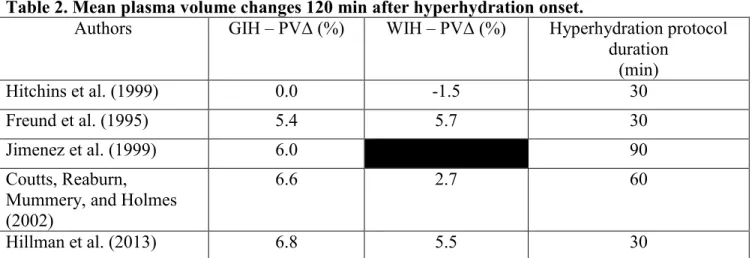
Although the latter numbers clearly testify that WIH is a poor fluid retention technique, plasma volume gains have been reported with WIH. However, it must be pointed out that the plasma volume responses reported in the literature have been highly variable. Tables 1, 2 & 3 show the different plasma volume changes reported in studies that investigated the acute effects of WIH on plasma volume at different time points. Although the reasons for the variability in plasma volume responses with WIH are not readily explainable, they most likely relate to 1) the different hyperhydration protocols utilized to hyperhydrate participants; 2) the time at which plasma volume was estimated and; 3) the training state of the individuals undergoing hyperhydration.
Table 1. Mean plasma volume changes 90 min after hyperhydration onset.
Authors GIH – PVΔ (%) WIH – PVΔ (%) Hyperhydration protocol duration
(min)
Jimenez et al. (1999) 1.4 90
Hitchins et al. (1999) 4.8 0.0 30
Freund et al. (1995) 6.5 5.8 30
GIH, glycerol-induced hyperhydration; WIH, water-induced hyperhydration; PV, plasma volume.
Table 2. Mean plasma volume changes 120 min after hyperhydration onset.
Authors GIH – PVΔ (%) WIH – PVΔ (%) Hyperhydration protocol duration (min) Hitchins et al. (1999) 0.0 -1.5 30 Freund et al. (1995) 5.4 5.7 30 Jimenez et al. (1999) 6.0 90 Coutts, Reaburn, Mummery, and Holmes (2002)
6.6 2.7 60
Hillman et al. (2013) 6.8 5.5 30
11 Table 3. Mean plasma volume changes 150 min after hyperhydration onset.
Authors GIH – PVΔ (%) WIH – PVΔ (%) Hyperhydration protocol duration
(min)
Hitchins et al. (1999) -0.5 -4.5 30
Magal et al. (2003) 7.3 1.0 30
Koehler et al. (2011) 7.5 4.0 20
GIH, glycerol-induced hyperhydration; WIH, water-induced hyperhydration; PV, plasma volume.
Regardless of the fluid retention efficiency of WIH, some studies have shown pre-exercise WIH to lessen heart rate (Latzka et al., 1998; Moroff & Bass, 1965; Nadel, Fortney, & Wenger, 1980) and core temperature (Grucza, Szczypaczewska, & Kozlowski, 1987; Moroff & Bass, 1965) augmentations compared to pre-exercise euhydration in situations where dehydration is not prevented during exercise. Hence, considering that exercising individuals often lose more than 2% of BW through sweat (Sawka et al., 2007), pre-exercise WIH can help ease dehydration-related physiological stressors. Although not entirely clear, the mechanisms explaining the observed attenuations of heart rate and core temperature with WIH could be due to increased total body enthalpy from the liquid overload or from WIH-induced plasma volume expansion, which would lessen cardiovascular strain.
Although WIH does appear to provide some physiological benefits during exercise, whether it impacts endurance performance remains unclear. Indeed, methodological limitations restrain the inferential power of the only two studies that have compared the effects of pre-exercise WIH and euhydration on endurance performance. In the study by Latzka et al. (1998), the authors did not find pre-exercise WIH to improve treadmill exercise time-to-exhaustion (≈55% of maximal oxygen consumption) compared to pre-exercise euhydration but the exercise testing took place in uncompensable heat stress. Hence, the possibility that the beneficial effects of pre-exercise WIH on endurance performance were undermined in this study cannot be ruled out. In the study by Hillman et al. (2013), completion time of a 90-km cycling time-trial was similar whether participants were subjected to pre-exercise WIH or euhydration. However, post-exercise BW losses were ≤ 1% because participants drank sufficiently to counter BW losses, rendering pre-exercise hyperhydration of little practical use. In this instance, although WIH may help attenuate the cardiovascular and thermal strains exacerbated by dehydration, it is remains
12 unclear whether it could benefit athletic performance undertaken in situations of compensable exercise-heat stress and where dehydration is prone to develop.
1.4.2 Glycerol-induced hyperhydration
A better way of orally inducing hyperhydration is to add glycerol, a colourless, odourless and membrane permeable trivalent alcohol with a molecular weight of 92.09 g/mol, to hyperhydrating solutions. In their seminal study, Riedesel, Allen, Peake, and Al-Qattan (1987) administered 21.4 ml/kg BM of a 0.1% NaCl solution with either 0.0, 0.5, 1.0 or 1.5 g/kg BW of glycerol to 22 individuals. They found that significantly less urine was produced during the 4 h after hyperhydration with 1.0 and 1.5 g/kg BW of glycerol compared to the no glycerol condition. These findings, that glycerol-induced hyperhydration (GIH) promotes greater fluid retention than WIH, have since been confirmed by several authors (Anderson et al., 2001; Coutts et al., 2002; Freund et al., 1995; Goulet, Robergs, Labrecque, Royer, & Dionne, 2006; Koehler et al., 2011; Lyons, Riedesel, Meuli, & Chick, 1990; Magal et al., 2003; McCullagh, Munge, Weerakkody, & Gamble, 2013; Melin, Jimenez, Koulmann, Allevard, & Gharib, 2002; Montner et al., 1996; Montner et al., 1999; O'Brien, Freund, Young, & Sawka, 2005). Typically, 23.9 ml of fluid/kg BW with 1.1 g of glycerol/kg BW have been administered to participants taking part in studies investigating the effects of GIH on fluid retention or exercise performance (Goulet et al., 2007). Of all this liquid, approximately 12.9 ml/kg BW is retained 136 min after the onset of hyperhydration, which is ≈ 7.7 ml/kg BW greater than that observed with WIH. Today, glycerol is considered the “gold standard” hyperhydrating agent.
Glycerol directly acts on the kidneys to improve fluid retention (Nelson & Robergs, 2007). More specifically, with GIH, serum glycerol concentrations increase, which concomitantly causes the glycerol content of the renal filtrate to increase. When this happens, glycerol passively diffuses from the filtrate to the renal medulla, prompting water reabsorption in the process. Although this mechanism most likely explains the bulk of fluid retention with GIH compared to WIH, diuretic hormone may also play a part. As a matter of fact, post-GIH plasma anti-diuretic hormone concentrations have been shown to be similar compared with euhydration (Melin et al., 2002) and significantly greater compared to WIH (Montner et al., 1999). In another
13 study, Freund et al. (1995) showed that although significant diminishments in plasma anti-diuretic hormone concentrations occur with both WIH and GIH, these tend (p = 0.07) to be of lesser magnitude when a glycerol solution is ingested. This can be explained by the fact that glycerol is membrane permeable, meaning that upon absorption by the stomach and small intestine, it distributes evenly within the intra- and extracellular fluid compartments (Lin, 1977). Therefore, glycerol only mildly disturbs body water distribution, which explains its blunt effect on anti-diuretic hormone-mediating osmoreceptors. Considering the above, it is reasonable to believe that part of GIH’s effectiveness, compared to WIH, resides in its lesser effect on anti-diuretic hormone serum concentrations.
The addition of glycerol to a hyperhydrating solution also appears to provide greater plasma volume increases than the ingestion of water alone (Tables 1, 2 & 3). This is not surprising for two reasons. First, fluid retention is greater with GIH than WIH, which increases the potential for fluid compartment volume gains. Second, by providing a surplus of extracellular osmoles, GIH increases vascular and interstitial osmotic pressure, thereby decreasing the relative quantity of water that would otherwise get sucked into cells (Guyton & Hall, 2011). What is surprising, however, is the variability in the plasma volume responses to GIH. The different hyperhydration protocols utilized, the times points at which plasma volume changes were estimated and participant training state may all partially explain why studies have reported such different plasma volume responses.
To date, only three studies have investigated whether pre-exercise GIH benefits exercise performance compared to pre-exercise euhydration (Goulet et al., 2008; Hillman et al., 2013; Latzka et al., 1998). Both Goulet et al. (2008) and Latzka et al. (1998) have shown that pre-exercise GIH improved pre-exercise time-to-exhaustion compared with pre-pre-exercise euhydration. In contrast, Hillman et al. (2013) showed that completion time of a 90-km cycling time-trial was similar whether exercise debuted in a hyperhydrated (GIH or WIH) or euhydrated state. However, as mentioned previously (section 1.4.1), exercise-incurred BW losses were either null or minimal (i.e. ≤ 1%) in their study, rendering hyperhydration of little practical use. Hence, although pre-exercise GIH appears to improve exercise time-to-exhaustion over pre-exercise euhydration, whether it confers any advantage during time-trial type exercise bouts, where
14 dehydration is prone to develop (Burke et al., 2005; Byrne et al., 2006; Lee et al., 2010; Millard-Stafford et al., 1997; Passe et al., 2007), remains an open question.
In addition to its favourable impact on exercise tolerance compared to pre-exercise euhydration, pre-exercise GIH has been found to improve endurance performance compared to pre-exercise WIH. A meta-analysis by Goulet et al. (2007), in which studies that used time-trial and time-to-exhaustion exercise protocols were pooled together, demonstrated that pre-exercise GIH improves endurance performance by 2.62% (CI: 0.07-5.17%) compared to pre-exercise WIH. Considering that the smallest worthwhile performance change that impacts endurance performance is 0.5-1.5% (Hopkins, Hawley, & Burke, 1999; Hopkins & Hewson, 2001; C. Paton & Hopkins, 2006; C. D. Paton & Hopkins, 2001; Stewart & Hopkins, 2000), these results suggests that pre-exercise GIH should provide an ergogenic benefit for endurance athletes.
The precise mechanisms by which pre-exercise GIH improves endurance performance over pre-exercise euhydration or WIH, however, are not entirely clear. One explanation is that by increasing fluid provision, pre-exercise GIH attenuates core temperature and/or heart rate increases to a greater extent than either pre-exercise euhydration (Goulet et al., 2008; Latzka et al., 1998; Lyons et al., 1990) or WIH (Anderson et al., 2001; Lyons et al., 1990; Montner et al., 1996) thereby delaying dehydration-related physiological strains. Another possibility is that pre-exercise GIH diminishes perceived effort for a given pre-exercise intensity (Goulet et al., 2008; Hitchins et al., 1999; Montner et al., 1996; Wingo et al., 2004), which would enable athletes to exert themselves to a greater extent and thus perform better. Finally, attenuated thirst may play a role in pre-exercise GIH-associated performance improvements, although only two studies have reported attenuated thirst with pre-exercise GIH (Goulet et al., 2008; Wingo et al., 2004), one of which found no change in performance (Wingo et al., 2004). Although all of the above mechanisms may contribute to improved endurance performance with pre-exercise GIH, it must be pointed out that several studies have not found pre-exercise GIH to impact exercising heart rate, core temperature, perception of effort or thirst sensation. Different ambient conditions and fluid intake protocols most likely explain these discordant findings.
15 In 2010, the World Anti-Doping Agency (WADA) banned the use of glycerol because of its plasma diluting properties, which could potentially offset recombinant erythropoietin-induced increases in haemoglobin, hematocrit and reticulocyte count (Koehler et al., 2011). In line with this, some authors have reported significant decreases in haemoglobin and hematocrit values with GIH (Freund et al., 1995; Koehler et al., 2011). Moreover, because the equation proposed by Dill and Costill (1974), which has typically been utilized in GIH studies to compute plasma volume changes, is primarily based on haemoglobin and hematocrit variations, it can reasonably be hypothesised similar decreases were obtained in studies where GIH-induced plasma volume gains were reported (Coutts et al., 2002; Hitchins et al., 1999; Jimenez et al., 1999; Magal et al., 2003).
Surprisingly, WIH appears to have a similar plasma dilution potential to GIH. As a matter of fact, a recent meta-analysis has shown that WIH-induced haemoglobin and hematocrit changes are respectively clinically and statistically non-significant compared to those induced by GIH (Koehler, Thevis, & Schaenzer, 2013). This suggests that athletes may not even need glycerol to mask recombinant erythropoietin-induced hematological alterations. Nevertheless, glycerol is and remains on the World Anti-Doping Agency banned substance list.
1.4.3 Sodium-loading
Another way of increasing body water stores is to add an extracellular-bound agent to a hyperhydrating solution. When a sufficient amount of such an agent reaches the bloodstream, intracellular water migrates to the interstitial and vascular fluid compartments and decreases osmoreceptor cell volume (Johnson, 2007). This, in turn causes anti-diuretic hormone to be secreted, which decreases urine output (Greenleaf, 1992; Guyton & Hall, 2011; Tam & Noakes, 2013). Without a doubt, the most logical extracellular-bound agent to use for the purpose of hyperhydration is sodium because it is the most abundant cation in extracellular fluid and is almost entirely confined to the interstitial and vascular fluid compartments (Guyton & Hall, 2011).
Greenleaf and Brock (1980) were most likely the first to investigate the effect of an orally ingested sodium solution, commonly referred to as sodium-loading (Mora-Rodriguez & Hamouti,
16 2012; Sims, Rehrer, Bell, & Cotter, 2007), on plasma volume shifts. They reported 9-12% increases in plasma volume following the ingestion of 16-17 ml/kg BW of an isotonic (0.9%) saline solution and a 5-10% increase in plasma volume after an identical ingestion of hypertonic (1.5%) saline. Although the authors did not report total fluid retention, their results clearly demonstrated sodium-loading’s effectiveness for increasing plasma volume.
In the past 20 years, scientists have studied the effects of sodium-loading in males (Coles & Luetkemeier, 2005; Greenleaf et al., 2001; Greenleaf, Jackson, et al., 1998; Greenleaf, Looft-Wilson, et al., 1998; Greenleaf et al., 1997; Sims, van Vliet, Cotter, & Rehrer, 2007) and females (Sims, Rehrer, et al., 2007). The plasma volume augmentations reported by these investigators range from 3-8%, with training state most likely explaining the wide range of results considering that the sodium-loading protocols used were virtually identical across studies (10-12 ml/kg BW of a 157-164 mmol/L sodium solution) (Mora-Rodriguez & Hamouti, 2012). Along with the findings of Greenleaf and Brock (1980), these results suggest that sodium is a potent plasma volume expander given that water is ingested alongside it. Moreover, most of these studies found lesser free water clearance with sodium-loading compared with equivalent water intake (Greenleaf et al., 2001; Greenleaf, Looft-Wilson, et al., 1998; Sims, Rehrer, et al., 2007; Sims, van Vliet, et al., 2007), thereby providing evidence for increased fluid retention with sodium-loading.
Being that several authors have shown that GIH improves endurance performance compared to WIH (Anderson et al., 2001; Coutts et al., 2002; Hitchins et al., 1999; Montner et al., 1996), one could reasonably hypothesise that sodium-loading would impact endurance performance in a similar way. Indeed, pre-exercise sodium-loading has been shown to ameliorate endurance capacity and performance in the heat (Greenleaf et al., 1997; Sims, Rehrer, et al., 2007; Sims, van Vliet, et al., 2007) and in temperate conditions (Coles & Luetkemeier, 2005) compared with pre-exercise ingestion of an equivalent volume of water. Although attenuated heart rate and core temperature increases appear to be responsible for these results when exercise is undertaken in the heat, it is unclear why sodium-loading enhances endurance performance in temperate conditions, as it does not appear to impact cardiovascular and thermal responses (Coles
17 & Luetkemeier, 2005). Nevertheless, it is clear that athletes could benefit from pre-exercise sodium-loading.
1.4.4 Sodium-induced hyperhydration
Considering the results presented above, sodium may be an interesting and legal alternative to glycerol for athletes wishing to hyperhydrate prior to exercise. However, it is currently unknown whether sodium is as potent a hyperhydrating agent as glycerol because sodium-loading studies have used far less voluminous fluid intake protocols (10-12 ml/kg of BW) than GIH studies (24 ml/kg BW) (Goulet et al., 2007; Mora-Rodriguez & Hamouti, 2012). To date, only one study has used a sodium-based hyperhydration protocol with a quantity of liquid comparable to what has generally been administered in GIH studies (from hereon, this technique will be termed sodium-induced hyperhydration (SIH)). In this study, Gigou et al. (2012) had endurance athletes ingest 26 ml/kg BW of a sodium (130 mmol/L) solution, which is more than twice the fluid volume that has typically been administered in sodium-loading studies. Interestingly, the authors reported that 14.8 ml/kg BW of liquid was retained 110 min after debuting the fluid intake protocol. These fluid retention numbers compare favourably well with those reported in GIH studies (Goulet et al., 2007) and thus provide strong evidence that sodium may in fact be as potent a hyperhydrating agent as glycerol. Although Gigou et al. (2012) did not find pre-exercise SIH to impact running time-trial performance over pre-exercise euhydration, they reported that thirst, heart rate and rectal temperature were lower during the running bout in the SIH condition. Hence, SIH may be an interesting and novel technique to hyperhydrate prior to exercise.
1.5 Purpose of the study and research hypotheses
The previous pages have made the case that athletes can benefit from increasing body water stores prior to exercise onset. Furthermore, studies have shown that sodium may be a potential replacement for glycerol, the “gold standard” hyperhydrating agent, now banned by the World Anti-Doping Agency. To our knowledge, however, no study has directly compared the hyperhydrating potential of glycerol with that of sodium when similar quantities of liquid are
18 ingested. Therefore, the main purpose of this study was to compare WIH, GIH and SIH with respect to fluid retention and plasma volume changes. Our research hypotheses for this project were as follows:
1. Fluid retention will be significantly greater with SIH and GIH compared with WIH. 2. Fluid retention will be similar between SIH and GIH.
3. Plasma volume gains will be significantly greater with SIH and GIH compared to WIH. 4. Plasma volume gains will be significantly greater with SIH compared to GIH.
19 2. METHODS AND RESULTS
Being that this Master’s thesis is article-based, the methods and results sections are described in the enclosed manuscript entitled “Sodium-induced hyperhydration decreases urine output and improves fluid balance compared with glycerol- and water-induced
hyperhydration”. The submission proof for this article to the journal entitled Applied Physiology, Nutrition and Metabolism can be found in Annex K.
20 2.1 Copyright: Authorisation to integrate a written article in the present thesis.
23
Sodium-induced hyperhydration decreases urine output and improves fluid
balance compared with glycerol- and water-induced
hyperhydration Félix A. Savoie
Tommy Dion 1,2Audrey Asselin 1,2
Eric D.B. Goulet 1,2
1Research Centre on Aging, University of Sherbrooke, Sherbrooke, P.Q., CAN., J1H 4C4 and; 2Faculty of Physical Education and Sports, University of Sherbrooke, Sherbrooke, P.Q., CAN., J1K 2R1.
Running head: Comparison of hyperhydration techniques. Correspondence:
Dr. Eric D.B. Goulet, Ph.D.
Research Centre on Aging/Faculty of Physical Education and Sports University of Sherbrooke
1036 Belvédère Sud
Sherbrooke, Québec, Canada J1H 4C4
24 2.2 ABSTRACT
PURPOSE: Before 2010, the year the World Anti-Doping Agency banned its use, glycerol was commonly used by athletes and considered the ''gold standard'' compound for hyperhydration. Through its effect on osmoreceptors, we believe that sodium could prove a viable alternative to glycerol as a hyperhydrating agent. Therefore, this study compared the effects of sodium-induced hyperhydration (SIH), glycerol-induced hyperhydration (GIH) and water-induced hyperhydration (WIH) on fluid balance responses.
METHODS: Using a randomised, double blind and counterbalanced protocol, 17 men (21 ± 3 yrs, 64 ± 6 kg fat-free mass (FFM)) underwent three, 3h hyperhydration protocols during which they ingested, over the first 60 min period, 30 mL/kg FFM of water with 1) an artificial sweetener (WIH); 2) an artificial sweetener + 7.45 g/L of table salt (SIH) or; 3) an artificial sweetener + 1.4 g glycerol/kg FFM (GIH). Changes in bodyweight (BW), urine production, fluid retention, hemoglobin, hematocrit, plasma volume and perceptual variables were monitored throughout the 3h trials.
RESULTS: After 3h, SIH was associated with significantly (p<0.05) lower hemoglobin, hematocrit (SIH: 43.1 ± 2.8%; GIH: 44.9 ± 2.4%) and urine production, as well as greater BW, fluid retention (SIH: 1144 ± 294 mL; GIH: 795 ± 337 mL) and plasma volume (SIH: 11.9 ± 12.0%; GIH: 4.0 ± 6.0%) gains, compared with GIH and WIH. No significant differences in heart rate or abdominal discomfort were observed between treatments.
CONCLUSION: Our results indicate that SIH is a superior hyperhydrating technique than, and proves to be a worthwhile alternative to, GIH.
25 2.2 RÉSUMÉ
BUT: L’utilisation du glycérol, considéré comme étant l’agent hyperhydratant par excellence, est interdit par l’Agence Mondiale Anti-dopage depuis 2010. Vu son effet sur les osmorécepteurs, le sodium pourrait remplacer le glycérol comme agent hyperhydratant. Or, cette étude compare l’hyperhydratation induite par le sodium (SIH), le glycérol (GIH) et l’eau (WIH) sur l’équilibre hydrique.
MÉTHODES: À l’aide d’un devis chassé-croisé randomisé et contre-balancé à double aveugle, 17 hommes (21 ± 3 ans, 64 ± 6 kg masse maigre (MM)) ont complété trois protocoles d’hyperhydratation de 3h. Pendant la première heure, ils ont consommé 30 mL/kg MM d’eau avec 1) un édulcorant (WIH); 2) un édulcorant + 7.45g/L de sel de table (SIH) ou; 3) un édulcorant + 1.4g de glycérol/kg MM (GIH). Le poids corporel (PC), la production d’urine, la rétention de liquide, l’hémoglobine, l’hématocrite, les changements de volume plasmatique et les sensations perceptuelles furent mesurées tout au long des expérimentations.
RÉSULTATS: Après 3h, l’hémoglobine, l’hématocrite (SIH: 43.1 ± 2.8%; GIH: 44.9 ± 2.4%) et la production d’urine étaient significativement (p<0.05) moins élevées pour SIH que GIH et WIH. Le PC, la rétention de liquide (SIH: 1144 ± 294 mL; GIH: 795 ± 337 mL) et l’augmentation du volume plasmatique (SIH: 11.9 ± 12.0%; GIH: 4.0 ± 6.0%) étaient significativement (p<0.05) plus élevés avec SIH que GIH ou WIH. La fréquence cardiaque et l’inconfort abdominal étaient similaires entre les conditions.
CONCLUSION: Nos résultats indiquent que SIH est supérieur à GIH et donc que le sodium pourrait remplacer le glycérol étant qu’agent hyperhydratant par excellence.
26 2.3 INTRODUCTION
It is the position of the American College of Sports Medicine that dehydration-induced bodyweight (BW) losses ≥ 2% impair endurance exercise performance (Sawka et al. 2007). According to the “cardiovascular model of dehydration”, hypohydration causes progressive cardiovascular drift and reduces the body’s ability to thermoregulate (Montain and Coyle 1992), both of which act in concert to impair exercise performance (Cheuvront et al. 2003). However well this model holds during fixed or incremental intensity endurance exercise, it apparently does not when exercise is carried out in a way that mimics out-of-doors exercise conditions, i.e., during time-trial exercises.
Indeed, recent findings have demonstrated that running (Dion et al. 2013) and cycling (Goulet 2011) time-trial performances are unaltered with exercise-induced BM losses ≥ 2%, but that under conditions comprising fixed exercise intensities, they are (Gigou et al. 2012). Moreover, it has been reported that drinking below the sensation of thirst hinders cycling time-trial performance and that drinking above it offers no meaningful performance advantage during running (Dion et al. 2013) and cycling (Goulet 2011) exercises.
Notwithstanding, our knowledge of the impact of dehydration on endurance performance is limited due to important gaps in the literature, one of which relates to our inability to predict its effect on exercise bouts > 120 min (Dugas et al. 2009). Hence, until controlled experimental studies undermine the impact of dehydration on endurance and ultra-endurance performances, it may be wiser for the moment to make the recommendation to athletes competing in such events to try and minimise cardiovascular drift, core temperature increases and thirst development.
Pre-exercise hyperhydration (PEH) has been shown to reduce dehydration-induced increases in heart rate (Moroff and Bass 1965; Nadel et al. 1980; Latzka et al. 1997; Goulet et al. 2008; Gigou et al. 2012), heat storage (Moroff and Bass 1965; Grucza et al. 1987; Lyons et al. 1990; Gigou et al. 2012) and sensation of thirst (Goulet et al. 2008; Gigou et al. 2012) compared with pre-exercise euhydration (PEE). Perhaps of greater relevance to athletes competing under real-world conditions is that it has been demonstrated that PEH does not alter running economy (Beis et al. 2011) nor uphill running time-trial performances (Gigou et al. 2012), suggesting that
27 the excess BW does not burden athletes during exercise. Considering the above, PEH could be beneficial for athletes participating in events > 120 min where fluid consumption may be impractical (e.g., swim portion of an IronmanTM race), restricted due to race regulations (e.g., Marathon des Sables) or voluntarily reduced due to gastrointestinal distress or a loss of interest to drink, all of which may lead to substantial dehydration and thirst development (Goulet 2012).
In 2007, a meta-analysis by Goulet and colleagues demonstrated that fluid retention was greater following glycerol-induced hyperhydration (GIH) than water-induced hyperhydration (WIH). However, consumption of exogenous glycerol has recently been prohibited by the World Anti Doping Agency (WADA) because of its dope-masking properties (Koehler et al. 2011). Therefore, the hyperhydrating power of other substances needs to be investigated.
Sodium is the most abundant extracellular cation, and therefore a primary determinant of plasma osmolality and extracellular fluid volume (Nose et al. 1988). Moreover, it has a potent effect on osmoreceptors and anti-diuretic hormone (ADH) secretion, which promotes water reabsorption from the kidney tubules (Greenleaf 1992). Hence, ingestion of an isotonic or slightly hypertonic saline solution should substantially increase extracellular fluid volume and attenuate urine excretion compared with WIH. To this effect, several studies have successfully used sodium loading as a means of expanding plasma volume (Greenleaf and Brock 1980; Greenleaf et al. 1997; Greenleaf et al. 1998a; Greenleaf et al. 1998b; Coles and Luetkemeier 2005; Sims et al. 2007a; Sims et al. 2007b; Sims et al. 2008). However, most of these studies provided relatively small fluid volumes (i.e., ~ 10 mL/kg BW), making it impossible to determine whether or not sodium is as potent a hyperhydrating agent as glycerol.
Recently, results of a study comparing the effects of PEE and sodium-induced hyperhydration (SIH) on endurance performance suggested that the ingestion of 26 ml/kg BW of a 130 mmol/L sodium solution promotes a level of fluid retention (~1200 mL) comparable to that seen with GIH (Gigou et al. 2012). Unfortunately, no direct comparisons between WIH, SIH and GIH were made in this study.
28 Therefore, the purpose of this study was to compare the effects of WIH, SIH and GIH in order to determine the suitability of SIH as a replacement for the GIH technique. It was hypothesized that SIH and GIH would have a similar effect on fluid balance responses and prove superior to WIH.
2.4 METHODS Subjects
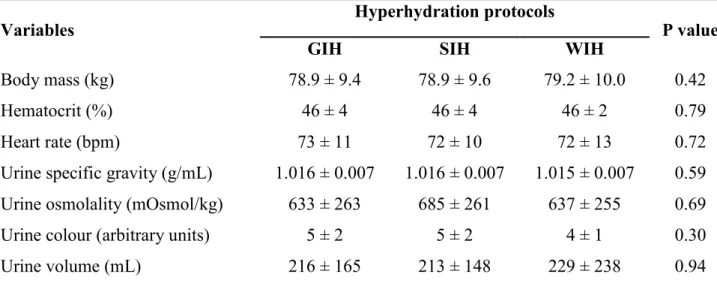
Seventeen unacclimatized, healthy and recreationally trained (4-8 h of training/week) males (age: 21 ± 3 yrs (mean ± SD); height: 182 ± 5 cm; BW: 79 ± 10 kg; fat-free mass (FFM): 64 ± 6 kg; % fat mass: 15 ± 6 %; body mass index: 24 ± 3 kg/m2; resting heart rate: 63 ± 9 beats/min) participated in the study. Inclusion criteria were: 1) to be aged between 18 and 50 yrs old; 2) to have no known health problems and; 3) to be training ≥ 4 h/week. Exclusion criteria were: 1) supplementation with creatine monohydrate; 2) use of diuretics or other drugs that could interfere with water homeostasis; 3) high blood pressure (≥ 140/90 mmHg); 4) known intolerance to the ingestion of high fluid loads and; 5) being in the process of heat acclimatization. The protocol was thoroughly explained, and subjects gave their written informed consent to participate in this study. The University of Sherbrooke’s Institutional Review Board approved all experimental procedures.
Study overview
Following a preliminary visit, subjects underwent three, 180 min hyperhydration trials (GIH, SIH and WIH) separated by 7 days and conducted at the same time of day. Trials were administered in a double blind, randomized and counterbalanced fashion. Fluid intake was limited to the first 60 min of the experiments, but physiological and perceptual measurements were taken throughout the 3h periods.
29 Preliminary visit
During the preliminary visit, subjects' BW, height, body composition, resting heart rate and blood pressure were determined. Post-void, nude BW was measured to the nearest 50 g with a digital scale (Seca 707, Seca, Germany), height with a wall stadiometer, fat mass and FFM with dual-energy X-ray absorptiometry (Lunar Prodigy, GE Healthcare, USA), resting heart rate after a 3-minute seated rest period with a Polar S810 heart rate monitor (Polar USA, USA) and blood pressure with an automated sphygmomanometer (Welch Allyn, USA).
Pre-experimental procedures
Subjects were asked to 1) refrain from dietary supplement intake 48 h prior to all hyperhydration trials; 2) keep track, with the aid of an electronic scale and food log, of food and fluid intake 24 h before the first trial, as they would have to replicate this diet before subsequent experimentations and; 3) undergo the same physical activities during the 24 h leading to each trial, but to restrain from long (≥ 2 h) or high intensity exercise. No physical activity was to be undertaken during the 8 h prior to arrival at the laboratory. To standardize sleep and promote euhydration on experimental days, subjects were respectively asked to go to bed at identical times and to consume 500 mL of water 2 h before bedtime the nights before trials. Lastly, in an effort to standardize hydration, hormonal and nutritional status, participants were required to ingest a 240 kcal (4g fat, 41g carbohydrate, 10g protein), 237 mL nutritional drink (BoostTM, Nestlé, Switzerland) with 200 mL of water 2 h prior to the trials, after which they remained in a fasted state.
Experimental protocol
Upon arriving at the laboratory, subjects' clothing and shoes were weighed with a digital toploading scale (Symmetry, Cole Parmer, USA) and room ambient temperature (DVTH, Supco, USA) and relative humidity (psychometric chart) were measured. Then, subjects voided their bladder as completely as possible, provided a urine sample and a BW measurement, corrected for clothing and shoes weight, was determined with a high precision scale (BX-300+, Altron
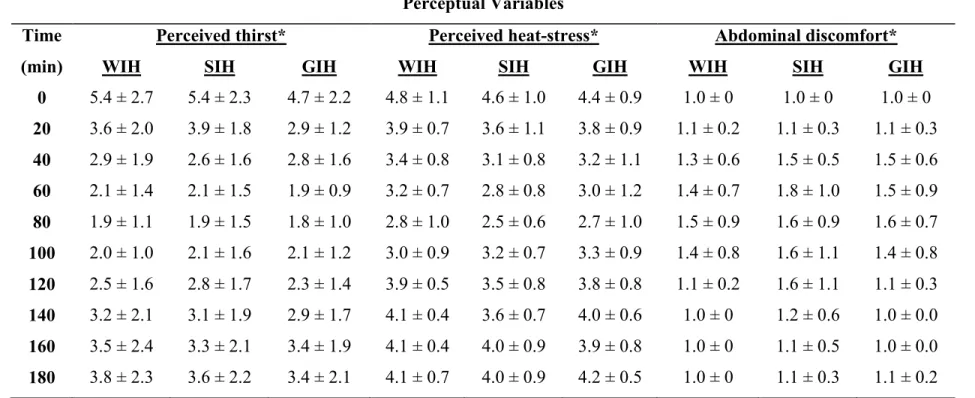
30 Systems, USA). Next, volunteers were instrumented with a heart rate monitor (Polar Vantage NV, Polar USA) and chest electrode (T-31 Polar electrode, Polar USA) after which they sat quietly for 20 min. Afterwards, measurements of heart rate and perceived heat stress (1-7 scale: 1 = too cool; 7 = too hot), thirst (1-11 scale: 1 = no thirst; 11 = extreme thirst) and abdominal discomfort (1-5 scale: 1 = no discomfort; 5 = extreme discomfort) were obtained. Thereafter, a finger prick was performed to collect capillary blood, subjects voided their bladder, provided a urine sample and a corrected measurement of BW was again taken. Subjects then started the 180-min long hyperhydration protocols during which urine collection and measurements of BW, urine specific gravity, urine colour, heart rate and perceived heat stress, thirst and abdominal discomfort were obtained every 20 min. Further, urine osmolality, hematocrit and hemoglobin were measured every 60 min. Subjects remained seated throughout the trials except when they had to void their bladder or be weighed.
Hyperhydration protocols
To induce hyperhydration, subjects drank a total water volume of 30 mL/kg FFM with 1) 4.7 g/L of a tangerine and grapefruit-tasting artificial sweetener (Crystal Light, Kraftfoods, USA) (WIH trial) (18 mOsmol/kg); 2) 7.45 g/L of table salt+ 6.2 g/L of a tangerine and grapefruit-tasting artificial sweetener (SIH trial) (247 mOsmol/kg) or; 3) 1.4 g glycerol/FFM + 4.7 g/L of a tangerine and grapefruit-tasting artificial sweetener (GIH trial) (519 mOsmol/kg). A greater quantity of the artificial sweetener was added to SIH to augment palatability of the solution. The quantity of glycerol incorporated in the GIH solution was based on the mean dosage used in previous GIH studies (Goulet et al. 2007), whereas the sodium concentration of the SIH solution was based on the SIH protocol used by Gigou et al. (2012). The hyperhydration solutions were provided at 2°C and ingested at a rate of 7.5 mL/kg FFM every 20 min (starting at min 0) for the first 60 min of the trials. This rate of fluid ingestion was chosen because it has been shown to produce no side-effects during SIH (Gigou et al. 2012).
31 Measurement procedures
Urine specific gravity, osmolality, colour and sodium concentration
Urine specific gravity and osmolality were respectively determined with a hand-held refractometer (PAL-10S, Atago, USA) and the freezing point depression technique (Micro Osmometer, Osmette, Precision Systems Inc., USA). Urine colour was estimated with an 8-level colour scale in a well-lit room immediately after collection (Armstrong et al. 1998). Urine sodium concentration was measured using the ion selective electrode technique (Modular Analytics, Roche, Switzerland)
Hematocrit, hemoglobin and plasma volume changes
After their hand had been sandwiched between two plastic bags containing 40-45°C water for 10 min, the subjects’ index or middle finger was pricked using a high volume lancet (Unistik 3 Dual, Owen Mumford, UK). After removal of the first drop of blood, ~20L of blood was collected with two HemoPoint H2 Microcuvettes (Alere, USA). Each Microcuvette was then analyzed with a HemoPoint H2 photometer (Alere, USA) for hemoglobin and hematocrit. In our laboratory, the within and between Microcuvette test-retest coefficient of variations for hemoglobin and hematocrit measurements are respectively 0.44% and 4.2%. Capillary hemoglobin and hematocrit have been demonstrated to be slightly higher than (~1.5-2%) and highly correlated (r=0.90-0.93) with values derived from venous blood (Hutler et al. 2000). Percent changes in plasma volume were calculated with the equation proposed by Dill and Costill (1974).
Statistical analyses
Normality of distribution was tested using the Shapiro-Wilk test. When normally distributed, data were analyzed using either paired t-tests, one-way repeated measures analyses of variance (ANOVA) or two-way (treatment x time) repeated measures ANOVA, with Greenhouse-Geisser corrections when sphericity was violated. Abnormally distributed data were tested with