Microstructural evolution of Ag based braze and its
effect on the tribological behavior using different
brazing current
.
1Rida Badi
,
1Youcef Yahmi
,
1Bouzid Maamache
,
3Jan Balko
,
3Pavol Hvizdos
,
2Djamel Miroud
,
,2 1i
Billel Chenit
1st Research Center in Industrial Technologies, CRTI, P.O.Box 64 Cheraga, Algeria.
2nd Science and Engineering Materials Laboratory (LSGM) USTHB BP 32 El Alia 16111, Bab Ezzouar. Algeria. 3rd Institute of Materials Research, Slovak Academy of Sciences, Watsonova 47, 04353 Kosice, Slovak Republic
………
Corresponding Author [email protected]
Abstract—In this work, the WC-Co carbide/braze/1020
steel brazed joints have been prepared, using Tungsten Inert Gas (TIG) process. The effect of brazing current on the microstructure evolution of the Ag-Cu-Zn braze has been practically investigated. The results indicated that the braze contained three different phases: Cu solid solution, Ag solid solution and Ag-Cu-Zn eutectic phase, where their fractions depend on the brazing current applied. The interdiffusion reactions between the braze phases and their effect on the wear resistance were studied. Moreover, the mechanical properties especially the hardness (HIT) and Young’s modulus (EIT) of each phase were evaluated by nano-indetation measurements. The tribology test using linear mode revealed that, the wear mechanism becomes adhesive with the increase of brazing current.
Keywords—Ag braze, interdiffusion, Microstructure, mechanical properties, wear resistance.
I. INTRODUCTION
In mining and oil industries, tungsten carbide/cobalt (WC-Co), is frequently used in drilling tools fabrication due to its wear resistance, high hardness even at high temperatures as well as its low thermal expansion coefficient (TEC) even at high temperatures [1]–[4]. For such applications, this material is usually joined to structural steels in order to reduce the high cost of some industrial components and to solve some problems related to their brittleness [5]. Recently, great attention has been devoted to WC-Co/steel joining as it is generally difficult to produce defect free weld joints between these materials because of the cracks and other type of defects that may occur during the joining process [6], [7]. The use of an adequate braze is highly recommended to improve the bonding and reduce the residual stresses in the interface. It was found that the fracture mechanisms of the bonded materials depend on various interfaces formed by the diffusion bonding process [8] which was also beneficial for both the residual stresses relaxation and the improvement of the mechanical behavior of the weld join
In this work, the effect of TIG brazing current on the microstructure evolution of the Ag-Cu-Zn-Ni braze is studied. The mechanical properties of each phase is evaluated by Agilent G200 instrument nano-indenter machine using Berkovic diamond indenter at constant depth of 500 nm. The hardness and modulus are automatically calculated according to the standards of instrumented
indentation using Oliver-Pharr method [9].Wear resistance of the braze issued from each current is investigated by tribology test with SiC ball using linear mode under 2N load.
II. Experimental procedures
The braze considered in this work is Ag-Cu-Zn-Mn-Ni generally used for brazing the PDC bit (WC-10% Co cemented carbide) to the steel of the drilling tools (AISI 1020 steel with 0.21% of C) where the nominal chemical composition is shown in table 1. The brazing operation was carried out using the Tungsten Inert Gas (TIG) process, where the currents were varied from 40A, 60A 80A and 100A. The temperatures recorded during brazing operation were measured using SCANTEMPS 490 non-contact infrared thermometer.
The microstructural examination was done by means of a JEOL JSM 6360 scanning electron microscope (SEM). An Energy dispersive spectrometry (EDS) system was employed to determine the different local chemical compositions throughout the brazed joints. Thereafter, Nano-indentation tests were done of the braze with a maximum depth of 500 nm using AGILENT G200 nano-indenter machine to investigate the mechanical properties especially the Indentation Hardness (HIT) and the
Indentation modulus EIT (Young’s Modulus) of each zone
of the braze.
The tribological behavior is evaluated by wear tests, using UMT-3 Bruker instrument with linear mode at room temperature in dry environments. According to the sever working conditions of the drilling tools (hard rock), SiC ball with hardness of 22.51 GPa as counter-body is employed under 2N load and sliding time of 1 hour and that with sliding ball-on-disk experiment. The volume losses due to the wear test is measured by confocal microscope PLu neoxn 3D Optical Profiler, by SENSOFAR, and the specific wear rates (W) are calculated in terms of the volume loss (V) per distance (L) corresponding to 360m and applied load (F) according to the following equation (1):
Table. 1: Chemical composition of the braze used
III. RESULSTSANDDISCUSSION
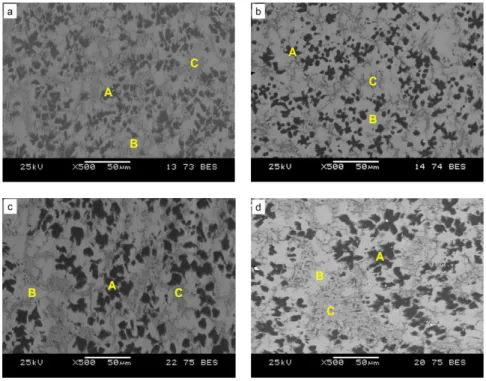
Fig. 1(a–d) shows the microstructures of the braze obtained after applying different brazing currents. The common point in these micrographs is that they exhibit three distinct regions labeled: A, B and C. These regions were analyzed using the EDS technique and can be described as follows:
- Region A (dark) consists of Cu (s,s).
- Region B (clear) is a solid solution (s,s) matrix of Ag.
- Region C is an eutectic structure of Ag-Cu-Zn. The chemical compositions of each region are in good agreement with those found in other research works [10]
which confirm the presence of the phases cited before. It has been demonstrated that the presence of Ni (> 6 % wt) and Zn (> 20% wt) in the filler material (braze) decreases the temperature of the formation of the eutectic structure as indicated in the Ag-Cu binary phase diagram (from around 779°C) [11] to approximately 675°C [10]. It can be seen in Fig.1 that the amount of the eutectic structure has increased whereas the one of the Cu (s,s) has decreased slightly with the increase of the brazing current
Since the equilibrium conditions cannot be considered during the brazing process, the peak temperature generated by the high currents promotes a low cooling rate.
Consequently, coarse eutectic structure was formed for 100A (Fig. 1d). The maximal temperature reached at 40 A current (around 900 °C), led to the formation of a finer eutectic structure because of the rapid cooling rate (Fig. 1a). In addition, the extent of Ni in the braze is reduced due to its accelerated diffusion to the base materials enhanced with increasing the current from 40A to 100A. The nucleation sites of Cu (s,s) are thus reduced, causing a reduction of its volume fraction. Jiang et al. [6] asserted that the Cu element join the Ni and forms Cu (s,s) island. They demonstrated that the increase of the brazing time, enhances the Ni diffusion to the substrate interface which reduces the island Cu (s,s) and increases the Cu (s,s) layers along the interface. The accordance of these results with those published in literature is due to the fact that the thermal effect caused by the increase of brazing temperature in this study, can be similar to the one caused by the increase of the holding time in the case of the high induction process, which increases the exposure time of the braze at a given temperature.
Based on the continuously registered load, depth, stiffness data, hardness (HIT), Young's modulus (EIT) in depth profiles were automatically calculated according to the standards of instrumented indentation technique. Load-displacement curves of each phases reveal that the indents are located exacly in each individual phases. The maximum load to reach the maximum depth for Cu (s,s) is 16 mN, followed by Ag-Cu-Zn eutectic phase (s,s) with 13 mN and Ag (s,s) with 11.5 mN. This difference is attributed to the difference in the mechanical properties of these phases, as can be seen in Fig. 2, the hardness (HIT) and Young modulus of Cu(s,s) are much higher compared to the Ag (s, s) ones. The good mechanical properties (hardness) of Cu (s,s) has a good influence on the braze microstructure and improves its mechanical strength by the dispersion strengthening mechanism. The effect of the brazing current on the hardness and Young’s modulus of the phases is less remarkable.
Elements C Ni Mn Ag Zn Cu
Braze
(wt.%) 4.12 6.11 8.02 44.39 21.52 15.84
Fig. 1: Microstructural evolution of the braze for the different current densities: (a) 40A, (b) 60A, (c) 80A, (d) 100A
It can be seen a small decrease in Cu(s,s) hardness which may be attributed to the diffusion of nickel out from this phase towards the interfaces. Nevertheless, due to the decrease in the fraction volume of Cu (s,s) islands with increasing the current, the global hardness of the braze decreases from 3.6 GPa to 2.8 GPa with the brazing current.
Fig. 2: Nano-hardness (HIT) and Young’s modulus (EIT) of
different phase of the braze
The wear profiles illustrated in Fig. 3 show the presence of a relatively soft and slightly abrasive wear. By comparing the wear tracks of each braze, it can be noticed that the pull out of the material (beads) is slightly increased with the increase of the brazing current which may indicate a low plastic deformation especially for the 40A braze one. On the other side, the observation of the wear profile of 40A seems to indicate that we are in the presence of Ploughing wear mechanism
Fig. 3: 3D topography of the wear track and wear profile
issued from 40A and 100A, respectively.
Fig.4:SEM micrographs of the warn surfaces issued from 40A, 60A and 80A brazing current respectively
SD
Adhesive aspectThe examination of worn surfaces (Fig. 4) shows an adhesive mechanism of the braze which become more sever with increasing the brazing current, in 80A the braze undergoes more ductile flow and severe plastic deformation, resulting in higher volume loss compared to 40A. The wear rate using 40A is two times higher than the one using 100A (4.8 10-7 mm3/Nm and 9.7 10-7 mm3/Nm respectively) this is caused by the change in wear mechanism under 100A, A high amount of oxygen is detected in some trips of the worn surface issued from 40A. The high friction contact due to the high hardness of that surface allows the formation of oxides (SiO2) as the third body in some areas of the worn surface and inhibiting the wear loss which confirmed by the results of non-contact profile mapping across the wear tracks. The high hardness of the brazed issued from 40A due to the hard phase of Cu(s,s) promotes the decrease in volume lost and improve the wear resistance of the braze.
IV. CONCLUSION
The main conclusion of this works are summarized as follows:
-
A decrease of the Cu (s,s) fraction was observed when increasing the brazing current in accordance with a coarsening phenomenon of Ag-Cu-Zn eutectic structure-
The effect of the brazing current on the hardness and Young’s modulus of each phases is less remarkable.-
The mechanical properties (hardness and Young modulus) of Cu (s,s) has a good influence on the braze microstructure and improves its mechanical strength by the dispersion strengthening mechanism.-
The wear test results indicate an adhesive mechanism of the braze which become more sever with increasing the brazing current,-
Using 80A brazing current, the braze undergoes more ductile flow and severe plastic deformation, resulting in higher volume loss compared to 40A.REFERENCES
[1] H. Chen, K. Feng, S. Wei, J. Xiong, Z. Guo, and H. Wang, “Microstructure and properties of WC – Co / 3Cr13 joints brazed using Ni electroplated interlayer,” Int. Journal of
Refractory Metals and Hard Materials, vol. 33, pp. 70–74,
2012.
[2] P. Q. Xu, “Dissimilar welding of WC–Co cemented carbide to Ni42Fe50.9C0.6Mn3.5Nb3 invar alloy by laser–tungsten inert gas hybrid welding,” Materials and Design journal, vol. 32, pp. 229–237, 2011.
[3] K. Feng, H. Chen, J. Xiong, and Z. Guo, “Investigation on diffusion bonding of functionally graded WC-Co/Ni composite and stainless steel,” Materials and Design, vol. 46, pp. 622– 626, 2013.
[4] K. Nagatsuka, Y. Sechi, Y. Miyamoto, and K. Nakata, “Characteristics of dissimilar laser-brazed joints of isotropic graphite to WC – Co alloy,” Materials Science & Engineering
B, vol. 177, no. 7, pp. 520–523, 2012.
[5] H. Chen, K. Feng, S. Wei, J. Xiong, Z. Guo, and H. Wang, “Int . Journal of Refractory Metals and Hard Materials
Microstructure and properties of WC – Co / 3Cr13 joints brazed using Ni electroplated interlayer,” RMHM, vol. 33, pp. 70–74, 2012.
[6] W. B. Lee, B. D. Kwon, and S. B. Jung, “Effects of Cr3C2 on the microstructure and mechanical properties of the brazed joints between WC-Co and carbon steel,” International Journal
of Refractory Metals and Hard Materials, vol. 24, pp. 215–221,
2006.
[7] H. Chen, K. Feng, J. Xiong, and Z. Guo, “Characterization and stress relaxation of the functionally graded WC-Co/Ni component/stainless steel joint,” Journal of Alloys and
Compounds, vol. 557, pp. 18–22, 2013.
[8] C. Guoqing, Z. Binggang, W. Zhenzhong, M. Wei, and F. Jicai, “Electron beam welding–brazing of hard alloy to steel with Ni– Fe intermediate,” Int. Journal of Refractory Metals and Hard
Materials, vol. 40, pp. 58–63, 2013.
[9] W. C. Oliver and G. M. Pharr, “An improved technique for determining hardness and elastic modulus using load and displacement sensing indentation experiments,” Journal of
Materials Research, vol. 7, no. 06. pp. 1564–1583, 1992.
[10] C. Jiang, H. Chen, Q. Wang, and Y. Li, “Effect of brazing temperature and holding time on joint properties of induction brazed WC-Co / carbon steel using Ag-based alloy,” Journal of
Materials Processing Technology, vol. 229, pp. 562–569, 2016.
[11] Jose, ´ Lemus-Ruiz Æ Leonel Ceja-Ca, ´rdenas Æ, and J. A. V. Æ. O. Flores, “Joining of tungsten carbide to nickel by direct diffusion bonding and using a Cu – Zn alloy,” Journal of