HAL Id: hal-00322479
https://hal.archives-ouvertes.fr/hal-00322479
Submitted on 27 Nov 2018HAL is a multi-disciplinary open access archive for the deposit and dissemination of sci-entific research documents, whether they are pub-lished or not. The documents may come from teaching and research institutions in France or abroad, or from public or private research centers.
L’archive ouverte pluridisciplinaire HAL, est destinée au dépôt et à la diffusion de documents scientifiques de niveau recherche, publiés ou non, émanant des établissements d’enseignement et de recherche français ou étrangers, des laboratoires publics ou privés.
Multi-scale domain decomposition method for structural
analysis of a passenger ship
Ahmad Mobasher Amini, David Dureisseix, Patrice Cartraud, Natacha
Buannic
To cite this version:
Ahmad Mobasher Amini, David Dureisseix, Patrice Cartraud, Natacha Buannic. Multi-scale domain decomposition method for structural analysis of a passenger ship. ECCOMAS Thematic Conference: Marine 2007 - Computational Methods in Marine Engineering, 2007, Barcelone, Spain. pp.1-4. �hal-00322479�
MULTI-SCALE DOMAIN DECOMPOSITION METHOD FOR
STRUCTURAL ANALYSIS OF A PASSENGER SHIP
A. MOBASHER AMINI*, D. DUREISSEIX†, P. CARTRAUD* AND N. BUANNIC††
*
GeM, CNRS UMR 6183 - Ecole Centrale de Nantes 1, rue de la Noë, BP 92101 44321 NANTES CEDEX 3 - France
e-mail: [email protected] and [email protected]
† LMGC, CNRS UMR 5508 - Université Montpellier 2
CC048,Place E. Bataillon, 34095 MONTPELLIER CEDEX 5- France Email: [email protected]
†† Principia Marine
1, rue de la Noë, BP 22112 - 44321 NANTES CEDEX 3 - France Email: [email protected]
Key words: Domain decomposition method (FETI-DP), Multi-scale, ship structure.
Summary. In this paper a domain decomposition approach (FETI-DP) is combined with a multi-scale approach for the analysis of ship structure. Each sub-domain has it’s own discretization scale (microscopic or macroscopic), according local effects are present or not. The global analysis of structure can thus be optimized, by concentrating microscopic description in zones of interest.
1 INTRODUCTION
The finite element analysis of a structure like passenger ship with small size structural details is a difficult problem. To obtain a solution for the whole structure as well as a good accuracy near the structural details, a model with a fine mesh is required but it is prohibitive to solve.
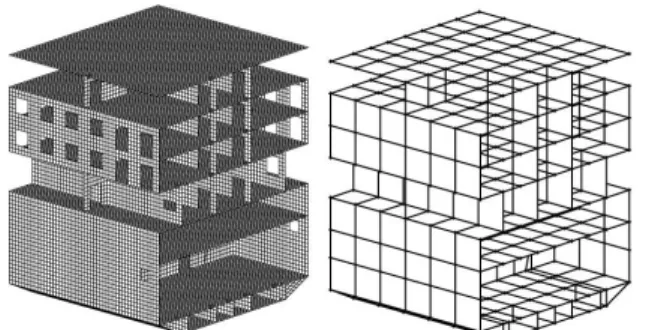
Appropriate methods have to be used to reduce the CPU time. The domain decomposition method appears to be well suited for passenger ships (figure 1), which present a natural sub-structuring architecture. An application of that method was presented in 6 for ship structural
analysis. This method is herein developed to obtain a multi-scale decomposition domain approach. Each sub-domain has it’s own discretization scale (microscopic or macroscopic), according local effects are present or not. The global analysis of structure can thus be optimized, by concentrating microscopic description in zones of interest.
2 GENERAL DESCRIPTION OF THE METHOD 2.1 FETI-DP Method
Domain decomposition methods are both an efficient and flexible tool for structural analysis 4,5. Numerous methods are discussed in the literature namely BDD 8, FETI 9, FETI-DP
10,11, LATIN micro-macro 12. FETI-DP version was retainedfor ship structural analysis. This
method is a dual primal method : the sub-domains are connected with each other in a weak way at the interfaces and in a strong way at the corner. In this manner, a coarse mesh corresponding to the corner nodes is obtained, which is similar to the industrial model.
A. MOBASHER AMINI, D. DUREISSEIX, P. CARTRAUD, N. BUANNIC
Figure 1: fine mesh discretization of a part of the ship structure and that corresponding coarse mesh
2.2 Multi-scale approach
If classical FETI-DP method is applied to whole ship structure, all sub-domains are meshed finely. The problem corresponding to the ship analysis involves Lagrange multipliers at the interfaces, as well as the degrees of freedom of the corner (coarse) nodes. However, the use of a fine mesh is relevant only if the sub-domain is subjected to local effects. Therefore, it’s interesting to develop a multi-scale approach in order to reduce the computation time. With this method, the sub-domains in zones of interest are meshed finely (microscopic) and sub-domains in the reminder of the structure are described by coarse mesh (macroscopic or homogenized). The development of a multi-scale domain decomposition method raises mainly two difficulties, first connection between microscopic and macroscopic sub-domains and second determination of the stiffness used in macroscopic sub-domains (figure 2).
Figure 2: Micro and macro zones.
When the micro-macro interface is considered, the connection has to be reformulated due to incompatible meshes : the macroscopic sub-domain has only coarse nodes while microscopic sub-domain comprises several nodes along the interface. Two types of connection are proposed here, which are based on displacement (kinematics approach) and force (static approach) assumptions, respectively.
When a sub-domain is described on a macroscopic scale, stiffness should be associated to it. This one is given in a preliminary stage starting from a fine mesh. In practice, the internal nodes are condensed statically. For the nodes on the edge, the previous assumptions (kinematics or static) are taken again. In this way, it is possible to define stiffness only defined on the coarse
nodes. The homogenized stiffness is thus kinematics or static type, depending on the connection nature.
3 NUMERICAL EXAMPLES
In a first step, the method is validated. The macro stiffness is checked with patch tests performed on one macro sub-domain. The micro-macro connections are used in simple loading cases and it’s verified that the exact solution is recovered.
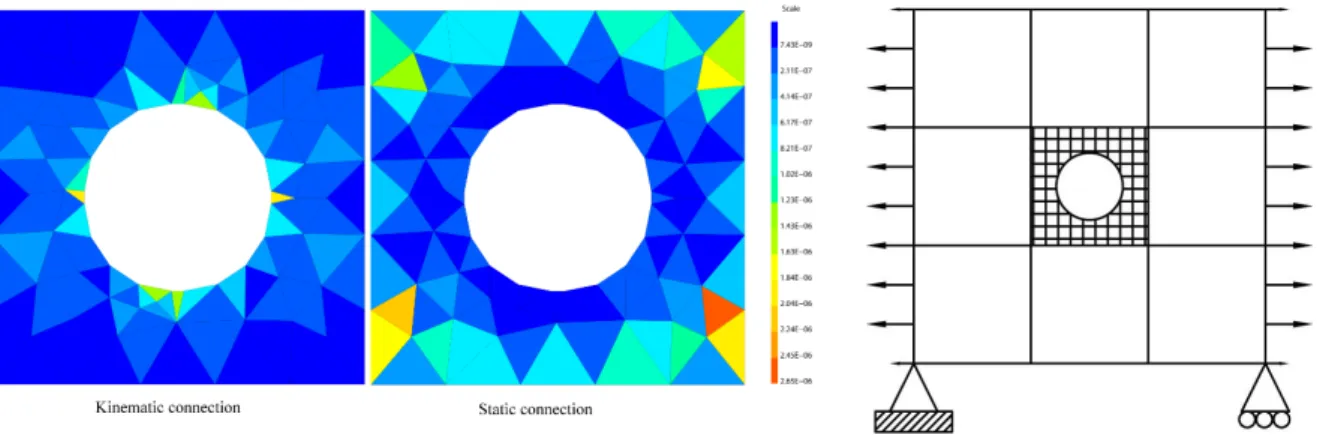
In order to illustrate the method on a simple example, a plate with a hole is considered in in-plane loading. A reference solution is obtained by using a classical FETI-DP method (all the sub-domains are discretized with a fine mesh). Next, the two scales method described here is applied by keeping only one micro sub-domain (including the hole).
The solution computed with the method on two scales is compared with the reference solution, and the energy of the difference of the two displacements solution is used to assess the multi-scale method. The results are presented figure 3. It appears that the results are more accurate with the static method the error being localized in the vicinity of the connection zone, but decreasing quickly when one moves away from there, which can be viewed as the Saint-Venant principle. On the contrary, for kinematics connection, the error is weaker in the vicinity of the interface, but increases when one moves away from there.
4 CONCLUSION
By the approach presented in this paper we can choice in the flexible way the fine zones and optimize the time of the structural analysis.
Figure 3: Energy of the difference between multi-scale solution and reference.
REFERENCES
[1] C. Farhat, F. X. Roux , « Implicit parallel processing in structural mechanics », Computational Mechanics Advances, vol. 1, n° 2, p. 1-120, 1994.
[2] Le Tallec P., « Domain decomposition methods in computational mechanics », Computational Mechanics Advances, vol. 1, n° 2, p. 121-220, 1994.
A. MOBASHER AMINI, D. DUREISSEIX, P. CARTRAUD, N. BUANNIC
for ship structural analysis with FETI-DP method », III European Conference on
Computational Mechanics Solids, Structures and Coupled Problems in Engineering, Lisbon, Portugal, vol. 5-9 June, p. 233-244, 2006.
[4] J. Mandel. Balancing domain decomposition. Communications in Applied
Numerical Methods, 9 :233–241, 1993.
[5] C. Farhat and F.-X. Roux. A method of finite element tearing and interconnecting and its parallel solution algorithm. International Journal for Numerical Methods in
Engineering, 32 :1205–1227, 1991.
[6] C. Farhat, M. Lesoinne, K. Pierson, « A scalable dual-primal domain decomposition method », Numerical Linear Algebra with Applications, vol. 7, n° 8, p. 687-714, 2000. [7] P. Ladevèze and D. Dureisseix. A micro/macro approach for parallel computing of heterogeneous structures. International Journal for Computational Civil and Structural
Engineering, (1) :18–28, 2000.