Air-sea exchange of CO
2
over a subantarctic
macrocystis kelp bed
B. Delille
1, D. Delille
2and M. Frankignoulle
1http://www.ulg.ac.be/oceanbio/co2/
1Unité d’Océanographie Chimique, G.H.E.R.Université de Liège,4000 Liège, Belgium 2U.M.R. 7621, Observatoire Océanologique
de Banyuls, 66650 Banyuls/mer, France
Acknoledgments:
Institut Français pour la Recherche et Technologie Polaire Belgian Federal Office for Scientific, Technical and Cultural affairs Fond National pour le Recherche Scientifique
Macrophytes has been reported to be a potential sink of Carbon Dioxide (CO2) at a global scale in 1981. Two decades after, in the context of
climate change, study of the contribution of Macrophytes to the biological pump of CO2have not advanced significantly. Diel and seasonal changes of partial pressure of CO2(pCO2) and related biological parameters (phytoplankton and bacterioplankton) have been investigated during a two years
survey (1996 and 1997) over some Macrocystis kelp beds surrounding the Kerguelen Archipelago (Indian sector of the Southern Ocean). The evolution of pCO2is regulated by kelp bed activity, phytoplanktonic and bacterial production, hydrodynamics and air-sea exchange. The contribution of
each of these processes varies as a function of the considered season. Primary production has been estimated from Dissolved Inorganic Carbon (DIC). In summer, Net Primary Production (NPP) could reach 4.2 gC.m-2.d-1and gross primary production (GPP) up to 40 gC.m2.d-1 have been
observed. From August to April the primary production of kelp beds keeps pCO2below the threshold of saturation. Thereafter, air-sea exchange of pCO2over the year have been estimated to range from –16 to –33 gC.m-2.yr–1 depending of the air-sea exchange coefficient considered.
A substancial proportion of subantarctic coastlines is occupied by highly productive giant kelp bed Macrocystis pyrifera. This marine macroalagae is one of the largest and grows up to 50m in length, forming forest in hard-bottom subtidal area. Surface occupied by Macrocystis around kelp
bed in the Kerguelen Archipelago would be about 1000 km2.
Figure 1: Macrocystis pyrifera
Abstract:
J F M A M J J A S O N D 100 200 300 400 500 pC O2 ( ppm V ) Indian Ocean Kerguelen Archipelago Morbihan Gulf Brise-Lame Bay Table Bay 48.5 °S 49.0 °S 49.5 °S 50.0 °S 68 °S 69 °S 70 °S 71 °S 72 °S 0 5 kmFigure 2: Sampling sites
Measurements were carried out from December 1995 to December 1997 in the Kerguelen Archipelago, Southern Ocean (Indian sector). Usually, Kerguelen Archipelago is cited in the literature as a subantarctic island. However, from a strict oceanographic point of view, this archipelago is situated either in the Polar Frontal Zone or in the Antarctic Zone depending of the position of the Polar Front with regards to the Island.
Monitoring of diel cycles have been conducted in three sites around the Archipelago.
JFMAMJ J ASOND 1.3 1.5 1.7 1.8 1.9 2.0 2.1 2.2 2.3 1996 1997 N o rm a liz e d DI C (m m o l. k g -1) 21 0 3 6 9 12 15 18 21 1.9 2.0 2.1 2.2 2.3 Dec Jan Feb Nov Dec Elapsed Time 21 0 3 6 9 12 15 18 21 100 200 300 400 500 Jul Aug Sep Winter Elapsed time n o rm al iz ed pC O 2 (p p m V ) 21 0 3 6 9 12 15 18 21 100 200 300 400 500 Dec Jan Feb Nov Dec Summer Elapsed Time
Seasonal Changes Diel Changes
Method:
Measurements were carried out from December 1995 to December 1997 in the Kerguelen Archipelago, Southern Ocean (Indian sector). A substantial proportion of the coastlines of the archipelago are occupied by
Macrocystis pyrifera kelp beds. Monitoring of diel cycles have been conducted in three sites around the Archipelago. The study consisted in the monitoring of both diel and seasonal variations of pCO2and related biological
parameters (Nutrients, Chlorophyll and Bacterial abundance)
pCO2and DIC was calculated from pH and Total Alkalinity using the acidity constant of Mehrbach et al. pCO2and DIC measurements presented here have been normalized to a constant temperature and salinity
respectively.
Gross primary production have been assessed from diel cycles of DIC (DIC change over 12 hours), while seasonal variations of DIC have been used to compute net primary production (DIC changes over weekly/monthly period).
Air-sea exchange of CO2has been computed from air-sea gradients of pCO2 using windspeed measurements made in the meteorolgical station of Kergelen and the algorithms of Liss et Merlivat (1986), Wanninkhof (1992), Wanninkhof and Mc Gillis (1999) and Nightingale et al. (2000).
Results:
Depending of the considered season, waters above Macrocystis pyrifera can exhibit marked diel cycles of pCO2and DIC. Taking into account chlorophyll abundance - phytoplankton - and bacterial abundance and considering diel cycles outside the kelp bed (data non shown), Diel cycles appear to be essentially due to Macrocystis though the kelp bed seems to favour phytoplankton growth. Physical factors (temperature, air-sea exchange) act to play a leading role limited to winter while organic matter decay increases sharply DIC and pCO2in autumn.
Taking into account the reduced currents in Macrocystis kelp forest, diel cycles allow us to assess that gross primary production of the kelp through the change in DIC over the light period of the day. During our observations, this one ranged from 15 to 40 mgC.m-2.d-1while it reached
hardly 10 gC.m-2.d-1during summer. Over several days or weeks, DIC changes gives us an indication of the Net Primary Production. DIC
average changes over spring yield to NPP around 0.25 gC.m-2.d-1. However over shorter period (week) which are less biased by advection,
NPP between 2 and 4 gC.m-2.d-1were observed. These values are in the range of previous observations of productivity of Macrocystis in
California (2.7-3.6 gC.m-2.d-1).
Air-sea exchange of pCO2have been computed from diel cycles of pCO2, and integrated over the year. Depending of the algorithm used for the
calculation of the exchange coefficient, overall fluxes range from 16 to 33 gC.m-2.d-1. In spite of a large primary production, overall fluxes do not
reflect diel uptake of CO2because of the advection of surrounding water in the kelp bed.
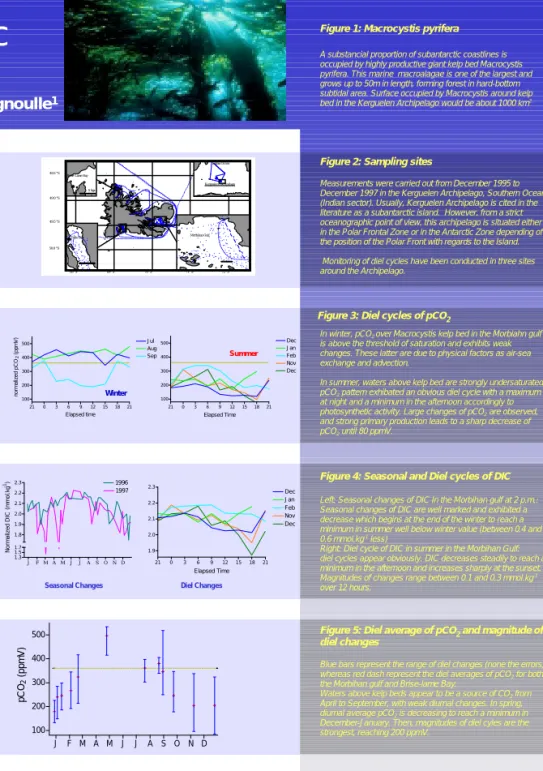
Figure 3: Diel cycles of pCO2
In winter, pCO2 over Macrocystis kelp bed in the Morbiahn gulf
is above the threshold of saturation and exhibits weak changes. These latter are due to physical factors as air-sea exchange and advection.
In summer, waters above kelp bed are strongly undersaturated.
pCO2pattern exhibated an obvious diel cycle with a maximum
at night and a minimum in the afternoon accordingly to
photosynthetic activity. Large changes of pCO2are observed,
and strong primary production leads to a sharp decrease of
pCO2until 80 ppmV.
Figure 4: Seasonal and Diel cycles of DIC
Left: Seasonal changes of DIC In the Morbihan gulf at 2 p.m.: Seasonal changes of DIC are well marked and exhibited a decrease which begins at the end of the winter to reach a minimum in summer well below winter value (between 0.4 and
0.6 mmol.kg-1less)
Right: Diel cycle of DIC in summer in the Morbihan Gulf: diel cycles appear obviously. DIC decreases steadily to reach a minimum in the afternoon and increases sharply at the sunset.
Magnitudes of changes range between 0.1 and 0.3 mmol.kg-1
over 12 hours.
Objectives:
Macrophytes could contribute significantly to the sink of atmospheric CO2by primary production because of : • a high biomass (about two-thirds of oceanic plant biomass)
• high primary production
• high turnover time compared to phytoplankton
We aim to asses the uptake of CO2by primary production of the Macrocystis kelp bed and budget the air-sea exchanges of CO2.
Figure 5: Diel average of pCO2and magnitude of diel changes
Blue bars represent the range of diel changes (none the errors)
whereas red dash represent the diel averages of pCO2for both
the Morbihan gulf and Brise-lame Bay.
Waters above kelp beds appear to be a source of CO2from
April to September, with weak diurnal changes. In spring,
diurnal average pCO2is decreasing to reach a minimum in
December-January. Then, magnitudes of diel cyles are the strongest, reaching 200 ppmV.
Conclusion:
Growth of Macrocystis pyrifera kelp bed leads to a strong uptake of CO2reflected in the diel cycles of pCO2. Hence, the kelp bed is likely to act as a
strong sink of CO2with regard to atmospheric CO2. However, advection processes bias computation of the annual budget of air-sea exchange of