Digitalisation and Restructuring:
which social Dialogue?
Work Package 1: Transnational analysis
Synthesis report
Authors:Laura Beuker (LENTIC, University of Liège) Marine Franssen (LENTIC, University of Liège) Vassil Kirov (ISSK-BAS)
Frédéric Naedenoen (LENTIC, University of Liège)
March 2019 Sofia – Liège
Introduction... 3
1. Methodology ... 4
2. Literature review ... 5
2.1. Ongoing debates ... 6
2.2. Findings from stakeholders’ reports ... 7
3. National social dialogue related to restructuring ... 12
3.1. Contextual factors ... 13
3.2. National debates on digitalisation ... 14
3.3. Social dialogue and stakeholders’ points of view ... 16
3.4. The emergence of new players ... 21
3.5. Digitalisation related restructuring ... 22
4. Sectoral developments ... 25
4.1. Financial services sector ... 26
4.2. Postal services sector ... 32
4.3. Manufacturing sector ... 39
4.4. Tourism sector ... 47
Conclusion ... 54
Introduction
The DIRESOC project intends to contribute to a better understanding of the impact of digitalisation in European societies, analysing digitalisation as a cause of companies restructuring and highlighting the role of social dialogue. Assessing the capacity of social dialogue to anticipate and to manage the social impact of restructuring, the DIRESOC project will contribute to identify inspiring solutions and at the same time obstacles to a fruitful participation of social partners. In order to provide relevant recommendations for the future of social dialogue role in digital restructuring, the DIRESOC project has selected economic sectors both from services and industry in EU member states belonging to different patterns of industrial relations.
This first work package of DIRESOC aims at explaining the national and sectoral debates over the thematic of the project. The four sectors it focuses on are financial services (bank/insurance), postal services (extended to delivery services), manufacturing industries and tourism. More concretely, the objectives of this report are to better understand the impact of restructuring driven by digitalisation on social dialogue and vice versa, addressing the following questions:
• What: what are the main topics of debate and issues of concern around digitalisation and restructuring among social partners and governments?
• Who: which actors are involved in social dialogue regarding restructuring driven by digitalisation? May we see an evolution of roles of the traditional players? Can we identify the involvement of new actors, such as non-union employee representatives or quasi-unions?
• Where: Are the old forms of social dialogue and industrial relations structure at national, sectorial and company level still relevant? Or new place of bargaining may be identified (i.e. platforms)?
• How: How do the relationships among social partners change? May we find out an evolution in the practices, in the process, of the regulatory framework;
• When: are we able to identify in social dialogue practices of anticipation or management of the effects of digitalisation?
As shown in figure 1 below, the possible impacts of digitalisation on jobs (Degryse, 2016), are examined for the four sectors and the eventual social dialogue processes/outcomes are discussed.
Figure 1 - DIRESOC global framework
The important question addressed through the report is about the specific role of social dialogue to influence restructurings driven by digitalisation and to mitigate their potential negative consequences. In this perspective we examine the relevance of traditional restructuring policies and measures1 on the one hand and what new initiatives and policies are discussed and implemented, on the other hand.
This report is based on the comparison of eight national reports, prepared within the framework of DIRESOC project and is divided in three parts. The first one outlines the review of literature on a transnational level. The second one is dedicated to national situation and the digitalisation-related policy initiatives in each of the eight countries. The third part presents the findings of the four examined sectors.
1. Methodology
All the national reports have been prepared following a common methodological framework based on a set of definitions (see figure 2 below) and template (see national reports). The data collection is based on documentary analysis and qualitative interviews. 92 interviews have been carried out - at national and sectoral levels - within the participating countries: Belgium (15), Bulgaria (11), France (10), Germany (10), Italy (18), Portugal (11), Spain (11) and Sweden (6). Respondents are national and sectoral level stakeholders (representatives of trade unions, employers’ organisations, NGOs, state administration, company management). Each
national report has been written in a two-steps process in order to allow the partners and the coordinators of the WP1 to read the first draft version of all the country reports and to suggest complementary research in order to get comparative data. In the same vein, two versions of the transversal analysis have been produced between August and December 2018. Interviews have been carried out face-to-face or by telephone/skype/e-mail. Part of the interviews has been recorded.
Social dialogue: the processes between social partners at various levels of industrial relations: especially national and cross-sectoral level, sectoral level and company or at establishment level (Eurofound)2.
Digitalisation: all types of changes that are based on the changing use of digital technology, which in some way affects individuals, as employees in their exercise of their professional role. The project focuses on the two main technological transformations: the digitalisation of production through automation/robotics/artificial intelligence/big data (also referred to as ‘Industrie 4.0’,) and the digitalisation of work through the platform economy (also referred to as ‘Uberisation’) - the platform business model being based on exchange of goods and services between interdependent individuals or groups.
Restructuring: all types of changes that, from the point of view of the individual worker, imply a change in employment status or working conditions. This can include dismissals, reduction of wages, reduced working hours and other forms of changes where the employer changes the working conditions in an effort to reduce labour costs and or adapt the workforce to avoid redundancies.
The four impacts of digitalisation on work and employment, identified by Degryse (2016, p.14) are as follows:
- Job creation: new sectors, new products, new services;
- Job change: digitalisation, human/intelligent machine interface, new forms of management; - Job destruction: automation, robotisation;
- Job shift: digital platforms, crowdsourcing, ‘sharing’ economy.
Figure 2 - Definitions
2. Literature review
This first part presents what could be drawn by the analysis of recent literature (based on academic and stakeholders’ publications).
2.1. On-going debates 2.1.1. Destruction and change
The digitalisation is not new as such, but what is new is its pace and scope (Meil & Kirov, 2017). There is a growing consensus that the new digital technologies are transformative, heralding a fourth Industrial Revolution. In a larger sense, digitalisation is perceived as an
“economic and social transformation triggered by the massive adoption of digital technologies to generate, process, share and transact information” (Katz, Koutroumpis &
Callorda 2014, p.151). The digital transformation deeply modifies many aspects of our lives: the way we buy, sell, network, communicate, participate, create, consume and, of course, the way we work (Meil & Kirov, 2017). The general acceleration in the pace of technological change in the economy has been driven by a massive expansion of our capacity to store, process and communicate information using electronic devices. In that perspective, new developments in robotics (cobots), Internet of Things, 3D printing, but also in the field of big data, machine learning and artificial intelligence and the possible combinations of all, are considered as powerful drivers for changes in the spheres of employment, living and working conditions, and mobility.
The academic literature puts a strong focus on two main technological transformations: the digitalisation of production through automation/robotics (also referred to as ‘Industrie 4.0’, as Germany was first to outline this strategy) and the digitisation of work through the platform economy (also referred to as ‘Uberisation’). According to some authors, both have the capacity to eradicate jobs: the first by substituting jobs with technology; the second by using technology to replace jobs with micro-tasks. Both can also make existing skills as well as tax and welfare systems ineffective. Indeed, the current scientific and policy discourse is dominated by predictions of mass unemployment, hollowed-out government and social upheaval (e.g. Frey & Osborne, 2013; Brynjolfsson & McAfee, 2014; Streeck 2015; Fuchs, 2018). However, new insights call for more nuanced approach. The actual outcome of both transformations depends on the business models adopted by different actors, including companies, and by the responses provided by institutions, including social partners. These
business models can deliver the ‘dystopia’ (Fuchs, 2018) that the more recent discourse predicts. Alternatively, they can lead to upgraded job quality, wealth creation and socio-economic inclusivity (Jaehrling et al., 2018). According to ILO (2016), while technological changes may have eventually led to new job creation, they typically began with “labour-saving” efficiency gains (i.e., job shedding) and the speed of such technological efficiency enhancement was often faster than that of creating jobs for displaced workers. What both perspectives have in common is that current scientific understanding of these developments and their socio-economic implications lack systematic evidence and are heavily influenced by topical rather than typical developments (Bernhardt, 2016).
2.1.2. Evolution and disruption
During the last 3-4 years, a large stream of publications focusing on digitalisation has been published. Among the seminal works comes the recurrent question of the characterisation of digitalisation i.e. the fact that for some scholars digitalisation has a disruptive character, while for others it is a question of an incremental change or a continuous evolution.
The widespread thesis can be summarized in these words: “digitalisation is opening completely new and unknown technology application potentials with no less than disruptive social and economic consequences” (Avent, 2014). These numerous voices advocating for disruption are counterbalanced by other authors calling it ‘pouring ‘old’ wine in ‘new bottles’ (e.g. Jasperneite, 2012). They argue that previous debates about the automation, computerisation can instruct us on this matter. According to them, it will be useful to connect today’s reshaping with what has been already happening and to moderate the fascination of digitalisation as a disruptive factor. For example, they cite the fascination during the 1980s for telework, that was seen as the answer for everything. A second example happened during the second half of the 1990s, where the New Economy’s “multimedia”, “World Wide Web” and “e-commerce” seemed to hail the advent of a new societal prosperity.
2.2. Findings from stakeholders’ reports 2.2.1. European Union
The EU has focused on ICT developments and digitalisation for a long time, but the recent Europe 2020 strategy (the EU’s growth strategy for the decade 2010–2020) has reasserted this strong interest, considering it as a growth force (Kirov, 2017). Europe 2020 has a special focus on digitalisation and ICT as the base of the key objective of achieving a ‘smart,
sustainable and inclusive economy’. In this perspective, the Europe 2020 strategy is based on seven pillars, one of them being the digital agenda which proposes to ‘better exploit the potential of ICTs as a way to foster innovation, economic growth and progress’3.
The European commission has put in place a tool for measuring the digitalisation progress in the member states. The Digital Economy and Society Index (DESI)4 is a composite index that summarises relevant indicators on Europe’s digital performance and tracks the evolution of EU member states in digital competitiveness. According to the DESI 2018 results (see fig. 3 below), Denmark, Sweden, Finland, and the Netherlands have the most advanced digital economies in the EU followed by Luxembourg, Ireland, the UK, Belgium and Estonia. Romania, Greece, Bulgaria and Italy have the lowest scores on the DESI.
Figure 2 - DESI 2018 ranking (European Commission)
The composition of the countries, covered by DIRESOC illustrates well all the possible configurations: Sweden and Belgium being among the most advanced countries; Germany, France, Portugal and Spain in the middle and Italy and Bulgaria at the end of the line. Beyond the overall figure, it is relevant to examine the score concerning the business digitalisation (defined as the integration of Digital Technology by businesses) (see fig. 4 below). According to this particular indicator, Sweden and Belgium are again among the leaders, followed
3 https://eur-lex.europa.eu/legal-content/lv/LSU/?uri=CELEX%3A52010DC0245 4 https://ec.europa.eu/digital-single-market/en/desi
closely by Spain, Portugal, France and Germany are situated at the middle, followed by Italy and Bulgaria in the last part of the ranking. However, the ‘objective’ measurement of digitalisation is not directly correlated with the restructuring processes and the accompanying social dialogue practices.
Figure 3 - DESI 2018, Integration of Digital Technology (European Commission)
2.2.2. European trade unions
Until recently, trade unions in Europe were not placing digitalisation among the key challenges to address (Kirov, 2017). However, this situation seems to be changing since 2015. In June 2015 the European Trade Union Confederation (ETUC) endorsed a Preliminary Assessment about the digital agenda of the European Commission. In this document, ETUC (2015a) argues that:
The Commission fails to deliver a clear analysis of the strengths and weaknesses of the digitizing industries and service providers in Europe and its impact on jobs, of the risks of abuse of dominant position, and on the compatibility of the digitalisation with the “social market economy” set as one of the EU objectives. (p. 1)
ETUC further asserts that:
Digitalisation is not just a technological issue or a question of the market but also is ‘about just transition of traditional jobs to digital jobs in the industrial and the service sector, it is a question of future society and its cohesion. Digitalisation is a megatrend for the world of work, one we must be involved in shaping’ (p. 1).
From this perspective ETUC declares that:
The ‘trade unions’ main focus must be put on the spectacular increase in productivity and its huge impact on employment and work. There is potential for major risks—in terms of monopoly building, mass redundancies, new possibilities of supervision and
control, even of spying on employees, inadequate data protection and so on—and for major opportunities as well, new possibilities for better information, communication, participation and networking’ (p. 1)
Finally, in the Preliminary Assessment about the digital agenda of the European Commission the ETUC “demands that digitalisation be based on quality work and the transition to be
anticipated and managed in close cooperation with trade unions, European Works Councils (EWC), workers representatives in general” (op. cit.: 2).
In a way, this opinion is a milestone in the changing trade union agenda, now taking account of digitalisation, identified as new opportunities, but also new risks. In other public interventions of ETUC officials, this discourse is strongly reaffirmed.
In the autumn of 2015, ETUC adopted its program for 2015–2019 (ETUC 2015b) stating that: Innovation and ICT provide new opportunities to enrich the quality of employment, public services and of education. Trade unions can help to create the political vision and raise expectations for the effective use of ICT. To provide the workforce with the skills and knowledge necessary to achieve smart and sustainable growth, quality education and training, workplace and work-related learning as well as re-skilling and up-skilling strategies for workers are needed. (p. 8).
In 2016, ETUC adopted a new working document, called ETUC resolution on digitalisation: ‘Towards fair digital work’. In this resolution several points summarizing union claims are developed— stressing inclusive digitalisation, that does not reinforce inequalities, the need of upskilling the workforce, gender and so on. In this resolution, European trade unions claim that the European Commission should not consider the future of work as a marginal sub-theme, but to inspire debates on the German examples of Work 4.0 (BMAS 2015).
2.2.3. European employers’ organisations
While the position of trade union is focused on the risks, accompanying digitalisation, the European level employers’ organisations consider digitalisation mainly as an economic opportunity. For Business Europe (the largest European employers’ organisation):
Digital is crucial to ensure Europe’s competitive advantage in the global economy and deliver growth and jobs. Technology will offer EU businesses new opportunities to close the gap with their competitors at global level.
Innovations such as cloud services, data analytics improving efficiency in industrial processes and intelligent connected machines could add more than 2,000 billion euros to Europe’s GDP by 2030. Europe has lost ground in the digital sector over the last years and it is fundamental to reverse this trend (Business Europe, 2018).
Business Europe has also published several position papers on digitalisation related issues, some of their main messages being summarized below.
Already in 2015, Business Europe published “Recommendations for a successful digital transformation in Europe”. In this document, the organisation claims:
Europe needs an overarching shift to become the most dynamic digital growth region in the world, taking into account the digital economy’s global nature and business integration in global value chains, requiring more global convergence of rules and standards.
While the focus of the document is on business development and opportunities, it also addresses the labour markets and skills:
There are also opportunities for workers, e.g. more autonomy and flexibility in work organisation, more possibilities to balance work and private life, more learning opportunities as well as access to more potential work opportunities. Some existing jobs and areas of activity will evolve; some jobs will disappear, but new activities will appear, leading to overall employment gains. (p. 5)
In this paper, Business Europe recommends flexibility and re-skilling:
Europe needs to assess how best to adapt labour markets and work organisation in order to derive maximum benefits of the digital transformation. A process of adaptation to the increased work flexibility required by digital industries is essential. (p. 9)
The recent strategy paper of artificial intelligence focuses on the growth potential of AI: Artificial intelligence (AI) has the potential to double annual economic growth rates of developed economies and increase labour productivity by 40% within 20 years. It can improve conditions for society on the whole by innovating sectors like manufacturing, healthcare, agriculture, education, infrastructure, public safety and financial services. (Business Europe 2017, p. 1)
The emergence of AI will also create opportunities in many areas, resulting in an overall net increase in jobs for Europe if a favourable harmonised regulatory environment for businesses and appropriate educational and long life learning strategies are implemented. Re-skilling Europe’s workforce is essential to reap the benefits of this technological shift. Currently 40% of EU citizens possess digital skills whereas 90% of jobs will require them by 2025. (p. 1)
Business Europe calls for a dialogue, but social dialogue seems not be central in their statement:
An informed and fact-based dialogue among relevant stakeholders is required to identify potential economic and societal challenges of specific AI applications. Policy makers should remain informed on AI developments through a continued dialogue with stakeholders and experts in industry, the research community, academia, civil society and where applicable financial supervisors. The development of AI based technology happens on a global scale, so a narrow focus on Europe is not an option as international competition in this field is high. (p. 2)
The examination of the European social partners’ opinions allows concluding that there are shared concerns about the future of work and employment, but also major differences concerning the perception of opportunities (for employers) and threats (trade unions) and the need of social dialogue to address the digitalisation-related restructuring.
3. National social dialogue related to restructuring
In this part we examine how digitalisation is addressed and accompanied by social dialogue in the participating countries on a national level. The national reports within the WP1 focus on the structure, actors and state of play of the national social dialogue in order to explain its connection to digitalisation-driven restructuring. In this report the development of national social dialogue in the eight countries is not explored in a comparative way, as numerous analyses are available elsewhere (Eurofound country profiles5). The only introductory remark here is that the countries covered by DIRESOC represent the different European social and employment relations models with their specific characteristics: Nordic/Scandinavian (Sweden); Continental (Germany, Belgium), Southern/Mediterranean (Italy, Spain, France,
Portugal) and Transitional/Post-communist (Bulgaria). The restructuring regimes and practices in these countries have been examined elsewhere (see Bergström (2014) for the project MOLIERE). However in this report we take note of some recent changes, compared to the situation in 2014.
3.1. Contextual factors
Before exploring the core of the DIRESOC project, it is important to briefly introduce some contextual factors impacting the way restructuring, digitalisation and social dialogue is evolving in each of the countries covered by the project.
First, it is worth mentioning that the economic conjuncture differs deeply between the eight countries examined in this project. In Spain, and Italy, the 2008 crisis is still deeply impacting the economic climate and social partners are still concentred to overcome its effects, sometimes to the detriment of digitalisation related concerns. Inversely, the other countries witness a recovery for the last years, with a shift from high unemployment rate to a situation where job shortage has become the main concern of the social partners (Germany, Bulgaria, Sweden, Belgium, France and Portugal).
Second, the regulatory framework is also evolving differently across the DIRESOC countries. In part of the countries covered by the research the role of social dialogue has been undermined. In Spain, the current supervisory of the European Commission has important effects on the way socio-economic issues are usually managed in the country: the Government answers to the EU pressure by directly deciding without respecting the tradition of social dialogue. The same evolution of the Government role may also be seen in Belgium but for national political reasons: the Liberal Government acts more and more unilaterally and often make decisions close to the employer representatives position (Gracos, 2018). In France, recent legislative changes aim to decentralise the social dialogue to the company level where, according to Teissier (2018, p. 2) “a deep restructuring of worker representation at company
level (occurred) by putting in place only one body for employee representation (the Conseil Social et Economique) instead of several (staff delegates, health and safety committees, works councils)”. Moreover, the French legislator has abandoned the hierarchy of norms and now
authorizes the local social partners to derogate to sectoral and intersectoral rules, such as the possibility to directly negotiate collective layoffs by “mutual agreement”, without respecting the information-consultation process. In Sweden, the Government adopts more and more the
principle of “Government Public Investigations” where all the stakeholder representatives are involved in the regulatory process.
3.2. National debates on digitalisation
The national debates on digitalisation differ in their scope and narrative, among countries and among social partners. However, digitalisation seems to be a buzzword in most of the examined countries about which a lot of papers and things are written. For example in Belgium, social partners have defined digitalisation in the Central Economic Council’s report (2017, p. 11):
In a broad sense, the digitalisation can be defined as the adoption and the increasing utilisation of information and communication technology and their derivatives (robotics, artificial intelligence, machine learning, internet of things, big data analysis, etc.) by the public authorities, the enterprises, the branches of activity and the people, and the impact of those developments on societal, economic and social evolutions. The consequences of automation and robotisation are thus taken into account. The digitalisation is a transversal process driven by the complex interaction between offer, demand and infrastructure, hence its integration in the entire economy.
In Germany, according to Itterman and Nihaus (2015), as cited in Mühge (2018, p. 3), the buzzword of the debate is the "Industrie 4.0" concept:
The future expectation that “Industrie 4.0” stands for is based on a radical, partly disruptive change in productive models, which is induced by digital technologies and whose quality corresponds to what is known as a fourth industrial revolution. This revolution so the idea, leads to largely digitized and virtualized production systems not only in the industry, but also in the service sector
In France, digitalisation has become one of the main topics on the policy agenda, as highlighted by Teissier (2018):
This notion has clearly become significant in the national debate and puts under the spotlights all of the issues mentioned in international literature regarding the possible impacts of digitalization, from the changes in jobs and tasks possibly leading to downsizing or reskilling processes to the raise of “new” forms of self-employed workers and economic actors (the platform economy in its diversity) and the related problems/issues –workers ‘status, social protection, workers organisation, etc. In this
context, the employment issues raised by the AI have become prominent in the last period, giving birth to different reports aiming to identify changes AI already produces or could produce. (p. 3)
As underlined by Teissier, in France a recent report defines digitalisation as new technologies Eurofound ranges under the concept of “digital revolution“:
A general acceleration in the pace of technological change in the economy, driven by a massive expansion of our capacity to store, process and communicate information using electronic devices. In that extent new developments in Robotics (cobots), Internet of Things, 3D printing, but also big data, machine learning and artificial intelligence and the possible combinations of all, are considered as powerful drivers for changes in employment (Teissier, 2018, p. 6).
In Sweden, according to Bergström and Ismail (2019), digitalisation is seen as:
A challenging force that has consequences on almost all societal and industrial areas. It is both described an opportunity, with high potential to take advantage of and as a threat, leading to restructuring, job loss, changing business models, increasing competition and the need for new skills and competencies. However, the transformations taking place as a result of digitalization are also described as something that is a part of structural changes in the economy, not new and that “we” already have experience of and “systems” to deal with. (p. 31)
In Italy, the debates about the digitalisation of the world of work are concentrated in the robotisation issue and in the fragmentation of employment statuses, as highlighted by Leonardi and Di Nunzio (2018):
On the side of labour, digital workers can be distinguished in three different types: 1) micro and self-entrepreneurs; 2) offline high-skilled freelances, 3) online low-skilled platform workers (Forlivesi, 2018; Vandaele, 2018).
Trade unions focus their organizational strategies on the second and third type, as for the first – even according to the EU legislation – it’s hard to see recognized the right to a union-type of organization. (p. 12)
Inversely, in Spain and Bulgaria, even if digitalisation is now a common topic at the different levels of social dialogue, its impact remains more limited. In Spain, the issue is also less prominent, due to the low level of innovations in its companies. The topic also varies sector
by sector with, quite surprizing, the public sector as the spearhead of digital transformation. In Bulgaria, the effect of digitalisation is concentrated mainly in the subsidiaries of multinational companies.
3.3. Social dialogue and stakeholders’ points of view 3.3.1. Social dialogue
Social partners at national level are involved in different ways and degrees in the digitalisation-related social dialogue. Not surprisingly, in Germany such involvement is very advanced and takes a variety of forms. First of all, there are debates in the works councils. According to the report of Mühge (2018, p. 6), there are also interesting initiatives at national level:
Another aspect of the topic of Industry or Work 4.0 is the labour-policy claim of the trade unions (Haipeter et al. 2018), in particular the IG Metall, the metal workers union. This is expressed in two projects, the project "Work and Innovation" of the IG Metall and the project "Work 2020", carried out by the IG Metall, trade unions of other industries and the DGB, the German trade union umbrella association. Both projects offer works councils extensive support structures through advice, qualification and support with working methods.
In France, there are number of publications suggesting that digital transformation could be shaped in a socially responsible way by social partners:
The actors and experts we met at national and cross sectoral level (see section 2.) all seem to agree on what digitalisation is, in general terms, as regards its impacts on work and employment: a revolution which we can already experience concretely in all sectors and companies and which is both fast and still on-going with uncertain impacts. In addition, all of them agree on the fact, also underlined by many international and national reports11, that all changes allowed by technological innovations do not have to be “automatically” put in place, i.e. that the transformation also supposes to be socially accepted. (Teissier, 2018, p. 9)
3.3.2. Employers’ organisations
The debates at national level generally present a positive view from employers’ (and much nuanced position by trade unions). The employer position is well illustrated by the Spanish example:
The main Spanish employers’ confederations (CEOE-CEPYME) have an essentially positive view about the benefits linked to digitalisation. In this regard, employers state that “the digital transformation of our country should not be an option but a reality, since it is the greatest and best opportunity that Spain has to generate high-value employment, consolidate economic growth, evolve the Public Administration and improve the welfare of citizens” (Confederación Española de Organizaciones Empresariales, 2017, p.1, as cited in Rocha & de la Fuente, 2018, p. 10).
Concerning the inclusion of digitalisation as a social dialogue topic, the position of the employer representatives varies between countries. Some organisations consider that this subject is the sole prerogative of company management while other claim it has to be raised in social dialogue instances. In France, for instance, employers’ organisations are reluctant because few companies would be prepared to include digitalisation in social dialogue practices. Inversely, employer representatives from other countries (for example Sweden, Germany, but also Italy) adopt the second position. In Bulgaria, digitalisation is a social dialogue subject only inside some subsidiaries of multinational companies. Legislation may also affect the debates: while an explicit law exists in Spain to forbid the inclusion of technological innovations in social dialogue, an intersectoral collective agreement (CCT 39) imposes, in Belgium, the opposite : an information and consultation phase before the implementation of any new technology with potential impact on jobs. Globally, national level employers’ organisations from the DIRESOC countries claim for a modernisation of social dialogue – i.e. more flexible and less constraining - in order to consider the evolution of the economy.
3.3.3. Trade unions
Trade unions consider digitalisation both as an opportunity, but also as a threat, as it is well illustrated by the following quotation from the Spanish report (Rocha & de la Fuente, 2018, p. 9):
The two main trade unions in Spain consider that the digital transformation of the Spanish economy could lead to opportunities in terms of new activities and jobs, as well as of improvement of the productivity. However, they express at the same time their fears about some potential social risks that could be reinforced by this phenomenon, such as: (a) jobs losses caused by automatization; (b) fragmentation of the labour market; (c) worsening of the quality of jobs; (d) reinforcement of the
control capacity of management (digital surveillance, data protection…); (e) effects of health and safety; (f) deterioration of industrial relations; and (g) the deepening of societal challenges, like unemployment and rising inequalities; deregulation (labour law, wage-setting, collective bargaining…); tax erosion, social protection funding; and growing social polarisation (Confederación Sindical de Comisiones Obreras and Union General de Trabajadores, 2017).
In Portugal the situation is similar. Employers are supporting the process, while for unions it includes both opportunities and number of threats:
While the employers’ side focuses on the business efficiency, the workers’ side is worried over job losses and working conditions. Both sides however seem also to agree that employment is growing and, thus, the digitalisation impact has also involved coping with a lack of qualified workers. Finally, both CIP and CGTP consider that platforms are making new forms of work emerge that fall beyond existing regulations and raise new questions, especially on the best ways to assure social protection and reinforce the social security budget. (Rego, 2018, p. 9)
Unsurprisingly, trade unions largely consider that digitalisation should be subject of social dialogue, even if the intensity of this claim may vary between countries. In Spain and Bulgaria, for instance, trade unions give few emphasis on this kind of topics because either they consider that other subjects are more urgent (Spain) or because unions feels relatively unprepared to deal with these subjects, which in addition are less present in companies and sectors (Bulgaria). This is in line with the results of a recent ETUC survey(Voss & Riede, 2018), which shows that “only around one third of respondents indicated that (…) working
groups within trade unions and company level employee representation bodies (…) had been established” (p.17). In Belgium, the awareness and emphasis on digitalisation as a topic of
social dialogue grew stronger in the unions’ minds mainly because of previous projects they undertook to increase the awareness of shop stewards and other trade union representatives. A step further in this direction is taken by the Swedish trade unions for which digitalisation is mainly seen as an opportunity to develop their national economy while improving both the environmental care and the well-being of their workers.
An important concern raised by trade unions in several national reports is the development of platform economy and its corollary challenges over the status of workers. Because these platform workers choose – or are forced – to adopt the status of (bogus / economically dependent) self-employed, they are excluded from the social protection and the work
regulation devoted to salaried workers. Moreover, the demands of these atypical workers are potentially not covered by the actions usually developed by unions for traditional salaried workers. Finally, as underlined by the Italian report, traditional trade unions are less and less considered as legitimates by these platforms workers. Another main issue is the sustainability of the social security scheme, as raised by the French report: “the multi-activity of many new
self-employed raises the question of the risk of poverty and constitutes a major problem for social cohesion as well as it challenges the evolution and financing of the social protection system” (Teissier, 2018, p.10). In Bulgaria, trade unions claim for robot taxation to
compensate the reduction of wage taxes (Kirov, Yordanova & Terziyska, 2018).
3.3.4. Public authorities
The national governments in all the participating countries have launched different programmes supporting digitalisation of the economy, often labelled as “Industry 4.0”. In Spain (Rocha & de la Fuente, 2018, p. 8):
The former national government launched between 2013 and 2017 a set of actions aimed to promote the digital society and economy, following the guidelines adopted by the European Commission in this field. More specifically, it is worth highlighting three main initiatives: (a) the Digital Agenda for Spain (2013); (b) the initiative
Connected Industry 4.0 (2015); and (c) the Digital Strategy for a Smart Spain
(launched for public consultation in 2017, but still pending of adoption in July 2018 due to the change of government).
In Portugal, Rego (2018) states that there are important public policies stimulating Portuguese companies to advance with digitalisation and restructuring. Among them are the Coalition for Digital Employability (Coligação Portuguesa para a Empregabilidade Digital), the 2017 government programme Indústria 4.0 (with a €4.5 billion budget over four years, based on a mix of funding instruments - loans, tax aid and private investment - to be implemented by private players).
Nevertheless, beyond these proclamations, the real investment of national government differs from countries - like in Bulgaria, where a lack of financial support inhibits the positive intentions - to countries - e.g. Belgium and Sweden, where important concrete actions are highlighted in national reports. In France, the topic of digitalisation is approached through the
re-use of previous social dialogue tools: “EDEC / ADEC6 are “old” tools whose objective is
to support all active people (employees but also craftsmen, farmers and managers of SMEs), especially within SMEs to anticipate changes and to facilitate professional transitions”,
(Teissier, 2018, p. 12)
In some of the countries covered by DIRESOC, the fact that there are numerous national programmes and initiatives does not mean that social partners are particularly involved. Such is the case of Belgium or yet Portugal. Rego (2018, p. 6) asserts that “despite the numerous
programs, there is no direct involvement from the social partners in either the design or the oversight of implementation, as Gasparri and Tassinari (2017) noted, and we may correspondingly assume most measures address companies”. These observations are in line
with a larger analysis made by the recent ETUC survey (Voss & Riede, 2018), which indicates that
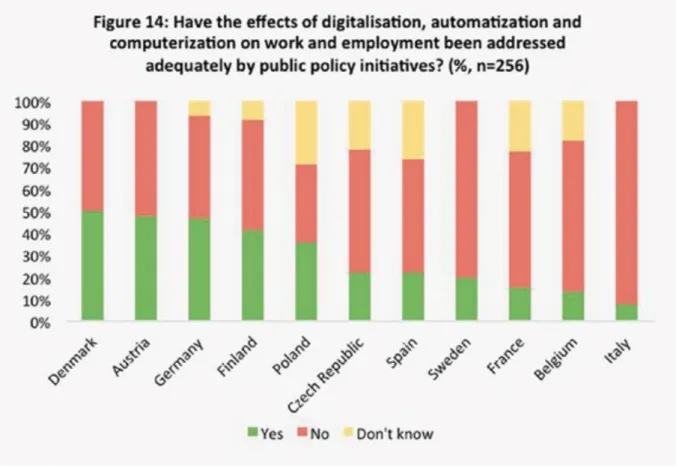
The dissatisfaction (and lack of knowledge) exhibited by trade unions with regard to public policies is particularly striking in Italy (92%), Belgium (86%), France (85%), and Sweden (around 80%). As highlighted by both interviews and workshops, the disappointment experienced by trade unions in the last two countries is due to political changes in the national government that, contrary to strong traditions of tripartite social dialogue, has introduced policy changes that have weakened the participation of trade unions in public policies. (p. 16)
Figure 5 presented below shows one of the results of the recent ETUC survey about the respondents (trade unions representatives and company workers representatives) perception of the public policy initiatives.
6 Engagement de Développement de l’Emploi et des Compétences/ Accord de Développement de l’Emploi et des Compétences
Figure 4 - ETUC Survey (Voss & Riede, 2018, p. 16)
In other countries, the position of the public authorities evolved according to governmental changes, as in Spain, where the previous government used to weaken the social bargaining system through the promotion of direct public consultation, while the new one has recently declared to be in favour of “fair digitalisation”, focused on social dialogue debates.
3.4. The emergence of new players
In some countries, new groups/organisations are emerging to represent the interest of new kind of companies or workers. On the employer side, new lobbying groups are constituted mainly to lobby in favour to less regulations, as it is the case in Spain where
A Business Association (“Association for the Digital Economy” - ADIGITAL), aims to represent the sector of the digital economy in Spain. This association is developing an intensive action aimed to lobby in favour of the promotion of the platform economy. According to their view, there is the need to promote public measures to foster entrepreneurship in this field, including the liberalization of those economic activities “excessively regulated” in order to allow the arrival of new operators. Also, they express their refusal to apply the existing labour regulation for employees to the workers in this field. (ADIGITAL, 2017, as cited in Rocha & de la Fuente, 2018, p.10)
On the workers side, quasi-unions may be found in several countries to defend the interest of atypical workers. In Belgium, the SMart cooperative emerged in recent years. Its position can be described as followed:
A cooperative for freelancers, offering all kind of services, including transforming commercial contract into salaried work34, personal advices, juridical help, handling the freelancers’ contract, etc. They played a key part in the negotiation process between workers from the Deliveroo platform (see point in the postal service sector) and the company. Both CSC/ACV and UCM (as well as UNIZO on the Flemish part) pointed out that they act as a quasi-union, without necessarily having the adequate credit and experience to do so, and without having the power to sign binding collective agreements as traditional unions have. (Beuker, Franssen & Naedenoen, 2018, p. 16) In Italy, Leonardi and Di Nunzio (2018) indicate:
The new workforce, atypical, freelancers and digital workers are also attempting to create their own forms of representation, out of the traditional labor organisations (Bologna, 2015; Ciccarelli, 2018; Capponi, 2017; Donini et al., 2017; Tassinari and Maccarrone, 2017). These organisations are quasi-unions and are characterized as associations based on a strong professional homogeneity, on the voluntary work of the activists and on a "liquid" membership (Forlivesi, 2018). Often in open dispute with the big confederal unions, accused of not having done enough to protect their condition so far. Or to misunderstand it. ACTA, for example, proudly claims the status of self-employed for its affiliates and constituency, against the traditional trade unions approach, essentially based on the homologating extension of the subordinate status. (p.13)
3.5. Digitalisation related restructuring
Throughout the national reports, digitalisation is identified clearly as one of the main drivers for restructuring and change (already in operation or as a potential development), but always in parallel with other processes (cost-cutting strategies, increasing international and national competition, changing nature of regulations, austerity policies, and so on). The digitalisation development could be facilitated or made more difficult by various processes and factors. In Spain, according to Rocha and de la Fuente (2018) there are several factors making the process difficult, e.g. the low innovation rate. In Italy, according to a report elaborated in 2017 by the Digital360, 54% of medium and large companies have not started any project of digital transformation (Leonardi & Di Nunzio, 2018).
While in some countries, numerous cases of digitalisation related restructuring are already well-covered by media and at top of the social partners negotiation agenda, in others, digitalisation has played a minor role till now.
Among the first are Belgium, France, Germany, Sweden and Italy. The French example is really instructive: digitalisation was the topic of the first part of a report published in January 2017 by the “Employment Orientation Council” (Conseil d’Orientation sur l’Emploi- COE). This report is often seen as one of the main source of general information about digitalisation, especially by the social partners representatives met in the framework of this study. Based on the international literature published since 2013 (for example Frey & Osborne, 2013), the report aimed at clarifying as much as possible the possible impacts of digitalisation on employment in order to point out possible reforms to be implemented. According to Teissier (2018, p. 6), this recent report suggests that:
Globally, less than 10% of existing jobs are at risk of being destroyed due to automation and digitalisation. But, 50% of the existing jobs are likely to be transformed in their content (tasks, working methods) in a large extent. Technological progress is likely to foster skilled or/and high skilled jobs, jobs most at risk being no or low skilled jobs.
The conclusions of the French report (Teissier, 2018, p. 9) are the following:
It‘s clear, considering the French context, that digitalisation (and the different and often interlinked technologies it refers to) has to deal with restructuring in a comprehensive way as defined in the DIRESOC project. Generally speaking, digitalisation is not considered in France only as a driver of job destructions but also, and perhaps first, as potentially huge and on-going transformations of jobs, occupations and work organisation as well as a driver for job creations. In other words, the French context seems to be ripe for anticipation of the effects of digitalisation on work and employment. A perfect topic for social dialogue?
In Belgium the digitalisation impacts on jobs have already made a large echo in media, especially because of the significant cases in the financial sector:
Digitalisation has received bad press in Belgium because of several famous cases. In 2016, P&V (insurance company) declared they were to eliminate 300 jobs by 2020 and Axa (bank) decided to eliminate 650 jobs within the same time frame. In 2017, it was up for ING and Record Bank (banks) to pursue with the intention of eliminating
one third of their staff members by 2021 (3150 jobs and 750 bank agencies). What is interesting is that most of the key cases are in the financial services sector. (Beuker et
al., 2018, p. 9)
In Italy, two quotations from the expert interviews illustrates well the two trends of digitalisation, one related to manufacturing, the other to the platform economy, developing in services:
Digitalization is mostly related to restructuring strategies aimed at maximizing returns on invested capital and - with regard to the c.d. Industry 4.0 - the strengthening of large European companies producing capital goods. (int. Salento, Univ. Salerno, as cited in Leonardi & Di Nunzio, 2018, p. 7).
Gig economy and Industry 4.0 are two faces of the ongoing digitalization of the world of labour. They share the fact of having an employer in the form of artificial intelligence, able to organize the work of human persons. But they differ in terms of sector and level of social protection. Tertiary and distribution tend to refer to the gig economy, with external flexibility and weak or no protections; manufacturing industry is more connected to the model of Industry 4.0, more centered on internal flexibility, lean production, and where employees still enjoy higher levels of protection. (int. Faioli, Univ. Rome, as cited in Leonardi & Di Nunzio, 2018, p. 9)
Among those with limited (yet) digitalisation impacts on restructuring are Spain, Portugal and Bulgaria. In Spain:
Against this background, it can be said that digitalisation has played so far a relatively lower influence in the development of restructuring processes, compared with other traditional factors”. (Rocha & de la Fuente, 2018, p. 6)
In Portugal:
When observing the trends in corporate restructuring data, and despite the important limitations of Eurofound as a source, companies do not seem to have varied their behaviours very differently in recent years. Internal restructuring still seems to be the most important cause of threats to jobs. (Rego, 2018, p. 5)
All in all, the main topics raised by the social partners over digitalisation related restructuring when interviewed are the followings:
- Knowledge management: how to anticipate and to face the evolution of tasks consecutive to digitalisation?
- Numerical flexibility: how to adapt the volume of workforce in both direction, i.e. the reduction of those workers which tasks are becoming obsolete, and the attraction of new workers with specific skills?
- Organisational flexibility: how to promote internal mobility?
- Control of work: how to protect the workers against new technological panoptism? - Role of social dialogue: how to reinforce and to adapt social dialogue and collective
bargaining practices in order to face the evolution of economic activity?
These themes often came up during the interviews as questions to which none of the social partners can yet provide detailed answers.
Another element to take into consideration is the distinction that social partners can make over the different technologies covered by the digitalisation phenomena. The impact of the platform economy is for instance a hot topic in most of the countries, mainly because – as already said - it is deeply modifying the structure of the employment relationship, with an important use of self-employment contract, which deeply impacts the social dialogue. Another key concern is the introduction of robots inside company plants. For most of the social partners interviewed, this evolution leads to both the destruction of jobs, the transformation of tasks and functions and, consequently, the transformation of skills needed.
4. Sectoral developments
The debates about digitalisation and work still remain at a very general level, without taking into account the specific features in the different sectors, branches and professions. Often, for part of the observers, digitalisation is connected with the brave new world of work and business opportunities, as analysed in the first section. For other, more critical voices, digitalisation brings substantive changes and numerous risks (Degryse, 2016; Valenduc & Vendramin 2016; Meil & Kirov, 2017; Holtgrewe, Haider, Salamon, Ramioul & Vereycken, 2018). The impacts of digitalisation clearly differ, according to the examined sectors and the countries covered by this report and the following four parts present the concrete findings about the digitalisation-related characteristics, restructuring and accompanying social dialogue practices in each sector.
4.1. Financial services sector
The financial services sector includes banks, insurance and other financial services (see full description in NACE7). In the framework of DIRESOC, the research focus is placed on banks, as they represent the most prominent cases, but some examples from insurance have been also provided in the national reports. Restructuring in banks has been examined elsewhere (Kirov & Thill, 2018), but the digitalisation impact on it is still a relatively new topic of academic and policy oriented research in the sector (see an overview in Holtgrewe et al., 2018).
4.1.1. Digitalisation and social dialogue
While digitalisation in the financial services clearly impacts company business models practices and jobs, quite surprisingly the topic of digitalisation is still not among the top agenda of social dialogue in most countries studied within the DIRESOC framework. In Belgium for instance, union interviewees explain that “At the joint committee, the
digitalisation is ‘not depicted as a matter’, because the trade union focus more on dealing with the consequences it induced” (CGSLB-ACLVB reps.) and “digitalisation is a “pretty hackneyed topic: everyone is concerned about it, but nobody has a clear knowledge of it”
(Assuralia reps, as cited in Beuker et al., 2018, p. 26). In Germany the digitalisation-related social dialogue focuses on restructuring as underlined in the national report: “In terms of
employee participation, digitalisation (…) leads to excessive demands of works councils. In addition to the requirement of specialist knowledge, this is supported by the "constant crisis mode" in which works councils are always placed. One restructuring project is chasing the next one” (Trade union secretary, as cited in Mühge, 2018, p. 12). The rate of change in
German companies in this sector is so high that the co-determination in its existing forms cannot always react effectively, according to the interviewed union representative (Mühge, 2018).
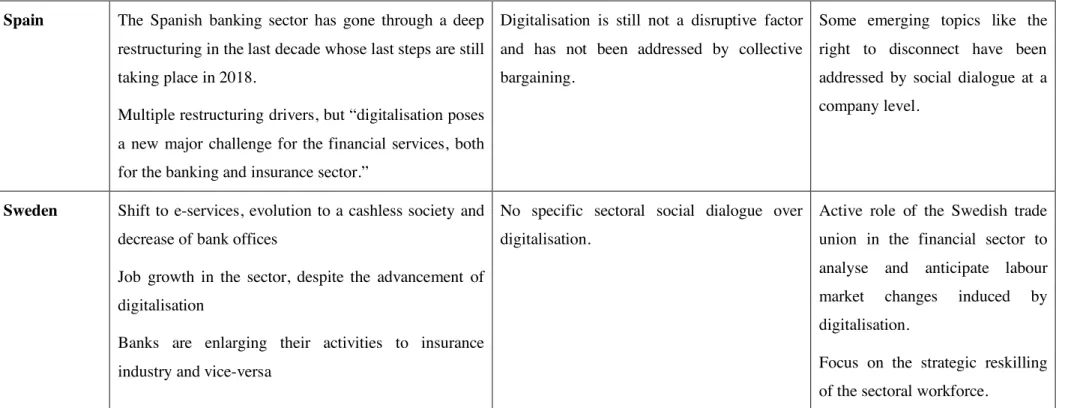
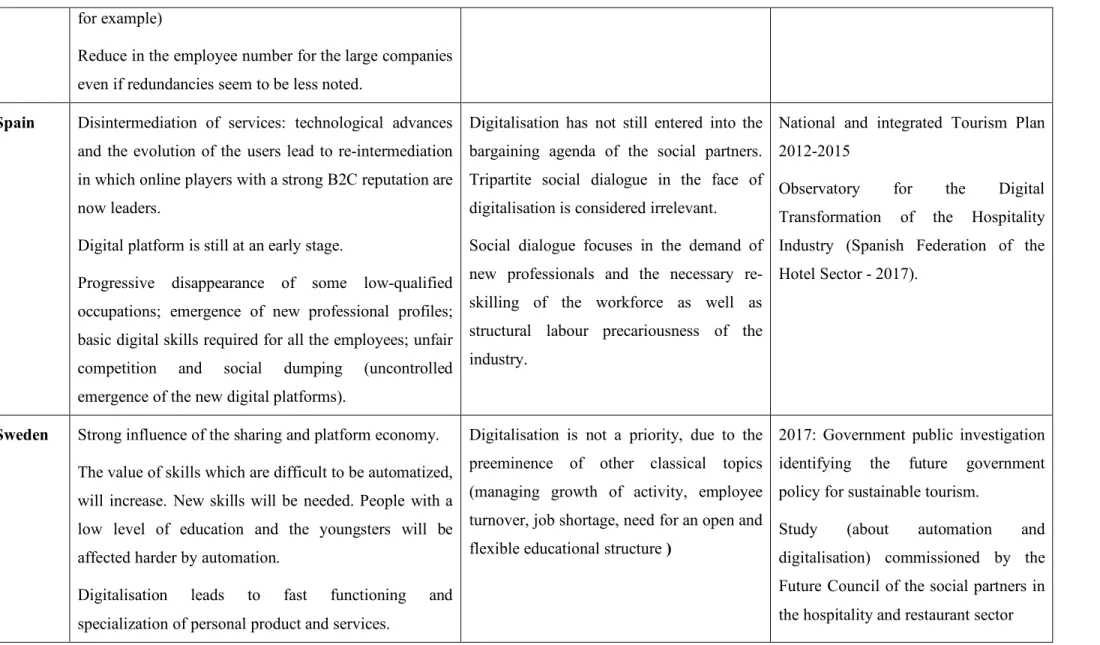
Nevertheless, social dialogue initiatives, related to digitalisation have started at EU level and in several European countries (DIRESOC national reports; Holtgrewe et al., 2018), as summarized in the table 1 below.
The particular social dialogue takes place at different levels: company and/or sector. The main topics covered relate to awareness raising, anticipation and skills development, but also
anticipation of the future changes and concrete actions for the managing of restructuring consequences through collective labour agreement (CLA) and sectoral fund. Our findings from DIRESOC cases are in line with other recent researches on the digitalisation and social dialogue in the financial services sector, e.g. the recent research, commissioned by the European services trade union Uni-Europa, that has examined the trends of digitalisation within the different European employment and IR models, as well as some of the trade union responses (Holtgrewe et al., 2018).
At the European level, the sectoral social dialogue development also included digitalisation among the priorities of social dialogue. On the 4 December 2018 the European social partners in the banking sector signed a “Joint Declaration on the impact of digitalisation on employment”. The new declaration addresses the effects on employment of digitalisation and automation processes in the banking sector. The social partners engage to jointly “address the
opportunities and challenges of digitalisation in a positive manner, aiming to shape the digital transformation in a socially responsible way and create value for all stakeholders including shareholders, sector, employees, consumers and society in general” (p. 2). The
specific topics of the social dialogue to be developed are: data protection and privacy, healthy working conditions and work-life balance, considered as crucial for the digital transformation of the banking sector.
4.1.2. Digitalisation and restructuring
Digital transformation has been among the restructuring drivers for a number of years – e.g. the automation of back office activities, online and more recently mobile banking, clients’ relationship through internet (Skype or other messenger tools). However recently, digitalisation has included multiple new areas – AI, bots for customer’s relationships, fintech, blockchain, and so on. These technological evolutions are supposed to increase the performance of financial services companies and respond to the clients’ preferences changes. In almost all the countries covered by the project (to a lower extent in Bulgaria), clients have deeply changed the way they interact with their financial institution, preferring the technology mediated communication instead of the visit on-site.
These various aspects of digitalisation in the sector have led to multiple impacts on jobs and skills. As a matter of fact, the DIRESOC national reports inform about several significant restructuring cases occurred in different countries, e.g. in Belgium, France, Sweden and Italy. The question here is to what extent digitalisation is not used to “mask” pure cost-cutting
strategies that are not new as such. Other contextual factors may help further explaining these restructuring processes: the still on-going impact of the 2008 global crisis on finance activity regulations, the increasing regulation of the sector and or the persistently low interest rates. However, the existing literature and national reports suggest that at present digitalisation is now amongst the most important factors for restructuring. For most of the DIRESOC countries, digitalisation is seen as new driver to explain the continuous reduction of jobs in this sector since the 1990s. In Italy for instance, and according to a union representative “Five-ten years ago, we had restructuring and jobs cuts costs saving driven. Today, they are
driven by the digitalisation and its impact”. (int. Nat. Off., FISAC-CGIL as cited in Leonardi
& Di Nunzio, 2018, p. 22).
Job transformation and career transitions are also at stake, as underlined in the French report
“digitalisation seems to highlight already old problems identified in the French context: how to efficiently support career transitions of workers” (Teissier, 2018, p. 25). Sweden is the sole
country covered by our research, where the overall amount of jobs in the sector increased over the last years, despite the massive entry of electronic services.
Country Restructuring events and patterns/impacts of digitalisation
State of social dialogue and importance of the topic of digitalisation
Spotted initiatives related to digitalisation
Belgium The sector is seen as “key historic player” of the
digitalisation.
Large restructuring cases happened during the last years.
Fintechs are emerging, decreasing number of bank agencies due to digitalisation.
Social dialogue topics dealt under the heading “digitalisation” are the work organization (Saturday and Sunday work), the vocational retraining, the flexibility, and private/professional life conflict
Parity action: “Study day on digitalisation”.
Bulgaria No, limited effect of the digitalisation. Very weak social actors and social dialogue
which does not allow the development of social dialogue initiatives related to digitalisation.
No particular initiatives by social partners related to digitalisation were identified.
Germany Universal banking system and dynamic market
development in recent years
Emergence of external actors (fintech, internet giants) 3 areas of digitalisation:
(1) the internal use of IT systems to streamline internal processes;
(2) the digitalisation of customer interaction; (3) the interaction with service providers.
Digitalisation is a subject among too many others, leading to an overloaded co-determination process.
Job cuts and employment security are the central problem areas of this sector-specific digitalisation
At company level, this process creates permanent conflicts between employers and works councils, and attempts by employers to
No particular initiatives by social partners related to digitalisation were identified.
undermine employee participation.
France The technological innovation, in the context of
changes in clients behaviour and requirements is one of the most important drivers of restructuring.
Various examples of digitalisation and its impacts; branch closures plans within major French banks.
Well-developed social dialogue with specific structures for the anticipation of change (including the Observatory for occupations, qualification, and professional equality between women and men in banking)
Digitalisation and its impact on employment and skills are not really a topic for a strategic / early social dialogue.
Few initiatives on skills development at sectoral level and impact of digitalisation on job level and skills at local level.
Italy In Italy, the sector is very affected by on-going
processes of radical restructuring, very much driven by digitalisation, in terms of the customer services and work organization.
As highlighted by the Association of Italian Banks (ABI) in a 2016 report, the banking sector is among the most exposed to the challenge of digitalisation, with Big data, robot advisor, artificial intelligence and blockchain.
Well-developed social dialogue and high unionization rates in the banking sector.
Sectoral fund providing funding and acting as shock absorber. Company level agreements aim at increasing the efficiency of the bank offices, strengthening productivity-related bonuses, welfare benefits, wellbeing at work, worklife balance (smart -working).
Portugal Significant restructuring impacts in the Portuguese
banks.
Rare cases of collective bargaining, e.g. in large foreign banks.
No particular initiatives by social partners related to digitalisation were identified.
Spain The Spanish banking sector has gone through a deep restructuring in the last decade whose last steps are still taking place in 2018.
Multiple restructuring drivers, but “digitalisation poses a new major challenge for the financial services, both for the banking and insurance sector.”
Digitalisation is still not a disruptive factor and has not been addressed by collective bargaining.
Some emerging topics like the right to disconnect have been addressed by social dialogue at a company level.
Sweden Shift to e-services, evolution to a cashless society and
decrease of bank offices
Job growth in the sector, despite the advancement of digitalisation
Banks are enlarging their activities to insurance industry and vice-versa
No specific sectoral social dialogue over digitalisation.
Active role of the Swedish trade union in the financial sector to analyse and anticipate labour market changes induced by digitalisation.
Focus on the strategic reskilling of the sectoral workforce.
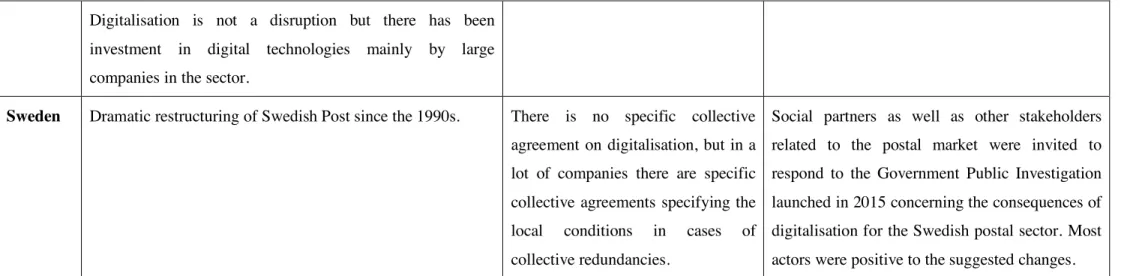
4.2. Postal services sector
The postal sector underwent a large and long process of transformation since 1996. The restructuring drivers include liberalization, privatization and technological modernization (Martinez et al., 2018). In some countries, as in Spain or in Portugal, an additional factor for restructuring is the global crisis, which is still impacting this industry in a negative way. Recently, posts in European countries witnessed changing patterns of postal services consumption, namely the continuous replacement of paper letter with e-mails and the massive increase of e-commerce. This lead to a switch of the company business models, with a decrease of the added value and volume in letter distribution, often more than compensated by the CEP (courier, express and parcel services) activity growth. As far as digitalisation is concerned, this evolution questions the degree and the direction of investment that companies may dedicate to technological tools, as underlined in the Belgian report:
A union’s delegate points out the fact that bpost never switched to a complete robotisation of their processes. According to him, the decision was taken to not switch to an entire robotic environment because of the decrease in letters stocks to handle. The volume of letters had become too small for it to be financially interesting to shift to a robotic line of operation. (Beuker et al., 2018, p. 27)
DIRESOC partners mainly focused their analysis of the postal sector on traditional postal operators, but due to the heterogeneity of the sector, some national reports have addressed also the logistics sector as it is the case for Germany, or have also investigated the delivery activities such as in Belgium.
The digitalisation process concerns the transition from paper to e-mailing, the consequent increase of e-commerce profoundly modifying the parcels’ delivery, as well as the automation/robotisation of sorting and the increasing use of e-devices to plan and control the work of postmen. Nevertheless, this evolution is not totally new, these processes having emerged during the end of the nineties. Moreover, if digitalisation represents high hopes for the transformation of the entire sector, technologies and companies are still not totally ready to fully exploit it, or are limited to big companies as in Spain, where the picture is still far from being so disruptive (Rocha & de la Fuente, 2018).