Picturing Transcendence
Maria Giulia Dondero
Abstract
This paper will examine how two different media, painting and photography, respond in representing the same theme: the theme of religion and transcendence. Four different cultural objects will be studied in this light: 1) religious painting, 2) artistic photography with a religious theme, 3) devotional photography that is transformed into holy images, and 4) the Russian icon. We will analyse the filtering effect of these two media in the representation of religious themes. We will seek to explain why the religious theme in painting has been able to assume a sacred dimension which, by contrast, seems unachievable in contemporary artistic photography.
Résumé
Cet article compare deux médias, peinture et photographie, et les manières dont ils structurent la représentation d'un même thème: la religion et la transcendance. Il abordera quatre objets culturels différents: 1) la peinture religieuse, 2) la photographie d'art à thème religieux, 3) la photographie dévotionnelle transformée en image sainte, 4) les icônes russes. On tentera d'examiner la manière dont se rencontrent propriétés médiologiques et contenus thématiques, de manière à expliquer pourquoi seule la peinture, non la photographie d'art contemporaine, s'est révélée capable d'assumer une dimension sacrée.
Keywords
Introduction
This paper will examine how two different media, painting and photography, respond in representing the same theme: the theme of religion and transcendence. Four different cultural objects will be studied in this light: 1) religious painting, 2) artistic photography with a religious theme, 3) devotional photography that is transformed into holy images, and 4) the Russian icon. We will analyse the filtering effect of these two media in the representation of religious themes. We will seek to explain why the religious theme in painting has been able to assume a sacred dimension which, by contrast, seems unachievable in contemporary artistic photography.
“Sacred” is defined herein as something based on values that are incommensurable and can be conveyed only by translation (consider transubstantiation, for instance), values that religion can deal with only indirectly -- and by religion we mean an organized social domain. Religion is therefore an institutionalized way of accessing the sacred. In the realm of religion, the opposition of values is founded on the axis of good and evil. Conversely, in the realm of the sacred, the opposition of values is founded on the axis of sensibility and insensibility. In this sense, the sacred concerns the struggle against the meaninglessness of life, and why we accept life or death.
The main objective of this study is to show that the different significations of photography (artistic versus devotional) and the different dimensions of painting (Western Renaissance artistic painting versus the Russian icon) go beyond distinctions between different production techniques: it is the status, or in other words, the institutional role assumed by an image, that determines the signification of the medium.
We could thus maintain that the medium will prove to be a product that depends on three semiotic levels of analytical relevance (Basso Fossali and Dondero 2011):
1) institutional status (in terms of reception and interpretation practices), 2) textual configurations (morphologies of visual textualities) and 3) instantiation practices (i.e., production practices).
The religious theme in painting and photography
Firstly, we can say that painting has been given very free rein, even to represent God and transcendence, while photography has been relegated from its beginnings to a media-based role, and by virtue of popular opinion has become the “imprint of the visible and the present”, only capable of representing here and now situations.
Particularly since Walter Benjamin’s work in the thirties, painting has been viewed as unique, original, having an aura and a cultic or even sacred value. On the other hand, photography has been interpreted as a medium which allows for reproduction only, and consequently deals in profane values.
Painting has always been seen as exemplifying the autographic arts (as Nelson Goodman established in Languages of Art in 1968), in which any mark inscribed on the canvas is pertinent to signification, since the medium of autographic images is supposed to be original, and thus the unique and non-repeatable result of the producer’s sensory-motor activity.
On the other hand, photographs have long been interpreted as allographic, that is to say, reproducible from a matrix, which is the negative. The medium used to inscribe shapes on the different prints could therefore not be considered as unique or original.
According to Benjamin (2008), while paintings have always been interpreted as unique, separate and sacralized, photographic reproductions, on the other hand, are multiple and varied, and have been viewed as profane. With the advent of the photographic medium, the concepts of originality and falsity lost their significance and gave way to the notions of copy and reproduction. This is also why photography acquired an artistic status very late in its development and why, in contrast to painting, popular opinion has described it as a medium-based object incapable of either representing or signifying transcendence.
This distinction, which assigns an ontological meaning to the medium, i.e., which considers that the technique determines the signification of cultural objects, will be refuted by our corpus. We will show that the ways in which the painting medium and the photographic medium function are more complex: there is more to determining the meaning of a corpus than an opposition of techniques (the sensory motor activity of painting versus the mechanical activity of photography, or the sacral uniqueness of the painting versus the multiplicity of photographic prints).
It will be seen that the ability to signify transcendence cuts across a distinction based on techniques of production. So instead of placing the photo on one side and the painting on the other, we will propose another regrouping that places western religious painting and artistic photography on one side, and eastern painting (in the form of the Russian Icon) and devotional photography on the other.
The relevant distinction concerns not just technique, but an array of parameters that takes account of the mediation of statuses and interpretive practices.
1.1 Occidental religious painting and artistic photography
The iconography of artistic photography with a religious theme draws from the pictorial iconography of the modern western tradition.
The recent work of certain photographers, such as Bettina Rheims, Sam Taylor-Wood, Jan Saudek, Pierre and Gilles and many others, constitutes tableaux vivants, which mimic the iconographies of famous Renaissance- and Baroque-period paintings.
In contrast to the paintings that inspired them, the tableaux vivants-photographs look like ostentatious theatrical machinations; they seem false, misleading and dishonest, and the subjects are portrayed as impostors. The mere fact that a set was designed to show posed characters mimicking postures stabilized in the iconographic tradition nullifies the sacralizing effect of the religious scene (Dondero 2009).
While the religious theme in painting goes hand in hand with a sacred signification, the same cannot be said for artistic photography. Sacred meaning seems to be off limits in photography. In our culture, one of the most interesting concepts of the sacred covers the semantic field of authenticity and grace, as the anthropologist Gregory Bateson states. In Style, Grace and
Information in Privitive Art (1977), Bateson states that man’s fundamental problem is the quest for
grace— the sort of grace one finds in animals. He observes that there is a naiveté and a simplicity in the communication and behavior of animals, which man has lost. In Bateson’s view, grace is synonymous with integration, i.e., the integration of the diverse parts of the mind, particularly of the multiple levels ranging from the “conscious” to the “unconscious”. Grace is sometimes lost by having too much consciousness of what one is doing. Bateson is convinced that grace requires being unconscious about our knowledge. Like holiness, grace is practiced by not having any way to talk or think about it or become conscious of it. We can only consider as sacred that which is not ostentatiously depicted, is not subject to marketing strategies, cannot be pre-packaged, and may be wholly unknown to us (see also Bateson 1991 and Bateson & Bateson 1987).
According to this concept, in order to be preserved as such, the sacred cannot be augmented or reproduced: this is why a photograph representing a religious theme in which characters are
posed with the intention of being witnessed loses its sacral aura completely. While the sacred, as
described by Gregory Bateson, is the domain of a non-repeatable, non-marketable and even unconscious tacit communication, artistic photography with a religious theme, conversely, has been
viewed as the product of an action that is intentionally aesthetic and complicated, and so has been interpreted as a kind of blasphemous trade in the images of saints and as the profanation of an
inviolable tradition. The religious theme in artistic photography reveals its entirely constructed
nature, while the sacred is something that we can neither construct nor set up.
One can thus explain the desacralizing effect of the pictorial iconography produced in photography in two ways:
1) photography is a product of inauthentic and posed representation, while painting is considered as the authentic product of the sensory-motivity of the painter, who has himself been sacralized, particularly since the Renaissance;
2) while painting has been viewed as the result of an unrepeatable act (a unique sensory-motor act), as is the experience of the sacred (which is always an unrepeatable experience of epiphany), the photograph is highly reproducible into multiple prints, which clearly leads to the dispersion of the separate uniqueness that is the essence of the sacred.
The holy image as a media prototype
Now I would like to turn to another status found in photography: the private status of devotional photography. I intend to show that originating “by imprint” does not prevent the photographic work from signifying something beyond simply reproducing a here-and-now situation.
While contemporary artistic photography inherits its iconography from the western painting tradition (mainly from large-scale religious scenes), the iconography of devotional photography is tied to the tradition of the icon (primarily to portrait iconography).
In devotional photography, normally a face is recorded on a photosensitive plate. The saint is never depicted doing anything worldly; he is simply shown with his eyes gazing at the observer, and from fairly close up. This type of photograph belongs to a “private” class of image, in the sense that despite being mass-produced and distributed by religious institutions, like all santini, it also becomes a personal relic that the believer carries around in contact with his body like a private item. What might seem surprising is that the practice of personalizing the devotional photo (with the “skin” of the photo in contact with the earthly body of the believer) contrasts sharply with the impersonal nature of the snapshot. Moreover, the “singularization” of every holy image as it acquires its patina from contact with the believer’s body or other personal objects is in sharp contrast with the image’s distribution in thousands of copies and the fact that it is one of the most
anonymous images in existence.
While artistic photography has been interpreted as constructed and intentional, the semantization processes at work in devotional photography bring to light a composition that is structured so as to make the recorded presence seem to have emerged from some unfathomable place or impenetrable depth. There is an astonishing effect in that the face seems as though it has come from somewhere outside the will and premeditation of the photographer, in short, it seems as if the photo had no enunciator with hands and intentions. It looks like an unintentional, impersonal image, which gives it an aura of authenticity and necessity of existence.
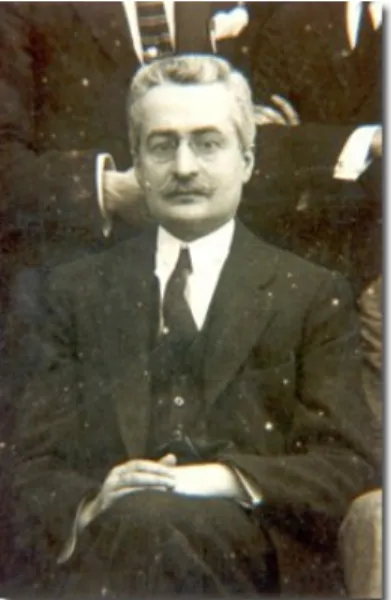
In a paradoxical way, the fact that the devotional photo of Saint Moscati of Naples (Figure 1) is produced by a technical process whose presence is tangibly attested in the entire imprint only serves to confirm its sacred value: it appears as though the work derives from “something” transcendent to man, something that is superior to him and which escapes his comprehension (escaping the action of the photographer as well). This “something” has given rise to this presence, which has autonomously imprinted itself on a medium.
Figure 1 Giuseppe Moscati (1880-1927)
In artistic photography, it is precisely the reproducibility ensured by the equipment that has prevented the images from being interpreted as “authentic” products that are unique and sacralized.
This could seem paradoxical if we stop to think that artistic images are always unique, and that devotional images, by becoming holy images, are reproduced in an infinity of replicas. One of the reasons for evaluating these two types of images differently no doubt lies in the fact that we cannot appropriate the artistic image, while the devotional image practically becomes a relic. In
some sense, one could say that artistic photography circulates through society occupying a status of
textuality to look at and to appreciate, while devotional photography circulates as an object that we can touch, manipulate, and appropriate to make it into an intimate object.
One could say that devotional photography, in contrast to photography with an artistic dimension, does not represent a religious theme or event, but is itself at the center of a religious
event. In fact, the devotional photo transformed into a holy image functions as a contact point
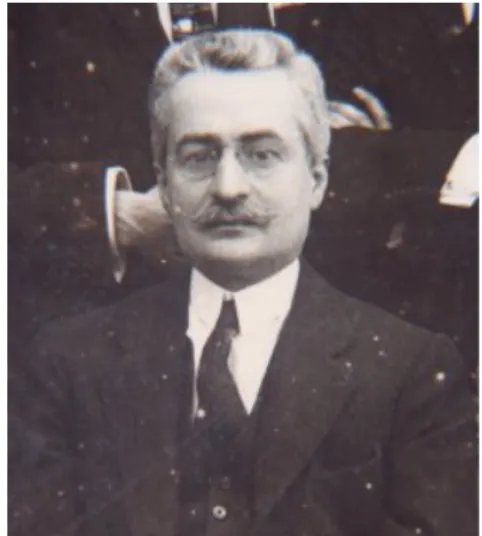
between the believer and the transcendent moment, while paradoxically presenting a textuality that is quite anonymous in its process of instantiation and in its composition strategies. The anonymity of the hand during instantiation is paralleled by a process of “making anonymous” the body of the photographed saint as the photo is gradually transformed into a graphic image, or even a holy image (Figures 2-3).
Figure 2. Giuseppe Moscati, retouched photograph (graphic image)
In other cases, where holy images are not produced from a photograph, they derive their figurative and formal configuration from the institutionalized pictorial iconography of the saints. They are never an exact reproduction of a famous painting; they are imitations of a multiplicity of famous paintings.
In painting, no brushstroke by the producer can be taken as contingent, and no deviation considered as non-significant. (That is a characteristic of autographic arts.) The fact that in the holy images, the hand of the painter gives up its characterizing and individualizing stylistic saliencies in favor of an accumulation/subtraction of hands means that these little images have to be considered as examples of stylistic anonymity.
These images thus become recurrent: on the iconographic level, it is because the visual configuration, which is “original” in painting, becomes an anonymous iconography, lacking in all singular and characterizing properties, which are autographic. The holy image is an image that is
the average of the hands of different artists, and it derives from an average style, an average hand
that becomes the contemporary prototype of an impersonal mediation.
In our culture this impersonal mediation has always signified the incarnation of the divine.
As we saw in the case of Saint Moscati, his photographed body devolves into a body that is less and less distinctive, and more and more stereotyped and cut off from the present, eventually becoming an iconographic model that is no longer immersed in its time. This abstraction of time is one of the characteristics that every medium used for devotional practices seems to need. One could say that the devotional photo takes on a phatic function.
These images have no function other than to keep one in tune with the transcendent order; they help the believer to remain in that transcendent presence, and make it possible to await the revelatory event.
In a way, these images function as pure media: the fact that the figures represented in holy images are often very banalized shows that what matters is the simple availability of the holy image.
The visual morphologies and characteristics are quite insignificant because in fact the aim is to use them in worship as a medium and a filter, or to see through them and go beyond them. The anonymity of the holy image is specifically what helps it to mobilize the inner eye, which must transcend the banality of the visible: it is the figurative banality of the holy image that enables one to transcend the visible, to not focus on mere textuality so as to accede to something else.
Holy images are lazy machines, according to Umberto Eco (1979), that ask the believer to go beyond the banality of the stereotype and to arrive at mediation: through the holy image we are not, in fact, devotees to a Saint, but to a practice of transcending.
1.3 The Holy Shroud and the photographic revelation
While the “tableaux vivants” that represent traditional pictorial iconographies appear to be utterances that reveal the inauthenticity of the performance and the effort to appropriate a stabilized tradition, in the devotional photo, the image of the Saint seems to have imprinted itself on the impregnating paper without passing through the hands and thoughts of man. This indexical origin is what lends authenticity to the emergence of presence. This kind of emergence of forms in the devotional photo, linked to an instantiation that is understood as non-intentional and therefore authentic, reminds us of another, decidedly more famous emergence of presence: that of the body of Jesus Christ on the Holy Shroud.
We must remind ourselves that the strategy of reversing from negative to positive, which is typically how imprinting and photographic development function, is what made it possible to reveal and bring forth the body of Jesus Christ onto the holy shroud, and to portray the naturalness of this imprint (see Belting 2007 and Grojnowski 2012). Indeed, after several scientific experiments on the Holy Shroud - which showed traces of a “natural”, non-intentional action between the body and the fabric - the mystery of an image with no mediation, no author, no hands – in a word, acheiropoeta – was born. And so the photographic negative, like the shroud, assumes the status of an imprint not yet developed and yet to be revealed.
From that time on, the typically photographic mechanism that transforms the negative into positive – i.e., the mechanism that enables the revelation of the holy shroud – has been interpreted as something that speaks on behalf of transcendence itself.
Note that the social role of an image can determine the significations of the technique, and not vice-versa. While in the case of artistic photography there was non-compatibility between the sacralizing effect and the specificity of the medium (the intentionality of the photo shoot, the construction of the pose), one can see that the private-devotional status emphasizes and makes relevant other characteristics of the same photographic medium, such as the automatism of the process and the physico-chemical mechanism: in other words, the processes of inscribing development and revelation “naturally”, which become paradigms of an image that is produced “without hands”, as in the case of the Holy Shroud.
The role and signification of the photographic medium change depending on the image’s status (devotional vs. artistic), even though the photographic technique of printing remains the same in the two cases: the medium, which represents reproducibility and falseness in the artistic image (the
tableau vivant) becomes the embodiment of the faithful proof of originality for the devotional
image – even for the most “original” image (in the case of holy images reminiscent of the Holy Shroud). In terms of devotional status, this becomes the prototype for all unique and sacred imprints.
Paradoxically, while the devotional photograph, from the standpoint of production, is an image meant to be interpreted as acheiropoeta, or non-mediated, from the point of view of reception, conversely, it is supposed to possess strong communicative power, specifically for mediation between two different levels of reality.
It is true that in order to provide access to the sacred realm (and not just the religious realm), the devotional image must be viewed as resulting from non-human execution and thus be interpreted as an image without mediation, but it is also true that the devotional image uses its non-mediated character as a guarantee of mediation between the receiver and a transcendent realm.
1.4 The Russian icons
While the Holy Shroud is the prototype of all unique imprints, the Russian icons were the first images to use the photographic process ante-litteram to signify the incarnation of the divine.
The act of printing the negative as a positive, using techniques that make shapes emerge on the surface of a photosensitive surface via a chemical adjustment of light, is similar to the emergence of shapes through the entire process of instantiation of the Russian icons.
If we follow the ideas of Russian theologian and philosopher Pavel Florensky, the Russian icons are conceived as imprints, images taken by contact in a manner similar to revelation. The normative repetition of models of icons is intended to ensure a relation between a new imprint and the first contact with a primordial image of the holy face that was naturally inscribed in the minds and eyes of the church patriarchs.
The Russian icons are effectively paintings, but the resulting figurative syntax is not what we typically find in a painting. In the French semiotician Jacques Fontanille’s terms (2004), figurative syntax is the manner in which the shapes are stratified and composed, and in the case of icons, this manner is not quite “typically” pictorial.
In the case of Russian icons, although the production materials come from the tradition of painting, the manner in which the shapes emerge does not appear to be the result of manual sensory-motivity, i.e., proceeding by strokes of color. The shapes of the icon emerge gradually from an impenetrable depth, their contours becoming progressively more visible and concrete, as though emerging from the shadows – just as they do during the development of photo negatives.
In my opinion there is a strong connection between the figurative syntax of the icon and the figurative syntax of devotional photography, one that makes the production of the icon commensurable with the act of photographic development/revelation. Florensky describes the delicate instantiation of the icon by comparing it to a process of printing a vision on the canvas:
For when, on some hypothetical icon, there appears that first concreteness (i.e., first according to spiritual rank and historical emergence) which is the golden light, then the white silhouettes receive the first level of concreteness and actualise what until then had been only the abstract possibility of existence, [...].
[...] the operation is one of filling in with colour the spaces defined by the golden contours so that the abstract white silhouette becomes the concrete colourful silhouette of the figure. For at this point, the space does not yet possess true colour; rather, it is only not a darkness, not wholly a darkness, having now the first gleam of light, the first shimmer of existence out from the dark nothingness.
[...] This floating of colours is a highly significant detail of the icon-painting process, for it shows that both the painterly brushstroke and the glazing technique are impossible in icon painting, for here, in the icon, there are no half-tones or shadows: instead, reality is revealed by the degrees of the manifestation of existence – but not by putting one piece or quality alongside another (Pavel Florensky, 1996, pp. 138-139).
Florensky goes on to explain that when the face primer (sankir) has dried, the contours of the face, both inner and outer, must be redrawn with color, so that the face passes from abstractness to the
first degree of clarity: the face receives a first degree of animation in this way. The shapes of the
icon become clearer, as if emerging out of a place of confusion: they come to light by progressive degrees of emergence, and not by juxtaposed parts. The icon painter proceeds from the shadowy to the bright, from darkness to light, quite like the photographic negative as it is being revealed. Florensky states that there is a gradual revelation of the image. In icon painting, the shapes keep emerging, always more obvious, always more marked, which is what happens during the revelatory act when the photograph develops from the negative to the positive: the shapes become clearer; they are distinguished as differences of depth emerging in the contours. We see that every moment in the icon’s production is caught within a syntax of emergence of shapes by layers, as if the iconographer were faced with the manifestation of a vision that emerged from within the canvas, one that gradually manifests itself in successively greater degrees of clarity. The expanded temporality of the
icon’s instantiation is intended to signify the progressively clearer and more “apprehendable” appearance of the vision of the hereafter. Both icon painting and photographic development cause shapes to emerge as items that appear gradually out of the light, not as illuminated by a source of light. The preparation of the canvas, the additions of specific materials, and the procedures using not the stroke of a paintbrush, but the filling of flat spaces predetermined by the contours are meant to convey the experience of the vision of God emerging into the perception of the church patriarchs and the saints, a vision that can be observed it through the icon itself. The relation between photographic development and the figurative syntax of the icon proves to be far more profound than the relation between the icon and Renaissance painting, even though the icon and the painting make use of (practically) the same materials: in this case, it is the figurative syntax of the shapes emerging in the medium that matters in interpreting the images heuristically, and not the materials (which participate in the origin). Devotional photography and the icon are two objects that share the same figurative syntax on the plane of expression, and the same impersonality of doing on the plane of content.
Indeed, the figurative syntax of the icon seems to be determined by decisions taken not by the producer (who is only an executor), but by a distant authority who was stabilized by the first theologians. In the case of the icon, the reason that the religious institution and the sacred dimension coincide is that the icon as a religious cult object is what determines the life of the executor, not the reverse. In Renaissance painting, by contrast, it is the painter who determines the painting: the painting is at his service (immanence of values). In Renaissance painting, it is specifically the sensory-motivity and the intelligence of the producer – who is fully the master of himself – that are sacralized: from this standpoint, the religious theme does not take on any true sacral value (it is the artist who determines the work). The artwork itself assumes a sacral quality that does not depend on any sanction from the transcendent dimension, but is based instead on a humanist claim that declares itself capable of determining its own foundation of values (the artist is in fact an artifex who emulates God). The artist sees himself as the only possible transcendence. It is a transcendence that is immanent to him or her, and thus not at all sacred. The executor of the icon, on the other hand, is in no way the master of himself or his work. The latter are determined by a cult and a religious tradition that must agree with the ethical choices and the conduct of the executor.
Finally, to my mind there is a strong double relation between a) the modus operandi or even the structuring of the pictorial text of the western Renaissance painter (the use of sensual oil colours that slide over the canvas and the use of linear perspective) and the choices of the orthodox
iconographer (the use of the stucco canvas and the reversed perspective) and b) the two respective forms of life: the orthodox executor with his anonymity (the transcendence of values, in the case of icons) versus the western painter (the immanence of values). The colors, the characteristics of the inscription media, and the cadences of the painter’s hand over the surface are consistent with cultural and spiritual demands.
To conclude
To conclude, I would say that studies about the ontological nature of pure technique (and technique has been confused too often with the notion of medium), such as the one I quoted by Benjamin at the beginning of this paper, are heuristically lacking. I have shown that the medium cannot be reduced to technique. The photographic medium demonstrates an ability to sustain the semantic effects of total non-authenticity as well as the semantic effects of total authenticity with respect to the sacred values of our existence (as in the case of the devotional photograph).
References
BASSO FOSSALI, Pierluigi and DONDERO, Maria Giulia 2011. Sémiotique de la photographie, Limoges: Pulim. BATESON, Gregory
1972. Style, Grace and Information in Primitive Art, in Gregory BATESON, Steps to an
Ecology of Mind, New York: Chandler Publishing Company.
BATESON, Gregory
1991. A Sacred Unity - Further Steps to an Ecology of Mind, New York: Harper Collins Publishers.
BATESON, Gregory and BATESON, Mary Catherine
1987. Angels Fear - Towards an Epistemology of the Sacred, New York: Macmillan Publishing Co.
BELTING, Hans
2007. La vraie image: Croire aux images?, Paris: Gallimard. BENJAMIN, Walter
1931. The Work of Art in the Age of Its Technological Reproducibility, and Other Writings
on Media, Harvard: Harvard University Press, 2008.
DONDERO, Maria Giulia
2009. Le sacré dans l’image photographique. Etudes sémiotiques, Paris: Hermès-Lavoisier. ECO, Umberto
1979. The Role of the Reader: Explorations in the Semiotics of Texts, ed. Thomas Sebeok, Bloomington: Indiana University Press.
FLORENSKY, Pavel A.
1996. Iconostasis, Crestwood, NY: Saint Vladimir’s Seminary Press. FONTANILLE, Jacques
2004. Soma et Séma. Figures du corps, Paris: Maisonneuve et Larose. GOODMAN, Nelson
GROJNOWSKI, Daniel
2012. Photographie et Croyance, Paris: La Différence.
Maria Giulia Dondero ([email protected]) is Research Associate at the National Fund for Scientific Research (Fonds National de la Recherche Scientifique), University of Liège, Belgium
Member of the Collège des Alumni, Académie Royale de Belgique http://www.academieroyale.be/n11458/Maria%20Giulia.Dondero