BIORESOURCE PAPER
The Quebec Respiratory Health Network Biobank
Sabrina Biardel
1, Christine Racine
1, Yvan Fortier
2, Andrea Karen Mogas
3, Émilie Maillé
4,
Emmanuelle Brochiero
4,5, François Maltais
1, Anne-Marie Lauzon
3,6, Sze Man Tse
7,
Catherine Laprise
8,9, Philippe Joubert
1, Éric Rousseau
2, Élyse Bissonnette
1,
Michel Laviolette
1, Yohan Bossé
1,10,*and Simon Rousseau
3,6,*1 Institut universitaire de cardiologie et de pneumologie de Québec, Québec, CA
2 Faculty of Medicine and Health Sciences, Université de Sherbrooke, Centre de Recherche du CHUS, Sherbrooke, Québec, CA 3 Meakins-Christie Laboratories, Research Institute of the McGill University Health Centre, Montréal, Québec,CA
4 Centre de recherche du Centre hospitalier de l’Université de Montréal (CRCHUM), Montréal, Québec, CA 5 Département de médecine, Université de Montréal, Montréal, Québec, CA
6 Department of Medicine, McGill University, Montréal, Québec, CA 7 Centre hospitalier universitaire Sainte-Justine, Montréal, Québec, CA
8 Département des sciences fondamentales, Université du Québec à Chicoutimi, Chicoutimi, Québec, CA 9 Centre de santé et de services sociaux du Saguenay, Chicoutimi, Québec, CA
10 Department of Molecular Medicine, Université Laval, Québec, CA
* Co-senior authors
Corresponding author: Simon Rousseau, Ph.D. ([email protected])
The Quebec Respiratory Health Network (RHN) Biobank is a multi-site infrastructure located in the province of Quebec (Canada) to collect, store, and supply high-quality human biological specimens for research on respiratory diseases. The sample types are diverse (plasma, serum, buffy coat, primary lung cells, lung parenchyma, bronchial biopsies, polyps, others), disease-oriented, and mirror research activities conducted at each site. The biobank currently manages approximately 57,000 specimens from 8,000 research participants or patients treated by standard of care. Specimens’ inventory and corresponding clinical data from all sites are denominalized and linked to a centralized database with retrieval and querying capabilities. Archival samples from recent to nearly 20-year collections are available to academic and industry researchers studying respiratory diseases.
Keywords: Respiratory health; biomedical research; precision medicine; genetics; biomarkers
Funding statement: The infrastructure is supported by the Quebec Respiratory Health Network (rsr.
chus.qc.ca) of the Fonds de la recherche du Québec – Santé (FRQS), the research centers involved, local foundations and users of the biobank. Each biobank site is responsible to sustain their activities.
(1) Bioresource Overview
Project description
The Quebec RHN Biobank was initiated in the late 1990s by founder and visionary respirologist-researcher Dr. Michel Laviolette. The original goal was to facilitate, regulate and ensure optimal research use of human biological specimens in the field of respiratory medicine. The biobank was origi-nally designed for local researchers at the Institut
univer-sitaire de cardiologie et de pneumologie de Québec (IUCPQ,
Québec, Canada). Throughout the years with the help of the RHN of the Fonds de la recherche du Québec – Santé (FRQS), the biobank expanded into a province-wide collaborative biorepository that collects human biological materials for research in a wide range of respiratory diseases. The multi-site infrastructure is linked to a centralized database. A coor-dinating committee is in place to harmonize and standardize
specimen handling, technical best practices, data entry and management, as well as ethical and legal issues. Activities at each site vary with time owing to the level of interest of local researchers and evolving clinical workflows. As of today, the physical repository of the Quebec RHN Biobank is distrib-uted across six sites (Table 1).
Biological specimens are from patients with differ-ent respiratory conditions including pediatric and adult asthma, lung cancer, chronic obstructive pulmonary dis-ease (COPD), cystic fibrosis, lung transplant, sleep apnea, pulmonary arterial hypertension, interstitial lung diseases, and acute respiratory distress syndrome (ARDS), as well as healthy controls for selected specimens. A comprehensive set of clinical data is also available, tailored to each specific condition, and denominalized in the database. Researchers using this resource benefit from a well-established biobank
network that uses a common and stringent set of proce-dures allowing a quick access to rare samples needed in spe-cific research fields (e.g. molecular anomalies in pulmonary arterial hypertension), as well as a large number and volume of samples in other fields (e.g. genomics). The maturity and size of sample collections vary by medical conditions. The different collections are built with the long term vision to allow world-class research [1–5]. The Quebec RHN Biobank is also a flexible and dynamic infrastructure that can meet specific user needs for the academic, biotechnology and pharmaceutical sectors including prospective studies.
The performance of the Quebec RHN Biobank has increased progressively throughout the years, which is tracked by annual reports generated by each site. The sam-ples and clinical data from the biobank are now contribut-ing to roughly 20 scientific manuscripts per year and fuel more than 50 ongoing research projects.
Classification (1)
Human.
Species
Homo Sapiens.
Classification (2)
Biological samples and associated data for epidemiologi-cal, biological and genetic research in respiratory health.
Context
Spatial coverage
The Quebec RHN Biobank is a multi-site infrastructure located in the province of Québec, Canada. Participants and samples are from six centers located in four cities (latitude and longitude coordinates are provided):
1) Institut universitaire de cardiologie et de pneumol-ogie de Québec (IUCPQ), Quebec City (46.778392, –71.297093).
2) Meakins-Christie Laboratories at the Research Institute of the McGill University Health Centre ( RI-MUHC), Montréal (45.473125, –73.600681). 3) Centre de Recherche du Centre Hospitalier
Universi-taire de Montréal (CRCHUM), Montréal (45.510832, –73.555723).
4) Université du Québec à Chicoutimi (UQAC), Chicoutimi (48.4199, –71.052188).
5) Centre hospitalier universitaire Sainte-Justine (CHUSJ), Montréal (45.503219, –73.623916).
6) Centre hospitalier universitaire de Sherbrooke (CHUS), Sherbrooke (45.445704, –71.865186).
Temporal coverage
The biological specimen collections were initiated at dif-ferent time. Figure 1 shows the initial year of sample
collection as well as the cumulative number of patients (left panel) and samples (right panel) by respiratory con-dition. The first collection was established in 1996 to procure bronchial biopsies from patients with asthma. Throughout the years, the types of samples collected have diversified. In 1999, the acquisition of tumor and non-tumor lung specimens from lung cancer resection started. Other collections were established in 2001 for COPD and sleep apnea, 2007 for pulmonary arterial hypertension, 2008 for lung transplant and cystic fibrosis, and 2010 for interstitial lung diseases. The recruitment of most of these collections is still ongoing. The rate of recruitment varies among collections based on the frequency of the diseases and the level of interest of researchers involved. For exam-ple, the rate of lung tissue acquisition from lung cancer resection has progressively increased with time and we are now collecting samples from 350–400 new patients annually.
Temporal coverage for accessibility
The Quebec RHN Biobank is building on a vision to sus-tain the infrastructure in perpetuity. The samples and cor-responding clinical data are kept as long as they are of scientific interest, but for a maximum duration of twenty-five years as per the consent form. However, at the end of this period, members of the biobank committee have the option to request an extension of accessibility through the research ethics committees of the affiliated centers.
(2) Methods
The acquisition of biological specimens in the Quebec RHN Biobank follows different biobanking collection strategies. In one typical acquisition strategy, called the biobank
strat-egy, samples of potential interest are stored until needed
Table 1: Repository sites of the Quebec Respiratory Health Network Biobank.
Site Recruitment Years active Current researchers in charge
Institut universitaire de cardiologie et de
pneumologie de Québec (IUCPQ) active 1998–ongoing François MaltaisPhilippe Joubert Centre de recherche du Centre hospitalier de
l’Université de Montréal (CRCHUM) active 2011–ongoing Emmanuelle Brochiero
Meakins-Christie Laboratories active 1998–ongoing Simon Rousseau
Anne-Marie Lauzon Université du Québec à Chicoutimi (UQAC) active 2005–ongoing Catherine Laprise Centre hospitalier universitaire de Sherbrooke (CHUS) inactive 1998–2006 NA
and are not associated to any specific projects. In the
pro-spective collection strategy, samples are collected to meet
the requirements for a specific project or investigator(s). The collection of the Quebec City Case-Control Asthma Cohort [6, 7] is an example of this prospective collection model. Finally, the third collection strategy is the clinical
trial strategy, where samples are collected from clinical
tri-als. In this scenario, samples are usually obtained exclu-sively for a specific clinical trial, but additional or residual tissues may become available for biobanking according to the biobank strategy provided that the original consent allows secondary use. It should also be emphasized that the biobank staff is open to evaluate the feasibility of new sample processing requirements to meet the need of spe-cific projects including prospective studies.
Steps
Patients receiving care or research participants at each site are invited to sign the consent form to contribute data and samples to the Quebec RHN Biobank. Blood derived specimens are collected by qualified nurses. Tissues derived from surgeries are collected by patholo-gists, predominantly from excess tissue not required for diagnosis. Other types of tissues (e.g. bronchial biopsies) are obtained in bronchoscopy by respirologists. The sam-ples collected are then processed by dedicated biobank-ing staff based on standardized protocols for collection, handling and storage. For each participant, an electronic form is filled, which includes general and disease-specific clinical information, dates of acquisition as well as infor-mation concerning sample processing, i.e. identification code, quantity, location of storage, and type of prepara-tion. Electronic data from all sites are entered in a central-ized database. A management framework of the Quebec RHN Biobank is approved by the ethics committees of each site and reviewed annually. This framework provides a description of the biobank, ethical principles, measures
to assure privacy, administrative management structure, data and database management, as well as rules and pro-cedures of access for researchers.
Stabilization/preservation
Stabilization and preservation are specific to the type of tissues collected. Table 2 describes the types of biological
specimens available and corresponding stabilization/pres-ervation methods.
Type of long-term preservation
The biological samples are frozen and preserved in OCT (optimal cutting temperature), cryovial, liquid nitrogen tanks or in FFPE (formalin-fixed and paraffin-embedded) (Table 2).
Storage temperature
Most types of biological samples are stored in monitored ultra-low temperature freezers equipped with alarms and back-up energy supply (Table 2). Primary lung cell lines
are conserved at –150°C in freezers or at –196°C in liq-uid nitrogen tanks. In case of electrical failure, a genera-tor will take over and maintain the ideal temperature for adequate preservation of samples. Security will response to the alarm and call the person in charge printed on the front door of the freezers.
Shipping temperature from patient/source to preservation or research use
The biobank sites are located in hospitals specialized in respiratory diseases and biological specimens are stored on-site. On rare occasions, biological specimens can be collected at one site and stored at a second site. In such cases, samples are shipped in dry ice for frozen samples or room temperature for others. The transfer of fresh tissues for isolation of primary cells from the patient source to the biobank repository is carried out on ice. Procedures
Figure 1: Cumulative number of patients (left panel) and samples (right panel) by medical condition in the Quebec
Respiratory Health Network Biobank. COPD: Chronic obstructive pulmonary disease, ILD: Interstitial lung diseases, PAH: Pulmonary arterial hypertension.
are in place at each site for the packaging and transport of ambient temperature and frozen biospecimens to ensure their integrity and safety. This includes packaging specifi-cations to maintain appropriate temperature conditions (wet ice, dry ice, and liquid nitrogen handling), shipment regulations for hazardous materials, shipment logs, deliv-ery notifications, and confirmation of delivdeliv-ery.
Shipping temperature from storage to research use
Biological specimens are shipped on dry ice or at room temperature depending on the storage temperature.
Quality assurance measures
The Quebec RHN Biobank is a member of the Canadian Tumor Repository Network (CTRNet) as well as the International Society for Biological and Environmental Repositories (ISBER). The Quebec RHN Biobank adheres to the best practices set forward by these organizations in terms of sample collection, preservation, storage, and dis-tribution. The quality assurance of biological specimens is directly related to the application of the management guide and the content of the procedures manual, which consists of a description of a set of methods concern-ing personnel, equipment, techniques, and documenta-tion. This includes compliance with Good Laboratory Practice (GLP), clinical practice based on the International Conference on Harmonization (ICH), approved technical
protocols, training of personnel, controlled access to facilities, efficient and well-maintained equipment, and security for temperature and fire. This guarantees that the samples are prepared and preserved to ensure opti-mal research use. Procedures are in place throughout the whole process including consent, collection, handling, preservation, storage, distribution, and transport. Steps involved in the tissue collection are thoroughly coordi-nated to decrease time between the point of acquisition and storage. For example, the time from surgical removal to storage is less than 30 minutes for the lung cancer collection. Quality standards of tissues are also reviewed by pulmonary pathologists. Finally, quality assurance on samples is also performed iteratively from the results of a large number of projects using the specimens. Feedback from users are consistently taken into account to modify or fine-tune our methods.
Source of associated data
Biological specimens are thoroughly annotated and asso-ciated clinical data are tailored to each respiratory con-dition. The source of data depends on the biobanking collection strategies described above (biobank, prospective collection, and clinical trial strategies). Accordingly, the source of data can come from a specific research protocol or directly from the medical records of patients treated by standard of care. Trained staff at each site extracts clinical
Table 2: Stabilization, preservation and storage of biological samples.
Type of samples Stabilization/preservation Type of long-term
preservation Storage temperature
Serum Tubes are plain VACUTAINER®
containing no anticoagulant Cryotube aliquots in ultra-low temperature freezers –80°C
Plasma Tubes with spray-coated K2EDTA Cryotube aliquots in ultra-low
temperature freezers –80°C
Buffy coat Tubes with spray-coated K2EDTA Cryotube aliquots in ultra-low
temperature freezers –80°C
Tissue:
Bronchial biopsies
Muscle biopsies Nasal polyp Nasal mucosa
Non-tumor and Tumor lung Parenchyma
Mucus Uvula
Tissue from lung transplant Trachea
10% neutral buffered formalin 4% formaldehyde solution Tissue microarrays (TMA)
Paraffin Embedded Room
temperature OCT: Embedding medium for frozen
tissue specimens Ultra-low temperature freezers –80°C
Snap frozen in liquid nitrogen Ultra-low temperature freezers –80°C Glycol Methacrylate (GMA)
embed-ding medium Freezers –20°C
Induced sputum
supernatants With or without antiprotease Cryotube aliquots in ultra-low temperature freezers –80°C Bronchoalveolar lavages
supernatants With or without antiprotease Cryotube aliquots in ultra-low temperature freezers –80°C
DNA DNA is eluted in Buffer AE, Qiagen Cryotube aliquots in ultra-low
temperature freezers –80°C
RNA RNA is eluted in RNase-free water Cryotube aliquots in ultra-low
temperature freezers
–80°C
Lung primary cell cultures DMSO Liquid nitrogen tanks –150°C
data from these sources and ensure data entry manually using electronic forms specific for each respiratory condi-tion. Data are then stored in a centralized database. For the cystic fibrosis collection at the CRCHUM, clinical data are also entered into the Canadian CF Registry.
Ethics Statement
The main ethical principle that governs the Quebec RHN Biobank is respect for human rights with regard to physi-cal integrity, cultural and spiritual values, and dignity. The highest ethical and scientific standards are applied. The samples come from voluntary donations and all partici-pants provide written informed consent. Donors’ privacy and the confidentiality of data are preserved at all times. A unified informed consent for adult is shared across sites, but adapted to the needs of each site and specific ethical approvals. The consent allows the use of samples for bio-medical and genetic research from academic and industry researchers. For one site (CHUSJ), the consent is intended for minors and also allows health and genetic research for academic and industry researchers.
Constraints
Use of samples and data are limited to research in respira-tory diseases. The samples for some collections are exclu-sive to the investigator(s) in charge and in this scenario; access may be possible through research collaboration only.
(3) Bioresource description
Object name
The Quebec Respiratory Health Network Biobank
Bioresource name
The Quebec Respiratory Health Network Biobank
Bioresource location
The biological repositories are located at six sites. Each site stores a unique part of the biobank (no duplicate samples across sites).
1) Institut universitaire de cardiologie et de pneumol-ogie de Québec (IUCPQ), 2725 chemin Sainte-Foy, Québec (Québec), Canada, G1V 4G5.
2) Meakins-Christie Laboratories at the Research Institute of the McGill University Health Centre (RI-MUHC), Cntr Trans Biol (CTB), Block E, Rm M3. EM32217, 1001 Decarie Blvd., Montréal (Québec), Canada, H4A 3J1.
3) Centre de Recherche du Centre Hospitalier Univer-sitaire de Montréal (CRCHUM), Montréal (Québec), Canada.
4) Université du Québec à Chicoutimi (UQAC), 555, boulevard de l’Université, Chicoutimi (Québec), Canada, G7H 2B1.
5) Centre hospitalier universitaire Sainte-Justine (CHUSJ), 3175, Chemin de la Côte-Sainte-Catherine, Montréal (Québec), Canada, H3T 1C5.
6) Centre hospitalier universitaire de Sherbrooke (CHUS), 3001, 12e Avenue Nord, Sherbrooke
(Québec), Canada, J1H 5N4.
Bioresource contact
E-mail: [email protected]
Bioresource URL
Web (English): tissuebank.ca Web (French): biobanque.ca
Identifier used
An example of sample identifier is “IAP 01578-15”. The first letter corresponds to the respiratory condition (e.g. asthma, COPD) of the patient. The second letter is the type of sam-pling (e.g. aliquot, slide) and the third letter is the type of sample (e.g. induced sputum, blood). In the above example, we have a patient with interstitial lung diseases (I) for which we have collected an aliquot (A) of plasma (P). The following five digits number is automatically generated by the central server. Finally, the last two digits indicate the year the sam-ple was collected (2015 in the above examsam-ple). This seven digits number connects each sample to a site. Accordingly, the origin of samples can be traced without access to sensi-tive data from the participants. A unique number across all sites is also convenient to manage inventory.
All information concerning the identity of the par-ticipants is stored in the private section of the database. Each site has its own private section and is responsible for the information contained therein. Mechanisms of security are in place to keep the information confidential. Information in the private section of one site cannot be consulted by other sites. The shared database is housed on a web server and is accessible to authorized person-nel only. Credentials are needed (user ID and password) to access the shared database. The shared database contains descriptive information related to the participants (e.g. age, gender, weight, medication, pulmonary function) and their respective samples (e.g. quantity, type of prepara-tion, location of storage). The shared database is denomi-nalized. The link between the nominal and descriptive information is a unique ID number for each subject. This number can be used to trace back the original donor, but only the coordinators at each site can make this link.
Bioresource type
Respiratory diseases including pediatric and adult asthma, lung cancer, COPD, cystic fibrosis, lung transplant, sleep apnea, pulmonary arterial hypertension, interstitial lung diseases, and ARDS.
Type of sampling
Samples can be obtained in the context of clinical care (e.g. lung cancer resection) of patients treated for various respiratory diseases at different hospitals in the province of Québec. Samples can also be acquired through par-ticipation to specific research protocols or clinical trials requiring tissue sampling.
Anatomical site
Most samples are from the lungs, airways, and blood. However, samples from the nose, trachea, quadriceps, uvula, esophagus, thymus and heart ventricle are also available for research in respiratory diseases.
Disease status of patients/source
Pediatric and adult asthma, lung cancer, COPD, cystic fibrosis, lung transplant, sleep apnea, pulmonary arterial hypertension, interstitial lung diseases, and ARDS.
Clinical characteristics of patients/source
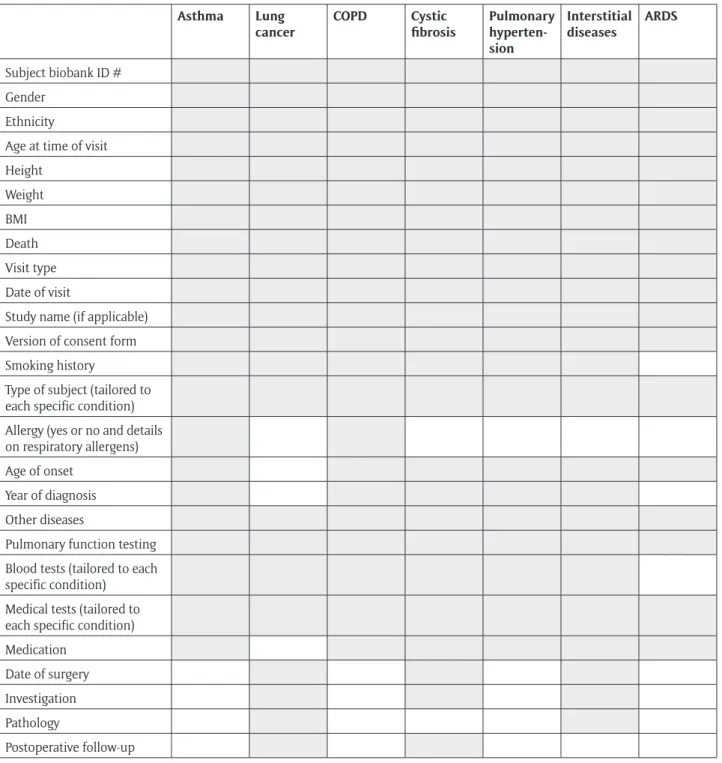
Clinical characteristics relevant to each medical condition are collected. Table 3 shows an overview of clinical data available.
Size of the bioresource
Table 4 indicates the number of subjects and samples by
respiratory condition.
Vital state of patients/source
Post-surgery and long-term outcome including vital status and relapse are available for the lung cancer collection. Vital status is also available for pulmonary arterial hyper-tension and interstitial lung diseases. Some postmortem samples are also available.
Clinical diagnosis of patients/source
Pediatric and adult asthma, lung cancer, COPD, cystic fibrosis, lung transplant, sleep apnea, pul-monary arterial hypertension, interstitial lung dis-eases, and ARDS.
Table 3: Clinical data collected by respiratory condition.
Asthma Lung
cancer COPD Cystic fibrosis Pulmonary hyperten-sion Interstitial diseases ARDS Subject biobank ID # Gender Ethnicity
Age at time of visit Height Weight BMI Death Visit type Date of visit
Study name (if applicable) Version of consent form Smoking history
Type of subject (tailored to each specific condition) Allergy (yes or no and details on respiratory allergens) Age of onset
Year of diagnosis Other diseases
Pulmonary function testing Blood tests (tailored to each specific condition)
Medical tests (tailored to each specific condition) Medication
Date of surgery Investigation Pathology
Postoperative follow-up
Pathology diagnosis
The full pathology report is available for the lung can-cer collection as well as for some patients with intersti-tial lung diseases. Pathological report is also available for specimens collected during autopsies for patients with interstitial lung diseases and pulmonary arterial hyperten-sion. For the lung cancer collection, pathologic classifica-tion and staging is updated according to the classificaclassifica-tion of lung tumors from the World Health Organization and the lung cancer staging project from the International Association for the Study of Lung Cancer (IASLC).
Control samples
Control samples are not systematically collected as part of the biobank. However, some control samples are avail-able for the majority of respiratory conditions. For exam-ples, nasal polyps from participants with or without cystic fibrosis are collected and bronchial biopsies from patients with or without asthma. Moreover, some research pro-tocols require the collection of control samples, e.g. the Quebec City Case-Control Asthma Cohort [6, 7]. Trachea, bronchi, and parenchyma samples from lung donor are also collected during lung transplantation. Non-tumor lung samples from lung cancer resection are available for most patients.
Biospecimen type
Whole blood, serum, plasma, buffy coat, DNA, RNA, non-tumor lung parenchyma, lung non-tumor, bronchial biopsies, muscle biopsies, sputum, nasal polyp, nasal mucosa, bronchoalveolar lavage, uvula, bronchus, bronchioles, mucus, trachea, and lung primary cell cultures (Table 2).
Release date
N/A
Access criteria
Samples are available to academic, biotechnology, and phar-maceutical researchers following requests that are approved by the scientific and ethics committees. The following steps are recommended for samples and data request.
1) Requestors can send an email to the biobank con-tact to check for tissue and data availability. It is important to specify the type of respiratory disease (asthma, cystic fibrosis, etc.), biological specimens (serum, lung tumor, etc.) and sample size needed. 2) The biobank staff will evaluate tissue availability
and feasibility of the project, and may propose alter-natives as needed. Collaboration with local research-ers may also be proposed.
3) The biobank will provide an estimate of costs associ-ated with the samples and clinical data.
4) Requestor must then provide a research protocol and documentation confirming ethics approval from his/her own institution.
5) The research protocol must also receive approval from the scientific and ethics committees that over-see the specific biobank site.
6) The biobank will then provide a quote and the biological material transfer (MTA) agreement. 7) Once the MTA is signed by both parties, the
biologi-cal materials and data will be sent to the requestor.
(4) Reuse potential
Biological specimens and corresponding clinical data may be reused according to the access criteria described above. Approval of submitted projects depends on samples and data availability. Samples and clinical data from a single donor can be used for different projects. For example, if DNA is extracted from samples, residual samples are kept for new projects that will go through the same access criteria. Data/results generated by researchers using the samples do not need to be returned at the Quebec RHN Biobank. However, researchers must return any material that will not be used for the accepted project and are not allow to use residual samples for other purposes. For some collections, research collaboration agreement needs to be established between the requestor(s) and investigator(s) in charge. Partnerships with academic and commercial entities to co-develop companion diagnostics, biomarkers or others are welcome.
Acknowledgements
We are thankful to individuals that generously donate their biological specimens to the Quebec RHN Biobank of the Fonds de la recherche du Québec – Santé (FRQS). The authors would like to recognize the contribution of devoted research and clinical staff, nurses, respirologists, pathologists and surgeons at the different institutions for recruiting patients and collecting data. We are also grate-ful to the dedicated research staff at the Quebec RHN Biobank for storing of biological materials and continu-ously updating the clinical database. Throughout the years, the Quebec RHN Biobank has benefit from the expertise of individuals at the different biobank sites. In particular, we want to recognize the contribution of Drs. Pasquale Ferraro, Martin Desrosiers, Christian Couture, Massimo Conti, Paula Ugalde, Ron Olivenstein, Qutayba Hamid and Ms. Cathy Fugère. Finally, we thank the research offices of participating institutions, the Fondation de l’Institut
universitaire de cardiologie et de pneumologie de Québec,
Table 4: The number of subjects and samples by medical
condition. # subjects # samples Asthma 2540 17701 Lung cancer 3712 29165 COPD 510 6715 Cystic fibrosis 335 409 Lung transplant 34 26 Sleep apnea 50 255
Pulmonary arterial hypertension 483 2237
Interstitial lung diseases 244 545
the Thoracic Surgery Research Foundation of Montreal, and Cystic Fibrosis Canada for supporting the biobank infrastructure.
Competing Interests
The authors have no competing interests to declare.
Author Roles
Sabrina Biardel Coordinator of the Quebec RHN Biobank.
Christine Racine Biobank manager at the IUCPQ. Yvan Fortier Database manager and Éric
Rousseau is responsible for the database at the Laboratoire de
Télématique Biomédicale (LTB)
– CHUS.
Andrea Karen Mogas Biobank manager at RI-MUHC/Meakins-Christie Laboratories.
Émilie Maillé Biobank manager at the CRCHUM.
Emmanuelle Brochiero Researcher in charge at the CRCHUM.
Anne-Marie Lauzon Researcher in charge at the RI-MUHC/Meakins-Christie Laboratories.
François Maltais and Researchers in charge at the Philippe Joubert IUCPQ.
Sze Man Tse Researcher in charge at the CHU Sainte-Justine.
Catherine Laprise Researcher in charge at UQAC. Élyse Bissonnette Director of the Quebec RHN
and oversees the activities of the biobank.
Michel Laviolette Founder and past Director of the Quebec RHN Biobank. Yohan Bossé Previous Director of the Quebec
RHN Biobank and largely con-tributed to this manuscript. Simon Rousseau Director of the Quebec RHN
Biobank.
References
1. Bossé, Y, Postma, DS, Sin, DD, Lamontagne, M, Couture, C, Gaudreault, N, et al. 2012. Molecular
signature of smoking in human lung tissues. Cancer Res, 72(15): 3753–63. DOI: https://doi.org/10.1158/0008-5472.CAN-12-1160
2. Hao, K, Bossé, Y, Nickle, DC, Pare, PD, Postma, DS, Lavio-lette, M, et al. 2012. Lung eQTLs to Help Reveal the
Molecu-lar Underpinnings of Asthma. PLoS Genet, 8(11): e1003029. DOI: https://doi.org/10.1371/journal.pgen.1003029 3. Morin, C, Sirois, M, Echave, V, Albadine, R and
Rousseau, E. 2010. 17, 18-epoxyeicosatetraenoic acid
targets PPARgamma and p38 mitogen-activated pro-tein kinase to mediate its anti-inflammatory effects in the lung: Role of soluble epoxide hydrolase. Am J
Respir Cell Mol Biol, 43(5): 564–75. DOI: https://doi.
org/10.1165/rcmb.2009-0155OC
4. Ruffin, M, Bilodeau, C, Maille, E, LaFayette, SL, McKay, GA, Trinh, NT, et al. 2016. Quorum- sensing
inhibition abrogates the deleterious impact of Pseudomonas aeruginosa on airway epithelial repair.
FASEB journal: Official publication of the Federation of American Societies for Experimental Biology, 30(9):
3011–25. DOI: https://doi.org/10.1096/fj.201500166R 5. Trinh, NT, Bilodeau, C, Maille, E, Ruffin,
M, Quintal, MC, Desrosiers, MY, et al. 2015.
Deleterious impact of Pseudomonas aeruginosa on cystic fibrosis transmembrane conductance regula-tor function and rescue in airway epithelial cells.
Eur Respir J, 45(6): 1590–602. DOI: https://doi.
org/10.1183/09031936.00076214
6. Lavoie-Charland, E, Berube, JC, Boulet, LP and Bossé, Y. 2016. Asthma susceptibility variants are more
strongly associated with clinically similar subgroups. J
Asthma, 53(9): 907–13. DOI: https://doi.org/10.3109/
02770903.2016.1165699
7. Lavoie-Charland, E, Bérubé, JC, Laviolette, M, Boulet, LP and Bossé, Y. 2013. Multivariate asthma phenotypes
in adults: The Quebec City Case- Control Asthma Cohort.
Open Journal of Respiratory Diseases, 3: 133–42. DOI:
htt-ps://doi.org/10.4236/ojrd.2013.34021
How to cite this article: Biardel, S, Racine, C, Fortier, Y, Mogas, AK, Maillé, É, Brochiero, E, Maltais, F, Lauzon, A-M, Tse, SM,
Laprise, C, Joubert, P, Rousseau, É, Bissonnette, É, Laviolette, M, Bossé, Y and Rousseau, S. 2018. The Quebec Respiratory Health Network Biobank. Open Journal of Bioresources 5: 13. DOI: https://doi.org/10.5334/ojb.39
Published: 31 December 2018
Copyright: © 2018 The Author(s). This is an open-access article distributed under the terms of the Creative Commons
Attribution 4.0 International License (CC-BY 4.0), which permits unrestricted use, distribution, and reproduction in any medium, provided the original author and source are credited. See http://creativecommons.org/licenses/by/4.0/.